




Abstract
Despite the growing evidence that the modern world is more diverse and so is the nature of relationships that present in therapy, there remains paucity of empirical evidence on how cultural differences impact those in intercultural romantic ties. We conducted this comprehensive scoping review with the aim to outline the size and scope of existing research in the field of intercultural love and romantic relationships. We utilised a five-stage scoping review protocol provided by the Joanna Briggs Institute (JBI) manual for synthesis of evidence for a scoping review to ensure the rigour, transparency, and replicability of our findings. We reviewed peer-reviewed articles across nine electronic databases as well as “snowballing” the literature from the reference lists. A total of 46 studies were included in this review. We found that the majority of studies approached intercultural relationships from the deficit perspective, focusing on the domains of cultural difference that bring challenges to the relationship. These included culture-rooted differences in parenting standards and gender role expectations, among others. Often, cultural differences were found to bring power impedance into the relationship. Open communication and flexibility were found as important coping strategies. Differences in native language posed challenges to emotional communication between partners. These findings demonstrate that intercultural relationships face an additional layer of challenges and complexities that have to be recognised in therapy. We propose four domains of transmodality relational competencies on the basis of our findings to inform culturally sensitive therapeutic practice.
Keywords
Introduction
Research searching for culturally universal components of romantic love suggests that across many countries around the world romantic love consists of intimacy, passion and commitment between partners (Sorokowski et al., 2021; Steinberg, 1986, 2019). However, despite the seeming universality of these basic components of romantic love, the way these are expressed and experienced likely differs between different cultures (Sorokowski et al., 2021). In addition, the number of intercultural romantic relationships is rising in the Western part of the world. For example, according to the 2018 U.K. census data, 4.2% of all couples in the U.K. were in a relationship with a representative of another ethnicity (Office for National Statistics, 2020). Figures for the USA and Australia also indicate growing numbers of intercultural marriages (Australian Bureau of Statistics, 2000; Murphy, 2015). Despite the evidence that the modern world is more diverse and so is the nature of relationships that present in therapy, there remains paucity of empirical evidence on how cultural differences impact those in intercultural romantic ties. This comprehensive scoping review aims to outline the nature and extend of research efforts in the field of intercultural love and romantic relationships available to date. A sample of papers that focus on exploring the role of culture in functioning of intercultural romantic relationships is analysed in relation to our research questions. We begin by defining our search strategy and the scoping review protocol, and we follow this by presenting a summary and conceptualisation of our findings. We end this review with our view on what is important to consider in guiding future empirical work on the topic of intercultural love and romantic relationships.
The need for a comprehensive scoping review
We performed an iterative search of the corpus of research literature using the EBSCOhost search engine to identify any existing reviews published on the topic of intercultural romantic love between the years 1995 and 2022. This produced the output of only three existing review studies. Two of these are the literature reviews that aimed at exploring issues relevant to intercultural couples in general (Sullivan & Cottone, 2006; Uhlich et al., 2022) and another one focused specifically on intercultural parenting (Crippen & Brew, 2007). Sullivan and Cottone (2006) provided a useful discussion of how defining intercultural relationships through the lens of race can limit our understanding of the role of culture in the couple relationship. The authors argue that focus on ‘race’ leads to overlooking of other important cultural elements, such as cultural differences in emotional expression and language. Without specifying what search strategy was used to identify the studies that were included in this review, the authors provided a summary of specific cultural characteristics, such as religious practices and gender role expectations, that have been found to affect couple relationships by introducing the grounds for cultural differences. Crippen and Brew (2007) provided the reader with an extensive exploration of cultural differences in the domain of parenting practices. Similar to Sullivan and Cottone (2006), the authors do not outline the details of the search strategy chosen to select the literature but conclude that arrival of children into the intercultural family poses both challenges and opportunities for growth. Here, the authors specify that it is common for partners to overcome the difference in their cultural values and beliefs by creating a new set of shared cultural practices as they are adapting to the new stage of the family life cycle. The third and more recent review of literature by Uhlich et al. (2022) is a meta-analysis of literature on relationship satisfaction of couples where partners come from diverse sociocultural backgrounds. The authors tested the hypothesis that intercultural couples have lower relationship satisfaction than culturally homogeneous counterparts (Uhlich et al., 2022). While providing a useful insight into the fact that intercultural couples do not appear to be less satisfied in their relationships, the study does not explore in what way cultural differences shape relational experiences.
It is evident that previously, authors did not always use a formal literature search strategy in summarising the findings on the role of culture in the lived experiences of intercultural romantic love. To provide a comprehensive and rigorous examination of what is known about the role of culture in intercultural relationships, we will review a representative sample of literature that has been generated since the publication of the seminal chapter by Falicov (1995) on the aspects of culture that might impact marital relationships. Falicov’s, 1995 chapter was one of the earliest contributions in line with our research topic because it has linked multiculturalism and diversity of families in a way that aligns with our research. Furthermore, we deemed that research over 28 years to be a long enough span for this scoping review because this gives us more than 2.5 decades of research in this context. This chapter being one of the earliest contributions in line with our research topic made it a useful benchmark and justified for us both in the literature review planning process 1995 as our cut off and a starting point for our search.
A critique of the concepts of “culture” and “intercultural relationship”
We begin this review by offering a critique of the concepts of “culture” and “intercultural romantic relationship” because there appears to be lack of agreement on what is the best way to define “culture” with some describing it as a “magic word – positive in connotations but hard to pinpoint” (Valsiner, 2009, p. 6). Indeed, there are more than 160 definitions of the word ‘culture’ available in the literature (Lago, 2006). The majority of definitions perceive culture as rooted in various artefacts, such as words, rituals, and material objects, that allow humanity to preserve and transmit beliefs, norms, and conventions between members of the social group and across generations of people (Cole & Parker, 2019). Here, we will perceive culture through the lens of this definition.
Following the view of many contemporaries (Bustamante et al., 2011; Fonseca et al., 2020, 2021; Holzapfel et al., 2018), we define an intercultural romantic relationship as a romantic union between two people who self-identify as belonging to different national, racial, ethnic, language, and/or religious backgrounds. It may seem that the social and cultural characteristics of one’s ethnicity, language and religious beliefs are most intuitive in defining one’s cultural background. However, this understanding of what constitutes cultural difference has not always dominated the field. Historically, there was an almost unanimous recognition of equivalence between “intercultural” and “interracial” (Sullivan & Cottone, 2006). This reduced the concept of culture exclusively to the aspects of physical appearance and reflected common at the time belief that different races represent distinct subgroups of human population (Hirschman, 2004). We emphasise how equivalence of culture and race demonstrated the oppressive and discriminatory attitudes that intercultural couples experienced due to belonging to different racial categories (Mcfadden & Moore, 2001). Later advances in scientific thought did not substantiate the importance previously given to racial differences due to failing to prove systematic genetic differences between subgroups of people (Ballard, 2002). This contributed to the advocacy for the concept of race to be used to accentuate the commonalities rather than differences that exist across the human population, as in the term “human race” (Ballard, 2002).
The evolution in understanding of what race is has led to the now widely accepted belief that viewing intercultural relationships exclusively through the lens of racial categories or phenotypic differences is limiting our understanding of which elements of culture shape human behaviour and relationships (Fonseca et al., 2020; Sullivan & Cottone, 2006). Having offered the critique of the concept of race, it is important that we however acknowledge the multiple social categories, such as nationality, ethnicity, and, crucially, race that constitute one’s cultural background, and also acknowledge that every single individual can belong to multiple cultures and subcultures at the same time. This means that cultural difference can represent the difference on the grounds of nationality, race, ethnicity, language, or religion, as well as on the basis of political views, social class, and belonging to a particular generation (Falicov, 1995).
Aims and objectives of this comprehensive scoping review
The purpose of this comprehensive scoping review is to explore the nature and breadth of research on the topic of culture and its role in intercultural romantic relationships. Our aim is to provide a snapshot of existing types and nature of evidence as well as what remains unknown and thus warrants further exploration. We follow the guidance proposed by Munn et al. (2018) and aim to: • Identify the types of available evidence • Clarify key concepts and definitions • Use this comprehensive scoping review as a precursor to a systematic review • Identify and analyse what remains unknown
Method
In conducting this scoping review, we ensured the rigour, transparency, and replicability that would be expected of the study of this calibre. As a guide to ensuring quality, we used the Preferred Reporting Items for Systematic Reviews and Meta-Analyses extension for Scoping Reviews (PRISMA-ScR) framework (Tricco et al., 2016). This guided us through the markers of quality of the literature we have selected for a review as well as the standards for reporting our findings, limitations, and implications for clinical practice. Our goal was to explore the size and scope of research literature on intercultural romantic relationships which is in line with the aims of a scoping review (Grant & Booth, 2009; Munn et al., 2018). Despite the fact that there is no requirement for a formal assessment of quality of the literature that constitutes a scoping review (Grant & Booth, 2009), we performed an informal assessment of quality using the checklists developed by the Critical Appraisal Skills Programme (CASP) (2022). Finally, the methodological framework was applied to this scoping review (Peters et al., 2021; Taylor & Pagliari, 2018). This framework is discussed in detail in the section below.
Structure of the methodology
In establishing the methodological framework for this scoping review, we used guidance provided by Peters et al. (2021) as part of the Joanna Briggs Institute (JBI) manual for synthesis of evidence for a scoping review. This framework is commonly applied by the researchers conducting scoping reviews in health, psychological and sociological research (Levac et al., 2010; Taylor & Pagliari, 2018). Notably, this framework is consistent with the reporting standard proposed by the PRISMA-ScR framework (Tricco et al., 2016). Broadly, the framework can be reduced to a five-stage scoping review protocol (Levac et al., 2010; Peters et al., 2021; Taylor & Pagliari, 2018): 1. Identifying the research question 2. Identifying the relevant literature 3. Selecting the studies 4. Charting the data 5. Collating, summarizing, and reporting the results
Stage I: Identifying the research question
Broadly, the research question that was addressed in this comprehensive scoping review is:
What is known in existing research about the role of culture in functioning of intercultural romantic relationships?
In addition to this overarching question, we created the following list of sub questions to address certain specific areas of interest which is in line with (Taylor & Pagliari, 2018) guidance for scoping reviews: • What is the total number of studies published by year? • What terms are used to describe the nature of this research? • What academic communities are most active in this field? • Where are study authors located, according to the first author’s affiliation? • What cultures are being included in this research? • What topics are being addressed in this research? • What methods are being used to address research questions?
Stage II: Identifying the relevant literature
As part of this comprehensive scoping review, we captured a wide range of literature from the electronic databases and reference lists to ensure the breadth of our findings (Taylor & Pagliari, 2018). As such, our studies come from the following sources. First, we searched for the peer-reviewed academic journal articles using the following electronic databases available through EBSCOhost covering social sciences and multi-cultural journals: APA PSYCHINFO, APA Psych Articles, CINAHL, MEDLINE, SOCINDEX, MLA International Bibliography, and ERIC. The databases MLA International Bibliography and ERIC with a special focus on language and education literature were included to ensure the multidisciplinary focus of the literature included in this review.
Selection criteria
The first author performed systematic search of all databases and reference lists. Based on the agreed inclusion and exclusion criteria (as noted in the section that follows), two authors independently reviewed the articles to decide which would be included in this review. Studies that have been included in this review were selected after their titles, abstracts and full texts were screened for eligibility using the inclusion and exclusion criteria outlined below.
Inclusion and exclusion criteria
Peer-reviewed journal articles that explore factors relevant to functioning of intercultural romantic relationships were included in this scoping review. We aimed to be as comprehensive as possible within the constraints of time associated with conducting this study which is why we limited our inclusion criteria only to the peer-reviewed empirical studies and theoretical papers that focused on the intercultural relationships that were described as romantic. To be included in the review, intercultural relationships must have been the primary focus of the study or a theoretical discussion where the paper was not an empirical study. After the removal of duplicates, our search terms produced the output of N = 246 entries all of which were initially screened for eligibility by reviewing titles and abstracts. These studies were published between 1995 and 2022 and their full text was available through the York St John University library collection. In our research, we were focusing on intercultural elements of romantic relationships hence our inclusion criteria did not include the word ‘race’ in the search. However, we also appreciate that the social category of race constitutes a meaningful social characteristic that can shape and influence one’s relational experiences. For example, in the reviewed body of literature, the studies by Doxey (2007), Long (2003), McFadden (2001), Rosenblatt and Stewart (2004) do not exclude the category of ‘race’ in their analysis of intercultural couples. Therefore, our selected body of literature permitted us to investigate the role of this important aspect of personal and social identity within relational functioning of intercultural and interracial romantic relationships.
It is also important to note that in reviewing the research and making decisions about inclusion and exclusion criteria, we were also aware that there is literature that focuses on cultural aspects of similarities and differences between couples across different cultural contexts. This work offers insight into cultural differences in couple communication with positive communication being related to higher levels of relationship satisfaction in individualistic but not collectivistic cultures (Williamson et al., 2012). This line of research also shows cultural differences in relationship standards with US couples valuing more boundaries and couples of Chinese heritage showing more tolerance towards exercise of power and control within the relationship (Epstein et al., 2005). While offering valuable insight into cultural differences between couples in different countries and contexts, for this review we selected only the literature that specifically focuses on intercultural couples.
Search parameters
First, in light of diversity in terminology used to refer to intercultural romantic relationships (Campbell et al., 1996; Sullivan & Cottone, 2006) a formative analysis was undertaken to understand which search terms are likely to yield literature that is most relevant to our search questions. We followed the requirements of the Manual for Scoping Reviews (Joanna Briggs Institute (JBI; Peters et al., 2020); and the consultation of the senior librarian and first ran separate searches for two generic terms (“intercultural marriage” and “intercultural couples”) that seemed to consistently produce a lot of hits in two online databases: APA PSYCHINFO and SocINDEX. We ran separate searches for each of these terms in each database and constructed this search as phrases rather than separate words because an initial search that included separate words produced articles most of which were unrelated to the topic of interest. Searches with the term “intercultural marriage” produced 26 and 13 hits and “intercultural couples” yielded 102 and 43 hits in the APA PSYCHINFO and SocINDEX respectively. The words contained in the titles, abstracts and index terms of the articles that were identified across the two databases using these search terms were then used to generate the full search strategy that contained the following words: “intercultural marriag*”, “intercultural relationship*”, “intercultural couple*”, “cross-cultural couple*”, “transcultural famil*”, “multicultural couple*”.
Stage III: Selecting the studies
All articles that were deemed appropriate to be included in this scoping review had the primary aim of exploring factors related to functioning of intercultural relationships. In addition, all studies included in this scoping review were subjected to a formal quality assessment. While there is no requirement to undertake a formal assessment of the quality of studies included in the scoping review (Grant & Booth, 2009), we assessed all papers using the guidelines provided by the Critical Appraisal Skills Programme (2022) to ensure rigour in the selection process. Following the full-text review and all the relevant quality checks, the overall number of studies that were chosen to be included in this scoping review was N = 39 with additional N = 10 studies identified through the reference list search.
Stage IV: Charting the data
The aim at this stage is to produce a descriptive summary of the results, identify gaps in knowledge and gather data for subsequent analyses. We charted the data in the Excel spreadsheet that included the following columns: • Number of articles according to the year of publication • Research aims and questions • Nature, including methodology, authors’ and participants’ cultural backgrounds, if applicable
Additional columns also included article titles, author/s, database and journal title (volume, issue number, pages, DOI), keywords, methodology, and abstract.
Stage V: Collating, summarizing, and reporting the results
Abstracts and titles of each article were screened for eligibility by the first author, and those articles that met the inclusion and exclusion criteria were included for the full text review. The results were summarized using a qualitative descriptive approach, which involves grouping concepts of interest based on similarity. The process of selection of articles and summarizing the key concepts of interest was checked for accuracy by the second author to avoid subjective interpretation. Descriptive summary that reflects our findings in relation to each research question was generated using the pivot table in the excel spreadsheet.
Results
Study selection and extraction of data
An executive summary of the overall body of literature identified on the basis of the chosen search criteria was generated in the excel spreadsheet. A total number of N = 438 peer-reviewed articles were identified via the database search. Of these N = 246 were screened and N = 46 were included in this review based on their focus on the psychological and socioeconomic factors relevant to relational functioning of intercultural romantic relationships (see Figure 1). We achieved 100% interrater reliability agreement in relation to the procedures involved in data extraction.
Descriptive summary of the research on the role of culture in intercultural romantic relationships
We performed the frequency analysis to answer the research questions that we outlined in Stage 1 of this scoping review.
Amount of research on culture in intercultural romantic relationships
The number of articles exploring the role of culture in intercultural romantic relationships has been varied peaking at N = 6 articles published in 2018 and 2021 (please see Figure 2). This notable variability and small numbers of research literature indicate the need for more research efforts in the field.
Focus of research on the role of culture in intercultural romantic relationships
To summarise the key themes across all included research literature, Reflexive Thematic Analysis was used (Braun & Clarke, 2022). Thematic analysis is a method that allows analysis of patterns of meaning across the dataset and its reflexive iteration puts at the centre the subjectivity of the researcher and their reflexive influence on the findings (Braun & Clarke, 2022). See Table 3 for the summary of themes identified across all papers. First, codes were generated to reflect the singular meanings in each paper and codes with shared meaning were collated into themes to reflect meanings across all literature included in this review. A vast majority of studies included in this scoping review approached intercultural romantic relationships from the deficit perspective and focused on the exploration of domains of cultural differences that can bring challenges to relational functioning. These include cultural differences in parenting standards, preferences to spend leisure time, and gender role expectations. Several studies had specific focus on the role of language differences in communication and relationship dynamics. Cultural preferences for the high- and low-context communication styles, emotional expression in a different language, and impact of language fluency on forming relationships with extended family became a common focus of discussion. Another key domain of cultural differences was in relation to parenting and several studies chose this as a sole focus of the investigation. Further, studies explored the power dynamics and formation of intercultural couple identity. It was common to discuss cultural differences in light of oppression and racism directed towards the minority partner. The role of acceptance of the relationship by the wider society and its impact on partners’ ability to integrate their own cultural identity and a couple identity were also addressed (Hoogenraad, 2021; Williams & Yu, 2006). We note here that qualitative methodology was used in the overarching majority of the studies reviewed in this paper. Specifically, of the articles included, 7 used Thematic Analysis, 3 used Grounded Theory, 1 used mixed methods, 1 used Qualitative Content Analysis, 11 used quantitative methodologies, 7 were literature reviews, 3 used interpretative phenomenology, 2 used discourse analysis, 2 used narrative analysis, 2 were case studies, 1 used qualitative description methodology, 3 used relational dialectic approach, and 1 used ethnographic interviewing. It is notable that 2 studies used an undefined qualitative methodology.
Furthermore, the participants’ national and ethnic backgrounds spread across United States, South America, Western and Eastern Europe, Russia, Africa, Asia, Australia and some indigenous populations, such as Native Hawaiian and Native American. In addition to considering the cultural background of research participants, it is also important to note the wider sociocultural context within which the research was conducted. Western cultural context has been described previously as culturally hyperdiverse which can increase acceptance of cultural minorities and therefore positively influence relational experiences of intercultural partners (Halford et al., 2018). It is possible that experiences of cultural diversity might differ when partners reside in countries with lower rates of immigration and less accepting attitudes towards these types of relationships. The cultural context of the studies included in this review varied between predominantly Western (e.g., USA, UK and Australia) and some non-Western cultures (e.g., Turkey and Israel). Therefore, the findings of this review for the most part reflect relational experiences of intercultural romantic partners who reside in the Western cultural context.
Discussion
The key finding of this scoping review is that partners in intercultural relationships are facing unique difficulties, challenges, and complexities that they must navigate in their private lives. We begin the discussion of our findings by conceptualising the key themes that were derived from the literature included in this scoping review, followed by our view of how these themes manifest in the relational competencies required for therapy with intercultural romantic relationships. We finish by proposing our recommendations for researchers who conduct research on the topic of intercultural love and romantic relationships Our review resulted in the conceptualisation of themes summarised in Table 1.
Key themes in intercultural relationship research
Culture-related stressors and their impact on relational functioning
The first theme that we have identified as part of this review is the difficulty of raising children in families where parents who do not share the same cultural background. It is often emphasised that the birth of children can catalyse conflict and raise doubts in the cultural compromises that had been put in place by the parents (Crippen & Brew, 2007). Parents can differ in their views on the amount of discipline that is needed when raising a child (Bustamante et al., 2011), what languages to teach their children (Tien et al., 2017), how much autonomy to allow children as they are growing up (Cools, 2006; Crippen & Brew, 2007), whether to allow children to sleep in the same bed as parents, while also clashing in attitudes towards breastfeeding, wearing nappies and receiving education (Bhugun, 2017).
Another theme that is repeatedly discussed and considered a source of conflict is the domain of gender role expectations and power imbalances in intercultural relationships. Hsu (2001, p. 233) pointed out that cultural understanding of gender roles a is “a classic source of problems for intercultural couples”. Singh et al. (2020) conclude that this can result in either the male or the female partner being perceived as domineering in the couple relationship. This might mean that partners might need to not only adjust their personal styles, but also establish mutually agreed rules concerning gender role divisions without having any common ground at all which can create considerable stress in the relationship (Cools, 2006; Hsu, 2001; Tien et al., 2017). The challenge of negotiating gender roles can become even more complicated when the minority partner is dependent on the partner who is either local to the host country or is more familiar with the local cultural repertoire to successfully navigate in the novel environment. This was demonstrated by Hoogenraad (2021) study of men who migrated to Australia from the African continent. Men’s reliance on their partners for what would have been typically expected of them in their own culture, for example, earning the living and paying the bills, had a negative impact on their perceived identity as a male figure in the family, making them feel powerless in their dependency on the partner. This complex interplay between gender and culture can contribute to the shift in power within the relationship to the representative of the majority culture or to the member of the couple who is more familiar with the particularities of the local culture (Hsu, 2001). With one partner holding more power, another can feel increasingly insecure, anxious and incompetent (Rosenblatt, 2009). Imbalance of power due to belonging to different racial categories can also lead to what Yampolsky et al. (2021) called experiences of intimate racism when the minority partner (the person in the coupling or relationship whose identity aligns with minority groups in the society within which the couple or polyamorous group live in) is subjected to racist comments in the relationship.
Partners’ religious beliefs appear to represent another common domain of disagreement between romantic partners. Often, similar faith is regarded as a major factor that allows individuals to be together despite other cultural differences and partners choose to date someone with the same religious views (Tien et al., 2017). Focusing on theological and religious differences in the relationship can lead to conflicts and poorer family wellbeing while further accentuating perceived distance between partners in the relationship (Joanides et al., 2002). At times, the pressure to accept religious views of the partner can come from the wider social context with can complicate baptism of children and subsequent negotiation of children’s religious development (Joanides et al., 2002).
Cultural differences in the experience and expression of emotions
The way emotions are experienced and expressed across cultures differs and can have a noticeable impact on relational functioning. To illustrate this point, de Munck et al. (2011) found considerable cross-cultural variation in the experience of romantic love. Participants from the United States, Russia, and Lithuania agreed that transcendence, intrusive thoughts, passion, and altruism are at the core of romantic love but only the US participants included friendship in their definition of love. American participants also differed in their expression of love by valuing a verbal expression of feelings while Filipinos and Chinese preferred to show their love through actions rather than words (Karandashev, 2015).
Widely acknowledged cultural variability in the expression and definition of romantic love serves as a vivid demonstration of the fact that emotions themselves are culturally specific. Based on this finding, Fonseca et al. (2020) argued that similarity in emotional processes is at the core of successful intercultural romantic relationships. Empirical evidence appears to confirm this claim because greater similarity in the way partners define and express romantic love and approach conflict is found to be associated with higher relationship quality in intercultural romantic relationships (Fonseca et al., 2021) Partners who are more similar in the way they experience and show their emotions also perceive each other as more responsive towards their emotional needs (Fonseca et al., 2021). It is important to note that findings like this demonstrate what active ingredients of culture (vs. the social constructions of race or ethnicity) contribute to relational functioning in romantic relationships (Fonseca et al., 2020). Despite the strengths of this approach in understanding cultural difference and what it means in a romantic relationship, correlation does not imply causation and we cannot be certain whether partners must show similarity in emotional processes to be successful in their relationships or if more successful partners become more similar over time.
Familial and societal attitudes towards intercultural romantic relationships
In addition to the cultural differences in attitudes, values and beliefs, intercultural couples often experience othering on behalf of the wider society and extended family. Issues that are commonly experienced range from unhelpful remarks from family members who question the partners’ ability to learn a foreign language to anger and blame towards the couple (Dervin, 2013; Molina et al., 2004). The impact of these attitudes can be as significant as causing the relationship to end (Rosenblatt, 2009). When the matter concerns intercultural same-sex relationships, families are found to blame the foreign partner for influencing the sexual orientation of their children (Long, 2003). Partners can also be blamed for their lack of loyalty to the family and ethnic group which may have led to the tension of being pulled between one’s partner and family or community (Long, 2003). Often, intercultural partners’ experiences of being marginalised vary as a function of their cultural background, with black-white couples suffering from hostility more than Chinese-Euro American couples (Rosenblatt & Stewart, 2004). Individuals who find their intercultural relationship being marginalised by the community can struggle to integrate their own cultural identity with the couple identity. Inability to connect these core parts of one’s self can create a situation in which one must choose between the different identities they hold within themselves to demonstrate loyalty to the relationship or the social group at the detriment of relationship quality (Yampolsky et al., 2021).
Conveying love to a partner in a different language
Difference in cultural backgrounds often brings difference in native languages spoken by the members of an intercultural union. Along with enriching the relationship, this can pose substantial challenge for partners to navigate (Singh et al., 2020). Lacking proficiency in partner’s native language can complicate on the overall communicative process by limiting communication with extended family, compromising understanding of the customs and traditions of each other’s cultures placing one member of the relationship at a power disadvantage (Cools, 2006; Sala & Ersoy Çelik, 2021). Proficiency in the majority language often means more effective integration into the country and local community while lacking ability to effectively communicate with others outside the relationship can lead to homesickness and increase dependency on the partner who is native or more proficient in that language (Cools, 2006). This dependency can be a risk factor for domestic violence (Williams & Yu, 2006). Frustration and misunderstandings that emerge from being unable to effectively use lingua franca (shared language) to communicate in the relationship can lead to arguments and reduced relationship satisfaction (Rosenblatt & Stewart, 2004; Sharaievska et al., 2013). Struggling to find the right words to express emotions can make communication slower and less efficient while words of love expressed in a foreign language are often perceived as superficial and lacking depth of meaning (Dewaele & Salomidou, 2017). However, despite an array of the negative consequences and limitations, using a foreign language in communicating with one’s partner can become a liberating experience due lacking emotional attunement and ease this brings to talking about the feelings and topics that might be more difficult to speak about in the native language (Dewaele & Salomidou, 2017; Singh et al., 2020).
Emotional expression in a foreign language can be further complicated by the cultural differences in communication styles (Singh et al., 2020). For example, Remennick (2013) found that Russian-Hebrew partners experience difficulties in expressing and discussing emotions due to cultural differences in normative emotion talk and how much emotion to share in the relationship. Here, cultural differences were found due to Russian culture being characterised by a more reserved stance towards communicating emotions while Israeli culture welcoming open expression of a full spectrum of emotions which created mismatch between partners in relation to the ways in which they relayed their emotions to one another. Thus, what we understand as cultural communication styles refers to widely conceptualised cultural ways of relaying feelings, emotions, and relational needs within relationships. Having said this, we also acknowledge the critique that even though people might be from the same culture, there is no homogeneous way of being.
How do partners cope with challenges brought by the cultural stressors
When exploring the different ways in which partners cope with the cultural differences, there are multiple perspectives noted in the literature which include formal and informal approaches as well as frameworks to overcome the challenges brought by cultural difference in the relationship. Among the first category of authors are Crippen and Brew (2007) and Mcfadden and Moore (2001). We summarise the strategies proposed by both authors in the Table 2. The strategies summarised in Table 2 lie on the spectrum between one partners’ compromise of their cultural identity and the situation when there is some degree of mutual cultural accommodation and creation of a third culture that represents a creative mixture of the partners’ cultural backgrounds. Among other more specific examples of strategies is for example flexibility in attitudes towards gender roles and expectations (Bustamante et al., 2011). This might involve openness to overlooking culturally prescribed gender norms which allows flexibility in undertaking various household chores irrespective of the partners’ gender. Using humour in the relationship to minimise cultural differences and openness in communication are also widely mentioned (Bustamante et al., 2011; Kuramoto, 2018). These strategies allow for a direct expression of feelings which ultimately allows for a greater attunement between partners (Kuramoto, 2018). In addition, using compromises, engaging in religious activities and reliance on extended family are all mentioned by intercultural partners as being effective in offsetting distress caused by the cultural differences in their relationship (Kuramoto, 2018; Maffini et al., 2022; Ruebelt et al., 2016).
Above all, it appears to be important for intercultural partners to engage in some form of creation of a third culture that blends cultural perspectives of both partners and establishes a relational dynamic that allows everyone enough cultural expression to comfortably navigate complexities of the relationship (Bustamante et al., 2011; Crippen & Brew, 2007; Perel, 2000; Ruebelt et al., 2016; Yun, 2015). This is impossible without open communication about cultural differences which unsurprisingly shows associations with higher relationship satisfaction and less relational distress (Ruebelt et al., 2016). Killian (2012) used the concept of cultural inclusion to refer to effective communication about cultural differences between partners. Cultural inclusion allows partners to introduce important elements of each other’s culture into their relationship (Killian, 2012). Undoubtedly, cultural diversity can be seen as a strength of intercultural couples. Introducing novel cultural elements into one’s life is found to be associated with expansion of the sense of self and reduced ethnocentrism (Naeimi, 2021; Stȩpkowska, 2021; Tili & Barker, 2015). This suggests that cultural differences between partners can enrich their sense of self if approached with openness and readiness to communicate about cultural backgrounds with one another which makes cultural identification fluid and evolving as a function of changes in one’s life circumstances and intersubjective experiences. In clinical practice, the degree to which novel cultural traditions and characteristics are accepted and valued by intercultural partners can be measured using formal assessment tools (e.g., the Index of Cultural Inclusion) which opens an important avenue for exploration in therapy (Killian, 2015). Another strength of intercultural partners who welcome cultural diversity is in the effectiveness with which partners learn to communicate with one another. For example, Kuramoto (2018) found that partners from high-context cultures that are characterised by the cultural preference for indirect communication were able to successfully adapt their communication style to be able to more directly express their feelings to their intercultural partners.
Key implications for therapeutic practice
As evidenced by the key themes that have been identified within the reviewed body of literature on intercultural love and romantic relationships, intercultural partners are facing challenges that introduce an additional layer of difficulties, challenges and complexities to the relationship. These difficulties are often a combination of cultural, sociopolitical, economic and personal challenges, which are compounded by changes in the life cycle, for example arrival of children into the relationship. It is also evident that despite these challenges, relationships that navigate their relational patterns successfully, partners engage in 1. Open communication about their needs; 2. Focus on similarities that unite them in the relationship, 3. Maintain flexibility of their cultural perspectives; 4. Adopt and recognise importance of each other’s cultural traditions and values, and 5. Ultimately create a third culture that transcends cultural differences and integrates those cultural elements that are important for the relationship to prosper.
Recognition of the significance of culture and the role it plays in shaping experiences of partners in intercultural romantic relationships leads us to argue that psychotherapists/practitioner psychologists working with intercultural individuals/couples, or those in polyamorous relationships need to consider the cultural differences between partners. In addition to understanding and valuing each partner’s cultural background and heritage, it is important to explore the combined culture created by the partners in the relationship to ascertain if this culture allows for coexistence between different cultural identities or rivalry between them (Blount & Young, 2015). To be able to successfully navigate this work, therapists must possess the multicultural counselling competencies which involve therapist’s awareness of own social identity, client’s worldviews, and how these influence the therapeutic relationship (Ratts et al., 2015).
The Multicultural and Social Justice Counselling Competencies (MSJCC) is an example of a skills-based framework that allows therapists to engage in culturally sensitive practice and research (Ratts et al., 2015). The framework reflects the complexity of power, privilege and oppression dynamics in the therapeutic relationship and calls for the therapists’ awareness of their own attitudes and beliefs, clients’ worldviews and how both shape the therapeutic relationship (Ratts et al., 2015). In the section that follows, we propose a transmodality relational framework that is specifically designed to outline more competencies required to form and engage in culturally sensitive therapeutic relationships with intercultural couples and polyamorous romantic relationships. In developing this framework, we based our conceptualization on the multicultural and social justice counselling competencies framework (Ratts et al., 2015), the relational competencies framework (Paul & Charura, 2014), the humanistic psychological therapy competencies (Roth et al., 2009), and the work of Singh (2009). Being positioned and influenced by practitioner psychologist epistemologies, we are also informed by the recent Health and Care Professions Council (HCPC) Standards of Proficiency for Practitioner Psychologists (2023). The HCPC are the regulator of the health and care professions in the UK. Thus, our alignment to their revised competencies highlights the importance of acknowledging the cultural experience as a key component of the lived experience of patients and clients. Hence it is paramount to have the skills and knowledge to work with ethically and culturally diverse individuals, couples, and families. The HCPC revised review focuses for example on key competencies, namely: Recognising the impact of culture, equality and diversity on practice and practising in a non-discriminatory and inclusive manner (HCPC, 2023). We are informed by all of the above frameworks as we apply them to in our practice to the relational therapeutic work with intercultural couples. Our conceptualisation spans relational competencies across the four domains: practical, personal, professional and contextual, and how these apply to humanistic therapy with intercultural romantic relationships. This model is different from other models from three perspectives: the first is that it integrates the research evidence from intercultural relationships and research from therapists who work with intercultural relationships and conceptualises from that integration what the authors have termed relational competencies in working with intercultural relationships; the second is that this model is focused specifically on intercultural romantic relationships rather than being aimed at working with individuals in therapy; the third is that it splits the formulated competencies into ‘practical’ ‘personal’, ‘professional’ and ‘contextual’ rather than just a category of generic professional competencies and this conceptualisation is in line with other relational models that are already employed with other groups within psychotherapy practice.
The conceptualisation of proposed competencies stems from the research evidence reviewed here that demonstrates that culture is an important dimension of life and identity that meaningfully shapes and influences the psycho-social-sexual-spiritual and existential aspects of intrapsychic and relational functioning. The ‘practical’ and ‘professional’ competencies would therefore enable the clinician to incorporate this understanding into their work with intercultural relationships. The stance of authentic understanding of partners’ cultural experiences cannot be separated from the ‘personal’ competencies that involve recognition of therapist’s own values and beliefs that have been shaped by their own cultural and ethnic heritage (Singh et al., 2020). This process of reflexive self-awareness should be coupled with continuous efforts to co-construct the knowledge about the client’s worldviews through intersubjective dialog and open conversation (Singh, 2009; Williams, 2008; Yan & Wong, 2005). Whilst the ‘contextual’ competencies overlap with the ‘personal’ domain, it goes beyond personal awareness and includes reflection on how the therapist’s wider social context, such as broader sociocultural views, assumptions, prejudices, biases, as well as therapist’s own social identity and status (privileged/marginalised; minority/majority) influence their assumptions, values, beliefs, biases, ‘world view/s’, power and privilege and ultimately how this shapes the therapeutic relationships with intercultural couples.
Summary of proposed relational competencies in psychotherapy with clients in intercultural romantic relationships.
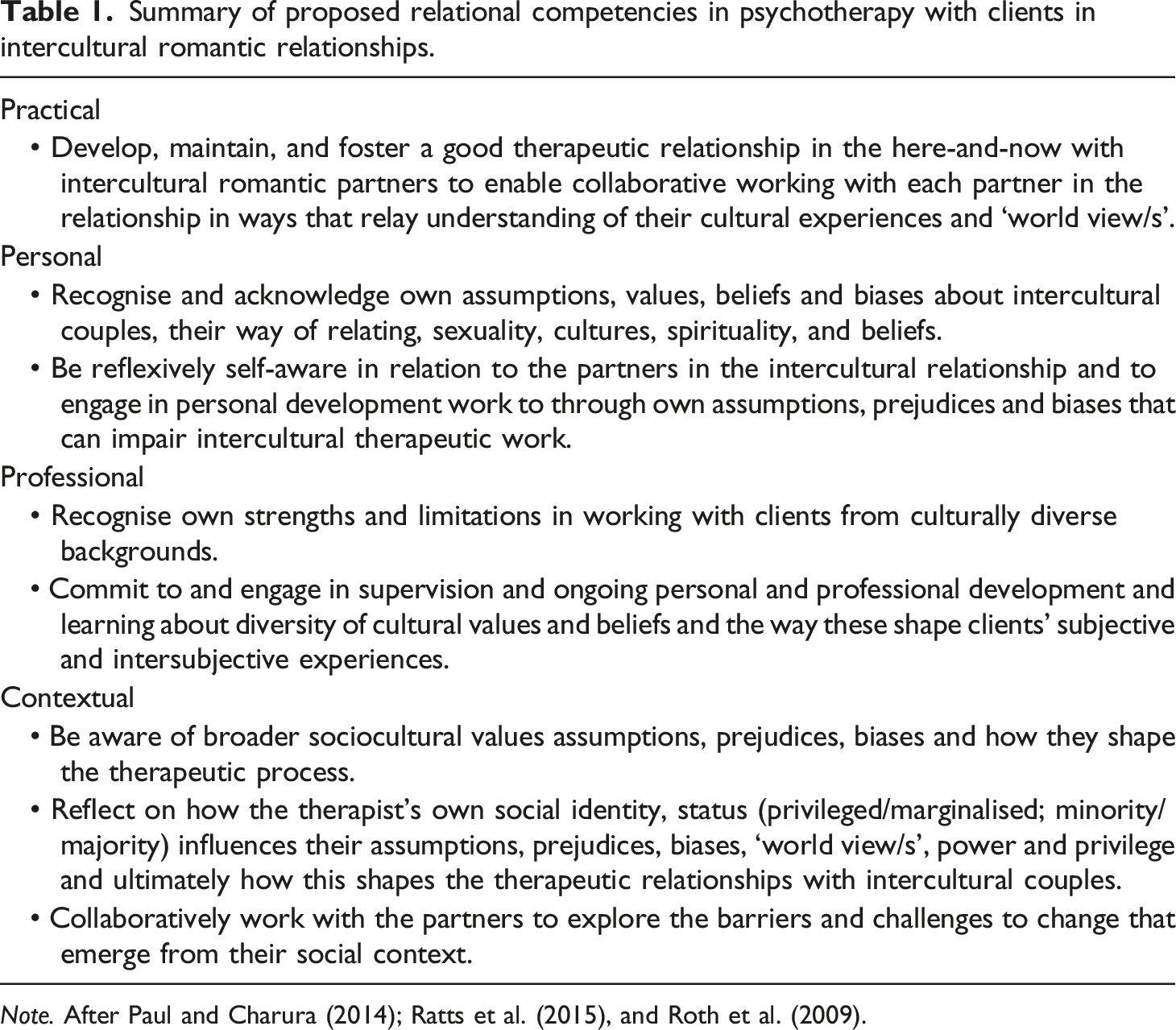
Note. After Paul and Charura (2014); Ratts et al. (2015), and Roth et al. (2009).
Limitations and recommendations for researchers
As with any literature review method, we acknowledge that this review was limited in scope because we only considered the literature available to us in English. Given that this is a topic about intercultural relationships, we want to acknowledge that there are other research evidence and literature in other languages which we will have evidently missed. As we are committed to decolonising research, we wanted to note that we value other cultures and epistemologies as equal knowledge generating partners. However, in line with the protocol of conducting a scoping review, our goal was not to exhaust all the existing research but rather through a specific criteria and search terms noted at the start of this paper we have presented themes which give the reader a sense of the types of studies and research questions that have been addressed (in English) to date.
It is also evident that existing research is limited in scope and focus. Given the important role of intimacy and sexuality in relationship satisfaction (Kellner, 2009; Yoo et al., 2014), it is surprising that no studies have addressed how cultural similarities and differences in intimacy and sexual practices shape relational dynamics of intercultural romantic partners. It is also notable that the majority of current research appears to be using phenomenology and thematic analysis as primary research methods and it might be relevant to expand the repertoire of methodologies to include culturally appropriate methodologies.
We conclude by recommending further international research into the phenomenological lived experiences of individuals intercultural romantic relationships to consider the following questions.
The questions that are conceptualised from this scoping review include: 1. What personality traits and skills serve as facilitators and barriers to engaging in a successful and fulfilling intercultural relationship? 2. How to engage in sensitive and culturally appropriate research to explore sex and sexuality experiences of those in intercultural relationships? 3. What are the best culturally appropriate methodologies for researching in the area of intercultural romantic relationships and is there a space for creative, mixed methods, Critical Race Theory, and duoethnographic methodology? 4. Given that religious and spiritual differences can be ground for religious conflict, then how can partners use spirituality to overcome these difficulties?
This comprehensive scoping review focused on intercultural love and romantic relationships as relayed in the existing literature and research. This has enabled us to identify the size and scope of what is known about the multifaceted layers, challenges, and complexities of intercultural relationships and therapeutic approaches. This paper contributes key insights about the importance of understanding the journeys, strengths, as well as perspectives of complexities and challenges of being in and navigating intercultural relational dynamics. We assert the importance of therapists having an awareness of the different ways in which culture plays a role in shaping experiences, relational patterns, and the unique evolution of different intercultural romantic relationships. Therefore, drawing from the reviewed research, we have formulated and presented practical, personal, professional and contextual relational competencies for practitioners to demonstrate in their work with couples and individuals. However, we acknowledge that more research is needed in areas including sexual and spiritual experiences of those in intercultural romantic relationships and their experiences of intercultural relationship therapies. We also recommend that such research engages in culturally appropriate research methodologies. As people continue to engage in diverse intercultural romantic relationships, this growing area of research offers an opportunity for the contribution of knowledge and skills required to navigate therapeutic practice in different professional contexts.
Supplemental Material
Supplemental Material - Comprehensive scoping review of research on intercultural love and romantic relationships
Supplemental Material for Comprehensive scoping review of research on intercultural love and romantic relationships by Ekaterina Yurtaeva and Divine Charura in Journal of Social and Personal Relationships
Footnotes
Declaration of conflicting interests
The author(s) declared no potential conflicts of interest with respect to the research, authorship, and/or publication of this article.
Funding
The author(s) received no financial support for the research, authorship, and/or publication of this article.
Open research statement
As part of IARR’s encouragement of open research practices, the authors Ekaterina Yurtaeva and Divine Charura have provided the following information: This research was not pre-registered.

Supplemental Material
Supplemental material for this article is available online.
References
Supplementary Material
Please find the following supplemental material available below.
For Open Access articles published under a Creative Commons License, all supplemental material carries the same license as the article it is associated with.
For non-Open Access articles published, all supplemental material carries a non-exclusive license, and permission requests for re-use of supplemental material or any part of supplemental material shall be sent directly to the copyright owner as specified in the copyright notice associated with the article.
