




Abstract
Compassionate love (CL), a particular kind of love, is centred on enlarging beneficence to another. A short form to assess CL for a romantic partner (CLS-P-SF) was recently developed. The CLS-P-SF is a one-dimensional measure. In this study, we examined CLS-P-SF’s measurement invariance (MI) across gender and age, and the relationship of the CL with sexuality measures. There were 1184 Portuguese participants, 48% women and 52% men, aged between 18 to 79 (M = 37.36; SD = 16.89). Confirmatory factor analyses evidenced that the one latent dimension of the CLS-P-SF confirmed an acceptable fit to the data. MI, and internal consistency were adequate. This invariance permitted to perform meaningful latent average comparisons. The effect of gender and age were not significant. CLS-P-SF was positively associated with sexual desire, love is most important, sex demonstrates love, love comes before sex and satisfaction with sex life, and negatively associated with sex is declining and sociosexuality. Findings are discussed in their relationship with existent literature. The CLS-P-SF’s brevity makes it a promising tool for researchers and practitioners.
Introduction
In a review of love, Berscheid (2010) distinguished four types of love as being the most theoretically consistent: companionate love/liking, romantic/passionate love, attachment love, and compassionate love (CL). CL represents a relative newcomer to the close relationships’ interests in psychology (Sprecher et al., 2014). In recent years, greater attention has been paid to the study of CL given its concern for the well-being of others, openness towards their experience, respect and admiration, and understanding and acceptance (Reis et al., 2014). CL can be directed toward humanity as a whole, strangers, close others, and specific individuals (Sprecher & Fehr, 2005). In this study we evaluate the measurement invariance (MI) across gender and age of the Compassionate Love for a Partner Scale Short Form (CLS-P-SF) (Neto & Neto, 2022), and the relationships between CL and sexuality constructs.
Compassionate love
CL is central to diverse philosophical and religious traditions (Oman, 2011; Underwood, 2009). However, the concept did not appear in the social psychology literature until 1999 (Virat, 2020). Scholars have generated several theories and definitions of compassionate love (Sprecher et al., 2014, for a review).
Underwood (2002) advanced a conceptualization of CL as a kind of love centered on another’s well-being. This concept has inspired several scholars. For instance, Sprecher and Fehr (2005, p. 630) advanced the definition of CL as “an attitude toward other(s), either close others or strangers or all of humanity; containing feelings, cognitions, and behaviors that are focused on caring, concern, tenderness, and an orientation toward supporting, helping, and understanding the other(s), particularly when the other(s) is (are) perceived to be suffering or in need”. Shacham-Dupont (2003) compiled a sampling of other experts’ definitions. The topic of giving of oneself for another’s welfare is represented in most of these definitions.
Research has shown that CL has many positive outcomes. For instance, feeling compassionate love is linked to higher psychological well-being (Caycho-Rodriguez et al., 2022; Chiesi et al., 2020; Holt-Lunstad & Smith, 2012; Kahana et al., 2021; Sánchez Aragón, 2021), gratitude (Kim et al., 2018; Neto & Menezes, 2014), empathy (Sprecher & Fehr, 2005; Virat et al., 2020), forgiveness (Kim et al., 2022; Neto & Menezes, 2014), and pro-social behaviors (Fehr et al., 2014; Oosthuizen, 2021; Sprecher & Fehr, 2005; Strauss et al., 2016).
Furthermore, CL increases marital satisfaction (Reis et al., 2014) as well as marital stability (Neff & Karney, 2009). CL for their partner is connected with the utilization of more compassionate strategies to end the relation (Sprecher et al., 2014), suggesting that CL is beneficial not only while the relation is intact, but also in the process of relation dissolution. The benefits of CL concerned mainly the giver, rather than the recipient (Rauer et al., 2014).
As the relevance of benefits of CL expands, the search for valid and reliable tools becomes fundamental. Underwood (2002) evaluated CL with 2 statements: “I feel a selfless caring for others” and “I accept others even when they do things, I think are wrong”. Subsequently, Sprecher and Fehr (2005) created the Compassionate Love Scale (CLS) with alternative forms, to assess CL for humanity/strangers, close others in general (family and friends), and a particular close other (e.g., romantic partner). The CLS includes 21 statements such as “I often have tender feelings toward ___ when he or she seems to be in need” and “When I hear about ___ going through a difficult time, I feel a great deal of compassion for him or her”. The original item generation of CLS was theoretically based on prior research about love and spiritual experiences (Hendrick & Hendrick, 1986; Underwood, 2002), and prototype perspective (Fehr & Russell, 1991). The CLS presented reliable and valid results (Fehr & Sprecher, 2009).
Three short forms were created to measure CL towards strangers and humanity: the Santa Clara Brief Compassion Scale (SCBCS) with 5 items from the original CLS (Hwang et al., 2008); the short version of the Compassionate Love Scale for Humanity (CLS-H-SF) with 9 items of the CLS (Chiesi et al., 2020); and the short scale of compassion for others (strangers) with 7 items (COS-7; Schlosser et al., 2023).
A short form was recently developed to measure compassion towards a romantic partner, the Compassionate Love for a Partner Scale Short Form (CLS-P-SF; Neto & Neto, 2022) in three studies, based on the original CLS (Sprecher & Fehr, 2005). This shortened form of the CLS includes five items, constituting an alternative to the longer scale. The CLS-P-SF presented a single factor explaining 71.67% of the total variance. The correlation between the CLS-P-SF and the CLS was very large (r = .94). A Confirmatory Factor Analysis (CFA) indicated that a one-dimensional model presented an adequate fit to the data. Regarding convergent validity in relation with other measures, the CLS-P-SF correlated significantly with passionate love, agapic love, positive affect, love satisfaction, romantic loneliness, and commitment. Besides, results indicated that CLS-P-SF was significantly associated with other measures, such as love status and religion. As regards as the discriminant validity, the CLS-P-SF did not significantly correlate with stress, anxiety, and depression. Regarding the incremental validity, CLS-P-SF scores predicted romantic loneliness, commitment, and positive affect, over and above agapic love and love satisfaction. Finally, composite reliability and alpha coefficient values were adequate (>.75).
Globally, findings showed that the CLS-P-SF had a one-factor structure, satisfactory internal consistency, and convergent, discriminant and incremental validities in a Portuguese cultural setting (Neto & Neto, 2022). The samples of this set of studies were college students. These prior studies have not examined the CLS-P-SF measurement invariance as a function of gender and age. In the present study, we aim to address this gap by investigating measurement invariance across different groups.
The present study
Two main objectives guided this study. The first goal is to investigate the MI of the CLS-P-SF across gender and age. MI is a procedure used to assess the equivalence of items in a scale from different groups (gender and age in our case), which is based on stepwise multi-group CFA (Brown, 2015).
MI is important to ensure that a given instrument measures the construct of interest in the same way across different groups (Han et al., 2019). Indeed, the absence of MI implies an inability to make comparisons of latent means between groups. Non-invariance can be caused by a lack of conceptual equivalence, the quality of item translations, and whether culturally specific knowledge is needed to fill out the items (Wetzel et al., 2021). Only empirical evidence that both genders and age groups identically understand statements that evaluate a latent trait (in our case, compassionate love) gives findings with confidence to indicate differences in accordance with gender and age. Therefore, MI is considered as a prerequisite in order to compare scores of the CLS-P-SF across gender and age groups (Byrne, 2008).
We will test MI in two steps. First, we will test an adequate model of the CLS-P-SF for each gender and each age group separately using CFA (configural invariance). Second, we will check if the best fitting factor model will be adequate and equal across groups (metric invariance), and whether the intercepts/thresholds will be equal across groups (scale invariance). Ensuring MI across distinct groups, such as men and women, as well as young adults, adults, and older adults, is crucial for performing meaningful group comparisons. Our expectation is that the measurement properties of the test are independent of the characteristics of the groups.
Gender differences on the CL tend to be mixed. Lemmetty (2014) indicated that men have higher levels of CL than women. Other studies reported gender differences of CL (Fehr & Sprecher, 2009; Sprecher et al., 2007; Sprecher & Fehr, 2005). Females revealed higher CL for others than males, independently of the target of CL. This result is consonant with the idea that females tend to be nurturers (Taylor, 2006). However, when the measurement of CL is one’s romantic partner, gender differences are frequently not found (Fehr et al., 2014; Neto & Wilks, 2017; Rauer et al., 2014).
Up to now, there is little work about the relations between aging and experiencing CL. This represents a major gap. The study of CL among older adults is especially relevant as life expectancy increases (Hatfield & Rapson, 2014). Age differences into CL tend also to be mixed. Empathy and altruistic values were most common in mid-life (Smith, 2009). Though, feelings of normative obligation to help to kin (Marks & Song, 2009) and altruistic behaviors (Smith, 2009) were great in elderly adults. Neto and Wilks (2017) found no age differences on CL for romantic partners among young adults, adults, and elderly people, suggesting that CL, rather than being particular to an age group, may constitute a more universal standard.
The second goal of this study is to examine links between compassionate love and sexuality. Romantic love and sexuality are inextricably connected “with love as the basis for much of our sexual interaction, and sex as the medium of expression for much of our loving” (Hendrick & Hendrick, 1987, p. 159). In this line, compassion for one’s romantic partner is also important for sexual outcomes. CL may be particularly linked to various aspects of sexuality as it facilitates trust, caring, understanding, helping, and sharing (Fehr & Russell, 1991).
Sexuality concerns both physical and emotional aspects and it is one of the most intimate acts accomplished between romantic partners. Then, it is necessary to capture its multifaceted nature (Busby et al., 2023). In order to achieve this, we consider sexual desire, satisfaction with sex life, sociosexuality, and perceptions of love and sex.
Regan and Atkins (2006) suggested that sexual desire is the most universal sexual response experienced by both males and females. Indeed, feelings of sexual desire play an important role in close relationships (Regan & Berscheid, 1999). Sexual desire refers to “the sum of the forces that lean us toward and push us away from sexual behavior” (Levine, 2003, p. 285). Regan (1998, p. 145) found that “sexual desire, rather than sexual intercourse, is viewed as an index to overall relationship quality”. Sexual desire is associated with romantic love (Hatfield & Rapson, 2014; Regan, 1998).
Satisfaction with sex life concerns “a global evaluation by the person of his or her sex life” (Neto, 2012, p. 19). It is “a barometer for the quality of a relationship” (Sprecher & Cate, 2004, p. 24). Satisfaction with sex life represents a relevant correlate of well-being (Hatfield et al., 2020; Mark et al., 2014). Fraser et al. (2023) examined the links between relational compassion and comprehensive measures of sexual well-being. These scholars showed that relational compassion may be a key facilitator of sexual well-being. CL correlated significantly with satisfaction with sex life (Neto & Wilks, 2017).
Sociosexuality, also known as sociocultural orientation, concerns “individual differences in willingness to engage in uncommitted sexual relations” (Simpson & Gangestad, 1991, p. 870). It is said to operate on a continuum from restricted sociosexuality to unrestricted sociosexuality. In general, restricted individuals score greater on well-being (Gangestadt & Simpson, 1990), and greater expressed love (Simpson et al., 2004; Simpson & Gangestad, 1991). CL was linked to restricted sociosexual orientations (Neto, 2015).
Sexuality is viewed either as resulting of love or as collaborating closely together with love in romantic relations (Hendrick & Hendrick, 1987). “If one accepts the assumption that sex and love are linked in the service of evolution, then studying the two constructs in tandem – rather than separately, as they have so often been considered – is theoretically compelling” (Hendrick & Hendrick, 2002, p. 363). These authors approached the way how love and sex were connected in romantic relations. They found four dimensions: “Love is Most Important”, “Sex Demonstrates Love”, “Love Comes Before Sex”, and “Sex is Declining”. This last dimension focuses mainly on diminishing sexual frequency in a relationship. Hendrick and Hendrick (2002) showed that “Love is Most Important”, “Sex Demonstrates Love”, and “Love Comes Before Sex” were positively related to positive love measures, while “Sex is Declining” was negatively linked to love measures. More specifically, “Sex is Declining” was a strong negative predictor of relationship satisfaction.
In line with the literature reviewed, we hypothesized (1) one-dimensional model for the CLS-P-SF (Neto & Neto, 2022); (2) adequate reliability of the one-dimensional model of the CLS-P-SF; (3) factorial invariance of the CLS-P-SF by gender and age; (4) positive relations between CLS-P-SF and sexual desire and satisfaction with sex life; (5) a negative correlation between the score for the CLS-P-SF and sociosexuality; and (6) “Love is Most Important”, “Sex Demonstrates Love”, and “Love Comes Before Sex” would be positively related to CLS-P-SF, and “Sex is Declining” would be negatively associated with CLS-P-SF.
Given the mixed findings of previous research, we are not in position of advancing particular hypotheses about the impact of gender and age on CL for a partner. We address the next research question: How gender and age would relate with CL for a romantic partner?
Method
Participants
The study group included 1184 Portuguese people. Females made up 48% of the sample and males 52%. All participants reported identifying as heterosexual and cisgender. The mean age of the participants was 37.36 (SD = 16.89); the median age was 31, and the range was 18–79. They were between 18 to 79 years old (M = 37.36; SD = 16.89). Average age of the sample by gender did not show significant differences, F (1, 1,183) = 3.71, p > .05. Three age groups were engendered in line with Erikson’s psychosocial stages (1963): young adults (18–30 years, N = 574), adults (31–59 years, N = 409) and older adults (60–79 years, N = 201). As regards as educational level 46.1% had completed secondary education or less, 49.8% attended a university, and 4.1% have not answered. Participants single made up 56.9%, married 24.9%, cohabiting 8.5%, divorced 3.3%, widowed 4%, and 2.4% have not answered. Thirty percent were non-believers and 70% believers.
Instruments
The questionnaire included the instruments indicated below, along with demographic information on gender, age, education level, marital status, and religious beliefs.
Short Form Compassionate Love for Partner (CLS-P-SF)
This scale comprises five statements (e.g., “I spent a lot of time concerned about the well-being of ___ [the partner]” (Neto & Neto, 2022). Ratings ranged from 1 (“not at all true”) to 7 (“very true”). Higher CLS-P-SF score indicates higher level of compassionate love. Previous research with the CLS-P-SF showed good reliability and validity (Neto & Neto, 2022).
Sexual desire
It was assessed with one item (Neto, 2015; Regan & Berscheid, 1995) Respondents indicated the amount of sexual desire they currently felt in relation to their partner. Ratings ranged from 1 (“none/very little”) to 7 (“very high amount”).
The Satisfaction with Sex Life Scale
This tool includes 5 items, such as “So far I have gotten the important things I want in sex life.” Greater scores denote higher satisfaction with sex life (Neto, 2012b). Prior work has reported adequate reliability and validity of this tool for a Portuguese population (Neto, 2012b). In this study the α value was .90.
The Sociosexual Orientation Inventory (SOI)
The SOI includes seven items. Greater scores denote a more unrestricted sociosexual orientation, whereas lower scores denote a more restricted one (Simpson & Gangestad, 1991). Prior work has reported adequate reliability and validity of this tool for a Portuguese population (Neto, 2015). In this study the α value was .69.
The Perceptions of Love and Sex Scale
This scale includes 17 items with four dimensions: “Love is the Most Important” (6 items) (e.g., “For us, sex is secondary to the friendship aspects of our relationship”); “Sex Demonstrates Love” (4 items) (e.g., “Sex shows our love for each other”); “Love Comes Before Sex” (4 items) (e.g., “My partner and I wouldn’t have had sex if we didn’t love each other”); and “Sex is Declining” (3 items) (e.g., “We were sexual at the beginning of our relationship, but now we are abstinent”) (Hendrick & Hendrick, 2002). This instrument demonstrated adequate psychometric features (Hendrick & Hendrick, 2002). Previous research has reported adequate reliability and validity of this tool for Portuguese population (Neto, 2012c). In this study the α value was .76 for “Love is the Most Important”, .67 for “Sex Demonstrates Love”, .64 for “Love Comes Before Sex”, and .80 for “Sex is Declining”.
Procedure
Participants were recruited in the Lisbon area by two research assistants at a range of venues, such as workplaces, shopping centers, and community organizations. The questionnaires were administered via the form of paper and pencil. The work was carried out according to the current legal and ethical norms in the country and in line with the principles of the Declaration of Helsinki. Anonymity was assured. Respondents gave informed consent and were informed that they could discontinue their participation at any time. Participants were unpaid volunteers.
Data analysis
Descriptive statistics, CFA, reliability, measurement invariance, analysis of variance, and Pearson’s correlations were performed. The descriptive analysis of the CLS-P-SF items was conducted (mean, standard deviation, asymmetry, and kurtosis). CFA was conducted to examine whether the one-dimensional model of the CLS-P-SF previously found (Neto & Neto, 2022) obtained a satisfactory fit in a new sample. The next goodness-of-fit indices were carried out: χ2/df (ratio chi-square and degrees of random), GFI (goodness of fit index), CFI (comparative fit index), SRMR (standardized root mean square residual), and RMSEA (root mean square error of approximation). Models with χ2/df smaller than 5 are judged good; models with CFI and GFI values in the .90s or higher indicate an acceptable fit; RMSEA and SRMR with values close to, respectively .06 or .08 or lower indicate an acceptable fit (Byrne, 2016; Hu & Bentler, 1999).
Reliability of the CLS-P-SF was evaluated by means of Cronbach’s alpha and McDonald’s Omega. Values of α and ω greater than .70 are judged as satisfactory (Hair et al., 2010).
Measurement invariance of the CLS-P-SF according to the gender (women vs. men) and age groups (young adults, adults, older adults) of the participants was analyzed with multigroup CFA (MGCFA), which applied increasing constraints to a base model (configural): equal factorial loadings (metric invariance), and equal factor loadings and intercepts (scalar invariance). Scalar invariance is necessary for direct comparison of means across demographic groups (i.e., gender and age). A minimum of two hundred people per subgroup for MGCFA has been recommended (Meade & Kroustalis, 2006). The sample size (N = 1184) and invariance subgroups in the current work surpassed this directive. Rutkowski and Svetina (2014) suggested that ΔCFI <.020 indicates adequate levels of invariance, while ΔRMSEA should be less than .030 to support metric invariance and less than .010 to support scalar invariance. Following the test of MI, the latent means were compared (Dimitrov, 2012). To analyze the differences by gender and age groups analysis of variance was applied. Finally, Pearson’s correlation coefficients between the CLS-P-SF scores and the other variables scores were used. Based on guidelines suggested by Cohen (1988), correlations between .10 to .30 are considered small, those between .30 and .50 are regarded moderate, and those greater than .50 are regarded high. Data analyses were performed utilizing IBM SPSS AMOS (version 26). Significance level was set at .05.
Results
Descriptive statistics
Descriptive statistics of the compassionate love for a partner scale short form.
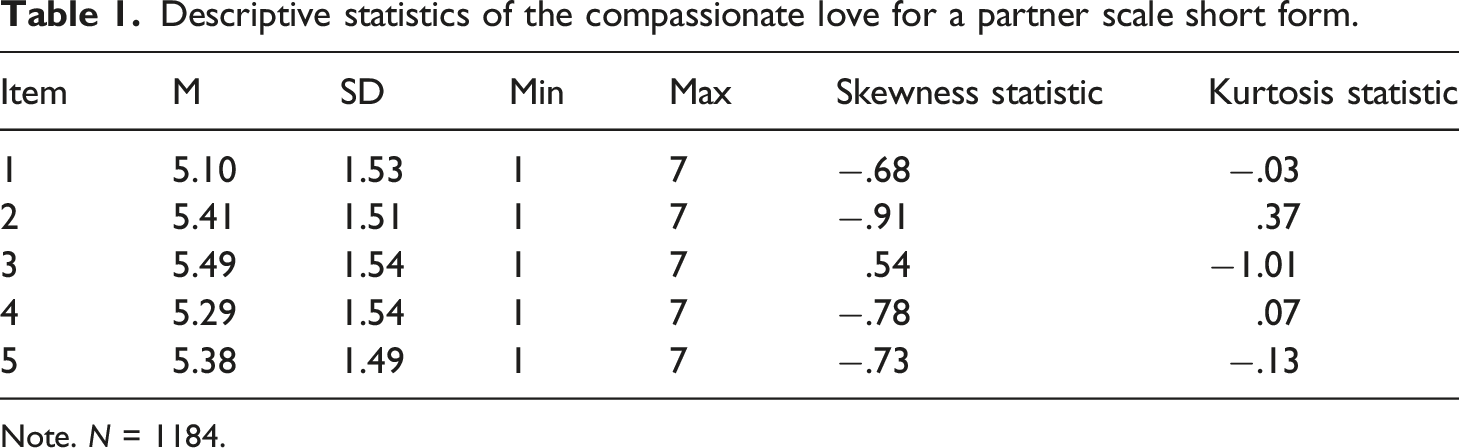
Note. N = 1184.
Dimensionality
CFA was tested with a one-factor model based on the original work of Neto and Neto (2022). CFA was performed on the raw data of the CLS-P-SF (correlation matrix, maximum likelihood estimation). The one-factor model of the CLS-P-SF evidenced a good fit to the data (χ2 = 22.76, df = 5, χ2/df = 4.75, CFI = .99, GFI = .99, SRMR = .019, RMSEA = .056, 90% CI [.035, .080]) (Hu & Bentler, 1999). All estimates (λ) of the items were significant at p < .001, ranging between .64 (Item 5) and .73 (item 2), with an average of .68 (see Figure 1). Confirmatory factor analysis of one-factor model of the CLS-P-SF.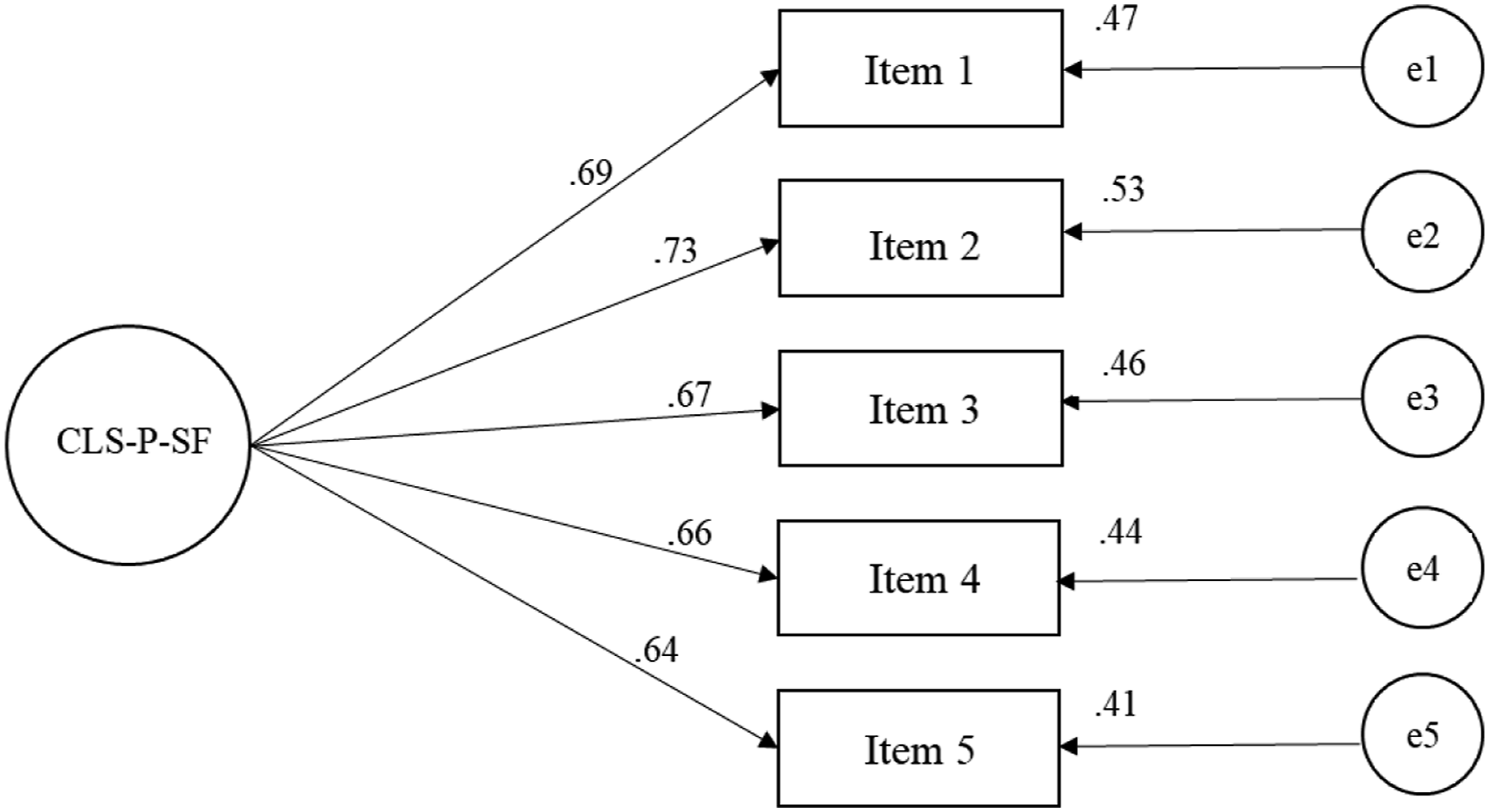
Reliability estimation
The CLS-P-SF displayed an α of .81 (CI 95% .79–.83) and an ω of .81. Item-test correlation estimates were ≥.57 and alpha-if-item-deleted values were >.75. These findings evidence adequate reliability in this sample.
Measurement invariance by gender and age
Confirmatory factor analysis fit statistics by gender and age and measurement invariance.
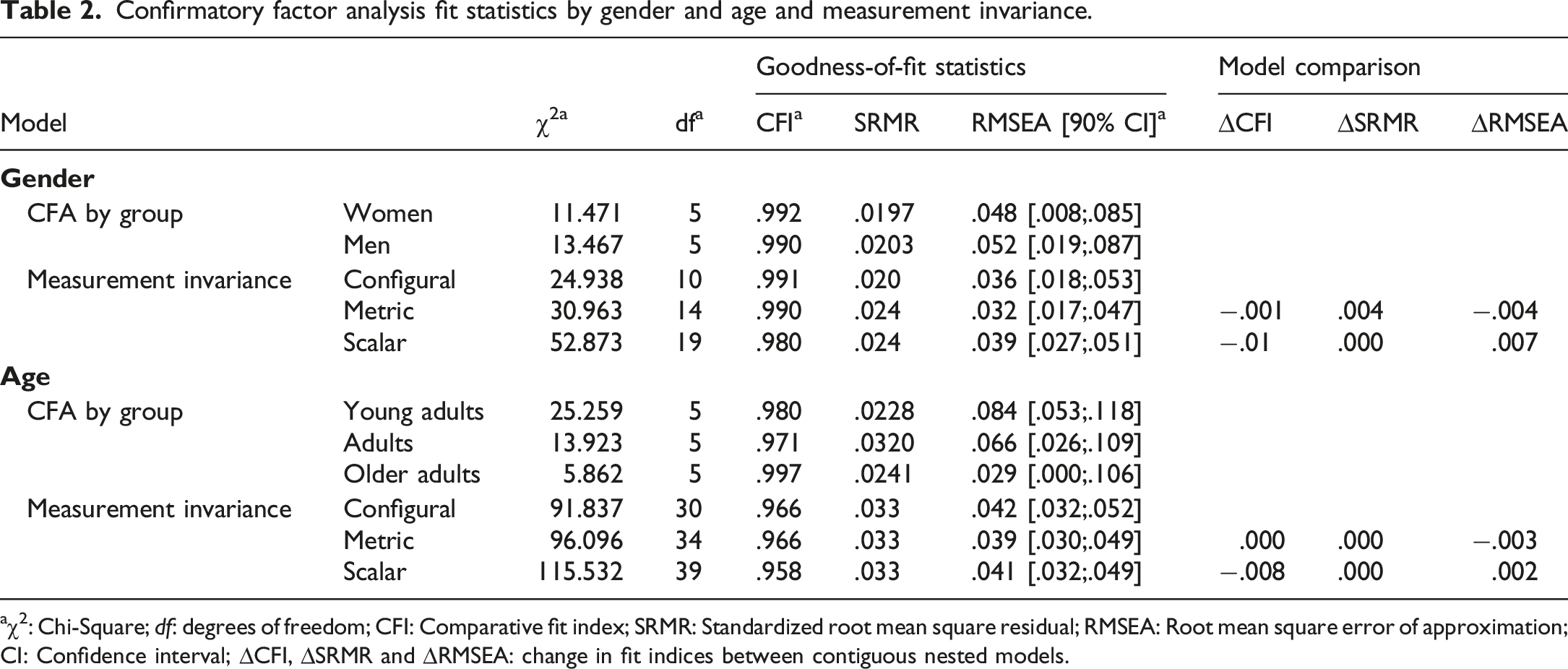
aχ2: Chi-Square; df: degrees of freedom; CFI: Comparative fit index; SRMR: Standardized root mean square residual; RMSEA: Root mean square error of approximation; CI: Confidence interval; ∆CFI, ∆SRMR and ∆RMSEA: change in fit indices between contiguous nested models.
Regarding gender, metric and scalar invariance with men and women was observed (Table 2). Considering age invariance (young adults, adults, and older adults) fit indices were good with differences between models below the thresholds.
Therefore, we can conclude that the CLS-P-SF is invariant, indicating that the construct has the same meaning in all groups. In this way, the means achieved in the latent variable between the groups examined can be compared.
Gender and age comparisons
In order to meet this objective, analysis of variance was carried out to evaluate the differences between the latent mean values of the groups (gender and age) on the CLS-P-SF. This analysis showed that the main effect of gender was not significant, Z (1, 1178) = 6.59, p = .10. Women (M = 4.51; SD = .94) revealed similar CL to men (M = 4.32; SD = .93). This analysis revealed also that the main effect of age was not significant, Z (2, 1178) = 2.86, p = .26. The interaction gender x age was not significant, Z (2, 1178) = 1.01, p = .37).
Correlations with sexuality constructs
Correlations between the CLS-P-SF scores and sexuality measures.
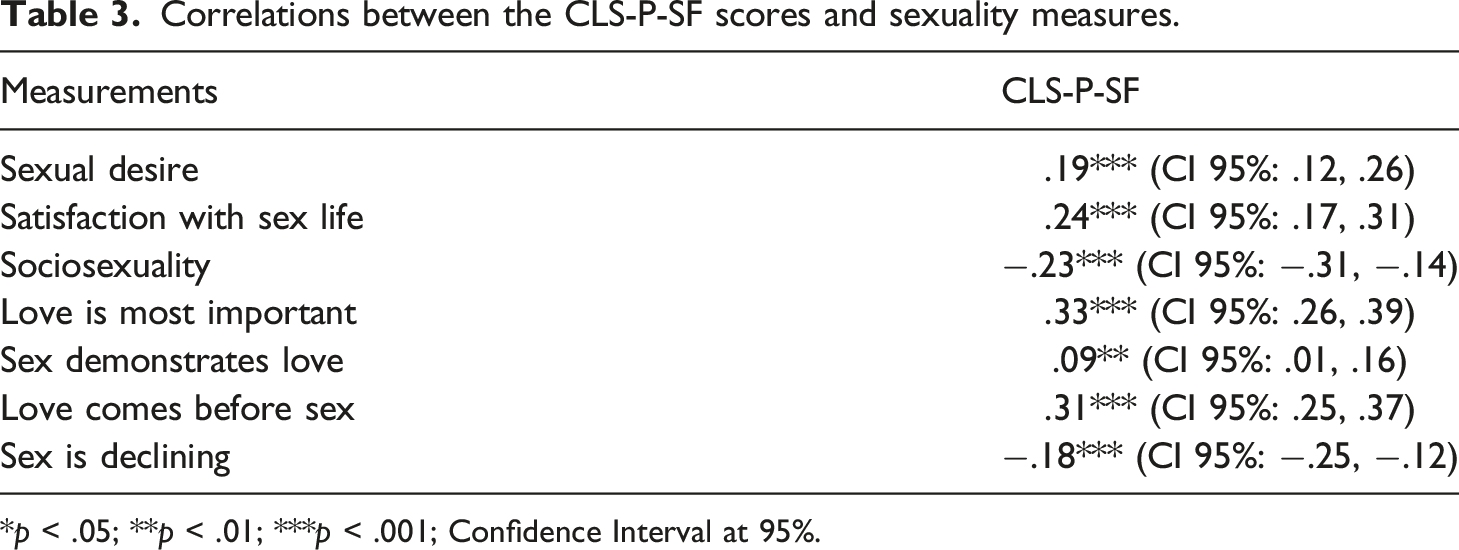
*p < .05; **p < .01; ***p < .001; Confidence Interval at 95%.
Discussion
The results give further endorsement to the validity and reliability of the CLS-P-SF. In accordance with the CFA, the one-dimensional structure of the CLS-P-SF evidences adequate fit, with estimates varying between .64 and .73. These factor loadings are in line with those obtained in the original research (Neto & Neto, 2022), and with the underlying theoretical model of the scale’s development, which is unidimensional as well (Sprecher & Fehr, 2005). These findings supported our first hypothesis. Further, the CLS-P-SF displayed good internal consistency (α and ω ≥ .80), which supported the second hypothesis.
The measurement invariance test provides support that permits us to envisage that one tool can assess the same construct across several groups (Rutkowski & Svetina, 2014). The factorial structure of the CLS-P-SF was displayed via a CFA in each group (gender and age) as a preliminary analysis to the measurement invariance. The findings showed much goodness-of-fit. The current results supported the third hypothesis.
The findings of the invariance of the CLS-P-SF by gender and age have relevant practical implications for the research on CL. In this regard, results offer support for the configural invariance, showing that the latent factor is identical in each group studied. In this way, women and men, as well as young adults, adults and older adults conceptualize CL identically with a one-dimensional model. Achieving metric invariance permit us to undertake that CL is the same in each group; that is, the participants of each group give the same meaning to CL. Finally, scalar invariance was also achieved, which makes it possible to compare the latent means. Hence, the CLS-P-SF assesses the same construct across gender and age groups. An implication of this result is that the CLS-P-SF can be utilized to compare men and women as well as age groups. Additionally, the finding of MI can be considered as further support of the validity and reliability of the CLS-P-SF.
The results showed no gender differences on CL. This result is consistent with previous research indicating that when the measurement of CL is one’s romantic partner, gender differences are frequently not found (Fehr et al., 2014; Neto & Wilks, 2017; Rauer et al., 2014). The results also showed no age differences on CL. This finding agrees with a prior work which has not found age differences on CL for romantic partners among young adults, adults, and elderly people (Neto & Wilks, 2017).
Sexuality is one of the most intimate behaviors performed between romantic partners (Busby et al., 2023). The relationships of the CLS-P-SF scores with measures of sexuality (sexual desire, satisfaction with sex life, sociosexuality, and perceptions of love and sex) were as hypothesized. The positive relation between CLS-P-SF and sexual desire illustrates that beliefs on sexual desire have repercussions for interpersonal relationships (Regan, 1998). The positive association between the CLS-P-SF score and satisfaction with sex life is consistent with previous research (Neto, 2012b; Neto & Wilks, 2017). This finding is also consonant with work indicating that females’ and males’ compassionate attitudes and behaviors had significant effects on their partner’s sexual well-being (Fraser et al., 2023). These positive associations between CLS-P-SF scores, and sexual desire and satisfaction with sex life supported our fourth hypothesis.
In line with our fifth hypothesis, a lower propensity to engage in sexual relations was associated with a greater CLS-P-SF score, a finding consistent with past research (Neto, 2015). This result is also in agreement with work showing that unrestricted persons, relative to restricted ones, tend to be less involved in romantic relationships (Penke & Asendorpf, 2008; Simpson & Gangestad, 1991). “Love is Most Important”, “Sex Demonstrates Love”, and “Love Comes Before Sex” correlated positively with CLS-P-SF, whereas “Sex is Declining” correlated negatively with CLS-P-SF. This pattern of correlations is in line with the findings of Hendrick and Hendrick (2002) on love constructs, supporting the sixth hypothesis.
Several important limitations of this research should be noted. First, although we covered a wide sample, the participants were recruited through a non-probabilistic sampling. This limits the generalizability of our findings. Second, the study was conducted cross-sectionally, which prevents any causal inferences. Thirdly, we also did not assess the possible effect of socially desirable responses, which may have been minimized by assuring anonymity in data collection (Schwarz et al., 1991). Next research should examine the social desirability (He et al., 2014). Fourth, test-retest reliability was not examined. Finally, we did not collect information about participants’ disability; this should be investigated in future research.
Conclusion
Notwithstanding limitations, the CLS-P-SF presents adequate one-dimensional model, internal consistency, an invariant factorial structure by gender and age, and empirical relationships with other theoretically related measures on sexuality. This research is the first to present measurement invariance of the CLS-P-SF. In fact, the findings attempted to fill a gap in the existing literature on the measurement invariance of the CLS-P-SF, thus improving future research. These CLS-P-SF findings indicate that the tool is valid and reliable to assess CL across both gender and the adult life span. In addition, for practical purposes, the short five-item format of the CLS-P-SF is beneficial for people who have little time to complete longer surveys. The CLS-P-SF’s brevity and ease of administration makes it a promising tool for large surveys and cross-national research. Thus, researchers and practitioners can benefit from using the brief and empirically sound CLS-P-SF to assess CL.
Footnotes
Declaration of conflicting interests
The author(s) declared no potential conflicts of interest with respect to the research, authorship, and/or publication of this article.
Funding
The author(s) disclosed receipt of the following financial support for the research, authorship, and/or publication of this article: Open access funding provided by FCT/FCCN (b-on).
Open research statement
As part of IARR’s encouragement of open research practices, the authors have provided the following information: This research was not pre-registered. The data used in the research cannot be publicly shared because the authors do not have permission to share data. The materials used in the research can be publicly posted. The materials can be obtained at:
