




Abstract
Research has shown that emoji can determine how interlocutors who use emoji are perceived (e.g., warmer) and can help complement written communication (e.g., clarify the meaning of a message). We argue that reciprocal emoji use may be particularly beneficial for user perceptions and communication outcomes. In two experiments (N = 568), we examined if using emoji, and reciprocating emoji use, in a work context (i.e., message between colleagues) influenced inferences about interlocutors and communication outcomes (Study 1), and if such effects differed according to the level of conflict between interlocutors (Study 2). Study 1 showed that using  (vs.
(vs.  ) resulted in higher perceptions of warmth, playfulness, and message’s positivity, whereas no benefits of using
  (vs. ) were observed. Likewise, reciprocating emoji use (
 vs. no emoji) resulted in higher perceptions of warmth, playfulness, and communication positivity. Study 2 showed only an effect of conflict in the scenario, such that, regardless of reciprocal emoji use, in the lower (vs. higher) conflict situation, perceptions of the interlocutor (e.g., warmer, more competent, more playful), and the conversation (e.g., messages more positive, less confrontational) were more favorable. Overall, our results reinforce the importance of emoji valence for person perception and communication outcomes, while also suggesting some emoji may not impact communication under specific circumstances (e.g., during situations of conflict).
Introduction
A recent report on global digital trends revealed that 64.4% of the world population uses the internet, mostly to stay in touch with close others (e.g., friends, family), through chats and messaging applications, and to connect to others through social media platforms (Kemp, 2023). And yet, research focusing on how specific cues included in text-based computer-mediated communication (CMC), such as emoji, may influence social and personal relationships is still scarce, particularly with an experimental approach.
Text-based CMC lacks nonverbal cues typically present in face-to-face communication (e.g., facial expression, accent; Chew & Ng, 2021), which facilitates decoding the sender’s intentions (e.g., tone of voice) or message’s contents (e.g., sarcasm). Individuals often overcome this by using multiple paralinguistic cues, including vocalizations (e.g., “hmm”), or typographic marks to convey meaning or reactions (e.g., adding exclamation points to emphasize a state of heightened emotion, “happy!!!!”, or using “#$%^” to signal censorship; Luangrath et al., 2017). Another common way is to include pictorial cues in messages, such as gifs, stickers, or emoji. Particularly, emoji have been shown to help complement messages (e.g., enhance affective tone; Kaye et al., 2016), improve communication outcomes (e.g., improve understanding; Holtgraves & Robinson, 2020; Prada et al., 2018), or even signal senders’ intentions (e.g., clarify that the sender has friendship/sexual/romantic intentions on a first interaction; Rodrigues et al., 2022). Emoji have also been shown to determine how users are perceived (e.g., warmer; Boutet et al., 2021).
Reciprocity is crucial for communication outcomes (e.g., Toma, 2014). In text-based CMC, individuals also tend to adapt their communication style to that of their interlocutors (e.g., by having a similar use of emoji; Stein, 2023; Wagner et al., 2022), and perceive this as a relevant driver for their communication with others (e.g., to signal interest in the interaction; Nexø & Strandell, 2020). However, few studies have experimentally examined the impact of reciprocity. Hence, in Study 1 we explored if perceptions about two interlocutors and their communication outcomes in a work context were influenced by using emoji and, more specifically, when emoji use was reciprocal. In Study 2 we explored if the level of conflict in the same work context was a boundary condition for any of the effects.
Impact of emoji on social and work outcomes
Research has shown that emoji influence perceptions about users and their intentions (e.g., Boutet et al., 2021; Rodrigues et al., 2022). For example, Beattie et al. (2020) manipulated the agent of a conversation (i.e., human vs. chatbot) and the type of message (i.e., verbal-only vs. with emoji), and assessed social attraction (i.e., the degree to which a person likes or wants to be around another), CMC competence, and source credibility (e.g., trustworthiness). Regardless of whether the agent was a human or a chatbot, messages with emoji resulted in the sender being perceived as more socially attractive, more competent in CMC, and more credible. In another study, Boutet et al. (2021) found that senders who used positive emoji (vs. negative; vs. neutral; vs. no emoji) were always perceived as warmer, regardless of the valence of the message (i.e., positive, neutral, or negative). Kim et al. (2022) expanded this line of research to the context of online classes. In this study, participants were asked to read a fictitious email sent by a professor welcoming new students, that could include (or not) emoji. Results revealed that the professor who used (vs. did not use) emoji was perceived as more authentic (e.g., honest) and intimate (e.g., warmth, emotional closeness).
Notwithstanding, this positive impact of emoji use is likely to vary according to contextual features, such as the setting (e.g., work settings) or the interlocutors’ relationship (e.g., work colleagues vs. work supervisors). For example, Glikson et al. (2018) found that using (vs. not using) emoji in a work message resulted in higher perceived warmth when the context was informal (vs. formal), and lower perceived competence when the context was formal (vs. informal). Consistently, Aretz and Mierke (2019) showed that including emoticons or emoji in work messages (vs. text only) resulted in perceptions of higher warmth and lower assertiveness. Another study by Riordan and Glikson (2020) found that including emoji in work e-mails decreased the perceived effectiveness of a manager (but not their likability), with this effect being mediated by the perceived appropriateness of emoji use in that situation. It is worth noting, that when the communication occurred in an informal (vs. formal) context, the negative impact of emoji on appropriateness was attenuated. Cavalheiro et al. (2022) showed that emoji use was perceived as more adequate with closer interlocutors (e.g., friends, work colleagues) when compared to more distant interlocutors (e.g., doctors, work supervisors). Even though the abovementioned research shows causal evidence that emoji use can be considered inadequate (e.g., Glikson et al., 2018) or have derogatory effects in certain work settings (e.g., lower perceived effectiveness; Riordan & Glikson, 2020), recent studies show that emoji are still used in these settings (e.g., Sampietro, 2019). For example, Shandilya et al. (2022) found that new collaborators reported using nonverbal cues (i.e., emoji, gifs, and memes) in text-based CMC at work, with emoji being the most often used. Participants indicated that such cues allow them to add humor, express emotions, clarify their intentions, or even soften the tone of conversations. Still, they also reported uneasiness in using these cues, driven by their unfamiliarity with the culture of the organization and their work team, and feeling unsure about how they could be perceived (e.g., as unprofessional). Overall, emoji use in a work setting can have both positive (e.g., higher perceptions of warmth) and negative outcomes (e.g., lower perceptions of competence).
Contextual features may also be important to help with emoji interpretation (Völkel et al., 2019; cf. Miller et al., 2017), as some emoji are perceived as ambiguous (Rodrigues et al., 2018). For example, Weissman (2019) compared the interpretation of emoji representing food that are more (vs. less) ambiguous (i.e., emoji that also have – or not - sexual connotations, like  and
and  , respectively). The authors also paired the emoji with messages biasing towards literal (i.e., food-related, reducing sexual connotation: “What are you getting at the grocery store?”) versus euphemistic interpretations (i.e., ambiguous, opening possibility of sexual connotation: “What are you doing this weekend?”). Results for the more ambiguous emoji revealed that providing a literal context helped to access the literal meaning of these emoji (i.e., providing a context allows participants to understand them as being food). Therefore, emoji understanding and interpretation are likely to depend, at least in part, on the context of communication. Like so, the impact of emoji is likely to vary according to other contextual features.
Message valence has also emerged as a relevant contextual feature to understand the impact of emoji use. For instance, emoji use was perceived as more adequate in positive (vs. negative) interactions, regardless of whether interlocutors were close or distant (Cavalheiro et al., 2022). In another study, Rodrigues et al. (2017) found that emoji use between romantic partners was perceived to contribute to relationship quality in a positive (vs. negative) scenario. When looking specifically at negative scenarios, however, the authors found that using emoji only resulted in higher perceived message positivity when the conflict scenario was less (vs. more) severe. Other studies have explored the idea of conflict being a relevant feature regarding emoji use, as message clarification facilitated by these cues can be a way to prevent potential negative impacts on interlocutors’ relationships. For example, a study by Kaye et al. (2016) showed that individuals report using emoji to reduce the ambiguity of their written communication. This includes adding an emoji to signal a joke, or to avoid being misconstrued as rude or irritable. Tandyonomanu and Tsuroyya (2018) found similar results, with participants also reporting including emoji in written messages to avoid misunderstandings and reduce ambiguity. In another study, Riordan (2017) manipulated the presence of non-facial emoji on (more or less) ambiguous messages to test the possibility that different emoji can contribute to the disambiguation of messages. Results revealed that, for example, adding  to a more ambiguous message “Got a shot” resulted in lower ambiguity (i.e., adding an emoji provided context and led participants to better understand the intent of the message in comparison with only text), corroborating this function of emoji. Yet, little research has experimentally explored emoji use in a context of conflict (for an exception, see Rodrigues et al., 2017). Building upon existing evidence, we conducted two experimental studies to explore if emoji use influences the inferences made about an interlocutor and the communication outcomes in a written interaction. In Study 1, participants saw a written interaction between two work colleagues. In Study 2, we manipulated the level of conflict to disentangle if this particular contextual feature mitigates or enhances the expected effects of emoji use.
Taken together, these findings emphasize the need to account for multiple contextual features when examining the impact of emoji use, including the type of relationship and communication style (e.g., closer relationships, informal communication styles). Interlocutors are motivated to match their recipient’s communication style (see communication accommodation theory, Giles et al., 1979), and reciprocating the other person’s linguistic style is among the most important strategies in communication (e.g., to promote feelings of trust between interlocutors; Toma, 2014). For example, even with non-human interlocutors (virtual agents), people seem to prefer matching conversational styles (Shamekhi et al., 2016). Accordingly, it becomes relevant to better understand the role of reciprocity in emoji for communication outcomes.
Reciprocity in emoji use
Research has suggested that individuals expect some level of reciprocity in emoji use between interlocutors (e.g., use a similar number of emoji) in online dating, otherwise, they are likely to experience insecurity and negatively impact communication outcomes (Nexø & Strandell, 2020). Likewise, Coyle and Carmichael (2019) found that individuals were perceived as more responsive when they matched their interlocutor’s communication style (i.e., when both used emoji), particularly when positive information was disclosed. When examining how both interlocutors were perceived, situations when both used emoji or both used only text (i.e., reciprocity) resulted in more positive perceptions (e.g., interlocutors were perceived as more patient and warmer), when compared to situations in which only one interlocutor used emoji. Moreover, Wagner et al. (2022) analyzed naturalistic data (i.e., screenshots of text messages exchanged by participants in a dating context) and observed a match in the frequency of emoji use between interlocutors. When asked about their motivations to include emoji in flirtatious texts, participants indicated that emoji were used to mirror the other person’s communication style (e.g., replying with emoji to a text containing emoji). A recent experimental study (Stein, 2023) manipulated closeness (i.e., the extent to which individuals have closer or more distant ties, more or less familiarity, with specific interlocutors, such as a best friend vs. a neighbor) between two interlocutors (i.e., close vs. distant) and emoji presence (i.e., with vs. without emoji) in messages, and asked participants to reply to said messages. Results revealed that participants used emoji more often when replying to messages that also included emoji, particularly when interacting with closer interlocutors. These findings indicate that individuals tend to reciprocate nonverbal behaviors with those who are closer to them, even in text-based CMC. Despite these recent findings suggesting reciprocity as a relevant variable to understand the impact of emoji use on user perceptions and communication outcomes, causal evidence is still scarce.
As previously highlighted, the context in which individuals communicate seems to be a determinant of the perception, evaluation, and effects of the emoji used. Particularly, work contexts are often considered inappropriate for emoji use. However, in recent years text-based CMC and emoji use became more pervasive. Specifically regarding work contexts, a recent report by Adobe reveals that 78% of younger generations use emoji at work (Adobe, 2022). And yet, few researchers have analyzed emoji use in this specific context. An exception is the recent study of Shandilya et al. (2022) that analyzed the collaborator’s perspectives about the use of non-textual responses in CMC. The authors found that, overall, participants seek to use non-textual (e.g., emoji) responses in text-based CMC, and that they do so to connect and bond with their teammates. Another recent study (Lu et al., 2022) analyzed naturalistic data from GitHub, focusing on remote workers. The authors found that emoji use patterns can predict turnover (i.e., not using emojis denotes a higher risk of dropping out). Consequently, despite past findings suggesting emoji use is not deemed appropriate or productive in work contexts, recent research suggests this behavior occurs frequently. Accordingly, in a set of studies, we seek to expand the current literature by experimentally testing emoji use in a work context while also assessing if the reciprocity of emoji use can be determinant for communication outcomes.
Overview of studies
In Study 1, we experimentally tested if the use of different emoji in an ambiguous (i.e., with a potential underlying conflict) work context had effects on the inferences made about two interlocutors (i.e., perceived warmth, competence, accusation level, cooperation, and playfulness) and on communication outcomes, namely messages’ quality (i.e., efficacy, positivity), and conversation quality (i.e., positivity, emoji role). Critically, we also tested if the reciprocal use of emoji benefitted some of these effects. In Study 2, we tested if the effects of reciprocity were moderated by the level of conflict depicted in the scenario.
Study 1
We expected a positive effect of emoji on how the interlocutor using it was perceived (e.g., warmer, more playful) and on communication outcomes (e.g., messages perceived as more positive and more efficient). However, these effects were expected to be stronger when emoji use was reciprocal.
Method
Participants and design
A sample of 369 individuals living in Portugal volunteered to participate in an online survey. Participants were, on average, 31 years old (M = 31.27, Mdn = 26.00, SD = 13.00, range: 18–71 years), and most identified as women (74.2%), had a university degree (89.7%), and were working (45.7%) or studying (42.4%).
Participants were randomly assigned to one of the experimental conditions in a 3 (interlocutor B’s emoji type: [negative], [baseline], [positive]) x 2 (interlocutor A’s emoji use: no emoji vs. ) between-participants design.
Materials
We selected emoji that could be plausible in a work context scenario. We strived to, as much as possible, maintain the similarity between icons in terms of body parts represented, while varying in valence. In a post-test, the selected emoji were deemed moderate to high in familiarity, adequacy to use in a work context (except , which was evaluated as low in adequacy), and low to moderate in perceived interpersonal conflict, while varying in valence as expected (see Supplemental Table). Specifically, was perceived as negative, followed by , , whereas was perceived as positive. Moreover, participants described as signaling “disagreement”, “rejection/negation”, or “something bad”; as signaling “writing”, “working on something”, or “paying attention”; as signaling “strength”, “motivation/encouragement”, or “general positivity”; and as signaling “lack of knowledge” or “indifference”.
Measures
Measures applied, reliability, and scale anchors.
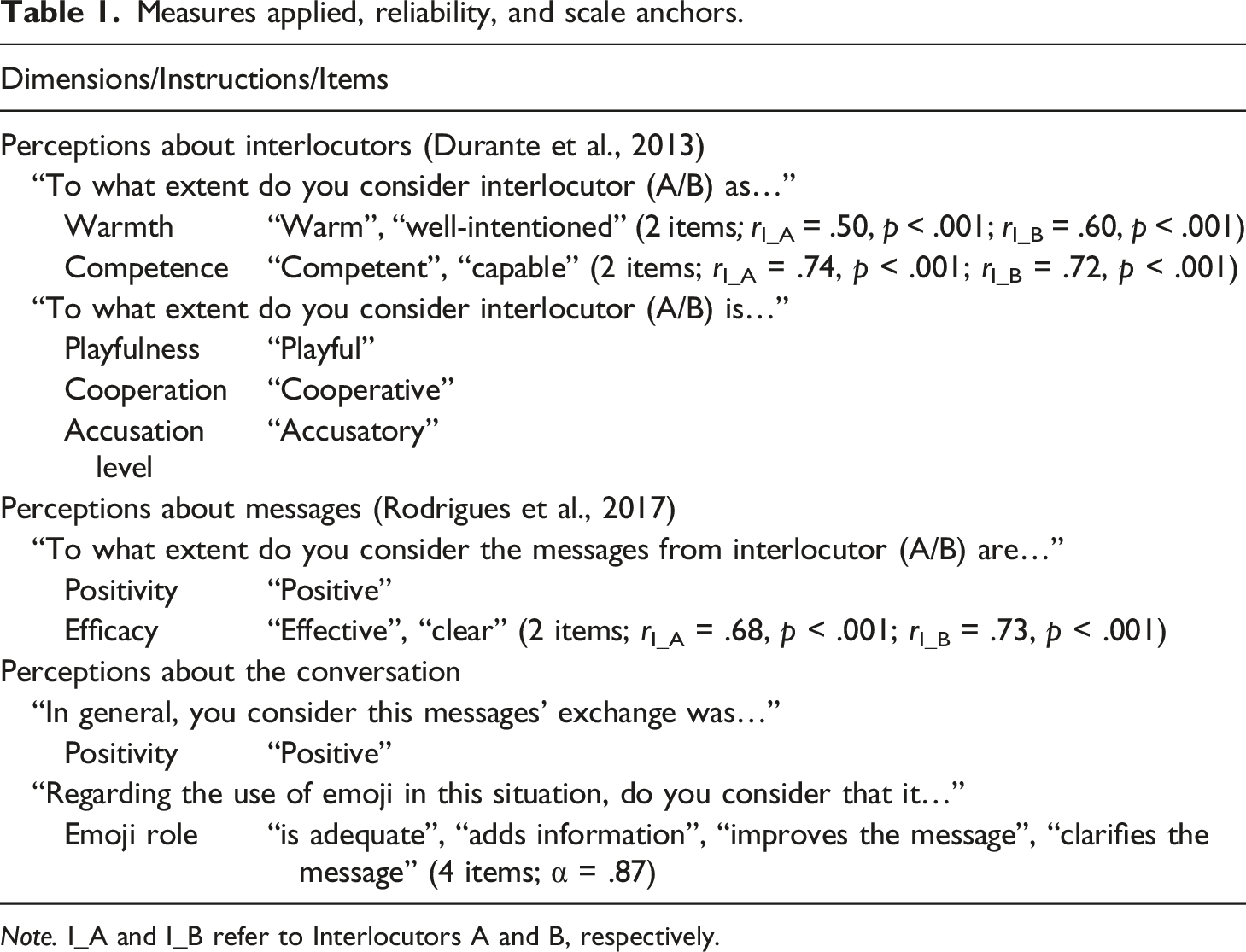
Note. I_A and I_B refer to Interlocutors A and B, respectively.
Procedure
This study was approved by the Ethics Committee at Iscte-Instituto Universitário de Lisboa (#97/2021). Data were collected through Qualtrics. Prospective participants were invited to take part in an online study about digital interpersonal communication through a link shared via email, on social media, and the participants pool available at the university. The general instructions informed about the purpose of the study, expected duration, and ethical aspects (i.e., all data were confidential and anonymous; participants could withdraw from the study at any point without their responses being considered for analysis). Agreement with informed consent was required before proceeding to the study. In all experimental conditions, participants were shown a page with the following information at the top: “This interaction occurred between two colleagues who are preparing a report together”. Below this information, participants were shown an image depicting a scenario of a conversation between two interlocutors on a chat service. The contents of the conversation were similar across experimental conditions, with interlocutor A writing “How’s the report?”, followed by interlocutor B’s reply “Still needs a lot of work…”, and ending with interlocutor A’s reply “It could be done already…if you did your part”. The first factor of the experimental design was manipulated by adding one of the following emoji to interlocutor B’s reply: Experimental Scenarios (Study 1). Note. The left panel represents conditions without reciprocity and the right panel reciprocity conditions. Emoji valence is manipulated in interlocutor B response (i.e., , , . The second factor of the experimental design was manipulated in interlocutor A’s reply, i.e., the last message could be text only (i.e., control condition) or text followed by the emoji . For a depiction of the materials, see Figure 1., , ). Labels identifying interlocutors A and B (see dashed text boxes in the left top scenario) were not presented to participants.
After seeing the hypothetical scenario, participants were asked to answer our dependent variables (see Measures section). After this, participants answered a control question, in which they were asked to indicate “…if both interlocutors used emoji”, “…if only one interlocutor used emoji”, “…if no interlocutor used emoji”, or “…if they didn’t remember of anyone using emoji”. Lastly, participants provided standard sociodemographic information (i.e., age, gender, occupation, level of education, nationality), were thanked, debriefed, and provided with the contact information of the research team.
Data analytic plan
First, we present a preliminary analysis regarding the control question. We then computed a series of 3 (interlocutor B’s emoji type: , , ) x 2 (interlocutor A’s emoji use: no emoji vs. ) MANOVAs to examine perceptions about both interlocutors and their respective conversation. Specifically, we analyzed the main effect of interlocutor B’s emoji type and interlocutor A’s emoji use on the perceptions about the respective interlocutors. We then analyzed the interaction between interlocutor B’s emoji type and interlocutor A’s emoji use on communication outcomes. When statistically significant differences or interactions were found, we computed pairwise comparisons with Bonferroni correction.
Results
The final sample included 369 participants, most of whom (84.6%) recalled being exposed to emoji in the conversation 1 .
Impact of emoji use on the perceptions about the interlocutors
Perceptions of interlocutor B
Results are shown in Figure 2. We found a main effect of emoji type on perceived warmth, F (2, 363) = 8.07, p < .001, ƞ2
p
= .043, playfulness, F (2, 363) = 15.14, p < .001, ƞ2
p
= .077, and cooperation, F (2, 363) = 3.16, p = .044, ƞ2
p
= .017. Specifically, interlocutor B was perceived as warmer when using Perceptions About Interlocutor B According to Interlocutor B’s Emoji Type. Note. Error bars indicate standard errors. *p ≤ .050; **p ≤ .010; ***p ≤ .001. (vs. ), p < .001, whereas no differences emerged between and , p = 1.00. A similar pattern was observed for playfulness, p < .001 and p = 1.00, respectively. Despite the main effect on perceived cooperation, no significant comparisons between conditions were found, all p ≥ .061. No main effects emerged for perceived competence, F (2, 363) = 1.03, p = .358, ƞ2
p
= .006, or accusation level, F (2, 363) = .73, p = .485, ƞ2
p
= .004.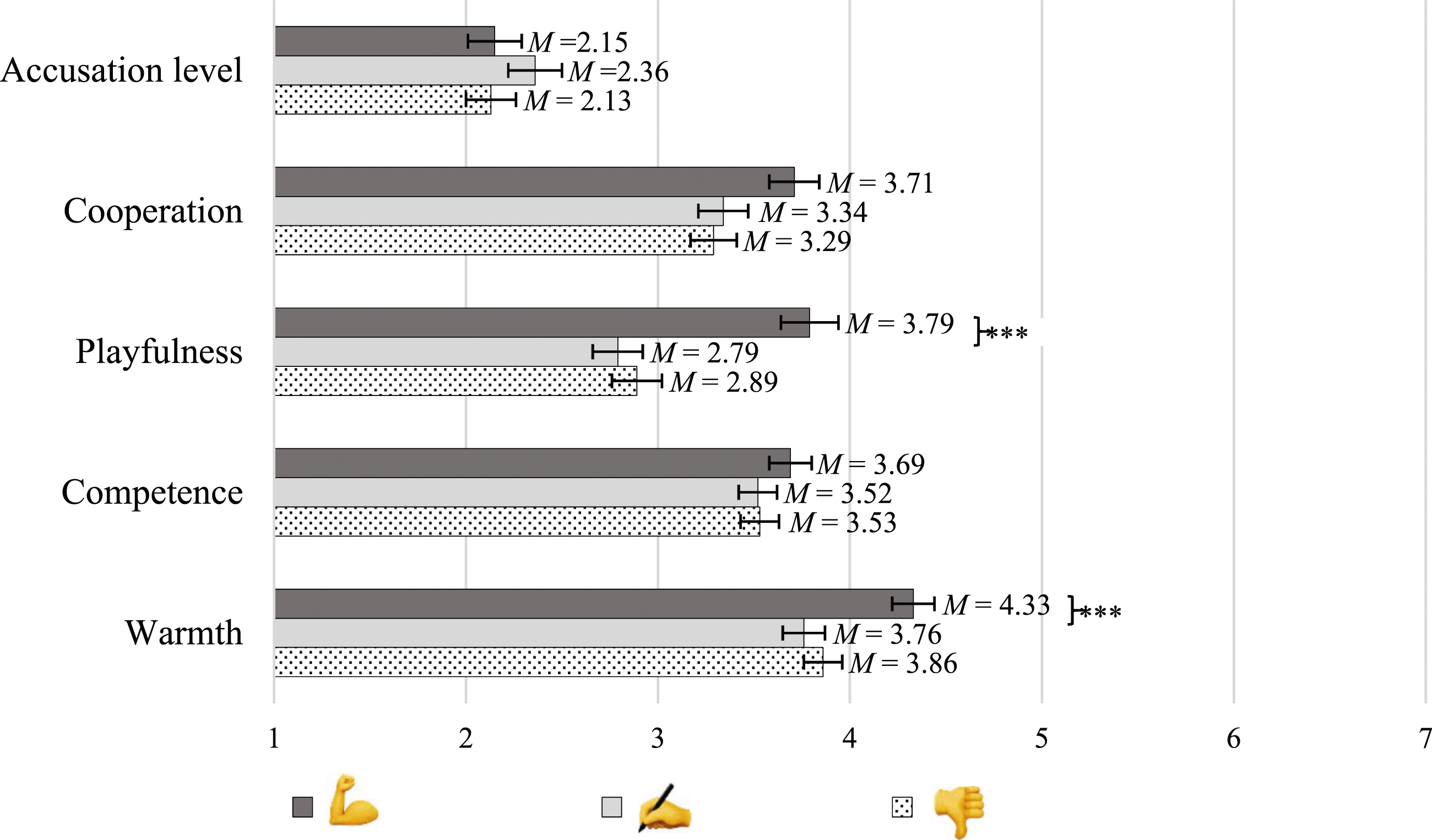
Perceptions of interlocutor A
Results showed a main effect of emoji use on perceived warmth, F (1, 363) = 4.00, p = .046, ƞ2
p
= .011, and playfulness, F (1, 363) = 8.82, p = .003, ƞ2
p
= .024. Specifically, interlocutor A was perceived as warmer when using (M = 3.08, SE = .10) compared to not using emoji (M = 2.85, SE = .08). A similar pattern was observed for playfulness (M = 2.30, SE = .11 vs. M = 1.90, SE = .08, respectively). No main effects emerged for perceived competence, F (1, 363) = 1.29, p = .256, ƞ2
p
= .004, cooperation, F (1, 363) = 1.80, p = .180, ƞ2
p
= .005, or accusation level, F (1, 363) = .41, p = .552, ƞ2
p
= .001.
Perceptions about the messages exchanged
Interlocutor B: Message’s positivity and efficacy
Results are shown in Figure 3. We found a main effect of emoji type on message positivity, F (2, 363) = 16.73, p < .001, ƞ2
p
= .084, but not message efficacy, F (2, 363) = .37, p = .691, ƞ2
p
= .002. Comparisons showed that interlocutor B’s messages were perceived as more positive when Perceptions About Interlocutor B’s Message According to Interlocutor B’s Emoji Type. Note. Error bars indicate standard errors. *p ≤. 050; **p ≤ .010; ***p ≤ .001. (vs. ) was included, p < .001. No differences emerged when comparing messages with and , p = 1.00.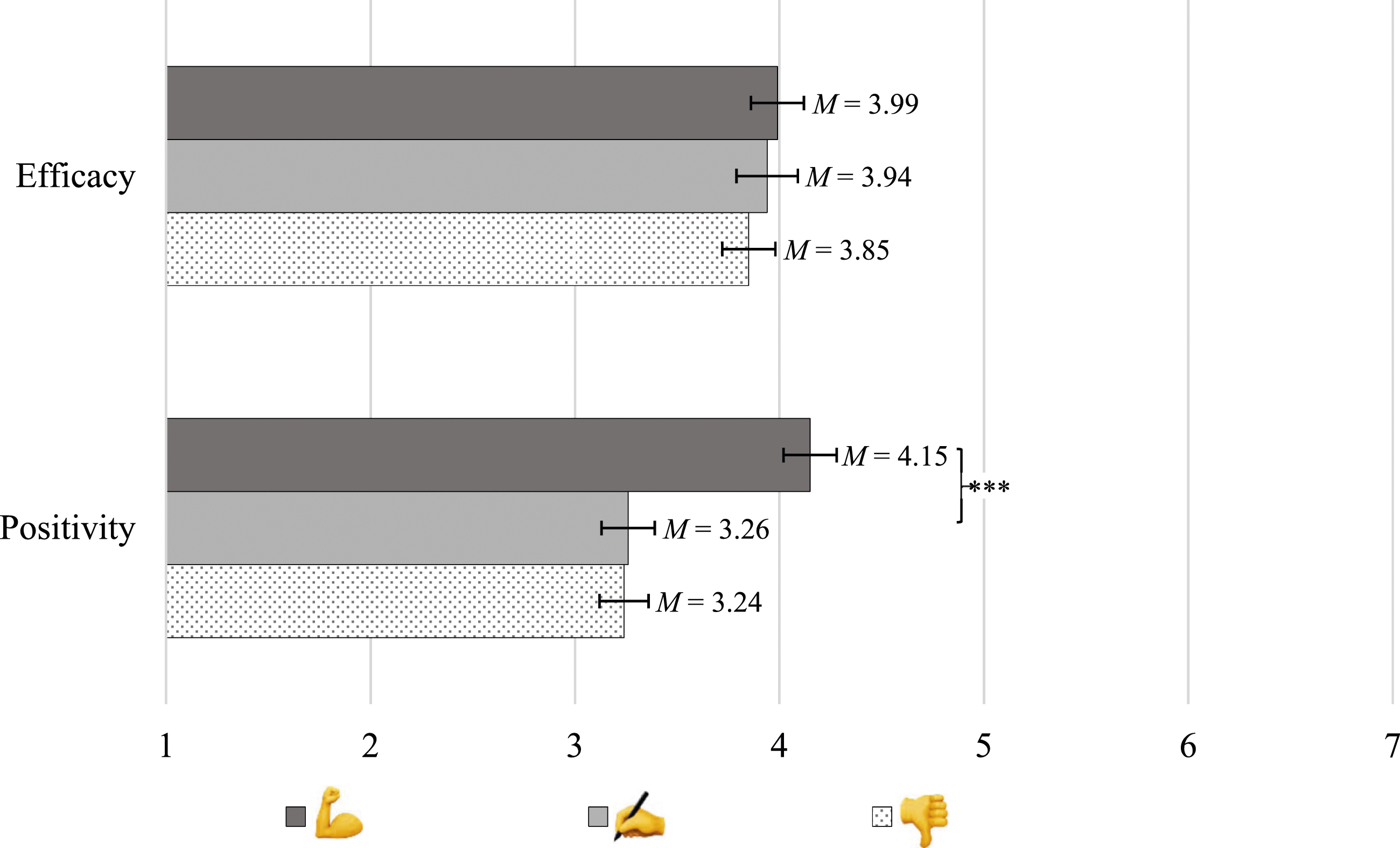
Interlocutor A: Message’s positivity and efficacy
We found a main effect of emoji use on message positivity, F (1, 363) = 5.09, p = .025, ƞ2
p
= .014, but not message efficacy, F (1, 363) = .390, p = .533, ƞ2
p
= .001. Comparisons showed that interlocutor A’s messages were perceived as less negative with (M = 2.76, SE = .11) than without emoji (M = 2.43, SE = .09).
Perceptions about the conversation
We found no main effects of the type of emoji used by interlocutor B on perceived positivity of the conversation, F (2, 363) = 2.65, p = .072, ƞ2
p
= .014, neither on the role of emoji use for communication, F (2, 363) = .65, p = .522, ƞ2
p
= .004. In contrast, we found a main effect of emoji use from interlocutor A (i.e., reciprocal emoji use) on perceived positivity of the conversation, F (1, 363) = 5.93, p = .015, ƞ2
p
= .016, such that the conversation was perceived as less negative when interlocutor A used (M = 2.73, SE = .11) when compared to no emoji use (M = 2.40, SE = .08). We did not find a main effect of interlocutor A’s emoji use on the role of emoji for communication, F (1, 363) = 2.11, p = .148, ƞ2
p
= .006.
Contrary to our expectations, the interaction between emoji type and emoji use was non-significant for both perceived positivity of the conversation, F (2, 363) = 1.06, p = .346, ƞ2 p = .006, and emoji role for communication, F (2, 363) = 1.73, p = .179, ƞ2 p = .009.
Discussion
Our results showed that emoji type can improve the perceptions made about the interlocutors (i.e., perceived as warmer, more playful, and more cooperant), particularly in the case of positive emoji (i.e., used by interlocutor B), message perceptions (i.e., messages perceived as more positive), and conversation quality (i.e., messages perceived as less negative). A similar pattern of results emerged when Interlocutor A included (vs. did not include) emoji, except for perceptions of cooperation. Noteworthy, an argument can be made about the low effect sizes obtained in our study and the small differences in magnitude between experimental groups. However, our results are in line with previous research showing that emoji use leads to more positive perceptions in relational dimensions such as warmth (e.g., Boutet et al., 2021), playfulness (e.g., McShane et al., 2021), and message/interaction positivity (e.g., Rodrigues et al., 2017). As such, finding a similar pattern of results to that of previous studies boosts our confidence in our results. Arguably, these effects may be bound to the context of interaction, as well as the relationship between interlocutors. For example, emoji use is deemed more adequate when used with a friend versus a professor (Cavalheiro et al., 2022), which suggests impression formations and evaluations of individuals may be influenced by the context of interaction and relationship rapport. Moreover, we must acknowledge that even though statistically significant differences were found when comparing groups (e.g., using resulted in the interlocutor being perceived as warmer and more playful vs. using ), in most cases average scores were still below the scale mid-point or close to it. Still, results should be interpreted with caution because, in both cases, interlocutor B is not either evaluated as being warm or playful. Looking at our experimental materials and the overall means, the scenarios depicting conversations in a work context with a potential underlying conflict may have determined how both interlocutors and their communication were perceived. Of note, we did not observe an interaction between emoji type and emoji use on perceptions about the conversation, which is likely to be a consequence of the most evident contextual features (i.e., a potentially quarrelsome, work-related, interaction). Building upon the differences between conflict levels reported by Rodrigues et al. (2017), in Study 2 we tested if reciprocity in emoji use would benefit interlocutor and communication perceptions when the conflict level was lower (vs. higher). As in Study 1 only the emoji differed from the baseline condition, we kept this emoji constant across conditions, manipulating only the level of conflict and the presence/absence of the emoji (i.e., reciprocity).
Study 2
As in the previous study, we expected a main effect of emoji use on interlocutor perception and ratings of communication outcomes. Specifically, when interlocutor A uses an emoji, they are perceived as warmer and more playful, and the message is rated as more positive and more efficient. We also explored if the positive effects of emoji use on communication outcomes were stronger when both interlocutors used emoji (i.e., reciprocal). Moreover, we explored whether the level of conflict between interlocutors moderated the impact of reciprocal emoji use across variables.
Method
Participants and design
A sample of 199 individuals living in Portugal volunteered to participate in an online survey. Participants were, on average, 35 years old (M = 34.99, Mdn = 34.00, SD = 8.94, range: 19–67 years), and most identified as women (54.3%), had a university degree (69.7%), and were working (68.3%) or unemployed (14.1%).
Participants were randomly assigned to one of the experimental conditions in a 2 (conflict: lower vs. higher) x 2 (interlocutor A’s emoji use: no emoji vs. ) between-participants design.
Measures
Measures replicated Study 1 with the addition of the following four items (all using 7-point rating scales): (a) “In general, you consider that this message exchange was confrontational?” (from 1 = Not at all to 7 = Extremely); (b) “To what extent do you consider that the interlocutors…” and presented them three options “have known each other for a long time”, “are close (e.g., are friends)”, “would like to work together again” (from 1 = A little to 7 = A lot).
Procedure
This study was approved by the Ethics Committee at Iscte-Instituto Universitário de Lisboa (#97/2021). Data were collected through Qualtrics. Prospective participants were invited to take part in an online study about digital interpersonal communication through a link shared on ClickWorker platform. In this study, participants were rewarded with a monetary incentive (€1 each).
Overall, procedures and depicted scenarios were similar to those of Study 1, except for the manipulation of the conflict level on the last message by interlocutor A. Specifically, using the same scenario (i.e., the interaction between two colleagues preparing a report together), the first factor was manipulated in the final message by interlocutor A: “It could be done already…How can I help you?” [lower conflict] or “It could be done already…I can never count on you!” [higher conflict]”. Like Study 1, this final message could be text only (i.e., control condition) or include the Experimental Scenarios (Study 2). Note. The left panel represents conditions without reciprocity and the right panel reciprocity conditions. Top scenarios represent lower conflict conditions and bottom scenarios the higher conflict conditions. Labels identifying interlocutors A and B (see dashed text boxes in the left top scenario) were not presented to participants. emoji. For a depiction of the materials, see Figure 4.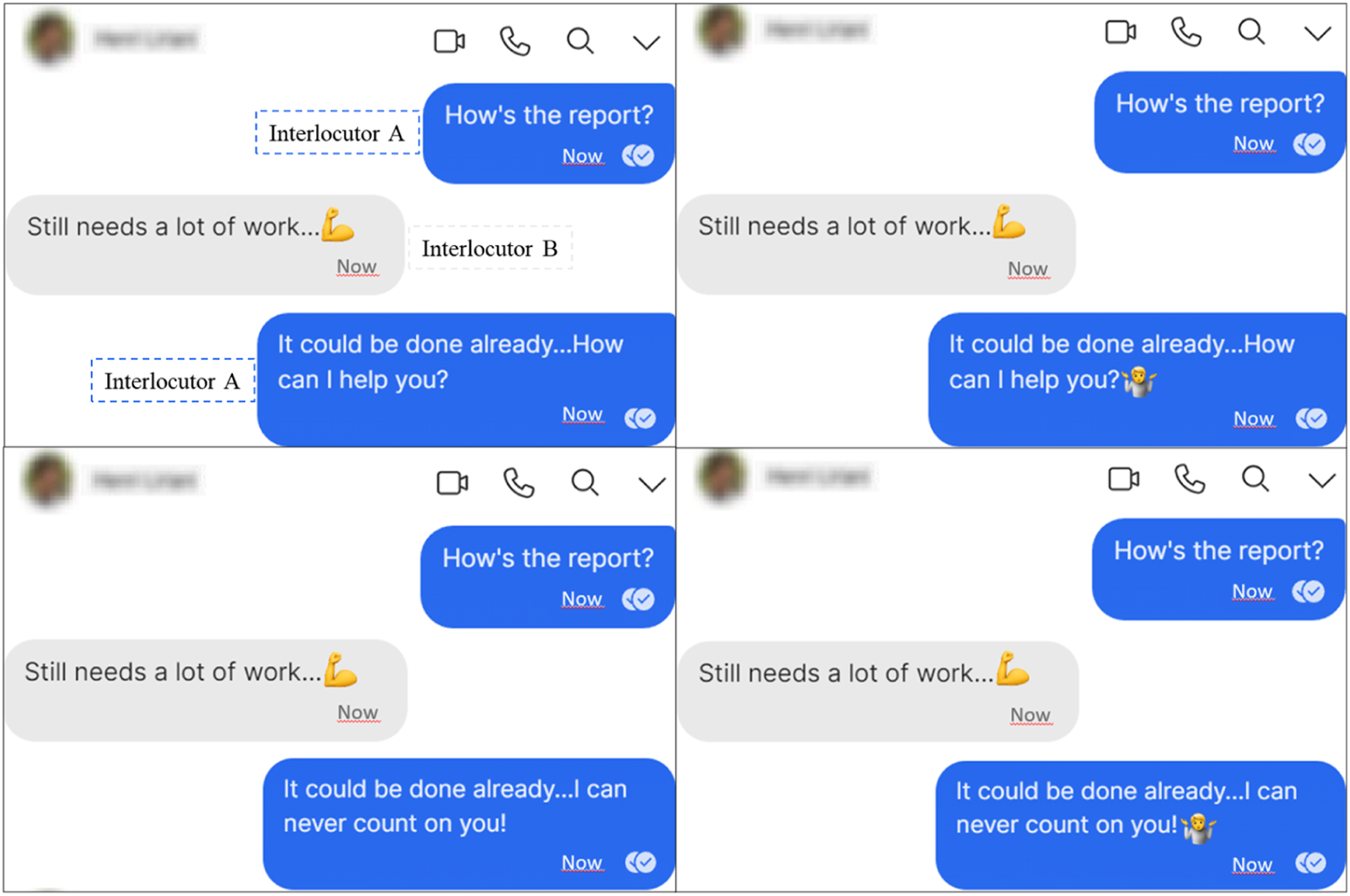
After seeing the hypothetical scenario, participants were asked to answer a set of dependent variables similar to those of Study 1 (with a few exceptions, see Measures section), and were thanked, debriefed, and provided with the contact information of the research team.
Data analytic plan
First, we present preliminary analysis regarding the control questions. We then computed a series of 2 (conflict: lower vs. higher) x 2 (interlocutor A’s emoji use: no emoji vs. ) MANOVAs to examine perceptions about interlocutor A and the conversation. Specifically, we analyzed main effects of conflict and interlocutor A’s emoji use on perceptions about interlocutor A. We then analyzed the interaction between conflict and interlocutor A’s emoji use on communication outcomes. When statistically significant differences or interactions were found, we computed pairwise comparisons with Bonferroni correction.
Results
The final sample included 199 participants, most of whom (76.3%) recalled being exposed to emoji in the conversation 2 .
Overall, participants considered that interlocutors likely knew each other for a long time (M = 4.34, SD = 1.54, CI 95% [4.13,4.56]), were moderately close (M = 3.93, SD = 1.47, CI 95% [3.72,4.14]), and unlikely to want to work together again (M = 2.81, SD = 1.56, CI 95% [2.59,3.03]). Lastly, we found a main effect on confrontational level, with higher perceived confrontation when the conflict was higher (M = 5.07, SD = 1.60) than when it was lower (M = 3.27, SD = 1.48), F (1, 197) = 68.01, p < .001, ƞ2 p = .257, confirming that our conflict manipulation was successful.
Impact of emoji use and conflict level
Perceptions of interlocutor A
We did not find a significant main effect of emoji use on any of the variables, namely: perceived warmth, F (1, 195) = .87, p = .353, ƞ2 p = .004, competence, F (1, 195) = .00, p = .953, ƞ2 p = .000, playfulness, F (1, 195) = .96, p = .327, ƞ2 p = .005, cooperation, F (1, 195) = .19, p = .663, ƞ2 p = .001, or accusation level, F (1, 195) = 3.21, p = .075, ƞ2 p = .016.
In contrast, we observed a main effect of level of conflict across variables. Specifically, when the conflict level was lower (vs. higher), interlocutor A was perceived as warmer (M = 3.99, SE = .12 vs. M = 2.60, SE = .12), F (1, 195) = 63.95, p < .001, ƞ2 p = .247, more competent (M = 4.60, SE = .12 vs. M = 3.59, SE = .15), F (1, 195) = 27.02, p < .001, ƞ2 p = .122, more playful (M = 2.31, SE = .13 vs. M = 1.71, SE = .13), F (1, 195) = 10.43, p = .001, ƞ2 p = .05, more cooperant (M = 4.57, SE = .13 vs. M = 2.44, SE = .15), F (1, 195) = 115.79, p < .001, ƞ2 p = .373, and less accusatory (M = 4.28, SE = .18 vs. M = 5.89, SE = .15), F (1, 195) = 47.48, p < .001, ƞ2 p = .196.
We found no interaction effects between conflict and interlocutor A’s emoji use on perceptions of warmth, all F <1.
Perceptions about the messages exchanged
We did not find main effects of interlocutor A’s emoji use on perceived positivity, F (1, 195) = .79, p = .376, ƞ2 p = .004, or perceived efficacy, F (1, 195) = 1.03, p = .313, ƞ2 p = .005. Again, we observed a main effect of conflict on perceived positivity, such that interlocutor A’s messages were seen as more positive when conflict was lower (M = 3.82, SE = .15) than when conflict was higher (M = 2.27, SE = .15), F (1, 195) = 53.07, p < .001, ƞ2 p = .214. We did not observe a main effect of conflict on message efficacy, F (1, 195) = 2.61, p = .108, ƞ2 p = .013, nor any interaction effects between conflict and interlocutor A’s emoji use on perceptions of message positivity or efficacy, all F < 1.
Perceptions about the conversation
In contrast with our predictions, interlocutor A’s emoji use did not influence perceptions about the positivity of the conversation, the role of emoji use for communication, or confrontation level, all F < 1.
We found a main effect of conflict on perceptions of positivity, such that the conversation was seen as more positive when conflict was lower (M = 3.76, SE = .14), versus higher (M = 2.24, SE = .13), F (1, 195) = 60.95, p < .001, ƞ2 p = .238. Regarding the role of emoji, no main effect of conflict was observed, F (1, 195) = .46, p = .499, ƞ2 p = .002.
Again, there were no significant interactions between conflict and interlocutor A’s emoji use on these three variables, all F < 1.
Discussion
Our results showed that emoji use did not impact either perceptions about interlocutor A, message perceptions, or conversation quality. We did find, however, that level of conflict is a relevant variable: when conflict level was lower, interlocutor A was evaluated as warmer and more competent, more playful, more cooperant, and less accusatory. Regarding message perceptions, we observed that for lower conflict, messages from interlocutor A were perceived as more positive. Similar to Study 1, although comparisons between experimental groups were statistically significant, we must acknowledge that some of our evaluations were below the response scale mid-point (particularly, those related to the effects of conflict level on perceptions of warmth, playfulness, and messages and conversation’s positivity). In other words, even though the evaluations of interlocutor A’s warmth and playfulness were higher in the condition of lower (vs. higher) conflict, they were still not evaluated as being warm or playful. Similarly, message’s and conversation’s positivity were higher in the condition of lower (vs. higher) conflict, but were, overall, still evaluated as negative. This seems to suggest that despite the lower conflict condition allowing for slightly more positive inferences about the interlocutor and the interaction, these perceptions were still mostly perceived as negative. This is likely to be a consequence of the interaction occurring in a work context that is simultaneously potentially negative (as interlocutor B is always, as implied by A, late on their assignment).
We did not observe any interactions between emoji use and conflict. Taken together, these results seem to suggest may lack attributes to significantly contribute to influencing perceptions about an interlocutor using it. Moreover, is unable to influence perceptions about an interlocutor using it irrespectively of conflict level. It is possible that, even when conflict was lower, emoji use can still be overshadowed by the subject at hand and, thus, be irrelevant.
General discussion
In two experimental studies, we aimed at evaluating if reciprocity (i.e., interlocutors matching communication style by both using emoji) could relate to impact of emoji type on inferences made about interlocutors and communication outcomes, particularly in a work setting, with potential underlying conflict. In the first study, we assessed this possibility by manipulating emoji type used by interlocutor B (, , ), and then by having interlocutor A reciprocate (or not) emoji use, by including an arguably neutral emoji (i.e., ). In the second study, interlocutor B always used the same emoji (i.e., ), while interlocutor A still reciprocated (or not) the emoji use, and additionally manipulated the level of conflict (lower vs. higher) in the scenario.
Study 1 showed that, regarding interlocutor B, only the (vs. ) emoji produced significant effects, with the interlocutor being perceived as warmer, more playful, and more cooperant, and the messages as more positive. These results seem to align with previous research, as positive emoji are expected to have such positive impact (Boutet et al., 2021). These results are also corroborated by our post-test in which the was reported to be more positive than any of the other emoji. Regarding interlocutor A, when they used emoji (i.e., ), the interlocutor was seen as warmer, more playful, their messages as more positive, and the overall conversation as more positive. This matches previous research that reports emoji may add positivity to messages (Rodrigues et al., 2017), as well as influence perceptions of playfulness (McShane et al., 2021). However, as the use of by interlocutor A was simultaneously how we signaled reciprocity, the positive effects abovementioned could also be due to reciprocity. The way we manipulated reciprocity was, therefore, a potential limiting factor. Also, reciprocity was signaled by . Our post-test revealed this emoji to be neutral, as we expected. But at the same time, it also carries a degree of ambiguity. Taking the emojipedia.org definition as a reference, this emoji is described as indicating a lack of knowledge about a subject; however, the definition expands and opens the possibility of having different meanings, such as communicating a lack of worry about a certain situation’s outcome. Indeed, previous research has explored this idea and found emoji interpretation may depend on different elements, such as message content (Weissman, 2019). Congruently, when we asked participants in the post-test how adequate using would be in a work context, they considered it inadequate, despite also considering it to be neutral in terms of both conflict level and valence. This seems to reinforce the idea of the emoji having a degree of ambiguity to it. We decided to use the emoji because it fits the tone of the message written by interlocutor A, without being overtly negative. However, because this emoji can also denote “lack of worry/knowledge” (aligned with emojipedia’s definition and the results of our post-test), the context may have conditioned how participants interpreted its meaning. Moreover, the emoji is more visually complex when compared to a typical facial emoji, as it depicts a person with gestures and facial expressions. Hence, comparisons with other emoji must be taken with some caution. Research in this field could benefit from future normative studies focused on the evaluation of a broader set of emoji (cf. Rodrigues et al., 2018). This would allow for an informed decision on which different type of emoji may convey a similar meaning to that attached to the emoji, as well as under which conditions (e.g., specific settings of communication and/or specific interlocutors). As such, we signaled reciprocity by using different emoji, varying both in terms of semantic meaning and valence (i.e., , and vs. ). It is possible that to properly elicit a reciprocal communication style, it may be necessary to use similar emoji (either equivalent emoji, emoji with equal valence, or both). It is also worth noting that, in line with previous research (e.g., Glikson et al., 2018), we found a positive impact of using emoji in a work context, particularly on interpersonal dimensions (e.g., warmth, cooperation) and overall positivity of the messages. Previous research suggests emoji use is considered adequate with work colleagues (Cavalheiro et al., 2022), and it can be argued this should be especially true if such colleagues are friends. Previous organizational studies have found a positive relationship between symmetrical communication cultures (i.e., between peers and when they show respect and reciprocate each other’s feelings and ideas) and emotionally positive communication cultures (e.g., of expressing love, joy, and gratitude; Men & Yue, 2019) in work contexts. Emoji are often described as cues capable of conveying emotions (Lu et al., 2022), particularly in the case of positive ones (e.g., Pfeifer et al., 2022). Rodrigues et al. (2022) also found emoji as potentially important for the formation of relationships. As such, future work could assess if emoji use during symmetrical interactions in work contexts could elicit positive outcomes, particularly when organizations also foment positive emotional expression as discussed above. Other studies on organizational communication have suggested informal communication (e.g., having more personal conversations) may result in increased affective commitment and job satisfaction (Koch & Denner, 2022). Emoji use has been identified as useful to foster affiliation between individuals (Sampietro, 2019) or even as able to increase perceptions of intimacy (even with more distant interlocutors; Kim et al., 2022). Consequently, when work-related interactions occur through text-based CMC, one could expect emoji to be a useful tool to foster personal conversations at work and contribute to positive job and organizational outcomes. Nonetheless, and as discussed, emoji use does not always result in positive outcomes, particularly in work settings (e.g., it may reduce perceptions of competence; Glikson et al., 2018). Arguably, the impact of emoji use may depend on the type of relationship between individuals (e.g., perceived intimacy, closeness) and/or the organizational communication climate (e.g., formal vs. informal; Riordan & Glikson, 2020).
In Study 2 we aimed at exploring if the conflict level conveyed in the interaction could help to further understand the findings of Study 1. However, our results revealed only effects of conflict level on all measured parameters and the absence of effects of emoji use by interlocutor A. In a way, these results may suggest lacks the semantic and emotional value to assume importance in a quarrelsome interaction, either it being of higher or lower levels of conflict. It may also suggest using to signal reciprocity may not be appropriate (as discussed above), especially as is not seen as a positive emoji (particularly in comparison to ; see Supplemental Material).
It is worth mentioning, as previously discussed in each Study, differences emerged when we compared specific groups (e.g., vs. any other emoji; low vs. high conflict), with an arguably positive impact of emoji use or lower conflict on evaluations of certain dimensions (e.g., in terms of playfulness or positivity). However, the overall ratings in some cases were still low. This may have been a consequence of the scenario we chose. First, we decided to evaluate an interaction in a work context with few elements for participants to accurately evaluate playfulness and even positivity. Moreover, in all interactions, there was a certain level of conflict, as Interlocutor A was always suggesting that Interlocutor B was underperforming (e.g., by being late with their work). Thus, we believe our results are relevant, particularly for emoji use, given the observed differences indicating that certain emoji influenced inferences about interlocutors and communication outcomes. Still, it is important to replicate these same studies in different contexts, with different characteristics (e.g., more levels of conflict, or even different levels of cooperation instead of conflict). Future studies could also seek to examine other variables (besides reciprocity) that can determine the effects of emoji use on communication outcomes. For example, previous studies have found that a professor using emoji leads students to perceive the professor as more intimate, which then results in increased attention during that professor’s classes (Kim et al., 2022). Other studies found relational (e.g., intimacy) and motivational (e.g., expressing emotions) dimensions as predictors of emoji use (Cavalheiro et al., 2023). Therefore, relational and motivational variables may play an important role in explaining the impact of emoji use on communication outcomes, even in work settings. Future studies could benefit from measuring such dimensions and exploring them as potential explaining factors. As organizations may employ individuals of different age groups, age may also be an important variable to consider. Recent evidence shows convergence exists between different age groups regarding their preferred channels of communication within organizations (except that younger, vs. older, individuals preferred messaging applications, such as WhatsApp, over SMS; Woodward & Vongswasdi, 2017). These are, arguably, some of the channels in which individuals may resort more to emoji to communicate, and age has been revealed as a relevant variable for understanding emoji use (e.g., Prada et al., 2018). Thus, future studies could additionally analyze if, within organizations, individuals from different age groups understand emoji use differently, and if that impacts their evaluations of work colleagues and consequent communication outcomes.
We must acknowledge a potential limitation related to our experimental designs. Our procedure does not allow us to clearly disentangle whether our findings are due to the emoji used or due to the reciprocity in emoji use. For example, the interpretation of the interaction can be influenced by the particular combination of with each of the other three (i.e., , , ) emoji (Weissman, 2019). However, the lack of significant interactions between the factors (i.e., emoji type and emoji use) suggests that the positive impact of using emoji by each interlocutor does not seem to be dependent on each other’s emoji use. In other words, participants may not have noticed or attributed importance to the reciprocity of emoji use in this interaction. Instead, it seems that it was the isolated use of each emoji that elicited different perceptions about the conversation. Regarding the specific emoji we used, it is also worth mentioning that emoji interpretation may depend on different factors such as context or individual differences (e.g., Völkel et al., 2019). For this reason, even with our post-test assessing different dimensions of the used emoji, one can argue that including each emoji in a message, within a given context and/or relationship rapport, may result in different outcomes. This may help explain the inconsistent results between our studies regarding the impact of and reciprocity. On the one hand, the scenarios were different across studies (particularly in the level of conflict). This may have interfered with participants’ interpretations of and consequently their evaluations. On the other hand, interlocutors used different emoji, which may have hindered perceptions of emoji use as reciprocal. To disentangle these issues, future studies could follow up on this idea and systematically test the impact of reciprocal emoji use (e.g., similarity in valence or semantic value) using similar scenarios of interaction. Another possible limitation is the task presented to the participants, as we asked them to evaluate a fictitious conversation as third-party viewers. Although in our view it was a more ecologically valid procedure than asking participants to “imagine being Person B″, this may have resulted in participants feeling less invested in the interaction and, hence, in the evaluation of the interlocutors and conversation. Future research could benefit from asking participants to take different perspectives in a conversation (e.g., by inviting them to an online conversation with an interlocutor) and determining if (or how) our current findings changed.
It is also worth noting that we did not collect certain demographic information (e.g., race/ethnicity, city of residence, sexual orientation, information related to disabilities). Given the focus of the current research on social and interpersonal interactions held through CMC, future studies could find this demographic information worth collecting.
Overall, our findings seem to partially align with research on how impactful using specific emoji can be (e.g., benefits of using emoji) for interpersonal communication occurring in text-based CMC. Not only that, but we also expand the field by replicating this idea in a different context where social relationships proliferate and in which emoji use seems to be on the rise (i.e., work context, where emoji use was generally deemed inappropriate). It is worth noting that, in our studies, the presented interactions were always associated with a certain level of conflict, and we still found a positive impact of emoji use. Hence, our results can open the door for future studies focused on examining whether using emoji in this context may facilitate social and interpersonal interactions, particularly for individuals working remotely, as interactions may be more grounded on CMC, particularly text based.
Supplemental Material
Supplemental Material - Examining the effects of reciprocal emoji use on interpersonal and communication outcomes
Supplemental Material for Examining the effects of reciprocal emoji use on interpersonal and communication outcomes by Bernardo Pereira Cavalheiro, Marília Prada and David L. Rodrigues in Journal of Social and Personal Relationships.
Footnotes
Declaration of conflicting interests
The author(s) declared no potential conflicts of interest with respect to the research, authorship, and/or publication of this article.
Funding
The author(s) disclosed receipt of the following financial support for the research, authorship, and/or publication of this article: This work was supported by the Fundação para a Ciência e Tecnologia to BPC (SFRH/BD/146388/2019), DLR (2020.00523.CEECIND), and by CIS – Centro de Investigação e Intervenção Social (CIS-ISCTE) through financing attributed by Fundação Portuguesa para a Ciência e Tecnologia (FCT; UIDB/03125/2020, DOI: 10.54499/UIDB/03125/2020)
Open research statement
As part of IARR's encouragement of open research practices, the author(s) have provided the following information: This research was not pre-registered. The data used in the research are available. The data can be obtained by emailing

Supplemental Material
Supplemental material for this article is available online.
Notes
References
Supplementary Material
Please find the following supplemental material available below.
For Open Access articles published under a Creative Commons License, all supplemental material carries the same license as the article it is associated with.
For non-Open Access articles published, all supplemental material carries a non-exclusive license, and permission requests for re-use of supplemental material or any part of supplemental material shall be sent directly to the copyright owner as specified in the copyright notice associated with the article.
