




Abstract
Previous research has found relational benefits of interpersonal emotional convergence. Drawing on relational turbulence theory, we expected that partners’ convergence in emotional high and low points is associated with relational uncertainty, qualities of interdependence, and relational turbulence. These hypotheses were tested using data retrieved from a longitudinal project in which spouses in 64 American married couples independently reported high and low experiences and completed relationship measures every week for ten weeks from June to August of 2020. Results from multilevel models confirmed some of the hypothesized benefits of convergence in highs, but predictions about convergence in lows were largely unsupported. The findings suggest that dyadic emotion is an antecedent of relational turbulence processes and highlight the importance of sharing positive experiences for maintaining relationship health.
Keywords
Introduction
The extent to which relationship partners share emotional experiences, whether through processes of contagion (Hatfield et al., 1993), transmission (Almeida et al., 1999), crossover (Katz et al., 2000), or otherwise, has long been assumed to relate to relationship well-being. For example, Butler (2011) described how temporal interpersonal emotion systems (TIES) can involve processes that are morphostatic or morphogenic in ways that are consequential for relationship partners. Most research on interpersonal emotions has quantified aspects of emotional experience (e.g., intensity, duration, rate of change) and considered how these variables relate to each other between partners (e.g., Levavi-Francy et al., 2020; Schade et al., 2020; Sels et al., 2020). Although much has been gained by examining the correspondence between partners’ emotions using ecological momentary assessment and experience sampling methods, extant research tends to emphasize partners’ momentary affect states and little is known about how individuals interpret their emotions. To complement research examining shared emotions within dyads, we consider another approach to mapping partners’ interpersonal emotional system. Specifically, we examine convergence in partners’ emotional highs and lows reported over one-week periods.
The COVID-19 pandemic presented a unique opportunity to study married couples’ emotional experiences in everyday life. Not only did the pandemic disrupt individuals’ personal lives, leaving many with aggravated depression, anxiety, and sadness (Goodwin et al., 2020), but challenges emerging from the pandemic lockdown, such as financial uncertainty, remote working, home schooling, and limited social activities, altered normal relationship functioning and challenged relationship stability (Schmid et al., 2020). Particularly during the lockdown period, married and cohabiting couples had to balance work, family, and personal needs in the confinement of their home. According to relational turbulence theory (RTT; Solomon et al., 2016), such changes put couples at the risk of heightened relational uncertainty and problematic interdependence, which can lead to a myriad of cognitive, emotional, and communicative outcomes, as well as a global assessment of the relationship as chaotic and unstable. Prior tests of RTT, and its predecessor the relational turbulence model (RTM; Solomon & Knobloch, 2004), have demonstrated that the relationship qualities amplified during transitions polarize episodes in romantic relationships, which means that individuals become more sensitive and reactive to relational events, often experiencing more intense emotions (King & La Valley, 2019; Knobloch et al., 2007). Thus, RTT offers a useful lens to examine marital qualities and emotional experiences as couples experienced the early stages of the COVID-19 pandemic lockdown.
The overall goal in this paper is to advance research on emotional experiences in marriage by examining spousal convergence in attending and responding to emotion-provoking experiences. One specific aim is to document married couples’ individual high and low experiences and examine their convergence. A second aim is to examine the association between emotional convergence and relationship qualities highlighted by relational turbulence theory. As a foundation for this investigation, we first review research on emotional similarity and convergence in close relationships and explain our focus on convergence in emotional highs and lows. Then, we develop hypotheses and research questions drawing on relational turbulence theory. Finally, we report and discuss a study that used diary-like surveys of spouses to gather information about weekly highs and lows for a 10-week period from June through August 2020.
Convergence in emotional highs and lows
The process of people becoming more emotionally similar over time is known as emotional convergence (Anderson et al., 2003; Gonzaga et al., 2007; Parkinson, 2020). In a longitudinal study of dating partners’ emotions when discussing events of their day, Anderson et al. (2003) found partners became more emotionally similar over the course of 6 months, and that couples with greater emotional similarity at the end of the study had more cohesive and stable relationships. Consequently, that paper proposed the emotional convergence hypothesis, reasoning that emotional similarity is adaptive because it coordinates partners’ thoughts and behaviors as a team, facilitates mutual understanding about each other’s goals and motivations, and provides validation for one’s own emotional experiences. Anderson et al. (2003) also suggested three possible mechanisms by which emotional convergence may occur: shared emotional context, convergent appraisal styles, and emotional contagion.
The benefits of emotional similarity have since been well documented in relationships research. Many studies found positive associations between partners’ momentary affect similarity and perceptions of the relationship, such as feelings of love and perceived partner responsiveness (Sels et al., 2020), a sense of managing life well with one’s partner (Schade et al., 2020), positive feelings about the relationship (Levavi-Francy et al., 2020), and relationship satisfaction (Brown et al., 2022). However, because these studies rarely asked individuals what their emotions were about, their results may attest more to the benefits of developing similar affective patterns than to the implications of responding to particular events in similar ways. Individuals in similar mood states could be attending and responding to different objects. For example, both partners could be in distress, but if one person was distressed because of an argument at work while the other person was feeling neglected by their partner, their experiences would be essentially divergent. In other words, similar affect without a common attentional orientation may not necessarily indicate a meaningful emotional connection.
Existing research on emotional similarity and convergence also tends to emphasize individuals’ experiences in the moment, even though initial reactions may be altered by subsequent interpersonal and intrapersonal dynamics, causing partners to converge or diverge on their emotional responses. For example, when people experience an emotional event, they may tell other people about it (Rimé, 2009); in doing so, some of the person’s appraisals of the event may be validated and reinforced while others questioned and challenged. As a result, the person may re-evaluate their original experiences so that their interpretations and recollections of the event become more similar to their partner’s. Individuals may also modify their emotional orientations based on their perception of a partner’s emotional response (Parkinson, 2020). An event deemed insignificant at first may later become a major source of distress because of its negative impact on one’s partner. These processes of adjusting and coordinating attentional focus, appraisals, and emotional responses, above and beyond initially experienced emotions, are integral to couples’ emotional life and meaningful for understanding their relationship experiences.
Although emotional convergence encompasses the full range of emotions partners might experience, this study emphasizes convergence with regard to emotional highs and lows. Highs and lows are positive and negative emotional episodes that stand out as having greater intensity and significance when people reflect on past experiences. Unlike research seeking to capture individuals’ momentary affect by minimizing recall bias to the extent possible, we focus on highs and lows to capitalize on the unique insights embedded in individuals’ recollections of important emotional events. Through the memory filter, highs and lows concentrate on experiences most impactful for an individual. The correspondence between partners’ independently identified highs and lows also sheds light into many aspects of their relationship. Whereas a shared living situation may create exposure to similar stressors and resources, activities not involving a spouse can elicit distinctive emotional responses. Furthermore, when communication is limited or ineffective, couples may be unaware of each other’s private joys and struggles, and a lack of intimacy or concern about the relationship may also render them indifferent to a partner’s emotional ups and downs. Thus, partners’ congruence in identifying their best and worst experiences can reflect the degree to which their lives are integrated objectively and subjectively, making it a suitable index of couples’ emotional connection.
In sum, although research has accrued evidence indicating the benefits of emotional similarity and convergence, these studies have emphasized momentary affect states over the causes of emotions, and they generally did not consider how individuals’ initial reactions may be changed and modified through subsequent interaction. To complement that research, we examine spousal convergence in emotional highs and lows, which are recalled emotional episodes that are intense and subjectively important. 1 In the next section, we draw on relational turbulence theory to discuss how convergence in emotional highs and lows may relate to indices of relational well-being.
Relational turbulence theory and emotional convergence
Because we focused on couples’ emotional and relational dynamics during a difficult transition, we turned to relational turbulence theory (RTT; Solomon et al., 2016), which provides a useful framework for understanding how relationship characteristics may be altered by challenges associated with transitions. RTT proposes that transitions are stressful because they can prompt doubts about the relationship and cause disruptions to interdependence processes. Specifically, people experience relational uncertainty when they lack the information and confidence to make sense of relational events; it can stem from having doubts about one’s own involvement (self uncertainty), a partner’s involvement (partner uncertainty), and the status of the relationship (relationship uncertainty). Interdependence refers to a couple’s established routines of performing daily activities, which can be disrupted when circumstances change within or surrounding a relationship. People may experience interference from a partner when their partner’s involvement complicates daily tasks, or facilitation from a partner when the partner’s involvement makes their goals easier to achieve. RTT argues that heightened relational uncertainty and disrupted interdependence complicate communication episodes and, over time, can accumulate and give rise to relational turbulence, which is a global perception of the relationship being unstable and chaotic.
How might relationship characteristics highlighted by RTT be associated with the degree to which partners converge on their emotional experiences? Although theory and research have not spoken directly to this question, they suggest possible associations between them. As noted, emotional similarity can facilitate mutual understanding, coordinate partners’ behaviors, and provide interpersonal validation (Anderson et al., 2003). These benefits may help counteract the negative changes of relationship characteristics outlined by RTT. First of all, emotions provide a window into how others experience and interpret a particular event. Having similar emotional reactions to an event indicates to an individual that they and their partner share similar understanding of the event and that their goals and motivations align with each other. This promotes a sense of mutual understanding and shared reality (Rossignac-Milon & Higgins, 2018), which can sustain the person’s confidence about their own and partner’s involvement in the relationship, thereby corresponding to lower relational uncertainty. Emotional similarity also facilitates behavioral coordination. When partners feel similarly about an issue, they are more likely to consider similar action plans and engage in shared decision making such as collaborative planning (Solomon et al., 2016). This allows individuals to view a partner’s behavior as contributing to, rather than detract from, their goal pursuit, which promotes perceptions of less interference and more facilitation from their partner. Finally, through validating a person’s feelings and providing a sense of solidarity and support, emotional similarity has been shown to lower perceived stress (Townsend et al., 2014) and improve the ease and quality of interaction (Verhofstadt et al., 2008). Given evidence of a positive association between stress and relational turbulence (Weigel & Shrout, 2020), as well as the effects of constructive communication on dampening relational turbulence (Jones & Theiss, 2021), emotional similarity may also reduce experiences of relational turbulence.
With the general predictions in place, we then consider how these associations may be further nuanced using longitudinal data. Compared to cross-sectional studies, which only assess between-person differences, longitudinal studies can parse between-person from within-person effects, as well as assess over-time associations between variables. Previous longitudinal testing of RTT has generally revealed similar patterns of associations between RTT constructs and interpersonal phenomena for within- and between- person effects, albeit with some inconsistencies. For example, Theiss and Solomon (2006) found that across 6 weeks, all facets of relational uncertainty and partner interference corresponded with increased cognitive and emotional jealousies, but the association between self uncertainty and jealousies did not hold for within-person effects, and weekly increase of partner interference corresponded with weekly increase of emotional, but not cognitive, jealousy. In another study involving 4 weekly surveys, Jones and Theiss (2021) found that whereas on average, relational uncertainty and partner interference were negatively associated with open communication, those associations were nonsignificant for within-person effects. Combining our general predictions with evidence of possible overlap and discrepancies between within-person and between-person effects, we propose the following hypotheses:
On average, spouses who have more convergence in weekly highs and lows report lower levels of (a) relational uncertainty, (b) partner interference, and (c) relational turbulence, and (d) higher levels of partner facilitation.
Within a given week, increases in spouses’ convergence in weekly highs and lows, relative to their average level of convergence, correspond with decreases in (a) relational uncertainty, (b) partner interference, and (c) relational turbulence, and (d) increases in partner facilitation.
Another piece of the longitudinal logic concerns the lagged effects between emotional convergence and relationship perceptions. Although some have argued for a bidirectional association between emotional similarity and relationship quality (Gonzaga et al., 2007), we focus on the lagged effects of weekly emotional convergence on subsequent relationship perceptions in this study. Our reasoning was that whereas the effect of similar emotions on relationship perceptions can be readily explained by psychological variables such as perceived partner responsiveness (Sels et al., 2020), the effect of relationship quality on emotional similarity is less straightforward and may be limited to certain contexts. When partners directly interact with each other, for example, higher relationship quality may lead to a higher degree of empathy and emotional contagion (Mazzuca et al., 2019), resulting in greater similarity of emotions. But when partners are otherwise engaged with life, situational demands render their emotional experiences context-dependent, which does not necessarily reflect the influence of relationship quality. Accordingly, we present the following hypotheses:
From one week to the next, spouses’ convergence in highs and lows negatively predicts their subsequent (a) relational uncertainty, (b) partner interference, and (c) relational turbulence, and (d) positively predicts subsequent partner facilitation.
Whereas H1—H3 concern relationship perceptions based on weekly experiences, ongoing exposure to coordinated or disconnected emotional episodes may also cumulatively nurture or erode relationship quality. In particular, research has highlighted two possibilities on how specific experiences may result in changes of global relationship qualities. First, the aggregation of positive and negative experiences within a relationship, as indicated by conceptions of relationship maintenance (Stafford, 2011) and emotional reserves (Afifi et al., 2016), can shape evaluations of the costs and benefits of a relationship and impact relationship satisfaction (Rusbult, 1980). Alternatively, fluctuations in relationship experiences, over and above their aggregation, can also affect relationship quality, particularly regarding relationship stability. For example, Arriaga (2001) found couples whose relationship satisfaction fluctuated more over time were more likely to break up. Moreover, Dailey et al. (2017) reported that weekly fluctuations in perceived partner commitment were positively associated with relational turbulence. Following previous research, we expect the aggregation of convergent emotional experiences to be positively linked to relationship satisfaction, and the fluctuations of those experiences to be positively linked to relational turbulence. Formally stated:
The mean level of couples’ convergence in highs and lows over time is positively associated with each partner’s increase in marital satisfaction;
The variance of couples’ convergence in highs and lows over time is positively associated with each partner’s increase in relational turbulence. Finally, although the benefits of emotional convergence are considered to apply to both positive and negative experiences (Anderson et al., 2003), empirical evidence has provided mixed support for the effect of shared negative emotions (e.g., Brown et al., 2022; Chen et al., 2021). Given this inconsistency, we ask the following research question:
Are the associations specified in H1—H4 different for couples’ convergence in emotional highs versus lows?
Method
Author positionality
Of the three authors, two are Asian/Pacific Islander and one is White; all are female; two are citizens of the United States. One lived alone during the COVID lockdown, while the other two lived with spouses and either young children or a child in high school. All three authors and, where relevant, spouses and children experienced a transition to remote work and/or school in 2020 due to the pandemic. These standpoints and experiences likely influenced our approach to thinking about the subject matter that is the focus of this paper.
Participants
Our sample consisted of 64 heterosexual, married couples (128 individuals) drawn from a longitudinal project conducted in the United States between June and August 2020 examining marital qualities and work-related disruptions due to the COVID-19 pandemic. 2 To be eligible, participants needed to be over the age of 18, currently married, both spouses of the couple had to be willing to participate, and at least one partner had to have either lost a job or switched to remote working due to the pandemic. 3 Participants in our sample were married for an average of 15.53 years (SD = 12.30, range = 1 – 41, median = 12), and their age ranged from 24 to 84 (M = 44.49, SD = 13.91, median = 39.00). The majority of them (77%) identified as European American, with 9% identifying as Latinx, 9% as Asian or Pacific Islander, and 2% as African American. Most (86%) participants had at least one child. Approximately 58% of couples reported one spouse had faced a work-related change at the start of the study (39% indicated switching to remote working for one spouse, 19% indicated job loss for one spouse). The remaining 42% of couples reported changes to both spouses’ work arrangements (29% indicated switching to remote working for both spouses, 10% indicated that one spouse switched to remote working while the other lost a job, 4% reported job loss for both spouses).
Participants were recruited through a nationwide Qualtrics pre-paid panel. Eligible participants first received an emailed link inviting them to the pre-test survey. At the end of the pre-test, they were asked if they were interested in participating in the diary and post-test surveys. The 64 couples in our sample completed a pre-test survey, at least 3 of the 10 weekly surveys (mode = 10; M = 9.2, n = 1174 diaries), and a post-test survey. Participants were compensated by Qualtrics for taking part in the pre-test survey. Those who participated in the diary and post-test surveys could earn up to $50 per person on an Amazon gift card. Participants signed separate consent documents for the pre-test and diary/post-test portions of the study.
Procedures
Participants completed the entire study over 12 weeks. In the first week, individuals filled out the pre-test survey via an emailed link and were invited to participate in the longitudinal portion of the study. Those who agreed were given a randomly generated ID number that connected their diary and post-test responses to their pre-test responses, and to their spouse’s responses. A week later, they received the first diary survey via text message at 8 p.m. and were instructed to complete it before going to sleep that night. Participants who did not complete the survey received a reminder at 9 o’clock the following morning. Nine additional diary surveys were then distributed every Friday night following the same procedures. In the last week, participants received the post-test survey again via an emailed link. Procedures were approved by the institutional review board at the Pennsylvania State University.
Measures
Participants reported their “high points” and “low points” of the week in diary surveys in response to the prompt: “What were the high (low) points of your week?”. These data were then coded to determine each couple’s weekly emotional convergence. Relationship qualities, including relational uncertainty, interference and facilitation from a partner, and relational turbulence, and marital satisfaction, were assessed in pre- and post-test and diary surveys. 4
Open-ended measures and coding for emotional convergence
To assess overlap in spouses’ highs and lows, four trained judges first worked independently to estimate, for each couple in each week, the proportion of shared emotional episodes in each spouse’s highs and lows. 5 An emotional episode was identified by a clear statement of an event or cause of emotion, and it was considered shared if both spouses referred to the same object in their highs or lows (see Supplemental materials for examples of highs, lows, and coding for convergence). These ratios were estimated using a 5-point scale (0 = no overlap, 1 = less than 50% overlap, 2 = 50% overlap, 3 = over 50% overlap, 4 = complete overlap). In addition, a response was coded as 5 if it reported having no specific highs or lows, and both spouses’ responses were coded as 6 if one or both of them reported uncodable data. 6 We excluded from subsequent analyses responses that had “no specific highs or lows” or were “uncodable”. Judges’ ratings were averaged into a composite score for each diary entry, and both spouses’ ratings in the same week were averaged to generate couple-level convergence scores on highs and lows. 7 Descriptive statistics are reported in Supplemental Table S1.
Interrater agreement was evaluated using the irr and irrCAC packages in the R software environment, version 4.1.2 (R Core Team, 2021). First, Gwet’s AC1 was calculated to assess agreement on whether data were coded into one of the three categories: as fit for using the 5-point scale, as having no specific highs or lows, or as uncodable. Gwet’s AC1 was .94 for convergence on lows, and .93 for convergence on highs, suggesting very good interrater agreement (Altman, 1999). 8 Next, intraclass correlation coefficients (ICC) were calculated for responses rated on the 5-point scale. ICC was .94 for convergence on lows, and .94 for convergence on highs, indicating excellent interrater agreement (Koo & Li, 2016).
Closed-ended measures
Pre- and post-test surveys assessed relational uncertainty, interference and facilitation from partner, relational turbulence, and marital satisfaction “right now.” Weekly diary surveys assessed relational uncertainty, interference and facilitation from partner, and relational turbulence “this week.” All items were assessed on 6-point Likert scales (1 = strongly disagree, 6 = strongly agree). Analysis of the measurement properties of these scales, which accounted for data from individuals nested in dyads and repeated measurement, was reported in Brisini and Solomon (2022).
At pre- and post-test, self, other, and relationship uncertainty were measured using six-item scales capturing participants’ doubts about their own and spouse’s relational involvement as well as the status of the relationship (Solomon & Brisini, 2017). Interference and facilitation from a partner were measured with five-item scales assessing the extent to which participants felt their spouse was disrupting or helping them with their daily goals (Knobloch & Solomon, 2004). Relational turbulence was measured using four semantic differential scales evaluating the degree of chaos and turmoil in the relationship (McLaren et al., 2012). Marital satisfaction was assessed using five items from Norton’s (1983) Marriage Quality Index, which captures the overall quality of the relationship. Weekly diary measures of self, other, and relationship uncertainty used the shortened versions of the above scales, which comprise of three items developed and validated in Brisini and Solomon (2020). Weekly measures of interference and facilitation from a partner also adopted the shortened versions used in Brisini and Solomon (2020), containing two items. Weekly measures of relational turbulence used the semantic differential scales described above. Complete scale items can be found in the Appendix in the supplemental materials. Descriptive statistics are reported in Supplemental Table S1 and S2.
Results
Before testing our hypotheses, we calculated associations between study variables in pre- and post-test (see Supplemental Tables S3 and S4) and assessed the non-independence of observations between husbands and wives using Pearson product-moment correlation (Cook & Kenny, 2005). Correlations between relationship evaluation variables were largely significant and in the expected direction. Spouses’ responses on all variables are significantly correlated (see diagonals in Supplemental Tables S3 and S4), suggesting the need to account for dyadic interdependence in our analysis. We treated heterosexual couples as distinguishable dyads because gender differences have frequently been found in research on emotional dynamics in close relationships (see Sels et al., 2018). 9
Analyses
To test H1—H3, we constructed multilevel models (MLM) using path analysis in MPlus (8.8) with emotional convergence predicting spouses’ scores on the dependent variables (see Figure 1). Although our longitudinal dyadic data contain three conceptual levels– the dyad, members within the dyad, and observations within persons, they were modeled as two levels because random variability does not exist at the person level for distinguishable dyads (Bolger & Laurenceau, 2013). H1 and H2 were tested in the concurrent models, and H3 was tested in the over-time models. We constructed separate models for each of the dependent variables, given our sample size and to avoid issues with multi-collinearity. In each model, weekly convergence variables were split into time-averaged and time-varying components through cluster mean centering to parse within-couple from between-couple effects. Spouses’ residuals on dependent variables were allowed to covary, and their scores on dependent variables at time t-1 were included as covariates to account for temporal correlations within individuals. We used maximum likelihood estimation and specified the following goodness of fit criteria: χ2/df < 3.00, CFI >.90, and RMSEA <.08 (Kline, 1998). Illustration of the Path Model. Note. In the concurrent model, t indicates a comparison of spouses’ scores on emotional convergence and dependent variables within the same week computed across the 10 weeks. In the over-time model, spouses’ scores on emotional convergence at time t – 1 are used to predict outcomes at time t. In both models, i indicates spouses’ membership in a particular dyad. e1 and e2 estimate the residual variance for husband’s and wife’s scores.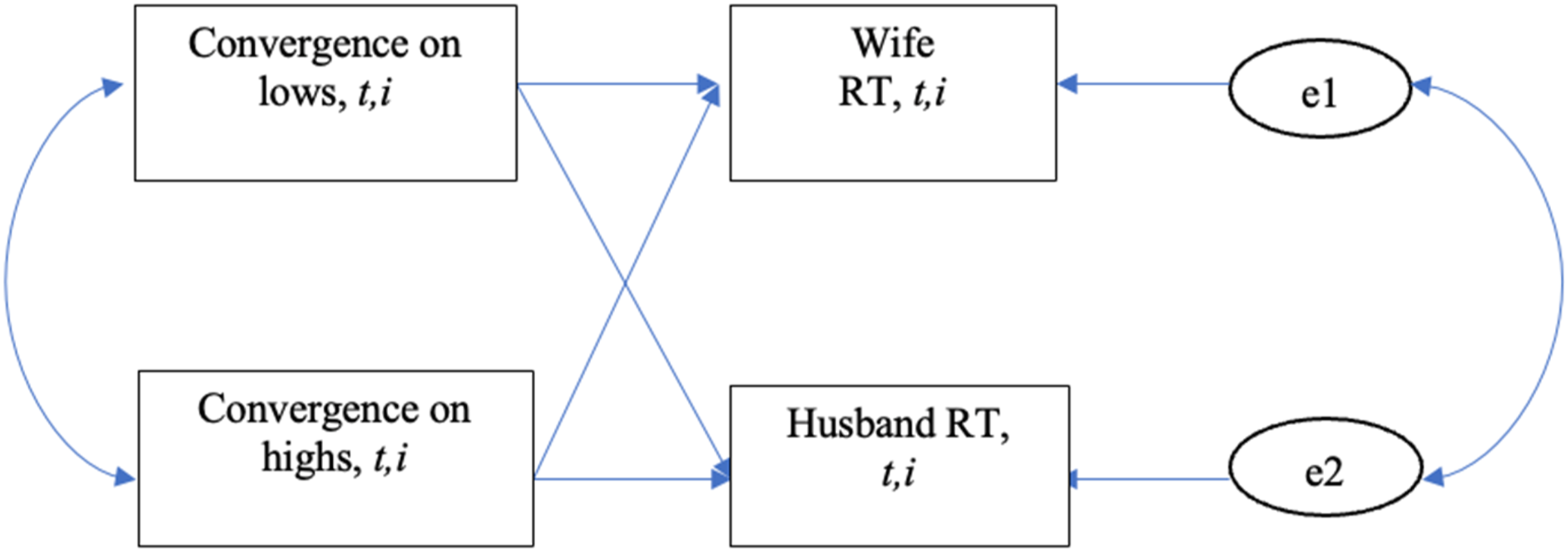
To test H4, we used lagged regression to model pre- to post-test changes in relationship qualities. We constructed 2 path models in MPlus using the means and variance of couples’ emotional convergence across the 10 weeks to predict their post-test marital satisfaction and relational turbulence, respectively. Spouses’ pre-test scores on the dependent variable were included as covariates. Again, partners’ scores were allowed to covary, and we used maximum likelihood estimation and specified the following goodness of fit criteria: χ2/df < 3.00, CFI >.90, and RMSEA <.08 (Kline, 1998).
Within diary associations
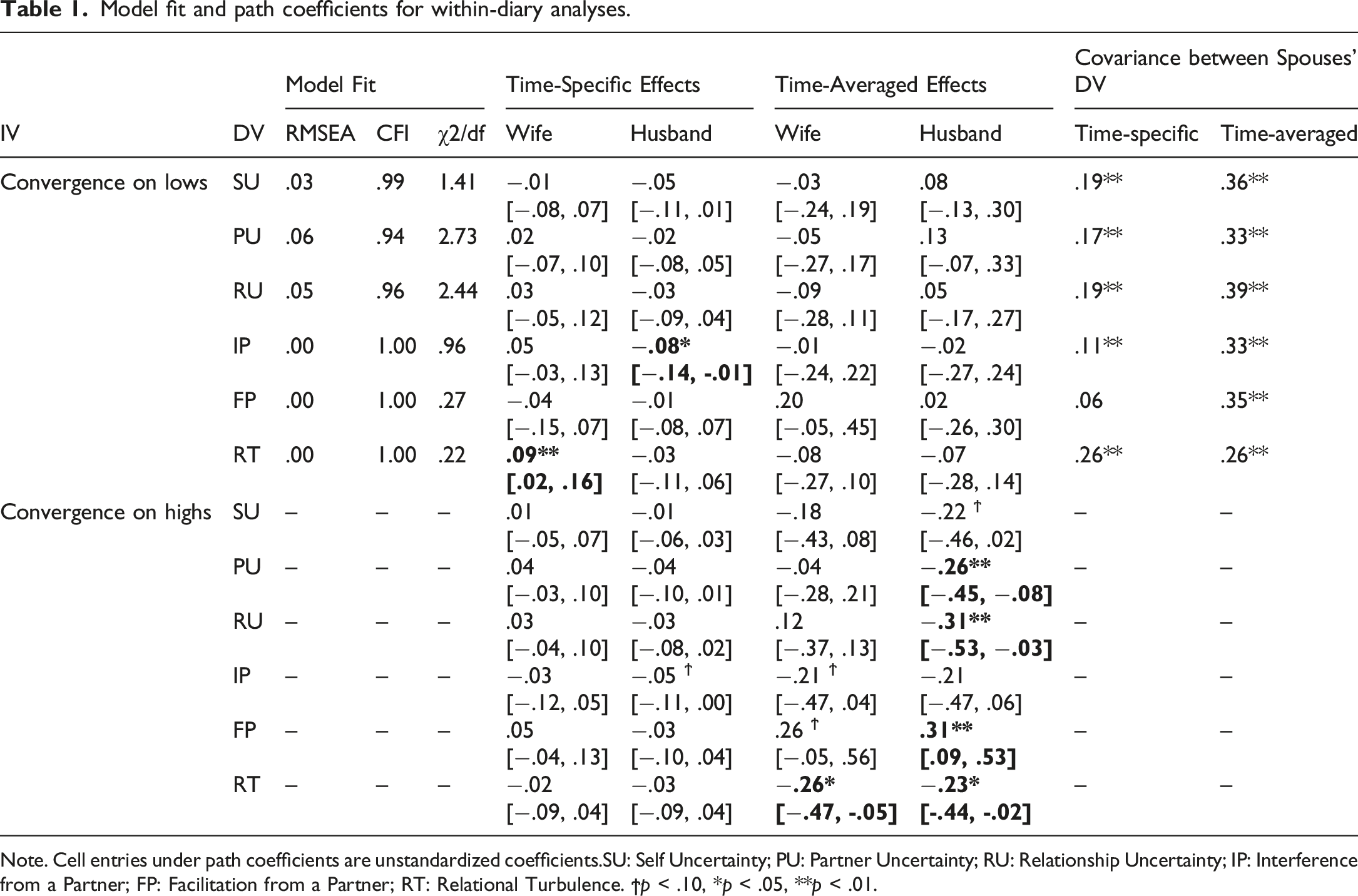
H1 and H2 predicted cross-sectional associations between emotional convergence and relationship qualities. H1 examined associations between scores on the variables averaged across the 10 diaries, and H2 assessed the associations between couples’ weekly fluctuations around their 10-week average for the variables. To test them, we constructed 6 separate multilevel models with time-specific (level 1) and time-averaged (level 2) emotional convergence on lows and highs predicting spouses’ relationship evaluations. All models met the criteria for good model fit.
Model fit and path coefficients for within-diary analyses.
Note. Cell entries under path coefficients are unstandardized coefficients.
SU: Self Uncertainty; PU: Partner Uncertainty; RU: Relationship Uncertainty; IP: Interference from a Partner; FP: Facilitation from a Partner; RT: Relational Turbulence. ϯp < .10, *p < .05, **p < .01.
H2, which predicted time-specific effects, received mixed support (see Table 1). Couples’ weekly deviations from their typical level of convergence in lows were negatively associated with husbands’ interference from a partner within the same week (β = −.08, p = .03), aligning with H2b, but they were positively associated with wives’ relational turbulence (β = .09, p = .01), contradicting H2c. In other words, weeks when couples reported more convergent lows than is typical for them, wives experienced greater relational turbulence, but husbands perceived less interference from their partner in the same weeks. All other paths were nonsignificant.
Over-time diary associations
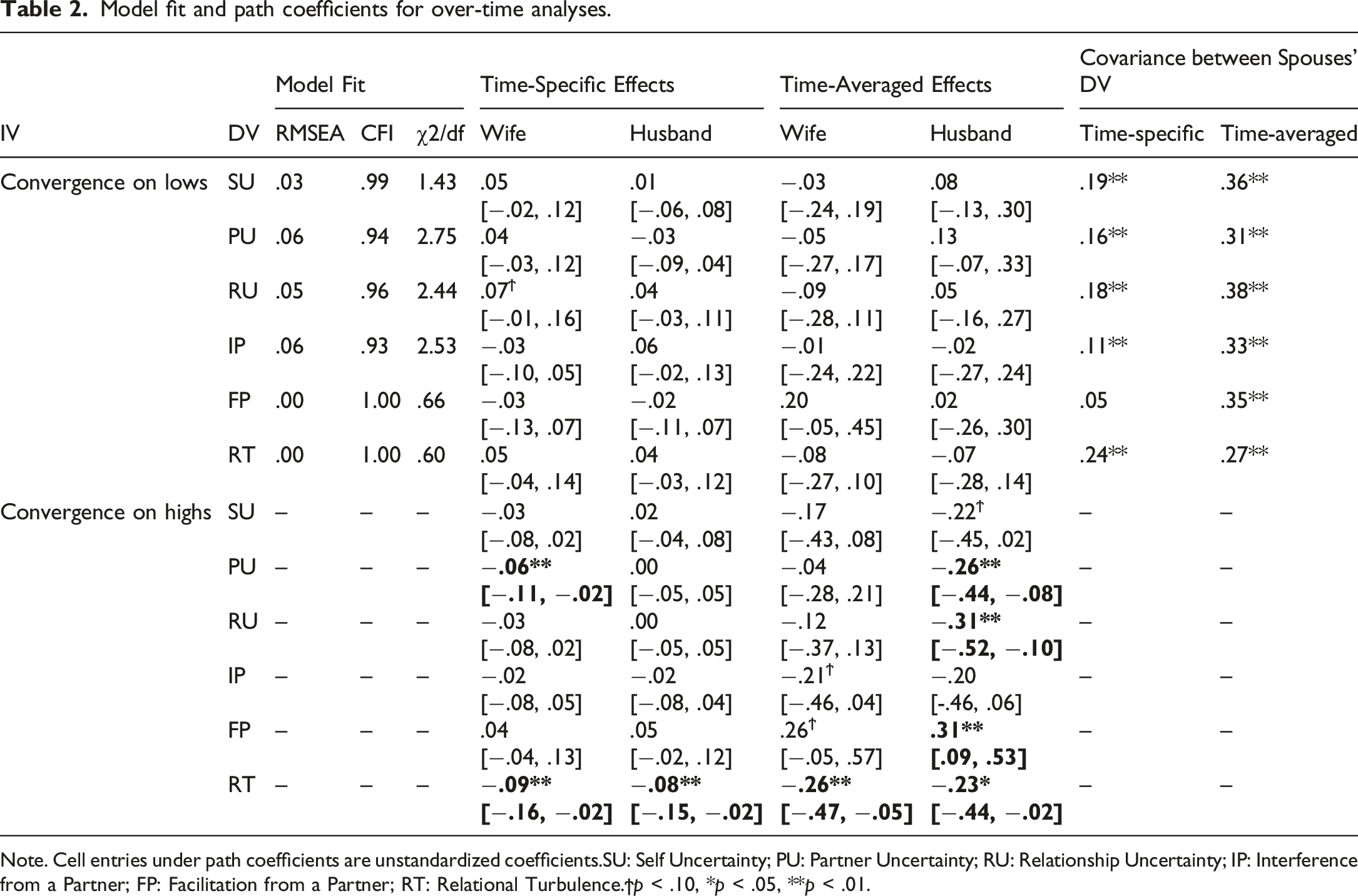
H3 predicted emotional convergence on a given week affects relationship states assessed in the following week. To test this, we conducted separate over-time multilevel analyses using emotional convergence at time t – 1 to predict spouses’ scores on each of the 6 dependent variables at time t. Partners’ scores on the dependent variable assessed in the previous week were included in the time-specific portion (level 1) of the models to control for temporal correlation. The time-averaged portion (level 2) of the models were identical to those created for testing same-week associations. 10 All models met the criteria for good model fit.
Model fit and path coefficients for over-time analyses.
Note. Cell entries under path coefficients are unstandardized coefficients.
SU: Self Uncertainty; PU: Partner Uncertainty; RU: Relationship Uncertainty; IP: Interference from a Partner; FP: Facilitation from a Partner; RT: Relational Turbulence.
ϯp < .10, *p < .05, **p < .01.
Changes of global relationship qualities between pre- and post-test
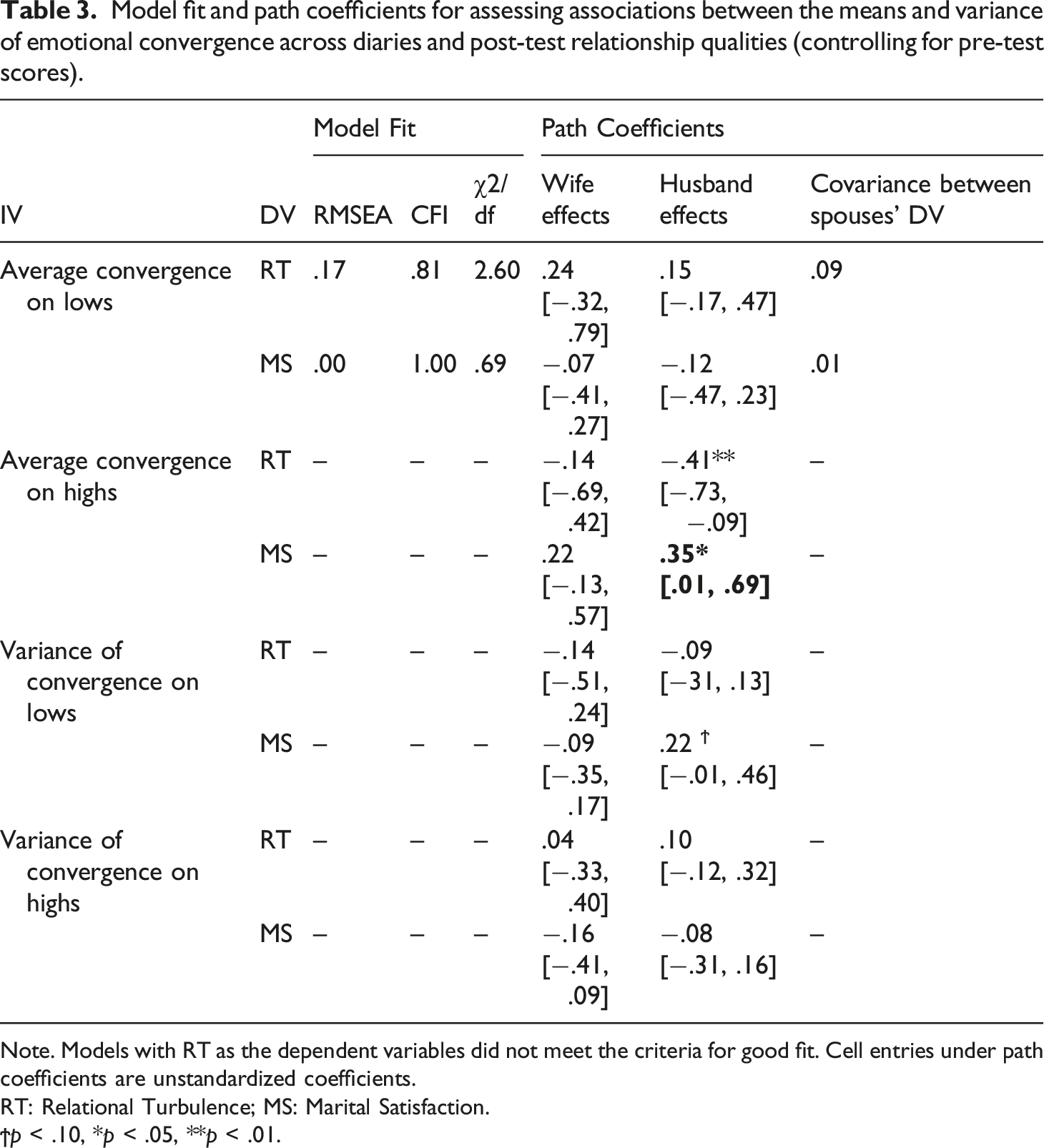
Model fit and path coefficients for assessing associations between the means and variance of emotional convergence across diaries and post-test relationship qualities (controlling for pre-test scores).
Note. Models with RT as the dependent variables did not meet the criteria for good fit. Cell entries under path coefficients are unstandardized coefficients.
RT: Relational Turbulence; MS: Marital Satisfaction.
ϯp < .10, *p < .05, **p < .01.
The model assessing marital satisfaction met the criteria for good model fit, but the model assessing relational turbulence did not fit adequately. Average convergence in highs was positively associated with husbands’ marital satisfaction at post-test (β = .35, p = .04), whereas average convergence in lows was not associated with either spouse’s post-test marital satisfaction. Thus, H4a received partial support for convergence in highs, but only for husbands. Because the model assessing relational turbulence did not fit well, H4b was not supported.
Convergence in emotional highs versus lows
Finally, we asked whether the associations between emotional convergence and relationship evaluations are different for high and low experiences. Across the four analyses, convergence in highs demonstrated a greater number of significant associations with outcome variables than convergence in lows. Specifically, H1, H3, and H4 all received partial support, but only for convergence in highs. The effect of convergence in lows was found only in the over-time analyses (H2), such that it reduced husbands’ perception of partner interference, and augmented wives’ experience of relational turbulence, in the subsequent week. Thus, emotional convergence appears to relate differently to relationship outcomes depending on its valence, with convergent highs being consistently beneficial, and convergent lows having divergent impact on husbands and wives.
Discussion
The primary aim of the current research was to examine whether married couples’ convergent emotional experiences are associated with relationship qualities highlighted by relational turbulence theory (RTT). Using a 12-week longitudinal design, we inspected their associations within the same week, from one week to the next, and from pre-test to post-test. Across these analyses, we found spouses’ convergence in emotional highs to be more predictive of relationship outcomes compared to convergence in lows. Spouses who typically converged more in weekly high experiences had lower levels of relational turbulence on average, and the husbands also reported lower levels of partner and relationship uncertainty and felt more facilitation from their partner. Moreover, weeks when couples had more convergent high experiences than is typical for them, both spouses reported less relational turbulence in the following week, and the wives experienced less partner uncertainty in the following week. These associations are in line with our predictions based on the logic of RTT, and they demonstrate the utility of convergent highs in alleviating turbulent relationship experiences. Notably, the benefits of convergent highs appeared more robust for relational turbulence than for relationship conditions giving rise to turbulence. This suggests that convergent high experiences may reduce relational turbulence through mechanisms other than relational uncertainty or partner interference and facilitation. For example, previous research showed that feeling similarly as others helps dampen individuals’ stress response (Townsend et al., 2014), which may serve to reduce one’s experiences of relational turbulence. Sharing joyful experiences also facilitates positively valenced interactions, which, according to RTT, can break the negative cycle that spirals into relational turbulence (Solomon et al., 2016). Accordingly, we suggest future research explore the effects of convergent dyadic emotions on partners’ subsequent stress level and communication quality to test and clarify these potential mechanisms.
That convergent lows were less predictive of relationship functioning than convergent highs is consistent with prior research demonstrating mixed effects of shared negative affect (Brown et al., 2022; Schade et al., 2020). One explanation is that the relational processes underlying shared negative affect can be divergent. Partners may share each other’s distress through compassion and dyadic coping, which tends to promote relationship health, but negative affect can also stem from conflict and criticism, which likely hurts relationship quality. Indeed, Anderson et al. (2003) cautioned that whereas similar patterns of emotional responding should be generally beneficial, specific contexts may render emotional dissimilarity rather than similarity more advantageous. In addition, our results indicate that weekly increase in convergent low experiences was beneficial for husbands but harmful for wives. In accounting for this divergent effect, we reckon it may be due to the asymmetry in couples’ emotional convergence. Previous research has found relationship partners with less power tend to make more of the change necessary for convergence to occur (Anderson et al., 2003). This may take the form of imbalanced emotion work (Erickson, 2005), where one partner makes more of an effort to enhance the other person’s emotional well-being. Although we did not analyze the sources of couples’ convergent lows, it is possible that they were oriented more towards the husbands’ concerns or the communal issues within a relationship than towards the wives’ own concerns, in which case sharing those experiences would be a relief for husbands but a burden for wives. Future research can examine the symmetry of spousal emotional convergence by looking into the specific contents of their shared experiences.
In addition to relationship perceptions based on experiences within a particular week, we also investigated how convergence relates to changes in global relationship qualities over 12 weeks. Consistent with the aforementioned benefits of convergent highs, couples’ average level of convergence in highs positively predicted husbands’ increase in marital satisfaction over three months, although this effect was not observed for wives. We also expected the variance with which couples reported convergent emotions to be positively associated with their increase in overall relational turbulence, but the path model testing this hypothesis did not fit well. The poor model fit may have been due to our limited sample size, but two other reasons also merit consideration. First, highs and lows are only a subset of the emotions couples experience in a week, and thus spousal convergence in identifying high and low experiences may not represent their overall level of emotional similarity in responding to daily events, which might still have implications on relational turbulence. Second, it may be that relational turbulence was associated more strongly with the highs and lows of one’s own emotional experiences than with the extent to which those experiences were shared by a partner. Theory and research have established intense emotions as both antecedents and outcomes of relational turbulence (King & La Valley, 2019; Knobloch et al., 2007; Solomon et al., 2016). Although experiencing similar emotions as a partner can confer some benefits, they may not be enough to offset the impact of otherwise polarized, emotionally charged episodes. Therefore, future work should assess the association between shared emotions and relational turbulence after adjusting for the intensity of individuals’ own affect.
Overall, our findings join a broader body of research linking emotional similarity and convergence, especially shared positive affect, with interpersonal affiliation and relationship health (Brown et al., 2022; Levavi-Francy et al., 2020; Sels et al., 2020). In addition, our research also extends that literature in a number of ways. First, we presented a different approach of assessing convergent emotions. Instead of quantifying emotion type and intensity using affect scales, we contextualized couples’ emotional experiences by asking people to elaborate on the events and episodes giving rise to their emotions, and we emphasized the correspondence between partners’ recall and interpretations of important emotional events rather than how similarly they reacted initially. Although highs and lows do not encompass the full range of emotions people may experience, our results demonstrated that spouses’ convergence in recalling such experiences has notable bearings on their relationship functioning.
A second contribution of the study is the adoption of a different time frame. The choice of time scale has important implications for observing and understanding interpersonal emotional dynamics because the same phenomenon can involve different processes and mechanisms when examined over different lengths of time (Butler, 2011). Whereas previous studies either took many repeated measures over short periods of time or had two assessment points separated by a long interval, our study assessed emotional experiences weekly for 10 weeks, which allowed us to compare experiences week-to-week rather than every day or every few seconds, and to link weekly fluctuations in emotional similarity to ongoing changes in relationship evaluations. Our data suggest that even if partners had different emotional experiences on a day-to-day or moment-to-moment basis, subsequent communication and coordination may help them align their understanding of an event and reach common grounds.
Finally, this is the only study we know of that has examined over-time associations between couples’ emotional similarity and relationship assessments. Although intensive longitudinal data are fairly common in this line of research, most analyses focused on how emotional similarity relates to global or concurrent relationship qualities, and thus their results did not speak to the causal direction of the associations. Our study found evidence that weekly convergence in emotional highs can reduce both spouses’ relational turbulence, and wives’ partner uncertainty, in the following week. Looking forward, we see value in future work exploring the possibility of reciprocal associations between emotional convergence and relationship qualities across time.
Strengths and limitations
The results of this study are qualified by the strengths and limitations of its methods. First, the relatively small sample size gave us limited power to detect significant results, and although participants were recruited across the United States, our sample is not random, consists only of heterosexual, generally satisfied couples, and lacks cultural diversity, which limits the generalizability of our findings to other populations. Second, although focusing on high and low experiences allows the comparison of subjectively important experiences, it does not capture the full range of emotions people experienced in a week, and therefore spousal convergence in highs and lows may not represent their overall degree of emotional similarity. It is possible for couples who identified different highs and lows to be highly congruent in their less intense experiences, which may still be relevant for understanding the functioning of their relationship. A third limitation of the study is it did not analyze the sources of couples’ convergent emotional experiences. A couple’ convergent emotions may be oriented towards either partner, aspects of the relationship, or external matters. Information about the contents of dyadic emotions can shed light into the shared foci of the dyad, representing another worthwhile avenue for future research. Finally, our data were drawn from a larger project investigating married couples’ experiences of work-related disruptions during the COVID-19 pandemic. Although we believe the associations uncovered here extend to other transitional and non-transitional contexts, it is possible that the unique challenges of the pandemic or the specific stressor of work-related changes may have affected the associations between convergent emotions and relationship quality. Future research should explore whether the effects of emotional similarity may be moderated by characteristics of the stressor or transition, such as its severity, controllability, and whether it originated within or outside of the household.
Conclusion
In this study, we documented married couples’ convergent high and low experiences and examined their associations with relationship perceptions during the COVID-19 pandemic lockdown. We found evidence that spousal convergence on highs has benefits for relationship functioning, whereas convergence on lows was less influential. This study extends the literature on emotional similarity in romantic dyads and invites further research on how couples’ emotional life both shapes and is shaped by their relationship environment.
Supplemental Material
Supplemental Material - Relational turbulence and couples’ convergence and divergence in weekly highs and lows during three months of the COVID-19 pandemic lockdown
Supplemental Material for Relational turbulence and couples’ convergence and divergence in weekly highs and lows during three months of the COVID-19 pandemic lockdown by Shaochun Li, Denise Haunani Solomon, and Kellie St.Cyr Brisini in Journal of Social and Personal Relationships
Footnotes
Author’s notes
This paper was completed as the first author’s MA thesis under the direction of the second author. We are grateful to Dr. Xi Tian for her help with the coding process and to Payton Breidinger, Sie Kim, Caroline Sene, and Cassidy Zapico for their service as undergraduate research assistants.
Declaration of conflicting interests
The author(s) declared no potential conflicts of interest with respect to the research, authorship, and/or publication of this article.
Funding
The author(s) received no financial support for the research, authorship, and/or publication of this article.

Open research statement
As part of IARR’s encouragement of open research practices, the authors have provided the following information: This research was not pre-registered. The data used in the research are available upon request. The data can be obtained by emailing:
Supplemental Material
Supplemental material for this article is available online.
Notes
References
Supplementary Material
Please find the following supplemental material available below.
For Open Access articles published under a Creative Commons License, all supplemental material carries the same license as the article it is associated with.
For non-Open Access articles published, all supplemental material carries a non-exclusive license, and permission requests for re-use of supplemental material or any part of supplemental material shall be sent directly to the copyright owner as specified in the copyright notice associated with the article.
