




Abstract
Dating disagreements consist of divergences between partners’ opinions or needs. When left unresolved, dating disagreements may escalate into conflicts and even sometimes, to dating violence perpetration (DVP). Several risk factors have been documented for conflicts and DVP in adolescents, such as stress, attachment insecurities, and prior DVP, but they have never been explored in association with the events that usually precede conflicts and DVP: disagreements. This study aimed to examine (1) how adolescents’ variations in daily stress and attachment are associated with their probability of experiencing daily disagreements and their resolutions, and (2) whether adolescents’ DVP history moderates these associations. A sample of 216 dating adolescents answered a baseline questionnaire measuring DVP in the prior year and completed a 14-day online assessment of their stress, attachment states (anxiety, avoidance), dating disagreement occurrence, and resolution. Multilevel models indicated that on days when adolescents reported being more stressed or avoidant than usual, probability of disagreement occurrence was higher and of resolution weaker. Interaction effects of prior DVP were found for within and between-level attachment anxiety and between-level stress. Daily variations in stress and attachment may make adolescents vulnerable to disagreement, notably for those with prior DVP experiences. These findings support the relevance of examining daily variations in risk factors of dating disagreements and provide cues to enhance healthy dating relationships promotion programs developed for youth.
Keywords
Introduction
Dating disagreements refer to divergences in opinions, expectations, or needs between partners that, when left unresolved, can escalate into conflictual interactions (i.e., discussions with a highly negative emotional charge; Laursen & Jensen-Campbell, 1999; Winstok, 2008). While disagreements occur in every relationship, North American studies indicated that they are, in most cases, successfully resolved (Todorov et al., 2021) and are not usually occurring on a daily basis (Fortin et al., 2021; Lapierre et al., 2023; Rogers et al., 2018). Partners resolve disagreements by finding common ground and lowering the interaction’s emotional charge (Laursen & Jensen-Campbell, 1999). However, when they do not, partners increase their odds of experiencing dating violence (Burk & Seiffge-Krenke, 2015; Fortin et al., 2021; Ha et al., 2019). Dating violence consists of any behavior that “causes physical, psychological, or sexual harm” to the partner to whom it is directed toward (Krug et al., 2002, p.89). Rates of dating violence among North American adolescents are relatively high, with approximately 50% of youth having experienced dating violence, either as victims or perpetrators (Wincentak et al., 2017; Ybarra et al., 2016). While dating violence perpetration (DVP) often stems from disagreements (the starting point of the escalation process) between dating partners (Capaldi and Langhinrichsen-Rohling, 2012; Fernet et al., 2016), to our knowledge, only three studies have examined daily disagreements in adolescents. The first one was conducted in the United States by Rogers and colleagues (2018) with 196 adolescents, which found that daily disagreements were associated with a negative emotional experience that same day. More recently, in two previous papers with the same sample as the current study, it was found that Canadian adolescents have approximately two dating disagreements a week, and that experiencing a disagreement is associated with lower same-day relationship satisfaction (Lapierre et al., 2023; Todorov et al., 2021). We know little about the risk factors associated with the occurrence and resolution of dating disagreements, even though such information may help in the design of efficient prevention strategies for DVP. Multiple individual and relational factors, such as insecure romantic attachment and stressful life events, have been identified as risks for DVP over time (Duval et al., 2020; Vagi et al., 2013) and as even having a role sooner in the escalation process, that is, when disagreements first arise.
Romantic attachment
Attachment is developed in childhood through initial contact with caregivers, usually parents, who ensure child survival (Bowlby, 1979). The quality of these early relationships, through the development of an internal working model of the self, others, and attachment-based relationships, determines how intimate, romantic relationships are experienced in later life (Brennan et al., 1998; Noonan & Pilkington, 2020). According to the tenants of romantic attachment, attachment can be conceptualized using two dimensions: the anxiety toward separation and abandonment and the avoidance of proximity (Brennan et al., 1998). Attachment anxiety refers to the degree of anxiety one feels when faced with a real or imagined threat of rejection and abandonment from a partner, while attachment avoidance refers to the degree of discomfort and distrust one feels in an intimate context (Brennan et al., 1998). According to this theory, disagreements may emerge when partners’ needs and expectations concerning intimate proximity are at odds (Feeney & Fitzgerald, 2019; Fournier et al., 2011). Insecure attachment (i.e., high attachment anxiety and avoidance) has frequently been highlighted as a key risk factor for intimate conflict and violence perpetration in both youths and adults (Spencer et al., 2021; Velotti et al., 2020).
Romantic attachment is known to vary with time (Fraley et al., 2011), and recent data suggests that it may even change over days (Gou, 2019; Haak et al., 2017). Fraley et al. (2011) first documented the variability of attachment across time using daily measurements (1 measure per day for 1 month) and then using weekly measurements (1 measure per week for 1 year). Their findings revealed that attachment fluctuates significantly from day to day and month to month and that a latent construct model, in which a stable attachment trait underlies temporal variations of attachment state, can be observed. These results support the hypothesis that individuals experience observable micro-variations in their attachment (i.e., attachment state), and that these variations together make up a more stable attachment model (i.e., attachment trait). Daily attachment would thus consist of a transient internal state in which the level of attachment insecurities fluctuates in response to a perceived threat of abandonment or rejection (attachment anxiety) or a perceived partner’s attempt at intimate bonding (attachment avoidance). These variations could result from internal (e.g., thoughts) or external (e.g., partners’ behaviors) triggers. Daily variations in attachment could be a useful source of information to predict the occurrence of an intimate phenomenon that varies in time, such as disagreement occurrence. Results from a 7-day study involving 234 college students showed that time variations in attachment insecurity within an individual (i.e., intra-individual variations) better explained the occurrence of physical DVP than inter-individual variations (i.e., being higher on attachment insecurity than other participants in the sample; Haak et al., 2017). Because of attachment’s clear association with DVP in adolescent samples (Emanuels et al., 2022) and the link between attachment’s variability and DVP that was recently supported in adults (Haak et al., 2017), attachment could be a situational risk factor for the occurrence of disagreements by determining whether the days on which adolescents report higher than usual anxious or avoidant attachment states are also the days on which they have more disagreements with their partner. However, to our knowledge, this hypothesis has never been examined. Also, the associations between conflictual interactions or attachment and DVP (Burk & Seiffge-Krenke, 2015; Veloti et al., 2020) suggest that adolescents who have previously perpetrated dating violence may be involved in more disagreements with their romantic partner and less able to resolve them. Hence, it is also possible to hypothesize that prior DVP could moderate the association between attachment and disagreement occurrence and resolution, as prior DVP experiences could lead adolescents to be more sensitive to abandonment or rejection threats (Velotti et al., 2020).
Stress
Dating violence perpetration experiences in adolescents have also been associated with stress (Chen & Foshee, 2015). While stressful events are likely to occur throughout life, they are especially prevalent in adolescence (Arnett, 2010), when a cascade of cognitive, psychological, and physical changes are experienced and challenging, especially when faced in romantic relationships (Harper & Welsh, 2007). Although stress is unavoidable and intense in adolescence (Anniko et al., 2019), and that stress levels have increased significantly over the past decades, now rivaling adult levels (Bethune, 2014), it remains poorly documented, particularly in terms of how it affects adolescent dating relationships. It is well established that stress plays a critical role in how we perceive and experience close relationships (Afifi et al., 2016). In adults, levels of stress and life stressors have been associated with marital satisfaction and functioning (Randall & Bodenmann, 2009), intimate conflictual interactions (Story & Repetti, 2006) and intimate partner violence (Yim & Kofman, 2019). However, stress has never been examined specifically in association with disagreements or conflicts in adolescent dating relationships, although it has been associated with DVP. Shortt and colleagues (2013) were among the first to investigate stress levels in young adults and found that those who self-reported being more stressed were also more likely to engage in psychological DVP in their dating relationships. A similar association was also found between self-reported stress and overall DVP (i.e., all types of violence combined, Ngo et al., 2018). Finally, Chen and Foshee’s (2015) findings indicated that the number of stressful life events within the past year was positively associated with physical and psychological DVP seven months later.
Given the well-documented and long-established links between stress and marital functioning in adulthood (Randall & Bodenmann, 2009; Story & Repetti, 2006), as well as the links between stress and DVP in adolescence (Chen & Foshee, 2015; Ngo et al., 2018), it is relevant to consider stress as a possible risk factor for romantic disagreements in adolescence. Stress is well known to fluctuate over days. Such fluctuations have been successfully measured in adolescents’ and adults’ psychology, health, and educational studies (e.g., Bartley & Roesch, 2011; Hsu & Raposa, 2021). Prior studies have underscored the need to examine whether adolescents' daily variations in stress are associated with romantic disagreements and successful resolution. Moreover, considering the associations between stress and DVP (Chen & Foshee, 2015; Ngo et al., 2018), adolescents with prior DVP may be more sensitive to variations in stress, and thus stress contribution to the risk of experiencing and resolving disagreements may be different for them.
The use of ecological momentary assessments design
Until now, most studies on adolescent disagreements and conflicts in dating relationships have relied on either laboratory observations of couple interactions (e.g., Courtain & Glowacz, 2019; Fernet et al., 2016; Paradis et al., 2017), which have limited ecological validity, or retrospective data collection, which is prone to recall and selection biases (Laurenceau & Bolger, 2005). Event-level designs using proximal data collection strategies have been identified as promising methods to overcome these limitations (Laurenceau & Bolger, 2005; Seidman & Burke, 2015), and have been successfully used to examine family violence (Cunradi et al., 2013). Until now, research on adolescent dating has focused on identifying distal risk factors for dating conflict and violence (e.g., attachment, prior DVP experiences, peers’ victimization, childhood maltreatment), with the goal of documenting who is more likely to experience conflictual interactions and dating violence in their relationship (Duval et al., 2020; Hébert et al., 2019; Vagi et al., 2013; Velotti et al., 2020). Adolescents with such risk factors do not, however, experience conflict every day. Thus, a more precise understanding of situational risk factors is important to better identify the contexts in which disagreements are triggered. Identifying proximal antecedents that lead to couple disagreements could provide useful information for the refinement of communication skills and conflict management programs.
Current study
This study aims to examine the role of prior DVP experiences and situational variations in risk factors in disagreement occurrence and resolution. Specifically, two multilevel models were proposed to analyze the intra- and inter-individual effects of daily attachment insecurity (anxiety, avoidance) and stress on the probability of disagreement occurrence and resolution. Situational risk factors, such as daily variations of stress and attachment state, should be studied because they may represent a temporally immediate vulnerability for disagreement and conflict. Considering the correlations between stress and attachment and DVP, as well as between conflictual interaction and DVP (Chen & Foshee, 2015; Ha et al., 2019; Velotti et al., 2020), we hypothesized that adolescents with a history of DVP would be more likely to have their disagreement experience affected by variations in attachment intimacy (e.g., partner’s withdrawal) or stress levels. According to learning theories, prior emotional experiences and emotions shape our appraisal and enactment of future experiences (Skinner, 1950). Hence, adolescents who have experienced disagreement escalation (conflictual interactions and, in worst cases, DVP) may be more hypersensitive to escalation triggers in future disagreements (e.g., estrangement of the partner, attachment insecurity), exacerbating their fear of relationship quality impairment and dissolution, but also the probability of actual disagreements. Higher frequencies of DVP suggest that many disagreements are left unresolved. Grounded in learning theories (Skinner, 1950), we expected DVP to moderate the association between daily variations of stress, attachment, and disagreement resolution. Following these hypotheses, the moderation effect of prior DVP has been tested in two multilevel models (disagreement occurrence; disagreement resolution) to examine if it interacts with adolescents’ daily attachment insecurity and stress.
Method
Participants
A total of 216 adolescents aged 14–19 years (M = 17.03 years, SD = 1.49) were recruited in the Greater Montreal Area. The sample consisted of adolescents who reported being in a relationship for at least one month without cohabiting with their partner. A dating relationship was defined as “More than a date, it is an ongoing intimate relationship of four weeks or more with the same person”. Over half of participants reported being assigned female at birth (57.4%). Almost two-thirds were born in Canada from two Canadian-born parents (63.4%), while others were born in Canada from one foreign-born and one Canadian-born parent (8.8%), or from two foreign-born parents (9.7%), or were born outside of Canada (18.1%). Over half had a mother who completed a bachelor’s degree (57.9%). The majority reported French as their first language (85.3%), while the rest indicated English (11.1%), or Arabic, Bulgarian, Spanish, Dutch, Kabyle, Moldavian, Portuguese, Romanian, or Russian as their native language (3.6%). Regarding ethnicities, most participants self-identify as Quebecers (72.7%). All other participants reported being North-African, West-European, Latinx, East-European, First Nations, Asian, Caribbean, Black, or of another ethnic background. The mean partner age was 16.90 years (SD = 1.72; range = 13–24), and for a sizable minority (40.3%), this was their first relationship, with a duration of at least one year (41.2%). Some participants identified as belonging to the LGBTQIA + community, with 5 participants (2%) indicating being engaged in a same-sex relationship, and 1 self-identifying as transgender. Others reported being involved in a romantic relationship with a person of the opposite sex, and having a cisgender identity. Most participants (86.1%) reported being a student as their principal occupation, while the rest were employed or searching for employment. We did not collect data on participants disability status.
Procedure
Participants were recruited on a voluntary basis in high schools and colleges from the Greater Montreal Area and through social media ads on Facebook and Instagram. When recruited in educational settings, the research project was presented to adolescents in person by a research assistant, either in their classroom or at an information stand set up in the schools’ common areas. Interested participants received information on the research project and procedure, and written consent was obtained. Since parental consent is not legally required in Quebec for participants 14 years of age or older (Loi modifiant le Code civil et d'autres dispositions législatives en matière de recherche. LQ. (2013), c. 17), it was not requested from adolescents who participated in our research. When recruited online, adolescents who had filled out an interest form were contacted by a research assistant for a screening phone interview. After their eligibility was confirmed, they received the same information as youth recruited in person and were invited to complete an online consent form. All participants received a link to access the baseline questionnaire (30–45 min.) by short message service (SMS) or email on the day they gave consent. The next day, and for a total of 14 consecutive days, they received at 8:00 p.m. an SMS or email link to access a daily diary (5-min questionnaire) that assessed their interactions with their partner that day. On days 2, 7, and 12, participants were contacted by phone by a research assistant to ensure their well-being and the proper use of the diaries. Adolescents received $4 for each completed questionnaire (for a maximum compensation of $60). Participants who completed at least 12 out of 14 daily diaries were also eligible to win a $250 gift certificate for the mall of their choice. After adolescents had completed their participation (after 14 days), youth who had reported DVP were questioned about these behaviors and asked whether they were interested in receiving support. Resources for assisting victims of dating violence were also made available to them. Following this procedure, no cases needed to be reported to child welfare authorities. In this project, 3 024 data entries were possible, with a maximum of 14 days for each participant. Overall, adolescents completed 2 795 entries (range = 2–14, M = 12.94 daily diaries, SD = 2.27), for a compliance rate of 92.4%. This project was approved by the Université du Québec à Montréal ethics board.
Measures
Sociodemographic data pertaining to age, sex assigned at birth, education level of the mother, ethnicity, place of birth, relationship status and duration, and partner’s age was collected among participants. Questionnaire items that were originally only available in English were translated into French using back translation and translation audit methods with two native English speakers (French as a second language) and two native French speakers (English as a second language). English-speaking adolescents were given the original questionnaires (all questionnaires were available in English).
Prior year dating violence perpetration
Dating violence perpetration was assessed using the Conflict in Adolescent Relationships Inventory (CADRI, Wolfe et al., 2001), which includes five DVP subscales: threat (4 items; e.g., “I threatened to hurt him/her”), physical DVP (4 items; e.g., “I pushed, shoved, or shook him/her”), relational DVP (3 items; e.g., “I spread rumors about him/her”), verbal DVP (10 items; e.g., “I insulted him/her with put downs”), and sexual DVP (4 items; e.g., “I touched him/her sexually when he/she didn’t want me to”). As formulated by Wolfe et al. (2001), for each item, adolescents were asked to “Check the box that matches your best estimation of how often any of these things have happened with your current boyfriend/girlfriend in the past year” using a 4-point Likert scale ranging from 0 - Never to 3 - 6 times or more. Total DVP scores were computed by adding all subscale scores, as suggested by Wolfe et al. (2001). The CADRI showed high internal consistency with the present sample (α = .84) as it was with Wolfe et al.’s (2001) original sample (α = .83).
Daily stress
Stress variations were assessed daily using a visual analog scale (VAS) as recommended by Stone and colleagues (Stone et al., 1997; Stone & Neale, 1984). Participants were asked, “What was your level of stress today” and recorded their answer using a sliding scale ranging from 0 – Not stressed at all to 100 - Most stressed that I have ever been. This procedure has been used in previous studies with adults and adolescents to document daily emotional variations (e.g., Gil et al., 2003; Porter et al., 2000) and was found to be reliable (Stone et al., 1997).
Daily attachment insecurities to romantic partner
As suggested and successfully used by Haak and colleagues (2016), a 4-item adaptation of the revised version of the Experience in Close Relationships scale (ECR-R, Lafontaine & Lussier, 2003; Sibley, et al., 2005) was used to assess daily attachment anxiety (two items) and avoidance (two items) with a 7-point Likert scale, ranging from 1 - not at all to 7 - a lot. For attachment anxiety, the items were “Today I worried about being abandoned by my partner” and “Today I worried that my romantic partner doesn’t care about me as much as I care about him/her”, and for avoidance, “Today, I preferred not to show my partner how I felt deep down” and “Today, I felt comfortable sharing my private thoughts and feelings with my partner.” (reverse-scored). Daily scores were averaged for each subscale to derive mean daily scores for anxiety and avoidance, with higher scores indicating greater attachment insecurity. Internal consistency was adequate with Omega coefficients (McNeish, 2018), a coefficient better suited for scales comprised of few items and for modeling negative factor loadings (Sideridis et al., 2018). For the anxiety subscale, within-level consistency was ω = .81 (consistency across days within the same individual), and between-level consistency was ω = .99 (consistency across individuals). For attachment avoidance, within-level consistency was ω = .78, and between-level was, ω = .99. Internal consistency was similar to other studies using the ECR-R (e.g., Gou, 2019, anxiety scale, α = .91, avoidance scale, α = .94) and better than the sole study that used it daily (Haak et al., 2017), inter-item correlations for the anxiety (r (591) = .60) and the avoidance (r (354). = .39).
Disagreement occurrence and resolution
Finally, participants were asked if they communicated with their partner that day. If that was the case, they were asked if disagreement occurred that day using a yes/no question: “Were there times today when your opinion differentiated from your boyfriend’s or girlfriend’s (you disagreed about something)?”. Participants who answered yes to this question were then asked to think about the most important disagreement of the day. With the following item, they indicated whether or not it had been resolved: “When thinking of the most important conflict, discussion, or difference of opinion that you have had today, can you say that the situation is resolved?” (yes/no).
Statistical analyses
We conducted a Monte Carlo simulation prior to data collection to determine the required sample size needed to conduct the statistical model of interest (Muthén et Muthén, 2002; Muthén et Muthén, 2015). Our results indicated that, with 14 time points, one within-level variable, and one between-level moderator, 100 participants were needed to detect an effect size of d = .10 with a power of 78.8%. Since analytical strategies are still limited regarding power estimation with multilevel models, the sample size required for the overall model (i.e., 2 within-level predictors and 1 between-level moderator) could not be computed.
Descriptive analyses were conducted using SPSS 24 and SAS (SAS Institute, 2021). Because of the nested nature of the data (14 daily diaries for each of the 216 adolescents), inferential analyses were conducted with the Demands for Academics edition of SAS (SAS Institute, 2021), using a Generalized Linear Mixed Modelling approach (GLMM). This approach allowed for a finer analysis of micro processes that contribute to family violence and couples’ conflicts, such as triggers and situational factors (Assari, 2013; Rose, 2018). It permits the distinction between the effects of inter-individual variations between individuals (e.g., reporting a higher level than the sample mean; between-person) and the effects of intra-individual variations within an individual across time (e.g., reporting a higher level than their own intra-individual average; within-person). To model between-person effects, all variables were grand-mean centered (i.e., the grand mean of all participants was subtracted from each adolescent’s mean score across the 14 days). For within-person effects, all variables were person-centered (i.e., each participant’s mean value on predictors across the 14 days was subtracted from the value at each measurement point).
This study first examined the multilevel effects of attachment anxiety, attachment avoidance, and stress on (1) the probability that adolescents would have a daily disagreement in their dating relationships; and (2) if so, the probability that the disagreement was resolved within that day. To address these objectives and take into account both the between and within effects of daily anxiety, avoidance, and stress, two different multilevel models were estimated using a GLMM approach, one for disagreement occurrence and one for disagreement resolution. Secondly, the study explored how prior DVP interacted with the variables of interest (i.e., attachment anxiety, attachment avoidance, and stress) on the occurrence and resolution of disagreements. For this, prior DVP was included in each model as a same-level and cross-level moderator, respectively, of the between- and within-person effects of anxiety, avoidance, and stress on disagreement occurrence and resolution. Control variables were selected based on prior research on the determinants of conflictual interactions in dating relationships (e.g., Connolly et al., 2010; Giordano et al., 2010; Johnson et al., 2023). They were first included in each model and then removed in the absence of significance. Sex was also incorporated as a moderator in all our models. Since no moderation was significant, these results are not presented. Given the complexity of the models that were used to test our hypothesis (i.e., our aim was to examine how past DVP moderates the associations between risk factors and outcomes), a lack of power may have prevented the detection of a moderation effect for sex, even if such an effect does exist. As it is recommended when conducting multilevel analysis in which the passage of time is taken into account, time was also added to each model as a within-person variable and was person-centered (i.e., centered to the study mid-point), and random effects were allowed for intercepts and slopes (Laurenceau & Bolger, 2005). Finally, a HLM – 2 ways interaction computational tool (Preacher et al., 2006) was used to determine the region of significance of the interactions when moderation effects were found to be significant.
Results
Descriptive statistics
Descriptive Statistics and between-Persons correlations among study variables.
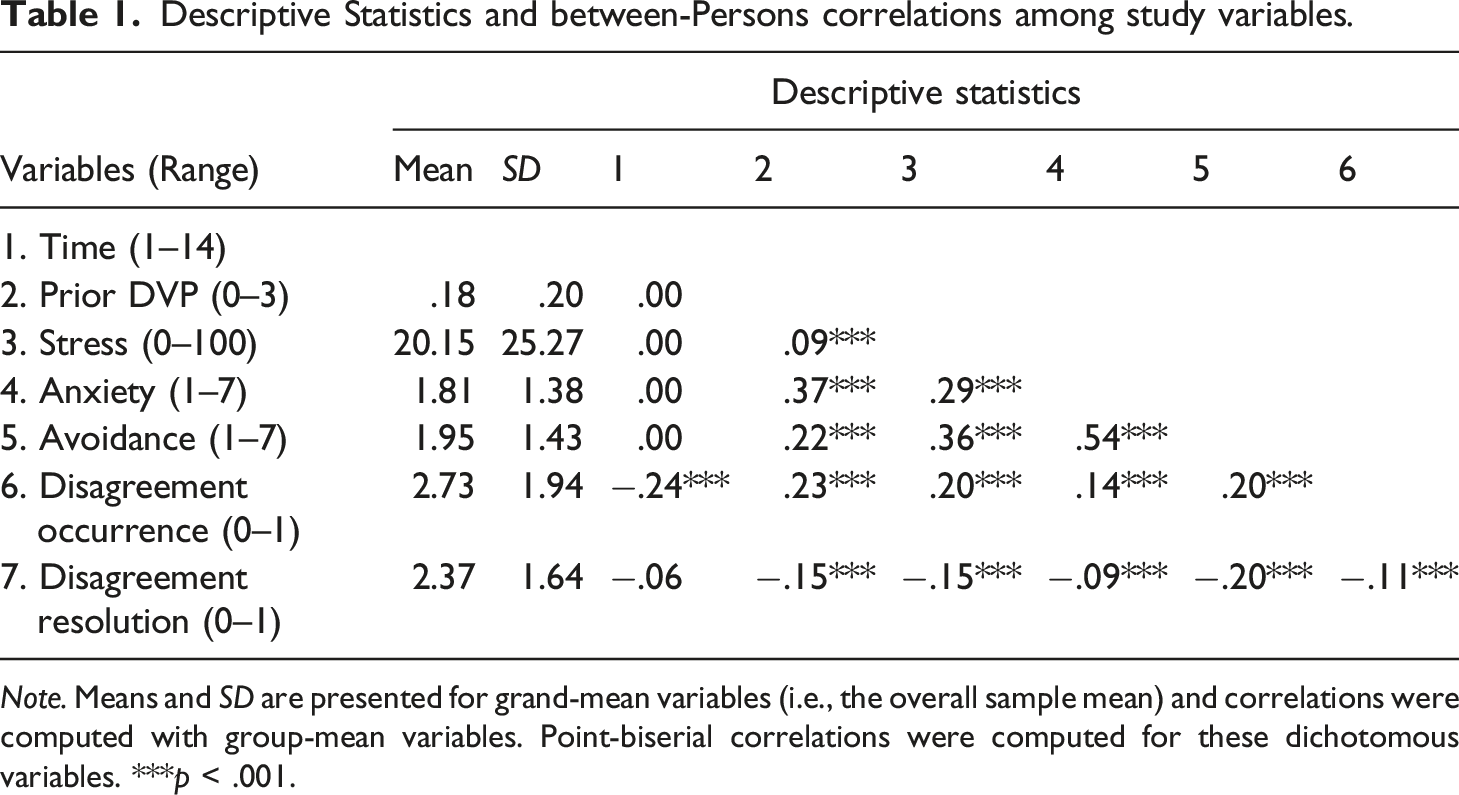
Note. Means and SD are presented for grand-mean variables (i.e., the overall sample mean) and correlations were computed with group-mean variables. Point-biserial correlations were computed for these dichotomous variables. ***p < .001.
Disagreement occurrence
Interaction effects of DVP with attachment and stress on daily Disagreement occurrence.
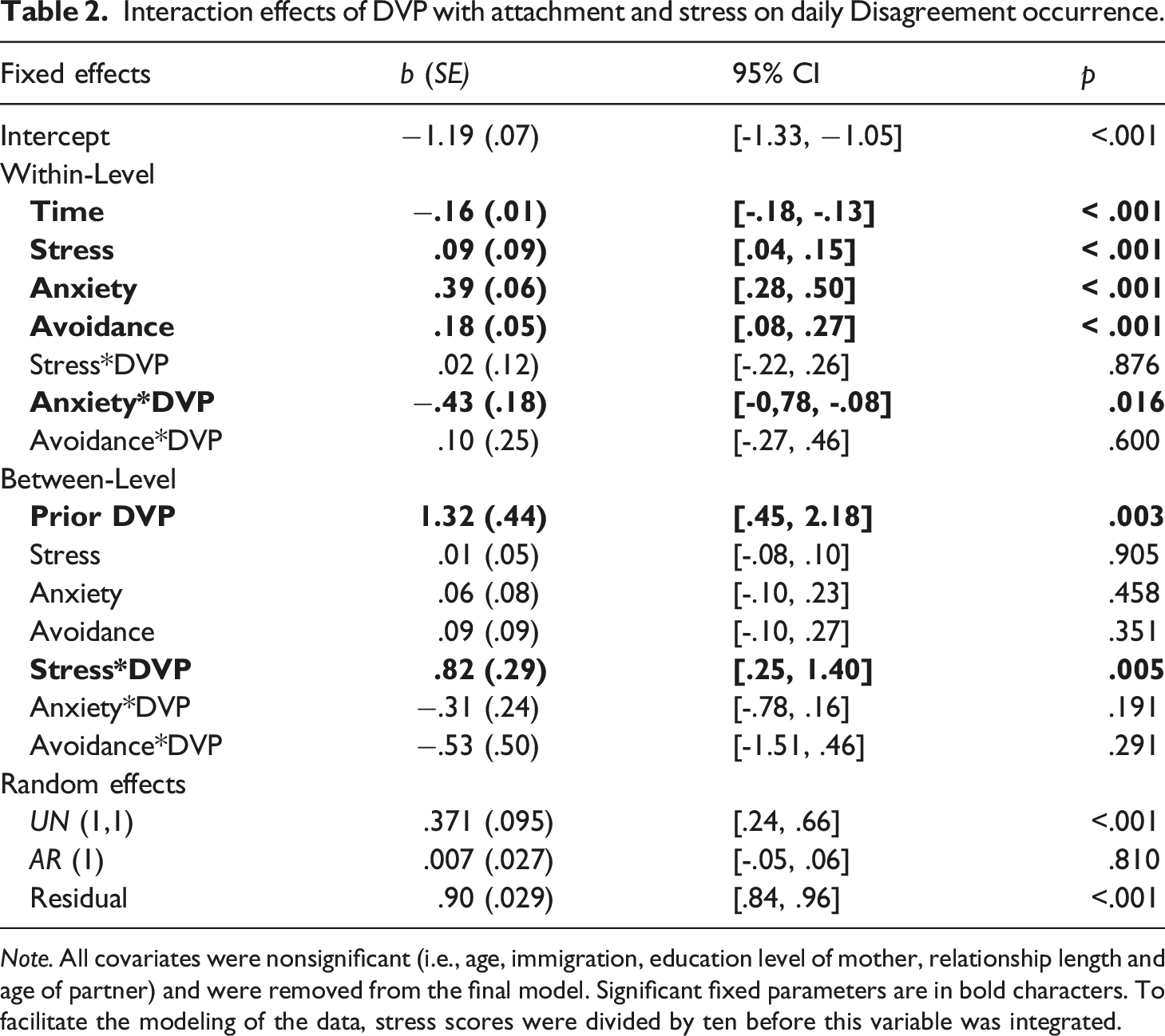
Note. All covariates were nonsignificant (i.e., age, immigration, education level of mother, relationship length and age of partner) and were removed from the final model. Significant fixed parameters are in bold characters. To facilitate the modeling of the data, stress scores were divided by ten before this variable was integrated.
Regarding the moderating role of prior DVP, results of cross-level interactions (i.e., between within and between-person effects) indicate that prior DVP moderation with within-person attachment anxiety was significant (see Figure 1(a)) when levels of the moderator were below .49 units or above 4.40. Thus, adolescents reporting a level of prior DVP that is one point higher than that of their peers, in addition to having a one-unit increase in attachment anxiety on a given day, reduced their risk of experiencing a disagreement that day by 35.0% (OR = .65, p = .014). At the between-person level, one interaction was found to be significant (see Figure 1(b)) when the moderator reaches .14 units. It suggests that for adolescents who reported a higher level of prior DVP and a higher level of stress in comparison to peers, the risk of facing a disagreement in general is two times higher (OR = 2.28, p = .005). Interaction effects of prior dating violence perpetration. (a) DVP interaction effect with daily within-anxiety on daily disagreement occurrence. (b) Dvp interaction effect with daily between-stress on daily disagreement occurrence. (c) Dvp interaction effect with within-stress on daily disagreement resolution. (d) Dvp interaction effect with between-anxiety on daily disagreement resolution.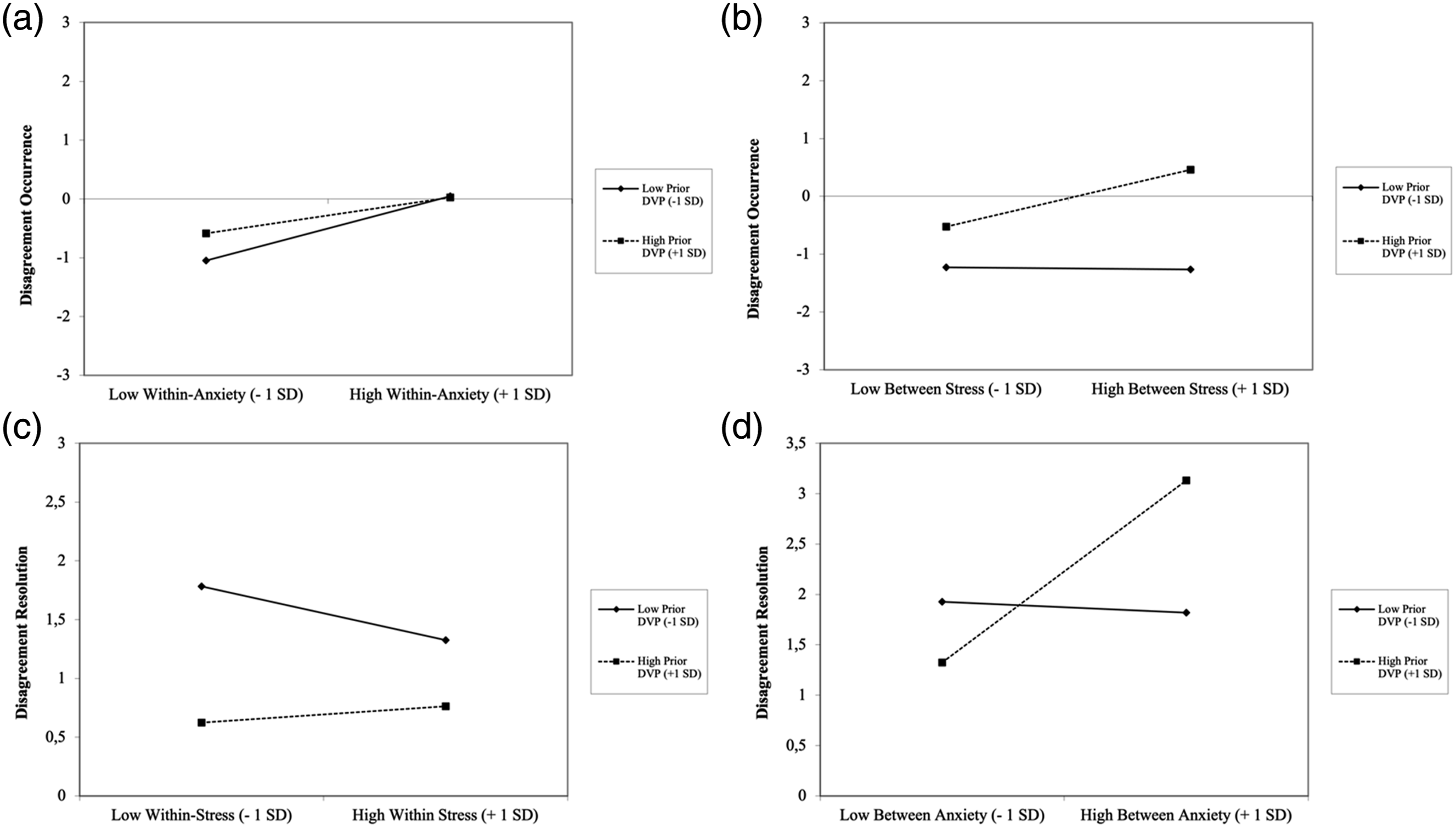
Disagreement resolution
Interaction effects of DVP with attachment and stress on daily Disagreement resolution.
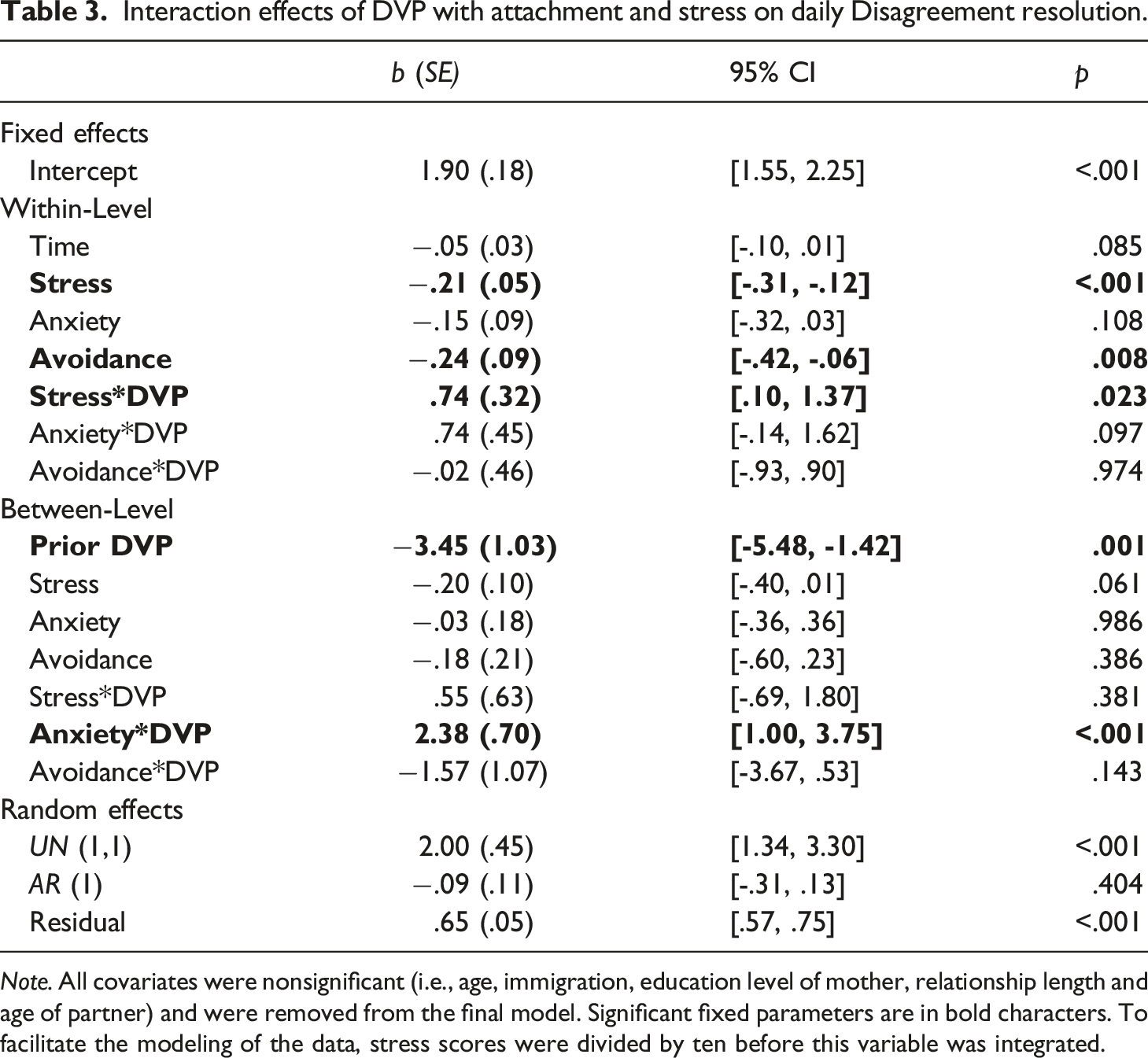
Note. All covariates were nonsignificant (i.e., age, immigration, education level of mother, relationship length and age of partner) and were removed from the final model. Significant fixed parameters are in bold characters. To facilitate the modeling of the data, stress scores were divided by ten before this variable was integrated.
Regarding how prior experiences of DVP interplay with variables of interest in the probability of disagreement resolution, one significant cross-level interaction was found and is represented in Figure 1(c). This effect becomes significant when the moderator is reported to be under .15 or over .92 units. For adolescents reporting a level of prior DVP that is one point higher than their peers, on days when their stress increases by one unit, the probability they resolve the disagreement was two times higher (OR = 2.09, p = .02). At the between-person level, the interaction of prior DVP and attachment anxiety was significant when the moderator’s level was higher than .49 units. In comparison to their peers, adolescents who reported higher DVP and higher attachment anxiety were 10 times more likely to resolve their disagreements (OR = 10.77, p < .001). This interaction effect is represented in Figure 1(d).
Discussion
To better understand when and why disagreements occur in adolescent dating relationships, this study focused on the daily contribution of two risk factors identified for their distal association with DVP: attachment and stress (Chen & Foshee, 2015; Vagi et al., 2013; Velotti et al., 2020). Using an innovative momentary assessment design, this study examined the associations of daily variations in stress and attachment with the risk of having an intimate disagreement and the probability of resolving this disagreement within the same day and explored the moderating effect of prior DVP.
Contribution of daily attachment and stress on disagreement occurrence and resolution
Until now, scientific data has indicated that general stress and attachment style (as stable traits or internal working models) are associated with increased disagreements and conflicts (Chen & Foshee, 2015; González-Ortega et al., 2021; Gou, 2019; Ledermann et al., 2010; Ulloa et al., 2014). Our results showed that on days when adolescents were more stressed or avoidant than usual, they were more likely to experience a disagreement in their dating relationship. These results support the hypothesis that stress and attachment-state variations are observable and measurable in youth and that they are associated with conflict occurrence.
While previous research on stress and attachment did not examine the probability of conflict occurrence, associations with DVP have been documented (Chen & Foshee, 2015; Velotti et al., 2020). In previous studies, having experienced more stressful life events or reporting higher levels of stress was associated with a higher risk of DVP (Chen & Foshee, 2015; Ngo et al., 2018; Shortt et al., 2013). Our study indicated that adolescents’ risk of experiencing a disagreement increased on days when they reported feeling more stressed. Thus, our results expand on earlier findings by showing that stress not only plays a role in adolescents’ violent behaviors in their dating relationships but that, similarly to adults (see Story & Repetti, 2006), it is also associated with the occurrence of disagreements. According to the stress transactional theory which posits that stress and insecurities (e.g., attachment insecurity) impair coping and relational skills (Lazarus & Folkman, 1984), it is likely that when adolescents are more stressed, they are more sensitive to disagreements and are probably less emotionally inclined to engage in positive communication. Regarding attachment, our results showed that a daily elevation of avoidance was associated with a higher probability of disagreements. In accordance with the demand/withdraw patterns’ theory, which suggests that disagreements occur when partners’ needs and expectations regarding intimacy are at odds with one another (Feeney & Fitzgerald, 2019; Fournier et al., 2011), being more avoidant than usual could have led to intimacy discrepancies between partners, thus increasing the probability of experiencing relationship disagreements (Bartholomew & Allison, 2006). The reverse hypothesis is likewise conceivable: experiencing a disagreement may engender a relational distancing among intimate partners and an elevation of avoidance state. Our model also indicated that within-level variations in attachment anxiety contributes to the probability of disagreement occurrence, interacting with prior DVP experiences (will be discussed later). These results are consistent with those of Haak et al., 2017 which indicated that more daily variations in attachment anxiety were associated with an increased risk of physical DVP (measured in young adults with a 12-month reference period), as were daily variations in avoidance, but only for men. Sex was tested as a moderator in our models but was not significant. Based on the findings of Haak et al., 2017, more studies are needed to clarify how daily attachment might have different effects depending on gender.
To our knowledge, our results on the likelihood of resolving daily disagreements are the first available in the adolescent literature on dating relationships and the only ones that explore the associations with attachment and stress. Our models indicated that disagreement resolution probability was significantly decreased by within-variations of stress and avoidance. These results converge with those on adult conflictual interactions, which found that avoidance is related to a lower probability of using efficient conflict resolution strategies (Shi, 2003), and that engaging in discussions using constructive strategies is associated with a lower level of stress (Robles et al., 2006). It would be relevant that future research focus on positive conflict resolution to document in which situations adolescents efficiently succeed in resolving their disagreements and how they do so (e.g., identifying which strategies of conflict management are the most efficient).
In contrast, having a higher level of stress, anxiety, or avoidance than others (i.e., between-level effects) did not increase the likelihood of having a disagreement with one’s partner, or of resolving it. This lack of significant results is surprising given that numerous studies have found distal between-level associations between stress, attachment, and conflictual interactions (e.g., Chen & Foshee, 2015; Velotti et al., 2020). This could be explained by the gap between the reference period that was used in our study (14 days) and the one that was used in other studies (12 months for the most) or by the fact that we used a multilevel modeling approach that separated the effects of time-variations (within-level) and person-variations (between-level), which allowed us to show that there were no meaningful between-level effects. The previous studies only considered between-person differences in their design and analyses. They examined between-level effects in which within-level variations could have been embedded, and their results should therefore be interpreted with caution as they may incorrectly conclude that the differences in outcomes are due to between-individual differences in risk factors. Our findings add significantly to the available knowledge on conflicts in adolescents’ dating relationships by showing that reporting high levels of stress or attachment insecurities in comparison to others (i.e., between-level effects) may not be as important as previously thought.
Prior dating violence perpetration effects
Regarding the interaction effects of prior DVP, a significant between-level effect with stress was observed, indicating that adolescents who reported a higher overall level of stress across days (i.e., mean level compared to others) were more likely to have a disagreement, but only if they also reported more DVP. According to learning theories (Skinner, 1950), adolescents with a history of DVP and who report higher stress levels may be more likely to experience disagreements with their partner. Indeed, having previously experienced emotionally charged conflictual interactions such as DVP may have heightened the fear of reliving such experiences. When combined with high levels of stress, this fear may lead adolescents to become hypervigilant to the triggers and signs of disagreements, further increasing the probability that these adolescents will experience disagreements again. This result is not only consistent with previous research that has linked high stress to an elevated risk of DVP (e.g., Chen & Foshee, 2015; Ngo et al., 2018), but also adds to the available knowledge by demonstrating that stress and DVP, when experienced together, increase the risk of dating disagreement.
Two significant cross-level interaction effects were observed: prior DVP with anxious attachment state and prior DVP with daily stress. It could be hypothesized that prior negative relational experiences, such as DVP, can leave adolescents particularly vulnerable to attachment-related or stress-related daily issues. It is possible that adolescents who have experienced prior DVP could fear that disagreeing with their partner could lead to an escalation of conflict, to the use of violence, or to the dissolution of the relationship, which could trigger their attachment anxiety or elevate their stress. To alleviate their attachment anxiety or stress and avoid further negative relational experiences such as dating violence, they may choose to accommodate to lower the risk of a disagreement arising and foster its resolution.
Finally, a moderating effect of prior DVP and anxious attachment on conflict resolution was also found, but at between-level. Again, a possible explanation is that attachment anxiety may encourage adolescents with prior experience of DVP to withdraw from conflict or to calm things down by agreeing with their partner if they fear abandonment, separation, and loss. Therefore, having a generally higher level of attachment anxiety may urge these adolescents to resolve their disagreements more quickly and efficiently to avoid using violence, as they may fear that their partner could distance themselves and that the relationship would then be at risk of ending. It is interesting to note that the moderation effect of prior DVP with attachment anxiety was at the between-level for disagreement resolution but at the within-level for disagreement occurrence. This may reflect the fact that the resolution process may be ongoing across days. Indeed, for conflict resolution, anxiety may need to be elevated across several days for the moderation to be significant (between-level effect), whereas for disagreement occurrence, which is a daily event, anxiety may need to only be elevated on a specific day. Disagreement occurrence and resolution processes are extremely complex, and documenting their risk factors, especially situational ones, is necessary to prevent DVP. This study serves as a foundation on which future studies can expand.
Limitations
Our results should be interpreted considering several limitations. First, this study was conducted with a convenience sample of youth recruited in schools and colleges whose motivations for participating could have biased the sample’s representability and the results’ ecological validity. Also, the sample’s characteristics and experiences were somewhat homogeneous (e.g., mostly white, heterosexual, having a mother holding a bachelor’s degree, and reporting verbal/emotional DVP). Therefore, conclusions drawn from this study may not apply to certain youth populations (e.g., LGBTQIA + community, youth who use higher rates of physical or sexual DVP). Additionally, considering that adolescents were required to report their 12-month prior DVP only on their current relationship and that 59% of them were engaged in this relationship for less than a year, this may have limited the report of DVP in the current study. Future studies on relationship disagreements would benefit from data collection among representative samples to enhance the findings’ ecological validity. Secondly, because of the response burden associated with being asked to answer more questions when reporting a disagreement, it is impossible to draw conclusions regarding the decrease in disagreement occurrences over time. Also, attachment and stress were measured on the same day as the disagreements. Thus, results should be treated as correlations rather than causations. Prior disagreements may have influenced next-day stress and attachment insecurity in the same way prior stress and attachment may have influenced daily disagreements. Considering that all variables had the potential of being either risk factors or outcomes, several direct, lagged, and interaction effects could have been considered in the micro-analysis of the daily dating disagreements. However, this level of analysis was not possible, as it would have required significantly more statistical power. Contexts and variables that were considered in the analyses were limited to the study objectives and hypotheses; others should be examined in future studies (e.g., prior-day risk factor variations on next-day outcomes; trajectories of risk factors over time and their associations with outcomes; moderating effects of different types of DVP). Another limitation of this study is that, while it only considered the perspective of one partner, disagreements always involve both parties. It would be relevant to conduct daily studies from a dyadic perspective and to examine how one’s own risk factors and those of one’s partner influence the occurrence and resolution of disagreements (which are shared events). Finally, the way disagreement was operationalized in this study might have resulted in the inclusion of diverging opinions between partners that did not evolve into conflicts. Indeed, both partners may have disagreed without it being conflictual or requiring an engagement into a disagreement resolution process. Future daily studies could include specific questions on the intensity of disagreements. This could allow the performance of differential analyses (disagreements vs. disagreements escalating into conflicts).
Implications
Individual risk factors for conflict and DVP have been well-documented but were not sufficient to explain why at-risk adolescents were not having disagreements in each interaction with their partner and why certain disagreements were resolved but not others. First, to the best of our knowledge, this study is unprecedented because it is the first to examine the context in which disagreements occur and are resolved in adolescent dating relationships. Our findings indicate that intra-individual daily variations in attachment and stress are not only measurable and observable, but that they also have a significant role in the likelihood of disagreement occurrence and resolution, beyond their inter-individual variations (i.e., between-person level). This underscores the need to take into account the within-individual time-variations of risk factors that were previously solely considered for their between-person effect. This is necessary when documenting a phenomenon that may evolve over time (Mehl & Conner, 2012), such as disagreements within couples. While we successfully used a momentary assessment method to examine disagreements, future research should further explore the behaviors used to resolve disagreements, including DVP and other conflict management strategies. However, because DVP most often occurs in the context of disagreements (Capaldi and Langhinrichsen-Rohling, 2012; Fernet et al., 2016), and good conflict management skills are indubitably known as the best protective factor against DVP (Spencer et al., 2020), there is an urge to develop research on positive conflict resolution (e.g., healthy communication or problem-solving strategies). It is crucial to gain a better understanding of the situational factors that contribute to disagreements escalating into conflicts and sometimes DVP, but also those associated with conflict “de-escalation” (i.e., when the disagreements are resolved in an effective and positive way).
That being more insecure or stressed than usual (within-person effects) was more strongly associated with disagreement occurrence and resolution than being more insecure or stressed than others (between-person effects) suggests that individuals are used to their own levels of stress or attachment insecurity and that deviations from this “normality” are associated with disagreement occurrence and resolution. Adolescents may not be adequately equipped to manage shifts in their own stress levels or attachment states. When faced with elevated stress or attachment insecurity, they might focus their energy and attention on self-soothing, leading them to be less emotionally available to engage positively in conflict resolution and more likely to behave in ways that are associated with a higher risk of experiencing disagreements and a lower likelihood of resolving them. In light of these findings, relationship conflict prevention programs could be developed to provide adolescents with concrete guidance on how to better recognize and manage situations that could increase stress and attachment insecurity (using, for example, mindfulness exercises, cognitive restructuration of attachment-related thoughts, etc.).
Conclusion
Disagreements in adolescent couples are prevalent (Todorov et al., 2021) and have been associated with a higher risk of conflictual interactions (Fernet et al., 2016; Winstok, 2008) and DVP (e.g., Fortin et al., 2021). DVP is widespread among adolescents and has serious consequences for the victims’ physical and mental health (Taquette & Monteiro, 2019). In addition, the occurrence of dating violence in adolescence predicts intimate partner violence in adulthood (Gómez, 2011), which could lead to severe issues, such as injuries or death (Nesca et al., 2021). It is therefore vital to understand the context in which dating disagreements occur and are resolved in adolescence. The current study enhanced our understanding of dating disagreement in adolescents by identifying daily attachment insecurities and stress as important situational factors that play a role in disagreement occurrence and resolution. These findings highlight that attachment and stress are factors on which healthy relationship programs could focus to prevent disagreements that, if left unresolved, could develop into conflicts and possibly DVP.
Footnotes
Authors’ note
History of the manuscript. Some portions of the findings published in this manuscript were previously presented at these conferences: Lapierre, A., Paradis, A., Hébert, M., & Cyr, C. (2022, may). Désaccords amoureux à l’adolescence: Interactions des variations quotidiennes du stress et de l’attachement avec les expériences passées de violence perpétrée. [Dating Disagreements in Adolescence: The Interplay of Stress and Attachment Daily Variations with Past Perpetrated Dating Violence]. Conference presented to the 44th congrès de la société québécoise pour la recherche en psychologie (SQRP), St-Sauveur, Canada. Lapierre, A., Paradis, A., Fortin, A., Hébert, M., & Cyr, C. (2021, october). Les jours où je suis plus stressé ou insécure par rapport à mon partenaire, j’ai plus de chance de vivre des conflits et d’avoir de la difficulté à les résoudre – Une étude multiniveaux sur les relations amoureuses à l’adolescence. [On Days when I Experience Higher Stress or Attachment Insecurity in my Dating Relationship, I am More Likely to Face a Dating Disagreement and Challenges in their Resolution - A Multilevel Study on Adolescent Romantic Relationships]. Conference presented to the 43th congrès de la Société Québécoise pour la Recherche en Psychologie (SQRP), Chicoutimi, QC, Canada. (Online event: COVID-19). Lapierre, A., Paradis, A., et Hébert, M. (2019, july). Daily Variations in Adolescent Romantic Attachment and Daily Stress: A Multilevel Modeling Approach. Conference presented to the International Attachment Conference, Vancouver, Canada. Lapierre, A., Paradis, A., et Hébert, M. (2019, march). Conflits quotidiens dans les relations amoureuses à l’adolescence: contribution des variations quotidiennes du stress et des expériences antérieures de violence dans ses relations amoureuses [Daily Disagreements in Adolescent Romantic Relationships: The Contribution of Daily Stress Variations and Prior Experiences of Dating Violence]. Conference presented to the 41th congrès de la Société Québécoise pour la Recherche en Psychologie (SQRP), Mont-Tremblant, Canada.
Funding
The author(s) disclosed receipt of the following financial support for the research, authorship, and/or publication of this article: Andréanne Lapierre was supported by master and doctoral’s scholarships from the Social Sciences and Humanities Research Council (SSHRC) and the Fonds de recherche du Québec – Société et culture (FRQ-SC). Alison Paradis was funded by grants # 430-2018-00771 from the the Social Sciences and Humanities Research Council of Canada (SSHRC) and # NP-2018-204990 from the Fonds de recherche du Québec – Société et culture (FRQ-SC).
Open research statement
As part of IARR’s encouragement of open research practices, the authors have provided the following information: This research was not pre-registered. The data used in the research are not publicly shared due to privacy or ethical restrictions but are available upon request. The data can be obtained by emailing: Dr. Alison Paradis
