



Abstract
Successful identity integration processes are fundamental for the well-being of working parents during stressful circumstances. In two studies we analyzed the associations between Parent–Work Identity Integration (PWII), workload, care-load, and parents’ work problems in a sample of individual working parents in Italy (N = 326 individuals; Study 1), and those between work–life conflict, task-sharing between partners, PWII, and parents’ intention to leave their job and mental health in a sample of mixed-sex working couples with school-aged children (N = 97 couples, Study 2). Finally, we examined gender differences in all the above associations. Study 1 results showed that parents dissatisfied with care-load distribution within the couple and those with higher workload also reported more problems at work, and these effects were fully mediated by PWII. Moreover, Study 2 showed that care-load distribution is only associated with women’s PWII and, indirectly, their well-being and their intention to leave their job. Moreover, parents’ lower work-life conflict was associated with higher PWII and, in turn, to better mental health and lower intention to leave their job. The effects of work-life conflict were also found to cross-over onto the partner’s well-being. Promoting working parents’ ability to harmoniously blend their work and parental identities, in addition to balance conflicting demands between work and life, appears crucial for intervention.
Keywords
Stressful working conditions may have negative consequences on working parents. For example, COVID-19 containment measures led to unprecedented rates of telework (Eurofound, 2020) and to an increase in care and educational burden for working parents (Santagati & Barabanti, 2020). This brought radical changes in work–family boundaries, resulting in a unique overlap of parental and work roles, which is now extending beyond the aftermaths of the COVID-19 outbreak (Whetal et al., 2022). Indeed, working parents are among the protagonists of the so-called Great Resignation (i.e., employees leaving their jobs or thinking about doing so during and after the COVID-19 pandemic; De Smet et al., 2021). Thus, understanding how to create better conditions to accommodate and retain parents in the workforce represented nowadays a crucial goal for research. Parents' experience of conflicting or harmonious parental and work identities is a potentially relevant predictor of their well-being and job retention (Manzi et al., 2021), which goes beyond work-life balance dynamics (Brough et al., 2020) to include identity processes (e.g., blending parental and work identities; Manzi et al., 2021). Understanding the interplay between identity processes and workers’ outcomes, as well as the associated familial and work factors, can guide interventions for working parents' personal and professional well-being.
To this aim, we focused on parent-work identity integration (PWII; Manzi et al., 2021), capturing the degree to which parent and work identities are perceived as compatible and synergistic versus incompatible and disconnected with each other (Benet-Martínez & Haritatos, 2005; Sacharin et al., 2009). For individuals with high PWII, parental and work roles are incorporated seamlessly into their self-concept, while less parent–work integrated individuals feel caught between these roles. PWII is related to, though differ from, typical concepts from the work-life interface domain. In particular, while work-life conflict and balance (Brough et al., 2020) focus on perceptions of conflicting (or compatible) demands between the two domains of private life and work, PWII translates these perceptions into working parents’ identity concept. Although conflicting (or compatible) demands can certainly result in conflicting (or compatible) identities, this is not always the case. Perceptions of incompatibility and conflict between identities may derive from other sources than demands. Indeed, even when demands are highly compatible (e.g., flexible working hours), one may feel that their parental identity is not compatible with their worker one or vice versa, due -for example- to social norms or stereotypes (e.g., being a mother and a night club bouncer). Based on the Identity Integration literature (e.g., Manzi & Benet-Martínez, 2022), PWII has been recently used to analyze the stressful experience of working parents in the very first phase of the COVID-19 pandemic (Manzi et al., 2021). Manzi and colleagues (2021) found that PWII predicted positive adjustment in the professional, parental, and mental health domains at that time. This study, however, did not investigate family and work correlates of PWII, nor the mediational role of PWII between family and work variables and workers’ outcomes. Indeed, identity integration may explain, at least in part, the links between work and family factors, such as high workload and care-load, poor work-life balance, and unequal division of household labor between partners, with parents’ personal and professional well-being. Understanding the role of harmoniously blending one’s work and parental identity, in addition to effectively balancing work and family demands, would provide further directions for interventions targeting working parents’ well-being. To this aim, in two studies we examined the interplay between family and work factors, PWII, and workers’ personal and professional well-being. We also examined gender differences, since studies attested especially heavy costs paid by working mothers during the COVID-19 pandemic (e.g., U.C.L., 2020).
Parent–work identity integration and workers’ outcomes
Within the social cure perspective, it has been extensively shown that multiple social identities have a beneficial effect on adjustment (see, for a review, Haslam et al., 2018). The identity integration approach goes beyond multiple social identifications and emphasizes the importance for well-being of the quality of their interrelationship within a person’s self-concept (e.g., Ferrari et al., 2019; Manzi & Benet-Martínez, 2022). Note that the concept of identity integration relates to the one of social identity complexity, which captures how people subjectively perceive an overlap between multiple ingroups (Roccas & Brewer, 2002). Identity integration, however, complements this concept by focusing on the cognitive and affective compatibility, at the level of the self, between two identities (Spiegler et al., 2022). Indeed, identity conflict can arise when managing multiple identities (Hirsh & Kang, 2016), which can lead to perceived incompatibility and negative outcomes. For example, lack of identity integration was associated with stress and depression (Settles et al., 2002), behavioral problems (Ferrari et al., 2019), sexual risk-taking behaviors (Corsbie-Massay et al., 2016), lower self-esteem and poorer performance (Settles et al., 2009), whereas greater identity integration was associated with better academic performance, health and life satisfaction (Herrmann et al., 2021), organizational involvement, future time perspective, and psychological well-being (Manzi et al., 2021).
Family and work domains are vital aspects of the adult identity (Kemph, 1969). Research has shown how identification with work and family had positive implications on several outcomes (i.e., according to the above-mentioned social cure perspective; e.g., Svensson & Frisén, 2021). In line with the identity integration perspective, however, it is binding to analyze how these identifications are perceived as blended and compatible versus conflictual and incompatible, particularly in the context of stressful situations, challenging the interplay among people’s roles (Manzi et al., 2021). Integrating the most central domains for the adult’s identity development (i.e., occupation, partnership, and parenthood) into a coherent self is a crucial task of adulthood (Kroger, 2015). Indeed, the interconnection between parental and work identities is critical for working parents during work reorganization periods, such as post-COVID-19 teleworking adjustments.
Manzi et al. (2021) found that teleworking parents with higher PWII showed greater job satisfaction, parental efficacy, and post-traumatic growth, and lower levels of stress, after controlling for family and work identification as well as for workload and care-load. This study highlighted the role of PWII during a major disruption of parents’ family and work routines. In the present study we moved forward by analyzing the role of PWII and its relationship with family and work factors in a more normalized period. This will expand the understanding of the role and correlates of this integration beyond emergency periods, with relevant implications. Sustaining working parents’ identity integration will then be an avenue for interventions promoting the well-being and job retention of working parents, in addition to providing typical family-work reconciliation measures (e.g., part-time contracts, permits, etc.). Evidence from longitudinal studies (e.g., Ferrari et al., 2015 on bicultural identity integration) and experimental studies where identity integration can be manipulated (e.g., Fleischmann & Op De Weegh, 2022; Koc et al., 2021) supports the potential for change and intervention in this area.
The pivotal role of PWII for working parents’ well-being
Research has documented the associations of different family and work factors – such as care-load, workload, and work-life conflict (e.g., Pace et al., 2021) – with working parents’ outcomes. Regarding care-load, Bekker et al. (2005) found that women with children reported higher levels of distress than women without children, despite similar cortisol levels. Moreover, Bainbridge and Broady (2017) showed how unpaid care-load can disrupt workers’ career if they were not supported by their workplace. A good work–life balance, instead, promoted better mental health outcomes, such as higher well-being (e.g., Rich et al., 2016), lower perceived stress (Bekker et al., 2005), and higher job satisfaction (e.g., Starmer et al., 2016). Finally, considering partners’ division of labor, heterosexual women primed with information that men were taking on more caregiving roles showed increases in career ambitions (Croft et al., 2019). Similarly, heterosexual women with stronger career ambitions sought a more family-oriented male partner, especially when they expected problems in balancing work and family (Meeussen et al., 2019). Indeed, in line with the Integrative Theory of Division of Domestic Labor (Alberts et al., 2011), integrating work and family life is a process involving the couple as a system. Sharing caregiving tasks with the partner may be associated with better integration of working parents’ professional and parental identities, and especially with a greater integration of work identity and aspirations for women.
In fact, balancing work and life not only implies the actual time availability or the organizational issues related to work and non-work demands, but also the concern for one role while attending to another role (Greenhaus & Beutell, 1985). On this basis, we proposed that PWII could play a mediating role in the established association between family and work factors and working parents’ outcomes. Specifically, excessive workload or care-load could be linked to workers’ identity integration, by reducing the time and energy devoted to identities other than the professional or family ones and enhancing work-related or caregiving concerns, which may derail people’s attention from one or the other identity domain. Also work-life balance was strongly connected to workers' identities (e.g., Williams et al., 2016). Indeed, Reverberi et al. (2021) found that work-life balance problems were associated with lower identity integration and that equitable division of care tasks was important for work identity, especially for women. Thus, identity integration may partially explain the associations of high care-load and workload, poor work-life balance, and unbalanced home responsibilities with parents’ well-being. Previous studies have shown the mediational role of identity integration in the relationship between contextual variables and individual outcomes (e.g., Fleischmann & Op De Weegh, 2022), but none specifically analyzed PWII. In two studies we tested whether the negative associations of care-load and workload (study 1) and of work–life conflict and unbalanced family task-sharing (study 2) with workers’ outcomes were mediated by PWII.
The role of gender
When analyzing factors that may promote better outcomes for mixed-sex working parents, paying specific attention to gender differences is mandatory. Women in mixed-sex couples, in fact, spend on average two-thirds of all household labor (Bartley et al., 2005). This gap is still evident in stay-at-home father/breadwinning mother households, in which partners were found to return to traditional gender roles in the evenings and weekends (Latshaw & Hale, 2015). Moreover, evidence suggested that women were affected by the COVID-19 crisis more severely than men (e.g., Lagomarsino et al., 2020; Mazzucchelli et al., 2022; Rania et al., 2022). The disproportionate impact of COVID-19 on women’s employment was even more pronounced among parents (Fuller & Qian, 2021; Mazzucchelli et al., 2022). Working mothers suffered from the increased family burden in terms of well-being (e.g., Cheng et al., 2021; Seedat & Rondon, 2021), productivity and work performance (Feng & Savani, 2020), but also future career opportunities.
Considering the importance of identity integration processes for well-being, in a sample of working parents in Italy (Study 1) and in a sample of mixed-sex working parents’ couples with school-aged children (Study 2) we tested the associations of PWII with work-related outcomes and the mediational role of PWII between family and work variables with parents’ work and personal outcomes. Finally, we examined gender differences in the above associations.
Study 1
During stressful periods of increased care-load and workload, working parents’ PWII may be especially at risk. For example, the increased care-load for parents provoked by the COVID-19 outbreak (Huebener et al., 2021), together with an increase in workload, were likely to be associated with working parents’ PWII. The limited time and energy available to meet the demands of either work or family roles was likely linked to perceptions of conflict (rather than harmony) between work and family (Marks, 1977).
Consequently, in Study 1 we tested the associations between workload, care-load, PWII, and perceived problems at work. We expected PWII (H1a) to be negatively associated with problems at work, while workload (H1b) and care-load (H1c) to be positively associated with such perceptions. We also expected that workload (H2a) and care-load (H2b) were negatively associated with PWII and that PWII mediated the association between workload (H3a) and care-load (H3b) and problems at work. In the above associations we also analyzed gender (coded as woman/man) differences (RQ1) as well as differences related to the work setting (RQ2; working from home vs. alternating working from home and working from office vs. working from office), given that the possibility to express one’s parent and work identities in the same context (e.g., when exclusively working from home) or in separate contexts may be associated with working parents’ ability to integrate their identities. Evidence exists, for example, that working from home facilitates lower work-life conflict (Laß & Wooden, 2023).
Method
Participants and procedure
Data from 2021 Italian respondents were collected for a broader study aimed at understanding Italians’ everyday life during the COVID-19 pandemic by a data collection company (IPSOS). This study conformed to international and national ethical standards (i.e., US Federal Policy for the Protection of Human Subjects; APA ethical standards; Law Decree DL-196/2003). All participants gave their informed consent prior to participation. For this study, only working parents were selected (N = 326). This sample comprised 153 men and 143 women (M age = 47.74, SD = 10.93). At the time of data collection (June 2021), 58.6% of participants were working from their office (i.e., Full WFO), 23% was alternating working from home and working from office (i.e., WFH/WFO), and 18.5% was working entirely from home (i.e., Full WFH). Parents had from 1 to 4 children (M = 1.70, SD = .67).
Measures
Workload
Participants indicated their agreement with the following statement Thinking about my work over the last year and making a comparison with the previous year, on average I worked many more hours a day than usual on a Likert scale from 1 (completely disagree) to 5 (completely agree).
Care-load
We assessed care-load in terms of (a) having school- or pre-school-aged children and (b) being dissatisfied with the sharing of care tasks within the couple and used these two variables as separate indicators of care-load. In particular, we measured (a) with the following three-level categorical variable: (1) having at least one child under 6 years; (2) having at least one school-aged child; (3) having all children over 18 years. We measured (b) by asking participants their degree of satisfaction with sharing childcare with the partner (reversed). Response options ranged between 1 = very negative to 5 = very positive.
Parent–work identity integration
We used three items measuring parent and work identity harmony versus conflict from Manzi et al. (2021): I feel that there is no conflict between my identity as a worker and as a parent, I find it easy to reconcile my identity as a worker and as a parent and My identity as a worker and that as a parent are incompatible (reversed). Participants were asked to rate these questions on a Likert scale from 1 (completely disagree) to 5 (completely agree). Reliability was acceptable (ɷ = .78).
Problems at work
A 3-item measure asked participants to indicate on a 5-point Likert scale (1 = completely disagree, 5 = completely agree) their agreement with the following statements: During the last year I have been more stressed than usual because of my job, My relationships with co-workers have deteriorated, I have felt that my skills were no longer fully adequate to carry out my duties. Reliability was acceptable (ɷ = .78).
Data analyses and results
We tested whether the relationships between workload, care-load, and perceived problems at work were mediated by PWII using Jamovi 1.2 (The jamovi project, 2023; see Figure 1). We used bias-corrected bootstrap confidence intervals (CI-BC) for inference about indirect effects. An estimate of the indirect effect was obtained from the mean of 5000 bootstrap samples and 95% CI-BC. The indirect effect was considered statistically significant when confidence intervals (CI-BC) did not include zero. Theoretical model tested in study 1. Note. PWII = parent-work identity integration.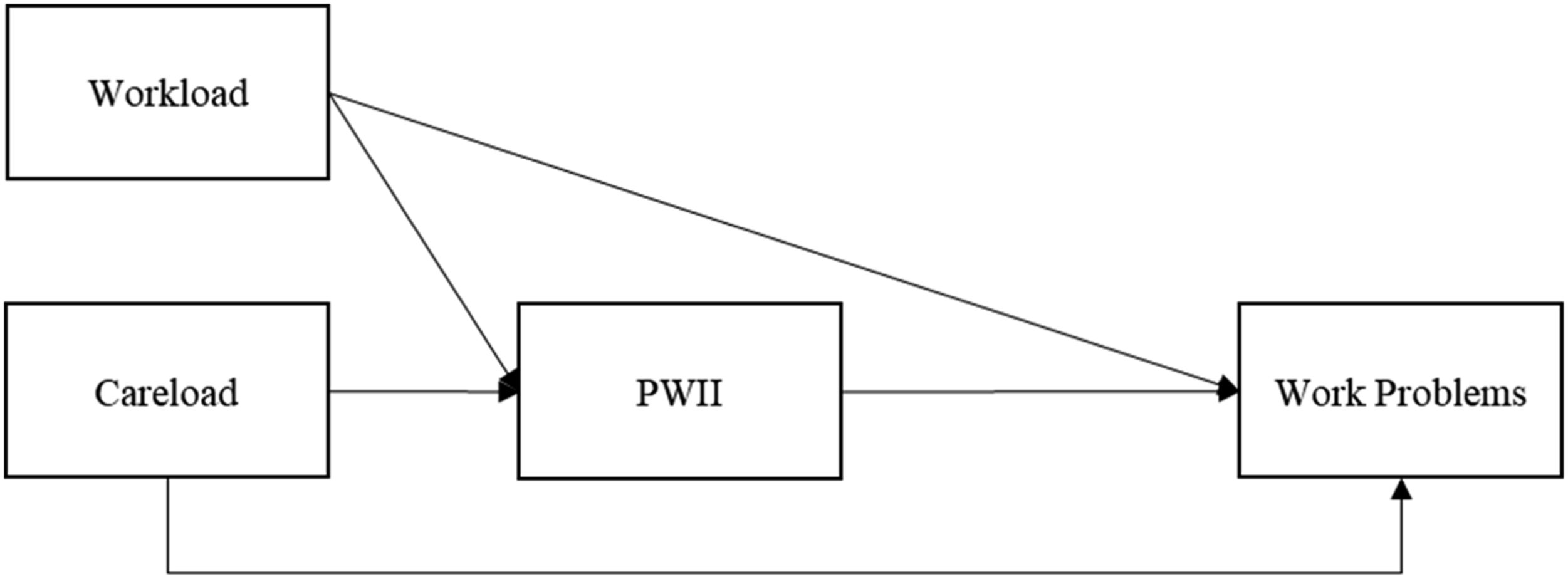
Correlations, means and standard deviation of variables in study 1.
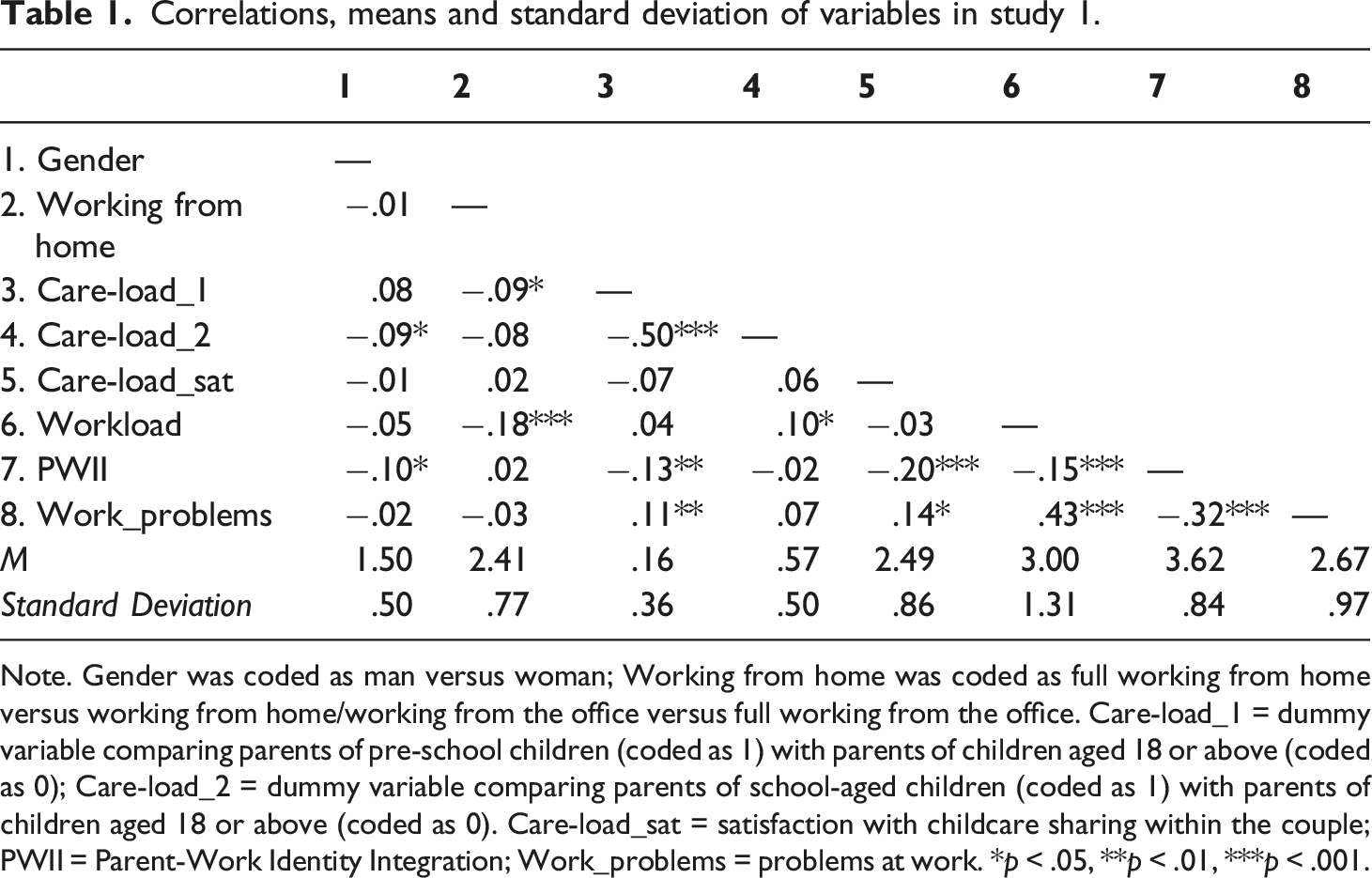
Note. Gender was coded as man versus woman; Working from home was coded as full working from home versus working from home/working from the office versus full working from the office. Care-load_1 = dummy variable comparing parents of pre-school children (coded as 1) with parents of children aged 18 or above (coded as 0); Care-load_2 = dummy variable comparing parents of school-aged children (coded as 1) with parents of children aged 18 or above (coded as 0). Care-load_sat = satisfaction with childcare sharing within the couple; PWII = Parent-Work Identity Integration; Work_problems = problems at work. *p < .05, **p < .01, ***p < .001.
Study 1 mediation model results.
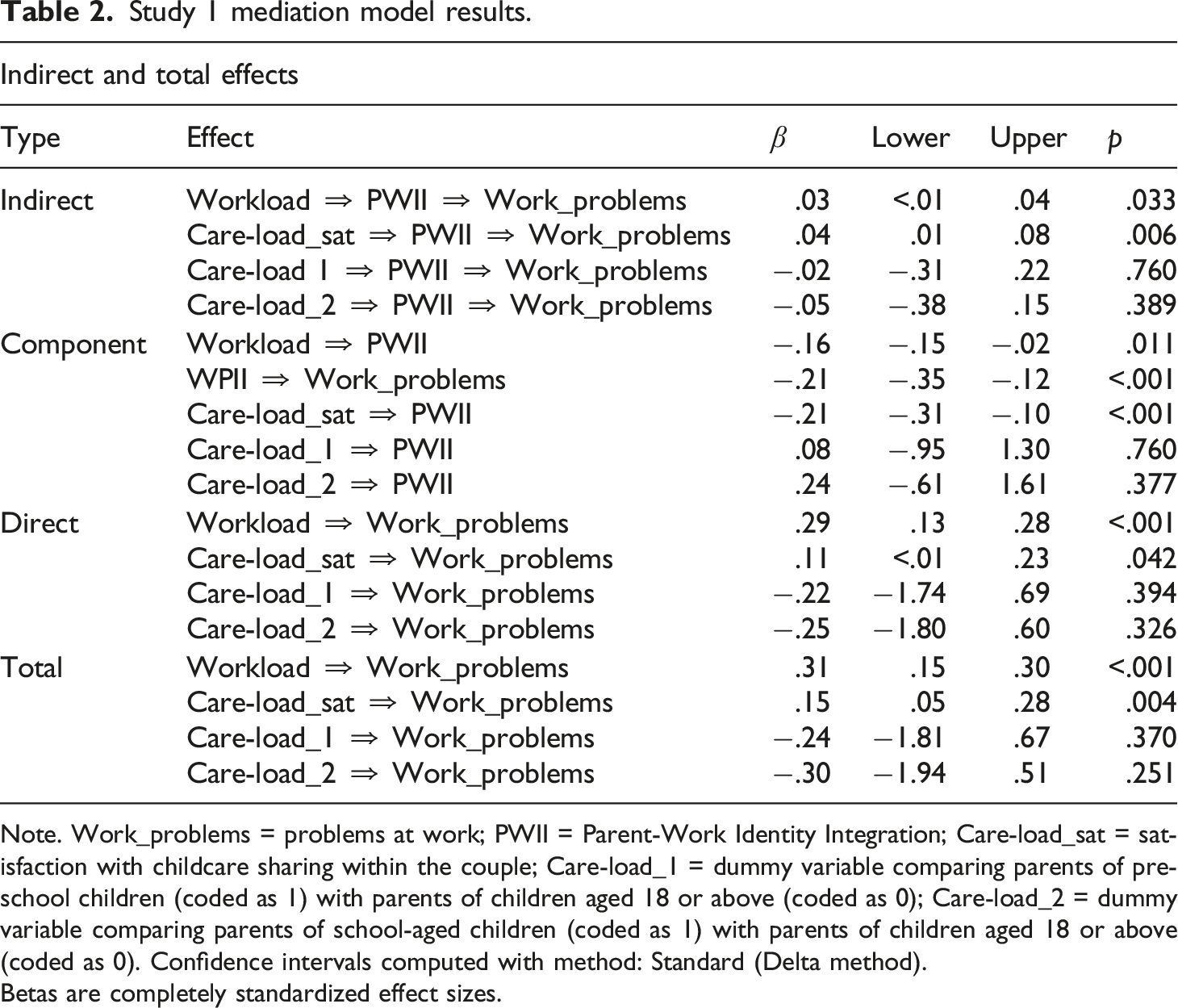
Note. Work_problems = problems at work; PWII = Parent-Work Identity Integration; Care-load_sat = satisfaction with childcare sharing within the couple; Care-load_1 = dummy variable comparing parents of pre-school children (coded as 1) with parents of children aged 18 or above (coded as 0); Care-load_2 = dummy variable comparing parents of school-aged children (coded as 1) with parents of children aged 18 or above (coded as 0). Confidence intervals computed with method: Standard (Delta method).
Betas are completely standardized effect sizes.
We then tested whether gender (RQ1) and type of work (RQ2; Full WFO, WFH/WFO, and Full WFH) moderated the above associations. None of the interaction terms was significant.
Discussion study 1
These findings confirm the association between PWII and parents’ well-being, in terms of fewer perceived problems at work (H1a). They also show that heavier workload and care-load were associated not only with higher perceptions of problems at work (H1b and H1c), but also with lower PWII (H2a and H2b). This study adds to the literature by showing that excessive burden in either work or family domains could not only undermine working parents’ personal and work well-being, but also their ability to successfully integrate those important parts of their self-concept. What is more, these findings highlight that such a capacity is related to higher perceptions of work problems and partially mediates the links of workload and care-load with such perceptions (H3a and H3b). It is likely that workers burdened with higher work and family demands experience a more problematic work environment, not only for the organizational issues engendered by workload and care-load, but in part for the difficult integration of the identities pertaining to these two life domains. The absence of differences across sexes (RQ1) and work contexts (RQ2) speaks for the importance of workload and care-load as well as of PWII for both women and men’s outcomes, irrespective of their workspace arrangements.
Of note, it is satisfaction with childcare sharing, rather than the presence and age of children, to be significantly associated with problems at work and PWII. Thus, these findings point to the role of how family tasks are shared within the couple as well as of the interplay between partners’ variables. Study 1 individual research design, however, did not allow to test these aspects and this motivated the adoption of a dyadic design in Study 2.
Study 2
Study 1 showed that dissatisfaction with childcare sharing was negatively associated with parents’ PWII and positively associated with work problems. Study 1, however, used the individual was the unit of analysis, thereby limiting the understanding of the interplay between partners. Workload and care-load, in fact, are unlikely experienced in isolation, but are lived in connection with the partner. According to the Spillover Crossover Model (SCM; Bakker et al., 2014) work-related stressors and positive experiences are carried over to home and cross-over to affect the partner as well (Orellana et al., 2023).
The SCM posits that partner behavioral processes (e.g., conflict management; communication; etc.) are likely mediating mechanisms through which work-related experiences affect both partners. Partners’ identity integration processes, however, may also play a role in the work-family interface. Partners can either support or hinder each other’s ability to integrate work and family identities. For example, communicative strategies partners use for negotiating (or resisting) change in their division of household labor mostly entail requests for behavioral change (e.g., persuading the partner to do more household tasks), but also communicative techniques targeting partner’s sense of self, in terms of competence and self-worth for their role (e.g., complimenting the partner on their ability to clean the bathroom or take care of children’s needs; Riforgiate & Boren, 2015). Indeed, studies have shown that work–life balance and shared home responsibilities had a crucial role, especially in dual-earner couples, for both their well-being (e.g., Rich et al., 2016) and identity integration (Reverberi et al., 2021). To understand the interplay between work and family factors, PWII, and working parents’ outcomes, examining the parental couple relationship and identity integration is essential.
Thus, in Study 2 we took a closer look to working parents through a dyadic design, using a sample of couples, which allows to test cross-partner effects. In addition, a dyadic design enables to measure task-sharing within the couple more reliably, using both partners as informants about their division of labor. Literature on labor division, in fact, has shown significant discrepancies between partners in the evaluation of how much their household tasks were shared within the couple (e.g., Kamo, 2000). Analyzing task-sharing patterns at the dyadic level, thereby integrating both partners’ perspectives, allows a richer understanding of the role of task-sharing for partners’ PWII. In study 2 we tested whether the associations of work-life conflict (WLC) and task-sharing with working parents’ well-being and intention to leave their job were mediated by PWII. We expected PWII to be positively associated with working parents’ well-being (H1a) and negatively associated with parents’ intention to leave their jobs (H1b). We expected the same associations for a more equitable task-sharing between partners (H2a, for well-being; H2b, for intention to leave one’s job) and opposite associations for WLC with well-being (H3a) and intention to leave one’s job (H3b). We also expected WLC to be negatively associated with working parents’ PWII (H4a) and a more equitable task-sharing between partners to be positively associated with it (H4b). In addition, we hypothesized PWII to mediate the associations of task-sharing with parents’ well-being (H5a) and intention to leave one’s job (H5b) as well as the associations of WLC with well-being (H5c) and intention to leave one’s job (H5d). We also examined gender (coded as female/male) differences in all the above associations (RQ1). Finally, we expected one’s reports of WLC to be associated with the partner’s well-being and intention to leave their job (i.e., cross-partner effects; H6a and H6b, respectively). Partners’ perceptions of tensions between work and life domains may in fact translate into tensions at home, which could undermine the other’s well-being as well. Moreover, given that partners’ may compensate for the other’s work stress by increasing their involvement in family tasks (Bolger et al., 1989), it could be that one partner’s reports of WLC may associate with the other’s intention to leave their job. Given the lack of studies on cross-over effects in partners’ PWII, we did not make specific predictions about associations involving this variable (RQ2).
Method
Participants and procedure
Data collection took place in July 2021. Eligibility criteria were (a) being parent of at least one school-aged child (for the Italian school system: 6–18 years old); (b) being in a couple relationship with the parent of the school-aged child; and (c) participating together with the partner. Sampling was not restricted in terms of gender, race/ethnicity, sexual orientation, or other characteristics. Participants were recruited through social media and snow-ball sampling. An online questionnaire was administered to both partners. Participants provided their digital informed consent. Participation was anonymous and participants could abandon the research at any time without consequences. This study conformed to international and national ethical standards (i.e., US Federal Policy for the Protection of Human Subjects; APA ethical standards; Law Decree DL-196/2003).
Ninety-seven couples participated in the research. For the present study, we selected those couples whose partners were working at least part-time: 15 couples were then excluded as they were either unemployed or retired. The remaining 82 couples were all composed of mixed-sex cohabiting partners. Most couples (56.1%) had 2 children (range: 1–6). Women’s M age was 45.45 (SD = 4.64), men’s M age was 47.76 (SD = 5.32). Regarding participants’ education level, 1.2% of women and 8.5% of men reached up to 8 years of formal education, 34.1% of women and 47.6% of men to 13 years, 40.2% of women and 31.7% of men reach between 16 to 18 years, and 24.4% of women and 12.2% of men to more than 18 years.
Measures
Task-sharing
Family-related task-sharing between partners was measured through three ad-hoc items, each referring to a different task (i.e., housework, food shopping, and administrative work), inspired by typical ad-hoc measures of labor division used in the literature (e.g., Alberts et al., 2011). Item prompt was How do you and your partner deal with the following tasks? and responses were rated on a 5-point Likert scale (1 = I deal with it on my own; 3 = We share it equally; 5 = My partner deals with it on their own). Responses were analyzed at the dyadic level, by identifying subgroups of couples in terms of their pattern of sharing (see the data analyses section).
Work–life conflict
WLC was measured through five items from the Work–Life Balance Scale (WLB; Hayman, 2005) measuring interference between work and personal life. Items were rated on a 5-point Likert scale (1 = strongly disagree, 5 = strongly agree), with higher scores indicating greater levels of perceived work–life conflict during the past school year. Item examples: Stress at work makes me irritable at home; Personal worries distract me from work. Reliability was ɷ = .65 for women and ɷ = .75 for men.
Parent–work identity integration
We used the same three items as in Study 1, measuring identity harmony versus conflict between the parental and worker roles. Reliability was ɷ = .77 for women and ɷ = .79 for men.
Worker’s well-being
Well-being was measured through the 5-item World Health Organization Well-Being Index (WHO-5; Bech et al., 1996). Item example is Over the past two weeks…: I have felt cheerful and in good spirit, I have felt calm and relaxed. Items were rated on a 5-point (1 = completely disagree, 5 = completely agree). Reliability was ɷ = .87 for women and ɷ = .81 for men.
Intention to leave
Turnover intention was measured using three items inspired by Cammann et al. (1979). Items were How often do you think of leaving your job?, How often do you wish to find another job that better suits your personal needs, and How often can’t you wait for another working day to come? (reversed). Items were rated on a 5-point Likert scale (1 = never; 5 = all the time). Reliability was ɷ = .76 for men and ɷ = .63 for women.
Data analyses
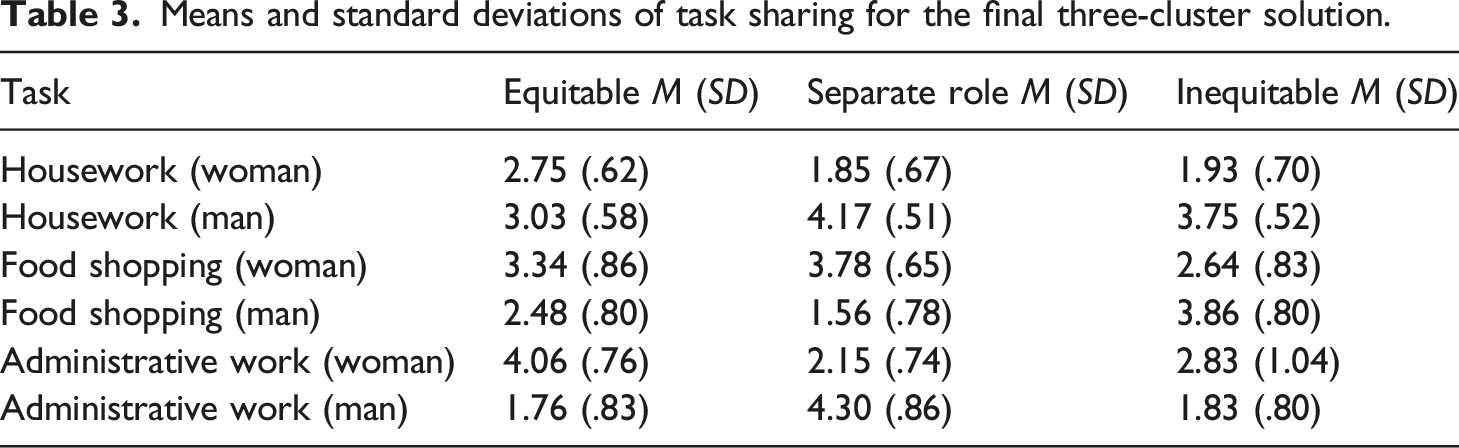
First, to examine partners’ task-sharing at the dyadic level, we run a Cluster Analysis on partners’ task-sharing items, using the couple as the unit of analysis. In addition to increasing precision in the task-sharing measure (by using two different informants), this method also allowed us to describe subgroups of couples in terms of labor division. Describing a taxonomy of couples, rather than examining task-sharing as a dimensional variable, in fact, could provide a more informative picture on the role of specific patterns of labor division in this context. We performed cluster analysis on the continuous scores of the six task-sharing variables (three variables per partner), following the recommendations of Bergman et al. (2012) and using the software ROPstat (Vargha et al., 2015). More information on the Cluster Analysis procedure was reported in the Supplementary material.
Second, to examine the hypothesized associations, we adopted the actor–partner interdependence model (APIM: Kenny, 1996), an analytic approach for dyadic data which estimates associations for both members of the couple simultaneously, while controlling for the interdependence between them (Kenny et al., 2006), and tests the effects of one partner’s predictor on their own (i.e., actor effect) and the other partner’s (i.e., partner effect) outcome (with the only exception of task-sharing cluster that was a dyadic, couple-level variable). In particular, the actor–partner interdependence mediation model (APIMeM; Ledermann et al., 2011) tests mediational effects within the APIM. The significance of indirect effects was tested through the bootstrapping method (with n = 2000 bootstrap resamples) with bias-corrected confidence intervals (Shrout & Bolger, 2002). Models were tested with AMOS 27.0. Finally, to examine gender differences, women’s and men’s paths of interest in the model were constrained to be equal and the Chi-square difference test was performed. In case the constrained model showed no significantly different fit from the unconstrained one, the constrained, more parsimonious model was retained.
Results
Means and standard deviations of task sharing for the final three-cluster solution.
Correlations, means and standard deviation of variables in study 2.
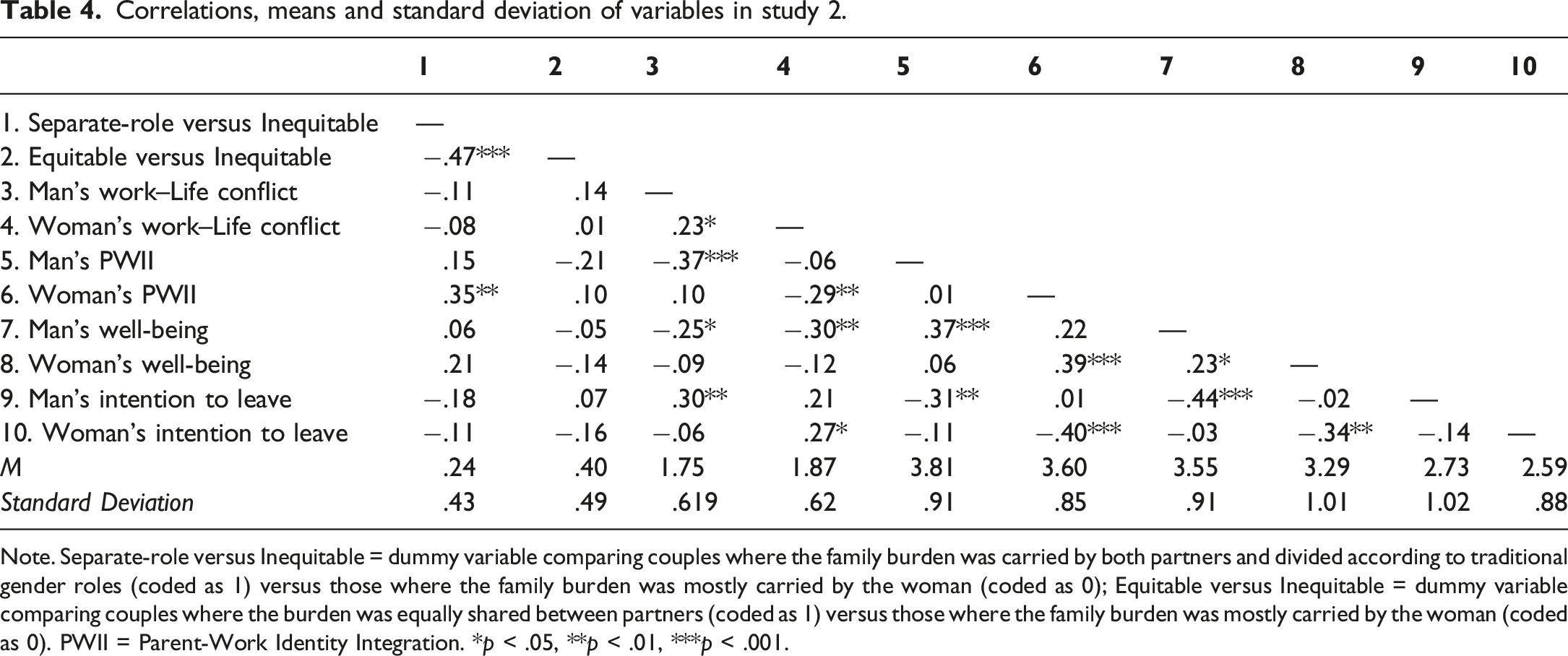
Note. Separate-role versus Inequitable = dummy variable comparing couples where the family burden was carried by both partners and divided according to traditional gender roles (coded as 1) versus those where the family burden was mostly carried by the woman (coded as 0); Equitable versus Inequitable = dummy variable comparing couples where the burden was equally shared between partners (coded as 1) versus those where the family burden was mostly carried by the woman (coded as 0). PWII = Parent-Work Identity Integration. *p < .05, **p < .01, ***p < .001.
With regard to the APIM model, we first reported the analysis of gender differences (RQ1), since hypothesis testing was based to the final model that accounted for them. In particular, we found only two paths in the model that differed significantly between men and women: the associations between being Equitable (vs. Inequitable) and PWII as well as the one between being Separate-role (vs. Inequitable) and PWII, which were positive and significant for women only. In fact, constraining the paths between being Separate-role (vs. Inequitable) and PWII to be equal across genders led the Chi-square of the model to turn from non-significance to significance (p = .049), while constraining the path between being Equitable (vs. Inequitable) and PWII led to a still non-significant Chi-square (p = .055), but also to a worse fit, as indicated especially by the RMSEA fit index (GFI = .95; CFI = .93; Chi-square/df ratio = 1.64; RMSEA = .09). Once all other paths were constrained to be equal, instead, no significant differences were found between the unconstrained and the partially constrained model, and the fit indexes of this final, more parsimonious model were all good (GFI = .96; CFI = .98; Chi-square/df ratio = 1.21; RMSEA = .05).
This final APIM model (see Figure 2) supported the hypothesis that better own PWII was associated with higher well-being (H1a) and lower intention to leave one’s job (H1b) for both partners. Contrary to our expectations, no significant associations with well-being were found for task-sharing groups (H2a) and WLC (H3a). As expected, however, significant associations of being equitable (vs. inequitable) in task-sharing within the couple with working parents’ lower intention to leave one’s job (H2b) were found, while a positive association was found between one’s own WLC and intention to leave one’s job (H3b). Moreover, one’s perceptions of higher conflict between work and life predicted lower own PWII (H4a) for both partners. As already observed, task-sharing groups predicted PWII (H4b), so that being Equitable– as compared to being Inequitable –was associated to significantly higher integration for women (but not for men). As compared to being Inequitable, adopting a Separate-role strategy in task-sharing was also associated with higher integration for women only. APIMeM study 2. Note. APIMeM of the associations between Work–Life Conflict, Task-sharing group: Equitable (vs. Inequitable) and Separate-role (vs. Inequitable), Parent–Work Identity Integration, Well-being and Intention to Leave one’s job. Integr. = Integration. Path coefficients are standardized estimates. Bold values refer to paths presenting significant gender differences. p$ = .07; p * < .05; p** <= .01; p*** < .001.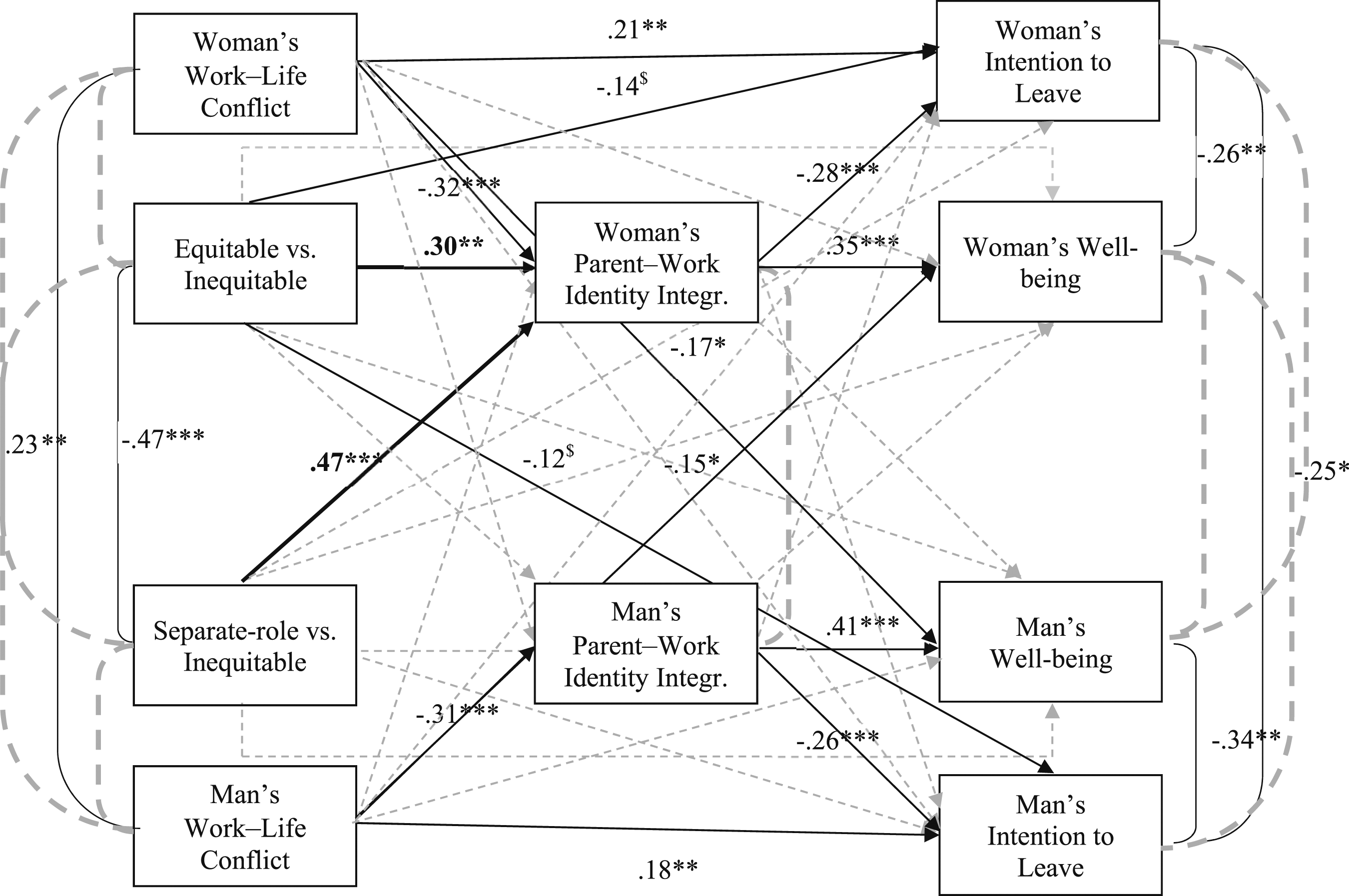
Regarding the mediating role of own PWII, the model showed that the indirect effects of being Equitable (vs. Inequitable) and being Separate-role (vs. Inequitable) on women’s well-being (unstandardized indirect effects = .22 and .39, respectively) via women’s PWII were both significant (p = .003 and p = .001, respectively; H5a). Moreover, the indirect effects of being Equitable (vs. Inequitable) and being Separate-role (vs. Inequitable) on women’s intention to leave (unstandardized indirect effects = −.16 and .39, respectively) via women’s PWII were both significant (p = .002 and p = .001, respectively), though with opposite effects (H5b). No significant indirect effects were found of task-sharing groups (either Equitable or Separate-role vs. Inequitable), via men’s PWII, on men’s well-being (H5a) or intention to leave their job (H5b). The indirect effect (unstandardized indirect effect = −.19) of WLC on workers’ own well-being (H5c) was found to be significant for both partners (p = .001), thereby showing that PWII totally mediated this link. The same was true for the indirect effects of partners’ own WLC (unstandardized indirect effect = .13) on their own intentions to leave their job via PWII (p < .001), which were partial (H5d).
In addition, the model also revealed two cross-over effects, so that women’s and men’s perceptions of higher WLC predicted lower well-being (H6a) for their partner as well, while it was not related to the partner’s intention to leave their job (H6b). We found no cross-over effects of one’s PWII on one’s partner’s outcomes (RQ2).
Discussion study 2
This study’s findings show that PWII is associated with two relevant working parents’ outcomes–their personal well-being (H1a) and intention to leave their jobs (H1b), in addition to the direct associations between intention to leave one’s job, but not well-being, and partners’ equitable task-sharing (H2b) and WLC (H3b). PWII also statistically mediates the association of task-sharing (H5a and H5b), for women’s only, and WLC (H5c and H5d), for both partners, with these outcomes. In addition to structural and organizational aspects, as represented by task-sharing groups and WLC, working parents’ PWII allows to identify workers at risk of job termination.
Perceptions of work–life conflict are negatively associated with PWII for both partners (H4a). When working parents perceive that work and family spheres require them to juggle conflicting demands, they also struggle to integrate their professional and parental roles into their selves. Family resources, however, are also at play: different clusters of couples can be described according to women’s and men’s perceptions of household task-sharing and such task-sharing groups are associated with women’s PWII (H4b). Study 1 suggested that dissatisfaction with sharing the care-load can undermine working parents’ PWII, Study 2 that equal sharing of the load with the partner is positively linked with working women’s ability and opportunity to integrate their identities. Interestingly, not only an equitable division of household labor between partners, but also an balanced distribution of care loads that is reached through a traditional gender-role separation between partners is associated with a better integration between women’s parental and work identities (while an inequitable division may undermine their integration). Separate-role task-sharing, like equitable task-sharing, is also associated to women’s greater well-being, through their PWII. Unlike an equitable division of labor, however, separate-role division is also linked to greater intentions to leave their jobs for women, through women’s PWII. Thus, at the level of the individual’s identity integration, complementarity and division of responsibilities may be beneficial, but at the professional level, it may be detrimental for women and contribute to the status quo of gender inequality. Moreover, while actually sharing the family burden with the partner (either equally or through separation of roles) can be a resource for women’s PWII, it is not for men’s. This suggests that, to promote women’s PWII, an individualistic approach may not be sufficient. Rather, both partners should be involved in interventions tackling both individual resources and couple dynamics.
Finally, the present study showed some cross-over effects. Working parents’ perception of WLC is not only associated with one’s own lower well-being, as already evidenced in the literature, but also their partner’s well-being (H6a), thereby showing the dyadic nature of these processes. One’s WLC, however, does not predict the other’s intentions to leave their job (H6b). It seems that partners’ intention to leave is more a reaction to one’s own perceptions of conflicting demands between work and life than to one’s partner’s WLC. As discussed above, however, the partner does play a role in women’s decision to retain or leave their job, in terms of how equitable the distribution of household labor within the couple is.
General discussion
Understanding how to create better conditions to accommodate and retain parents in the workforce represents a crucial goal for research. To this aim, we focused on identity processes of workers, specifically on the synergistic combination of parental and work identities (Manzi et al., 2021), while most literature has focused on organizational or behavioral factors, such as how partners balance their work and family responsibilities (Brough et al., 2020).
In two studies we analyzed family and work correlates of PWII and we tested the mediational role of PWII between such variables and workers’ outcomes. Findings from both studies confirm that PWII plays a central role in understanding work adaptation, but also the well-being of working parents.
The first study shows that parents dissatisfied with how the care-load was distributed within the couple and those with higher workload are particularly at risk for having problems at work. These data, gathered from a sample of working parents in Italy, confirm studies evidencing the critical situation of working parents in other countries (e.g., Cheng et al., 2021; Otonkorpi-Lehtoranta et al., 2021). What is more, the effects of workload and care-load were fully mediated by PWII, suggesting that having higher workload and a dissatisfying distribution of care-load, may make it more difficult for working parents to blend and integrate family and work identities and favor problems at work. Increased workload or care-load can lead to work-related issues, not only from an organizational standpoint, but also due to potential conflicts between the individual’s identities as a parent and a worker. Indeed, cultural emphasis on intensive parenting (Hoffman et al., 2010) may contribute to these integration difficulties. Stay-at-home fathers reported that some breadwinning mothers choose to increase their care-load at nights and weekends, by taking over their male partner’s duties, due to their sense of guilt for not spending enough time with the children or at home (Latshaw & Hale, 2015). Increase care-load during non-working hours may then generate problems at work due to working mothers’ potential stress and fatigue. Promoting PWII in the work and family contexts could be an effective intervention goal for this target population.
The second study was aimed at analyzing family variables that could protect PWII. The dyadic methodology allowed to obtain a richer measure of how the care-load is shared between partners. Moreover, this kind of methodology allowed to take in account the cross-over effects between partners. Cluster analysis profiled couples in relation to the care-load distribution between partners. Interestingly, in our sample, there are no inequitable couples where the care-load is shouldered by men only. Almost one in four couples showed an inequitable care-load distribution at disadvantage of women. This finding does not surprise since women in mixed-sex couples are still taking the lion’s share of care-load and that the COVID-19 emergency even exacerbated the gendered distribution of the family burden (e.g., Otonkorpi-Lehtoranta et al., 2021). Moreover, many couples in our study (40.3%) share the family burden so that women are more in charge for household and food shopping, while men for administrative work, suggesting a division of labor in line with gender-role stereotypes (Hoffman & Kloska, 1995).
As for gender differences, Study 2 reveal different results for working mothers and fathers. The care-load distribution is associated with PWII and indirectly with well-being and intention to leave one’s job for women’s only, and interestingly all these associations are quite strong. As observed, in the present sample, the division of household labor, when unequal between partners, it is so at disadvantage of women. Thus, the degree to which working mothers share the family burden with their partner can make a difference for them. These findings not only confirm the importance of sharing the care-load for women’s well-being (Baxter & Tai, 2016), but also shed light on how inequalities within the family are directly associated with women’s ability to perceive their parental role as in harmony with their professional identity. Probably, in sharing the care-load with their partner women implicitly receive recognition and legitimation of their professional identity, and this may help in successfully integrating work and family identities. This study expands upon Reverberi et al. (2021) findings, which showed that task-sharing with the partner is related to gender–work identity integration of over-50 women, in that it also shows the mediational role of identity integration in the relationship between task-sharing and women’s health and work outcomes. Moreover, in Reverberi et al. (2021) study task-sharing was measured through women’s reports only, whereas here we have a more complex measure of what happens in the family.
Of note, for women, identity integration is associated also with a balanced distribution based on gender prescriptions. In this case, however, the indirect effect of such a variable seems to associate with women’s higher intention to leave. This finding could be explained considering that women in these traditional couples are likely to be more aligned with the gender-role prescriptions and therefore probably less identified with their professional identity. Indeed, Liu and Ngo (2017) showed that traditional feminine identities are indirectly related to higher levels of intention to leave.
Findings from study 2 also suggest that perceiving less conflict between work and family spheres may help to better integrate parent and work identities and this may support parents’ mental health and work retention. These findings confirm that conflicting demands between work and family can impact not only how working parents organize responsibilities, but also their perception of disharmonious parental and work identities (Reverberi et al., 2021) and then parents’ distress and motivation to maintain their job. Recognizing the importance of reconciling identities alongside balancing work and family demands is essential, as this aspect has often been overlooked in interventions.
Moreover, the perception of work–life conflict is particularly problematic, as it seems to cross-over on the well-being of the partner. These findings partially confirm Bolger and colleagues’ (1989) study on the cross-over effect of home-work stress between partners, but it shed also light on the inherent systemic and dyadic nature of the work–life interplay. Not only experiencing conflict between different domains of life, but also living with a partner who is experiencing a clash between life spheres can be difficult for workers. A distress partner, in fact, can be a less effective or competent source of support for the worker (e.g., Rapelli et al., 2021). Moreover, when both partners are struggling with WLC, tensions may arise within the couple and the couple relationship quality may decrease (see for a review Fellows et al., 2016). Finally, partners’ quality time together may be reduced when both are having a hard time with balancing work and life (Jacob et al., 2008). The present findings align with the integrative theory of the division of domestic labor (ITDDL; Alberts et al., 2011). First, this theory emphasizes the role of identity processes in the labor division between partners, especially regarding gender socialization and gender production processes where task allocation may convey gendered identities. The theory, however, does not explore how partners’ multiple identities may integrate or conflict. Moreover, by focusing on the social/relational and sense-making processes underlying labor division carried out through communication, the ITDDL highlights the need for a dyadic approach, considering that domestic labor is part of a social organizing system created by both partners.
The present findings should be interpreted considering the following limitations. Most notably, these studies are based on cross-sectional data, which prevent causal interpretation. Although a-temporal mediation with correlational data can provide value for future research, when its rationale is based on the existing literature, it cannot establish the specific sequential process among variables (Winer et al., 2016). Moreover, the use of two informants (i.e., the two partners) was a strength of Study 2, as it increased precision in the measurement of task-sharing, while Study 1 focused on sharing from the perspective of a single individual. In both studies, however, the exclusive use of self-report measures limits our understanding regarding the investigated phenomena to workers’ perceptions and awareness. Finally, measures of intention to leave and WLC in Study 2 showed relatively low reliabilities for women, so that findings involving these measures should be interpreted with caution. Despite these limitations, the present findings corroborate the importance of PWII (and its correlates) as a target(s) for psychosocial interventions aiming at promoting working parents’ well-being and work retention, during and beyond emergency periods. Sustaining working parents in blending their work and parental identities integration, in addition to providing typical family-work reconciliation measures (e.g., part-time contracts, permits, etc.) to balance conflicting work and life demands, is crucial for interventions and policies aimed at enhancing the well-being and job retention of working parents. They also confirm the mediating role often played by identity in explaining job-related psychosocial processes, as evidenced in the wide literature on organizational identity (He & Brown, 2013). Finally, they suggest that, to reduce the negative cross-over of WLC between partners, interventions should include both partners and tackle both individual and dyadic processes.
Supplemental Material
Supplemental Material - Moving from “balancing” to “blending”: The role of identity integration for working parents
Supplemental Material for Moving from “balancing” to “blending”: The role of identity integration for working parents by Claudia Manzi, Silvia Donato, Francesca Lagomarsino, Maria G. Pacilli, Stefano Pagliaro, and Nadia Rania in Journal of Social and Personal Relationships
Footnotes
Declaration of Conflicting Interests
The author(s) declared no potential conflicts of interest with respect to the research, authorship, and/or publication of this article.
Funding
The author(s) disclosed receipt of the following financial support for the research, authorship, and/or publication of this article: This overall research was funded by a grant from the Ministero dell’Università e Ricerca – FISR2020 (protocol n. R1064300059) awarded to Claudia Manzi.
Open research statement
As part of IARR’s encouragement of open research practices, the author(s) have provided the following information: This research was not pre-registered. The dataset and materials for this manuscript is not publicly available because, under the Italian legal and privacy restrictions referring to the study (i.e., Italian Data Protection Code – Legislative Decree No. 196/2003), participants did not give their consent to public sharing. However, the raw data supporting the conclusions of this manuscript and relevant materials can be made available by the first author to qualified researchers upon request, via e-mail:

Supplemental Material
Supplemental material for this article is available online.
References
Supplementary Material
Please find the following supplemental material available below.
For Open Access articles published under a Creative Commons License, all supplemental material carries the same license as the article it is associated with.
For non-Open Access articles published, all supplemental material carries a non-exclusive license, and permission requests for re-use of supplemental material or any part of supplemental material shall be sent directly to the copyright owner as specified in the copyright notice associated with the article.
