



Abstract
Despite its association with attraction and liking, similarity fails to reliably predict relationship satisfaction in marriage. This study suggests that individual differences in relationship regulatory focus, i.e., the motivation to prevent negative outcomes or promote positive outcomes in relationships, might address this inconsistency. Specifically, the comforting nature of similarity could potentially enhance marital satisfaction among relationship prevention-focused individuals by fostering a stronger interconnectedness with their partner, compared to relationship promotion-focused individuals. We tested this hypothesis using an online survey with 1,792 participants from Korea and 1,531 participants from the U.S. The results confirmed that relationship prevention-focused individuals experiencing higher self–partner similarity felt a stronger interconnectedness and, consequently, higher marital quality. However, self–partner similarity had a less pronounced effect on relationship promotion-focused individuals. These findings indicate that the perception of similarity plays a more significant role in the marriages of prevention-focused individuals.
Whatever our souls are made of, his and mine are the same. —Wuthering Heights (Emily Bronte, 1996)
The feeling of attraction does not necessitate a substantial occasion or event. Merely sharing a similar taste in music (Boer et al., 2011) or a similar surname (Jones et al., 2004) can make people grow fond of the other. A sheer hint of similarity, indeed, is powerful enough to reduce social distances between people (Liviatan et al., 2006), thereby bringing them psychologically closer. People are more likely to be attracted to similar others because they are likely to engender a more comforting feeling of being liked and provide the rewarding sensation of consensual validation (Hampton et al., 2019). As posited by Bahns et al. (2017), selecting similar others to associate with can lead to a more stable, secure social environment where interactions feel safe and comforting.
However, despite the impact similarity has on attraction and bonding, it does not necessarily lead to greater satisfaction in couples (e.g., Gattis et al., 2004). That is, although the similarity–attraction link has been established in previous studies, the support for the similarity–satisfaction link has been rather ambiguous with studies pointing to mixed results in terms of the effect similarity has on marital satisfaction. While several researchers have identified a positive association between similarity and relationship satisfaction (Gaunt, 2006), others have reported a weak (Arránz Becker, 2013) or even nonsignificant association (Gattis et al., 2004).
In dissecting the variability in findings, researchers have delved into specific domains of similarity. The domains of personality, attitudes, and values have garnered significant attention from researchers, often more so than overt demographic similarities (e.g., Arránz Becker, 2013; Luo & Klohnen, 2005), possibly because enduring psychological traits as in personality has shown to have a more lasting impact on satisfaction than the transient background or contextual factors (Gutiérrez et al., 2005; Kelly & Conley, 1987). However, despite its attention, the influence of psychological similarities on satisfaction has shown inconsistency. For example, within the realm of personality similarity, studies by Luo and Klohnen (2005) and Gaunt (2006) advocate its positive effect, whereas Leikas et al. (2018) find its impact minimal. While findings within values and attitudes appear somewhat more consistent, they are not exempt from disparities. Specific shared values and attitudes, such as gender role orientation, marriage affinity (Arránz Becker, 2013), and self-directional values (Leikas et al., 2018), are seen as beneficial for relationship satisfaction. Conversely, research by Gaunt (2006) and Luo and Klohnen (2005) present fluctuating effects of attitude similarity. This patchwork of results paints an unclear picture, prompting exploration into the potential individual differences influencing the impact of similarity.
Indeed, similarity may not produce equal effects for every individual; some may find greater satisfaction from self–partner similarity, while others might be less affected. Here, we propose that relationship regulatory focus, characterized by an individual’s predominant aim to either avoid negative outcomes (prevention focus) or foster positive ones (promotion focus) in relationships, may provide clarity on the disparate effects of similarity on marital satisfaction. Building on the idea that similarity inherently affords a safe haven, where interactions are made safe and congenial (e.g., Bahns et al., 2017; Singh et al., 2015), we propose that individuals with a relationship prevention focus might derive increased satisfaction from self–partner similarity due to the attendant interconnectedness with their partner. Conversely, for those with a promotion focus in their relationships, similarity might be associated with less interconnectedness, thereby exerting a lesser impact on satisfaction levels. Our objective is to explore how a relationship regulatory focus (prevention vs. promotion) influences the intimate experience with spousal similarity and its consequent association with the overall quality of the relationship.
Relationship Regulatory Focus and Similarity
Many studies have well-established the distinct processes by which people regulate pleasure and pain, notably since Higgins (1997) proposed the regulatory focus principle. This principle distinguishes the strategic motives of individuals toward preventing losses (prevention focus) and promoting gains (promotion focus). Those with a strong prevention focus are more inclined to avoid undesirable events, whereas those with a strong promotion focus tend to lean toward desirable ones (Higgins, 1997). Recent evidence suggests that these general promotion or prevention inclinations can indeed be adapted to more specific contexts, such as romantic relationships. Cortes et al. (2018) found that individuals focused on relationship promotion are more attuned to growth in relationships, while those with a relationship prevention focus tend to seek security. These relationship regulatory focus dynamics may provide insight into the differential impacts of similarity on individuals with a promotion or prevention focus.
Similarity is expected to facilitate more positive experiences among individuals with chronic prevention focus in relationships due to the increased emphasis they place on security in contrast to relationship promotion-focused individuals (Cortes et al., 2018). Security may be more easily maintained using high levels of self–partner similarity, because similarity safeguards people from divergence in traits and values, which result in less conflicts (e.g., Hobman & Bordia, 2006). Similarity, indeed, ensures interactions that are safe and congenial (Bahns et al., 2017). In other words, a person’s interactions with similar others ensure more empathetic understanding (O’Brien & Ellsworth, 2012), cooperation (Fischer, 2009), and affiliation (Curry & Dunbar, 2013). Conversely, insecurity arises when a partner is perceived as discrepant (Murray et al., 2005). In fact, even as infants, people are attracted to those who punish dissimilar others (Hamlin et al., 2013). Such an innate tendency to penalize dissimilarity suggests that dissimilarity, as opposed to similarity, imposes cues of incongruency or threat. Thus, when a partner displays high levels of similarity, relationship prevention-focused individuals may be inclined to perceive their relationship as a safe haven and readily feel interconnectedness to the kindred spirit.
In contrast, similarity may induce less interconnectedness among relationship promotion-focused individuals because they are less attuned to relationship security (Cortes et al., 2018). Given that the need for security comprises one of the fundamental needs of humans (Maslow, 1958), relationship promotion-focused individuals would also be appeased to perceive self–partner similarity. However, we suggest that the appeasing aspect of similarity is insufficient for producing increased marital satisfaction among relationship promotion-focused individuals because they are more attuned to seeking growth instead of maintaining security. Assimilating certain differences may help partners to expand the self (Aron et al., 2004), which provides an opportunity for growth. Thus, the rewarding nature of similarity may be relatively weak for relationship promotion-focused individuals. Hence, they will be less likely to desire to readily include the partner in the self as a consequence of perceiving increased self–partner similarity. Accordingly, similarity may be less able to foster increased interconnectedness and, hence, satisfaction among relationship promotion-focused individuals.
Building on previous studies on regulatory focus, the present research proposes that the relationship between self–partner similarity and relationship satisfaction differentially manifests for relationship prevention- and promotion-focused individuals. Specifically, we propose that interconnectedness functions as a differential mechanism through which individuals with a relationship prevention and promotion focus derive varying levels of satisfaction from similarity. Crucially, while the fundamental meaning and essence of interconnectedness remain unchanged across regulatory focus, its correlation with similarity will be contingent on an individual’s relationship regulatory focus. This hypothesis is grounded in the notion that for relationship prevention-focused individuals, similarity readily provides a sense of secure foundation, fostering a heightened sense of interconnectedness due to the recognized self-resemblance. Conversely, individuals with a promotion focus are expected to resonate less with similarity, given its constrained ability to enhance their interconnectedness with their partner. This hypothesis aligns with the self-expansion theory proposed by Aron and Aron (1986), which emphasizes that amalgamating diverse ideas and resources from a partner spurs greater self-expansion. As promotion-focused individuals gravitate more towards self-expansion and personal advancement over security (Cortes et al., 2018), dissimilarity is likely to fuel their taste for novelty and learning and become more appealing to them to foster interconnection. In contrast, similarity might not kindle as intense a drive for such interconnectedness among this group. Interconnectedness, subsequently, is anticipated to influence their marital satisfaction (Mroz et al., 2022).
Culture and similarity
While the similarity–attraction hypothesis has long captured scholarly attention, cross-cultural examination of similarity remains insufficiently explored. Much of the research on similarity has been centered on Western industrialized nations such as those in North America and Europe (e.g., Curry & Dunbar, 2013; Singh, 1973), with only a handful of studies conducted elsewhere (e.g., Chi et al., 2020). Yet, despite the dearth of cross-cultural studies on similarity, the rewarding sense of consensual validation offered by similarity seems to be universally recognized. Byrne et al. (1971), for example, demonstrated the pervasive power of similarity across different cultures. Further, consistent preferences for similarity have been reported in both Japan and the U.S. (Schug et al., 2009), suggesting that similarity may be innately rewarding across cultures.
However, Heine et al. (2009) argued that the impact of similarity can vary between cultures. They found a stronger effect of similarity in Canada than in Japan, attributing this disparity to Canadians’ more positive self-view. Such a view holds that a positive self-perception increases appreciation for those with similar attributes; however, this interpretation requires further scrutiny. Research has shown that East Asians also possess strong self-enhancement motives, although they might manifest differently (Sedikides et al., 2015). Indeed, Japanese individuals often view their relationship partners more favorably than themselves (Endo et al., 2000), suggesting that similarity to a partner could elicit more positive responses among East Asians in established relationships. Significantly, research on Chinese couples further supports this perspective. For instance, Chi et al. (2013) found that similarity in relationship standards and couple communication patterns were linked to higher marital satisfaction. Moreover, East Asians, known for their higher prevention focus compared to Americans (Cheon et al., 2021), may derive greater contentment from substantial self–partner similarity. This body of work suggests that cultural contexts could moderate the role of similarity in relationship dynamics, and as such, warrants more nuanced cross-cultural explorations. However, with a lack of cross-cultural studies having been conducted on the similarity–satisfaction link, whether the association between similarity and relationship satisfaction may differ across cultures remains a matter of speculation. Therefore, we aim to investigate the potential impact of culture on the role of regulatory focus in the relationship between similarity and relationship satisfaction.
The present study
The present study examined the positive role of similarity in shaping the marital experiences of relationship prevention-focused (vs. promotion-focused) individuals. The safe haven provided by similarity was hypothesized to be significantly associated with interconnectedness and, subsequently, with marital satisfaction among relationship prevention-focused individuals. However, such an association was hypothesized to be much weaker among relationship promotion-focused individuals.
Drawing on prior research highlighting the enduring impact of psychological characteristics on satisfaction (Gutiérrez et al., 2005), we focus on the domains of personality and values. We specifically consider personality similarity, as partners with similar personalities often experience emotions in similar ways (Gonzaga et al., 2007), potentially enhancing mutual understanding and future predictability. However, personality similarity has contributed to inconsistent findings regarding its impact on marital satisfaction (e.g., Leikas et al., 2018; Luo & Klohnen, 2005). We suggest that the individual’s motivation for security or growth may be a crucial factor in reconciling these inconsistencies. Additionally, we explore the domain of value similarity. Although its effects on relationship satisfaction have been more consistent, findings remain mixed (e.g., Arránz Becker, 2013; Luo & Klohnen, 2005). We postulate that further examination of its relationship with relationship regulatory focus could elucidate the influence of similarity on marital satisfaction.
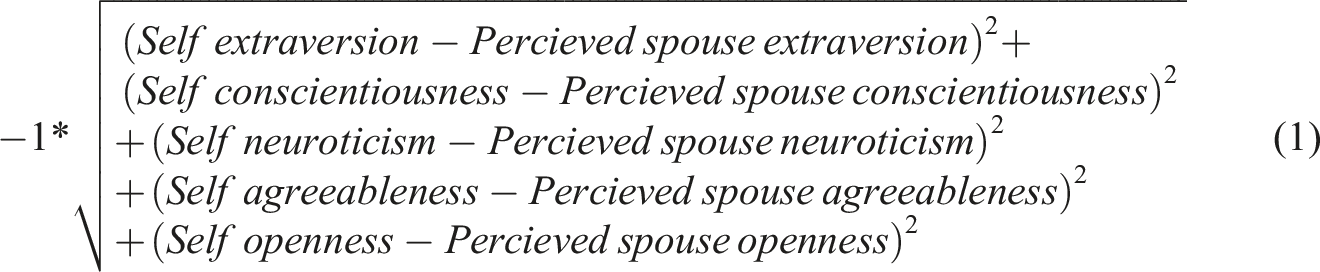
In measuring similarity, the present study used two approaches to measure self–partner similarity. The first is the calculated/observed personality similarity. Specifically, we calculated the Euclidean distance to measure personality similarity, which is calculated by applying the Pythagorean theorem (i.e., the square root of the sum of squared differences; Deza & Deza, 2009). This study applied the Euclidean metric in computing the overall Big Five similarity, because it enables the calculation of the distance between points across dimensions (e.g., Conroy-Beam & Buss, 2016) and is a rather straightforward way to capture (dis)similarity.
The second is the perceived personality and value similarity. The participants were directly requested to self-report their perception of their personalities and value similarity with their partner. To circumvent the issues posed by the computational method of similarity scores, several studies have implemented a self-reported measure of similarity (e.g., Westmaas & Silver, 2006). Following these studies, the present study instructed the participants to directly estimate their level of similarity to their partner. This way of measuring similarity is not only intuitive but also directly taps into people’s perception of their level of similarity to their partner. In fact, by simultaneously implementing the self-reported measure of similarity and the computational approach (i.e., the Euclidean distance) to measure similarity, the present study intended to verify whether the distinct approaches for measuring similarity yielded the same result.
Although other more advanced techniques are available for computing similarity (see Rogers et al., 2018), we opted to use the Euclidean distance and direct self-report because the present study was interested in estimating the moderating role of similarity instead of precisely gauging the level of similarity. Hence, the two most straightforward measures were used to facilitate the interpretation of the results.
Furthermore, we measured perceived similarity through direct self-report because prevention-focused individuals should be assured to perceive their relationship as a safe haven when they are able to perceive similarities with the partner. Any similarity that is not perceived by the observer is less likely to impact one’s evaluation of the relationship. Aligning with this reasoning, previous scholars have also identified perceived similarity as a better predictor of relationship quality than actual similarity (Tidwell et al., 2013). In fact, whether objective similarity exists is beyond the scope of the paper (see Weisberg, 2012, for a philosophical discussion). This aspect will be further expanded upon in the Discussion section.
Method
Participants and procedure
Previous studies on similarity demonstrated that the effect size of similarity is small when actor and partner effects are controlled for (Dyrenforth et al., 2010). Hence, the current study recruited a large sample to ensure accurate parameter and power estimates (Maxwell et al., 2008). A priori analysis using G*Power (Faul et al., 2007) revealed that approximately 1,302 participants are required to detect an effect with a small effect size (f2 = .01) in testing the moderating role of regulatory focus. To explore potential cultural variations in the effects under study, we aimed to recruit a minimum of 1,500 participants from each of the two selected countries – South Korea and the United States. Participants were recruited through online survey platforms specific to each region. For South Korea, we utilized PanelNow operated by dataSpring Korea, while Amazon Mechanical Turk was used for the participant pool in the United States. Only married individuals were eligible to participate in the study.
A total of 1,820 participants were recruited from South Korea (Mage = 42.62) and 1,544 from the United States (Mage = 40.89). Individuals who reported a marital duration same as or greater than their age were excluded from the analysis (27 from Korea, 9 from the U.S.). Due to the limited representation and a small number of participants who indicated a gender other than male or female (1 from Korea, 4 from the U.S.), they were excluded from the analysis. This decision was made to ensure that the analysis focused on a more homogeneous sample, allowing for meaningful comparisons, and reducing potential confounding factors. However, including all participants does not alter the observed patterns of findings.
STable 1 in the supplementary file describes the characteristics of the final sample (Korea: 1,792; United States:1,531). The study forms part of a larger research (research on motivation and emotion, conducted in the year 2020), where other unrelated measures served as fillers. For the present study, the participants completed measures of personality (of the self and the spouse), which were used to compute calculated/observed personality similarity, perceived personality similarity, perceived value similarity, relationship regulatory focus, interconnectedness, and marital quality. Twenty observations with missing values were listwise deleted during the analysis. The datasets collected and analyzed in the current study are available from the corresponding author upon a reasonable request. This study was not preregistered. R codes generated for this study and the corresponding results are available at https://osf.io/z6ybp/?view_only=2b5a5581f21b49b6a4970641daa3e542.
Measures
Calculated/observed personality similarity
The participants completed the Ten Item Personality Inventory (TIPI; Gosling et al., 2003) to evaluate their own and their spouses’ personality traits
1
. The instrument included dyads of adjectives pertaining to five personality dimensions (e.g., extraverted, enthusiastic). Participants indicated their agreement with how well each adjective pair described their personality and their spouse’s personality. Responses were gathered on a 7-point Likert-type scale, with 1 indicating “strongly disagree” and 7 indicating “strongly agree.” To derive a measure of the calculated/observed personality similarity between spouses, we computed the square root of the sum of the squared differences between the Big Five scores for the self and for the spouse. The score was multiplied by −1, where high scores indicate high levels of self–partner personality similarity. Equation (1) presents the formula used to compute personality similarity
Perceived personality similarity
Participants were asked to answer a single-item measure on personality similarity (“How similar do you feel your personality is to your spouse?”) on a 7-point Likert scale (1: “not similar at all,” 7: “very similar”). The item was adapted from the previous studies measuring general similarity (Westmaas & Silver, 2006).
Perceived value similarity
Two items directly measured participants’ similarity in value to the spouse 2 . The first item was “How much do you feel you share the same values as your spouse?” in which participants were asked to rate the question on a 7-point Likert scale (1: “do not share at all,” 7: “do share to a great extent”). The item was adapted from Westmaas and Silver (2006). The second item was from the Perceived Homophily Scale (McCroskey et al., 1975, 2006) and asked participants to indicate the extent to which they felt that the spouse does or does not share their values on an 11-point Likert-type scale (0: “My spouse does not share my values,” 11: “My spouse shares my values”). The Spearman–Brown reliability coefficients for our measurements were .80 for the Korean sample and .83 for the U.S. sample.
Relationship regulatory focus
The study used the 15-item measure for relationship regulatory focus by Winterheld and Simpson (2011). Seven items assess relationship prevention focus (e.g., “In general, I am striving to protect and stabilize my relationships”; Cronbach’s α = .75 and .86 for the Korean and U.S. participants, respectively), whereas eight items measure relationship promotion focus (e.g., “In general, I am striving to nurture, grow, and enhance my relationships”; Cronbach’s α = .90 and .89 for the Korean and U.S. participants, respectively). The items were assessed using a 7-point Likert-type scale, ranging from 1 (“strongly disagree”) to 7 (“strongly agree”). Deletion of two prevention focus items that were also heavily loaded to promotion focus resulted in Cronbach’s α = .83 and .89 for Korean and U.S. participants, respectively (refer to the supplementary document for further details). The overall relationship regulatory focus score was computed by subtracting the prevention focus from the promotion focus score, with a higher value signifying a stronger promotion focus.
Interconnectedness to the partner
Interconnectedness or cognitive interdependence was evaluated using the Inclusion of Other in the Self scale (IOS; Aron et al., 2004), which provides a graphical assessment of the extent to which one assimilates the other into the self. The participants were presented with a set of seven diagrams, each depicting varying levels of overlap between the self and the partner. They then selected the diagram that best represented the closeness they felt toward their spouse. A greater degree of overlap on the diagram indicated a stronger inclination to consider the partner as part of the self. The upper end of the diagram (7) represented significant merging or overlap, while the lower end (1) indicated no overlap between the self and the partner.
Marital quality
The Quality of Marriage Index, a 6-item measure, was used to assess the quality of participants’ marriages (Norton, 1983). Participants were asked to express their level of agreement with statements such as “We have a good marriage” on a 7-point Likert-type scale, with 1 indicating “strongly disagree” and 7 indicating “strongly agree.” This measure demonstrated excellent reliability, with a Cronbach’s alpha value of .97 for both groups in our study.
Demographics and other measures
Participants provided information regarding their gender, length of marriage, education, and occupation. The descriptive statistics for these data are available in the supplementary material. Only participants from the U.S. indicated their ethnicity. Other measures not incorporated in this study included emotion suppression, self-esteem, power, mattering, intimacy, and domain satisfaction.
Results
Statistical analyses
We first tested the measurement invariance of relationship regulatory focus and marital quality across cultures because the cross-cultural measurement invariance of these scales has not been fully established by previous studies. Results of the measurement invariance are reported in the online supplementary file.
Next, we performed an exploratory factor analysis on the perceived general similarity measure, yielding three consistent components across both countries: value, personality, and general similarity. Given the study’s emphasis on psychological similarity, we are reporting results related to perceived value and personality similarity, as well as calculated/observed personality similarity. Other general items designed to measure perceived general similarity are not included in the primary analysis, but the code and output are available online (https://osf.io/z6ybp/?view_only=2b5a5581f21b49b6a4970641daa3e542).
We then examined the potential role of culture in moderating the effect of prevention focus on the relationship between similarity and marital quality, to discern whether any further consideration of culture was necessary. All analyses conducted in this study controlled for gender, age, and length of marriage. Additionally, when examining the effect of personality similarity, the personality scores of both the participant and their spouse were controlled for. This was done to effectively isolate the impact of similarity, beyond the potential influence that individual personality traits may have on marital quality.
On finding no significant cultural differences, we proceeded to test the interaction between relationship regulatory focus and the impact of similarity on marital quality. Culture was controlled for, because the same number may not reflect the same meaning across cultures (Chen, 2008). Finally, to investigate the pathway through which relationship prevention-focused individuals obtain more satisfaction from self–partner similarity than relationship promotion-focused individuals, we tested the moderated mediation model as shown in Figure 1. The lavaan package in R (Rosseel, 2012) was used for analysis. The analyses involved bootstrapping with 5,000 resamples at a 95% confidence interval (CI), following Hayes’ (2009) recommendations. Moderated mediation model tested.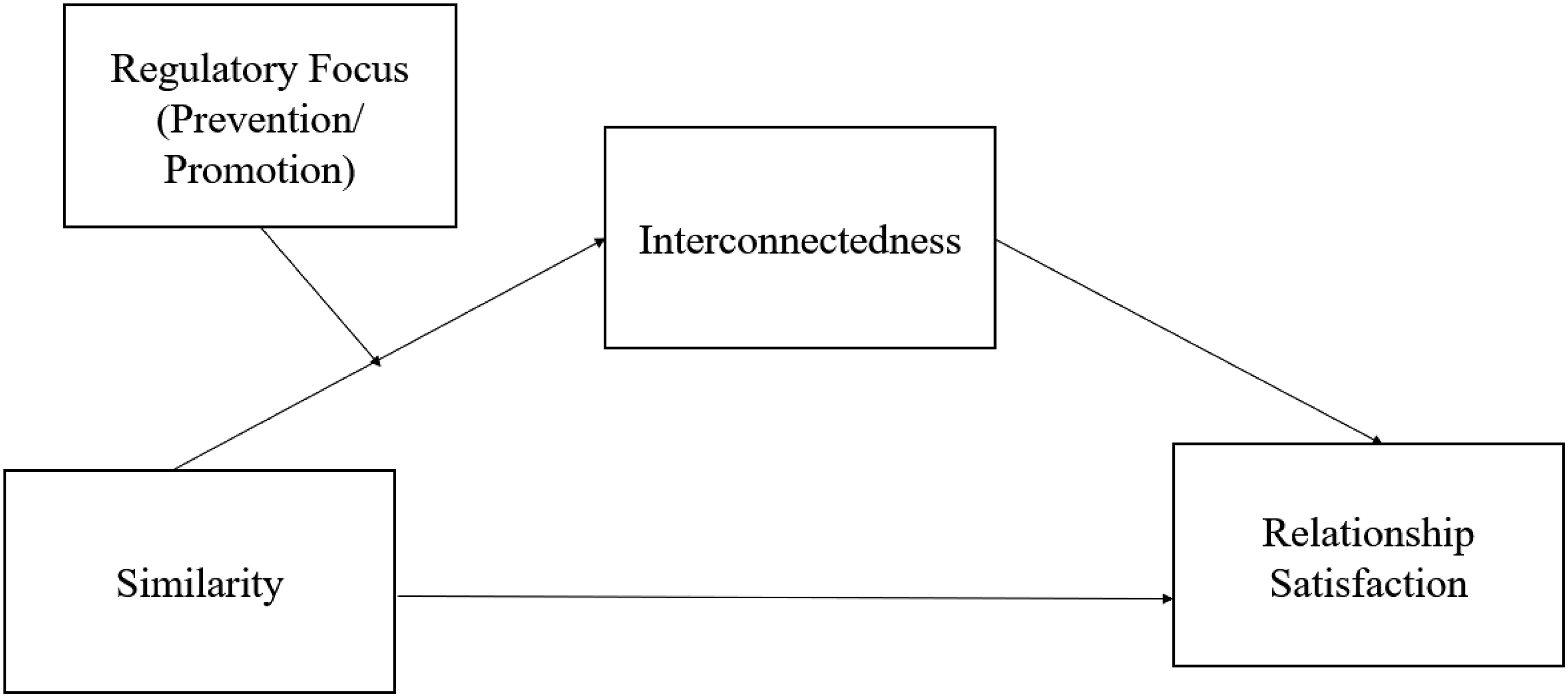
Additionally, as a supplementary analysis, the difference between the two simple slopes was tested by subtracting their coefficients and determining whether the difference was statistically significant. This specific analysis aimed to establish whether individuals with high (+1 SD) and low (−1 SD) levels of regulatory focus differed significantly in their tendency to be influenced by similarity. The detailed results concerning the slope difference can be found in the supplementary material.
Descriptive statistics
STable 2 in the online supplementary file displays the correlations of the variables for the Korean and U.S. samples. The U.S. participants (M = 5.79, SD = 1.33) reported significantly higher levels of marital quality than those of Koreans (M = 5.19, SD = 1.42), t(3302.1) = −12.68, p < .001. Moreover, a significant positive correlation was found between promotion focus and marital quality among the Korean (r = .50, p < .001) and U.S. (r = .44, p < .001) participants. However, a significant negative correlation was observed between prevention focus and marital quality for both groups (Korea: r = −.32, p < .001; United States: r = −.40, p < .001).
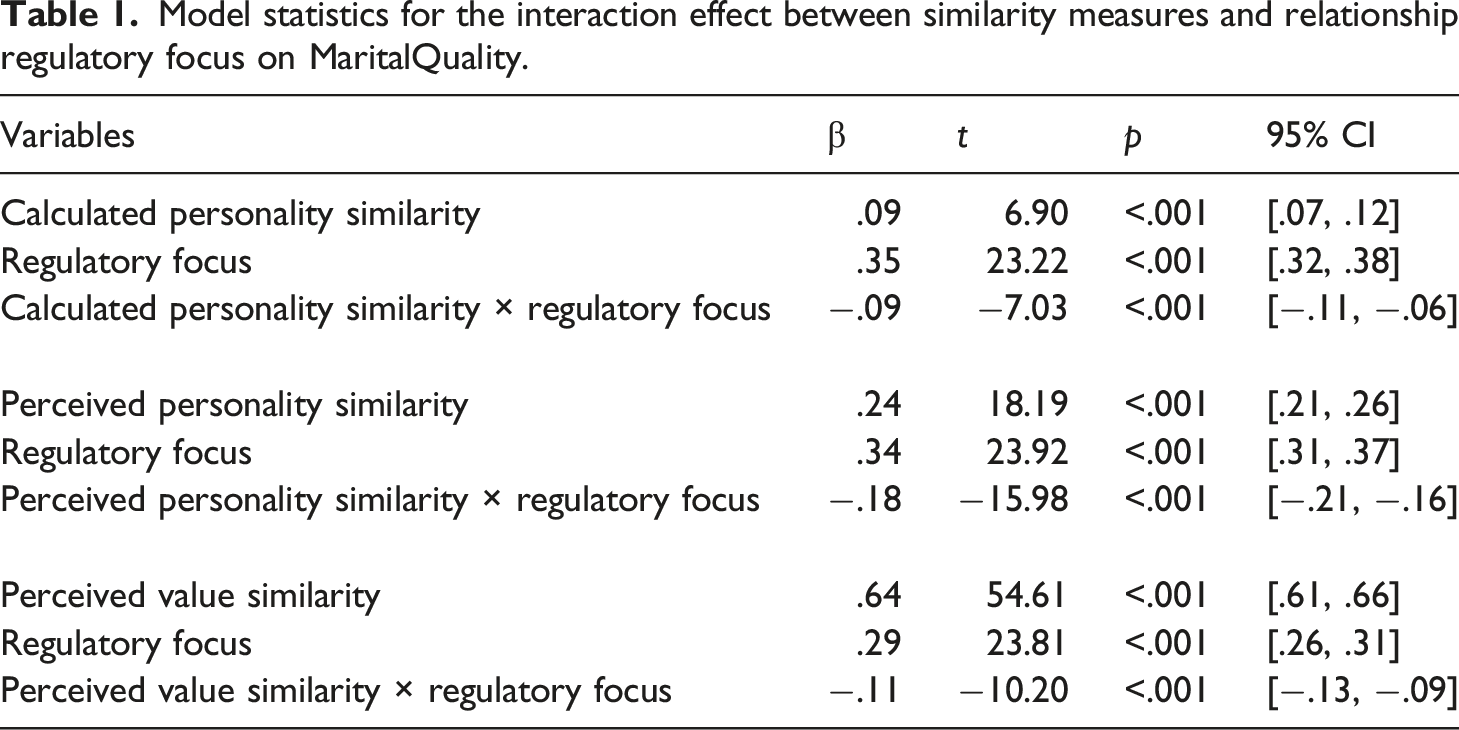
The moderating role of regulatory focus in the relationship between similarity and marital quality
Model statistics for the interaction effect between similarity measures and relationship regulatory focus on MaritalQuality.
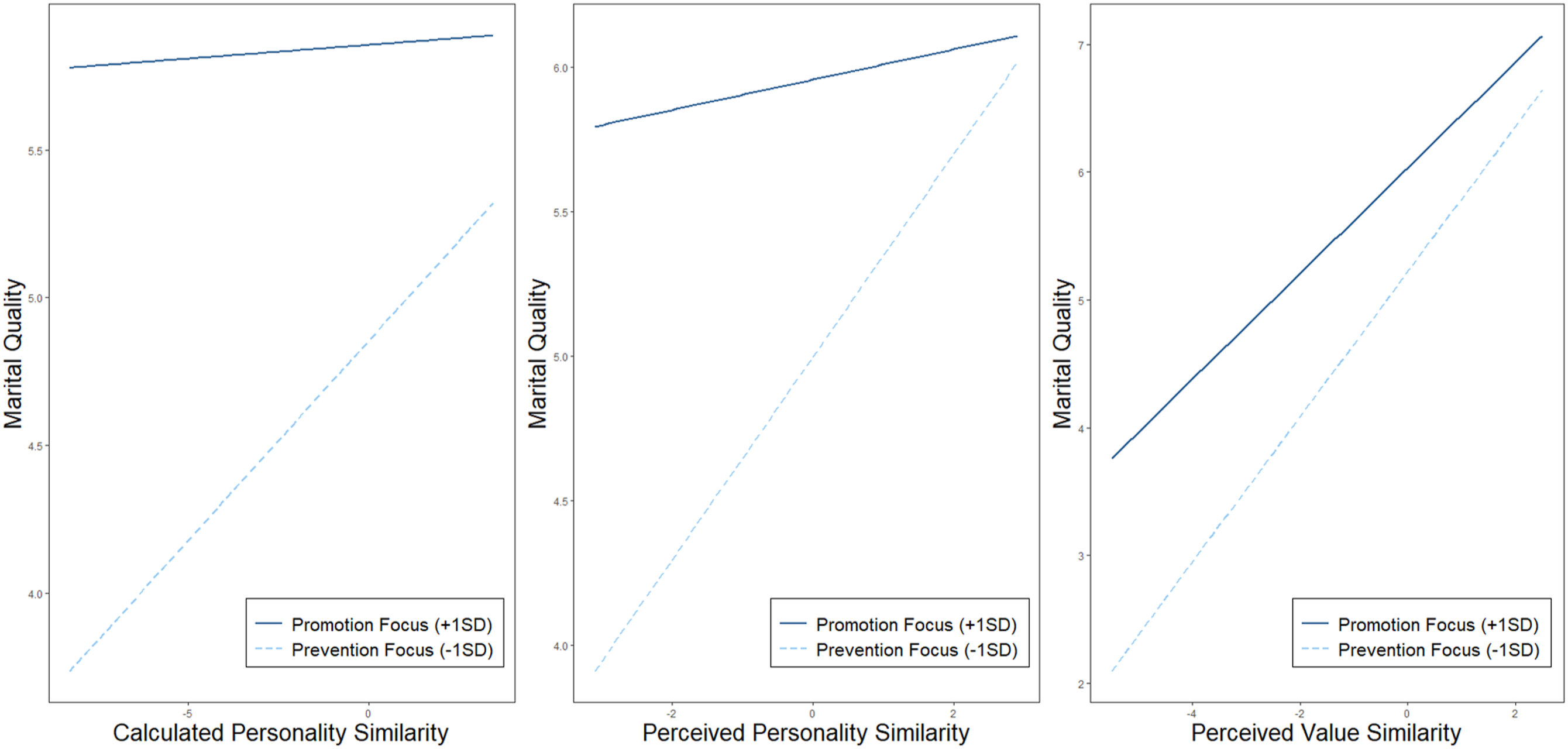
Relationship between similarity and marital quality as moderated by relationship regulatory focus.
Firstly, regarding calculated/observed personality similarity, there was a positive relationship between calculated/observed personality similarity and marital quality for those with high prevention focus (−1 SD; βsimple = .17, p < .001). However, a nonsignificant association was observed between calculated/observed personality similarity and marital quality among individuals with high levels of promotion focus (+1 SD; βsimple = .01, p = .482) 3 .
Next, a similar pattern was observed using the perceived personality similarity measure. Perceived personality similarity exerted a significantly stronger effect on marital quality among individuals with high prevention focus (−1 SD; βsimple = .41, p < .001) versus high levels of promotion focus (+1 SD; βsimple = .06, p < .001
Finally, decomposing a significant interaction between perceived value similarity and regulatory focus similarly revealed that those with high prevention focus were more likely to show a stronger association between perceived value similarity and marital quality (−1 SD; βsimple = .74, p < .001) than those with high levels of promotion focus (+1 SD; βsimple = .54, p < .001).
The moderated mediation model
We examined whether promotion-focused individuals are less likely to incorporate their partner’s identity into their own when they perceive high self–partner similarity, by testing the moderated mediation model (as shown in Figure 1). Three models were evaluated to ascertain if the pathway linking similarity and marital quality via interconnectedness varied according to the relationship regulatory focus. Each model used a different similarity measure (calculated/observed personality similarity, perceived personality similarity, or perceived value similarity) as the independent variable.
The first model involved calculated/observed personality similarity as the independent variable, relationship regulatory focus as the moderator, interconnectedness as the mediator, and marital quality as the dependent variable. The result showed a significant moderated mediation index (β = −.03 (.01); 95% CI = [−.04, −.01]). Specifically, the interaction effect between similarity and regulatory focus on interconnectedness was significant (β = −.05, 95% CI = [−.07, −.02]). Prevention-focused individuals perceived an increased sense of interconnectedness with their partner (−1 SD; βsimple = .15, p < .001) more significantly than promotion-focused individuals (+1 SD; βsimple = −.01, p = .859) when there was higher self–partner similarity. Furthermore, the indirect pathway from personality similarity to marital quality through interconnectedness was significant for prevention-focused individuals (−1 SD; β = .09, 95% CI = [.06, .13]) but was nonsignificant for promotion-focused individuals (+1 SD; β = −.00, 95% CI = [−.04, .03]). Overall, the model explained 73.1% of the variance in marital satisfaction 4 .
The second model employed perceived personality similarity as the independent variable. The moderated mediation model was significant (β = −.08 (.01); 95% CI = [−.10, −.07]). A significant interaction between perceived personality similarity and relationship regulatory focus on interconnectedness (β = −.15, 95% CI = [−.17, −.12]) revealed that individuals with high levels of prevention focus felt greater interconnectedness with partners with higher self–partner personality similarity (−1 SD; βsimple = .47, p < .001) than promotion-focused individuals (+1 SD; βsimple = −.05, p = .074). Moreover, the indirect pathway from personality similarity to marital quality through interconnectedness was stronger for prevention-focused individuals (−1 SD; β = .26, 95% CI = [.23, .29]) than for promotion-focused individuals (+1 SD; β = −.03, 95% CI = [−.06, −.00]). Overall, the model explained 74.5% of the variance in marital satisfaction.
In the final model, perceived value similarity was the independent variable. The result yielded a significant moderated mediation index (β = −.03 (.01); 95% CI = [−.04, −.02]). Specifically, the interaction effect between value similarity and relationship regulatory focus on interconnectedness was significant (β = −.07, 95% CI = [−.09, −.04]). A simple slope analysis revealed that there was a stronger association between perceived value similarity and interconnectedness among prevention-focused individuals (−1 SD; βsimple = .69, p < .001) than among promotion-focused individuals (+1 SD; βsimple = .45, p < .001). The indirect pathway from personality similarity to marital quality through interconnectedness was stronger for prevention-focused individuals (−1 SD; β = .33, 95% CI = [.30, .35]) than for promotion-focused individuals (+1 SD; β = .22, 95% CI = [.19, .25]). Overall, the model explained 76.7% of the variance in marital satisfaction.
Discussion
Similarity attracts. The realization of common characteristics offers people a safe haven where ideas, interests, and idiosyncrasies are shared and validated. However, the present study demonstrated that the safe haven provided by similarity does not equally induce intimate experiences for everyone within a marriage. Specifically, the study highlights that the perception of similarity has a stronger association with relationship quality among relationship prevention-focused individuals compared to relationship promotion-focused individuals. For relationship prevention-focused individuals, who prioritize maintaining stability, the perception of self–partner similarity was associated with a greater sense of interconnectedness and higher marital quality. However, for relationship promotion-focused individuals whose motivation lies in growth, self–partner similarity was less strongly associated with interconnectedness with the partner and, thus, marital quality. Furthermore, these patterns were apparent across both cultural contexts examined in our study: Korea and the United States. This finding implies that the feelings of comfort and security derived from similarity could act as a sanctuary and benefit intimate relationships, particularly for those individuals who are high in relationship prevention focus, regardless of their cultural background.
While similarity had a generally stronger impact on prevention-focused individuals, it is important to recognize that variations emerged in the influence of similarity across different domains or in the way similarity was calculated. First, regarding domains, value similarity generally produced a moderate to large influence on marital satisfaction for both prevention- and promotion-focused individuals, although the strength of this influence varied between the two groups. Conversely, personality similarity had only a small to moderate impact on these groups. This finding implies that similarity in values may carry greater importance than personality similarity in influencing marital satisfaction. Second, it is worth noting that while the patterns of findings were mostly similar whether using calculated or perceived personality measures, the magnitude of influence was notably more pronounced for perceived personality measures. This observation aligns with previous studies that have identified perceived similarity as a more robust predictor of relationship quality than actual similarity (Tidwell et al., 2013).
Although it has been argued that similarity is inherently rewarding (e.g., Byrne & Blaylock, 1963), our study demonstrates that this is not uniformly true across contexts. The varying effects of similarity were partly attributed to its relationship with interconnectedness, a central concept in self-expansion theory, which emphasizes individuals’ drive to expand themselves. According to the self-expansion theory, individuals have an inherent drive to self-expand, often achieved by incorporating others into their self-concept and thereby gaining broader perspectives (Aron & Aron, 1986). Thus, optimizing self-expansion could involve becoming interconnected with a dissimilar partner. Yet, the situation is not straightforward as similarity also offers rewards such as consensual validation and increased certainty of being liked (Hampton et al., 2019), along with providing a congenial environment for interactions (Bahns et al., 2017; Singh et al., 2015). Given the potential for self-expansion and the establishment of a secure interaction environment, individuals with different primary relationship regulatory focuses may also differ in their motivation to include their partner in the self, or to interconnect, when perceiving self–partner similarity. Our study confirmed this divergence.
Furthermore, the degree of interconnectedness was found to be linked to marital quality. Previous research has indicated that manifestations of interconnection or fusion with a partner, such as a couple’s shared profile picture on Facebook (Saslow et al., 2012), or a heightened sense of “we-ness” among couples (Reid et al., 2006), are associated with increased relationship satisfaction. In line with these findings, our study revealed that a heightened sense of interconnection was indeed linked robustly to marital quality. However, considering the close relationship between these two constructs, further exploration of their distinctiveness is necessary. Interconnectedness relates to a sense of unity within a relationship (Aron et al., 2003), whereas marital quality involves a more comprehensive evaluation of the relationship (Norton, 1983), with factors like communication and sexual frequency contributing to this overall assessment (Park et al., 2023). Supporting their distinctiveness, Cruwys et al. (2022) reported that while interconnectedness strongly predicts relationship satisfaction, it remains a separate construct from marital quality. Nevertheless, more research should be dedicated to fully understanding their individual significance and treatment as distinct constructs.
In addition, the inverse relationship between prevention focus and marital satisfaction invites further discussion. Past research has suggested that prevention-focused individuals are less likely to maintain an optimistic outlook compared to their promotion-focused counterparts (Winterheld & Simpson, 2011). Therefore, prevention-focused individuals may typically be less satisfied in their relationships, potentially leading them to perceive less similarity with their partners (Morry, 2005). Satisfaction can color perceptions of shared characteristics with others, and it has been shown that people in satisfying relationships often overestimate their similarity to their partners, even when such similarity is not objectively present (Murray et al., 2002). Therefore, individuals with greater marital satisfaction might perceive more self–partner similarity. Indeed, promotion-focused individuals, who reported higher levels of marital satisfaction than their prevention-focused counterparts, showed a positive correlation with perceived similarity. This suggests that promotion-focused individuals, who are generally more likely to be happy in their relationships, may also perceive an increased similarity with their partner. However, it is crucial to note that the relationship between similarity and satisfaction is bidirectional, as is underscored by decades of psychological research (e.g., Byrne et al., 1971). Due to our study’s cross-sectional design, we are limited in making strong causal statements. A longitudinal analysis could provide more definitive insights into whether similarity does indeed lead to interconnectedness and, subsequently, enhanced marital quality among those with a relationship prevention focus. Such analysis could better establish the directionality and strength of these proposed relationships over time.
Despite the relatively small variance accounted for by regulatory focus, we believe our findings significantly enhance our understanding of the role of similarity in marriage. It is important to note that even minor effect sizes can offer valuable insights into comprehending and augmenting the psychological processes inherent in our daily lives. For instance, an effect size as subtle as .0036 (r2) can “improve predictive efficiency by more than 6%” when its influences are reproduced consistently over time (Newman & Newman, 2000). Indeed, small effects, when persistent, can have meaningful and practical long-term implications (Abelson, 1985). Therefore, with further replication and validation of our study, these findings could inform the design of interventions aimed at enhancing the marital relationships of individuals with different relationship regulatory focuses. On the one hand, understanding that promotion-focused individuals derive less satisfaction from similarity could guide therapy toward fostering an appreciation for diversity and personal growth. On the other hand, awareness that prevention-focused individuals find security and interconnectedness in similarity could lead to relationship interventions that strongly emphasize shared experiences and mutual goals. Therefore, while our study’s effect sizes may be small, the knowledge it offers can provide critical insights for devising more tailored, effective strategies to assist couples in navigating and enriching their marital lives.
However, the topic of similarity also raises many questions that extend beyond the scope of this paper. While we measured similarity using Euclidean distance and direct self-report, the methods for computing perceived or objective similarity open further discussions. There have been endeavors to gauge similarity more objectively, for instance, by assessing the congruence of self-reported characteristics between partners (Furr, 2008). However, whether such attempts have truly yielded an objective measure of similarity remains unclear for the following reasons. First, self-reported characteristics are bounded by one’s perception, to which the other may not agree. Second, whether congruence between self-reported characteristics necessarily leads partners to perceive similarity is unclear. Hence, deciding whether true objective similarity that exists beyond the perception can be assessed is extremely difficult, especially when it comes to assessing psychological similarity that precludes objective criteria (e.g., nationality, age). All in all, psychological similarity stems from one’s ability to perceive commonalities with the other. This intricate concept of objective and perceptual similarity leads to a relatively philosophical debate (Weisberg, 2012). However, it is crucial to highlight that our study found a moderate correlation between the calculated personality similarity and the perceived personality similarity measure. This suggests that while not strictly congruent, actual and perceived similarity may overlap to some extent. Yet, importantly, our findings also demonstrated a stronger link between perceived (vs. calculated) similarity and marital satisfaction, underscoring the significant impact of subjective perception in gauging the effect of similarity on relationships.
Despite the complexities of the topic, the study provided an enhanced understanding of similarity within relationships by highlighting the important role of individual differences in examining the seemingly homogenous effect of similarity. This study suggests that regulatory focus should be considered when examining the role of similarity; similarity provides a safe haven, where the marital experiences of prevention-focused individuals become increasingly satisfying.
Conclusion
Similarity provides a safe haven where interaction is secure and congenial (e.g., Curry & Dunbar. 2013; Fischer, 2009). However, despite the positive influence of similarity in relationships, the present study indicates that such an effect does not equally reward every individual in marriage. The perception of self–partner similarity plays a greater role among prevention-focused individuals, who are oriented toward maintaining security in relationships. For promotion-focused individuals, who are sensitive to nurturance and growth, similarity plays a significantly weaker role in increasing interconnectedness with the partner and, subsequently, marital satisfaction. By addressing for whom similarity fosters a more harmonious feeling of being one, the present study suggests that motivations in relationships are important. If a person is geared toward finding security in relationships, then the person may want to focus on exploring the similarities between the spouse and the self.
Supplemental Material
Supplemental Material - Similarity as a safe haven: Similarity leads to satisfaction in prevention focus
Supplemental Material for Similarity as a safe haven: Similarity leads to satisfaction in prevention focus by Jeong Eun Cheon and Young-Hoon Kim in Journal of Social and Personal Relationships
Footnotes
Declaration of conflicting interests
The author(s) declared no potential conflicts of interest with respect to the research, authorship, and/or publication of this article.
Funding
The author(s) disclosed receipt of the following financial support for the research, authorship, and/or publication of this article: This work was supported by the Ministry of Education of the Republic of Korea and the National Research Foundation of Korea (NRF-2021S1A5A2A01069279). This research was also supported by the Yonsei Signature Cluster Program of 2022 (2022-22-0006).

Supplemental Material
Supplemental material for this article is available online.
Notes
References
Supplementary Material
Please find the following supplemental material available below.
For Open Access articles published under a Creative Commons License, all supplemental material carries the same license as the article it is associated with.
For non-Open Access articles published, all supplemental material carries a non-exclusive license, and permission requests for re-use of supplemental material or any part of supplemental material shall be sent directly to the copyright owner as specified in the copyright notice associated with the article.
