




Abstract
A considerable body of literature takes a deficit perspective and shows that children who experience a parental separation have more disadvantages than children who live in a two-biological-parent family. This article argues that not all children respond identically to their parents’ separation, and examines whether there are heterogeneous effects based on parent-child relationship quality. We expect that having a good relationship with the resident parent can buffer the potentially negative effects of parental separation on a child’s well-being. Using longitudinal data from waves 2 to 13 (2009/2010 – 2020/2021) of the German Family Panel pairfam, we estimate fixed-effects models based on a sample of 2,057 children aged 7 to 15, 99 of whom experienced the separation of their parents. We find that children who had a high level of conflict with the resident parent had significantly more emotional problems after parental separation, whereas children who had few conflicts with the resident parent had significantly fewer emotional problems after separation. Similarly, we find that only children in a parent-child dyad with a low level of intimate disclosure had more behavioral problems after parental separation than before.
Keywords
Introduction
Family life and family arrangements in advanced societies have changed dramatically over the last few decades. Whereas most families in Germany in the post-WWII era could be characterized as stable, first-marriage, nuclear families (i.e., two parents and their biological children), one-parent families and stepfamilies have since become increasingly common. While 79% of the persons born between 1971 and 1973 lived continuously with their biological parents until age 18, only 69% of those born between 1991 and 1993 did so (see Figure 1). This decline has been accompanied by an increase in the share of individuals who have ever lived in a single-parent household or stepfamily by age 18. These trends are of sociological relevance, because a large body of research has consistently reported that children who grow up in post-separation families have less favorable cognitive, social, and health outcomes than children who are raised in two-biological-parent families (Härkönen et al., 2017; McLanahan et al., 2013; Raley & Sweeney, 2020). Hence, investigating the effects of parental separation on child outcomes is crucial, as these effects can lead to inequalities that persist throughout adulthood (Amato, 2005, 2014; Bernardi & Radl, 2014; Lopoo & DeLeire, 2014; Sobolewski & Amato, 2007). Share of individuals who have ever lived in the respective family type by age 18, by birth cohort.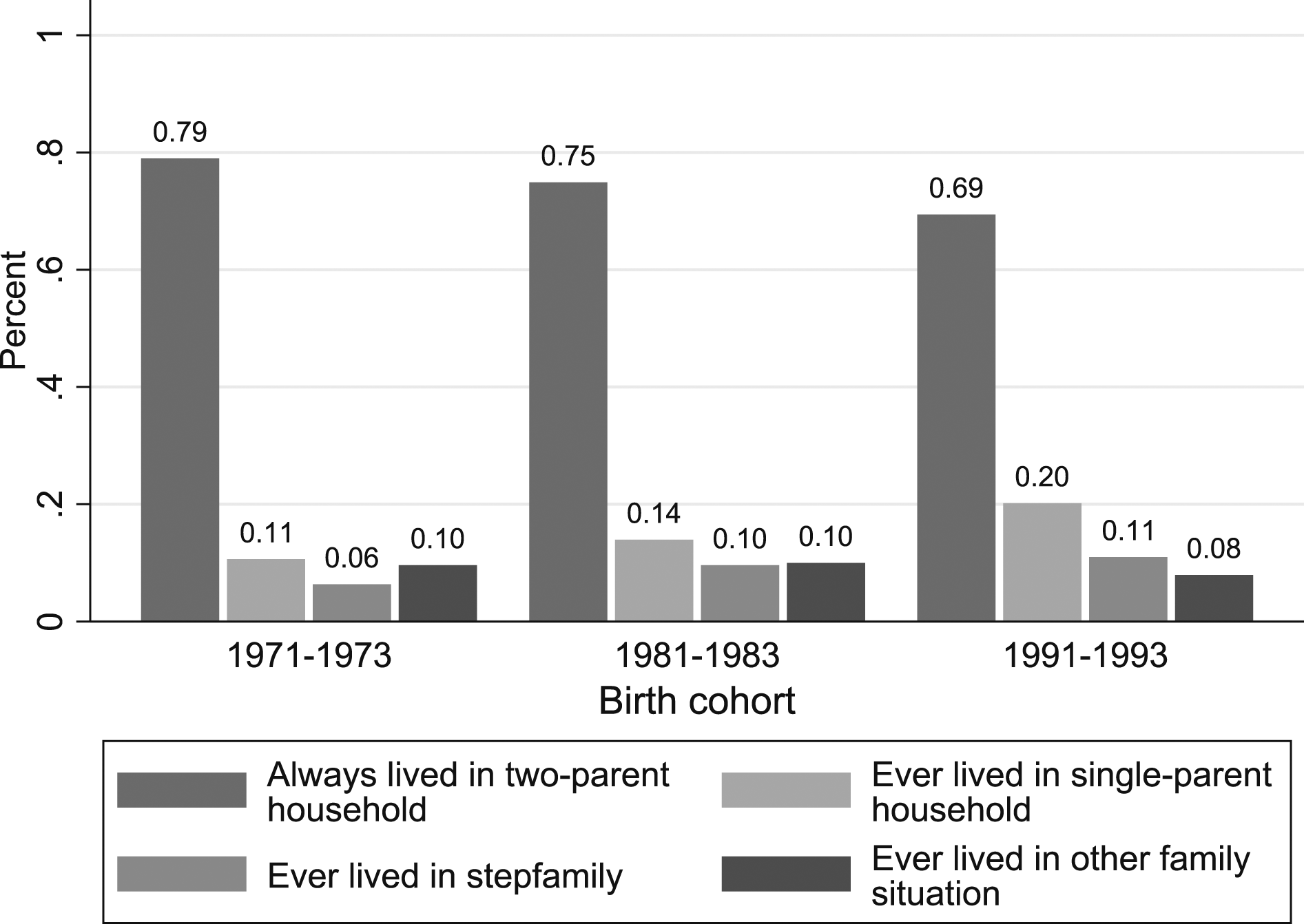
While many studies of the consequences of parental separation have adopted a deficit perspective, in this paper, we extend prior research by examining heterogeneous effects of parental separation based on parent-child relationship quality. In doing so, we contribute to a recent development in family research that not only examines differences in family structure and child well-being, but also determines for whom or under what conditions family structure affects child well-being (Jensen & Sanner, 2021). Specifically, we analyze how the impact of parental separation on children’s well-being varies depending on the quality of the resident parent-child relationship. Prior research has shown that family relationship quality is associated with a range of children’s well-being indicators (Li & Meier, 2017; Streit et al., 2020; Suldo & Fefer, 2013). Specifically, high levels of parental warmth, care and emotional support are associated with high levels of child well-being, in contrast to punishment, over control and parent-child conflict, which are associated with low levels of child well-being (Suldo & Fefer, 2013). In our study, we consider intimate disclosure and parent-child conflict as two dimensions of parent-child relationship quality. We argue that children who have a good relationship with the resident parent do not suffer from decreased well-being after the separation, whereas children with a poor relationship with the resident parent tend to have lower levels of well-being after the separation than before. In our study, the “resident parent” is the parent with whom a child lives after separation.
To the best of our knowledge, we are the first to analyze the moderating effect of parent-child relationship quality on children’s well-being after parental separation. In our definition of separation, we focus not only on married but also on cohabiting parents. We refer to the personal information about the end of parents’ coresidential partnerships. By utilizing waves 2 to 13 (2009/2010 – 2020/2021) of the German Family Panel pairfam in our study, we are able to draw on panel data for children between 7 and 15 years old. For our analysis, we use a fixed-effects regression. In order to investigate the heterogeneous effects of parental separation on the well-being of children in families with different levels of parent-child relationship quality, we estimate interaction effects. In order to avoid biased estimates through confounding (Elwert, 2013), resident parent’s depressive symptoms, child’s perception of the economic deprivation of the family, child’s age and resident parent’s age serve as our control variables. Given the structure of our data, we focus on the short-term effects of parental separation in the year following the transition to a single-parent family.
Theoretical Background
Many researchers have studied the effects of parental separation on children by looking at the deficits in a variety of outcomes. The findings of these studies have uniformly shown that in virtually every area that is assessed, children and adolescents living in post-separation families fare worse, on average, than children and adolescents living with both of their biological parents (Amato, 2000, 2014; McLanahan et al., 2013; Raley & Sweeney, 2020). Compared to children with continuously married parents, children with divorced parents have more behavioral and emotional problems, obtain lower academic test scores, and have more problems with social relationships (Amato, 2014). A negative effect of parental separation has also been shown on physical health indicators such as the longer term development of BMI (Goisis et al., 2019) and c-reactive protein (Kleinschlömer et al., 2022). Two different theoretical perspectives are often discussed in the literature to explain the effects, (1) the stress-theoretical perspective and (2) the resource theory.
First, children might experience stress because a parent’s partnership transitions change the overall family situation. Amato (2000) identified five subcategories of stressors that are associated with a parental separation: (1) financial insecurity; (2) interparental conflicts; (3) parental stress and changes in the parenting skills of the resident parent; (4) the lack of contact with the non-resident parent; and (5) possible further changes in the child’s living circumstances due to moving, changing schools, or the loss of friends. Second, changes in family resources may also explain the different levels of well-being in children before and after they experience a parental separation. If a parent moves out of the home following a separation, children lose the benefits of the income and social support that an additional parental figure can provide (Manning & Lamb, 2003; Sweeney, 2010). Moreover, single parents often face the dual demands of fulfilling both caregiving and breadwinning roles, which may limit the amount of quality time they can spend with their children (Magnuson & Berger, 2009). Hence, children’s access to emotional, social, and financial resources may be more limited in single-parent than in two-biological-parent families.
The stress and the resources arguments are partly interrelated. The lack of financial resources can produce stress (Conger et al., 2010) and children with a high level of stress might withdraw from social interaction with their parents (Ulmer-Yaniv et al., 2018) and have difficulties to accept and profit from emotional and social resources. However, both stress and resources might affect children also independently. A child might simply miss the other parent after parents’ have separated leading to psychological distress in the child, for instance. This is unrelated to resources of the family. In sum, both mechanisms, stress and resources, lead us to the same theoretical expectation. We hypothesize that the well-being of children is lower after a parental separation than before (Hypothesis 1).
The existing empirical research that focused on the effects of divorce on children was mainly based on U.S. data. The findings of these studies provide a uniform picture: children living with both biological parents have, on average, higher well-being than children living in a post-separation family (e.g. single-parent family or stepfamily) (Amato, 2014; Hetherington et al., 1992; McLanahan et al., 2013; Raley & Sweeney, 2020). The negative effects of parental separation on child well-being have been found in other countries as well (Amato, 2014). A number of studies that focused on the German context found small, but non-negligible effects of living in a post-separation family: namely, that these children have more emotional and behavioral problems than children who live with their two biological parents (Entleitner-Phleps & Walper, 2020; Heintz-Martin & Langmeyer, 2020; Walper & Wendt, 2005). However, most of these German studies were based on cross-sectional data (Feldhaus, 2016). Without longitudinal analyses, we cannot rule out the alternative explanation that the observed child outcomes were caused by factors that are more common among families who experience parental separation.
Going beyond this deficit perspective, we are interested in the adaptation to the situation after parental separation. Protective factors can mitigate the negative effects of a parental separation on children’s well-being. Such “shock absorbers” (Amato, 2000, p. 1272) can moderate the effects of parental separation (i.e., their presence or absence can lead to heterogeneous effects of parental separation on children’s well-being). One protective factor is the quality of the parent-child relationship. Prior research has shown that positive parent-child relationships are associated with higher levels of emotional security in children (Suldo & Fefer, 2013). In a family with positive parent-child relationships, the parents might continue to have thoughtful and honest conversations with their child even after their union has dissolved. Parents can make it clear that their separation does not change their love for the child. The child might feel more involved in the decision-making process, which can help him/her accept the new family constellation. We expect to find that a positive resident parent-child relationship buffers the possible negative consequences of parental separation. Therefore, we argue that the well-being of children who have a good relationship with the resident parent is less negatively affected after a parental separation than that of children who have a poor relationship with the resident parent (Hypothesis 2). 1
Research that explicitly took heterogeneous effects into account mainly focused on the socio-economic background of the family (Augustine, 2014; Bernardi & Boertien, 2017; Grätz, 2015; Härkönen et al., 2017; Mandemakers & Kalmijn, 2014). The studies based on cross-sectional data (Dronkers, 1999) and on longitudinal data (Amato et al., 1995; Amato & Hohmann-Marriott, 2007; Booth & Amato, 2001; Brand et al., 2019; Hanson, 1999) that considered heterogeneous effects based on family relationships were mainly focused on interparental relationship quality, more specifically on interparental conflicts (Booth & Amato, 2001; Brand et al., 2019). Instead, in our study, we focus on the relationship quality between parent and child rather than the relationship between parents.
To our knowledge, no previous study has analyzed parent-child relationship quality as a moderator of children’s well-being before and after separation using longitudinal data. The few studies that have analyzed the role of parent-child relationship quality in the association between family structure and children’s well-being have yielded mixed results. One study that examined the effects of parental breakup during childhood on the well-being of adults in the U.S. found no support for a moderating effect of parent-child closeness (Sobolewski & Amato, 2007). This study measured parent-child closeness at the time of the interview (when the adult child was 19 years or older), and not at the time of the parents’ separation. Tschann et al. (1990) analyzed 184 divorced families, and found that children had more emotional and behavioral problems when the relationship with their biological mother was poor at the time of divorce. However, since the first measurement of the outcome variable took place only at the time of divorce, the causal relationship between divorce, quality of parent-child relationship, and the well-being of the children could not be assessed. An advantage of our study is that we can analyze changes in a child’s well-being and the quality of the parent-child relationship before and after parental separation. Additionally, the data used in the study by Tschann et al. (1990) are from 1980 to 1983, and thus refer to a time when divorce was not as common as it is today. Therefore, it is unclear whether the effects of parental separation on children’s well-being have changed in more recent years.
Independent of family structure, research has confirmed that high-quality biological parent-child relationships are positively associated with child well-being (Li & Meier, 2017; Musick & Meier, 2010; Thomas et al., 2017). This is the case for both father-child and mother-child relationships, and for adolescents as well as for children (Li & Meier, 2017; Streit et al., 2020; Videon, 2005). Hence, the socioemotional adjustment and psychological well-being of both children and adolescents tend to be better when they experience warmth and acceptance from their parents.
Method
Data and Sample
By utilizing wave 2 to wave 13 (2009/2010 – 2020/2021) of the German Family Panel pairfam, release 13.0 (Brüderl et al., 2021), we draw on rich, individual-level panel data for children between 7 and 15 years old and their resident parents. The main participants, the so-called anchors, are usually one of the parents of these children. The anchors belong to three birth cohorts (born in 1971–73, 1981–83, and 1991–1993). They are randomly drawn from the German population registers, and interviewed annually to track multiple life phases. In the first wave, 12,402 anchors participated.
Moreover, parents, partners, and selected resident children are also surveyed. Resident children were surveyed from the second wave onwards, and their participation was conditional on a parent’s consent. The coverage rate among children was around 60% in all waves (Brüderl et al., 2021, p. 39) and the response rate of children whose respective anchor person had given consent was high with 76% (Brüderl et al., 2021, p. 32) to 96% (Brüderl et al., 2021, p. 21) in different survey waves. A detailed description of the study can be found in Huinink et al. (2011). In our analyses, we combine data from the child questionnaire and anchor data, which include the anchor’s relationship history.
The unit of analysis in our study is the child. Because a considerable share of anchor respondents was childless, and because only a subset of children was surveyed, the child dataset contains information on 3,882 children who completed the questionnaire. Given the longitudinal character of our data, we keep in our sample only the children who participated in the survey at least twice. With our focus on parental separation, we restrict the sample to children whose parents were in a relationship with each other when they entered the survey (as this is the group at risk of experiencing the transition from a two-biological-parent family to a single-parent family). In addition, we only keep in our sample those children whose anchor was the biological parent. Since repartnering of the resident parent (Kuhlemann & Krapf, 2022) and the overall number of family structure transitions is negatively associated with children’s emotional symptoms (Fomby & Cherlin, 2007), we ensure with the restriction that the transition to a single-parent family is the first family transition the child experiences. Moreover, we only keep children in the sample who have their primary residence after separation at the anchor’s place. Thus, we can be sure that the child refers to the resident parent when asked about the quality of the relationship. We drop children who have any missing values on the variables of interest. In general, the number of missing values on each variable is very small in our sample, i.e., not more than 5% of respondents have missing information on a single variable. With such a small share, the potential impact of the missing data on the results is negligible (Jakobsen et al., 2017).
The sample restrictions lead to our analytical sample, which includes 2,057 children, aged 7–15, who provide us with 9,141 valid person-years. Of these children, 99 experienced a transition from living in a two-biological-parent family to living in a single-parent family. The remaining 1,958 children in our analytic sample continued to live with both of their biological parents. Although they did not experience a change in our treatment variable, they are included in the sample in order to obtain more reliable estimates for the age and period effects (and the other control variables) (Brüderl, 2010). Of the children who were living in a single-parent family after their parents separated, 80.81% were residing with their biological mother, while only 19.19% were living with their biological father. A sensitivity analysis showed that the results were similar for a sample that included only biological mothers and their children. Therefore, we have chosen to keep single-father families in the sample (results are provided upon request). In order to investigate a uniform time frame for all children who experience parental union dissolution, we focus on the short-term effects of separation (i.e., we compare the level of child well-being reported in the interview years before the parents’ separation, and in the interview in the year after the separation). We limit our sample to one year after separation because it is possible that children’s well-being adjusts to the new family structure. Thus, by restricting the time frame, we ensure that our effect is not diluted by differences in the post-separation period.
Measures
In the following, we discuss the measurement of variables in our analyses. All variables in our models are time-varying, and were measured in waves 2 to 13.
Child Well-Being
We use two measures of child well-being as our outcome variables: emotional symptoms and behavioral problems. The respective item batteries are part of the established and standardized Strengths and Difficulties Questionnaire (SDQ) (Goodman, 1997) that is partly integrated into pairfam. Behavioral problems are measured by the children’s responses to questions about whether they usually do what adults request; take things that do not belong to them; can make other people do what they want; often lose their temper; or cheat. Emotional problems are measured by the children’s answers to questions about whether they easily lose self-confidence; experience a lot of headaches, stomach aches, or sickness; have a lot of fears; are often unhappy; or worry a lot. The answering categories are based on a three-point scoring system: 0 = not true, 1 = somewhat true, 2 = very true. For the two scales, we calculate the average from five items, (i.e., each scale ranges between zero and two, with higher values indicating greater problems). Regarding the ordinal nature of items with only three response options, we calculate Ordinal Alpha to analyze the reliability of our outcome variables. Ordinal Alpha is conceptually equivalent to Cronbach’s Alpha but provides a more accurate estimate of reliability for binary and ordinal response scales (Zumbo et al., 2007). For emotional problems, the Ordinal Alpha is α = .74, and for behavioral problems, it is α = .69. In contrast, Cronbach’s Alpha for our two outcome variables is lower (α = .65 for emotional problems; α = .50 for behavioral problems). Previous German studies have also reported low Cronbach’s Alpha for children’s self-reports of their emotional and behavioral problems (Becker et al., 2018; Lohbeck et al., 2015). However, a simulation study has shown that Cronbach’s Alpha tends to underestimate reliability in ordinal variables, which seems to explain the lower values observed in our case (Zumbo et al., 2007). While Ordinal Alpha for emotional problems takes a value above .7, which is widely considered an acceptable level of reliability, Ordinal Alpha for behavioral problems is just below the threshold. One reason for the low alpha might be a restricted theoretical reliability. The behavioral problems scale contains items that refer (a) to behaviors targeted more towards authority figures (e.g., the item I usually do as I am told) and (b) to behaviors that are targeted more toward other children (e.g., the item I take things that are not mine). Although both aspects are part of the construct of behavioral problems, their correlation is small (Spearman’s r = .12). This might account for the comparatively lower level of the reliability measure. Other indicators belonging to the SDQ scale are not regularly asked in pairfam.
Separation Indicator
Our key independent variable is the parents’ separation. From the relationship histories of the biological parents, we extract the information about their relationship status. We create a dummy variable, which takes a value of zero if the biological parents were still in a relationship, and a value of one if the biological parents had separated since the last interview. We focus not only on the marital partnerships, but also on the non-marital partnerships of parents.
Parent-Child Relationship Quality
To test our second hypothesis, we interact the family relationship variable with the separation indicator. To measure parent-child relationship quality, we use two concepts: perceived conflict behavior, and intimate disclosure. Both measures are based on the children’s reports. Each variable is composed of two items. Conflict behavior is measured by the children’s responses to questions about (a) how often the resident parent and the child are angry with each other; and (b) how often they disagree and quarrel. The response options range from (1) never to (5) always. The individual mean of the answers to these two items is our measure of conflict levels, and ranges from one to five. Intimate disclosure is measured by the children’s answers to questions about (a) how frequently the child shares his/her secrets and private feelings; and (b) how often the child tells the resident parent what is bothering him/her. Again, we use the mean of the two items for our intimate disclosure measure.
The question battery is based on the Network of Relationships Inventories (NRI), a tool used to measure children’s perceptions of their personal relationships (Furman & Buhrmester, 1985). Cronbach’s alphas for the two relationship dimensions range between α = .71 for conflict behavior and α = .79 for intimate disclosure. Since each indicator variable in itself measures a reliable relationship dimension, we decided to analyze the effect of the relationship indicators separately instead of calculating a summary score.
Control Variables
In the multiple regression models, we control for the possible confounding effects of a number of factors. A confounder is a variable that influences both our outcome variable, child well-being, and our key independent variable, parental separation. An approach for deciding whether or not variables count as confounders is based on theoretical considerations (Rohrer, 2018). In the following, we elaborate on our inclusion of control variables based on the findings of prior research.
One possible confounder is the economic situation of the family. Prior research has shown that couples with fewer economic resources are more likely to separate (Amato, 2010). At the same time, parents’ economic situation also influences child well-being (Duncan et al., 2015). We measure the economic situation of each family based on children’s self-rated economic deprivation. It consists of three questionnaire items: (a) we do have enough money for everything we need; (b) we often have to do without because of financial constraints; and (c) in my family, money is usually tight (Cronbach’s alpha = .81). The response scale ranges from (1) completely wrong to (5) completely true. From these three items we calculated an average that ranges from one to five, with higher values indicating higher levels of family economic deprivation from the child’s perspective. We refer to children’s evaluation because we are interested in how the parents' financial situation is perceived by the child. Moreover, we control for depressive symptoms of the resident parent. Individuals with lower levels of mental health have a higher probability of separation (Breslau et al., 2011). Simultaneously, it has been shown that maternal depressive symptoms are negatively related to children’s well-being (Luoma et al., 2001). In pairfam, the anchor persons are asked whether they are happy, calm, and relaxed; whether they feel good and secure; and whether they enjoy life (Cronbach’s alpha = .90). From this information, we create an index variable based on the mean of the self-rated answers, ranging from one to four. In order to control for possible age effects, we include the children’s and the resident parents’ ages in the models.
In order to test whether the control variables contribute to the quality of the model, we calculate the within R2 in a fixed effects regression (Hansen, 2022). Therefore, we added our control variables to the null model step by step and show that the within R2 increases (see Appendix A).
Analytical Strategy
In order to estimate the effects of parental separation on child well-being, we use fixed-effects regressions. Fixed-effects models estimate the causal effects based on a comparison of changes within an individual before and after a so-called treatment event – in our case, a parental separation – has occurred. In our study, the 99 children who have experienced a parental separation provide us with the within-child variation needed to calculate a fixed-effects estimator. This approach allows us to analyze the differences in well-being before and after the parental separation within each child. The resulting within-estimator controls for all (unobserved and observed) time-constant factors, and thus eliminates bias from temporally stable unobserved heterogeneity (Brüderl & Ludwig, 2015). One example of such an often unobserved potential confounder is an individual’s personality. People who are neurotic are more likely than people who are not neurotic to separate (Roberts et al., 2007) (i.e., they self-select into separation). At the same time, the children of parents who are neurotic have lower levels of well-being (Fan et al., 2020). The fixed-effects approach adjusts for the bias generated by omitting such time-constant unobserved variables, which makes causal claims more robust (McLanahan et al., 2013). This is an important contribution to the literature, given that most of the studies that have examined the effects of parental separation on children (especially in Germany) were based on cross-sectional data that ignored such unobserved heterogeneity.
To identify varying effects of separation on children depending on the parent-child relationship quality, we estimate a multiplicative interaction term of separation and the level of (a) intimate disclosure and (b) the level of conflicts between the child and the resident biological parent. 2 All analyses were estimated with Stata 17 (StataCorp, 2021).
Results
Descriptive Results
Descriptive statistics for variables used in the analysis.
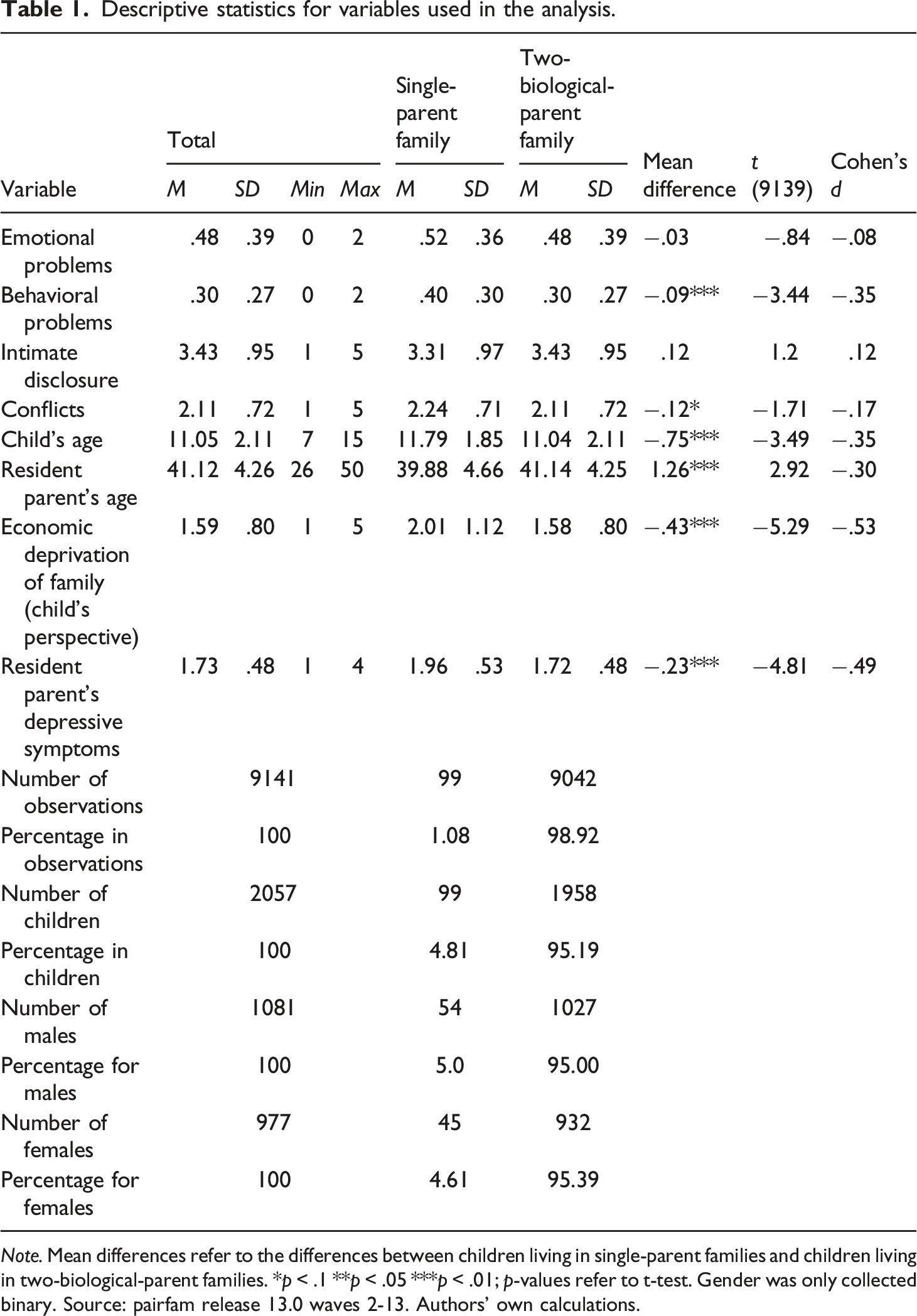
Note. Mean differences refer to the differences between children living in single-parent families and children living in two-biological-parent families. *p < .1 **p < .05 ***p < .01; p-values refer to t-test. Gender was only collected binary. Source: pairfam release 13.0 waves 2-13. Authors’ own calculations.
Results of the Multiple Regression Analyses
Results of the multiple regression analyses.
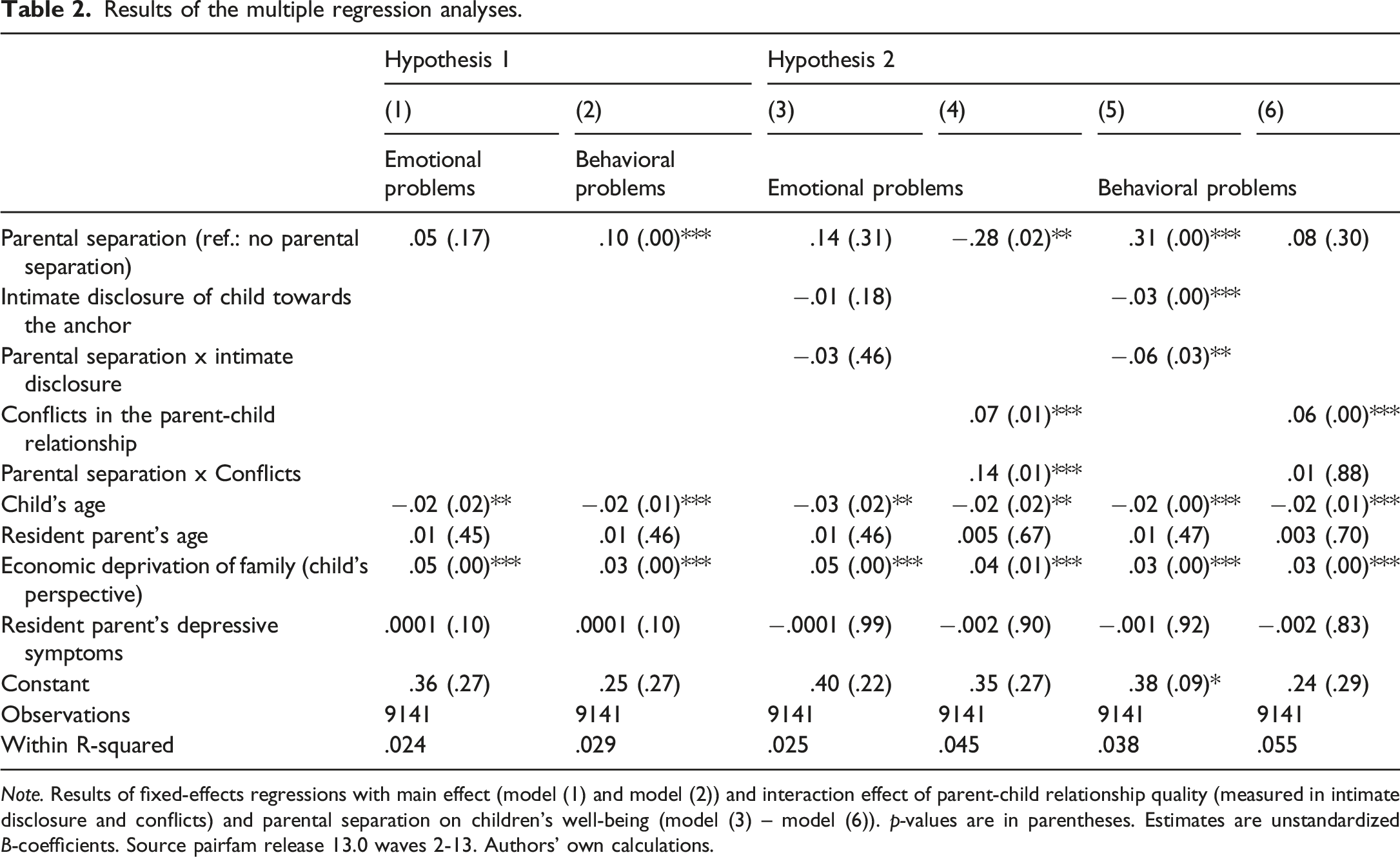
Note. Results of fixed-effects regressions with main effect (model (1) and model (2)) and interaction effect of parent-child relationship quality (measured in intimate disclosure and conflicts) and parental separation on children’s well-being (model (3) – model (6)). p-values are in parentheses. Estimates are unstandardized B-coefficients. Source pairfam release 13.0 waves 2-13. Authors’ own calculations.
In order to identify the potentially buffering effect of high parent-child relationship quality (hypothesis 2), we estimate an interaction between parental separation and our two measures of relationship quality (models 3 – 6 in Table 2). By adding the interaction effect, the within R2 increases indicating an improved model fit. Theoretically, the interaction provides insights into whether the negative effects of a parental separation on children’s well-being varied depending on the quality of the relationship between the resident parent and the child. Figure 2 illustrates the interaction effects in conditional effect plots. The marginal effects were estimated while keeping effects of all other variables constant at their sample mean. The corresponding regression table for Figure 2 can be found in the supplementary material (Appendix B; Table 4–5). The plots show the effects of the separation indicator conditional on the values of the different measures of relationship quality. Thus, we can directly compare the difference in well-being of children who live with their two biological parents and children who experienced the transition to a single parent family for different levels of relationship quality. The dashed horizontal line refers to the well-being of children in two-biological-parent families (reference category). The solid line shows the children’s emotional and behavioral problems after parents’ separation depending on the relationship quality level. Fixed-effects regression with interaction effect of parent-child relationship quality (Measured in intimate disclosure and conflicts) and parental separation on children’s well-being.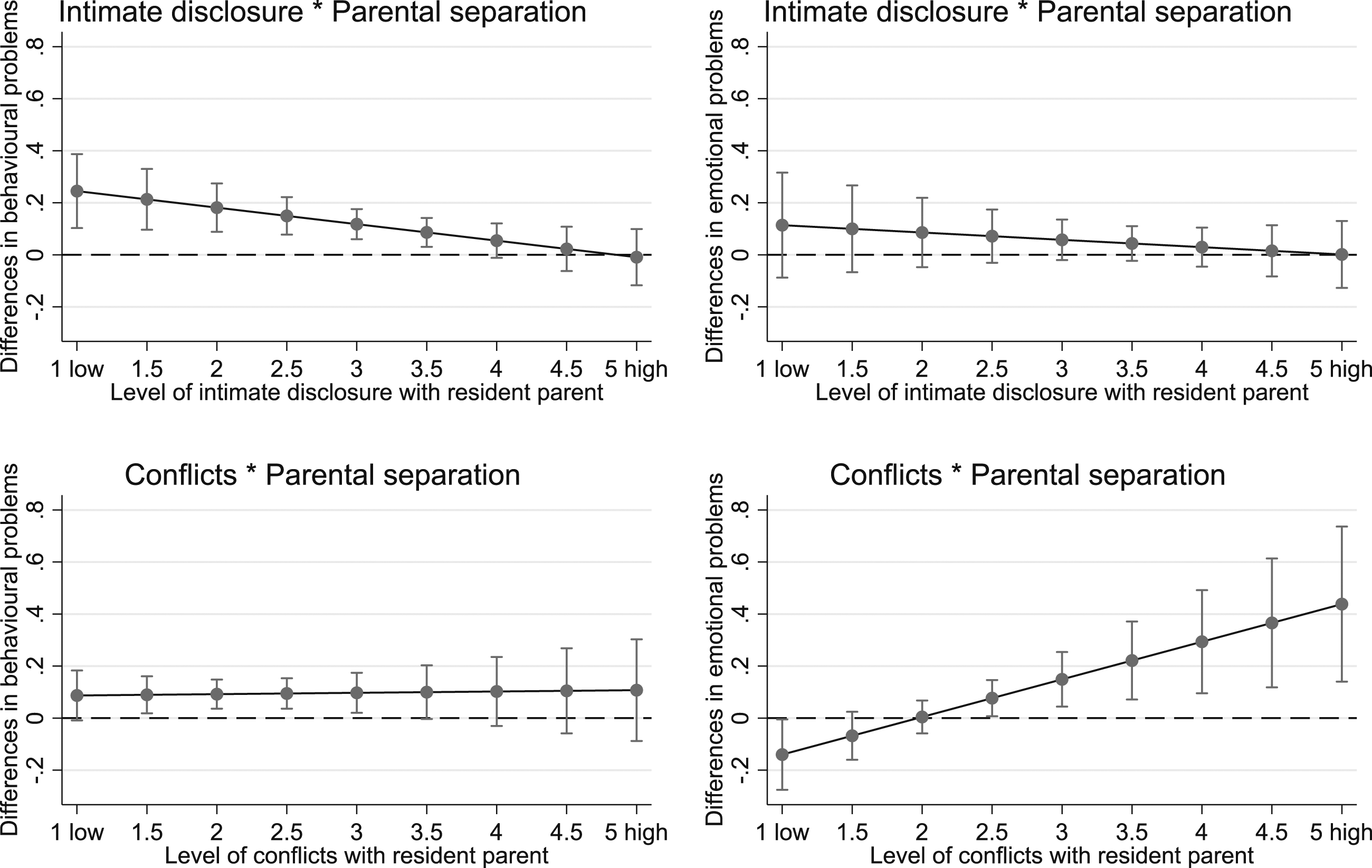
The upper left panel shows that a child who has experienced the transition to a single parent family and who has a very low level of intimate disclosure has increased behavioral problems by .24 compared to the child who lives with two biological parents and also has an intimate disclosure level of 1. This difference in behavioral symptoms disappears if the level of intimate disclosure between parents and children is high (intimate disclosure = 4 or higher). Hence, these finding indicates that an intimate parent-child relationship can buffer the negative effects of a parental separation on children’s behavioral problems and supports our second hypothesis. However, the pattern of the interaction of conflicts and separation on behavioral problems (illustrated in the lower left panel of Figure 2) does not support hypothesis 2. Here, the level of behavioral problems is increased for all children after separation compared to before separation, regardless of the level of conflicts.
With regard to emotional problems, we find that experiencing a separation had a significantly stronger effect if the level of conflict between the parent and the child was high, while experiencing a separation was associated with slightly fewer emotional problems than before the separation if the level of conflict was very low (cf. lower right-hand panel in Figure 2). These findings are in line with our hypothesis 2. The pattern of the moderating effect of intimate disclosure is similar (although less pronounced) for emotional problems. An intimate parent-child relationship can buffer the negative consequences of a parental separation on children’s emotional problems. However, the interaction remains statistically insignificant (cf. upper right-hand panel in Figure 2).
Discussion
Research has shown that experiencing a parental separation is negatively associated with children’s well-being. While many studies took a deficit perspective, in our paper we investigated factors that support children to adapt to family changes. Prior research has focused mainly on the socio-economic situation of families as a moderator of parental separation (Brand et al., 2019; Grätz, 2015; Härkönen et al., 2017). We extend on this finding and argue that also the parent-child relationship quality might be a source of heterogeneity in separation effects on children. Having a good relationship with the resident parent can reduce the negative outcomes for children following the separation of their biological parents. We focused on two parent-child relationship indicators: intimate disclosure and conflict. In the empirical analyses, we used fixed-effects regressions to analyze the changes in a child’s well-being in the years before and in the year after separation. In doing so, we focused on the short-term consequences of parental separation. As measures for children’s well-being, we used emotional symptoms and behavioral problems.
The findings of our regression analyses were mixed. First, with regard to the main effects, we found a significant increase in children’s behavioral problems after their parents’ separation. However, the increase was not significant for emotional symptoms. In the second part of our analyses, in which we analyzed children with low and high relationship quality in separate groups, we found partial support for our heterogeneous effects hypothesis. Children who had a high level of conflict with their resident parent experienced an increase in their emotional problems after their parents broke up. In line with this finding, we observed that children who had a low level of intimate disclosure with their resident parent had more behavioral problems after than before the separation. By contrast, we did not find statistically significant heterogeneous effects of parental separation on children’s emotional problems depending on their level of intimate disclosure with the resident parent. Here, the effects were small and insignificant for children regardless of whether they had a low or a high level of intimate disclosure. For children’s behavioral problems, the effects of parental separation were similar for both the low and the high conflict group. In both groups, behavioral problems increased after the separation.
These findings might indicate that different indicators of relationship quality are relevant for the two well-being dimensions analyzed in our study. With regard to conflicts and emotional symptoms, the literature shows that conflictual relationships limit children’s ability to manage emotions, which, in turn, increases the likelihood that children will develop emotional problems (Kiel & Kalomiris, 2015; Lougheed et al., 2022). By contrast, the effect of the level of intimate disclosure in the parent-child relationship might be more relevant for children’s behavioral problems. In our study, intimate disclosure was defined as the child having frequent contact with the resident parent, and being able to share his/her private feelings and thoughts. Prior research has shown that children with behavioral problems have fewer conversations about their emotional experiences with their mother than children without behavioral problems (Katz & Windecker-Nelson, 2004). These honest conversations can improve both the parent’s and the child’s understanding of the new family situation, and in turn, explain why children who had a low level of intimate disclosure with their resident parent had more behavioral problems after than before the separation.
Areas of action for future research can be derived from our limitations. Our first limitation concerns reversed causality. Simple fixed-effects models do not necessarily eliminate the problem of reverse causality (Collischon & Eberl, 2020). Whether parental separation affects child well-being or whether child well-being influences the likelihood of parental separation remains unclear. For example, children’s behavior or characteristics (e.g., emotional problems) could affect their parents' decision to separate. However, Amato and Anthony (2014) discussed different methodological approaches in their study, and concluded that given the impossibility of conducting true experiments, child fixed-effects models are among the best methods for estimating the causal effects of divorce on children. Second, while a fixed-effect model solves the omitted variable problem with respect to time-constant variables, it does not control for unobserved time-varying variables. Two potential confounders that we could not control for were interparental relationship quality after separation and the quality of the children’s relationship with the non-resident parent. As both factors may influence the children’s well-being and their relationship with the resident parent, they could confound our results. Unfortunately, the variables were collected as part of the pairfam question program at irregular intervals only; thus, we were unable to control for them in our analyses. A third weakness of our study is the small number of separation events. Parental separation is rare in our longitudinal data and since the number of children surveyed in pairfam was rather small, the statistical power of our analyses was limited. Moreover, due to the limited size of our sample, we were unable to analyze how the children adjusted to their parents’ separation over time. It is, for example, conceivable that the children adjusted to their new family situation, and that their well-being recovered from the shock of the parental separation. Future research should therefore analyze adjustment effects using a growth curve model. The extent of the children’s adaptation might also vary over different levels of parent-child relationship quality. In terms of heterogeneous effects analysis, there are many other exciting further aspects. For example, future research could look at heterogeneous effects in relation to sexual orientation and sexual identity or race and ethnicity. In our sample, however, we do not have enough information to analyze these potential moderators. Given the increasing relevance of studying children living in various family structures, we need larger longitudinal datasets that include information on children. This would enable social scientists to assess children’s well-being in subcategories (i.e., in joint physical custody families or in residential custody single-mother or single-father families; or according to how much time the children spend with their mother or father).
The results of this study contribute to the literature in several ways. Most importantly, our findings support the claim that not all children respond identically to their parents’ separation. This was found in a fixed-effects model that indicated the robustness of the effects after time-constant factors were taken into account. Such analyses have rarely been done using German data. Thus, our results underline the importance of taking heterogeneous effects into account in future research and contribute to the identification of indicators that facilitate adjustment to parental separation. Analyzing the variability in children’s responses after the separation of their parents provides us with a better picture of the consequences of parental separation, and of children’s resilience to stress. Thereby, our study emphasizes the importance of recognizing and valuing the diversity of families and working to provide inclusive and supportive services to all families, regardless of their structural differences (Russell et al., 2022). These findings are relevant not only for researchers in the field, but also for policymakers and institutions seeking to reduce social inequality, and to provide the best possible support for children after parental separation.
Supplemental Material
Supplemental Material - Parental separation and children’s well-being. Does the quality of parent-child relationships moderate the effect?
Supplemental Material for Parental separation and children’s well-being. Does the quality of parent-child relationships moderate the effect? by Pauline Kleinschlömer and Sandra Krapf in Journal of Social and Personal Relationships
Footnotes
Acknowledgements
This paper uses data from the German Family Panel pairfam, coordinated by Josef Brüderl, Sonja Drobnič, Karsten Hank, Bernhard Nauck, Franz Neyer und Sabine Walper. Pairfam is funded as a long-term project by the German Research Foundation (DFG). We thank Adrian Greiner and Jana Klein for research assistance.
Funding
The author(s) disclosed receipt of the following financial support for the research, authorship, and/or publication of this article: The research for this paper is part of the project “Family relationships and child wellbeing in post-separation families”. Principal investigator of the project is Sandra Krapf (ifb - State Institute for Family Research at the University of Bamberg). The project is supported by a grant from the Deutsche Forschungsgemeinschaft (DFG, Project number 434010343).
Open Research Statement
As part of IARR’s encouragement of open research practices, the author(s) have provided the following information: This research was not pre-registered. The data used in the research are cannot be shared with any person each data user has to apply (and pay) for the dataset. The data can be obtained at:  . The materials can be obtained by emailing:
Supplemental Material
Supplemental material for this article is available online.
Notes
References
Supplementary Material
Please find the following supplemental material available below.
For Open Access articles published under a Creative Commons License, all supplemental material carries the same license as the article it is associated with.
For non-Open Access articles published, all supplemental material carries a non-exclusive license, and permission requests for re-use of supplemental material or any part of supplemental material shall be sent directly to the copyright owner as specified in the copyright notice associated with the article.
