




Abstract
Single and childless women over the age of 35 constitute an expanding demographic in North America and many parts of the world, yet our society continues to place importance on marriage and family as markers of life success. This study explored how eight single (never-married) and childless women experience themselves during early midlife (ages 35–45) utilizing the Listening Guide method of analysis. Three categories of participant voices were uncovered in this research: voices which conveyed the positivity of living a single and childless identity (i.e. the voices of hope, faith, gratitude, nurturance, freedom, and resilience), voices which conveyed the struggles of living a single and childless identity (i.e. the voices of invisibility, shame, confusion, loneliness, guilt, longing, and uncertain waiting), and the voice of ambivalence. Implications for clinical practice and research are discussed.
Keywords
Introduction
The social fabric of our modern society is changing dramatically and there is now a rapidly expanding population of women who are single in many countries around the world. According to a recent report by Statistics Canada (2022), the proportion of women aged 50 and over who have no biological children is on the rise from 14.1% in 1990 to 17.4% in 2022. Simultaneously, the number of women in Canada getting married has been declining since the early 1970s (Statistics Canada, 2022). This long-term decline in marriage rates is not restricted to Canada—it can be seen in countries across the globe. Demographic trends in the delay and decline in marriage, along with increase rates of divorce and separation, have meant that more women have experienced periods of singleness and/or childlessness, the focus of the present research.
The pressure to marry and have children tend to be the greatest for single and childless women in their 30s and 40s, who are considered to be non-normative (Addie & Brownlow, 2014; Lesch & van der Watt, 2018; Moore & Radtke, 2015; Ntoimo & Isiugo-Abanihe, 2014; Wang & Abbott, 2013). Specifically, in Canada, single women at ages 35–45 are positioned as non-normative in relation to marriage and motherhood (Moore & Radtke, 2015). Thirty-five is also seen as a turning point in the development of a woman’s lifespan due to concerns about pregnancy risks and a decrease in or loss of fertility (Moore et al., 2017; Sharp & Ganong, 2011; Wang & Abbott, 2013), loss of youth and beauty (Lahad & Hazan, 2014; Ntoimo & Isiugo-Abanihe, 2014; Wang & Abbott, 2013) and decreasing number of potential partners (Lahad, 2013; Lahad & Hazan, 2014; Sharp & Ganong, 2011; Slonim et al., 2015; Wang & Abbott, 2013). For example, a common struggle for single and childless women is “social infertility,” a term coined by the in vitro fertilization (IVF) industry to describe the experience of women in their fertile years who desire to have children but are unable to do so (due to not having a partner). Those experiencing social infertility also experience feelings of anxiety (Ji, 2015), depression (Hansen, 2021), and grief (Fieldsend & Smith, 2020; James & Singh, 2018; Tonkin, 2010), yet the paucity of literature on this life circumstance has made it difficult to understand women’s unique experiences and to offer support.
Familism as a dominant cultural narrative
Despite statistics showing that many young women are departing from conventional roles and expectations, the ideology of marriage and family or “familism” (Byrne, 2003, p. 443) remains a dominant cultural narrative in North America (Budgeon, 2016; Moore & Radtke, 2015; Sarkisian & Gerstel, 2016; Sharp & Ganong, 2011) and around the world (Lahad & Hazan, 2014; Lamb, 2018; Lesch & van der Watt, 2018). Research studies have shown that women experience more pronounced pressure to abide by this ideology than men (Budgeon, 2016; Simpson, 2016) because gender constructions emphasize caring and dependence as requirements of femininity. Both the popular and social science literature on the lives of singles emphasizes the hegemony of heterosexual couplehood and gives marriage a central place along the normative life path; hence, heterosexual partnership is considered the most important peer relationship, and is considered to result in happiness and fulfilment (Slonim et al., 2015). There are similar premises for the family ideology, which holds that adults who marry and have children are happier, less lonely, more mature, and lead more meaningful and complete lives than those who do not marry and have children (Slonim et al., 2015). Research findings, however, tend to show that people are better off not having children, particularly women, singles, lower socioeconomic strata, and people residing in less pronatalist societies (Hansen, 2012). In fact, being childless has a number of advantages with evidence showing that women who are involuntarily childless tend to effectively adapt and compensate to their life circumstance (Bear & Offer, 2023; Zhang, 2020), which in turn promotes wellbeing.
The current study
Although several research studies have examined women’s experiences of singlehood (Ji, 2015; Lahad, 2013; 2017; Lahad & Hazan, 2014; Sharp & Ganong, 2011; Simpson, 2016) and childlessness (Koert & Daniluk, 2017; Graham, 2015; Holton et al., 2010) as separate areas of inquiry, there has been glaringly little research on women’s experiences of being both single and childless. Although these women have become more prevalent in our contemporary society, they tend to be often neglected and stigmatized, and their voices silenced. The purpose of this research is to offer an open and non-judgmental space for women who had expected and desired to be married with children by 35–45 years of age, and who currently desire marriage and motherhood, to share their stories. The research hopes to deepen our understanding of how single and childless women experience themselves and how their sense of self evolves with their experiences. In order to accomplish its purpose, this study will be guided by the following research question: How do women who are involuntarily single and childless experience themselves during early midlife? Our hope with this research is to recognize and celebrate these women’s lives as valuable and meaningful with voices worth listening to.
Method
Participants
Participant Demographics.
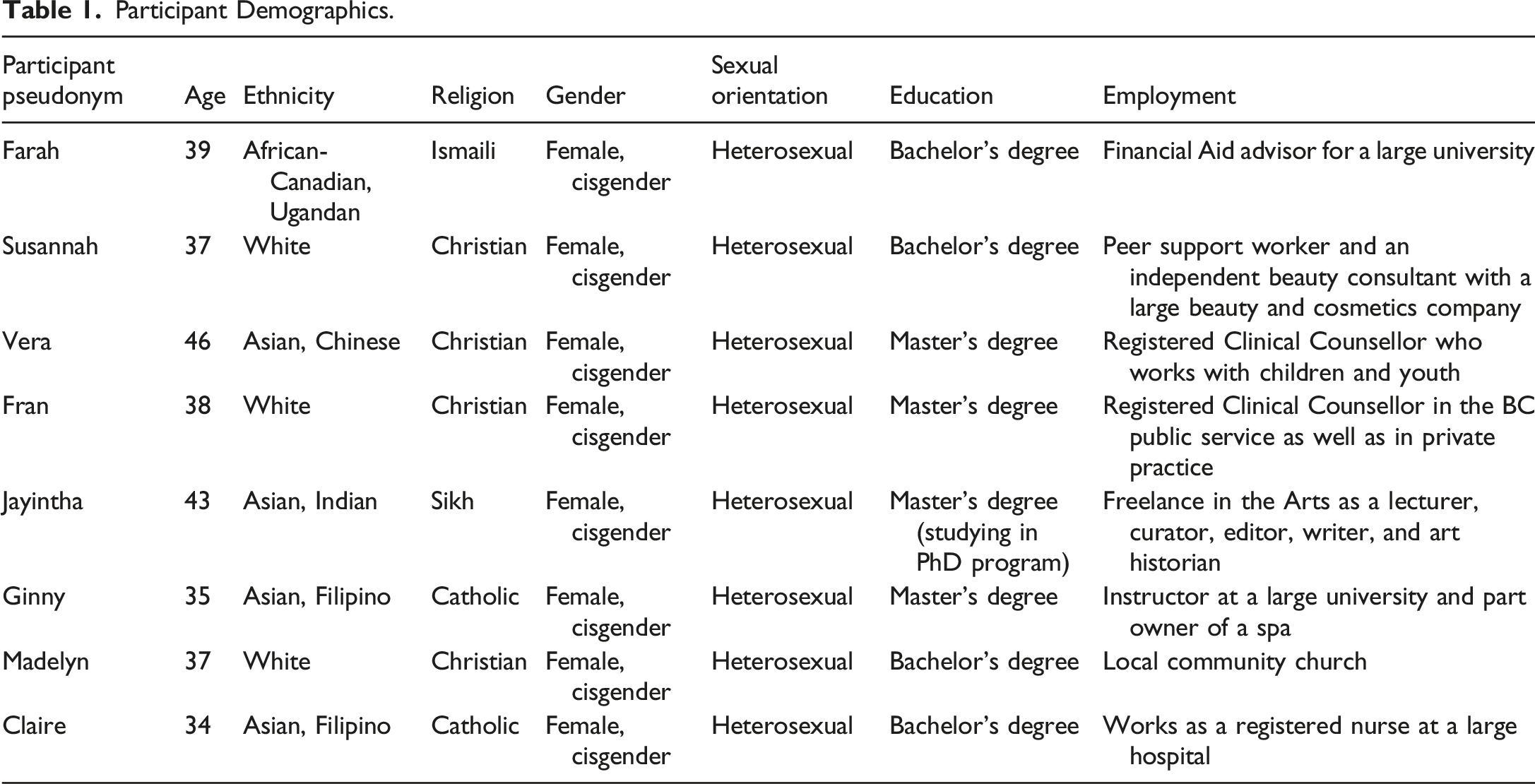
This was an exploratory study which focused on depth of analysis using the Listening Guide approach, hence the sample size was small. Although the Listening Guide does not utilize the concept of ‘saturation,’ the researchers determined that no new voices were emerging after eight participants were recruited and analyzed. For the purposes of this study, single refers to never-married. Women who have been separated, divorced, or widowed were not included in this study. For the purposes of this study, childless refers to women who are without children by circumstance, specifically those women experiencing social infertility, or the inability to have children as a result of not having a partner. Women who are experiencing biological infertility were not included in this study. Finally, women who have made the explicit decision to remain childless and/or never-marry were not included in this study.
Procedure
Participants were recruited through purposive sampling via online advertisements (through social media and forums) as well as leaflets distributed in public locations including women’s groups, coffee shops, universities, libraries, and yoga centres. Once a participant was confirmed to be eligible to be part of the study, she was briefed about potential risks and benefits of participating in the study verbally by the research team and via a written informed consent document. If the woman consented to participate, she signed and returned the consent form to the research team. Two semi-structured interviews were conducted at a location of the participant’s choice to ensure privacy and confidentiality. These locations included the participants’ homes, participants’ place of employment, and online. All interviews held in a public space were conducted in a private room. Seven of the eight participants’ interviews were conducted in person in the cities of Vancouver, Burnaby, and Langley located in British Columbia, Canada. The eighth interview was conducted online given that she lived in London, England. During the first interview, participants were asked questions about how they experience themselves as single and childless, and lasted approximately 1.5 hours (see Appendix A). Following the initial interview, data analysis was conducted by the research team. Interviews were transcribed by the primary researcher to familiarize with the participant and to conduct a preliminary listening. The transcription process comprised of listening to the audio recordings and writing verbatim everything discussed by the researcher and participant. Members of the analysis team were trained in the Listening Guide method of analysis, and strong collaboration with the research team was used throughout the analysis process. Each analysis meeting focused on a different participant and lasted approximately two to 3 hours. Following analysis, a second interview (approximately 45 minutes) was conducted where participants were given the opportunity to read the analysis, ask questions, and to add, verify, or clarify any of the findings (see Appendix A). The research was conducted in accordance with ethical standards approved by Trinity Western University.
Research paradigm
The paradigms chosen to guide this research include the social constructivist and the transformative paradigm. Coming from a social constructivist paradigm, our assumption is that meaning and reality are created from an individuals lived experience, interactions with others, and social and cultural norms (Creswell, 2013). This epistemological assumption is inherent in the Listening Guide, in that knowledge is conceived as socially constructed. Another component central to the constructivist framework is the idea that relationship is central to knowing, and that the interactive process between the researcher and the participant is part of the construction of reality, and, therefore, encouraged. Because the assumption of the Listening Guide includes the premise that human development occurs in relationship with others, our sense of self is inextricable from our relationships with others and with the cultures within which we live (Spencer, 2000). Listening Guide is, therefore, an appropriate fit for the relational and sociocultural nature of the research question which focuses on exploring involuntarily single and childless women’s experienced sense of self.
Transformative researchers also believe in multiple realities, however certain realities have been given privilege due to social, political, cultural, ethnic, and gender influences (Mertens, 2015). This premise fits with the Listening Guide, a research method that gives voice to the marginalized. Single and childless women over the age of 35 are stigmatized based on a triple discrimination of age, gender, and single status (Lahad & Hazan, 2014). Qualitative methodologies, such as the Listening Guide, are also geared toward identifying and incorporating such contextual influences that would otherwise be disregarded as confounds in quantitative research and enable issues of trust and power to be addressed openly.
Researcher position
The primary researcher of this paper (RC) was inspired to conduct this research out of her own personal experience as a never-married and childless woman. She also draws on the experiences of close family members, relatives, friends, and acquaintances who were either in this population (involuntarily single and childless woman between the ages of 35–45) or were just entering it. A similarity of experience and emotion in those around 35–45 who were childfree and single was observed, and included wrestling with the emotions that were coming up, having to defend themselves to others, and trying to navigate their paths by making sense of who they were and what they wanted for the future. The research team felt a genuine desire to empower these women, as many of them struggled with feeling not good enough and that something was wrong with them. We wanted to empower these women to embrace and love who they were, and to encourage them to live a joyful and purposeful life regardless of whether marriage and/or motherhood happens for them.
The listening guide
Women’s experiences of being single and childless may have the power to oppress and silence women for fear of being ostracized. This oppression of women results in a silencing of women’s literal voices, as well as to women’s ways of being who they are. Gilligan (1982) firmly believes that a person has a distinctive voice; you recognize it, and hear changes in it. This voice is considered central to a person’s identity, a “footprint of the psyche bearing the marks of that person’s history, of culture in the form of language” (Gilligan et al., 2003, p. 157). For women, many of their voices have been quieted or silenced as a result of living in a patriarchal society and in effort to fit in due to their defining of themselves through relationship or childbearing. Gilligan (1982) found that it was not uncommon for a woman to silence herself so that she could co-exist with others.
The Listening Guide (Gilligan, 1982) was chosen as the method for conducting this research due to its ability to delve into the psychological complexities of experience, and its attention to voices and silences for those who are marginalized. It was important to select a method that enables exploration into the experiences of single and childless women and how they make sense of themselves in a world that prioritizes marriage and family. The Listening Guide also gives space for these diverse women to share their unique stories and raise their voices against the backdrop of the often silenced presence lived by many single and childless women. The Listening Guide encourages women to access and use their voice for sharing their stories within the context of relationship, and it opens a space for which oppressed women may become empowered. In fact, the LG method aims to tune into the rhythms, harmonies, and disjunctures present in experiences that are the most complicated, taboo, or awkward to share with others. Telling one’s own story also enables the woman to gain control over her own narrative and become the writer to her life story. Doing so within the context of a relationship, such as the one with the researcher, brings validation because the woman defines herself in relation to others. Interestingly, the desire for relationships silences us but the bond of relationships heals us, rendering the voice and relationship complexly interconnected (Gilligan, 1982).
Data analysis
The Listening Guide method of analysis comprises a series of sequential listenings, each designed to bring the researcher into relationship with a person’s distinct and multilayered voice by tuning in or listening to distinct aspects of the woman’s expression of her experience. Each step requires the active presence of the researcher and an acute desire to engage with the unique subjectivity of each research participant (Brown & Gilligan, 1992).
Step 1: Listening for the plot
The first listening comprises two parts: (a) listening for the plot and (b) the listener’s response to the interview (Gilligan et al., 2003). The first part was done by attending to what is happening and what stories are being told, as well as the landscape or multiple contexts within which these stories are embedded. Repeated images and metaphors and dominant themes were noted, as were contradictions, silences, and absences, or what is not expressed. The researchers identify the larger social context within which these stories are experienced and within which the researcher and research participant come together. In addition, listening for the plot directs researchers to locate themselves in relation to the data and explore their feelings and thoughts about the persons they have listened to and the material gathered (Gilligan, 2015).
Step 2: I-poems
According to Gilligan et al. (2003), in this second listening, the listener focuses in on the voice of the “I” by following the use of this first-person pronoun. This is done in order to pick up the distinctive cadences and rhythms of the participant’s first-person voice, and to hear how the participant speaks about herself. Constructing an “I-poem” involves first underlining the I-statements (pronoun and verb and other important accompanying words), then lining up the phrases like lines in a poem while maintaining the sequence in which they appear in the text. These I-statements fall into a poetic cadence, with each “I” starting a separate line of the poem and stanza breaks marking where the I shifts direction (Gilligan, 2015). The I-poem may also capture something not stated directly but central to the meaning of what is being said.
Step 3: Listening for contrapuntal voices
While the second listening is similar to writing a piece of poetry, the third listening can be compared to composing a piece of music. Similar to the way that each melodic line has its own rhythm, shape, and movement that are played simultaneously and move in some form of relationship with each other, each woman’s story has multiple voices and facets being told that reflects the rich complexities of their experiences. This step involves reading through the interview two or more times, then identifying and tuning into different aspects of the story and voices in the woman’s expression of experience.
The researcher creates an initial definition or description of a possible voice along with its potential markers. The text is read through, listening for just one voice at a time, marking the appearance of this voice in a particular colour. The text is read through a separate time for each contrapuntal voice. This implies that one statement may contain multiple meanings, and therefore could be marked with multiple colours. Once the contrapuntal voice listenings have been completed, with each voice underlined in a different colour, the transcript provides a visual way of examining how these voices move in relation to one another and to the participant’s first-person voice, and enables the picking up of tensions, harmonies, and dissonances. Listening for at least two contrapuntal voices and their nuances, modulations, and silences takes into account that a woman expresses her experience in a multiplicity of voices or ways, and the researcher can listen for the relationship between these voices.
Step 4: Composing an analysis
If the second listening was composing a poem and the third listening was composing a piece of music, then the fourth step is composing an essay. Having gone through the text a minimum of four times, an interpretation of the interview is developed that pulls together and synthesizes what has been learned about the participant in relation to the research question.
Rigour and quality
The following strategies were taken in order to enhance the rigour and quality of this research. The primary researcher made sure to spend time to build a rapport with each participant to reflect the relational nature of this research. The researcher’s ability to co-create meaning is dependent on factors such as context, culture, and rapport with the participant (Morrow, 2005). To enhance researcher reflexivity, the primary researcher kept a journal to make explicit personal thoughts, emotions, and interpretations through the entire research process. To achieve fairness, the data and analyses were shared with the analysis team, and at least two team members in addition to the primary researcher were present for each analysis session to facilitate multiple perspectives. All interpretations were shared amongst other members of the team and opened for discussion if they felt the interpretations reflected any personal biases as opposed to the participant’s experience. Member checks with the participant were done consistently throughout the research process to facilitate ontological and catalytic authenticity.
Results
Three categories of voices emerged from the data: voices which conveyed struggle in living a single and childless identity, voices which conveyed the positivity of living a single and childless identity, and a voice of ambivalence. Voices of struggle included invisibility, shame, confusion, loneliness, guilt, longing, and uncertain waiting, while voices of positivity included hope, faith, gratitude, and nurturance, freedom, and resilience. The voice which encompassed both the positivity and struggle of being single and childless was the voice of ambivalence.
Voice of ambivalence
The voice of ambivalence appeared in six of the women’s narratives. This voice reflected the conflicting perspectives about being single and childless, between singleness experienced as an asset identity and deficit identity. The women spoke in the voice of ambivalence when they came to the realization that the marriages of others, in particular those of friends or relatives, were not always perfect, yet they still continued to long for marriage. The women acknowledged that they would rather be single than in a difficult marriage; however, they also experienced painful emotions from being single and childless. Susannah 1 shares about this duality in the following words: “There’s that part of me that’s content and grateful, and happy to be single without kids,” she admits, “but there’s also that huge part of me that has that piece of the puzzle, that huge piece of the puzzle missing in my life.” Women also spoke in the voice of ambivalence when sharing about the difficulties of pregnancy and childrearing. Ginny reveals, “I’ve always wanted kids… I just like being around them.” Seconds later, she acknowledges, “but I’m not too envious of the whole pregnancy thing.” Seeing her friends with their kids also makes her see the “realistic” side of things. “I see them with their kids, and I think oh my god, that’s hard… I don’t know if I could ever even do that.”
Voices of struggle
Voice of longing
The voice of longing was one of the dominant voices. We heard this in five of the participants’ narratives. When participants spoke in this voice, they expressed their desire for something they don’t have, and used words such as “yearning,” “longing,” “desire,” “want,” or “need.” The most common desire was marriage. Farah conveys her longing for a partner when she shares about “loveless” couples, “it’ll be New Year’s Eve, and they’re like yeah, he was sleeping on the couch and I was watching TV upstairs, and it’s like I would die to be married and do things with that person, and these people are wasting it away.” She laments, “I don’t have somebody and I want to do things with him.” The voice of longing was heard even in the narratives of participants who have never been in a relationship, as was the case with Claire. She says, “the yearning is there, as a vague yearning, like it’s not, it hasn’t been specific for me. Like I haven’t had the experience of actually wanting to be married or have children with this specific person.” The voice of longing was also dominant in Fran’s narrative; however, the longing was for more than simply a partner, but for a stable attachment and to belong with someone specific. She laments, “I need an attachment, I need a family.” The biggest part is I really want to have a family,” she says, “I want to adopt, and I want to foster… I want my own brood of kids and pour into them, so I can receive the benefit of that reciprocal love.”
Voice of invisibility
Five of the women spoke to the voice of invisibility at some point in their narrative, which was coded as feeling unacknowledged, unrecognized, or simply feeling judged by others because they didn’t understand the experiences of those who are single and childless. These women deeply desired their lives to be seen as having value and meaning despite their singleness and childlessness. The invisibility also refers to the women’s experience that their emotions, trials and tribulations, and even their existence in general, is not recognized. The voice of invisibility was used in some of the participants’ narratives when they spoke about feeling misunderstood or judged by others. Farah articulated this voice well: “if there’s anything people can know about single and childless women, is to stop judging them as if there’s something wrong with them because they’re not married, or they are too picky, because that’s not always the case.” She went on to say, “if you knew some of the relationships I’ve been in, I was not picky unfortunately when I should have been.”
Voice of shame
Women spoke in the voice of shame when they shared about times when they felt invisible or unacknowledged; hence, the voice of shame was identified together with the voice of invisibility. Other times, the voice of shame was spoken on its own and not as a result of feeling invisible. This sense of shame and unworthiness was experienced by participants in how they believed the world perceives single and childless women. Five of the women spoke in this voice. Farah said, “I think it’s so looked down upon. Because I feel, I feel like everyone is looking at me, going what’s wrong with you?” She admitted, “I just definitely will feel that I’m completely a loser if by 40 I’m not married.” Farah said this shame had a lot to do with the media: “I also think in media there needs to be this emphasis placed that just because you’re not married, it’s okay.” Farah suggested that the desire for marriage and motherhood might have just as much to do with it being a social construct as a biological one. She said, “I’m not sure if it’s different in other parts of the world, but um, yeah, I think I guess if we were raised with a different mindset, I wouldn’t be feeling this empty.”
Voice of confusion
The voice of confusion was a voice heard in four of the participants’ narratives, as the women would question why marriage hasn’t happened for them, or why it seemingly comes so easy for others but is difficult for them. When speaking in the voice of confusion, participants would often express their feelings of deprivation, frustration, and anger. For Susannah, the voice of confusion was spoken when comparing herself to others, particularly her roommate. She said, “Like, I’m older than my roommate, and she’s way older than her fiancé, like why does it get to happen to them? And I’m turning 38, and I still have not reached that.” Sometimes, the voice of confusion was directed at God, and this often led the participant to questioning whether they were deprived because they were not good or perfect, as though one had to be good and/or perfect in order to receive love. Farah confessed, “At times I feel that God is depriving me of a loving relationship… every now and then I just feel like, why did God give this to other people but not to me?”
Voice of loneliness and isolation
The voice of loneliness and isolation was another dominant voice in the women’s narratives, spoken by seven of the women. We define loneliness as a subjective feeling about the gap between a person’s desired levels of social contact and their actual level of social contact. It refers to the perceived quality of the person’s relationships. On the other hand, social isolation is an objective measure of the number of contacts that people have; it is about the quantity rather than quality of relationships. Claire offered an example of loneliness: “when my good friend got married last summer, I teared up… I kind of feel that eventually they will probably all get married and do their own thing and I will become less a part of their lives.” Fran echoed the difficulty of isolation from others. “It can be very lonely, and it’s like I love to travel and so it’s lonely to go on trips and not have anyone with me and share that and it’s lonely to live by myself.” For Farah, being alone carries a significant meaning, as it makes her feel she is facing life on her own. She revealed, “I’d just feel there’s somebody else who will have my back if I need it. Or when I’m weak, that person will have my back…but right now I just feel all I have is me, and it’s too much…I just can’t do it all.”
Voice of guilt
Three of the women spoke in the voice of guilt. The most common type of guilt was feeling guilty as a result of depriving their parents of grandchildren or making their parents worry about them. Ginny discloses, “I feel bad that I’m not giving him a grandchild. So that’s one thing I do feel bad about, because with my cousin when she visits with her daughter, like he loves playing with her.” This voice of guilt was heard even though Ginny did not personally feel pressure to get married. “I do feel guilty…because I’m giving him stress. Even though I feel no stress but he’s stressed for me, so I feel bad.” Like Ginny, Madelyn confessed that it’s “harder” and “more painful” for her thinking about her mom. “I almost tear up just thinking about it… that my mom won’t have that experience.” She continues to say, “because I won’t have kids, she won’t have the experience of having a grandchild close by. I would have liked to give that to my mom. Cuz now, it’s my mom’s loss as well, not only mine.”
Voice of uncertain waiting
The voice of uncertain waiting is a voice used by four participants to express what it is like for them to wait for “the one” to come into their lives. This is also known as liminal space and can create feelings of anxiety and fear. Words like “waiting,” “transition,” “season,” and “uncertainty” were used in women’s narratives. “It’s like there’s so much energy spent on wondering” Fran says, “you can just get caught up in daydreaming or hoping, like any potential single man you meet, you kind of wonder, could this be the one? It’s just relentless, cuz you don’t know if this season will end.” Claire also remarked, “Because you’re in transition you don’t want to commit yourself to a state that you hope is just a passing stage, except that it’s taking longer that you think so it might actually be... a stage in itself.” She adds, “It might not even be a transition stage. This might be it!” Claire also brought up the feeling of powerlessness that heightens this uncertain waiting state. “It’s something you can’t control,” she expressed, “I mean we can control it to some extent, like we can change factors in our lives that probably increase our chances of meeting somebody but it’s really not in our control.”
Voices of positivity
Voice of freedom
The voice of freedom is a dominant voice found in seven of the women’s narratives and is most commonly cited as the main advantage of singlehood and childlessness. For the majority of the women, the most appealing aspect of being single and childless is having freedom and independence to do the things they want to whenever they want to, without needing to confer with anybody. They recognize that women who are married with or without children do not have that luxury. Susannah speaks with the voice of freedom when she shared about the excitement of going to Ontario this summer for work and a visit with her relatives, while her colleague is unable to go because of her children. “It’s nice to be single and not be tied down so to speak,” she said, “I can just decide to do that and go, and I don’t have anyone saying, or anything needing me here, or saying that I can’t go, or restricting me from taking time.” Fran also enjoys having the freedom to travel and explore. She reflected, “I’ve had a lot of freedom to do a lot of cool things that other people can’t because they have responsibilities. Like, I take lots of different trips and travels and explore a lot of different things.”
Voice of hope
One of the positive voices identified in the women’s narratives was the voice of hope, which was spoken by four of the women The voice of hope was heard when the participants described feeling hopeful about their future or expressed excitement and joy about a current or future possibility. The first hope we identified as a research team was the hope of a partner. Jayintha used the voice of hope when she recounts reading about Amal Clooney. “It felt so good to hear how she, when she was 35 at the peak of her career and beautiful, and she thought she was going to be a spinster.” She continued, “and she got a gorgeous guy! That’s amazing! It’s good to hear role models. And she’s got kids! She’s got kids at the age of 40. And she said at the age of 35 she thought would get nothing!” Another hope we identified was the hope of having children despite their older age. About her sister’s pregnancy, Susannah reveals, “This pregnancy for her gives me hope for myself, cuz she’s 41, and she just had another baby…she thought she was too old to have kids. It does give me hope…there’s still this possibility.” For Susannah, the voice of hope is also used to express the celebration of the single and childless woman. Susannah spoke in this voice when she took a selfie near the end of the interview, announcing triumphantly, “There! I captured the moment. It feels good!” She hopes that single woman, regardless of where they are at, can be recognized and acknowledged, and be worthy to continue the conversation. Susannah hopes to play a role in this movement by sharing stories with women like herself. “I can intentionally go here with other single, child free women,” she said with realization, “and celebrate that.”
Voice of faith
When analyzing the interviews, we noticed participants’ voice of hope was sometimes used interchangeably with the voice of faith, a voice found in five of the women’s narratives. Madelyn shared, “God knows my heart, and He’ll take care of me…there is a sense of His promise to me that it will happen 1 day. I could be 75 and I would be okay with that.” Vera said, “God becomes someone I can depend on, so my faith in Christ is the major support where I can find comfort, peace, no matter my singleness or married life.” For some of the women, the voice of faith was used when speaking about how God serves as the catalyst for who they are, who they want to be, and how they want to live their life as a single and childless woman. Claire asserted, “I always believed that my purpose in life is to love and serve God.” This drives her purpose in life as she commits to spending much of her free time at Church mentoring and volunteering. “I derive a lot of meaning from it because, I think everybody is called to serve other people in different ways, and sometimes the way you’re called to do it is through your own family.” She continues, “and sometimes the way you’re called to raise children…and you’re supposed to sacrifice yourself for them and your family, you know, and that’s fine, but I think for me because that’s not my situation in life, I’m called to do things in a different way.”
Voice of gratitude
The voice of gratitude was a positive voice heard in four of the participants’ narratives, that was sometimes used with the voice of hope as well as the voice of faith. Gratitude was expressed as feeling thankful in the participants’ narratives, using words such as “gift,” “blessing,” “thankful,” and “grateful.” For some women, gratitude was expressed during the interview in affirming who they are. Jayintha spoke in the voice of gratitude after she was called a pioneer for going against the conventional mindset of how marriage should look, especially in the Indian culture. Other women spoke in the voice of gratitude when reflecting on how blessed their lives were despite being single and childless. Vera reflects, “I will say it’s a blessing right now. It’s a blessing, and I know God wants me to make use of this. So, it’s a gift and a blessing.” She goes on further to say, “I also see lots of growth, lots of opportunities, and lots of very precious relationships.” Susannah speaks in a voice of gratitude when she calls this interview “a gift” and shares, “what does matter is where I’m at, is this whole story that you’re giving me an opportunity to share and acknowledge that other people don’t, so thank you.”
Voice of nurturance
We coded the voice of nurturance as expressing the desire to care for and nurture someone or something. Five of the women spoke in this voice. Nurturing others was a protective factor and contributed to the woman’s resiliency; therefore, it was coded as a positive voice. Often, the object of nurturance serves as a substitute for the children that these women don’t have. As a counsellor who works with children and youth, Vera said, “I literally call the children that come across my life my kids.” She explained, “if a person truly loves children, it doesn’t matter if it’s your children or other people’s children, because you love children by nature.” Madelyn also has a strong calling to serve others. “I’ve always had a heart for the marginalized, the poor, the oppressed,” she tells me. “That’s why I ended up in Nigeria, I wanted to be involved in humanitarian work.” Like Vera, she also dedicates much of her time to her nieces and nephews. Madelyn had a strong desire to nurture those who are not blood related as well. She explained, “[Our culture is] so isolated and [we] need single people to step in and be aunties and help and babysit.” Fran also speaks in the voice of nurturance when she talks about wanting to adopt or foster. Speaking of a teen in foster care, she expresses, “I could just feel his need for love and I just wanted to be his mother…I see very real examples of kids who need love and I want to give love.”
Voice of resiliency
The voice of resiliency, spoken by five of the women, was coded as the ability to bounce back from adversity. By speaking in a voice of resiliency, the women oriented themselves to being in a position of control and spoke from a place of power rather than powerlessness. The voice of resiliency was strong for Jayintha, who struggled for years with being shamed by her parents, and especially her mother. Jayintha said, “I’ve gone on to be resilient, I haven’t been broken, my spirit has never been broken.” Vera recognized that while there are difficult days, they can be overcome. “There are moments of regret,” she acknowledges, “but it’s not all my present life… the present is I’m single, so what can I do with the gift that come along with singleness?”
Discussion
The purpose of this study was to explore the way single and childless women experience, feel about, and speak of their singleness in early midlife. The study also aimed to investigate how single and childless women construct and understand their sense of self within a single and childless identity. In conducting this research, we delved deeply into women’s voices which may have been silenced or quieted as a result of living in a patriarchal society which heavily ideologizes marriage and motherhood. From analyzing the data, a total of 14 voices emerged which were categorized under one of three types of voices: voices of positivity, voices of struggle, and voice of ambivalence. The findings that corroborate the extant literature are primarily the disadvantages or deficits of being single and childless (e.g., social stigma, survival and independence). This study’s novel contribution highlights the possibilities of creating a positive or asset identity in the single, childless woman.
The experience of social stigma was a prevalent theme for the women in the study, who often spoke about these experiences in the voice of shame or voice of invisibility. Social stigma was often experienced from parents, friends and co-workers who were married, acquaintances they meet, and sometimes, no one in particular. As compatible with extant literature, the findings showed that women struggled to prove themselves in front of others (Ji, 2015; Lamb, 2018). In a similar vein, some women had to account for their singleness, as noted in the literature (Bear & Offer, 2023; Simpson, 2016). The stigma felt by the women gives rise to feelings of not belonging, and a feeling of being “uncategorized” by society, as opposed to being categorized as the “Other” in the literature. However, being uncategorized appears to have more serious repercussions, as it suggests this population, along with its needs and wants, are largely invisible to and neglected by society. Moreover, conversations are halted when women respond to enquiries about their marital status, fueling feelings of shame, abnormality, and perpetuating the identity of the single and childless woman as unacceptable. Compatible with the visibility/invisibility paradox (Sharp & Ganong, 2007), women in the current study attested to feeling uncomfortably visible (i.e., when they attend weddings or parties and their singleness is highlighted, resulting in them deciding to not attend any more in the future), and feeling invisible (i.e., when their experiences are overlooked, misjudged, or not talked about).
The women in the current research also emphasized the theme of survival and independence in their narratives, a theme also noted in the literature (Addie & Brownlow, 2014; Ji, 2015; Lamb, 2018; Moore & Radtke, 2015; Simpson, 2016). When women talked about survival in their narratives, they expressed a strong sense of needing to rely on themselves (Ji, 2015; Lamb, 2018). The Listening Guide methodology permitted us to hear the voices and emotions driving and accompanying the act of survival for the women in this study. For some, there is sadness in not having anyone she can depend on, no one who can be her ‘emergency person.’ There is tiredness in having to do everything themselves, with no one they can depend on. For others, there is guilt in knowing their parents are concerned for their future and wanting to ease them of their worries by taking good care of themselves. There is also resilience in being able to persist despite all odds.
While results from previous literature documents women adjusting expectations to cope with the existence of a single and childless life (Koert & Daniluk, 2017; Lamb, 2018; Sarkisian & Gerstel, 2016; Sharp & Ganong, 2007; Wang & Abbott, 2013), what was unique in the findings in this research (compared to narrative accounts in the literature) was the resiliency and proactivity expressed by the majority of the women. They spoke about creating a meaningful life using the voices of nurturance, faith, and gratitude, all of which are expressions not documented in the extant research literature. The women’s ability to cope with their unexpected status of being childless and single was enhanced and supported by their faith as they found a sense of deeper purpose and meaning beyond their situation. This finding is consistent with recent research conducted in Indonesia studying involuntarily single people and showed that religion can inform strategies to cope with unwanted singleness (Himawan, 2020). Gratitude was even expressed for the research team offering a safe space to share freely without judgment because they haven’t been given that opportunity by other people. This is consistent with Rogers’ (1959) self-concept theory which delineates that unconditional positive regard (nonjudgmental acceptance) and empathic understanding from one who is experienced as genuine and human must occur for an individual to develop unconditional positive self-regard (self-esteem) and self-actualization.
A central tenet of the transformative paradigm is to use the findings for empowerment and social action, which in this research included empowering the women in the study to find worth and meaning in themselves, so they can empower other women in their lives. The research also challenges the dominant discourse about marriage and family while offering women the opportunity to redirect the love and nurturance they hold into other worthwhile avenues. Other research supporting this notion has been documented in China where women are nurturing meaningful relationships with others and resisting patriarchal formations of womanhood in interaction with others (Zhang, 2020). By sharing their stories, women also hope to empower others in their position to live meaningful lives in light of their single and childless status. While harbouring hope for a marriage partner is a finding documented in the literature (Lesch & van der Watt, 2018), in this study hope was voiced when speaking about their future, believing that they will be okay. The voice of hope was also used in regard to bringing their voices into conversation with others, increasing awareness and understanding, and making a difference in the lives of single and childless women just like them.
Implications of the current research study
Clinical implications
The proposed study has important implications for those who work in the helping professions, such as counselling and psychology. Clinicians can begin to assist women in working through their feelings of shame, grief, loneliness, confusion, angst, and hurt. But first and foremost, it is important to remember that these women want to be seen and heard, given that they may not have had this opportunity in their everyday life with family and friends. Clinicians can provide a safe attachment figure from where women can feel unconditional positive regard and empathy, so she can move closer to a state of congruence and develop positive self-regard. Most importantly, however, clinicians can help these women view singleness as a viable life option, and that living a full, meaningful life is possible without marriage and motherhood. Clinicians can help these women explore possibilities outside the traditional family unit and consider non-traditional ways of motherhood or find ways that can allow her to express her maternal instincts, such as finding an outlet for her desire and need to nurture. In addition to finding creative ways to generate a meaningful existence, clinicians could also help women gain a deeper acceptance of themselves, while also encouraging them to use their voice, enabling them to feel safe enough to share their experiences.
Social implications
The rapidly expanding population of women who are single and childless in many countries around the world is changing the social fabric of our modern society. Despite social conditions which privilege marriage and family life as markers of successful life course development, women still experience shame, invisibility, and stigma associated with being single and childless. Byrne and Carr (2005) identifies a ‘cultural lag’ in which singles are caught: Cultural adjustments of valuing marriage and motherhood have not yet accounted for the social changes of increasing single and childless women. Indeed, in Western society, cultural norms valuing heterosexual committed and long-lasting relationships remain well anchored (Salamin, 2021). However, despite experiencing stigma from friends and family, in this study we found evidence that women were proactive in creating and maintaining social ties from within these same networks. Perhaps women can learn to be selective and intentional within social relationships in order to live meaningful and connected lives while not being in a committed romantic relationship with children. This notion that a single person could seek connection and attention in different kinds of relationships deserves more exploration and future research, preferably using a qualitative method, could examine how these social relationships offer the single and childless woman new forms of recognition and belonging within the social body in ways that are not tied to marriage and motherhood.
Research implications
Singlehood and childlessness can be thought of as sociocultural constructions. One’s interaction with her society, culture, religious affiliation, social network, and more all play a role in a woman’s experience of herself as single and childless. One of the key findings of this research was that nurturance, faith, and gratitude play a key role in transforming women’s experiences of being unexpectedly single and childless. Yet the current research did not explicitly explore the influence of faith, religion, society, and culture on a woman’s experience of being single and childless. Future research could explore the intersection of faith, religion, and culture on experiences of being single and childless in early mid-life. Furthermore, our research focused on a sample of women who had a desire and expectation for marriage and motherhood but have unexpectedly found themselves single and childless. We did not focus on individuals who may not desire or ‘choose’ marriage and/or motherhood. Recent research argues that the idea of individual choice pertaining to the topic of being single and childless may be a more nuanced concept worthy of further exploration. In their study, Bear and Offer (2023) categorized participants into two groups: those who believed they chose to be single (challenging singlehood) and those who believed they did not choose to be single (normative singlehood). They found that both groups used the same choice ascription schema, one that rests on the ideology of marriage. Bear and Offer (2023) suggest that choice might be a culturally constructed category, which varies by situation and context. Further research might help to elucidate the distinctive voices of these groups and the ways these groups overlap in their experiences.
Strengths and limitations
The Listening Guide method of analysis in this study provided the opportunity to delve into the rich and multi-layered experience of the single and childless woman. It was a core strength of this research given that it enables us, as researchers, to attend to the multiple and at times contradictory voices embedded in a woman’s narrative and explore how these voices may be influenced and potentially silenced by the sociocultural environment surrounding the individual. While this study cannot make generalizations, it does offer richness in data to an area of study that is only emerging. A limitation of the study includes the inability to explore the impact of society and culture on the woman’s experience of herself as a single and childless woman. Without being able to explore this relationship, we are deprived crucial information in understanding a woman’s experience.
Conclusion
The number of women who are remaining single past the normative age is higher than it has ever been before, and this is a statistic that is increasing, both in North America and many countries around the world. Despite this, many women are attempting to find their place in a modern society that does support her in pursuing and maintaining a meaningful and fulfilling career, yet at the same time ideologizes marriage and motherhood as normative roles for women and stigmatizes those who are still single past the age of 35 as “off-time.” The results of this study showed that while single and childless women voiced moments of discomfort in their experiences of self, they were also found to be proactive and resilient in creating a happy and meaningful life that is not defined by relationship to a man, but in accordance to her own values.
Footnotes
Acknowledgments
We would like to thank the women of this study who shared their stories with us. Not only have your experiences helped bring insight into this growing population, but you have inspired us with your vulnerability and authenticity, reminding us that we are in this together.
Declaration of Conflicting Interests
The author(s) declared no potential conflicts of interest with respect to the research, authorship, and/or publication of this article.
Funding
The author(s) received no financial support for the research, authorship, and/or publication of this article.
Ethical Approval
This study was approved by the Trinity Western University Research Ethics Board.
