




Abstract
Romantic relationships are developmentally salient across the transition to adulthood, yet the timing to a first relationship for sexual minority youth is largely unknown and is complicated by the developmental timing of sexual orientation development. We use the National Longitudinal Study of Adolescent to Adult Health to predict the timing to a first relationship among heterosexual and sexual minority youth, defined as those with same-sex attraction and/or a sexual minority identity. We examine variability across subgroups of youth with a sexual minority status in adolescence only, in adulthood only, or in both developmental periods, and by gender. Participants with lesbian/gay sexual orientations emerging during adulthood delay a first relationship compared to their heterosexual peers. Those with bisexual orientations only in adulthood enter relationships earlier than their heterosexual peers, particularly women. Results suggest that patterns of dating relationship formations differ by distinct developmental contexts of sexual orientation development.
Introduction
Romantic relationships are a central developmental concern during the transition to adulthood, surpassing peer, or family relationships as the most salient social relationship (Arnett, 2000; Furman, 2018). Different-sex relationship trajectories are well-established among heterosexual youth, who typically enter a first dating relationship during mid-adolescence (ages 14 to 16; Collins, 2003). Deviations from normative trajectories, such as having a first serious dating relationship in early adolescence or later in adulthood, are often associated with worse health outcomes (Beckmeyer, 2015) and later romantic relationship difficulties in adulthood (Collins et al., 2009; Meier & Allen, 2009) among heterosexual individuals.
Sexual minority people’s relationship timing is largely unknown, although research has documented entering a first same-sex relationship as a key developmental milestone in the coming out process (Bishop et al., 2020). Studies have also identified barriers to entering relationships for sexual minority populations, which can differ by developmental period. Most of these barriers are due to sexual minority-motivated stigma and discrimination. For instance, sexual minority youth may decide to avoid or delay relationships to disguise their same-sex attraction from others (Glover et al., 2009). Other barriers to forming a romantic relationship in adolescence and early adulthood include lack of partner availability (Diamond et al., 1999). Despite these barriers, qualitative research suggests that sexual minority people pursue intimacy in relationships in similar ways as heterosexual people (Frost, 2011), suggesting that contemporary youth might develop relationships similarly to their heterosexual counterparts.
Using the National Longitudinal Study of Adolescent to Adult Health (Add Health), we explore the timing to a first dating relationship among heterosexual youth and those with a sexual minority orientation, defined as those who report any same-sex attraction and/or a sexual minority identity during the transition to adulthood. Given that sexuality is complicated and subject to change over the life course (Diamond, 2016; Bishop et al., 2020), we distinguish between youth who report a sexual minority status in adolescence only, in young adulthood only, or in both developmental periods. Further, because timing to a dating relationship differs by gender among heterosexual youth (e.g., Giordano et al., 2012), we examine gender differences in timing to a first dating relationship.
The developmental importance of romantic relationships for youth
Developmental theorists posit that a central developmental task during late adolescence and young adulthood is establishing intimacy in the context of romantic relationships (Erikson, 1968; Arnett, 2000). Early dating relationships provide an environment in which youth develop thoughts and emotions surrounding the relationship and the context in which their relationship occurs (Collins et al., 2009). Youth also rely on contextual factors, such as the opinions of family and peers, to adjust how they view their relationships and to craft a sense of self through this process (Collins, 2003), although this reliance decreases with age (Arnett, 2000). Thus, initial relationship experiences have implications for youth’s relational health and well-being that extend into adulthood (Furman, 2018; Collins et al., 2009).
Sexual minority youth’s relationship priorities during adolescence and young adulthood are comparable to those of heterosexual youth. Early evidence suggests that sexual minority male youth’s ideal relationships involve intimacy, passion, and commitment (Bauermeister et al., 2011), which aligns with heterosexual youth’s views (Berscheid, 2010). In adulthood, sexual minority individuals assign meaning to their relationships in similar ways to their heterosexual counterparts (Frost, 2011). However, unlike for heterosexual people, whose relationships align with heteronormative expectations, sexual minority people’s same-sex relationships may serve as an important part of understanding, affirming, and/or making visible a minoritized sexual identity (Bishop et al., 2022; Martos et al., 2015). This process might alter the timing to these relationships, or the context in which they occur.
Timing to dating relationships for sexual minority youth
According to life course theory, social pathways, developmental trajectories, and the broader social climate shape an individual’s life (Elder et al., 2003). Under this theory, the principle of timing suggests that an event—such as when a first relationship occurs—could impact an individual’s life differently depending on when it occurs (Elder et al., 2003). Indeed, when a relationship forms has implications for future relationship trajectories (Collins et al., 2009), but also other facets of their life such as health and wellbeing (Beckmeyer, 2015). Combined with the principle of life span development, which states that individuals continue developing throughout the life course (Elder et al., 2003), both principles indicate that, for sexual minority people, when a relationship forms likely matters for the life course, yet this process is complicated by the fact that sexual orientation might continue to develop beyond adolescence (Bishop et al., 2022; Martos et al., 2015). For example, studies documenting the developmental timing of sexual minority peoples’ sexual identity development processes have shown that a substantial number of sexual minority people experience their first same-sex relationship in adulthood (Bishop et al., 2022; Martos et al., 2015).
The timing to a first dating relationship might differ between heterosexual and sexual minority people. Sexual minority youth face minority stressors not experienced by their heterosexual counterparts, including sexual-minority related discrimination, internalized bias regarding a minoritized sexual identity, expectations of rejections from family and friends, and the feeling that concealment of a sexual minority identity is necessary (Meyer, 2003). These stressors may delay entry into a first dating relationship, particularly for youth with lesbian, gay, or bisexual sexual orientations who may receive less support and have fewer coping resources to draw from than heterosexual youth (Meyer et al., 2008). Further, these stressors may change in importance across the transition to adulthood, particularly as youth place less weight on the appraisal of family and peers as they age (Collins, 2003).
A delay in sexual minority people’s relationship formation might also occur due to a lack of partner availability, as same-sex partners may not be “out” to others (Diamond et al., 1999) because they fear family or peer rejection (Feinstein & Dyar, 2017; Pachankis et al., 2020). In these instances, sexual minority youth might delay a first dating relationship compared to heterosexual youth. Alternatively, youth with bisexual sexual orientations might enter a different-sex relationship to offset lack of partner availability or to cope with family or peer disapproval.
Although the process of developing a sexual orientation begins in adolescence, youth might not formally identify with a sexual minority identity until young adulthood (Bishop et al., 2022; Martos et al., 2015). In these instances, early dating relationships might provide unique insights that shape a youth’s sense of self and inform a later sexual orientation (Collins, 2003; Morgan, 2013). Indeed, sexual minority youth are equally as likely to enter different-sex relationships as they are to remain unpartnered (Russell & Consolacion, 2003) and entrance into both same- and different-sex relationships are common (Bauermeister et al., 2010). Thus, youth who endorse a sexual minority orientation in young adulthood, but not in adolescence, may form a dating relationship in similar ways to those with a consistent heterosexual orientation, particularly if they eventually develop a bisexual orientation in adulthood.
Yet, it could also be that youth who establish a lesbian or gay sexual orientation in young adulthood may choose to forgo adolescent relationships entirely (delaying them until young adulthood). The developmental process of establishing a sexual minority orientation does not occur linearly; rather, it varies in the timing, pace, and pattern of key events, such as realizing a same-sex attraction or sexual minority identity, engaging in a same-sex sexual experience and/or relationship, or disclosing their sexual identity to others (Martos et al., 2015; Bishop et al., 2020). In a national study of sexual minority adults in the U.S., Bishop and colleagues (2022) found four distinct profiles of sexual minority orientation development using latent profile analysis. Those who fell into the adulthood profile did not report a same-sex relationship until age 28 on average, but they did report a same-sex attraction in adolescence (age 14), which was consistent with the other profiles (Bishop et al., 2022). Thus, the literature on sexual minority development milestones might suggest that those who establish a lesbian or gay sexual orientation later in young adulthood may delay same-sex relationships, but also different-sex relationships, as different-sex relationships would not be consistent with their already realized sexual attraction or identity.
The role of gender
Gender differences in the timing to dating relationships among sexual minority youth are relatively unknown. Sexual minority men are less likely to enter same-sex relationships than women (Bauermeister et al., 2010), likely due to strict gender norms surrounding men’s masculinity that discourages same-sex attraction and behavior (Connell, 1995; Russell & Consolacion, 2003). These gendered norms may be particularly pronounced in adolescence and young adulthood, when they are particularly policed and reinforced by peers (Russell & Fish, 2019). Taken together, sexual minority male youth may be more likely to delay relationship formation than sexual minority female youth.
Unlike sexual minority men, sexual minority women face greater social acceptance of fluidity with respect to sexual attraction and identity (Katz-Wise, 2015). Women are also more likely to report bisexual identity (England et al., 2016), attractions, and behaviors (Vrangalova & Savin-Williams, 2012) than men. These findings suggest that sexual minority women may be more likely to enter dating relationships at similar times as their heterosexual counterparts, particularly if they report a bisexual orientation.
Current study
In the current study, we sought to examine sexual orientation-related variability in developmental timing to a first romantic relationship. We use the National Longitudinal Study of Adolescent to Adult Health (Add Health) to explore timing to a first dating relationship among youth in (1) adolescence only (2) young adulthood only, or (3) both adolescence and young adulthood. We distinguish between sexual minority youth who adopt a bisexual orientation (those attracted to both sexes and/or who report a bisexual sexual identity) and those who adopt a gay/lesbian orientation (those primarily attracted to the same sex and/or who report a lesbian or gay sexual identity) during those developmental periods and by sexual minority youths’ gender.
We propose the following hypotheses: H1: Entry into a first dating relationship will occur at later ages for youth with a gay or lesbian sexual orientation relative to heterosexual youth. This difference will be more pronounced for youth who develop gay or lesbian sexual orientations in adulthood. H2: Entry into a first dating relationship will occur at similar ages for youth with a bisexual sexual orientation relative to heterosexual youth, regardless of when bisexual youth first report a bisexual sexual orientation. H3: Entry into a first dating relationship will occur at later ages for sexual minority men relative to heterosexual men and sexual minority women.
Method
Data
We use data from National Longitudinal Study of Adolescent and Adult Health (Add Health; n = 20,745), which was a U.S. study designed to examine the influence of the environment and individual characteristics on health. (Harris et al., 2009). Adolescents nationwide in Grades 7 through 12 were recruited to participate from 80 high schools to 52 middle schools during the 1994-1995 school year (Wave 1). These participants were followed up in 1996 (Wave 2), in 2001–2002 when they were between 18 and 26 years old (Wave 3), in 2008 when they were between 24 and 32 years old (Wave 4), and most recently in 2016–2018 when they were between 33 and 43 (Wave 5). We use data from Waves 1, 3, 4, and 5.
Out of the 20,745 adolescents who participated in Wave 1, we restrict the sample size to those who completed Wave 3, Wave 4, or Wave 5 (n = 18,378). Because we were interested in timing to a first dating relationship, we further restrict the sample to include only those who provide relationship start dates for a dating relationship or those who report never having been in a relationship (n = 14,590). Those who report cohabitation or marriage start dates but do not provide information on when they first began dating that partner are not included in the study. We also exclude dating relationships that occurred prior to age 12. Lastly, we include only those who were not missing weight variables (n = 12,157).
We use multiple imputation using chained equations (MICE) to account for missing data due to nonresponse (7% data missing). For MICE, each variable is treated as the dependent variable and all other variables are regressed onto it (Johnson & Young, 2011). For instance, the missing values for continuous variables were imputed using ordinary-least squares regression whereas missing values for dichotomous variables were imputed using logistic regression.
Measures
Age at first dating relationship
We rely on information from the relationship histories from Waves 3 and 4, as well as the information on current or most recent partnerships at Wave 5, to identify the earliest start date of any romantic relationship occurring on or after age 12 (beginning of adolescence). At Waves 3 and 4, participants were asked the month and year of a relationship as well as the relationship type (e.g., dating, cohabitation, marriage). We compare the begin dates for every dating, cohabitation, and marital relationship; if cohabitation and marital begin dates are the same as the dating relationship, we do not include these relationships in our models. Only dating relationships that precede cohabiting or marital unions are included. When discrepancies occur between the Wave 3 and Wave 4 relationship histories (60%), we prioritize Wave 3 information to avoid recall error. Sensitivity analyses with Wave 4 dates prioritized indicated that results were consistent for timing to dating relationships by sexual minority status. For those who were not interviewed at Wave 3 or who reported no relationships, we used the Wave 4 relationship histories (n = 1164; 9% of dating relationship information came from Wave 4).
These relationship histories are supplemented with Wave 5 relationship measures for those who have no earlier relationships or who were not interviewed at either waves (n = 336; 3% of dating information came from Wave 5). At Wave 5, participants were only asked about the month and year that their current or most recent relationship began, as well as the type (they did not provide a relationship history at Wave 5). Thus, many first dating relationships that occurred between Wave 4 and Wave 5 are unable to be included in our analyses. For all waves, the month and year of all dating relationships were converted into the age at first relationship using the participant’s date of birth from Wave 1.
Sexual orientation status
Because sexuality is complicated and subject to change over the life course (Diamond, 2016; Bishop et al., 2020), we use same-sex attraction at all Waves 1–5 and sexual minority identity at Waves 3–5. At each wave, participants were asked, “Have you ever had a romantic attraction to a female?” and ““Have you ever had a romantic attraction to a male?” We match their responses with their biological sex and identify same-sex attraction, different-sex attraction, and attraction to both sexes at each wave. Sexual identity is measured at Waves 3 to 5 with the prompt, “Please choose the description that best fits how you think about yourself” with the following responses: “100% heterosexual (straight)”, “mostly heterosexual (straight), but somewhat attracted to people of your own sex” “bisexual that is, attracted to men and women equally” “mostly homosexual (gay), but somewhat attracted to people of the opposite sex” “100% homosexual (gay)” “not sexually attracted to either males or females” “refused” or “don’t know.” We collapse possible responses into (1) heterosexual, (2) bisexual, and (3) gay/lesbian. Those who identify as mostly heterosexual (straight) or mostly homosexual (gay) are included in the heterosexual and gay/lesbian categories, respectively.
To capture transitions across adolescence and into adulthood, we create 7 categories consistent with existing research (Fish & Pasley, 2015; Liu et al., 2019; Pearson & Wilkinson, 2017). Our categories are: (1) lesbian/gay in adolescence only, (2) lesbian/gay in adulthood only, (3) bisexual in adolescence only, (4) bisexual in adulthood only, (5) lifelong bisexual, (6) lifelong sexual minority (7) lifelong heterosexual. To be included in the adolescent sexual minority status only categories, youth reported same-sex or bisexual attraction at Waves 1–2 only, and no same-sex attraction nor lesbian/gay/bisexual sexual identity in Waves 3–5. To be included in the adulthood sexual minority status only categories, youth reported no same-sex or bisexual attraction in adolescence at Waves 1–2 and reported same-sex/bisexual attraction and a lesbian/gay or bisexual sexual identity at Waves 3–5. Lifelong heterosexual people reported consistent different-sex attraction across all waves and heterosexual identities at Waves 3–5. The lifelong bisexual respondents exclusively reported both-sex attraction at all waves and a bisexual identity at Waves 3–5. If participants shifted from bisexual to exclusively gay/lesbian attraction or identity (or vice versa) across the transition to adulthood, we classify these respondents as lifelong sexual minorities.
Control variables
We account for several demographic and family controls that may influence timing to a dating relationship among sexual minority and heterosexual youth. At Wave 1, we control for respondent’s biological sex (1 = female), dichotomous indicators of race/ethnicity (ref: non-Hispanic White), and age. We also control for parental education level (ref: less than high school education) as well as family structure (ref: two biological parent family) at Wave 1. Lastly, because sexual minority-related structural stigma (Hatzenbuehler, 2009) might affect sexual minority people’s timing to a relationship, we control for the sexual minority policy contexts at the state-level. Three state-level policies—state prohibits employment discrimination, state has hate crime statutory provisions, state allows same-sex marriage/domestic partnership,—were summed to create an index of the state policy context (α = 0.70). Higher scores indicate that the state has more accepting policies for sexual minorities.
Analytic plan
We tested all hypotheses using Kaplan-Meier survival estimates and multivariate Cox proportional hazards models. Adolescents were at risk for entering into a dating relationship (with either a same- or different-sex partner) beginning at age 12; failure occurred at the age at which adolescents or young adults entered a dating relationship or censoring occurred. Respondents were censored at their age at the last available interview if they did not enter a dating relationship by then. The Kaplan-Meier survival estimates allowed us to descriptively examine differences in timing in age to a first dating relationship for the full sample and by gender.
These descriptive estimates were supplemented with multivariate Cox proportional hazards models that predict timing in age to a first relationship from sexual identity statuses with additional covariates. To explore gender differences, we stratified the Cox proportional hazard models by gender and used Wald tests to compare group differences between men and women using procedures outlined in Clogg et al. (1995).
Results
All analyses were run in Stata 16 using the survey suite of commands because of the clustered nature of the Add Health sample. These commands adjust for the three levels of weights: individual, school, and region. Wave 3 weights were used in the analyses.
Descriptive statistics
Weighted Descriptive Statistics for Full Sample and By Gender.
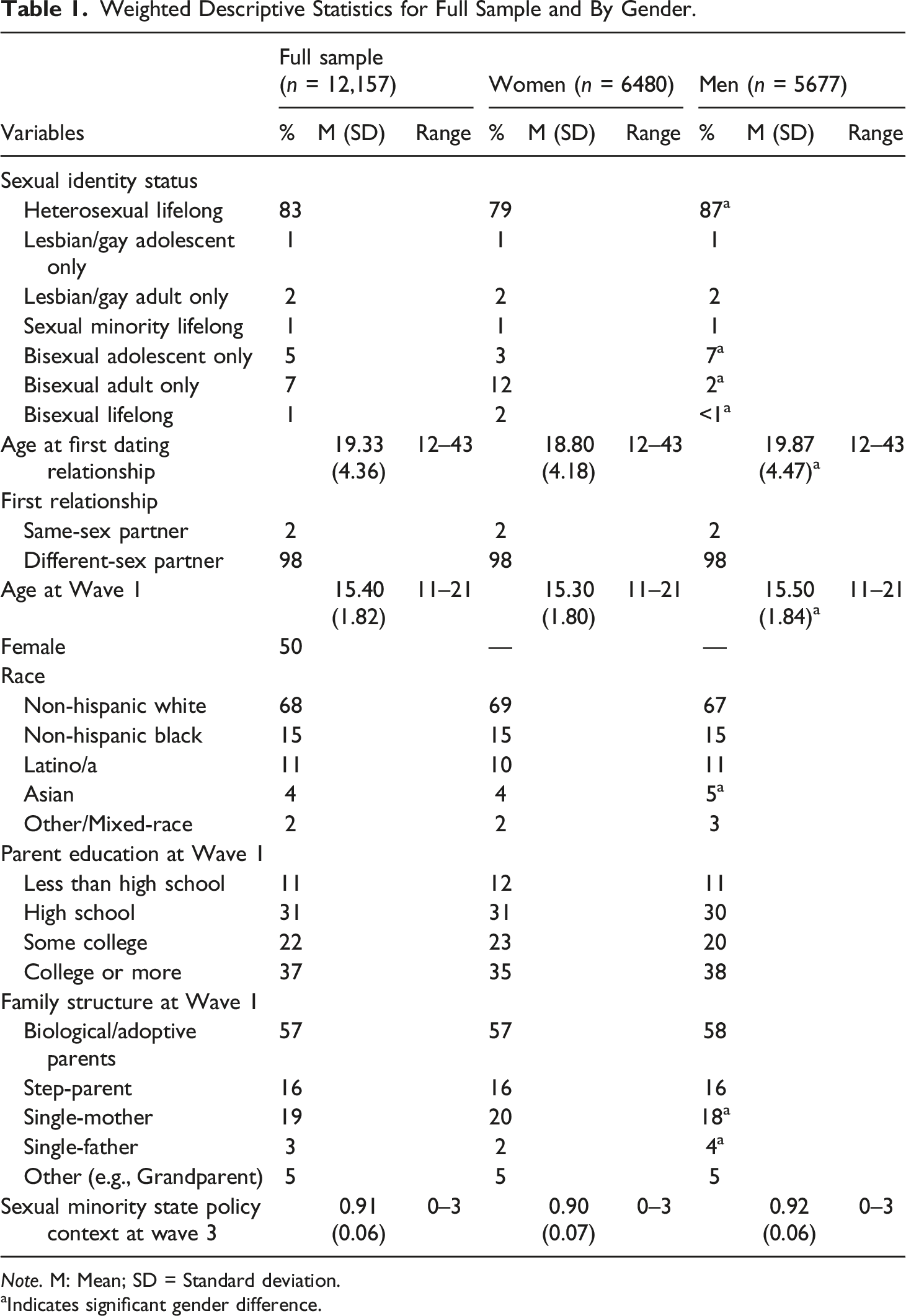
Note. M: Mean; SD = Standard deviation.
aIndicates significant gender difference.
We found significant descriptive differences by gender using chi squared and ANOVA tests. Women were more likely than men to identify as bisexual across the transition to adulthood and in adulthood only, whereas men were more likely than women to identify as bisexual in adolescence only. Men were also more likely to be older, Asian, and from a single-father household in adolescence (but less likely to be from a single-mother household in adolescence) compared to women. Men were older at the age of their first dating relationship than women.
Survival estimates
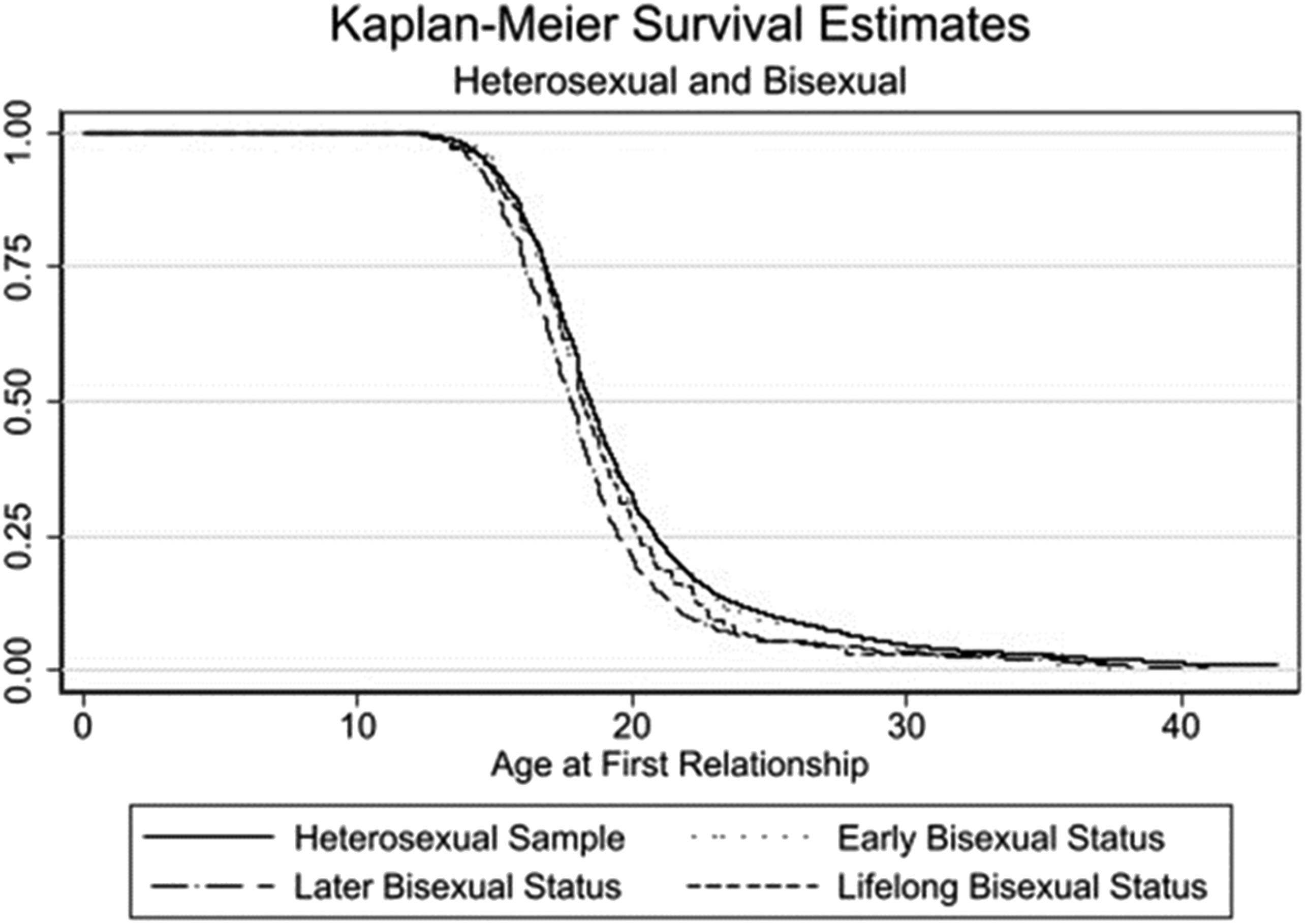
Compared to youth who had heterosexual sexual orientations across the life course, those who had lesbian or gay sexual orientations in adolescence only, in adulthood only, or across the transition to adulthood (both lesbian/gay and bisexual consistently) delayed dating relationships (see Figure 1). This delay was particularly apparent for those who had adult lesbian/gay sexual orientations only. Conversely, bisexual youth in any category entered dating relationships at similar or earlier ages than heterosexual youth (see Figure 2). Specifically, bisexual people in adulthood only began their first dating relationship at younger ages than heterosexual people. Heterosexual youth broadly mirrored bisexual youth in adolescence only and bisexual youth across the transition to adulthood in their relationship timing. Kaplan-Meier survival estimates of the timing to a first dating relationship for those with gay or lesbian and heterosexual sexual orientations. Kaplan-Meier survival estimates of the timing to a first dating relationship for those with bisexual and heterosexual sexual orientations.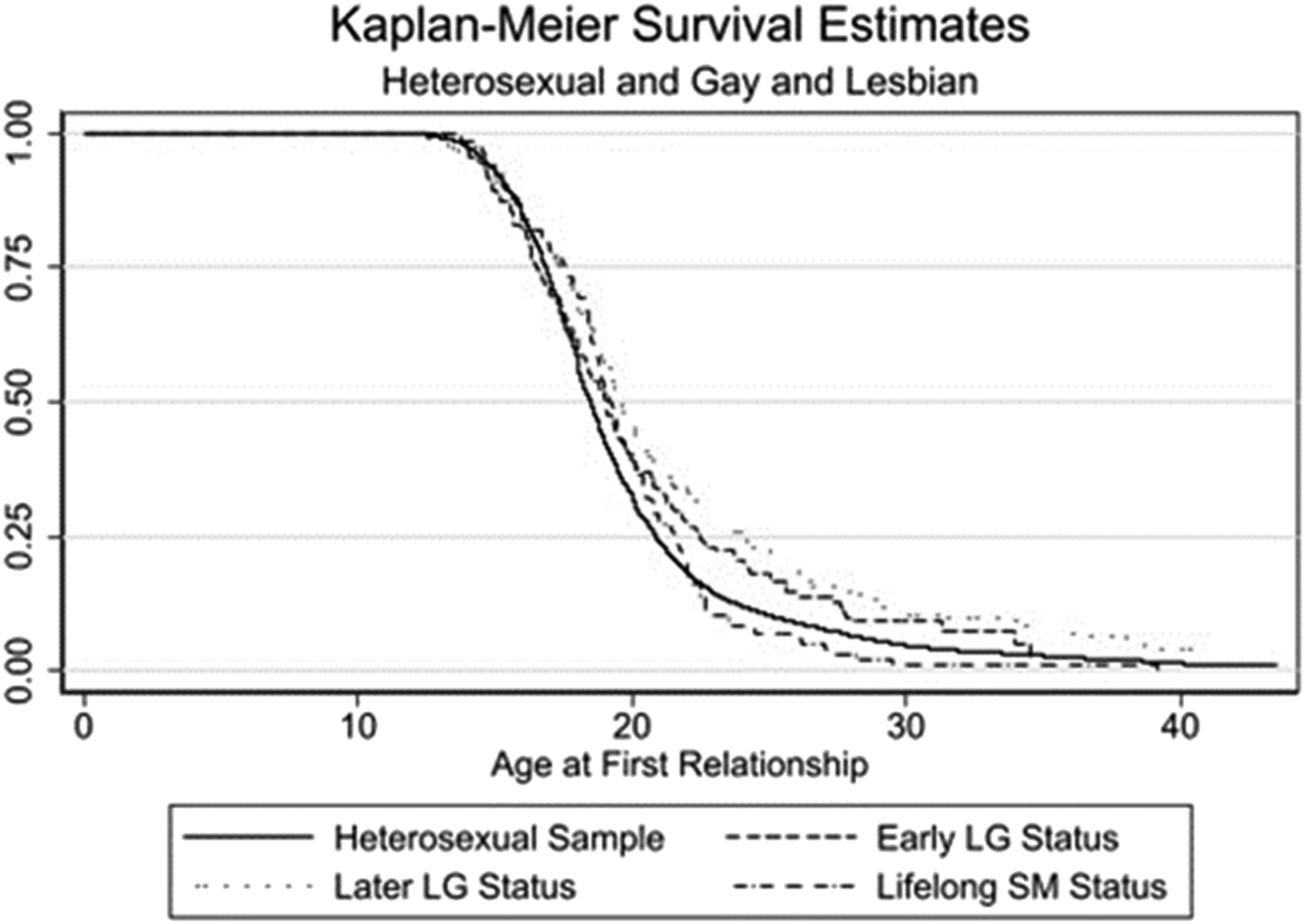
Cox proportional hazard regression models
Cox Proportional Hazard Models Predicting Timing to a First Dating Relationship.
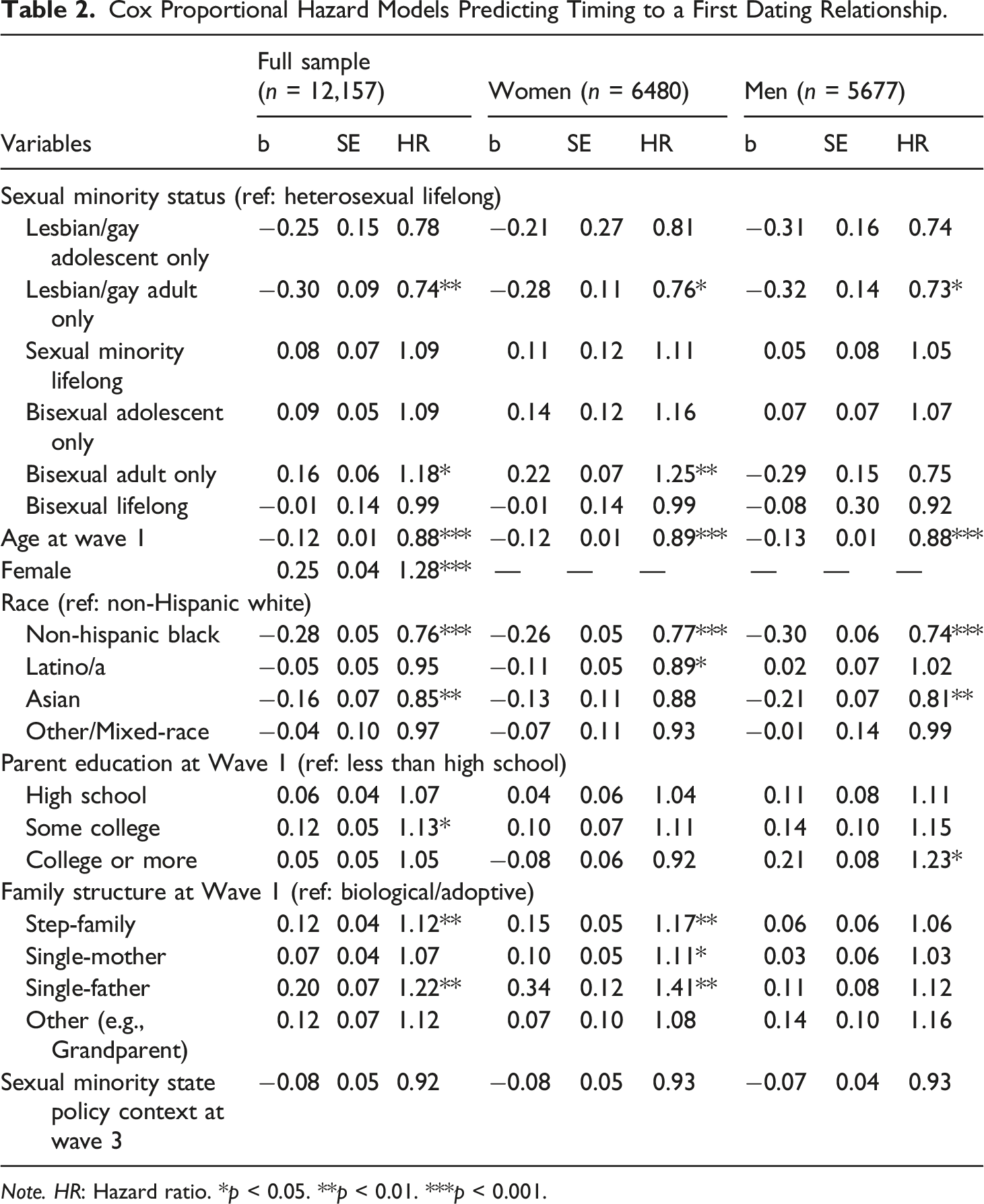
Note. HR: Hazard ratio. *p < 0.05. **p < 0.01. ***p < 0.001.
For women, findings for sexual identity status mirrored those for the full sample: compared to heterosexual women, women with a lesbian orientation in adulthood only delayed their first dating relationship whereas women with a bisexual orientation in adulthood only entered dating relationships earlier. Control variables indicated that women who were older at Wave 1, or who were non-Hispanic Black or Latina delayed their first dating relationships. Women from step-family or single-parent households (led by mother or father) in adolescence entered relationships earlier than women from two biological/adoptive parent adolescent households.
Consistent with findings for the full sample and for women, men with a gay orientation in adulthood only delayed their first dating relationship compared to heterosexual men. However, unlike findings for the full sample or for women, bisexual orientations were not significantly predictive of relationship timing. Men who were older, non-Hispanic black, or Asian delayed first dating relationships compared to younger, non-Hispanic white counterparts. Men with college or more educated parents in adolescence entered dating relationships earlier than men with parents without a high school degree.
For sexual minority status, Wald tests suggested that women and men differed on the timing to a first dating relationship when they reported a bisexual orientation in adulthood only (z = 9.49; p < 0.001). Thus, bisexual women in the adulthood only status experienced earlier dating relationships compared to bisexual men in that status and heterosexual women. Wald tests indicated that there were no other gender differences between men or women for any other sexual identity statuses.
Discussion
During the transition to adulthood, romantic relationships are the most salient social relationship (Furman, 2018) with implications for health and wellbeing (Beckmeyer, 2015) and future relationship trajectories (Collins et al., 2009; Meier & Allen, 2009). Indeed, life course and developmental theorists argue that off-time relationships, that is, those not occurring in a typical stage of life, can negatively alter an individual’s trajectory. (Arnett, 2000; Elder et al., 2003). For instance, youth who enter an “on-time” relationship are more likely to form a subsequent cohabitation or marriage in early adulthood (Brown, 2022), and these types of relationships are more protective for health than others (Mernitz & Kamp Dush, 2016). Although relationship formation for heterosexual youth is well-established (e.g., Furman, 2018; Collins et al., 2009), our study is the first to examine this process among both heterosexual and sexual minority youth in a large, nationally representative sample. Further, because adolescence and young adulthood are critical periods for the development of a sexual minority orientation (Bishop et al., 2022), we distinguished between sexual orientation status in adolescence only, in young adulthood only, and across the transition to adulthood in both developmental periods. Consistent with our first hypothesis, we found that sexual minority people who had a lesbian or gay sexual orientation delayed a first dating relationship compared to heterosexual people. However, this finding was only true for those with a lesbian or gay orientation in adulthood only. Sexual minority people face stressors unique to their sexual identity (Meyer, 2003; Meyer et al., 2008) and it could be that these people anticipate more rejection from family and friends because of their sexual minority status, leading them to delay relationships.
Interestingly, although sexual minority people who waited until adulthood to endorse a lesbian or gay sexual orientation did date different-sex partners, the majority (51%) entered a first same-sex dating relationship. Conversely, and inconsistent with our second hypothesis, sexual minority people who reported a bisexual orientation in adulthood only almost exclusively entered a first dating relationship with a different-sex partner (98%) and entered a relationship earlier than heterosexual youth. These results suggest that barriers to forming a same-sex relationship, such as the lack of partner availability (Diamond et al., 1999) likely delay dating relationships when people desire same-sex partners. Those who wait until adulthood to report a bisexual orientation might be more apt to use dating relationships to aid in their sexual identity development because early relationships provide insights that inform a youth’s sense of self (Collins, 2003; Morgan, 2013) and, thus, have more motivation to enter them earlier than heterosexual people. Meanwhile, consistent with our second hypothesis, bisexual youth in adolescence only or those who were bisexual across the transition to adulthood did not differ from heterosexual youth in the timing of their dating relationships, suggesting that youth who might have more established sexual orientations earlier in the life course rely less on dating relationships to inform or re-evaluate these orientations.
Inconsistent with our 3rd hypothesis, we found evidence to suggest that sexual minority gay men in adulthood only delayed their first dating relationship compared to heterosexual men, but they did not differ in relationship timing from sexual minority women. Yet, bisexual women in adulthood only entered a dating relationship earlier than bisexual men in adulthood only. Sexual minority women who experience sexual fluidity typically do not report same-sex attraction nor bisexual identities until young adulthood (Kaestle, 2019), yet they do have different-sex sexual experiences in adolescence (Maguen et al., 2002), primarily in the context of dating relationships (Savin-Williams & Diamond, 2000). Thus, the sexual minority women in our sample who waited until adulthood to adopt a bisexual orientation might not wait to form a dating relationship with different-sex partners. Conversely, as men face stricter gender norms that discourage same-sex attraction and behavior (Connell, 1995; Russell & Consolacion, 2003) and are also more likely than women to be sexually exclusive (e.g., heterosexual or gay; Mishel et al., 2020), sexual minority men may be less likely to form dating relationships with a different-sex partner.
Our results also highlight some sociodemographic differences in timing to dating relationships and suggest avenues for future research. Past research has documented delayed relationships among racial-ethnic minorities in heterosexual samples (Brown, 2022; Meier & Allen, 2009) and our results mirror these findings for non-Hispanic Black, Asian, and Latino/a (women only) for our sample of both sexual minority and heterosexual youth. Although existing research suggests that those from lower socioeconomic backgrounds and single- or step-parent households enter cohabitation and marriage earlier than those from more advantaged backgrounds (Bae & Wickrama, 2019) or those who grew up in a two-parent household (Ryan et al., 2009), we find that these patterns only extend to dating relationships for family structure. Instead, we find the opposite for socioeconomic status: youth with educated parents began dating earlier than those with less parental education. Because a key developmental task for young adulthood is establishing intimacy with romantic partners (Arnett, 2000), it could be that youth from more socioeconomically advantaged backgrounds have the freedom and flexibility to meet this developmental task whereas those with less advantaged backgrounds may need to prioritize other life domains, such as work or their own education. Yet, given that people often seek out partnerships with high status partners (Baxter et al., 2022), it could also be that those from more socioeconomically advantaged backgrounds are more likely to be selected as a dating partner by others—that is, they have higher mate value—than those from lower socioeconomic backgrounds.
The observed sociodemographic differences in timing to dating relationships in the current study do not explicitly consider differences between sexual minority and heterosexual youth; rather, they speak to differences in timing trends for the full population. While scholars have documented similar rates of same-sex unions (e.g., cohabitation or marriage) between racial/ethnic groups and by different family backgrounds and socioeconomic status (Prince et al., 2020), dating relationships may differ between sexual minority and heterosexual youth, or within sexual minority groups (e.g., bisexual vs. gay/lesbian). Highlighting and addressing any socioeconomic differences in the timing to a first dating relationship—or other relationship types—between sexual minority and heterosexual youth could be a fruitful avenue for future research.
Although this study provides a unique examination into sexual minority and heterosexual first dating relationships, there are several limitations worth noting. First, sexual identity was not measured in adolescence and our measure of sexual orientation in adolescence relies solely on same- or both-sex attraction to determine sexual minority status. By relying on one dimension to determine sexual minority status, we have a less robust measure of adolescent sexual orientations. However, it is unlikely that youth mischievously reported their same-sex attraction in adolescence (Fish & Russell, 2018). Second, the measurement of relationships in Wave 5 did not allow us to include dating relationships that occurred between Waves 4 and 5. Although the majority of the first dating relationships occurred in Waves 3 and 4 (97% total), we may be overestimating the age at which a participant first entered a dating relationship for first relationships that occurred at Wave 5. Lastly, several of the sexual orientation statuses, such as those who reported a bisexual orientation across the entire transition to adulthood, had small cell sizes. As such, the findings for these groups cannot be generalized to the full population and should be interpreted with caution.
Despite these limitations, our study is among the first to explore the timing to a first dating relationship from sexual attraction and identity using prospective data. Further, by exploring timing to any relationship—not just a first relationship with a same-sex partner—we were able to provide a more nuanced exploration into the process through which both heterosexual and sexual minority people form relationships, which has implications for future health and wellbeing (Beckmeyer, 2015) and relationship trajectories (Collins et al., 2009). Our approach goes beyond demographic explanations (i.e., partner availability) and focuses on the relationship between sexual orientation development and romantic relationship formation. We found that sexual minority people commonly delay first dating relationships compared to their heterosexual peers, but only when a lesbian or gay sexual orientation is reported in adulthood; those who report a bisexual orientation in adulthood only exhibit earlier dating relationships than heterosexual peers, which was driven by sexual minority women. Taken together, these findings highlight variation in sexual minority status over time and suggest that sexual minority people’s relationship formation processes vary by the developmental stage at which they adopt a sexual minority status. Future research could examine sexual minority youth’s motivations for entering a dating relationship with either same- or different-sex partners, including the sociodemographic differences in these patterns, and explore the consequences of this process for youth as they transition to adulthood.
Footnotes
Declaration of Conflicting Interests
The author(s) declared no potential conflicts of interest with respect to the research, authorship, and/or publication of this article.
Funding
The author(s) disclosed receipt of the following financial support for the research, authorship, and/or publication of this article: This research was supported by the Eunice Kennedy Shriver National Institute of Child Health and Human Development grant numbers R03HD099417 (awarded to Mernitz) and P2CHD042849 (awarded to the Population Research Center at The University of Texas at Austin). The research was further supported by the National Institute on Alcohol Abuse and Alcoholism grant number F32AA030194 (awarded to Bishop). The content is solely the responsibility of the authors and does not necessarily represent the official views of the National Institutes of Health. Add Health is directed by Robert A. Hummer and funded by the National Institute on Aging cooperative agreements U01AG071448 (Hummer) and U01AG071450 (Aiello and Hummer) at the University of North Carolina at Chapel Hill. Waves I-V data are from the Add Health Program Project, grant P01HD31921 (Harris) from Eunice Kennedy Shriver National Institute of Child Health and Human Development (NICHD), with cooperative funding from 23 other federal agencies and foundations. Add Health was designed by J. Richard Udry, Peter S. Bearman, and Kathleen Mullan Harris at the University of North Carolina at Chapel Hill.
Open Research Statement
As part of IARR’s encouragement of open research practices, the author(s) have provided the following information: This research was not pre-registered. The data used in the research are available. The data can be obtained at: https://addhealth.cpc.unc.edu/data/. The materials used in the research are available. The materials can be obtained at:  .
.
Appendix
Sexual Orientation Status by First Dating Relationship Partner Sex (n = 11,528).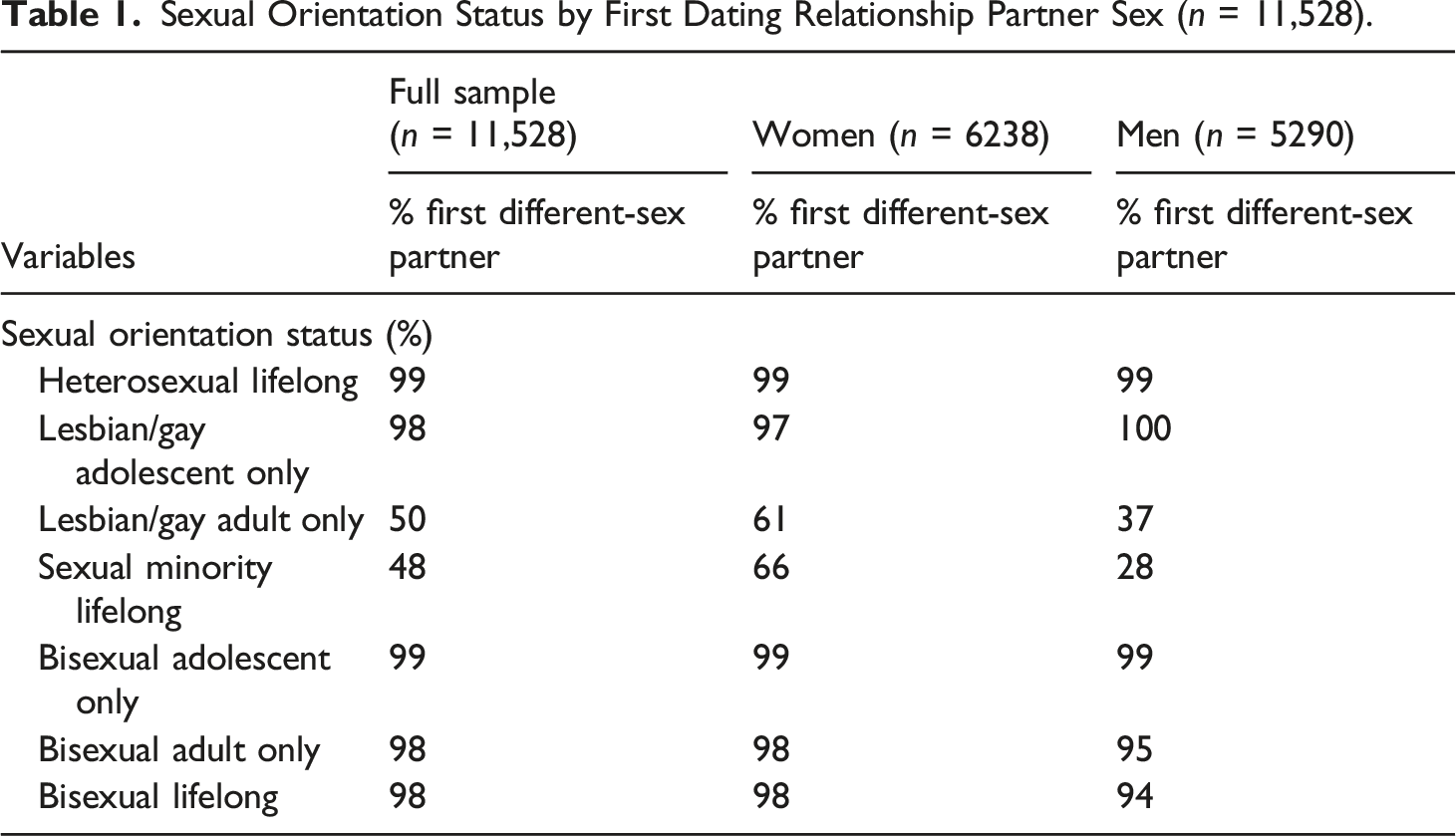
Variables
Full sample (n = 11,528)
Women (n = 6238)
Men (n = 5290)
% first different-sex partner
% first different-sex partner
% first different-sex partner
Sexual orientation status (%)
Heterosexual lifelong
99
99
99
Lesbian/gay adolescent only
98
97
100
Lesbian/gay adult only
50
61
37
Sexual minority lifelong
48
66
28
Bisexual adolescent only
99
99
99
Bisexual adult only
98
98
95
Bisexual lifelong
98
98
94