




Abstract
For emerging adults, high-quality friendships can be an important source of companionship and support. The most commonly studied negative interaction between friends is conflict, yet work with youth suggests more serious victimization also occurs in friendship. In the current study, we developed and obtained preliminary psychometric evidence for the Friendship Victimization Scale, a measure that assesses physical, sexual, relational, and verbal forms of victimization in the friendships of emerging adults, as well as coercive and controlling behaviors. Emerging adults (N = 316, Mage = 21.27 years, SD = 1.47; 60.4% women, 37.0% men; 59.2% White) completed the Friendship Victimization Scale along with measures to examine construct validity. The majority of the sample reported experiencing at least one act of victimization by a friend, and men reported more victimization than did women. Results supported a 2-factor structure, with relational and verbal victimization loading on one factor and physical and sexual victimization and controlling behaviors loading on the other. Cronbach’s alphas exceeded .90 for the total score and both subscales. Greater friendship victimization was predicted by negative features in each of a best and a challenging friendship, even after accounting for negative features in a dating relationship, and was unrelated to positive features in any of these relationships. Overall, results indicate that victimization is common in emerging adults’ friendships. The findings provide preliminary evidence for the utility of the Friendship Victimization Scale as a measure of this understudied source of risk in the interpersonal lives of emerging adults.
Introduction
Friendship is typically viewed as a positive interpersonal context, and indeed, for emerging adults (ages 18–25 years; Arnett, 2000), friendships are an important source of intimacy and support (Carbery & Buhrmester, 1998). Of course, friendship also involves negative interactions, and although researchers have typically focused on conflict (Dryburgh et al., 2022), work with children and adolescents suggests that more serious victimization (i.e., being targeted aggressively; Grotpeter & Crick, 1996) also occurs between friends (e.g., Crick & Nelson, 2002; Mishna et al., 2008). Moreover, compared to victimization by peers more generally, victimization within friendship may be more similar to dating victimization, as the close, intimate nature of this type of relationship opens the possibility of more varied types of harm. Research on victimization in the friendships of emerging adults has been impeded by the lack of tools designed to assess this construct. Thus, in the current study, we developed a measure of victimization in emerging adults’ friendships by revising and extending an existing measure of dating violence and obtaining preliminary psychometric evidence.
Negative Interactions in the Friendships of Emerging Adults
Friendships are close, dyadic, voluntary relationships with peers (Parker & Asher, 1993). Friendships differ reliably in their quality, or the interactions and provisions that characterize the relationship (Asher & Weeks, 2018). For emerging adults, having a friendship high on positive features, such as companionship, intimacy, help, and security (Bagwell & Schmidt, 2011; Dryburgh et al., 2022), promotes better adjustment (e.g., Buote et al., 2007). For these reasons, friendship is typically viewed as a positive relational context. Yet, negative interactions also occur between friends. The most commonly studied negative feature of friendship is conflict, or the extent to which friends disagree and fight (Asher & Weeks, 2018; Simpkins & Parke, 2001). However, previous research hints that emerging adult friendships may also involve interactions consistent with conceptualizations of peer victimization at younger ages, including more severe aggression, as well as behaviors involving coercion and control. Conflict, broadly defined as interpersonal events in which two people are in opposition (Laursen & Adams, 2018), is not synonymous with victimization. Although conflicts may give rise to aggressive or controlling behaviors – for example, a friend may react to a disagreement with insults or by applying pressure to get their own way – they can also be resolved constructively, using strategies such as assertion and compromise (see Kirmayer et al., 2021; Merolla & Harman, 2018; ). Given the crucial role of friendship for the well-being of emerging adults (Barry et al., 2016), it is important to extend beyond conflict to map the full spectrum of negative experiences that occur in adult friendships.
A growing body of work suggests that emerging adults may be victimized by friends and that these experiences are harmful. Work on peer victimization among children and adolescents (see Casper & Card, 2017) has focused on the extent to which youth experience physical, verbal, and relational (e.g., being the target of rumors or exclusion) aggression at the hands of age mates. Relationship between the aggressor and the victim is typically not assessed (Closson & Hymel, 2016); however, some research shows that these aggressive behaviors happen in the friendships of children (e.g., Crick & Nelson, 2002; Mishna et al., 2008) and adolescents (e.g., Brendgen et al., 2015), as well as those of emerging adults. For example, in a daily-diary study with emerging adults and late adolescents, more than half of the participants experienced aggression by a friend over 4 days, including physical and verbal forms (Arbel et al., 2019). Emerging adults also describe experiencing relational aggression in their friendships (e.g., Goldstein, 2011; Kirmayer et al., 2021), and some report that they would use relational or verbal aggression in response to challenging situations with friends (Kirmayer et al., 2021; McDonald & Asher, 2013).
Although little work has focused on the social and emotional correlates of victimization by friends in emerging adulthood, research with children and adolescents has shown that greater victimization in friendship is associated with poorer adjustment including greater loneliness and distress (e.g., Brendgen et al., 2015; Crick & Nelson, 2002). Aggression by a friend may be particularly harmful. Among emerging adults, friends’ behavior is frequently a cause of hurt feelings (Leary et al., 1998), and because friends often have intimate knowledge of a person (e.g., Shulman et al., 1997), their insults and betrayals may be especially painful. In fact, Skrzypiec et al. (2021) found that adolescents reported that more harm resulted from relational aggression perpetrated by a best or close friend than by another peer.
Given evidence that physical, verbal, and relational aggression occur in the friendships of emerging adults, and that these behaviors are likely to cause harm, they should be included in a measure of victimization in friendship; however, the context of a close relationship may engender other types of harm. Physical, relational, and verbal victimization can occur in many different relational contexts, whereas other types of victimization may occur more exclusively in close relationships, as observed in research on intimate partner violence. For example, coercive control, or one person trying to dominate the other, is a central dynamic in intimate partner violence (Hamberger et al., 2017). Aggression is one strategy that may be used to gain control over a romantic partner (Wekerle & Wolfe, 1999), but research has identified others, including making threats, limiting access to family and friends, and excessively monitoring a person’s whereabouts and communications (Breiding et al., 2015).
Close friendships share similarities with romantic relationships that suggest coercive control may also occur in this context. Like dating relationships, friendships are defined by closeness and intimacy (Shulman et al., 1997). Although emerging adults may have lower expectations of exclusivity in friendship than in dating relationships (e.g., Baxter et al., 2001), recent research by Krems et al. (2021) found that emerging adults react with jealousy when they perceive a close friendship is being threatened by a third-party who could replace them. These circumstances could motivate some emerging adults to act in controlling ways to “guard” their friendship, such as by checking in on a friend or making threats. Consistent with these findings, work with adolescents (Etkin & Bowker, 2018; Padilla-Walker et al., 2015) and emerging adults (Etkin et al., 2022) documents that controlling behaviors such as checking and monitoring occur between friends. As with aggression, controlling behavior in friendship is associated with increased maladjustment such as symptoms of anxiety and depression (Etkin et al., 2022; Etkin & Bowker, 2018). In sum, research suggests that controlling behaviors may be occurring in friendships and are associated with poorer psychosocial functioning. A measure of friendship victimization should assess these behaviors.
Measuring Victimization in the Friendships of Emerging Adults
Existing evidence suggests that emerging adults may experience victimization in their friendships. It is critical to assess victimization during this period for two reasons. First, emerging adults may experience different types of victimization than do younger adolescents and children. The provisions of friendship change markedly from childhood to young adulthood (see Bagwell & Schmidt, 2011; Langheit & Poulin, 2022), becoming more rooted in self-disclosure and intimacy, which may create opportunities to cause hurt. In addition, many emerging adults report engaging in sexual activity with friends (Afifi & Faulkner, 2000). Situations in which friends are not aligned in their sexual or romantic motivations may also contribute to victimization. Second, experiencing victimization in friendship may be especially detrimental during emerging adulthood. This developmental period is marked by significant changes, including facing increased responsibilities such as attending university or entering the workforce, and establishing new friendships and romantic relationships (Arnett, 2000). For many young adults, friends are their primary source of support as they navigate these transitions (Carbery & Buhrmester, 1998). Thus, victimization in friendship may be particularly pernicious at this time.
When measuring friendship victimization in emerging adulthood, the best place to start may be tools to assess dating victimization. To date, investigators studying peer victimization in emerging adulthood have taken one of two approaches: They have either used measures of peer victimization designed for use with children and adolescents such as the Social Experiences Questionnaire (Crick & Grotpeter, 1996; see Brendgen et al., 2021; Leadbeater et al., 2014) or the Revised Peer Experiences Questionnaire (Prinstein et al., 2001; see Mukherjee & Hussain, 2022), or they have used measures of aggression in the workplace, such as the Aggressive Experiences Questionnaire (Glomb, 2002; see Brendgen & Poulin, 2018). As described earlier, these measures typically capture behaviors, such as physical aggression or verbal insults, that could happen between any two classmates or co-workers. Many of the relationally aggressive behaviors assessed also do not presuppose a relationship between the aggressor and victim (e.g., telling lies or saying mean things about someone; Crick & Grotpeter, 1996). A comprehensive measure of victimization in friendship must also include relationally and verbally aggressive behaviors that are more likely to occur in the context of a close relationship, such as saying or doing something to make the person jealous (Linder et al., 2002), bringing up bad things that the person has done in the past, or telling someone that they are not a good friend. Moreover, like dating relationships, expectations of exclusivity and feelings of jealousy can occur in friendships (see Goldstein, 2011), which may contribute to controlling behaviors such as monitoring the other person’s activities. In sum, given conceptual similarities between friendship victimization and dating victimization, it makes sense to adapt a measure of dating victimization to understand experiences in friendship, rather than rely exclusively on tools designed to assess victimization in the broader peer group.
As capturing relationship-specific forms of victimization was important in measuring friendship victimization, we chose to adapt the Conflict in Adolescent Dating Relationships Inventory (CADRI; Wolfe et al., 2001) to assess victimization in friendship. The CADRI is a widely used measure of adolescent dating violence that has also been used with emerging adults (e.g., Cascardi et al., 2019). The CADRI includes items assessing physical, relational, verbal, and sexual aggression, as well as controlling behaviors, such as threats and monitoring. We made a number of adaptations to the CADRI, including rewording the items to be about a friend instead of a dating partner, and adding items capturing aggressive and controlling behaviors that may be occurring in friendship. To explore the construct validity of this measure, we examined the correlation between friendship victimization and dating victimization as assessed by the original CADRI, as well as associations with the positive and negative qualities of both friendships and a dating relationship. Research with adolescents has shown that youth who are victimized by peers are more likely to experience dating violence (Exner-Cortens et al., 2022; K. Smith et al., 2021), suggesting that greater friendship victimization will be associated with greater dating victimization. We further examined the convergent validity of the measure by examining associations with negative features in both a friendship and a dating relationship. Greater victimization in friendship should be associated with having friendships characterized by more negative features—that is, greater conflict and disagreement. Given evidence that adolescents’ negative behavior with friends is related to their negative behavior with dating partners (Furman et al., 2002), greater friendship victimization may also be associated with more negative features in a dating relationship. In contrast, given work establishing the relative independence of positive and negative features in friendship (see Dryburgh et al., 2022), as well as in romantic relationships (e.g., Collibee & Furman, 2015), friendship victimization should not be associated with positive qualities in either relationship, a pattern that would provide evidence for the discriminant validity of the measure.
Goals of Current Study
The goals of the current study were to: (1) Develop a comprehensive measure of victimization in friendship. As we had no explicit expectations about the structure of the new measure, we used an exploratory approach to examine the factor structure. (2) Examine overall prevalence and demographic correlates of friendship victimization; specifically, gender differences. Work on how emerging adults respond to conflict – a context likely to engender aggressive and coercive behaviors – has not yielded consistent gender differences. For example, in a study of emerging adults, McDonald and Asher (2013) found that men were more likely than women to endorse goals of revenge and threatening to end the friendship in response to hypothetical conflicts with a friend. In contrast, another study using hypothetical conflict scenarios found that women stated they would feel angrier and would take longer to reconcile a conflict with a friend compared to men (Benenson et al., 2014). Given such contrasting findings, it is important to explore gender differences here. (3) Obtain preliminary psychometric evidence for the measure of friendship victimization. First, we examined internal consistency. Second, we tested convergent and discriminant validity by examining associations with related constructs. We hypothesized that more friendship victimization would be associated with higher levels of dating victimization, and more negative features in both friendships and dating relationships, but that friendship victimization would be unrelated to positive features in these relationships.
Method
Participants
Participants were 320 undergraduate students attending a large university in Montréal, Canada. Four participants were removed from analyses as they were older than 25 years, leaving a final analytic sample of 316 emerging adults (M = 21.27 years old, SD = 1.47, range = 18.0–25.9). Demographic characteristics of the sample are presented in Supplementary Table S1. Overall, 60.4% of participants identified as cisgender women, 37.0% as cisgender men, and 2.5% as non-binary or chose not to disclose; 80.4% were heterosexual and 19.6% were sexual minority, questioning, or chose not to answer; 59.2% identified as non-Hispanic White, 20.9% as East Asian, 10.8% as Middle Eastern or West Asian, and 5.4% as South Asian. Nearly half (48.4%) of participants reported being in a dating relationship currently. Less than a quarter (24.1%) of the sample reported Psychology as a major, and another 9.5% and 5.7% reported being Neuroscience or Cognitive Science majors, respectively.
Measures
Friendship Victimization Scale
We revised the CADRI (Wolfe et al., 2001), a commonly used measure of adolescent dating violence (J. Smith et al., 2015), to assess victimization in friendship. The CADRI includes 25 items assessing relational, physical, sexual, and verbal aggression, as well as threatening and coercive behavior. In adapting the CADRI, we took steps consistent with recommendations for scale development (e.g., Boateng et al., 2018). To begin, we made minor changes to some of the items. Due to ethical concerns about reporting sexual assault, we combined two items assessing sexual violence, “Touched me sexually when I didn’t want them to” and “Forced me to have sex with them when I didn’t want to,” into one item encompassing a broader range of sexual behaviors, “Forced me to do something sexual that I didn’t want to do.” In addition, minor changes were made to some items to increase clarity or update language (e.g., “Insulted me with putdowns” was revised to “Insulted me”). Each of these 24 items was then adapted to be about a friend (e.g., “Threatened to end our friendship”). We then added 20 items based on a review of the literature, including recent work in which emerging adults were asked to identify challenging situations occurring with their same-gender friends and report how they would respond (Kirmayer et al., 2021), as well as informal consultation with experts on relationships in adolescence and emerging adulthood. Additional items captured a broader range of negative behaviors that might occur within friendships including coercive (e.g., “Told me that he/she would end our friendship if I did not do something he/she wanted”), controlling (e.g., “Told me that I needed to spend more time with him/her”), and demeaning behaviors (e.g., “Told me that I was not a good friend”). We piloted new items with undergraduate students to ensure clarity. All new items were administered after the original CADRI items. Participants were told: “We are interested in your experiences in close relationships, including with friends. In the last 6 months, has a friend done any of the following to you?” The final measure comprised 44 items. Participants rated how often each item happened on a 5-point scale, from 0 (never) to 4 (most days of the week), in the past 6 months.
Conflict in Adolescent Dating Relationships Inventory – Extended (CADRI; Wolfe et al., 2001)
The original CADRI (with revisions noted above) was administered to assess victimization in participants’ dating relationships. Participants rated how often each of 24 items happened over the last 6 months with a romantic, dating, or intimate partner on a 5-point scale (0 = never to 4 = most days of the week). Alpha was excellent (.92). As we sought to capture victimization in any dating or romantic context, we administered the questionnaire to all participants regardless of relationship status.
Network of Relationships Inventory (NRI; Furman & Buhrmester, 1985)
The NRI was used to assess the positive and negative qualities of participants’ best friendships, as well as the qualities of their dating relationship for those who reported currently being in a relationship. Participants rated each item on a 5-point scale, from 0 (Little or None) to 4 (The Most), for how much they believe it characterizes their relationships with their 1) closest friend at university, and 2) current dating partner. Alphas were excellent for both positive (.96 for friendship and .95 for dating relationships) and negative features (.86 for friendship and .91 for dating relationship).
Friendship Quality Questionnaire for Adults (FQQ; Simpkins & Parke, 2001)
Participants filled out the NRI about their best friendship, which is typical (Furman & Buhrmester, 1985); however, victimization may be occurring in a friendship other than the best friendship. Although it would not have been possible for participants to rate the quality of all their friendships, to examine the generalizability of our results, we obtained a second measure of friendship quality by having participants complete the FQQ about a friendship that they find challenging or difficult in some way. They were also informed it should be a current friend with whom they spend time regularly, but not someone with whom they have ever had a romantic or sexual relationship. Participants rated this friendship on 21 items assessing positive features (e.g., companionship, self-disclosure, α = .95), and six items assessing negative features (i.e., conflict and betrayal, α = .80). Each item was rated on a 5-point Likert scale, from 1 (not at all true) to 5 (really true).
Procedure
All procedures were approved by the relevant Research Ethics Board. Participants provided written informed consent before the study began. We recruited participants through pools maintained by the Department of Psychology, as well as advertisements on campus and posts to student Facebook groups. Participants completed all measures online over approximately 1 hour and were compensated with either a $10 gift card or course credit.
Data Analysis
To begin, we examined the descriptive statistics for each item in the Friendship Victimization Scale, including means, standard deviations, skewness, and kurtosis. We then used an exploratory approach to examine the factor structure. Following inspection of the inter-item correlations, we conducted a series of exploratory factor analyses (EFA), extracting one to six factors. Analyses were conducted in MPlus version 8.4 (Muthén & Muthén, 1998-2019) and FIML was used to handle missing data. As factors were expected to correlate, we conducted an oblique (geomin) rotation of factor loadings. Because the chi-square value (χ 2 ) is sensitive to sample size, we evaluated the fit of six models based on agreement across several indices (Chen et al., 2008; Hu & Bentler, 1995); specifically, the root mean square error of approximation (RMSEA) ≤ .06, comparative fit index (CFI) and Tucker–Lewis index (TLI) ≥ .95, standardized root mean square residual (SRMR) ≤.05, correlations between all factors <.70. To compare models, we examined change in CFI, with Δ > .01 indicating that an additional factor improved fit (Chen, 2007; Cheung & Rensvold, 2002). After identifying the best-fitting solution, we reviewed factor loadings, retaining items with a primary factor loading >.60 and no cross-loadings > .32 (see Tabachnick & Fidell, 2013). A face-valid approach was then used to determine the construct reflected by each factor.
Next, we examined prevalence by calculating the percentage of the sample reporting any friendship victimization. To examine demographic correlates, we constructed a regression model with friendship victimization as the dependent variable. The primary independent variable was gender (coded 0 = man and 1 = woman). There were too few non-binary participants to include them in this analysis, but they were included in the factor analysis. Relationship status (0 = not currently in a relationship, 1 = currently in a relationship) and age (continuous) were also included as predictors.
Finally, we examined the reliability and construct validity of the new measure. We began by calculating Cronbach’s alpha (α). To examine construct validity, we first computed the zero-order correlations among friendship victimization and dating victimization, as well as the positive and negative qualities of a best friendship, a challenging friendship, and a dating relationship. Then, we constructed a regression model in which we added positive and negative qualities of a best friendship to the model with the demographic predictors. We then added a third block with the positive and negative features of a dating relationship to test whether the positive and negative qualities of a friendship were uniquely associated with friendship victimization after accounting for the qualities of a dating relationship. Note that this model was restricted to the participants who reported being in a relationship; as such, relationship status was removed as a covariate. To examine generalizability of the associations between friendship victimization and friendship quality among various types of friendships, we re-ran the regression substituting positive and negative features of a challenging friendship for those of a best friendship. Regressions were conducted in MPlus 8.4. Between 0% and 0.6% of cases were missing for each variable. FIML was used to handle missing data.
Results
Descriptive Statistics
Descriptive statistics for all 44 items are presented in Supplementary Table S2. Many had skewness and kurtosis values exceeding |1.50| (Tabachnick & Fidell, 2013); thus, for the factor analyses, data were treated as categorical (i.e., each response option reflected a discrete category; see Flora & Curran, 2004) and we used the weighted least squares means and variance adjusted (WLSMV) estimator (Barendse et al., 2015). Average scores were then computed across items for all remaining analyses. For each item, no more than one case was missing.
Factor Structure of the Friendship Victimization Scale
All items demonstrated satisfactory inter-item correlations (>.20) and were submitted to EFA. Based on review of the fit indices for all six models, presented in Supplementary Table S3, the 2-factor solution appeared optimal. The chi-square was significant, χ 2 (859) = 1156.80, p < .001, but all other indices were adequate, RMSEA = .033 [.028, .038]; CFI = .98; TLI = .98; SRMR = .07. Although the correlation between factors was high, r = .73, fit was better than for the 1-factor model, as evidenced by a difference in the CFI of .02. In contrast, using the same criterion of a CFI change greater than .01, adding a third factor did not improve fit. Additionally, in the 3- and 4-factor models, no items loaded uniquely on the third and fourth factors.
Factor loadings for the final version of the friendship victimization scale.
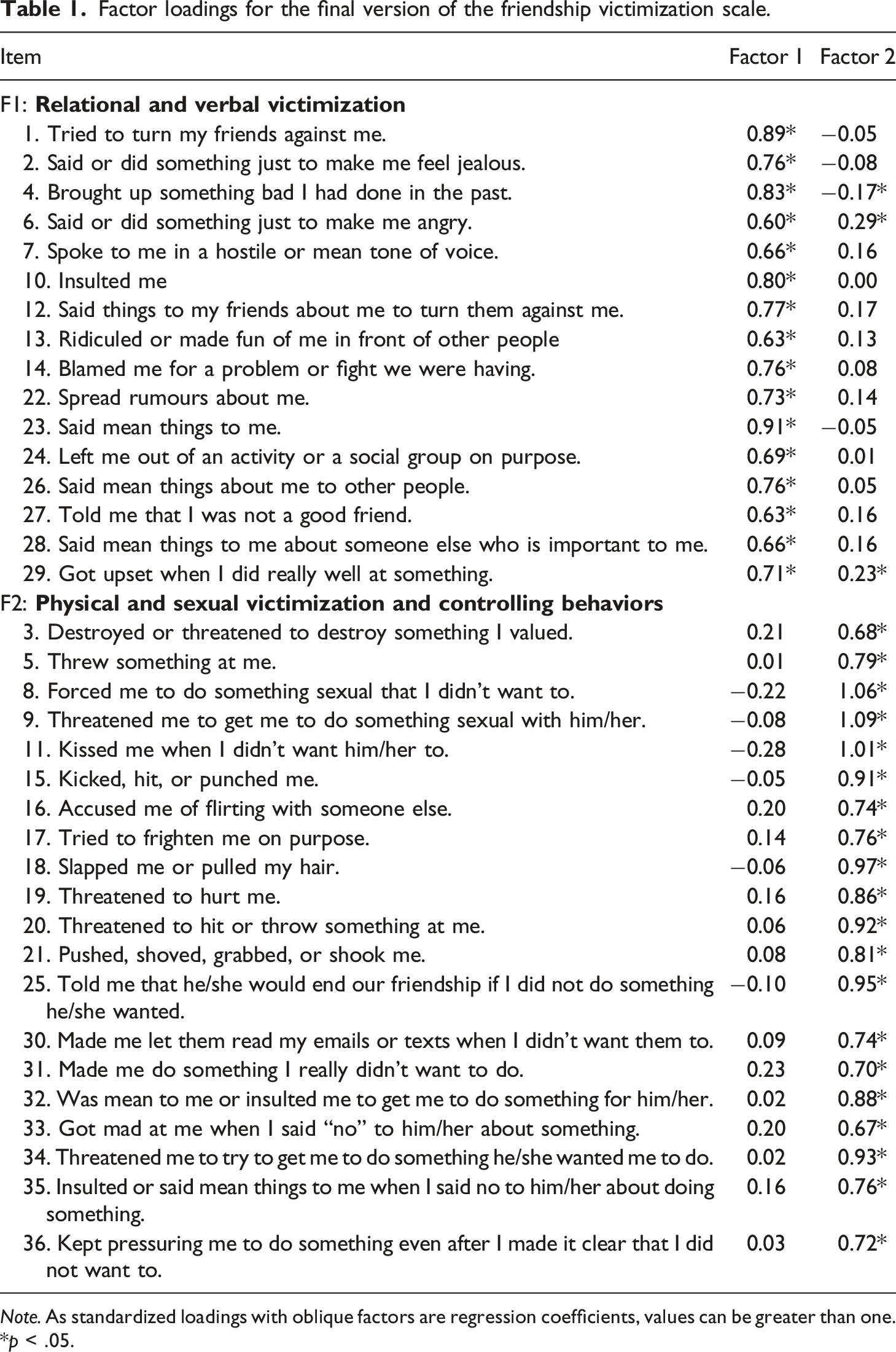
Note. As standardized loadings with oblique factors are regression coefficients, values can be greater than one. *p < .05.
Prevalence and Demographic Correlates of Friendship Victimization
Bivariate correlations and descriptive statistics for all study variables.
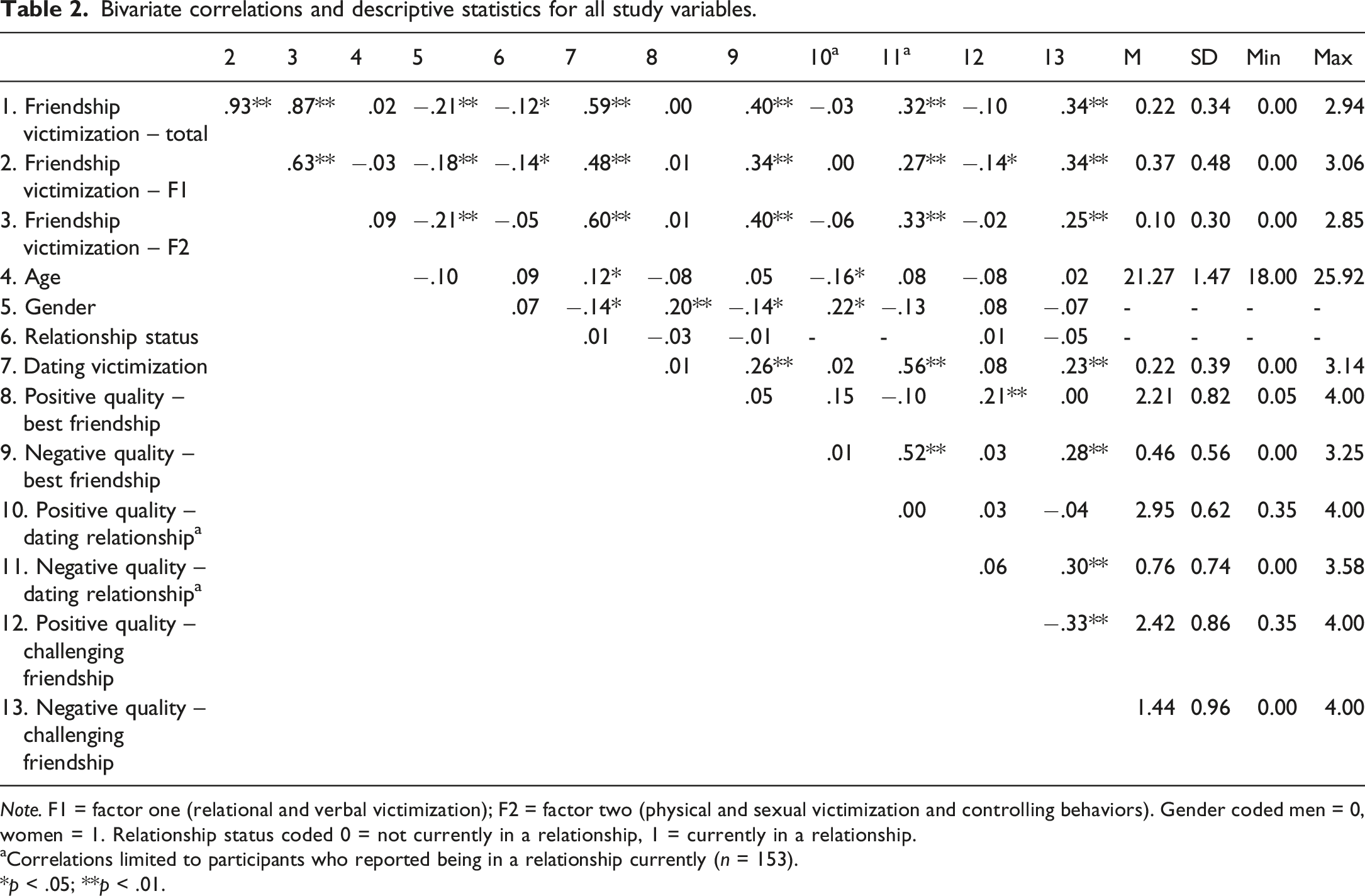
Note. F1 = factor one (relational and verbal victimization); F2 = factor two (physical and sexual victimization and controlling behaviors). Gender coded men = 0, women = 1. Relationship status coded 0 = not currently in a relationship, 1 = currently in a relationship.
aCorrelations limited to participants who reported being in a relationship currently (n = 153).
*p < .05; **p < .01.
Hierarchical Regression Analyses Predicting Friendship Victimization.
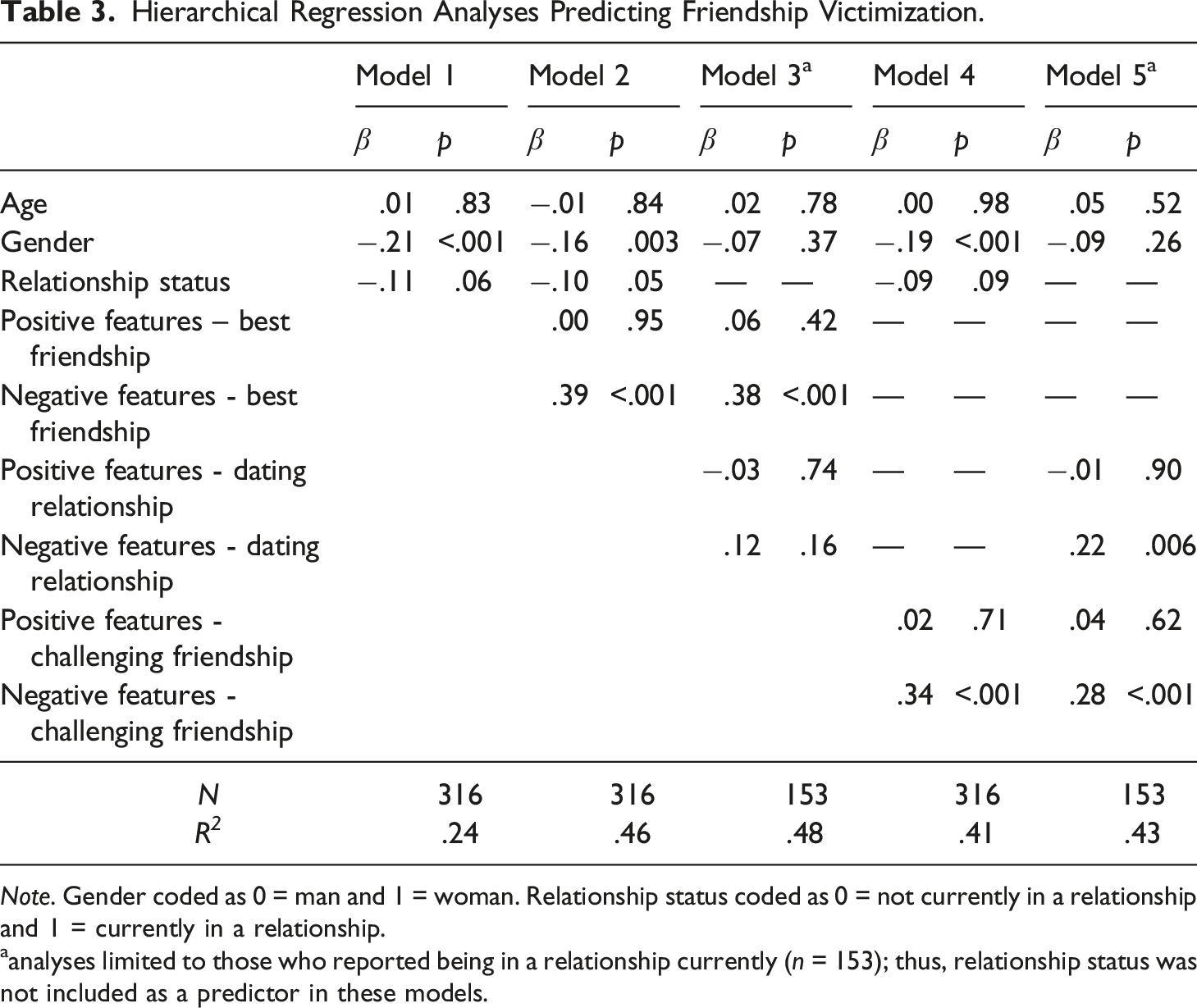
Note. Gender coded as 0 = man and 1 = woman. Relationship status coded as 0 = not currently in a relationship and 1 = currently in a relationship.
aanalyses limited to those who reported being in a relationship currently (n = 153); thus, relationship status was not included as a predictor in these models.
Reliability and Validity of the Friendship Victimization Scale
Internal consistency was excellent for the full scale, α = .95, and both subscales: relational and verbal victimization, α = .93, and physical/sexual victimization and control, α = .95. Table 2 presents zero-order correlations among all variables. Greater friendship victimization was associated with greater dating victimization, r = .59, p < .001, as well as more negative features in a best friendship, r = .40, p < .001, a challenging friendship, r = .34, p < .001, and a dating relationship, r = .32, p < .001. Greater friendship victimization was not associated with positive features of any relationship assessed. A similar pattern emerged when examining the subscale scores, although greater relational and verbal victimization was associated with fewer positive features in a challenging friendship, r = −.14, p = .02.
We built on these findings by running regression analyses in which friendship victimization was the dependent variable (see Table 3). In the first model, we included positive and negative features of a best friendship, along with gender, relationship status, and age. Negative features were associated with friendship victimization, β = .39, p < .001, whereas positive features were not, β = .00, p = .95. When positive and negative features of a romantic relationship were also included (Model 3), negative features of a best friendship continued to be associated with greater victimization, β = .38, p < .001; negative features of a dating relationship were not, β = .12, p = .16. Neither positive features in a best friendship nor a dating relationship predicted victimization. Results were similar when we substituted positive and negative features of a challenging friendship for those of a best friendship (Model 4): negative features of a challenging friendship were associated with greater victimization, β = .34, p < .001, whereas positive features were not, β = .02, p = .71. When quality of a dating relationship was included in the model (Model 5), the negative features of a challenging friendship continued to predict greater victimization, β = .28, p < .001. Here, though, the negative features of a dating relationship were also associated with friendship victimization, β = .22, p = .006. We re-ran all models using subscale scores as the dependent variables. Results are presented in Supplementary Table S4. Overall, results were similar, except for the prediction of relational and verbal victimization from the negative features of both a challenging friendship and dating relationship. Here, only the negative features of a challenging friendship, β = .32, p < .001, and not of a dating relationship, β = .15, p = .05, predicted more friendship victimization.
Discussion
In this study, we developed and obtained preliminary psychometric evidence for a measure of victimization in the friendships of emerging adults. We tested the factor structure of the measure and examined overall prevalence of and gender differences in friendship victimization. Finally, we obtained evidence for construct validity by examining associations with dating victimization, as well as positive and negative features of friendships and dating relationships.
To create the Friendship Victimization Scale, we adapted and expanded a widely used measure of dating victimization to capture physical, relational, verbal, and sexual victimization, as well as coercive and controlling behaviors, occurring with close friends. Factor analysis indicated that the scale comprised two factors. Review of the items indicated that one factor reflected relational and verbal aggression. Work with children and adolescents has documented that these behaviors occur between friends (e.g., Brendgen et al., 2015; Crick & Nelson, 2002); we show here that emerging adults also have these experiences in friendships. Relational aggression often targets someone’s relationships with others, for example, by spreading rumors about them. Emerging adults reported having these experiences with friends, but they also reported aggression that targeted the friendship specifically; for example, being told that they are not a good friend or reminded of bad things they have done in the past. These items expand upon the behaviors assessed by existing measures of peer victimization, capturing experiences that would be much more likely to occur within close relationships (e.g., Crick & Grotpeter, 1996). This finding underscores the importance of developing a tool focused specifically on victimization in friendship, as being in a close relationship opens up new avenues for harm.
The second factor of the Friendship Victimization Scale comprised physical and sexual aggression and controlling behaviors. While rarely endorsed, the occurrence of sexual violence in friendship may reflect the overlap between friendship and dating relationships in emerging adulthood (e.g., Afifi & Faulkner, 2000). Navigating relationships characterized by differing levels of sexual interest may be a challenging, and potentially risky, situation during this developmental period. Understanding emerging adults’ intentions in their friendships may provide insight into how harmful dynamics develop, particularly regarding sexual victimization.
In creating the scale, we expanded the number of controlling behaviors that were included in the CADRI. Many of these items were retained, including “made me let them read my emails or texts when I didn’t want them to,” and “got mad at me when I said no to him/her about something.” Previous work suggests that varied motivations may underlie controlling behaviors in friendship, including a desire to protect the friend from possible harm (Etkin et al., 2022) or to maintain the friendship (Krems et al., 2021). Although some of these behaviors may be associated with benefits, such as greater closeness (Etkin et al., 2022), we found that many of the items assessing controlling behaviors loaded on a factor with sexual and physical aggression. These results suggest that some controlling acts may be part of a pattern of trying to establish dominance. It will be important for future work to examine the consequences of being in a friendship characterized by high levels of control.
Prevalence and Demographic Correlates of Friendship Victimization
Our results indicate that being victimized by a friend is a common experience, with 75.7% of emerging adults reporting at least one act of victimization by a friend in the last 6 months. Relational and verbal victimization (75.0%) were more common than physical/sexual aggression and control (39.3%). These results are consistent with work on dating violence among university students. For example, Hines and Saudino (2003) reported that 80.0% of college students were psychologically victimized, and 24.5% physically victimized, in their current dating relationship (see also Bliton et al., 2016). The high rates of victimization in the close relationships of emerging adults highlight the need for continued prevention and intervention efforts, as well as the importance of expanding these efforts to friendships.
We also examined demographic differences in report of friendship victimization. Gender emerged as a significant predictor: compared to women, men reported greater victimization by friends. More data about the features of the friendships in which men and women are experiencing victimization are needed to understand this pattern. For example, among adolescents and emerging adults, women report perpetrating physical and psychological aggression against dating partners at higher rates than do men (see Williams et al., 2008), often in relationships that are reciprocally violent (Whitaker et al., 2007). It is possible that a similar dynamic characterizes some mixed-gender friendships, which are more common in emerging adulthood than in earlier developmental periods (Mehta & Strough, 2009). Alternatively, the same-gender friendships of men may be characterized by higher rates of victimization than those of women. More data are also needed to extend these findings to gender-diverse young adults.
Age was not associated with friendship victimization, but relationship status was. Specifically, those without a dating partner reported more relational and verbal victimization by a friend than did those with a dating partner. Relationship status was not associated with physical/sexual victimization and control. For emerging adults, the provisions of friendship may change as a function of dating status; for example, those without a partner may rely more on friends for support and companionship (e.g., Markiewicz et al., 2006), or be more likely to see a friend as a potential partner (Fuhrman et al., 2009). Future research should test the extent to which greater expectations or misaligned romantic intentions foster aggression between friends.
Reliability and Validity of the Friendship Victimization Scale
We obtained preliminary evidence for the reliability and validity of the Friendship Victimization Scale as a measure of victimization in the friendships of emerging adults. Internal consistency reliability was excellent; alphas exceeded .90 for the full scale and both subscales. In support of the construct validity of the measure, greater friendship victimization was associated with greater dating victimization. This correlation is consistent with previous work suggesting that youth who experience greater victimization in the peer group are also more victimized in their dating relationships (e.g., K. Smith et al., 2021).
We also examined associations between friendship victimization and negative and positive features in friendships. Friendship quality is typically assessed with respect to a specific friendship (see Dryburgh et al., 2022); however, to obtain a preliminary understanding of the prevalence of friendship victimization, we asked participants to report on victimization by any friend. For this reason, we deliberately assessed the quality of two friendships: a best friendship, and a friendship that the person viewed as challenging or difficult. Results were similar across both. As hypothesized, greater negative features were associated with more victimization. In other words, participants who report experiencing more victimization within their friendships, broadly, also report having specific, dyadic friendships characterized by greater conflict, disagreement, and betrayal. Moreover, and in support of the discriminant validity of the scale, friendship victimization was unrelated to the positive features of specific friendships. This result suggests that the Friendship Victimization Scale is capturing negative interactions between friends, rather than the absence of positive features such as companionship or fun.
Emerging adults with a dating partner also reported on the positive and negative features of that relationship. As hypothesized, the zero-order correlations revealed that greater friendship victimization was associated with more negative features in a dating relationship, but was unrelated to the positive features. This finding is consistent with work documenting similarities in adolescents’ behavior with friends and with dating partners (Furman et al., 2002). When we included positive and negative features of both a dating relationship and a best friendship in the model predicting friendship victimization, only negative features of the friendship emerged as a predictor. This pattern suggests that although there are commonalities across emerging adults’ interactions with friends and dating partners, the Friendship Victimization Scale is capturing experiences unique to friendships. Note that when positive and negative features of a challenging friendship were included instead of a best friendship, negative features of both the friendship and the dating relationship predicted friendship victimization. This difference may be due to the fact that qualities of a best friendship and a romantic relationship were assessed with the same instrument (i.e., NRI), but we used a different instrument (i.e., FQQ) to assess the features of a challenging friendship, which may have decreased the variance shared between report of the qualities of these two relationships. Taken together, our findings provide preliminary evidence for the construct validity of this tool.
Limitations and Future Directions
It is important to note limitations of this work. We obtained preliminary evidence for the psychometric properties of the Friendship Victimization Scale; however, it is necessary to replicate its factor structure and to establish test-retest reliability. The discriminant validity of the scale should also be examined further, for example, by showing that responses are unrelated to assessments of social desirability. In this study, we asked participants about victimization occurring in any friendship. Future research should assess victimization in the context of specific friendships. Examining the extent to which victimization in a specific friendship is associated with social and emotional adjustment after controlling for negative features in that relationship would provide further insight into the construct validity of the measure. Moreover, such work would help to map structural and psychological features of friendship that may contribute to victimization. Future work should also examine whether the forms of victimization that comprise the two factors are differentially associated with predictors and outcomes. For example, it may be clinically informative to understand if different motivations underlie these different forms of victimization. Given the observed correlation between the two factors, in the absence of a priori hypotheses regarding unique associations, researchers may wish to use the total score.
The current study revealed that many of our participants reported experiencing victimization in their friendships. It will be critical to elucidate when this victimization is cause for concern. In some cases, these behaviors may reflect developmentally typical difficulties with resolving conflict in a close relationship effectively (e.g., insulting someone during an argument). In others, however, victimization may reflect maladaptive relationship processes or emotional and behavioral dysfunction. In addition, item-response theory could be used to map the typical-to-atypical continuum of forms of friendship victimization, from less severe behaviors that occur more frequently to more severe behaviors that occur less often (see Wakschlag et al., 2012). Future work should also examine the consequences of victimization within friendships by examining the prospective associations between this construct and key indicators of socioemotional adjustment, including depression and substance use, as well as friendship dissolution. Ultimately, the goal is to understand more precisely when and how friendship victimization poses a risk to the well-being of emerging adults.
This measure was designed for and tested with emerging adults (18- to 25-year-olds). Validation with other age groups will be necessary before use with adolescents or older adults. Finally, the current study was conducted with undergraduates. In the United States, 69.1% of emerging adults are enrolled in college or university (National Center of Education Statistics, 2019), making this an important population to study. However, features of the university environment, such as high rates of alcohol and substance use (e.g., Mason et al., 2014), may impact interpersonal processes, including vulnerability to victimization. As such, results may not generalize to adults who transition directly to the workforce. More generally, it will be important to examine friendship victimization in more diverse samples of emerging adults. For example, participants were all undergraduate students, and we did not obtain information about socioeconomic status, financial stress, or disability status.
Conclusions
In this study, we documented that victimization happens in the friendships of emerging adults, suggesting that friendship, which is typically viewed as a positive interpersonal context, can also be a source of risk. We provided preliminary evidence for the reliability and validity of the Friendship Victimization Scale, and although further psychometric work is needed, it appears to be a promising tool to examine the predictors and consequences of friendship victimization during emerging adulthood—research that may ultimately inform prevention and intervention efforts focused on the development of healthy relationships during this developmental period.
Supplemental Material
Supplemental Material - The Development and Preliminary Validation of a Measure of Victimization within the Friendships of Emerging Adults
Supplemental Material for The development and preliminary validation of a measure of victimization within the friendships of emerging adults by Nicole S. J. Dryburgh, Alexa Martin-Storey, Wendy M. Craig and Melanie A. Dirks in Journal of Social and Personal Relationships
Footnotes
Acknowledgements
We thank Camila Bahn and Sydney Turk for help with the organization of this project.
Declaration of conflicting interests
The author(s) declared no potential conflicts of interest with respect to the research, authorship, and/or publication of this article.
Funding
The author(s) disclosed receipt of the following financial support for the research, authorship, and/or publication of this article: This work was supported by the Public Health Agency of Canada awarded to Wendy Craig. Additional support came from fellowships from the Fonds de recherche du Québec – Société et culture and Mitacs awarded to Nicole Dryburgh and an Insight Grant from the Social Sciences and Humanities Research Council of Canada awarded to Melanie Dirks.
Open research statement
As part of IARR’s encouragement of open research practices, the authors have provided the following information: This research was not pre-registered. The data used in the research cannot be publicly shared but are available upon reasonable request by emailing:

Supplemental Material
Supplemental material for this article is available online.
References
Supplementary Material
Please find the following supplemental material available below.
For Open Access articles published under a Creative Commons License, all supplemental material carries the same license as the article it is associated with.
For non-Open Access articles published, all supplemental material carries a non-exclusive license, and permission requests for re-use of supplemental material or any part of supplemental material shall be sent directly to the copyright owner as specified in the copyright notice associated with the article.
