




Abstract
Spatial proximity may be an artifact of relationships research methodology; however, little work has explored how this feature of research designs influences perceptions of one’s relationship, particularly shared reality (i.e., experiencing a commonality of inner states). The present research tested whether spatial proximity would independently contribute to shared reality in couples’ daily lives. In 2 daily diary studies, each across 3–4 weeks (N1 = 76 couples, 3694 observations; N2 = 84 couples, 3073 observations), participants indicated whether or not their partner was spatially proximal, and also completed measures of shared reality and relationship satisfaction. Spatial proximity to one’s partner resulted in higher shared reality on the day of the survey completion and predicted increases in shared reality from the previous day, but this effect did not spillover into the following day. These findings held controlling for conflict, shared daily experiences (e.g., cooking together), and shared survey experiences (i.e., whether they completed the survey at the same time). In addition, this effect was unique to shared reality, whereby spatial proximity did not predict relationship satisfaction. However, shared reality was associated with increases in relationship satisfaction across the daily diary period. Thus, researchers should consider spatial proximity when developing their research design as it may influence shared reality, which has implications for relationship well-being.
Introduction
A great deal of close relationships research collects data from romantic couples but little is known about how the research methodology might impact participants and the responses they provide. Prior research suggests that simply participating in a study with one’s romantic partner can influence their relationship. For instance, in a longitudinal couples study, participants who were involved in more frequent and intensive interviews across the study period reported feeling more competent as spouses (Veroff et al., 1992). Participants also reported more benevolent attributions for their partners’ negative behaviours after completing measures of commitment, satisfaction or simply factual information about the relationship (Burton & King, 2004). Moreover, when couples were explicitly asked about their involvement in a study, most indicated that they experienced positive effects (Bradbury, 1994; Rubin & Mitchell, 1976).
Whereas simple participation might influence global relationship judgements, we explored the effects stemming from the specific features of participation. Indeed, researchers provide particular instructions to participants with the assumption that features of the study procedure might influence results. For instance, researchers might instruct couples to not complete the survey together. However, other features are often overlooked, such as whether the partner is in the same room but not completing the survey. The present research explores this feature of relationships research methodology with a specific focus on how it uniquely influences shared reality (i.e., experiencing a commonality of inner states; Rossignac-Milon et al., 2021) as compared to other relationship constructs, such as relationship satisfaction. To demonstrate this, the present research also explores the effect of having one’s partner spatially proximal on relationship satisfaction. Lastly, as a further test to the robustness of the link between spatial presence and shared reality, this research explores whether spatial proximity influences shared reality independent of partners’ shared daily experiences, shared survey experiences, and conflict.
Spatial Proximity
While simply having one’s partner present may seem innocuous, there is some research to suggest that this feature of the commonly used daily diary design may be worth examining further (e.g., Feeney & Kirkpatrick, 1996), especially given the likelihood of partner presence fluctuating throughout the daily diary period. Indeed, early research suggests that spatial proximity does have an interpersonal influence (e.g., Festinger et al., 1950). In addition, these effects may occur implicitly: prior research suggests that people might use implicit information of spatial proximity to simulate psychological proximity between themselves and those close to them (Barsalou, 1999; Niedenthal et al., 2005). In fact, when participants were implicitly primed with spatial closeness, they reported stronger emotional attachments to their close others (Williams & Bargh, 2008). Despite evidence to support the influence of spatial proximity in close relationships, to our knowledge, no work has explored the effects of spatial proximity from a research methodology perspective to consider whether they might be confounded with widely-used relationships research designs, such as the daily diary design. As such, the present research explores how spatial proximity might influence daily fluctuations in romantic partners’ experiences of their relationship, specifically their experiences of shared reality. To test the specificity and independence of the proposed link between spatial proximity and shared reality, this research also examines the influence of this research design feature on relationship satisfaction, given it is a common outcome in relationships research.
Shared Reality
As romantic relationships develop, romantic partners start to converge upon a shared worldview (Rossignac-Milon & Higgins, 2018). That is, partners come to transcend the limits of their own reality and create a shared reality, where they perceive an overlap of inner states (i.e., thoughts, feelings, and concerns) with their partner about the world (Rossignac-Milon et al., 2021). Research indicates that people possess both a relational and an epistemic motive to establish a shared reality with their partner (Hardin & Higgins, 1996). Namely, people are motivated to feel close to their romantic partner (Baumeister & Leary, 1995) and to feel certain about their subjective experiences (Echterhoff & Higgins, 2017; Higgins, 2012).
Despite shared reality being rather niche and only recently gaining attention in the context of close relationships (e.g., Rossignac-Milon & Higgins, 2018; Rossignac-Milon et al., 2021), it is an important outcome for the study of spatial proximity in romantic couples for a number of reasons. First, there is both theoretical and empirical evidence to suggest that the presence of one’s partner is uniquely important for establishing a sense of shared reality (e.g., Przybylinski & Andersen, 2015; Rossignac-Milon & Higgins, 2018), such that having one’s partner present facilitates a couple experiencing their dyadic-specific culture or shared meaning system. In addition, it is one of the only constructs in relationships research that focuses on the world outside of one’s relationship (Rossignac-Milon et al., 2021). In doing so, any influence of spatial proximity may not only have direct consequences on shared reality but may also influence participant ratings about constructs beyond the relationship (e.g., Enestrom et al., in prep; Rossignac-Milon et al., 2021). While the present research does not explore these downstream consequences empirically, we believe they provide some justification for why shared reality is a valuable construct to consider when examining research methodology in romantic relationships.
Based on findings from previous research, we describe two potential pathways for how spatial proximity might influence shared reality, the first being the activation of a shared identity and the second being the adaptive benefits of having someone close by to validate one’s perception of their environment. Research in motivated cognition suggests that the spatial presence of another person who resembles one’s partner can indirectly activate a shared meaning system with that romantic partner (Przybylinski & Andersen, 2015), which should activate a shared reality (Andersen & Przybylinski, 2018). Given this effect of a symbolic presence of one’s partner, one can imagine that an actual presence of one’s partner would similarly activate one’s shared identity with their partner, potentially to a greater extent.
Another possibility is that the partner being close by suggests that they are available and open to providing validation. Across three experiments, males preferred female targets who were closer to them than farther away, which was partially explained by closer targets seeming more psychologically accessible (Shin et al., 2019). Indeed, distance is linked to the amount of energy that needs to be invested (Proffitt, 2006); therefore, it is adaptive to rely on those that are more proximal. Further evidence of this adaptive function can be found in research exploring partner presence during a stressful task. Specifically, those who had their partner present during the cold pressor task had significantly lower levels of blood pressure reactivity compared to the control participants and perceived less pain during the task (Bourassa et al., 2019). The spatial presence of a romantic partner allows people to “share the load” of facing the threatening task, which is adaptive in that it requires less of one’s own resources. Applied to shared reality, when the partner is close by it may be adaptive to share a reality with them in that one is “sharing the load” of making sense of their environment.
Lastly, the present research will aim to gauge whether spatial proximity should be of interest to shared reality research specifically or to relationships research more broadly. Whereas there are tight theoretical links between spatial proximity and shared reality, these effects might generalize to relationship satisfaction. However, there is minimal evidence to suggest that such a link exists, as only some research has explored spatial proximity within romantic relationships (e.g., Conradi et al., 2020; Ogolsky et al., 2021). Therefore, the present research examines the specificity of the effect on shared reality and also considers the relationship between shared reality and relationship satisfaction more generally, as the literature suggests that they are associated (e.g., Enestrom & Lydon, 2021; Rossignac-Milon et al., 2021). In doing so, we can shed light on the degree to which spatial proximity should be important for relationships researchers even if shared reality is not their outcome of interest.
Present Study
The present study examined cohabiting couples in two samples with similar designs (N 1 = 76 dyads, N 2 = 84 dyads). 1 Participants completed daily diary surveys 2 across 3–4 weeks where they indicated whether or not they were with their partner during the completion of the survey that day. When participants were with their partner this was considered being in the presence of their partner (i.e., spatially proximal). The opposite was true for days when the participants indicated that their partner was not around. In addition, we collected information on the number of hours couples spent together on a given day to examine the extent to which they were sharing experiences throughout the day. We also collected time stamps for when participants started and completed their daily diary surveys. Couples were considered to have shared in the survey completion experience if they started or completed their survey within 5 minutes of their partner. This cut-off value was based on the median time it took participants to complete the survey. Couples also completed measures of conflict, shared reality and relationship satisfaction.
Multilevel modelling was used to examine whether being in the presence of one’s partner during survey completion influenced same-day and next-day shared reality. We hypothesized that spatial proximity would alter the in-the-moment feelings of shared reality with one’s partner as it activates the couple’s shared worldview and also provides the adaptive function of having one’s partner nearby to validate one’s inner states about the world. We also explored whether spatial proximity would influence the following day’s shared reality controlling for the current day’s shared reality. We predicted that this effect would be significant; specifically, a same-day increase in shared reality due to one’s partner being spatially proximal might lead couples to behave in line with their shared worldview. These behavioral signatures of shared reality should further promote each partner’s sense of shared reality (Rossignac-Milon et al., 2021). Lastly, we examined whether spatial proximity led to increases in shared reality from one’s baseline by using the previous day’s shared reality to predict today’s shared reality. This additional lagged model was included in response to reviewer comments; as such, we had no prior hypotheses.
In testing these research questions, the present research explores spatial proximity during the survey completion in conjunction with how much partners were sharing experiences throughout the day (i.e., shared daily experiences). Prior research suggests that shared experiences allow partners to co-construct a shared reality about the world around them (Rossignac-Milon & Higgins, 2018), thus, including shared daily experiences as a covariate would serve to test the robustness of our expected findings. As such, we included a measure of how much time partners spent together throughout the day; this type of measure has been used in prior research as a proxy for sharing experiences with one’s partner (e.g., Bodenmann et al., 2007; Hill, 1988). Beyond shared daily experiences, this research also explored a very specific (and somewhat atypical) shared experience, whether or not couples completed the survey within 5 minutes of one another. This type of shared experience is one in which partners are explicitly evaluating their relationship while sharing the experience, which differs from the shared daily experiences often explored in the literature (e.g., cooking together; Girme et al., 2014). However, this type of shared experience is especially relevant to the current research as researchers seemingly have an implicit concern about couples completing surveys together, as they often instruct participants to complete them separately. In addition, prior research suggests that completing a task during a research study at the same time as one’s partner can influence how one views the relationship (Murray et al., 2011). Although we expected these measures of shared experience to predict shared reality (Rossignac-Milon & Higgins, 2018), we believed spatial proximity would predict shared reality independent of shared experiences as it leads to an in-the-moment activation of a shared worldview and provides the adaptive function of having someone to verify one’s worldview.
As part of our exploratory analyses, we also controlled for conflict and conflict intensity as this might explain why partners were not completing the survey near their partner and why there would be less shared reality under such circumstances. In addition, we re-ran our models substituting relationship satisfaction for shared reality to test whether the link between spatial proximity and shared reality was unique, or whether it applied to other, more common relationship constructs. For instance, it’s possible that being in the presence of one’s partner during the survey completion would make partners less likely to rate their relationship negatively. As such, any obtained effects would likely not be specific to shared reality and would apply to relationship constructs more generally. 3
Beyond distinguishing between the influence of spatial proximity on shared reality and relationship satisfaction, we also carried out some exploratory analyses to directly test the relationship between shared reality and relationship satisfaction. Specifically, we examined whether participants with different levels of shared reality across the daily diary period, which we expected should be influenced by their daily fluctuations in spatial proximity, experienced any changes in their relationship satisfaction between baseline and follow up. These analyses would allow us to provide some evidence that relationship researchers should care about spatial proximity in their research designs even if it does not directly influence relationship satisfaction, as long as it could have some downstream consequences due to its influence on shared reality, which prior work has already shown can influence relationship well-being (Enestrom & Lydon, 2021; Rossignac-Milon et al., 2021).
Method
Participants
Two samples of Israeli cohabiting couples were recruited from the general community of Beersheba. In order to be eligible to take part in the study, couples had to be at least 18 years old, in their romantic relationship for at least 6 months, and currently living together.
In Sample 1, 87 couples were recruited and completed an initial background questionnaire, after which they participated in a 4-week daily diary study. Of the 87 couples, 11 couples dropped out of the study, either because they no longer wanted to participate or because they did not complete at least 10 daily diary entries. The final sample consisted of 76 dyads (Mage = 31.4, SD age = 10.5) with 3694 observations. The average relationship length was 7.2 years (SD = 9.1 years) with an average cohabitation of 5.1 years (Median = 1.6 years). Further, 36% of couples were married and 16% had at least one child. All couples self-identified as cisgender male-female couples.
In Sample 2, 98 couples were recruited and completed an initial background questionnaire, after which they participated in a 3-week daily diary study. Of the 98 couples, 14 couples dropped out of the study, either no longer wanting to participate or because they did not complete at least 10 daily diary entries. The final sample size was 84 dyads (Mage = 30.1, SD age = 9.2) with 3073 observations. 4 The average relationship length was 7.5 years (SD = 8.6 years) with an average cohabitation of 5.2 years (Median = 2 years). Further, 33% of couples were married and 18% had at least one child. All couples self-identified as cisgender male-female couples except for three couples who identified as cisgender female-female couples.
Procedure
Across both samples, participants were told that the goal of the study was to examine daily processes in intimate relationships. Eligible participants then provided consent and completed the initial questionnaire. Afterwards, participants took part in a daily diary component, for which they received a link to a survey each night at 8 p.m. and they had until 10 a.m. the following day to complete it. However, participants were asked to complete the survey within 1 hour of going to bed. They were also asked to complete the survey separately. 5 On average, participants completed 24.3 daily diary surveys (SD = 4.01, 87% compliance) in the first sample and 18.4 daily surveys (SD = 3.38, 88% compliance) in the second sample. Once the daily diary component was finished, participants completed a follow-up survey. Participants were not provided with monetary compensation but were instead entered into a raffle for two prizes (i.e., vacation vouchers) worth $140. Despite there being multiple components to the study, the present research examined data from the daily diary portion of the study and did not include data from the initial and follow-up questionnaires, with the exception of the participants’ demographic information and relationship satisfaction.
Measures
Descriptive Information
Participants completed demographic measures including questions about their age, relationship length, and relationship status.
Spatial Proximity
To examine whether or not participants were proximal to their partner during survey completion, we included a categorical measure of partner presence during the completion of the survey with three categories. The measure asks participants if their partner is (1) next to [them] (e.g., the same room), (2) nearby but not next to [them] (e.g., other room in the house), and (3) not around (e.g., outside the house). Option 1 reflects spatially proximal, option 2 represents somewhat spatially proximal, and option 3 is considered not spatially proximal. Of the surveys completed for Sample 1, participants indicated that their partner was next to them in 42% of the surveys, nearby but not next to them in 29% of the surveys, and not around in 29% of the surveys. Of the surveys completed for Sample 2, participants indicated that their partner was next to them in 48% of the surveys, nearby but not next to them in 22% of the surveys, and not around in 30% of the surveys.
In the present research, we focus on the first and third options, that is, whether partners were spatially proximal or not spatially proximal. For this measure, a dummy-coded variable was created with not around as the reference point. Thus, the variable compares next to them (same room) to not around (i.e., spatially proximal to not spatially proximal). Results for the models including an additional dummy-coded variable to capture days where partners were somewhat spatially proximal can be found in the supplemental materials (Supplementary Tables 1–3).
Shared Reality Scale – Daily
Participant’s daily experience of shared reality with their partner was measured using an adapted 2-item version of the Shared Reality Generalized questionnaire (SR-G; Rossignac-Milon et al., 2021). The two items were chosen based on their high loading (>.60) in the original questionnaire. These items were (1) “Today, we shared the same thoughts and feelings about things” and (2) “Today, we felt like we have created our own reality.” This measure was rated on a 7-point Likert scale, higher numbers indicating greater shared reality with one’s partner that day. The Rc reliability (Shrout & Lane, 2012) for these two items is .806 in Sample 1 and .792 in Sample 2.
Relationship Satisfaction
In Sample 1, two items were averaged to create a relationship satisfaction measure (Bar-Kalifa et al., 2015, 2021). The two items included the degree to which one feels 1) satisfied from the relationship, and 2) loved by the partner. Participants rated these items on a scale from 1 to 5 (1 = not at all, 5 = very much). In Sample 2, we used the Couples Satisfaction Index (Funk & Rogge, 2007), which takes the sum of four items that ask about one’s relationship. The first item is rated on a 7-point Likert scale (0 = extremely unhappy, 6 = perfect), while the remaining items are rated on a 6-point Likert scale (0 = not at all, 5 = completely). An example item is “I have a warm and comfortable relationship with my partner”. In both samples, higher scores indicated greater relationship satisfaction.
Covariates
Shared Daily Experiences
We measured time spent with one’s partner that day with an open-ended response. Participants were asked to indicate the number of hours in the day they had spent with their partner, not including sleep time. This measure was used to indicate the extent to which partners shared experiences on a given day, whereby higher values indicate sharing more daily experiences.
Shared Survey Experiences
To examine whether or not partners shared in the survey completion experience, we examined the time stamps for when each participant started and submitted their daily survey. On a given day, if couples started the survey within 5 minutes of each other or submitted the survey within 5 minutes of each other, this would be considered sharing the survey experience. These cut-off values were chosen based on the time it takes to complete the survey; specifically, the median completion time for Sample 1 was 5 minutes and 31 seconds whereas the median completion time for Sample 2 was 7 minutes and 39 seconds. This measure was dummy coded so that 0 represented days when partners did not share the survey experience (Sample 1: 77% of days; Sample 2: 73% of days) while 1 represented days when they did share the survey experience (Sample 1: 23% of days; Sample 2: 27% of days).
Conflict
Two measures were used to assess conflict. First, participants were asked whether or not they had had any conflict with their partner in the last 24 hours, responding with either yes (0) or no (1). Participants were also asked to rate the intensity of their conflict on a 7-point Likert scale (1 = very low, 7 = very high). A score of 0 was assigned to participants who did not have any conflict.
Data Analysis
In order to examine our research questions, we analyzed the data following the guidelines set out by Bolger and Laurenceau (2013), using the lme function in the nlme package in R (Pinheiro et al., 2015). Specifically, multilevel models were used that have been designed to provide best estimates of the lower-level random effects and autocorrelation. Although the datasets contained almost all heterosexual couples, we did not expect any gender effects (e.g., see Rossignac-Milon and colleagues (2021) which does not consider gender when exploring shared reality) and therefore pursued the models as indistinguishable. However, we also examined the models as distinguishable to be sure that we were analyzing the data appropriately and found that the distinguishable model did not provide significantly better model fit compared to the indistinguishable model. In addition, we did not find any significant interactions between spatial proximity and gender, suggesting that the simplified model would appropriately provide the results for both men and women. These analyses can be found in the supplemental materials (Supplementary Tables 4–7).
We used the categorical spatial proximity variable to create a dummy-coded variable with partner not around (i.e., not spatially proximal) as the reference point. Thus, we compared days where the partner was next to them when completing the survey (i.e., spatially proximal) to days where partners were not around (i.e., not spatially proximal). We also used the measure of how much time partners spent together on a given day as an indicator of shared daily experiences. As an additional measure of sharing experiences, we used the start and end times for the daily surveys to distinguish days where partners completed the survey at the same time to days where they did not in order to measure shared survey experiences. Specifically, we created a dummy-coded variable with the reference group (i.e., 0) being those days when partners completed the survey at the same time and the comparison group (i.e., 1) being those days when partners did not complete the survey at the same time. We set the cut-off point at 5 minutes, meaning partners had to start their survey within 5 minutes of their partner or complete their survey within 5 minutes of their partner in order for it to be considered a shared survey experience. Lastly, we included a dummy-coded variable that measured whether or not partners experienced conflict that day, whereby 0 represented no conflict that day. Of note, the analyses for the second sample were pre-registered on the Open Science Framework (OSF; https://osf.io/4j38q). The following analyses were carried out to examine our research questions:
Spatial proximity will be associated with higher same-day shared reality, controlling for shared daily experiences, shared survey experiences, and whether or not they experienced conflict that day. SRtjk = β0jk + β1(SP)tjk + β2(CompletedSameTime)tjk + β3(TimeSpent)tjk+ β4(Conflict)tjk + rtjk SRtjk was the shared reality reported on day t by individual j from dyad k. This was modeled by this person’s intercept, spatial proximity, shared survey experience, shared daily experiences, conflict experienced that day, and a level-1 residual term. A lag-1 autoregressive structure was imposed on the level-1 residual matrix to account for autoregression in reported shared reality. At the between-subject level (level-2), the intercept was modeled as random to account for between-dyad variability. In addition, to account for partners’ interdependence, the covariation in partners’ variability was estimated at level-2. As we noted above, the model was estimated as indistinguishable, and thus estimates for partners in a dyad were modeled as the same.
Spatial proximity will be associated with higher next-day shared reality, controlling for same-day shared reality, shared daily experiences, shared survey experiences, and whether or not they experienced conflict that day. All estimates are consistent with the same-day model with the exception of the outcome, which now represents next-day shared reality, and the additional predictor, which represents today’s shared reality. SR(t+1)jk = β0jk + β1(SP)tjk + β2(CompletedSameTime)tjk + β3(TimeSpent)tjk+ β4(Conflict)tjk + β5(SRtjk) + rtjk
Additional Lagged Model
This model will test whether spatial proximity will be associated with higher same-day shared reality, controlling for the previous day’s shared reality, shared daily experiences, shared survey experiences, and whether or not they experienced conflict that day. All estimates are consistent with the same-day model with the exception of the additional predictor, which represents the previous day’s shared reality.
SRtjk = β0jk + β1(SP)tjk + β2(CompletedSameTime)tjk + β3(TimeSpent)tjk+ β4 (Conflict)tjk + β5(SR(t-1)jk) + rtjk
Results
Same-day shared reality and relationship satisfaction results.
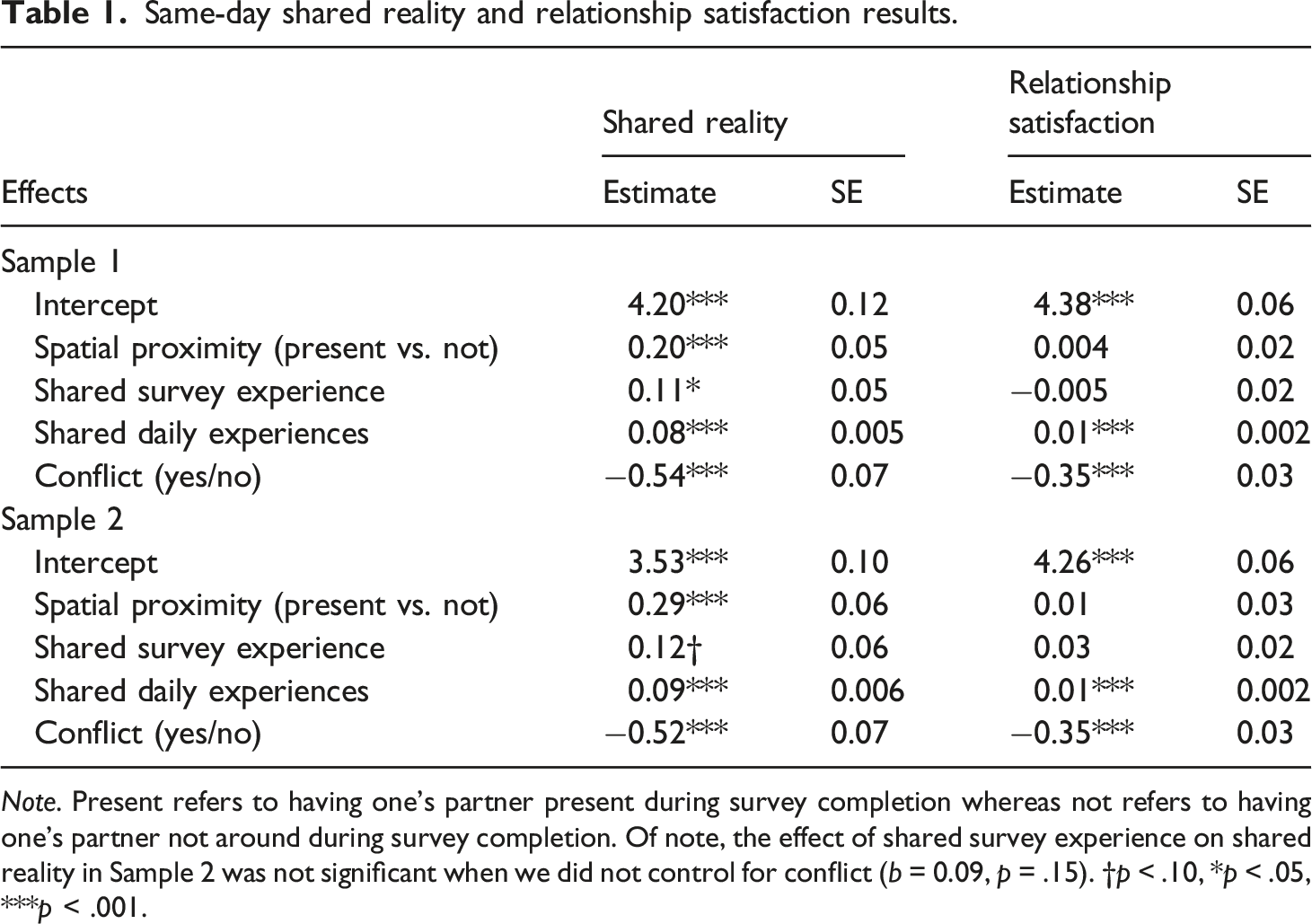
Note. Present refers to having one’s partner present during survey completion whereas not refers to having one’s partner not around during survey completion. Of note, the effect of shared survey experience on shared reality in Sample 2 was not significant when we did not control for conflict (b = 0.09, p = .15). †p < .10, *p < .05, ***p < .001.
Lagged results (Predicting next-day shared reality and relationship satisfaction).
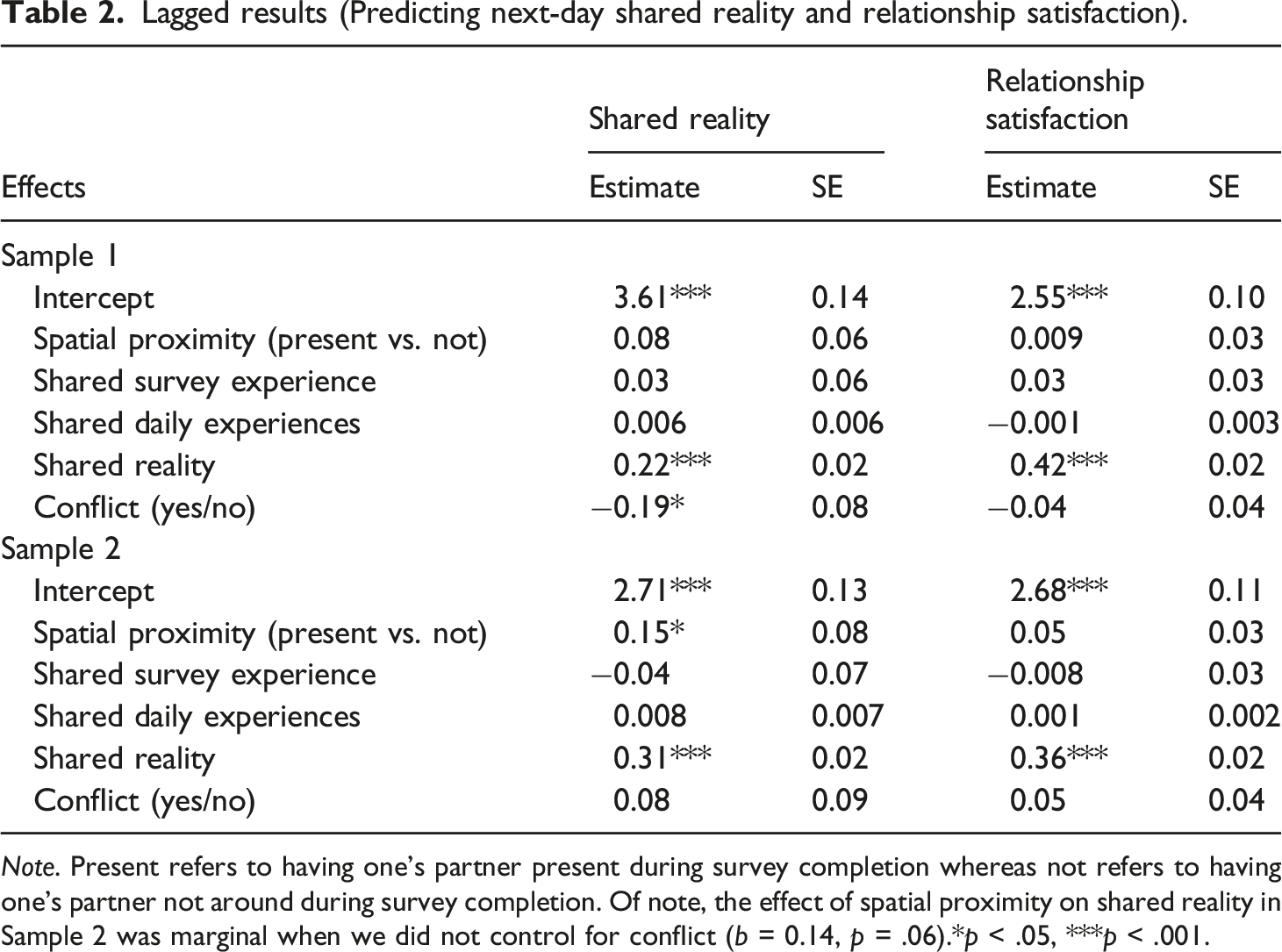
Note. Present refers to having one’s partner present during survey completion whereas not refers to having one’s partner not around during survey completion. Of note, the effect of spatial proximity on shared reality in Sample 2 was marginal when we did not control for conflict (b = 0.14, p = .06).*p < .05, ***p < .001.
Lagged results (Lagged shared reality and relationship satisfaction as predictor).
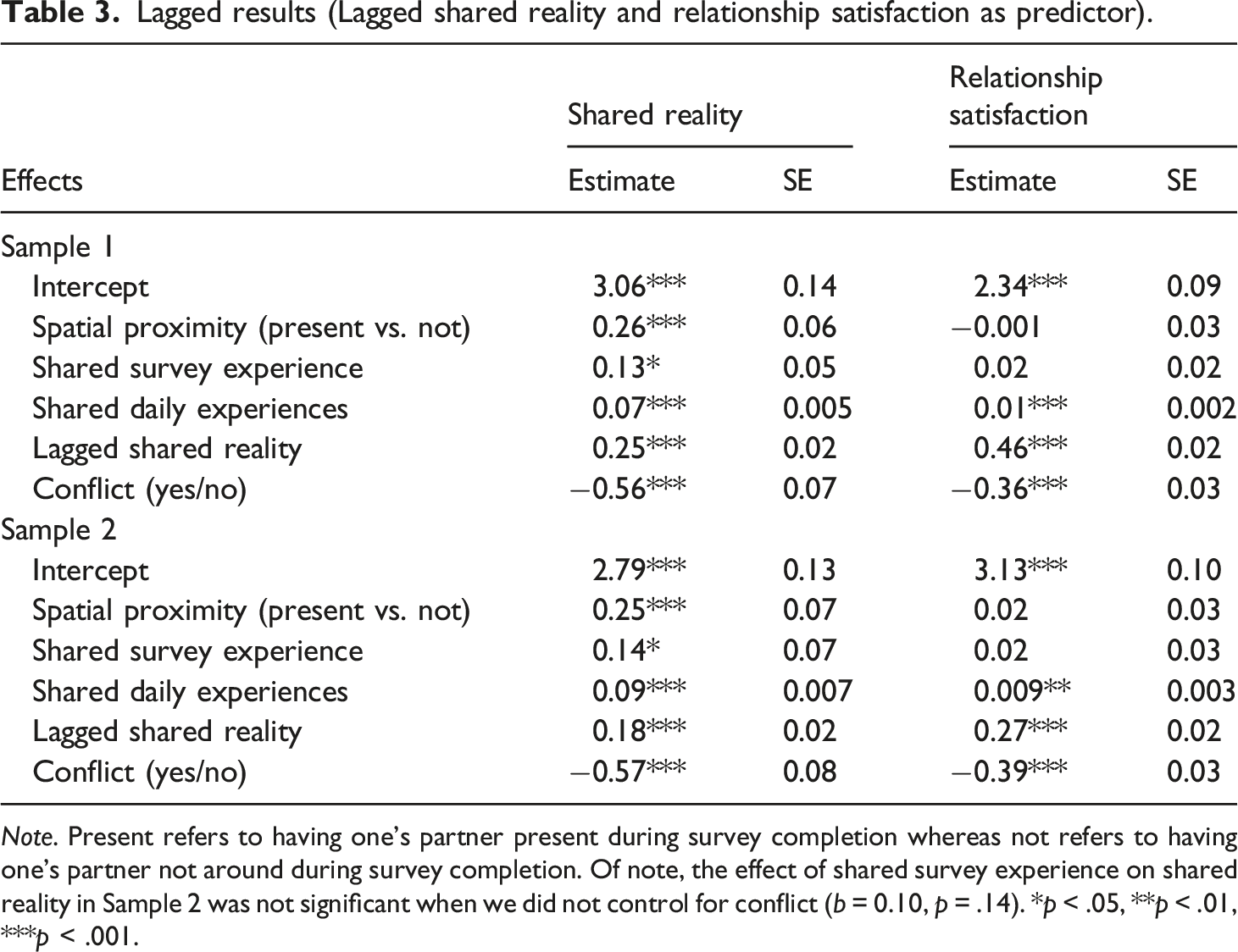
Note. Present refers to having one’s partner present during survey completion whereas not refers to having one’s partner not around during survey completion. Of note, the effect of shared survey experience on shared reality in Sample 2 was not significant when we did not control for conflict (b = 0.10, p = .14). *p < .05, **p < .01, ***p < .001.
Lastly, the results did not hold when we replaced shared reality with relationship satisfaction (see Tables 1–3), suggesting that spatial proximity does not simply influence all relationship constructs equally whereby, for instance, people see their relationship through rose-coloured glasses. Despite this, some exploratory analyses suggest that the aggregated effects of having one’s partner spatially proximal on shared reality may correspond to changes in relationship satisfaction over time. For instance, those with higher average shared reality across the daily diary period experienced increases in relationship satisfaction between baseline and follow up (Sample 1: b = 0.14, p < .001; Sample 2: b = 0.59, p < 001). In contrast, those with lower average shared reality across the daily diary period experienced decreases in relationship satisfaction between baseline and follow up (Sample 1: b = −0.18, p < .001; Sample 2: b = −0.17, p < .01). These findings held controlling for average relationship satisfaction across the daily diary period.
Discussion
In support of our hypotheses, being spatially proximal to one’s partner during survey completion resulted in greater shared reality. These findings held controlling for the extent to which partners shared daily experiences, whether or not they had a shared survey experience, and whether or not they experienced conflict and the intensity of the conflict. Specifically, being spatially proximal to one’s partner survey completion was associated with greater same-day shared reality. Additionally, spatial proximity resulted in a marginal increase in next-day shared reality in Sample 2 but not Sample 1; however, spatial proximity significantly predicted increases in one’s shared reality from the previous day for both samples.
These findings suggest that having one’s partner around while completing the survey positively influences shared reality. Extending prior research (Andersen & Przybylinski, 2018; Bourassa et al., 2019; Przybylinski & Andersen, 2015; Shin et al., 2019), we reasoned that this association may take place through two processes. The first is related to research on motivated cognition (Andersen & Przybylinski, 2018; Przybylinski & Andersen, 2015), which suggests that having one’s partner spatially proximal might activate a shared identity that in turn promotes a sense of shared reality between partners. The second is based on the adaptive benefits of having someone close by to validate one’s perception of their environment, thereby “sharing the load” in making sense of their environment (Bourassa et al., 2019; Shin et al., 2019).
Interestingly, this effect on shared reality was not only found on the same day that the partner was present but was also found to increase from the previous day. However, the findings for the lagged model predicting increases in the next day’s shared reality were less consistent. While we had predicted that activating one’s shared worldview with their partner would lead them to behave in line with this shared worldview, which could further promote shared reality, our findings suggest that this may only take place within the same day and not lead to increases in the next day.
Our findings also suggest that the effects of spatial proximity on shared reality may take place implicitly, as participants passively indicated where their partner was located and were not specifically asked to consider what this meant for their relationship or their participation in the survey. This aligns with prior research suggesting that people might use implicit information of spatial proximity to simulate psychological proximity between themselves and those close to them (Barsalou, 1999; Niedenthal et al., 2005; Williams & Bargh, 2008).
Overall, by controlling for shared experiences we found additional evidence to support the effect of spatial proximity on shared reality. Specifically, sharing more daily experiences with one’s partner did not eliminate the effect of spatial proximity on shared reality, and neither did sharing the survey experience. These findings suggest that being in the presence of one’s partner during the survey completion strengthens one’s sense of shared reality, independent of shared daily experiences and shared survey experiences. This is likely due to the two proposed processes for why spatial proximity might influence shared reality (i.e., its ability to activate a shared identity and it being adaptive for making sense of one’s environment) being separate from those that link shared experiences to shared reality, especially the adaptive process. In addition, the effects remained consistent when controlling for conflict. One can imagine that lack of presence might be signs of a conflictual day that lowers shared reality; however, our findings suggest that this was not the case. Lastly, the results were not consistent when we examined relationship satisfaction, suggesting that spatial proximity does not have a blanket influence on all relationship outcomes, simply due to individuals not wanting to rate their relationship negatively in the presence of their partner. In addition, conflict and shared daily experiences both predicted daily satisfaction, which provides additional discriminant validity between shared reality and relationship satisfaction. Taken together, it appears that there is something about spatial proximity that specifically influences shared reality.
All in all, our findings suggest that researchers should consider spatial proximity when conducting couples studies. For instance, when couples are provided with instructions, researchers may want to indicate that partners must not be in the same room when completing the survey (and also control for whether or not they were in the same room). For in-lab studies, researchers should consider whether or not they would like romantic partners to be spatially proximal for a given task. These findings are also clinically relevant as romantic partners are often provided therapy as a couple, which might place them in the mindset of their shared identity or shared worldview. Thus, depending on the objective of the therapy, couples may think and therefore react differently to therapy if they were to be separated.
Lastly, despite daily relationship satisfaction not being a substitute for daily shared reality, some exploratory analyses suggest that the aggregated effects of spatial proximity might influence relationship satisfaction over time. Specifically, those participants whose partners are often spatially proximal during the daily diary surveys are more likely to report higher average shared reality during the daily diary period, which might lead to an increase in relationship satisfaction over time. Taken together, while our findings highlight important implications of relationships research methods on shared reality specifically, these exploratory analyses, along with prior work showing the downstream consequences of shared reality on relationship and personal well-being (e.g., Enestrom & Lydon, 2021; Rossignac-Milon et al., 2021), suggest that researchers and practitioners should consider spatial proximity when designing their studies, even when shared reality is not their outcome of interest. However, future research may wish to explore the effects of spatial proximity on additional relationship constructs that relate to shared reality, such as closeness and self-other overlap (Rossignac-Milon et al., 2021).
Limitations and Future Directions
There are some notable limitations in the current research. First, couples were instructed to complete the survey independently, which may have limited the extent to which they completed the survey in the same room or around the same time. Future work might remove this instruction in order to allow for more spontaneous spatial proximity during survey completion. Alternatively, one might manipulate instructions about spatial proximity. In addition, there were no checks in place to see whether participants were comparing or discussing their responses during the survey completion. Although some studies may ask participants whether they spoke when completing the survey, this should be studied more systematically, since communication during the survey completion might influence the extent to which spatial proximity influences shared reality. In addition, while our findings provide evidence that spatial proximity has a robust influence on shared reality, the mechanisms through which this is achieved remain unclear. Further work is needed to explore possible mechanisms such as whether spatial proximity suggests that one’s partner is open and available to validate their worldview. Moreover, there were some limitations in the covariates used to explore the role of shared experiences. Specifically, we decided on a cut-off value of 5 minutes for whether or not partners had a shared survey experience. However, one might consider a more direct measure of whether or not partners were completing the survey at the same time. In addition, the measure of shared daily experiences simply asked participants how many hours were spent together outside of sleep time. Prior research suggests that a better measure would be to ask about the time spent actually sharing different types of activities (Girme et al., 2014); this method of measuring shared daily experiences is suggested for future research. Lastly, some demographic information (e.g., race) was not included as part of the data collection. This is an area for future research as differences in demographics may influence our obtained findings.
Conclusion
When collecting data on romantic couples, researchers often rely on daily diary sampling or other research methods that might allow for partners to be spatially proximal. We explored how this common feature of relationships research methods may promote shared reality in couples’ day-to-day lives. The present research explored daily fluctuations in shared reality potentially resulting from spatial proximity in two samples of cohabiting couples. Our findings suggest that being in the presence of one’s partner positively influences in-the-moment and, to some extent, lagged feelings of shared reality with one’s partner. These results hold controlling for shared daily experiences, shared survey experiences, and conflict. In addition, these results were unique to shared reality as the same results were not found for relationship satisfaction. This work provides an important contribution to research on close relationships by exploring the common and inevitable phenomena of spatial proximity in conducting relationships research. In doing so, the current research draws researchers’ attention to a specific feature in data collection that can influence researchers’ obtained results.
Supplemental Material
Supplemental Material - Spatial proximity in relationships research methods: The effect of partner’s presence during survey completion on shared reality in romantic couples’ daily lives
Supplemental Material for Spatial proximity in relationships research methods: The effect of partner’s presence during survey completion on shared reality in romantic couples’ daily lives by M Catalina Enestrom, Eran Bar-Kalifa, Yael Bar-Shachar and John E Lydon in Journal of Social and Personal Relationships
Footnotes
Declaration of conflicting interests
The author(s) declared no potential conflicts of interest with respect to the research, authorship, and/or publication of this article.
Funding
The author(s) received no financial support for the research, authorship, and/or publication of this article.
Open Research Statement
As part of IARR’s encouragement of open research practices, the authors have provided the following information: This research was pre-registered. The aspects of the research that were pre-registered were the analyses for Sample 2. The registration was submitted to the Open Science Framework. The data used in the research are available. The data can be obtained at:  or by emailing:
Supplemental material
Supplemental material for this article is available online.
Notes
References
Supplementary Material
Please find the following supplemental material available below.
For Open Access articles published under a Creative Commons License, all supplemental material carries the same license as the article it is associated with.
For non-Open Access articles published, all supplemental material carries a non-exclusive license, and permission requests for re-use of supplemental material or any part of supplemental material shall be sent directly to the copyright owner as specified in the copyright notice associated with the article.
