




Abstract
This study examined the associations between mothers’ predisposition to show rejection sensitivity and children’s cognitions regarding peer rejection and their social self-perceptions. It also explored whether these associations were mediated by mothers’ behaviors in situations that might suggest their children were rejected by peers. Participants were 122 Jewish Israeli mothers and their kindergarten children (50.82% female; MChild age in months = 67.52, SD = 6.35). Mothers completed the Adult Rejection Sensitivity Questionnaire and reported their likely behaviors in scenarios suggesting the rejection of their children by peers. Children were interviewed using the response evaluation scale for the rejection stories in the Social Information Processing Interview–Preschool Version and the peer acceptance subscale of the Pictorial Scale of Perceived Competence and Social Acceptance for Young Children. Results revealed indirect links between mothers’ rejection sensitivity and children’s maladaptive response evaluations and lower social self-perceptions, through fewer supportive maternal behaviors. These findings highlight the need to consider parents’ dispositions and behaviors in the context of their children’s peer interactions for a more complete understanding of the development of children’s social competence.
Keywords
Children’s cognitions regarding social relationships in early childhood predict their social competence and wellbeing over time (Blöte et al., 2019; Crick & Dodge, 1994; Harris & Orth, 2020), making it imperative to identify what shapes these cognitions. Several studies have suggested parents’ predisposition to aggression, anxiety, altruism, and sociability can affect children’s social cognitions (Lavenda & Kestler-Peleg, 2018). The aim of the present study was to extend this body of work in two ways. First, we examined a parental predisposition, rejection sensitivity, not explored thus far. Second, we investigated the process by which parental predisposition to rejection sensitivity may affect children’s social cognitions. Specifically, we examined whether mothers’ behaviors in situations that might suggest their children were rejected would mediate the link between a maternal predisposition to rejection sensitivity and children’s social cognitions.
Rejection sensitivity is a predisposition to “anxiously expect, readily perceive, and overreact to social rejection” (Downey & Feldman, 1996, p. 1327). Studies of adults and children suggest rejection sensitivity is associated with biased information processing and maladaptive behaviors in social interactions. Individuals with higher rejection sensitivity tend to show hypervigilance for social cues that could reflect rejection. They respond to such cues with intense negative emotions and fluctuate between anxious and ingratiating behaviors to prevent the expected rejection and anger, hostility, or avoidance once a rejection is perceived to have occurred. Such tendencies, in turn, are associated with poorer quality of close relationships, increased loneliness, anxiety, and depression, and negative self-perception (Berenson & Downey, 2006; Gao et al., 2017; Norona et al., 2018; Purdie & Downey, 2000).
Research suggests repeated experiences of being rejected by parents may underlie the development of rejection sensitivity (Levy et al., 2001). This notion is based on attachment theory, which postulates that the quality of caregiving children receive shapes their representations of self and others, and this, in turn, informs their expectations and behavior in social interactions (Bowlby, 1982). When children experience responsive parenting, they presumably construct a perception of themselves as worthy of love and care and as competent in communicating their needs and interacting with peers. They also expect interactions with peers to be rewarding (Bowlby, 1982; Bretherton, 1992). When children’s need for comfort and reassurance within the parent-child relationship is not met, children may learn to expect close relationships will be unpredictable and untrustworthy. They may perceive themselves as less worthy of love, misinterpret social interactions as peer rejection, and respond with heightened emotional reactions, aggression, or avoidance; over time, they are likely to develop rejection sensitivity (Downey & Feldman, 1996; Feldman & Downey, 1994).
Several studies have found children who experience controlling or uninvolved parenting express more negative social self-perceptions, have poorer social skills, and show more biased information processing of social interactions, such as higher hostile attribution biases and increased relational aggression. In contrast, children who experience supportive parenting have more positive social self-perceptions (i.e., seeing themselves as popular and socially accepted; Harter, 1988), show higher social competence, and are more accepted by their peers (Fernandes et al., 2020; Paulus et al., 2018; Rispoli et al., 2013; Ziv et al., 2016; see meta-analyses in Groh et al., 2014).
Recent work has also shown that experiencing parental rejection is concurrently associated with and predicts later rejection sensitivity among adolescents and young adults (Erozkan, 2009; Gardner & Zimmer-Gembeck, 2018; Rowe et al., 2015). Similarly, the rejection sensitivity of young adults has been associated with their retrospective reports of experiencing rejection in their relationships with their parents during childhood (Ibrahim et al., 2015; Khaleque et al., 2019).
In the current study we examined an additional process that may underlie the development of children’s rejection sensitivity. We propose that parents’ rejection sensitivity may shape their children’s social cognitions, not only through the rejecting behaviors parents show towards their children, but also through the ways parents behave when their children interact with their peers.
Parents often supervise and mediate their young children’s interactions with peers and provide direct guidance on what may or may not be effective and appropriate social behaviors (Grusec & Davidov, 2010; Ladd et al., 1992). In addition, parents’ behaviors in social interactions serve as a model for their children; children watch their parents and learn from them how to interpret social cues and how to respond (e.g., Diener & Kim, 2004). We propose that when witnessing or learning from their children about an event that might suggest their children were rejected by their peers, parents with high rejection sensitivity may not provide their children with either a model of behavior or direct guidance that involve adaptive strategies of how to resolve this situation and similar situations in the future (Ladd et al., 1992; McDowell et al., 2003). Such parents may experience intense negative emotions and respond in maladaptive ways, as they tend to do in situations in which they themselves expect or perceive a social rejection (Downey & Feldman, 1996; Zimmer-Gembeck et al., 2016). They may be focused on relieving their own distress and try to avoid the situation and their children (Levy et al., 2001) or show anxious responses (Purdie & Downey, 2000) that in the context of parenting may include overinvolvement, such as preoccupation with the rejection a child is thought to have experienced and attempts to directly intervene in the situation to prevent or diminish the rejection.
In short, parents high on rejection sensitivity may provide their children a biased model of how to interpret and how to respond to possible social rejection, based on the biased patterns they follow in their own social interactions. Parents who respond by avoiding their children’s rejection experience may unintentionally and implicitly teach them that social rejection is a threatening experience and leave them without the necessary guidance and support. Parents who respond in an overinvolved manner by trying to intervene and control their children’s social interactions with peers may unintentionally and implicitly teach their children to respond with aggression to diminish the rejection or to think they cannot handle such situations without the aid of the parent, possibly resulting in a sense of incompetence or helplessness.
Finally, parents may contribute to their children’s social cognitions and behavioral repertoire in interactions with peers via dialogues with the children about past experiences, such as reminiscing about the day at school (Fivush & Nelson, 2006; Harris et al., 2017). In these dialogues, parents co-construct with their children the meaning of past experiences with peers and guide the children on how to respond in similar future events (Koren-Karie et al., 2003; McDowell et al., 2003). Parents high on rejection sensitivity may find the task of guiding conversations on social rejection difficult, because discussing it may trigger negative emotions and emotionally overwhelming memories of their own social rejection experiences. Those parents may have difficulty structuring dialogues that encourage children to share their thoughts and feelings, discuss appropriate responses, and help children reach a positive resolution of their negative emotions. Instead, they might avoid discussing their children’s social rejection experiences altogether, shift the focus of the dialogue to irrelevant details, force their own ideas or emotions, prevent the children from expressing negative emotions, or enhance and exaggerate their children’s negative experiences thus overwhelming them (Koren-Karie, et al., 2008).
Taken together, parents’ avoidance, overinvolvement, and lack of support can lead to children’s formation of less adaptive social cognitions. Such parental responses might also lead to children’s development of less appropriate behavioral responses to possible peer rejection, of avoidance, aggression, or helplessness, which, in turn, could lead to poorer social self-perceptions (Goodwin et al., 2004; Laible et al., 2004).
A recent study found mothers’ rejection sensitivity was associated with biased information processing of hypothetical and ambiguous situations suggesting the rejection of their children by their peers (Harel-Zeira et al., 2019). More specifically, mothers’ rejection sensitivity was associated with their attributions of intentional rejection of their children and expectations that they would experience higher levels of negative emotions. These, in turn, were associated with mothers’ reports that they would be likely to respond in such situations by showing avoidance or withdrawal or by becoming overinvolved, specifically by becoming preoccupied with the situation and attempting to intervene and modify it. This study argued rejection sensitivity was “activated” in mothers not only in their own social interactions but also in relation to the social interactions of their children.
However, the study focused on mothers’ reports and did not examine whether mothers’ rejection sensitivity and their social information processing were associated with their children’s social outcomes. In addition, it evaluated only maladaptive responses (i.e., overinvolvement and avoidance), and did not assess mothers’ supportive responses, such as discussing the situation with their children and helping them process it and choose appropriate responses.
Hence, we investigated the sequential links between maternal rejection sensitivity, mothers’ reports of behavioral responses of support, overinvolvement, and avoidance in situations suggesting their children were being rejected by their peers, and two aspects of the social cognition of kindergarten children. The first was children’s evaluations of the appropriateness and effectiveness of various responses in situations suggesting peer rejection. The second was social self-perception. We focused on mothers and their kindergarten-aged children, because at this age, peer interactions increase at the dyadic and group levels, dominance hierarchies emerge in group interactions, and parents often play an active role in organizing and mediating their children’s peer interactions (Hay et al., 2004).
We hypothesized the following. (1) In line with the results of Harel-Zeira and colleagues (2019), when facing ambiguous situations that may suggest a peer rejection of their children, mothers with higher rejection sensitivity will tend to show avoidant or overinvolved responses and tend less to show supportive responses, such as discussing the situation with the children. (2) These maternal behaviors will be associated with children’s (2a) less adaptive evaluations of how they should respond in situations which suggest they are being rejected by their peers and (2b) more negative social self-perceptions.
Method
Participants
Participants were 122 Jewish Israeli mothers, cisgender female, and their kindergarten children (50.82% female). Most mothers were married (96.4%, n = 107), and their spouses were cisgender male. Most of the mothers reported belonging to the middle class (22%, n = 24) or upper-middle class (59.7%, n = 65). Most mothers (93.44%) had post-high school education. The number of children in the family ranged from 1 to 6 (M = 2.98, SD = 1.17). Children’s ages ranged from 53 to 80 months (M = 67.52, Mdn =68, SD = 6.35). Children with disabilities were not included in the study. Note that kindergartens in Israel serve 4- to 6-year-old children. Some children attend kindergarten for an extra year and enter first grade at the age of 7.
Procedure
This study was part of a larger research project assessing the social and emotional development of kindergarten children (Ziv & Arbel, 2020; 2021). Data were collected in 2018–2019. Participants were recruited from education centers in the northern part of Israel, using flyers distributed by kindergarten teachers. The inclusion criterion was children without developmental difficulties. Data were collected in two home visits and two visits to the education centers. Child data collection relevant to this study took place during the first visit to the educational center. Mothers completed the questionnaires between the two home visits. Mothers received gift cards worth 20 USD for their participation, and children received modest gifts (e.g., stickers, paints, or erasers). Mothers signed a consent form, and children gave their verbal assent prior to data collection. The study was approved by the ethics committees of the university (approval # 464/16) and the Israeli Department of Education Chief Scientist Office (approval # 9312).
Measures
Maternal variables
Maternal rejection sensitivity
The Adult Rejection Sensitivity Questionnaire (A-RSQ; Berenson et al., 2013) was used to assess mothers’ rejection sensitivity. The A-RSQ includes nine hypothetical situations of possible rejection by family, significant others, friends, and colleagues (e.g., “You ask your parents or another family member for a loan to help you through a difficult financial time”). For each situation, mothers were asked to report the degree of their concern or anxiety about the outcome of the situation (e.g., “How concerned or anxious would you be over whether or not your family would want to help you?”) on a 6-point scale ranging from 1 (very unconcerned) to 6 (very concerned). Mothers were then asked to indicate the likelihood that the other person(s) would respond in an accepting fashion (e.g., “I would expect that they would agree to help as much as they can”) on a 6-point scale ranging from 1 (very unlikely) to 6 (very likely). The rejection sensitivity score was calculated by multiplying the score of the level of concern/anxiety by the reverse score of the level of acceptance expectancy. Higher scores reflected higher rejection sensitivity. The A-RSQ has shown good psychometric properties, with an internal reliability of Cronbach’s α = 0.83, a 4-month test–retest reliability of Cronbach’s α = 0.78, and convergent validity with related traits, such as neuroticism and social avoidance/distress, and attachment styles of anxiety and avoidance (Berenson et al., 2013). The questionnaire has been translated into Hebrew and validated for Jewish Israelis (Harel-Zeira et al., 2019). Internal reliability of the A-RSQ in our study was good (Cronbach’s α = 0.78).
Mothers’ behavioral responses to scenarios portraying a peer rejection of their children
Mothers were invited to read three scenarios from the Peer Rejection Scenarios (Harel-Zeira et al., 2019) describing a possible rejection of their child (e.g., “One morning, when you bring your child to kindergarten, a group of children starts to rhyme using her/his name”). Following each scenario, mothers were asked to report their likely responses.
Mothers’ supportive responses
Mothers reported on a 5-point scale ranging from 1 (not at all true) to 5 (very true) the extent to which they would have responded by (1) talking with the child about how the child felt and trying to provide support to the child; (2) discussing and explaining the situation to the child; and (3) trying to put her emotions aside so they didn’t distract her from responding appropriately. We calculated the average score of these responses across scenarios. In a previous study, this 3-item scale showed adequate reliability across scenarios (Cronbach’s α = 0.66, Sher-Censor et al., 2020). In our study, reliability was α = 0.86.
Mothers’ overinvolved responses
Mothers reported on a 5-point scale ranging from 1 (not at all true) to 5 (very true) the extent to which they would have responded by (1) ruminating about what had happened and (2) becoming actively involved in their child’s interaction with peers and stopping the peers’ behavior toward their child. We calculated the average score of these two items across scenarios. The scale showed good reliability in a previous study (Cronbach’s α = 0.81, Harel-Zeira et al., 2019) and in the current study (α = 0.81).
Mothers’ avoidant responses
Mothers reported on a 5-point scale ranging from 1 (not at all true) to 5 (very true) the extent to which they would have responded to the event described in the scenario by (1) trying to disconnect themselves and thinking about other issues and (2) preferring not to talk with the child about what happened. We calculated the average score of these responses across scenarios. In a previous study, this scale showed adequate reliability (Cronbach’s α = 0.79; Harel-Zeira et al., 2019). In our study, the internal reliability was Cronbach’s α = 0.80.
Children’s variables
Children’s maladaptive response evaluations of peer rejection
Children’s response evaluations of peer rejection were assessed using the two peer exclusion vignettes from the Social Information Processing Interview–Preschool Version (Ziv & Sorongon, 2011). In this structured interview, a trained interviewer presented the child with a storybook easel illustrating bears of the same gender as the participating child. The first vignette was a non-hostile exclusion story, in which the protagonist asks two other bears if he or she can join their game; the bears refuse and say the teacher does not allow more than two bears to play this game. The second vignette reflected an ambiguous exclusion. The storyline is similar to the previous one, but this time, the bears do not respond to the protagonist’s request.
The interviewer then presented three responses of the protagonist bear: an aggressive response (e.g., “Dana can step on the play-doh and say, ‘You better let me play or I’ll hit you’”), a competent response (e.g., “Dana can suggest to the kids, ‘If you let me play, I’ll show you how to build all kinds of animals’”), and an inept response (e.g., “Dany can burst into tears and say, ‘That’s not fair’”). After presenting each response, the interviewer asked the participating child three yes/no questions: (1) “Was this a good thing or a bad thing to do?”; (2) “If you had done this, would the other children love you?”; (3) “If you had done this, would the other children let you play?” “No” was coded as “0”, and “yes” was coded as “1.” Hence, for each of the three responses of the protagonist bear in each of two vignettes, children’s scores could range from 0 to 3. In our study, the correlations between children’s scores for each protagonist response across the two vignettes ranged from .25 (p < .001) to .50 (p < .001). We summed the scores for each protagonist response across the two vignettes. Thus, scores could range from 0 to 6. Next, following Ziv et al. (2016), we reverse-scored children’s evaluation of the protagonist’s competent responses. We averaged the evaluation of the aggressive responses, the reverse score of the evaluation of the competent responses, and the evaluation of the inept responses to form a score of maladaptive evaluation of peer rejection. Scores ranged from 0 to 6, with higher scores reflecting a more maladaptive (Afifi et al., 2007; Aram & Aviram, 2009; Asbrand et al., 2017; Berenson & Downey, 2006) evaluation.
Children’s social self-perceptions
(Harter & Pike, 1984). To assess children’s social self-perceptions, we used the 6-item peer acceptance subscale of the widely used Pictorial Scale of Perceived Competence and Social Acceptance for Young Children (Harter & Pike, 1984). The interviewer showed the participating children sets of two juxtaposed pictures of children of the same gender but representing opposite levels of social competence (e.g., “This child does not have many friends, while this child has many friends. Which child resembles you?”). The children were invited to point to the picture that most resembled them. The interviewer then asked if the children were always or usually like the child in the picture they had chosen and invited the children to point to a large or small circle underneath the picture that was more like them. Thus, for each item, children received a score ranging from 1 to 4. We calculated the overall social self-perception based on items’ mean after reversing items in which the more competent self-perception appeared as the first of the two pictures (Cronbach’s α = 0.71).
Children’s vocabulary
Children’s vocabulary was assessed using the Hebrew version of the word definition task (Snow et al., 1989; Hebrew version by Aram & Aviram, 2009). Children were asked to define 14 familiar nouns (alphabet, bicycle, bird, clock, diamond, donkey, flower, foot, hat, knife, nail, stool, thief, and umbrella) using the prompt, “What’s a _____?” The richness of each definition was coded using six categories: definitional features, functional features, examples, descriptive features, synonyms, comparisons, and communicative adequacy (Snow et al., 1989). Scores were summed across the categories and the nouns to indicate children’s vocabulary.
Data preparation and analytic plan
The distribution of all variables was sufficiently normal to render parametric statistics valid (Afifi et al., 2007). Percentage of missing data ranged from 0.82% (n = 1) in children’s receptive vocabulary to 10.7% (n = 13) in mothers’ income and rejection sensitivity. Missing data were estimated using the expectation maximization (EM) algorithm in SPSS 20.0, as supported by Little’s (1988) MCAR test, χ2 (103) = 90.88, p = .80. The significance of the findings was the same with and without EM.
To test the study’s hypotheses, we first conducted bivariate correlation analyses. Next, to examine the hypothesized mediation model, we preformed SEM analyses using Amos 23 statistical software (IBM Corp., 2013). We evaluated the model fit using chi-square, comparative fit index (CFI), and root mean square error of approximation (RMSEA) fit indices. A non-significant chi-square, a CFI of .95 or higher, and an RMSEA of .08 or less are considered acceptable fit (Browne & Cudeck, 1993; Hu & Bentler, 1995).
Results
Preliminary analyses
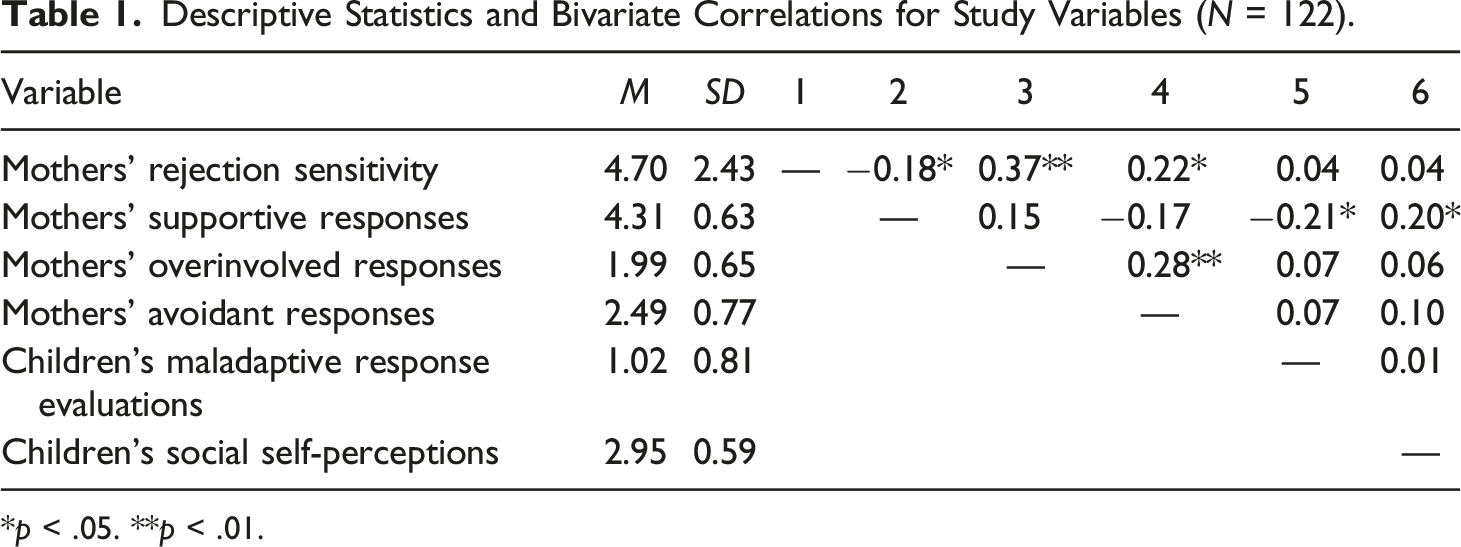
Descriptive Statistics and Bivariate Correlations for Study Variables (N = 122).
*p < .05. **p < .01.
Given these results, subsequent analyses controlled for socioeconomic status, child age, child gender, and child receptive vocabulary. Considering the significant relationship between maternal socioeconomic status and maternal education (r = 0.34, p < .001), to minimize collinearity concerns, we did not include maternal education in further analyses.
Primary analyses
Bivariate associations
As shown in Table 1, as expected, maternal rejection sensitivity was negatively associated with mothers’ supportive responses and positively associated with their overinvolved and avoidant responses. As hypothesized, mothers’ supportive responses were negatively associated with children’s maladaptive response evaluations and positively associated with their social self-perceptions. Unexpectedly, mothers’ overinvolved and avoidant responses were not significantly associated with children’s maladaptive response evaluations or with their social self-perceptions.
Mediating role of maternal behaviors in links between maternal rejection sensitivity and children’s maladaptive response evaluations and social self-perceptions
The hypotheses were further examined using SEM. We compared two competing models. The first model included the direct paths between maternal rejection sensitivity and children’s maladaptive response evaluations and social self-perceptions, the indirect paths through maternal supportive, overinvolved, and avoidant responses, and the covariates found to have significant correlations with study variables, as detailed above (i.e., socioeconomic status, child age, child gender, and child vocabulary). The model showed good fit to the data, χ2 (25) = 23.96, p = .522; CFI = 1.00; RMSEA < .001; AIC = 83.96; BIC = 168.08. The model indicated significant paths from maternal rejection sensitivity to overinvolved, avoidant, and less supportive responses, and from maternal supportive responses to the two child outcomes. The direct paths from maternal rejection sensitivity to child outcomes and the paths from mothers’ overinvolved and avoidant responses to child outcomes were not significant.
Considering these results, we created a second model that included the direct paths between maternal rejection sensitivity and children’s maladaptive response evaluations and social self-perceptions and the indirect paths through mothers’ supportive responses only. This model also included the path from child gender to mothers’ supportive responses and the path from child age to children’s maladaptive response evaluations. Only these two paths were included because the first model indicated all other pathways between covariates and study variables were not significant. The revised model showed good fit to the data, χ2 (8) = 5.14, p = .742; CFI = 1.00; RMSEA < .001; AIC = 31.14; BIC = 67.60. The AIC and BIC values of this model were lower than the previous model, suggesting it was a better fit to the data (Hooper et al., 2008). Examination of the significance of the indirect effect supported the study’s hypothesis. More specifically, as shown in Figure 1, fewer maternal supportive responses mediated the links between mothers’ rejection sensitivity and children’s maladaptive response evaluations (95% CIs [0.002, .11], p =.032) and between mothers’ rejection sensitivity and children’s lower social self-perceptions (95% CIs [−0.10, −0.003], p = .028). Structural Equation Model Predicting Children’s Maladaptive Response Evaluations and Social Self-Perceptions (N = 122). Note. This structural equation model predicts children’s maladaptive response evaluations and social self-perceptions from mothers’ rejection sensitivity with mediating effects of mothers’ supportive responses. Analyses were conducted while controlling for child age and gender and socioeconomic status. Statistics are standardized regression coefficients. *p < .05.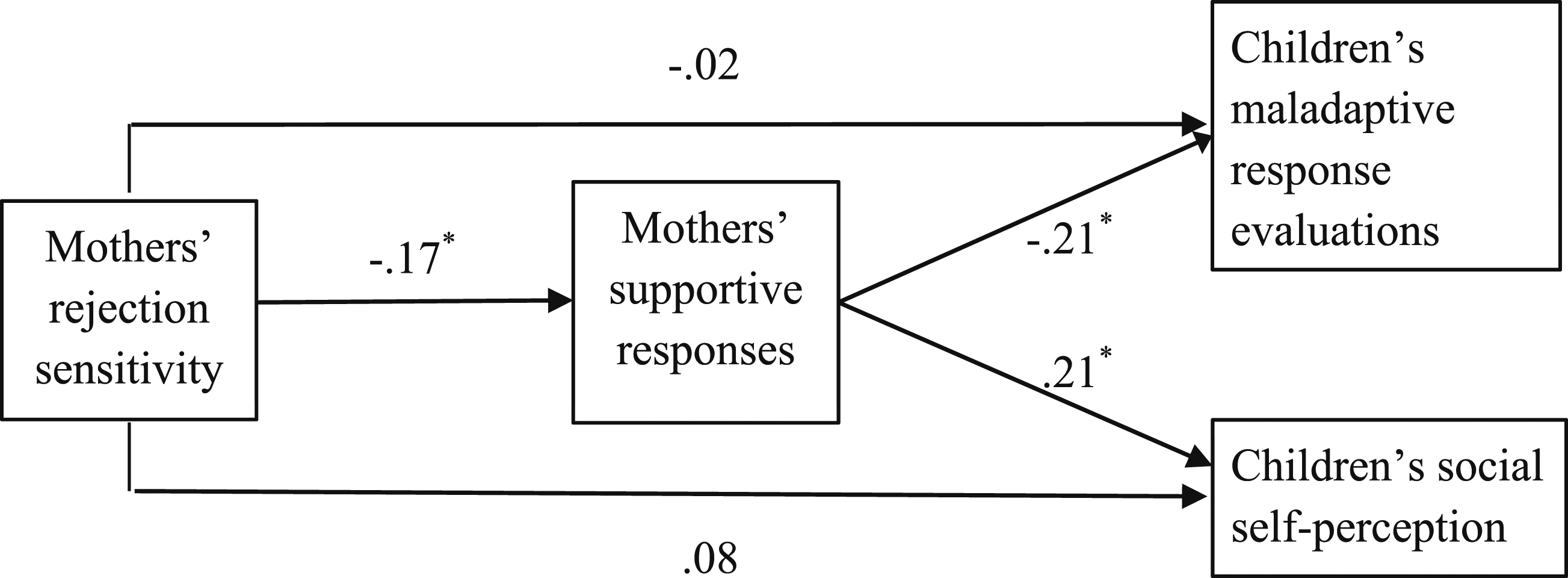
Discussion
This study examined the links between mothers’ rejection sensitivity and their kindergarten children’s cognitions about peer rejection and social self-perceptions. We found that fewer supportive responses from mothers mediated the link between mothers’ higher rejection sensitivity and their children’s maladaptive evaluations of how they should respond to a peer rejection, as well as their more negative social self-perceptions. These findings extend current models that postulate children’s unmet needs for comfort and reassurance within the mother-child relationship underlie the development of their rejection sensitivity (Downey & Feldman, 1996) and poorer social self-perceptions (Bowlby, 1982; Sroufe, 1988). Our study points to an additional process that may involve mothers’ disposition to rejection sensitivity and their inadequate mediation of their children’s interactions with their peers in the context of peer rejection. Our study also extends the previous investigation of maternal rejection sensitivity and mothers’ information processing of possible social rejection of their children (Harel-Zeira et al., 2019) by revealing indirect links between mothers’ rejection sensitivity and their young children’s social cognitions and by documenting the importance of maternal supportive behaviors.
Mothers with lower rejection sensitivity were more likely to report that in response to situations suggesting possible rejection of their children by peers they would talk with their children, check how their children felt, and think about the most appropriate responses to these situations. These maternal behaviors suggested a tendency to keep the focus on the children’s needs and provide them with an appropriate mediation of the situation. The children of these mothers, in turn, tended to evaluate the competent responses of the protagonist bear (i.e., the protagonist bear’s attempts to approach the peer bears in a constructive way) as appropriate and effective and to evaluate the protagonist bear’s aggressive and helpless responses as inappropriate and ineffective. These children also tended to perceive themselves as more popular and accepted by their peers. Studies have documented links between parents’ and children’s social competence (e.g., Asbrand et al., 2017; Lavenda & Kestler-Peleg, 2018; Murray et al., 2008) and between parents’ and children’s social information processing (Runions & Keating, 2007; Ziv et al., 2016). Previous work has also found that mothers’ mediation of their children’s social interactions that involves positive interpretations of the interactions and acceptance of children’s emotions is associated with children’s more adaptive social information processing and higher social competence (Laird et al., 1994; Mize & Pettit, 1997; Ruffman et al., 2002; van Dijk et al., 2018). Our study joins this body of work and points to the importance of considering the specific context of children’s peer rejection when studying mothers’ and children’s cognitions and mothers’ mediation of children’s peer interactions.
Interestingly, we found mothers of girls tended more than mothers of boys to report they would provide support to their children and discuss the situation. This is consistent with past research on parent-child reminiscing dialogues on emotional events. This work has found parents conduct more elaborate conversions about past emotional events with their daughters than with their sons, particularly when the events involve negative emotions (e.g., Fivush et al., 2000; Fivush et al., 2003; Reese et al., 1996). Studies with larger samples are needed to explore the moderating effect of child gender on the links between maternal rejection sensitivity and child social cognition.
In our study, maternal rejection sensitivity was related to mothers’ reports that they would be more likely to show both overinvolvement and avoidance. These results replicate findings of a recent study on mothers’ rejection sensitivity (Harel-Zeira et al., 2019). However, maternal overinvolvement and avoidance were not related to children’s social cognitions. Overinvolved and avoidant maternal responses in both our study and the previous one included mothers’ self-focused behaviors, such as rumination or trying not to think about the situation. These behaviors are covert and therefore may have less direct effects on children’s experiences. Observational studies that assess behavioral indicators of maternal overinvolvement and avoidance are needed to shed further light on the relationships between these maternal behaviors and children’s social cognitions.
Several limitations of the research may guide future studies. First, although the study combined interviews and self-reports collected from mothers and children, thus overcoming the limitations of shared source and shared method, the use of reminiscing mother-child dialogues on situations involving peer rejection could further validate the results. Future studies could employ the well-validated Autobiographical Emotional Events Dialogue developed by Koren-Karie et al. (2003), based on Fivush (1991). In this procedure, parents and children are invited to discuss the children’s past emotional experiences, and the extent to which parents provide supportive guidance is assessed (Hsiao et al., 2015; Sher-Censor et al., 2017). The procedure could be adapted to the specific context of rejection sensitivity, and mother and child could be invited to discuss past events that may suggest peer rejection.
Second, the study was cross sectional. Although we used SEM analyses, it is impossible to infer the direction of effects or causality links. Research with longitudinal or experimental designs is needed to address these issues. Third, the study focused on mothers. Fathers make distinct contributions to children’s social development (Fernandes et al., 2020; Rodrigues et al., 2021). Thus, the study should be replicated in the context of father-child dyads. Fourth, data on mothers’ age and sexual orientation were not collected, an omission that should be corrected in future work. Finally, participants mostly reported middle and middle-upper socioeconomic status. Families with other socioeconomic backgrounds must be included to generalize the results.
Conclusions
Despite these caveats, the study shows that as early as kindergarten, children of mothers with a higher predisposition to rejection sensitivity tend to show maladaptive cognitions about peer rejection and construct more negative social self-perceptions. Furthermore, the results shed light on the process by which maternal disposition is related to children’s (mal)adaptive social cognitions by showing that mothers’ responses in situations which could be interpreted as a rejection of their children by peers mediated these associations. In doing so, this study integrates the personality and social psychology literature on rejection sensitivity with the developmental psychology research on the associations between parenting and children’s social development. Social cognitions tend stabilize during childhood and impact wellbeing across the life span (Putnick et al., 2020; Ziv & Elizarov, 2019). The study highlights the importance of targeting mothers’ rejection sensitivity and behaviors in situations involving their children’s interactions with peers in prevention and intervention efforts to improve children’s social competence.
Footnotes
Funding
The author(s) disclosed receipt of the following financial support for the research, authorship, and/or publication of this article: This research was supported by grant number 492/16 to Yair Ziv from the Israeli Science Foundation (ISF).
Open research statement
As part of IARR’s encouragement of open research practices, the authors have provided the following information: This research was not pre-registered. The data used in the research are available upon request. The data can be obtained by emailing:  ). Others are available upon request to: