




Abstract
Converging evidence shows that mindfulness is associated with various indicators of interpersonal behavior and well-being. Although promising, the effects of mindfulness should ultimately be expressed during interpersonal interactions and observed by interaction partners. The current study assessed the associations between trait mindfulness, interpersonal stress, and interpersonal perceptions during stressful interpersonal tasks between strangers. Sixty-seven same sex stranger dyads (134 individuals; all females) participated in a laboratory study. Trait mindfulness was measured via an online questionnaire. In the lab, participants were asked to engage in two tasks with a stranger: (1) a stressful interaction task (they were asked to introduce themselves standing only 27 cm apart) and (2) a joint coordination task. Afterwards, both partners’ levels of interpersonal stress and interpersonal perceptions (i.e. liking of the interaction, perceived attentiveness, and perceived coping) were assessed. Results of Actor Partner Interdependence Models (APIM) showed a negative association between trait mindfulness and experienced interpersonal distress. Trait mindfulness was positively associated with liking of the interaction, perceived attentiveness and perceived coping. Actors’ trait mindfulness was positively associated with the partners’ liking of the interaction (marginally significant), but no other partner effects were found. There was no association between trait mindfulness and performance on the joint coordination task. The current findings underscore the importance of studying trait mindfulness dyadically. In actual interpersonal interactions, trait mindfulness positively affects interaction experiences of actors, but we found little support for a transfer to experiences of interaction partners. We discuss the implications of these findings in light of several theoretical models.
Keywords
Introduction
Mindfulness is generally conceptualized as a state in which one directs attention toward present moment experiences with an attitude of openness to whatever arises (i.e. irrespective of valence; Kabat-Zinn, 1982, 2013). People differ in the extent to which they approach daily life mindfully - also called trait mindfulness (e.g. Brown, 2003; Murphy et al., 2012). Mindfulness can also be temporarily induced as state mindfulness and trained over time by practicing mindfulness meditation (e.g. Bishop et al., 2004). Repeated practice of mindfulness meditation may ultimately increase levels of trait mindfulness (Bernstein et al., 2015; Bishop et al., 2004). Converging evidence shows that trait, state and trained mindfulness benefit individual well-being across both healthy and clinical populations. For instance, mindfulness is related to improved stress and emotion regulation, less rumination, more positive mood, and better overall well-being (e.g. meta-analyses by Carpenter et al., 2019; Chu & Mak, 2020; Goldberg et al., 2022).
The large body of support for intrapersonal benefits of mindfulness raises the question whether these effects might spill over into the interpersonal domain. Indeed, potential interpersonal effects of mindfulness are receiving increasing scientific attention in recent years. This research has shown that mindfulness tends to be positively related to empathy and compassion (e.g. Dekeyser et al., 2008; meta-analysis by Kreplin et al., 2018), prosocial responses towards ostracized strangers (Berry et al., 2018), increased cooperation (Kirk et al., 2016), decreased implicit bias (Lueke & Gibson, 2015), and decreased hostile attribution bias (van der Schans et al., 2019). These studies are promising in showing that mindfulness might indeed affect how people relate to and behave towards others. It is often assumed that these ‘social’ effects as shown on self-report scales and in experimental tasks generalise to real interactions. Yet, very little research directly assessed whether the effects of mindfulness are experienced by interaction partners. If trait mindfulness indeed affects interpersonal relations, the interpersonal effects of mindfulness should be expressed and experienced during actual interactions.
In the current research, we explored how mindfulness affects an actual encounter between two strangers. Encounters with strangers are an integral part of our social and interpersonal lives: such encounters take place frequently in people’s daily lives (Sun et al., 2020), can be rewarding (Epley & Schroeder, 2014), and the quality of such interactions tends to impact people’s happiness and well-being (e.g. Dunn et al., 2007; Sun et al., 2020). Following interdependence theory (Rusbult & Van Lange, 2003), people will naturally and mutually influence one another when they engage in an interaction. Also strangers are interdependent because their behaviors affect each other’s outcomes, even if it is for a brief interaction. When two strangers, Karin and Barbara, meet and are having an actual interaction, does their individual level of trait mindfulness affect how they perceive and evaluate the interaction, and does it affect the smoothness and pleasantness of the interaction? And does Karin’s level of trait mindfulness affect not only Karin’s experience during the interaction, but also Barbara’s experiences (and vice versa)?
Trait mindfulness in interactions
A core question is why and how trait mindfulness may have interpersonal consequences. Suppose that Karin and Barbara, unfamiliar to each other, meet and are having an interaction. Based on previous theorizing (Donald et al., 2018; Karremans et al., 2017), we developed the following rational about why mindfulness would influence experiences in the specific context of stressful social interactions. During an interaction, higher levels of mindfulness should help to (1) notice distracting thoughts, emotions and behavioral inclinations, (2) diminish the automatic influence of such reactions on attention and behavior, and (3) redirect attention to the interaction and interaction partner. For example, during a difficult interaction, one might experience feelings of stress and negative thoughts (e.g. about the interaction, the other, or oneself) which might influence the interaction negatively. Being occupied with thoughts might interrupt the flow of the interaction, as interaction partners are not attentive to one another. Becoming mindfully aware of distracting feelings and thoughts might reduce their intensity, and may allow for more space to redirect one’s attention towards the interaction partner (e.g. Adair et al., 2018; Block-Lerner et al., 2007). In short, trait mindfulness might increase ‘presence’ in the interaction and promote its quality.
Relatedly, mindfulness might benefit stress regulation and thereby facilitate more smooth and enjoyable interactions. According to the Stress Buffering Account of mindfulness (Creswell & Lindsay, 2014) the effects of mindfulness (1) are most likely to manifest itself in stressful situations and (2) the stress buffering effect of mindfulness may be the prime mechanism by which mindfulness benefits (inter)personal well-being (see also e.g. Kozlowski, 2013). Indeed, a systematic review shows that trait and trained mindfulness are associated with diminished subjective distress in stressful social situations (Morton et al., 2020). Lower subjective distress in interpersonal settings may provide space for other positive interpersonal effects that are generally associated with mindfulness such as empathy, perspective taking, and compassion (e.g. meta-analyses by Berry et al., 2020; Donald et al., 2018; Kreplin et al., 2018), resulting in more enjoyment of the interaction (Haas & Langer, 2014). In short, we expect that higher levels of trait mindfulness should generally promote the perceived quality of interpersonal interactions, because trait mindfulness should promote more presence and effective coping with potential interpersonal stress.
To understand the interpersonal impact of trait mindfulness, it is important to examine this question dyadically. Does Karin’s level of trait mindfulness affect her own interaction experiences as well as the experiences of her interaction partner Barbara? Are both Karin and Barbara’s level of trait mindfulness mutually affecting each other’s experiences during an interaction? Only a handful of studies have examined the dyadic effects of mindfulness and have provided initial support for the idea that an individual’s level of mindfulness can affect how others perceive them and relate to them. For instance, mindfulness decreased negative affect (May et al., 2019) and increased relationship satisfaction (Karremans et al., 2020) in participants who received mindfulness training, as well as in their close partners who did not receive training. Employees were rated as more helpful by their co-workers after a short mindfulness induction (Hafenbrack et al., 2020). A study among mothers and their adolescent children showed that mothers’ trait mindfulness was associated with low stress levels, which in turn was associated with better perspective taking, as rated by their children (Kil & Grusec, 2020). After a mindfulness meditation retreat, participants were perceived as happier by outside observers (Choi et al., 2012), which can have important interpersonal implications (Van Kleef et al., 2004). Recently, McGill, et al. (2020) found that in a sample of heterosexual romantic couples, both the men and women’s level of trait mindfulness were associated with both partners’ report of relationship quality. Thus, these findings generally indicate that mindfulness can affect relationships dyadically, such that partner A’s level of mindfulness affects her outcomes and also partner B’s outcomes. Most of these studies, however, were done in relationships that tend to be close (i.e. romantic partners; mother-child). Whether such dyadic effects of mindfulness extent to encounters between strangers is an empirical question.
Current research
Although it is often assumed that mindfulness benefits social relations, little is known about how trait mindfulness emerges in actual interactions with others. Previous studies are promising in showing that mindfulness affects indicators of social behavior. Yet these studies are mostly based on general self-report questionnaires of social inclinations or recall of interpersonal instances.
In the current study, we set up encounters between two strangers in the lab, who then engaged in two consecutive stressful interpersonal interactions. First, they engaged in a stressful interpersonal task in which they had to introduce themselves to each other at close distance, and second, they engaged in a joint behavioral coordination task. We assessed the associations between trait mindfulness, interpersonal stress, and interpersonal perceptions during these stressful interpersonal tasks. We hypothesized that trait mindfulness would be associated with more positive experiences with the interpersonal interaction. We explored this general hypothesis by examining whether (1) trait mindfulness would be negatively associated with subjective distress during a stressful interpersonal interaction, (2) trait mindfulness would be associated with more positive interpersonal perceptions (i.e. liking of the interaction, perceived attentiveness of the interaction partner, perceived coping of the interaction partner). Importantly, we tested whether any effects occurred both as actor effects – does partner A’s trait mindfulness affect partner A’s experience of the interaction –, as well as partner effects – does partner A’s trait mindfulness affect partner B’s experience of the interaction?
We also explored whether more mindful dyads would show better behavioral coordination on the joint coordination task they engaged in. Since successful joint coordination requires presence and attention to oneself, the other and the task at hand, it can be expected that paying mindful attention during the joint coordination task could lead to better performance.
Methods
Data collection and initial analyses were conducted in 2014. We did not pre-register the study. Ethical approval was acquired according to the regulations of the local university at the time of data collection.
Participants
Sixty-seven same sex stranger dyads (total N = 134; all female; M age = 21.00, Median = 20.00, SD age = 3.02, range = 17–37) were recruited at Radboud University Nijmegen, The Netherlands, to participate in a laboratory study. Participants indicated the following as their native language: Dutch 109, German 22, Other 3. They each received course credits or €5.00 for their participation. We chose to focus on female dyads who were strangers to each other instead of mixed-gender dyads, because we wanted to limit effects of gender and/or power that may arise in mixed-gender interactions (e.g. Hess et al., 2000; Karremans et al., 2009). We did not ask for other demographic characteristics besides age, gender and native language. Current ethics regulation in Europe do not allow us to ask extensive demographic information; according to the General Data Protection Regulation (GDPR) researchers may only ask for demographic information that are directly related to the research question.
Procedure
Participants completed several questionnaires online, including trait mindfulness, and were then invited to the lab, where they completed the experiment in dyads. Upon arrival, two participants (who did not know each other) were coupled, and engaged in a stressful interaction (explained in more detail below). In separate spaces, they indicated their levels of experienced interpersonal distress, and next engaged in a joint coordination task together. Finally, participants indicated their interpersonal perceptions of the interaction and their interaction partner, and received debriefing and reimbursement. 1
Materials
Trait mindfulness
To measure trait mindfulness, the Five Facets Mindfulness Questionnaire (FFMQ; Baer et al., 2008) was used. This scale consists of 39 statements (e.g. ‘I pay attention to physical experiences, such as the wind in my hair or sun on my face’) that are rated on 5-point Likert scales, ranging from never or very rarely true (1) to very often or always true (5). As in previous research (e.g. Hertz et al., 2015; Kappen et al., 2018), we operationalized mindfulness to be the composite of the five facets being asked in the FFMQ. Scores were summed across all items (α = .77; see Baer et al., 2008) with higher scores indicating higher levels of trait mindfulness. For completeness, analyses conducted on the separate mindfulness facets can be found in the supplementary materials.
Interpersonal stress task
Participants were instructed to introduce themselves to each other, standing at a distance of only 27 cm. They were asked to state their name, age, and education, to describe the street they live in, and to briefly tell how they see themselves in 5 years from now. Standing at such a small interpersonal distance while interacting is generally considered stressful (as it invades personal space; Walters et al., 2005).
Interpersonal stress
After the interpersonal stress task participants were asked to fill out a measure of stress on opposite sides of the room to ensure confidentiality. Stress levels were measured using the short State-Trait Anxiety Inventory (Marteau & Bekker, 1992) consisting of 6 items (e.g. ‘I feel tense’) that are rated on a 7-point Likert scale, ranging from not at all (1) to very much (7). Sum scores were computed (α = .88; higher scores indicate higher stress levels).
Joint coordination task
Next, participants engaged in a joint coordination task (Ramenzoni et al., 2011). One participant was instructed to keep a pointer within the boundaries of and without touching the target circle, which was held by the other participant (Figure 1). The pointer was constructed using a 30-cm long iron handle, with perpendicularly attached a second iron stick that was 16 cm long with a diameter of 1.25 cm. The circle was constructed using a 26-cm long iron handle, with a ring with a diameter of 4 cm attached to the handle. Participants were instructed to jointly move from right to left (80 cm, indicated on the floor) four times, while holding the pointer within the circle without touching it. They were told to try and do this as fast as possible, but also with as little as possible errors (i.e. touching the circle with the pointer). The task captures joint coordination, since it requires not only to coordinate one’s own movements, but also to adjust these movements to those of the interaction partner. After completing this task once, participants switched roles, holding the pointer or circle and repeated the task. Graphical depiction of the joint coordination task (Ramenzoni et al., 2011). One participant held a circle and the other participant held a pointer within the boundaries of and without touching that target circle. They were asked to move from side to side (80 cm) for four times.
Interpersonal perception
To measure how participants had experienced interacting with each other during both tasks, a subjective interpersonal perception measure was developed that consists of 14 items in total. Scores for 4 different subscales were calculated by summing the corresponding items: the extent to which they liked interacting with the other participant (i.e. liking of the interaction; e.g. ‘I liked doing these tasks with my interaction-partner’, α = .84); to what extent they experienced their partner to be attentive (i.e. perceived attentiveness; e.g. ‘I had the feeling that the other was acting with awareness’, α = .77); to what extent they experienced the other to be at ease during the introduction phase (i.e. perceived introduction coping; e.g. ‘During the introduction, the other seemed calm’, α = .77); and to what extent they thought their interaction partner to be able to cope with errors during the task (i.e. perceived task coping; e.g. ‘If we made a mistake during the task, I felt that the other person could easily put this behind her’, α = .74). All items were rated on a 7-point Likert scale, ranging from totally disagree (1) to totally agree (7).
Analyses plan
Pairwise correlations were computed to assess the associations between variables and between individuals of the dyads of the non-independent data (Griffin & Gonzalez, 1995).
Mixed-effects modelling using R (R Core Team, 2022, RStudio Team, 2022) were used to estimate separate Actor Partner Interdependence Models (APIM; Ledermann & Kenny, 2017; Olsen & Kenny, 2006) for trait mindfulness predicting stress and the indicators of interpersonal perceptions. To account for the non-independent nature of our data, participants were nested in dyads with random intercepts. Also, interaction partners were modelled as indistinguishable because we did not predict moderating effects per individual (both females). Thus, only one partner and one actor effect were estimated per model. Models were run with the gls() function from the package nlme (Pinheiro et al., 2022) with a compound symmetry correlation structure. Confidence intervals were estimated with parametric bootstrapping with 10.000 iterations with the package boot (Canty & Ripley, 2020).
A linear regression analysis was used to assess the effect of trait mindfulness in each dyad on the amount of errors in the joint coordination task while controlling for time.
Results
Pairwise correlations
Means, Standard Deviations, and Correlations Among Partners’ Mindfulness, Stress and Perceived Interaction Quality.
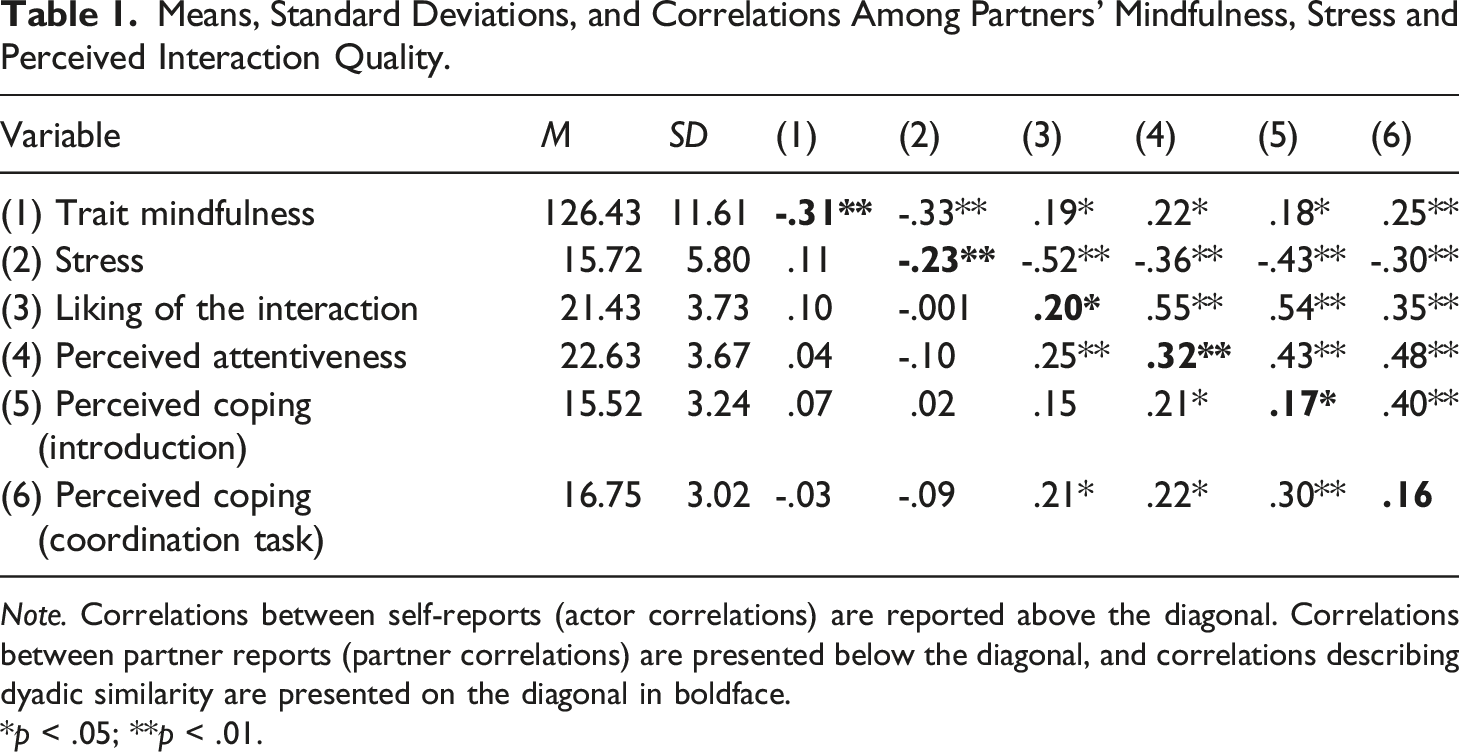
Note. Correlations between self-reports (actor correlations) are reported above the diagonal. Correlations between partner reports (partner correlations) are presented below the diagonal, and correlations describing dyadic similarity are presented on the diagonal in boldface.
*p < .05; **p < .01.
Actor partner interdependence models
Actor and partner effects for actors’ and partners’ mindfulness predicting dyad members’ perceptions of interaction quality as estimated with separate models per outcome measure.
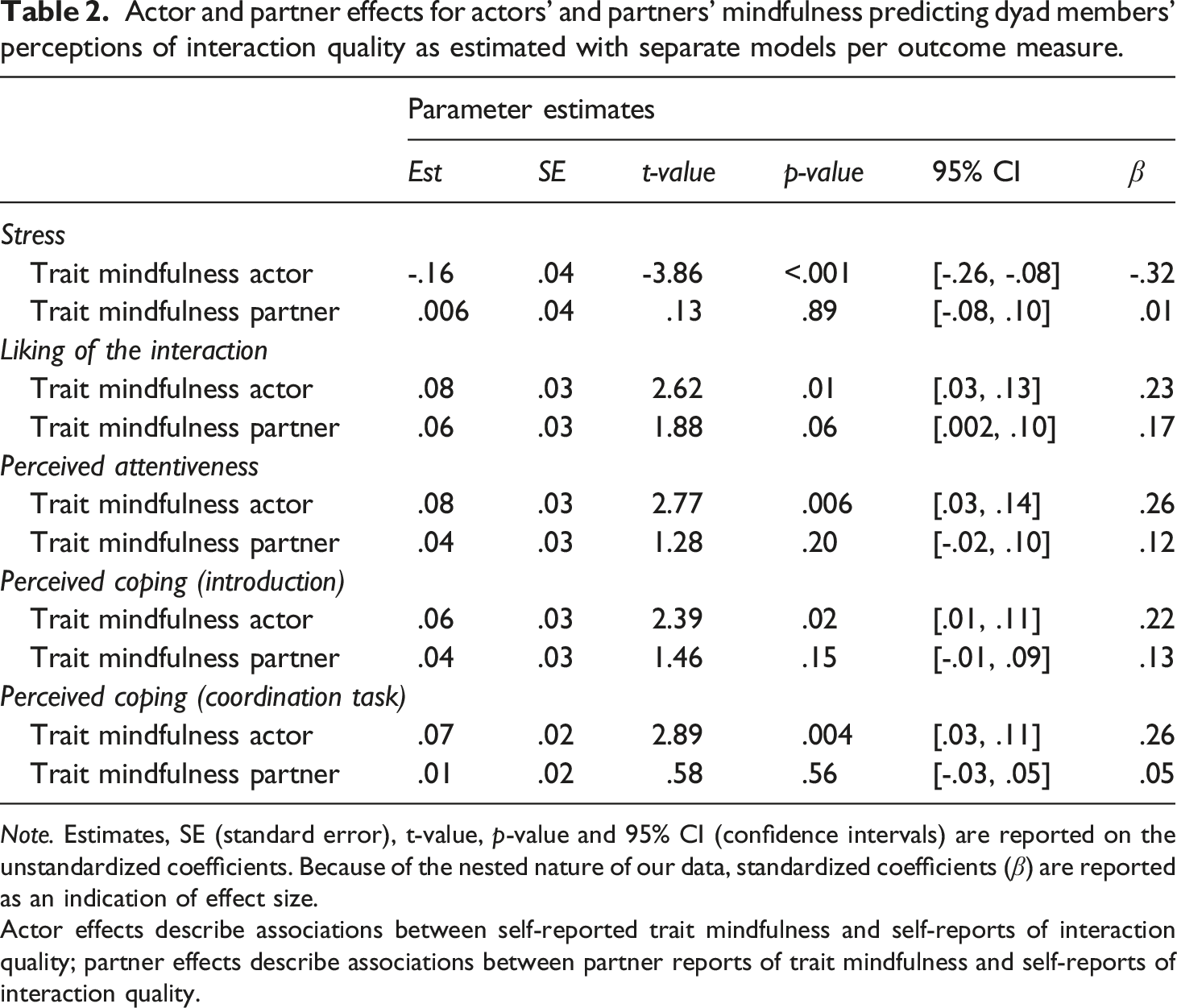
Note. Estimates, SE (standard error), t-value, p-value and 95% CI (confidence intervals) are reported on the unstandardized coefficients. Because of the nested nature of our data, standardized coefficients (β) are reported as an indication of effect size.
Actor effects describe associations between self-reported trait mindfulness and self-reports of interaction quality; partner effects describe associations between partner reports of trait mindfulness and self-reports of interaction quality.
Actor effects
Results of the APIM models showed that actors’ trait mindfulness significantly predicted their own stress levels. Actors’ trait mindfulness was a significant predictor of their own liking of the interaction, how attentive they perceived the other to be, and how well they perceived the other to be able to cope with both the introduction and the joint coordination task (see Table 2).
Partner effects
Results of the APIM models revealed that there was not a significant partner effect of trait mindfulness on stress: participants subjective stress level was not associated with their interaction partners’ level of trait mindfulness. Participants were not rated by the interaction partners as more, or less, attentive, nor were they rated by the interaction partner as being better, or worse, at coping with the introduction task nor the joint coordination task in association to their trait mindfulness. We did find a marginally significant partner effect for liking of the interaction: overall, participants tended to report higher levels of liking of the interaction when their interaction partner was higher in trait mindfulness (see Table 2). 2
Performance
Finally, we explored whether trait mindfulness in each dyad was associated with their performance on the joint coordination task. The sum score of trait mindfulness of partner 1 and partner 2 was used as an indication of trait mindfulness of the dyad in linear regression. Following research on the speed-accuracy trade-off effect (e.g. Heitz, 2014), performance during the joint coordination task was operationalized with amount of errors controlled for duration to finish the task, with less errors indicating better performance. Time and errors were averaged across the two times that the dyads did the coordination task. Trait mindfulness of the dyad was neither associated with mean time (β = -.07, p = .58), nor with mean errors (β = -.05, p = .68). Using linear regression analysis, trait mindfulness of the dyad was not a significant predictor of errors (β = -.08, p = .47) when controlling for time (β = -.44, p < .001). This indicates that more mindful dyads did not show better performance on the joint coordination task. 3
Summary of results
Our results primarily showed actor effects. Participants higher in trait mindfulness reported lower distress and better liking of the interaction, and they perceived their interaction partner to be more attentive, and better able to cope with the stressful introduction and joint coordination tasks. We found very little support for partner effects, only that trait mindfulness tended to be positively associated with a partner effect of liking of the interaction (albeit marginally significant). Finally, we did not find a significant association between trait mindfulness and performance on the joint coordination task.
Discussion
When Karin and Barbara have an interaction, their trait mindfulness might influence how they experience this interaction, how they perceive the other, and how they are perceived during the interaction. This basic assumption has often been made in previous literature on the interpersonal effects of mindfulness (e.g. Karremans et al., 2017). Is this indeed the case?
The present research assessed whether trait mindfulness may foster interpersonal interactions and coordination in actual interactions between strangers. In line with previous theorizing about mindfulness in interpersonal relations, we examined whether trait mindfulness would be (1) negatively associated with subjective distress during stressful interpersonal interactions, and (2) associated with more positive interpersonal perceptions (i.e. liking of the interaction, perceived attentiveness, perceived coping). Importantly, we also assessed whether one’s own trait mindfulness would affect subjective distress and interpersonal perceptions of the interaction partner. Finally, we explored whether more mindful dyads would show better interpersonal coordination on a joint coordination task.
The findings provide mixed conclusions. On the one hand, participants’ own trait mindfulness promoted a positive interaction experience: trait mindfulness was associated with less experienced distress, better liking of the interaction, and perceiving the partner in a more positive light (i.e. more attentive, and better able to cope with stress). On the other hand, our results did not show convincing partner effects.
The emerging literature on mindfulness in interpersonal relations shows that mindfulness might foster our perceptions of and our behavior towards others (e.g. meta-analyses by Berry et al., 2020; Donald et al., 2018; Kreplin et al., 2018). The present research contributes to this literature by assessing the effects of mindfulness in an actual interaction between strangers. Whereas previous research showed a negative association between trait mindfulness and self-reported distress to imagined social situations (Hayes-Skelton & Graham, 2013), our findings reveal a negative association between trait mindfulness and distress in actual interactions. More mindful participants were less distressed by the intense social situations. These findings are consistent with the stress buffering account of mindfulness which propose that mindfulness should manifest itself particularly in stressful situations (Creswell & Lindsay, 2014).
On the other hand, the findings provide little support for the prediction that trait mindfulness also benefits the interaction partner. In short, the results suggest that a person’s trait mindfulness mostly affect one’s own, but not the interaction partner’s experience. We reasoned that bringing more trait mindfulness to the interaction would increase attentiveness (or ‘presence’) and we examined whether the interaction partner would indeed perceive higher levels of attentiveness. In our study, persons higher in trait mindfulness were not perceived as being more attentive; higher trait mindfulness was not picked up by their interaction partner.
Conversely, we found that participants high in trait mindfulness perceived their interaction partner to be more attentive and better at coping with distress. One possible explanation for this finding is that mindful people might project their own attributes onto others. Converging evidence shows that people readily engage in social projection (Krueger, 2007; Ross et al., 1977), such that they attribute their own experiences, thought and feelings, attitudes and beliefs (Marks & Miller, 1987), motivational states (Van Boven & Loewenstein, 2003), personality traits (cf. Cho & Knowles, 2013; Thielmann & Hilbig, 2014), and behavior (Monin & Norton, 2003) onto others. Hence, more mindful people might perceive their interaction partners to be more attentive because they project their own attentiveness onto them.
Another explanation could be that more mindful people generally regard the world more positively. Research in positive psychology shows that mindfulness facilitates positive affect and positive evaluations (Garland et al., 2015; 2017). For instance, an experience sampling study by Garland et al. (2015) showed that after a mindfulness training participants indicated more positive emotions, which in turn facilitated more positive appraisals of their thoughts and cognitions and positive emotions the following day. This ‘upward spiral’ of positivity also seems to spill over into the social domain; participants felt more connected to other people after a mindfulness training (Fredrickson et al., 2019). Similarly, studies in social psychology show that mindfulness can decrease the influence of negative biases in evaluations of situations and other people. For instance, after a mindfulness induction, participants attributed less hostile intentions to others’ ambiguous social behavior (van der Schans et al., 2019) and were more likely to attribute behavior to the situation than ideas about others’ (stereotyped) disposition (Hopthrow et al., 2017; Tincher et al., 2016). Thus, rather than only projecting their own traits to their interaction partners, more mindful people might regard the world and other people therein as less negative and more positive in general.
Overall, our study provides modest support for the interpersonal effects of trait mindfulness. Although converging evidence shows beneficial associations between mindfulness and actor reports of interpersonal perceptions and behavior, we found little support for the dyadic (partner) effects of mindfulness. These findings concur with research on dyadic relationships more broadly that tends to find much stronger actor as compared to partner effects. For example, a large synergy of relationship studies showed that relationship satisfaction was largely predicted by actor-reported individual variables and actor-reported relationship variables (Joel et al., 2020). Partners characteristics and judgements about the relationship had less effect on one’s experience of relationship quality. Our study highlights the importance of a dyadic approach in assessing the interpersonal effects of mindfulness. Although converging evidence shows the benefits of mindfulness on self-reported social behavior (e.g. Dekeyser et al., 2008; meta-analysis by Kreplin et al., 2018), the transfer to partner effects might not be straightforward. Future studies should assess the robustness of the partner effect of liking of the interaction, and should further investigate when dyadic effects occur and why.
How do our results among strangers translate to interactions in close relationships? Previous research showed benefits of mindfulness among romantic partners (e.g. Quinn-Nilas, 2020) and close friends (e.g. Pratscher et al., 2018), but very little studies have examined actual interactions. Among one of the few, studies by Laurent and colleagues showed that mindfulness dampens physiological stress responses to and improves recovery from conflict between romantic partners (Laurent, Hertz, et al., 2016; Laurent, Laurent, et al., 2016). Yet, little is known about how mindfulness affects how partners subjectively experience the interaction, and how partners perceive each other during an interaction. We believe that some processes may be inherent to interacting with other people. According to interdependence theory (Rusbult & Van Lange, 2003), people mutually affect each other’s experiences and behavior when they engage in any form of interaction – from strangers to romantic partners. It can therefore be expected that our effects would also occur in close relationships. However, there might also be important differences between strangers and close partners. In close relationships, people could be more motivated to use their mindfulness skills to regulate their automatic reactions and stress in order to attend to their partner and improve the interaction quality (see Karremans et al., 2017 for similar reasoning). Hence, the absence of partner effects in the current research could be because participants were strangers to each other and lacked the motivation to sustain long-term bonds. Within close relationships, people might be more motivated to use their mindfulness skills to improve partner interactions and the effects may be more prominent. Thus trait mindfulness may affect the interactions and partners more strongly in close as compared to non-close relationships. It is still an empirical question how mindfulness affects actual interactions between close partners, and is an important route for future research.
We explored whether mindfulness would facilitate interpersonal coordination, but found no support in the data. Previous research by Haas and Langer (2014) did show an association between mindfulness and a specific form of interpersonal coordination (i.e. more mindful participant couples were more likely to re-enter a room simultaneously as compared to less mindful participant couples). The joint coordination task (Ramenzoni et al., 2011) that we used in this study was more complex and hence simply bringing mindful attention to the task might not be sufficient to facilitate interpersonal coordination. Research on joint action shows that interpersonal coordination requires (1) having a common goal, (2) attending to where the other is attending to, (3) understanding of what the other is doing and the ability to predict future actions of the other, and (4) the ability to integrate and attune to one’s own and others’ actions (e.g. Keller et al., 2014; Sebanz et al., 2006). It has been argued that bringing mindful attention to an interpersonal task could facilitate interpersonal coordination by heightening attention to detail and the selection of appropriate responses (instead of automatic responses) which could enhance task performance (cf. Gallagher, 2020). Future research is necessary to investigate whether and how mindfulness might foster interpersonal coordination.
A few limitations should be noted. First, we assessed whether trait mindfulness would be associated with experiences of the social interaction. Hence, we cannot make causal conclusions about the influence of mindfulness in social situations and there might be other personality characteristics driving the effects. We did explore the possible confounding variables social anxiety and self-esteem which did not influence the results (see supplementary materials). Future research could further investigate the effects of a mindfulness training on experiences during real social interactions to further elucidate possible causal effects. Second, as we assessed self-reported subjective distress right after the interpersonal task, these answers might be influenced by several biases (e.g. expectancy bias, experimenter bias). Continuous physiological measurements of stress (e.g. heartrate or breathing rate) as well as subjective measurements of distress might provide more nuanced information about the influence of mindfulness on physiological stress and the subjective appraisal of stress throughout the social interaction. Third, our joint coordination task might have been too complex to assess subtle effects of trait mindfulness. Future studies could use a stepwise approach to assess whether trait or manipulated mindfulness affects different determinants of interpersonal coordination separately (for instance, attention, synchrony etc.; Keller et al., 2014; Sebanz et al., 2006). Lastly, we conducted this research among a female student sample that were strangers to one another and mostly Dutch and German which limits the generalizability of our results. Future research is necessary to assess how mindfulness affects experiences of social interactions among different samples, ethnicities, age groups and social contexts.
Although extant literature suggests interpersonal effects of mindfulness, very little research assesses how mindfulness manifest itself during actual interpersonal interactions. The present study aimed to investigate actor and partner effects of trait mindfulness during actual interpersonal interactions. In our study we found that if you are high in trait mindfulness, you may generally have more positive interaction experiences, but that is not necessarily true for your interaction partners. Our study highlights the importance of a dyadic approach in studying mindfulness in social behavior. Whilst trait mindfulness might robustly affect self-reported social behavior, it might not strongly manifest itself in real interpersonal situations. Future studies should further elucidate when, whether, and how mindfulness affects social relationships. For example, by testing the effects of mindfulness experimental inductions and interventions on interpersonal interactions.
Footnotes
Acknowledgements
We would like to thank Prof. Dr. Melissa Curran and an anonymous reviewer for their very helpful feedback.
Declaration of conflicting interests
The author(s) declared no potential conflicts of interest with respect to the research, authorship, and/or publication of this article.
Funding
The author(s) received no financial support for the research, authorship, and/or publication of this article.
Author Note
This manuscript has been presented at the following conferences: the annual meeting of the Dutch association of Social Psychologists (ASPO) 2022 and the International Association for Relationship Research Conference (IARR) 2022.
Open research statement
As part of IARR's encouragement of open research practices, the authors have provided the following information: This research was not pre-registered. The data used in the research are publicly posted. The data can be obtained at:  or by emailing:
Supplemental Material
Supplemental material for this article is available online.
Notes
References
Supplementary Material
Please find the following supplemental material available below.
For Open Access articles published under a Creative Commons License, all supplemental material carries the same license as the article it is associated with.
For non-Open Access articles published, all supplemental material carries a non-exclusive license, and permission requests for re-use of supplemental material or any part of supplemental material shall be sent directly to the copyright owner as specified in the copyright notice associated with the article.
