




Abstract
Late-life remarriage is one form of repartnering later in life, a phenomenon that has developed with the increase in life expectancy and other modernization processes, such as the shift from an extended to a nuclear family structure. Knowledge on the phenomenon of repartnering is based on research conducted mainly within Western societies living by individualistic values. It has also been studied in societies such as Israel, which value self-determination alongside familism. How the phenomenon is experienced within a more patriarchal, collectivist society undergoing modernization processes, such as the Arab Muslim society in Israel, is yet to be explored. The aim was to understand the meaning of late-life remarriage and how it is experienced among older Arab Muslim widowers in Israel who remarried at old age after a long-term marriage and raising a family. Using a phenomenological approach, semi-structured qualitative interviews were conducted with 14 Arab Muslim widowers aged 70–80 at time of remarriage, to never-married, middle-aged women. Three themes were identified: The first theme addresses motivations for remarriage, the second theme examines continuity and change from a lifelong marriage, and the third theme refers to the meaning they attribute to their current wife. Each theme addresses participants’ inner world, their relationship with spouse and offspring, and their perception of the society they belong to. Conclusions address late-life remarriage as a solution for older widowers to receive care within the extended collectivist family. Thus, the phenomenon reflects a reaction to modernization processes alongside a way to preserve patriarchal gender roles.
Introduction
Repartnering later in life (Brown & Lin, 2013) is a phenomenon that has developed along with the increase in life expectancy and other changes due to processes of modernization, such as the change from an extended to a nuclear family structure. Knowledge on the phenomenon is based on research conducted mainly within Western societies living by values of individualism (e.g., Bildtgård & Öberg, 2019). It has also been studied in societies located between tradition and modernity, such as India (e.g., Samanta & Varghese, 2019) and Israel, which value self-determination alongside familism (Koren & Eisikovits, 2011). Familism is a form of social organization that grants the family an important role in individual and collective identity (Shoham, 2014), enabling the state to rely on the responsibility of family members for each other (Keating, 2022).
Remarriage is one form of repartnering. However, living together without being married in the same house (cohabitation) (Brown & Wright, 2017) or in separate houses (LAT) (Benson & Coleman, 2016) are the forms of late-life repartnering preferred by older Jewish repartnered adults in Israel. The phenomenon was previously studied in Israel among Jewish couples when both partners, the man and the woman, were older citizens when they entered the repartnering relationship after widowhood or divorce from a long-term marriage and raising families (Koren, 2011).
Late-life repartnering for older Arab Muslims however, is allowed in the form of remarriage and for men only. Widowed Muslim women are forbidden to remarry outside their late husband’s immediate family (Yasien-Esmael et al., 2020). Thus, the most common situation is that the wives the older men remarry are usually single, middle-aged women who were never married before and are much younger than their older husbands. The reason is related to the characteristics of the Arab Muslim family in Israel as originally patriarchal and living by hierarchical collectivist values (Azaiza, 2013).
Although modernization has caused the Arab Muslim family in Israel to shift toward more individualist values alongside traditionalism (Fogiel-Bijaoui & Halperin, 2018), research referring to how the changes within the Arab Muslim family are shaping the lives of older adults within this society is scarce, though developing (e.g., Azaiza, 2013). Most research focuses on filial responsibility, support, caregiving (e.g., Ayalon, 2018; Khalaila & Litwin, 2012; Silverstein et al., 2013), and health (Schwartz et al., 2019). The role of late-life remarriage as a phenomenon associated with modernization is yet to be explored within such families, and findings on this subject may help understand how older remarried Arab Muslim widowers cope with changes caused by modernization and how it affects and is affected by their life course. This in turn could be useful for healthcare and social work counseling and interventions. The aim of this article is to understand the meaning of late-life remarriage in a patriarchal collectivist society in the process of modernization and how it is experienced among older Arab Muslim men in Israel who remarried at old age after widowhood from a long-term marriage and raising a family.
Late-life repartnering
Motivations for entering a late-life repartnering relationship in modern Western societies include enjoying life as long as possible and loneliness due to widowhood or divorce (Koren, 2011). Three main forms of late-life repartnering are identified throughout the empirical literature (e.g., Bildtgård & Öberg, 2019; De Jong Gierveld, 2004). They refer to living arrangements and differ in relationship formality and levels of commitment (Lewin, 2017). Remarriage is the most official (Brown & Lin, 2013), with the most commitment (Lewin, 2017). Cohabitation is living in the same household without official marriage (Brown & Wright, 2017), with less commitment (Lewin, 2017). Living apart together (LAT) are unmarried couples who live in separate homes, do not necessarily expect the relationship to be permanent (Benson & Coleman, 2016), and as such are the least committed (Lewin, 2017). Preferences differ according to obligation practices toward familism and self-determination, how partner and family relationships are culturally perceived, and the role of religion (for a detailed review see Koren & Ayalon, 2022). In Scandinavian countries (Bildtgård & Öberg, 2019), the Netherlands (De Jong Gierveld, 2004), and Britain (Haskey & Lewis, 2006), LAT and cohabitation are more common than remarriage among older adults, whereas in the United States remarriage has received more visibility in research than cohabitation or LAT (Koren & Ayalon, 2022).
Marriages in Israel are bound to religious courts of law, which complicates divorce. Therefore, older Jewish adults who repartner prefer LAT or cohabitation, and those who remarry are motivated by religion (Koren, 2014). Late-life repartnering in Israel is a possibility but is not officially recognized. It is mostly experienced as essentially different in comparison to a long-term marriage, opening new life opportunities with unique forms of love (Koren, 2021). Acceptance of the phenomenon is enhanced when the partner contributes to care for an older parent/grandparent (Koren & Simhi, 2016).
Older adults enter such relationships when both partners are functioning independently, physically and cognitively. However, as aging proceeds, health and functionality potentially decrease (Devi, 2018), and assistance from others might be needed. Research on caregiving expectations shows that late-life repartners prefer to rely on their partners rather than on their children (Koren et al., 2016), which coincides with modern culture (Yarry et al., 2007). Partners who were already confronted with illness in their current LAT relationship were found to provide care to their partner (De Jong Gierveld, 2015).
The Arab Muslim family in Israel
Muslim Arabs comprise 18% of the Israeli population (ICBS, 2021). Older adults aged 65+ make up 11.8% of the population in Israel, with 13.6% of the Jewish population and 4.8% of the Arab population aged 65+ (Shnoor & Cohen, 2021). The Arab Muslim family in Israel is traditionally patriarchal, with family life practiced according to hierarchical, collectivist values related to age and gender within extended families (Azaiza, 2013) and conservative Muslim norms (Meler, 2016). Furthermore, Arabs less than Jews agree that spouses should be equally engaged in household chores (58.4%; 83.7%, respectively) and contribute equally to the household income (63%; 87%, respectively) (Shnoor & Cohen, 2021). Most middle-aged and older women are financially dependent on their husband or on other men in the family when they are unmarried (Meler, 2020). However, modernization processes in Israel have gradually generated change within the Arab Muslim family, from living in extended, multigenerational households toward nuclear, generational homes (Azaiza, 2013).
At first, the change was mainly structural due to changes in employment resources, from family agriculture toward a diversity of jobs, while holding on to familism (Al-Haj, 1989; Kanaana, 1975) without adopting individualist values (Meler, 2016). Yet, although there are members of younger generations holding on to classic traditionalism (Fogiel-Bijaoui & Halperin, 2018), others—including young, educated women (Meler, 2016)—are gradually adopting values of self-determination associated with individualism, alongside traditionalism (Fogiel-Bijaoui & Halperin, 2018), despite disapproval of male or older authorities within the extended family (Meler, 2016). However, such change does not yet apply to the older and middle-aged generations who continue a lifestyle dictated to them by the gender contract in which all women are dependent on male members of the family. Being married is considered a preferable marital status despite gender inequality (Manor, 2018). Therefore, never-married middle-aged women prefer to marry despite being dependent on a husband. Although they do not inherit their husband’s entire assets, they receive an inheritance that provides them with a home and finances to cover their needs. Furthermore, as single women without children, marriage is also motivated by loneliness.
Support within the Arab Muslim family
Older Arab adults are more familial than older Jewish adults, receive more support from children, and have higher filial expectations (Katz & Lowenstein, 2012). However, although intergenerational solidarity is very strong in the Arab sector and family care was found preferable to paid care, family caregivers—more than the older care-receivers—stated that they prefer family care to paid care (Ayalon, 2018). Thus, perhaps the caregiver is more eager to provide care than the older care-recipient wishes to receive. However, this could be explained by social desirability that adult children are expected to act according to collective intergenerational solidarity. Although burden plays a role in caregiving, filial piety among Arab adult children providing care to their older parents was found to be strong (Khalaila & Litwin, 2012) yet decreasing (Manor, 2018). Older Arab adults, however, were found to prefer and to utilize their partner for receiving support rather than their adult children or other family members (Azaiza, 2013). This coincides more with modern values than with traditional ones (Yarry et al., 2007). Thus, despite strong filial piety, modernization processes were found to influence support preferences of older Arab adults.
The current study aims to understand the meaning of late-life remarriage and how it is experienced among older Arab Muslim widowers in Israel who remarried at old age after a long-term marriage and raising a family within a collectivist patriarchal society in the process of modernization. The research question is: What is the experience of late-life remarriage and its meaning for older Arab Muslim widowers in Israel, undergoing modernization processes?
Method
This qualitative study uses a phenomenology approach to explore the experience of late-life repartnering and its meaning among older widowers within the patriarchal, collectivist Arab Muslim society in Israel. A phenomenology approach (Smith et al., 2009) enables capturing in-depth experiences and their meaning perceiving reality as subjective, relational, and multifaceted.
Sampling, sample, and data collection
A purposeful, criterion-type sampling (Patton, 2002) was used according to the most common lifestyle found among older Arab Muslim men who remarry, as follows: Age 65+, widowed from a long-term marriage that included raising a family with children and grandchildren. Most Arab Muslim men aged 65+ (88.9%) are married or remarried. Divorce rates are very low (1.9%) among Arab Muslim men aged 65+ and decrease with age, but the share of widowers aged 65+ is high (7.4%) and increases with age: 17.7% at age 75+ compared to 4.5% at age 65–74 (Shnoor & Cohen, 2021). Only 1.8% of Arab Muslim men aged 55+ are never-married (ICBS, 2021). Most Arab Muslim men aged 65+ have five children or more (75.9%) and 14.8% have three to four children (Shnoor & Cohen, 2021). Thus, the vast majority of Arab Muslim men aged 65+ are either married or were married and raised a family with offspring; the study inclusion criteria were chosen accordingly.
Demographic information.
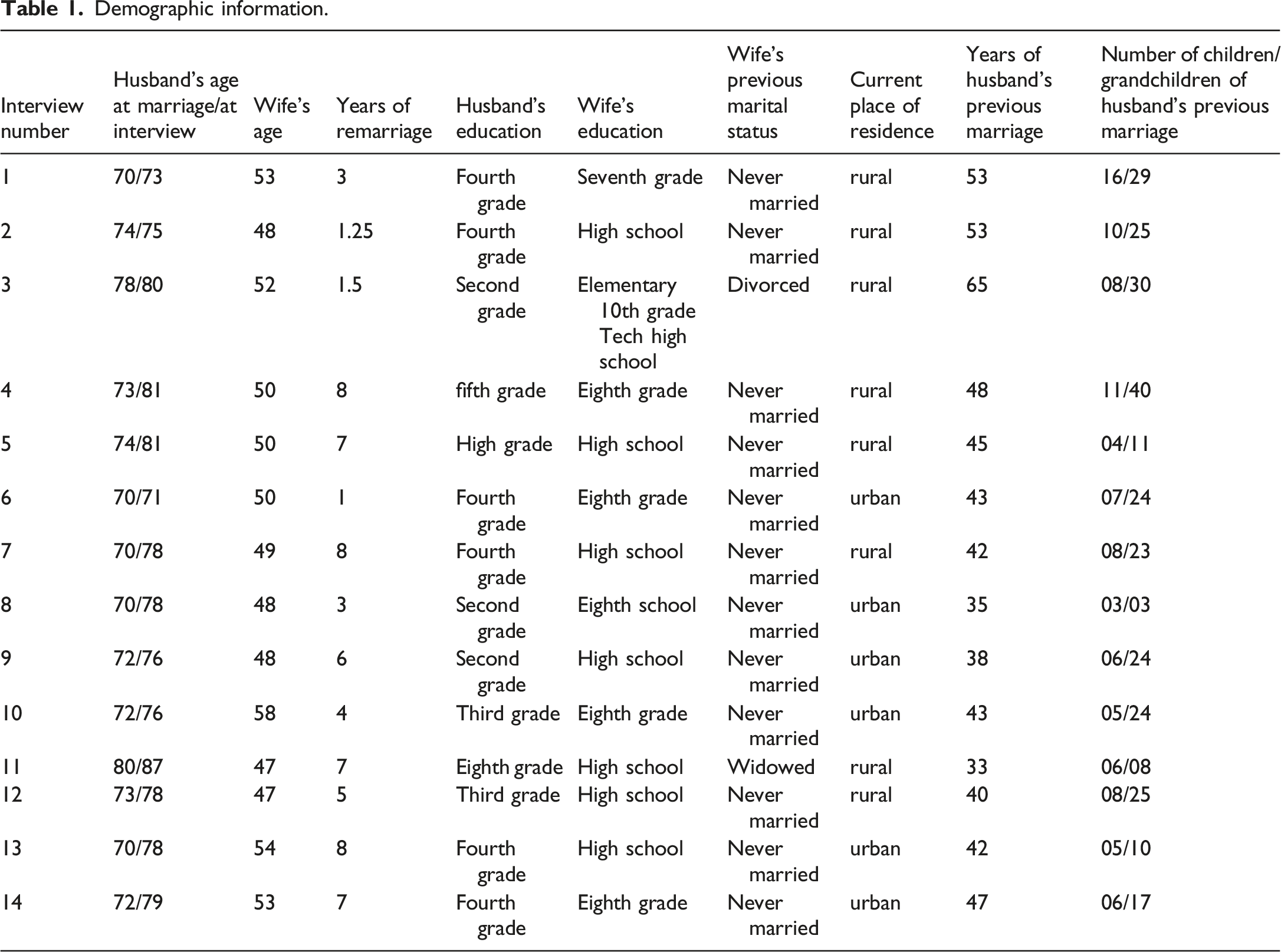
The research tool was a semi-structured interview guide meant to enable participants to freely discuss their overall experience of remarriage at an older age. The interview guide included an overall opening question and several topics to be covered, with examples for possible questions used to probe participants. Besides the opening question, all other topics were referred to according to the interviewee’s choice, as the interview proceeded (see Figure 1). Furthermore, probing questions were asked to derive a deeper understanding (Kvale & Brikmann, 2009). Interview guide.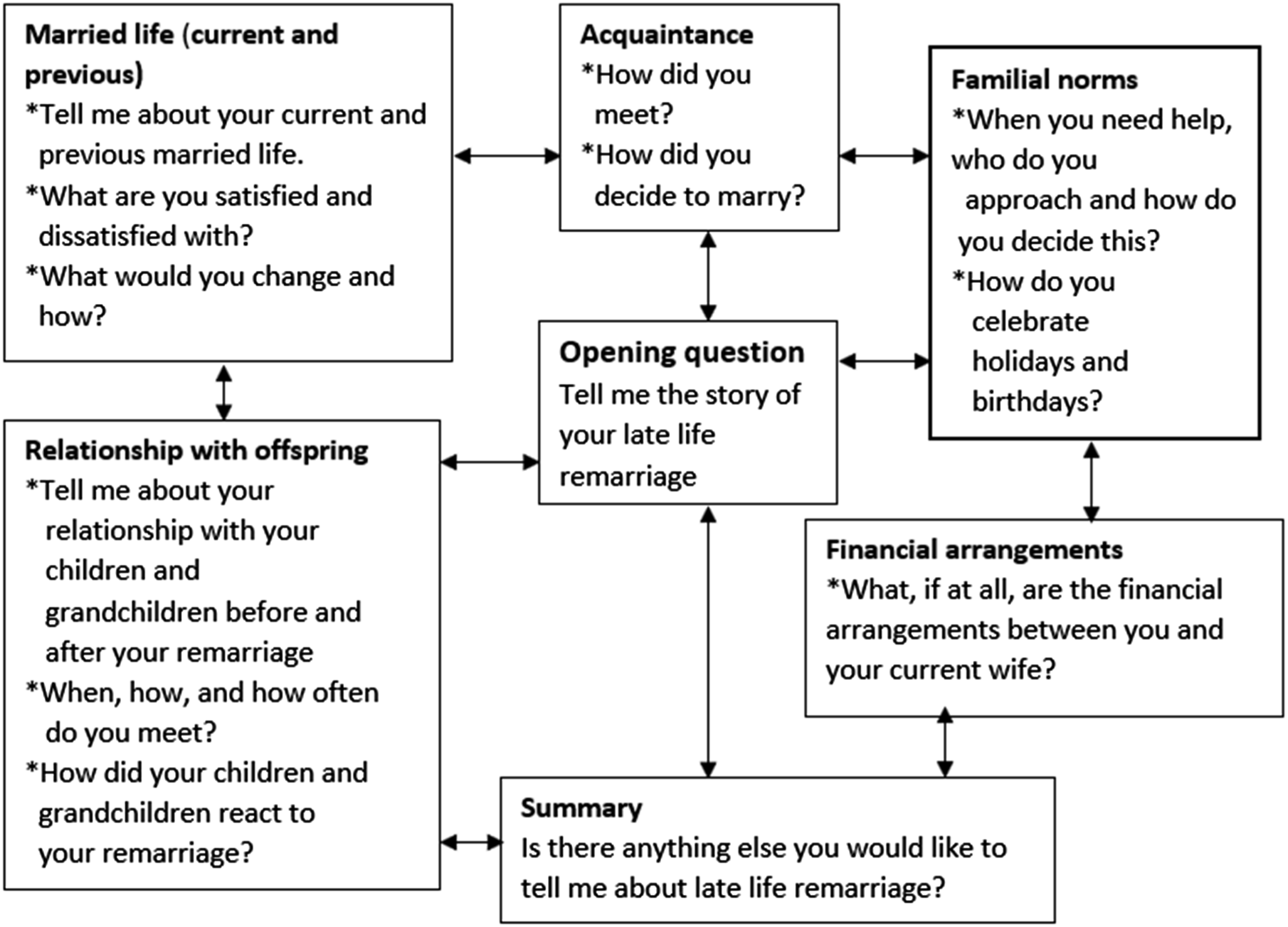
Data analysis was conducted by the second author and supervised by the first author. Analysis was based on the principles of interpretive phenomenological analysis (IPA) (Smith et al., 2009), narrative analysis (e.g., Lieblich et al., 1998), and thematic analysis (Braun & Clarke, 2013). Analysis included three main phases: Phase I was an in-depth analysis within each interview separately, whereas Phase II was an analysis conducted between interviews. Phase III refers to the formation of the findings section. Each phase includes several parts. Analysis was not necessarily linear but rather a back-and-forth procedure between phases and their parts.
Phase I comprised the following: (a) a holistic analysis, which included reading and rereading a single interview to gain familiarity with the data and to identify central motifs that characterize the specific interview; (b) identifying units of meaning within the interview without leaving out data and information and providing titles/codes to the units of meaning that reflect their content and structure; structure refers to use of language such as grammar, metaphors, and slang (Smith et al., 2009), and a title/code could also be in-vivo, an expression within the text. This part is also referred to as ‘complete coding’ (Braun & Clarke, 2013) because it attributes equal importance to all the data; (c) grouping several units of meaning into larger units to provide an overall title/category to assist with identifying themes at a later stage; (d) stages (a), (b), and (c) were repeated with all 14 interviews.
Phase II consisted of identifying themes between interviews: (a) examining how a central motif that appeared in an interview was expressed in other interviews, if at all; also known as selective coding (Braun & Clarke, 2013). This was repeated for all the motifs identified in each interview; (b) identifying dialectics among codes and arranging them on continuums; (c) examining how central motifs and larger units of meaning intertwine, if at all, to derive themes and sub-themes; (d) listing all the excerpts for each theme and sub-theme.
Phase III consisted of writing the findings: (a) choosing the excerpts for representing each theme and sub-theme. Choice of excerpts was based on richness of their content and structure; (b) each chosen excerpt was analyzed in depth by combining content and structure to derive an interpretation based on the data.
Ethics and trustworthiness
Conducting the study in an ethical manner helps to ensure the study’s trustworthiness (Patton, 2002). The study received approval of the University’s ethics committee for conducting research with humans (approval #513/21a). The participants signed a form of consent promising not to reveal identifying details, assuring that no harm will be caused to them if they refuse to participate, and that they are free to choose what to share and what not to share. The recordings and their transcriptions were available to the research team only. Trustworthiness was also established (Patton, 2002) as follows: (1) providing a detailed description of the research procedure (in this method section); (2) presenting the complex reality of the phenomenon in themes and sub-themes. This was achieved by providing rich, thick descriptions in the form of excerpts and their interpretations (see findings section and supplementary materials); (3) an insider’s perspective on the Arab Muslim family was provided by the second author, an Arab Muslim social worker, who collected data and took part in data analysis; (4) Themes and sub-themes were discussed in meetings held with the research team, which included the PI (first author) and research assistants.
Findings
The experience of late-life remarriage and its meaning for older Arab Muslim widowers in Israel was identified in three themes. The first theme addresses motivations for remarriage, the second theme examines continuity and change from a lifelong marriage, and the third theme refers to the meaning they attribute to their current wife. Each theme addresses the widowers’ inner world, their relationship with spouse and offspring, and their perception of the society they belong to. In the IPA method (Smith et al., 2009), the purpose of presenting excerpts is to convey experiences emphasizing depth over breadth. Accordingly, the excerpts chosen are the richest experiences in content and structure, rather than a quantity of brief descriptions. For the entire range of excerpts, see Supplementary material, Table S1: Themes and excerpts, which includes all the excerpts identified from the data for each theme and sub-theme.
Theme I: Motivations for remarriage: Loss, helplessness, and social criticism
This theme includes: (a) the experience of losing a wife from a lifelong marriage, (b) the experience of helplessness and troubling others, and (c) social/familial criticism/objection to remarrying or not remarrying late in life.
The experience of losing a wife from a lifelong marriage
The experience of loss leading to remarriage is illustrated by Interviewee#9: The first wife is different, she understands you without talking, she lives with you in all life circumstances, raises children. You know she invested a lot in everyone and didn’t spare anything from anyone. When she passed away, I lost a part of me, a big part of my life. A long time … a long time till I decided that I must get out of it, start thinking about remarrying. Difficult, very difficult.
Describing the emotional difficulty of the wife’s death, her uniqueness and special characteristics, the advantages of a lifelong marriage, along with the process of deciding to remarry assist with understanding the magnitude of the loss. Furthermore, emphasizing the significance of the loss justifies the decision to remarry in order to overcome the loss.
The experience of helplessness and troubling others
Interviewee#2 illustrates One of my daughters would come and do household tasks, finish, and return home and tomorrow and the day after there’d be no one. I’d sit with myself and say there’s no choice but to remarry to end these circumstances and not trouble others, even the closest people to me, like my son’s wife who lives a floor below me; I won’t tell them “Do this and that for me” [. . .], like in the kitchen, I’m not used to it … I never went into the kitchen. When you are widowed its different, there is no wife who’d do everything. After a while I decided to enter the kitchen, peel potatoes, cut vegetables—you know, things I’ve never done before in my life. I’m not a woman to do such things, I need different food, not the kind I know how to make; no man can make food like women do, good food. In the end I decided, even the children came to talk with me and tell me, not once and not twice, that I need to remarry. Everyone, the children and daughters, would talk to me about it. They would stop all their activities and come for half an hour and help with what they could and after that go to their homes. I know they have homes of their own and have their children. I’m a person that doesn’t accept other people doing things for me, coming every day, working for me—I was ashamed. That’s the main reason why I decided to remarry.
The excerpt begins and ends with the two same reasons for remarrying. One reason was not wanting to be alone after his family came to help and the other was not wanting his family to be troubled by helping him. Although his family initiated helping him, he felt ashamed and uncomfortable. First, he makes the impression that the initiative to remarry was his alone. However, as the excerpt continues, we learn that although the final decision was his, he was also encouraged by his family. Perhaps, adding his family’s encouragement serves as justification to remarry. Finally, another reason he decided to remarry was his incompetence and unwillingness to fulfill household chores, which in Arab Muslim society are clearly considered women’s gender-based roles.
Social/familial criticism/objection to remarrying or not remarrying late in life
Older widowers experienced social/familial criticism/objection related to late-life remarriage, some to remarrying at such an old age and some to not remarrying earlier.
Interviewee#13 illustrates criticism over not remarrying earlier, even though he is still mourning his deceased wife. Our society is a harsh and critical society. You know, they expect a person to quickly overcome such a crisis and they talk from above what should be done: A man whose wife has died should remarry, you know, in our society they meddle in a person’s life, you know, I understand the concern, but a person needs time, time takes its course … you know, the children, friends, the extended family—everyone pressured me. I felt I was living under pressure and if I don’t remarry, whatever I’d do, would be socially and religiously unacceptable. That’s why, after a while, I started to listen to them, I was willing to listen. I also didn’t want to remain under the pressure of others. With time, a person starts to soften, and God helped us, I found this girl and we agreed between us, and God blessed us.
An opposite social criticism, against late-life remarriage for very old widowers, is illustrated by Interviewee#12: A man cannot live without a woman, you know, I always say that even if he’s ninety, he should remarry if he doesn’t have a wife, and I always bring as an example Mr. Hussain here from this village: He’s ninety-two and remarried … he was without a wife, going out to prayers untidy, had no ironed and clean clothes, after that he’d go to his daughter to eat something at her place or drink coffee and return to an empty home without a wife to receive him, to make him feel good with her, that she’s there for him. He enters an empty home and goes out again … I mean, as if he were a street dweller, he didn’t sit at home because he had no reason to, for what? When he remarried, he began to come to the mosque in clean cloths, neat, happy, you could feel that his life had changed after he remarried. He used to relate that after prayers he and his wife would go out together, he was very happy in his remarriage. I found him twice in Jordan, together with her. They used to go out together; he lived with her for ten years. Now, when he wanted to remarry at age 82, people started to criticize him: “Why should he remarry when he’s so old? How long will he live?” and more and more things like that, but its good he did it for himself, he lived a happy life after he remarried, why should he remain alone? Our society doesn’t look at people’s needs; our norms must change.
While the previous experience was social criticism of older widows not remarrying, the current experience is criticism of older widows remarrying. Perhaps norms change according to age of entering widowhood. Thus, those who lost their wives at a younger old age are criticized for not remarrying, whereas those who lost their wife at an older old age are criticized for remarrying. Although the interviewee’s actions coincide with the Arab Muslim norms because he is within the right age range for remarrying (age 73 when he remarried), relating an experience of a widower within an older age range emphasizes that norms must change. Finally, remarriage occurring at a very old age against the norm is justified by its benefits.
The two opposite experiences indicate that whether the norm is to encourage remarriage or oppose remarriage, the common experience is the need to conform to social/religious norms. Both experiences emphasize dissatisfaction with societal intervention in the personal lives of individuals. Perhaps criticism of social norms is a consequence of modernization processes that Arab Muslim society in Israel is experiencing, and a wish to construct one’s own life course.
Theme II: Experiences of continuity and change from a lifelong marriage
This theme addresses continuity and change in late-life remarriage, with three sub-themes on a continuum. At one end is continuity of family cohesion, the most common experience; in-between is an experience of continuity and change of marital features; and at the other end is change related to the starting point of remarriage, which is the exceptional experience.
Continuity of family cohesion
The importance of family cohesion and how continuity is assured is explained by Interviewee#6.
Interviewer: How is your relationship with your children? What changed, what continues? Man#6 The same, there was no change. The preparations I made prior helped a lot with preserving the relationship with the children because I explained to my current wife that there are traditions that we will preserve, for example every Friday we gather for lunch or dinner, no matter [what] … we’re together all the children and grandchildren. When you explain it and everything is agreed to, that they’ll come and sit here, inside or outside, depending on the weather, there’ll be no problems. She [current wife] understands this, we talked about it in advance. It’s the family atmosphere that we had, and I want to preserve it, that it continue, it’s important to me to preserve it. It helps to keep in touch, the weekly gathering helps a lot. I recommend that everyone have such meetings because during the week everyone is busy with work and study, but once a week you can gather them even over a cup of coffee and cake, not necessarily a meal. It keeps the group close together: the girls, the daughters-in-law, the grandchildren, the children, the wife—everyone. I mean, what’s the group? The father has to take care of it to prevent dropping out of this family. We need to safeguard the family gatherings from all sides. When everyone sees it and you give them a pleasant atmosphere, there’s no reason for anyone to drop out of this family. It’s like a string with beads: If you take care of it, no part will fall out and scatter the rest of the beads.
Continuity and change of marital features
Interviewee#2 relates the following You know, the [re]marriage is a continuation of what was in my previous marriage. Widowhood was something I coped with but very quickly I understood that if I remarry, I'm going back to where I was, a continuity of life, being in an ordinary marital relationship. My current wife is a good wife; choosing her felt like I was continuing something I was used to and came back to me. As I said, it’s like a working person who stops working and then returns to work. At the beginning, a person is 20 years old when he first marries. Of course, there’s a difference between then, when I was a boy, and now an older man who has 10 children and his wife passed away, the gap between the two is big. At the time I lived at my parents and my parents were with us in the house and so were my sisters. It’s different when you remarry when you are 75 years old and have no one; you sit alone all the time. A person doesn’t know how long he’ll live, and we trust God, but a person alone is difficult, difficult. I wanted to feel loved. My children love me, that’s true, but a spouse is different, someone warm, close, and containing, you know, someone to stroke your head, and put your head on her shoulder.
Continuity and change are both used to justify late-life remarriage. Remarriage is perceived as a continuation of life and coming back to oneself. Returning to work after a period of absence is used as a metaphor of remarriage after a lifelong marriage. Change is also used to justify remarriage in order to overcome loneliness. At the beginning of his first marriage, he was a young man starting his life in his parents’ home, surrounded by family, whereas widowhood at later life included living alone. The difference in living arrangements as a young man beginning his first marriage surrounded by family, in comparison to his present living arrangement as an older widower, is perhaps more an indication of different eras due to modernization rather than different life stages. Late-life remarriage is not only justified to avoid being alone but is practiced without going against religious commands, while taking responsibility without having to be dependent on his children—serving as another justification for late-life remarriage.
Change related to the starting point of remarriage
Interviewee#14 emphasizes No comparison, not even one percent. To compare between this marriage and my first marriage, it’s something different. Here the starting point is easier, as you said, different. Here I started something new, from a place that I’m ready from all aspects, you know, financially, and I’m also free, I don’t work. Not like in my first marriage, when we worked all the time, me and my wife. We raised children, everything was difficult. In this marriage its easier: I don’t work, I have free time, I have relaxation, my wife also doesn’t work. We get up together, do things together. This didn’t exist before, there is nothing to compare because the starting point is different.
Change is indicated by stating that late-life remarriage cannot be compared to a lifelong marriage because the starting point of each is very different. The first marriage included the hard work of raising a family with no free time, whereas an improved financial situation and retirement create free time to relax and spend time together in the current marriage. These differences could more easily be related to developmental marital stages than to differences between lifelong marriage and remarriage. However, perhaps not having a lifelong history with his current wife shapes his current marital relationship differently than it would have been shaped with his former wife at this life stage.
Theme III: The meaning attributed to the current wife
This theme includes two sub-themes: (a) being between a caregiver and a spouse, which addresses the participant’s inner world, and relationship with spouse and (b) the wife’s place in the family: "She cannot be above my son”, reflecting the participant’s relationship with offspring and the patriarchal society he belongs to that the women and especially a new wife are inferior to the men in the family.
Being between a caregiver and a spouse
Experiences range from the wife serving mainly as a housekeeper and caregiver at one end to a wife that serves mainly as a spouse and companion at the other end.
Interviewee#4 illustrates the wife serving mainly as housekeeper and caregiver: You know, I married for substantial reasons. I want someone to help me. I’m not young, 81 years old, [I] need services. I can’t get myself ready alone. I need help with putting on my shoes, getting dressed. In the shower, she often gets in with me to help me. We get older not younger. I need her at home for food, and socially, if someone comes to visit me, that she make a cup of coffee. If I want to get up and get prepared for prayer, that she get everything ready for me and then prepare a cup of tea or coffee, I’ll be happy.
Interviewee#1 however, refers differently to his remarriage, portraying his wife as a spouse and companion: You can’t live without a wife for help, assistance, and support, and sometimes for caregiving. The spirit at home is the wife that brings and shares the good and the bad with me. You know, woman was created from man’s bone, the bone that contains the heart in it. I believe that a man and a woman complement each other, and it has nothing to do with age [. . .]. I try to give it to her, I mean, she says that she’s a very happy wife. You know, thank God, since I married, [we] go out, have fun, we live together. A person doesn’t have much in life, I don’t have any small children that she must take care of, and thank God I’m strong and healthy and I drive. I’m available to her and we go out together. She told me something that I keep in mind, and this sentence encouraged me to continue with her when we were getting to know each other. She said that: “I’m at that age and you’re at that age that what do we want from life besides living together and being happy? Because we do not have much time left. We’ll live several good years, no reason not to live them well.” That’s one of the things that led me to decide that she is suitable for me, in my position and situation.
The last sub-theme shifts us back to a different attitude.
The second wife’s position in relation to the husband’s children is illustrated by Interviewee#3: You know, honestly, she cannot be above my son … that's the nature of fatherhood, its partially from above, I haven’t distributed my assets yet. I could have done it before I remarried, I hear that people do that, but through my assets I hold on to my children; perhaps if I distribute my assets, they'll leave me. But on the other hand, this created a problem toward the children: It's true that our relationship is good, but this issue always comes up, you know, if I pass away will my current wife get something? They are concerned that she won't share with them the land and houses I have and that my children have, [they wish] that I register each child’s house and the land they reside on in their name. Everything is still in my name. I think that's right, later I'll make a will. The children are always above, no matter what. Even if the wife gets something from the assets, she'll get something minor in comparison to what the children get.
The dilemma referring to the man’s distribution of his assets touches upon two issues related to each other: One is the hierarchy of importance within the extended Arab Muslim family and the other is fear of being abandoned by children at old age. The man’s late-life remarriage causes conflict between these two needs. Perhaps his concern demonstrates that the wife’s position within the family does not necessarily coincide with the default laws of inheritance. Thus, only a written will can ensure that his children receive a larger portion than his wife.
Discussion
The aim of this article is to understand the meaning of late-life remarriage and how it is experienced among older Arab Muslim widowers in Israel who remarried at old age after a long-term marriage and raising a family within a collectivist patriarchal society in the process of modernization. The women they remarried were middle-aged Muslim woman who never married before and were without children, except for one divorcee and one widow. Besides two women partially employed, the rest were fulltime housewives, dependent financially on their husbands, motivated to marry out of loneliness and to improve their social status. The findings are discussed relating to modernization, the Arab Muslim family in Israel (e.g., Azaiza, 2013), and late-life repartnering.
Loneliness, caregiving services, and enjoying life while still possible were motivations for older Arab Muslim widowers to remarry. Although these motivations were also found in other cultural contexts (e.g., De Jong Gierveld, 2004), the emphases differ. For example, the Arab Muslim men stress receiving caregiving services, whereas for repartnered Jewish men, the main motivation was enjoying life while still possible (Koren, 2011). Two decades ago, women in modern societies were found to prefer LAT over late-life remarriage to avoid the caregiving role that might be expected of them (De Jong Gierveld, 2004). However, more recent findings show that currently, men in modern societies emphasize motivations of loneliness and enjoying life, and like women, fulfill a caregiving role when necessary (De Jong Gierveld, 2015). Thus, such relationships in Western cultures are more equal and symmetric.
Late-life remarriage in the current study enabled continuity of the older widowers’ lifestyle of being taken care of by a wife who fulfills household tasks and provides emotional support, in return for which the wife is financially provided for. However, the older widowers did not allow their late-life remarriage to interfere with the continuity of relationships with their offspring. Furthermore, these findings differ from findings among Jewish repartnered couples in Israel, who experienced their late-life repartnering relationship as essentially different from their lifelong marriage. The most common experience for Jewish participants was discontinuity and change (Koren, 2011), while for the Arab Muslim participants in the current study the most common experience is continuity.
Muslim Arab widowers in Israel who remarry late in life were found to prefer not to be dependent on their adult children and daughters-in-law, despite collectivist values of familism (Manor, 2018). Instead, they preferred receiving care from a wife, which coincides with previous findings (Azaiza, 2013) and caregiving norms in modern societies (Yarry et al., 2007). Moreover, they indicated they did not want family members to be troubled by helping them. In other words, they did not want to be a burden. This contradicts previous findings that burden is an unfamiliar concept for traditional parents (Cahill et al., 2009). These findings could indicate the effect of modernization on the older generation, as its members respond not only to the structural changes of living arrangements in nuclear households (Al-Haj, 1989; Kanaana, 1975) but also to change in cultural values from familism to self-determination (Meler, 2016). When assistance from family members is a taken-for-granted value within the collectivist extended family, then the older family member who needs help does not hesitate to receive it because it is the expected way of life. However, when these norms are changing (Azaiza, 2013), the older widower apparently prefers to receive assistance elsewhere in a manner that does not contradict Islam and within a familiar setting such as marriage (Manor, 2018). Thus, late-life remarriage serves as a solution for older widowers’ personal needs and coincides with changes inflicted by modernization processes without contradicting Islamic rules. Furthermore, the use of accounts (Scott & Lyman, 1968) to justify and excuse late-life remarriage perhaps indicates that in the traditional, collectivist Arab Muslim extended family, late-life remarriage is not the norm. Justifying how beneficial it is to remarry and excuses for remarrying because of pressure by others are therefore required. Such accounts are used to bridge between the traditional norm and the deviation of late-life remarriage from the tradition, despite the fact that such a practice does not violate Islam.
Although older widowers remarry due to modernization, the new wife’s status within the extended family is shaped by patriarchal norms (Fogiel-Bijaoui & Halperin, 2018) such as: "She cannot be above my son”. Such an attitude perhaps reflects the process of transition being experienced within Muslim Arab society, by responding to modernization along with preserving traditional familial and religious norms. Finally, the participants expressed dissatisfaction with social/familial expectations to conform to norms. This is yet another indication of the older generation’s flexibility to adapt to cultural changes due to modernization without giving up religious beliefs and practices. The findings reflect the current time and place of the older Arab Muslim widowers within a process of modernization. Whether Arab Muslim society in Israel will adapt to a modern Western late-life repartnering style or develop a different late-life repartnering style remains to be examined in the future.
Limitations
This study applied a phenomenology approach that focuses on presenting a subjective, relational and multifaced reality identified from in-depth experiences. This approach favors depth over breadth. Therefore, each sub-theme was illustrated using one or two excerpts. However, additional excerpts for each theme and sub-theme can be found in the Supplementary material (Table S1) which includes all the excerpts identified from the data for each theme and sub-theme. We aimed our sample to include the most common features of the study population; thus, we used information from the Israeli Census Bureau of Statistics (ICBS, 2021) to determine the criteria for purposive sampling (Patton, 2002). The research assistant is an Arab Muslim social work graduate student, which has cultural advantages but also disadvantages. For example, the reason for not choosing a wife within the same age group was not asked. It was taken for granted that the widowers would prefer a much younger wife who would be able to fulfill a caregiving role. Furthermore, adding a dyadic perspective of husband and wife and adding an extended family perspective that includes children, children-in-law, and grandchildren could provide a deeper and broader understanding of late-life remarriages in Arab Muslim family and society.
Conclusions
First, the major motivation identified in this study for older Arab Muslim widowers to remarry is for receiving instrumental and emotional care. They need someone to fulfill the role their deceased wife used to fulfill, but without granting their current wife a higher or equal status to their children. The reason for the current wife’s lowered status might be related to the man’s fear of losing his own patriarchal status among his offspring within the extended family. Thus, while late-life repartnering relationships in Israel among Jews are more equal and symmetric between partners (e.g., Koren, 2014), late-life remarriage relationships among Arab Muslims are more hierarchical between husband and wife. Second, younger generations have led to changes in family roles. In the past, older men were traditionally solely supported within their families, and remarriage for widowed Arab Muslim men was not practiced. At present, along with modernization, cracks are appearing in the intergenerational contract (Manor, 2018), with needs being fulfilled by other sources (Azaiza, 2013) such as late-life remarriage (Manor, 2018). However, the encouragement older widowers receive from their adult children could indicate a different way of supporting their fathers. To conclude, older Arab Muslim widowers found a solution for receiving caregiving services by marrying a middle-aged woman never married before, capable of providing care. Thus, late life remarriage of older Arab Muslim widowers could be perceived as a Micro caregiving initiation coinciding well with their previous traditional lifestyles. It frees them from dependency on their adult children and daughters in law yet receiving the needed care within their home without having to move to a long-term care facility. Thus, late-life remarriage of older Arab Muslim widowers could be perceived as a reaction to and a way of coping with the modernization processes the Arab Muslim family in Israel is undergoing and as such advance our understanding of its consequences and effects on their life course. The findings and conclusions could assist social workers and healthcare professionals working with this population to understand their needs.
Supplemental material
Supplemental material - The experience of late life remarriage and its meaning for older Arab Muslim widowed men in Israel
Supplemental material for The experience of late life remarriage and its meaning for older Arab Muslim widowed men in Israel by Chaya Koren and Hanan A Morshed in Journal of Social and Personal Relationships
Footnotes
Declaration of conflicting interests
The author(s) declared no potential conflicts of interest with respect to the research, authorship, and/or publication of this article.
Funding
The author(s) received no financial support for the research, authorship, and/or publication of this article.
Open research statement
As part of IARR's encouragement of open research practices, the author(s) have provided the following information: This research was not pre-registered. The data used in the research are not available. The materials used in the research are not available. The suplementary material provides all the data relevant to all the themes and sub-themes presented in the findings section.

Supplemental material
Supplemental material for this article is available online.
References
Supplementary Material
Please find the following supplemental material available below.
For Open Access articles published under a Creative Commons License, all supplemental material carries the same license as the article it is associated with.
For non-Open Access articles published, all supplemental material carries a non-exclusive license, and permission requests for re-use of supplemental material or any part of supplemental material shall be sent directly to the copyright owner as specified in the copyright notice associated with the article.
