




Abstract
Feeling and expressing love is at the core of romantic relationships, but individuals differ in their proclivity to worry about their relationships and/or avoid intimacy. Saying “I love you” signals a commitment to a future with our romantic partner. Contrary to gender stereotypes, research in the United States demonstrates that men are more likely to confess love first. We aimed to replicate this sex difference in an online cross-national sample (seven countries, three continents), while testing for variation according to attachment style and environment (the national sex ratio). Men were more likely to confess love first in a relationship, with preliminary evidence that this was more likely when men had more choice (more female-biased sex ratio). Independent of biological sex, highly avoidant respondents were less happy to hear “I love you” than less avoidant respondents, and highly anxious respondents were happier to hear “I love you” than less anxious respondents. Our findings suggest that prior observations generalize beyond an ethnically homogenous sample and incorporate attachment theory into the study of love confessions. Our research suggests a dissociation between initial declarations of love (moderated by biological sex) and emotional responses to love confessions, moderated by attachment style but not by biological sex.
Keywords
Introduction
Expressing love and the male confession bias
Romantic love and passion are cultural universals (Jankowiak, 2008) and the need to feel belonging within stable social relationships is ubiquitous (Baumeister & Leary, 1995). The feeling of love predicts desire, sympathy, and commitment by facilitating trust and improving how couples resolve conflict (Gonzaga et al., 2001). Commitment, in turn, both predicts and causes forgiveness in relationships (Finkel et al., 2002) and lowers anxiety in response to stress when we feel supported (Collins & Feeney, 2013; Ditzen et al., 2008). Moreover, expressions of love and acts of affection enhance commitment (Joel et al., 2013; Marston et al., 1998) and predict stable marital bonds (Huston et al., 2001). In sum, both the emotion and expression of romantic love contribute to stable long-term relationships and positive health outcomes (see also Cacioppo et al., 2015; Foran et al., 2015; Whisman & South, 2017 for discussion).
While the emotion and expression of romantic love underpins good quality relationships, individuals differ in their proclivity toward romantic love, and such differences may be revealed in speech acts. Saying “I love you” signals commitment to future behavior with a romantic partner (Ackerman et al., 2011). Extensive research on evolutionary approaches to behavior within romantic relationships has revealed differences between men and women in mating-related preferences, cognitions, and behaviors, which may have implications for how heterosexual relationships function at various stages (see Buss & Schmitt, 2019 for a recent review). Many of these studies have used self-report methods to test hypotheses generated from evolutionary theories and observations across diverse cultures and species. Moreover, within this field, robust findings from self-report data converge with experimental tests, among other diverse methods (see Buss & Schmitt, 2019 for a recent review), consistent with the importance of triangulation in science (Munafo & Davey Smith, 2018). Research on sex differences around mating has developed, in part, based on two key theories: parental investment theory of mate choice (Janicke et al., 2016; Todd et al., 2007; Trivers, 1972) and Error Management Theories of human perception and cognition (Haselton & Buss, 2000; Haselton & Nettle, 2006; Johnson et al., 2013). The current paper and the research we attempt to replicate (Ackerman et al., 2011) also draws from these two theories. Error management theory proposes that because decision-making under uncertainty can lead to error, human perception and cognition has evolved to pursue the least costly of two opposite strategies in contexts related to survival or reproductive fitness. While false positive errors are favored (i.e., “optimism”) in contexts where it is less costly to think/act/speak than to not do so, false negative errors (i.e., “caution”) are favored in contexts where it is less costly, from an evolutionary perspective, to avoid that same behavior than to engage in it. Because speech acts such as love confessions are made under a degree of uncertainty and are associated with non-trivial costs and benefits (e.g., backfire in the attempt to escalate the level of commitment), particularly when communicated for the first time, they too can be studied via this framework.
According to biological theories on parental investment, the more investing and “selective” sex would value signals of commitment more than the other, less investing, sex, particularly in light of the long period of parental investment required for our species (see Lawson & Mace, 2011 for discussion). Due to both biological (pregnancy and lactation) and societal factors, women generally invest more heavily in children than men. Therefore, following this theory and empirical evidence for sex differences in mating-related cognition and behaviors (e.g., Haselton & Buss, 2000; Janicke et al., 2016; Todd et al., 2007) that are consistent with an error management framework (i.e., relatively cautious females and optimistic males, Haselton & Buss, 2000), women could avoid the greater costs of a potential poor mate choice by setting a relatively higher threshold than men do in displaying commitment or investment, all else equal. Consistent with this proposal, American men, on average, are more likely than American women to say “I love you” first in a romantic relationship (the “male confession bias”), and are happier than women to hear their partner confess love, particularly if this is communicated before the couple has engaged in sexual intimacy within their relationship (Ackerman et al., 2011). This earlier male confession may function to escalate sexual intimacy within the relationship in light of the stronger relative importance of men communicating commitment to women than vice versa, all else equal (Ackerman et al., 2011).
Replication of this effect across cultures is important as it allows us to infer whether prior observations are universal or generalizable (see, e.g., Pollet & Saxton, 2019 for a recent discussion). Romantic love is a cultural universal (Jankowiak, 2008), but cultures differ in their romantic practices (Hatfield & Rapson, 2005) and gender norms. Moreover, little is known about love confessions as they are normally a private act, which may partly explain why folk beliefs and perceptions differ from observed behaviors when examining who confesses love first (Ackerman et al., 2011). Thus, cross-cultural research on love confessions is needed and can shed light on the utility of evolutionary explanations for this topic if the previously observed sex differences are robust. Indeed, cross-cultural research is central to evolutionary approaches to human behavior, as this field is interested both in patterns that occur at the species level and cultural variations that can be predicted by evolutionary theory. Thus, the current study attempted to replicate and generalize Ackerman and colleagues’ findings for sex differences in confessing love (who confesses first), and other sex differences related to a love confession (happiness at hearing a love confession, days into relationship before: thinking about confessing love, and confessing love), across a larger global sample, while also examining whether this sex difference is consistent across each nation surveyed (Hypothesis #1).
Cultural differences and the male confession bias
Consistency in behaviors across diverse cultures does not rule out systematic variation between cultures in those same behaviors, such as the extent to which they are expressed, driven by the characteristics and demands of a given environment. Thus, we also tested for cultural differences in responses to our survey items, examining whether the timing of a love confession was predicted by the national sex ratio of males to females. Sex ratio theory, corroborated by correlational evidence, suggests that proxies for male investment and female promiscuity are observed, respectively, in ecologies with male-biased versus female-biased sex ratios (reviewed in Del Giudice, 2012). For example, historical data from North America demonstrates that men invested more in pair bonds and children in male-biased regions where women had more “bargaining power” as women were more likely to find a partner than men were (reviewed in Schacht & Smith, 2017). Conversely, female-biased sex ratios are related to greater promiscuity according to psychometric tests in non-western communities (Schacht & Borgerhoff Mulder, 2015). Complementary experimental work demonstrates that men and women shift from sex-typical mating strategies (female monogamy and male promiscuity, Schmitt, 2005) toward the strategy of the opposite-sex when the opposite-sex is scarce, as the latter has more bargaining power (Moss & Maner, 2016). Here, we integrate this theory with the earlier logic on love confessions to make predictions about the extent to which the sex ratio alters the costs versus benefits of confessing love, regardless of the veracity of the speech act (i.e., all else equal). Within the general hypothesis that the male confession bias varies according to the national sex ratio (Hypothesis #2) we can test two alternate hypotheses, examining the direction of this variation. Evidence that men confess love earlier than women in countries with a more male-biased sex ratio (Hypothesis #2a) would support the proposal that men confess love as part of an unconscious strategy to signal investment potential in light of their environment, because male–male competition is more intense, and investment potential is valued by women, who have greater choice in male-biased environments. Alternatively, evidence that men confess love earlier than women in countries with a more female-biased sex ratio (Hypothesis #2b) would support the proposal that men confess love as part of an unconscious strategy to escalate intimacy (see Ackerman et al., 2011) when their environment permits greater mating opportunities. Tests of these alternate hypotheses can shed initial light on the potential evolutionary dynamics of love confessions in different environments.
Attachment styles and individual differences in the male confession bias
In addition to sex differences in the expression of and emotional response to romantic love, there are some individual differences. Indeed, some people worry a lot about the security of their relationships and others avoid aspects of romantic intimacy, reflecting two insecure attachment styles of anxiousness and avoidance, respectively. The final aim of our cross-cultural study was to incorporate attachment styles into the study of love confessions. Developmental theories of attachment (Bowlby, 1973; see Groh et al., 2017 for a recent review) have been applied extensively to the study of romantic relationship functioning (e.g., Hazan & Shaver, 1987; Mikulincer & Shaver, 2007) both within and across cultures (see, e.g., Schmitt et al., 2004). Attachment styles predict trust in romantic contexts (Fitzpatrick & Lafontaine, 2017; see also Bartz et al., 2011), closeness (Mikulincer et al., 2010), relationship quality (Noftle & Shaver, 2006), care provision and support seeking (Collins & Feeney, 2000; Feeney & Collins, 2003), and how we respond to emotional warmth from others (Philipp-Muller & MacDonald, 2017), and close contact from our partner (Kim et al., 2018). Attachment styles are also related to the expression of concern for the good of our partner (i.e., compassionate love) in both younger and older adult cohorts (Sabey & Rauer, 2017; Sprecher & Fehr, 2011). Collectively, attachment styles are related to a variety of behaviors within romantic relationships.
Attachment styles also bias perceptions of our relationship in the present and future (see Dykas & Cassidy, 2011 for a review). For example, attachment styles bias the affective content and written interpretation of events within our relationship (Collins, 1996), how we evaluate our partner’s empathy (Simpson et al., 2011), and support from our partner under stress (Collins & Feeney, 2004), and perceive our partner as responsive to our needs (or lack thereof) for trust, intimacy, and independence (Ren et al., 2017). Indeed, anxiously attached individuals require more time, affection, and self-disclosure than secure individuals do before they judge their relationship as “close,” while avoidant individuals require less time, affection, and self-disclosure than secure individuals do before they judge their relationship as “close,” which suggests that perceptual mechanisms motivate different approach-avoidance behaviors among insecurely attached individuals (Hudson & Fraley, 2017). Collectively, attachment styles underpin how individuals navigate and appraise a romantic relationship, which may explain relationship outcomes (see also Karantzas et al., 2014).
In the current study, we examined whether the male confession bias (the tendency to say “I love you” first/earlier) is moderated by attachment style. Men, on average, have a more avoidant and less anxious attachment style than women (see Del Giudice, 2011 for a meta-analytic review across different nations). Both biological sex and attachment style may therefore play a role in love confessions, as the latter is important in how we appraise our relationship over time. Considering the evolutionary logic behind earlier male confession, we therefore examined whether attachment style could moderate Ackerman and colleagues’ previously observed sex difference. Because attachment styles motivate vigilance to relationship maintenance in different ways (Barbaro et al., 2016), they could alter the perceived costs and benefits of confessing love (escalating or maintaining a relationship) and responding to a confession (i.e., optimistically or cautiously, Haselton & Buss, 2000; Haselton & Nettle, 2006), interacting with the different mating strategies of men and women outlined in Hypothesis #1. Here, we examined whether men confess love earlier than their partners do if the respondent in our study has an insecure attachment style (i.e., anxious or avoidant, Hypothesis #3). We predict that both insecure attachment styles are related to an earlier confession among male respondents. Anxiously attached men would be expected to confess love earlier than their partners do to feel secure about retaining their romantic partner, as anxious attachment is related to hypervigilance to partner rejection (Barbaro et al., 2016), and parental investment theories emphasize the importance of sexual access to selective females for male reproductive fitness. Given the theorized role of love confessions in escalating sexual intimacy (Ackerman et al., 2011), earlier love confession would also represent a strategy for avoidant men to escalate intimacy, as avoidant people require less time to perceive their relationship as “close” (Hudson & Fraley, 2017). Finally, as error management theories predict greater female skepticism of signals of male commitment (Haselton & Buss, 2000; Haselton & Nettle, 2006; Johnson et al., 2013), anxiously attached women would be predicted to delay a love confession, as anxious people require more time to perceive their relationship as “close” (Hudson & Fraley, 2017), and skepticism of partner commitment (see Ackerman et al., 2011; Johnson et al., 2013 for discussion) may be heightened when women are anxiously attached. We have no a priori directional hypothesis for female avoidance and the male confession bias.
Thus, in sum, our study tested the following pre-registered hypotheses 1 :
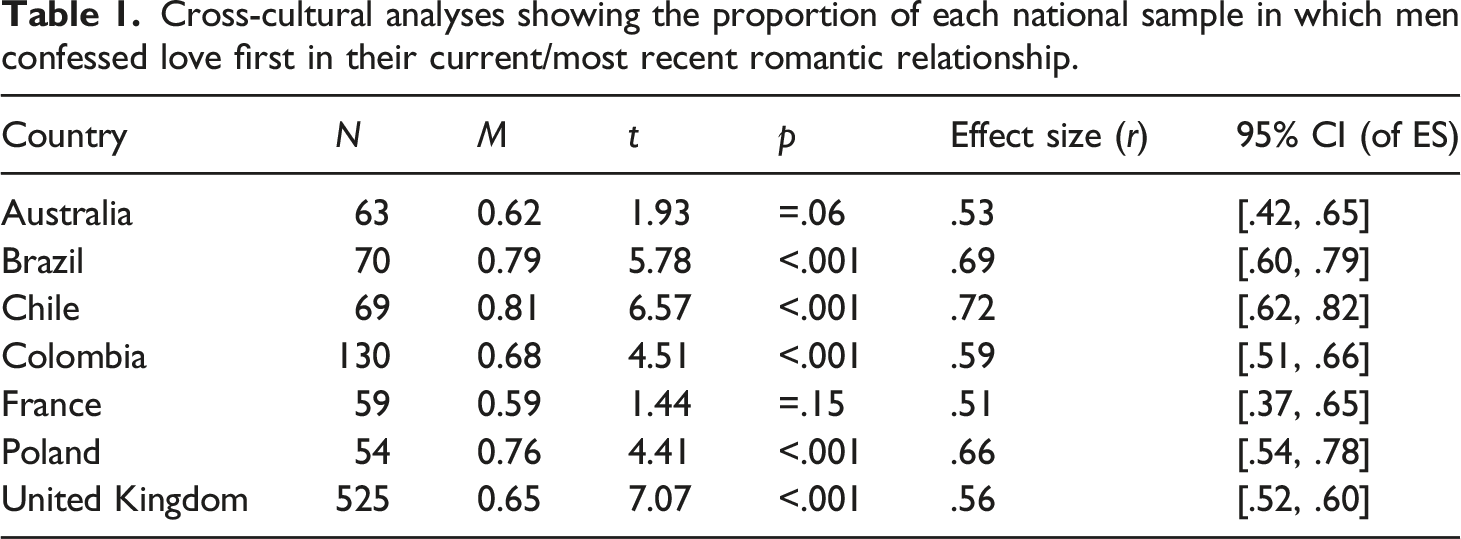
Cross-cultural analyses showing the proportion of each national sample in which men confessed love first in their current/most recent romantic relationship.
Hypothesis # 2: People who live in countries with a more male-biased sex ratio will report that men confess love earlier than women (Hypothesis #2a). People who live in countries with a more female-biased sex ratio will report that men confess love earlier than women (Hypothesis #2b).
Hypothesis # 3: If the respondent in our study has a relatively more insecure attachment style (i.e., anxious or avoidant 2 ), they will be more likely to report that the male in the relationship confessed love earlier than the female did.
We also examined potential effects of self-rated attractiveness in one exploratory analysis, as a proxy for “mate quality.” Attractiveness may partly explain the timing of a love confession, if more attractive individuals can afford to be choosier/selective in light of our positive orientation toward them (see Maestripieri et al., 2017 for general discussion). Thus, such individuals may be more likely to delay a love confession.
Method
Participants
A total of 3109 participants (Mage = 31.90 years, SD = 11.60 years, 71% women, 26% men, 1% non-binary, 3% did not disclose; 85% heterosexual, 6% homosexual, 5% bisexual, 1% other, 3% did not disclose) were recruited to an online study by all authors in their respective countries, via campuses and the wider community, research participant pools, word of mouth, Twitter, academic groups on social media and a press release from the lead author’s communications department. The press-release informed readers that we were conducting a global study into romantic expression but did not mention that we were measuring sex differences or attachment styles. The survey platform did not permit duplicate responses from the same device, and participants were not compensated for their time.
All procedures for testing and recruitment were approved via the lead author’s Ethics Committee, with our introduction and method sections pre-registered via the Open Science Framework after data collection but before data analysis (https://osf.io/hsvx9/). Participants provided informed consent after reading an information sheet describing the contents of the survey. We excluded participants who (i) reported being less than 18 years old, (ii) did not report their sex as male or female or identify as heterosexual, or, for cross-national analyses, and (iii) if their IP address did not match their reported country of residence. After applying exclusion criteria (see Data analysis), we analyzed data from the full eligible sample (N = 1428 participants, 336 men, 1092 women. M age = 32.90 years, SD = 11.59 years), and for analyses comparing nations (seven countries from three continents), included countries with data from at least 50 respondents (N = 970 participants, 251 men, 719 women. M age = 34.16 years, SD = 12.28 years), who reside in the same country as their birth (following Watkins et al., 2019), which exceeds 80% power to detect moderate effects (Lakens & Evers, 2014).
Measures
Demographic information
Participants first provided demographic information and proxies for “mate quality” (sex, age, sexual orientation, country of residence, country of birth, relationship status, relationship length, ethnicity, and self-rated attractiveness) before completing three questionnaires in a randomized order, with other questionnaires unrelated to the current study (see Watkins et al., 2019). Attractiveness of self was measured on a one (much less than average) to seven (much more than average) scale.
Love confession questions
For the current study, participants completed a six-item questionnaire adapted from Ackerman et al. (2011) and the 36 item Experiences in Close Relationships Questionnaire (ECR, Brennan et al., 1998). Participants were asked to complete the love confession questionnaire if they were describing a current relationship where both partners had said “I love you” at least once in the relationship or if they were describing their most recent past relationship where both partners confessed love at least once. Following Ackerman et al. (2011), participants were asked, in the last/current relationship in which someone confessed their love, who admitted love first (Options: Me, My Partner, N/A). The answer to this question was used to create our binary “male confession bias” variable (man confessed first = 1, woman confessed first = 0). Ackerman and colleagues (2011) found converging evidence for a male confession bias when this item was administered in reference to a past relationship, and when it was administered to current couples. They were also asked, separately and in days, how long into the relationship (i) they began thinking about saying they were in love, (ii) they confessed to their partner that they loved them, and (iii) their partner confessed to them that they loved them. As delays in reciprocation are of interest in understanding romantic relationship functioning over time, these two last variables were combined into our continuous “male confession bias” variable representing the difference in days between the woman’s and the man’s confession in the relationship. High scores above zero on this variable indicate that the man in the relationship confessed love earlier than was reciprocated by his partner. Scores below zero indicate that the woman in the relationship confessed love earlier than her partner did. Participants were also asked to record (iv) in general in romantic relationships, how happy they feel when hearing their romantic partner say “I love you” on a 0 (Not at all) to 100 (Extremely happy) scale. Finally, participants were asked, “in general, when does it become acceptable to admit love in a new relationship,” with the options, “First day,” “two to three days,” “One week,” “Two to three weeks,” “One month,” “Two to three months,” “Six months,” “One year,” and “Two or more years.”
Attachment styles
For the ECR (Experiences in Close Relationships) scale, participants were informed that the statements concern how they feel in romantic relationships, and we were interested in how they generally experience relationships, rather than what is happening in a current relationship. Participants were asked to respond to each statement by indicating how much they agree or disagree with it on a one (Disagree strongly) to four (neutral/mixed) to seven (agree strongly) scale. Complete responses to items (N = 1235) were averaged and used to calculate two dimensions with high scores indicating anxious attachment (M = 3.58, SD = 1.13, range = 1.00–6.56) and avoidant attachment (M = 2.44, SD = 0.91, range = 1.00–6.39), respectively. Reliability measures for both subscales were excellent (both Cronbach’s ɑ = 0.90). After completing all questionnaires, participants were debriefed and could exit the survey.
Translations and country-level data
Native speakers based at a university translated foreign language versions of the study (French, Spanish, Brazilian Portuguese, Italian, German, and Polish), with published and translated versions of the ECR consulted where necessary (French and Italian versions of the ECR-R; Busonera et al., 2014; Favez et al., 2016). Statistics for national sex ratio (2017 estimates, adult and operational sex ratios for ages 15–54) were obtained in March 2018 from the CIA world fact book https://www.cia.gov/library/publications/the-world-factbook/fields/print_2018.html. A ratio above one indicates a male-biased sex ratio and a ratio below one indicates a female-biased sex ratio (all eligible countries shown in Table 1, except Australia, had a female-biased sex ratio based on 2017 estimates).
Data analysis
First, chi square tests on the binary male confession bias variable examined whether men were more likely to admit love first than women were, with data analyzed across the sample and for each sampled nation separately. We also tested for sex differences in (i) days into the relationship before thinking and (ii) confessing love, and (iii) happiness at hearing “I love you” using t-tests.
Then, generalized linear mixed effects models (GLMMs) were run to test for relationships between national sex ratio and male confession bias (both binary and continuous variables), nested within the higher-level variable of country (random intercept).
Finally, a linear mixed effects model on the continuous male confession bias variable was run with the between subjects’ factor participant sex, the covariates anxious attachment score and avoidant attachment score and each covariate entered separately as a two-way interaction term with the between subjects’ factor, and with a random intercept for each country. 3 Models were re-run with different outcome variables: First thought about confessing love (days into the relationship); First love confession (days into the relationship, i.e., in absolute terms instead of relative to partner); and Happiness at hearing “I love you.” Two additional non-pre-registered models were run on Partner’s love confession (days into the relationship in which their partner confessed love) and the binary male confession bias variable.
Data on number of days before love confessions were analyzed if the respondent gave a definitive numerical answer (with an average taken if the participant estimated a range within 10 days) that was logical (i.e., thinking about confessing love before saying it; days before confessing love was less than the participant’s age), complete (i.e., provided data on when love was confessed/reciprocated and who confessed first), and consistent with their other responses to these questions (i.e., on who confessed first). Details of further robustness checks are provided in the results. This included repeated tests after the exclusion of outliers, to confirm whether outliers exert any undue influence on the conclusions derived from our models, given that extreme values could still represent genuine responses. Of the total sample recruited, 4% were dropped for not being eligible for broad/initial analyses of the sample as described in the participants section, with a further 12% dropped for not being heterosexual. Forty-nine percent of the recruited sample did not meet the criteria for cross-cultural analyses detailed in the participant’s section. Four percent were dropped for not completing the love confession questions correctly, and six percent were dropped for analyses involving attachment as they did not complete all items on the questionnaire. Four percent were dropped for analyses involving both attachment and cultural differences due to missing data on these items.
Results
The male confession bias across cultures (Hypothesis # 1)
Participants reported that men confessed love first in the relationship at levels greater than chance (χ2(1) = 170.89; p < .001). Interestingly, a greater proportion of women than men reported that men confessed love first in the relationship (χ2(1) = 19.40; p < .001), a reporting or memory bias observed previously (Ackerman et al., 2011). However, the male confession bias effect was still significant when chi square tests were split by respondent sex (both χ2(1) > 7.44, both p < .007). Men confessed love first in six of the seven countries with sufficient data (see Table 1), representing a mean weighted effect size (r) across nations of 0.59 (95% CI [0.55, 0.63], as calculated in Watkins et al. (2019). Of note, while there was no significant sex difference in France, a one-tailed prediction would be valid for Australia given the directional pre-registered hypothesis, and as the confidence intervals for the effect size suggest a moderate effect.
No sex differences were observed in days in which respondents first thought about confessing love (Mmen = 69.87 days, 95% CI [60.04, 79.69], Mwomen = 76.99 days, 95% CI [71.19, 82.79], absolute t(1411) = 1.19; p = .23), days into the relationship in which love was confessed (Mmen = 107.76 days, 95% CI [90.13, 125.39], Mwomen = 122.61 days, 95% CI [104.08, 141.15], absolute t(1426) = 0.84; p = .40), or happiness at hearing “I love you” (Mmen = 87.01, 95% CI [85.29, 88.74], Mwomen = 88.73, 95% CI [87.81, 89.66], absolute t(1421) = 1.76; p = .08).
The male confession bias between cultures (Hypotheses # 2a and #2b)
A GLMM using the logit link function on the binary variable male confession bias (Full model: Male confession bias ∼ National Sex Ratio [nested within country] + Participant Sex + Participant age + Relationship status + Self-rated attractiveness) revealed a negative effect of National Sex Ratio, before and after outliers were excluded and with and without control variables (Participant sex was the only significant control variable in this model, Est(b) = 0.46, SE = 0.15, t = 2.95; p < .01). Men were more likely to confess love first if they lived in a nation with a relatively more female-biased sex ratio (Est(b) = −10.51, SE = 4.85, t = −2.16, p = .04 for the full model). Of note, we chose participants’ sex, age and relationship status as the control variables to include in our models as a robustness check because these variables may have an effect on the outcome variable and their distributions might differ between countries in light of our convenience sampling strategy.
Running this same model (but with the identity link function) on our continuous male confession bias variable revealed effects of Participant sex (Est(b) = 23.17, SE = 5.20, t = 4.46; p < .001) and Relationship status (Est(b) = 13.98, SE = 5.90, t = 2.37; p = .02) only after controlling for outliers (+/− 3SD). No effects of the National Sex Ratio were observed in the simple model (National Sex Ratio only), after controlling for outliers, or when including the above demographic characteristics as a robustness check (all other absolute t < 1.51, all other p > .14). We should note here that the continuous male confession bias variable used in these models is less informative than the binary variable used in the previous set of models. We have more confidence in the results of these first models, as most people responded to a love confession on the same day as their partner (see discussion).
Individual differences in the male confession bias (Hypothesis #3)
To test Hypothesis # 3, which involves combinations of several continuous and categorical variables plus their interactions, separate LMMs were run (Outcome variable ∼ Participant sex + Anxious attachment style + Avoidant attachment style + [Anxious attachment style * Participant sex] + [Avoidant attachment style * Participant sex] + [1 | Country]) on the following outcome variables: continuous male confession bias; First thought about confessing love; First love confession; Happiness at hearing “I love you”; Partner’s love confession; and a GLMM using the logit link function was run on the binary male confession bias variable. These analyses revealed no significant main effects or interactions (all p > .07), except for a negative relationship between avoidant attachment style and Happiness at hearing “I love you” (Est(b) = −5.83, SE = 0.96, t = −6.06; p < .01) and a positive relationship between anxious attachment style and Happiness at hearing “I love you” (Est(b) = 2.13, SE = 0.78, t = 2.72; p < .01), which remained significant after excluding outliers (see supplementary materials and Figure 1 for effect sizes). Excluding outliers resulted in significant interactions between participant sex and both avoidant attachment style and, separately, anxious attachment style for the model on continuous male confession bias (see supplementary materials). These interactions were driven by women’s, but not men’s, attachment style, such that more avoidant and less anxious women took longer to confess love relative to their partner. As this was not observed in the full dataset, we do not interpret these interactions further. Similar non-robust results were observed for an additional model using the binary, instead of the continuous, male confession bias variable (see supplementary materials). Of general note, we observed no sex differences across the sample in avoidant (Mmen= 2.45, Mwomen= 2.44, 95% CI [−0.11, 0.13], absolute t(1233) = 0.17; p = .87) or anxious attachment styles (M men= 3.50, M women= 3.61, 95% CI [−0.26, 0.04], absolute t(1233) = 1.50; p = .13), while anxious and avoidant styles were correlated in both men (r(282) = .17; p = .004) and women (r(949) = .17; p < .001). People with avoidant attachment styles are less happy to hear their partner confess love than less avoidant people (Panel a. Raw correlation r = −0.36, 95% CI [−0.41, −0.31]). People with anxious attachment styles are happier to hear their partner confess love than less anxious people (Panel b. Raw correlation r = 0.05, 95% CI [−0.005, 0.11]). Following Lee and Preacher (2013), these two raw correlations differed significantly from one another (absolute Z value = 11.67; p < .0001).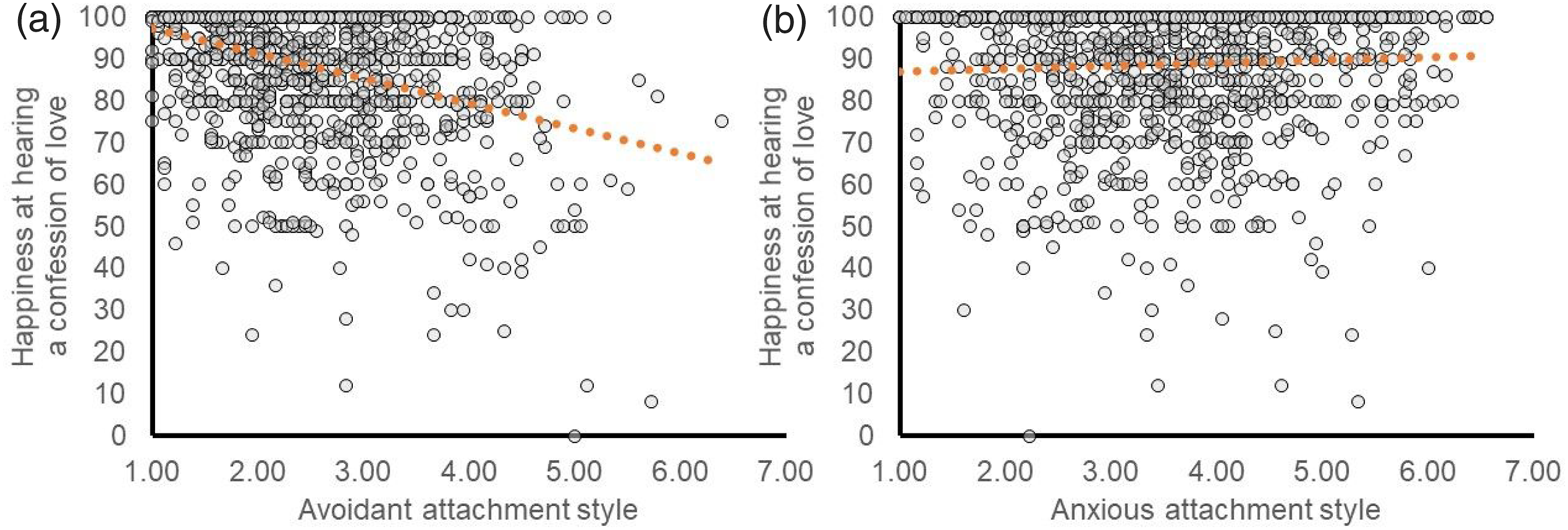
Discussion
As predicted (Hypothesis # 1) and consistent with previous results (Ackerman et al., 2011), men, across different nations, were more likely than women to confess love first in a romantic relationship. When split by countries with sufficient data (seven countries, three continents), this “male confession bias” was large in effect size and observed in six of the seven countries, with non-significant results from France still in the predicted direction. However, no sex differences were observed in the duration before thinking about confessing love or level of happiness at hearing a love confession, revealing a sex difference in speech acts but not the accompanying emotional response to a love confession. In contrast to predictions (Hypothesis # 3), no robust relationships were observed where respondent attachment style predicted the difference between partners in their timing of a love confession. Our data instead suggest that insecure attachment styles predict emotional responses to a love confession across men and women. Here, avoidant people were less happy to hear a love confession than less avoidant people (Figure 1(a)) while anxiously attached people were happier to hear a love confession than less anxious people, with this latter effect very small (Figure 1(b)). We also observed preliminary evidence that confessing love first was related to the national sex ratio, such that men were more likely to confess love first when they lived in countries where they had more choice (i.e., more women than men in the population, Hypothesis #2b). In summary, we found that the male confession bias is observed in a cross-national sample and environmental factors (sex ratio) may moderate the likelihood that men confess love first, while attachment styles moderate emotional responses to love confessions.
Our findings support theory and corroborate evidence on sex differences in mating-related cognition and behaviors (e.g., Haselton & Buss, 2000; Janicke et al., 2016; Johnson et al., 2013; Todd et al., 2007; see also Walter et al., 2020) within a relatively diverse sample, replicating some patterns observed in campus and online research of American couples and individuals retrospectively recalling a past relationship (Ackerman et al., 2011). Our findings develop the literature on attachment styles and romantic relationships by suggesting that they moderate emotional responses to speech acts (hearing someone tell them they love them), which may be important for the feeling of love and relationship outcomes, particularly if it is the case that individuals with insecure attachment styles seek complimentary insecure partners (i.e., avoidant individuals couple with anxious individuals and vice versa; Holmes & Johnson, 2009). Of note, our dataset did not observe sex differences in attachment styles, possibly because these sex differences are smaller in online studies (reviewed in Del Giudice, 2011). Our work also supports sex ratio theory (e.g., Del Giudice, 2012) by providing preliminary evidence that national sex ratios predict the likelihood of men confessing love first in a romantic relationship. If this is replicated in independent samples, it may suggest that the escalation of sexual intimacy (via love confession) is more likely in environments where men have greater mating opportunities and female promiscuity is relatively more common (see Del Giudice, 2011 for discussion). Of course, it may also suggest “honest signaling” of male commitment in an environment where potential mates are relatively abundant and they have more “bargaining power” in mate choice, all else equal (see, e.g., Del Giudice, 2012). Further research should examine the different contexts that motivate our use of romantic speech acts and our responses to them, both experimentally and using diary-based methods, to establish when these behaviors are honest or manipulative.
Consistent with Ackerman et al. (2011), we observed a reporting bias, where a greater proportion of women than men reported that men confessed love first in a relationship. This may suggest that social stereotypes associating women with romantic intimacy, or motivated reasoning on these issues to maintain a particular self-image, might shape people’s memory of this episode. For example, if folk beliefs tend to associate women with romantic love, romantic behavior that counters these intuitions may be better retained in women’s memories (as the recipient of a love confession) than men’s memories. However, our models take this bias into account by controlling for the sex of the respondent, and these findings converge with prior evidence from an ethnically homogenous sample of both current couples and individuals providing retrospective accounts, who report that men confess love before women (Ackerman et al., 2011), which also suggest that our pattern of results are unlikely to be artifacts of a recency bias in responses.
Contrary to predictions, we observed no robust relationships where respondent attachment style predicted the difference between partners in their timing of a love confession. This may be because there were no sex differences observed in attachment style within our sample, which would have underpinned our proposed interaction between attachment style and the male confession bias, for example, by moderating the time perceived as necessary to judge a relationship as close (Hudson & Fraley, 2017) and their subsequent confession and/or reciprocation. Alternately, because any effects we did observe involving attachment style and biological sex were not robust (i.e., were not observed pre- and post-outlier exclusion), traits or motives other than attachment style may be important in relationships where the timing and reciprocation of a love confession is atypical, or the relationship is maintained based on certain types of love only (Sternberg, 1986). It is also possible, however, that some of our null findings on this issue were false negatives, given that a power analysis requested by reviewers suggested that we had sufficient power to detect interactions of moderate, but not small, effect size, due to the skew of females to males in our final sample. We suggest some caution in interpreting the data on the relative difference in days between both partners’ confessions (the continuous male confession bias variable), given that many of our participants reported that both dyad members confessed on the same day, and because participants may have a fallible recollection of the exact timing of their own and their partner’s love confessions. This is why we also used a binary variable (who confessed love first in the relationship) in our models, as a more reliable measure of the relative timing of a love confession. Further longitudinal work in representative samples of couples could help address these issues, for example, by incorporating diary-based methods or examining the frequency of love confessions and other forms of intimacy over time. This would also enable researchers to directly examine the interaction between different attachment styles in relationships and its possible effects on love confessions, as a limitation of our dataset is that we only have information about the respondent’s attachment style (and not their partner).
In light of our convenience recruitment and sampling strategy, some continents were not captured in the current project (Africa and Asia), and some countries within our sample were not independent, such as Australia, which is culturally and historically connected to the United Kingdom. Thus, before claiming that the male confession bias is universal, further research conducted in additional countries (ideally including remote societies) would also be important to examine the extent to which the male confession bias generalizes to these countries as well. A valuable follow-up study would include regions with a wider range of sex ratios (6 of the 7 countries in our dataset had a female-biased sex-ratio), to investigate if the cross-cultural variation observed here is robust. These findings may also motivate further work on the hormonal mechanisms involved in emotions and affection within close relationships, if attachment styles shape oxytocin responses to behaviors that are important for successful pair bonds (reviewed in Bartz et al., 2011; see also Schneiderman et al., 2014 for relationships between oxytocin and couple communication). Finally, due to local data protection legislation and some ethical considerations, we did not collect data on participant location (beyond confirming that their IP address matched their self-reported country), ethnicity, nor status (socioeconomic, disability, and student status). Although we would not anticipate our a priori hypotheses to be necessarily refuted within sufficiently powered samples of different demographic groups, except perhaps confession timing in groups of people attracted to the same or both sexes, it would of course be interesting to examine the same phenomena in these contexts.
That biological sex motivates speech acts that are important in the progression of a romantic relationship, while both men and women emotionally respond similarly to a love confession in light of their attachment styles, highlights the importance of examining both cognition and affect when studying how people navigate relationships over time. Pending further research into this area, these findings may, for example, have utility for relationship counseling, if alignment between what people say and how they feel is important for relationship outcomes (e.g., a “Rogerian” view on the conditions required for personal growth; Rogers, 1961). Although further work on the motives for confessing love is necessary, our findings demonstrate a theory-driven sex difference in speech acts that will influence the recipient’s emotional response and accompanying behaviors (e.g., to reciprocate, lie, delay, etc.) within relationships, regardless of the explicit motive for the underlying love confession.
To conclude, we replicate the “male confession bias” in a large cross-national sample. Our findings provide the first cross-national comparison of romantic speech acts and our verbal and/or emotional responses to them, while considering the factors that do and do not moderate these behaviors (biological sex, attachment style, and social environment). This simple three-word phrase can inspire much more effort within relationship science.
Footnotes
Acknowledgments
In alphabetical order, we are grateful to the following for support of the work: Carlota Batres, Graeme Bletcher, Samuela Bolgan, Martha Lucia Borras Guevara, Clare Cunningham, Jitka Fialova, Amanda Hahn, Corinne Jola, Max Korbmacher, Colin McLean, Tomaso Querci, Gislene Rocha, Elena Rusconi, Alexandre Schwob, and Zuzana Sterbova.
Funding
The author(s) received no financial support for the research, authorship, and/or publication of this article.
Open research statement
As part of IARR’s encouragement of open research practices, the author(s) have provided the following information: This research was pre-registered. The aspects of the research that were pre-registered were the introduction and method sections. The registration was submitted to: Open Science Framework ( ). The data used in the research are available. The data can be obtained at https://osf.io/hsvx9/. The materials used in the research are available. The materials can be obtained by emailing: