




Abstract
Friendships fulfill needs for intimacy, belonging, and support and yet have rarely been the focus of forgiveness research. In this study, we explored forgiveness, unforgiveness, and young adults’ experiences of transgressions in same-sex friendships (N = 407). Our results suggest that, although forgiveness and unforgiveness share important antecedents (e.g., apology status, perceived remorse, and barriers to forgiveness), they are nevertheless empirically distinct constructs, both worthy of further investigation in friendships. For example, unforgiveness predicted unique variance in current friendship status controlling for forgiveness. We discuss several lessons learned from our study about the nature of responses to wrongdoing among same-sex friends (e.g., even when forgiven, offenses may cause longstanding changes in people’s views of their offending friends).
Friends figure prominently among our most valued relational partners and those to whom we turn most often to fulfill needs for belonging, intimacy, and support (Fehr, 2004; Oswald, 2017). For these and other reasons, friendships are also characterized by the kind of interdependence that maximizes both the benefits and potential costs associated with forgiving. We know comparatively little about forgiveness as it unfolds between friends, however; few studies of friendship have investigated forgiveness and few studies of forgiveness have examined friends’ experiences (Hojjat et al., 2017). In this study, we sought to fill this gap by exploring forgiveness between same-sex friends. Additionally, we aimed to extend the forgiveness literature by broadening our focus beyond forgiveness to examine the related but distinct construct of unforgiveness. Our results provide a descriptive base that serves as a point of departure for future investigations aimed at understanding how people respond to wrongdoing between friends.
Friendships and forgiveness
Friendships are an apt context in which to study forgiveness because transgressions and related aversive experiences occur frequently between friends (Leary et al., 1998; McCullough et al., 2001; Rapske et al., 2010). They are also unique, however, in ways that raise concerns about drawing conclusions about forgiveness in friendships from research on forgiveness in other relationships (Hojjat et al., 2017).
Research comparing friendships with romantic relationships, for example, suggests that people generally expect less emotional closeness, companionship, and positivity in their friendships than in their romantic relationships (Fuhrman et al., 2009). Furthermore, compared to romantic couples, friends tend to experience less conflict and prefer avoidant approaches to its resolution (Fehr, 1996).
Friendships are also relatively free from the obligatory constraints, duties, and additional social ties which, in families and marriages, promote their continuance and maintenance across time and changing circumstances (Oswald & Clark, 2006). Consequently, friendships are more vulnerable to disruption and dissolution than other close relationships (Oswald, 2017).
Finally, because friendships are typically relationships between equals, they are comparatively unaffected by inequalities in power and status inherent to relationships such as those between parents and children, heterosexual romantic partners, and employers and employees (Helgeson, 2009). Research suggests that power influences forgiveness (e.g., Karremans & Smith, 2010) and that forgiveness may be empowering (Strelan et al., 2019). The fact that friendships differ from other relationships in their power dynamics highlights the need for research targeted directly at understanding forgiveness between friends. In this paper, we explore forgiveness in the important but as yet understudied context of same-sex friendships. 1
Forgiveness and unforgiveness
As defined by Stackhouse and colleagues (2018), unforgiveness refers to “people’s experiences when they do not forgive” (p. 130). This conceptualization of unforgiveness builds on and extends Worthington’s (2001) original notion of unforgiveness as a cold emotional complex that can result when people ruminate about experiences in which they have been wronged.
Beyond the lingering negative affect and continued preoccupation with the offense that Worthington discussed (which Stackhouse et al. call emotional-ruminative unforgiveness), Stackhouse et al. postulate that experiences of unforgiveness also reflect victims’ efforts to understand and give meaning to the offense and its outcomes. Their model articulates two additional dimensions along which experiences of unforgiveness may vary. Cognitive-evaluative unforgiveness encapsulates beliefs, reasoning, and intentions related to not forgiving and may include an unwillingness to forgive, beliefs that the offense or offender is unforgivable, and rejection of the possibility that forgiving has value in the particular situation. Offender reconstrual reflects the extent to which individuals reconstruct their view of the offender in a negative fashion in their efforts to reconcile the offender’s actions with their image of the offender’s character. At its core, offender reconstrual reflects variability in the extent to which victims experience difficulty disentangling offender from offense and thus come to view the offender as (for example) cruel, malicious, or morally bankrupt.
Critically, like Worthington (2001; Worthington & Wade, 1999), Stackhouse and colleagues view unforgiveness not as the polar opposite of forgiveness but as a distinct—though overlapping—construct (Jones Ross et al., 2018; Stackhouse et al., 2016, 2018). In part, this view rests on the assumption that unforgiveness can be reduced through means other than forgiving (e.g., cognitive reframing, exacting revenge; Worthington, 2001). If unforgiveness were simply a lack of forgiveness, the argument goes, only forgiveness should reduce unforgiveness.
Research supports the hypothesized disjuncture between forgiveness and unforgiveness. In a study of individuals in a forgiveness intervention (Wade & Worthington, 2003), both trait forgiveness and the degree to which participants had attempted to forgive their offender predicted forgiveness, whereas neither variable predicted unforgiveness. 2 Moreover, despite the presence of a substantial negative correlation between forgiveness and unforgiveness, unforgiveness scores varied even at the highest levels of forgiveness (i.e., among participants who had completely forgiven their offenders). Additionally, and consistent with the proposition that unforgiveness can be reduced through multifarious means, some participants reported very low unforgiveness despite reporting that they had not forgiven at all.
Why might people continue to experience unforgiveness after having forgiven their offenders? There are at least two possible answers to this question. First, situations may sometimes reopen old wounds after forgiveness has been granted, rekindling unforgiving thoughts, feelings, and orientations toward the offender. Second, people may experience residual unforgiveness despite having forgiven when they find complete forgiveness difficult to achieve or to sustain because they experience ambivalence in their attitudes and feelings toward forgiveness (Boon et al., in press) and/or fluctuations in their motivations to forgive (McCullough et al., 2003).
Researchers (e.g., Witvliet et al., 2020) frequently operationalize unforgiveness using scores on the revenge and avoidance subscales of the Transgression-Related Interpersonal Motivations scale (TRIM; McCullough et al. 1998). Considering the TRIM was designed to measure forgiveness, we believe this move conflates low forgiveness with unforgiveness. Here, we used the Unforgiveness Measure (UM; Stackhouse et al., 2018), which measures emotional-ruminative unforgiveness, cognitive-evaluative unforgiveness, and offender reconstrual, to assess people’s experiences of unforgiveness. This permitted measurement of the three dimensions of unforgiveness posited by Stackhouse et al. and avoided the conceptual pitfalls associated with using a forgiveness inventory to measure a construct postulated to be both conceptually and empirically distinct from forgiveness.
The current study
We explored four research questions in this study. The first addressed whether our data support the claim that forgiveness and unforgiveness are distinct constructs. Wade and Worthington’s (2003) findings suggest so, but their participants were from a forgiveness intervention and thus both struggling to and motivated to forgive. We placed no restrictions on participants’ orientations toward their offending friends, permitting an examination of the overlap between forgiveness and unforgiveness in the broader, more ecologically valid context where individuals could recall forgiven or unforgiven offenses. It was also important to examine whether cognitive-evaluative unforgiveness and offender reconstrual demonstrate the same empirical independence from forgiveness Wade and Worthington found for emotional-ruminative unforgiveness.
RQ1: Are forgiveness and unforgiveness empirically distinct constructs in same-sex friendships? We also sought to extend our understanding of the factors that shape people’s experiences of unforgiveness in friendships. Previous research suggests that an individual’s willingness/ability to forgive often hinges on their offender’s behavior post-transgression. Offenders who apologize, take responsibility for the harm they caused, express remorse, and engage in amends-making are more likely to be forgiven than those who do not (Fehr et al., 2010; Merolla & Zhang, 2011). To our knowledge, however, researchers have not explored these (or other) variables as antecedents of unforgiveness as a construct distinct from forgiveness. We thus asked:
RQ2a: To what extent is lack of an apology associated with individuals’ positions along the three unforgiveness dimensions?
RQ2b: To what extent does the failure to express remorse predict an individual’s positions along the three unforgiveness dimensions? RQ3 expanded on RQ2 by examining obstacles that might inhibit forgiving and perhaps explain both forgiveness and unforgiveness. A small literature has explored people’s understandings of the impediments that diminish their ability or willingness to forgive (e.g., Rapske et al., 2010; Younger et al., 2004). Here we investigated associations between forgiveness, unforgiveness, and several barriers to forgiveness identified by Pearce (Pearce, 2014; Pearce et al., 2018), including loss of trust in the offender; the offender’s failure to respond appropriately post-transgression; concerns that forgiving might fail to prevent further wrongdoing; moral outrage; the offenses’ enduring negative effects on the victim’s life; desires for vengeance; and concerns around preserving a positive public self-image.
RQ3: Which barriers to forgiveness are most closely associated with both the degree to which participants forgave their offending friends and their experiences of unforgiveness? Finally, we investigated whether unforgiveness predicts the current status of participants’ relationships with their offending friends. We thus examined the extent to which the experience of unforgiveness predicts an important outcome—specifically, whether participants’ friendships remained intact at the time of our study.
RQ4: Does unforgiveness predict current friendship status? If so, how does unforgiveness perform as a predictor in comparison with forgiveness and does unforgiveness still predict friendship status controlling for forgiveness? In conclusion, this study contributes to the literatures on both friendship and forgiveness in important ways. First, it extends research on forgiveness by investigating forgiveness in an important but understudied context. Second, it seeks to corroborate the claim that forgiveness and unforgiveness are related but distinct constructs. To the extent that they are distinct, a complete understanding of friends’ experiences after wrongdoings will require that researchers broaden their research focus. Third, it explores possible antecedents of both forgiveness and unforgiveness, thus permitting a more fully developed understanding of when/why people experience unforgiveness and providing further data concerning overlap between forgiveness and unforgiveness (i.e., do they share antecedents?). Finally, it examines the extent to which experiences of unforgiveness toward an offending friend have implications for whether people’s friendships with their offenders continue and tests whether unforgiveness accounts for variation in friendship status when controlling for forgiveness. Given the important role friendships play in people’s lives, there is considerable value in extending our understanding of those factors—such as forgiveness and unforgiveness—that may potentially undermine them and perhaps contribute to their dissolution.
Method
Participants and procedure
-Undergraduate psychology students from two universities (the University of Calgary in Calgary, Alberta, Canada, and the University of MassachusettsDartmouth in Dartmouth, Massachusetts, in the United States) received partial course credit for completing two online surveys approximately one week apart. The first survey included demographic items and personality measures. In the second survey, participants recalled an offense committed by a same-sex friend and completed measures of (a) their evaluations of/responses to the transgression and (b) predictors of those evaluations/responses. The Canadian sample completed the surveys in a supervised laboratory, the American sample at a location of their choice.
A total of 842 participants completed the first and 568 participants completed the second survey (33% attrition). We removed 24 duplicate submissions 3 and 63 participants whose surveys could not be merged because they failed to follow instructions for providing a merging code (N = 755). We then dropped the data for an additional 284 participants because they responded “no” to one or both of two self-report data integrity items that asked whether we should use their data. Additionally, we dropped the data for one participant who did not follow instructions and reported on an offense that happened 10 years before the study and for 37 participants who reported on opposite-sex friends or provided discrepant responses to two items that asked whether they were still friends with their offender. Of the 433 remaining participants, 296 passed instructional manipulation checks in both surveys and 407 passed one of two such checks. To ensure an adequate level of data quality but avoid being overly restrictive (Curran & Hauser, 2019), we ran our analyses on the data for participants who passed at least one attention check. 4
Our final sample (N = 407) comprised 217 men (53%) and 190 women (47%) with a mean age of 20.5 (Mdn = 19, SD = 3.6, range 17 to 45; 55 participants did not report their age). Two hundred and fifty-four were Canadian; 153 were American. Participants self-identified as White (50.1%), Asian (24.6%), multiple ethnicity (8.8%), Latinx (5.2%), Black (4.9%), and American Indian/Indigenous (.5%). The remainder identified as “other” or did not report their ethnicity.
Materials
The data were collected as part of a larger study; here, we discuss only those measures utilized in the present analyses. Unless otherwise specified, participants used 7-point scales (1 = strongly disagree to 7 = strongly agree) to respond to all items. Both surveys are available at https://osf.io/rypc5/?view_only=3167b2991bb24f5a9ad8a743ba0d4e1b
Participants reported their age, sex, ethnicity, and which university they attended 5 in the Part One survey. All other measures used in this paper appeared in the Part Two survey.
Transgression recall task
The Part Two survey began with instructions to: Please recall a serious transgression that occurred between you and a close, same-sex friend (non-romantic) in which the friend wronged you in some way and you felt very hurt or offended. Please think about a transgression that occurred within the last three years.
Participants indicated the nature of the transgression by selecting the appropriate option(s) from a 12-item checklist (e.g., “revealed secrets of mine”). They then reported how long ago the transgression had occurred, the sex of the offending friend, whether they were still in contact with their offender, whether they and their offender remained friends, and the length of their friendship at the time of the offense. Finally, they completed five items assessing the severity of the transgression (e.g., “The offense caused me a lot of pain.” α = .84).
Forgiveness 6
Participants rated the extent to which they had forgiven their offending friend (“Using your own definition of forgiveness, would you say you have forgiven this friend?”). Higher scores reflect greater forgiveness.
Apology
Participants selected one of eight options to indicate whether their friend had apologized (e.g., “my offender has not apologized”).
Remorse
Participants rated their agreement with five items assessing the extent to which they believed their offending friend had expressed remorse for their actions and made efforts to repair the friendship (e.g., “my offender has demonstrated remorse for having hurt me”). Higher scores reflect greater perceived remorse (α = .90).
Barriers to Forgiveness Scale (BTF)
This 49-item scale (Pearce, 2014) assesses seven different concerns that may impede individuals’ willingness or ability to forgive a transgression. Each barrier is measured with seven items. Participants used a 1 = strongly disagree to 5 = strongly agree scale to indicate their agreement with items that attributed difficulties forgiving to (a) offender responses (α = .94; “they haven’t apologized for what they did”), (b) trust dissolution (α = .94; “what they did permanently severed all trust between us”), (c) recidivism prevention (α = .81; “I don’t want them to think it’s ok to do again”), (d) enduring effects (α = .90; “I haven’t been able to put what happened behind me”), (e) morality judgments (α = .90; “what they did was too wrong or reprehensible to forgive”), (f) vengeful desires (α = .87; “I want to get back at them for what they did”), and (g) impression management (α = .85; “it might make others perceive me as weak or foolish”). The trust, enduring effects, and morality subscales form a higher-order reactive barriers index (α = .86); the vengeful desires, impression management, and recidivism prevention subscales form a higher-order active barriers index (α = .83). Higher scores reflect higher levels of perceived barriers to forgiveness.
Unforgiveness measure (UM)
This 13-item scale (Stackhouse et al., 2018) gauges the extent to which individuals experience lingering negative emotions and intrusive thoughts about the transgression (emotional-ruminative unforgiveness; 6 items e.g., “It is hard for me to let go of this event.” α = .83), beliefs that forgiving the offender is inappropriate, impossible, and/or unhelpful (cognitive-evaluative unforgiveness; 4 items e.g., “I have no desire to forgive my friend.” α = .95), and negative changes in perceptions of the offender (offender reconstrual; 3 items e.g., “This event has forever altered my perception of my friend.” α = .92). Participants rated their agreement with each item (items were adapted to refer to friends). Higher scores reflect greater unforgiveness.
Results
On average, participants recalled transgressions occurring approximately 1 year prior to the study
Are forgiveness and unforgiveness distinct constructs in same-sex friendships?
Wade and Worthington (2003) presented evidence suggesting that forgiveness and unforgiveness are related though distinct constructs. With RQ1, we tested the generalizability of this finding for transgressions in same-sex friendships and among individuals who varied in the degree to which they had forgiven their offender, examining whether it holds for all three unforgiveness dimensions. 8
To answer RQ1, we followed the procedures employed by Wade and Worthington. First, we examined correlations between the single-item forgiveness measure and the unforgiveness dimensions, controlling for observed variation in sex, university, and offense severity. All three partial correlations were significant at p < .001, but they varied considerably in magnitude. Emotional-ruminative unforgiveness showed the lowest partial correlation, r(401) = −.25. The two more cognitive dimensions were more strongly correlated with self-reported forgiveness: offender reconstrual r(401) = −.64 and cognitive-evaluative unforgiveness r(401) = −.79. The partial correlation for cognitive-evaluative unforgiveness is large enough to raise questions about whether cognitive-evaluative unforgiveness is distinct from forgiveness.
Next, we plotted scores for each unforgiveness dimension for participants at each level of forgiveness. Wade and Worthington found variation in unforgiveness scores at all levels of forgiveness, with the variability greatest among those reporting the least forgiveness. They interpreted their finding that some individuals scored low on both forgiveness and unforgiveness as evidence that the two constructs are distinct because it suggests that people can reduce unforgiveness by means other than forgiving.
The boxplots in Figures 1–3 reveal considerable variation in emotional-ruminative unforgiveness at all levels of forgiveness, though no apparent pattern in the magnitude of variability at different levels. The results for both cognitive-evaluative unforgiveness and offender reconstrual reveal variability in unforgiveness across levels of forgiveness as well but, especially for cognitive-evaluative unforgiveness (which showed the largest partial correlation with forgiveness), less variability at the very high end than at other values. Interestingly, the distribution of scores for cognitive-evaluative unforgiveness is also rather tighter at the very lowest level of forgiveness than toward the middle. Variation in emotional-ruminative unforgiveness at each level of self-reported forgiveness. Note. Ns at each level of forgiveness: Not at all (1) = 34, 2 = 31, 3 = 26, 4 = 57, 5 = 71, 6 = 89, Completely (7) = 98. Variation in cognitive-evaluative unforgiveness at each level of self-reported forgiveness. Note. Ns at each level of forgiveness: Not at all (1) = 34, 2 = 31, 3 = 26, 4 = 57, 5 = 71, 6 = 89, Completely (7) = 98. Variation in offender reconstrual at each level of self-reported forgiveness. Note. Ns at each level of forgiveness: Not at all (1) = 34, 2 = 31, 3 = 26, 4 = 57, 5 = 71, 6 = 89, Completely (7) = 98.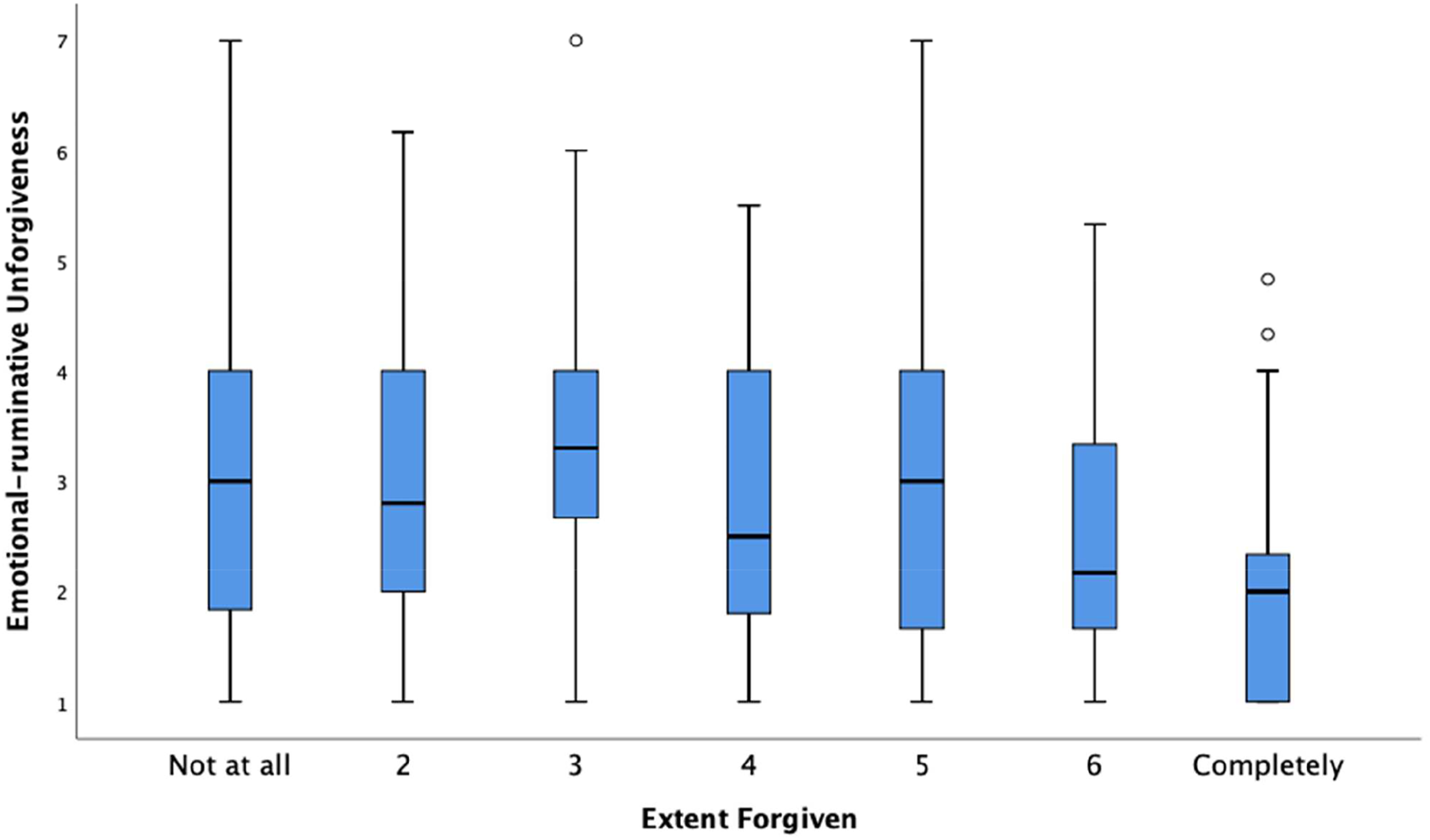
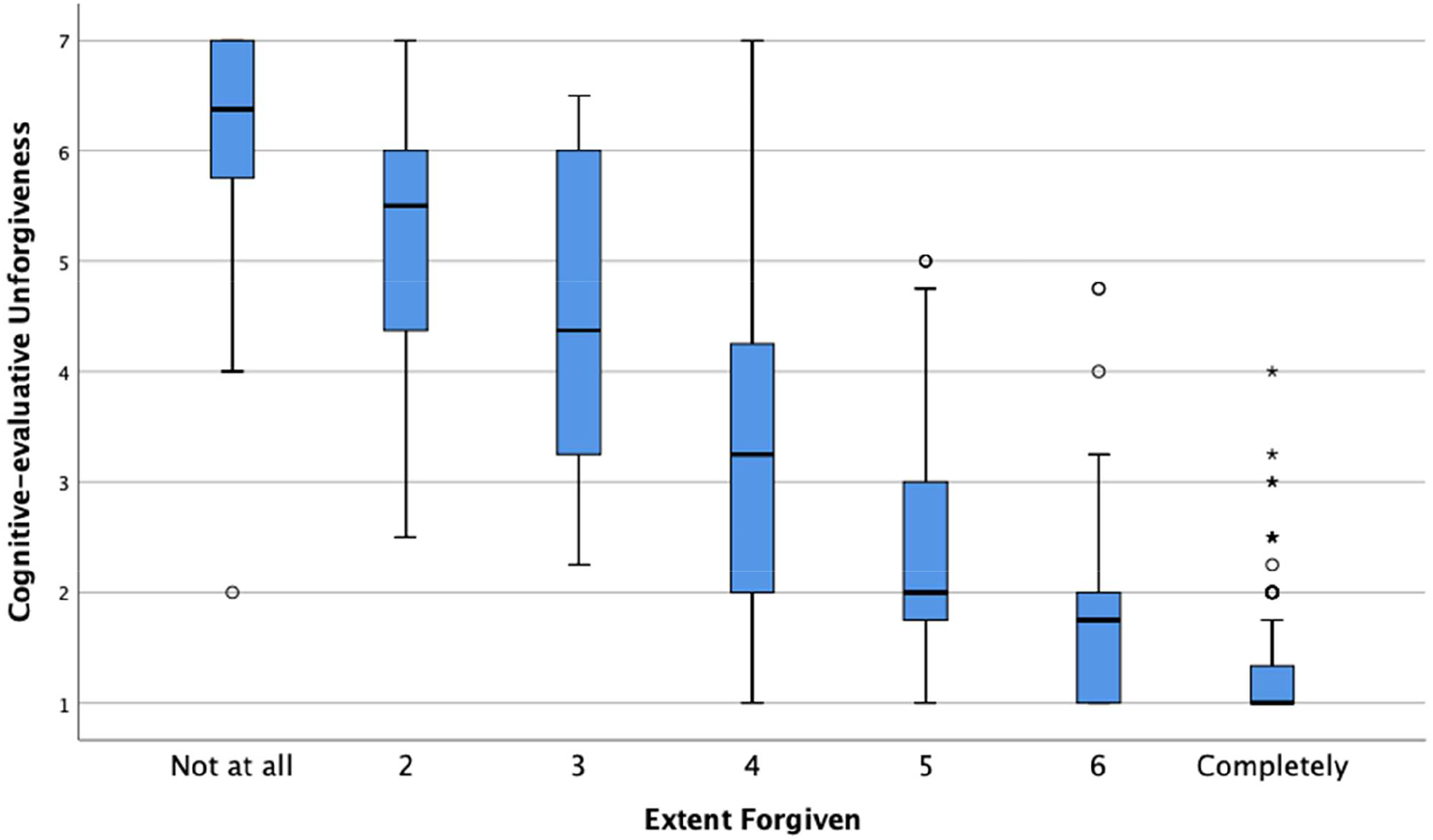
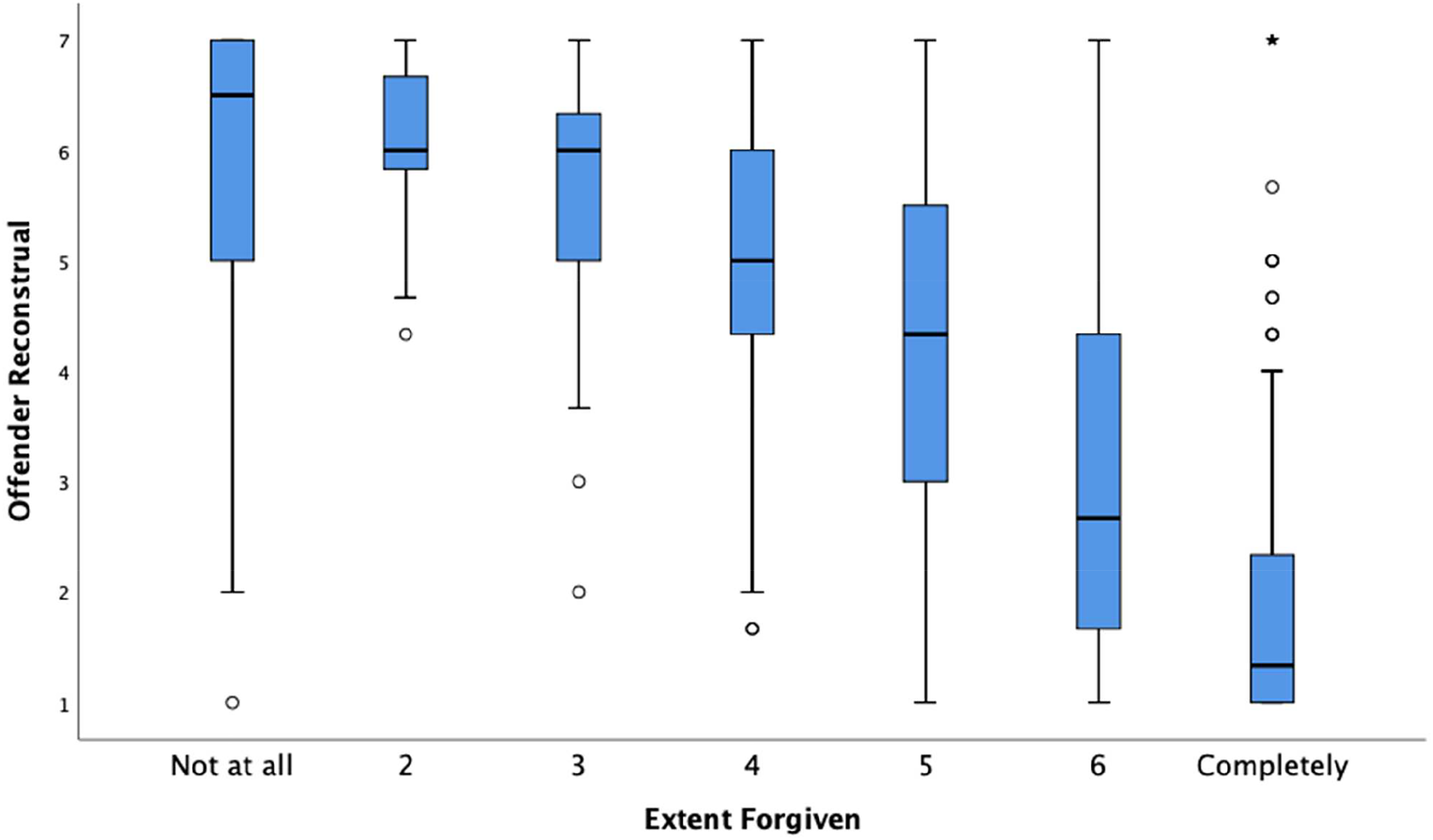
Overall, we are inclined to conclude that our results support the proposition that forgiveness and unforgiveness are distinct constructs. However, we base that conclusion primarily on the broad evidence of variation in unforgiveness scores across nearly all levels of forgiveness, which suggests that some people experienced lingering unforgiveness even when they had mostly or completely forgiven their friend. We also note that the evidence that the two constructs are distinct is less compelling for cognitive-evaluative unforgiveness than for the other unforgiveness dimensions.
Antecedents of unforgiveness
Percentage endorsing each apology status.
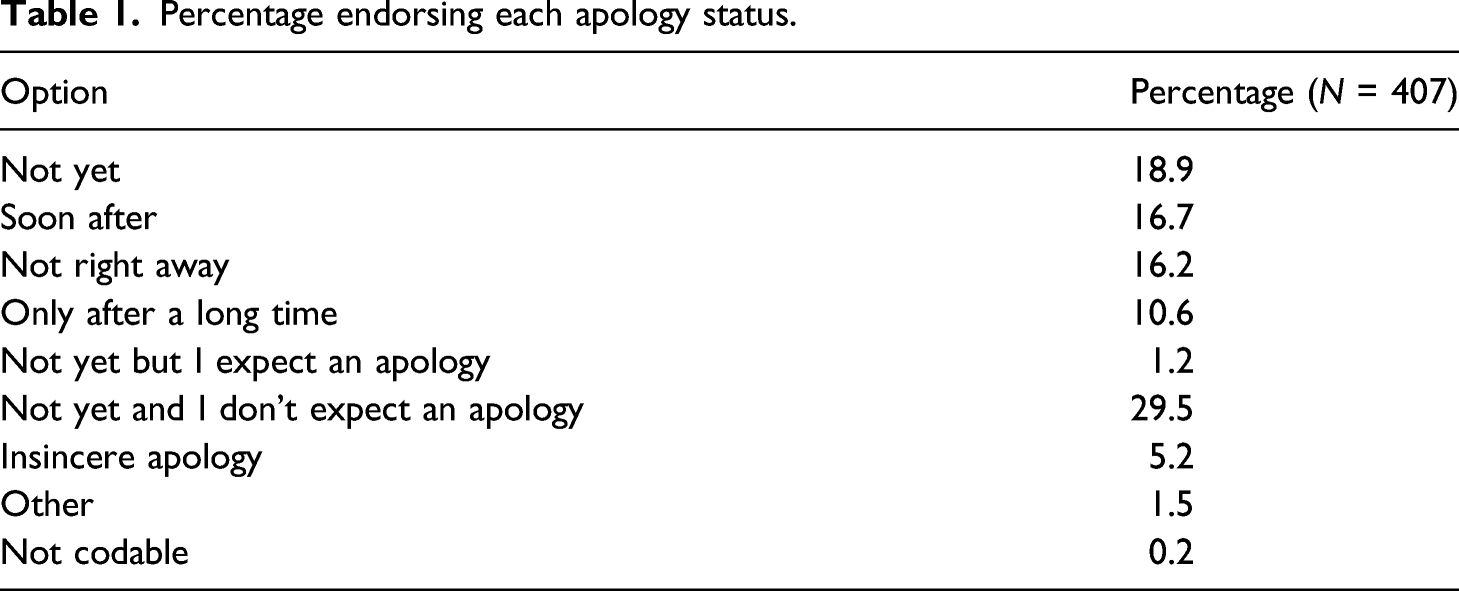
Compared to those who had not received an apology, those who had received an apology reported a more positive evaluative stance toward their friend (partial r pb (389) = −.38, p < .001), less difficulty reconciling their current view of their friend with their pre-offense view (partial r pb (389) = −.45, p < .001), and less lingering bitterness and rumination (partial r pb (389) = −.17, p = .001). These results suggest that (sincere) apologies may help reduce the odds that individuals experience unforgiveness, though the much smaller association between emotional-ruminative unforgiveness and apology status raises the possibility that apologies may prove less effective in reducing lingering bitterness and resentment than in either enabling victims to maintain a consistent view of the friend unvarnished by the harm the friend caused or view the offender as worthy of forgiveness. Consistent with previous research, the partial correlation between forgiveness and apology was significant and positive (partial r pb (389) = .47, p < .001). It was also comparable in magnitude to the partial correlations for cognitive-evaluative unforgiveness and offender reconstrual.
Regression predicting unforgiveness dimensions using perceived remorse (N = 405).
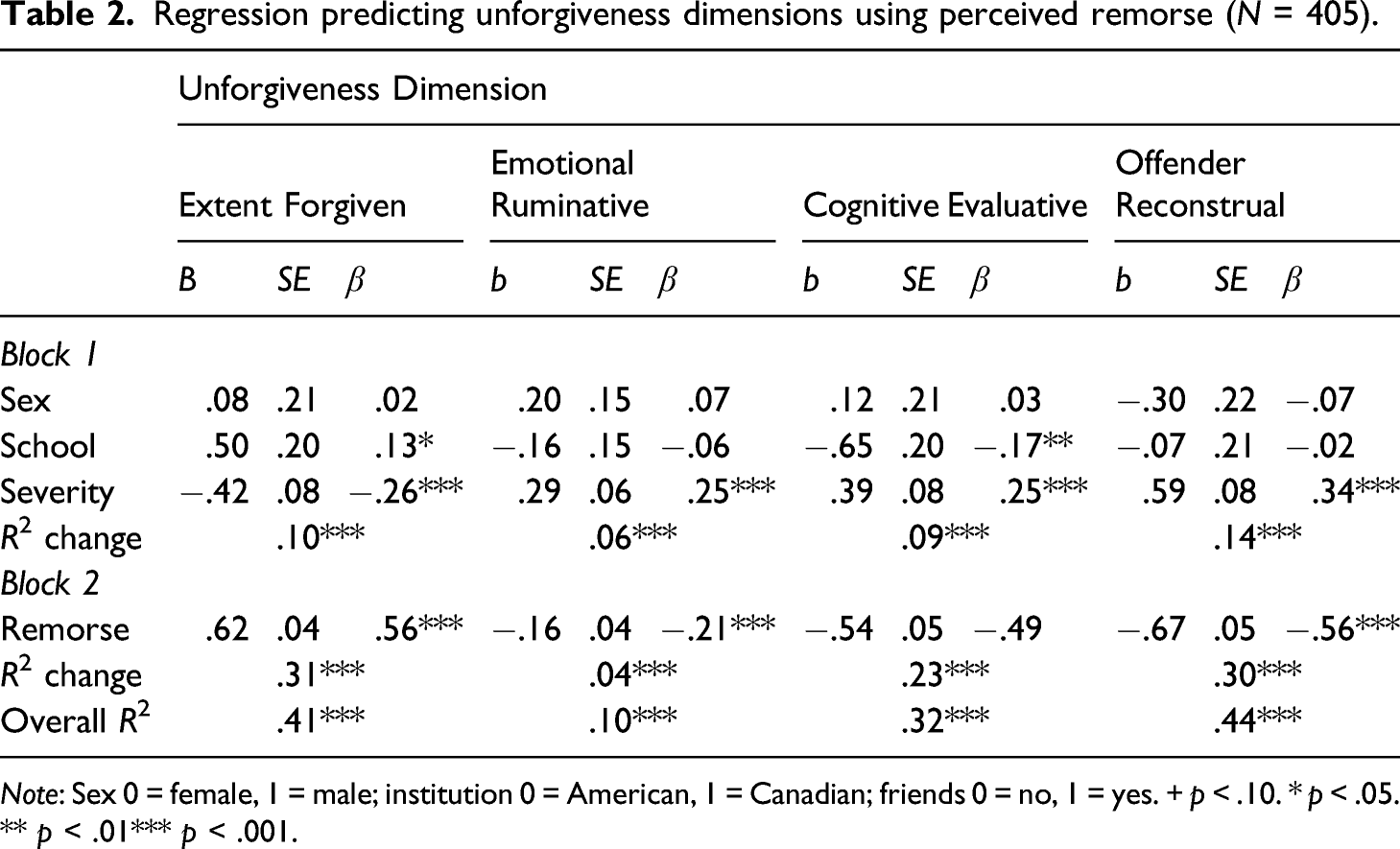
Note: Sex 0 = female, 1 = male; institution 0 = American, 1 = Canadian; friends 0 = no, 1 = yes. + p < .10. * p < .05. ** p < .01*** p < .001.
Which barriers to forgiveness are most closely associated with forgiveness and unforgiveness?
Descriptive statistics and partial correlations between barriers to forgiveness and extent forgiven and unforgiveness dimensions controlling for sex, university, and severity.
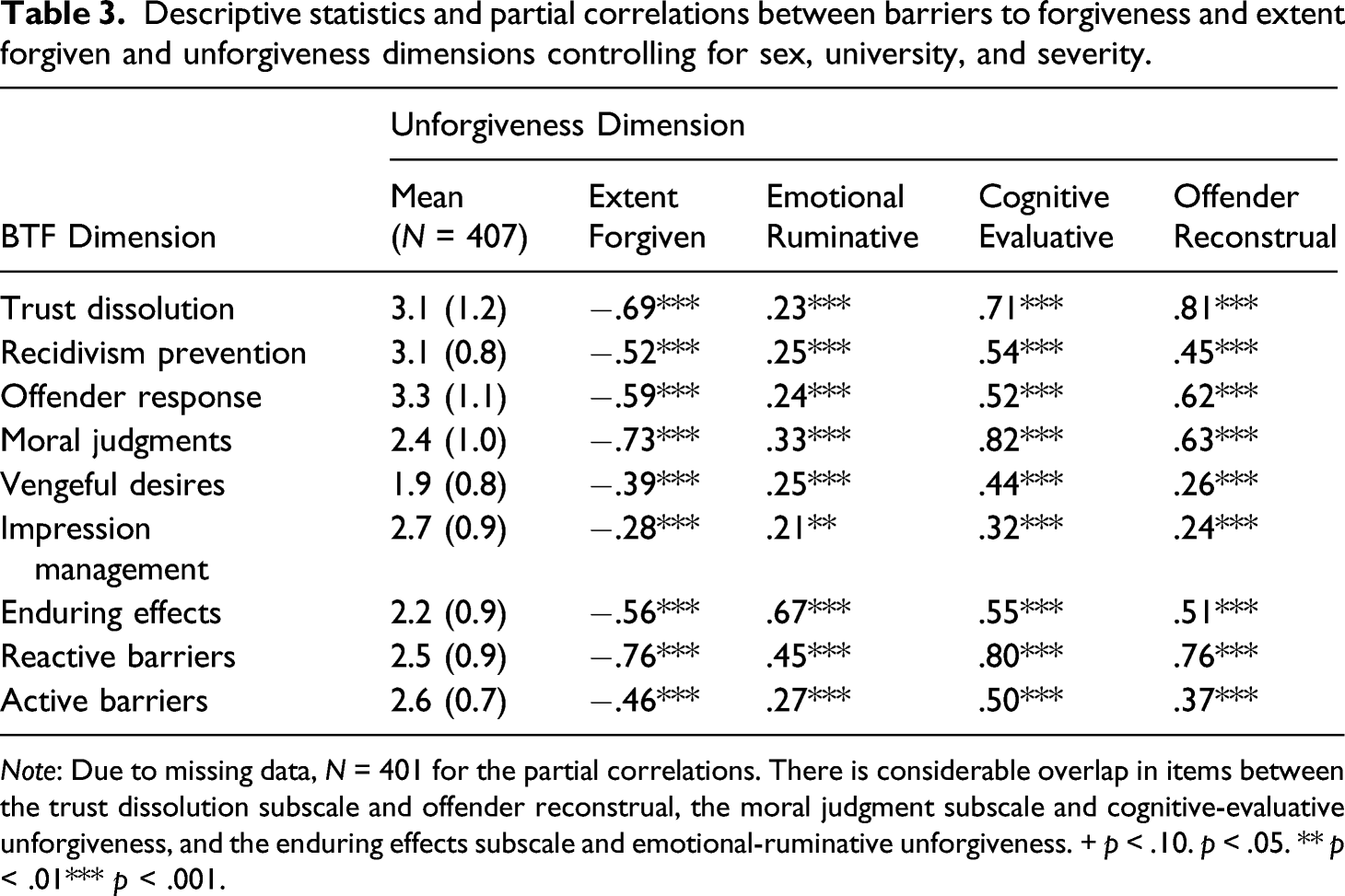
Note: Due to missing data, N = 401 for the partial correlations. There is considerable overlap in items between the trust dissolution subscale and offender reconstrual, the moral judgment subscale and cognitive-evaluative unforgiveness, and the enduring effects subscale and emotional-ruminative unforgiveness. + p < .10. p < .05. ** p < .01*** p < .001.
The partial correlations in Table 3 answer RQ3. Conceptual overlap between items in the UM and certain BTF subscales (i.e., trust dissolution, moral judgments, and enduring effects) constrains our interpretation of some of these values. The very high partial correlations between trust dissolution and offender reconstrual, moral judgments and cognitive-evaluative unforgiveness, and enduring effects and emotional-ruminative forgiveness, for example, may be attributed to the fact that the BTF and UM items for these pairings of variables measure very similar constructs. The very high partial correlations between the reactive barriers index (a composite of trust dissolution, moral judgments, and enduring effects) and both cognitive-evaluative unforgiveness and offender reconstrual are unsurprising for the same reason. Conceptual overlap cannot, however, explain the remainder of the correlations in Table 3, including those involving forgiveness.
Consider first the results for unforgiveness. If we conceptualize the unforgiveness dimensions as reflecting people’s experiences when they do not forgive and barriers to forgiveness as factors that impede forgiving, the correlations in Table 3 suggest that some concerns/impediments are more strongly associated with certain aspects of unforgiveness than others, perhaps providing a partial explanatory account for how people end up experiencing unforgiveness in the way they do. Two observations seem noteworthy in this regard.
First, reflecting a pattern observed in answer to RQ2a and b, the various barriers were more closely associated with the two more cognitively oriented unforgiveness dimensions than with emotional-ruminative unforgiveness. Second, our results highlight the potentially important role that the moral implications of a wrongdoing may play in shaping unforgiveness. The partial correlation between the moral judgment barrier and offender reconstrual was large (.63), effectively tied with offender response (.62) for largest association with this unforgiveness dimension (i.e., among those associations not attributable to item overlap). Additionally, though none of the associations for emotional-ruminative unforgiveness were large, the moral judgment barrier also produced the largest partial correlation for this dimension.
With respect to the results for forgiveness, trust dissolution and moral judgments produced the strongest associations and vengeful desires and impression management the weakest (and thus the reactive barriers index was more strongly associated with forgiveness than the active barriers index). Importantly, the associations for forgiveness were generally comparable in magnitude to those for the two more cognitively oriented unforgiveness dimensions but larger than those for emotional-ruminative unforgiveness.
Does unforgiveness predict friendship status?
Most participants (73%) reported that they still had contact with their offender at the time of the study. In fact, the majority (67.1%) reported that they and their offender remained friends. In short, participants recalled offenses occurring in friendships which, for the most part, survived the offense. 9
Regression predicting current friendship status (N = 405).
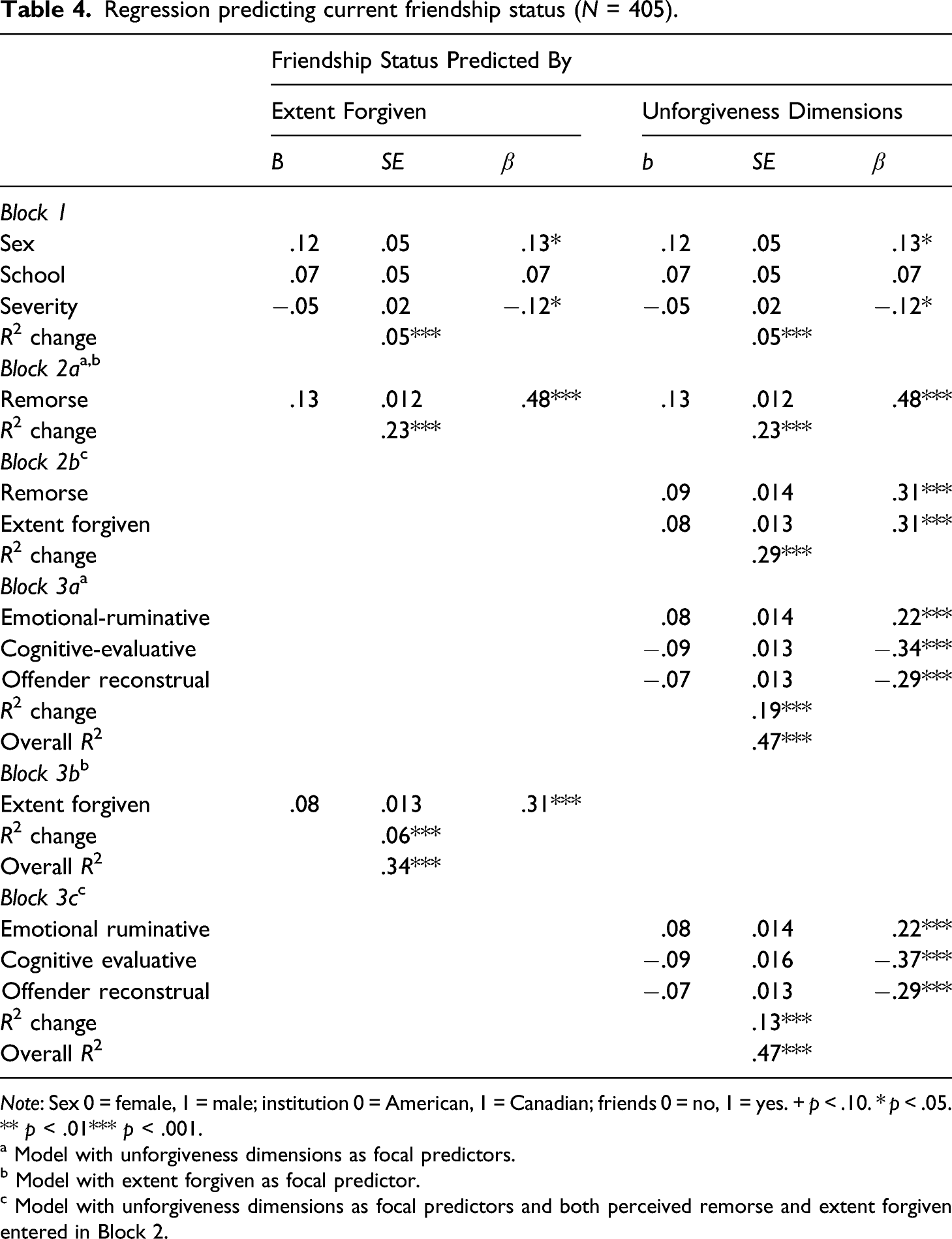
Note: Sex 0 = female, 1 = male; institution 0 = American, 1 = Canadian; friends 0 = no, 1 = yes. + p < .10. * p < .05. ** p < .01*** p < .001.
a Model with unforgiveness dimensions as focal predictors.
b Model with extent forgiven as focal predictor.
c Model with unforgiveness dimensions as focal predictors and both perceived remorse and extent forgiven entered in Block 2.
The overall regression model accounted for 47% of the variance in friendship status (0 = no longer friends, 1 = friends). Most pertinent to RQ4, each of the unforgiveness dimensions was a significant predictor and, combined, they accounted for a further 19% of the variance in friendship status, F(3, 397) = 47.85, p < .001 (see Block 3a). Unexpectedly, the β for emotional-ruminative unforgiveness was positive (β = .22), suggesting the presence of suppression (see Table S2 for the 0-order correlations). The β’s for both cognitive-evaluative unforgiveness and offender reconstrual were negative (as would be expected) and larger than the β for emotional-ruminative unforgiveness.
When we ran the analysis with forgiveness as the focal predictor, the regression model accounted for 34% of the variance in friendship status (see Block 3b). Controlling for sex, university, severity, and perceived offender remorse, forgiveness accounted for just 6% of the variance, F(1, 399) = 35.53, p < .001. Not surprisingly, those who remained friends with their offenders reported greater forgiveness.
Finally, we reran the first model adding forgiveness in Block 2 (alongside perceived remorse) to determine whether unforgiveness accounted for variance in friendship status incremental to forgiveness. In support of the view that forgiveness and unforgiveness are related but distinct constructs, the unforgiveness dimensions accounted for approximately 13% of the variance in friendship status, F(3, 396) = 33.27, p < .001, controlling for sex, university, and severity, and above and beyond forgiveness and remorse (see Block 3c). The β-weights for each unforgiveness dimension remained significant.
Together, these results suggest that both forgiveness and unforgiveness predict friendship status and, importantly, that variation along each of the three unforgiveness dimensions continues to account for significant variance in friendship status even controlling for forgiveness.
Discussion
Lessons learned
A full understanding of responses to wrongdoing in same-sex friendships requires considering both forgiveness and unforgiveness
RQ1 explored whether forgiveness and unforgiveness are distinct constructs in same-sex friendships. The answer is not straightforward. On the one hand, we found a consistent pattern in which both cognitive-evaluative unforgiveness and offender reconstrual demonstrated substantial overlap with forgiveness. Most extreme in the partial correlations between forgiveness and the unforgiveness dimensions we ran to answer RQ1, this pattern also emerged in analysis of the associations with apology status, remorse, and barriers to forgiveness that answer RQs 2 and 3.
On the other hand, there was clear evidence that all three unforgiveness dimensions capture unique variation in an important behavioral outcome—friendship status. Not only did the regression analyses for RQ4 show that the unforgiveness dimensions outperformed forgiveness in predicting friendship status (accounting for 47% of the variance versus 34% for forgiveness), but they accounted for an additional 13% of the variance incremental to forgiveness. The results of our boxplot analyses, too, though not aligning fully with the pattern Wade and Worthington (2003) observed, 10 suggest a degree of independence between forgiveness and unforgiveness. Scores on both emotional-ruminative unforgiveness and offender reconstrual, and to a lesser extent cognitive-evaluative unforgiveness, varied considerably across the full distribution of forgiveness scores, indicating that some participants experienced unforgiveness even when they had completely forgiven their offending friends.
As noted previously, the forgiveness literature generally treats unforgiveness as the polar opposite of forgiveness (e.g., see Thompson et al., 2005, who model unforgiveness as the negatively worded items in the Heartland Forgiveness Scale). Although the need for research that more fully explores their points of intersection and disjunction seems clear, we are inclined to conclude that our findings call this view into question and provide modest support for the contention that forgiveness and unforgiveness are both conceptually and empirically distinguishable. We thus urge those interested in understanding how friends respond to wrongdoing to investigate both constructs.
Equally important, our findings suggest that Stackhouse et al.’s definition of unforgiveness should be broadened to incorporate the possibility that unforgiveness can be experienced even when people have forgiven. Future research should explore how individuals make sense of their experiences when they believe they have forgiven a friend but still harbor some degree of unforgiveness along one or more of its dimensions.
The special case of emotional-ruminative unforgiveness
In answer to RQ4, we were surprised to find that those who remained friends with their offenders reported more—not less—emotional-ruminative unforgiveness than those who had not. The associations between both offender construal and cognitive-evaluative unforgiveness and friendship status fell in the theoretically expected direction (i.e., those whose friendships had terminated scored higher on both dimensions than those in intact friendships), but the association for emotional-ruminative unforgiveness was opposite in direction to what extant theorizing (e.g., Worthington, 2001; Stackhouse et al., 2018) would predict. This raises the intriguing possibility that compared with cutting ties with the offender, continued friendship might pose an obstacle to emotional recovery and prolong preoccupation with the offense.
The findings for emotional-ruminative unforgiveness deviated from those for the more cognitively oriented unforgiveness dimensions elsewhere in our analyses, as well. Specifically, associations with apology status, perceived remorse, and the barriers to forgiveness (in answer to RQs 2 and 3) were all markedly weaker for emotional-ruminative unforgiveness than either of the more cognitively oriented dimensions.
Should research replicate this consistent tendency for the findings for emotional-ruminative unforgiveness to deviate from those for the other unforgiveness dimensions, it will be important to account for this pattern. To the extent that perceptions of an offender and beliefs about forgiveness might be more amenable to efforts at self-regulation than are affect and rumination, researchers may wish to explore whether emotion regulation may help explain it. First, though, they may wish to rule out the possibility that it is attributable to the fact that scores on emotional-ruminative unforgiveness were very low in this study, presumably because most participants reported moderate to high levels of forgiveness.
Offender reconstrual and the changed nature of friendships post-transgression
A failure to apologize (sincerely) and/or express remorse might be expected to taint an individual’s view of their offending friend. It may not be especially surprising, therefore, that, in answer to RQ2a and b, the associations between apology status and perceived remorse were particularly pronounced for offender reconstrual. This pattern of results is nevertheless noteworthy because it corroborates theorizing asserting that variation in offender reconstrual may distinguish between forgiven and unforgiven offenses (Jones Ross et al., 2018). The present data provide the first quantitative evidence in support of this conjecture (Jones Ross et al.’s claim was based on analysis of interviews).
This pattern of results is also intriguing given that, overall, scores on the unforgiveness dimensions indicated that participants experienced rather little unforgiveness (see Table S2). The possible exception is offender reconstrual, whose mean approached a magnitude suggesting that, though most participants reported on intact friendships, they struggled to maintain an image of their offending friend unvarnished by the recalled transgression. To the extent that they experienced unforgiveness toward their friends, then, participants’ difficulties appear to have revolved more around separating their offenders from their wrongful actions than with either lingering negative affect and preoccupation with the offense (emotional-ruminative unforgiveness) or questioning the value in forgiving—or whether forgiving was possible—in the instance under consideration (cognitive-evaluative unforgiveness). Put differently, our results suggest that participants’ friendships with their offenders may have changed in consequential ways 11 in the wake of the wrongdoings they recalled—despite the high levels of forgiveness they reported and though most remained friends with their offenders—and that, among unforgiveness dimensions, it is a loss of faith in their friend that most effectively tracks variation in whether that friend apologized or expressed remorse.
An important question is whether this finding would hold for individuals reporting on offenses in other kinds of relationships. Friendship theorists often remark on the fragility of friendships (e.g., Casper & Card, 2010; Oswald, 2017). Are friendships perhaps more vulnerable to the impact of negative shifts in perceptions of an offender that can occur after a relational partner’s wrongdoing than relationships that benefit from institutional supports that foster their preservation? If so, what accounts for the fact that so many of our participants and their offenders remained friends?
On the morality of forgiving and losing faith in a friend
If we assume that barriers to forgiveness help shape both the process by which people forgive and the particular way they experience unforgiveness, our findings for RQ3 suggest that two such barriers deserve special attention in research on (un)forgiveness between friends. Consistent with previous research (Pearce, 2014), barriers reflecting loss of faith in the friend (trust dissolution) and moral qualms about forgiving (morality judgments) exhibited the strongest partial correlations with reported forgiveness. These same barriers also showed the strongest associations with two of the three unforgiveness dimensions (of those not inflated by item overlap).
Though theologians and scholars in other fields (e.g., philosophy) have often grappled with questions concerning whether it is morally acceptable to forgive (e.g., North, 1998), researchers from the social sciences have largely neglected such considerations (for exceptions, see Lozano, 2015, and Zechmeister & Romero, 2002). Our findings suggest that this issue matters to (same-sex) friends who have been wronged and deserves researchers’ attention. Moreover, they reinforce the value in employing multidimensional measures of unforgiveness, such as used here, capable of gauging wronged individuals’ positions with respect to the ethics of forgiving.
Together with our findings for RQ2, the findings for RQ3 also suggest that scholarly understanding of forgiveness between friends would benefit from research that unpacks the experiences of those whose trust in the friend has been shattered. Can trust be restored in such instances? If so, can the friendship ever truly be “the same” after the offense? Questions such as these seem particularly worthy of study given that most of our participants and their offenders remained friends.
Strengths and limitations
No study is without limitations. By investigating only transgressions in same-sex friendships, we ignored the heterogeneity evident in both friendships and experiences of gender (Monsour, 2017). Along related lines, we neglected to collect data concerning participants’ sexual orientation, disability, or socioeconomic status and therefore cannot speak to whether variation along these dimensions might have revealed nuances in our results. Future research should explore this possibility.
Our use of a single-item measure of forgiveness 12 also raises concerns about the validity of the conclusions we can draw based on findings for that variable. And our cross-sectional design precluded investigation of the time-course of forgiveness and unforgiveness between friends. Future research should extend the study of both forgiveness and unforgiveness to a more diverse array of friendships, employ a multiple-item forgiveness measure, and utilize research designs that permit examination of shifts in friends’ experiences of (un)forgiveness over time. Evidence that increases (or decreases) in forgiveness do not necessarily occur in concert with changes in unforgiveness would further support the view that forgiveness and unforgiveness are independent constructs.
Future research should also explore communicative aspects of unforgiveness similar to work investigating the communication of forgiveness (e.g., Pederson, 2014; Waldron & Kelly, 2005). Important questions include when and how is unforgiveness communicated between friends? And how frequently do those who express forgiveness also engage in behaviors that communicate a lack of forgiveness? At a minimum, researchers should measure whether participants communicated forgiveness and/or unforgiveness to their offending friend.
It might also be worth adopting a more nuanced approach to understanding apology status and, particularly, the extent to which an offending friend’s apology meets participants’ expectations or desires. Unforgiveness may depend less on whether an apology was or was not received (and the conditions under which it was received, i.e., was it late? Insincere? Expected?) than on the discrepancy that may exist between what the individual expected by way of apology and what they received.
Additionally, as most of our participants reported on transgressions in intact friendships, 13 it will be important to determine whether our results replicate among those whose friendships end after the transgression. Broken friendships sometimes result in antipathetic relationships, or relationships characterized by mutual dislike (Casper & Card, 2010). Whether forgiveness and unforgiveness operate as observed here when former friends find each other distasteful is a question worth investigating.
Notwithstanding its limitations, our study also has several noteworthy strengths, particularly in relation to previous unforgiveness research. First, we employed a more conceptually elaborated model of unforgiveness than have most studies on this topic, one that captures variability along several dimensions of people’s unforgiveness experiences. Second, we measured unforgiveness with a scale designed and validated for the express purpose of measuring unforgiveness (not forgiveness) and that avoids conflating low forgiveness with unforgiveness. Third, by leaving participants free to vary in the degree to which they had forgiven their offending friends, we were able to explore our research questions along the full spectrum from those who had forgiven completely to those who had not forgiven at all, thus resulting in greater ecological validity.
Conclusion
This study makes several noteworthy contributions to the literatures on both friendship and forgiveness. It investigates forgiveness in the important but understudied context of same-sex friendships. It provides tentative support for the proposition that forgiveness and unforgiveness are distinct and, therefore, that a complete understanding of friends’ experiences in the aftermath of wrongdoing requires examination of both constructs. Its findings also suggest that, despite sharing at least some antecedents with forgiveness, unforgiveness has the power to predict variation in an important behavioral outcome—namely, friendship status—incremental to forgiveness.
Remarking on demographic changes (e.g., in family structure, gender relations, marriage rates, and the number of single persons) occurring in Western nations, some scholars (e.g., Allan, 2008) have speculated that friendships might hold greater significance in contemporary Western society than ever before. There is therefore considerable need for further research on forgiveness—and unforgiveness—between friends.
Supplemental material
sj-pdf-1-spr-10.1177_02654075211062272 - Supplemental Material for Between friends: Forgiveness, unforgiveness, and wrongdoing in same-sex friendships
Supplemental Material, sj-pdf-1-spr-10.1177_02654075211062272 for Between friends: Forgiveness, unforgiveness, and wrongdoing in same-sex friendships by Susan D. Boon, Mahzad Hojjat, Mélanie Paulin and Madelynn R. D. Stackhouse in Journal of Social and Personal Relationships
Footnotes
Author’s note
Portions of this paper were presented at the 2018 meeting of the International Association for Relationship Research in Fort Collins, CO, July 12–16. The authors would like to thank Lobna Al-Wadeiah, Andleeb Azad, Eric Borowsky, Anastasja Kalajdzic, Eden Matthews, and Rayan Zaza for their assistance with data collection.
Declaration of conflicting interests
The author(s) declared no potential conflicts of interest with respect to the research, authorship, and/or publication of this article.
Funding
The author(s) received no financial support for the research, authorship, and/or publication of this article.
Open research statement
As part of IARR’s encouragement of open research practices, Susan Boon, Mahzad Hojjat, Mélanie Paulin, and Madelynn Stackhouse have provided the following information: This research was not pre-registered. The data used in the research are not available. The recruitment ad and materials used in the research are available at  .
.
Supplemental material
Supplemental material for this article is available online.
Notes
References
Supplementary Material
Please find the following supplemental material available below.
For Open Access articles published under a Creative Commons License, all supplemental material carries the same license as the article it is associated with.
For non-Open Access articles published, all supplemental material carries a non-exclusive license, and permission requests for re-use of supplemental material or any part of supplemental material shall be sent directly to the copyright owner as specified in the copyright notice associated with the article.
