



Abstract
Closeness is often considered synonymous with better quality romantic relationships. However, individual differences exist in the degree of closeness people desire in their relationships. This study examined the implications that discrepancies between actual and ideal closeness have for relationship quality in romantic couples. A questionnaire was administered to a sample of 103 cohabiting couples (N = 206) in the United States, who were randomly selected from a nationally representative survey panel. Dyadic analysis using actor–partner interdependence models with latent outcomes revealed that internal discrepancies between actual and idealized closeness were associated with poorer relationship quality for both individuals and their partners. These associations persisted above and beyond the effects of actual closeness and dyad-level differences in actual and ideal closeness. The association between closeness and relationship quality may be more individual than dyadic in nature, warranting renewed attention to the idiographic experience of closeness and its association with relational well-being.
Keywords
Closeness and Relationship Quality
Feeling close to a romantic partner is indicative of a more intimate, committed, and satisfying relationship (Brunell et al., 2007; Hassebrauck & Fehr, 2002; Pietras & Briken, 2021). Feelings of closeness are further representative of the degree to which individuals include aspects of their romantic partners within their own self-concept: Inclusion of other in self (IOS; Agnew et al., 2004; Aron et al., 1992; Aron et al., 1991). Seeking self-expansion by including qualities of one’s partner (e.g., identities, resources, and experiences) in one’s self-concept is thought to produce beneficial outcomes at both the relational and individual levels (Aron et al., 2004; Branand et al., 2019). Indeed, research on IOS as an indicator of feelings of closeness in romantic relationships has demonstrated that higher levels of IOS are associated with better quality relationships (Le et al., 2010; Pietras & Briken, 2021; Tsapelas et al., 2009).
Closeness Discrepancies and Relationship Quality
Although the majority of research on closeness in romantic relationships is based on the assumption that closer relationships are better relationships, emerging research shows that individuals vary in the amount of closeness they want within their relationships (Aron et al., 2004; Fletcher et al., 1999; Goodboy & Booth-Butterfield, 2009; Kashdan et al., 2007; Mashek & Sherman, 2004). Recent research indicates that the role of closeness in determining the quality of romantic relationships is most accurately understood in the form of closeness discrepancies (e.g., Frost & Forrester, 2013; Frost et al., 2017). Closeness discrepancies reflect the internal cognitive comparison between the amount of closeness a person feels in the present moment (i.e., actual closeness) and the amount of closeness they desire with their relationship partner (i.e., ideal closeness). Experiencing a level of closeness that is less than one’s ideal represents an expectancy violation thereby resulting in negative emotions and dissatisfaction with one’s relationship. Alternatively, experiencing an amount of closeness that is greater than idealized threatens personal control and identity and therefore may result in problems for relationship quality (Aron et al., 2004; Mashek & Sherman, 2004). This work aligns with theory and research which emphasizes the importance of balancing both a desire for closeness alongside a desire for distance in relationships (e.g., Freeney, 1999; Hess, 2002; Hess et al., 2007), further suggesting the relationship between closeness and the quality of romantic relationships is more complicated than the simple assumption that more closeness uniformly translates to better relationships.
Drawing on self-discrepancy theory (Higgins, 1987), closeness discrepancy theory (Frost & Forrester, 2013; Frost et el., 2017; Gamarel & Golub, 2019; Mashek & Sherman, 2004) suggests that an individual’s ideal level of closeness serves as a cognitive comparator to which his or her actual experience of closeness is compared throughout various stages of a romantic relationship. In this regard, closeness discrepancies can be thought to function much like “self-guides” in self-discrepancy theory (Higgins, 1987). Individuals are motivated to attain alignment between the actual and ideal, and when individuals experience an actual-ideal discrepancy they become prone to dejection-related emotions. Thus, the positive impact of actual experiences of closeness on relationship quality are most pronounced when they are aligned with one’s ideal, while relationship quality becomes diminished in the presence of discrepancies between actual and ideal levels of closeness. Indeed, actual-ideal closeness discrepancies have been documented as exerting a stronger influence on relationship quality than actual experiences of closeness in and of themselves (Frost & Forrester, 2013).
Closeness Discrepancies in the Couple Context
The internal cognitive evaluation of the degree to which an individual’s actual experience of closeness aligns with his or her ideal level of closeness (i.e., an internal closeness discrepancy) is only one possible indicator of closeness discrepancies within the context of romantic relationships. An additional evaluative comparison exists between one partner’s actual experience of closeness and his or her partner’s experience of closeness (i.e., a dyadic closeness discrepancy). Figure 1 illustrates the relational context in which internal and dyadic closeness discrepancies can exist within a given couple. Although research on closeness discrepancies has demonstrated their complex associations with relationship quality for individuals in relationships, dyadic closeness discrepancies (i.e., differences in aspects of closeness that exist between partners) and their potentially differential associations with relationship quality have yet to be explored. Distinguishing between internal and dyadic closeness discrepancies in romantic couples.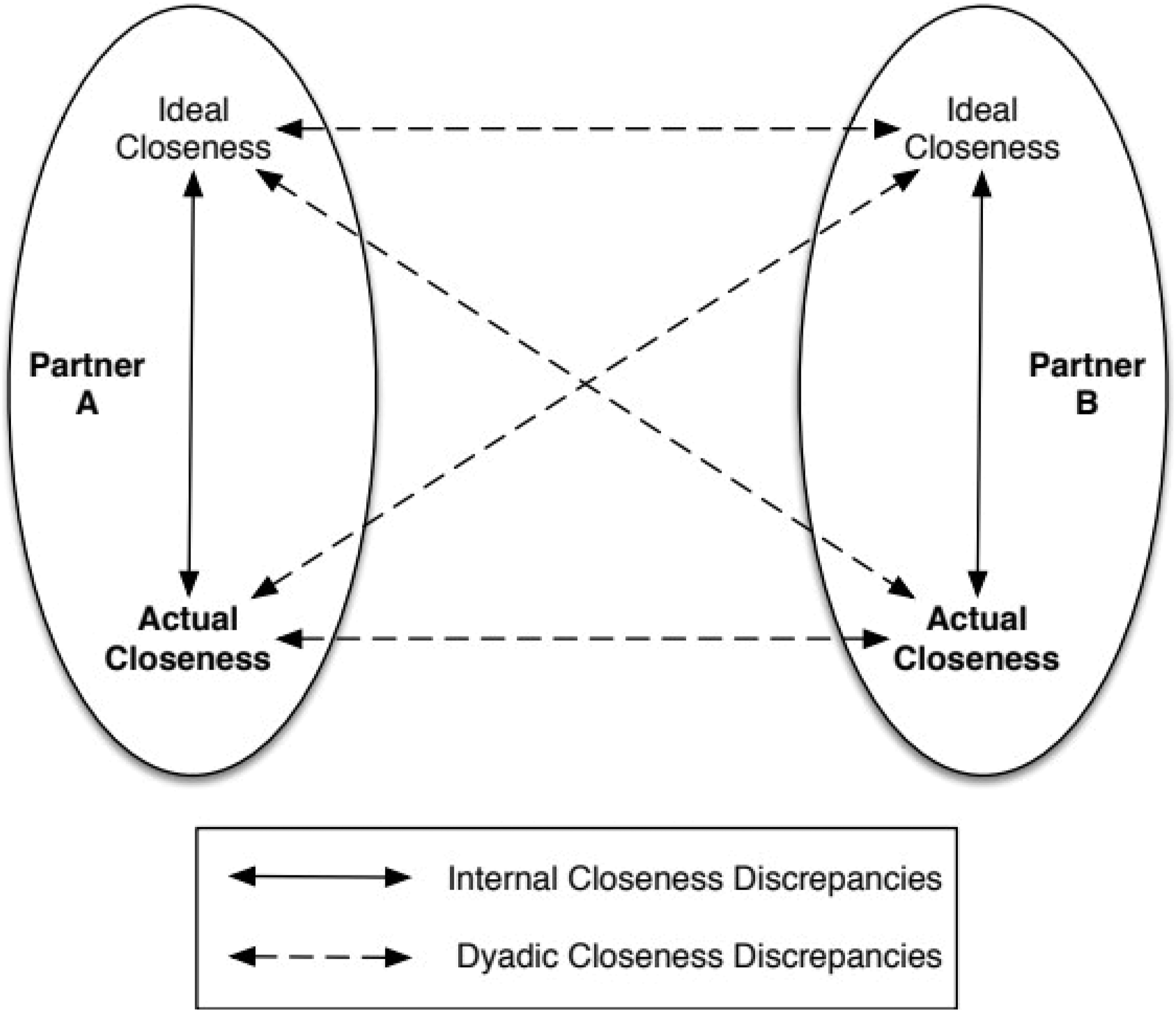
Relational discrepancy theory (Robins & Boldero, 2003) extends self-discrepancy theory in recognizing that important outcomes in relationships can result from dyadic discrepancies in self constructs (e.g., personality traits, values, and identity dimensions). Importantly, closeness is not a self-construct, but a relational construct that involves the degree of inclusion of aspects of one’s partner into one’s own self-concept (Aron et al., 2004). Thus, if the central tenant of closeness discrepancy theory holds, individual closeness discrepancies can be detrimental for relationship quality regardless of each partner’s actual experience of closeness (Frost & Forrester, 2013; Frost et al., 2017). Dyadic closeness discrepancies are therefore not likely to be detrimental to relationship quality in and of themselves, given both partners can experience actual closeness in line with their own potentially different internal ideal levels of closeness (i.e., internal closeness discrepancies). However, one individual’s internal closeness discrepancies may have a relational influence on his or her partner’s evaluation of relationship quality in so far as a lack of internal alignment in actual and ideal levels of closeness within a given partner is likely to result in more negative global evaluations of the quality of the relationship for both partners.
The use of the actor–partner interdependence model (APIMs; Kenny, 1996; Kenny & Kashy, 2014), given its basis in interdependence theory (Wickham & Knee, 2012), allows for the conceptualization and examination of associations between closeness discrepancies and relationship quality for both partners in a given romantic relationship, given both partners' outcomes are likely to be influenced by both one's own (i.e., “actor effects”) as well as one's partner’s (i.e., “partner effects”) lived experiences of closeness in their shared relationship. For example, theories of emotional contagion (e.g., Hatfield et al., 2014) suggest that one’s partner’s experience of diminished relationship quality could be considered a complementary emotional response to one’s own internal discrepancy between actual and idealized degrees of closeness. Additionally, theories of stress crossover in romantic relationships (e.g., Bolger et al., 1989; Neff & Karney, 2007) suggest that experiencing an internal closeness discrepancy may represent a stressor (e.g., stress resulting from lack of alignment between experienced and idealized relational states) that could have the potential to “cross over” in the dyadic context by producing a detrimental effect on one’s partner’s experience of relationship quality. Given the potential of closeness discrepancies to result in emotional contagion and stress crossover, it is likely that the experience of closeness discrepancies will exert a negative effect on relationship quality—for both oneself and one’s partner—above and beyond one’s own actual experience of closeness.
The Current Study
In order to examine the degree to which previously established linkages between closeness, closeness discrepancies, and relationship quality within individuals manifest within couples, we tested the following hypotheses pertaining to the individual and relational patterns of associations portrayed in Figure 2. We hypothesized a positive association between actual experiences of closeness and relationship quality (Paths A and C) and a negative association between closeness discrepancies and relationship quality (Paths B and D). We further hypothesized that—due to the suggested primacy of the subjective experience of closeness relative to the absolute experience of closeness—closeness discrepancies would demonstrate a more substantial association with relationship quality than actual closeness (Path B > Path A; Path D > Path C). Additionally, if internal working models of closeness discrepancies were more central to relationship quality than cross-partner differences in closeness constructs (i.e., dyadic closeness discrepancies), we hypothesized that the association between internal closeness discrepancies and relationship quality would be stronger than the association between dyadic closeness discrepancies and relationship quality (Path B > Path E). Finally, if the connection between closeness and relationship quality is more individual than relational in nature, we hypothesized people’s actual experiences of closeness and closeness discrepancies would be more strongly related to their own experiences of relationship quality than with their partners’ experiences of relationship quality (Path A > Path C; Path B > Path D). Hypothesized associations between closeness, internal closeness discrepancies, and dyadic closeness discrepancies and relationship quality in romantic couples.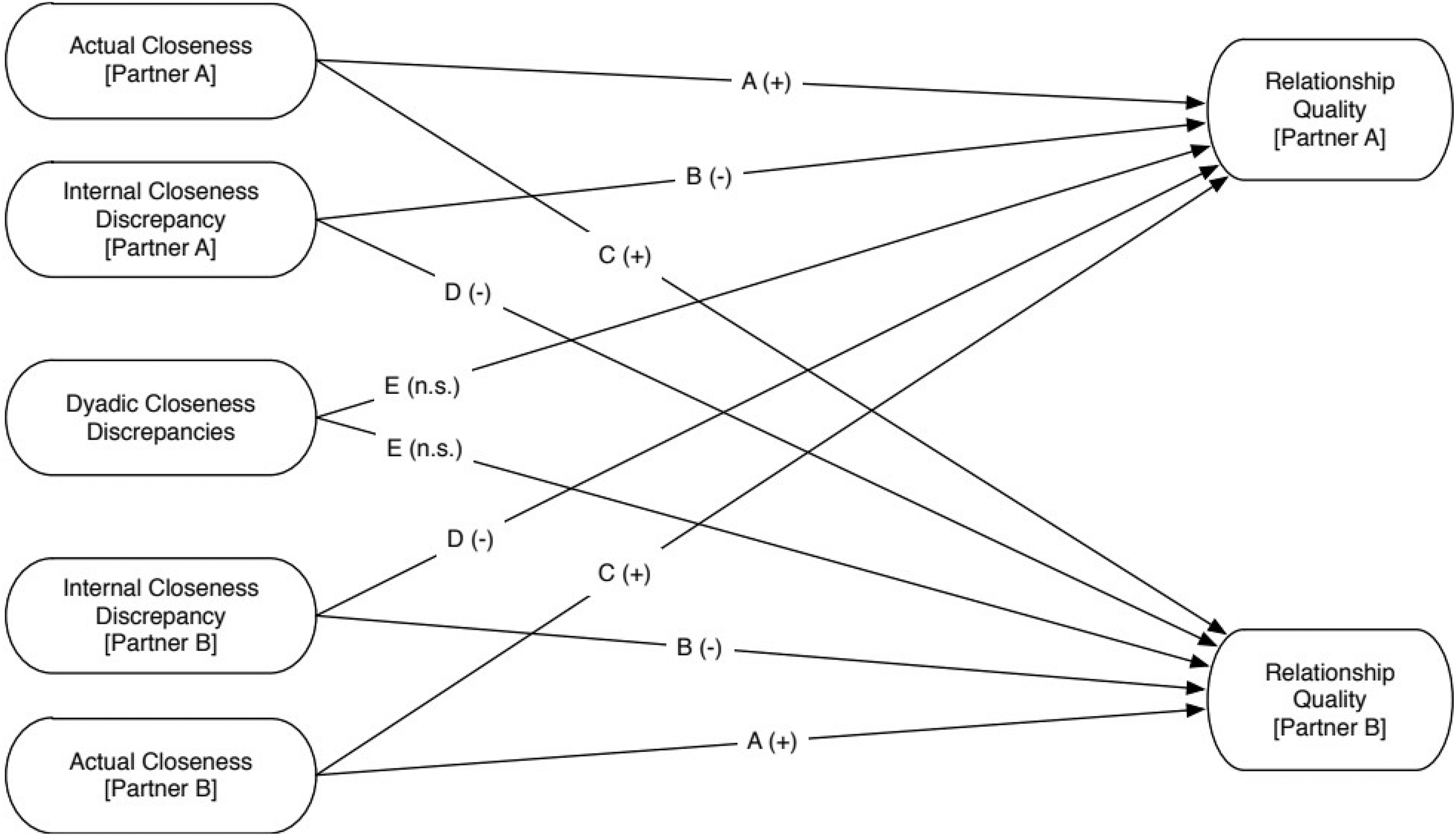
Multiple indicators of relationship quality were employed in testing the current study’s hypotheses. The first indicator, relationship satisfaction, was included to assess global evaluations of the degree to which one is getting what one wants out of his or her relationship and manifests in the amount of positive affect associated with one’s partnership, which is typically based on the degree to which the relationship fulfills each partner's needs (Rusbult et al., 1998). In addition to satisfaction with one’s relationship, relationship quality can be conceptualized and measured in the form of sexual satisfaction, or the degree to which the quality and frequency of sexual activity meets one’s sexual needs and desires (Alfonso et al., 1996; McClelland, 2011). Commitment was also considered an indicator of relationship quality as it represents the deliberate choice to engage in and remain engaged in a relationship (Acker & Davis, 1992), which can often manifest experientially in the form of thoughts about ending one’s relationship.
Finally, it was important to test the current study hypotheses taking into consideration other aspects of long-term romantic relationships known to be associated with relationship quality. For these reasons, we included relationship length and marital status as covariates in tests of our hypotheses in order to statistically control for their known associations with relationship quality (e.g., Brown & Booth, 1996; Heiman et al., 2011)
Method
Sample
To test these hypotheses, we surveyed a random sample of cohabiting couples living in the United States. Participants were obtained through a partnership with KnowledgeNetworks®, a survey research firm that maintains an online survey panel constituted using a combination of random digit dialing and address-based sampling techniques. The survey panel is representative of the entire US population (Yeager et al., 2011; for detailed sampling methodology, see Dennis, 2010). Once recruited into the survey panel, panel members were expected to complete an average of one 10- to 15-minute survey per week in exchange for access to the Internet. Individuals who did not have existing access to the Internet were provided access once joining the survey panel.
Eligible participants within the survey panel were identified as those households containing two adults aged 21 to 59 who reported living together as married or cohabiting romantic partners. A random sample of all eligible households was then selected and invited to participate in the present study and rescreened to confirm their relationship status and eligibility for the current study.
The final sample consisted of 103 cohabiting couples (N = 206), 80% of which were married or in a civil union or domestic partnership, and 4% consisted of partners of the same sex. The average length of couples’ relationships was M = 15.52 years (median = 12.50), SD = 9.58. Of the 206 individual participants, 50% identified their sex as female and 50% as male. A total of 38% reported having an education level consisting of a 4-year degree or greater. A total of 71% identified as White, non-Hispanic, 7% as Black, non-Hispanic, 6% as Other, non-Hispanic, 15% as Hispanic or Latino, and 1% identified with two or more racial and ethnic categories. Participants’ ages ranged from 22 to 59 (M = 43.10, SD = 10.22). All participants provided complete data and none were excluded. The sample size of 103 dyads was sufficiently powered (.80) to detect a small to medium sized actor/partner effect (r = .23) assuming a moderate degree of correlation between error terms (.6) and partner variables (.3) (Ackerman & Kenny, 2016).
Procedure
Eligible couples invited at random from the nationally representative survey panel received an email instructing them how to access and complete the survey for the present study. Each partner within a given household was invited as an eligible individual, and instructed to complete the survey on his or her own. Study invitations were sent individually, but at the same time. Each individual partner provided informed consent before they were able to begin the survey. The survey—containing the measures described below—took approximately 10 minutes to complete. The average difference (in hours) between partners’ participation was M = 20.86 (SD = 28.22). After completing the survey, each individual was taken to a “thank you” page which notified them that their participation was complete and provided them with contact information for the study team if they wished to ask questions or request further information. The study was approved by the IRB at San Francisco State University.
Measures
Participants first answered a series of demographic questions followed by the measures in the order presented below:
Closeness and closeness discrepancies
Aron and colleagues’ (1992) IOS scale was used to measure how individuals conceptualized their own experiences of closeness with their romantic relationship partner. This pictorial scale depicted six sets of two circles in which one circle represented the participant’s “self” and the other represented the participant’s “partner.” The sets were presented with varying degrees of overlap ranging from completely separate to almost completely overlapping. The current study employed a two-item approach to assessing IOS, where one version of the scale assessed participants’ actual (i.e., “current”) levels of IOS and a second version assessed participants’ ideal levels of IOS (Mashek & Sherman, 2004).
Internal closeness discrepancy scores were computed by subtracting each participant’s ideal IOS rating from their actual IOS rating. Negative numbers on this IOS discrepancy score indicated feeling “not close enough” to one’s partner, while positive numbers indicated feeling “too close” to one’s partner, and scores of 0 indicated no discrepancy between actual and ideal experiences of IOS. As demonstrated in previous research (Frost & Forrester, 2013), the direction of the discrepancy (positive vs. negative) does not differentially predict indictors of relationship quality; therefore, the absolute value of the discrepancy score was used in all analyses. Four dyadic closeness discrepancy scores were computed by taking the absolute value of the difference between the two partners’ actual IOS ratings and ideal IOS ratings, as well as between one partner’s actual IOS and the other partner’s ideal IOS.
Relationship satisfaction
The four-item version of the Couples Satisfaction Index (Funk & Rogge, 2007) was included to assess individuals’ satisfaction with their current primary romantic relationships. This measure was developed using item response theory and is the result of a factor analysis of items pooled from eight previously validated measures of relationship satisfaction. Example items include: “How rewarding is your relationship with your partner?” and “In general, how satisfied are you with your relationship?” Participants responded to such items on a scale of “not at all” to “completely.” This measure not only demonstrates strong validity correlations with other measures of relationship satisfaction, but it also demonstrates less noise and more power in detecting individual differences in satisfaction than existing measures (Funk & Rogge, 2007). The measure is scored on a scale of 0–21, with scores of 13.5 or below indicating relationship distress. In its originating study (Funk & Rogge, 2007), four-item scale scores were internally consistent at .94 and were highly correlated with the eight previously validated measures of relationship satisfaction (rs ranged from .84 to .94). In the current study, participants’ scores on the measure were internally consistent, Cronbach’s alpha = .87.
Dissolution thoughts
A single item was included in the survey to measure how often participants thought about ending their relationships with their current primary partners (Frost & Forrester, 2013). The item read, “How often in the past month have you considered ending your relationship with your current partner?” Participants responded on a scale of 0 “never” to 4 “a lot.” Scores were reverse coded, such that higher scores were considered indicative of fewer considerations to dissolve one’s relationship, which have been demonstrated to be key determinants of actual relationship dissolution (Gottman, 1993).
Sexual satisfaction
Sexual satisfaction was measured with a subscale of the modified Extended Satisfaction with Life Scale developed by Alfonso et al. (1996). The measure was developed as an efficient single instrument to evaluate multiple domains of life satisfaction including general life, social life, relationship, self, physical appearance, family life, school life, and job. The sexual satisfaction subscale is a 5-item assessment that includes the following items: “In most ways my sex life is close to my ideal,” “The conditions of my sex life are excellent,” “I am satisfied with my sex life,” “So far I have gotten the important things I want from my sex life,” and “I am generally pleased with the quality of my sex life” with a 7-point Likert scale response rating ranging from strongly disagree to strongly agree. The sexual satisfaction subscale has shown strong internal consistency with a Cronbach’s alpha score of .96 and stability with a test-retest correlation of .87 (Alfonso et al., 1996). In the current study, participants’ scores on the sexual satisfaction items were internally consistent, Cronbach’s alpha = .97.
Analysis Strategy
The actor–partner interdependence model (APIM; Kenny, 1996; Kenny & Kashy, 2014) was used to test the study hypotheses by estimating the associations outlined in Figure 2. The APIM is a flexible framework for dyadic data analysis because (a) it accounts for non-independence in the data attributable to the nesting of individuals within couples/households; (b) it tests both actor effects (e.g., the association between a given individual’s experience of closeness and his/her own relationship quality; Paths A and B) and partner effects (e.g., the association between an individual’s experience of closeness and his/her partner’s relationship quality; Paths C and D); and (c) it allows for the modeling of dyad-level effects (i.e., variables on which one score reflects the collective experience of both partners; Path E). Additionally, the effects of dyad-level controls—relationship length (in years) and marital status (married = 1, not married = 0)—on relationship quality were included in the APIM.
The APIM was fit to the data using structural equation modeling (SEM; Olsen & Kenny, 2006; Woody & Sadler, 2005). The use of SEM allowed for the modeling of a latent outcome variable of relationship quality, based on three observed indicator variables: relationship satisfaction, sexual satisfaction, and dissolution thoughts. The use of a latent variable outcome for relationship quality was motivated by theoretical and statistical concerns. Theoretically, in the spirit of parsimony, the hypotheses tested in the current study were not indicator-specific but pertained to the general concept of relationship quality, and thus, the testing of separate models for each indicator was not theoretically warranted. Statistically, the use of a latent outcome allowed for the testing of associations using only reliable outcome variance, which is an advantage of SEM (Kline, 2015), and reduced the number of hypothesis tests conducted thereby minimizing the potential of spurious findings (i.e., Type I errors). The latent outcome of relationship quality was modeled on a scale of 0–21 by fixing the coefficient linking the latent outcome to the observed indicator of relationship satisfaction (i.e., the Couples Satisfaction Index) to a value of 1. As specified by the APIM, all predictor variables were modeled as correlated within and across partners, and the error variances for each indicator variable and latent outcome were modeled as correlated across partners in order to model non-independence in the data.
Test of Indistinguishability within Dyads
The inclusion of both different-sex and same-sex couples in the randomly selected sample presented challenges for analysis, given different-sex couples are distinguishable based on sex (e.g., Partner A is always female and Partner B is always male), while partners in same-sex couples are indistinguishable. Rather than exclude same-sex couples, we examined whether different-sex couples were in fact empirically indistinguishable based on sex (following recommendations provided by Ledermann et al., 2011). This was accomplished by temporarily excluding the same-sex couples and comparing the fit of the unconstrained saturated APIM to a fully indistinguishable saturated (ISAT) model in which all estimated means, intercepts, error terms, actor effects, partner effects, dyad effects, and within-partner correlations were constrained to be equal across partners (Ledermann et al., 2011). Because the imposition of these equality constraints across partners did not meaningfully worsen the fit of the model [ΔΧ2 (26) = 34.77, p = .12], partners were determined to be empirically indistinguishable. In other words, no meaningful differences existed in the size of the estimated parameters between male and female partners in heterosexual couples. Additional t-tests were conducted to compare male and female individuals’ scores on individual-level study variables. There were no substantial differences observed on actual closeness (mean difference = .05, t = .26, p = .78), ideal closeness (mean difference = .04, t = .36, p = .72), internal closeness discrepancies (mean difference = .03, t = .18, p = .86), relationship satisfaction (mean difference = .19, t = .30, p = .77), sexual satisfaction (mean difference = .07, t = .28, p = .78), or dissolution thoughts (mean difference = .15, t = 1.05, p = .29). Thus, all analyses included both different-sex and same-sex couples and all models were estimated using the previously described equality constraints necessary to treat the couples as fully indistinguishable dyads (Olsen & Kenny, 2006).
Results
Descriptive and Bivariate Analyses
The most common type of internal closeness discrepancy reported was no internal closeness discrepancy (Partner A n = 61, 59.22%; Partner B n = 61, 59.22%), followed by negative discrepancies (Partner A n = 36, 34.95%; Partner B n = 35, 33.98%), with very few reporting positive discrepancies (Partner A n = 6, 5.83%; Partner B n = 7, 6.80%). Following previous research (Frost & Forrester, 2013) and in light of the low frequency of positive discrepancies, all further analyses were based on the absolute value of discrepancy scores. With regard to relational discrepancies, n = 56 (54.37%) Partner As reported actual levels of closeness that differed from their partner’s ideal closeness and n = 65 (63.11%) Partner Bs reported actual levels of closeness that differed from their partner’s ideal closeness. Additionally, n = 58 (56.31%) couples reported discrepancies in their actual levels of closeness and n = 43 (41.75%) couples reported discrepancies in their ideal levels of closeness. Correlations and descriptive information for all variables entered into the hypothesized model are included in an online supplement (Supplementary Table S1).
Actor Effects of Actual Closeness and Internal Closeness Discrepancies on Relationship Quality
The results of the APIM SEM tests of the study hypotheses are presented in Figure 3. This model is referred to as the fully ISAT model (Olsen & Kenny, 2006). As hypothesized, there was a sizeable actor effect between actual experiences of closeness and relationship quality such that, in general, the closer the individuals felt to their partners, the better their relationship quality tended to be. However, there was also a sizable actor effect of internal closeness discrepancies on relationship quality, such that the greater the distance between individuals’ actual and ideal experiences of closeness with their partners the poorer their relationship quality tended to be. The ISAT model explained 76% of the variance in the latent relationship quality outcome variables of both partners and demonstrated adequate fit to the data, Χ2 (82) = 108.88, p = .03, Χ2/df = 1.33, RMSEA = .06, CFI = .97. Results of latent variable actor–partner interdependence model testing the associations between closeness, internal closeness discrepancies, and dyadic closeness discrepancies and relationship quality in romantic couples. *** p < .001, ** p < .01, * p < .05. Coefficients represent unstandardized path coefficients with 95% bias-corrected confidence intervals in parentheses.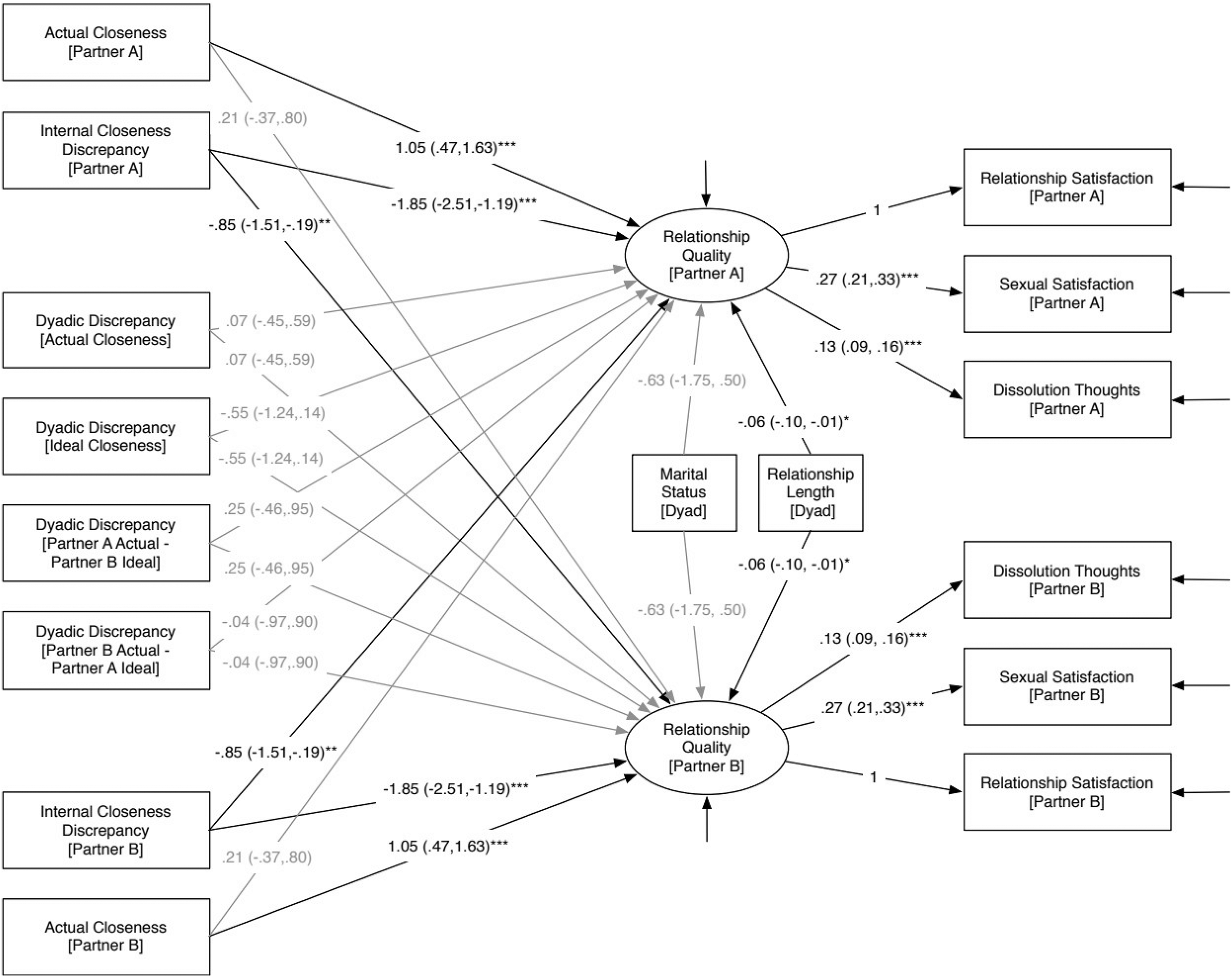
In order to compare the magnitude of the actor effects of actual closeness and internal closeness discrepancies on relationship quality, we tested an alternative APIM SEM in which these effects were constrained to be equal and compared the fit of this alternative model to the ISAT model. The imposition of equality constrains on the actor effects of actual closeness and internal closeness discrepancies significantly worsened the fit of the model [ΔΧ2 (1) = 67.36, p < .001], indicating that the actor effect of internal closeness discrepancies on relationship quality was significantly stronger than the actor effect of actual closeness on relationship quality.
Partner Effects of Actual Closeness and Internal Closeness Discrepancies on Relationship Quality
The partner effect of actual closeness on relationship quality in the ISAT model was not meaningfully different from 0 (Figure 3). However, a sizeable partner effect of internal closeness discrepancies on relationship quality was observed, indicating that the greater the distance between a given partner's actual and ideal experiences of closeness the poorer his or her partner’s relationship quality tended to be.
We further investigated whether the partner effect of internal closeness discrepancies on relationship quality was meaningfully larger than the partner effect of actual closeness on relationship quality. Imposing equality constraints on these parameters produced a significantly poorer fitting model when compared to the ISAT model [ΔΧ2 (1) = 10.75, p = .001], indicating that the partner effect of internal closeness discrepancies on relationship quality was stronger than the partner effect of actual closeness on relationship quality.
Associations between Dyadic Closeness Discrepancies and Relationship Quality
There were no meaningful associations between the four indicators of dyadic closeness discrepancies and the latent relationship quality outcome variables, given the confidence intervals (CI) for the parameter estimates of these effects all contained 0 (Figure 3).
Test of Individual versus Couple-Level Pattern of Effects
In order to test the hypothesis that the association between experiences of closeness and closeness discrepancies and relationship quality would be more individual than dyadic in nature, the procedures recommended by Kenny and Ledermann (2010) were employed to measure and test dyadic patterns within the APIM. This involved the use of phantom variables in SEM to estimate a parameter k, representing the ratio of the partner effect to the actor effect for a given predictor variable. Values of k approximating 1 were considered to be indicative of a couple-level pattern of effects where the actor effect and partner effect of a given predictor variable are equal. Values of k approximating 0 were considered to be indicative of an individual or actor-only pattern of effects where the actor effect of a predictor variable is meaningfully different from 0, but corresponding partner effect is not. Given the dyads were determined to be fully indistinguishable, one value of k was estimated testing the pattern of effects for actual closeness and one value of k was estimated testing the pattern of effects for closeness discrepancies. Bias corrected (BC) 95% CI were calculated around each value of k using maximum likelihood estimation bootstrapping procedures with 10,000 samples (Shrout & Bolger, 2002). The 95% BC CIs were examined for the presence of 1 or 0, indicating a couple-level or individual pattern of effects, respectively (Kenny & Ledermann, 2010).
With regard to the effects of actual closeness on relationship quality, an individual-level or actor-only pattern of effects was observed, k = .15, 95% BC CI = −.40, .95. Constraining k to 0 did not significantly worsen the fit of the model, ΔΧ2 (1) = .42, p = .52. This finding indicated that the amount of closeness one partner feels is associated with only his or her own experience of relationship quality and not his or her partner’s experience of relationship quality. With regard to the effects of internal closeness discrepancies on relationship quality, it was not possible to distinguish between an actor-only pattern and couple-level pattern of effects, k = .41, 95% BC CI = −.04, 1.11. To explore this pattern further, we fit two alternative models to the data—the first constrained k to 0 and the second constrained k to 1—and compared the fit of these models to the unconstrained model estimating k for the associations between internal closeness discrepancies and relationship quality. Constraining k to 0 significantly worsened the fit of the model, ΔΧ2 (1) = 6.30, p = .01. Similarly, constraining k to 1 significantly worsened the fit of the model, ΔΧ2 (1) = 6.63, p = .01. These findings suggest that even though a significant partner effect of internal closeness discrepancies on relationship quality was observed (Figure 3), the association between experiencing a closeness discrepancy and relationship quality was primarily individual in nature.
Discussion
The present findings complement and extend existing research on IOS and closeness in romantic relationships by demonstrating that the association between closeness and relationship quality in cohabiting couples is more complicated than existing psychological research suggests. Although heightened closeness is indicative of a given individual’s general experience of relationship quality, his or her actual experience of closeness had no bearing on his or her partner’s experience of the quality of their relationship. Rather, what mattered most for both partners’ experiences of the quality of their relationship is whether their own individual feelings of closeness in the present match their own internal cognitive guide defining a personalized ideal level of closeness. These internal closeness discrepancies were robustly associated with each partner’s own experience of the quality of their relationship and his or her partner’s experience of the quality of their relationship. In other words, when a given partner’s feelings of closeness move out of alignment with his or her idealized level of closeness, the experience of relationship quality for both partners is likely to be diminished. Importantly, the negative association that internal closeness discrepancies can have with relationship quality persisted and remained substantial regardless of how close both members of a couple actually felt to one another. These findings extend previous theory and research on the role of closeness discrepancies in determining relationship quality beyond the individual (e.g., Aron et al., 2004; Frost & Forrester, 2013; Frost et al., 2017; Mashek & Sherman, 2004), to account for the negative impact that closeness discrepancies can have for both partners in a relationship. The findings further lend support for calls to contextualize individuals’ experiences of closeness in relation to desires for distance in romantic relationships (e.g., Freeney, 1999; Hess, 2002; Hess et al., 2007).
Findings that dyadic closeness discrepancies did not demonstrate an association with relationship quality further support the emerging notion that the association between closeness and relationship quality is most strongly determined by individuals’ idiosyncratic experiences of closeness (e.g., Frost & Forrester, 2013; Frost et al., 2017). For example, differences in actual closeness across partners may not impair the relationship quality of either partner in and of itself, so long as each partner’s actual closeness does not differ from his or her own internal ideal level of closeness. The same may be true for dyadic discrepancies in ideal levels of closeness, in that partners may differ in how much closeness they desire with their relationship partner, but this difference may not exert a negative influence on the quality of the relationship so long as both partners are able to achieve a level of closeness in the present that is aligned with each of their personal ideal levels of closeness. Thus, the present research suggests that partners’ actual and ideal experiences of closeness can vary from one another without affecting the quality of their relationship as long as their actual experiences of closeness are in line with their own ideal levels of closeness.
Additional theoretical explanations for the current findings may be found in theories of perceived partner responsiveness and emotional contagion. For example, stemming from Reis and Shaver’s (1988) interpersonal process model of intimacy, one’s perceptions of their partner’s responsiveness was theorized to be more important to intimacy and the quality of individuals’ relationships than one’s partner’s actual behaviors. Research has demonstrated the primacy of the importance of perceived over actual partner responsiveness for a variety of relational and well-being outcomes (Crasta et al., 2021; Laurenceau et al., 1998; Selcuk & Ong, 2012). Although purely speculative given it was not assessed in the current study, the primacy of perceived over actual partner responsiveness mirrors the primacy of internal closeness discrepancies over dyadic closeness discrepancies (based on one’s partner’s actual closeness) in predicting one’s own as well as one’s partner’s relationship quality.
Furthermore, the partner effect of one’s own internal closeness discrepancy on one’s partner’s relationship quality can potentially be explained by theories of emotional contagion (e.g., Hatfield et al., 2014), given one’s partner's decreased relationship quality could be considered a complementary emotional response to one’s own internal discrepancy between one’s actual and ideal amount of closeness. Additionally, given we observed partner effects for internal discrepancies but not actual closeness, conceptualizations of stress crossover in romantic relationships (e.g., Bolger et al., 1989; Neff & Karney, 2007) suggest that the internal closeness discrepancy may represent a stressor (e.g., stress resulting from lack of alignment between experienced and idealized relational state); resulting in negative outcomes not only for oneself but also one’s partner. To our knowledge, the use of APIM in the current study provides the first demonstration of partner effects of closeness discrepancies on relationship quality in long-term adult romantic relationships.
The pattern of associations observed in the present study did not vary by gender, as indicated by the empirical test of indistinguishability. Additionally, given the potential influences of marital status and relationship length were controlled in all predictive analyses, support for the tested hypotheses exists across a diversity of relationship types. Although this study contained a relatively small sample (N = 206), it was sufficiently powered to detect medium and large effect sizes and the fact that it was randomly constituted from a nationally representative panel of US households further bolsters the generalizability of the present findings.
Limitations and Directions for Future Research on Closeness Discrepancies
More research is needed to extend theory and research on closeness discrepancies and the mechanisms by which they explain relationship quality. Future work can benefit from including other forms of internal closeness discrepancies that were not accounted for in the present study. For example, in addition to an internal personalized ideal of closeness, an individual may compare his or her actual experience of closeness to an internal cognitive representation of his or her partner’s ideal level of closeness. The latter is importantly different from his or her partner’s own ideal level of closeness, as the two may differ depending on perceptual accuracy and communication within the couple. The construct of “perceived inclusion of other in self”—introduced by Tomlinson and Aron (2013)—will likely be useful in this line of further inquiry into closeness discrepancies. Future research should also investigate the mechanisms underlying the production and reduction of closeness discrepancies. Although dyadic closeness discrepancies were not predictive of relationship quality, other dyadic factors such as communication, division of labor, and parenting responsibilities are likely at play in shaping the internal closeness discrepancies that were most predictive of relationship quality in the current study. A strength of the current study was its use of a multi-indicator latent outcome of relationship quality; however, it was limited to only three indicators of relationship satisfaction, sexual satisfaction, and dissolution thoughts. Future studies may benefit from including additional indicators of relationship quality, such as love and conflict. Future studies could benefit from investigating not only the consequences of closeness discrepancies, but their antecedents as well. Given previous research has demonstrated closeness discrepancies vary by attachment style (Aron et al., 1997; Mashek & Sherman, 2004), additional research is needed to understand the extent to which attachment and other relational factors may moderate the association between closeness discrepancies and relationship quality in dyads. Larger sample sizes will be needed to examine additional predictors as well as mediating and moderating mechanisms and curvilinear associations. Because the sample was recruited from an existing nationally representative panel, we did not have access to demographic information on gender identity, sexual orientation, or disability. Future research should examine the extent to which the present findings persist or vary across these important dimensions of diversity. Finally, the greatest limitation of the present study is its cross-sectional design. More work needs to be done to test the causal ordering of the associations implied by the present analysis, including attention to the potentially reciprocal association that internal closeness discrepancies may have across partners throughout various stages in a relationship.
Summary and Conclusion
Close is a relative construct. Just as subjective notions of distance define idiosyncratic judgments of near and far, individuals compare their own feelings of closeness with their internal ideals, which serve as cognitive guides for what constitutes the “right” amount of closeness for them in relation to their romantic partner. As the current study showed, when one partner’s experience of closeness is out of line with his or her ideal amount of closeness, the relationship quality of both partners suffers. The negative effects of internal closeness discrepancies are stronger than, and persist above and beyond, both partners’ actual experiences of closeness, as well as any differences that may exist between partners in their actual and ideal experiences of closeness. Closeness is therefore not absolute in its association with relationship quality as previous theory and research have suggested. Future research and intervention attempts focused on understanding and addressing the role of closeness in romantic couples can benefit by incorporating a focus on the individual and relational effects that internal closeness discrepancies can have on relationship quality.
Supplemental Material
sj-pdf-1-spr-10.1177_02654075211050070 – Supplemental Material for The complicated connection between closeness and the quality of romantic relationships
Supplemental Material, sj-pdf-1-spr-10.1177_02654075211050070 for The complicated connection between closeness and the quality of romantic relationships by David M. Frost and Allen J. LeBlanc in Journal of Social and Personal Relationships
Footnotes
Funding
The author(s) received no external financial support for the research, authorship, and/or publication of this article.
Open research statement
As part of IARR’s encouragement of open research practices, the author(s) have provided the following information: This research was not pre-registered. The data and materials used in the research are available. The data and materials used can be obtained by contacting the corresponding author at

Supplemental Material
Supplemental material for this article is available online.
References
Supplementary Material
Please find the following supplemental material available below.
For Open Access articles published under a Creative Commons License, all supplemental material carries the same license as the article it is associated with.
For non-Open Access articles published, all supplemental material carries a non-exclusive license, and permission requests for re-use of supplemental material or any part of supplemental material shall be sent directly to the copyright owner as specified in the copyright notice associated with the article.
