




Abstract
Power dynamics have been described as being constitutive of romantic relationships and can impact outcomes such as relationship quality. Yet, in relationships nowadays, power may be less important than in the past due to changes in gender roles and society’s expectations. We analyzed four power characteristics and their effects on a multidimensional measure of relationship quality using an actor-partner interdependence model framework with 181 heterosexual couples. There was usually a balance of power in the couples with respect to a personal sense of power but an imbalance in positional power. We found actor and partner effects: Personal sense of power and satisfaction with power predicted actors’ and partners’ relationship quality. By contrast, positional power, the general power motive, and the balance of power were not associated with relationship quality. There were hardly any differences in actor or partner effects between men and women. Apparently, it is not objective, positional power but subjective, experienced power that is relevant to overall relationship quality. Furthermore, what matters most for satisfaction with the relationship is not the balance of power but rather the perceived personal level of power. Future research may extend these findings by using domain-specific power measures and behavioral power indicators.
Keywords
Power is a social construct that is pervasive in everyday interactions and relationships. There is a long tradition in social and personality science of analyzing differences in the level of power between romantic partners and the consequences of having or lacking power for variables such as relationship satisfaction (Blood & Wolfe, 1960; Rodman, 1967; Safilios-Rothschild, 1976). The question that is often asked is “Who’s on top?” (Felmlee, 1994).
Only a few researchers have found a balance of power in couples (Neff & Suizzo, 2006). Instead, many researchers have found that in most couples, men have more power and more influence over decisions than women do (Bruhin, 2003; Felmlee, 1994; Gillespie, 1971; Sprecher, & Felmlee, 1997). This observation is in line with traditional gender roles and societal factors that foster the tradition of women supporting their partners and primarily being responsible for family work.
However, traditional roles have changed, particularly in western societies. Gender roles have adapted in such a way that there is now more equality in romantic relationships (Athenstaedt & Alfermann, 2011; Schwartz & Gonalons-Pons, 2016). In the present study, we used a heterogeneous sample to explore power and relationship quality in contemporary couples because actual and perceived power have been found to impact various aspects of relationships such as satisfaction and commitment (Kim et al., 2019). To extend previous research, we aim to provide information on the relations between men’s and women’s power and their own and their partners’ perceived relationship quality (RQ) by analyzing the dyadic effects of four different power characteristics on a multitude of RQ dimensions by using reliable and validated scales. A better understanding of the relevance of power in relationships will support researchers’ ability to make up-to-date inferences about the functioning of intimate relationships.
Positional and experienced power in romantic relationships
Power in social psychology is typically understood as control over resources (Keltner et al., 2003). This idea is in line with earlier accounts such as resources theory (Blood & Wolfe, 1960; Safilios-Rothschild, 1976), which assumes that the resources an individual has are central to the individual’s ability to change the behavior of a relationship partner. In these accounts, the concept of resources is broadly formulated and encompasses socioeconomic (e.g., money, prestige), affective, societal, and other kinds of resources. An index of objective power can, for example, emanate from socioeconomic resources, such as income, occupational status, and educational attainment (Conger et al., 2010; Greaves et al., 1995; Harvey et al., 2002; Pahl, 1995; Strickhouser & Sutin, 2020). In the literature on marital power, the capacity to influence one’s partner on the basis of socioeconomic resources is usually termed positional power (Fox & Blanton, 1994).
Even though positional power may be important in romantic relationships (Schwartz & Gonalons-Pons, 2016), experienced power may be at least as important in a relationship. Many researchers have used self-reports to measure the experience of power and conceptualized it as subjective decision-making ability within the intimate relationship (Beach & Tesser, 1993; Gray-Little & Burks, 1983). For example, Felmlee (1994) asked, “In your relationship, who makes more of the decisions about what the two of you do together?” However, one drawback of this early literature is the use of different and unvalidated measures (Gray-Little & Burks, 1983).
An influential concept was recently suggested, the personal sense of power (Anderson et al., 2012), along with a validated scale. Personal sense of power is defined as a “psychological state—a perception of one’s capacity to influence others” (p. 314; Anderson et al., 2012). Other definitions concerning subjective power in romantic relationships also emphasize the ability to influence others as a characteristic of power. For example, Simpson et al. (2015) define power as “the ability or capacity to change a partner’s thoughts, feelings, and/or behavior so they align with one’s own desired preferences, along with the ability or capacity to resist influence attempts imposed by the partner” (p. 409).
Given that the common ground of theories on power is the understanding that power is a form of control or influence (over the partner; Kim et al., 2019), the personal sense of power seems to be an appropriate and broad theoretical basis to assess experienced power in intimate relationships. 1 Moreover, personal sense of power can be based on but can also be independent of socioeconomic resources (Anderson et al., 2012; Körner et al., 2021). Actually, research shows that people with high positional power can have low perceived power, and vice versa. Moreover, perceived power has a stronger impact on behavior than positional power does (Bugental & Lewis, 1999; Fast & Chen, 2009). In line with this, in dyadic power theory (Dunbar et al., 2016), the perception that an individual has resources and authority is seen as more relevant than the actual levels of these characteristics. Thus, it is important to distinguish between resources that impact positional power in a relationship and the self-reported perception of influence that one partner has over the other partner.
Personal sense of power and other conceptualizations of power are typically referenced in a social context. This means that one’s own level of power can have an impact on others’ outcomes. In this vein, prominent theories and models, such as the interdependence theory (Kelley et al., 2003; Kelley & Thibaut, 1978), dyadic power theory (Dunbar et al., 2016; Rollins & Bahr, 1976), or the dyadic power social-influence model (Simpson et al., 2015), emphasize the social nature of power in intimate relationships and hold that an individual’s power in a relationship affects the outcomes of both partners. Still, previous research has mostly studied the relevance of an individual’s perceptions of power in the relationship for his or her own relationship satisfaction but has neglected the impact that a partner’s perceptions may have on the individual. A more complete approach for understanding the impact of power in relationships can be provided by asking both partners about their perceptions and using statistical techniques that account for interdependence within the couples (Kenny et al., 2006).
The impact of power on relationships
Previous research has observed the consequences of having or lacking power and a(n) (im)balance of power in romantic relationships with regard to relationship duration and quality, commitment, trust, sexual desire, and other variables (Bruhin, 2003; Felmlee, 1994; Kim et al., 2019; Lennon et al., 2013; Zverling, 2019). For example, a high income (as an indicator of positional power) was found to be associated with a lower commitment to marriage. Moreover, the partner with the higher income was typically found to attribute the partner’s generous acts to instrumental motivation (Inesi et al., 2012) and to suspect that the partner had ulterior motives or was trying to make nice.
In self-report studies, women have typically reported higher investment and emotional involvement in the relationship than men (Felmlee, 1994; Sacher & Fine, 1996). Power over the partner is typically associated with less interest in the relationship and is more often found in men than in women (Sprecher et al., 2006). Low commitment, in turn, was found to have a negative impact on the relationship by lowering trust (Wieselquist et al., 1999). On the other hand, experiencing high power in a relationship led to increased authenticity (Neff & Suizzo, 2006) and subjective well-being (Kifer et al., 2013)—and experiencing low power led to a reduced tendency to address problems and to behavioral inhibition (Keltner et al., 2003; Rusbult et al., 1991). Finally, reports of a balance of power were associated with emotional well-being, relationship satisfaction, and higher sexual desire (Aida & Falbo, 1991; Brezsnyak & Whisman, 2004; Drigotas et al., 1999). Overall, the literature on power in intimate relationships has suggested that similar levels of power between partners but also high levels of experienced power may be beneficial.
The highest RQ has been reported by couples with a balance of power (Conroy et al., 2016; Gray-Little & Burks, 1983). RQ is a multidimensional construct consisting of facets such as fascination, engagement, sexuality, the long-term potential of the relationship, trust, and constraints (Hassebrauck & Fehr, 2002; Siffert & Bodenmann, 2010). It is understood as the subjective evaluation of several dimensions of the relationship and has important implications for relationship commitment and health (Hassebrauck & Fehr, 2002; Robles et al., 2014).
Previous research has studied how the perception of power in relationships affects people’s relationship quality (actor effects; e.g. Sprecher et al., 2006). However, it is less clear how people are affected by their partners’ perceptions (partner effects). Analyzing only individual views does not account for the interdependence of partners in intimate relationships. In fact, test statistics become inaccurate when the assumption of nonindependence is violated (Cook & Kenny, 2005). Thus, in analyzing psychological processes in romantic couples, the interpersonal nature of these phenomena needs to be considered, and the fact that the data from the individuals are nested within the couple must be taken into account.
The present study
With the present research, we aimed to extend previous research by using appropriate statistical techniques to investigate the relations between a variety of power measures on multidimensional RQ within couples. By considering the dyadic nature of the data and analyzing partner effects in addition to actor effects on the link between power and RQ in western societies, we may be able to provide new insights into the functioning of contemporary romantic couples. To this end, we used actor-partner interdependence models (APIMs; Kenny et al., 2006).
We tested for differences in partners’ power levels (Research Question 1) and for associations between power characteristics and RQ (Research Question 2). In doing so, we distinguished between subjective and objective power. As much research on power and RQ is either outdated (Gray-Little & Burks, 1983) or was investigated in developing and threshold countries (Conroy et al., 2016), whether experienced and positional power still have impacts on romantic relationships in western, industrialized countries are open questions. Further, the present study is the first to distinguish between different aspects of power (personal sense of power, positional power, satisfaction with power, power motive) and between different aspects of relationship quality (six dimensions of RQ) and thus provides a fine-grained account of the associations between these variables. In doing so, we were able to test the moderating role of sex in an exploratory fashion.
With respect to Research Question 1, we expected to find relatively equal levels of both experienced and positional power due to increasing levels of equality between men and women in western societies (Athenstaedt & Alfermann, 2011; Schwartz & Gonalons-Pons, 2016).
For Research Question 2, specific predictions were made regarding the distinct power measures: First, we expected personal sense of power to most strongly influence RQ. As higher experienced power leads to positive emotions, optimism, and well-being in general as well as in romantic relationships (Anderson & Galinsky, 2006; Keltner et al., 2003; Kifer et al., 2013), a positive association between an actor’s sense of power and his/her RQ was expected. Regarding the effect of the actor’s sense of power on the partner’s RQ, a negative association was expected as more decisions made by the actor could constrain the partner.
Second, as an objective measure of power, we measured positional power by comparing the participant’s financial situation with the partner and including occupational/educational prestige. Previous research found that positional power was linked to lower satisfaction and commitment in relationships in the individual (Inesi et al., 2012; Vogler et al., 2008)—however, satisfaction and happiness with the relationship were found to be higher in couples with a high overall level of socioeconomic status (Conger et al., 2010). Thus, both positive and negative effects of positional power on the actor and the partner seem possible, and thus, no specific predictions were made.
Third, as people may have low personal or positional power but may be happy not making many decisions and having little responsibility, satisfaction with power was also assessed. It seems likely that partners who are satisfied with their level of power in the relationship would also be satisfied with their relationship overall (Ronfeldt et al., 1998). Thus, we expected positive associations between satisfaction with power and RQ and its dimensions. This positive effect may also transfer to the partner, and thus, a positive association between the actor’s satisfaction with power and the partner’s RQ was also expected.
Finally, we measured the general (not relationship-specific) power motive. Pursuing power may have different effects than having power (Kim et al., 2019). In past research, men’s need for power was linked with low relationship satisfaction (Stewart & Rubin, 1976) and aggressive sexual behavior (Zurbriggen, 2000). We expected both negative actor and partner effects of the power motive on RQ, especially in men. For example, a partner might report lower RQ due to a suppressive, coercive, and authoritarian actor, but the actor might also report lower RQ because the partner might not easily concede and might not behave according to the actor’s desires.
Furthermore, to understand effects on the level of the couple, we tested for associations between the balance of power and RQ. Past research has provided evidence of positive relations between the balance of power and commitment, well-being, and relationship satisfaction (Aida & Falbo, 1991; Drigotas et al., 1999; Le & Agnew, 2001) but has not tested this link with different aspects of power measures. Actor and partner effects have also not been distinguished for RQ dimensions. We addressed these concerns within an APIM framework to contribute to the understanding of the complex nature of power in relationships.
Method
Participants
We aimed to collect data from at least 80 to 100 couples in accordance with the sample size recommendations for APIM analyses (Ledermann & Kenny, 2017). We were able to recruit 181 romantic heterosexual couples (men: Mage = 31.04, SDage = 12.38, Range: 19 to 73; women: Mage = 29.19, SDage = 12.55, Range: 18 to 72). A total of 41 couples were married (22.7%), 7 engaged (3.6%), and 133 not married (73.8%). The average relationship duration was 7.78 years (SD = 10.30, Range: 1 month to nearly 52 years). Most individuals were in their second or third romantic relationship (M = 2.63, SD = 2.00, Range: 1 to 15). A post hoc power analysis indicated that we were able to detect effects of βActor/Partner = .20/.15 with a power of .98/.84 (α = .05, correlations of errors and of actor and partner variables = .30; Ackerman et al., 2020).
Procedure
Couples were recruited via a snowball procedure in Germany. They were addressed in person and then received a link to an online survey tool. Participation was voluntary without incentive. Participation was possible for individuals who were at least 18 years old and had been in a romantic heterosexual relationship for at least 1 month. An individual code was generated so that data could be matched between the respondent and the partner. First, participants provided demographic data on their age, biological sex, education, and profession. The relationship variables were collected with questionnaires about power and RQ. The survey took approximately 10 min to complete.
Measures
Power measures
Subjective power in the relationship was measured with the German-language version of the Personal Sense of Power Scale (Anderson et al., 2012; Körner et al., 2021). The scale captures beliefs about the possibility of influencing others’ with six items (e.g., “My ideas and opinions are often ignored”). Reponses were given on a scale ranging from 1 (strongly disagree) to 7 (strongly agree). The instructions read: “In my relationship with my partner….” Cronbach’s alpha coefficients were between .76 and .90 in the original publication and similar in the present study (see all alphas in Table 1).
Descriptive statistics (means, standard deviations), Cronbach’s alphas, partner similarity (Pearson correlations), and partner differences (paired-samples t tests with Cohen’s d) for the power measures and relationship quality.
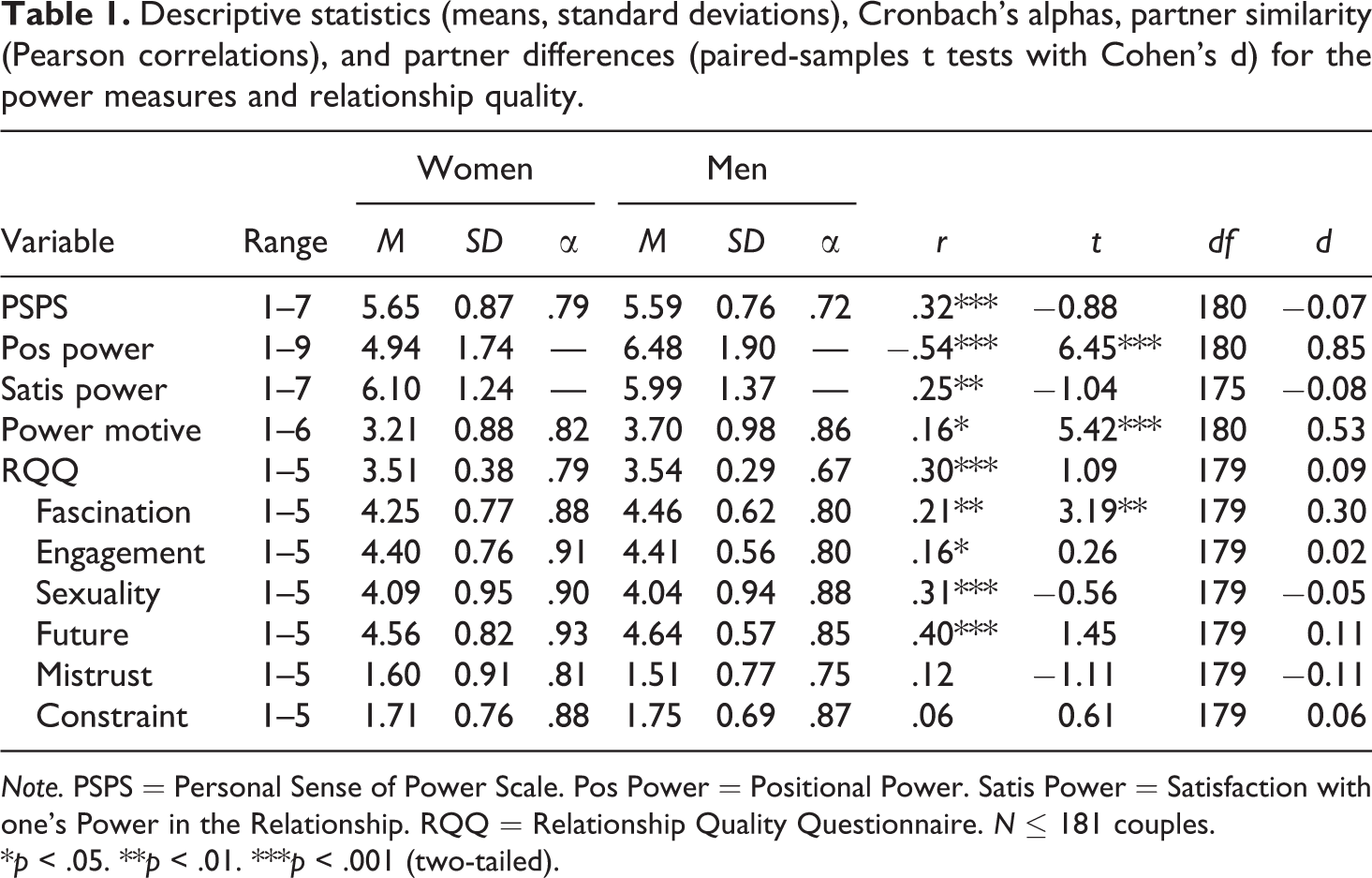
Note. PSPS = Personal Sense of Power Scale. Pos Power = Positional Power. Satis Power = Satisfaction with one’s Power in the Relationship. RQQ = Relationship Quality Questionnaire. N ≤ 181 couples.
*p < .05. **p < .01. ***p < .001 (two-tailed).
Satisfaction with power was measured with a single item: “How satisfied are you with the extent to which you influence decisions in your relationship?” Participants responded on a scale ranging from 1 (very dissatisfied) to 7 (very satisfied). 2
Positional power was calculated as an index of a person’s educational/occupational qualification and financial situation. Educational/occupational qualification was measured with nine response options pertaining to the German educational system. Reponses were given on a scale ranging from 1 (no academic/vocational qualification) to 9 (university-entrance diploma and master’s degree/diploma/PhD). Financial situation was measured on a scale ranging from 1 (I earn significantly less than my partner) to 5 (I earn significantly more than my partner). We performed a linear transformation of the 5-point scale that measures financial situation to obtain a 9-point response scale. Then, we computed the mean of the two items (educational/occupational qualification and financial situation) to create our index of positional power.
The short version of the Unified Motive Scales (UMS; Schönbrodt & Gerstenberg, 2012) was used to measure the power motive on a 6-point scale. We only presented the subscale (six items) on the desire to have an impact on others and the drive for status and prestige (e.g., “I like to have the final say”). A Cronbach’s alpha coefficient of .80 for the power subscale was reported and was comparable to the coefficients in the present study.
Relationship quality
The Relationship Quality Questionnaire (RQQ; Siffert & Bodenmann, 2010) consists of six subscales with a total of 26 items. Fascination measures admiration for and attraction to the partner (e.g., “I admire many things about my partner”). Commitment and investment in the relationship is captured by Engagement (e.g., “I invest in our relationship”). The Sexuality subscale addresses sexual fulfillment in the relationship (e.g., “I enjoy sex with my partner”). The duration and potential of the relationship is captured by the Future subscale (e.g., “I think that our relationship has a future”). Mistrust (e.g., “Sometimes I distrust my partner”) measures a lack of trust toward the partner. The experience of restrictions is captured by Constraint (e.g., “I feel restricted and confined by our partnership”). Answers were given on a scale ranging from 1 (disagree) to 5 (strongly agree). The authors reported Cronbach’s alpha values that ranged from .75 to .94 for the subscales and a value of .78 for the global score. In the present study, the Cronbach’s alpha values were similar (see Table 1).
Analytic strategy
First, paired-samples t tests and Pearson correlations were calculated to test for mean differences and partner similarities in the measured variables. Then, APIMs (Kenny et al., 2006) were computed to detect associations between the power measures and RQ. 3 The APIM accounts for the interdependence of predictor and outcome variables for the respondents and their partners. Actor effects are intrapersonal and describe associations between the predictor and outcome for the respondent. Partner effects are interpersonal and describe associations between the respondent’s predictor and the partners’ outcome (Kenny et al., 2006). Because of the dyadic nature of the data, the couple was the unit of analysis. Analyses were implemented in Mplus 7 (Muthén & Muthén, 1998–2012) using Maximum Likelihood estimation for the SEM framework. Bootstrapped 99% Confidence Intervals (k = 5,000 samples) were reported. The total score of the RQQ was modeled as a latent trait with the six subscales as indicators. Within the APIM analyses, we tested a saturated model (all effects freely estimated) against a nested equal-actor-equal-partner-effects model. The equal-effects model indicated the absence of sex effects and was favored when the Likelihood Ratio Test was nonsignificant (p < .20; Kenny & Ledermann, 2010; see OSF). When the saturated model was favored but the b coefficients were still very similar for men and women (difference < .10), we tested an equal-actor-different-partner-effects model and/or a different-actor-equal-partner-effects models against the saturated model. For the b coefficients, we chose a conservative criterion for statistical significance due to the multiple tests (p < .005, two-tailed). For the effect size, we calculated coefficient Δ following the procedure by Brauer and Proyer (2018; see also Proyer et al., 2019). Δ describes the change in the outcome (RQ) in standard deviations when the predictor (power measure) changes by 1 point. The coefficient was calculated separately for men and women (ΔF/M = b/SDF/M) because they had different variances on the outcomes.
Moreover, we tested for the influence of power balance (called similarity in the following) on RQ with the previously described APIM procedure for the total RQ score as the outcome (see Figure 1). We controlled for actor and partner effects on the respective power measure to obtain the unique contribution of similarity. Four new variables were computed in two steps. They represent power balances with respect to sense of power, satisfaction with power, positional power, and the power motive. First, we computed the absolute difference score for each power measure within the couple as is common practice in dissimilarity research (e.g., Brauer & Proyer, 2018; Chopik & Lucas, 2019; Dyrenforth et al., 2010). Then, in line with previous similarity research (e.g., Furler et al., 2013), we multiplied the absolute difference variables by –1. Thus, the new variables represent similarity instead of dissimilarity. Thus, higher b coefficients indicate that a balance of power (higher similarity) is related to higher RQ. For example, if people reported that they experienced higher power (e.g., a “7” on a response scale) than their partners (e.g., “3”), a large absolute difference score would result (“4”). Partners in other couples may report experiencing equal levels of power, and in such a case, the absolute difference would be zero. When the signs of these scores are reversed (“4” → “–4”; “0” → “0”), higher b coefficients in the APIM indicate higher RQ through the balance of power. As the cutoff for statistical significance, we chose p < .05 (two-tailed). All data and codes are on the OSF (https://osf.io/txyb9/).
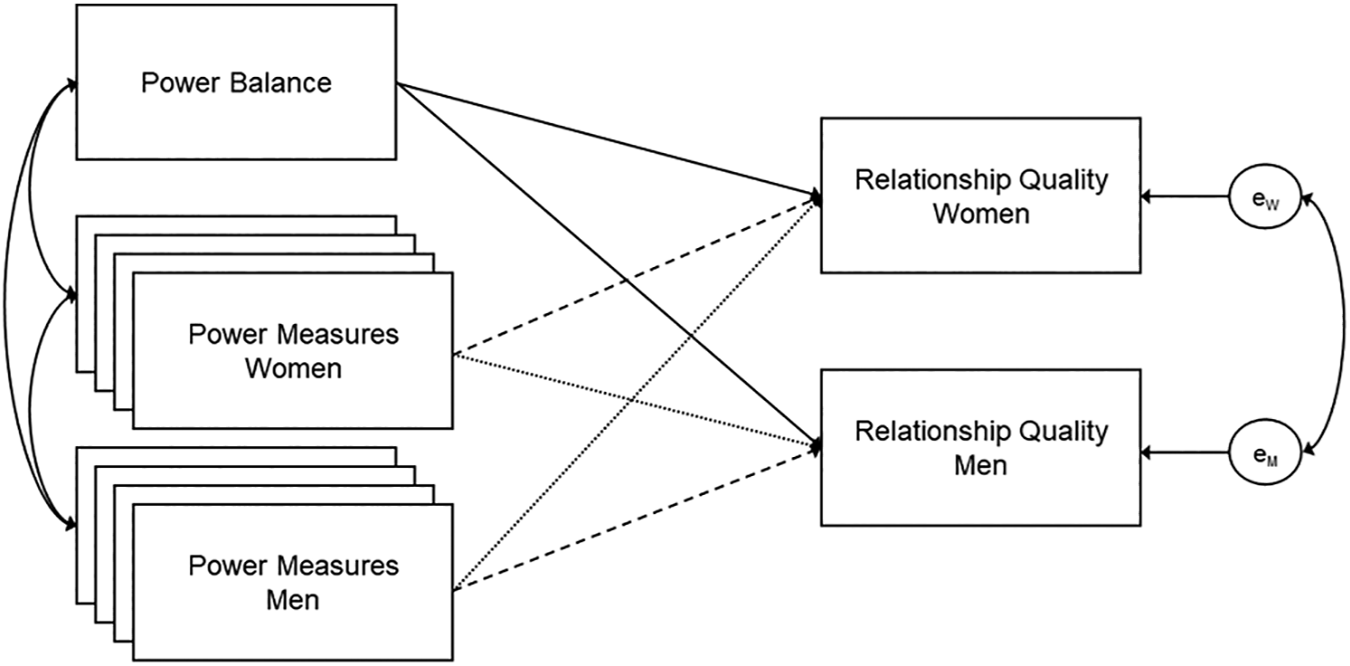
Model specification for the APIM estimating the effect of a balance of power on RQ, controlling for the respective power measure of both partners. Continuous arrows = Effects of a balance of power. Dashed arrows = actor effects. Dotted arrows = partner effects.
Results
Research question 1: Are contemporary romantic relationships characterized by a balance of power?
Descriptive statistics for all study variables are displayed in Table 1. Correlations between variables within and between partners can be found at https://osf.io/txyb9/. Men’s and women’s personal sense of power, r(180) = .32, as well as their satisfaction with power in the relationship, r(175) = .25, were positively correlated. Also, the power motive was slightly positively correlated within couples, r(180) = .16. Positional power was strongly negatively associated within couples, r(180) = −.54. Regarding partner differences, men reported a higher power motive (d = 0.53) and more positional power (d = 0.85) than women. No sex differences were found for experienced power (d = −0.07) and satisfaction with power (d = −0.08). Thus, the present sample was characterized by an imbalance of power regarding positional power with men having higher values but a balance of power regarding personal sense of power.
There were positive associations within the couple with respect to total RQ, r(179) = .30, and its dimensions, .06Constraint ≤ rs(179) ≤ .40Future. A significant difference was only found for Fascination: Men reported more Fascination with their partner than women did (d = 0.30).
Research question 2: How are power characteristics associated with RQ?
Personal sense of power
In line with the hypothesis, for actors, experienced power was significantly and positively associated with all facets of RQ (0.18 ≤ |bs| ≤ 0.37, 0.24 ≤ |ΔF| ≤ 0.56, 0.32 ≤ |ΔM| ≤ 0.54) and the total RQ score (b = 0.27, ΔF = 0.71, ΔM = 0.93). Only the association of women’s experienced power and the RQ dimension of Constraint (b = −0.20, p = .013) was not significant when we applied our conservative criterion of significance. Contrary to our hypothesis, partners’ RQ was also positively associated with actors’ experienced power for several dimensions (see Table 2). Partner effects that were independent of sex were found for Engagement (b = 0.18, ΔF = 0.24, ΔM = 0.32) and Future (b = 0.12, ΔF = 0.16, ΔM = 0.21). Men’s experienced power was positively associated with women’s Fascination (b = 0.26, ΔM = 0.42). The effect of women’s experienced power on men’s total RQ was not significant (b = 0.09, p = .012), but men’s experienced power had a positive significant effect on women’s total RQ (b = 0.21, ΔM = 0.72).
Results (unstandardized regression coefficients, bootstrapped 99% confidence intervals, standard errors, p-values for two-tailed Wald tests, effect sizes) of APIM analyses predicting relationship satisfaction from personal sense of power.
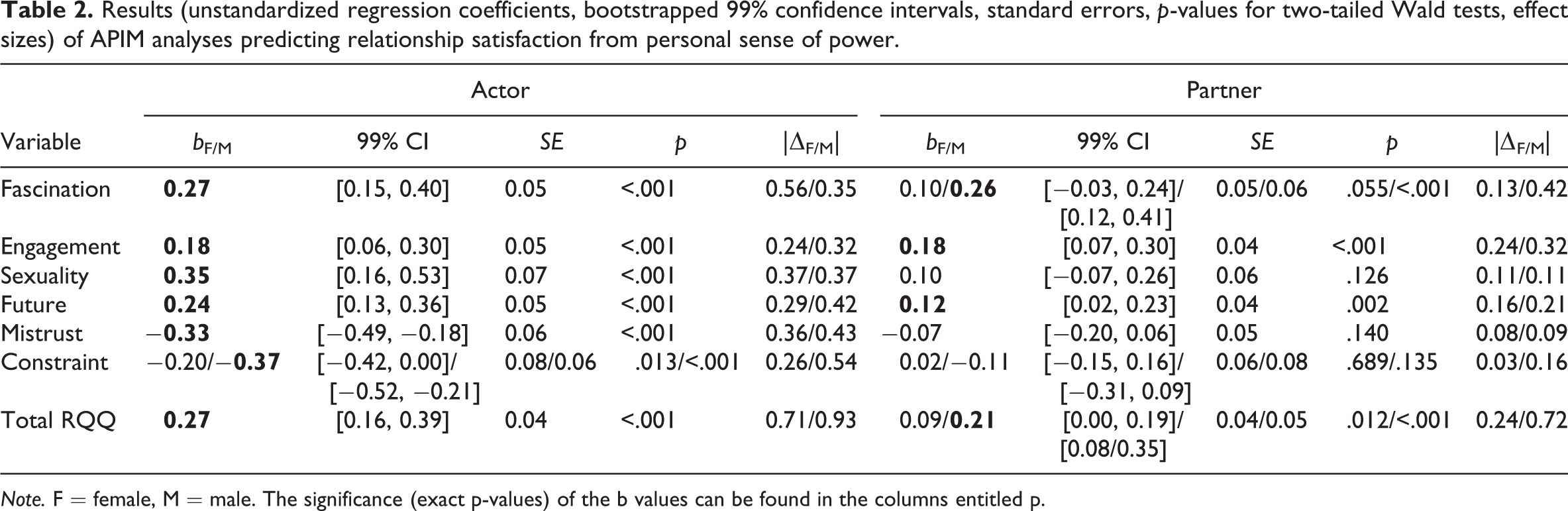
Note. F = female, M = male. The significance (exact p-values) of the b values can be found in the columns entitled p.
Positional power
There were neither significant actor (|bs| ≤ 0.09, ps ≥ .025) nor significant partner effects (|bs| ≤ 0.07, ps ≥ .053) between positional power and RQ (see Table 3). Only the associations between power and women’s Fascination (b = 0.09, ΔF = 0.12) and women’s and men’s Constraint (b = −0.06, ΔF = 0.08, ΔM = 0.09) for actors showed small effects but missed the cutoff for significance.
Results (unstandardized regression coefficients, bootstrapped 99% confidence intervals, standard errors, p-values for two-tailed Wald tests, effect sizes) of APIM analyses predicting relationship satisfaction from positional power.
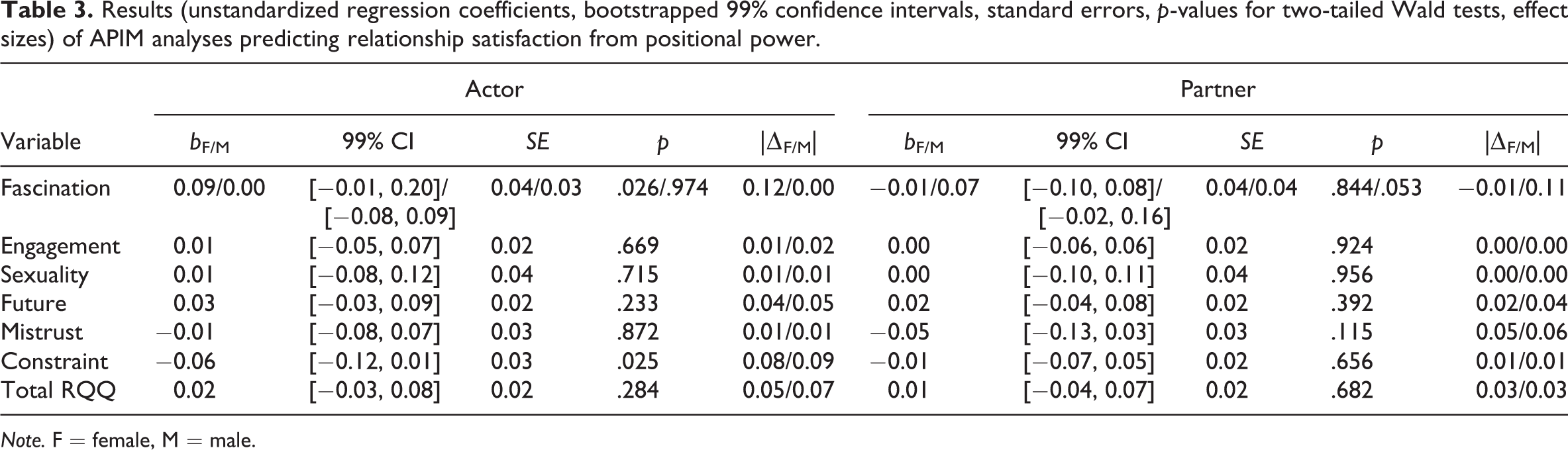
Note. F = female, M = male.
Satisfaction with power
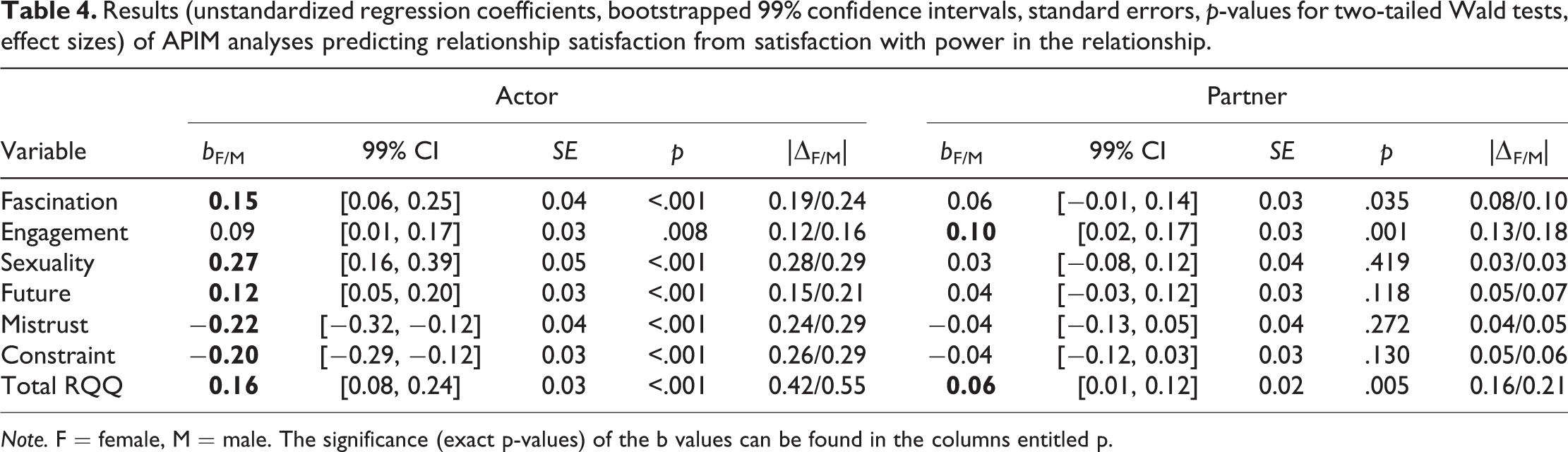
Consistent with our hypothesis, for actors, associations between satisfaction with power in the relationship and RQ were significant (see Table 4) and in the expected direction for five out of six RQ facets (0.12 ≤ |bs| ≤ 0.27, 0.15 ≤ |ΔF| ≤ 0.28, 0.21 ≤ |ΔM| ≤ 0.29) and the total RQ score (b = 0.16, ΔF = 0.42, ΔM = 0.55). Only for Engagement was the cutoff for statistical significance not met (b = 0.09, p = .008). As expected, total RQ was positively associated with partners’ satisfaction with power (b = 0.06, ΔF = 0.16, ΔM = 0.21). There was also a significant positive partner effect for Engagement (b = 0.10, ΔF = 0.13, ΔM = 0.18). All other partner effects were not statistically significant (|bs| ≤ 0.06, ps ≥ .035).
Results (unstandardized regression coefficients, bootstrapped 99% confidence intervals, standard errors, p-values for two-tailed Wald tests, effect sizes) of APIM analyses predicting relationship satisfaction from satisfaction with power in the relationship.
Note. F = female, M = male. The significance (exact p-values) of the b values can be found in the columns entitled p.
Power motive
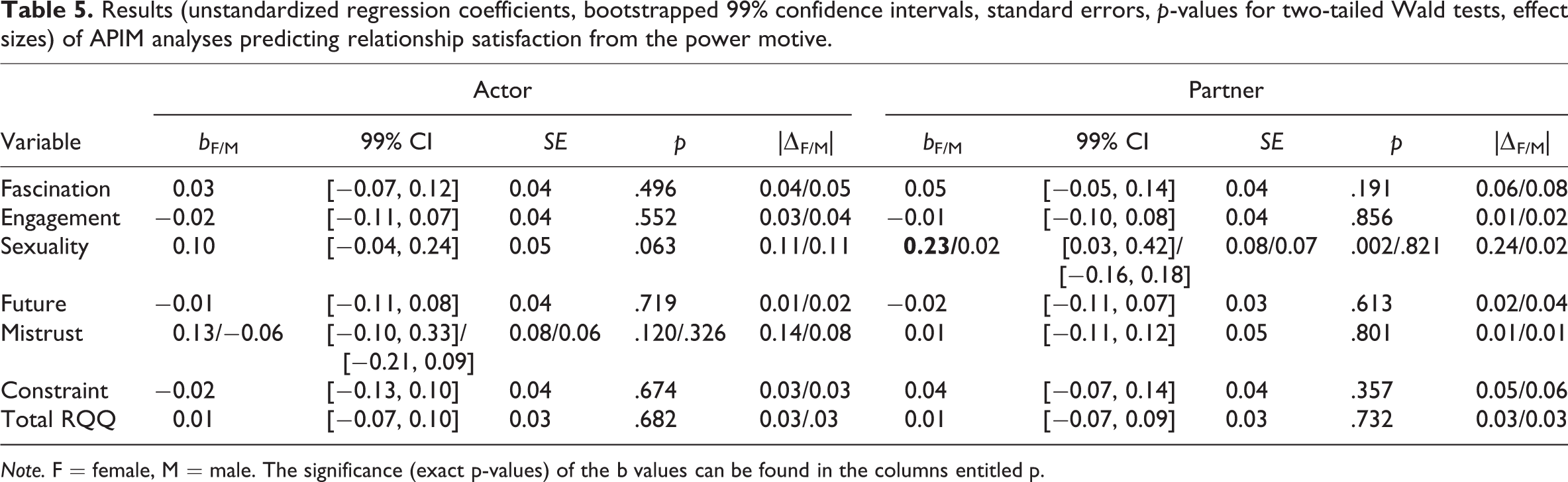
There was only one unexpectedly positive association between women’s power motive and men’s scores on Sexuality (b = 0.23, ΔF = 0.24). Contrary to our hypothesis, no significant actor (|bs| ≤ 0.13, ps ≥ .063) or partner effects (|bs| ≤ 0.05, ps ≥ .191) were found (see Table 5).
Results (unstandardized regression coefficients, bootstrapped 99% confidence intervals, standard errors, p-values for two-tailed Wald tests, effect sizes) of APIM analyses predicting relationship satisfaction from the power motive.
Note. F = female, M = male. The significance (exact p-values) of the b values can be found in the columns entitled p.
Balance of power
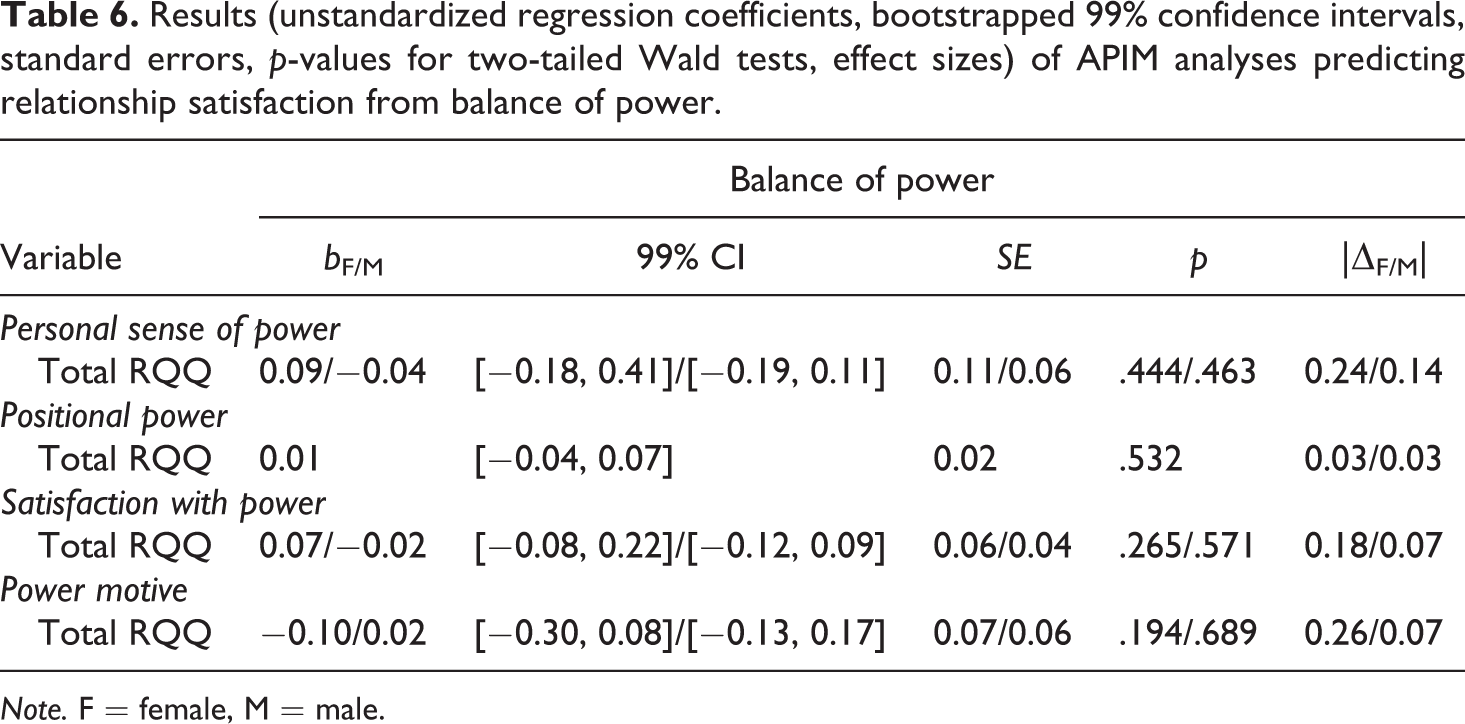
We tested the influence of a balance of power on the total RQ score (see Table 6). Surprisingly, we found no significant effects of a balance of power on total RQ for either power measure (0.01 ≤ |bs| ≤ 0.10, 0.03 ≤ |ΔF| ≤ 0.26, 0.03 ≤ |ΔM| ≤ 0.14).
Results (unstandardized regression coefficients, bootstrapped 99% confidence intervals, standard errors, p-values for two-tailed Wald tests, effect sizes) of APIM analyses predicting relationship satisfaction from balance of power.
Note. F = female, M = male.
Discussion
In this study, we investigated how partners in romantic heterosexual relationships perceive their power in the relationship and how satisfied they are with their power. Further, we asked for power motives and computed positional power on the basis of socioeconomic factors. Our first research question concerned the balance or imbalance of power in contemporary couples. The second research question dealt with the importance of power for relationship-related outcomes, which is why we analyzed the associations of various aspects of power with facets of RQ. Using APIM models, we tested for both actor and partner effects.
Balance of power
With respect to the first research question, as expected, a balance of power was found for personal sense of power. In most couples, the partners reported that they had a similar influence on and a similar say in decision-making. Further, both partners reported rather high experienced power, which means, on average, both individuals feel that they are able to get their way. How might this work? First, decisions are not necessarily a zero-sum game (Nalis et al., 2018). Second, individuals may seek influence in different aspects of the relationship, and each may have different realms that are especially important to them (Beach & Tesser, 1993). For example, she might want to decide where to go on vacation, whereas he may decide where to eat dinner. Thus, both partners can have their way in their respective domain, and this is why they can experience equal and high levels of power (McCormick et al., 1984; Sprecher, 1985). This idea also fits with positive associations between personal sense of power and satisfaction with power in the relationship and equal levels of satisfaction with power within couples.
Yet, with respect to positional power, an imbalance was observed. Men reported having significantly more positional power, operationalized as educational and occupational qualification as well as higher income, than women, a finding that is in line with national statistics and other studies: Despite the societal emphasis of more gender equality, women still have less positional power than men, there is still a gender pay gap, and men work in better paid jobs (Bergmann et al., 2019; Schwartz & Gonalons-Pons, 2016). Moreover, in our sample, the men were 2 years older than their partners on average. This enhanced men’s positional power as they had more years to complete a higher education and earn money. Finally, sex differences were also found for power motives. Overall, men pursued power more than women did, which is also in line with traditional gender roles (Diekman & Eagly, 2008).
Associations between power measures and RQ
Beyond merely testing whether there is a balance or imbalance of power in relationships, we were interested in understanding how both partners’ perceptions of power affect their own and their partners’ relationship-related outcomes. Regarding personal sense of power, there were the expected positive associations between actors’ power and the RQ dimensions Fascination, Engagement, Sexuality, Future, and Trust, as well as the total RQ score. Thus, experiencing power was associated with an overall positive evaluation of the romantic relationship. This is in line with research showing a link between personal power and positive evaluations in general (Anderson et al., 2012; Keltner et al., 2003; Kifer et al., 2013; Körner et al., 2019; Körner & Schütz, 2021). Only women’s sense of power was not associated with the RQ dimension Constraint, which suggests that their feeling of being in power is not related to feeling constrained. Maybe it is other objective factors that are more relevant to the perception of feeling constrained. Contrary to the hypotheses, partner effects of personal sense of power on Engagement and Future were positive. Even though in past research, high power was found to be associated with a lack of emotional involvement and commitment to a relationship for both men and women (Sprecher et al., 2006), high power may have negative or positive consequences. For example, high power can also increase social responsibility (Overbeck & Park, 2001; Scholl, 2020), and thus, in the context of intimate relationships, it can lead to increased feelings of responsibility for the relationship. Therefore, the partner possessing less power may also perceive a long-term positive potential of the relationship and invest in the relationship. The effects of men’s personal sense of power on women’s Fascination and on women’s total RQ were also positive. As sense of power has also been shown to increase authenticity (Kraus et al., 2011; Neff & Suizzo, 2006), men reporting more sense of power and consequently expressing authenticity may be perceived as particularly fascinating by their partners.
Independent of their personal sense of power, many women in our sample were admired by their partners, and the partner effect of personal sense of power on total RQ was much stronger for men than it was for women. This means that the higher a man’s experienced power, the higher a woman’s RQ. Apparently, many women were more satisfied with the relationship when the partner felt that he is in charge, which is in line with traditional gender roles. Future research could explore changes over time or differences in different parts of the population.
For positional power, there were neither significant actor nor significant partner effects. The strongest sex-independent effect (although it still did not reach the cutoff for significance) was the actor effect for Constraint. This means that the higher someone’s socio-structural power was, the less restricted the individual felt in the relationship. Yet, objective power characteristics were not associated with RQ. An explanation for this finding may be found in the following reasoning: When women out-earned their partners, decision-making still often remained unchanged (Tichenor, 2005), suggesting that financial resources will be less likely to influence relationship variables than the actual sense of power in that very relationship. Further, income has a weaker effect on relationship outcomes today than it did in the past (Schwartz & Gonalons-Pons, 2016). Moreover, regarding the impact of positional power on satisfaction in relationships, past research has found positive and negative effects (Conger et al., 2010; Inesi et al., 2012; Vogler et al., 2008), and these effects may balance each other out.
With respect to satisfaction with power in the relationship, all actor effects were significant except for the effect on Engagement. The general positive effect makes sense as satisfaction with power was related to a personal sense of power and RQ. People who were satisfied with their decision-making ability in their romantic relationship were also satisfied with their overall RQ. Partner effects were found for Engagement and total RQ. Thus, when people were satisfied with their own level of power, their partners were also happier with the relationship and tended to invest more.
Regarding the power motive, there were no significant actor effects and only one significant association between women’s power motive and men’s Sexuality. Men reported more sexual fulfillment when women reported a strong power motive. This sex-dependent effect is in line with research showing that men’s power motive is associated with relationship dissatisfaction, whereas women’s power motive shows no such relation (Stewart & Rubin, 1976). Instead, women’s power motive was positively associated with frequency of sexual intercourse (Schultheiss et al., 2003) and with estradiol (Stanton & Edelstein, 2009)—a hormone increasing women’s sexual desire and behavior (Cappelletti & Wallen, 2016), which in turn may be related to men’s satisfaction with the couple’s sex life.
In addition to APIM analyses of absolute power characteristics on RQ, the similarity of the two partners on the power measures was analyzed and related to RQ. Surprisingly, no associations between the balance of power and total RQ were significant. This is contrary to past research that has suggested a positive link between balance of power and relationship-related outcomes (Aida & Falbo, 1991; Drigotas et al., 1999). Yet, past research did not control for individuals’ level of power, which is why the association between balance of power and relationship-related variables might have been overestimated (cf. Furler et al., 2013; Schröder-Abé & Schütz, 2011). This issue is also known as a “confounding of difference scores with their constituents,” and this is why researchers have recommended that main (actor, partner) effects (i.e., the absolute levels of the partners’ scores) be controlled for when testing for similarity (Dyrenforth et al., 2010; Griffin et al., 1999). Furthermore, our sample of romantic heterosexual couples was primarily characterized by a balance of power (for experienced power and satisfaction with power), which means that the sample was too homogeneous to find an effect. Overall, this result suggests that what matters for RQ is not the balance of power but rather the absolute power level. This may make sense because the feeling that one can act freely may be more important than the relative feeling of having a say.
Other techniques are also available for assessing similarity (power balance) effects. Researchers have used dyadic response surface analyses (Schönbrodt et al., 2018) or have computed profile similarity coefficients (Furr, 2008). However, response surface analyses would have produced many more coefficients than our APIM models, and thus, the results regarding our focal questions would not have been as clear, and multidimensional power measures (e.g., assessing different domains of experienced power) would have been useful if we had computed a test of profile similarity. We did not find similarity effects with our approach, but future research may address the issue with more heterogeneous samples, multidimensional measures, and some of the aforementioned techniques.
Limitations and future directions
In the present study, we used the general power motive because, to the best of our knowledge, there is no power motive measure that is specifically designed for romantic relationships (e.g., How important is the following statement for you, “Setting the tone in my romantic relationship”). Yet, the use of a valid and reliable measure of power motives regarding intimate relationships may uncover associations with RQ that were not found for the general power motive. In line with past research (Fox & Blanton, 1994; Greaves et al., 1995) the measure we used to assess positional power was based on objective power characteristics. However, the component regarding the financial situation was not completely objective. We had asked for relative earnings (i.e., who earns more within the couple) to avoid having too many missing values due to lack of responses. 4 Moreover, our index of objective power that was based on resources theory (Blood & Wolfe, 1960) and approach/inhibition theory (Keltner et al., 2003) does not contain subjective aspects (e.g., relational resources such as trust or attention; Safilios-Rothschild, 1976) because we aimed to employ a relatively objective indicator (i.e., positional power) that was related to the subjective experience of power (personal sense of power). Further, as different resources that impact the level of positional power may have different personal value for each partner, the value of (or the need for) these resources should also be measured in upcoming studies.
Several distinct power measures were used in this study. An additional differentiation could be made with respect to the domains in which power is exercised (Dunbar et al., 2016; Sagrestano et al., 1998). Steil and Weltman (1991) differentiated between four areas (e.g., household, childcare), and Beach and Tesser (1993) differentiated between 24 areas (e.g., how to spend free time, when to have sex, where to go on vacation) in which decision-making between men and women can differ. An appropriate measure may be the Relationship Power Inventory (Farrell et al., 2015), which includes 10 areas. Future research may test whether these areas moderate the effect of power on dimensions of RQ (i.e., Is less or more power in a specific field relevant to relationship quality in men or in women?). Our overall approach may also explain why, on average, both partners reported high experienced power—they may have power in aspects that are relevant to them. Another fruitful avenue would be to use behavioral power indicators (see Simpson et al., 2015, or Farrell et al., 2015, for discussions of this issue) when observing couples’ interactions and to contrast the effect of experienced power on RQ with the effect of observed levels of behavioral power on RQ. Furthermore, in future studies, outcomes other than RQ can be tested, and the effect of power in homosexual couples using APIM analyses can be investigated.
Even though the participants in our sample covered a broad age range, young couples were overrepresented. This point should be taken into consideration with respect to the generalizability of the results. Thus, a potential task for future research would be to test whether power has different effects on relationship functioning in younger and older couples. Further, as power has different connotations in different cultures (Hofstede, 2001; Schwartz, 1994), the findings might not be generalizable across cultures. They may apply to individualistic countries but could be different in collectivistic countries.
Moreover, we used self-report measures to assess power and RQ, and thus, social desirability may be an issue. Yet, we did not directly ask whether a relationship was unbalanced or whether someone had less power than their partner. Rather, we used the personal sense of power scale to assess an actor’s subjective decision-making ability and perceived influence without making comparisons. Thus, because our analyses were based on absolute scores, they may be less biased by social desirability. Further, Farrell et al. (2015) reported that their measure of subjective power in romantic relationships was unrelated to social desirability. A final limitation refers to the cross-sectional design of our study. To establish causality between power and RQ as well as other outcomes, longitudinal as well as experimental evidence will be essential.
Conclusion
Does power still matter in romantic relationships? To some extent. We found there was a balance of power with respect to personal sense of power and satisfaction with power. Both forms were strongly associated with several dimensions of and total RQ—but the balance of power seemed less important. Positional power and the power motive were higher in men than in women but were not associated with RQ. Apparently, in contemporary romantic relationships, formal aspects of power are less important to the partners than the perceived ability to make decisions and have an impact. The latter seems to be a crucial factor in people’s own RQ as well as their partners’—for both men and women.
Footnotes
Acknowledgments
The authors are grateful to Jane Zagorski for language editing. Further, we thank Kay Brauer for discussing with us important points of the analyses.
Ethics approval
All procedures performed in studies involving human participants were in accordance with the ethical standards of the institutional and/or national research committee and with the 1964 Helsinki declaration and its later amendments or comparable ethical standards. This article does not contain any studies with animals performed by any of the authors.
Funding
The author(s) disclosed receipt of the following financial support for the research, authorship, and/or publication of this article: This research was partly funded by a graduate scholarship granted by the state of Saxony-Anhalt, Germany, to Robert Körner. The source of funding had no involvement in the study design, data analysis, interpretation of data, writing, or decision to submit.
Informed consent
Informed consent was obtained from all individual participants who were included in the study.
Open research statement
As part of IARR’s encouragement of open research practices, the authors have provided the following information: This research was not pre-registered. The data used in the research can be publicly posted. The data and analysis code can be obtained at:  . The materials used in the research cannot be publicly shared but are available upon request via email.