




Abstract
People low in self-esteem are likely more vulnerable to the wellbeing costs of relationship dissolution. Yet, several methodological limitations may mean that prior studies have overestimated such vulnerability. Overcoming prior limitations, we apply propensity score matching (PSM) to compare the later wellbeing of matched samples who experienced a dissolution over the past year (N = 1,333) versus remained in a romantic relationship (N = 1,333). Controlling for pre-dissolution wellbeing, people who experienced a dissolution reported lower later wellbeing compared to people who remained in a relationship. Although this pattern was more pronounced for people initially lower in self-esteem, the relative effects were small. Using PSM to provide stringent tests of the wellbeing effects of dissolution reveals a general resilience when experiencing dissolution and indicates that the vulnerability of low self-esteem may be smaller than assumed. Acknowledging the strengths and limitations of the PSM approach, we consider theoretical and methodological implications.
Romantic relationships are a central source of happiness and satisfaction (Proulx et al., 2007), making relationship loss a risk to long-term wellbeing (Amato, 2000; Rhoades et al., 2011). Yet, some people are likely to be more vulnerable to the potential wellbeing costs of relationship dissolutions, and other people more resilient. In the current study, we matched samples of people who experienced a breakup over the past year vs. those who remained in a romantic relationship to examine whether lower vs. higher levels of self-esteem predicted poorer vs. more resilient wellbeing after experiencing dissolution.
Relationship dissolution, self-esteem, and wellbeing
High-quality relationships fulfill fundamental needs (e.g., intimacy, support, belonging), and thus being involved in a stable romantic relationship predicts greater psychological and physical wellbeing (Braithwaite & Holt-Lunstad, 2017; Slatcher & Selcuk, 2017). Yet, relationship dissolutions are relatively common (e.g., Rhoades et al., 2011; Rosenfeld, 2015). Given the central role relationships play in fulfilling relatedness needs, experiencing a relationship dissolution is associated with greater psychological distress and depressive symptoms (Kim & McKenry, 2002; Sbarra et al., 2014), lower happiness and life satisfaction (Braithwaite et al., 2010; Gustavson et al., 2016), and a greater risk of psychological and physical health problems (Rhoades et al., 2011).
Although relationship dissolution constitutes a risk to wellbeing, people differ in how they experience and respond to dissolution (see Sbarra et al., 2015). One important characteristic that is likely to determine how people experience and respond to relationship dissolution is self-esteem. According to the sociometer theory, self-esteem indexes the degree to which individuals are accepted and valued by others (Leary & Baumeister, 2000; Leary et al., 1995). People who have been repeatedly rejected and socially devalued develop lower self-esteem (Denissen et al., 2008; Harter, 2003). As a result of negative interpersonal experiences, and subsequent beliefs that the self is not valued and won’t be in the future, people with lower self-esteem react more adversely to rejection and the loss of social acceptance (Leary & Baumeister, 2000). Such sensitivity to rejection and loss of acceptance likely means that people with low self-esteem are at a greater risk for poorer wellbeing following a loss of relationship bonds, such as relationship dissolution.
Past research does indicate that self-esteem predicts heightened distress after loss of social acceptance, including romantic rejection. For example, undergraduate students lower in self-esteem respond more negatively to experimentally induced rejection (Nezlek et al., 1997), and evaluate themselves more negatively after being primed with rejection-related words (Sommer & Baumeister, 2002), and exhibit greater distress after imagining romantic rejection (Waller & MacDonald, 2010). Regarding dissolution in particular, students lower in self-esteem who experienced a recent breakup (<6 months ago) retrospectively rated the breakup as more stressful and experienced more current adjustment problems (Frazier & Cook, 1993). Lower self-esteem has also been associated with greater emotional distress in samples of divorced/divorcing women (Barron, 1987) and undergraduate students who recently experienced a break-up (Waller & MacDonald, 2010).
Overcoming limitations of prior research using propensity score matching
Given the strong theoretical foundation (Leary & Baumeister, 2000) and the role of self-esteem in relationship processes (Murray et al., 2006), it may appear that the literature has provided definitive evidence that low self-esteem is a vulnerability for the wellbeing risks of relationship dissolutions. Yet, the intuitive appeal of the moderating role of self-esteem on wellbeing following dissolution is not matched by a strong evidentiary basis. Instead, the current evidence suffers several important limitations that limit understanding of the presence, size, and generalizability of the effect of self-esteem on wellbeing following dissolution. First, although experimental studies show that self-esteem moderates immediate responses to manipulated rejection (Nezlek et al., 1997; Sommer & Baumeister, 2002), these studies are uninformative about how people respond to relationship dissolution or whether any immediate reactions to manipulated rejection extend to the impact of real-life dissolution on wellbeing over the medium/long-term.
Second, examining the effects of dissolution by asking participants to recall past dissolutions (N = 85, Frazier & Cook, 1993) or imagine future relationship dissolutions (N = 190, Waller & MacDonald, 2010) may lead to inaccurate conclusions due to recall and forecasting biases. With regard to recall, memories of prior events are biased by people’s current wellbeing (e.g., Chang et al., 2018; Safer et al., 2001); hence, reports of prior dissolutions may overestimate the effect of dissolution, especially for those who already feel worse about themselves or experience lower wellbeing. Similarly, people tend to expect future emotional events will cause greater distress than they actually do (Wilson & Gilbert, 2003). For example, comparisons of predicted versus actual distress following a relationship breakup have shown that undergraduate students overestimate how distressing breakups will be (Eastwick et al., 2008). Importantly, such overestimation biases are likely to be amplified for people low in self-esteem who more readily expect, perceive, and overreact to social rejection (Ayduk et al., 2000; Dandeneau & Baldwin, 2004), perceive partners as more uncaring and rejecting than is warranted (Bellavia & Murray, 2003), and underestimate how much partners accept and value them (Murray et al., 2000). Thus, past findings showing that lower self-esteem predicts heightened distress/poorer wellbeing when recalling or imagining dissolutions may be, at least in part, due to more negative biases.
Third, strong assessments of the effects of dissolution need to account for the fact that wellbeing declines before relationship dissolution occurs (see Johnson et al., 2020). Although low self-esteem is associated with lower wellbeing for people who have recently experienced divorce or dissolution (N = 36; Barron, 1987; N = 66; Waller & MacDonald, 2010), by not accounting for pre-breakup wellbeing, these studies may simply be capturing lower rates of wellbeing before any dissolution occurred. Fourth, just as low self-esteem is associated with poorer wellbeing in general (Orth et al., 2012), other factors that are related to both self-esteem and dissolution could potentially explain any predictive effects of self-esteem in prior studies. For example, low self-esteem is associated with poorer relationship satisfaction (Erol & Orth, 2014) and neuroticism (Robins et al., 2001), which are also associated with reactions to dissolution (Rhoades et al., 2011; Tavares & Aassve, 2013). Isolating the effects of self-esteem requires accounting for these confounding variables, which past studies have not done.
Lastly, as the sample sizes noted in the references above highlight (Ns range 36–190), prior research has predominantly relied on small, non-representative samples (undergraduates, divorcees) that limit generalisability. Given that relationship closeness and length both predict more distress/lower wellbeing following relationship dissolution (Fine & Sacher, 1997; Simpson, 1987) research relying on undergraduate samples may not generalize to different populations or more serious, longer-term, relationships. Moreover, the intensity and impact of divorce may not generalize to non-marital dissolution (Sbarra et al., 2015), and examining the effects of non-marital relationship dissolution in non-student samples is important given declining rates of marriage (and divorce) in the western world (see Rotz, 2016).
In the current research, we overcome these five important limitations. We assess the effect of real-life relationship dissolution and remove any potential recall or forecasting biases by examining wellbeing before and after a dissolution occurred. We account for the fact that wellbeing declines before relationship dissolution (Johnson et al., 2020) by controlling for pre-dissolution wellbeing when testing whether self-esteem assessed before dissolution predicts later wellbeing following a dissolution. To provide stronger evidence that any effects are due to self-esteem and relationship dissolution, rather than a range of third variables associated with self-esteem and the risk of dissolution (e.g., lower wellbeing, poorer quality relationships, neuroticism), we use propensity score matching (PSM) to match participants who are similar across a range of relevant confounds but differ in whether they experienced dissolution vs remained in their relationship (Austin, 2011; Stuart, 2010). To test the effect of dissolution on wellbeing, we compare the wellbeing of participants who experienced relationship dissolution with matched participants who remained in their relationships, and we test whether the effect of dissolution was greater for participants who had lower self-esteem before the dissolution. This technique approximates the conditions of a randomized controlled experiment as any differences in later wellbeing across groups—those who experienced dissolution vs. remained in their relationship—can be more confidently attributed to dissolution and lower initial self-esteem, given that pre-existing differences in confounding variables have been eliminated. Finally, we extend prior research that has relied on small, non-representative samples, by using a nationally representative panel study sample of people aged 18–78 involved in different kinds of relationships (married, cohabiting, committed partnerships) to identify 1,333 people who experienced a dissolution compared to 1,333 matched people who did not.
The current research
Our primary aim was to test whether the risk of relationship dissolution on wellbeing is greater for people who have lower self-esteem while overcoming limitations found in prior studies that limit understanding of the size and generalizability of the moderating effect of self-esteem. To do this we utilized data from a large national probability sample of New Zealand adults who reported on their relationship status, wellbeing, and self-esteem annually. We identified people who had been in a relationship at an initial time point and then reported being single a year later, and thus had experienced a relationship dissolution (N = 1,333). We then used PSM to match these participants with a group who reported being in the same relationship across both time points (N = 1,333). Controlling for initial wellbeing, we tested whether people who had experienced a relationship dissolution vs. those who remained in a relationship reported lower wellbeing 1-year later, and we tested whether the lower wellbeing reported by participants who had experienced a relationship dissolution (vs. those who remained in a relationship) was greater for people initially lower (vs. higher) in self-esteem.
Method
Procedure and participants
Sampling procedure
The data were drawn from waves 1–9 (2009–2018) of the New Zealand Attitudes and Values Study (NZAVS), a large multiyear study based on a national probability sample of New Zealand (NZ) adults (30,000+ participants; see Sibley, 2014, Ethics approval 014889). Participants were posted a copy of the survey or e-mailed and invited to complete an online version. See Sibley (2018a) for further details. 1
Identifying relationship dissolutions
At each time point, participants responded to the question “Do you have a romantic partner” (yes/ no). If at one time point participants responded “yes” (coded 1), and at the consecutive time point indicated “no” (coded as 0), this indicated a relationship dissolution had occurred over the last year. For participants who reported being in a committed relationship at both timepoints (i.e. coded 1 across consecutive time points), we specified that their relationship length had to be longer than 1.5 years (i.e. longer than the year between measurements) to safeguard against the possibility of drawing data from people who had ended one relationship and started another within 1 year. 2 We used this procedure to calculate relationship dissolutions across waves 1–9 of the NZAVS (see OSM for example syntax). Due to the number of dissolutions, attrition, and imbalanced data points across participants, it was not feasible to conduct analyses modeling multiple relationship transitions, and with no information about prior relationship transitions, we drew the first dissolution to minimize the impact of multiple breakups on the results. So, we drew data from the first relationship dissolution that occurred, or if no dissolution occurred, from the first pair of waves in which people remained in the same relationship. Accordingly, participants who reported being in a relationship at one time point and single the next (i.e., experienced a relationship dissolution) were compared with participants who reported being in the same relationship across consecutive time points (i.e. remained in a relationship).
We extracted self-esteem and personal wellbeing, demographics, relationship-related variables (relationship status, length, and satisfaction, and social support), personality traits (the Big 6), and demographics (age, gender, socioeconomic status, ethnicity) at the pre-time point (before any dissolution occurred) and at the post-time point (after any dissolution occurred), as well as the year the pre-wave data was drawn. Thus, the sample of pre/post data was distributed across the nine chronological years the study had been running (e.g., data for one participant may be drawn from waves 2009–2010, whereas another participant data may be drawn from waves 2015–2016). This data generation strategy allowed us to gather the largest data set possible for the current tests.
Propensity score matching (PSM)
We used the built-in one-to-one propensity score function in SPSS 26 (see Thoemmes, 2012), which matched participants whose relationship dissolved (N = 1,406) to participants who remained in a romantic relationship (initial sample N = 16,295) via an estimated propensity score (see Sibley et al., 2020). This method allowed us to match participants who initially rated similarly across the range of meaningful covariate or confounding variables but differed in whether they experienced a dissolution (vs. remained in a relationship) across the following year.
We included variables in the PSM that were important to control for given their likely association with the occurrence of and/or the outcomes associated with relationship dissolution (see OSM for matching variables list). We matched participants on initial levels of self-esteem and personal wellbeing, ensuring that participants were similar across these focal variables before any relationship dissolution occurred (Austin, 2011; Stuart, 2010). We also matched on relationship-related variables, including relationship status, length, satisfaction, and social support given that (1) self-esteem is associated with less satisfying and shorter-term relationships (Erol & Orth, 2014; Orth et al., 2012) and smaller, lower-quality support networks (Kincaid & Caldwell, 1995; Marshall et al., 2014), and (2) people are more negatively affected by the dissolution of longer, more satisfying relationships (Simpson, 1987), and greater social support buffers against these negative effects (Amato, 2000). We matched on personality traits as self-esteem is associated with neuroticism and extraversion (Robins et al., 2001), and there is some evidence that personality influences responses to dissolution (e.g., more agreeable undergraduates report more personal growth, greater neuroticism predicts greater distress, Tashiro & Frazier, 2003; Tavares & Aassve, 2013). Lastly, following PSM conventions, we matched on demographics (age, gender, ethnicity, and year of data collection) to account for established gender (Stronge et al., 2019) and ethnic differences in wellbeing (i.e., indigenous people of New Zealand [Māori] experience lower wellbeing than Europeans, see Sibley et al., 2011, and OSM).
We aimed to produce close matches and maximize our sample size across groups. Given the large sample of people who remained together and our one-to-one matching strategy, we set our matching tolerance to .1 (range 0–1, smaller values produce closer matches, but decrease the number of matched cases). 3 This means the maximum propensity-score distance between matches was restricted to .1 SDs of the logit of the propensity score (Austin, 2011). The matching procedure yielded 1,333 matches; 73 participants who experienced a dissolution could not be matched due to missing data across the matching variables. The final matched sample size was 2,666: 1,333 participants who experienced a breakup were matched with 1,333 participants who remained in a relationship.
Measures
Measures were embedded within the larger NZAVS battery (see Sibley, 2018b).
Self-esteem
Three statements adapted from Rosenberg’s (1965) Self-Esteem Scale were averaged (α = .78): “On the whole, I am satisfied with myself,” “I take a positive attitude toward myself,” “I am inclined to feel that I am a failure” (reverse coded; 1 = very inaccurate, 7 = very accurate).
Wellbeing
The NZAVS includes two indicators of subjective wellbeing that have been previously used to examine the effects of relationship status on wellbeing (Girme et al., 2016). Participants rated 4 items indicating how satisfied they were with their “standard of living,” “health,” “future security,” and “personal relationships” (0 = completely dissatisfied, 10 = completely satisfied; Cummins et al., 2003) and 2 items referencing life satisfaction “I am satisfied with my life” and “In most ways my life is close to ideal” (1 = strongly disagree, 7 = strongly agree; Diener et al., 1985). As in prior work (Girme et al., 2016), these scales were highly correlated at both time points (rs > .68) and were combined to create an overall wellbeing score by converting all items to a 1–7 scale and averaging the items (αs > .82). The same results emerged when modeling the two indicators separately (see OSM).
Relationship-related variables
Relationship Status was assessed by asking “What is your relationship status?”: “single,” “married,” “de-facto,” 4 “civil union,” “widowed,” “living together” (see OSM). Of the matched sample, 52.3% were “Married,” 31.4% were categorized as having a “partner/committed/relationship,” 15.4% “De-facto Relationship,” 0.7% “Engaged” and 0.2% “Civil Partnership.” Relationship Length was assessed by asking “If you are in a relationship, how long have you been with your partner?” (years and months were combined to a score in years). Relationship Satisfaction was assessed by asking “How satisfied are you with your relationship with your partner?” (1 = not at all satisfied, 7 = very satisfied). Social support was assessed by averaging 3 items (α = .80) adapted from Cutrona and Russell (1987): “There are people I can depend on to help me if I really need it,” “There is no one I can turn to for guidance in times of stress” (reverse-coded), “I know there are people I can turn to when I need help” (1 = very inaccurate, 7 = very accurate).
Personality
The NZAVS includes the 24-Mini-IPIP 6 Personality Scale, including 20-items developed by Goldberg (1999) and 4 additional items indexing Honesty-Humility (Sibley, 2012). The 4 items assessing each trait were averaged: Extraversion (α = .74), Agreeableness (α = .70), Openness to Experience (α = .70), Neuroticism (α = .71), Conscientiousness (α = .67), and Honestly-Humility (α = .77).
Demographics
Participants indicated their date of birth, which was used to calculate age. In the first five waves (years 2009–2014), gender was measured using a single dichotomous variable (e.g. “Are you male or female?”) and participants ticked one of two boxes. The gender identity measures were updated to an open-ended item (e.g. “What is your gender?”) from the sixth wave (2014/2015) and were coded as men, women, transgender, nonbinary, unsure, or outside the scope. Our need to maximize potential matches meant only those coded as men or women were included in the model (0.3% of participants in the NZAVS identify as gender diverse; Greaves et al., 2017). Participants were asked which ethnic group they identify with; analyses included codes for the minority groups “Māori” (0 = no, 1 = yes), “Pasifika” (0 = no, 1 = yes), and “Asian” (0 = no, 1 = yes) with the reference group representing the NZ Pakeha/European majority.
Results
Table 1 presents the descriptive statistics on all covariate, predictor, and outcome variables. The mean differences across groups of people who remained in a relationship and experienced relationship dissolution tests whether there were differences across subsamples before (left side of Table 1) and after (right side) matching participants via PSM. Large differences were present across samples of people who remained in a relationship and experienced relationship dissolution before PSM occurred, but these differences were reduced after PSM (compare Mean Differences across Groups columns before and after PSM). Few differences across subsamples remained after PSM; at the initial time point, people who experienced relationship dissolution in the following year (vs. remained in a relationship) were less satisfied in their relationship, involved in that relationship for a shorter time, more open to experience, and slightly older (also see Table 2). Importantly, there were no differences in the predictor and outcome variables after PSM, and additional analyses accounting for the few differences that remained did not change the results (reported below).
Means and variances across groups who remained in a relationship (coded as 0) versus experienced a relationship dissolution across the following year before and after propensity score matching.
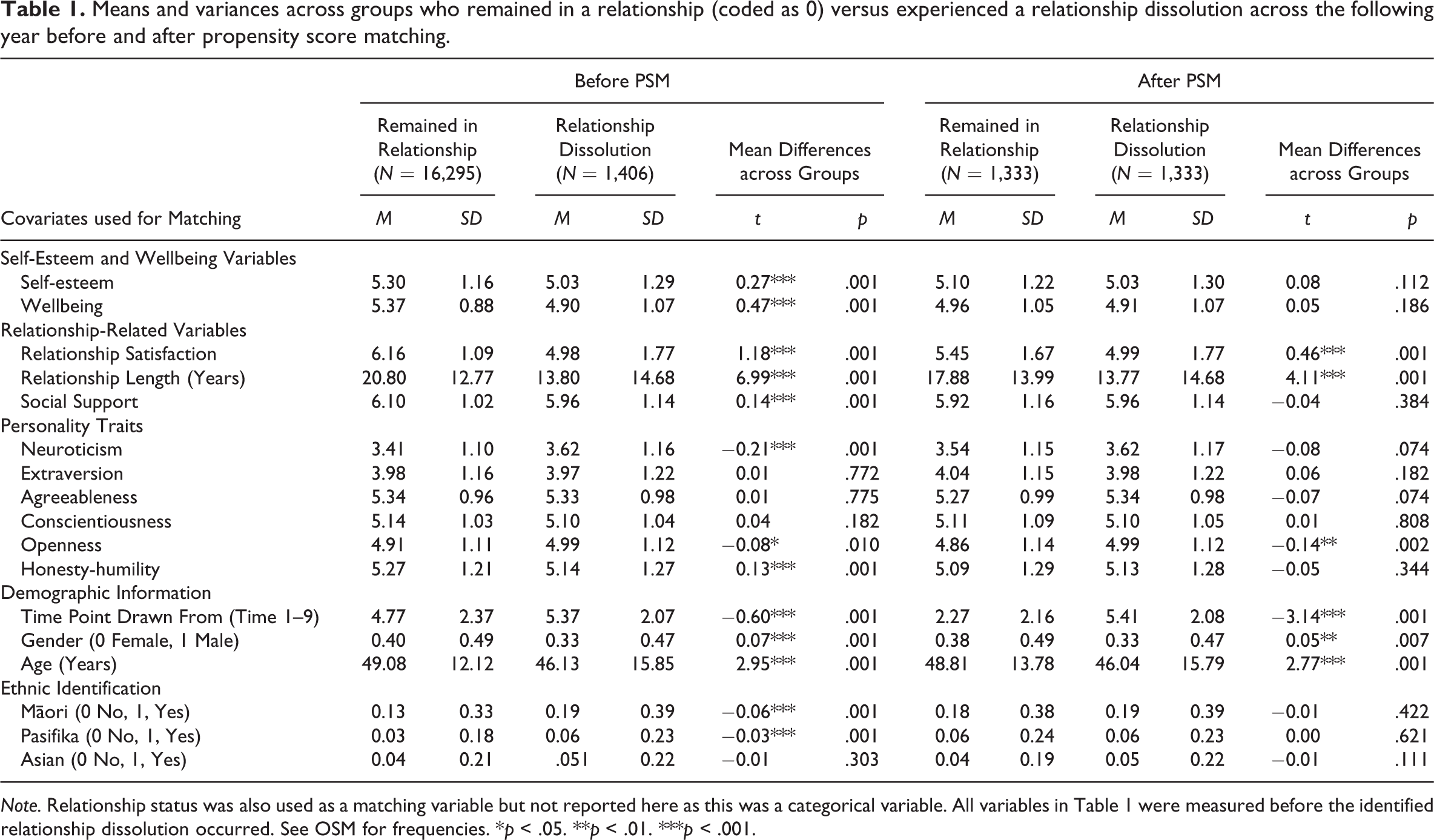
Note. Relationship status was also used as a matching variable but not reported here as this was a categorical variable. All variables in Table 1 were measured before the identified relationship dissolution occurred. See OSM for frequencies. *p < .05. **p < .01. ***p < .001.
Correlations across relationship dissolution and all measures collected at the initial time point for the matched sample.
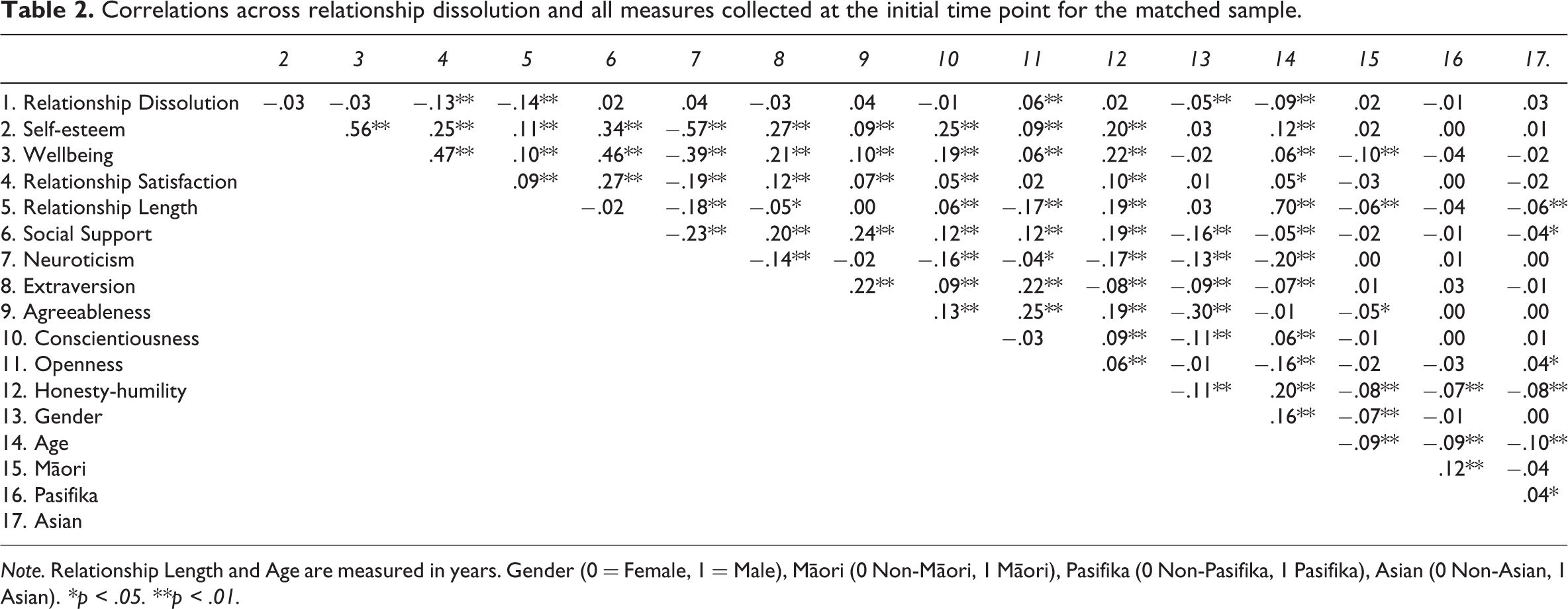
Note. Relationship Length and Age are measured in years. Gender (0 = Female, 1 = Male), Māori (0 Non-Māori, 1 Māori), Pasifika (0 Non-Pasifika, 1 Pasifika), Asian (0 Non-Asian, 1 Asian). *p < .05. **p < .01.
To estimate the effects of relationship dissolution on later wellbeing, we compared the wellbeing of matched samples experiencing a relationship dissolution vs. remaining in a relationship who were matched on self-esteem, wellbeing, relationship variables, personality, and demographic differences at Time 1 before the identified dissolution occurred. Using a hierarchal linear regression approach, we regressed wellbeing at Time 2 on initial levels of wellbeing at Time 1 (Step 1), relationship dissolution (0 = no, 1 = yes, Step 2), initial levels of self-esteem at Time 1, and the relationship dissolution x initial levels of self-esteem interaction (Step 3). Continuous predictors were grand mean-centered. As shown in Table 3, all regression models were significant, and each additional step explained a significant amount of added variance. Initial wellbeing strongly predicted greater later wellbeing (Step 1). Controlling for initial wellbeing, relationship dissolution (vs. remaining in a relationship) significantly predicted lower later wellbeing (Step 2). Comparing mean levels show that people who experienced a dissolution reported lower wellbeing (M = 4.74) compared to people who remained in a relationship (M = 5.02). Lastly, as shown in Step 3, initial self-esteem was associated with greater later wellbeing and moderated the degree to which experiencing a dissolution (vs. remaining in a relationship) predicted lower wellbeing.
Hierarchical linear regression testing the links between relationship dissolution and wellbeing, and the moderating effect of self-esteem on wellbeing.
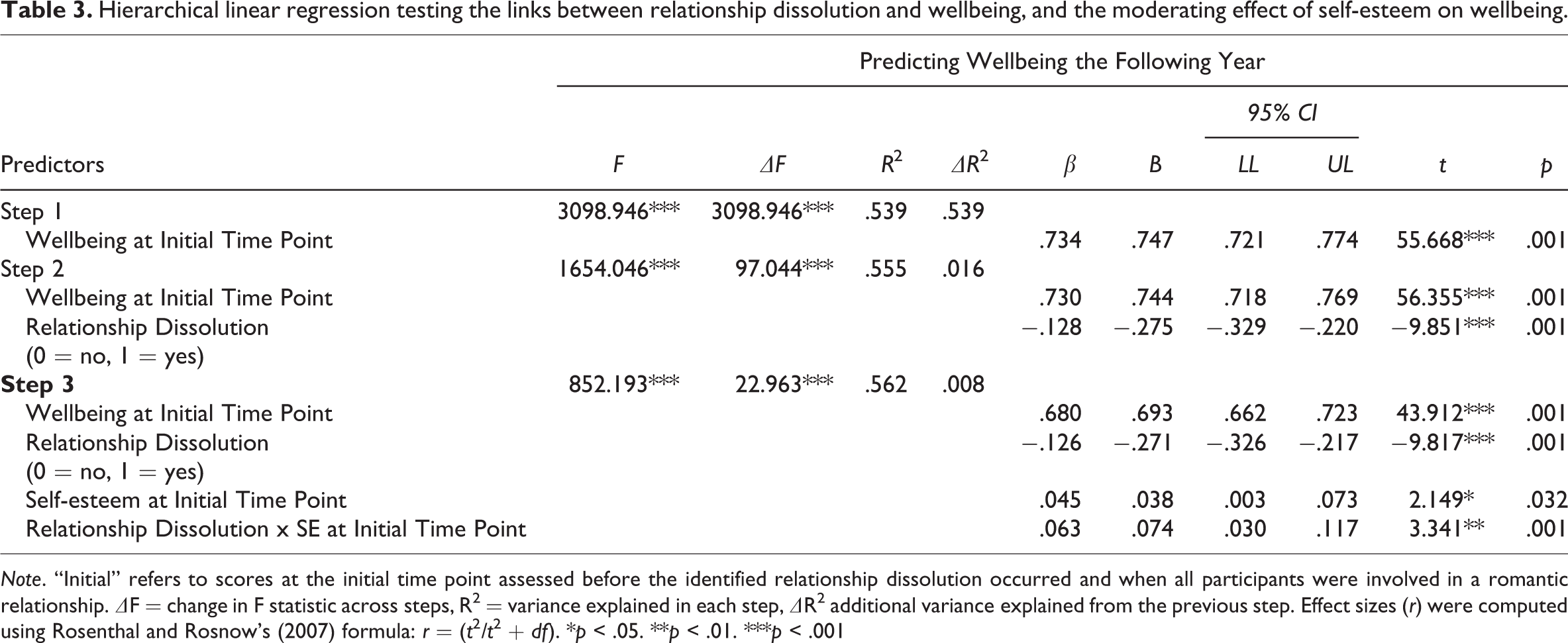
Note. “Initial” refers to scores at the initial time point assessed before the identified relationship dissolution occurred and when all participants were involved in a romantic relationship. ΔF = change in F statistic across steps, R2 = variance explained in each step, ΔR 2 additional variance explained from the previous step. Effect sizes (r) were computed using Rosenthal and Rosnow’s (2007) formula: r = (t 2 /t 2 + df). *p < .05. **p < .01. ***p < .001
To illustrate the relative effect of dissolution across levels of self-esteem, Figure 1 displays the effect of relationship dissolution (differences between the lines) across the full-scale range of self-esteem (M = 5.06, SD = 1.26) and wellbeing (M = 4.88, SD = 1.08). The N values on the y axis represent the number of people who fall within each 1-point range of self-esteem. The slopes illustrate that lower initial self-esteem predicted lower later wellbeing for those who remained in a relationship (grey slope = .04, t = 2.11, p = .035), but the negative effect of self-esteem on wellbeing was more pronounced for those who experienced dissolution (black slope = .11, t = 6.67, p < .001). As evident by the error bars, wellbeing was significantly lower for those whose relationships dissolved across all levels of self-esteem, but this effect was greater for those low in self-esteem (see left side of figure) and very small for people high in self-esteem (see right side of figure). Table 4 presents the effect sizes. Although the effect of relationship dissolution on wellbeing was relatively small, this relative resilience was not experienced by people with very low levels of self-esteem.
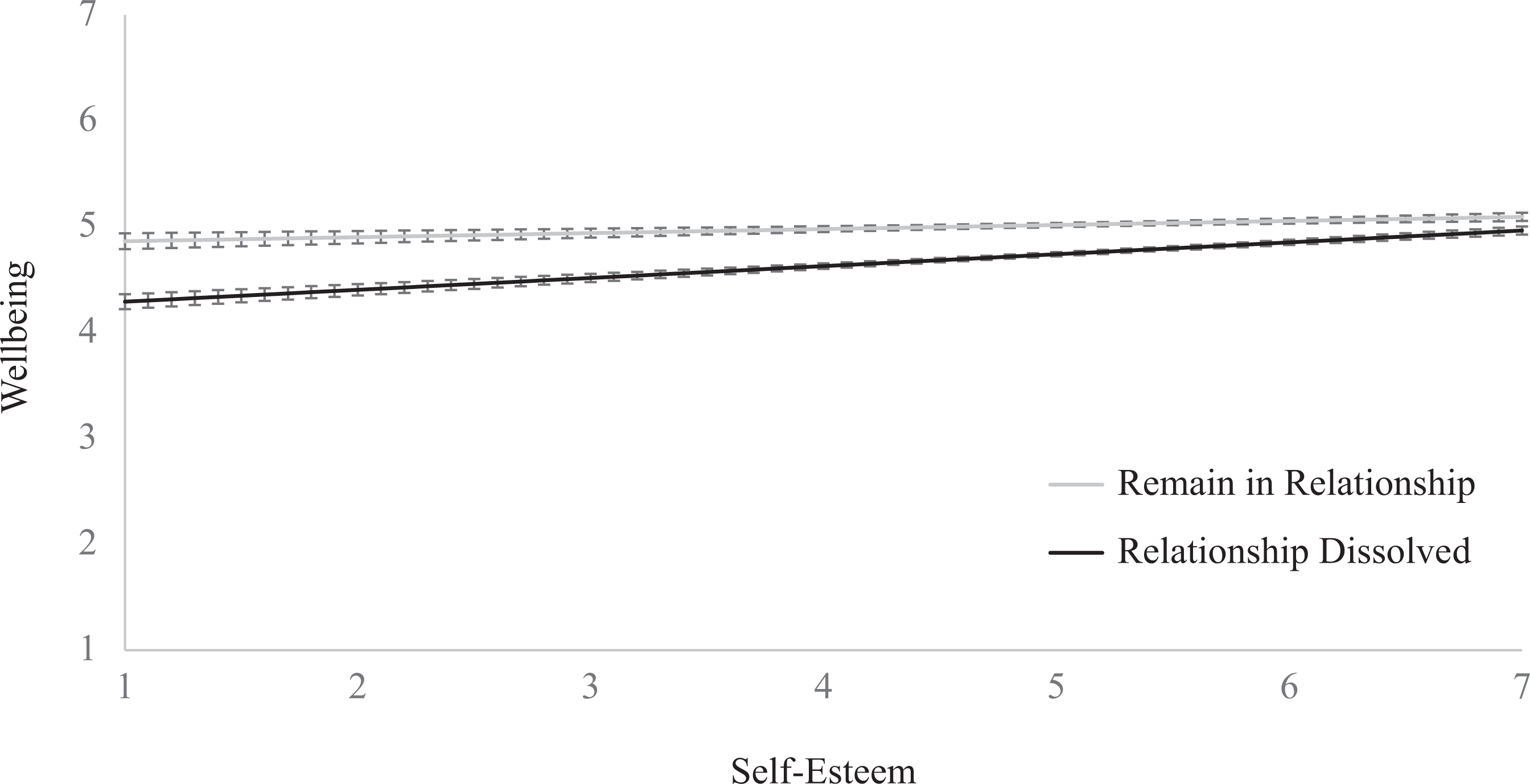
The moderating effect of initial levels of self-esteem (assessed at time 1) on the effect of relationship dissolution on wellbeing (assessed at time 2, controlling for wellbeing at time 1). Note. The effect of relationship dissolution (differences between lines) is presented across the full-scale range of self-esteem (M = 5.06, SD = 1.26) and wellbeing (M = 4.88, SD = 1.08) to illustrate the relative effect of dissolution across levels of self-esteem. The N values on the y axis represent the number of people who fall within each 1-point range of self-esteem. As shown by the error bars, wellbeing was significantly lower for those whose relationship dissolved across all levels of self-esteem, but this effect was greater for those low in self-esteem and very small for people high in self-esteem.
Effect of dissolution on later wellbeing at different values of self-esteem.
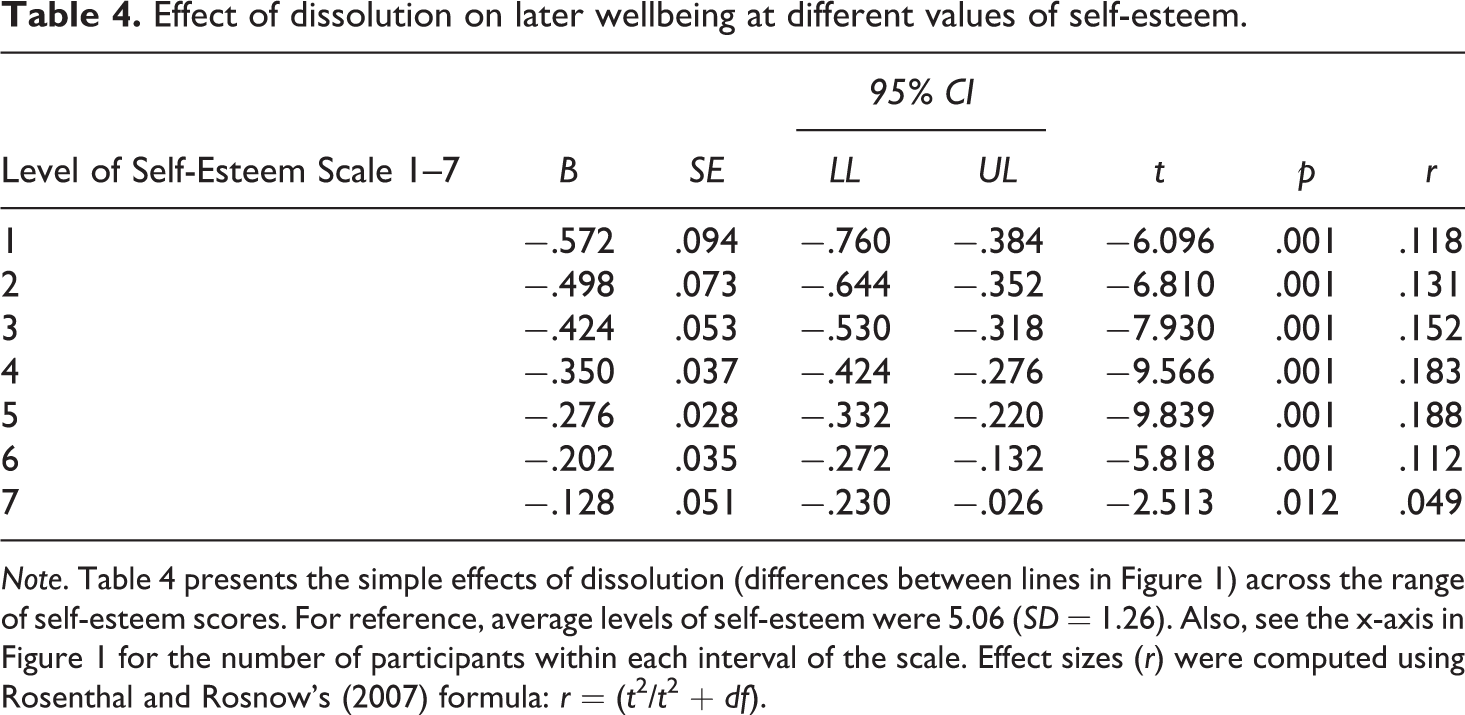
Note. Table 4 presents the simple effects of dissolution (differences between lines in Figure 1) across the range of self-esteem scores. For reference, average levels of self-esteem were 5.06 (SD = 1.26). Also, see the x-axis in Figure 1 for the number of participants within each interval of the scale. Effect sizes (r) were computed using Rosenthal and Rosnow’s (2007) formula: r = (t 2/t 2 + df).
A series of additional analyses tested whether alternative variables produced similar results and/or accounted for the moderating effect of self-esteem (see OSM for full results). First, we ran models equivalent to those displayed in Table 3 but replaced self-esteem with each covariate used in the matching procedure. Relationship satisfaction (B = −.06, CI [−.08, −.02], t = −2.98, p < .001) and neuroticism (B = −.05, CI [−.11, −.01], t = −2.49, p < .001) moderated the effect of relationship dissolution: the wellbeing risks of dissolution were greater for people who were initially in more satisfying relationships or were higher in neuroticism. However, simultaneously modeling the moderating effect of self-esteem and each alternative variable revealed that the moderating effect of low self-esteem on the association between dissolution and wellbeing was independent, and stronger, than the moderating effects of relationship satisfaction and neuroticism.
Second, rerunning the primary analyses controlling for the propensity score of relationship dissolution, which accounts for the propensity for people to breakup, did not alter the moderating effect of self-esteem shown in Figure 1 (B = .07, CI [.03, .12], t = 3.33, p < .001). We also conducted analyses treating the propensity score as a moderating variable. The propensity to experience relationship dissolution moderated the effect of relationship dissolution on wellbeing (B = .40, CI [.11, .69], t = 2.72, p < .01): those were less likely to experience a relationship dissolution experienced lower wellbeing if they did experience a dissolution, suggesting that more unlikely breakups may be more likely to undermine wellbeing (see SM10). Nonetheless, controlling for the moderating effect of the propensity score did not change the moderating effect of self-esteem in Figure 1.
Discussion
Social acceptance and loss are integral to key theoretical models of self-esteem (Leary & Baumeister, 2000) and self-esteem is one of the most studied individual difference variables assumed to affect the success of relationships (Cameron & Granger, 2019; Harris & Orth, 2020). It appears obvious, therefore, that low self-esteem should be a key vulnerability to the wellbeing risks of relationship dissolution. Yet, like many effects of self-esteem, there is not strong consistent evidence for this theoretical assumption (see Harris & Orth, 2020), with the relatively few studies examining whether self-esteem predicts wellbeing following dissolutions using small, non-representative samples with methods that do not assess real-life rejection or suffer from retrospective and forecasting biases, and fail to account for a range of confounding variables, including self-esteem and wellbeing before any dissolution occurred.
The current research leveraged data from a large nationally representative study to provide the strongest test to date of the role of self-esteem in moderating the effect of naturally occurring romantic relationship dissolutions on later wellbeing. Comparing the later wellbeing of matched samples who experienced a dissolution over the past year (N = 1,333) versus remained in a romantic relationship (N = 1,333) revealed that experiencing a dissolution was associated with lower later wellbeing, and this detrimental effect was greater for people initially lower (vs. higher) in self-esteem. However, the size of the effect of relationship dissolution and the relative differences across levels of self-esteem were small. These results indicate that most people, even those low in self-esteem, may be relatively resilient after experiencing dissolution, and the methodological limitations found in prior research may have overestimated the moderating role of low self-esteem on changes in wellbeing following real-life dissolutions. Next, we consider the implications of these results in understanding and examining the role self-esteem plays in modifying the wellbeing risks of social loss in light of both the strengths and limitations of the PSM approach.
Dissolution and low self-esteem as risk factors for poor wellbeing?
Investigations of relationship dissolution are increasingly employing rigorous methods to test how dissolution may affect later wellbeing, including using PSM to account for factors that increase the risk of dissolution and thus could be the cause of any wellbeing declines (e.g., Sbarra et al., 2014), modelling change in wellbeing before and after dissolution to account for the fact that wellbeing often declines before dissolution (e.g., Johnson et al., 2020), and using large samples that examine the loss of long-term relationships across diverse samples (e.g., Van Scheppingen & Leopold, 2019). Our data confirmed the importance of these factors. Before accounting for these differences via PSM, people lower in self-esteem and wellbeing were more likely to experience relationship dissolution, and lower self-esteem was associated with a range of factors that predicted a greater risk of dissolution and poorer wellbeing (e.g., less satisfying relationships, younger, poorer social support). These results provide new evidence supporting models that specify self-esteem is a key determinant of relationship success, especially given that a recent meta-analysis of prior studies (only 8 small samples assessing dissolution) found null effects between self-esteem and relationship stability (see Cameron & Granger, 2019). These initial effects also highlight that prior studies, which have not accounted for the fact that lower self-esteem is associated with a greater propensity to experience relationship dissolution, do not provide adequate tests that lead to appropriate conclusions.
Combining the rigorous approaches now commonly applied to understanding relationship dissolution, our PSM analysis also overcomes the range of other limitations of prior studies, including not assessing wellbeing and self-esteem before or after real-life dissolution, biased retrospective and forecasting methods, and failing to account for key confounding variables. Our results support prior theoretical and empirical work suggesting that low self-esteem represents a vulnerability to the wellbeing risk of dissolution, and show that these effects are not simply due to low self-esteem being associated with poorer wellbeing in general and/or negatively biased evaluations. The results also reveal the relative size of the effects of experiencing a relationship dissolution on later wellbeing (r at average levels of self-esteem = .188), and the relative effect sizes for people low versus high levels of self-esteem (see Figure 1 and Table 4), which suggest that the effect of dissolution for people who are low-to-average in self-esteem is small-to-medium (Funder & Ozer, 2019), but becomes very small for people high in self-esteem.
This pattern aligns with resilience perspectives arguing that most people have the capacity to adapt successfully to significant challenges (see Masten, 2018) and recover quickly from stressful events, including social loss (Bonanno et al., 2011). Given we assessed later wellbeing, rather than the distress experienced at the time of dissolution, the results may indicate people, on average, are relatively resilient and adjust across time (see Sbarra et al., 2015). Wellbeing differences will likely be larger immediately following dissolution. Nevertheless, even if small differences are the result of resilience or adjustment across time (Lee & Sbarra, 2013; Sbarra & Emery, 2005), the relative impact of dissolution should vary according to differences in individual vulnerabilities and strengths. Indeed, resilience was clearly evident for people high in self-esteem, but less so for people with lower-average levels of self-esteem.
The small-to-medium effect size of dissolution at low-to-average levels of self-esteem is likely to have explanatory and practical value (see Funder & Ozer, 2019). Indeed, even small differences in wellbeing across time are consequential given the important implications for psychological and physical health (Lau et al., 2005; Michalos, 2012), and that people face numerous events that affect, and may culminate to undermine, wellbeing. Lower wellbeing, and potential prolonged recovery, may also be compounded by dissolution reinforcing low self-worth (Luciano & Orth, 2017), and thus may accumulate across time. Moreover, not only do we expect the effects to be larger immediately following dissolution, because wellbeing declines before dissolution (Johnson et al., 2020; Van Scheppingen & Leopold, 2019), wellbeing may have already been lower at the initial time point. Thus, our analytic strategy offers a conservative test, which is a strength in testing predictions, but may result in conservative estimates of wellbeing differences. Finally, the strengths of examining a representative sample of adults may also obscure the potential that people at vulnerable life stages may experience greater wellbeing drops that interfere with development and recovery.
Additional caveats, future research directions, and implications
The strengths of drawing on a large survey study are accompanied by an inability to model the processes that account for why low versus high self-esteem are more vulnerable versus resilient, or the contexts in which these patterns are most likely to occur. We had no information regarding participants’ prior relationship dissolutions (see Footnote 2) or why people’s relationships ended (e.g., partner rejection vs own initiation), which likely contributes to the degree to which dissolution affects wellbeing. Regardless of the circumstances, people lower in self-esteem may attribute dissolution to rejection in ways that confirm beliefs of low self-worth (e.g., Leary et al., 1995). People with low self-esteem may also cope with dissolution in maladaptive ways, such as engaging in more rumination and emotion-focused coping (Kuster et al., 2012). Future tests of these processes will help identify ways to mitigate the wellbeing risks associated with low self-esteem.
We only assessed wellbeing across two time points. Modeling potential wellbeing declines before dissolution (e.g., Bleidorn et al., 2021) and assessing whether dissolution produces more enduring, long-term, changes in wellbeing (see Fraley et al., 2020) provides more detailed information about the size and time course of effects. This approach, however, requires large samples of participants who have completed multiple waves (≥3 time points) before and after dissolution (not available in this study) to examine relative wellbeing trajectories as people approach dissolution and live on following dissolution. Finally, although we matched participants on a large set of meaningful covariates, one study cannot account for all variables that might affect the occurrence or effects of relationship dissolution. Utilizing large datasets with a variety of theoretically-relevant measures (e.g. commitment) is important for future research. Nonetheless, this study offers a valuable example of how to increase evidence of the effects, and moderating factors, of an important life event wherein experimental designs are not feasible or ethical.
Using matched samples of people who experienced dissolution versus remained in a romantic relationship over the past year, our results advance evidence that the wellbeing risks of dissolution are greater for people lower in self-esteem. The results offer an important intervention target by identifying people who may be most vulnerable to this common, challenging life event. The results also suggest that enhancing and protecting self-esteem may help protect wellbeing in the face of relationship dissolution and other forms of social loss. Although there is no consensus regarding which strategies best promote self-esteem (see Vonk, 2006), the current findings emphasize why this should continue to be an important goal for social psychology and relationship science.
Supplemental material
Supplemental Material, sj-pdf-1-spr-10.1177_02654075211005843 - Does low self-esteem predict lower wellbeing following relationship dissolution?
Supplemental Material, sj-pdf-1-spr-10.1177_02654075211005843 for Does low self-esteem predict lower wellbeing following relationship dissolution? by Emily J. Cross, Nickola C. Overall, Shanuki D. Jayamaha and Chris G. Sibley in Journal of Social and Personal Relationships
Footnotes
Authors’ note
Mplus syntax (for data extraction) and SPSS syntax (for models reported) will be posted on the NZAVS website.
Funding
The author(s) disclosed receipt of the following financial support for the research, authorship, and/or publication of this article: This research was supported by a grant from the Kate Edgar Charitable Trust.

Open research statement
As part of IARR’s encouragement of open research practices, the author(s) have provided the following information: This research was not pre-registered. The data used in the research cannot be publicly shared as the data are part of a large ongoing longitudinal study with stringent privacy rules, however, the data are available upon request by emailing
Supplemental material
Supplemental material for this article is available online.
Notes
References
Supplementary Material
Please find the following supplemental material available below.
For Open Access articles published under a Creative Commons License, all supplemental material carries the same license as the article it is associated with.
For non-Open Access articles published, all supplemental material carries a non-exclusive license, and permission requests for re-use of supplemental material or any part of supplemental material shall be sent directly to the copyright owner as specified in the copyright notice associated with the article.
