




Abstract
Previous research indicated that insecure attachment, that is, higher levels of attachment avoidance and attachment anxiety, is negatively associated with relationship satisfaction. The present study investigated the mediating role of gratitude toward the partner in this association. In a cross-sectional design, 362 participants (84% female, age range 18–70 years) involved in a romantic relationship completed an online questionnaire assessing attachment avoidance and anxiety, gratitude toward the partner, and relationship satisfaction. Data were analyzed by means of regression and bootstrap analyses. The regression analysis revealed significant negative total and direct effects of both avoidance and anxiety on relationship satisfaction. The bootstrap analyses revealed a significant negative indirect effect of avoidance, but not anxiety, on relationship satisfaction via gratitude toward the partner. Specifically, higher levels of avoidant attachment were related to less gratitude toward the partner, which in turn was associated with lower relationship satisfaction. These findings suggest that it might be valuable applying gratitude interventions to clients high in attachment avoidance attending couples therapy.
Keywords
Introduction
For most adults, romantic relationships are among the most important relationships in life. As being in a satisfying romantic relationship is a powerful predictor of psychological well-being, life satisfaction, and physical health (Proulx, Helms, & Buehler, 2007; Robles, Slatcher, Trombello, & McGinn, 2014), identifying factors and mechanisms that impact romantic relationship satisfaction is valuable. Previous research revealed adult attachment as an important predictor of relationship satisfaction (Mikulincer & Shaver, 2016); however, the underlying mechanisms are not yet fully understood. In this article, gratitude toward the partner is investigated as a mechanism explaining how adult attachment impacts relationship satisfaction.
Attachment refers to the internal working models individuals hold in the context of intimate relationships. These internal working models contain mental representations of the self and others. Internal working models are the basis of people’s understanding of and expectations about relationships and guide their social interactions and experiences (Hazan & Shaver, 1987). Individual differences in adult attachment are conceptualized in terms of two continuous dimensions, that is, avoidance and anxiety (Fraley, Hudson, Hefferman, & Segal, 2015). Individuals high in attachment avoidance and/or attachment anxiety are said to be insecurely attached (Mikulincer & Shaver, 2016).
Attachment avoidance is characterized by a negative view of others, resulting in discomfort with closeness and reluctance to be intimate with others. Attachment avoidance involves the use of attachment deactivating strategies for regulating emotions, such as excessive self-reliance, denial of attachment needs, and shifting away attention from attachment-related information. These strategies are motivated by avoiding the pain and distress caused by consistent unavailability of attachment figures in the past. Individuals high in attachment avoidance deny emotion-related thoughts and attempt to inhibit emotional reactions, as they learned that acknowledging and showing distress leads to rejection and separation (Mikulincer & Shaver, 2003, 2016; Shaver & Mikulincer, 2007).
Attachment anxiety is marked by a negative self-view and fear of rejection. Attachment anxiety involves the use of attachment hyperactivating strategies for regulating emotions, such as intense demands for care and clinging behaviors toward others. The goal of these strategies is to get an attachment figure to pay attention and provide support. As individuals high in attachment anxiety experienced attachment figures as inconsistently available in the past, they constantly fear separation and learned that exaggerated expression of needs and vulnerability can result in receiving protection and support (Mikulincer & Shaver, 2003, 2016; Shaver & Mikulincer, 2007).
Previous research revealed that higher levels of attachment avoidance and attachment anxiety are associated with lower romantic relationship satisfaction. Both the deactivating strategies observed in individuals high in attachment avoidance and the hyperactivating strategies observed in individuals high in attachment anxiety negatively affect romantic relationship satisfaction. Attachment avoidance was found to have a stronger negative effect than attachment anxiety, because individuals with higher levels of anxiety can value and experience the happiness of their relationship, whereas individuals with higher levels of avoidance try to keep the relationship from being an important part of their lives (for reviews, see Li & Chan, 2012; Mikulincer & Shaver, 2016). According to Mikulincer and Shaver (2019), more research is needed to better understand the specific strategies and defenses of individuals with higher levels of attachment avoidance and attachment anxiety in particular situations.
One underlying mechanism in explaining the negative association between attachment insecurity and romantic relationship satisfaction might be the inhibition of gratitude toward the partner. Gratitude can be conceptualized as an emotion that results from recognizing that a positive experience or outcome occurred due to another person’s responsive or thoughtful behavior (Algoe, 2012; Emmons, 2004; McCullough, Emmons, & Tsang, 2002; McCullough, Kilpatrick, Emmons, & Larson, 2001). According to the find-remind-and-bind theory (Algoe, 2012; Algoe, Gable, & Maisel, 2010), gratitude promotes interpersonal bonds and contributes to building and strengthening social relationships. In this respect, gratitude toward the romantic partner is likely to have a positive effect on favorable relationship outcomes, such as relationship satisfaction. Indeed, previous studies showed that the experience and expression of gratitude toward the partner is positively related to relationship satisfaction as well as to feelings of connectedness and commitment (e.g., Algoe et al., 2010; Gordon, Arnette, & Smith, 2011; Gordon, Impett, Kogan, Oveis, & Keltner, 2012).
Attachment (in)security and feelings of gratitude are proposed to be closely connected because, according to attachment theory, internal working models guide the perception of and reactions to social experiences (Mikulincer & Shaver, 2005, 2016; Mikulincer, Shaver, & Slav, 2006). As gratitude toward the partner arises from the interpretation of social interactions (Algoe, 2012; Emmons, 2004), it can be seen as an attachment-related emotion (Mikulincer & Shaver, 2005). In particular, avoidantly attached individuals hold negative views of others, and therefore distrust relationship partners and strive to maintain behavioral independence and emotional distance from partners. To this end, they typically use deactivating strategies for regulating emotions, such as avoidance of emotional involvement and the dismissal of attachment-related cues. Thus, it can be assumed that individuals high in attachment avoidance do not notice or even refuse their partner’s responsive behaviors, and consequently feel less gratitude toward the partner (Mikulincer & Shaver, 2005; Mikulincer et al., 2006). In contrast, anxiously attached individuals hold negative views of themselves, and therefore fear not meeting their partner’s expectations and being abandoned by their partner. In order to elicit the partner’s involvement and support, individuals with higher levels of anxiety use hyperactivating strategies, such as clinging and presenting themselves as relatively helpless. It has been proposed that anxiously attached individuals react ambivalently to their partner’s responsive behaviors. On the one hand, the partner’s responsive behaviors meet their need for attention and care, which results in feelings of gratitude and happiness. However, on the other hand, the partner’s responsive behaviors also cause fear and anxiety, as individuals high in anxiety are afraid that they will not be able to reciprocate their partner’s kindness and meet their partner’s expectations. This anxiety interferes with the ability to appreciate and enjoy the positive behaviors of the partner, and thus obscures the experience of gratitude (Mikulincer & Shaver, 2005; Mikulincer et al., 2006).
Results of empirical studies showed that attachment avoidance is indeed associated with the inhibition of the experience of gratitude in general and gratitude toward the partner (Dwiwardani et al., 2014; Gordon et al., 2012; Mikulincer et al., 2006; Zhang, Zhang, Yang, & Li, 2017). The results with respect to attachment anxiety were mixed, with studies finding no association (Gordon et al., 2012; Mikulincer et al., 2006) or a negative association (Dwiwardani et al., 2014; Gordon et al., 2012; Zhang et al., 2017) with the experience of gratitude in general and gratitude toward the partner.
The present study
The present study investigated the mediating role of gratitude toward the partner in the association between attachment insecurities and romantic relationship satisfaction. Based on previous findings (e.g., Li & Chan, 2012; Mikulincer & Shaver, 2016), it was expected that both higher levels of attachment avoidance and attachment anxiety are associated with lower relationship satisfaction. Additionally, based on previous findings regarding the relationships between avoidance and gratitude toward the partner (e.g., Gordon et al., 2012; Mikulincer et al., 2006) and gratitude toward the partner and relationship satisfaction (e.g., Algoe et al., 2010; Gordon et al., 2011), a negative indirect association between attachment avoidance and relationship satisfaction through gratitude toward the partner was expected. Due to inconsistent previous findings regarding the relationship between anxiety and gratitude toward the partner (e.g., Mikulincer et al., 2006; Gordon et al., 2012), it was expected that there is either no or a negative indirect association between attachment anxiety and relationship satisfaction through gratitude toward the partner.
Method
Participants and procedure
Participants were recruited via social networking sites (e.g., Facebook, LinkedIn) and flyers distributed throughout the city center of Utrecht, the Netherlands. Women and men who have been in a romantic relationship for at least 6 months were invited to take part in a study on “The secret of a happy relationship.” After opening the link to the online questionnaire, participants had to complete an informed consent form in which voluntary participation and anonymity were emphasized. As compensation for participation, participants could take part in a raffle for a 10 Euros gift voucher. On average, it took 15 min to complete the online questionnaire.
A total of 362 participants (84% female) with a mean age of 30.33 years (SD = 10.70, range 18–70) fully completed the questionnaire. The majority of the participants lived in a European country, mostly The Netherlands (43%), Germany (21%), and the United Kingdom (11%); only 7% lived in a non-European country. The mean relationship duration was 6.28 years (SD = 7.68, range 0.5–44.5). Most of the participants reported living together (62%), having no children (76%), having at least a Bachelor’s degree (66%), and being employed (63%).
Measures
The online questionnaire contained measures of personality, attachment avoidance and anxiety, gratitude toward the partner, interpersonal behavior, and relationship satisfaction. In the following section, only measures relevant to the current study are described.
Adult attachment
The Experiences in Close Relationship Scale–short form (Wei, Russel, Mallinckrodt, & Vogel, 2007) was used to measure attachment avoidance and anxiety. Avoidance (e.g., “I am nervous when partners get too close to me.”) and anxiety (e.g., “My desire to be very close sometimes scares people away.”) were measured with 6 items each. Responses were given on a 7-point Likert-type scale ranging from 1 = strongly disagree to 7 = strongly agree. Items were recoded if appropriate and averaged so that higher scores indicate higher levels of avoidance (α = .77, M = 1.92, SD = 0.88) and anxiety (α = .68, M = 2.96, SD = 1.13), respectively.
Gratitude toward the partner
Gratitude toward the partner was measured with a modified version of the Gratitude Questionnaire (GQ-6) (McCullough et al., 2002; Vogt, 2013). Four items were adjusted so that they focus on gratitude toward the partner instead of gratefulness in daily life and toward unspecified others (i.e., “There is so much in my partner to be thankful for,” “If I had to list everything that I feel grateful for in my partner, it would be a very long list,” “When I look at my partner, I don’t see much to be grateful for,” and “Long amounts of time can go by before I feel grateful to my partner”). Items were answered on a 7-point Likert-type scale ranging from 1 = strongly disagree to 7 = strongly agree. Items were recoded if appropriate and averaged so that higher scores indicate higher gratefulness toward the partner (α = .78, M = 6.22, SD = 0.82).
Relationship satisfaction
Relationship satisfaction was assessed with the Relationship Assessment Scale (Hendrick, 1988) consisting of 7 items (e.g., “In general, how satisfied are you with your relationship?”). Participants indicated their responses on 5-point Likert-type scales that fit the content of the item, e.g., ranging from 1 = unsatisfied to 5 = extremely satisfied. Items were recoded if appropriate and averaged so that higher scores indicate higher relationship satisfaction (α = .86, M = 4.31, SD = 0.59).
Statistical analysis
Bivariate correlations between the study variables were calculated. Then, a mediation analysis with attachment avoidance and attachment anxiety as predictors, gratitude toward the partner as mediator, and relationship satisfaction as outcome was conducted. The mediation analysis comprises the following steps (Hayes, 2018): First, in order to estimate the unique effects of avoidance and anxiety on gratitude toward the partner, a multiple regression analysis was calculated. Second, a hierarchical regression analysis was calculated in order to estimate the unique total effects of avoidance and anxiety (Step 1) and the unique direct effects of avoidance and anxiety as well as the effect of gratitude toward the partner (Step 2) on relationship satisfaction. Third, the unique indirect effects of avoidance and anxiety on relationship satisfaction through gratitude toward the partner were determined by means of bootstrap analyses with 5,000 bootstrap samples (Hayes, 2018). Standardized coefficients are reported.
Results
Bivariate associations between study variables
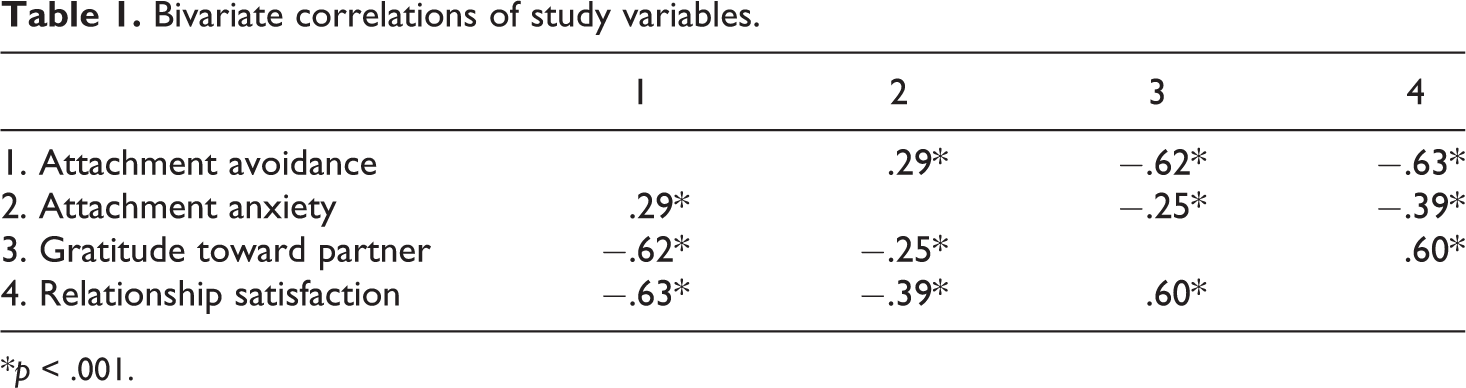
The correlation analyses (see Table 1) revealed that attachment avoidance and attachment anxiety were significantly negatively related to both gratitude toward the partner and relationship satisfaction. Furthermore, gratitude toward the partner was significantly positively related to relationship satisfaction.
Bivariate correlations of study variables.
*p < .001.
Total, direct, and indirect effects of attachment avoidance and anxiety on relationship satisfaction through gratitude toward the partner
The multiple regression analysis revealed a significant negative effect of attachment avoidance and a nonsignificant effect of attachment anxiety on gratitude toward the partner (see Figure 1). A total of 39% of the variance in gratitude toward the partner could be explained, F(2,359) = 113.79, p < .001.
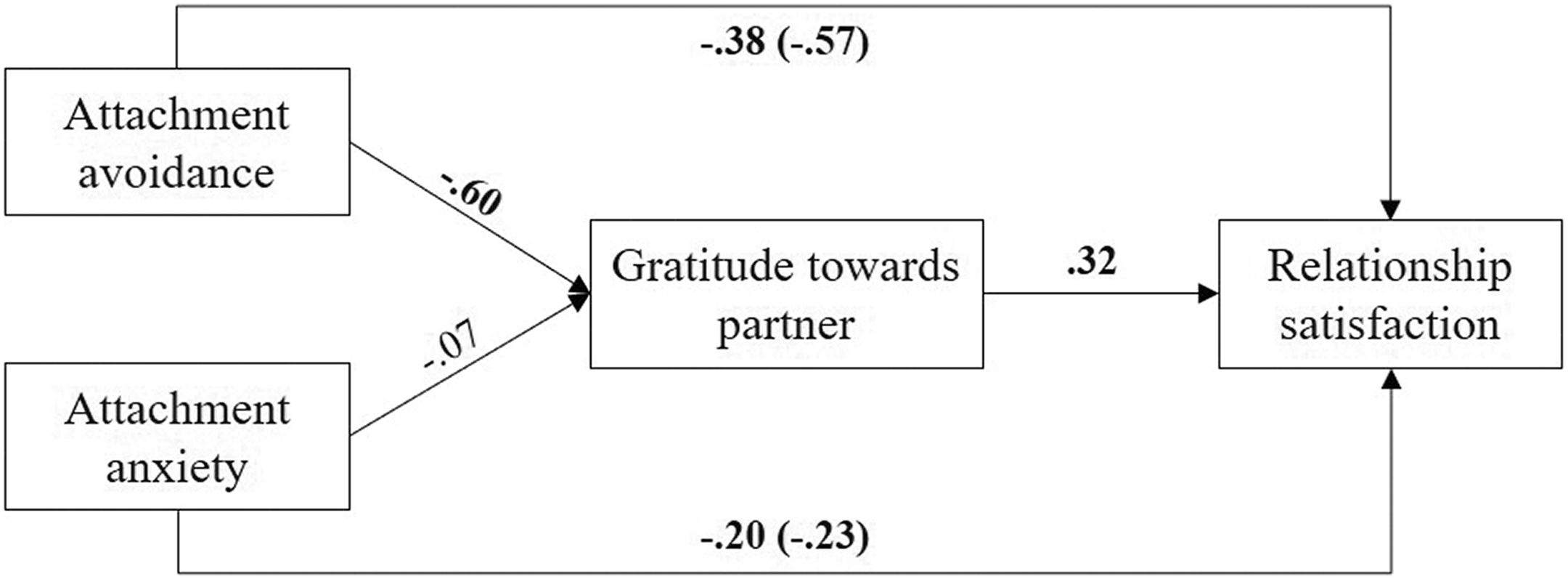
Results of the regression analyses. Coefficients in parentheses represent total effects. Coefficients highlighted in bold are statistically significant at p < .001.
The hierarchical regression analysis revealed significant negative total effects in Step 1 and significant negative direct effects of attachment avoidance and attachment anxiety on relationship satisfaction in Step 2 (see Figure 1). Furthermore, in Step 2, a significant positive effect of gratitude toward the partner on relationship satisfaction was found (see Figure 1). A total of 50% of the variance in relationship satisfaction could be explained, F(3,358) =122.11, p < .001.
The bootstrap analyses revealed a significant negative indirect effect of attachment avoidance, .20, BC 95% confidence interval (CI) [.28, .12], and a nonsignificant indirect effect of attachment anxiety, .03, BC 95% CI [.07, .01], on relationship satisfaction through gratitude toward the partner. The significant indirect effect indicates that higher levels of attachment avoidance were related to lower relationship satisfaction due to lower levels of gratitude toward the partner.
Discussion
The present study investigated the relationships of attachment avoidance and attachment anxiety with gratitude toward the partner and romantic relationship satisfaction. More specifically, the mediating role of gratitude toward the partner in the association between the attachment dimensions and relationship satisfaction was examined.
As expected, both higher levels of attachment avoidance and attachment anxiety were associated with lower romantic relationship satisfaction. These findings are in line with many previous studies that identified adult attachment as an important predictor of relationship satisfaction (e.g., Li & Chan, 2012; Mikulincer & Shaver, 2016) and underline the detrimental effect insecure attachment can have in the context of romantic relationships. Furthermore, gratitude toward the partner was positively associated with relationship satisfaction. This result is in accordance with the assumptions of the find-remind-and-bind theory (Algoe, 2012) and replicates past studies indicating that gratitude toward the partner positively affects romantic relationship outcomes (Algoe et al., 2010; Gordon et al., 2011, 2012).
Most importantly, as expected, the present findings confirm previous research suggesting that gratitude toward the partner is a mediating mechanism underlying the association between attachment avoidance and relationship satisfaction (e.g., Algoe et al., 2010; Gordon et al., 2011, 2012; Mikulincer et al., 2006). Specifically, higher levels of attachment avoidance were associated with decreased feelings of gratitude toward the partner, which in turn were associated with lower satisfaction with the romantic relationship. As proposed by Mikulincer and Shaver (2005) and Mikulincer, Shaver, and Slav (2006), the deactivation of the attachment system present in avoidant individuals seems to result in denying the partner’s expressions of appreciation or in appraising it as a threat to independence and, consequently, in an inhibition of feeling gratitude toward the partner. Alternatively, because of their internalized negative view of others, individuals high in attachment avoidance may perceive their romantic partners as not being appreciative of their relationship, which in turn may lead to an inhibition of feelings of gratitude toward the partner (Gordon et al., 2012). It can be assumed that the inhibition of feelings of gratitude is a defense mechanism to psychologically distance from the partner in order to avoid pain and distress (Mikulincer et al., 2006), which results in less positive experiences with the partner and eventually in lower satisfaction with the romantic relationship (Algoe, 2012). The present findings indicate that gratitude toward the partner only partially accounts for the association between attachment avoidance and relationship satisfaction. This is in accordance with the expectations, as previous research has already identified other strategies and defenses, such as withdrawal and disengagement in conflict situations and reduced disclosure and expressivity, as mechanisms underlying the negative effects of attachment avoidance on romantic relationship outcomes (Feeney & Fitzgerald, 2019).
With respect to attachment anxiety, although a significant negative bivariate association with gratitude toward the partner was found, gratitude toward the partner did not serve as a mediator between attachment anxiety and relationship satisfaction. Apparently, this is due to the nonsignificant association between attachment anxiety and gratitude toward the partner when both attachment dimensions were considered simultaneously as predictors. This indicates that the bivariate association between attachment anxiety and gratitude toward the partner results from the interrelation between the two attachment dimensions and that attachment anxiety does not account for a significant amount of variance in gratitude toward the partner. These findings are in line with previous research that found marginal significant bivariate associations (Gordon et al., 2012) and nonsignificant unique associations (Mikulincer et al., 2006) between attachment anxiety and gratitude toward the partner. As suggested by Mikulincer et al. (2006), these results indicate that, whereas higher attachment avoidance is related to decreased feelings of gratitude toward the partner, higher attachment anxiety may be related to more ambivalent responses to the partner’s kindness. Partner’s positive behaviors may meet the strong desire for intimacy, but may also cause negative emotions that interfere with feelings of gratitude, as individuals high in attachment anxiety fear not being able to reciprocate the partner’s kindness and meet the partner’s expectations (Mikulincer & Shaver, 2005; Mikulincer et al., 2006). In a nutshell, gratitude toward the partner could not be identified as an underlying mechanism in the association between attachment anxiety and relationship satisfaction, indicating that the negative effect of attachment anxiety on relationship satisfaction may rather be attributed to the use of other strategies and defenses, such as guilt induction, clinging, and dominating (Feeney & Fitzgerald, 2019; Fraley et al., 2015).
Interestingly, previous empirical findings with regard to the relationship between attachment anxiety and the experience of gratitude in general as measured with the GQ-6 (McCullough et al., 2002) are inconsistent, with some studies yielding negative bivariate and unique associations (Dwiwardani et al., 2014; Gordon et al., 2012) and others yielding no significant bivariate associations (Gordon et al., 2012; Mikulincer et al., 2006). These inconsistent findings may be accounted for by differences in sample characteristics across the studies, as generalized gratitude was particularly linked to attachment anxiety in older adult samples with longer relationships, but not in samples of undergraduate students with shorter relationships. Further research addressing kind of gratitude and length of relationship or age of participants as moderators of the relationship between attachment anxiety and gratitude would be valuable.
Practical implications
Overall, the results of the present study indicate that both attachment avoidance and attachment anxiety are negatively associated with relationship satisfaction, and that in the case of attachment avoidance, this relationship is partially mediated by gratitude toward the partner. These findings might have clinical implications for individuals high in attachment avoidance-seeking professional support for relationship problems. As gratitude interventions provided to couples and close friends were found to have positive effects on relationship outcomes, such as relationship satisfaction, perception of the other, and comfort in voicing relationship concerns (Algoe & Zhaoyang, 2016; Lambert & Ficham, 2011; Parnell, 2015), it might be valuable incorporating them in the frequently used and proven effective emotionally focused couples therapy (EFCT; Johnson & Zuccarini, 2010). On the other hand, it could be argued that gratitude interventions may not work on individuals with higher levels of avoidant attachment, because, given their preference for independence, they may not be motivated to engage in gratitude interventions (Lyubomirsky, Dickerhoof, Boehm, & Sheldon, 2011). However, this may also be true for other techniques used in EFCT, as its major focus lies on targeting negative interactions between partners who maintain attachment insecurity (Johnson & Zuccarini, 2010). As with other techniques, it would be up to the therapist to recognize the appropriate moment for gratitude interventions and to help a client to find a personally acceptable frame of reference (Young, 2009; Young & Hutchinson, 2012). These implications are preliminary and further research, in particular randomized controlled trials, is needed to conclude whether the incorporation of gratitude interventions in EFCT for clients with higher levels of avoidance is indeed of added value.
Limitations
Some limitations need to be acknowledged. Due to the cross-sectional design, the direction of causality in the associations between the constructs could not definitely be determined. Based on the adult attachment theory (Fraley et al., 2015) and the find-bind-and-remind theory (Algoe, 2012), the proposed model is most plausible, but it is also reasonable to assume that the interrelation of the constructs is much more complex. For example, previous empirical findings indicate that relationship quality has an impact on interpersonal processes, such as the perception of the partner’s behavior and feelings of being understood and validated by the partner (Morry, Reich, & Kito, 2010; Novak, Sandberg, & Davis, 2017). This suggests that, in the long run, there might be a downward spiral with attachment as starting point and gratitude and relationship satisfaction negatively influencing each other. Also, the present study did not investigate feelings of gratitude after an actual generous action of the partner and dyadic processes were not considered, while gratitude toward the partner is likely to function as part of a dynamic interpersonal process between two persons (Algoe, 2012). For example, previous studies found that gratitude toward the partner does not only influence the own interpersonal behavior and satisfaction with the relationship but also the partner’s interpersonal behavior and relationship satisfaction (Algoe et al., 2010; Gordon et al., 2011, 2012). Therefore, future research would benefit from longitudinal studies with a dyadic design that allow the investigation of different combinations and interactions between partners’ attachment styles, gratitude toward the partner after actual generous actions, gratitude-related behaviors, and relationship satisfaction.
Conclusion
As encouraged by Mikulincer and Shaver (2019), this study contributes to the understanding of the specific strategies and defenses of individuals with higher levels of attachment avoidance and attachment anxiety. In individuals with higher levels of avoidance, the inhibition of gratitude toward the partner was identified as a defense mechanism against attachment threats (Fraley et al., 2015). Moreover, the present findings indicate that the inhibition of gratitude toward the partner is one underlying mechanism through which attachment avoidance is associated with relationship satisfaction. In contrast, the inhibition of gratitude toward the partner could not be identified as mechanism in more anxiously attached individuals with a hyperactivated attachment system (Fraley et al., 2015). Given that these findings can be replicated in longitudinal and dyadic studies, it might be worthwhile investigating whether incorporating gratitude interventions into EFCT is of added value for individuals high in attachment avoidance seeking help for relationship problems.
Footnotes
Acknowledgment
We would like to thank Margaretha Madoures (MSc) for her contribution in data collection.
Funding
The author(s) received no financial support for the research, authorship, and/or publication of this article.

Open research statement
As part of IARR’s encouragement of open research practices, the authors have provided the following information: This research was not pre-registered. The data used in the research are available. The data can be obtained by emailing: