




Abstract
Do insecurely attached individuals perceive greater rejection from their heritage culture? Few studies have examined the antecedents and outcomes of this perceived rejection – termed intragroup marginalization – in spite of its implications for the adjustment of cultural migrants to the mainstream culture. This study investigated whether anxious and avoidant attachment orientations among cultural migrants were associated with greater intragroup marginalization and, in turn, with lower subjective well-being and flourishing and higher acculturative stress. Anxious attachment was associated with heightened intragroup marginalization from friends and, in turn, with increased acculturative stress; anxious attachment was also associated with increased intragroup marginalization from family. Avoidant attachment was linked with increased intragroup marginalization from family and, in turn, with decreased subjective well-being.
What family will want a daughter-in-law who can run around kicking football all day but can’t make round chapattis?
Meeting the expectations of your heritage culture can be difficult. Jesminder Bhamra, the British Asian protagonist of Bend it Like Beckham, goes by the more British name of Jess and dreams of playing football professionally. Much to the chagrin of her parents, her room is festooned with posters of David Beckham. When the opportunity of joining in a local women’s team presents itself, she engages in subterfuge after her parents ban her from playing a sport deemed too British and not befitting a young woman of their culture. They believe that they have only her best intentions at heart; at 18, she should focus on becoming an outstanding young woman in the Punjabi Sikh community, thus increasing the chances of finding a respected husband. As Jess pursues her dream in secret, she feels unhappy and torn between her two identities. Uncertain how she can meet their expectations, she angrily complains to her childhood friend, ‘Anything I want is just not Indian enough for them!’
Intragroup marginalization is the perceived rejection from one’s heritage culture group due to adopting a new mainstream culture in ways that are deemed as a threat to the group’s social identity (Castillo, Conoley, Brossart, & Quiros, 2007). For example, a British Asian like Jess may feel marginalized by other British Asians for having hobbies that are typically perceived as belonging to the mainstream culture. The purpose of this study was to investigate the antecedents and consequences of intragroup marginalization. More specifically, we investigated whether insecure attachment orientations were associated with increased intragroup marginalization and, in turn, with poorer psychological adjustment. The implications of an insecure attachment orientation ripple through one’s life. We hypothesized that the alienation and conflict typically experienced by attachment–anxious or avoidant individuals (Li & Chan, 2012; Mikulincer & Shaver, 2007; Mikulincer, Shaver, Bar-On, & Ein-Dor, 2010) would translate to difficulties identifying with fellow members of their heritage culture. Indeed, individuals high in avoidance tend to report indifference to their heritage culture (Polek, van Oudenhoven, & ten Berge, 2008). Intragroup marginalization, in turn, has been linked with increased acculturative stress (Castillo, Cano, Chen, Blucker, & Olds, 2008) but has yet to be examined as a predictor of other indicators of psychological adjustment such as subjective well-being and flourishing. This study is the first to investigate whether insecure attachment orientations are associated with increased intragroup marginalization and, in turn, with poor psychological adjustment.
Attachment theory
Attachment theory holds that children internalize models of themselves and others based on the quality of their interactions with primary caregivers (Ainsworth, Blehar, Waters, & Wall, 1978; Belsky, Steinberg, & Draper, 1991; Bowlby, 1969, 1973). This theory was later extended to adult romantic relationships (Hazan & Shaver, 1987). Research in adult attachment centres on two dimensions characterizing insecure attachments, namely, avoidance and anxiety (Bartholomew & Horowitz, 1991). Individuals high in avoidance are characterized by a lack of trust and excessive self-reliance (Griffin & Bartholomew, 1994a; Hazan & Shaver, 1987), whereas individuals high in anxiety are characterized by insecurity in the perceived availability of an attachment figure and fear of rejection and abandonment (Campbell, & Marshall, 2011; Griffin & Bartholomew, 1994a, 1994b). Both forms of insecure attachment are associated with overall decreased relationship quality, although they may take different forms; anxiety is associated with greater conflict, whilst avoidant attachment is negatively linked to positive aspects such as general satisfaction, perceived support and connectedness (Li & Chan, 2012). Secure attachment is commonly measured as low anxiety and avoidance (Bartholomew & Horowitz, 1991; Fraley, Waller, & Brennan, 2000).
The attachment framework has logical ties to perceptions of intragroup marginalization. Insofar as individuals who are low in anxiety and avoidance – that is, those who are securely attached – report greater identification and contact with their heritage culture (Polek et al., 2008), it is reasonable to surmise that those who are high in anxiety are more likely to experience alienation from their heritage culture group. Anxious individuals exhibit a heightened responsiveness to rejection threats, expecting and exaggerating their occurrence (Downey & Feldman, 1996). They also report more frequent conflicts in relationships (Campbell, Simpson, Boldry, & Kashy, 2005) and are more likely to ruminate and brood (Marshall, Bejanyan, & Ferenczi, 2013). Furthermore, they are inclined to pursue interpersonal goals that correspond with their need for closeness with others (Mikulincer et al., 2010) and are more likely to experience distress and shame following a negative interaction with their partner (Mikulincer & Shaver, 2005). We therefore hypothesized that anxious individuals would be hypersensitive to experiences of rejection and conflict from members of their closest social circles – their family and friends – on the basis of their perceived failures in meeting the expectations of their heritage culture.
On the other hand, avoidant individuals tend to feel uncomfortable with closeness and suppress rejection threats (Bartholomew & Horowitz, 1991; Fraley & Shaver, 1998; Hazan & Shaver, 1987; Li & Chan, 2012). Similar to anxious individuals, however, avoidant individuals are still sensitive to rejection (Ozen, Sumer, & Demir, 2010). In relationship-threatening situations, avoidant individuals are likely to engage in deactivating strategies such as defensive distancing and suppression of attachment-related cues, thus preventing frustration and pain (Bartholomew, 1990; Fraley & Shaver, 1998; Shaver & Mikulincer, 2002). Avoidant attachment has also been associated with decreased identification with one’s heritage culture (Ferenczi & Marshall, 2013), implying a greater susceptibility for intragroup marginalization due to not conforming to the heritage culture identity. Similar to anxious individuals, then, avoidant individuals’ sensitivity to rejection may translate into heightened experiences of intragroup marginalization, but the difference may lie in their behavioural response. Because anxious individuals engage in excessive proximity seeking (Collins & Read, 1990) they may seek to engage in reassurance and increased contact with members of their heritage culture; conversely, avoidant individuals may limit their interactions and levels of intimacy with those perceived to be rejecting them. Until now, no study has investigated the extent to which attachment orientations shape the experiences of intragroup marginalization.
Intragroup marginalization
Intragroup marginalization has been conceived through the lens of social identity theory (Tajfel, 1974). The prime conjecture of social identity theory is that important social groups are internalized into one’s social identity. A social identity influences psychological well-being (Haslam, Jetten, Postmes, & Haslam, 2009; Tajfel & Turner, 1979) and provides a buffer against daily stressors through perceptions of social support (Haslam, O’Brien, Jetten, Vormedal, & Penna, 2005). In order to maintain the benefits of a social identity, a social group must remain distinct and be positively evaluated in comparison with other groups (Turner, 1975). Threat to a group’s distinctiveness can arise when group members do not conform to its specific normative values. In this vein, individuals are more likely to be excluded by in-group members when they do not conform to the group’s values (Ojala & Nesdale, 2004). Thus, they may become the black sheep of their in-group through poor performance and not conforming to the prescribed social identity (Marques, Yzerbyt, & Leyenes, 1988). They even face higher levels of derogation compared to out-group individuals (Marques, Abrams, & Serôdio, 2001) because their behaviour has an increased relevance for other in-group members as it may impair the group’s positive evaluation (Marques et al., 1988).
Individuals can become the ‘black sheep’ of their heritage culture when they do not meet the cultural expectations. Intragroup marginalization draws on social identity theory and addresses the lack of research examining the psychological consequences of perceived rejection from members of one’s heritage culture (Castillo et al., 2007). Group members tend to marginalize other in-group members who are deemed to be adapting to the mainstream culture in ways that are threatening to the group’s distinctive norms (Castillo et al., 2007, 2008). Accusations of disloyalty, assimilation and the internal conflict of upholding the demands of several cultures feature prominently in marginalized individuals’ narratives (Castillo, 2009). The current study sought to extend findings through examining insecure attachment orientations as an antecedent of intragroup marginalization and poorer psychological adjustment as a consequence.
Psychological adjustment
The psychological adjustment of migrants and bicultural individuals is rooted within a stress and coping framework and centres on emotional and psychological well-being (Searle & Ward, 1990). Psychological adjustment is correlated with changes in one’s life, perceived social support and personality (Ward & Rana-Deuba, 1999). Three indices of psychological adjustment were measured in the current study, namely, acculturative stress, subjective well-being (SWB) and flourishing.
Acculturative stress arises from cultural stressors that negatively influence individuals’ physiological and psychological states and occurs in a variety of domains. Low acculturative stress is indicative of high psychological adjustment (Berry, Kim, Minde, & Mok, 1987). Stress tends to result from the perceived differences between heritage and mainstream culture. Significantly, acculturative stress indiscriminately affects both individuals who have moved to a new culture and those who have been born in a mainstream culture but have a different heritage culture (Miller, Kim, & Benet-Martínez, 2011). Castillo, Cano, Chen, Blucker, and Olds (2008) reported that intragroup marginalization from one’s family was associated with increased reports of acculturative stress.
SWB is a common index of psychological adjustment in cross-cultural research (Ward & Kus, 2012). The link between SWB – a construct that taps into an individual’s own evaluative judgement of their global life satisfaction (Diener, Emmons, Larsen, & Griffin, 1985) – and intragroup marginalization has yet to be tested. Flourishing is complementary, yet distinct, to SWB (Diener et al., 2010). It consists of five elements, namely, purpose in life, optimism, success in social relationships, feelings of competence and efficacy and self-esteem. The flourishing construct provides insight into the specific values of success in everyday life that indicate prosperity (Diener et al., 2010; Silva & Caetano, 2013). Flourishing has yet to be examined in multicultural samples, despite its potential for operationalizing successful outcomes in migrant and bicultural individuals.
Insecure attachment has negative repercussions on psychological well-being (Birnbaum, Orr, Mikulincer, & Florian, 1997; Polek et al., 2008). Anxious individuals produce higher levels of cortisol, suggesting that anxious attachment is a chronic stressor (Jaremka et al., 2013) and may increase susceptibility to acculturative stress (Belizaire & Fuertes, 2011). Low anxiety and avoidance are linked with increased psychological and sociocultural adjustment (Polek et al., 2008). Thus, we predicted that insecurely attached individuals’ susceptibility to perceive rejection would lead them to experience greater intragroup marginalization and, in turn, poor psychological adjustment. As there were no a priori justifications suggesting that intragroup marginalization would vary between family and heritage culture friends, we did not make separate predictions for family and friends.
Method
Participants
Ethics approval was given by the Ethics Committee of the Department of Psychology at Brunel University, in accordance with the recommendations of the British Psychological Society. All participants provided informed consent prior to participation. They were given the opportunity to contact the researchers, refuse to participate or withdraw at any time without consequences. Participants were recruited through several Internet sources (e.g., www.socialpsychology.org; the intranet of a London University; Amazon MTurk), through the university’s undergraduate participant pool and through leaflets. Inclusion criteria for the study required each participant to have a different heritage and mainstream culture, through being either a first or a second/later generation migrant. Each participant’s demographic responses were examined to ensure that they met the criteria. Indeed, acculturation research has often sampled from second- and third-generation migrant individuals in addition to first-generation migrants (Ryder, Alden, & Paulhus, 2000; Marshall, 2008).
We collected the responses of 258 participants (Mage: 27.81, SD: 8.90; females: 159, males: 99). As the general experience of intragroup marginalization was the focus of the present research, participants were recruited from multiple heritage and mainstream cultural backgrounds. Heritage culture distribution was varied, with the majority of participants reporting a European (36%) heritage culture. Participants also reported the following heritage cultures: East Asian (15%), African/Caribbean (12%), mixed heritage cultures (8%), South Asian (7%), Latin American (7%), North American (5%), Middle Eastern/North African (5%), Southeast Asian (3%), Jewish (1%), and Australian/New Zealand (1%). Regarding the mainstream culture, the majority of participants reported living in either European (55%) or North American (42%) cultures. They also reported the following mainstream cultures: Asian (1%), Middle Eastern/North African (1%) or South American (1%). In terms of cultural background, 155 (61%) participants reported having moved to a mainstream culture different to their heritage culture (Myears: 7.41, SD: 8.22), and 103 (39%) participants indicated that they were bicultural individuals who had been born in a mainstream culture but had a different heritage culture. Participants were highly educated (63% reported working towards or having obtained a university degree), were split evenly between being single or in a relationship and were largely in full-time employment or education (64%).
Materials and procedure
Data were collected through an online survey-hosting website. Participants completed the survey in English, which consisted of a total of 131 items and on average lasted 15 min.
Attachment orientations
We included two subscales from the Relationship Scales Questionnaire (RSQ; Griffin & Bartholomew, 1994a), avoidance (8 items; e.g., ‘I find it difficult to depend on other people’; α = .75) and anxiety (5 items; e.g., ‘I worry that others don’t value me as much as I value them’; α = .83), as proposed by Simpson, Rholes, and Nelligan (1992). Griffin and Bartholomew (1994a) replicated the 13 items from Simpson and colleagues (1992) in a principal components analysis of the RSQ in a large sample (N = 650). They argued that the avoidant and anxious dimensions of the RSQ capture Bowlby’s (1973) internal working models of self and other, respectively (Griffin & Bartholomew, 1994b). Furthermore, Kurdek’s (2002) confirmatory factor analysis of five different models of the RSQ found reasonable support only for the two-dimensional model of anxiety and avoidance proposed by Simpson and colleagues (1992). Accordingly, we asked the participants to rate the 13 items measuring the avoidant and anxiety dimensions on a 5-point Likert scale (1 = Not at all like me, 5 = Extremely like me).
Perceived intragroup marginalization
The Intragroup Marginalization Inventory (Castillo et al., 2007) is composed of two subscales that measure feelings of marginalization from one’s immediate family (α = .84) and from one’s wider social circle of friends (α = .91). We included 11 items from the family subscale (e.g., ‘My family has a hard time accepting my new values’). Sixteen items were included from the friends subscale (e.g., ‘Friends of my ethnic/heritage culture group want me to act the way I used to act’). One identical item was excluded from each of the subscales as it referred to apparent phenotypic differences between an individual’s heritage and mainstream cultures. Participants were asked to indicate the extent to which the items occurred in their daily lives on a 7-point Likert scale (1 = Never/Does not apply, 7 = Extremely Often).
Acculturative stress
The Riverside Acculturative Stress Inventory (Benet-Martinez, 2003) consists of 5 subscales with 3 items each. The items were combined to measure overarching acculturative stress (e.g., ‘I feel that there are not enough people of my own cultural/ethnic group in my living environment’; α = .84). Participants used a 5-point Likert scale (1 = Disagree Strongly, 5 = Agree Strongly).
Subjective well-being
The 5-item Satisfaction with Life Scale (Diener et al., 1985) assesses an individual’s global life satisfaction (e.g., ‘The conditions of my life are excellent’; α = .88). Participants used a 5-point Likert scale (1 = Strongly Disagree, 5 = Strongly Agree).
Flourishing
Eight items (e.g., ‘I am competent and capable in the activities that are important to me’; α = .92) form the unidimensional Flourishing Scale (Diener et al., 2010). Participants indicated on a 7-point Likert scale (1 = Strongly Disagree, 7 = Strongly Agree).
Neuroticism
Seven neuroticism items (e.g., ‘I worry a lot’; α = .81) were included as a control variable from the Berkeley Personality Profile (Harary & Donahue, 1994). Neuroticism refers to emotional instability (Griffin & Bartholomew, 1994a), which has been associated with increased insecure attachment (Shaver & Brennan, 1992). We measured this variable to establish that the potential associations of attachment avoidance and anxiety with experiences of intragroup marginalization could not be attributed to neuroticism. Participants rated each statement on a 5-point Likert scale (1 = Disagree Strongly, 5 = Agree Strongly).
Self-esteem
The Rosenberg Self-Esteem Inventory (Rosenberg, 1965) was included due to the association of self-esteem with increased insecure attachment (Marshall, Bejanyan, Di Castro, & Lee, 2013), thus establishing that any associations of insecure attachment with intragroup marginalization would be above and beyond the effects of self-esteem. Participants were asked to rate 10 statements (e.g., ‘I feel that I have a number of good qualities’; α = .89) on a 4-point Likert scale (1 = Strongly Disagree, 4 = Strongly Agree).
Identification with heritage and mainstream cultures
The Vancouver Index of Acculturation (Ryder et al., 2000) was included to control for an individual’s heritage and mainstream culture identification to ensure that the link between intragroup marginalization and poor psychological adjustment was above and beyond an individual’s own choice of identifying with either culture. It consists of a 10-item subscale for each of the cultures (e.g., ‘It is important for me to maintain or develop the practices of my mainstream/heritage culture’; both αs = .88). Participants rated each statement on a 9-point continuous Likert scale (1 = Strongly Disagree, 9 = Strongly Agree).
Results
Descriptive statistics
Means, standard deviations and Pearson’s correlations are reported in Table 1. All correlations save for one between intragroup friend marginalization and SWB met the assumptions required for tests of mediation (Baron & Kenny, 1986). 1 We conducted structural equation modelling using AMOS 18. The advantage of this approach is that it allowed us to include covariances between the independent variables, mediators and dependent variables – an approach not possible with traditional regression analysis.
Means, standard deviations and Pearson correlations.
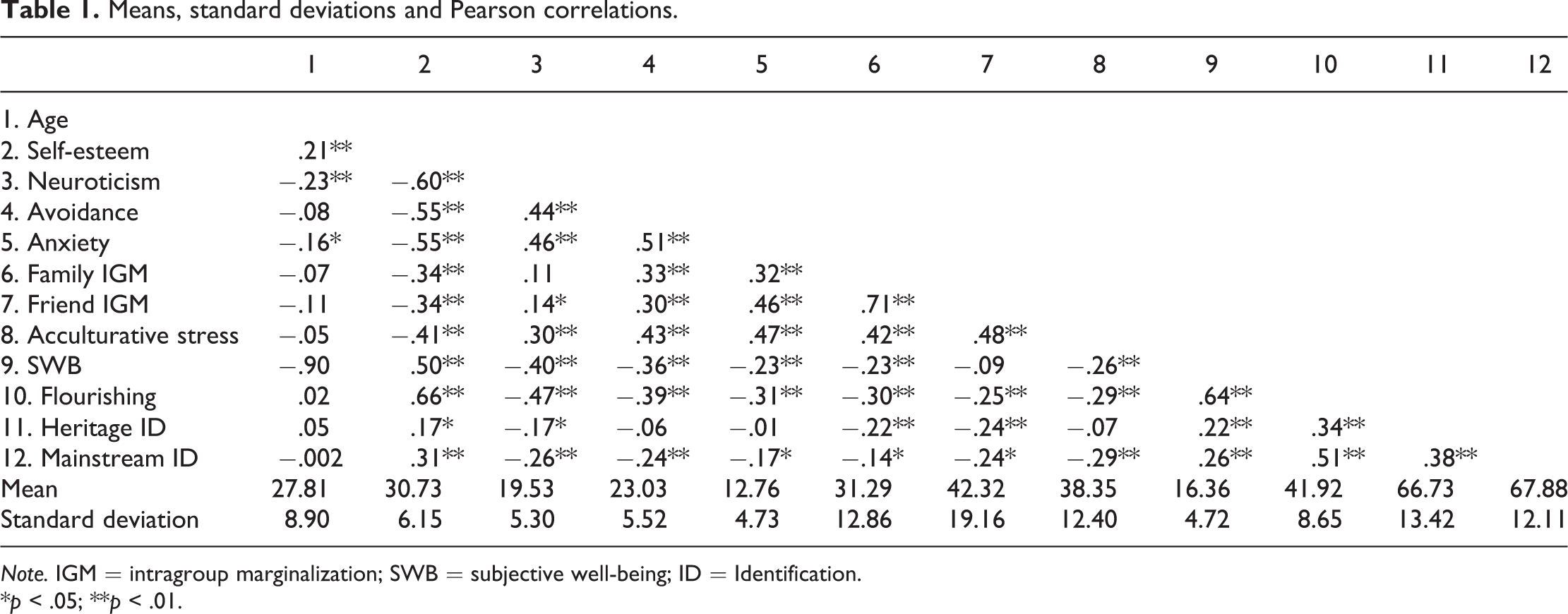
Note. IGM = intragroup marginalization; SWB = subjective well-being; ID = Identification.
*p < .05; **p < .01.
Several indices were inspected to evaluate model fit, such as the χ2 statistic, the comparative fit index (CFI), the root mean square error of approximation (RMSEA) and the standardized root mean residual (SRMR). Kline’s (2011) criteria were used to check whether the model yielded an acceptable fit for the data: the χ2 statistic should be non-significant (which, in larger samples, is an unrealistic expectation); CFI should be .90 or greater; RMSEA should be .08 or less; and SRMR should be .10 or less. As AMOS 18 can only run bootstrapping procedures for indirect effects on complete data, the following analyses relied on 206 participants (130 females and 76 males; 121 first-generation migrants, 85 second- or later generation bicultural individuals).
Item parcels were created to reflect latent variables, following the procedure described by Russell, Kahn, Spoth, and Altmaier (1998). Item parcelling allows for a more parsimonious and stable model that requires the estimation of fewer parameters (Little, Cunningham, Shahar, & Widaman, 2002; Marsh & Hocevar, 1988). Principal components analysis demonstrated that for each scale items loaded onto one factor; items were rank ordered on the basis of their factor loadings. Parcels were created through adding the highest and lowest loading items for the first parcel, then the second highest and lowest loading items to the second parcel, until all items had been assigned to a parcel; this ensured that all parcels equally reflected their respective latent variables. All of the indicators loaded significantly onto their respective latent variables (all parcel βs ≥ .72, p < .001), indicating that the item parcels sufficiently measured the latent variables. The measurement model was tested prior to the structural model (Anderson & Gerbing, 1988).
Measurement model
Confirmatory factor analysis revealed that the measurement model, which included covariances between all of the latent variables, provided a good fit, χ2(98) = 154.41, p < .0001, CFI = .98, RMSEA = .05, confidence interval (CI): [.04, .07], SRMR = .04. 2 As the proposed model is the first to link attachment orientations and psychological adjustment through intragroup marginalization, alternative measurement models were tested to gauge whether they fit the data better than our theoretical model. The first proposed alternative model included the total scores for the markers of adjustment (SWB, flourishing and acculturative stress) as three indicators of a single latent variable and yielded a significantly, χ2D(43) = 6.41, p < .001, poorer model fit, χ2(55) = 148, p < .0001, CFI = .95, RMSEA = .09, CI: [.07, .11], SRMR = .10. Thus, it may be inferred that the three outcome variables are distinct latent variables despite their overlap. A second alternative model tested a single latent variable representing intragroup marginalization with the total scores for family and friend marginalization serving as two indicators. When compared with the initial measurement model, the second alternative model also yielded a significantly poorer model fit, χ2(50) = 106.71, p < .0001, CFI = .97, RMSEA = .07 CI: [.06, .09], SRMR = .04, and χ2D(49) = 47.71, p < .05, implying that despite the overlap between family and friend intragroup marginalization, the pathways through which they are linked with attachment and psychological adjustment differ. Overall, our theoretical measurement model provided a better fit for the data.
Structural model
The fully saturated structural model included covariances between anxious and avoidant attachment, friend and family intragroup marginalization, and the three indicators of adjustment. It consisted of all the direct and indirect effects between insecure attachment, intragroup marginalization and psychological adjustment, providing an identical fit as the measurement model. To create a more parsimonious model, we first modified the structural model by removing the non-significant covariance between acculturative stress and flourishing, χ2(99) = 154.42, p < .0001, CFI = .98, RMSEA = .05, CI: [.04, .07], SRMR = .04; this model did not differ significantly from the initial model, χ2D(1) = .01, p > .05. The non-significant covariance between acculturative stress and SWB was also removed, resulting in a good model fit, χ2(100) = 156.06, p < .0001, CFI = .98, RMSEA = .05, CI: [.04, .07], SRMR = .04, that did not differ significantly from the initial saturated model, χ2D(2) = 1.65, p > .05. We then removed the non-significant direct pathways between anxious attachment and flourishing and SWB, beginning with the lowest standardised regression weights. A structural model with the pathway between anxious attachment and flourishing constrained to zero provided a good fit, χ2(101) = 156.12, p < .0001, CFI = .98, RMSEA = .05, CI: [.04, .06], SRMR = .04 and did not significantly differ from the initial model, χ2D(3) = 1.70, p > .05. The direct pathway between anxious attachment and SWB was also constrained to zero. The model yielded a good fit, χ2(102) = 156.14, p < .0001, CFI = .98, RMSEA = .05, CI: [.03, .07], SRMR = .04, and did not significantly differ from the initial model, χ2D(4) = 1.72, p > .05. The final modified structural model is illustrated in Figure 1.
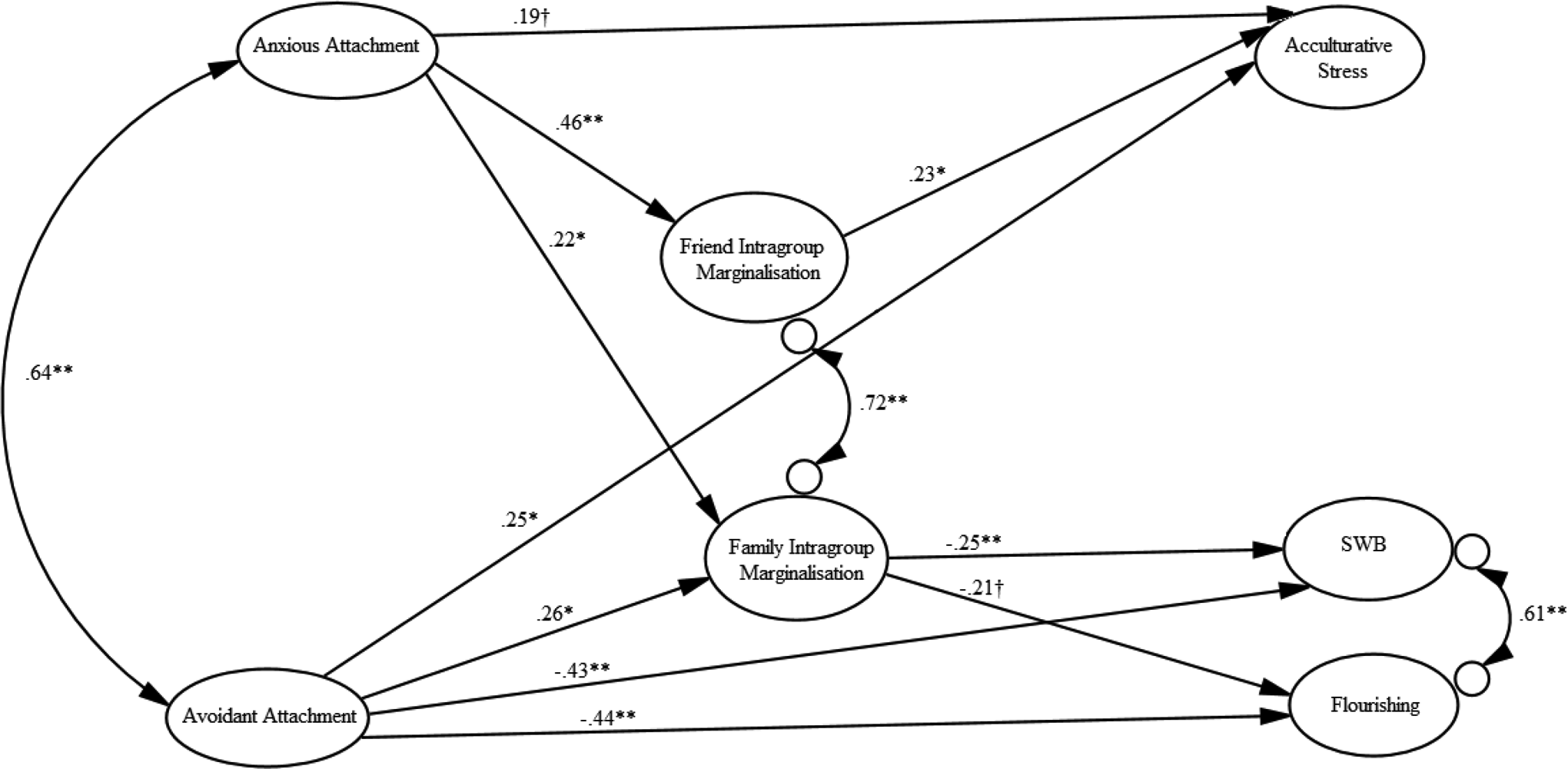
Modified structural equation model of the significant associations between insecure attachment, intragroup marginalization and psychological adjustment. *p < .05; **p < .01; †p = .07.
Avoidant attachment was significantly associated with increased family intragroup marginalization, whilst anxious attachment was a significant predictor of increased family and friend intragroup marginalization. In turn, family intragroup marginalization was significantly associated with decreased SWB; the identical association for flourishing approached significance (p = .07). Friend intragroup marginalization was significantly associated with increased acculturative stress.
Tests of indirect effects
The indirect effects of attachment anxiety and avoidance on psychological adjustment via intragroup marginalization were tested using bootstrap procedures in AMOS. Examination of the 95% bias-corrected CIs from 1,000 bootstrap samples revealed that the indirect effect of anxious attachment on increased acculturative stress via friend intragroup marginalization was significant (β = .08, p < .05, CI: [.001, .20]). The indirect effect of avoidant attachment on decreased SWB via family intragroup marginalization was also significant (β = −.05, p < .05, CI: [−.15, −.002]). Finally, the indirect effect of avoidant attachment on decreased flourishing via family intragroup marginalization approached significance (β = −.04, p = .06, CI: [−.14, .002]).
Discussion
Our results provided strong evidence that insecure attachment was associated with increased intragroup marginalization. Like Jess, participants who experienced intragroup marginalization reported poorer psychological adjustment. In the following sections, we discuss the implications of our findings for the association between insecure attachment and intragroup marginalization and, in turn, its negative links with psychological adjustment.
Attachment and intragroup marginalization
Both anxious and avoidant attachment were positively associated with intragroup marginalization from family members, but only anxious attachment was associated with increased intragroup marginalization from friends. The link between anxious attachment and intragroup marginalization from both family and friends can be situated in the tendency for anxiously attached individuals to become preoccupied with and ruminate on their relationships (Hazan & Shaver, 1987; Marshall et al., 2013); for such individuals, experiences of intragroup marginalization, which threaten close relationships with members of the heritage culture, can be particularly salient. Additionally, anxious attachment is correlated with less positive views of the self (Mikulincer, 1995). The current findings suggest that an anxious individual may hold negative perceptions of the self due to not conforming or meeting the social identity requirements of the heritage culture group. Anxious individuals’ chronic fear of rejection (Mikulincer, Shaver, & Pereg, 2003) may manifest itself in worry that the heritage culture group members will also reject the self.
Similarly, we found that avoidant attachment was associated with increased intragroup marginalization from family members. Membership to family is less controllable than that of the friendship group; thus, even avoidant individuals are susceptible to intragroup marginalization from family members. Furthermore, the current results imply that avoidant individuals are aware and willing to report experiences of rejection from family members regarding their social identities, paralleling previous research that avoidant individuals are less connected in relationships (Li & Chan, 2012) but still experience the need for belonging and acceptance (Carvallo & Gabriel, 2006). In light of the present results, further research could seek to clarify two different types of insecure attachment, such as dismissive and fearful attachment (Bartholomew, 1990; Bartholomew & Horowitz, 1991) and their relationship with intragroup marginalization, as the latter attachment orientation is characterized by high levels of both anxiety and avoidance. We did not investigate individuals’ affective and behavioural responses to intragroup marginalization, where the differences between the two insecure attachment types might have been more evident. For example, fearful individuals may engage in reassurance-seeking behaviours and increase contact with family and heritage culture friends despite perceived rejection, whereas dismissive individuals may seek to limit their contact with rejecting others. Future research should also investigate the potential differences in avoidant and anxious attachment in responses to intragroup marginalization. Overall, the present research builds upon previous findings on the influence of attachment orientations on the acculturation process (Bakker, van Oudenhoven, & van der Zee, 2004; Polek et al., 2008; Polek, Wohrle, & van Oudenhoven, 2010), in part through the indirect effects of attachment on psychological adjustment via intragroup marginalization.
Intragroup marginalization and adjustment
Intragroup marginalization is a significant contributor to increased acculturative stress (Castillo et al., 2008; Thompson, Lightfoot, Castillo, & Hurst, 2010), which the present findings corroborated for friend intragroup marginalization. The negative influence of intragroup marginalization on the adjustment of Latino college students in an American university was reported in a counselling case study (Castillo, 2009). Our findings provide empirical support and validate the intragroup marginalization construct in a global participant sample. Together with the finding that intragroup marginalization from family was negatively associated with SWB, we can conclude that intragroup marginalization plays a distinct role in psychological adjustment.
Castillo and colleagues (2008) reported a correlation between family intragroup marginalization and increased acculturative stress. The association we found between family intragroup marginalization and decreased SWB provides insight into the challenges individuals with multiple cultural identities have to navigate. Perceiving rejection from family arising specifically from the discordance between one’s changing identity and the perceived expectations of maintaining the heritage culture may have an impact on general well-being and an evaluation of one’s life. For example, experiencing teasing or criticism for lack of proficiency in one’s heritage culture language may decrease an individual’s satisfaction with their life. The trend towards significance in the association between family intragroup marginalization and decreased flourishing further illustrates the negative implications of intragroup marginalization. The differences between the relationships of family and friend intragroup marginalization with psychological adjustment may be linked to the impact each group has on an individual’s day-to-day life. For example, perceiving rejection from family may have a more insidious influence on psychological and emotional well-being (such as SWB and flourishing), as family is a more primary group to which membership is not voluntary. Conversely, individuals who perceive rejection from heritage culture friends may seek friendships outside of that culture and thus avoid the detrimental consequences on their well-being. However, difficulties with other heritage culture members outside of the family, including friends, may have an impact on the pragmatic aspects of everyday life which results in acculturative stress (e.g., feeling adjusted at work, intercultural relations and cultural isolation). Overall, intragroup marginalization is likely to be a chronic experience as individuals move between their heritage and mainstream cultures in their interactions with family members and the public sphere. Over time, daily hassles may have a negative impact on somatic health, daily mood and long-term psychological well-being (DeLongis, Coyne, Dakof, Folkman, & Lazarus, 1982; Eckenrode, 1984). The long-term implications of daily stressors and negative affect on mental health, including generalized anxiety disorders, are observable 10 years on (Charles, Piazza, Mogle, Silwinski, & Almeida, 2013). Thus, the wear and tear of frequent stress due to perceptions of rejection from family members due to not meeting the prescribed heritage culture identity expectations may have lasting consequences whose origin may not immediately be as evident or easily pinpointed as those following major life changes or upheavals.
Indirect effects of attachment on well-being
Close personal relationships are crucial to happiness (Diener & Seligman, 2002). Consistent with the tendencies of insecurely attached individuals to experience relationship disruption (Li & Chan, 2012), we found that they perceived greater intragroup marginalization from family and friends and, in turn, had poor psychological adjustment. Furthermore, migrants who have high anxiety and avoidance report decreased psychological adjustment (Polek et al., 2008). Our results indicated that the association of avoidance with decreased SWB was mediated, in part, by experiences of rejection due to not adhering to the prescribed social heritage culture identity. This sheds light on one of the mechanisms through which avoidant attachment may result in decreased SWB. Our results parallel findings elsewhere in the attachment literature; for example, avoidant attachment has been linked with lower SWB (Wei, Liao, Ku, & Shaffer, 2011), and a meta-analysis of 73 studies reported that avoidant individuals had lower general relationship satisfaction, connectedness and general support than those who were anxiously attached (Li & Chan, 2012). Our results imply that the indirect effects of avoidant attachment on decreased flourishing may be mediated, in part, by increased family intragroup marginalization. Although avoidant individuals tend to avoid intimacy (Bartholomew & Horowitz, 1991), engage in deactivating strategies in relationship-threatening situations (Bartholomew, 1990; Fraley & Shaver, 1998) and report being highly self-sufficient (Griffin & Bartholomew, 1994a), the experience of rejection from family members may still have repercussions on their subjective well-being and, potentially, their flourishing.
Anxious attachment is associated with lower resiliency and poorer coping mechanisms (Galatzer-Levy & Bonanno, 2013) and increased acculturative stress for migrants (Belizaire & Fuertes, 2011). Our findings imply that the pathway between anxious attachment and higher acculturative stress is, in part, mediated by perceived intragroup marginalization from friends. Anxious attachment is linked to feeling more rejected and perceiving more negative and fewer positive emotions in others (Kafetsios & Nezlek, 2002). The increased likelihood of perceiving negative emotions and rejection from friends might heighten acculturative stress; indeed, our findings imply that for individuals with multiple cultural identities, this perceived rejection stems from not being considered a worthy heritage culture member, which, in turn, is linked with greater difficulties in coping with cultural stressors.
The implications for insecurely attached individuals who do not perceive themselves as accepted and valued members of their heritage culture group are exemplified in their poorer psychological adjustment, both acculturation specific and general. The chronic perception that one’s identity is rejected may manifest itself in long-term decreased mental health. Furthermore, the implications may reverberate across the wider society, with rejected individuals either engaging in self-verification behaviours (Swann, Stein-Seroussi, & Giesler, 1992) of their heritage culture identity to the exclusion of their mainstream identity or rejecting their heritage culture altogether rather than seeking a harmonious and integrated self.
Limitations and further research
The hierarchical regression analyses indicated that heritage culture, effect coded as collectivistic or individualistic, did not predict intragroup marginalization or psychological adjustment, providing some preliminary support for the cross-cultural validity of our model. However, it is not possible to capture the finer nuances of intragroup marginalization in such a broad sample without taking into account cultural distance and historical context. Future research could focus on homogenous cultural samples that examine both heritage and mainstream cultures to delineate the exact tensions that individuals face in managing their cultural social identities. Furthermore, we did not measure the amount of contact that participants had with their family and heritage culture friends and how this may influence intragroup marginalization. Future research could address this limitation by asking participants to report whether they live with their extended family and the number of heritage and mainstream culture friends that they interact with on a regular basis. Further studies should also take into account individuals’ fluency in English or translate the questionnaires into their native language. However, as the data were collected from a London-based university and online websites that were oriented to English-speaking audiences, it is assumed that participants had at least medium to high proficiency in English.
Generational status in terms of first- or later generation migrants was not a significant predictor in our hierarchical regression models. Examining the influence of specific generational statuses, however, could improve our understanding of intragroup marginalization experiences. Relatedly, the long-term responses of individuals who report intragroup marginalization can drive future research. These individuals may not necessarily adopt a marginalized acculturation orientation; they may choose assimilation (self-identifying with the mainstream culture only) or they may still identify with their heritage culture (thus possibly choosing to be integrated or separated), despite the perceived rejection from family and friends. Finally, future research should seek to include more males to test the generalizability of the present models, although we did include gender as a control variable in our hierarchical regression models, and our findings were above and beyond any effects of gender. Limitations notwithstanding, as participants from a variety of cultures were sampled in the current study to investigate the general experience of intragroup marginalization by the heritage culture group, the current findings add to the conceptual foundation of intragroup marginalization.
Conclusions
Jess’s story ends on a hopeful note. Her parents come to understand that football, and implicitly, British culture, is a part of her identity, and she is allowed to pursue a football scholarship in the U.S. Her parents’ acceptance eradicates the anxiety she experienced in trying to remain true to two cultures and her avoidant behaviour of keeping secrets and distancing herself. There are glimpses of a more secure familial relationship where she feels unconditionally accepted, consequently providing glimpses of a more hopeful future for those of our insecurely attached participants who experienced intragroup marginalization and, in turn, poorer psychological adjustment. Social or clinical interventions that decrease attachment insecurity may ameliorate intragroup marginalization and its potential consequences. Research can further explore intragroup marginalization to provide an understanding of the tools that individuals can be equipped with to navigate the cultural junctions of the present day.
Footnotes
Funding
The author(s) received no financial support for the research, authorship, and/or publication of this article.