




Abstract
Albinism is a genetic condition caused by little to no melanin production in the eyes, resulting in visual impairment. Visual impairment is considered a low-incidence disability, and albinism is an even smaller subset of that group. As a result, young people with albinism may not have opportunities to interact with others who have albinism at school. Affinity groups are opportunities for individuals to gather and connect over shared identities. This qualitative research investigated an identity-specific summer camp as an affinity group to promote inclusion and belonging, utilizing questionnaires and interviews. Same needs, looking like others, staff as facilitators of inclusion and belonging, specific activities, and developmental level arose from the data. Shared needs and appearance resulted in feelings of belonging and inclusion for participants. Summer camps that serve a particular disability group may be valuable affinity groups for youth who otherwise lack shared identity in their daily lives.
Introduction
“It is a refrain that echoes across the spectrum of minority experiences – the need for a sense of belonging with ones’ own kind to know the wholeness of oneself” (Weeber, 1999). For children with albinism (CWA), finding a sense of belonging, even with other visually impaired peers, may be difficult due to the nature of their disability. Visual impairment is considered a low-incidence disability (Individuals With Disabilities Education Act, 2019), and CWA are an even smaller subset of that group. As a result, young people with albinism may not have opportunities to interact with others who have albinism within the school setting.
Albinism is a genetic condition caused by little to no melanin production in the eyes, resulting in visual acuity loss, nystagmus, and photophobia (Federico & Krishnamurthy, 2023). While ocular albinism particularly impacts the eyes, oculocutaneous albinism (OCA) also affects hair and skin (Thomas et al., 2023). People with OCA generally have blonde, yellow, or white hair and light to white skin, which is associated with higher risk of skin cancer (Federico & Krishnamurthy, 2023). Albinism impacts between 1 in 4000 and 1 in 15,000 people, with greater underestimation error among populations of European descent (Kromberg et al., 2023).
CWA may also experience forms of academic ableism, or stigmatization by educational professionals, within school systems due to the visible nature of their disability (Gibson, 2024). Academic ableism prevents people with disabilities “from accessing or fully engaging with education and other aspects of everyday life and, in an emotional psychological sense, leading to feelings of isolation, frustration, and anxiety” (Gibson, 2024, pp. 97–98). In prior studies, parents of children with albinism (PCWA) indicated that they were concerned about their children struggling both emotionally and socially in school (Corn & Lusk, 2018; Lepore-Stevens & Sosland, 2025). These experiences can result in CWA lacking community within their own schools and needing to look elsewhere to discover a sense of identity and belonging. Alternatively, being around others who share one’s disability status can allow for identity exploration and self-definition (Goodwin & Staples, 2005).
Affinity groups
Affinity groups are opportunities for individuals to gather and connect over shared identities (Steen et al., 2022). Affinity groups can “create a place for connection and recognition while also confronting within-group biases and internalised oppressions” (Myers et al., 2019, p. 3). As a key feature of affinity groups is formation around a particular identity, they have the opportunity to increase feelings of inclusion and belonging for members (Malone et al., 2023; Steen et al., 2022). Participation in affinity groups can support a sense of belonging and diminish feelings of isolation for members of the group (Malone et al., 2023).
These groups are common in workplace and school counseling settings, but have broader applicability (Beasley et al., 2024). In particular, affinity groups can create safe spaces, spaces that provide participants opportunities to challenge exclusion and build community, for people with disabilities in outdoor recreation settings (Rushing, 2024).
Disability-specific affinity groups
Affinity groups can be spaces in which historically marginalized groups can share experiences and find community (Steen et al., 2022). While research on affinity groups for individuals with disabilities is limited, evidence suggests that disability identity formation can happen in disability-specific environments (D’Eloia & Price, 2018; Goodwin et al., 2011; Lepore-Stevens & Schugar, 2023). Programs that are designed for children with disabilities can “provide a supportive environment for these youth to engage in challenging experiences, take on meaningful roles, learn new skills, identify with peer role models who share similar characteristics, and socially connect with similar others” (D’Eloia & Price, 2018, p. 8). Hogan et al. (2000) found that students with disabilities were half as likely as their nondisabled peers to feel belonging, safety, and acceptance at school. Hall (2010) found that many of these experiences of belonging occurred in disability-specific environments.
Salmon (2013) found that for disabled youth, spending time in places that felt safe for disabled teens was a key element of all the friendships. For most participants, these friendships were the first time they did not have to fight stereotypes about disability and instead experienced a sense of belonging with peers. (p. 353)
This may be due in part to disability-exclusive spaces offering an escape from normative judgments regarding behavior and interactions (Salmon, 2013). Within an environment designed for people with disabilities, individuals may feel “a form of segregated inclusion emerging from affirming group membership that supported inclusion through positive identity development, shared and safe emotional connections, and fulfillment of needs within a disability only or segregated setting” (Goodwin et al., 2011, p. 50).
Despite the evidence in support of disability-specific environments, inclusion activists have levied concerns that recreation programs for youth with disabilities are segregationist (Counsell & Agran, 2013; D’Eloia & Price, 2018; Mobily & Johnson, 2021). Rushing (2024) described the importance of the exclusionary nature of affinity groups: Paradoxically, to nurture a culture of inclusion where participants feel safe to be their authentic selves and belong, affinity groups need some degree of exclusion, or separation from the dominant culture. Like other safe spaces, absence of oppressing cultures and presence of others with shared identities and experiences creates a sense of relief where participants can be their authentic selves and not need to be vigilant or codeswitch. (p. 118)
Arguments against disability-specific recreation programs focus on the benefits of social inclusion, but lack the perspective of how these settings may act as affinity groups for individuals who do not regularly interact with others who share their disability status.
Summer camps for youth with disabilities
Participants in the current study were all attendees at a summer camp for CWA and their families. For youth with disabilities, summer camp can provide “a reprieve from disability isolation with gains in social acceptance, self-reliance and independence” (Bialeschki & Sibthorp, 2011, p. 16). Summer camps for youth with visual impairments can facilitate peer interactions and relationship development (Maher et al., 2024). In addition, mixing of age groups that occurs at camp can support the development of life skills (Maher et al., 2024).
A benefit of recreation programs designed for people with disabilities is the opportunity for participants to learn from others with the same disabilities (Standal & Jespersen, 2008). At summer camps for youth with physical disabilities, “connecting to others with disabilities helped [participants] understand themselves better” (Goodwin & Staples, 2005, p. 174). Lepore-Stevens and Schugar (2023) found that at a summer camp for youth with visual impairments, participants experienced meaningful inclusion through the normalization of disability. Specifically, summer camp programs for youth with visual impairments that promote open discussion of disability and create an environment that allows participants to interact with staff and older children who share their disability status can promote social inclusion, social engagement, and emotional safety (Lepore-Stevens & Foster, 2024). This research on a summer program for youth with albinism sought to investigate the qualities of an identity-specific summer camp that made it an affinity group to promote feelings of belonging and inclusion.
Methods
This research on perceptions of inclusion and belonging at summer camp was part of a larger study, which explored the experiences of inclusion and belonging for youth with albinism at school, that occurred during the camp program. This exploratory case study aimed to answer the question: What do youth with albinism and their parents and counselors with albinism perceive about experiences of inclusion and belonging at an identity-specific summer camp? Both questionnaires and interviews with counselors, campers, and campers’ parents provided qualitative data. This study was approved by Rowan University’s institutional review board.
Participants and setting
Data collection occurred at a summer camp for CWA and their families in the Northeastern United States. Families had to have at least one CWA to attend camp. CWA and their siblings lived in mixed-gender, age-grouped cabins, with parents in separate cabins. Campers spent mornings in activities with their cabin-mates and the afternoons in the care of their parents.
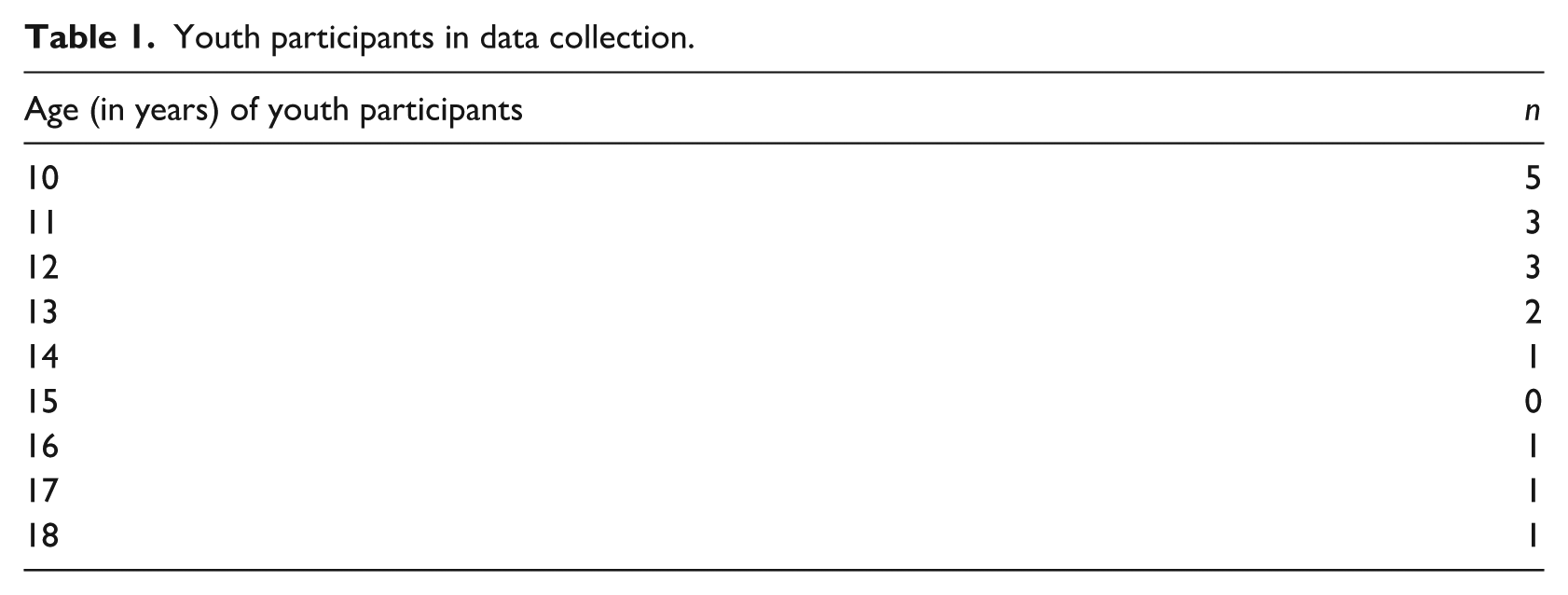
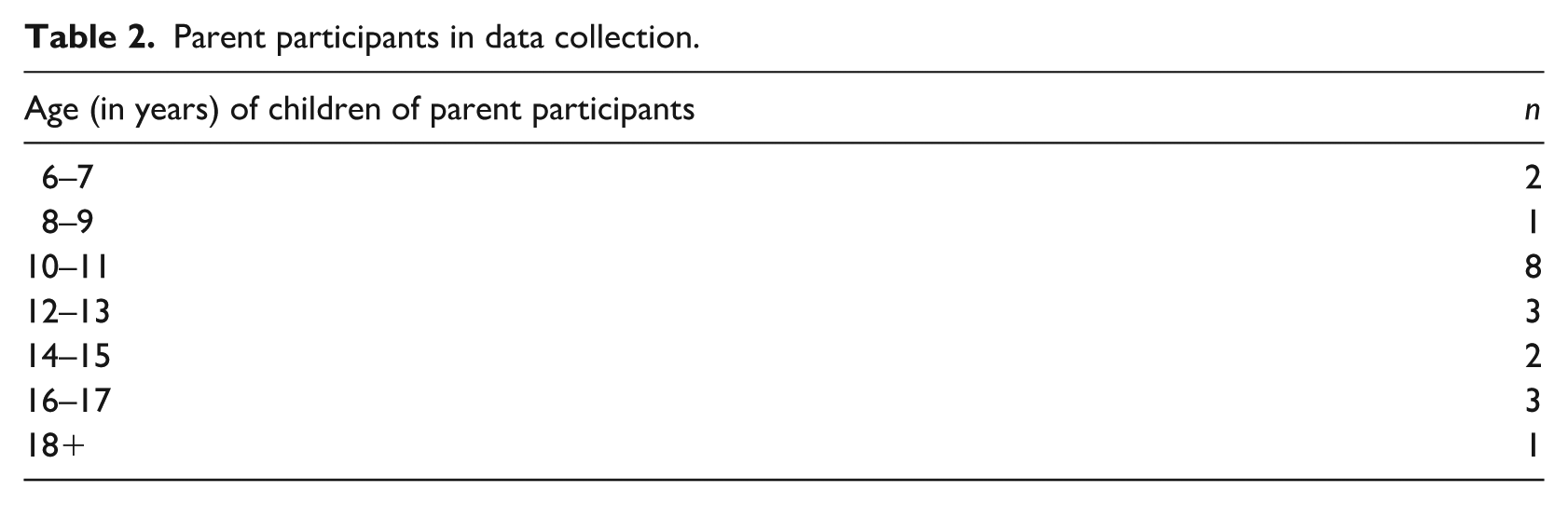
Out of the 21 CWA who came to camp, 13 answered questionnaires and 4 participated in semi-structured interviews. These children ranged in age from 10 to 18 years old (n = 17, M = 12.4, SD = 2.5). In addition, out of the 30 PCWA who attended the camp, 18 parents completed questionnaires and 3 completed interviews. Two parents completed both questionnaires and semi-structured interviews. Two of the parents who completed questionnaires had multiple CWA, and all of the parents had children between 6 and 22 years of age (n = 20, M = 12, SD = 3.9). None of the parents had albinism themselves. Demographic information related to the ages of youth participants and the ages of the children of parent participants is displayed in Tables 1 and 2. Of the 12 counselors who had albinism at camp, four counselors, ages 23 to 55, completed questionnaires. In total, 40 individuals (17 campers, 19 parents, and 4 counselors) provided qualitative data for this study. The remaining camp attendees may have chosen not to participate due to the full camp schedule or lack of interest in the research.
Youth participants in data collection.
Parent participants in data collection.
Instrumentation
Counselors with albinism, campers with albinism, and PCWA responded to anonymous written questionnaires that produced qualitative data. Four campers and three parents participated in semi-structured interviews. Campers were not required to participate in data collection if their parents did, and vice versa.
Questionnaires
All counselors with albinism, campers with albinism, and PCWA who consented to research were invited to participate in anonymous written questionnaires at a time of their choice throughout the week of camp. Both groups completed large print paper questionnaires, as the program occurred in a location with an absence of technology. The questionnaires included open-ended questions related to demographics and inclusion and belonging at camp (detailed in Figure 1). Questionnaires were created by the primary researcher to answer the research question after an extensive literature review. They were not validated, but were approved by the leadership of an albinism advocacy organization.
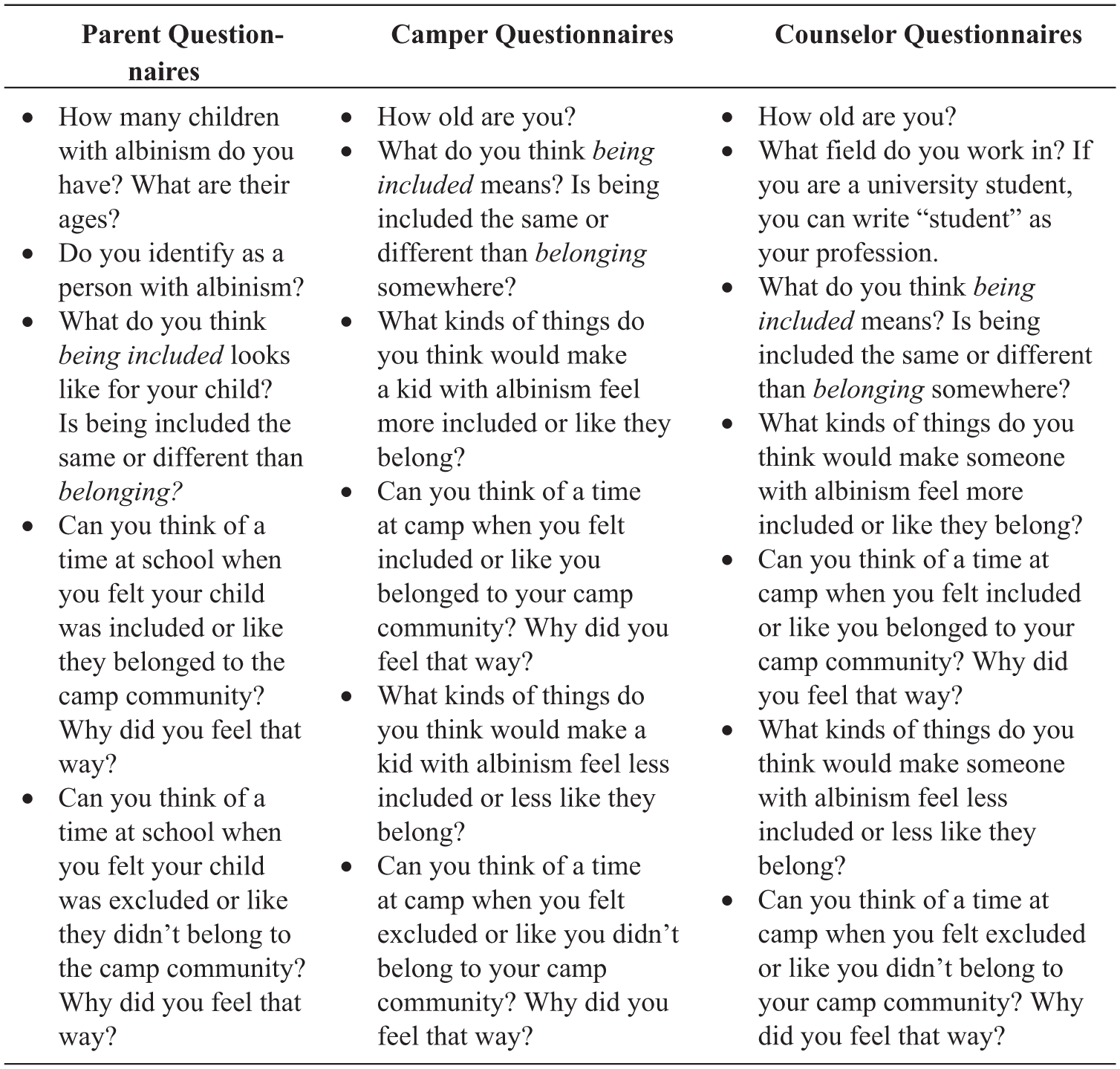
Questionnaire questions.
Interviews
Four CWA participated in semi-structured interviews. Interviews are useful in qualitative research as they allow researchers to learn about the opinions and ideas of participants (Naz et al., 2022). Semi-structured interviews permit the researcher to further investigate experiences and perceptions of the interviewee, as well as ask for clarification (Naz et al., 2022). One camper chose to participate in an interview rather than answer a questionnaire, as he preferred verbal to written communication. Two sibling campers requested that they complete their interview together. Three parents were asked to participate in semi-structured interviews to give a richer narrative to the questionnaire data. Parents were selected based on availability to participate in interviews. Neither campers nor parents had to answer questionnaires to participate in interviews. Semi-structured interview questions are detailed in Figure 2. Interviews were conducted by the primary researcher on the last 2 days and just after camp in a private location and recorded for later transcription.
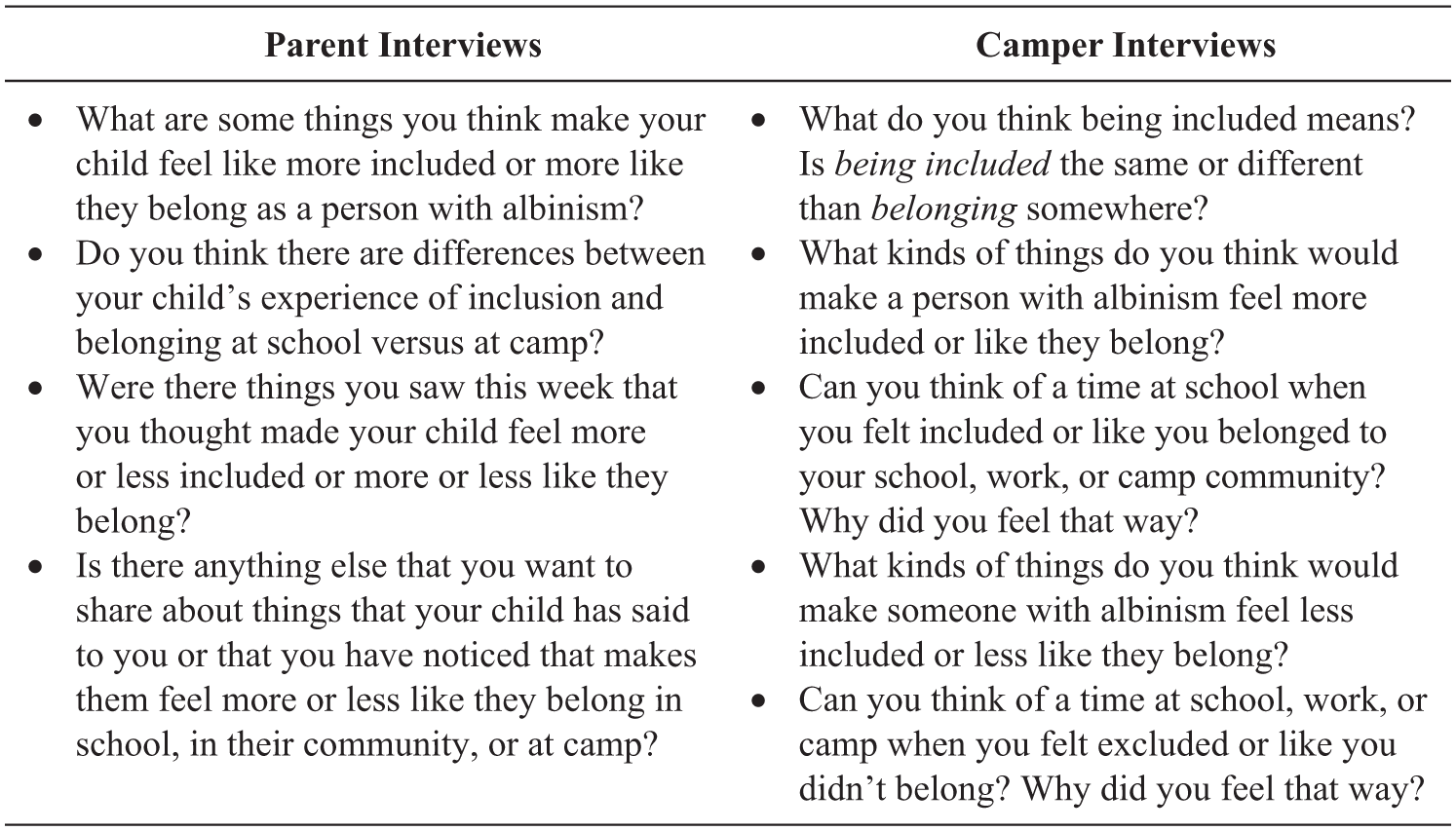
Semi-structured interview questions.
Data analysis
To answer the question of what people with albinism and PCWA perceive about experiences of inclusion and belonging at summer camp, qualitative data from questionnaires and interviews were coded using a general inductive approach (Thomas, 2006) until a point of saturation (Glaser & Strauss, 1967). All themes arose from the data, with no predetermined codes. The primary researcher utilized a code–recode method (Chilisa & Preece, 2005) to establish trustworthiness and triangulated data through data collection across several groups (PCWA, CWA, and counselors). This resulted in themes related to the definitions of inclusion and belonging and themes related to the experiences of inclusion and belonging at camp. The primary researcher is not an individual with albinism, but had been involved in summer camp programming specifically for individuals with albinism for two summers during data collection. As the primary researcher does not identify as a member of any of the groups involved in the data collection, an adult with albinism and a parent of CWA who have been to the camp investigated in this research but who did not participate in data collection read the findings and discussion as a means of confirming the credibility of the data.
Findings
Definitions of inclusion and belonging
Participants identified that inclusion means being present, while belonging means being accepted. One camper defined inclusion as “being allowed to do stuff that everyone else is doing,” while another camper wrote that inclusion means “allowing you to participate.” Parents gave comparable definitions, such as “being part of things” and “given the opportunity.” Counselors defined inclusion with phrases like “made felt welcome” and “allowed to participate.”
With respect to belonging, one camper explained the term meant “people accept you for who you are,” while another wrote that “belonging is feeling you’re loved and accepted.” Parents had similar definitions, with one parent writing that belonging relates to “a sense of being ‘at home’ where no explanation or aggravation of ‘fitting in/adapting’ is needed.” Another parent wrote that belonging means “you 100% feel you are part of whatever you are actively participating in.”
Sixteen parents, eight campers, and four counselors (70% of participants) differentiated between the two terms. One camper explained that inclusion means “when you feel like you’re being included in something you’re just like . . . getting invited to do something and it might be your first time instead of feeling at home,” while belonging means “you feel home there. Feel safe.” A parent wrote, “[inclusion and belonging] are different. Everyone wants to belong to a group.” One counselor explained, “Being included simply means being invited/involved, but belonging implies that you are embraced and accepted,” while another wrote, “You can be included and decide you don’t belong.” Four campers said that inclusion and belonging were roughly the same, while three parents and five campers made no distinction between inclusion and belonging.
Experiences of inclusion and belonging at camp
Themes of all the time at camp, same needs, looking like others, staff as facilitators of inclusion and belonging, and specific activities arose from interview and questionnaire data. With respect to exclusion or lack of belonging at camp, two themes emerged: never excluded and developmental level.
“All the time” at camp
Eleven parents, eight campers, and three counselors indicated that camp resulted in participants with albinism perceiving they were included and they belonged all the time at camp, and nothing at camp made them feel less included or less like they belonged. When asked if there were times when they felt their child was included or belonged to the camp community, one parent responded, “All the time! Because everyone here is educated and understanding. Very little is done different [sic] on the macro-level; it is all of the little things in interactions that make him feel normal/included.” Another parent explained, “This is our first camp. I don’t see my son isolated like I usually do in a group of his peers.” One camper responded they were included and belonged “kind of the whole time.”
When asked if there was anything at camp that made them feel less included or less like they belonged, seven campers indicated there was not, with four simply writing “no.” Ten parents believed that nothing at camp made their children feel less included or less like they belonged. One parent wrote, “everything is so awesome!!” while another elaborated, “they feel included and accepted completely.” A parent explained his daughter’s experience, “I cannot think of a moment when she felt anything but welcome.” Three counselors agreed that nothing made them feel less included or less like they belonged at camp. Three campers and one counselor did not answer that question.
Same needs
Six campers, six parents, and three counselors (approximately 38% of participants) reported a shared understanding of needs related to both low vision and hypopigmentation at camp. Campers wrote “everyone understood” and “everybody understands low vision.” Specifically discussing these experiences seems to be crucial as well, with campers writing that they felt included and like they belonged “when we had conversations about shared experiences relating to albinism” and “all of us had similar experiences to talk about.” Parents noted shared experiences, such as “everyone puts on sunscreen, everyone has hats and/or sunglasses.” One parent explained, Being included should not be an afterthought (reactive). [Name] camp is proactive. They organize all programming for both blind/ low vision and sighted. My daughter can have similar experiences as her sister who is sighted. Belonging is different. At [Name] camp she can be herself and not explain herself. Everyone around is familiar with albinism.
One counselor explained, “I love being in a place where I can just ‘be’ and not have to explain myself. So much of my adult life involves explaining myself and it feels so freeing to not have to.”
Four parents and one counselor identified a shared need for sunscreen and sun protection as particularly contributing to belonging and inclusion. One parent elaborated, Everyone had their hat on. She wasn’t fighting me on the hats or sunglasses and all that, where I usually get resistance. I could also say like, look everyone else is doing it, you know. It was nice to be able to say that . . .
One parent and one child also specified that shared experiences of visual accommodation needs are particularly impactful. A high school-aged camper highlighted that “not needing to answer others’ questions and not needing to say ‘I can’t see’” fostered belonging and inclusion. One parent explained that people at camp “calling out [child’s] name and greeting her by stating who you are, this happens frequently at camp, but is harder for people in her daily life to remember” supported belonging and inclusion. Shared experiences at camp contributed to a sense of belonging and inclusion.
Looking like others
Each family that attended camp included at least one person with albinism. A majority of the staff members at camp also had albinism. Five campers (29%), four parents (21%), and three counselors (75%) explained that being around other people with albinism contributed to inclusion and belonging. Campers wrote, “everyone was like me” and “there are other people with albinism . . . Like a lot!” One camper stated, “there’s not usually that many people with albinism near us.” Another shared, “I saw myself in everyone.” One parent reflected, people with albinism are the majority and we, those of us that don’t have any kind of visual impairments or albinism, were the minority. So it really turns the tables on the situation for them and they feel much more empowered and they feel much more comfortable.
Another parent elaborated, I felt like my son was included belonged [sic] as soon as we stepped inside the hall. Because being around others than look like you when you’re used to being the minority is uplifting in every way. You do not have to explain or be self-conscious about your differences, there is no comparison, you feel empowered and embraced . . . you feel home.
For two campers who requested to be interviewed together, looking like others was a significant part of their experience at camp. One explained, “there are other people with albinism [here] . . . Like a lot.” The other child elaborated, “Yeah. And there’s not really . . . there’s not usually that many people with albinism near us.” The experience of being around others who looked similar contributed to experiences of inclusion and belonging for CWA at camp.
Specific activities
Six parents (approximately 32%) and five campers (29%) indicated that specific camp activities supported belonging and inclusion, particularly with respect to low vision. One camper reported, “I felt included when playing all the games. It was really fun and interesting.” Another camper listed participating in physical activities like gaga ball as times that promoted belonging and inclusion. A camper explained that finding connection through a shared interest and shared identity contributed to inclusion and belonging: “We all loved art, and had albinism, so we understood each other.”
Parents reported “games with audible clues!” and “adaptive [sic] sports” contributed to belonging and inclusion for their children. Another parent elaborated, “there are accommodations that are made for them, there are special, you know, equipment that they can use. But they can still participate. And so sports, huge.”
Staff as facilitators of inclusion and belonging
While not a theme among campers or counselors, specific actions of staff arose as a theme among parents. Four parents (21%) detailed times when staff acted in ways that contributed to inclusion and belonging, related to both low vision and appearance. One parent explained that she heard staff “calling out [my daughter’s] name and greeting her by stating who you are. This happens frequently at camp but is harder for people in her daily life to remember.” Another parent explained that having staff at camp who had no family members with albinism or no direct link to the albinism community making accommodations and treating campers with respect showed campers that “people that don’t have to have albinism to care. Or visual impairments to care.”
Campers had many opportunities to interact with staff with albinism. In particular, two Paralympic athletes with albinism participated in the camp experience. One parent stated that they perceived the experience of having Paralympians at camp contributed to their child’s experience of belonging and inclusion: Listening to the two para-athletes that are here and seeing them as the role models, that it can be done and it’s not out of reach. Because it’s one thing to know that there’s a Paralympics and it’s a whole ‘nother [sic] to actually meet Paralympians.
Parents perceived that the actions of staff with and without albinism contributed to the experiences of inclusion and belonging for their CWA.
Developmental level
Five parents (26%) articulated that they perceived developmental level, including age, size, and social skills, contributed to feelings of exclusion or lack of belonging in their children. Parents explained that they perceived the times their children did not feel included or like they belonged were “more the usual social stuff” and “NOT related to albinism, but more of a growth and change due to age/maturity.” Three parents noted that their children are shy or do not initiate interactions in general.
Seven campers (41%) expressed similar sentiments. One middle school-aged child said, “people make fun of me bc [sic] I’m small.” Another child indicated that there were times at camp when he felt like they were not included and didn’t belong, but it was specifically older kids that made him feel that way. One camper was making the transition to being a counselor in training at camp, and the “whole mix between am I a camper that should worry about counselor stuff or am I a counselor who should, that’s kind of meant to do camper stuff” contributed to him feeling like an outsider.
Discussion
The present research supports the idea that summer camps can be used as affinity groups to promote belonging and inclusion for youth with disabilities. In particular, the camp in the present research created an environment in which participants had the same needs with respect to disability status, benefitted from similar accommodations, and looked like others, experiences that CWA and their parents do not report occurring at school (Gibson, 2024; Lepore-Stevens & Love, in press; Lepore-Stevens & Sosland, 2025). These characteristics are similar to those of an affinity group: shared identity, community, and experiences. This research supports prior studies about the experiences of inclusion and belonging for youth with disabilities in disability-specific summer camp settings (D’Eloia & Price, 2018; Goodwin & Staples, 2005).
Defining inclusion and belonging
Participants in the current study largely identified that inclusion and belonging are different constructs. PCWA and people with albinism themselves noted that inclusion means individuals are present within a physical space, while belonging means people are wanted and accepted. Carter et al. (2016) described presence in a space as the first dimension of belonging. Presence is essential to eventual belonging, as one cannot belong if they are not participants in the setting they wish to belong to (Carter et al., 2016). While an ideal definition of inclusion also involves belonging (Carter et al., 2016; Haegele & Maher, 2023), in practice, that is not always the case. Participants in the current study described belonging as being embraced, at home, safe, and accepted, as opposed to just being present. This perspective supports prior research in the field of inclusion and belonging for individuals with disabilities.
Swinton (2012) explained that inclusion is a legislatable experience while belonging is not: “the law can legislate for inclusion, but it cannot help people to belong” (p. 182). Thompson (2016) indicated that inclusion does not require nondisabled people to understand and befriend disabled people. However, for belonging to occur, “individuals must be missed when they are absent. In other words, the disability is noticed, welcomed, and accounted for” (Thompson, 2016, p. 1490). Inclusion in a place does not always mean individuals feel they belong.
All the time at camp, staff, and camp activities
The themes of staff as facilitators of inclusion and belonging and specific activities likely led to participants perceiving they were included and belonged all the time at camp. As one parent identified, camp was proactive in creating an inclusive environment by organizing all camp activities around the needs of individuals with albinism. Since camp was designed with accessibility in mind rather than reacting to accessibility needs after the fact, individuals with albinism never had to ask for their needs to be met. This contributed to a perception that people with albinism were included and belonged all the time at camp.
A majority of the staff at camp either had albinism or were PCWA. As a result, the whole staff contributed to an environment of inclusion and belonging by accommodating the needs of both counselors and campers with albinism, further creating an environment that always facilitated belonging and inclusion.
Same needs and accommodations
In prior research, parents identified access to visual accommodations and sun protection as barriers to inclusion and belonging in school (Lepore-Stevens & Sosland, 2025). At the camp in this research, participants with albinism had the opportunity to be in a setting where most people shared their needs, or at the very least, understood those needs. CWA, PCWA, and counselors in attendance all noted that being around people who had the same needs was a significant part of the experience. With respect to vision and skin protection needs, camp participants felt like they were provided with accommodations necessary to participate in activities and experienced normalization of sun protection.
Looking like others
Albinism is a low-incidence disability that is most commonly inherited through a recessive gene (Federico & Krishnamurthy, 2023). As a result, CWA may have never met someone who looks like them in person unless their families have sought out those connections. At the camp in the current research, many staff members and children had albinism, and all individuals without albinism had a connection to the albinism community in some way. This created an environment in which young people with albinism could see themselves in their peers and role models in a unique way that is unlikely to occur in everyday life. Summer camp created a place where awareness and lack of awareness of one’s own disability identity could exist simultaneously, as participants could be with others who looked like them but not be concerned about exclusion based on identity. This is a key feature of an affinity group: the absence of oppressive culture and the presence of others with shared identity (Rushing, 2024).
Implications and considerations
Disability-specific summer camps can be meaningful places in which children can grow in their disability identities. Particularly for those who have low-incidence disabilities, disability-specific programs may be the only place children can meet others who share their identity. The camp investigated in this research included several key components that allowed participants to experience inclusion and belonging. While findings may not be directly transferable due to the low number of participants, some elements of this particular program may serve as a guide for other organizations aiming to create an affinity group through summer camp.
Affinity group role models
Disability-specific settings may provide greater opportunities for young people to experience disabled role models than inclusive settings (Shah et al., 2004). PCWA in the current study, in particular, noted the importance of their children seeing staff members, professional athletes, and older CWA in the camp setting. Disability-specific settings allow young disabled people opportunities for “learning from each other to combat disabling barriers to success and fulfilment” that may not exist in inclusive settings (Shah et al., 2004, p. 127). Lepore-Stevens and Foster (2024) found that summer camps for youth with visual impairments should hire blind and visually impaired staff, as “allowing young people to interact with role models who share their disability status can promote social inclusion and social engagement” (p. 76). Similarly, the current research highlights the importance of hiring disabled adults in camps that serve as affinity groups.
Adapted activities
Lepore-Stevens and Sosland (2025) and Lepore-Stevens and Love (in press) found that CWA often feel left out in school, as well as specifically excluded from participation in physical activity and sport. At camp, all activities were designed to support the vision and sun protection needs of CWA. While most of the activities at camp (sports and recreation, arts and crafts, waterfront, theater, etc.) were typical summer camp activities, campers with albinism were able to participate without barriers. Adapted equipment, such as auditory balls and targets, and explicit verbal instruction can support inclusion in physical activity and recreation for CWA. In addition, regular and normalized opportunities to apply sunscreen and encouragement to wear sun protection items (sunglasses, sun shirts, hats, etc.) can support belonging and inclusion for youth with albinism in summer camp programs.
People with disabilities are “often isolated and discriminated against through physical barriers, exclusionary criteria, as well as societal and community standards” when participating in physical activity (Weston, 2017, p. 3). When creating summer camps that serve as affinity groups for children with disabilities, staff should be aware of the barriers to sport, physical activity, and recreation participation experienced by that group and be prepared to adapt to those needs. Some common physical activity adaptations for people with disabilities may include modifying the color, size, or weight of equipment; decreasing team sizes or field space; increasing the size of targets or goals; and disregarding time limits (Winnick & Porretta, 2021). Creating activities that are designed to support a variety of needs can result in more inclusive activities.
Varied developmental levels
While the summer camp in the current research grouped children by age during some structured activities, children interacted in mixed age groups during meals, free swim, and evening activities. Mixed age groups at camps for youth with visual impairments can build confidence, provide opportunities for leadership, and promote meaningful inclusion with respect to disability (Author, 2024; Maher et al., 2024). However, there may be times when older children want to have experiences and conversations that are inappropriate for younger children (Maher et al., 2024). In mixed-age settings, “older children may become overbearing or bossy. Younger children might feel overwhelmed or intimidated by the older children. Adults need to be particularly vigilant for signs of bullying” (Rasmussen, 2005, p. 4). Parents and children in the current study reported that age and general social skills played a role in times when CWA felt excluded or like they did not belong at camp. Strategies like grouping children by skill level, planning activities with varying levels of complexity, and increasing adult supervision may support inclusion and belonging in mixed-age groups (Rasmussen, 2005).
Supporting multiple disabilities
While not emerging as a theme, two parents indicated that their children had moments that led to not feeling like they were included or belonged at camp due to multiple disabilities. One parent wrote, “her secondary dx (ADHD) does present problems/difficulties for her when making and maintaining friendships.” Another parent explained, “all of the announcements during meals . . . [were] too much for her auditorily on a sensory level, so she was blocking her ears and not accessing the info.” The presence of secondary disabilities led to parental perceptions that their children experience barriers to inclusion and belonging at camp.
Chronic illnesses like Hermansky-Pudlak and Chediak-Higashi syndromes are also associated with albinism (Federico & Krishnamurthy, 2023), and prior research (DeCarlo et al., 2014; Kutzbach et al., 2007) indicates that rates of attention deficit/hyperactivity disorder may be higher among individuals with albinism than in the general population. Due to these associations with other disabilities and chronic health conditions, programs that serve youth with albinism should be prepared for coexisting neurodevelopmental and medical conditions that may require additional accommodations. Approximately 65% of children with visual impairments live with additional disabilities (Hatton et al., 2013). For organizations looking to create disability-specific summer camps, staff should be aware of disabilities and medical conditions commonly co-occurring in that group and be prepared to accommodate those needs. Accommodations to recreation activities may include changes to equipment, environment, rules, or instructional methods to support a variety of bodies and neurotypes (Winnick & Porretta, 2021). Communication with families about individual needs can also support the accommodation process.
Supporting new campers
Three parents discussed their child’s difficulty with integrating into new social groups, with one parent suggesting a virtual precamp gathering or an official buddy system between new and returning families. The camp did institute a precamp virtual meet-up to answer questions, which another parent indicated was helpful. However, this meeting was held at night, several weeks before camp, and not all families were able to attend. More opportunities to connect children with others who have been to camp before could support belonging at camp, as well as further the impact of camp as an affinity group beyond the actual camp environment.
Limitations
This research had several limitations. While some parents addressed the impact of multiple disabilities, participants were not asked directly about additional disabilities or intersecting identities such as race, ethnicity, country of origin, or gender. Questionnaires in this research were completed by children who varied in age and awareness of their potential multiple identities. In order for children to complete the questionnaires as anonymously and independently as possible, the questionnaires included only basic demographic information. Including additional demographic information on parent surveys also had the potential to unanonymize participants. The study did not explicitly consider the experiences of individuals from diverse social groups. Furthermore, all participants in this research belong to families who are connected to the albinism community and have sufficient discretionary income to attend a camp program that has associated costs. This sample likely already has affinity to the host organization, and individuals who do not feel that way are unlikely to attend. Individuals who had strong feelings about inclusion and belonging at camp may have been more willing to participate in the research.
Participants were allowed to select their own scribe, if needed. The selection of a parent or counselor may have impacted responses. During data collection, the primary investigator was in her second summer as a counselor and knew many of the participants from programs beyond camp. While this may have increased participants’ comfort in answering questions, it may also have impacted responses in a desire to please the researcher and support her work. Surveys were completely anonymous and did not ask if participants had come to camp before, so it is unknown how many participants may have had experience with the camp or research prior to the year the research was completed.
Conclusion
Disability-specific summer camps provide opportunities to meet with others based on shared identity – a key feature of affinity groups. At the summer camp investigated in this research, being around other people who look similar and have shared needs resulted in feelings of belonging and inclusion for participants with albinism. Camps that serve a particular disability group may be valuable affinity groups for youth who otherwise lack shared identity in their daily lives.
Footnotes
Funding
The author received no financial support for the research, authorship, and/or publication of this article.
Ethical considerations and consents
This study was approved by the Rowan University institutional review board (PRO-2023-133). Adult respondents gave written consent for review and signature before starting interviews or surveys. Youth respondents had parent consent and assented prior to participation.
Consent for publication
Not applicable.

Data availability
Research data is not currently available in a public data repository due to it containing potentially identifying information.