




Abstract
Multisensory storybooks are widely used to support shared book reading for children with a visual impairment (VI). However, little is known about the consistency in the methods used or the effectiveness of multisensory shared book reading in providing a learning experience for children with VI. Accordingly, we conducted a scoping review following Arksey and O’Malley, following PRISMA-ScR standardized reporting guidelines. Four databases were included in the literature search, and eight peer-reviewed articles, four book chapters, and five theses/research reports met the eligibility criteria. Our review indicates that multisensory storybooks are rarely developed exclusively to meet the needs of children with VI, employ a heterogeneous set of guidelines, and their effectiveness is rarely tested empirically. Given the increasing interest and potential value of using multisensory storybooks to support shared book reading by children with VI, we provide recommendations for establishing empirically tested guidelines to support their effectiveness.
Introduction
Shared book reading, or storytelling, is widely used to support children’s learning. This interactive experience allows an adult to read aloud and encourage children’s engagement with the story (Gámez et al., 2017). Research suggests that active engagement in shared reading enriches language exposure (Troseth et al., 2020), introduces diverse scenarios beyond daily life (Hindman et al., 2016), and familiarizes children with rare vocabulary within meaningful story contexts (De Temple & Snow, 2003). Many researchers argue that shared reading supports children’s reading development and fosters growth in language and cognitive skills, drawing on Vygotsky’s (1978) concept of scaffolding, which proposes that children can acquire emerging skills during critical developmental stages through guided, shared learning activities with a teacher, parent, or peer (Dowdall et al., 2020; Noble et al., 2019).
Visual images in books further support concept acquisition, allowing children to explore object features at their own pace. These images help children associate event meanings, understand intentions, and develop perspective (Murray, 2014).
Children with visual impairment (VI) often miss out on the benefits of storytelling and shared book activities because they cannot rely on pictures to support comprehension. Unlike sighted children, who acquire many concepts incidentally through visual interactions (Spungin et al., 2016), children with VI typically require explicit instruction and hands-on experiences with real objects to construct meaning (Koenig & Farrenkopf, 1997; McCarthy & Holbrook, 2017). The impact of VI, however, depends on its onset and severity. Children with congenital VI (present from birth) lack visual foundations, whereas those with adventitious VI (acquired later) may retain visual memory and spatial awareness that continue to shape cognitive and social development, particularly if they had usable vision before age 3 (Monegato et al., 2007). Similarly, children with low vision can extract some pictorial information but often miss details or misinterpret images, whereas those with no vision gain nothing from pictures. Across these groups, common challenges include developing visual concepts and interpreting abstract or spatial information in picture books (Holbrook & Koenig, 2000). These differences highlight the importance of multisensory approaches to storytelling. Tactile supports and auditory cues can make abstract concepts more accessible, while interventions may need tailoring to the specific needs of individual readers, given the diversity of experiences within the VI population (Bara et al., 2018; Lizarde, 2008).
One common approach to supporting the learning of children with VI is the use of tactile illustrated books, which combine text with tactile graphics. These illustrations typically depict objects through raised lines or textured 2D surfaces that can be explored with the fingertips or hands. This allows children to use the tactile graphics to interpret the meaning of the accompanying text (Valente et al., 2024). These illustrations often represent the physical characteristics of real-world objects as they appear visually. For example, a story about a bear might include tactile graphics that present the animal as a raised line drawing or incorporate materials like fur or textured surfaces. These elements may help the reader to better understand the concept and become more engaged with the story (Wright, 2010).
Studies highlight benefits of using tactile illustrated books, reporting improvements in language development (Carney & Levin, 2002), comprehension (Bara et al., 2018), and literacy skills (Heller & Gentaz, 2014). However, some research identifies limitations. Children often struggle to recognize and interpret objects presented in tactile form (Bara et al., 2018; Phutane et al., 2022; Theurel et al., 2013; Valente et al., 2024). In addition, the use of tactile books implicitly assumes that children have strong tactile literacy and spatial awareness skills (Phutane et al., 2022). Yet, children with VI often struggle to form visuospatial imagery (Theurel et al., 2013; Thompson et al., 2003) and may lack familiarity with visual conventions (Valente et al., 2024). Consequently, critics recommend moving beyond flat tactile graphics to offer more immersive sensory experiences created using interactive elements, such as real objects or 3D components, to provide a richer multisensory learning environment (Bara et al., 2018; Phutane et al., 2022; Valente et al., 2024).
Multisensory books are interactive tools designed to address this need for enriched sensory stimulation and to enhance the reading experience for children with VI. These books incorporate a variety of tactile elements (e.g., textures, raised lines), auditory components (e.g., music, sound effects), and sometimes olfactory features (e.g., scents). Engaging multiple senses supports deeper learning and greater enjoyment of reading (Fuller, 2013). In addition, unlike traditional storytelling, multisensory stories provide a more immersive experience by combining narrative with sensory stimuli tailored to the child’s needs (Fornefeld, 2013), so that narrative understanding is enhanced through touch, smell, and even taste. For example, when learning about animals, a child might handle physical models of an elephant or a dog to explore their shapes and textures, hear the animals’ sounds, or feel materials mimicking their fur or skin.
This use of multisensory books has emerged as part of a broader approach known as Multisensory StoryTelling (MSST), developed in the 1980s by Chris Fuller and influenced by Fuller’s (1999) Bag Books and Park’s (1998) work on multisensory theatrical performances. This has been further expanded through the efforts of third-sector organizations such as PAMIS (Promoting a More Inclusive Society, University of Dundee, 2010). MSST is grounded in an emotion-based and social interaction framework (Şafak et al., 2017), viewing storybooks as tools to foster meaningful social interactions that support children’s social and emotional.
MSST has grown both as a family activity and as an educational resource, particularly for individuals with profound and multiple learning difficulties (PMLD), or special educational needs and disabilities (SEND). This includes children with VI (Fornefeld, 2013; Şafak et al., 2017). MSST emphasizes personalizing content and format to match the needs of each child. Stories often reflect meaningful aspects of a child’s life and identity, or familiar experiences. To encourage engagement, each page presents an interactive object designed to capture the child’s interest and invite exploration.
There is growing evidence that multisensory information can enhance learning by enabling the formation of multiple, complementary sensory memory traces, thereby strengthening encoding and supporting later recognition and recall (see, for example, Mathias et al., 2021). However, although studies suggest MSST benefits children with special needs (e.g., Fornefeld, 2013; Fuller, 2013; Young & Lambe, 2011), research on the use and effectiveness of multisensory storybooks (MSSBs) for children with VI is limited. For example, Şafak et al. (2017) investigated the impact of MSSB for VI children following PAMIS guidelines, but included only a small sample of three children, and their materials were not externally validated. Similarly, based on a literature review, Lizarde (2008) developed instructions for creating multisensory story boxes as part of her Master’s degree, reporting benefits of multisensory books for children with low vision. However, as with other research, these observations appear to have been made informally and her materials again were not externally unvalidated. Stangl et al. (2014) developed a digital library of 3D-printed tactile picture books, tested with a small group of children with VI, along with their parents and teachers. Despite positive outcomes, the resource is highly specialized and not widely accessible, raising questions about its broader applicability. More recently, Föcker et al. (2025) showed that children, adolescents, and adults with blindness or VI respond positively to multisensory input, in this case designed to support learning of braille. Taken together, these studies suggest potential benefits for children with VI but reveal limitations in sample size, material validation, and scalability, or demonstrate the acceptability and positive experience of multisensory reading or learning methods without systematically assessing their effectiveness for aiding comprehension or supporting learning. Notably, the varied methods highlight the need for a standardized framework for development, evaluation, and implementation of MSSB tailored to the needs of children with VI.
MSST has been more widely applied and evaluated with children with PMLD and SEND, including participants with VI. Notably, ten Brug et al. (2012) and ten Brug (2015) used a combination of quantitative and qualitative methods to build evidence for MSST with PMLD and SEND, reporting benefits, including for participants with VI. Other studies have explored the potential of MSST to support broader outcomes, such as improvements in language development and comprehension. However, evidence comes mostly from small-scale pilot studies offering tentative support (Kamei-Hannan et al., 2022). In sum, despite growing promotion of multisensory approaches, these tend to be implemented with systematic evaluation and claims for their effectiveness are largely based on anecdotal or observational evidence rather than robust empirical data.
PAMIS has sought to address the need for greater consistency in the development of MSST resources by establishing a set of guidelines (PAMIS, 2010). These recommend that stories consist of 6 to 16 short sentences, with each sentence or pair of sentences linked to a carefully selected sensory stimulus. The stimuli should reflect both the content of the narrative and the needs of individuals. PAMIS also highlights the importance of how these stimuli are introduced: they should be presented to the child at the beginning of a session to allow for familiarization, then reintroduced at appropriate moments during the storytelling, with attention to pacing and vocal delivery, ensuring children have adequate time to process the narrative and engage with the sensory experiences. However, the guidelines are less clear about how to implement these recommendations in real-world settings, leading to variation in how multisensory stimuli are integrated into storytelling sessions. This highlights the need to better understand current practices, especially where PAMIS guidelines are used with children with VI. Such insights could inform more effective and standardized approaches tailored to their needs.
As a first step towards addressing this gap, the present scoping review systematically maps existing research on storytelling and story reading practices for children with VI that incorporate multisensory props or tactile objects to support the storytelling process. Specifically, the review aimed to explore three key areas: (1) current MSST practices used with VI children; (2) the protocols, procedures, and guidelines employed in the development of MSSB for this population; and (3) the evidence regarding the effectiveness of MSST for VI children, including the limitations of current approaches.
Materials and methods
Our scoping review followed the methodological framework proposed by Arksey and O’Malley (2005) and refined by Levac et al. (2010). The study adhered to reporting guidelines outlined in the Preferred Reporting Items for Systematic Reviews and Meta-Analyses extension for scoping reviews (PRISMA-ScR) checklist (Tricco et al., 2018). This requires that the scoping review follows a series of stage that (1) identify the research question, (2) identify relevant studies, (3) select eligible studies, (4) chart the data, and (5) collate, summarize, and report the results. By following these stages, our scoping review takes a systematic approach to mapping existing research on storytelling practices for children with VI.
Identifying the research question
Our review is concerned with understanding research on MSST practices for children with VI. With this review, our primary objective was to document available guidelines and procedures followed during multisensory story sessions specifically designed for children with VI. In addition, we sought to identify literature on the effectiveness of multisensory stories in achieving related outcomes for children with VI and to highlight the limitations of current MSST practices for this population.
Identifying the relevant studies
Eligibility criteria
The population, concept, and context framework (Peters et al., 2020) was used to formulate eligibility criteria for research included in the review (see Table 1). This review included book chapters, journal articles, and published dissertations. In line with PRISMA-ScR guidelines (Tricco et al., 2018), we also reviewed the ‘grey’ literature (e.g., research reports, unpublished PhD theses and unpublished dissertations) in this area, which, although not typically peer-reviewed, enabled a more comprehensive mapping of evidence on multisensory books for children with VI. All sources were systematically searched and screened using the same criteria as the peer-reviewed literature. Conference abstracts, editorials, commentaries, letters to editors, protocols, personal opinions, and blogs were excluded from the review, as these sources were unlikely to provide primary data.
Eligibility criteria – the scoping review.
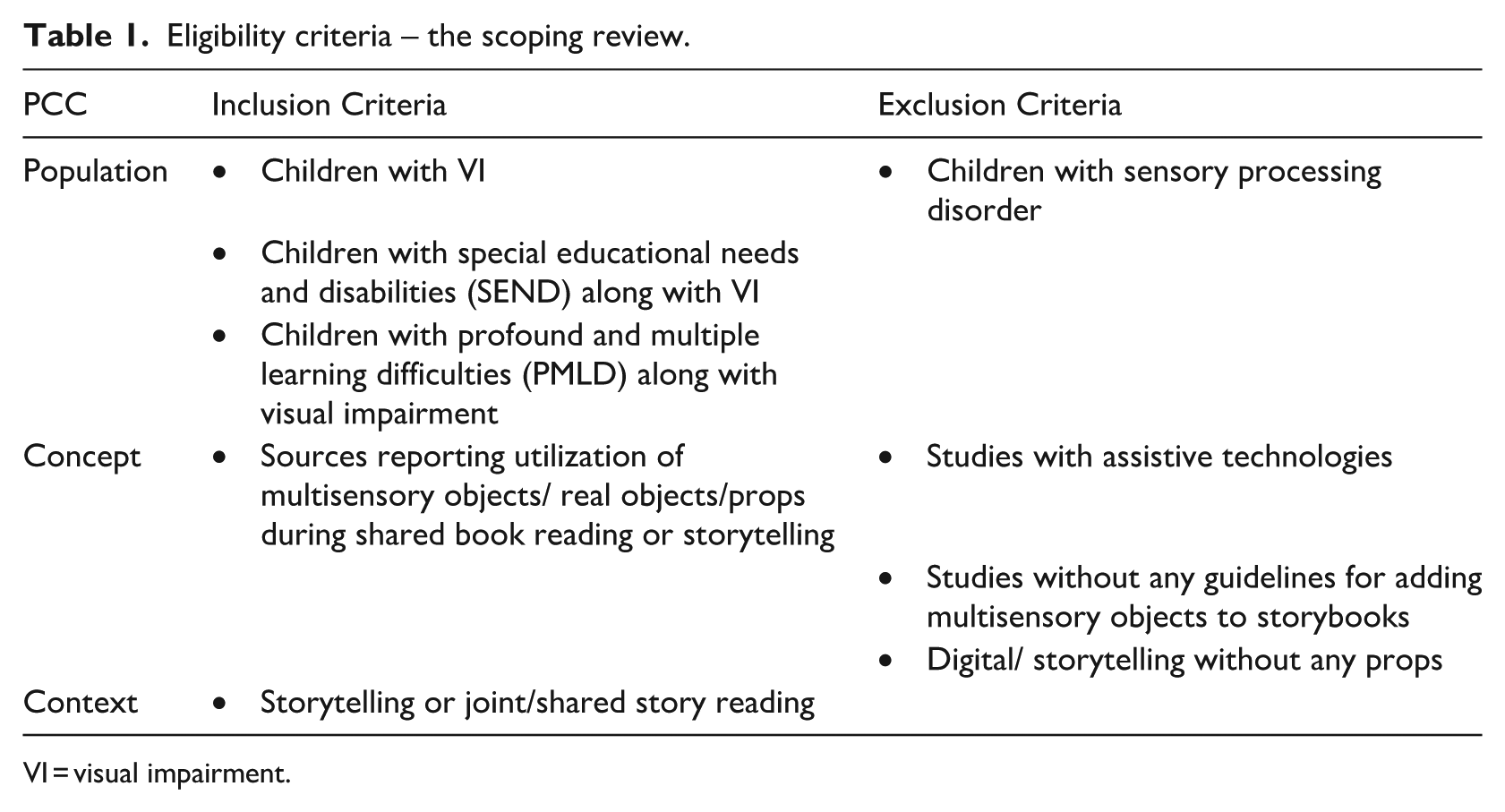
VI = visual impairment.
Search strategy
A three-step search strategy was undertaken. First, an initial search facilitated identifying the relevant articles and key search terms. In the second step, a test search was conducted using the initial search string in a single database. During this step, Library Research Services Consultant from the The University of Leicester was consulted to validate the strategy and the search string. In the last step, systematic search was carried out using the revised search string. Search terms included ‘Visual impairment’, OR blind* AND ‘Multisensory’ OR multimodal OR Tactile AND Storybooks OR ‘storytelling’ OR book OR reading plus database-specific subject headings and synonyms for free text terms.
A systematic search was conducted across four major databases: Web of Science, PsycINFO, Scopus, and Google Scholar. These were chosen for their broad disciplinary coverage and capacity to capture a diverse range of relevant research. To ensure inclusion of studies not identified through database searches, the reference lists of the selected publications were manually screened. In addition, a citation search of the final set of included studies was conducted using the Web of Science Citation Index (Arksey & O’Malley, 2005). To supplement the search, key authors in the field were contacted to request relevant unpublished or ongoing work. The search was conducted without restrictions on publication date or geographical context. However, only studies published in English were considered for inclusion.
Study selection
References retrieved from the database searches were exported into the reference management software EndNote X9, which automatically identified and removed duplicate records. However, as Rathbone et al. (2015) note, automated duplicate removal is only partially effective, making manual verification necessary. Accordingly, remaining duplicates were identified and deleted manually. Once duplicates were removed, the final set of references was imported into Rayyan (Ouzzani et al., 2016), a web-based platform designed to support the screening process in scoping, systematic, and other types of literature reviews. Rayyan was used to assist with the organization and selection of studies based on predefined inclusion and exclusion criteria.
The screening process was carried out in two phases. In the first phase, studies were initially assessed for eligibility based on their titles. Articles clearly irrelevant to the aims of the scoping review were excluded at this stage. Next, abstracts for the remaining papers were screened independently by two reviewers. For a study to be excluded at the title and abstract screening stage, both reviewers needed to agree on its exclusion. In cases of disagreement, the study was retained for full-text screening to ensure that potentially relevant research was not prematurely excluded.
The second phase involved full-text screening of the remaining studies. Studies with uncertain eligibility were referred to the second author for a final decision. Only studies that were clearly relevant or whose eligibility could not be determined from the abstract were included for full-text review. The full study selection process was documented using a PRISMA flowchart (Tricco et al., 2018), which provides a detailed illustration of the identification, screening, and inclusion stages (see Figure 1).
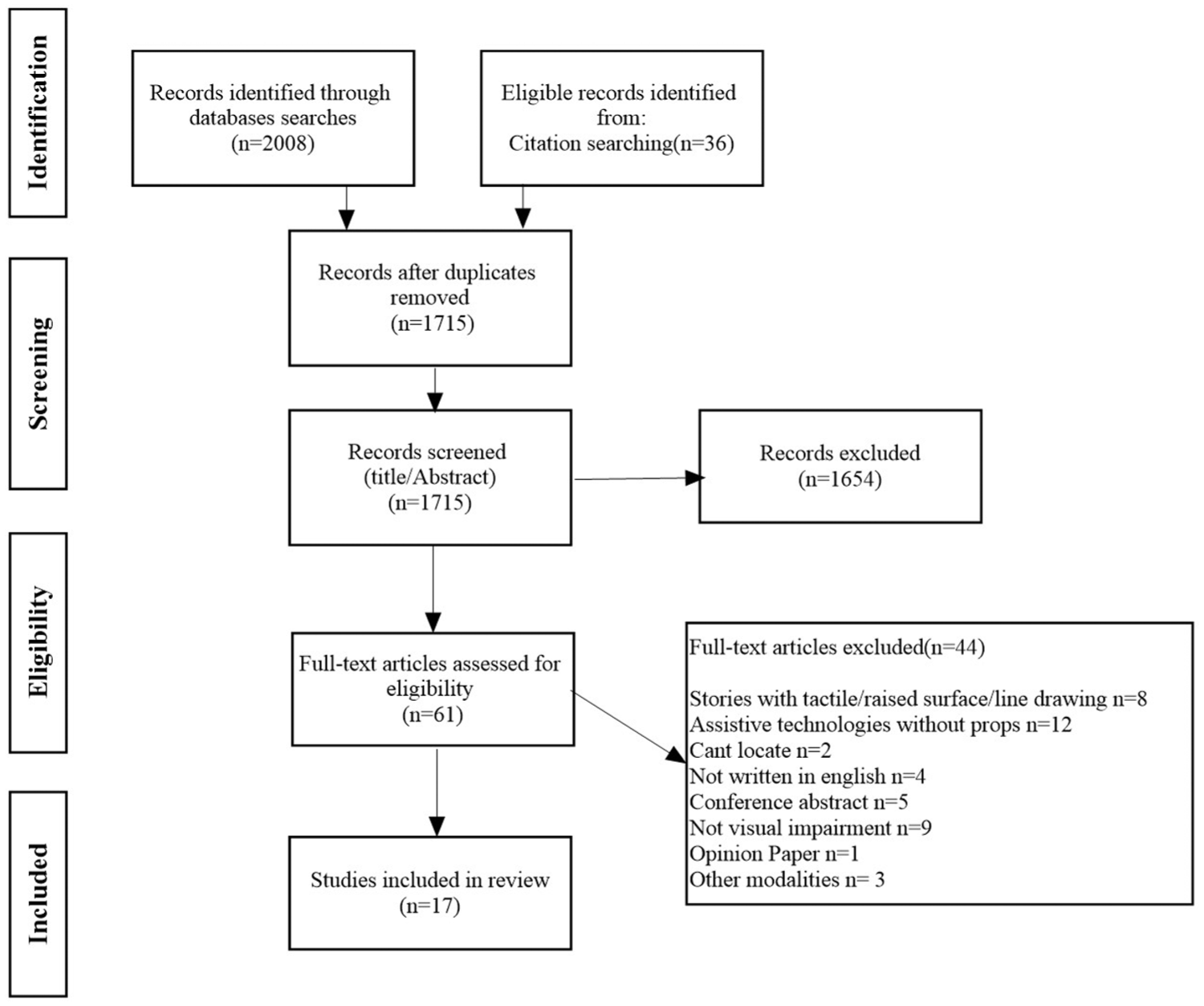
PRISMA flowchart identification, screening, eligibility, and inclusion of studies.
Charting of data
To extract relevant data from publications included in the review, the first author developed a standardized data extraction form. This was piloted by a second reviewer (U.S.) who tested it on a subset of articles. Necessary modifications were discussed and agreed upon with the first author to ensure accuracy and consistency. The finalized data were collected and organized in a spreadsheet by the first author. The extracted information included the following details: author, year of publication, sample characteristics, study design, type of storytelling session, and specific information regarding the use of multisensory elements, such as 3D objects or real materials, within the storytelling practice.
Collation, summary, and reporting of results
Data summary and synthesis
Given the anticipated scarcity of relevant literature and the expected variability across the identified studies, extracted data were synthesized to provide a descriptive overview of the existing research. The key findings summarize the characteristics of study samples, storytelling practices employed, and presence or absence of formal protocols or guidelines for using multisensory stimuli with children with VI. This approach maps the current practices and highlights areas where further research and standardization are needed.
Results
Selection of source evidence
The literature search yielded a total of 2044 references (Figure 1). After the removal of duplicates, 1715 unique records remained. These were screened at title and abstract level, resulting in exclusion of 1654 articles. The remaining 61 studies were retrieved for full-text review to assess eligibility. Following full-text screening, additional studies were excluded for the following reasons: use of raised surfaces or line drawings without multisensory elements (n = 8), focus on assistive technologies without the use of props or real objects (n = 12), full text unavailable (n = 2), not written in English (n = 4), conference abstracts lacking sufficient detail (n = 5), samples that did not include children with VI (n = 9), opinion papers without empirical data (n = 1), and duplicate articles published under different author names or abstracts (n = 3). Following this process, 17 studies met the inclusion criteria and were selected for analysis.
Characteristics of sources evidence
Characteristics and key findings of the 17 included studies are summarized in Table 2. The literature revealed a range of practices for using MSST with children with VI. Selected studies comprised journal articles (n = 8), book chapters (n = 4), theses (n = 3), and research reports (n = 2), published between 2011 and 2022. Geographically, the majority of studies were conducted in Western countries, with only one originating from South Africa.
Summaries of included articles.
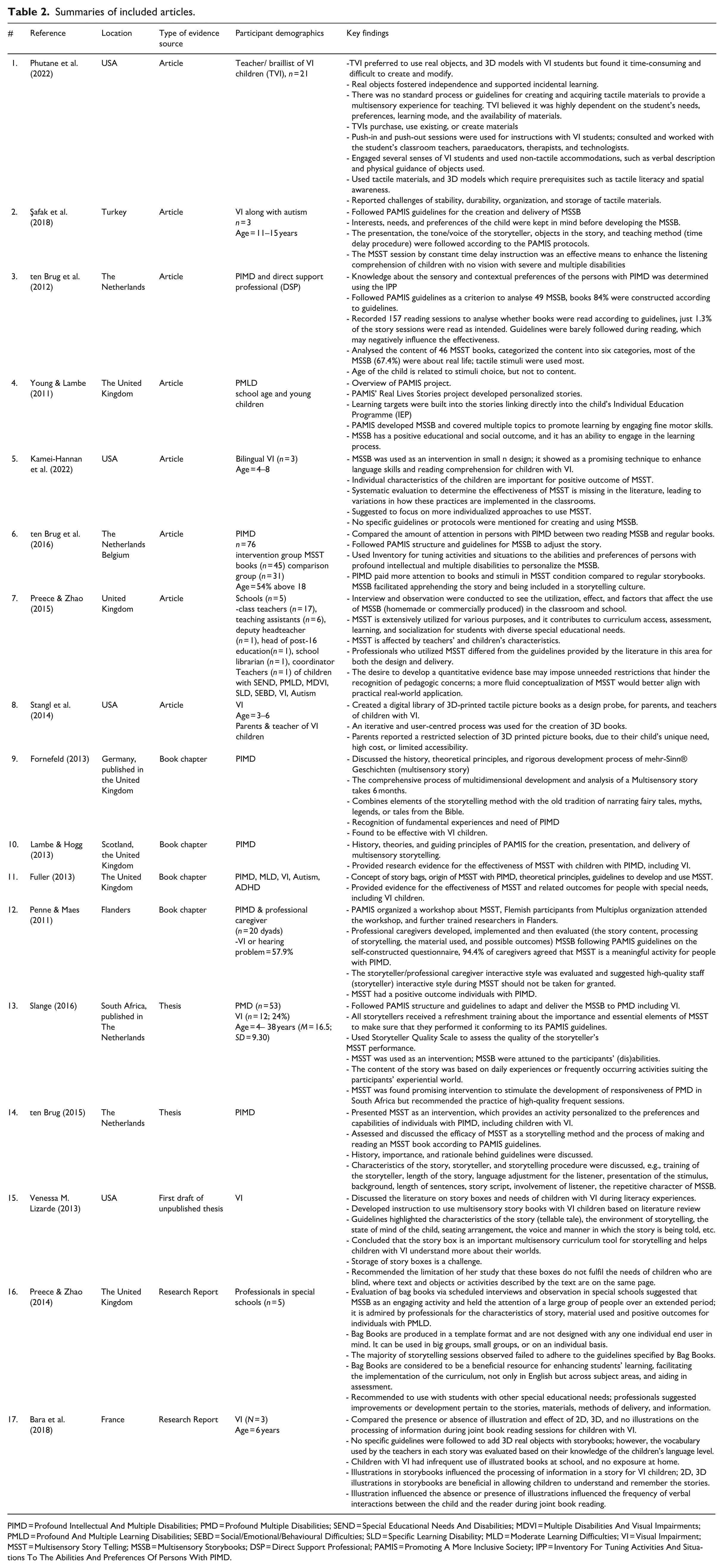
PIMD = Profound Intellectual And Multiple Disabilities; PMD = Profound Multiple Disabilities; SEND = Special Educational Needs And Disabilities; MDVI = Multiple Disabilities And Visual Impairments; PMLD = Profound And Multiple Learning Disabilities; SEBD = Social/Emotional/Behavioural Difficulties; SLD = Specific Learning Disability; MLD = Moderate Learning Difficulties; VI = Visual Impairment; MSST = Multisensory Story Telling; MSSB = Multisensory Storybooks; DSP = Direct Support Professional; PAMIS = Promoting A More Inclusive Society; IPP = Inventory For Tuning Activities And Situations To The Abilities And Preferences Of Persons With PIMD.
Most included studies focused on individuals with SEND, including those with PMLD, PIMD, and Moderate Learning Disabilities (MLD), with VI often represented within these samples. However, seven studies focused on children with VI or the perspectives of their teachers and caregivers (Bara et al., 2018; Kamei-Hannan et al., 2022; Lizarde, 2008; Preece & Zhao, 2015; Şafak et al., 2017; Stangl et al., 2014).
Synthesis of results
MSST practices with children with VI
The practice of MSSB with VI individuals is often situated within the broader context of MSST for people with SEND. Most studies included in this review focused on individuals with PIMD or PMLD, which sometimes included participants with VI. However, a smaller number of studies (Kamei-Hannan et al., 2022; Lizarde, 2008; Phutane et al., 2022; Şafak et al., 2017; Stangl et al., 2014) focused exclusively on children with VI and the use of multisensory books tailored specifically for this group.
Interestingly, three of the selected studies did not explicitly use the term multisensory objects, although they incorporated real objects during storytelling sessions. Instead, these objects were referred to as tactile materials, tactile illustrations, or 3D-printed tactile pictures. For example, studies compared effects of no illustrations, 2D images, and real 3D objects (Bara et al., 2018); evaluated tactile materials, 3D models, and real objects (Phutane et al., 2022); or produced 3D-printed models specifically for storytelling (Stangl et al., 2014).
The included book chapters explored the origins and development of MSST in various contexts. Fuller (2013) introduced personalized MSST through Bag Books, detailing its principles and practices for individuals with PIMD, including VI. Similarly, Lambe and Hogg (2013) outlined PAMIS’s pioneering work in Scotland, practical MSST guidelines on voice, pacing, atmosphere, and sensory materials. In Germany, Fornefeld (2013) developed the mehr-Sinn® Geschichten (multisensory stories) method, combining traditional storytelling with multisensory techniques tailored to the needs of individuals with PIMD, including VI. In addition, Penne and Maes (2011) described MSST use in Flanders by trained caregivers, following PAMIS standards.
Across the selected literature, MSST was applied either as an intervention (Kamei-Hannan et al., 2022; Slange, 2016; ten Brug, 2015; ten Brug et al., 2016) or as a practice associated with positive outcomes. Reported benefits included increased independence and incidental learning (Phutane et al., 2022), improved listening comprehension in children with severe and multiple disabilities (Şafak et al., 2017), enhancements in educational and social participation (Young & Lambe, 2011), language and reading comprehension gains for children with VI (Kamei-Hannan et al., 2022), and support for curriculum access, assessment, learning, and socialization (Lizarde, 2008; Preece & Zhao, 2014, 2015). In addition, MSST was found to stimulate responsiveness and engagement (Slange, 2016).
Several studies (Fuller, 2013; Preece & Zhao, 2014, 2015; Slange, 2016; ten Brug et al., 2012) emphasized the importance of formal training on the theoretical foundations of MSST for effective implementation. Fuller (2013), for instance, provided training materials, including instructional DVDs for using Bag Books. However, it was noted (Preece & Zhao, 2014; ten Brug, 2015) that, in practice, adherence to the recommended guidelines varied, with only a limited number of sessions fully applying the training principles.
Studies that followed established guidelines generally emphasized the creation of individualized, personalized stories tailored to the listener’s needs (Fornefeld, 2013; Fuller, 2013; Lambe & Hogg, 2013; Penne & Maes, 2011). These were designed to engage multiple senses (e.g., Phutane et al., 2022; ten Brug et al., 2012) and developed with careful consideration of elements such as story presentation and delivery, environmental setup, storyteller tone and manner, the emotional and cognitive state of the child, seating arrangements, story length, sentence complexity, and use of repetition and time delays (Fuller, 2013; Lizarde, 2008). The selection of sensory stimuli was consistently recommended to be age-appropriate, meaningful, and aligned with the sensory preferences of the child to promote interaction and engagement. Furthermore, several tools were used to support and evaluate MSST practices. For example, ten Brug (2015) and ten Brug et al. (2016) utilized the Inventory of Assessment Practices in People with Profound Intellectual and Multiple Disabilities to individualize MSSB content. Slange (2016) employed the Storyteller Quality Scale (SQS) to assess the quality of MSST delivery, while Penne and Maes (2011) developed a self-constructed questionnaire to evaluate the practical usefulness of MSST, contributing to the refinement of storytelling practices.
Protocols and guidelines for developing MSSBs with VI children
To address the second research question, most of the included studies (Fornefeld, 2013; Penne & Maes, 2011; Preece & Zhao, 2014, 2015; Şafak et al., 2017; Slange, 2016; ten Brug et al., 2012, 2016; Young & Lambe, 2011) reported following the PAMIS guidelines (Lambe & Hogg, 2013), which provide comprehensive principles covering the creation of multisensory stories, production of physical storytelling materials, and recommended narration techniques. PAMIS expanded on Chris Fuller’s earlier work (Fuller, 2013), offering a structured framework for MSST. Building on this, ten Brug (2015) analysed the rationale, development, implementation, and effectiveness of MSST according to PAMIS guidelines. They highlighted that, while most MSSBs were created in line with these guidelines, only 1.3% of storytelling sessions were delivered fully as intended. In contrast, some studies (Bara et al., 2018; Kamei-Hannan et al., 2022; Phutane et al., 2022) lacked standardized procedures or formal guidelines for developing multisensory resources for children with VI. Nevertheless, adaptations were made based on the specific needs of the children. For instance, in Bara et al. (2018), teachers adjusted the vocabulary of stories to match the language abilities of their students with VI. Similarly, Stangl et al. (2014) applied an iterative, user-centred design approach to create 3D tactile books for children with VI, ensuring that the materials were tailored to user feedback. Lizarde (2008) also proposed a set of instructions for the development of multisensory story boxes for children with VI, drawing on insights from previous literature.
Limitations of current practices of MSST for children with VI
Most studies reviewed focused on MSSB for children with SEND or PIMD, including those with VI, though the principles used were not tested specifically for children with VI. A possible reason for this limitation is that many children with VI have comorbidities or other co-diagnoses that may further impact on reading development and education (see Teoh et al., 2021), including ASD (Fazzi et al., 2019; Stevenson & Tedone, 2025) and ADHD (DeCarlo et al., 2014).
Of the studies we report, Phutane et al. (2022) used tactile materials and 3D models, which all VI children may not comprehend as these materials demand tactile literacy and spatial awareness. Further, ten Brug et al. (2012) suggested existing guidelines were hardly adhered to during the session, which might influence the effectiveness of MSSB. Stangl et al. (2014) created a digital library using 3D-printed tactile picture books which has limited accessibility and high cost. Lizarde (2008) cited the limitation of her story boxes for readers with VI as text and objects or activities are explained by written text on the same page.
Discussion
This review aimed to identify existing practices and protocols for creating and implementing MSSB with children with VI, and to document the limitations of current approaches. Exposure to multisensory books provides children with VI, whether congenital or acquired, with opportunities to build mental representations of the world, support story comprehension, and participate in shared storytelling experiences (Edirisinghe et al., 2022).
A total of 17 studies were identified that addressed the use of MSST with children with VI. However, the review revealed a clear lack of research focused exclusively on VI. Most studies addressed individuals with PIMD, which sometimes included participants with VI, but were not specifically tailored to their needs. Foundational guidelines, such as those developed by PAMIS (Lambe & Hogg, 2013; rooted in Fuller’s, 2013, work), provide direction on the creation, structure, and delivery of MSSB, including recommendations on story length, sentence structure, sensory materials, and overall storytelling environment. However, evidence suggests these guidelines are often not fully adhered to in practice. For instance, ten Brug (2015) reported that only 1.3% of storytelling sessions with PIMD participants fully followed guidelines, with deviations attributed to limited training and insufficient knowledge of individual preferences. This highlights the need for future research to explore the impact of guideline adherence on storytelling outcomes for children with VI.
This review also identified variation in how MSSBs are created and used for VI participants. While some studies (e.g., Young & Lambe, 2011) followed PAMIS guidelines, little evidence validates these protocols for VI populations. Other studies (Bara et al., 2018; Kamei-Hannan et al., 2022; Phutane et al., 2022), relied on teacher expertise without formalized guidelines, to adapt vocabulary, select tactile materials, and consider individual needs of children with VI. For example, Phutane et al. (2022) emphasized the importance of braillists and tailored tactile materials, while Lizarde (2008) developed multisensory story boxes, though these posed limitations for children with VI due to extensive use of text.
In addition, some approaches, such as Stangl et al.’s (2014) use of 3D-printed books, demonstrated innovative design processes but raised concerns about cost and accessibility. Overall, these diverse practices underscore the need for standardized, evidence-based guidelines specifically developed for and validated with VI populations.
While this review focused on studies using real objects and 3D models, three included studies (Bara et al., 2018; Phutane et al., 2022; Stangl et al., 2014) compared these materials with tactile graphics or illustrations. Findings from these studies suggest using real or realistic objects can enhance communication and inclusion in shared reading, as they do not rely on prior tactile literacy or spatial awareness to the same extent as raised-line graphics.
Across the selected literature, MSST was generally associated with positive outcomes for children with VI and other disabilities. These include improvements in language development, reading comprehension, social interaction, and overall engagement (Kamei-Hannan et al., 2022; Lizarde, 2008; Phutane et al., 2022; Preece & Zhao, 2014, 2015; Şafak et al., 2017; Slange, 2016; Young & Lambe, 2011). MSST was also used as an intervention in several studies (Kamei-Hannan et al., 2022; Slange, 2016; ten Brug, 2015; ten Brug et al., 2016), though the findings suggest formal training is essential for effective delivery. Studies such as those by Preece and Zhao (2014) and Slange (2016) reported that storytellers often deviated from guidelines, especially in the absence of structured training. Although short-term training helped practitioners create MSSBs, it was insufficient to ensure sustained, high-quality delivery. Furthermore, while adherence to guidelines is important, the literature emphasizes that customization is equally critical. Successful MSSBs must consider the age, sensory preferences, abilities, and lived experiences of individual children. Fuller (as cited in Preece & Zhao, 2014) advocates for tailoring MSSBs to reflect meaningful aspects of a child’s life, ensuring that the stories are personally significant and engaging.
Despite promising findings, this review highlights the limited evidence base regarding the effectiveness of MSSBs specifically for children with VI. While studies like those by ten Brug (2015) and ten Brug et al. (2012, 2016) show benefits of MSSBs for individuals with PIMD, the generalizability of these findings to VI populations remains unclear. Similarly, tools like the Storytelling Quality Scale (Slange, 2016) and self-constructed questionnaires (Penne & Maes, 2011) have been used to evaluate MSST, but these assessments were not specifically designed for or tested with VI samples.
Overall, the review identifies an urgent need for systematic, empirical research to assess the effectiveness of MSSBs for children with VI and to develop validated, standardized guidelines tailored to their unique sensory and educational needs. Future research should explore not only the outcomes of MSSB use but also strategies for the effective integration of sensory objects, ensuring accessibility, personalization, and meaningful engagement in storytelling.
Limitations
A key strength of this review lies in its use of a replicable and systematic methodological approach to identify and synthesize current MSST practices with VI children. However, several limitations should be acknowledged. First, as outlined in the PRISMA-ScR guidelines (Tricco et al., 2018), there were deviations from the original protocol. Specifically, the age eligibility criteria were expanded to include older children and young adults, as well as pre-schoolers. The population criterion that we include studies about children with VI was expanded to include studies that included individuals with multiple disabilities who also have VI. This adjustment was necessary due to the limited of focusing solely exclusively on VI children and the close association of MSST practices with individuals with PIMD, where VI is often one of several co-occurring disabilities (see Teoh et al., 2021). Consequently, many of the studies reviewed involved participants with additional diagnoses such as autism, ADHD, and other intellectual and learning disabilities alongside VI.
This broader inclusion was chosen to avoid further narrowing an already limited body of literature. However, it does mean that findings cannot be generalized exclusively to children with VI, as many included studies focused on individuals with multiple, complex needs. Another limitation is the potential omission of relevant grey literature, such as personal blogs or unpublished resources describing MSST practices with VI children. While such sources could offer valuable insights, particularly in an emerging field, the current review was limited to publicly accessible, peer-reviewed, and published literature to maintain methodological rigour and ensure objectivity. Consequently, it is possible that some practical applications of MSST with VI children were not captured. Future reviews could consider expanding the scope to include grey literature, provided clear inclusion criteria are established to maintain quality standards.
Conclusion
MSST originally was introduced without a strong scientific evidence base. However, research in recent years has demonstrated its growing use as an enjoyable and meaningful activity, particularly when tailored to the preferences and abilities of individuals with profound intellectual and multiple disabilities (PIMD) (e.g., Penne & Maes, 2011; ten Brug, 2015; Young et al., 2011; Young & Lambe, 2011). MSSBs were originally designed for individuals with PIMD, a highly heterogeneous group characterized by wide differences in motor, intellectual, and sensory abilities, as well as personal preferences (Van Der Putten et al., 2011).
The studies reviewed here suggest that MSST also holds considerable promise for children with VI, making it an important area for further investigation. However, current evidence on the development, implementation, and effectiveness of MSSBs for this population remains limited and inconsistent. Future research should therefore prioritize the systematic evaluation of MSSBs, aimed at developing flexible, evidence-based guidelines for their structure and content, tailored to the diverse needs of children with VI. In addition, future studies could usefully explore how exposure to multisensory books provides children with VI, whether congenital or acquired, with engaging sensory experiences, and examine the potential impact on their cognitive, emotional, and sensory development. Strengthening the evidence base in these ways will be essential to inform best practice and to maximize the benefits of MSST for children with VI.
Footnotes
Acknowledgements
This work was supported by the Visiting Fellowship awarded to Hafsa Khalil Toor from the Leicester Institute of Advanced Studies, University of Leicester.
Funding
The authors disclosed receipt of the following financial support for the research, authorship, and/or publication of this article: This research was funded by a Visiting Fellowship from the Leicester Institute of Advanced Studies, University of Leicester.
Ethical approval and informed consent
Ethical approval was not required for this research, as it did not involve human participants.

Data availability
There are no data resources associated with this research.