




Abstract
For individuals with vision impairment (VI), there can be physical and technical barriers to participating in research and accessing research outputs. As a result, researchers often target smaller VI samples and individuals with VI are left under-involved and underrepresented in the VI research discourse. This study aimed to evaluate the accessibility and utility of the Online Participant Engagement Network for Vision Impairment Research (OPEN VI Research) and explore the broader experiences of research involvement in individuals with VI to develop guidelines for researchers studying this area. Qualitative data were collected through a semi-structured focus group with seven adults with VI, and analysed using a dual inductive reflexive thematic analysis approach. Three overarching meta-themes emerged through the analysis: ‘access’, ‘participant permanence’ and ‘motivation’. It was identified that preferences for being reached to take part in research and optimisation for accessible web-design differed based on individual needs associated with varying levels of VI. The importance of researchers recognising participants with VI as active contributors, before, during and after participation, was also outlined. In addition, despite some participants expressing negative experiences of researchers failing to follow-up post-participation, it was found that focus group members remained highly motivated to continue to take part in research. To address these findings, guidelines for researchers were developed based on participant suggestions and discussed in relation to relevant literature. This study fills the gap in the literature on individuals with VI’s views and experiences of research involvement and the suggested guidelines have the potential to improve the accessibility and effectiveness of the practice of researchers of VI.
Keywords
Introduction
People with vision impairments (VI) are underrepresented and under-involved in health and social research circles – as both participants and research collaborators (Lewis et al., 2023; Rios et al., 2016). Consequently, there is potential for research on VI to misrepresent the interests and needs of people as it lacks input from those with real experience of living with a VI (Duckett & Pratt, 2007; Stone & Priestley, 1996). Public involvement (including members of the target population in the design, conduct and dissemination of research) has been identified as critical to ensure the quality and relevance of research to its respective target populations (Boivin et al., 2018). As such, understanding the opinions of those impacted by research on the methods and dissemination practices utilised within the research area is greatly important (Hoddinott et al., 2018).
Participant recruitment is considered to be one of the most difficult aspects of a research project as it can involve a challenging and lengthy process of gaining access to certain populations, often through gatekeeper organisations (Visanji & Oldham, 2001). These challenges are exacerbated in studies with individuals with VI as sight loss presents unique barriers to participation, which can lead to difficulties recruiting the numbers to sufficiently power a sample (Aw et al., 2014). Thus, researchers are often forced to target smaller VI samples, for example, in a review of the literature on physical activity interventions for adults with VI by Sweeting et al. (2020), 14 of the 17 studies included contained samples of under 50 participants. This can risk studies generating false-positive results and lead to unreliable findings (Vadillo et al., 2016).
Accessing research publications can be challenging for those without institutional access agreements as a recent review estimated only 28% of research publications are presently fully open access (Piwowar et al., 2018). Non-open-access articles are often only accessible through expensive ‘pay-per-view’ fees (Ware & Mabe, 2015); these fees are generally only avoidable through membership of higher education institutions or large research organisations. Addressing this inaccessibility is important as effectively disseminated, openly accessible research promotes transparency, public engagement and a closer link between research and public policy (Finch et al., 2013). Further barriers to accessing published research exist for individuals with VI as many journals are hosted online and primarily designed by and for the sighted population (Chiang et al., 2005). Moreover, while advances in assistive technology (e.g., screen readers and character enlargement tools) have aided in Internet accessibility for people with VI, many websites are not designed to adequately support such software (Lazar et al., 2007; WebAIM, 2023).
Physical access to research literature is challenging. Papers are costly, and moreover, the inaccessible subject-specific language research reports are often written in renders them difficult to understand and engage with for non-experts in the field they are published within (Salita, 2015), further limiting their real-world dissemination. As a result of this, effective science communication to non-specialists is key to the successful dissemination of research findings. Through recognising the complexity of the knowledge generated in research and disseminating it in a way that is accessible and understandable by laypersons (e.g., through easily accessible lay-summaries or public engagement events), researchers can expand the influence of their findings for the populations targeted by the research (Intemann, 2023). Research findings communicated in this manner can both directly be accessed by members of the target group and have a greater likelihood of reaching policymakers and influencing decisions that might impact the group (Goldstein et al., 2020).
Recent research has neglected to provide a platform for individuals with VI to express their opinions on how research including participants with VI should be conducted. Most recently, research by Duckett and Pratt (2001) supplied this platform and explored the views of people with VI on how VI-related research methods could be improved and topics of importance for research to investigate. The inaccessibility of language used in published research and the limitations of recruitment being conducted exclusively through VI services were identified as key concerns. Despite this, participants expressed motivation to be involved in VI research on a number of topics (primarily, access to information, access to the environment and attitudes towards people with VI) and to engage with related publications.
As a result of the difficulties recruiting and retaining participants with VI, many researchers have begun to employ a range of collaborative approaches to better engage participants with VI. For example, research by Pigeon et al. (2023) into the needs of individuals with VI found that employing a community-based participatory approach (i.e., equitably involving representatives with VI at every stage of the research process) encouraged engagement and continued involvement in the study. Moreover, co-design implemented in a way accessible to those with VI (e.g., voice or tactile based co-design sessions) has been identified as a potential method for facilitating idea creation and accessible involvement in VI research (Brewer, 2018). Conversely, many studies into VI entirely fail to involve individuals with VI, instead opting to simulate VI in participants with normal vision using filtered glasses or altered electronic displays (Abraham et al., 2024). Such methods exclude those with VI from the research discourse and can neglect the broader lived experience of VI.
To address the aforementioned issues around VI research the current researchers developed the Online Participant Engagement Network for Vision Impairment Research (OPEN VI Research) web-platform, currently accessible at https://sites.google.com/view/open-vi-research/ (Richardson et al., 2021). Centrally, the platform aims to provide an accessible international research community for VI research. This was realised through both a space for researchers to post accessible versions of their VI research, written in lay language, and as an area to advertise VI research to recruit participants with VI. In turn, this aimed to provide individuals with VI with a straightforward way to access current research publications related to VI and to explore opportunities to participate in relevant studies. Given the importance of public involvement and the inaccessible state of current VI research practice, it is now critical that the OPEN for VI platform is evaluated through input from people with lived experience of VI. This evaluation will be utilised as a lens to explore and address the broader issues within the area of VI research. Moreover, evidence-based research design recommendations will be presented to improve the practice of researchers of VI.
The aims of this study are twofold:
To explore the experiences of individuals with VI in participating in research and accessing findings and provide practical guidelines for researchers conducting research around VI.
To evaluate the accessibility and utility of the OPEN for VI platform and identify areas in which it can be improved for users with VI.
Method
Design
This study incorporated a qualitative analysis of focus group data. A qualitative design allows for the in-depth investigation of complex human experiences in great detail (Willig, 2019). This was utilised as it closely aligns with the aims of the current research which seeks to understand the views and experiences of research involvement and dissemination for individuals with VI. Specifically, the creation of materials, data collection and analysis were informed by a reflexive thematic analysis (RTA) approach as outlined by Braun and Clarke (2006). This involves the identification and description of patterns of meaning within a dataset. All data were analysed inductively as no pre-existing theoretic models or preconceptions deliberately informed the analysis (Guest et al., 2012).
Participants
Seven (four female, three male) adults with impaired vision participated in the research. The sample size was selected in accordance with the recommendations of Braun and Clarke (2013) for focus group studies using RTA. Recruitment was conducted via word of mouth, a local blindness support group and social media. To be eligible, participants were required to have a self-reported VI varying from partial sightedness to total blindness, be aged 18 or over and be able to adequately operate a computer (to access the online focus group). As this was an early explorative investigation, no other identifiable or demographic participant information was recorded.
Procedure
Data were collected through an online semi-structured focus group lasting approximately 90 min. The focus group was conducted remotely over Zoom due to the limitations on meetings during the Covid-19 pandemic. Focus group discussion centred around six primary questions designed to explore the participant views and experiences of using the OPEN platform and research participation and dissemination (see Table 1). The topic schedule was developed through an iterative process involving the discussion and refinement of ideas among the researchers. Two mediators conducted the focus group, and a third assistant was present for timekeeping. Each question was asked openly to the group and free-flowing discussion was encouraged. The mediators asked secondary probing questions to prompt further discussion and ensure each participant had the opportunity to contribute. Participants recognised as being less involved in the conversation were directly asked probing questions to encourage equal contribution to discussion. Upon completion of the focus group, the audio recording was used to produce a verbatim transcript on Microsoft Word (Version 16.50; available on OSF).
Six semi-structured questions around which the focus group was developed.
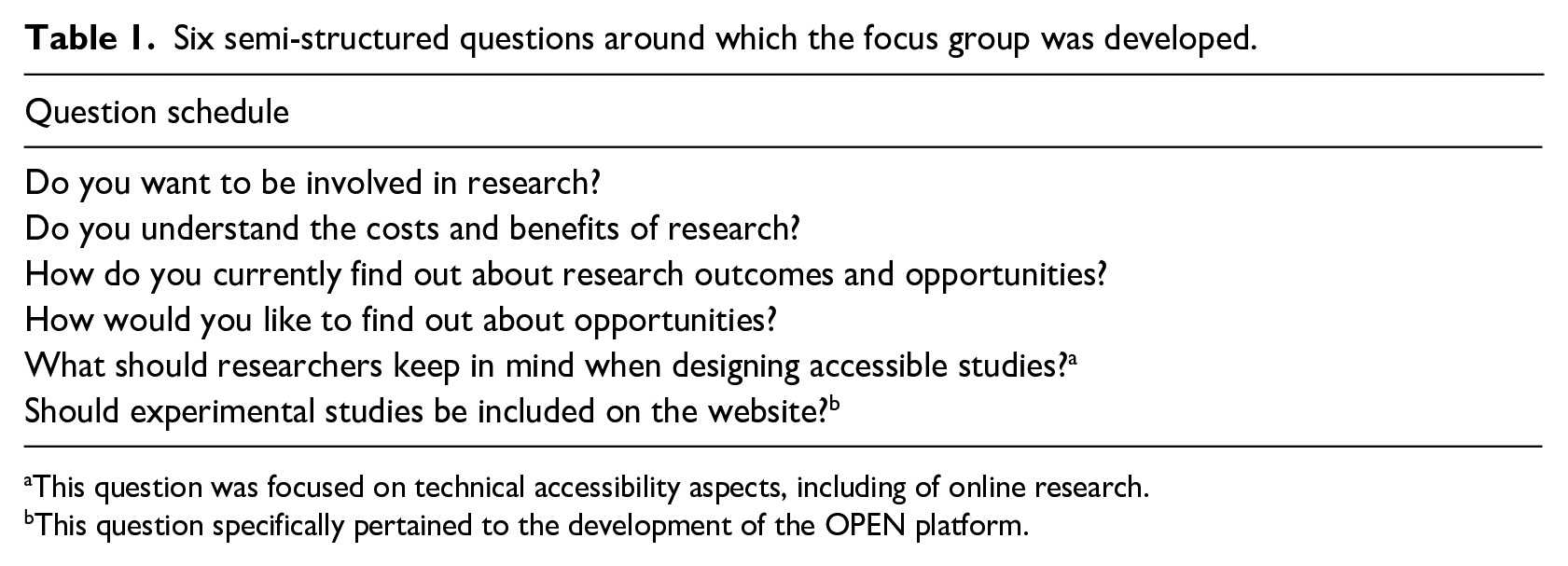
This question was focused on technical accessibility aspects, including of online research.
This question specifically pertained to the development of the OPEN platform.
Analysis
A dual RTA of the focus group data following methods described by Braun and Clarke (2006) was conducted. This involved two separate blind analyses of the data, which were synthesised. The following steps were followed by both analysts: first, the transcript was read multiple times for familiarisation, and notes were taken on concepts of interest. Next, initial inductive codes were identified representing features of relevance to the study. A second sweep was conducted to group codes into emergent themes representative of their collective meaning. The themes were then refined, whereby some were combined, altered or removed resulting in the production of superordinate themes. Finally, the superordinate themes of both analysts were synthesised into meta-themes ensuring that all elements of interest within the dataset were captured within the analysis.
Reflexivity
Inter-rater reliability (Gisev et al., 2013) was confirmed through the incorporation of two independent analyses conducted separately by different researchers. This ensured the quality, integrity and confirmability of analytic claims as any evidence of bias was identified through the comparison of the analyses (Kitto et al., 2008). While no explicit instances of researcher bias were identified, it was recognised that despite the implementation of an inductive approach to knowledge generation researcher bias cannot be fully eliminated (Galdas, 2017), and relevant preconceptions and experiences of the researchers likely influenced the analysis (Caetano, 2015). Thus, regarding positionality, the primary researcher does not have a VI themselves, or any experience of living with a disability. However, they are a passionate advocate for promoting equal opportunities for research involvement for individuals with disabilities and have previous experience researching VI and extensive reading around the subject.
Ethical considerations
Ethical approval for this research was granted by the University of Bath Psychology Research Ethics Committee on 8 June 2020 (Ethics Reference: 20-180). Separate approval for the subsequent analysis was granted by the Bath Spa University Research and Ethics Committee on 13 December 2021. All aspects of the research were conducted in accordance with the British Psychological Society Code of Human Research Ethics (Oates et al., 2021). To maintain anonymity participant names were replaced with pseudonyms, randomly generated using the AI tool ‘ChatGPT’.
Analysis
Three superordinate meta-themes were developed through the analysis, each explored through two sub-themes representing key elements of the participants’ views and experiences of research involvement with VI. The first meta-theme ‘access’ explores how participants felt individuals with VI could be best reached to participate in research. Next, ‘participant permanence’ outlines the need for participants to be supported as active contributors throughout the research process and how this can be accomplished. Finally, ‘motivation’ encompasses the participants’ interest in research involvement, despite prior poor experiences of researcher follow-up. Guidelines for researchers addressing the issues and suggestions of the participants are then reported.
Access
This meta-theme explores the participant opinions on how researchers can best access individuals with VI to notify them of potential research participation opportunities. Suggestions on the most accommodating medium for research recruitment, and how the accessibility of online resources could be improved are analysed.
Employing diverse recruitment strategies to support individual needs
Participant perspectives on the best approach to reach individuals with VI for research recruitment differed as the accessibility of online strategies divided opinions. While it was confirmed by Morgan that ‘it is incredibly hard to recruit visually impaired or other disabled types of participants’, Amari indicated that using online recruitment strategies might be the cause of this difficulty.
‘I want to say as well that a lot of blind people do not use Facebook, do not use the internet, because they just don’t. They don’t connect with it, even the young ones don’t’.
In contrast to this, it was stated by several of the participants that they had been reached to participate in research (including this study) through the online service ‘RNIB Connect’, showing individual needs for Internet use.
‘I found it through RNIB Connect’.
‘That’s how I got it. That’s how I found it’.
‘I did find out through RNIB Connect’.
Several participants suggested reaching potential participants in an in-person capacity as an alternative to online methods. Recruiting directly through blindness groups and charitable organisations was seen as a possible strategy.
‘when it’s face to face time you can come to talk to sort of a group of people and do it that way’.
‘If you want research with visually impaired and blind, or severely sight-impaired people, go straight to the source. Go to RNIB, Macular Society, Guide Dogs’.
‘You can also ask the blind veterans’.
Though, Avery expressed that some individuals with VI ‘aren’t involved in groups to do with visual impairment’ indicating that online strategies unrelated to blindness organisations may be necessary to reach some individuals, Overall, the varied participant opinions reflect the necessity for diverse methods to recruit samples with VI.
Flexibility in web-design to accommodate individual needs
It was identified that technical accessibility needs varied between individuals with different levels of VI. The challenge of trying to accommodate these diverse individual needs within web resources was outlined.
‘Well, I’m actually in contact with a few blind people in Bangor, and they use braille readers or braille type machines (. . .) Other people I do have some contact with would need it in large print and clear’.
‘We enlarge, we’ve vision readers, we have all sorts . . . it would never fit everybody but we’ve got to fit as many people as possible’.
Specifically, for partially sighted web users who may be able to read text under some conditions, the importance of high text to background colour contrast was expressed to optimise the readability of text.
‘If you’re aiming it at partially sighted people, they may have difficulty in focusing on the grey-y black with the white writing’.
‘if you’ve got people that can’t read anything black on white, they would need it on a different colour background, probably a black on yellow background’.
In addition, Skylar stated that the inclusion of ‘large print’ font sizing could also increase the ease of comprehension for partially sighted users, with Amari adding that some might also utilise ‘enlargers’ to read text. However, the possibility of web optimisation for users unable to read text (e.g., those with total blindness) who often use screen readers interfering with character enlargement tools was also described by Amari.
‘Yeah, I had a website that was just designed for readers, not the people that enlarge, and it had a barrier at the top and when someone enlarged on that barrier, they couldn’t see anything else’.
Despite this, flexibility in the design of a web resource was seen as an effective way to accommodate the needs of as many individuals as possible; this was displayed when Avery expressed that optimisation for the partially sighted wouldn’t necessarily impact the usability of screen readers.
‘If people are using a screen reader like me, it doesn’t matter what size the font is (. . .) so I would be happy to use something that is optimised for partially sighted people’.
Participant permanence
The importance of understanding that participants exist and must be supported and included throughout the research process (i.e., participant permanence) is explored in this meta-theme. First, the participants’ descriptions of the physical challenges faced by individuals with VI prior to and during research participation are analysed. This is followed by an exploration of how researchers can support participants with VI’s beyond participation through simplifying language used in research reports and other communications and diversifying methods of dissemination.
Support prior to and during research participation
While it may not be considered by the researcher, the act of participating in research with a VI can be highly challenging and time-consuming. The physical task of attending a research site to participate in-person with sight loss was expressed by Amari.
‘physically, sometimes when you can’t see, getting out that door is the most scariest thing in your life (. . .) people will say yeah, they want to come, and then they can’t physically get out of the door without other support in place’.
Overcoming this challenge and participating in in-person research with VI was also identified to be associated with potential costs to the participant. Such as the cost of a hired assistant and booking accessible accommodation for studies involving participation over multiple days.
‘It’s not just about compensating to have someone accompany you; quite often it’s someone you are having to pay by the hour to come with you. (. . .) and the train fares and that, and it can work out quite a lot of money’.
‘The thing is as well, you need to look at accommodation that’s accessible for that blind person. (. . .) You can’t just turn up anywhere with a blind person because they’ve got to be able to manoeuvre around the place’
When on the research site, the act of participation is not always straightforward for individuals with VI as research sites (often universities) can be difficult to navigate. This was expressed by Riley:
‘And another thing, if you are travelling to do something like this is, when you get there, we can’t see where to go (. . .) it’s a strange place. We can’t see where to go. We can’t follow the signs’.
Again, bringing an assistant or researchers organising to have someone ‘sort of trained in how to support someone with visual impairment’ present to guide participants in navigating the research site was suggested as a solution by Casey.
Inclusion beyond participation: accessible dissemination practice
The responsibility of the researcher to support participants must continue beyond the point of data-collection, particularly in research involving individuals with unique needs. As such, to better cater for the needs of individuals with VI, several participants suggested that researchers simplify the language used in communications with participants.
‘If the information sent out from researchers could be simple, not complicated, that we can easily understand in one go so we don’t have to read it about half a dozen times (. . .) use basic English, not complicated medical term English’.
‘You mean not using fifteen words where three will do? And using basic English?’
‘Just keep it simple’.
This importantly applies to the dissemination of research outputs, implying that simplifying language in research reports and other forms of science communication would improve the accessibility of findings for individuals with VI.
Furthermore, Skylar and Jordan suggested alternative methods for disseminating the findings of research to individuals with VI.
‘Getting research information out to people . . . after the lockdown of COVID-19, how about sending stuff through to libraries?’
‘I have a blind group and we actually keep looking for someone to come along and give them talks and everything else so that’s the ideal sort of places to go as well’.
These suggestions indicate that diversifying methods of dissemination beyond exclusively publishing findings within research journals could be a more accessible way to communicate findings to those with VI, increasing the ease of access to knowledge generated through research.
Motivation
A clear motivation and interest in being involved in the research process was expressed within the focus group. Despite this, dissatisfaction with post-participation follow-up and involvement in the progression of research that participants had previously engaged with was stated. This meta-theme will explore this motivation to be involved in research related to VI and the poor prior experiences of follow-up.
Interest in research involvement and outputs
If an individual expends their time and effort to participate in research, it is likely that they are interested in the outputs of that research. In the focus group, several participants expressed their motivation to be involved in research, for some, participating was seen as a way of helping themselves or others with VI through contributing to the knowledge on the subject.
‘I’m very interested in doing the research’
‘a lot of people that are looking to do things to help themselves, basically, and that are looking for information and are able to help with projects because a lot of them do projects’.
‘I’m happy to participate if I become aware of one. But I think this is the problem, that it’s becoming aware of them and being able to help’.
Jordan and Avery also expressed the importance of maintained contact with a researcher post-participation to learn the outputs of research they had participated in or that was relevant to them. This was presented by the participants as both an interest in the findings and gratification for having done their bit.
‘Yeah, that’s really good. It’s [having access to research findings] important (. . .) It helps you to realise you’re achieving something’.
‘I do try to keep in touch if I’ve been involved in something before because sometimes it helps me . . .’
Such motivation for involvement in research beyond participation reiterates the need for researchers to view participants as more than tools for data generation.
Negative experiences of follow-up post-participation
Of the participants who said they had participated in research before, there was an agreement that there had not been an adequate follow-up after taking part. Riley and Jordan described this, explaining the negative emotions associated with feeling used and only valued by researchers as a data source.
‘I’ve never had any results given to me. (. . .) It makes you feel worthless, doesn’t it?’
‘I did one for International [inaudible]. It was about injections in the eye and haven’t heard a thing back from them since doing that. They just want to know what you know and then that’s it. You’re thrown aside’.
These experiences may be reflective of researchers either neglecting to transparently notify participants of the time taken for research reports to be produced or failing to follow-up entirely. As a result, participants might be unlikely to participate in a study again after feeling undervalued or used by researchers.
Suggested guidelines for conducting research with participants with VI
Considering the analysis of the participants’ views and experiences, guidelines for researchers aiming to conduct research with participants with VI have been developed (see Table 2). These guidelines aim to address the issues and suggestions expressed within the focus group to increase the accessibility of research participation and the dissemination of findings for individuals with VI.
Suggested guidelines for researchers conducting research with participants with VI.
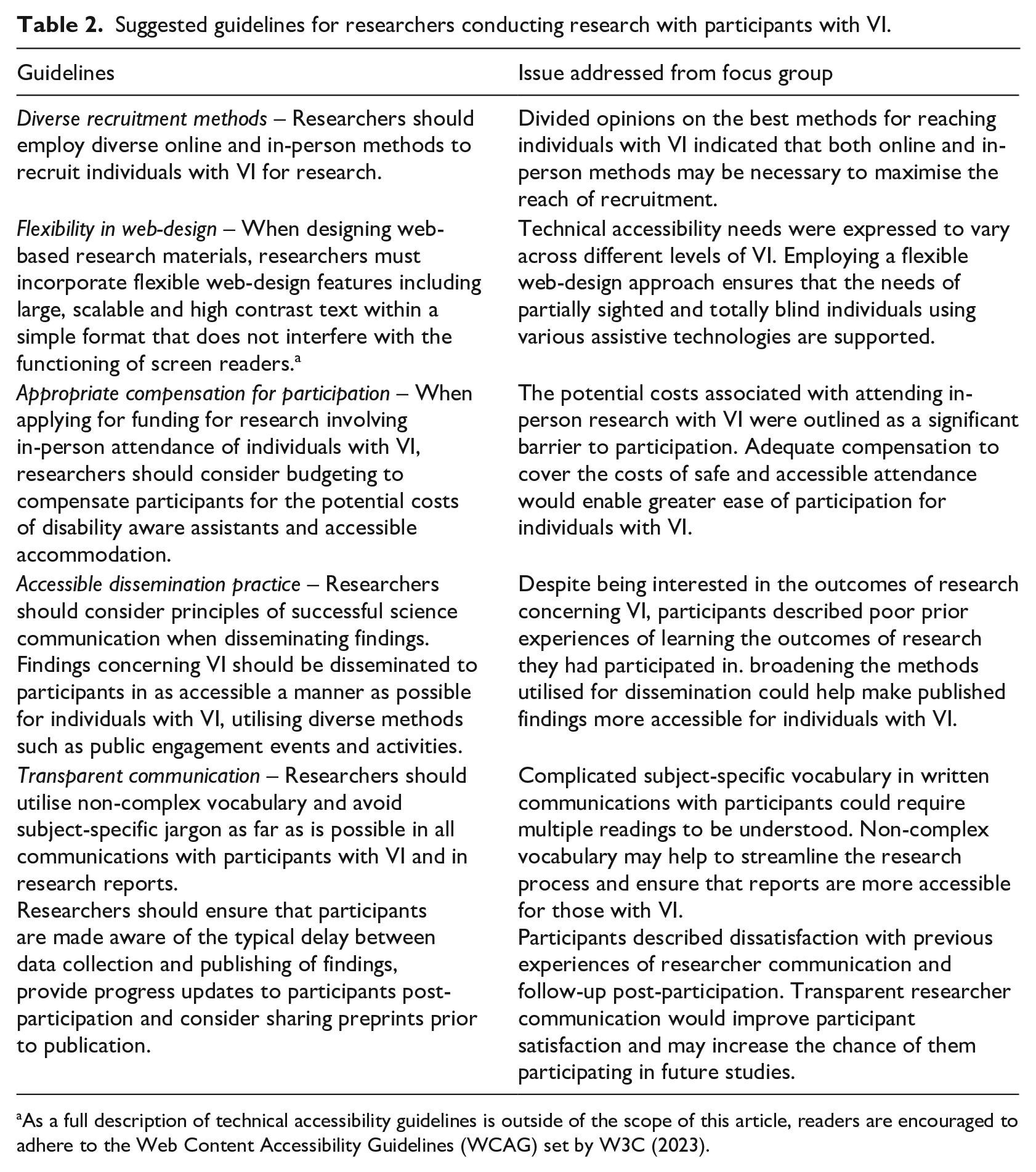
As a full description of technical accessibility guidelines is outside of the scope of this article, readers are encouraged to adhere to the Web Content Accessibility Guidelines (WCAG) set by W3C (2023).
Discussion
This study explored the views of seven participants with VI and their experiences of participating in research and accessing findings within the context of the OPEN for VI platform and wider area of research. Centrally, the importance of researchers recognising and supporting participants with VI as active contributors at each stage of the research process was outlined in the analysis. It was found that the act of travelling to and taking part in research could be challenging for individuals with VI. To improve the accessibility and inclusivity of research practice, it was identified that researchers should employ diverse recruitment strategies and offer suitable compensation and accessibility safeguards. Furthermore, the importance of incorporating flexible web design in online resources was emphasised due to the varying technical needs associated with different levels of visual acuity. Post-participation, it was recommended that researchers maintain transparent communication with participants, utilise non-technical language in communications and research reports and diversify methods of research dissemination. Despite the aforementioned barriers to participation, the participants were found to be highly motivated to be involved in and learn about the outputs of research relevant to VI.
As an extension of the previous literature detailing the difficulty of reaching individuals with VI to notify of research participation opportunities (e.g., Aw et al., 2014; Vadillo et al., 2016), several barriers to recruitment were identified in this study. Primarily, the mixed preferences for online and in-person recruitment, as some participants found online methods ineffective for the population, whereas others were reached for this study through online means and may not have been accessed through in-person methods. As such, by utilising exclusively online or in-person recruitment methods, researchers may be creating a barrier to participation for some individuals with VI and thus must consider utilising diverse strategies to meet the most needs and preferences.
Beyond recruitment, the participants expressed multiple challenges to participation within in-person research. It was found that travelling to and physically navigating a research site independently was challenging, and hiring a disability aware assistant could be expensive. This is reflected in much of the previous research which has found that the built environment can be difficult to navigate with reduced vision (Jeffries et al., 2020), often leading to experiences of limited independent mobility in individuals with VI (Altunay et al., 2021). However, previous studies have not explored such difficulties within the context of research participation. Consequently, to enhance the accessibility and viability of participation for individuals with VI, researchers should consider budgeting to compensate participants for the costs of hiring an assistant or accessible accommodation.
In relation to the physical accessibility of the OPEN platform, the importance of incorporating flexible web-design in online resources was emphasised. This was highlighted by the varying technical needs and preferences of the participants (e.g., partially sighted individuals prefer high contrast text and enlarged font, while those with total vision loss prefer optimisation for screen reader usage). Such findings consolidate the prior knowledge that despite recent advances in assistive software, the optimisation of the accessibility of online resources for individuals with VI remains an area in need of development (WebAIM, 2023). Furthermore, to support the varying needs and preferences of participants with VI, researchers are suggested to incorporate flexible web design including large scalable text and optimisation for screen readers in all online participant facing media. Beyond this, researchers are recommended to adhere to the latest guidance on technical accessibility (W3C, 2023) and its application in research (Yesilada & Harper, 2019).
Current dissemination practice was identified as deficient in accommodating the needs of individuals with VI. Specifically, the utilisation of unnecessarily complex subject-specific language in research reports and other communications with research participants was expressed to be difficult to engage with and understand. While mirroring existing findings from samples within the general population (e.g., Salita, 2015), importantly, this finding highlighted the enhanced challenge of comprehending complex language with VI. In addition, the alternative dissemination strategies suggested by participants indicate that public events and activities may provide a more accessible way to inform the VI population of research outputs. Within the literature, this need to diversify from traditional forms of science communication (e.g., research reports) to engage laypersons is well-recognised (Ross-Hellauer et al., 2020), with public talks and engagement events suggested as potential strategies. As such, researchers are recommended to avoid complex subject-specific language wherever possible in research reports and other communications and incorporate public engagement events and activities into budgets for research grants.
A central finding of this study was that despite poor prior experiences of follow-up post-participation, the participants remained highly motivated to be involved in and learn the outputs of research relevant to VI. This consolidates the findings of Duckett and Pratt (2001) and displays that there remains an interest in research involvement within the VI population. However, this finding may be subject to selection bias as the present sample may have contained individuals with greater motivation for research involvement than the wider VI population as they chose to participate in this study. Despite this, researchers must recognise this motivation and view participants as valuable contributors to research rather than merely sources of data, ensuring transparent communication throughout the research process.
Strengths and limitations
The explorative qualitative approach to data collection and analysis was displayed to be highly appropriate for investigating the views and experiences of individuals with VI on participating and engaging with research. Utilising a qualitative approach and expansive focus group allowed the data to represent the key priorities and areas of interest to the participants (Lavallee et al., 2020), which was a major strength given the limited recent literature on the subject. The limitations of the small sample and utilisation of a singular 90-min focus group must be recognised when appraising the generalisability and validity of the findings. The views expressed by the participants may not represent the full breadth of experience across UK adults with VI. However, recruitment was restricted by constraints associated with the Covid-19 pandemic and existing barriers to research participation with VI, and the sample was recognised as representing a suitably varied array of characteristics to ensure methodological rigour.
Implications and future research
Employing the suggested guidelines into methods of research practice could have implications for enhancing the experience of research conduct for researchers and involvement for participants with VI. Incorporating the guidance for recruitment and technical accessibility will likely make participation opportunities more accessible and aid researchers in recruiting larger VI samples. In addition, treating participants with VI as valued contributors throughout the research process through improving the physical accessibility of participation and incorporating diverse dissemination practices would increase participants’ satisfaction with the participation process and aid in the accessibility of knowledge generated through research for individuals with VI. The OPEN platform is well placed to support the widespread application of these recommendations across the field of VI research through their dissemination as guidelines to researchers who view the page or join the community. Furthermore, researchers recruiting through the platform or posting summaries of research findings will now be encouraged to adhere to technical accessibility guidance in line with the recommendations.
A future large-scale qualitative study is needed to assess the findings across a larger sample and consolidate or extend the guidelines presented in this report. Such a study should aim to assess whether employing the proposed guidelines leads to more positive experiences of recruitment, retention and dissemination within the VI population. The impact of the recommendations on participant satisfaction with research practice and follow-up post-participation must also be explored. Furthermore, through utilising the OPEN platform to coordinate the recruitment for such a study, the effectiveness of the updated version of the platform as a tool for engaging individuals with VI could simultaneously be assessed.
Conclusion
This study provided an in-depth perspective on the experience of research participation and accessing research findings for individuals with VI within the context of evaluating the OPEN platform. Through this exploration, several areas of concern in the practice of researchers and practical guidelines for improving these aspects were elucidated. These included improvements to the accessibility of methods of recruitment, participation, communication and dissemination within studies including individuals with VI. Centrally, the motivation for research involvement and additional needs of the participants led to the development of the concept of ‘participant permanence’, whereby the need for participants with VI to be considered and supported as active contributors at every stage of the research process was recognised. Applying these recommendations could have sizable implications for improving research practice and participant experience within VI research if future research can systematically confirm their effectiveness.
Footnotes
Acknowledgements
We would like to thank Beatriz Leitão, Eirini Kamperou and Jack Hill for their past support with network administration and website design. We would also like to acknowledge the support of Guide Dogs, which provided funding to Aikaterini Tavoulari during the preparation of this work. While this funding was not specifically tied to this project, we appreciate their contribution to advancing related fields of study.
Declaration of conflicting interests
All authors of this research paper are also collaborators on the OPEN for VI research platform. However, none of the authors have any financial competing interests to declare.
Funding
The authors received no financial support for the research, authorship and/or publication of this article: Funding for this research was awarded to Meike Scheller by the University of Bath Public Engagement Unit.
