




Abstract
Depression is prevalent in people with low vision and is often not acknowledged or treated. Eye care practitioners are well placed to identify suspected depression and refer patients for support. But first, they need to view this as an appropriate aspect of their role and receive relevant training. Patients can play an important role in their education. In this project we invited four individuals with vision impairment to share their personal stories with eye care students in short film clips. These were provided to educators alongside written materials and filmed role plays of screening and referring for depression to use in their teaching. The impact of the resources on students was evaluated using pre- and post-use surveys. Educators and patients also provided feedback. Students experienced an increase in understanding, knowledge and confidence around addressing depression. They reported an increased appreciation of the patient perspective and would be more likely to communicate about mental health in future. Educators felt more confident in teaching students about depression and patients felt more able to talk to others about the psychological impact of vision loss. Sharing real patient stories via film clips proved a useful way of educating eye care students about depression.
Project background
It is widely accepted that vision impairment (VI) can have a significant impact on psychological wellbeing (Demmin & Silverstein, 2020), and the prevalence of depression and anxiety in individuals with VI is higher than in the general population (van der Aa et al., 2015). Authors C.N., B.R. and colleagues found the prevalence of clinically significant depressive symptoms in UK patients with VI attending low vision clinics is among the highest for any patient group (43%), and 75% of those with symptoms were not in receipt of any treatment (Nollett et al., 2016). Our findings highlighted the need to establish an integrated pathway of care for a population that had previously received little formal mental health support.
Subsequently, the authors worked with the national Low Vision Service Wales to establish a screening and referral pathway, using the Whooley questions (Whooley et al., 1997) (a well-established depression case finding two-item questionnaire) and referral to the general practitioner (GP) for suspected cases of depression. All low vision practitioners in Wales were trained in the new support pathway, which was evaluated in a mixed-methods study (Bartlett et al., 2021; Nollett et al., 2020). While relatively successful, a key finding was that some practitioners were reluctant to discuss mental health, partly because they did not view it as part of their role or core training. This highlighted the need to incorporate information on the psychological impact of VI (and the practitioner’s role in addressing it) earlier on, into undergraduate and postgraduate education.
Involving health care service users in professional education is known to be advantageous (The Health Foundation, 2011; Hughes, 2017; Jha et al., 2009; Warren et al., 2017), with a systematic review revealing five common positive impacts on students: increased awareness of patient perspectives and experiences; greater empathy; enhanced communication and interpersonal skills; self-reflection and personal growth; and increased confidence in supporting patients (Nowell et al., 2024). The opportunity to share their lived experience may also be of therapeutic and personal benefit to service users (Walters et al., 2003) and address the issue previously reported that practitioners often do not understand the impact of having sight loss on mental wellbeing (Nollett et al., 2024). Thus, the opportunity to share experiences may offer benefit to both parties and have the potential to ‘humanise’ health care.
While ‘live’ interactions can be beneficial, these can be costly, inconvenient for the service user, difficult to schedule and impossible during restrictions such as recently experienced in the pandemic. Innovative digital resources such as short film clips offer flexibility in timing and context of use, are cost-effective as they can be shared widely (Bournemouth University, 2017) and may encourage a more honest discussion with students if the person is not present.
The aim of this project was to develop and use real-life human stories of people with lived experience of VI to create film clips which can be shown to students during their initial training, alongside a screening and referral role-play scenario, to help them consider why addressing mental wellbeing is an important part of their role and what they can do in practice. Feedback from students, educators, and service users has been sought on the impact of the resources.
Project procedures
The project was led by two academic optometrists (KL and BR) and a researcher with a background in mental health (CN). The project team met online with educators interested in using the potential resources from 12 institutions (mainly universities) from all four UK nations to understand their preferences for the types of case studies to include, the recommended length of videos and the additional resources needed to support the videos.
The team then worked with Camsight, a local VI support charity in Cambridge, to recruit four service users with diverse demographic backgrounds and different causes of VI who were willing to talk about the impact of sight loss on their mental health. CN designed a semi-structured discussion guide and conducted interviews with each individual on the Camsight premises. The sessions were filmed and edited to approximately 5 min each by a production company, and individuals gave their written consent for the videos to be shown to health care students. In addition to the filmed conversation, the videos included clips of the service users engaged in their usual activities such as making tea, working at their computer, and running. A filmed roleplay between a (real) optometrist (KL) and an (acting) patient (CN) was also produced. This demonstrated how to conduct depression screening using the Whooley questions and how to make a GP referral or signpost to third-sector services depending on the patient’s preference. Written resources and reflection questions were created to accompany the series of videos and completed the final resource package.
The package was made available to educators of under/postgraduate eye care practitioners (optometrists and dispensing opticians) from October 2023 until February 2024. They were asked to use the full package of resources but given freedom as to how these were delivered. To evaluate the resources, educators shared surveys with students pre- and post-use. The survey introduction explained that the resources were being evaluated by researchers at Cardiff and Anglia Ruskin Universities and their responses would only be used for this project; they were given the option to provide an anonymous response. Completing the survey was taken as consent to take part in the evaluation. Students were specifically asked to indicate their consent to their anonymous quotes being used for reporting. They were free to agree or decline. Students self-rated their understanding, knowledge, and confidence in managing mental health in low-vision patients on a 10-point rating scale. Pre-post comparisons were analysed using non-parametric Mann–Whitney U tests, since data were ordinal and anonymous. The post-questionnaires also asked two open-ended questions: ‘What impact did watching the videos have for you?’ and ‘What might you do differently as a result of watching the videos?’ Responses were categorised using content analysis. For the first question, categories were created based on the five potential impacts previously identified (Nowell et al., 2024), with additional codes for responses that did not fit. For the second question, all categories were created inductively. Educators also completed a post-use survey including five-point rating scale questions, and service users provided open-ended feedback via email or telephone about their experiences of taking part in the videos.
Project findings
Educators and their students at eight institutions across the four UK nations participated.
Student surveys
A total of 362 students completed the pre-use survey: 290 (80.1%) undergraduates and 72 (19.9%) qualified clinicians, for example, completing the Professional Certificate in Low Vision. The post-use survey was completed by 234 students: 190 (81.2%) undergraduates and 44 (18.8%) qualified clinicians.
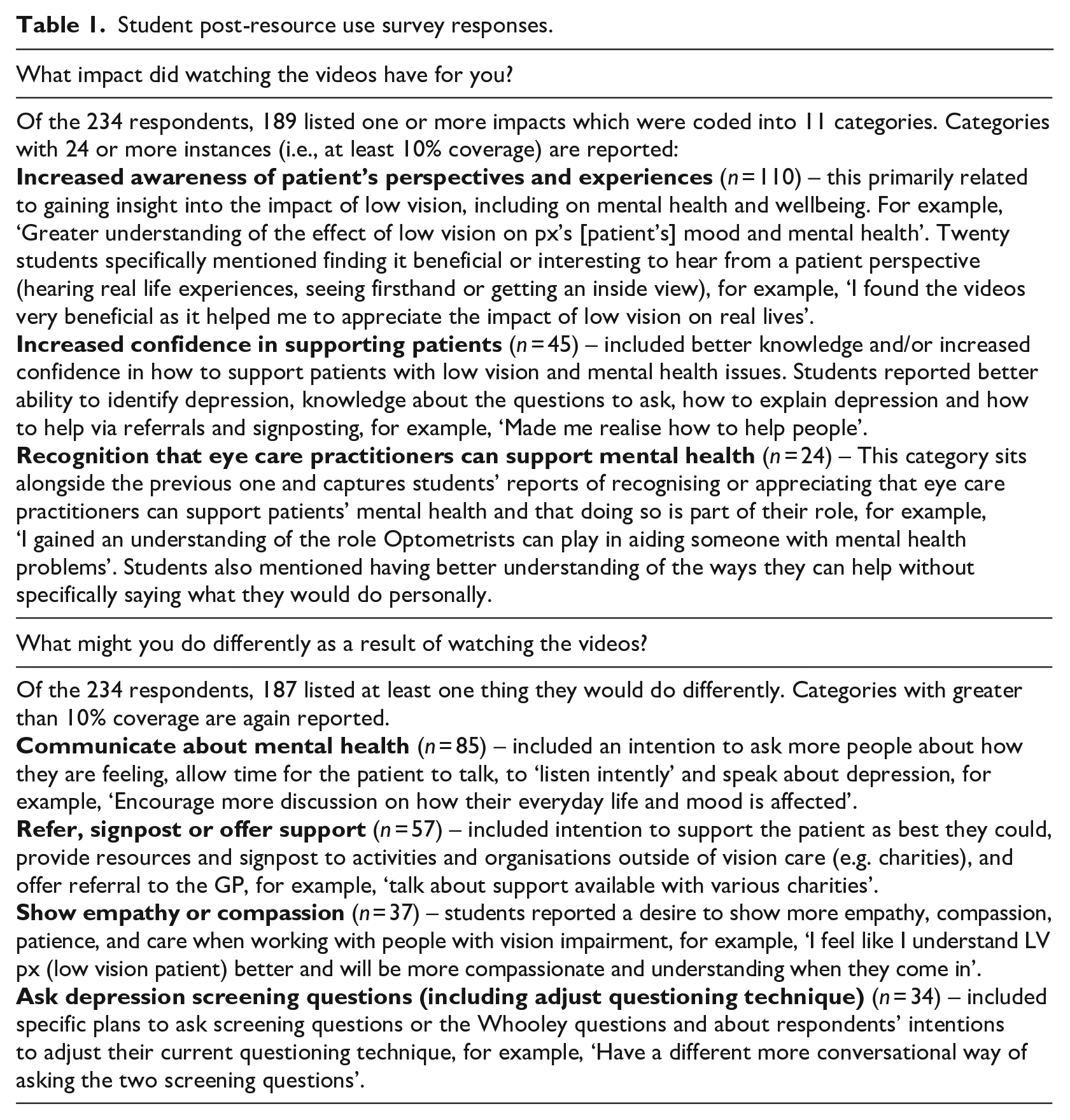
The resources had a significant positive impact on self-rating of understanding of the impact of low vision on mental health (Mann–Whitney U = 64,799.5; p < .001; median pre = 6; post = 8); on rating of knowledge of how to assess and support a person with low vision and depression (U = 71,247; p < .001; median pre = 5; post = 7); and on confidence to discuss depression with a person with low vision and depression (U = 68,996; p < .001; median pre = 4; post = 7). Categorised responses to the two open-ended questions are shown in Table 1.
Student post-resource use survey responses.
Educator feedback
All educators found the resources useful (2 useful; 6 very useful) and were likely to use them again (2 likely; 6 very likely). The resources improved educators’ confidence in teaching the impact of low vision on mental health (1 increased a little; 7 increased a lot).
Service user feedback
Three service users provided feedback on taking part in creating the videos. One had enjoyed sharing their story and hoped the messages they conveyed ‘get out there’ to help others with VI. They reported that showing the video to family had led to an emotional reaction from a family member and helped open a conversation. Another had found the experience ‘pleasing’ and felt useful in being able to share important messages with students. They had subsequently felt more comfortable talking to family and friends about their feelings, and this had led to other people with VI opening up to them: ‘People that I’ve least expected, that seem to have their life together, have their “bed days”. I was surprised to find nearly everyone is suffering, and suffering in silence. It has helped me to feel I am not on my own’. They were also keen to talk about the topic of VI and mental health at events and conferences and reported feeling ‘buzzy’ about being useful again.
Summary and further work
After using the low vision and depression resources, which included four real service users’ stories, eye care students self-reported a significant positive impact on understanding of the impact of low vision, knowledge of how to assess and support a person with low vision and depression, and confidence to discuss depression with a person with low vision.
They cited the two main impacts of the resources as an increased awareness of patient perspectives and experiences, and increased confidence in supporting patients. These findings are consistent with a systematic review of public participation in health care students’ education (Nowell et al., 2024). In addition, students in this evaluation also wrote comments that were categorised as ‘recognition that eye care practitioners can support mental health’. This was an important desired outcome given the qualified practitioners in a previous study questioned whether supporting mental health could be part of their role (Nollett et al., 2020).
The three other common impacts of patient involvement in teaching from the systematic review (Nowell et al., 2024) were less represented in student comments. ‘Greater empathy’ was represented in intended behaviour changes in practice. ‘Enhanced communication and interpersonal skills’ and ‘self-reflection & personal growth’ did not gain significant coverage in this project, which may represent a limitation of using videos rather than in-person interactions.
Students were most likely to suggest that they would now communicate about mental health with patients (talking, listening, asking about feelings), show empathy and compassion, and offer support and signposting to resources and charities. As with a previous study (Nollett et al., 2020), fewer were inclined to ask the recommended screening questions (although some intended to) or make a referral to the GP.
All educators found the resources valuable in their teaching. Service users taking part in the videos enjoyed their experience and felt it was important to raise awareness of mental health issues with eye care students. For two, it had led to having more open conversations with others about their mental health which had then been reciprocated.
In summary, watching real-life patient stories improved students’ awareness of the psychological impact of VI on patients, their recognition that it is part of their role to address depression and their confidence in how to communicate and offer support for mental health. Future work includes sharing the resources more widely with eye care providers outside of higher education and developing similar materials for addressing anxiety in low vision. The educational resources are available under licence from the authors on request.
Footnotes
Acknowledgements
The authors thank the four individuals with vision impairment who shared their stories, Camsight for supporting the project and the educators and students who piloted the resources.
Declaration of conflicting interests
The authors declared no potential conflicts of interest with respect to the research, authorship, and/or publication of this article.
Funding
The authors disclosed receipt of the following financial support for the research, authorship, and/or publication of this article: This project was supported by the AHRC Impact Acceleration Account through Cardiff University.
