




Abstract
Considering the effect of early literacy skills on later literacy processes, supporting the phonological awareness and listening comprehension skills of children with visual impairments is essential. This study aimed to compare phonological awareness and listening comprehension skills of children with visual impairments and sighted children. In this context, the study was designed with the comparative relational survey model, one of the quantitative research methods. The participants of this study consisted of 15 children with visual impairments and 14 sighted children between 57 and 68 months (n = 29). The data were collected in special education and rehabilitation centers and kindergartens where children with visual impairments and sighted children attend. In the study, subtests of the Early Literacy Test were used to evaluate the phonological awareness and listening comprehension skills of children with visual impairments and sighted children. The data were analyzed using the SPSS 22.00 package program. According to the findings, there was a significant difference between the two groups only in the rhyme awareness sub-skill among phonological awareness skills. In contrast, no significant difference was found in other sub-skills and listening comprehension skills.
Introduction
Early literacy skills (ELS) that preschool children must acquire include the prerequisite knowledge, skills, and attitudes required for formal literacy (Lonigan & Shanahan, 2009). Researchers have identified various skills within the cluster of ELS as strong predictors of children’s reading performance in primary school (Bowyer-Crane et al., 2017; Storch & Whitehurst, 2002). Although these skills are classified differently (Muter et al., 2004), they are generally letter knowledge, vocabulary knowledge, phonological awareness, print awareness, oral language, and listening comprehension (Aarnoutse et al., 2005; Kennedy et al., 2012; Lonigan & Shanahan, 2009; Rvachew & Savage, 2006; Spira et al., 2005). Wheater (2011) states that a rich environmental setting is essential for emergent literacy development. Children learn the forms and purposes of language in preschool. Children begin to learn concepts related to writing, such as environmental writing and alphabet knowledge, which receive more attention later on. A storybook reading activity can effectively support letter awareness. Emerging literacy skills must be supported at home and in early education settings. Parents and teachers can support the development of literacy skills by providing children with exposure to written materials (Day et al., 2005). The reading instruction provided in the first grade assumes that children have the prerequisite literacy skills (Ergul et al., 2014). When the findings obtained from the studies are examined, it is seen that students’ reading performances are not interfered with the preschool period. In the first years of primary school, children exhibit low success in reading as they start school with few skills covered by early literacy (Kargin et al., 2015; Snow & Matthews, 2016).
Phonological awareness
Phonological awareness and listening comprehension skills, essential sub-skills of ELS, are among the skills children should exhibit before formal literacy to ensure reading comprehension (Carroll et al., 2003; Treiman et al., 2022). Phonological awareness is the auditory perception and analysis skills such as recognizing, dividing, and changing words, syllables, and phonemes other than the meaning intended to be given in the language spoken by individuals (Lonigan & Shanahan, 2009). Phonological awareness skills include recognizing rhymes in words, producing rhymes, and recognizing, separating, counting, adding, and subtracting syllables (Kuppen & Bourke, 2017). Phonological awareness consists of phonological awareness, syllable awareness, and initial sound-final rhyme awareness (Kilpatrick, 2013). Syllable awareness is linked to finding the syllables that makeup words. Initial sound-final sound rhyme awareness perceives that a single syllable can have two units. Awareness of the first and last rhyming units in words enables the development of awareness of phonemes (Goswami, 2013). It is stated that phonological awareness predicts school-period reading performance on the way to reading (Suggate, 2016). Research shows that kindergarten and first-grade children who receive systematic phonological awareness training are better at reading and spelling words than their peers who do not receive training (Armbruster et al., 2006). Similarly, it has been found that children with high phonological awareness skills can perform letter-sound transformations more easily (Kim et al., 2010).
Listening comprehension
Listening comprehension supports reading comprehension, like phonological awareness skills, by covering grammatical processes such as gaining new words and providing morphological awareness and syntactic knowledge (Gottardo et al., 2018). Reading comprehension skills are essential to reading, and listening comprehension skills, one of the prerequisite skills of this skill, have an essential place in ELS before effective reading activity (Kargin et al., 2015). Listening skills include how individuals interpret and express what they hear. In this direction, depending on the purpose, evaluations are handled academically (Cushman, 2022). Considering the increasing importance of listening comprehension within the framework of society in daily life, there may be a need for research on assessing listening comprehension in the literacy process and developing this skill (Wolf et al., 2019). To perform well in the assessment of listening comprehension skills, components such as attention, vocabulary, syntactic knowledge, syntactic knowledge, morphological knowledge, and working memory are included in addition to expressive language skills such as giving correct answers to open-ended questions (Gottardo et al., 2018; Metsala et al., 2021).
Early literacy skills on visually impaired
ELS requires visual and auditory discrimination skills. In this context, visual perception is important for early literacy, and in the case of visual impairments (VI), ELS may be affected in various ways (Couvee et al., 2022). Pereira and Conti-Ramsden (2019) found that children with VI explore their environment less and have lower rates of spontaneous imitation, which hinders their social and cognitive development due to a lack of visual input. This limitation may prevent them from understanding social cues, emotional expressions, and basic motor skills (Tadić et al., 2010). Seeing adults use literacy in various areas of life creates positive role models for children in learning through observation. Reading newspapers, books, and magazines for information and pleasure, preparing shopping lists, taking notes, and reading and writing on computers, phones, and other devices show parents as strong models who use literacy to fulfill the purposes of daily life (Cunningham et al., 2009). In the case of VI, visual inputs can be collected and interpreted through other sensory channels (Lueck & Heinze, 2005). Since children with severe VI cannot model and imitate adults by observing them, they may miss reading opportunities that occur randomly in the home environment. Sighted children are exposed to written materials such as newspapers and books their families own. However, since this is limited in the case of VI, children may have difficulty developing literacy awareness in preschool (Grbović & Dimoski, 2016).
Research on ELS has received considerable attention. The majority of these studies focus on children with typical development. When the studies are examined, limited studies are found on phonological awareness and listening comprehension skills of children with VI in early childhood (Barlow-Brown & Connelly, 2002; Gillon & Young, 2002; Hatton et al., 2010). Considering the impact of ELS on later literacy processes, supporting the phonological awareness and listening comprehension skills of children affected by VI will help prevent academic problems that may be experienced during the school period. For this purpose, it is crucial to measure children’s phonological awareness and listening comprehension skills with current assessment tools.
The current study
This study aimed to compare the phonological awareness and listening comprehension skills of VI and sighted children. Within the scope of the research aim, answers to the following questions were sought:
How do children with VI perform on phonological awareness skills?
How do typically developing children perform on phonological awareness skills?
Do the phonological awareness skills of children with VI and sighted children differ?
How do children with VI perform on listening comprehension skills?
How do typically developing children perform on listening comprehension skills?
Do the listening comprehension skills of children affected by VI and sighted children differ?
Methods
This study aimed to compare the phonological awareness and listening comprehension levels of children with VI and sighted children. In this context, the study was designed with the comparative relational survey model, one of the quantitative research methods. This model allows the examination of the relationship between two variables and determines the strength and direction of the relationship between variables (Franzese & Iuliano, 2019).
Participants
The participants of this study consisted of 15 children with VI between the ages of 4 and 6 who attend special education and rehabilitation centers, special education institutions, kindergartens, and nursery schools and 14 sighted children who attend special education institutions, kindergartens, and nursery schools in Ankara (n = 29). The mean age of the VI group was 60.20 months, and the mean age of the sighted group was 59.42 months. After planning the study and developing the data collection tools, the necessary approvals and permissions were obtained from the Gazi University Measurement and Evaluation Ethics Committee (Date: 12 January 2023, Number: 77082166-604.01.02). With the ethics committee document, institutions with children who met the criteria were visited. These institutions were selected based on their acceptance of children with VI and their willingness to participate in the study. Children were selected according to specific criteria such as age, diagnosis, and educational status. These institutions were informed about the research, and permission was obtained for the implementation in line with ethical approval. Before the study, permission was obtained from the parents of the children by explaining the purpose of the study. The parents of the children filled in these forms and provided their consent in line with ethical guidelines. These forms included basic information such as age, diagnosis, educational status, and the purpose of the study. The parents of the children filled in these forms and provided their consent in line with ethical guidelines. All children attend preschool education. Children with VI include blindness and low vision. Table 1 presents the characteristics of children with VI.
Criteria for children with VI
(a) Being in the age range of 57–68 months,
(b) Being diagnosed with VI by hospitals,
(c) Not having any additional disabilities,
(d) Primary language is Turkish,
(e) Voluntary participation of parents in the study.
Criteria for sighted children
(a) Being between 57 and 68 months,
(b) Not having any additional disabilities,
(c) Primary language is Turkish,
(d) Voluntary participation of parents in the study.
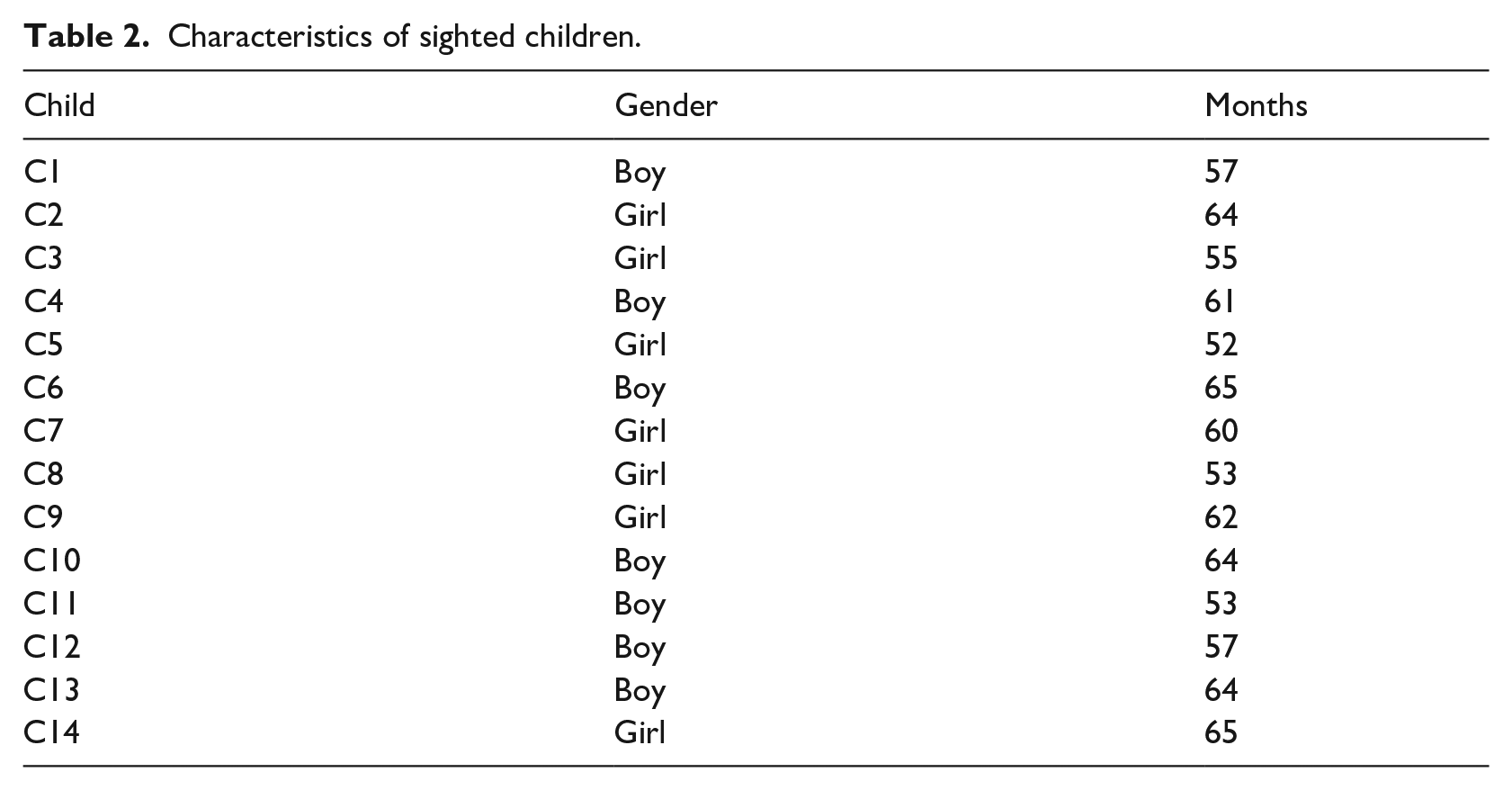
Table 2 presents the characteristics of sighted children.
Characteristics of children with VI.
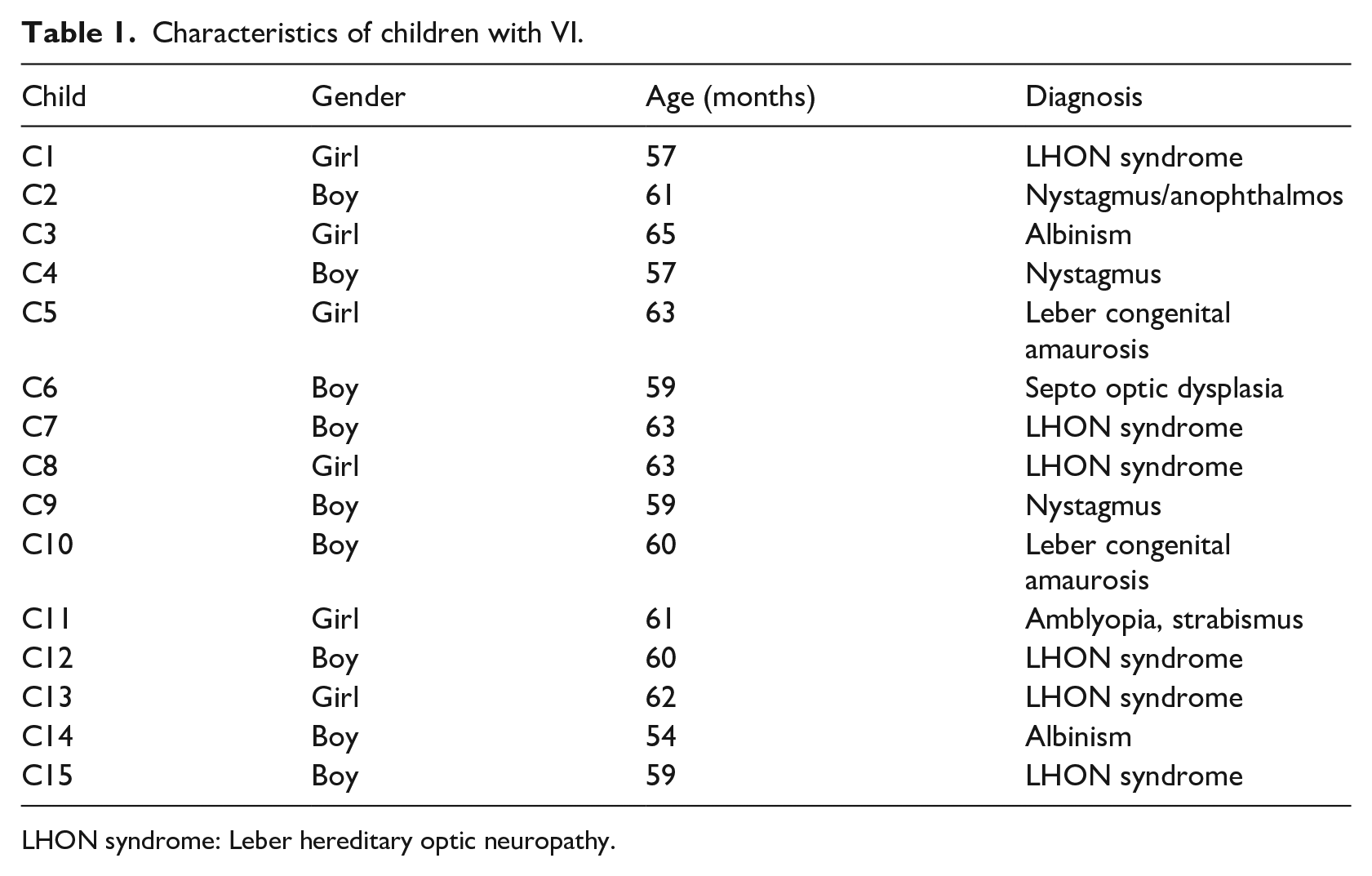
LHON syndrome: Leber hereditary optic neuropathy.
Characteristics of sighted children.
Data collection tools
In the study, phonological awareness and listening comprehension tests, which are subtests of the Early Literacy Test developed by Kargin et al. (2015), were used to evaluate the phonological awareness and listening comprehension skills of children with VI and sighted children. The Early Literacy Test is a standardized test for 5-year-old children that measures receptive language, expressive language, general naming, functional knowledge, letter knowledge, phonological awareness, and listening comprehension. Phonological Awareness subtest (a) Rhyme Awareness, (b) Matching According to the First Sound, (c) Matching According to the Last Sound, (d) Sentence Separation, (e) Syllable Separation, (f) Syllable Combining, (g) The test consists of eight dimensions, namely (i) Initial Sound Production and (ii) Final Sound Production. The test was developed and carried out on 403 children. It was observed that the factor loadings of the items in the dimensions within each subtest of Early Literacy Test, which consists of seven subtests, ranged between .43 and .93 and that the subtests gave the expected compatibility within themselves. The high KR20 and Spearman-Brown values obtained in the reliability analyses of Early Literacy Test showed that the test was reliable regarding internal consistency. The expert panel formed for the content validity of Early Literacy Test reported that the items in the subtests would reflect children’s competencies in the relevant tests, and it was accepted that Early Literacy Test adequately reflected the areas to be measured. The authors who collected data in this study participated in the Early Literacy Test practitioner training, completed the training, and received practitioner certificates.
Data collection
This study collected data from special education and rehabilitation centers, special education institutions, and kindergartens that accept children with VI. The evaluation sessions of the study were conducted individually with the children in a quiet environment. Before starting the study, a short conversation was held to familiarize the children with the environment and the practitioner, and the children were informed about the studies to be conducted. The assessments were administered to all children in the same order, and short breaks were given when necessary. The assessment took an average of 30 min for each child. No visual assessment step was used in the study.
For the confidentiality of child participants, their real names were replaced with codes. Each child was assigned a random number and letter “C (Child)” combination, and the data were recorded using these codes. In this way, it was ensured that the participants identities were protected and confidentiality principles were adhered to throughout the research process. In addition, participant information sheets, including detailed information about the study and the rights of the participants, were provided to the parents, and their consent was obtained in line with ethical guidelines.
Data analysis
The data obtained in this study were analyzed using the SPSS 22.00 package program. SPSS (Statistical Package for the Social Sciences) is a statistical analysis software developed by IBM (International Business Machines). It is widely used in social sciences, health sciences, market research, education, and other fields. SPSS allows users to manage data, analyze data, create graphical representations, and generate reports (Pallant, 2020). First, descriptive statistics were conducted to summarize the main features of the data. This included measures such as mean, median, mode, standard deviation, and range, providing a comprehensive overview of the central tendency and variability within the dataset. The Shapiro–Wilk normality test assessed whether the data followed a normal distribution. This test is particularly suitable for small sample sizes and is widely used to determine the appropriateness of subsequent parametric tests. The relationships between the variables were analyzed separately for both groups using the Spearman-Brown rank difference correlation coefficient. This non-parametric correlation measure was chosen due to its robustness in handling non-normally distributed data and its ability to assess the strength and direction of the monotonic relationships between the variables.
Reliability
Inter-observer reliability data were collected at least 30% of all sessions in the experimental process in randomly selected sessions to determine whether the participant children’s responses were recorded accurately. The inter-observer reliability data were coded by a researcher who continuing his doctoral education. The observer watched the video recordings selected by unbiased assignment and marked the participant’s reactions to the skill steps on the relevant data recording checklist. Inter-observer reliability was calculated for each skill using the formula “Agreement/Agreement + Disagreement × 100” (Tekin-İftar, 2012). Inter-observer reliability was calculated as 92%.
Results
Research questions (1) How do typically developing children perform on phonological awareness skills? and (2) How do children with VI perform on phonological awareness skills? were included. According to the study results, the sighted children’s total score was 216, while the total score of the children with VI was 168 for phonological awareness skills. The results indicated that sighted children had an average score of approximately 15.43 in phonological awareness skills, while children with VI had an average score of 11.20. The score distribution for sighted children ranged from 9 to 26, whereas for children with VI, the scores ranged from 1 to 26, suggesting more significant individual differences among the children with VI. Table 3 and Table 4 presents the descriptive statistics of the results related to phonological awareness and listening comprehension skills scores.
Descriptive statistics of the results related to phonological awareness skills scores.

Descriptive statistics of the results related to listening comprehension skills scores.

Research questions (3) How do children with VI perform on listening comprehension skills? and (4) How do typically developing children perform on listening comprehension skills? were included. According to the results related to listening comprehension skills scores, the total score of sighted children is 65, while the total score of children with VI is 58. The results indicated that sighted children had an average score of approximately 4.64 in listening comprehension skills, while children with VI had an average score of 3.87. The score distribution for sighted children ranged from 3 to 6, whereas for children with VI, the scores ranged from 1 to 6, suggesting more significant individual differences among the children with VI. Table 5 presents the results related to phonological awareness and listening comprehension scores.
Results related to phonological awareness and listening comprehension scores.
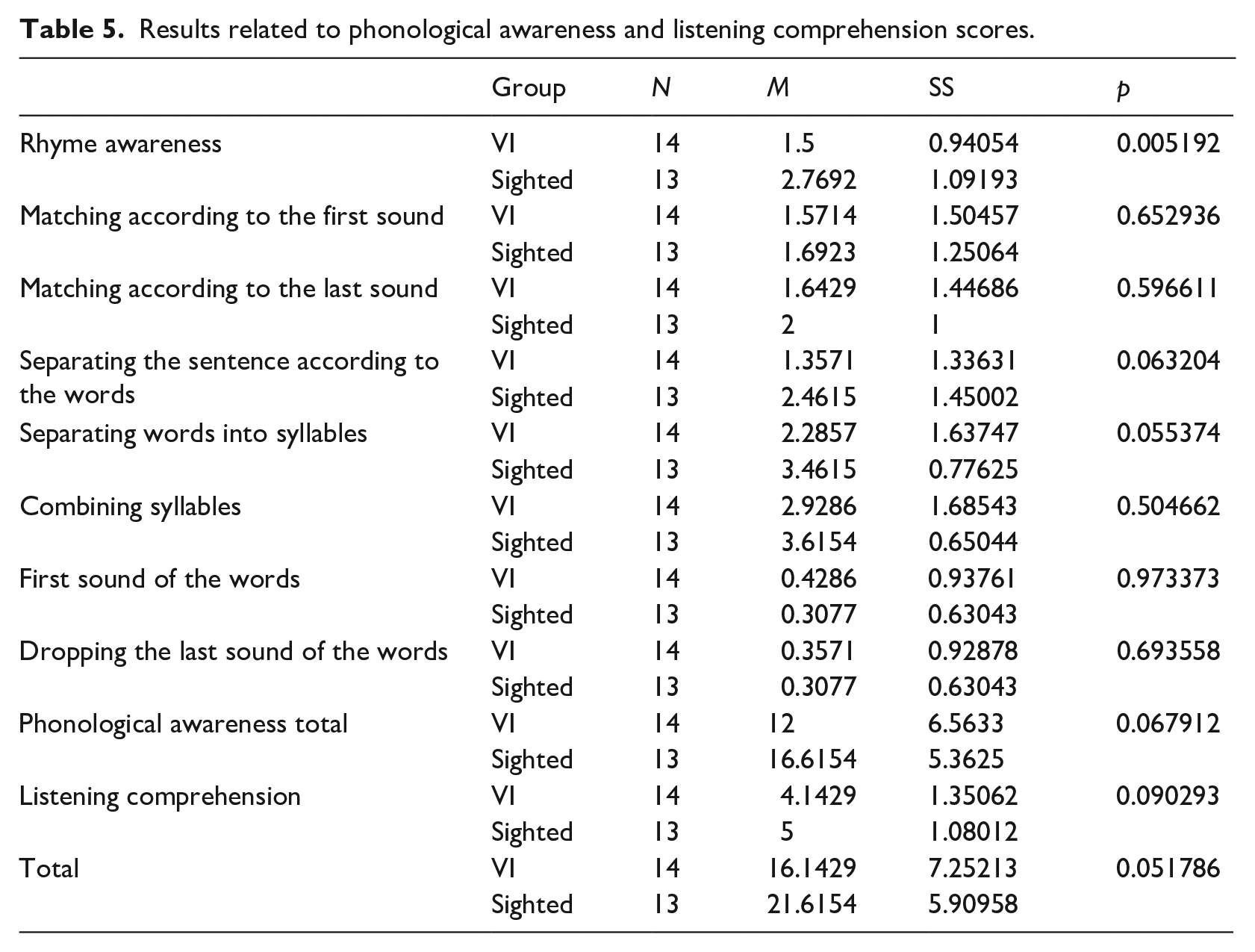
Research questions (5) Do the phonological awareness skills of children with VI and sighted children differ? and (6) Do the listening comprehension skills of children affected by VI and sighted children differ? were included. According to the findings, sighted children generally perform better in various phonological awareness tasks and listening comprehension than children with VI. In contrast, no significant difference was found in matching according to the first sound, matching according to the last sound, separating the sentence according to its words, separating words into syllables, combining syllables, discarding the first sound of words, discarding the last sound of words, phonological awareness, and listening comprehension skills, there was a significant difference between the two groups only in the sub-skill of rhyme awareness among phonological awareness skills.
Discussion
This study compared phonological awareness and listening comprehension skills, which are sub-skills of early literacy, of children with VI and sighted children. The findings from this study provide important insights into the phonological awareness and listening comprehension skills of sighted children and children with VI. Overall, sighted children generally performed better in all tasks compared to children with VI.
In this study, visually impaired children performed less rhyming skills than their sighted peers. Research shows that early intervention is crucial for developing phonological awareness skills in children, particularly rhyme recognition and production skills, which are fundamental to literacy development; enhancing these skills is essential for future reading and comprehension success (Vender & Melloni, 2021; Weisleder & Fernald, 2013).
Appropriate assessment of phonological awareness and listening comprehension skills in preschool children and making necessary interventions afterward are essential for future reading comprehension success (Kargin et al., 2017). This situation is also valid for children with VI. Acquiring a rich repertoire of early experiences is an important foundation for children’s literacy development. Research shows that children with VI acquire these experiences differently from their sighted peers (Erickson & Hatton, 2007). Rhyming ability is a foundational element in the early stages of phonological awareness. Enhancing this early rhyming skill could catalyze the acquisition of reading. The findings revealed that providing explicit instruction in rhyming to children as young as 37 months led to significantly improved rhyming abilities compared to similarly aged children who did not receive such instruction (Reynolds et al., 2003). Social signals represent the primary means of early interaction. Imitation is a powerful tool for acquiring social signals in early childhood, which is replaced when mastery of traditional language symbols is reached. Therefore, awareness of the other person’s role is vital for establishing standard references or shared events. Limited vision and lack of experience can affect the ability to form rhymes. Hearing sounds, and perceiving language structures in a child’s environment can help them to identify and form rhymes better. However, a child who does not hear language patterns and sounds regularly may struggle with rhyming due to a lack of experience (Kao & Mzimela, 2019).
ELS supports children’s language development, comprehension skills, communication skills, and basic skills for reading readiness (Brown, 2014). Therefore, strengthening children’s early literacy is critical in laying the foundation for successful literacy development. Children must learn many skills for reading comprehension while listening to stories and information told orally at home and school (Barclay, 2012). Children with VI need to have their ELS supported in the preschool period with adaptations appropriate to their visual level, like their sighted peers (Işıtan-Kılıç & Aykut, 2024). Research suggests that children with VI tend to have poorer print reading performance than their sighted peers. The reasons for this are that printed texts are more complex for them to access, and long-term difficulties in accessing print can lead to developmental delays. In this context, interventions that include ELS should be considered and supported for their impact on children’s cognitive development (Douglas et al., 2011).
Research has shown that multisensory approaches can significantly enhance the phonological awareness and literacy skills of children with VI, as they rely more on auditory and tactile inputs to compensate for the lack of visual information (Cullen & Metatla, 2018; Edirisinghe et al., 2022). By incorporating various sensory modalities, these approaches can address the unique learning needs of visually impaired children. Furthermore, providing children with VI access to technology-based learning tools, such as audiobooks and screen readers, can support their literacy development by offering alternative ways to engage with text (Mulloy et al., 2014). Collaborative efforts between educators, families, and specialists are essential in creating an inclusive learning environment that addresses the diverse needs of children with VI (Koenig & Holbrook, 2000). To maximize the learning opportunities for VI children’s ELS, it is necessary for the child’s family and the specialists they interact with to collaborate (Day et al., 2005). In the education of children with VI, the paramount objective is to maximize their independence and success across all domains, with ELS particularly regarded as pivotal for future academic achievement. ELS are also the basic structures for acquiring literacy skills. Individuals need to learn these skills to continue their school life successfully and not depend on anyone in the future. In addition, learning these skills is a priority for VI individuals to increase their self-confidence and to experience a sense of achievement (Almog, 2009; Suraweera et al., 2022).
Limitations
This preliminary study compares children with VI and sighted children in the early literacy literature. This study is expected to guide future research. All of the children in the study attended kindergarten during the research period. Although it was confirmed by asking their families that the children did not receive ELS intervention directly, they may have been exposed to ELS practices directly or indirectly in the school environment. This variable can be considered in future studies because the selected children come from different educational environments. The children in the study had different levels of vision. The visual residuals of children with low vision in the VI group may affect the evaluation results. In future studies, it is crucial to equalize and group the visual levels of the participants. It is also recommended that this study be repeated with a larger sample group. Considering the limitations of the studies conducted with children with VI in the literature, more research should be conducted to evaluate the ELS.
Footnotes
Authors’ note
This study was presented as an oral presentation at the Gazi University Turkish World Educational Sciences Congress between 16 and 17 November 2023.
Declaration of conflicting interests
The author(s) declared no potential conflicts of interest with respect to the research, authorship, and/or publication of this article.
Funding
The author(s) received no financial support for the research, authorship, and/or publication of this article.
