




Abstract
Braille literacy enables equal access to learning for students who are blind or have very low vision in a mainstream, inclusive classroom. Teachers need to know which teaching strategies best support the development of braille literacy skills in beginning touch readers. A scoping review following the PRISMA-ScR guidelines was conducted to identify and synthesise the body of literature on braille literacy. The search criteria were peer-reviewed research publications focusing on pedagogy for teaching braille in mainstream Kindergarten to Year 4 settings to beginning readers with vision impairment, without other disabilities, who spoke English as their first language. The publication period searched was from 1975 to 2022. A total of 740 articles were identified. After screening for eligibility using the search criteria, 10 articles were included. A thematic analysis identified the overarching theme of evidence-based pedagogy and the sub-themes of uncontracted and contracted braille, the Learning Environment of the Classroom and Reading Instruction. There was limited research found on evidence-based pedagogy to support the sustained, systematic development of braille literacy in Kindergarten to Year 4 students with vision impairment. The scoping review identified one seminal US study that found braille readers were falling behind their sighted peers as more complex reading skills were not being learned at the same rate. Determining successful evidence-based pedagogy which will support the sustained development of braille literacy skills in developing readers will require a sophisticated research approach involving braille literacy experts and braille readers.
Introduction
Most classrooms in mainstream Australian schools today are a celebration of inclusivity and diversity. Teachers work together with their students to co-create learning intentions, assessment criteria and expectations within the classroom. Each student is an integral part of their classroom. They know they are safe, valued, and cared for.
In 2023, 24% of total enrolments in Australian schools across sectors were students with disability (Australian Curriculum, Assessment and Reporting Authority [ACARA], 2023). Of the total enrolments, approximately 13% had a cognitive disability, 2% had a physical disability, 8% had a social-emotional disability, and 0.7% had a sensory disability (hearing and vision combined) (ACARA, 2023). The data identifying the number of students who are braille readers has not been collected. However, in 2021, the NSW Education Standards Authority (NESA) reported that 0.2% of the students with sensory disability required extensive or substantial levels of adjustment. ‘Adjustments are actions taken that enable a student with disability to process syllabus outcomes and content on the same basis as their peers’ (NESA, 2001, para. 2). Curriculum adjustments are considered extensive if required across all subject areas at all times and substantial if required for most subject areas most of the time. The adjustment level is based on the frequency and intensity of the adjustments in place to support the student in accessing the curriculum on the same basis as their peers (Nationally Consistent Collection of Data on School Students with Disability, 2022). Braille readers would be included in the 0.2% of the Australian school population.
The Disability Discrimination Act 1992 (Cth) (Australian Government, 1992) and the Disability Standards for Education 2005 (Australian Government, 2005) are the basis for the disability-specific recommendations of NESA, ACARA, and the Nationally Consistent Collection of Data on School Students with Disability (NCCD). Teachers across Australia are legally obligated to provide appropriate adjustments for all students with disability. NESA (2021) provides over 100 examples of adjustments for students with disability. One example is to provide braille.
Braille is a tactile reading and writing system. The braille code comprises cells containing six raised dots (two columns of three dots). Braille characters are represented by various combinations of these six raised dots. Braille is defined as uncontracted or contracted braille. Uncontracted braille uses one cell per letter of the alphabet (26) and some punctuation. Contracted Unified English Braille uses the alphabet cells and more than 150 characters and contractions, representing groups of letters or words and punctuation. These contractions are governed by a formal system of rules (Simpson, 2013).
The federal, state, and territory departments of education are committed to supporting all students with disability. As well as The Disability Discrimination Act 1992 (Cth) (Australian Government, 1992) and the Disability Standards for Education 2005 (Australian Government, 2005), the Australian Curriculum refers to the Alice Springs (Mparntwe) Education Declaration (Education Council, 2019). This Declaration is an aspirational document identifying all we, as a nation, hope for our young people in the Australian education system. ‘Our vision is for a world class education system that encourages and supports every student to be the very best they can be, no matter where they live or what kind of learning challenges they may face’ (Education Council, 2019, p. 2). How is this achieved for our students who are braille readers? Teaching them the braille code is not nearly enough. Our students must be literate, numerate, lifelong learners who can participate fully in a rapidly changing society.
Providing students with braille is essential; however, the braille code is only a code. Braille readers still need to be taught literacy skills. Holbrook (2008) and Swenson (2008) believe that teaching braille cannot be separated from teaching reading, which suggests that Teachers of Students with Vision Impairment (TSVI) and mainstream class teachers need to work together to support the development of braille literacy for their students. It is by being part of the mainstream classroom that braille readers will learn the important literacy skills to become highly proficient braille readers (Holbrook, 2008; Roe et al., 2014; Swenson, 2008).
Emerson, Holbrook, et al. (2009) have expressed concern that braille readers are falling behind their sighted peers as they are not learning more complex reading skills at the same rate as their peers. This raises the important question: How do mainstream teachers and TSVI work together to ensure students learn the complex skills of braille literacy to achieve the same literacy outcomes as their sighted peers? For TSVI and class teachers to be able to focus on teaching braille readers the complex skills of reading, we need to identify pedagogical strategies that support these outcomes.
Research question
What evidence-based pedagogy exists to support teaching beginning readers braille in a mainstream setting?
Rationale
Students with disability have the right to enrol in their local school on the same basis as their peers. They also have the right to access the curriculum on the same basis as their peers, with reasonable adjustments to support them (Australian Government, 2005). For students who are braille readers, reasonable adjustments include teaching braille literacy and providing all print materials in braille with tactile graphics. TSVI and mainstream teachers share the responsibility of teaching braille literacy to braille readers. Evidence-based pedagogical strategies support teachers to achieve sustained development of braille literacy for their braille reading students.
Several frameworks identify the braille literacy skills students need to achieve, for example, Queensland Braille Learning Progression and Assessment Tool 2021 (Queensland Department of Education, 2021). However, a preliminary literature review found limited research-based guidelines on the pedagogy that best supports braille readers to develop literacy skills equivalent to their sighted peers in a mainstream setting.
Methodology
Scoping reviews are used to determine the scope of evidence available on a topic, synthesise relevant studies and identify gaps in the research (Arksey & O’Malley, 2005; Levac et al., 2010; Lockwood et al., 2019; Munn et al., 2018). This scoping review follows the PRISMA-ScR guidelines, providing a protocol that increases the transparency of the review (Lockwood et al., 2019).
While conducting this scoping review the five stages identified by Arksey and O’Malley (2005) were followed: identifying the research questions, identifying relevant studies, study selection, charting the data, collating, summarising, and reporting the results.
Inclusion criteria
To be included in this scoping review, the following selection criteria were used:
peer-reviewed research
peer-reviewed literature reviews
articles published from 1975 – 2022 (legislation in Australia and the United States changed in 1975 to include a structure for the integration of students with disability in mainstream schools following the United Nations Declaration on Rights of Disabled Persons, 1975)
research involving the pedagogy of teaching reading and writing to beginning readers who are braille readers
research participants are students in Kindergarten–Year 4 (5–10 years old) in the early literacy development stages and their teachers
students who are blind or have low vision without other disabilities
braille is used as the primary medium
participants are enrolled in a mainstream school
participants use English as a first language
Exclusion criteria
The exclusion criteria were:
students who are dual media readers
co-morbidity of disability
research focused on braille Maths
research focused on braille Music
students older than Year 4 (older than 10 years old)
participants attending schools for students who are blind or have low vision
Identification
After consultation with a senior education librarian, the first author researched ProQuest Databases using an Advanced Search with the following keywords: ‘braille reader’ OR ‘braille user’ OR ‘braille literacy’ OR ‘touch reader’ OR ‘haptic reader’ OR ‘braille writer’, limited to peer-reviewed, full text, English, published between 1975 and 2022. The EBSCO databases were searched using ‘braille’ AND ‘literacy’, limited to full text, peer-reviewed, journal articles in English, published between 1975 and 2022. The initial search identified a total of 652 articles.
The first author then manually searched The Journal of Visual Impairment and Blindness, The British Journal of Visual Impairment and the Journal of South Pacific Educators of Vision Impairment using the keywords ‘braille literacy’. A total of 226 additional articles were identified. The first author also completed a citation search, examining papers that were referenced by the authors of the articles identified in the initial search. A further 11 additional articles were identified.
Screening and eligibility
In total, 889 full-text, peer-reviewed articles were identified. After screening the articles, 149 duplicates were removed, leaving 740 articles. After screening the abstracts of these articles, 482 articles were excluded, leaving 258 full-text articles. These full-text articles were then screened for eligibility according to the inclusion criteria, excluding 248 articles, leaving 10 full-text articles for the scoping review (see Figure 2 in Appendix 1).
Results
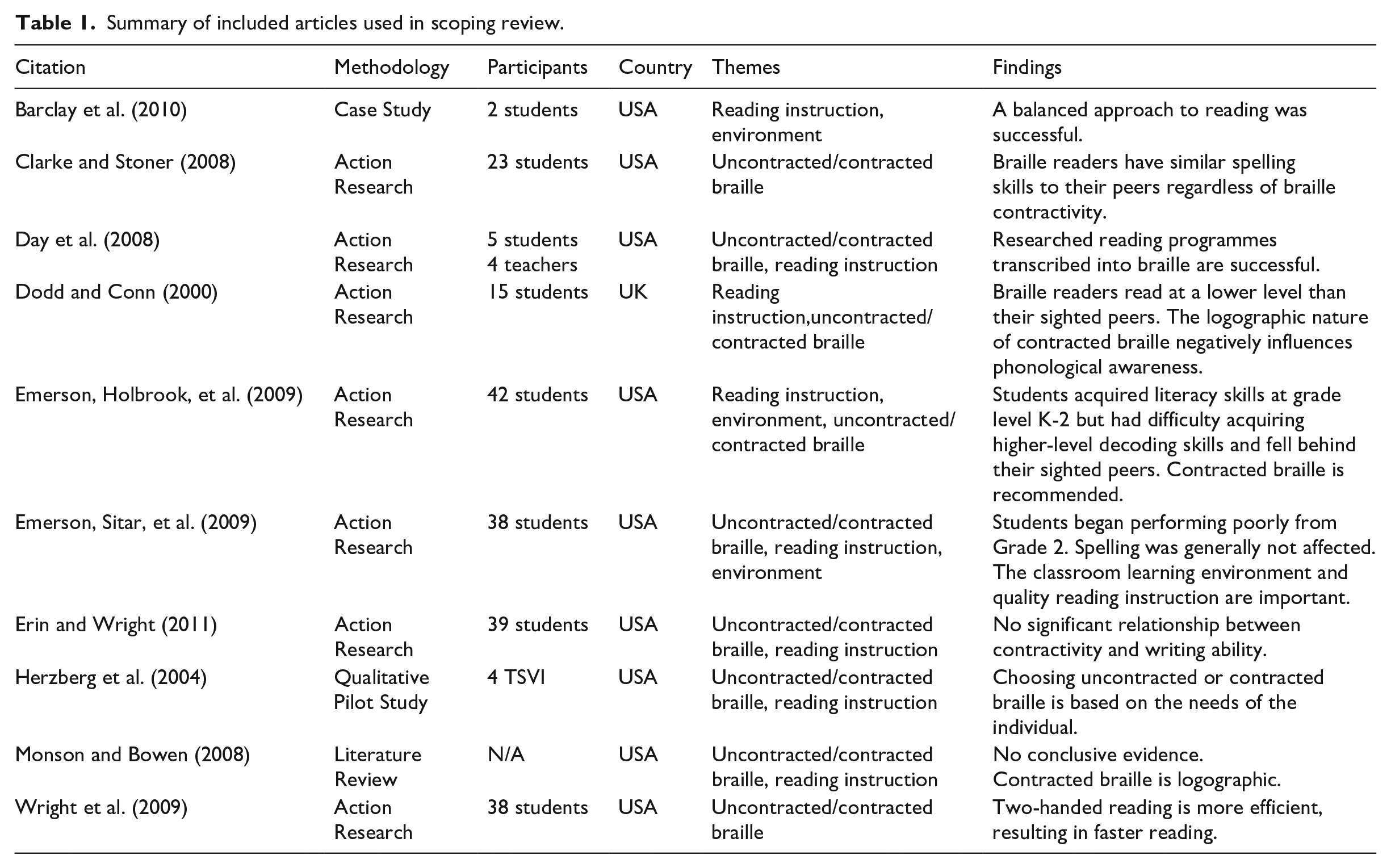
The publication dates of the selected articles range from 2000 to 2014. There is one case study with two students, six action research projects with student participant groups ranging from 5 to 42, one action research project with a group of five students and a group of four teacher participants, one qualitative pilot study involving four Teachers of Students with Vision Impairment and one article is a literature review. Of the ten articles, nine were written by researchers in the United States and one was written by researchers in the United Kingdom. (See Table 1 in appendices).
A thematic analysis was conducted on the 10 journal articles identified for the scoping review. Braun et al. (2019) recommend the use of themes to identify patterns of shared meaning, uniting data that may not initially appear connected. The overarching theme is evidence-based pedagogy, with the sub-themes, uncontracted and contracted braille, the learning environment of the classroom and reading instruction. (See Figure 1).
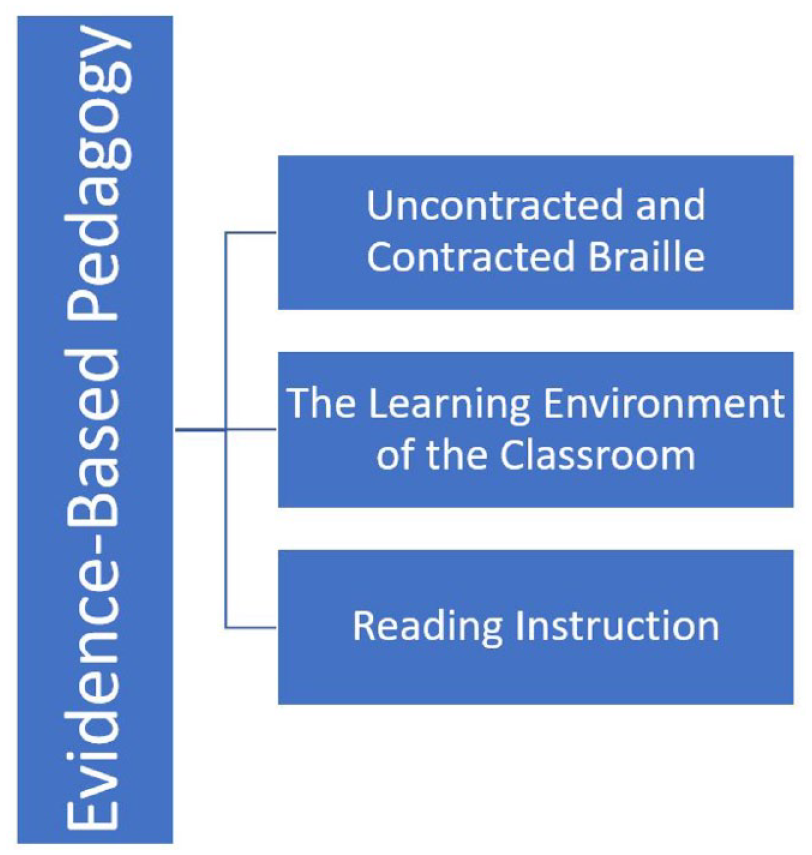
Theme and sub-themes.
Uncontracted and contracted braille
USA researchers, Emerson, Holbrook, et al. (2009) conducted a longitudinal research project (38 braille readers from 2002 to 2007) to determine the impact of learning uncontracted braille or contracted braille on the development of reading, writing, spelling, and vocabulary on young students. Emerson, Holbrook, et al. (2009) found that most students who initially learned uncontracted braille began learning contracted braille within a year or two. Those who had low contractivity (fewer than 25 contractions) were reading at much lower levels and had poorer decoding skills than their print-reading peers. Despite this, spelling skills did not appear to be greatly influenced by the number of contractions a student used. Clarke and Stoner (2008) compared the spelling skills of 23 braille readers with print readers using the norm-referenced spelling assessment, the Test of Written Spelling, Fourth Edition (TWS-4). They used grade-level entry points for the assessment and found that the spelling skills of the braille readers were similar to those of their sighted peers. They also found no significant difference in spelling skills between those using contracted and uncontracted braille.
The students in the Alphabetic Braille and Contracted (ABC) Braille Study (Emerson, Holbrook, et al., 2009) acquired literacy skills at grade level during Kindergarten – Grade 2 (5–8 years old) but then showed difficulties acquiring higher-level decoding skills. Students who read fewer contractions had poorer scores. Emerson, Holbrook, et al. (2009) concluded that the early introduction of contracted braille is associated with higher literacy performance.
Herzberg et al. (2004) were interested in the decision-making process to determine whether to teach beginning braille readers uncontracted or contracted braille. They questioned when contracted braille should be taught. They believe learning contracted braille is complicated and places extra cognitive demands on young braille readers that print readers do not have to contend with. Their research involved four TSVI who completed questionnaires investigating the factors that influence their decision to teach uncontracted or contracted braille to beginning readers and the pedagogy they use. The results revealed that the decision to teach uncontracted or contracted braille was based on the student’s individual needs and considered the student’s cognitive capacity, how they are progressing with braille, the classroom environment, and the materials available. The teachers explained that it was sometimes difficult to determine whether teaching a student uncontracted or contracted braille was best. They reported that some students were unable to learn contracted braille, but this could only be identified after instruction in contracted braille had been tried. The teachers also emphasised engaging students in learning to read and making it fun rather than solely focusing on the braille code being used. Herzberg et al. (2004) concluded that TSVI need to have a wide range of teaching strategies to support the individualised needs of their students, and this would be best supported through teacher training programmes.
Erin and Wright (2011) used the results of the longitudinal ABC Braille Study (Emerson, Holbrook, et al., 2009) to determine if the level of contractions used influenced the quality and complexity of language conventions or the length of the written text. They used writing samples which were collected once per year over 2–5 years. The students were given a prompt and required to write a recount or a personal narrative. No time limit was imposed. Erin and Wright (2011) found that as students mastered more contractions, they tended to write more, but there was no significant relationship between the level of contractivity and writing achievement. They did note that high contractivity did not result in poorer spelling skills, which supported the findings of Clarke and Stoner (2008) and Emerson, Holbrook, et al. (2009).
Wright et al. (2009) studied hand movements in relation to reading efficiency from video recordings taken during the ABC Braille Study (Emerson, Holbrook, et al., 2009). Wright et al. (2009) found that most students’ hand movements changed over time, moving from a less efficient method to a more efficient two-handed method. Students who used a two-handed method improved their reading speed faster than their peers who used a one-handed method. Wright et al. (2009) found there was no correlation between when contracted braille was introduced and reading efficiency.
The learning environment of the classroom
Emerson, Sitar, et al. (2009) used the ABC Braille Study (Emerson, Holbrook, et al., 2009), studying 38 young braille readers to compare high and low literacy achievers. The students were assessed annually and observed at school twice each year. Interviews with their parents and teachers were also conducted. Emerson, Sitar, et al. (2009) suggested that it is the educational environment that is crucial to braille readers’ success. Beginning braille readers require high quality reading instruction.
Reading instruction
Barclay et al. (2010) suggest that teachers need to have a balanced approach to reading where motivation and comprehension are as important as learning the code to read. They selected two students from the ABC Braille Study (Emerson, Holbrook, et al., 2009) who demonstrated progress in their literacy skills throughout the study. One student learned to read uncontracted braille for 3 years before learning contractions, while the other student learned contractions initially. Barclay et al. (2010) based their study on observations, written records, and interviews. There was no significant difference in progress based on initially learning uncontracted or contracted braille. Barclay et al. (2010) found that it was the balanced approach to teaching braille literacy that was successful. The TSVI did not separate teaching the braille code from teaching reading. Both students received literacy instruction one-on-one from their TSVI as well as classroom instruction with their peers. The TSVI collaborated with the class teacher to ensure the students were able to participate in class literacy activities with their peers. They also had access to a wide range of brailled books. Tactile pictures and concrete objects were used to support concept development for literacy activities. The students were given time to explore the tactile images while the TSVI explained what the images represented. This was found to improve engagement and create excitement and wonder for the students.
Day et al. (2008) questioned whether the current approach of introducing contracted braille was the best option for braille readers. They conducted a study to evaluate whether beginning braille readers learning uncontracted braille can learn to read successfully using a reading programme designed for print readers transcribed into uncontracted braille. The participants were five beginning braille readers in a mainstream setting from Kindergarten to Year 2 (5–8 years old) and their TSVI. Success was measured by the participants’ scores on a weekly assessment of high frequency word recognition. Day et al. (2008) found at the conclusion of the study, all the participants were able to read with at least 85% accuracy at a Kindergarten level (5–6 years old), with one student being able to read at a late Year 1 level (6–7 years old).
Both students and the TSVI who participated in the research conducted by Day et al. (2008) reported that they liked the programme, and the TSVI agreed the programme had been successful. One TSVI expressed concern that she would like to use the same reading programme as the mainstream class, while two TSVI reported that their students were learning the braille alphabet more efficiently and were also learning important reading skills such as phonics, context cues, and tracking. They believed using a print reading programme transcribed into uncontracted braille enabled them to teach reading with braille as the medium. This observation was shared by another TSVI who noted that the braille programmes she had used previously focused on teaching the braille code, rather than teaching the skills necessary for reading. Day et al. (2008) concluded that using a research-based print reading programme transcribed into uncontracted braille appeared more effective than learning contracted braille using a braille reading programme.
Dodd and Conn (2000) conducted research on the phonological development of braille readers in relation to the logographic nature of contracted braille. Contracted braille is considered logographic as a symbol, a letter, or a combination of letters represents a word. They included 15 braille readers aged 7–12 years old in their study and compared them to a sighted group matched for chronological age. Two experiments were conducted. In the first experiment, Dodd and Conn (2000) found that, on average, braille readers scored 10 months below their sighted peers for reading accuracy and 9 months below their sighted peers for comprehension. It must be noted that the text was uncontracted braille. In the second experiment, the braille readers demonstrated difficulty with phoneme awareness tasks involving contracted braille, scoring below their sighted peers. Overall, Dodd and Conn (2000) concluded that the logographic nature of contracted braille negatively influences phonological awareness.
Monson and Bowen (2008) also questioned whether the logographic nature of contracted braille influences phonological awareness. They reviewed the research in peer-reviewed journals and found it difficult to draw any conclusions as different assessment methods were used, and the results were conflicting.
Discussion
Steinman et al. (2006) suggested that students learning to read print or braille pass through similar stages; however, this scoping review did not uncover any developmental models that explicitly assessed the development of the reading process for braille readers. Chall (1983, cited in Steinman et al., 2006) identified six stages of reading development. Stage 0 is the pre-reading development, which occurs before formal education. It begins at birth and is the time when children develop the foundations for learning literacy. It is during this pre-reading stage that children learn about books, learn that words have meaning and associate pictures with text. Stage 1 is the beginning of students’ formal reading instruction. It is in this stage that students begin to recognise letters and associate them with letter sounds. They begin to develop decoding skills. At this stage the focus is on decoding the text rather than reading for meaning. Stage 2 is the development of automatic decoding and fluency. Students begin to look at whole words and use their pre-knowledge of sight words as well as their decoding skills to develop fluency. The texts are familiar content so that the focus of the student is on the decoding rather than the content. Meaning is still secondary to decoding the text. Stage 3 is the development of vocabulary, and the focus changes from decoding the text to synthesising meaning from the text with their own knowledge base. In Stage 4, students are able to use their knowledge of the world and their knowledge of text to make inferences, use deductive reasoning and reflection to develop a clear understanding of what they are reading. Stage 4 involves synthesising multiple perspectives on a topic to develop a more complex understanding of the world. Finally, Stage 5 is reached when the reader brings their knowledge to the text and uses it to scan for relevant information, analyse the information, judge its importance and accuracy and then synthesise the new information with what they already know.
When compared to Chall’s model of the six stages of reading (Chall, 1983, cited in Steinman et al., 2006), braille readers need explicit teaching of concepts to develop an accurate representation of the world in Stage 0; however, in Stage 1, they progress in a similar way to print readers with the development of phonological skills (Steinman et al., 2006). Steinman et al. (2006) suggest in Stage 2, braille readers may take longer to develop automatic decoding skills due to the cognitive demands of contracted braille. However, there does not appear to be any difference in their reading development during the remaining stages. Despite this observation, Emerson, Holbrook, et al. (2009) have expressed concern that braille readers are falling behind their sighted peers as they are not learning more complex reading skills at the same rate as their peers.
Uncontracted and contracted braille
This scoping review investigated the role learning uncontracted or contracted braille plays in the level of success braille readers have in reading, writing, and spelling. Emerson, Holbrook, et al. (2009) concluded from the results of their longitudinal ABC Braille Study conducted over 5 years that the early introduction of contracted braille was associated with higher literacy performance. Despite this, Emerson, Holbrook, et al. (2009) also expressed concern that after Grade 2 (7–8 years old), students demonstrated difficulties acquiring higher-order decoding skills, and their literacy levels fell behind their print reading peers. The reason for this is not clear. Many variables could impact these findings. The criteria used to decide if or when students in this study learned contracted braille are unknown. The teaching strategies of the TSVI were not analysed, and no direct comparison data on sighted peers were collected. Also, the results of the braille readers were compared to sighted norms, which did not include students with visual impairments, so comparisons should be viewed with caution. The inability to determine the reason for these results has been identified by the researchers as a limitation. Despite these limitations, the findings of Emerson, Holbrook, et al. (2009) are significant and suggest that further research needs to look at why beginning braille readers are falling behind their peers when more complex reading skills are required for them to be successful readers. Perhaps a focus on the pedagogy used by the TSVI would provide some interesting insight.
Herzberg et al. (2004) questioned whether contracted braille should be taught to beginning braille readers due to the complexity of the code and the extra cognitive demands it places on young braille readers. They wanted to know more about the decision-making process used by the TSVI to decide if and when beginning braille readers learn contracted braille. They found the TSVI in their study based their decision to teach contracted braille on the individual needs of each student. No formal assessment tool appeared to be used and at times the teachers would try teaching contracted braille and then decide it was too difficult for the student and return to uncontracted braille. The criteria used by the TSVI to determine that contracted braille was too difficult for a student was not identified by Herzberg et al. (2004). There was no indication of whether contracted braille was considered as the student’s reading skills developed or as they became older. Interestingly the TSVI in this study emphasised the importance of engaging students in learning to read and making it fun rather than focusing solely on the braille code used. This approach to teaching reading, not just teaching the braille code, is supported by Holbrook (2008), Swenson (2008), and Roe et al. (2014), who believe teaching reading is the focus and the learning needs to be embedded in enjoyment and fun. Although the study by Herzberg et al. (2004) was small (only four TSVI), it raises the important question of how TSVI decide if and when a beginning braille reader learns contracted braille. Considering the findings of Emerson, Holbrook, et al. (2009), students need to be given the opportunity to learn contracted braille so that they have the best opportunity to achieve a high level of literacy skills comparable with their print-reading peers. This study by Emerson, Holbrook, et al. (2009) raises two important questions: is there a need for a formal assessment to determine when a student is ready to learn contracted braille? And what pedagogy would best support beginning braille readers to successfully learn contracted braille?
The use of contracted braille does not appear to have a negative impact on spelling skills. Emerson, Holbrook, et al. (2009), Clarke and Stoner (2008), and Erin and Wright (2011) all found no significant difference in the spelling skills of braille readers using uncontracted and contracted braille. However, none of these studies investigated the teaching strategies used to ensure students using contracted braille were able to spell words correctly. This is an important skill and therefore the pedagogy used by TSVI to teach students using contracted braille spelling skills needs further investigation.
An individual’s ability to read braille efficiently and fluently, regardless of whether it is uncontracted or contracted, relies on their ability to read by touch. Wright et al. (2009) studied students’ hand movements when reading to determine which hand movement was most efficient. Wright et al. (2009) found that students who used a two-handed method improved their reading speed faster than their peers who used a one-handed method. However, the research study did not investigate the teaching strategies used. Further research into how touch reading is taught and the development of skills moving from a less efficient method to a more efficient method is important for TSVI. The researchers suggested further research investigating the role of each hand when reading is also important.
The use of contracted braille is not only important for reading but may also have an impact on the development of writing skills. Erin and Wright (2011) found that as students mastered more contractions, they tended to write more, but there was no significant relationship between the level of contractivity and writing achievement. There were, however, limitations in this study. Initially, 113 writing samples from 39 students were analysed, however, only writing samples from Year 1 and Year 2 students (6–8 years old) were used (29 students) as the collection of the samples was inconsistent across the other grades. Only two students produced writing samples over each of the 5 years. The quality of the writing was varied. More interesting writing prompts may have resulted in more imaginative writing, and it would have been interesting to collect samples of different written text types to assess students’ writing ability over a more varied sample. Students were marked down for infrequent use of adjectives and descriptions, which may have resulted from their vision rather than their writing skills.
The learning environment of the classroom
Emerson, Sitar, et al. (2009) suggested that it is the educational environment that is crucial to braille readers’ success. A limitation of the research by Emerson, Sitar, et al. (2009), is the subjectivity and limited observational data of the research, as they used annual assessments and observational data collected twice per year. This limited the ability to clearly assess what is happening in the classroom. Despite these limitations, it is well recognised that the learning environment of the classroom is important for all students. It is the learning environment of the classroom that provides experiences to learn, promotes engagement, sets expectations for learning, provides challenges, builds self-esteem, self-confidence and resilience and impacts students’ emotional experiences and their ability to self-regulate (Cavanagh, 2015; Connor et al., 2014; Faulk & Evanshen, 2013; Holbrook, 2008; O’Hara et al., 2022; Roe et al., 2014; Roskos & Neuman, 2011; Swenson, 2008).
It is important to note that Holbrook (2008) suggests that the learning environment is greater than simply the classroom or even the school. The home environment where the student first encounters books and is nurtured to enjoy reading is also an important influence on reading success.
The learning environment of the mainstream classroom is important for the success of braille readers. Holbrook (2008), Roe et al. (2014) and Swenson (2008) believe it is important for braille readers to fully participate in the mainstream classroom by completing the same tasks as their peers. Holbrook (2008) and Swenson (2008) believe that teaching braille cannot be separated from teaching reading. It is in the mainstream classroom that braille readers will learn more than simply the braille code, but the skills necessary to become highly skilled readers. For this to be possible, beginning braille readers need intensive one-on-one braille reading instruction from a TSVI (Swenson, 2008). Finding the balance between learning the braille code and learning to become a highly skilled reader can be challenging. While literacy instruction as part of the mainstream class is important, Roe et al. (2014) believe beginning braille readers need significant one-on-one time with the TSVI to learn specific braille skills. They acknowledge that the one-on-one time with the TSVI may mean that the braille students miss out on some of the mainstream literacy activities their peers are involved in, however developing the students’ braille literacy is the priority. By developing sound braille literacy skills, the students will be able to fully participate in lessons with their peers in the future. The challenge for TSVI is how to achieve a balance between teaching the braille code and teaching reading in a mainstream classroom. Further research on the pedagogy to support braille readers to sustain the development of their reading skills successfully will help to close the gap in reading proficiency between braille and print readers as identified by Emerson, Holbrook, et al. (2009).
Reading instruction
Although Barclay et al. (2010) conducted a case study on only two TSVI, which has limitations for making generalised comments, their conclusions resonated with others researching braille literacy. They found that a balanced approach to reading, where students participated in one-on-one lessons with the TSVI and also participated in the mainstream classroom literacy lessons, was most beneficial. This supports the recommendations of Holbrook (2008), Roe et al. (2014), and Swenson (2008). Barclay et al. (2010) observed that the TSVI did not separate learning the braille code from learning reading skills, which Holbrook (2008) and Swenson (2008) agree is vital for the success of students learning the skills of braille literacy. Barclay et al. (2010) identified the two TSVI in their study as experienced teachers of reading as well as being experienced teachers of braille. Holbrook (2008) believes that TSVI must understand the development of language and literacy in beginning readers, as well as understanding the braille code. Barclay et al. (2010) observed that both TSVI collaborated with the class teachers to ensure the braille reader could participate in the class literacy programme by brailling all print materials used by their sighted peers. This echoes Swenson (2008), who, while advocating for expert explicit braille reading instruction, does not believe that an alternate reading programme is necessary rather, the priority of developing sound literacy skills for braille readers is best achieved by immersing the learning of the braille code into the literacy activities in mainstream, inclusive, classrooms. Swenson (2008) believes meaningful learning with peers is motivating and effective. Although this study by Barclay et al. (2010) was limited to two TSVI, the findings suggest that much can be learned from observing and engaging with experienced TSVI who have demonstrated success in identifying the pedagogy they use to develop braille literacy skills in beginning readers so that they become successful readers and writers.
The research conducted by Day et al. (2008) has the limitation of only including five students, and not all of those students participated for the entire length of the research period. The assessment for the success of the programme on the student’s reading development was limited to identifying high-frequency sight words. Despite these limitations, the research raises some interesting possibilities for further research. Day et al. (2008) agree with Barclay et al. (2010) and Swenson (2008) that using the same reading programme as the mainstream print reading students ensures important reading skills are taught to the beginning braille reader, not just the braille code. This supports the theory that teaching braille cannot be separated from teaching reading (Holbrook, 2008; Swenson, 2008). Day et al. (2008) do, however, differ in their opinion that uncontracted braille should be used instead of contracted braille. In their research, Day et al. (2008) do not discuss if or when contracted braille should be introduced. In light of the research by Emerson, Holbrook, et al. (2009), teaching contracted braille needs to be considered for each student. Day et al. (2008) looked at the effectiveness of using a research-based print reading programme transcribed into uncontracted braille. It would be interesting research to investigate the impact of a research-based print reading programme transcribed into contracted braille. The questions raised by Herzberg et al. (2004) around the decision-making process to determine if and when a student should learn contracted braille also need to be considered.
Dodd and Conn (2000) concluded that the logographic nature of contracted braille negatively influences phonological awareness. As the students they included in their research where not beginning readers, but rather students in Grade 2 (7–8 years old) or older, this is an interesting finding regarding the observation made by Emerson, Holbrook, et al. (2009) that braille literacy development was not being sustained beyond Grade 2 (7–8 years old). However, Monson and Bowen (2008) were unable to draw any conclusions about the impact of the logographic nature of contracted braille in their literature review, as different methods of assessment were used, and the results were conflicting.
Another consideration regarding the logographic nature of contracted braille is the importance of teaching braille readers tactile discrimination, which requires perceptual and cognitive processing skills (Dodd & Conn, 2000; Roe et al., 2014). Roe et al. (2014) note that even students reading at an age-appropriate level make perceptual errors when reading braille. Further research on the development of tactile discrimination when reading braille and the complexities of the logographic nature of contracted braille may help improve the sustained development of braille literacy.
Limitations
This research focused on peer-reviewed, evidence-based pedagogy to support teaching beginning readers braille in a mainstream setting. More pedagogies may have been identified if the search had been expanded to include specialist settings, grey literature, and published books.
Unified English Braille (UEB) was not used in the literature identified in the scoping review as the research pre-dates the implementation of UEB in the United States and the United Kingdom. In addition, as it is uncommon to find many braille readers in mainstream classes, participant numbers in studies are small. This can result in bias and the observations of a small group can become broad generalisations which may or may not be an accurate reflection of braille readers generally. Finally, most of the research papers were from the United States. This makes it difficult to generalise findings on a global scale.
Conclusion
The ABC Braille Study (Emerson, Holbrook, et al., 2009) is seminal research. It has formed the basis for many other studies where research on young braille readers has been used. The most significant finding made by Emerson, Holbrook, et al. (2009) is also the most concerning. The reading skills of braille readers do not continue to develop at the same rate as their sighted peers after Grade 2 (7–8 years old). Reading instruction needs to focus on reading processes regardless of whether contracted or uncontracted braille is taught (Barclay et al., 2010; Day et al., 2008; Emerson, Holbrook, et al. 2009; Emerson, Sitar et al., 2009; Herzberg et al., 2004; Holbrook, 2008; Roe et al., 2014; Swenson, 2008). Emerson, Holbrook, et al. (2009, p. 622) believe that by focusing ‘classroom instruction on decoding and reading connected text’ braille reading efficiency can be improved.
For TSVI and class teachers to be able to focus on teaching braille readers the complex skills of reading, we need to identify evidence-based pedagogical strategies which support these outcomes. Determining successful evidence-based pedagogy which will support the sustained development of braille literacy skills in developing readers will require a sophisticated research approach involving braille literacy experts and braille readers.
Footnotes
Appendix 1
Summary of included articles used in scoping review.
| Citation | Methodology | Participants | Country | Themes | Findings |
|---|---|---|---|---|---|
| Barclay et al. (2010) | Case Study | 2 students | USA | Reading instruction, environment | A balanced approach to reading was successful. |
| Clarke and Stoner (2008) | Action Research | 23 students | USA | Uncontracted/contracted braille | Braille readers have similar spelling skills to their peers regardless of braille contractivity. |
| Day et al. (2008) | Action Research | 5 students 4 teachers |
USA | Uncontracted/contracted braille, reading instruction | Researched reading programmes transcribed into braille are successful. |
| Dodd and Conn (2000) | Action Research | 15 students | UK | Reading instruction,uncontracted/contracted braille | Braille readers read at a lower level than their sighted peers. The logographic nature of contracted braille negatively influences phonological awareness. |
| Emerson, Holbrook, et al. (2009) | Action Research | 42 students | USA | Reading instruction, environment, uncontracted/contracted braille | Students acquired literacy skills at grade level K-2 but had difficulty acquiring higher-level decoding skills and fell behind their sighted peers. Contracted braille is recommended. |
| Emerson, Sitar, et al. (2009) | Action Research | 38 students | USA | Uncontracted/contracted braille, reading instruction, environment | Students began performing poorly from Grade 2. Spelling was generally not affected. The classroom learning environment and quality reading instruction are important. |
| Erin and Wright (2011) | Action Research | 39 students | USA | Uncontracted/contracted braille, reading instruction | No significant relationship between contractivity and writing ability. |
| Herzberg et al. (2004) | Qualitative Pilot Study | 4 TSVI | USA | Uncontracted/contracted braille, reading instruction | Choosing uncontracted or contracted braille is based on the needs of the individual. |
| Monson and Bowen (2008) | Literature Review | N/A | USA | Uncontracted/contracted braille, reading instruction | No conclusive evidence. Contracted braille is logographic. |
| Wright et al. (2009) | Action Research | 38 students | USA | Uncontracted/contracted braille | Two-handed reading is more efficient, resulting in faster reading. |
Declaration of conflicting interests
The author(s) declared no potential conflicts of interest with respect to the research, authorship, and/or publication of this article.
Funding
The author(s) disclosed receipt of the following financial support for the research, authorship, and/or publication of this article: The first author is a doctoral candidate and as such, receives an Australian Government Research Training Programme Scholarship.
