




Abstract
Sound localization is the listener’s ability to detect the location of a sound based on direction and distance. The aim of this study was to evaluate the ability to orient to sounds of goalball players with visual impairment (n = 19), non-players with visual impairment (n = 16), and their sighted peers (n = 15). All participants were in middle or high school. An acoustics room with four speakers was used to assess sound localization abilities. Results revealed that the goalball players with visual impairments had better localization performance (p = .001) than the other two groups. The results suggest that engaging in goalball play may support sound localization, a skill useful in orientation and mobility, and other daily living skills.
Using slight differences in intensity and distance, the brain is capable of locating a sound source (Thompson, 2005). Sound locating consists of horizontal (Azimuth) and vertical (height) components. To locate, we have to figure out where the sound is in location to our body and whether it is at, above, or below eye level (National Research Council, 2005). Sound localization allows the listener to identify the origin of the sound based on its direction and distance as well as through subjective clues that are caused by audio filters from the outer ear, head, and torso (Andéol et al., 2013).
Sound localization is an essential skill for individuals with visual impairment as it supports the ability to perform certain functional life tasks such as orientation and mobility (O&M) (e.g., street crossings). Past research has shown that people with visual impairment can orient toward sound better than sighted individuals (e.g., Gougoux et al., 2005; Lewald, 2013; Schenkman & Nilsson, 2010).
Schenkman and Nilsson (2010) conducted a study to compare sound localization ability in participants with visual impairment and sighted people. In this study, 10 people with visual impairment and 10 sighted individuals were selected between the age range of 30–60 years. The 20 participants were tested in two rooms (acoustic and conventional). The speakers were placed at a distance of 2–5 m, and the participants were asked to recognize sounds as they were broadcast from different speakers. The results showed that participants with visual impairment were able to recognize the sounds better than the sighted participants. Also, participants with visual impairment had better performance in detecting the sounds in the normal room and also performed better at farther distances.
Lewald (2013) concluded, in a study conducted with 28 participants with visual impairment, that in the absence of visual capabilities, when performance is measured through the detection of audio clues, participants with visual impairment noticed auditory cues and sound direction considerably better than other people. Similarly, Gougoux et al. (2005) also found in their study that individuals with visual impairment perform better in sound localization than sighted people.
Regardless of better performance compared to sighted individuals, development of efficient and accurate sound localization should not be left to chance, given its role in everyday life for individuals with visual impairments. Finding ways to support students with visual impairment in honing their repertoire of sound localization skills is important.
Goalball is one of the popular sports for individuals with visual impairment. Beyond promoting recreation and leisure pursuits, the sport has potential for helping to hone sound localization abilities. Factors like sound and silence are very important during any game of goalball. The rules of the game regarding noise, which are implemented in order to create special circumstances and equal conditions for both athletes who are blind and those with low vision, who are prohibited from using their sense of sight with the use of blindfolds. Moreover, these rules are put in place so that players cannot benefit from the help and directions of coaches, fans, and anyone else outside the playing field. Under these conditions, players learn to practice and develop their sports skills and trust their other abilities and senses (Myers et al., 2004), including their sound localization abilities.
Evidence in other sports, in particular blind football, suggests that sport can bolster sound localization ability. Velten et al. (2016) investigated the spatial perception of sound in football players with visual impairment. Participants were put into the middle of a circle surrounded by 16 speakers. A sound was played in one of the speakers, and the participant was asked to point in the direction of the sound (forward, backward, right, and left) as well as provide a label for the location of the sound. The blind soccer players performed better than the other groups tested.
Velten et al. (2014) studied the representation of auditory spatial cognition in individuals with visual impairment. In this study, the mental representation of sound for football players with visual impairment was compared to the same phenomenon in non-athletes with visual impairment, and sighted peers. This research was also performed with participants in the middle of a circle surrounded by 16 speakers. A sound was then played from two speakers at the same time, and study participants were asked to point out whether or not the sounds were the same. The result showed that the mental representation of auditory space depends on visual and navigation skills. This finding revealed that the representation of spatial sound in different ways depends on the input; as a result, data and information which are collected through different senses come together and are combined. For example, even when sighted individuals were blindfolded, they continued to maintain a mental map of the environment in their minds.
Mieda et al. (2019) investigated the ability of blind footballers to rapidly identify sound direction. Footballers who were blind, sighted footballers, and sighted non-athletes were placed in the center of four speakers, front–left, front–right, back–left, and back–right and asked to move their foot forward in the direction of the sound under a simple condition (told ahead of time where the sound would come), a two-task condition (needed to identify the sound from one of two speakers) and a four-task condition (needed to identify the sound direction from one of four speakers). Response time was measured. The blind footballers had significantly shorter response time in the two-task and four-task condition than sighted footballers and non-athletes.
This study posits that goalball, like blind football, can improve the ability to locate sound because of the increase in attention and concentration needed to play (Çolak et al., 2004). More specifically, the study investigated the following research question: Are sound localization abilities different for middle school and high school goalball players with visual impairment as compared to non-players with visual impairment and sighted peers?
Method
Participants
Middle and high school students between the ages of 11 and 17 years were recruited for this study. Students were from a school for the blind and a local school in Tehran, Iran. All participants needed to have typical hearing ability and no additional significant disabilities (e.g., behavioral and sensory challenges). Typical hearing ability was assumed if the participant did not have an indication of hearing loss in their medical records and/or were not receiving services for hearing loss. Goalball players had to have no other formal sound localization training. Any student with a visual impairment could choose to play goalball. Initial selection for training was not based on testing of auditory abilities. Goalball player participants were athletes that had at least two years of continuous sports experience consisting of 1.5 hours of goalball training three times a week throughout the school year. Non-goalball players who were blind had to be non-athletic (i.e., not actively playing another sport like blind soccer) and not have received formal sound localization training. These eligibility criteria were determined through an interview with their sports teacher and documents at their school.
Requirements in Iran did not require an ethics review for this study; however, the researchers followed a checklist of ethical considerations, and informed consent was obtained from all participants. Nineteen goalball players with visual impairment, 16 non-players with visual impairment, and 15 sighted students participated. All participants with visual impairment were studying at a school for the blind. The average age of the goalball players was 15.31 (SD 1.44), 15.84 (SD 1.80) for non-players with visual impairment, and 14.93 (SD 1.38) for the sighted students.
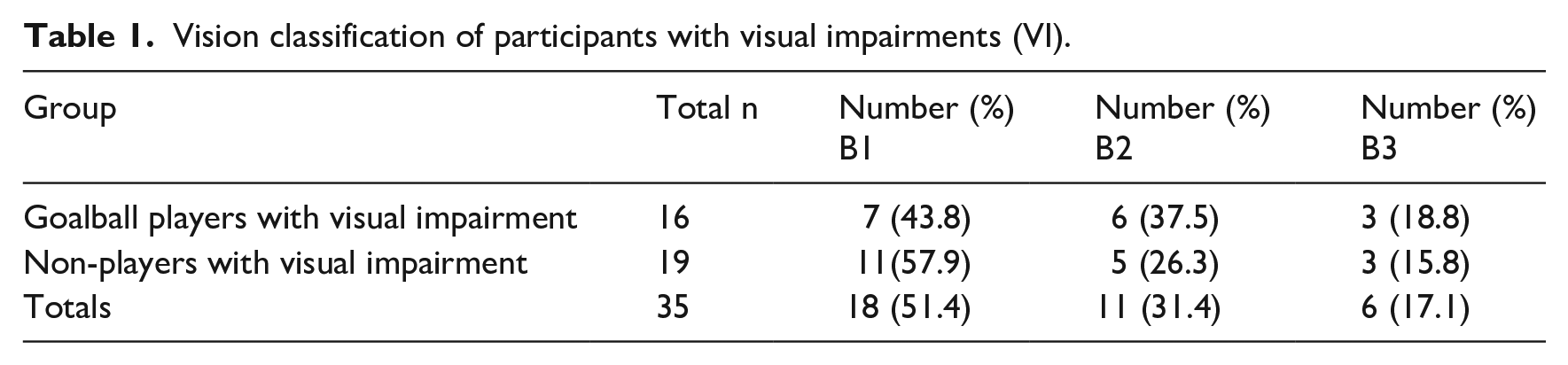
Sports classifications use B1 (no or some light perception up to light perception but an inability to recognize shape of the hand at any distance), B2 (ability to recognize the shape of the hand up to a visual acuity of 20/600 or a visual field of less than 5 degrees in the best eye), and B3 (visual acuity above 20/600 up to a visual acuity of 20/200 or a field less than 20 degrees but more than 5 degrees in the best eye) visual classifications (US Association of Blind Athletes, n.d.). The range of visual function varied for the individuals with visual impairment in the study with 51% (n = 18) being totally blind (B1 classification), 31% (n = 11) falling within a B2 classification, and 17% falling within the B3 classification. Table 1 shows the breakdown of vision level based on this classification system for the athlete and non-athlete groups.
Vision classification of participants with visual impairments (VI).
Procedure
An acoustics room 4 meters by 4 meters containing four speakers 15 cm by 15 cm was used for this study. All participants sat in a chair in the center of the room, facing the same direction. The speakers were on the floor placed around the individual (in front, behind, to the right, and to the left) at a distance of 1 meter from the subject (Zwiers et al., 2001). Figure 1 shows the layout of the room. Sound Frog, a sound meter software program, was used to produce sound frequencies of 2000, 3000, 4000, and 5000 Hz, with an intensity of 70 dB, that was broadcast to the different speakers. These sound selections were based on prior research (Andéol et al., 2013; Lewald, 2013; Mohammadi et al., 2019). While the procedure was not specifically validated, it was modeled after past published research using similar techniques.
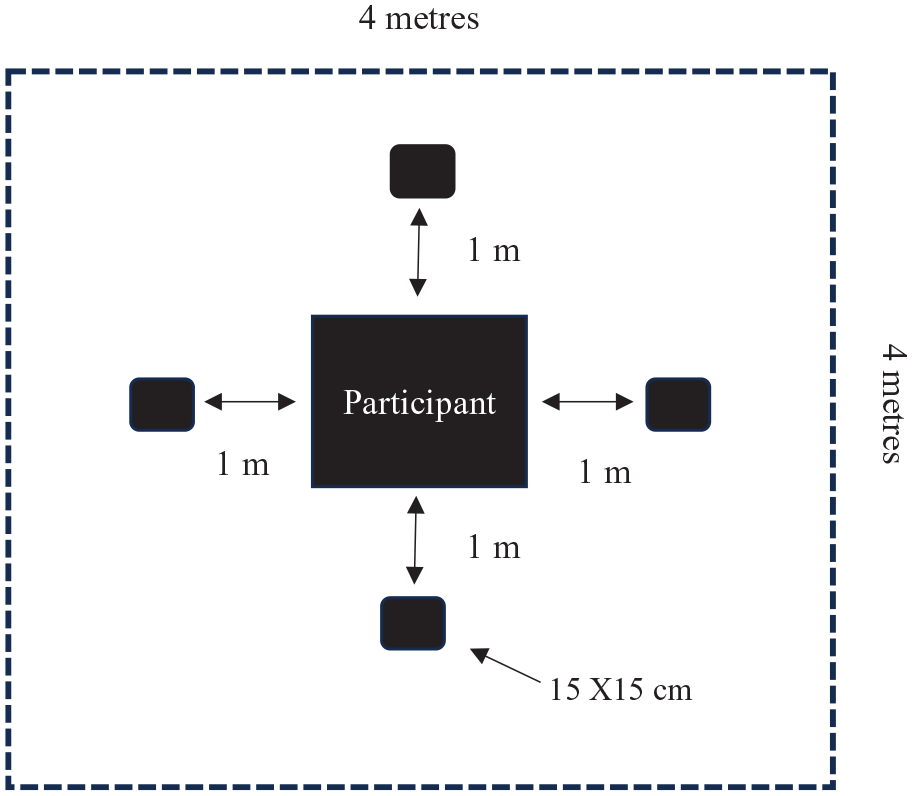
Layout of acoustics room for sound localization trials.
Once placed in the center of the room, the participant was asked to point in the direction from which they heard a sound played (i.e., right, left, in front, and behind) for each trial. All participants wore blindfolds for this study to ensure no vision or residual vision was being used to supplement auditory perception. Four sounds (i.e., car horn, ringtone, voice, sound of birds) under two conditions (noisy and noise-free) for each participant for a total of 16 trials. All participants were given the same order and sound type of trials. The researchers scored a trial as accurate if the participant directly pointed at the speaker from which the sound was broadcast.
Statistics
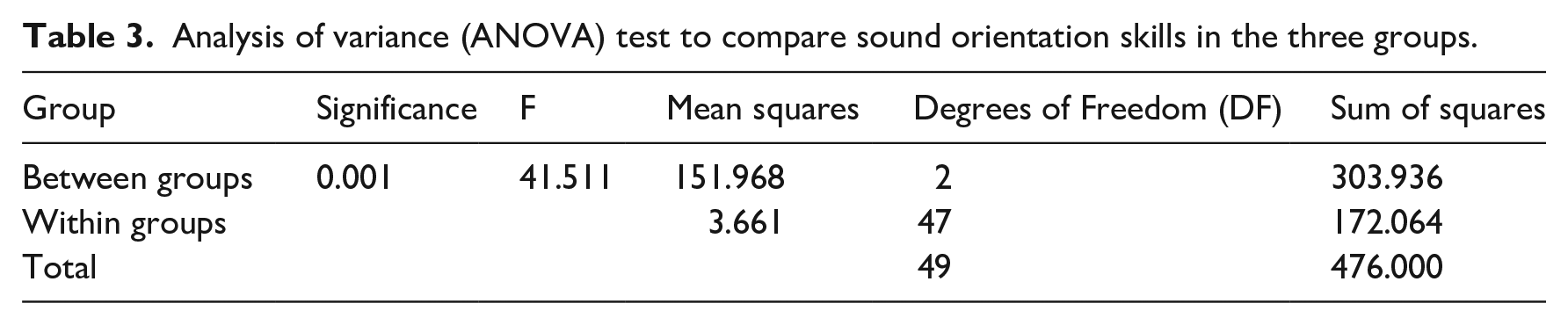
One-way analysis of variance (ANOVA) was used to assess differences in the sound localization skills among the three groups. Effect size was calculated using the omega-squared (ω2) statistic, considered to be less biased for small samples than the eta-squared statistic (Grace-Martin, 2011). Post hoc analyses were calculated using the Tukey Honestly Significant Difference (HSD) statistic.
Results
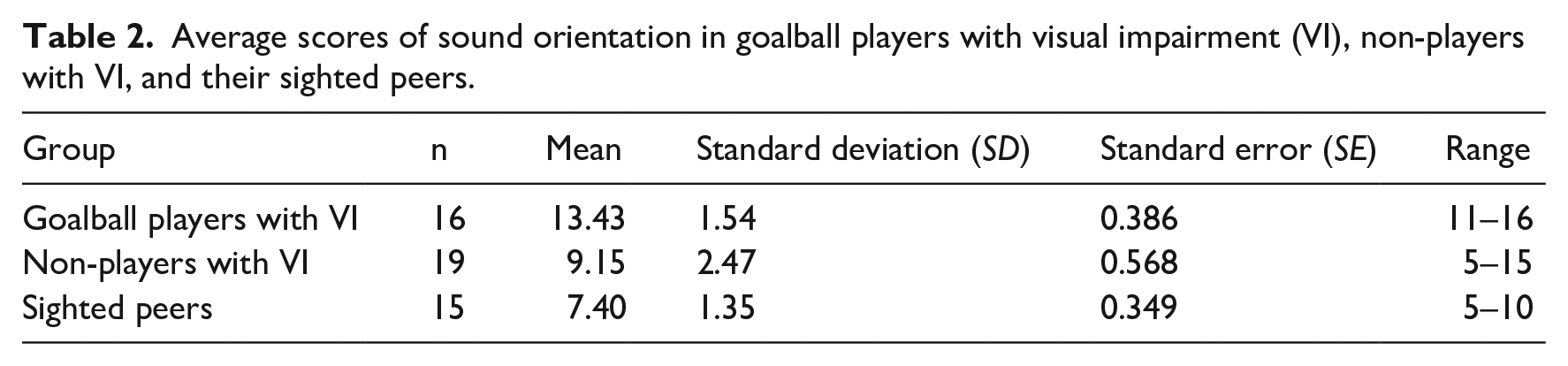
As indicated in Table 2, the average score (average trials correct out of 16) of sound orientation skills in goalball players with visual impairment was 13.43, with a standard deviation of 1.54. For non-goalball player students with visual impairment, the mean was 9.15, with a standard deviation of 2.47, and sighted peers averaged 7.40, with a standard dev of 1.35. Differences among the three groups were significant (p = .001). The percentage of correct responses for the goalball player group was 69%–100% (range 11–16 correct trials). For the non-player group with visual impairment, the percentage of correct responses ranged from 31 to 94 (range 5–15 correct trials). Sighted peers accurately indicated the direction of sound 31%–63% of the time (range 5–10 correct trials). Table 2 provides the descriptive statistics just reported, and Table 3 provides the results of the ANOVA. Levene’s test confirmed the homogeneity of variances (2.27; p = .116; degrees of freedom 2 and 47). The results indicated a large effect size (ω2 = .618)
Average scores of sound orientation in goalball players with visual impairment (VI), non-players with VI, and their sighted peers.
Analysis of variance (ANOVA) test to compare sound orientation skills in the three groups.
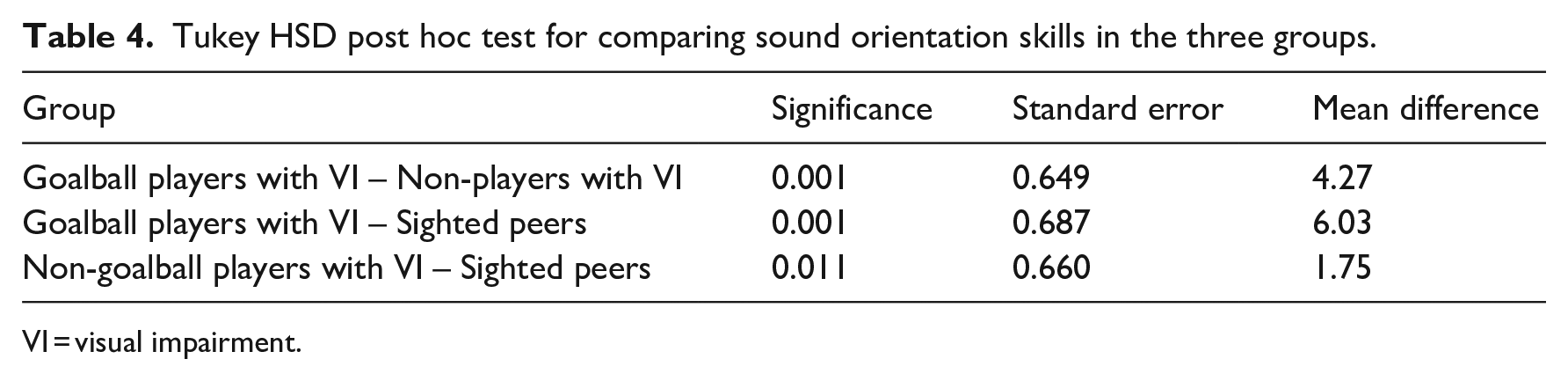
Tukey HSD post hoc analyses indicate that the goalball player group with visual impairment performed significantly better than the other two groups on the sound localization task. In addition, the non-player group with visual impairment performed significantly better than the sighted peer group. The mean difference between goalball players with visual impairment and non-players with visual impairment was 4.27 (p = .001), while the mean difference between goalball players with visual impairment and sighted peers was 6.03 (p = .001). Mean difference between non-players with visual impairment and sighted peers was 1.75 (p = .011). Table 4 shows the post hoc results.
Tukey HSD post hoc test for comparing sound orientation skills in the three groups.
VI = visual impairment.
Discussion
The initial findings illustrate that sound localization skills are different for goalball players as compared to non-players with visual impairment and sighted individuals; in other words, these findings corroborate past research with football players with visual impairment (e.g., Mieda et al., 2019; Velten et al., 2014, 2016). To explain these findings, it can be argued that in addition to the everyday needs of athletes regarding sound localization in order to perform their daily tasks (as would be similar for non-athlete individuals with visual impairments), athletes with visual impairments also use special techniques of audio information in sports for optimal performance. A bell is placed inside the ball in such sports as goalball so that when the ball is thrown, players can recognize the direction of the ball based on the sound it makes. This process must be done quickly and accurately so players can maintain their field positions and make the right decisions. Furthermore, given that in the process of a goalball game, precision, concentration and attention are required, such skills as sound localization can lead to more accuracy in the game and better performance than their peers.
The significant difference between sound localization in non-players with visual impairment and their sighted peers is also consistent with the findings of past research (Gougoux et al., 2005; Schenkman & Nilsson, 2010; Velten et al., 2014). This speaks to the necessity of sound localization skills for everyday tasks, probably being more important than for sighted individuals who also use vision to scan for the source of the sound. In addition, blindfolding the sighted individuals in the study sets up a situation that is not typical for them. Sighted people usually understand the field of space based on what they see and rely much less on their hearing, taste, smell, and haptic senses.
Vision, however, is not an important part of teaching sound localization. The sensory abilities of people with visual impairment improve not because of evolution and proliferation of sensory abilities or the existence of special abilities. Due to practice, individuals who are blind achieve more precision and accuracy in their other senses (Farzin & Sheibani, 2010). Therefore, the findings suggest that the engagement of students in sports such as goalball can provide not only access to recreation and leisure pursuits but also a means by which to enhance sound localization ability that can support other areas such as O&M. Future research could apply these and past research findings conducted in controlled situations (use of rooms with speakers) to the outdoor environment and compare how such sound localization differences influence O&M travel and street crossing abilities.
Limitations
Some possible limitations should be noted. Typical hearing ability was verified through records and services received but not through direct testing of hearing levels. Therefore, it is possible that some participants could have had an unknown mild hearing loss. In addition, while any student could choose to play goalball, it is possible that students with good auditory abilities would be more likely to self-select into or remain in the sport.
