




Abstract
Assistive Technologies (ATs) are extensively used and integrated into society, mainstream and specialist education settings, more so with students who have learning disabilities. Everyone has a perspective on the extent to which these devices provide students with disabilities and specifically in this case study, students with visual impairments (VI) independence during their education. This case study indicates the importance of researching emerging technologies within specialist education such as tablets, multiple forms of braille, and screen readers, while utilising a constructivist paradigm to undertake the mixed methods research. This study triangulates through the use of qualitative and quantitative research tools to discover mixed views on the extent to which AT promotes the independence of students with vision impairment, ultimately discovering the extent is somewhat individualised to each and every student. This study was conducted in an English, special-mainstream partnership further education college. Four students and five teaching staff members were interviewed, alongside five classroom observations of each staff member interviewed. The foci of this article are teacher and student perspectives on the extent to which ATs provide students with VIs independence in their learning, and if ATs play a crucial role in these students’ educations. The findings revealed largely positive views surrounding ATs potential for students with VI. The extent to which the students benefit from these advantages is dependent on the individual. The students focused much of their attention on their personal feelings towards using technology, whereas the teachers elaborated on their feelings and went into detail about particular students’ successes and pitfalls when using ATs. As technology is constantly changing, the participants expressed their concerns for keeping up to date. Recommendations for further research include a longitudinal study at the college where this research took place to discover whether partnership further education facilitates inclusion.
Introduction
Assistive Technology (AT) can be defined as, ‘items, devices, equipment, or products which may be commercially available, customised or adapted to help a person with a disability to function or to improve, maintain or increase their capacity to function’ (Asselin, 2014, p. 224). AT focuses on access and ease of use, to allow for inclusion, both in education and in everyday activities (Ahmad, 2015a). AT consists of both low-tech equipment for example; handheld magnifiers and large print text, and high-tech equipment including; magnification and recognition software such as Job Access With Speech.
The available AT hardware, software and devices is extensive and ranges from iPad apps to specialised educational technology hardware (Inclusive Technology, 2023). There have been great advances in technology in the last 20 years which has meant a wide range of ATs have been developed, not all of which have been rigorously explored to demonstrate their value (Higgins et al., 2012) which provides a rationale for the current research. The setting of this research was a specialist further education college which aims to move students towards independence and towards further education, located in a town in the East of England.
In July 2012, the government recognised the importance of AT for promoting independence (HM Government, 2012). AT is available to all students with visual impairments in educational settings however, it is important to highlight that no two students are the same (JISC, 2015). This research acknowledges this notion and how visual impairment captures a continuum whereby other individual needs can also occur. This research aimed to explore these differences and how one educational setting utilises such technologies to promote students’ independence. According to DePountis et al. (2015), the presence of technology in a classroom when teaching students with vision impairments is necessary, not optional. Thus, influencing the incorporation of ATs, enabling the facilitation of independence for students with vision impairments (Hakobyan et al., 2013).
Literature review
Inclusive education
Norwich’s (2008a, 2008b) dilemmas of difference, inclusion and disability highlight issues in where and how we support students including their identification of a basic dilemma of whether or not to recognise and respond to differences, as both cases pose some potential negative implications or risks associated with the denial of relevant and quality opportunities, stigma, rejection, and devaluation. Prior to Norwich’s examination on theoretical and empirical aspects about dilemmas of difference as they apply to education and specifically, disability, Berlak and Berlak (2012) drew out three sets of dilemmas, one being the broad control set and more specifically the distinct teacher versus child control which is useful in relation to understanding use of AT in schools. Students’ reasons for not wanting to use AT are different to those of their teachers; the reality is that students with visual impairments often do not want to appear different from peers thus, their perception of differences influences many students’ choices to not want to use AT (McIntosh, 2010).
Söderström and Ytterhus (2010) state that the use of Information Communications Technology (ICT) is thought to symbolise independence, belonging, and capability, yet the use of AT can be perceived as symbolising dependency, disparity, and restraint. Henceforth, ICT and ATs have intrinsically conflicting associations to one another and we cannot simply abide by the ideologies society already have regarding ICT when it comes to uncovering how we feel about ATs. It is believed by several researchers that young people with vision impairment refuse ATs wherever possible to conform as ‘normal’ young people (Edelmann, 1985; Gerber, 2003; Shinohara & Tenenberg, 2009). McIntosh also discovered many students’ issues and perceptions surrounding AT stem from the complications technology can introduce. If a student with a vision impairment has a lot of work to do they often feel technology does not actually speed up the process rather, it adds time and pressure (McIntosh, 2010). Contrasting to the above, AT is said to enable people with disabilities to be contributing members of society (Riemer-Reiss & Wacker, 2000). Phillips and Zhao (1993) credit ATs for allowing people with disabilities to achieve significant independence and functional ability. Scherer (2005) describes these devices as a means to equality between the capabilities of people with and without disabilities.
Current policy standpoint
Special educational needs policy law centralises the voice of the student in matters that concern their own lives. The Curriculum Framework for Children and Young People with Vision Impairment (CFVI; Hewett et al., 2023) was developed to provide young people 0–25 years of age with the knowledge to understand what their education is trying to achieve for them and crucially, for them to have a voice in this. The framework provides guidance on how students can access information and use technology, move about as independently as possible, interact confidently with others and have an understanding of their own potential. Furthermore, the Special Educational Needs and Disabilities Code of Practice (Department for Education & Department of Health, 2015) states that children have a right: to receive and impart information, to express an opinion and to have that opinion taken into account in any matters affecting them. The SEND Code of Practice recognises the UN International Rights of the Child (Article 12), where all children have a right to be part of decisions which influence their lives – to therefore be freely involved in making decisions regarding educational provision. Furthermore, the duty placed upon professionals to obtain these views and hence a variety of modes of communication should be utilised to do so (Department for Education & Department of Health, 2015). Therefore, it is imperative that individuals, including students with visual impairment, are supported to participate in discussions and share their views, for those views to be taken into account when planning and reviewing support, and for their goals and aspirations to be considered when agreeing desired outcomes.
Use of AT
Adoption and effectiveness of AT
Kelly (2008) believes we should provide students with visual impairment an appropriate level of autonomy and independence in their decisions as it has been found these two attributes are essential for health development. Fernández-Batanero et al. (2022) argue AT is a necessity for enhancing the learning of students with vision impairment, together with helping to progress their social, cognitive and emotional development. It is widely accepted that ATs make a positive contribution towards the social and educational lives of students with visual impairment (Cooper & Nichols, 2007; Strobel et al., 2006). AT ensures students have the ability to overcome major obstacles regarding autonomy and independence within their everyday lives due to the access to communication with sighted peers as well as ability to manage information efficiently (Harper et al., 2017). Wong and Cohen (2011) indicate AT as an enabler, ensuring students can participate in activities and learning targeted towards their age group. Although much of the literature highlighted so far suggests ATs have the ability to make a largely positive impact on learning, Kelly and Smith (2011) have identified a significant barrier concerning the notion that ATs tend to be developed more rapidly than researchers are able to evaluate them.
Much of the literature encourages the utilisation of AT to aid developing autonomy and participation (De Queiroz & Presumido Braccialli, 2017; Harper et al., 2017; McNicholl et al., 2020). In contrast, although research is in favour of the use of AT, studies have found that students with disabilities are not actually benefitting from the full potential of AT use in schools, communities, and home environments (Alammary et al., 2017; Byrd & León, 2017; Coleman et al., 2015; Copley & Ziviani, 2004; Ismaili & Ibrahimi, 2017; Johnstone et al., 2009). The specific shortcomings they identified related to; the preparation and awareness of educational professionals, integration of ATs in educational settings, issues surrounding inadequate training and support for parents of students with disabilities, and concern around the lack of collaboration and co-operation between researchers, families, teachers and technology providers (Alper & Raharinirina, 2006). Kelly (2009) supports this finding through her own study which found an estimation between 59% and 71% of students with visual impairment who had the capability to benefit from AT did not have the opportunity to use it. The issue surrounding this may be due to the lack of research being conducted on the use of AT in practice (Okolo & Diedrich, 2014). Quinn et al. (2009) develop this notion suggesting research on AT for students with disabilities is generally narrowly concentrated on primary-aged students only.
AT usage facilitates reasonable adjustments for students with vision impairment, giving them access to the same information as their sighted peers (Fernández-Batanero et al., 2022). Gasparetto et al. (2001) elaborate, stating that with access to the Internet and a computer, students with visual impairment have the ability to communicate with other settings including schools, colleges, libraries, databases, not to mention future employment opportunities.
Stanfa and Johnson (2015) point out how students with visual impairment often have trouble reading and writing. This is sometimes addressed with magnifiers, however, even these optical aids frequently fail to adequately help. Furthermore, some students would most likely benefit significantly from AT resources, which can include speech synthesisers and screen readers (Bin Tuwaym & Berry, 2018). The National Council of Teachers of English (NCTE) (2019), developed a list of 21st-century literacies that all 21st-century readers and writers must be able to do; one significant requirement ensures they can develop proficiency with the tools of technology. For students with vision impairment, as Presley and D’Andrea (2009) discovered, this proficiency can be facilitated through the vast array of specialist devices and software, known as AT.
Studies have shown students who would benefit from the utilisation of ATs often do not have access to them (Alammary et al., 2017; Byrd & León, 2017; Coleman et al., 2015; Copley & Ziviani, 2004; Ismaili & Ibrahimi, 2017; Johnstone et al., 2009; Kelly, 2009; World Health Organization & United Nations Children’s Fund, 2022). It has been found that this is due to the lack of skills and knowledge educators have in being able to select the most appropriate tool to meet the needs of their students (Jones & Hinesmon-Matthews, 2014; Malcolm & Roll, 2017; Yankova, 2019).
While some explanations for technology non-use are predictable, for example, the high cost of specialised assistive devices or lack of adequate supports or lack of funding (Atanga et al., 2020; McNicholl et al., 2020), other reasons would benefit from further exploration. Brady et al. (2014) conducted a study which uncovered valuable insights about non-use of ATs by people with visual impairment. One significant drawback they had not expected was the lack of knowledge of accessible options. Furthermore, they indicated a need for increasing the spread of information about screen readers with the hope of assisting individuals to avoid purchasing devices which may be incompatible with current screen readers, or broaden the scope of available options if they knew about accessible touch screen devices.
Teacher understanding of AT
Teachers have a primary role in promoting the use of ATs, therefore, to achieve inclusion of students with disabilities, teacher need to acquire the necessary skills and competences (Ahmed, 2020; Arori et al., 2020; De Sousa, 2014; Roque et al., 2018). However, significant barriers can hinder the use of assistive technologies by visually impaired students (Zhou et al., 2011). Lack of knowledge about and skills in using assistive technologies from teachers of students with visual impairments is a contributor (Byrd and León, 2017; Coleman et al., 2015; Lee & Vega, 2005). This means that many educators lack confidence and therefore are reluctant to teach assistive technology to students with visual impairments (Zhou et al., 2011). The personal opinions of teachers can also affect the extent to which students use assistive technology. For instance, some perceive it as a tool that leads students to success, and others are convinced it labels students, which can cause emotional harm and make students dependent on teachers to support them (Ahmed, 2020; Edyburn, 2006). In addition, most assistive technologies are inaccessible due to cost (Al-Tayar et al., 2019; Atanga et al., 2020; Cote, 2021; MacDonald & Clayton, 2013; McNicholl et al., 2020). It has been argued by those who adopt a medical approach to disability that well-designed assistive technologies help increase social inclusion and autonomy because of their ability to remove barriers to inclusion (Owuor et al., 2018; O’Brolchain, 2018). Yet, there is still an issue with accessibility, whereby some people do not have access due to funding, lack of training, or insufficient assessment (Ahmed, 2020). Moreover, even those with access to technology are often still socially marginalised and experience stigma (Owuor et al., 2018).
Alongside the problems of AT competency and usage is the need to understand how preservice and in-service educators feel regarding their own skill levels and knowledge of ATs (Ajuwon et al., 2016). In answer to this, Zhou et al. (2012) and Zhou et al. (2011) conducted two studies consisting of online questionnaires aimed at identifying teachers’ perceptions of their familiarity with ATs. Both studies revealed over 50% of participants claiming they lack confidence when instructing students with visual impairment on the use of ATs. No matter how aware professionals are of the importance of using ATs, it is simply not enough, and they must go beyond knowing to become familiar with and know how to use ATs effectively.
Generic AT solutions might not work for all students, due to considerations of the individual needs of each student, and their level of impairment (Ahmad, 2015a). Ahmad (2015b) and Praisner (2003) elaborate stating if we acknowledge the ‘differential abilities’ of all learners with disabilities, the education of all children with Special Educational Needs and Disabilities shifts into a shared responsibility between the different stakeholders involved.
Mack et al. (1990) conducted a study which highlighted the importance for teacher training programmes to train educators in the necessary motivations and skills, to ensure the bridge between technology and students continues to close. Yet, Parker et al. (1990) identified through their study how educators of students with visual impairment had little to no knowledge surrounding certain areas of AT. As a result of these studies, a further four studies were conducted, with a recurring theme surrounding the notion that educators are not appropriately prepared to utilise AT and therefore, unable to teach students with visual impairments how to use it (Abner & Lahm, 2002; Candela, 2003; Edwards & Lewis, 1998). In turn, Smith and Kelley (2007) indicate the importance of developing professional competencies for the correct use of ATs.
Kelly (2009) highlighted that the challenges educators may encounter could be due to the variety of media they are expected to utilise and the lack of training students have in using AT effectively. Much of the literature suggests teachers of students with vision impairments understand the importance of AT for their students’ education. However, they often do not acquire the knowledge necessary to use such technology to its full potential, thus, lacking competency when integrating AT in their instruction and teaching (Abner & Lahm, 2002; Corn & Wall, 2002; Zhou et al., 2012). Smith and Kelley (2007) and Lee and Vega (2005) suggest the low use of technology and lack of knowledge of such technology in teachers can often be attributed to insufficient training in the field. Corn and Wall (2002) support this explanation through their finding of how teachers of students prefer using technology designed for people without disabilities or ‘general technology’ in their lessons, due to feeling more competent with general technology over AT and not because they feel general technology is more appropriate for students with visual impairment.
The aim of this study was to examine the extent to which AT maximises independence for learners with vision impairment. The researcher developed two objectives and three specific research questions.
Objective 1: Discovering visually impaired student’s perceptions of using assistive technologies to promote their independence. The research question is as follows:
1. Do visually impaired students feel more independent when utilising assistive technologies in their learning?
Objective 2: Exploring professionals’ opinions on the use of assistive technology in specialist settings for visually impaired students. The research question is as follows:
2. To what extent do professionals feel visually impaired students become more independent when using assistive technologies in their learning?
A third research question was developed to bring both objectives together and provide further scope on the topic:
3. Are visually impaired students given appropriate, effective, and useful assistive technologies in their educations to promote independence?
Methodology
Research approach
The researcher used a constructivist paradigm for this study which utilised both qualitative and quantitative methods of research, thus maximising the data collection for the exploration of the extent to which ATs promote independence for students with visual impairments. Gorard and Smith (2006) explain how quantitative or qualitative can only truly represent one, often useless classification of methods. Furthermore, mixed methods research is becoming a more preferred approach among researchers (Gorard and Smith, 2006; Gorard & Taylor, 2004; Tashakkori & Teddlie, 2010). Pragmatism offers a different worldview to that of constructivism, positive and post positivism whereby it focuses on the consequences of the researcher as well as the problem that needs to be researched (Brewer & Hunter, 1989; Creswell & Plano Clark, 2017; Miller, 2006). This notion fits best within the topic of this study as the aim is to gain an understanding of what students and staff believe AT can do for independence, while hoping to come to conclusions about what problems the participants encounter and furthermore, what could or should be done to resolve said problems.
Case study
Yin (1984) outlines the case study research method, as an empirical inquiry that investigates a contemporary phenomenon within its real-life context; when the boundaries between phenomenon and context are not clearly evident; and in which multiple sources of evidence are used. (p. 23)
According to Gulsecen and Kubat (2006), the case study strategy is the most appropriate when a study is based around education. Second, case studies ensure detailed investigations can take place within a single organisation, in this case, the single organisation is a specialist college for student between the ages of 16 and 24 (Gay et al., 2009). In addition, Zainal (2007) explains how the variations in intrinsic, collective, and instrumental approaches to the case study method contribute towards the appropriate usage of both quantitative and qualitative analysis of data.
Methods
The researcher conducted five semi-structured face-to-face interviews with five teaching staff members alongside four semi-structured face-to-face interviews with four students at the same setting. Each interview was audio-taped to ensure all answers could be analysed effectively. The recorded interviews were transcribed immediately post interview. This provided the most accurate database for analysis (Opdenakker, 2006). The interviews incorporated open-ended questions, which was a deliberate choice to allow for free-flowing conversation whereby the researcher hoped the participants would elaborate on their feelings of independence and ATs.
The researcher devised an interview schedule which consisted of a host of issues formatted into questions, of which the researcher desired to cover to best answer the research questions. These questions were formulated to allow for follow-up questions and occasionally, probes. The researcher made use of verbal encouragement when particular aspects of the participants’ answers were significantly beneficial to the answering of the research questions.
Deem (2001) and Angen (2000) identify how even if we are understanding of the value of qualitative empirical research and case studies, methodological perspectives can still be critical of these methods of research. Diefenbach (2008) sees major flaws in qualitative semi-structured interviews stemming from the influence of the researcher on the research design, the reliability and sufficiency of the sources of information, internal validity, limits of theories, and the selection and grouping of participants of investigation. The aforementioned issues pose serious questions about the scientific value of qualitative empirical research, which influenced the decision to incorporate quantitative observation alongside semi-structured interviews.
During the observations, it was appropriate at times for the researcher to become part of the lessons which was justified by the participants’ desire for the researcher to become involved. This meant the researcher talked to students and in some cases joined in on activities, while watching the lesson, notetaking and reading necessary documents to enable the researcher to fully understand the situation. However, DeWalt and DeWalt (2002) identify a significant drawback of participant observation whereby it is conducted by a biased human who operates as the instrument for data collection. Therefore, the rationale for including both participant and non-participant observation was that the latter meant the researcher could employ explicitly formulated rules for the recording of behaviour (Bryman, 2010). Furthermore, a noteworthy advantage of non-participant observation is how it is a relatively unobtrusive research strategy for gathering data about an aspect of the social world without interacting directly with participants (Williams, 2008). For the non-participant observation, the researcher was co-present with research participants in a naturalistic setting.
To ensure the researcher could gain data surrounding the extent to which students are given appropriate, effective, and useful ATs in their education to promote independence, observations were the most appropriate method. The researcher made use of observations charts to record specific data, which was later measured through content analysis. The observations in this study were both quantitative and qualitative and they were recorded using a template created by the researcher.
Procedure and sampling
The data collection procedure for this study addressed the research questions through semi-structured interviews with four students with vision impairment, backed up by five interviews of the same nature with teaching staff and five corresponding observations of their practice.
This study utilised purposive sampling; to focus on specific research questions, to enable comparisons, to achieve representativeness, and to provide greater depth to the study than probability sampling could (Teddlie & Yu, 2007). The use of purposive sampling in this study meant all student participants were regular AT users, both in the setting and in their free time. As Lunenburg and Irby (2008) indicate, the use of purposive sampling ensures the researcher and study can investigate a specialised population. Therefore, guaranteeing the participant’s similar levels of knowledge surrounding the subject of ATs.
Figure 1 shows the triangulation method, whereby the two qualitative research strategies (unstructured observation and semi-structured interviews) are validated with that of the quantitative research strategy (structured observation; see Appendix 1 for the observation template).
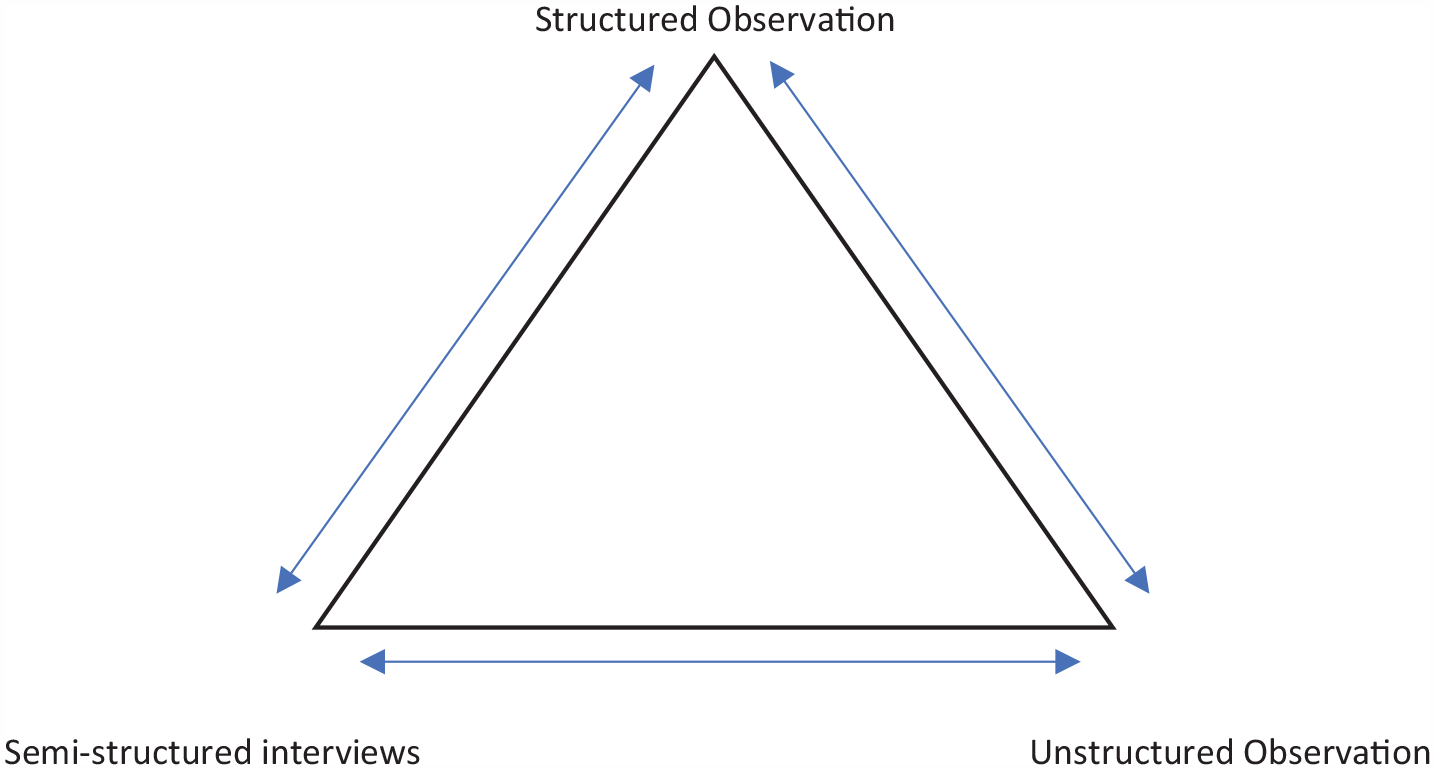
Triangulation of methods.
Crescent College is unique in its specialist-mainstream nature, and its overall aim is to provide further education to disabled students. Therefore, because of the unique nature of the college, it is not appropriate to provide more detail as only a small number of colleges in England operate in this way, meaning the college could be easily identifiable if I disclosed any further detail.
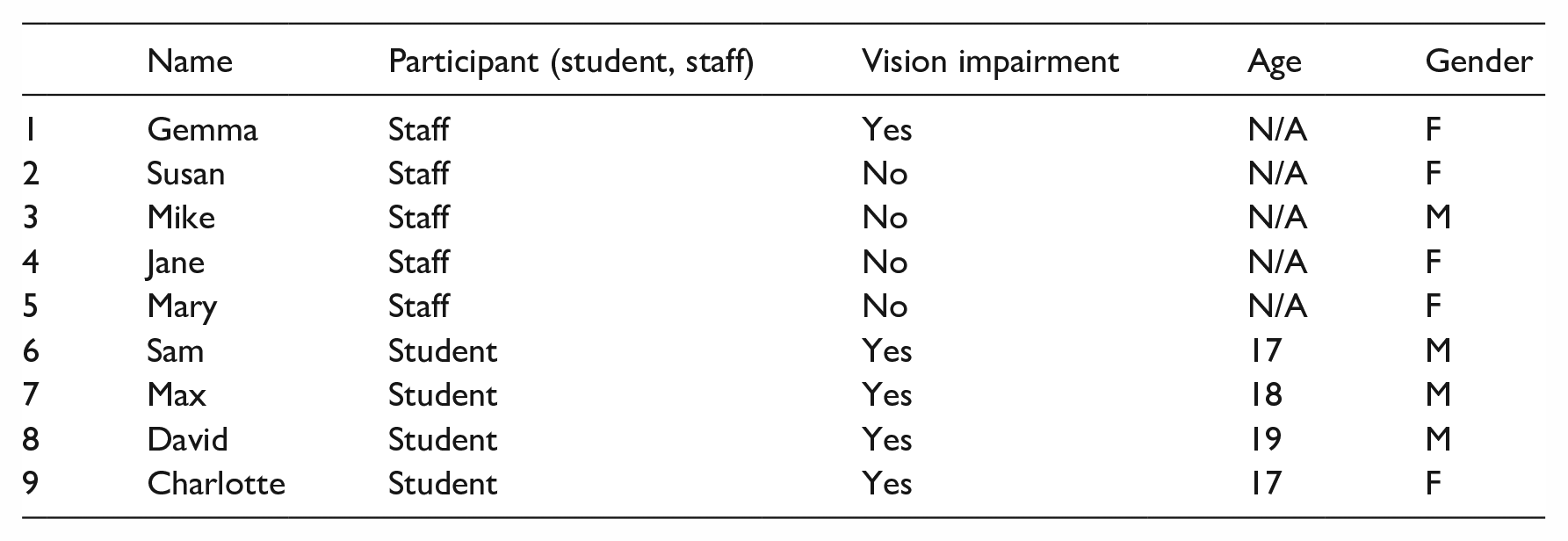
The following table details the characteristics of the participants. The inclusion and exclusion criteria were as follows; students had to have a formal diagnosis of visual impairment, be a student at the college and be willing to share their experiences. Staff had to be working with the student participants and be willing to share their experiences.
Findings
All the participants in this study use ATs, however, the extent to which differed and in turn the extent to which ATs maximised their learning was variable. Out of the four student participants, two enjoyed using AT for their learning and two showed more dissatisfaction and resistance to use AT. When asked whether they enjoyed using technology one student described her dislike for all technology had stemmed from her experience in accessing AT at her previous secondary school: having the access to an accessible laptop was good however, it meant having to collect it from the IT department if I wanted to use it in lessons which was time consuming so the tutors tended to just put me on the normal computer which I struggled with. (Charlotte, student)
Her reasoning for the dislike stems from the complications in accessing technology, suggesting it can sometimes hinder independence rather than maximise it since she found herself asking for more help than she wished. Whereas since she had begun college at Crescent College, Charlotte and the other student participants had not experienced any unwillingness to AT adoption from staff members.
Observations demonstrated that students were using BrailleNote devices, iPads, and Microsoft computers for college work, some had JAWS screen reading software on these computers, these data were obtained at point 9 on the observation chart (see Appendix 1). For personal use, students were observed mostly using iPads and general mobile phones with their inbuilt accessibility functions and some specialised apps designed to support people with vision impairments.
While AT was found to maximise students learning in different ways, the cost aspect of ATs was discussed as a significant barrier in the sense that technologies for people with VIs are very cost prohibitive and if you are not lucky enough to get it within your education you have to fund it yourself. (Jane, Staff)
Crescent college provides students with access to a range of ATs and Jane’s point regarding education funding ATs was triangulated through the observational data; for example all staff were observed meeting point 1 ‘the tutor incorporates the use of AT at the beginning of the lesson and throughout’ of the quantitative observation chart (see Appendix 1). Students were observed using different tablets such as iPads, they also had access to various computers and laptops, BrailleNote, many different assistive applications and screen reading software, and traditional Braille. Furthermore, staff told how they were always searching for funding and new technologies to incorporate into the college.
The cost of ATs was an agreed barrier across all of the staff interviewees, with a statistic of around 3500 pounds highlighted for a BrailleNote device. However, as observed in this research, when students attend a specialist setting, they were able to freely access expensive technologies like the BrailleNote. Therefore, expensive ATs maximised students learning experiences during their time at Crescent College.
Pressure and use of AT by students
When asked if students felt pressured to use ATs, some felt none at all due to enjoying using technology whereas others, who did not have the same enjoyment from technology felt pressure. For example, one student stated, sometimes [feel pressure] in educational situations when staff want me to test or start using an AT device that I don’t want to, especially if it would draw attention to me in public. (David, student)
Control is significant here as students emphasised their desires to have choice and control over the ATs they do or do not utilise. Another student expressed, I do feel pressure, I probably still would not use technology if I hadn’t been influenced by people around me. (Charlotte, student)
All staff interviewees expressed how they acknowledge most of their students as being driven towards being independent in their learning, however one staff participant detailed how he witnessed some students pressurising themselves because of their own feelings to fit in with their peers. For example, I was with a student in the neighbouring mainstream college and the student didn’t want me to sit with them and wanted instead to use their assistive laptop. This is a classic example of how students don’t want to stand out as different and want to appear independent, which AT can facilitate. (Mike, staff)
The student in this scenario exercised control over their learning experience and the use of AT enabled them to do so, thus, assistive laptops can be viewed as an AT which enables students to experience maximised learning.
However, another observation revealed the way a student pressurised themself within the specialist college, for example, Charlotte had previously had a negative experience using JAWS software on a college computer whereby it has caused her to make an error in her work. In turn, she was unwilling to use JAWS and instead opted for a handheld magnifier that she struggled with due to her level of vision. This then hindered her independence as she often needed to ask for support from the teacher. As such, JAWS software can be seen here as a form of AT that does not always support students in maximising their learning.
Independence and individualised AT
In all observed instances, AT was incorporated throughout the lessons and this was reflected by ticks against points 1 and 2 of the observation chart (Appendix 1) depending on the nature of the lesson. Each participant responded positively when asked ‘Do you feel like technology opens doors to your independence?’. For example, one student simply replied ‘sometimes’ and explained how it allows her to be more independent at college once she got the hang of it. Two other students gave descriptions on how it heightens their independence in all aspects of life, for instance, I can do pretty much all of my work independently now thanks to my Braille Note and the accessible apps they’ve taught me to use on my phone. (Sam, student) technology allows me to be able to do my own research without help (David, student)
All student participants acknowledged how they did not realise the possibilities AT could really offer until they began attending the partnership college. For example, BrailleNotes were provided to students with vision impairments but additionally, they were taught to use applications on their phones and tablets that enabled to function independently. Seeing artificial intelligence (AI) is an app which students particularly favoured as it reads food labels and instructions on packaging, in turn, enabling them to learn to function independently when completing household chores. Crescent College places importance on teaching students with visual impairments to learn to complete typical day-to-day activities like cooking and cleaning independently, to foster a learning experience which will support them post-college life.
Similarly, in more formal lessons, quantitative observations showed all staff members acknowledging their students’ preferences when using ATs by allowing their students to adapt technology to their learning as they wish. This observation was important as the participants all emphasised their understanding of students’ preferences and the notion all students learning is very individualised. They note that just because one student works well with a certain AT does not mean all students will find that AT the most effective for their learning. However, acknowledging students’ preferences and actually creating a differentiated environment are entirely separate concepts. Staff clearly created a learning environment based around meeting the needs of diverse learners. For example, in one arts and crafts lesson whereby students needed to work together in groups, the teacher was observed providing a student who was nonverbal with an iPad which enabled the student to communicate with their group and therefore participate in the lesson.
AT does allow students with visual impairments to learn more independently than without, however staff emphasised that this can be the case once students have learned how to use the technology properly. Staff expressed how a substantial amount of students have other conditions that go alongside their sight loss which can make learning the technology very difficult, therefore meaning their independence could be hindered if it is not taught appropriately. This demonstrates sensitivity and insight around the individuality of each student. A quote from a staff interview illuminates this finding: two students have the same conditions they can often work entirely differently to one another, so she prefers to get to know the student and their likes and dislikes before advising them on what AT would be best for them. (Gemma, staff)
Similarly, another staff member indicated a similar response, stating how it all comes down to the student finding their preferred way of learning which can take time and patience, however worthwhile in the long run. Ultimately, the decision is the students to make and the teaching staff are clearly all strong advocates of this.
Discussion
The first key theme of this article surrounds the extent to which AT maximises learning for students with vision impairments. The findings demonstrate that AT does maximise learning for the students involved in this study and that this is influenced by the nature of Crescent College being specialist-mainstream partnership and as a result, having highly skilled staff members to support the successful learning of ATs. As such, Crescent College supports the findings of Fernández-Batanero et al. (2022) in that they view AT as a necessity for enhancing the learning of students with vision impairments and incorporate AT in the everyday life of students.
The second key theme which emerged from the findings of this study was independence and individualised AT, which is consistent with the findings from other studies both relating to students with disabilities including those with vision impairments (Harper et al., 2017; McNicholl et al., 2020; De Queiroz & Presumido Braccialli, 2017). As discussed in the literature, AT is important in today’s society for students with vision impairment in providing equality of access in their education, as it provides several ways of completing their work as well as offering them increased independence, when performing tasks they previously could not accomplish (Roberts et al., 2008). Students highlighted their surprise at the possibilities AT could offer them and that this was only realised once they arrived at the partnership college. This can be linked with Norwich’s dilemmas of difference as it shows how recognition of differences by staff within Crescent College positively reflect the acknowledgement of individual needs and interests (Norwich, 2008a).
While this article emphasised an overall positive response to ATs promoting independence, an important barrier was discovered as a result of the specialised nature of ATs. McIntosh (2010) argued the reality students with vision impairments face for not wanting to stand out or appear different from peers. The ideas presented by Söderström and Ytterhus (2010) stating the use of ICT is thought to symbolise independence, belonging, and capability, yet the use of AT has been decided as symbolising dependency, disparity, and restraint, are backed up by the undesired feelings of reliance and inequality expressed by the student participants in this study.
Staff implied that ATs need to be more widespread and embedded into society to break down socially constructed barriers relating to AT usage. While the literature highlighted the challenges educators can encounter may be due to the variety of technology they are expected to utilise (Jones & Hinesmon-Matthews, 2014; Malcolm & Roll, 2017; Yankova, 2019) together with the lack of training students with visual impairment received due to not having access (Alammary et al., 2017; Byrd & León, 2017; Coleman et al., 2015; Copley & Ziviani, 2004; Ismaili & Ibrahimi, 2017; Johnstone et al., 2009; Kelly, 2009; World Health Organization & United Nations Children’s Fund, 2022), the findings presented in this article highlight that a setting of a specialist-mainstream nature is well equipped in terms of staff ability to teach students to use AT. Therefore, tackling the lack of training students with visual impairments receive. It is important to note that this is only observed at a further education level and work should be done to embed this practice into earlier learning environments.
While it can be seen from the findings of this study the students within this setting are given the opportunity to access and use ATs, it is important to highlight this is based on the ATs this setting is able to access. A key barrier was found to be cost of ATs and participants emphasised this despite the study focusing on whether or not AT maximises student learning and independence. Likewise, the literature drew attention to cost as a predictable, yet very worthy explanation as to why many students, staff, parents, and settings do not use ATs to their greatest potential (Bigham et al., 2008). Thus, demonstrating that cost is a fundamental issue and concern for students with visual impairments and teaching staff.
Conclusion and recommendations
The researchers conclude the extent of independence ATs bring to students with vision impairment is largely beneficial, while being highly dependent on the individual student. This conclusion is reflected throughout the research methods whereby the participants drew upon this notion and the researcher witnessed an individualised approach to use of ATs throughout all observations. The researcher witnessed students having choice over their own learning through ATs which was indicated in the literature as students being provided with an appropriate level of independence and autonomy, when making decisions regarding their preferred way of learning (Kelly, 2008).
While all teaching staff presented positive discussion when asked questions concerning their feelings towards students’ independence when using ATs, it was implied ATs need to be more widespread and embedded into society. Furthermore, societal stigma with ATs was often noted by the participants as one of the major reasons for AT not maximising student learning and independence.
Further research needs to be undertaken during different time periods and in different settings to ensure the findings from this study correlate with those of other settings, therefore allowing the findings to be applied to a larger population, using different types of settings and in different geographical areas. This study highlights the extent of which AT maximises learning and independence for students with vision impairment as being largely positive, however it is individualised to each student. Recommendations for a more longitudinal study and larger sample size in the college where this research was undertaken to substantiate and validate the findings from this case study.
