




Abstract
The purpose of this study was to explore the availability, awareness, and utilization of assistive technologies among students with visual impairment (SVIs) in higher education institutions in Ethiopia by taking one of the oldest universities in the country as a case. To this end, the study employed instrumental case study design. Five undergraduate SVIs, two special needs educators, an AT service-delivery facilitator, and the resource center coordinator were purposively selected from Haramaya University. Data were collected using semi-structured interviews and an observation checklist. The collected data were analyzed by using thematic analysis method and three overarching themes were generated inductively: knowledge and understanding about assistive technologies, availability and access to assistive technology devices and services, and utilization and management of assistive technologies. The study findings show that a lack of awareness among SVIs, instructors, and practitioners in the field; an improper organizational arrangement that dichotomize and diverge student disability services provision from trained professionals in the area; and the absence of policies and guidelines for managing assistive technologies had a negative impact on the availability and utilization of assistive technologies in the University. Thus, it is recommend that the University management, special needs educators, and other concerned stakeholders devise a means to equitably avail assistive technology devices and services for SVIs in the University accompanied by a planned training on its utilization and a coordinated management for sustainability of service delivery.
Keywords
Introduction
The global survey of visual impairment (Pascolini & Mariotti, 2012) estimates the number of people with visual impairment worldwide at slightly more than 285 million. Among them, 39 million are blind and 246 million have low vision primarily due to refractive errors (43%) and cataracts (33%). Providing independence and facilitating social connections through assistive technologies are likely to make a significant difference in the lives of people with visual impairment (Gray et al., 2011).
Assistive technology (AT) is an umbrella term which consists of AT devices and AT services. In the education context, AT devices are equipment, materials, or products made locally; adapted from an existing product or attained commercially; and used to improve the academic limitations of a student with disability, whereas AT services are those services delivered to help a student with disability in the attainment, assortment, and manipulation of AT devices (Bugaj & Norton-Darr, 2010). This service may include needs assessment, selection, and scheming, fitting, modifying, adapting, applying, retaining, restoring, and technical assistance for a student with a disability. In views of students with visual impairment (SVIs), ATs are taken as a rare extension of their body that enhances and encompasses their academic performance, interaction, and communication (Bhatt & Guesgen, 2012; Winance, 2006). Proper ATs support an SVI to timely access valuable information and efficiently accomplish tasks heading to autonomous achievement (Alkahatani, 2013).
Based on its availability, cost, maintenance, and ease of use, ATs of SVIs can be positioned on a continuum of complexity (Adésínà, 2015; Robitaille, 2010). At the outset of the continuum are low-tech devices which are easily available, inexpensive, and do not consume batteries or electricity. Simple ATs like pencil grips, slate and stylus, typewriters, and manual Perkin’s Braille are low-tech devices. On the other extreme of the continuum are high-tech devices which are computer-based, expensive, and need expertise assistance to manipulate. These high-tech ATs include screen readers, Microsoft Job Access with Speech (JAWS), VoiceOver, TalkBack, Narrator, magnifying devices, Closed-Circuit Television (CCTV), Non-Visual Desktop Access, Braille note touch and the like.
A research done in Tanzania by Kisanga and Kisanga (2022) underscores the benefits of ATs for SVIs in cultivating reading and writing, scaling up comprehension and reading speed, augmenting accessibility of electronic materials and audiobooks, reducing overdependence on sighted students, improving accessibility of educational materials, escalating trustworthiness of students’ work, and improving students’ interactions. This study corroborates with Robitalle’s (2010) work which emphasizes the benefits of assistive technologies (ATS) as outlined hereunder: Assistive technology is a life- changer. It can help individuals with disabilities increase their independence, build their self- confidence and self- esteem, improve their quality of life, and break down barriers to education and employment. The real challenge, of course, is finding the right devices and gadgets, for the right purpose, at the right price.
1
Therefore, in line with the above idea, sound integration of ATs in the classroom instruction requires not only accessing the devices to students, but it deserves instructors’ readiness to equip students with effective use of the device, facilitating ease of manipulation in the classroom, need for accessories, and designing efficient method to evaluate the impact of the device on students’ learning outcome. Universal design for learning strategy that reduces learning barriers of all students by moving beyond the “one-size-fits-all” should underpin mainstream AT to help facilitate learning for SVIs in inclusive classroom (Messinger-Willman & Marino, 2010).
Worldwide, more than 10 billion people with disabilities depend on one or more of these assistive technologies to function in their daily lives, but only 10% are able to benefit from them (WHO, 2016). People with disabilities in low-income countries in particular cannot afford to have access to ATs due to lack of knowledge about ATs, lack of clear policies, inaccessibility, limited resources, professional incapacity, unclear procedure, or leaders delegating AT provision to nongovernmental and charitable organizations (Sayers, 2006; WHO, 2019). Ethiopia has 1.2 million persons with severely sight impaired, according to the Federal Ministry of Health’s nationwide assessment on severely sight impaired, low vision, and trachoma (Berhane et al., 2006). Individuals with visual impairment in the country are often overlooked because their counter sighted individuals perceived their performing capacity in a suspicious manner. But in practice, individuals with visual impairment are capable to execute any task when supported by assistive technologies. Despite the rapid improvement of ATs, Ethiopian HEIs, like their counterparts in other underdeveloped countries, lag behind in providing modern ATs to their visually impaired students.
Few previous researchers, such as Yohannes (2015), conducted research focusing on curriculum inclusion in two Ethiopian public HEIs. But there has been no research conducted yet on the availability, awareness, and use of AT among SVIs at Ethiopian HEIs. As a result, further research in this area is needed to find possible technological means by which visually impaired students access the mainstream curriculum in the same way that their sighted peers do. In Ethiopia, Haramaya University is among the senior universities selected for enrolling students with a variety of disabilities for inclusion. In Haramaya University, there are more SVIs (28) than students with other types of disabilities such as physical and auditory impairment, which amount to 14 in total. Thus, the researchers take the initiative to explore the availability, awareness, and use of assistive technologies (ATs) among SVIs at Haramaya University in Ethiopia.
Figure 1 depicts the links among variables that are under investigation for accessing, obtaining, and using ATs.
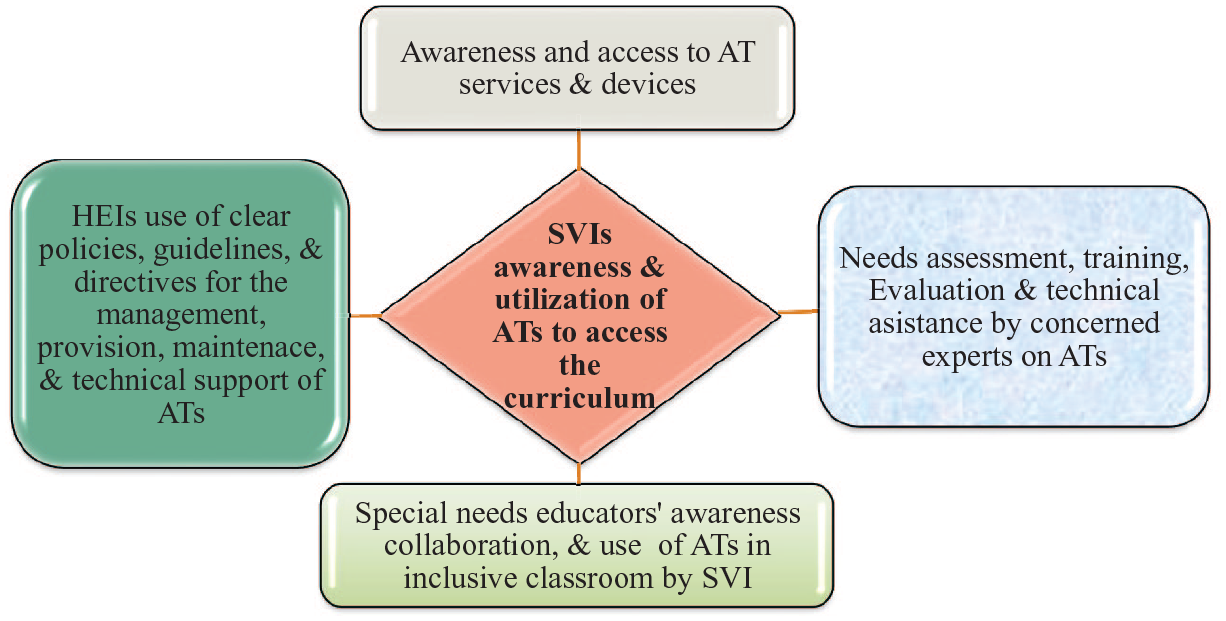
Conceptual framework depicting interrelationships among the study variables.
As depicted in Figure 1, the coordinated activity among the management, resource center personnel, special educators, concerned expertise, and SVIs results in the utilization of AT device and service provision in higher education institutions (HEIs).
ATs are the means to improve the academic achievement of SVIs by strengthening task accomplishment autonomy and facilitating social cohesion (Cowan et al., 2012; Hilda, 2018; Robitalle, 2010):
To this end, the following basic research question and subquestions guided the study:
➲ How do the availability, awareness, and use of ATs facilitate the learning of SVIs in HEIs? ➩ Do SVIs have access to and awareness of ATs use? ➩ How do special educators aware of and motivate SVIs to use ATs? ➩ How do AT devices and services are made available for SVIs? ➩ Do concerned administrative personnel respond to furnish resources for ATs of SVIs?
Methods
The instrumental case study design was employed for an in-depth exploration of (Creswell, 2008) the phenomenon of AT in terms of availability, awareness, and utilization among SVIs at Haramaya University and for gaining insight into the phenomenon in other similar HEI settings. Case study is selected as an appropriate design for the reason that it is a holistic study of a bounded system (Creswell, 2009) commonly used in the social sciences in general and in educational settings in particular (Yin, 2009). Stake (1995) classifies case study into three typologies as intrinsic, instrumental, and collective and further elaborates that “when the purpose of case study is to go beyond the case, we call it instrumental case study” (Stake, 2006, p. 26). In light of this, this study may be considered as instrumental because it may provide insight into the phenomenon of AT in other HEIs in Ethiopia which accommodate SVIs under similar higher education policy context and thereby guide the practices and provisions for these students almost alike. Multiple sources of evidence, including people, documents, and settings, as well as multiple instruments of data collection, including interview guide and observation checklist, were used for exploring the phenomenon of interest, as suggested by Schramm (1971).
Sampling
Purposive sampling technique was used as a strategy in order to select units based on specific objectives related to answering the questions in a research study. Purposive sampling when employed in qualitative research envisages particular parameters, individuals, or events deliberately selected for their important information they can provide that cannot be obtained through other choices (Tashakkori & Creswell, 2007; Tashakkori & Teddlie, 2009). As a result, Haramaya University was selected purposefully as it is a senior research university in Ethiopia and the site of inclusive instruction accommodating 42 students with various disabilities. The SVIs were purposively selected because of their large number (28). From among these possible informants, five information-rich SVIs who were actively enrolled in the University during the study period were involved in the study. In addition, two lecturers and three decision-makers working in the area of ATs were purposively selected to voice their perspectives.
Study participants
In Ethiopia, Haramaya University is one of the senior universities selected for enrolling students with a variety of disabilities for inclusion. The University devised support services for currently enrolled (42) students with disabilities in collaboration with the Ministry of Education. Participants for this study include five undergraduate SVIs from four departments in Haramaya University, two special needs educators, the resource center coordinator, and an AT service-delivery facilitator, who were purposively selected based on the criteria that they were information-rich about the phenomenon under study. Accordingly, selection criteria for inclusion of the study participants include (1) relevance of the position or role of the person in relation to AT service delivery, (2) direct classroom interaction with SVIs who use AT, (3) active engagement as a student or staff in activities pertaining to disability student services, (4) paid regular work on AT service operation and facilitation, and thus information-rich due to their roles and active engagement. In addition, the severity of the impairment (low vision, partial sight impaired, and severely sight impaired) and the distribution of SVIs by department were taken into account as shown in Table 1.
Demographic characteristics of the study participants.
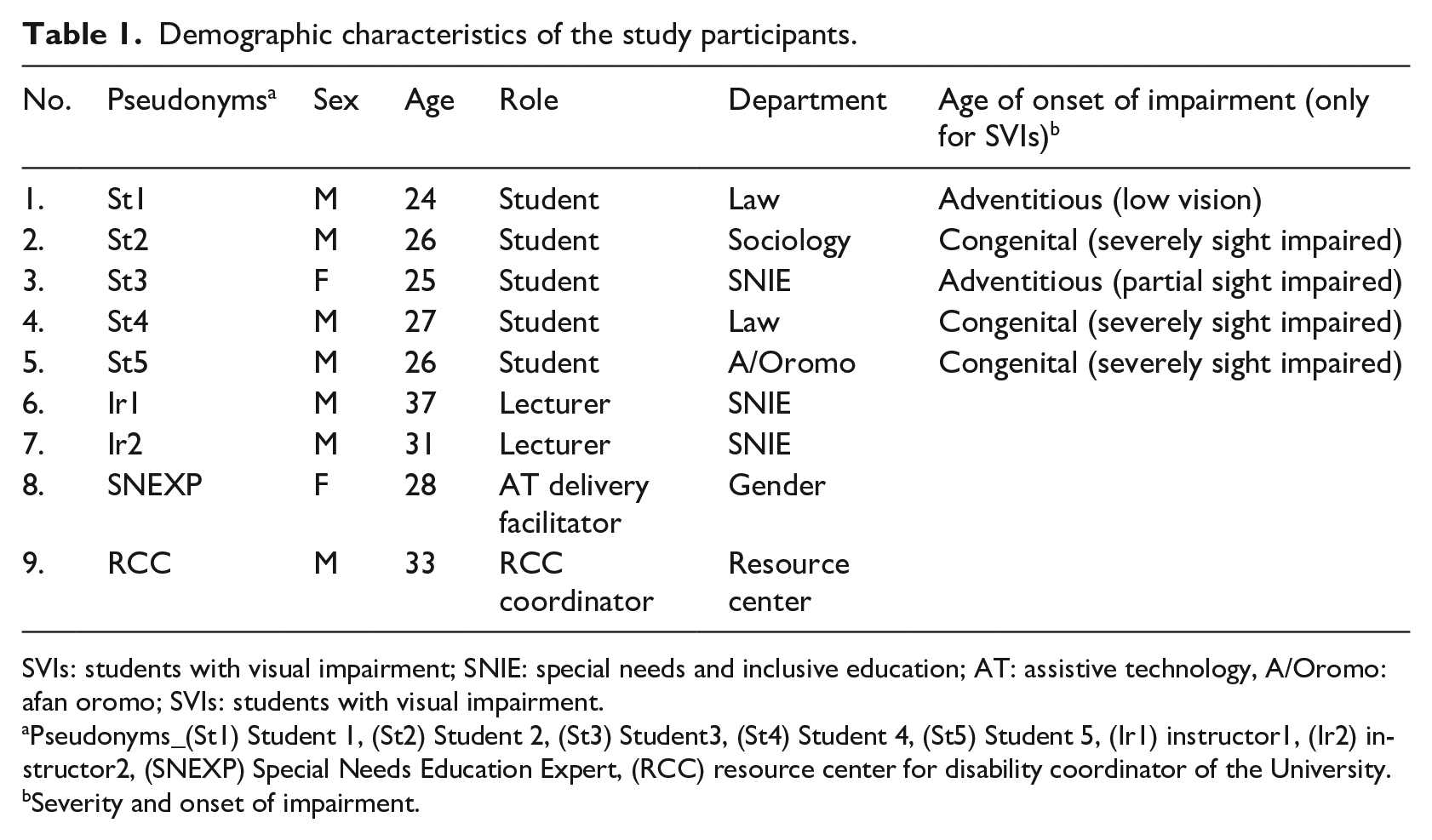
SVIs: students with visual impairment; SNIE: special needs and inclusive education; AT: assistive technology, A/Oromo: afan oromo; SVIs: students with visual impairment.
Pseudonyms_(St1) Student 1, (St2) Student 2, (St3) Student3, (St4) Student 4, (St5) Student 5, (Ir1) instructor1, (Ir2) instructor2, (SNEXP) Special Needs Education Expert, (RCC) resource center for disability coordinator of the University.
Severity and onset of impairment.
Methods of data collection
Semi-structured interview
This study used a semi-structured interview to gather information on AT availability, awareness, and use among SVIs. SVIs, special educators, resource center coordinator, and management were asked questions about demographic characteristics, disability issues, AT exposure, use, and challenges in the interview. When it was important to collect additional information, explain a point, or build on ideas, probing questions were asked. Field notes were taken at each stage to serve as an audit trail and retrieval during transcription. Semi-structured interview is a dynamic interchange of ideas based on open-ended questions or areas of interest posed by researchers, together with probes to extract details and explanations (Roulston, 2010).
Observation checklist
An observation checklist consisting of 22 AT items was developed and used to collect data on the AT availability, adequacy, and functionality pertinent to the study area.
Procedure
Participants in the study were notified about the study both through their representatives and directly. Five SVIs, two teachers, a special needs education expert from the Gender and Disability Mainstreaming Directorate, and the resource center coordinator who were willing to participate in the study were selected after an initial contact was made. Following their consent, a meeting schedule was arranged in such a way that they could attend at their convenient time and place. As a result, all SVIs preferred to be interviewed over extended time in the University’s Disability Resource Center, whereas special educators, the resource center coordinator, and a special needs education affairs facilitator preferred to be interviewed in their offices. During the interview, all study participants were asked to provide a full description of ATs in response to probing questions.
The data were collected over the course of a month from 23 October to 25 November of the year 2021. To ensure clarity of comprehension, participant interviews were conducted both in English and in Afan Oromo languages, digitally recorded, and lasted between 25 and 45 min.
Trustworthiness
To ensure the study’s dependability, the data collection tools (semi-structured interview and observation checklist) were verified to have the same content, structure, and phrasing sequence, as well as enlisting the help of experts in the field. Furthermore, special educators who are expertise in the subject matter double-checked the transcripts for concept errors. To determine transferability, the data collection tools were thoroughly examined to produce detailed descriptions of the phenomenon in question. Formal discussions on the item content substance with special educators operating on the subject matter helped to establish the reliability of the interview items.
According to the data provided by participants, trustworthiness relates to assessing the quality and worth of the entire study as well as determining how closely the study findings reflect the study’s goals (Alexander, 2019).
Ethical considerations
The Department of Special Needs and Inclusive Education at Haramaya University granted written ethical approval for this study. The consent form included with the interview guide made it obvious to the participants that participation in the study was on voluntary basis. Furthermore, they were informed that they had the right to withdraw at any time without any consequence and this statement was read to them.
Pseudonyms were used throughout the study to preserve confidentiality of the study participants. As a thank you for participation in the study, participants were provided no additional pay or other compensation except appreciation.
Method of data analysis
Data from the semi-structured interview were carefully transcribed and the appropriate translations from Afan Oromo to English for those interviews run in Afan Oromo in between the sessions were completed. Since one of the most prevalent forms of analysis in qualitative research is thematic analysis (Howitt & Cramer, 2020), this method was used in this study. The analytic steps followed include (1) arranging and transcribing the data, (2) examining the data to acquire a general idea of its meaning, (3) coding the data, (4) grouping-related codes to construct themes and categories, and (5) evaluating the information provided by the participants.
The transcribed data were double-checked to ensure that all of the details of the interviews were accurately documented and verbatim transcribed. Thus, following the above procedures, data generated both from interview and observation checklists were analyzed thematically.
Results and discussion
The analysis of interview transcripts generated three primary themes that best demonstrate the availability, awareness, and utilization of assistive technologies among SVIs. The major themes and subthemes generated from data analysis that helped to answer the research questions on AT availability, awareness and use among SVIs at Haramaya University are depicted in Table 2.
Main theme and subthemes.
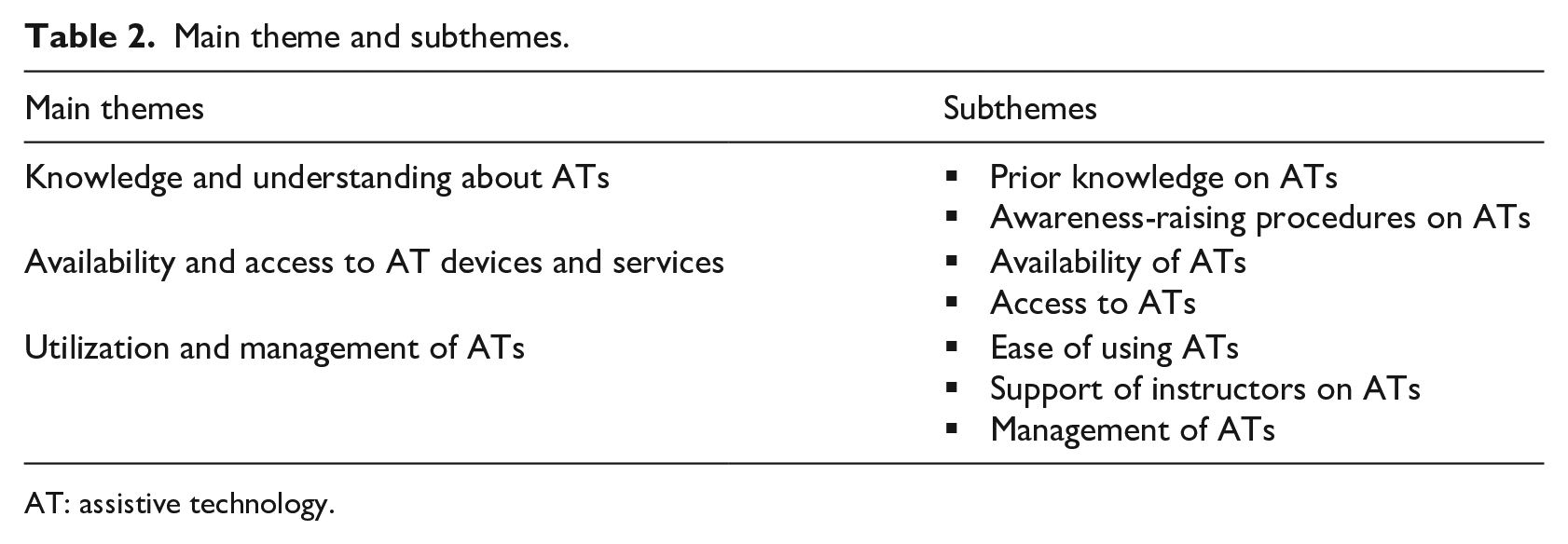
AT: assistive technology.
Knowledge and understanding about assistive technologies
It is critical to raise public knowledge about AT because it is the first step toward equitable provision of such equipment (Borg & Östergren, 2015).
Raising the knowledge and understanding about assistive technologies are the main themes of this study. SVIs’ lack of awareness and understanding of ATs is a serious concern that directly impedes their capacity to understand the mainstream curriculum. This theme was further examined under the following two subthemes.
Prior knowledge on assistive technologies
Knowledge of available assistive technologies, how to obtain them, and which types of assistive technologies are best suited to a specific student with visual impairment is largely determined by prior knowledge (exposure) and the severity of the impairment of that particular student. Despite their varying levels of awareness, all SVIs in the study state that they have had little prior knowledge of assistive devices. This is illustrated by a statement by one SVI as follows: I had little knowledge of assistive technologies, even by name, before coming to this University. I used to be very concerned about how my future studies would turn out. Because I needed my sighted colleagues’ help with the assignment and even tests. The world of the severely sight impaired has lately changed as a result of technological advancements. You know, I learned braille using contraction the old version that didn’t have any number coding representation. However, the braille format has been modified to a contraction one for the time being. Here, the University offered me a sound recorder, and even though the technique is difficult, the JAWS software is also there. Regarding the other technologies you listed, I’d never heard of them before. (St2)
The other SVI also reflects his view as follows: Things are always changing as a result of recurrent technology. I grew up in a remote part of the country with no power and no access to a nearby school, let alone assistive technology. After a long battle, I was accepted into a special needs boarding school. By the way, attending the special needs boarding school offered me the opportunity to get acquainted with several of the assistive technology that I use today, such as the sound recorder and Braille. (St4)
One special needs educator raises his idea as hereunder: In spite of the issue being offered in various courses of special needs, I am not sure that I have sufficient knowledge on ATs for SVI. There are no standalone courses in pre-service training or undergraduate education. To me, such critical issues should be dealt with as a course emphasizing specifically on Braille literacy rather than being incorporated within a general course. (Ir2)
The researchers conclude from both SVIs’ statements and the instructor’s view that while their prior knowledge of assistive technologies varies based on their exposure, SVIs have little awareness of assistive technologies prior to enrolling in tertiary education. This is supported by a study in Tanzanian by Kisanga and Kisanga (2022) indicating that prior to joining the institution, SVIs had a relatively low level of prior understanding of assistive technologies.
Awareness-raising procedures on ATs
Assessment of needs, intentional induction, and formal training are some of the approaches proposed by SVIs, and special needs educators to raise awareness of SVIs on ATs. With regard to these awareness-raising procedures, all SVIs participated in the study are responding in a similar way. SVIs and a facilitator expert to special needs students of the University reflected on their responses on this subtheme. One student with a visual impairment made the following remark in relation to the University’s awareness-raising activities: Things were pretty awesome when I joined this University. At first, I was confused by the environment, the course delivery style, and the social cohesion of the students. Over time, I became familiar with the environment and a few of my colleagues. In connection with ATs, the University conducted a kind of training in the middle of the semester. The training, however, is neither simulated with our needs nor is it considered the nature of delivering courses to students with visual impairments. I think the trainer was negligent of the trainees’ context. That is why he notes everything on the board rather than telling us what it is. I expect the trainer to tell us how the JAWS software works, the different buttons on the computer keyboard operates, how to manipulate the sound recorder. However, he notes it on the chart, contrary to what I anticipated. (St3)
The Special Needs Education expert at Directorate for Gender mainstreaming reported that As a facilitator of the Gender Equality Directorate’s special needs student team, I assume that the directorate provides training to students with disabilities every year. But this directorate did not evaluate the needs before the training. As far as trainers are concerned, I know that trainers are IT instructors, but they may be unaware of the very nature of these SVI training delivery systems.(SNEXP)
The researcher deduces from both SVIs’ interviews verbatim and the facilitator’s reflection that the University provides training for SVIs as a means to raise their awareness. However, the training is provided by an IT (information technology) instructor who is unfamiliar with the nature of the approach to SVIs training delivery. This argument of the facilitator corroborated with the research result indicated by Meng Ee and Cohen (2011) that when SVIs using the internet as a teaching tool, there was some confusion between AT and information and communications technology (ICT). Typically, students may require AT for support: speech access, Braille access, large print access, tactile communication systems, or any combination of these modes. But instructors aware of that AT, ICT, and web educational packages designed for general instruction to be collectively understood as ATs. Furthermore, the training is delivered without any needs assessment or status gap evaluation of SVIs.
Availability and access to AT devices and services
SVIs’ limited access to ATs can be linked to a number of factors, including its local availability, technological know-how, financial access, technical help, efficient administration, and clear policy guidelines, among others (Kisanga & Kisanga, 2022). SVIs’ academic potential to exploit the mainstream curriculum is severely limited due to their inability to access the available ATs, which can be adopted locally or purchased commercially. This theme is further scrutinized under the following subthemes.
Availability of assistive technologies
The interviews verbatim and observation checklist response all indicated the acute shortage of AT devices and services in the University. Almost all SVIs, instructors and the coordinator of a resource center for persons with disabilities agreed that AT devices and services are minimal at the resource center. In relation to this, one student responded on this issue as follows: The ATs available here in this University is not going with either the pace of instruction of the University (Perkins Braille) or the recurrent technological advancement of HEIs. I mean, you can find the audio recorder and the braille contracted even in my former school. There is no advanced AT here in the University, except the emboss braille which does not work until today. I think the University has ample resources to avail high-tech ATs. One problem I have seen is the fairness in the use of University resources. With the exception of a few computers, many of which are out of service due to hardware obsolescence and JAWS software, where are the high-tech ATs for SVI? Nothing. (St4)
One instructor also explained that At the moment, the University lacks ATs. What already exists in the University such as Perkins Braille is obsolete. The University should have to improve its budget allocation for buying slate and stylus, the high-tech ATs like Braille note taker and screen magnifiers. Updating the JAWS software, internet nodes, and obsolete computers in the resource center is also an urgent issue that requires the attention of the management in the University. (Ir2)
The resource center coordinator strengthened the above idea, by saying, As an IT technician, I advise the University to replace the obsolete computers, defective internet nodes, and update the JAWS software with other alternate commercialized ones so as to give efficient service in the center. There is an acute computer shortage particularly during the exam time. Additional computers are required to provide service for these students in an equitable manner. (RCC)
SVIs, instructors, and the resource center coordinator have all reported an acute shortage of AT devices at the University. The existing ATs are obsolete and not compatible with the current pace of instruction in the University. This statement is consistent with the findings from a study on AT conducted in Tanzania by Kisanga and Kisanga (2022) which identified the high cost of financing AT, the lack of experts and technical staff, and the lack of a management policy for ATs in HEIs as a challenge to provide ATs.
Access to assistive technologies
Access to ATs is key to SVIs’ academic success. The study participants, SVIs, are exposed to different levels of AT. One SVI confirmed this in the following way: I have received a sound recorder with a rechargeable battery, a slate, and a stylus from the University for academic purposes. In the resource center, there are a few computers with JAWS software installed. In addition to this, the University also provided white cane to those who could not afford it. (St1)
The other student participant with visual impairment also states, Regarding AT accessibility, the University accessed sound recorder with rechargeable battery, slate, and stylus with its accessories. I think, the University has the capacity to go further and provide high-tech ATs available commercially including a laptop computer. Because students with visual impairment few in number to cover their AT expenses. I raise this due to my difficulty to operate in JAWS software as a result of my inefficiency in using the computer.(St5)
From the above statements, the researcher deduce that the University does not give enough attention to afford the necessary updated high-tech ATs for SVIs to use for their academic endeavor. This statement is supported by the study conducted by WHO (2019) which verifies that in developing countries, for a variety of reasons, persons with disabilities have very limited or no access to AT. One of the main reasons according to this study is the lack of focused legislation, inaccessible organizations, specialists, and procedures that can give AT to individuals who might benefit from it.
Utilization and management of assistive technologies
The utmost utilization of ATs in their day-to-day academic engagement is the essential consideration that fundamentally affects SVIs’ lifestyle and academic endeavor. The following are the subthemes that emerged from participants’ reflections on the use and management of ATs in this study.
Ease of using assistive technologies
The transcript hereunder included an SVI, an instructor, and the resource center coordinator, all of whom were at various levels of functioning on ATs. The following is a transcript of the interview that one SVI reported verbatim: I attended a rare rural school with no access to assistive technology such as JAWS software or an audio recorder. On the one hand, the English language pronunciation included in the software is difficult to grasp for someone who has never heard such pronunciation before, such as me. Above all, it is quite difficult for me to access the entire course using only the JAWS software’s sound system and audio recordings. The usage of JAWS and an audio recorder on a regular basis has an effect on my hearing capacity in the long run. And what is surprising is that, if in due course of my study I encounter electric blackout, all the readings are disappeared and I started from zero. Furthermore, using ATs in a regular classroom is quite difficult. The instructor and fellow sighted classmates are both to blame for the difficulties. One thing I’ll be honest with you about is that my instructors do not recognize my ability to complete the course assignment and examination, despite the fact that I am capable of doing both. Instructors may refuse to allow you to use an audio recorder in the classroom, even if the country’s legislation allows you to do so for educational purposes. There should be alternate medium like braille to read rather than always depend on JAWS and audio recorder. (St2)
One of the instructors participated in the study also confirmed the above idea as follows: There are limited ATs here in the University. Even the available ATs are not compatible with the pace of course delivery in the classroom. For instance, I personally motivate my students to use Braille note takers and screen magnifiers but, impossible to have it. The University has the capacity to access these AT devices if planned. Imagine, I speak about education quality and equity in a situation where the University denies access to the necessary ATs for these few SVI. I have humble advice for the management to plan practical and tangible training for SVI on the use of ATs. Because both the quality of education and equity in classroom course delivery is highly affected when SVI fail to easily access their course work as desired.
The resource center coordinator for disability of the University witnessed the issue of difficulties in ease of use as here under: I have no idea about ATs, but some know-how on instructional technology maintenance and use. One problem I have observed here on the use of ATs among SVIs is that of refrain from using it. I think no one is perfect, but try out may lead you to perfection. Even though the technology of JAWS software, the pronunciation is not easy to manage it, I advise SVI to try it without any hesitation. As I told you, I am not smart in the areas of ATs, but eager to learn it in the future. Regarding SVIs AT usage, I tried my best to assist them to learn how to use a computer, but not how to manipulate the JAWS software. Because the latter is beyond my technical capacity’s to handle at this time. (RCC)
The views of SVIs, instructors, and resource center coordinator are somehow related to the difficulty of using ATs. This means that they have common consciousness on the difficulty of using ATs, but variation is there on the level of difficulty and how to handle it. Supporting this, the appropriate AT allows visually impaired students to effectively access information and accomplish tasks, allowing them to reach the highest level of independence possible. Once an appropriate AT has been chosen, it is critical that the user understands what it does and how to utilize it. In addition to the student user, training for others who will work with the SVIs should be provided. In the same vein, Söderström (2016) asserted in his study that integration of AT devices into classroom instruction helped students to show rapid improvements in their ability to perform in normal school activities without compromising their social participation. But, even instructors face difficulties in understanding how to operate the high-tech ATs as the research conducted in the United States by Ajuwon et al. (2016) affirmed in accord with the finding from this study.
As can be seen in Table 3, the University has a limited number of AT equipment in the disability resource center. Among these, some AT devices are not functioning owing to incompetence of the responsible personnel in technical skills for maintenance of the equipment (Braille embosser) and others are irrelevant to the needs of SVIs (e.g., fiction books in Braille irrelevant to subject areas studied).
Availability and functionality of assistive technologies in the University resource center.
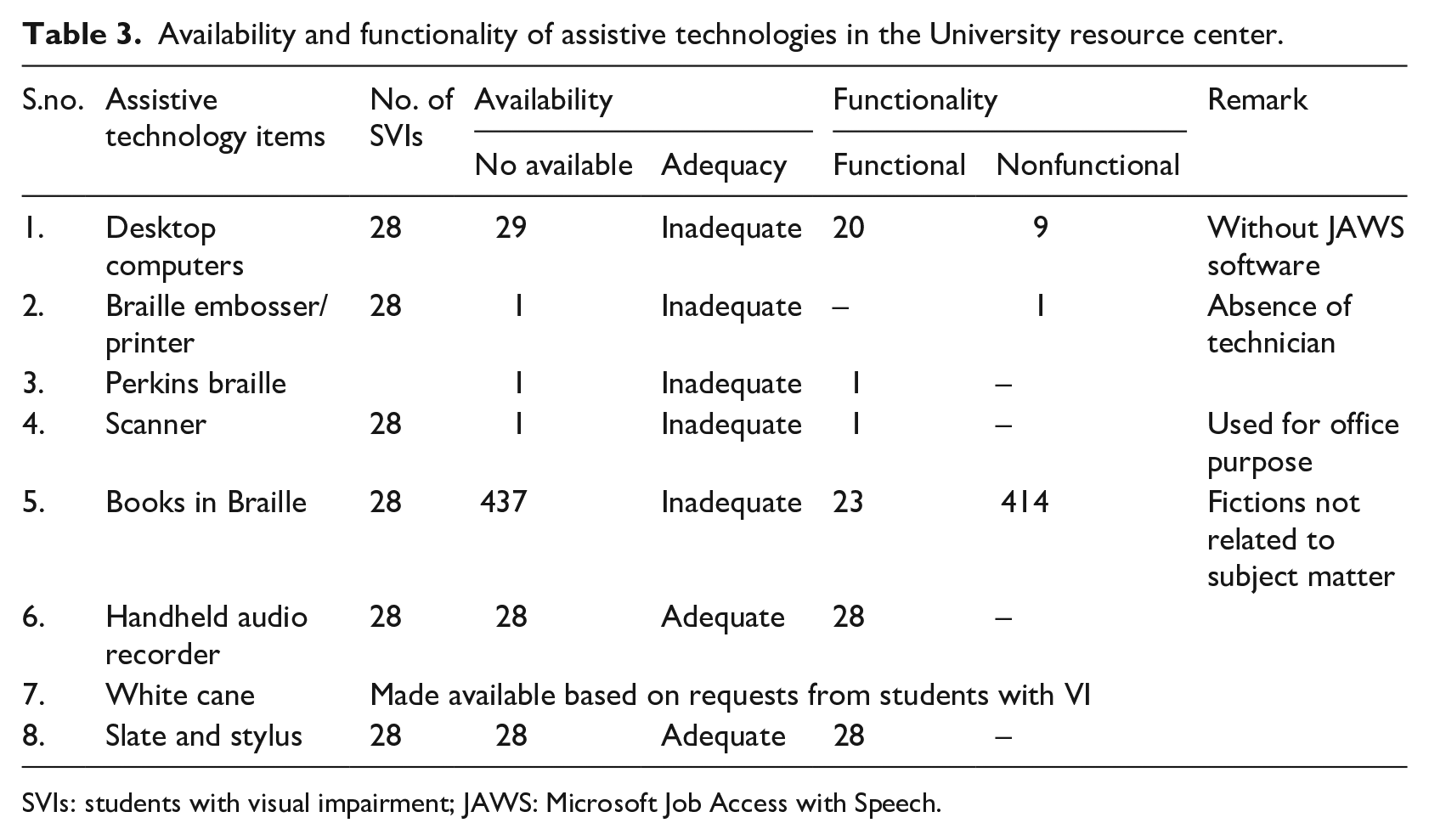
SVIs: students with visual impairment; JAWS: Microsoft Job Access with Speech.
The support of instructors on assistive technologies
Instructors should encourage effective usage of ATs in ordinary classrooms. Problems emerge on both the SVIs’ and the instructors’ sides unless ATs are made an integral element of their teaching aids for use in instruction. The following is the perspective of an SVI on the assistance that instructors provide in the classroom: No instructor would dare to help you use ATs in the classroom. A few sighted classmates may be able to assist you in setting up the audio recorder. However, some instructors fail to take into account the presence of SVI in the classroom. They cram every course concept onto the board rather than explaining it verbally. When I sought for assistance, they said they didn’t have time. The University must work on attitude of instructors towards SVI. (St5)
The perspective of one of the instructors who participated in the study on the supports provided on ATs to SVIs is set as hereunder: Many instructors, in reality, lack a firm knowledge of ATs and the essential facilitation that goes along with it in order to help SVI use them. I’m conscious of overlooking the existence of SVIs in my classroom on occasion. This is not expected of me. As an instructor, the essential adaptations to SVI to critically participate in the course are evident. I believe that all instructors should receive extensive training on how to aid SVIs, as well as how to employ ATs in the mainstream classroom. (Ir1)
The interview verbatim reflected by both SVI and instructor indicates low motivation of instructors for SVIs to use ATs at classroom level. This may arise due to either negligence to understand the academic engagement nature of SVIs or lack of awareness on the use of ATs in the instruction of SVIs. This perspective is further supported by the research done by Coleman et al. (2015) which states that instructors should make reasonable modifications to learning aids to ensure that visually impaired students are not significantly disadvantaged.
Management of assistive technologies
AT management refers to the systematic and structured arrangement of AT in a way that is appropriate for the immediate consumers in need (Peterson, 2016). A well-structured and accountable AT service delivery system with a defined structure, policy, guidelines, and directives is vital to making the most use of the limited human, material, and financial resources available. In relation to this, one instructor who participated in the study expressed his views in the following manner: A common concern about the delivery of assistive technology devices and services is the lack of a clear structure, policy directives, and guidelines for training, disseminating, governing, and evaluating the use of assistive technology devices and services in order to meet the needs of SVIs with the limited resources available. The University’s management of its assistive technology delivery service is ad hoc, with its structure split into two halves: a gender directorate and a special needs and inclusive education department. Human personnel with some knowledge of assistive technology can be found in the special needs and inclusive education department, but the gender directorate is in charge of all tasks related to assistive technology device disbursement, maintenance, training, management, and evaluation of its functionality. I think, the University follows something a paradoxically indifferent administration approach that deteriorates the service. (Ir2)
The resource center coordinator’s perspective on the management of ATs in the resource center is as follows: I’m not sure how the resource centers in the other University manage their assistive technology. In certain cases, I’m stumped as to who is to blame for the center’s service shortcomings. Clear structure, policy, guidelines, and unidirectional administration on how to deliver the service should all be in place, in my opinion. Look, there are qualified professionals on assistive technology with special needs and inclusive education know-how in the University, but the center is run by a gender directorate that has nothing to do with these issues. This has an effect on the neatness with which SVIs are served. (RCC)
The views expressed by both the instructor and the resource center coordinator point to a serious management problem with AT services and devices at the University. This arises from the absence of clear policy, guideline, and directives on the management of these services. In this regard, a phenomenological study conducted in the United States by Peterson (2016) underpins with this study finding stressing a chronic problem in effectively managing AT to meet the needs of SVIs. In this regard, the WHO (2021) pinpoints weak governance, inadequate domestic funding, inefficient regulatory capacity, shortage of skilled manpower, and insufficient service provision become challenges to the provision and management of AT in Africa. This issue is further strengthened by the findings of Ndlovu (2021) which indicates the incapacitation of skilled personnel to enable blind to access math signs using JAWS from the screen reader computer in some South African HEIs. The findings from the aforementioned studies which reported problems in AT management related to inadequacy of academic preparation and training organized for personnel who involve in AT service provision also corroborate with the findings of this study.
Conclusion and implications
The findings of this study show that instructors, SVIs, managers, and concerned experts have a low level of understanding about assistive technologies. The study further revealed that the major problem in the management and service delivery of AT in the University lies in the improper organizational arrangement which puts the Disability Resource Center under the Gender and Disability Mainstreaming Directorate, which is devoid of personnel with knowledge on significance of ATs for SVIs and technical skills for handling and maintenance of the devices. This organizational arrangement, which detaches the Disability Resource Center from the Department of Special Needs and Inclusive Education where trained professionals are available, had a negative effect on the provision of AT-related services as well as awareness-raising and capacity-building programs for teachers and SVIs. Besides, the absence of clear policy, guidelines, and directives on management of AT devices and services seriously hampered its service delivery. Furthermore, training, which is crucial for awareness-raising and capacity-building of the staff and the students, is mismanaged because it is not based on stakeholders’ needs assessment or status review. A fundamental lack of AT devices for SVIs and a chronic loophole in its utilization among all stakeholders are identified as major problems in the University.
In general, the lack of knowledge among SVIs and instructors, on one hand, and the management’s and concerned experts’ failure to address the issue, on the other, have a significant impact on the availability and utilization of AT in the University. Besides, a severe lack of AT devices as well as inefficient use and low proficiency in assistive technologies among SVIs limit their capacity to equitably access the mainstream curriculum and have an impact on their academic progress.
Implications for policy and practice
In conclusion, existing policies in the country should pay special attention to SVIs who have academic challenges that prevent them from progressing at the same pace as their sighted counterparts. How and when to employ ATs for academic activities is one of the academic issues faced by SVIs at Haramaya University. To effectively address this critical issue, an autonomous organizational structure that handles AT management and service delivery should be constituted, under the student support services, with clear policy, guidelines, and regulations, staffed with personnel who are familiar with Special Needs/Inclusive Education and related services.
Accessing appropriate ATs and increasing SVIs’ awareness of their manipulation should be prioritized by concerned bodies as one way to provide the least restrictive learning environment. To this end, training on the awareness, technical skills, and administration of AT devices and services should be given to SVIs following a consistent needs assessment and status evaluation at the start of the academic year through experts with experience in both special needs and AT. Besides, general classroom instructors, the resource center coordinator, and management should all receive training on how to handle the learning of SVIs and the utilization of assistive devices.
Special needs educators should take the lead in identifying, organizing, modifying, and sorting ATs that can help students access the core curriculum. More than anything, maintenance and upgrading of existing AT devices in the Disability Resource Center as well as regular power supply inspections should be prioritized. To accomplish this, the University should commit more resources to serving students with disabilities in general by giving special emphasis on facilitating assistive technologies to the utmost of its capacity.
SVIs should receive both practical and theoretical training during their course. Here, there should be curriculum rearrangement emphasizing on practice and awareness on AT devices.
Limitation of the study
One limitation of this study was the small number of study participants due to the very nature of the study design and sampling procedure employed that deters generalization of the study results. Another limitation was the context at which AT tied and articulated to low-tech technologies like slate and stylus as a result of the inaccessibility of mainstream high-tech assistive technologies in the University. Besides, the short duration of an in-depth interview schedule and lack of inclusion of other disability categories may seem to affect the rigor of the research to some extent.
Footnotes
Declaration of conflicting interests
The author(s) declared no potential conflicts of interest with respect to the research, authorship, and/or publication of this article.
Funding
The author(s) received no financial support for the research, authorship, and/or publication of this article.
