




Abstract
This is a qualitative study that gives voice to 33 siblings of children with visual impairment in care at the Robert Hollman Foundation, focusing on their relationships with their brothers/sisters. Participants aged 7 to 22 recounted their daily life experiences and perspectives, expressing their feelings during semi-structured individual interviews. Data were analyzed according to the thematic analysis in the conceptual framework of ‘the new sociology of childhood’. The vast majority of siblings showed a special relationship with their brother/sister, characterized by unconditional love and willingness to help. Different emotions, such as happiness, empathy, sorrow and sadness, were expressed as well as how the experience of being siblings of children with visual impairment shapes their attitudes, highlighting a number of needs in some of the subjects.
Keywords
Introduction
Siblings are an integral part of the family (Nguyen et al., 2021), and the family is the first and the most important relational space in which brothers and sisters meet, share their lives and build their personalities. When there is a child with a disability in the family, family life changes, as well as the whole family system, which functions as an emotional unit (Besier et al., 2010); when the child has a visual impairment (VI), family life can be very demanding, especially in Western societies, which are visual societies (Hutmacher, 2019) and where vision is usually regarded as the most important and essential sense. Specific factors related to visual deprivation, such as lack of eye contact and immediate understanding of facial expressions, can make communication between family members very difficult, even between siblings. The psychomotor development of a child with visual impairment shows significant delays in its main stages, especially in the first years of life (Fazzi et al., 2010), so the entire family has to adapt, coping with the consequences and repercussions in the daily social life of all its members.
Therefore, siblings of a child with visual impairment grow up in an environment where visual disability is an ordinary part of their daily lives, including relationships with parents and family members.
Literature shows that the bond between siblings is lifelong and the most enduring inside the family (McHale et al., 2012; Travers et al., 2020), even when there is a brother or sister with a disability (Rossiter & Sharpe, 2001). Moreover, these relationships between siblings are dynamic and change during different periods of life, being usually stronger in the early years of life, decreasing during adolescence and becoming stronger again in adulthood. At this stage of their lives, siblings are sometimes not only best friends, but they also become the main supporters of and caregivers to their brothers or sisters with disability (Coyle et al., 2014).
This sibling relationship entails typical characteristics and emotions, such as deep love, sharing, bonding, maturity, responsibility, resentment, jealousy, guilt, fear, rivalry, embarrassment, but it also has unique elements due to the circumstance of disability (Meyer & Vadasy, 2008; Milevsky, 2016).
Literature has shown different findings regarding the experience of being a sibling to a brother or sister with a disability. In their study, Travers et al. (2020) explored the experiences and perspectives of 155 siblings (aged 18–30) of individuals with intellectual disability or autism. The authors demonstrated that most of the siblings spent time together with their brothers/sisters and described their relationships as being of high quality. Stalker and Connors (2004) investigated, in a small-scale qualitative study of a group of 24 children (aged 6–19), the siblings’ perceptions of disability and differences compared to their brothers or sisters with various types of impairment. They found that the siblings were aware of their brother/sister’s impairments, but the majority of them did not feel them to be ‘different’. Caliendo et al. (2020) showed, in their study of 159 children (aged 3–9), that siblings of children with autism spectrum disorder and siblings of children with Down’s syndrome had greater emotional fragility than siblings of children with typical development. Mandleco and Webb (2015) reported, in their integrated review, that siblings of youths with Down syndrome described more positive perceptions and interactions with their brothers/sisters compared to siblings of youths with autism spectrum disorders. A recent systematic review by Kirchhofer et al. (2022) on 1312 siblings of children with neurodevelopmental disorders (aged 4–18) reported that lower levels of social support are associated with more negative psychosocial adjustment.
Recently, to our knowledge, Datta and Sabir (2021) interviewed students with VI (aged 15–25) as part of an investigation into their family lives. They interviewed the students themselves, their parents and their teachers, but there was no data regarding the experiences of their siblings. According to the existing literature, the topic regarding siblings of children with VI has not been examined in any great depth; it was decided to investigate it because of the importance of siblings’ relationships in their everyday lives and the influence it has on their mutual development (McHale et al., 2012).
Accounting for a qualitative methodology with a child-friendly approach, ‘the new sociology of childhood’ (Prout, 2011) has been chosen as a conceptual framework because it focuses on the agency of children and the idea of childhood as a social structural form in that children are actors in shaping their lives. The ‘new sociology of childhood’ came to notice during the mid-1980s, as a new conceptualization of childhood and children against the traditional socialization theories of those times, according to which children play a passive role, being incomplete and needing to mature cognitively to become competent. The ‘new sociology of childhood’ focused on the active role of children in constructing their world at any moment, being individuals capable of reflexivity and contributing to the cultural production of the different societies in which they live (James et al., 1998; Matthews, 2007). Their social relationships, both with peers and adults, are valuable and worthy of consideration, independently from adults’ perspectives (James & Prout, 1997). In the same era of the appearance of this ‘new paradigm’, as initially called by James and Prout, and also because of its new conceptual frame focusing on children, an increasing concern regarding the human rights of children emerged, resulting finally in the United Nations Convention on the Rights of the Child (UN General Assembly, 1989). Both of them aligned in giving voice to the children, recognizing their active role in society, especially concerning their opinions on choices and matters regarding them.
Siblings live with their brothers or sisters, sharing their family, which is the first social environment for a child. The choice of a qualitative methodology to explore the topic of relationships in siblings of children with VI, in the framework of the new sociology of childhood, allowed the siblings to express their feelings and thoughts freely in the first person and enabled them to highlight eventual needs. Making this choice, the researchers acknowledged the siblings’ narrations as valuable and to be respected as they would adult ones. Furthermore, it allowed the researchers to reflect on the siblings’ daily relationships from their perspective and added value to the analysis of the data.
Methodology
Participants
The siblings are brothers or sisters (aged 7–22) of children/teenagers with different degrees of visual impairment, from moderate to total blindness (World Health Organization [WHO], 2021), who are or were in care at the Robert Hollman Foundation (RHF). The RHF is a private non-profit making organization of Dutch origin, operating in Italy, which offers free consultation and support to the overall development of these individuals and cares for approximately 400 children a year.
The choice of the participants was based on the following criteria:
Availability of the family to the project
Availability of the siblings to being interviewed online
Ages more than 7 years old
The sample of 33 siblings is composed of 22 sisters and 11 brothers; 19 are firstborn, 10 second-born, 1 third-born and 1 fourth-born and 2 sets of twins; 25 siblings have a brother or sister with a diagnosis of isolated visual impairment, while 8 siblings have a brother or sister with visual impairment within a clinical pathology which presents associated disabilities (such as intellectual and motor disabilities); 14 siblings have a brother or sister with moderate or severe visual impairment and 19 with blindness.
All the demographic characteristics of the participants and of their brothers/sisters with VI are described in Table 1.
Demographics of participants and of their brothers/sisters with VI.
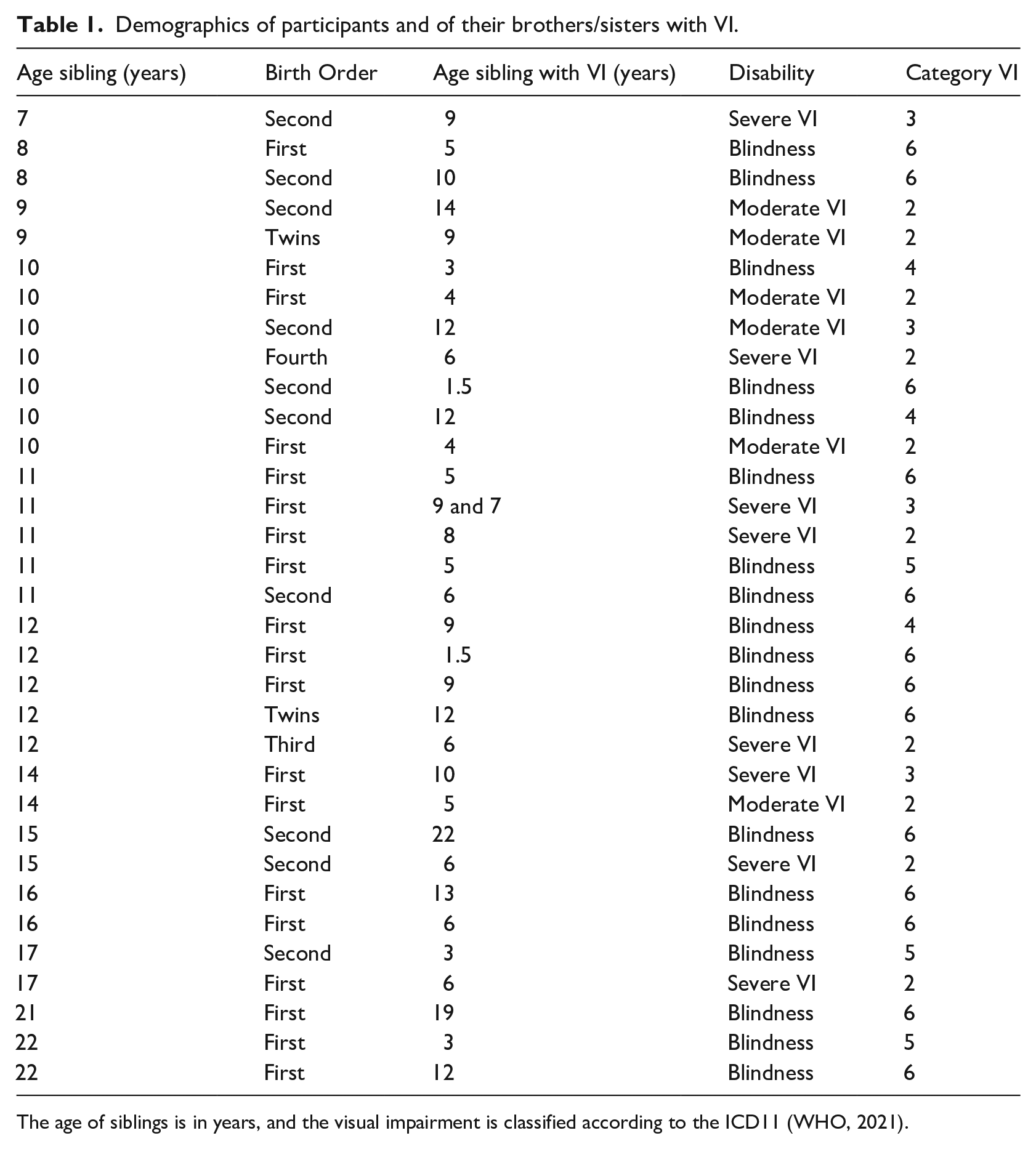
The age of siblings is in years, and the visual impairment is classified according to the ICD11 (WHO, 2021).
This project took place at the RHF and was carried out after the approval of the Institutional Board (N. R12_2020 RHF) and in agreement with the Helsinki Declaration (World Medical Association, 2013). All the parents gave their informed consent to include their children in the study, and the youths gave their own consent. All the participants were informed that participation was voluntary and that they could interrupt the interviews at any time. The project lasted approximately one year, from autumn 2020 to autumn 2021.
Setting and procedure
This qualitative cross-sectional study was carried out online, using different platforms (Google Meet, Zoom, Microsoft Teams and WhatsApp), because of the regional and national restrictions imposed due to the COVID-19 pandemic.
A 15–25 min, semi-structured, interview was conducted by two researchers, using a child-friendly approach. The former researcher has been working with children with VI for about 20 years; the latter approached VI for her Master’s thesis because of her personal interest in this research field. The first researcher interviewed and the second recorded the whole interview. The parents of the children were asked to leave them alone during the interview, allowing a direct conversation and leaving them free to talk, without any possible influence. This choice was taken, according to ‘the new sociology of childhood’, to allow the siblings to be independent actors, considering them capable and autonomous in expressing their opinions and feelings. With younger children, a question was repeated a few times by the first interviewer, while the second one recorded and checked. Clarification of the response was asked when necessary. No insistence was performed whenever it was clear that the child did not want to say anymore. Pauses were respected to give them time to adapt to the situation and to trust the interviewer.
Open-ended questions were chosen in accordance with the conceptual framework of the ‘new sociology of childhood’ to allow the siblings to provide insights into their lives without influencing their responses. Considerable care was taken by the researchers in choosing the questions since they had to be simple, easy to answer and based on siblings’ everyday situations, so that they could answer them spontaneously. They were centred on the siblings themselves, thereby making them feel they were the main character in their own lives. In a family where a child has a disability, the focus of attention may in fact be shifted onto that child or onto the family itself, thereby making the siblings feel neglected (Milevsky, 2016, p. 96).
The questions were varied slightly according to whether the child was first or second-born and the language used was chosen according to their ages to make them feel as comfortable as possible.
Adequate response time was given, so that both children and youths could take their time to answer properly and also allow them to express their emotions.
Every interview was audio-recorded and fully transcribed by the second researcher, with the permission of the family. Both researchers also took notes during the interviews, such as underlining of the tone of some words (i.e. ‘they put emphasis into their voice when saying the word . . .’.) or facial expression descriptions (i.e. ‘they smiled when. . .’.) as well as the presence of pauses or repetitions during the responses. These notes were regarded during the process of data analysis as a useful tool to facilitate reflexivity in the researchers when interpreting the participants’ answers and their feelings, helping them to explore unspoken meaning behind children’s words (Vaismoradi et al., 2016).
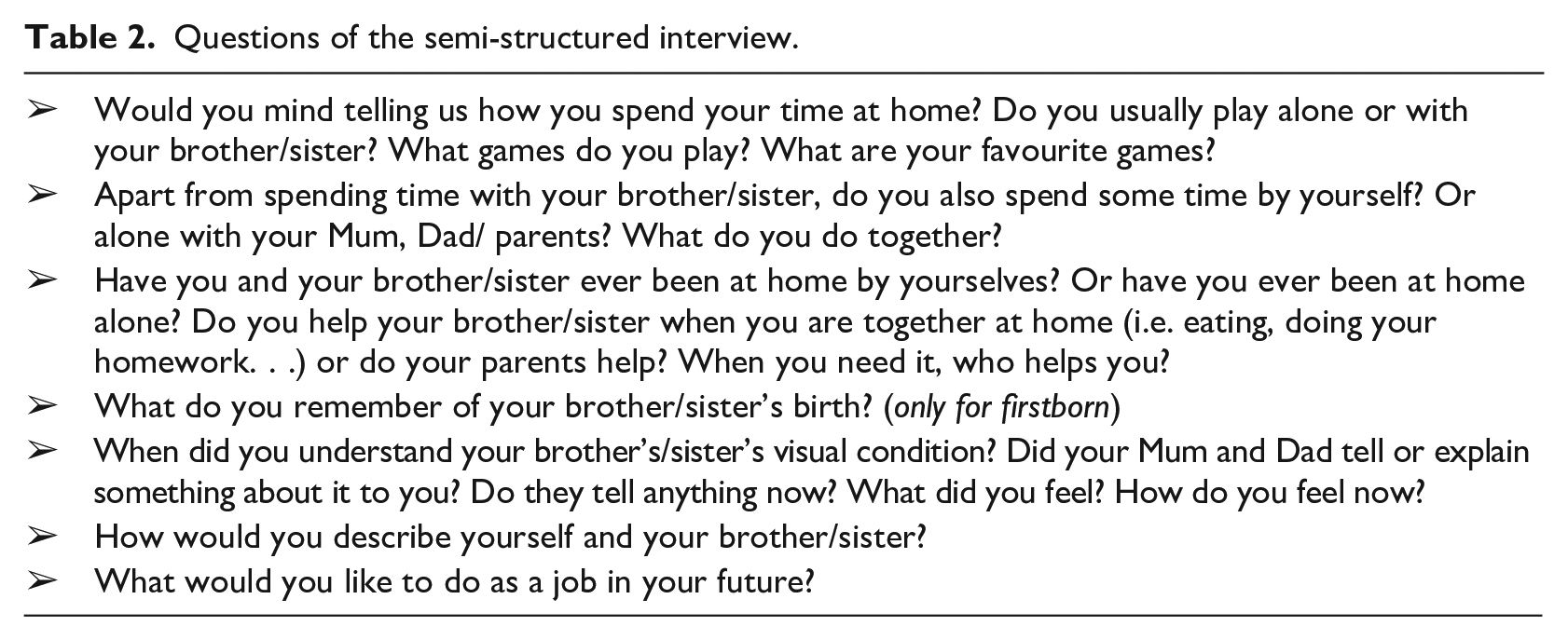
In Table 2, questions are reported.
Questions of the semi-structured interview.
Data analysis
Participants recounted their experiences and expressed their feelings; a space for their questions regarding this study or regarding the visual difficulties of their brothers/sisters was taken into consideration. They were considered as active agents during the interviews, able to answer in detail on all questions and on all subjects (Prout, 2011) and as competent beings, having knowledge derived from their personal experiences and events (Quennerstedt & Quennerstedt, 2014).
The responses were analyzed using thematic analysis (TA), an umbrella term for a set of approaches for analyzing qualitative data that address a research question (Braun & Clarke, 2006, 2017). TA, according to Braun and Clarke, is a 6-step process of data familiarization, data coding, generating themes, developing and reviewing themes, defining and naming themes and producing the report. Recently, Braun and Clarke (2021a, 2021b, 2022) renamed TA as Reflexive TA, to distinguish it from other TA approaches and to focus it on the researcher’s reflexivity. In this study, deductive Reflexive TA was used to analyze the data obtained by the interviews because data coding and themes’ development have been directed in the framework of the ‘new sociology of childhood’, and researchers’ subjectivity was considered an analytic resource in knowledge production.
The second researcher made the transcripts of the audio-recordings and integrated them with the notes taken during the interviews and highlighted in brackets, to get one final version to analyze. This final transcript was checked against the tapes for accuracy and the input of notes was also controlled. The final transcript was actively read several times by both researchers to familiarize themselves with the data, immersing themselves in it. Time was requested to achieve closeness with it, and reflective notes were taken to start making meaning of data and generate ideas for the subsequent coding process.
The two researchers independently conducted the systematic process of coding, using highlighters to underline and identify meaning units, focusing both on manifest and latent content. In the coding process, researchers read the transcripts carefully, moving forward and back several times and giving equal attention to every single piece of data and its relevance to the research question, which was addressed within a constructionist framework. They both interpreted the data through the framework of the ‘new sociology of childhood’, giving emphasis to the active role of siblings in their everyday life and trying to understand how their agency is enacted in their family and social environments. A predominantly experiential orientation was adopted, favouring the meaningfulness of the children’s lived experiences over the analysis of possible socio-cultural factors underlying their being siblings of children with visual impairment. Coding approach was open, with no use of pre-set codes, and collaborative between the two researchers. At the end of this time-consuming process, in fact, the analytic outputs were discussed together in an atmosphere of dialogue and thoughtfulness in order to make the most from the narrated experiences to address the aim of the study. Both researchers reflected on children’s experiences, imagining and wondering how they would have felt in their place; they also recalled personal experiences and feelings, sharing a similarity with the data. The difference in the expertise on VI of the two researchers was considered a resource and an added value for the analysis because it provided an opportunity to enrich the meaning-making process during their reflexive engagement with data interpretation and helped to contrast possible bias.
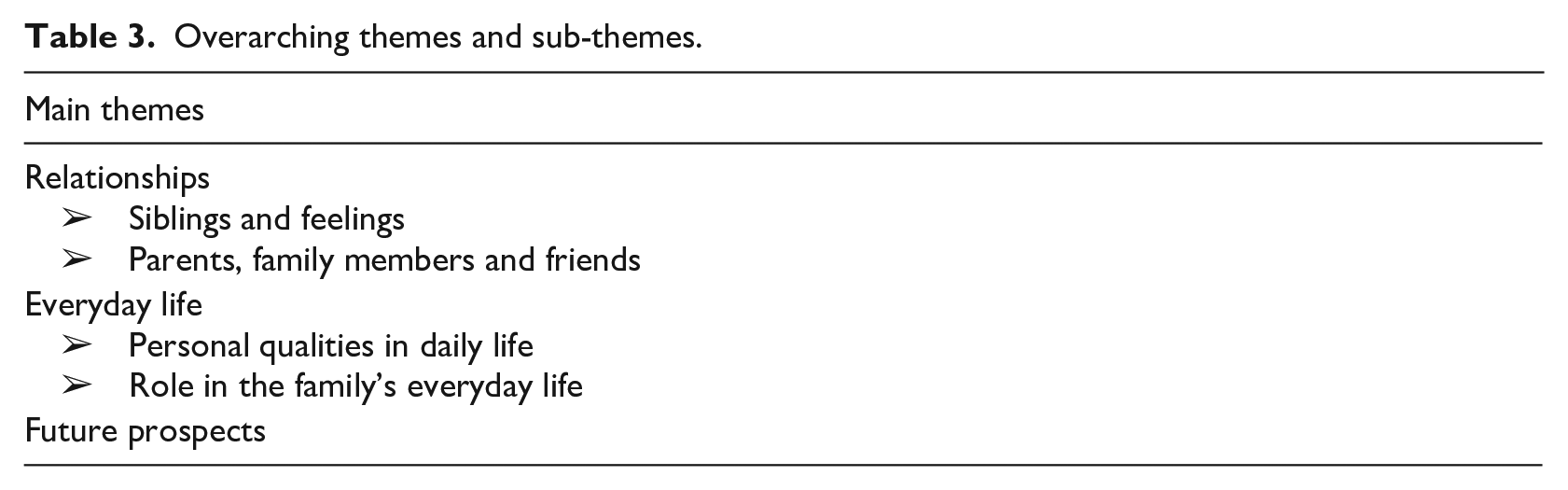
The transcripts were read once again together, and all the meaning units, which were valuable for developing themes, were included. The following steps of reflexive TA were carried on together in a mutual sharing of thoughts and reflections, from themes’ generation to themes’ definition and finally to the producing of a detailed report of the analysis. A recursive process of immersing in and distancing from data, questioning, imagining, reflecting, retreating and, above all, not taking anything for granted characterized all the steps of the analytic process. The continuous confrontation between the researchers regarding their interpretations of data also helped to identify personal beliefs or experiences that may have influenced the process. A greater number of sub-themes was generated at the beginning and was then reduced during the reviewing step. Codes were collated in three overarching patterns of meaning, ‘Relationships’, ‘Everyday life’ and ‘Future prospects’, which researchers actively generate from the extracted key elements. The generated themes were reviewed against the codes and also against the final transcript to verify their consistency. All the steps of the Reflexive TA were completed rigorously to ensure the trustworthiness (Nowell et al., 2017) of the quality of the research study.
Table 3 shows the three overarching themes and the sub-themes
Overarching themes and sub-themes.
Results
Relationships
This first overarching theme, focusing on the relationship mainly between siblings but also with parents or other possible role models, highlights that on the whole, all the siblings, including older ones, prioritize their relationship with their brother/sister with VI in their lives. This relationship is characterized by unconditional love and readiness to help; a feeling of sorrow for the impact of visual impairment on their quality of daily life was also expressed by quite a few of them.
Furthermore, all the siblings expressed a sentiment of gratitude and affect for their parents for informing them about the VI of their brother/sister, for guiding them in their early relationship with them and for supporting them in their daily life. Some siblings expressed a wish to be able to spend more time with their parents, even though they are aware that their parents do not do this on purpose but to follow the multiple needs of their brother/sister.
Siblings and feelings
During the interviews, the siblings expressed their feelings and emotions, both in a voluntary and involuntary way, through verbal and non-verbal language, while talking about their brother/sister.
The great majority of them love spending time together, playing and talking. Serena, a 10-year-old girl, referring to her sister, said: ‘I always play with her, I never play alone, I don’t like it!’. Maria, a 12-year-old girl, responded to the first question regarding how she spends time at home, mentioning immediately her baby sister: ‘As soon as I come back from school, I go to hug her!’ In only one situation, one sibling explicitly stated a preference for spending time mainly alone. Teenagers play both alone and with their brother/sister with VI and spend plenty of their time studying. Youths, despite their studies or jobs, always try to find some time of the day to dedicate to their brother or sister.
Almost all the siblings, during their stories, showed their willingness, friendliness and empathy towards their brothers or sisters with VI. Riccardo, a 10-year-old boy, told about his 3-year-old sister, who cannot walk because of other associated disabilities; he happily explained that they usually play together on the double bed, and he manages to make her laugh by asking her for kisses.
Ginevra, a 10-year-old girl, showed great admiration for his brother, exclaiming: “He once managed to complete the jigsaw puzzle all by himself. . . he was really great!!
The great majority of the siblings described their brother/sister in a passionate way and manifested positive feelings regarding them, reporting they would always be ready to help them. Arianna, a 10-year-old girl, said that she always comforts her sister when she is sad and cries.
Almost all of them are aware of the visual impairment of their brother/sister such as Ginevra, who also put it into words, saying: ‘I don’t even think or pay attention to his low vision, he plays, he rides his bike, sometimes he falls, and I help him up. . .’.
Siblings also perceive their brother/sister to be equal to them and unique. Valeria, a 15-year-old girl, explained: ‘She didn’t seem so different to me, as Mum and Dad told me. . . ’ and Rosanna (14 years old) even said: ‘I like to have a brother with a disability because he is so unique!’.
Some siblings expressed a feeling of sorrow towards their visual impairment, reaffirming at the same time their willingness to support them. Some of their quotes are reported here: ‘I wish my brother could see’ (Anna, 8 years old) ‘I always think that I must help her because she sees so little, while I see well. Once we were on a boat trip and there were jellyfish in the sea. . .she wanted to see them, but they were too far away for her. . .I think she wanted to see their details. . .In these situations, where I can do things and she can't, I feel sorry, I would like her to see as I see’ (Serena, 10 years old) ‘At the beginning, when I noticed she was going very near the television, I was telling her to go away from it, then I knew. . .and I felt sorry’ (Michele, 11 years old) ‘I feel I am lucky when I think of her not seeing; now, after all this time, it would seem strange to think of her as somebody who can see’ (Chiara, 12 years old) ‘At the beginning, I was a bit afraid, because I could not understand well his situation, then I got used to it’ (Veronica, 11 years old)
The younger siblings expressed their emotions more than the teenagers; Filippo, a 16 year-old boy, changing his face expression and lowering the tone of his voice, told about his sister: ‘When she started to grow up and was about 2 years old, I became completely aware of her difficulties. . .’.
One sibling clearly expressed the need to protect her sister: ‘When I realised she couldn’t see I was shocked, because I think she feels you when you get close to her; now I feel the need to protect her, to keep her safe’ (Giovanni, 17 years old)
The bond between siblings is very strong until the beginning of adolescence, when the connection weakens, but this is also related to physiological growth, considering adolescence as the period when relationships outside the home and the need to seek advice from peers increase (Scharf et al., 2005). Giorgia (17 years old) made it clear that she talks and relates more to her friends than to her sister. Filippo (16 years old) said: ‘When we were children, we played together a lot. Now we don’t spend as much time together’.
Most participants help their brother/sister in difficult situations, but sometimes the help is mutual, as Sara, a 15-year-old girl, expressed: ‘I help her when she asks or sometimes when I realise she needs help; I in turn ask her for help with foreign languages at school because she is very good at it!’
It is important to emphasize that not all the siblings verbally expressed their emotions during the interviews, but only through non-verbal language; in such situations, it was decided to respect their feelings and not to elaborate on them with further questions.
Emma, a 12-year-old girl, said: ‘I prefer not to think too much when I’m with her; when she calls me to play, I’m happy’
Marina (21 years old) was moved and nostalgic when talking about her brother: ‘When we were younger, he would talk to me about his difficulties, we would spend time together and play together. Now he is introverted and lonely’.
Parents, family members, and friends
One interview question asked the siblings whether they spent time alone with their parents. Almost half of them answered in the affirmative. Paradoxically, one child said he was happy with the restrictions during COVID-19 pandemic because his father could stay home from work and play with him more.
Four siblings said they would like to spend, or would have liked to spend, more time alone with their parents to play and talk together, but that this was not always possible because the centre of their attention was their brother/sister because of their needs due to their VI. They showed a need for exclusive attention from their parents, conveying feelings of jealousy and sadness. Ginevra said: ‘My brother always wants Dad and Mum, but I would like to play more with them too!’ Valentina, a 9-year-old little girl, did not finish her sentence and lowered her eyes when she said: ‘I often play with my aunt, because my parents are always very busy . . ’.. The teenager Giorgia said: ‘Since she was born, I felt I was no longer the only one at home with my parents’, leaking regret.
Almost all the participants reported that their parents were always there for them and supported them in times of need, showing help and support within the family unit.
Riccardo said: ‘It is good for me to talk about her VI with my parents, even though I feel sorry for her’. Ginevra said without hesitation: ‘When I need Mum’s help, I call her out loud and she always comes!’ Little Anna said: ‘I always ask my Mum for help with my homework and she stays with me’.
All the siblings reported that from an early age their parents informed them of their brother/sister’s disability and that this was the starting point in the sibling relationship. They implied that, in the beginning, their parents guided and supported them in the first periods of their relationship with their brother/sister with VI.
Some of them, who were firstborn, recounted that, as their brother/sister was growing up, they gradually became aware of their difficulties. Some of their quotes are reported here: ‘My sister cannot see well, even with glasses’ (Emma, 12 years old) ‘My parents told me about her VI when I was little, but I always knew that she didn’t see’ (Carlotta, 12 years old) ‘My parents told me, but I realised it as a child because I liked to run but with her I had to be quiet. . ’. (Filippo, 16 years old)
In the case of second-born siblings, some of them, especially the younger ones, showed that they were not yet fully aware of their brother/sister’s visual impairment.
For older siblings, relationships outside the family, such as friendships, are very significant in their lives. These adolescent siblings, who have developed a good degree of autonomy in their daily lives, reported confiding more in friends, asking them for support, than in family members, although it was clear that they are always supported by their parents whenever they need it. Giorgia said: ‘When I need help, I ask my friends’. It was also clear from their interviews how much they care about preserving some of their time to share special moments with their brother/sister and the whole family, whenever possible. Davide, a 16 year-old teenager, said: ‘I like to go out with my friends, but I also play with my brother’.
All the teens and the youths told in the interview that they had good friendships.
Everyday life
This second overarching theme focuses on the siblings’ daily personal experiences, which take place in their immediate environment, especially the family environment and emphasizes their role as main actors. All siblings expressed a general feeling of willingness to help. The siblings really help their brother/sister on a daily basis, often being their eyes during orientation and navigation in unfamiliar places or simply to complete what is missing in an outing, game or homework assignment. They also learn alternative communication, expanding their communication skills so that they can better help their brother/sister.
Personal qualities in daily life
It is important to emphasize that siblings of children with VI have individual and distinctive characteristics and qualities, just like any other sibling. Being siblings of a child with VI has contributed developing other qualities, primarily the readiness to be there for their brother/sister, whenever they need it.
Here are some quotes reported by the siblings during the interview: ‘After lunch I start doing my homework, but if she comes to me asking to play, I play with her’ (Maria, 12 years old) ‘I play with my sister with toys for blind children; I also like to write stories and then tell them to her; when we are outdoors I take her on the cart behind the bicycle’ (Leonardo, 8 years old) ‘I would like to learn Braille, because I think blind children feel more accepted if you learn their communication system’ (Veronica, 11 years old)
Moreover, they had to quickly develop alternative communication skills, as they had to relate to their brother/sister mainly through touch and hearing, which are not their usual main communication channels: ‘I started to learn Braille, I managed to do half of it. . .it’s very difficult! My sister is very clever for learning it so well!’ (Carlotta, 12 years old)
The siblings have developed different interests in their daily lives: children mainly play ‘Mama’s House’, ‘Playing vet ’, or tablet games, but they also play outdoors with a ball or ride a bike together. The others like reading, playing football or volleyball, spending time with virtual games on tablets or PCs, playing an instrument, and so on. These hobbies are personal, but are shared, when possible, with their brother or sister with VI, just as they often play board games together. Some siblings say that they often play an instrument in front of their brother/sister, because they notice they really like to listen to it. Giacomo, a 12 year-old boy, said: ‘Sometimes, when I play the piano, she comes to me, I pick her up and hold her because she likes to press the keys and so she has a lot of fun!’
When there is not so much age difference and/or they are both girls, siblings talk together a lot; three siblings said they tell each other every day how they spend their time: ‘I really enjoy reading or playing with my sister very much, but mostly with her, we tell each other about our day’. (Arianna, 10 years old) ‘We sisters chat a lot together, we don’t play a lot, but we spend time together’. (Carlotta, 12 years old)
Role in the family’s everyday life
In this sub-theme, the role of siblings within the family was explored. In every family, each brother/sister has ordinary tasks, which differ according to environment, age, gender and birth order.
Almost all the siblings reported that they help their brother/sister with homework, eating, dressing, brushing their teeth, tidying up, even playing, giving the impression that this is not occasional help, but rather a constant daily task, which happens spontaneously because of the context and the real need of help. Some of their quotes are reported here: ‘I help her dress the Barbie doll’ (Arianna, 10 years old) ‘When we go out, I hold her hand and guide her’ (Alessia, 11 years old) ‘When my parents are at work, I hold her, while I study’ (Marco, 17 years old) ‘I often help my sister while we play and also afterwards to tidy up’. (Carlotta, 12 years old) ‘I help my brother while he does his homework or while he plays’ (Rosanna, 14 years old)
Giorgia expressed her difficulty in helping her sister and said: ‘I had to check her contact lenses, but I did not perceive it as a responsibility, rather it was a source of stress for me’.
Siblings also act ‘in being their eyes’, helping their brother/sister to avoid obstacles in their everyday environment by warning them in advance. Some teenagers with VI are quite autonomous in the environments they know, so their siblings become helpful when the context changes. In fact, if the environment is new, unfamiliar and unexperienced, it becomes consequently more difficult to cope with, even for adolescents used to being autonomous in their daily life. Caterina, an 11-year-old little girl, told her brother that he knows their home very well, but when they go to their grandparents in a less known environment, he needs help. Veronica (11 years old) said: ‘I often help my brother, explaining to him what he asks me. Even when we go to unknown places, or where we’ve been a few times, I explain to him what they are like, so he learns about them’.
Some adolescents with VI are autonomous at home; in these situations, siblings support them when they realize they need it, even when there is no explicit request for help. Some of their quotes are reported here: ‘My sister does not ask anyone for help in most situations; I am the one who goes to her if I see her in difficulty’ (Serena, 10 years old) ‘I help my brother when he needs something, at home not too much because he knows it well and he handles it himself’. (Pietro, 14 years old) ‘I don’t always help my sister because she uses Braille and it is difficult for me, but if I can, I help her’. (Emma, 12 years old) ‘My brother is able to do almost everything on his own, at most I help him occasionally to pick up something that has been put on top, but if he needs help and asks for it, I help him’. (Giulio, 14 years old)
Future prospects
This third overarching theme revealed a propensity in the siblings to choose a helping profession for their future combined with a feeling of concern for the future of their brother/sister.
At the end of the interview, the siblings were asked what they would like to be when they grow up. This question allowed them to express and talk about their perspectives on their future. Not all the siblings already knew what job they would like to do in the future, but they told us their choices about the type of high school they would like to attend. The younger siblings gave wide-ranging answers such as that they would like to become a football player, a photographer, a movie voice-over or a dog trainer.
The focus of attention was, however, on the helping professions, as a considerable proportion of the siblings expressed the desire to become paediatricians, physical therapists, qualified teachers for people with VI or veterinarians.
Some siblings also expressed their concern for the future of their brother/sister, as in the following quotes: ‘Many times, when I was younger, I thought she bothered me, but now when I think of her, I say to myself: “Poor her”; I am used to it now and it is no longer a burden. Now, I often think about her future and that scares me’. (Filippo, 16 years old) ‘My sister wants to be a famous dancer in the future; we argue about this because I don’t encourage her. It is not really like that, I just don’t want her to get her hopes up. I want her to become a dancer, but if she is disappointed, she suffers afterwards. . .’ (Serena, 10 years old).
The ways in which the siblings responded to the questions were also observed: some siblings openly recounted their experience from the beginning, maintaining an active dialogue and giving coherent answers to questions. Others gave dichotomous responses or one-word answers at the beginning, deviating without giving a precise answer, but almost all of them, given time and respecting their silences, gradually opened up and were able to express their thoughts and feelings about their experiences.
Discussion
This study gave voice to the siblings of children and teenagers with VI and, through the framework of the ‘the new sociology of childhood’, allowed them to be agents in first person and acknowledged their active role and competence in being interviewed alone and sharing their feelings, experience and perspectives. In addition, it gave researchers, through Reflexive TA, the opportunity to interpret their feelings and thoughts, also bringing to light some needs, especially in the family context.
The described results are certainly complex to interpret; nevertheless, they have a psychological and social relevance that cannot be considered of secondary importance.
Almost all the siblings recounted having a positive relationship with their brother/sister with VI. The sibling bond has been described as the most enduring in life (Travers et al., 2020) and is unique due to its lifespan duration, egalitarian nature and shared socio-cultural environment (Mandleco & Webb, 2015). Furthermore, this particular relationship affects each other’s development as children grow up together, share the same family history and their behaviour is mutually shaped during daily interactions (McHale et al., 2012) and offers various developmental opportunities (Kirchhofer et al., 2022).
However, when a child with disabilities is present in the family, the scenario changes. Indeed, in addition to the ordinary adaptation, the entire family, including siblings, has to deal with grief, stress, challenges, and disappointments (Kandel & Merrick, 2003). The effects of this change in ordinary daily life on siblings can be positive or negative. Positive effects include increased empathy, helpfulness, compassion, maturity, independence and more positive interactions with others (Mandleco & Webb, 2015). Negative effects are also well described in the literature (Caliendo et al., 2020; Haukeland et al., 2020; Kirchhofer et al., 2022; Mandleco & Webb, 2015; Molinaro et al., 2020), which recounts how siblings of children with neurodevelopmental disorders are more at risk of developing communication (Haukeland et al., 2020), emotional, behavioural and internalizing problems, with even symptoms such as anxiety and depression (Kirchhofer et al., 2022).
The findings of the current study are encouraging because they show that the positive effects outweigh the negative ones, at least in this sibling population.
The peculiar bond between the siblings and their brother/sister was mainly expressed by emotions of joy and contentment, readable both at the non-verbal level in their smiles, tone of voice and facial expressions and at the verbal level in their descriptions of their brother/sister where they mostly used positive adjectives.
Six siblings expressed feelings and emotions such as sorrow and sadness about their brother/sister’s disabling condition. Sorrow is related to the fact that in some situations, children with VI are more limited in their autonomy and have difficulty seeing their surroundings well; sometimes, they need to get closer and closer to be able to see something, and sometimes, this is still not enough. The sadness is related not only to the current situation but also to worry about what will happen in the future, who will take care of their brother/sister and what they will do when they are alone or in situations that might be difficult to handle.
Not all the siblings expressed their emotions openly, and in these situations, it was decided not to push and respect their feelings. None of the siblings expressed embarrassment about their brother/sister’s behaviours and/or appearance, as described by other authors in the literature (Milevsky, 2016) and with other disorders, such as Autism Spectrum Disorders (Mandleco & Webb, 2015).
The current study also confirms the difference in sibling relationships by age, with siblings reporting more daily sharing of time, help and activities during childhood and more time spent with peers and friends during adolescence and youth (McHale et al., 2012; Travers et al., 2020).
One observation worthy of consideration, expressed by a few siblings, is the concern about an increased tendency for isolation of the adolescent brother/sister with VI. One sibling clearly expressed how her brother was excluded from peers during high school because of VI and how this affected his self-esteem. This is an important aspect to consider as reported also in the literature (Miyauchi & Paul, 2020; Pinquart & Pfeiffer, 2011).
Siblings’ adaptation to daily changes and challenges correlates with parental functioning and stress (Giallo & Gavidia-Payne, 2006), showing how good and open communication between parents and siblings is important in resolving family conflicts, as is strong family support (Milevsky, 2016). It is clear from the interviews that all the siblings were informed of their brother/sister’s visual impairment, although younger siblings did not manifest a clear awareness of this problem and what it entails. Most of the siblings also showed a positive relationship with their parents and family members, emphasizing how much fun it is for them to spend time with the whole family together, regardless of what they do (playing cards, board games, outdoor games, etc.). They reported a good family atmosphere where there is harmony, agreement, mutual help, where mostly there is equal attention for everyone. It is evident how essential time spent with parents is for them, not only time spent all together but also time spent alone with one parent or both. Four siblings stressed its importance by placing emphasis on it and asking for more of it, while fifteen siblings explicitly stated that they have the opportunity to regularly spend time alone with their parents. These answers do not allow us to know for sure whether the other siblings did not have time alone with their parents or whether they simply did not express it for some reason. What is important to understand is whether there is disguised emotional distress. What we do know for sure is that time alone with parents is an important need that should always be guaranteed in any family community.
Another aspect worth considering that results from this study is that almost all siblings support their brother/sister with VI whenever they need it, helping them at home with dressing, feeding, homework, playing, tidying up their room and whatever else they need. This prosocial behaviour, with its strong inclination towards cooperation and helpfulness, has already been described by other authors (Caliendo et al., 2020; Mandleco & Webb, 2015; Molinaro et al., 2020; Vella Gera et al., 2021). It leads us to reflect on what the distinction is between helpful help and excess responsibility. These siblings mature more quickly and develop deeper feelings of responsibility and, unintentionally, push themselves to always be available for others. This affective involvement may be so strong that it leads these siblings to choose caring professions for their future working lives (Milevsky, 2016), as eight participants in this study responded.
Limitations
This study also has some limitations that need to be considered. First, it is a qualitative cross-sectional study, considering only siblings of children in care at the Robert Hollman Foundation from an early age, so there may be a bias in not considering siblings of children with VI who have had other experiences. Therefore, a more heterogenous and larger sample should be considered, and their feelings, response patterns and emotions should be further investigated to reflect on the possibility of any similarities or differences and/or associations, both with this study and with various factors, such as age, family background, age difference with brother/sister, and so on.
Second, the interviews took place in the COVID-19 era, during national lockdown restrictions, so it is not known how much the responses were affected by this situation and the online interview process.
Third, the interviews were limited to siblings, whereas it would be interesting to also interview parents and brothers/sisters with VI (Datta & Sabir, 2021; Molinaro et al., 2020) to also have insight into the functioning of the family system.
Conclusions
In conclusion, in Italy, initiatives focusing on siblings of children with disabilities with various conditions are spreading rapidly and even across the board (Conway & Meyer, 2008). This study, conducted using Reflexive TA within the framework of ‘the new sociology of childhood’, highlighted the uniqueness and distinctiveness of the relationship between siblings, one of whom has a visual impairment. The depth and the intensity of this unquestioning bond is evident; although online, the siblings expressed their empathy and love very clearly. They also expressed feelings such as sorrow for their brother/sister’s sensory disability and concern for their future.
Although not all of them provided details about their difficulties, it is important to consider that the daily confrontation with their brother/sister’s disability, together with a family context and exposure to daily challenges, condition their being siblings and affect their development. They experience the significance of diversity on a daily basis, and although they develop positive attitudes such as helpfulness, empathy, kindness and a sense of responsibility, it is society’s duty to care for and offer social support to this particular population, which, despite what it has shown, has some fragilities within it.
It is hoped that the experiences narrated by these siblings can help open a discussion on the need to create sibling groups of children with visual impairment under the guidance of experienced personnel, such as psychologists, psychotherapists and educators. At the same time, these groups could help them promote a sense of empowerment and make them feel understood and supported without the fear of being judged, reducing the risk of externalizing and internalizing their problems.
Footnotes
Acknowledgements
The authors gratefully thank all the siblings and the families who participated in this study. Thanks to Dr Elena Martorana and Dr Anna Boldrini for their help with the computer drafting of the handwritten transcripts of the interviews.
Funding
The author(s) received no financial support for the research, authorship and/or publication of this article.
