




Abstract
Despite recent emphasis within the literature on developing personal agency of learners with vision impairment through specialist educational provision to enable them to have control over their own life as independent and active individuals, little attention seems to be given to investigating how learners with vision impairment promote their independence skills in schools in Turkey. This study examined the views of 12 young people with vision impairment (aged between 16 and 19) studying at upper-level secondary schools through semi-structured interviews to gain an insight into how young people with vision impairment perceive enablers and barriers to their independence prior to starting higher education in Turkey. Interpretative phenomenological analysis revealed the following four superordinate themes relating to young people’s perceptions on internal and external factors affecting their independence and readiness for higher education: (1) personal characteristics (i.e., maturity, level of vision), (2) parental factors (i.e., feeling dependent to parents, parental attitudes), (3) educational support (i.e., access to curriculum, independent living skills training), and (4) people’s attitudes (i.e., low expectation, limited knowledge). Demonstrating the views of young people with vision impairment, this article has significance for inclusive educational practice and policy in Turkey since it provides evidence for professionals in considering how they may well provide educational support in order for young people with vision impairment to develop their personal agency. This article also offers valuable insights to previous research in different national contexts as it presents distinctive insights into how young people with vision impairment in Turkey identify the factors that enable or hinder their independence and participation.
Introduction
The literature widely acknowledges that vision impairment may present a number of barriers for children and young people while participating in education and life (Douglas et al., 2011). There is an increased interest in investigating enablers and barriers to educational and social participation and independence of learners with vision impairment. Regardless of different national contexts, the relevant literature illustrates that other people’s attitudes towards individuals with vision impairment (Bishop & Rhind, 2011; Frank et al., 2020; Simui et al., 2018) and access to visual information (Douglas et al., 2011; Firat, 2021; Hewett et al., 2017) have been identified as widespread barriers to independence and participation of learners with vision impairment. With respect to enablers to independence and participation, the literature implies that young people with vision impairment commonly tend to identify their personal characteristics, such as maturity and self-motivation, as one of significant enablers to participation within educational and social contexts (Douglas & Hewett, 2014; Firat, 2021; Işlek, 2017).
With regards to factors impacting participation and independence of young people with vision impairment, similar evidence has been provided for the Turkish context. Firat (2021) found that young people with vision impairment who were enrolled in universities in Turkey (aged between 19 and 27) recognised personal factors (e.g., self-motivation) as one of the enablers to their participation in higher education, while they identified barriers relating to access to education, such as limited academic support, lack of materials, and insufficient library sources. As another example, a study of Işlek (2017) revealed barriers to independence of young people with vision impairment in Turkey (aged between 21 and 35) as follows: (1) remaining dependent others, (2) isolation, (3) psychological challenges in their everyday life, (4) inaccessible environments and equipment, and (5) inadequate accommodations and adjustments. Accordingly, it appears that although there is some evidence regarding enablers and barriers encountered by young people with vision impairment in higher education, little attention seems to be given to exploring factors which might affect young people’s independence and readiness for higher education in Turkey. In line with this, it seemed worth examining how students with vision impairment studying at upper-level secondary schools feel ready prior to starting higher education in Turkey.
In particular, since there is not any specialist curriculum framework designed specifically for learners with vision impairment to improve their independence skills in schools in Turkey (Akbayrak et al., 2023), such as the expanded core curriculum (ECC) in the United States (Sapp & Hatlen, 2010) or the curriculum framework for children and young people with vision impairment in the United Kingdom (CFVI) (Hewett et al., 2022), it may well be argued that there is limited educational support in schools in order for Turkish young people with vision impairment to ‘develop agency to facilitate independent learning and social inclusion’ (McLinden et al., 2020, p. 14). Unsurprisingly, a recent study, which investigated perceived self-competencies of young people with vision impairment relating to the ECC skills in Turkey, indicated that young people had notably lower levels of self-competence in a number of the ECC areas, including compensatory/access and assistive technology skills (Akbayrak et al., 2023).
However, it is important to note that some sort of additional support is provided for learners with vision impairment in school settings (i.e., in resource rooms) or outside school settings (i.e., in special education and rehabilitation centres) in Turkey (Ministry of National Education [MoNE], 2021). Considering the contents of these support programmes do not cover most of the areas of educational support curriculums which are designed for improving independence of learners with vision impairment, such as the ECC or CFVI, it was assumed that identifying barriers and enablers that Turkish young people with vision impairment face prior to higher education could provide valuable insights for demonstrating the importance of implementing a specialist national curriculum framework in Turkey.
To investigate social and individual factors which may represent barriers and enablers to independence and readiness for higher education, this study was designed to explore how young people with vision impairment at upper-level secondary schools (aged between 16 and 19) perceive their independence skills. Despite the fact that the ECC ‘is not an internationally adopted term’ in the field of vision impairment education (Douglas & Hewett, 2014, p. 82), the concept of independence was constructed linked with the ECC in this study. This was because not only the ECC ‘is clearly linked with the broad notion of independence’ (McLinden et al., 2016, p. 182), but also there is strong evidence in the literature that having the ECC skills would increase the readiness of young people with vision impairment for life, including positive employment outcomes (Douglas & Hewett, 2014; Lewis & Allman, 2014; Sapp & Hatlen, 2010; Wolffe & Kelly, 2011). Considering this, the aim of this study was to provide an insight into perceptions of young people with vision impairment towards their independence skills regarding nine ECC content areas. In line with this, the following research questions were investigated:
How do young people with vision impairment studying at upper-level secondary schools in Turkey perceive their independence skills linked to the ECC?
How do young people with vision impairment studying at upper-level secondary schools identify enablers and barriers to their independence and readiness for higher education?
Method
Participants
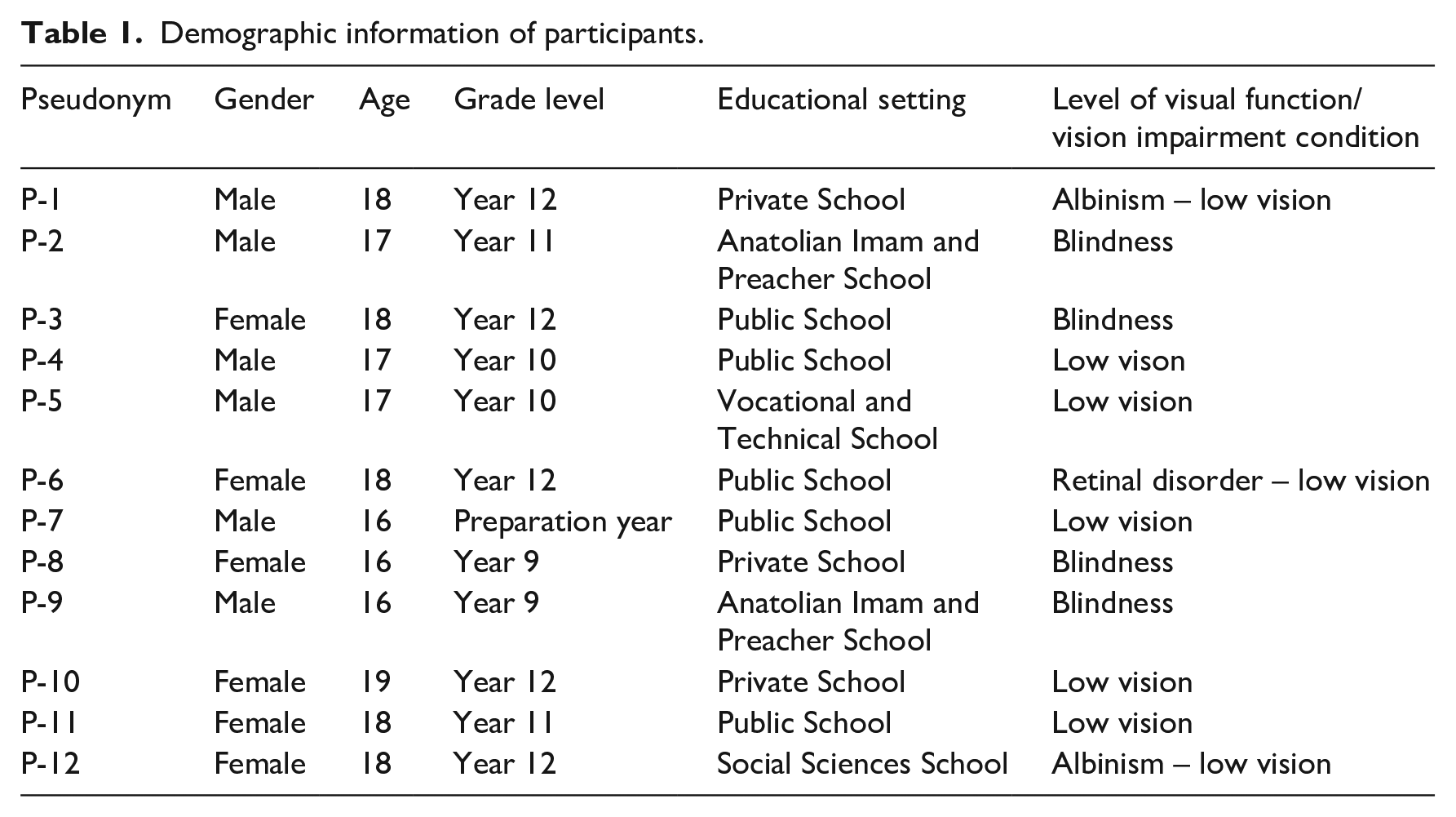
Twelve students with vision impairment (6 males and 6 females) who were studying at upper-level secondary schools in Turkey participated in the study. Participants’ ages were between 16 and 19. Excluding one participant (P1), all participants reported that they live with their families. One of the participants stated that he lives with his mother (P9) and one participant reported that she lives with her parents and grandparents together (P6). While most of the participants (n = 7) reported that they receive additional educational support to improve their academic skills in current school setting (i.e., in resource rooms), none of them reported that they have currently additional educational support outside the school to improve their independent daily living skills (i.e., special education and rehabilitation centres). Participants’ other demographic information was illustrated in Table 1.
Demographic information of participants.
Procedure
One of the aims of the study was to investigate barriers and enablers to independence and readiness of young people for higher education by reflecting the views of young people themselves. Semi-structured interview approach, therefore, was applied to ensure ‘deeper’ insights into how young people perceive enablers and barriers with respect to their own life experiences while providing flexibility for the researcher. Semi-structured interview schedule was designed in relation to nine ECC content areas (Sapp & Hatlen, 2010) to cover key topics relating to independence and readiness of young people prior to starting higher education (see Box 1).
Design of the semi-structured interview schedule.
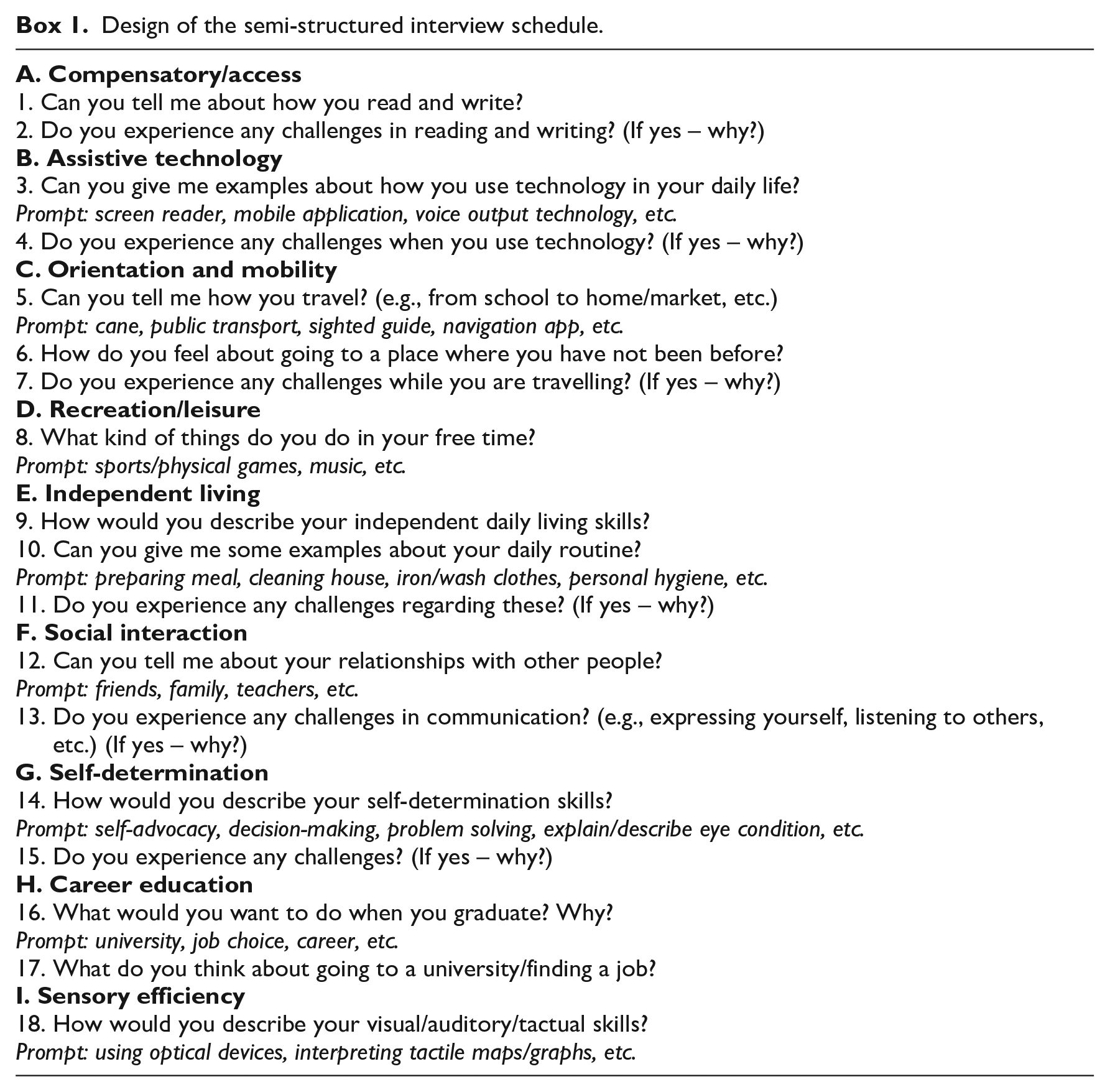
As indicated by O’Brien et al. (2014), researchers’ characteristics including their personal attributes and assumptions may influence the research. Taking this into account, it can be inferred that the author’s assumptions regarding the lack of independence skills among Turkish young people with vision impairment have impacted the design of the study. For instance, the interview schedule included specific questions such as ‘do you experience any challenges in [. . .]’, as illustrated in Box 1.
After gathering an ethical permission from Turkish National Ministry of National Education (MoNE) in Ankara, contact information of young people, who have been registered as students with vision impairment, studying in mainstream upper-level secondary schools in the two cities of Turkey have been gathered from the Department of Monitoring and Assessment in the MoNE (n = 64). Eighteen parents/carers of those students who study in different types of upper-level secondary schools (i.e., private, public, vocational and technical school) were contacted through phone by the author. The consent form which included information about the study (voluntary participation, anonymity, confidentiality, potential for harm and results communication) were emailed to these parents/carers. Then, 12 students whose parent/carers signed the consent form were interviewed by the author through phone. The phone interviews lasted approximately 50 to 55 min. Prior to starting interviews, all participants were also given their verbal consent.
Data analysis
To investigate how young people with vision impairment perceive enablers and barriers and what factors improve or reduce their independence and readiness for higher education, an interpretative phenomenological approach (IPA) was used. It was assumed that this approach would not only allow to gain an insight into personal experiences of young people regarding barriers and enablers to their independence and readiness for higher education but also to reveal the meaning of these personal experiences. As Smith et al. (1999) state, IPA ‘is concerned with an individual’s personal perception or account of an object or event as opposed to an attempt to produce an objective statement of the object or event itself’ (p. 218). Considering potential different perceptions of young people regarding enablers and barriers to their independence and participation, it was assumed that IPA would enable to explain in detail how young people were ‘making sense of their personal and social world’ (Smith & Osborn, 2003, p. 53) regarding their independence and readiness for higher education.
In relation to phenomenological research Denscombe (2014) states that interviews can be conducted with members of a particular group who can provide insights into their thinking, experiences, and reasoning which ‘allows the researcher to see things from the member’s point of view’ (p. 99). Since the aim of this study was to explore the own perceptions of young people with vision impairment regarding factors that enable or hinder their independence and readiness, semi-structured interviews were designed to explore how they perceive their independence skills in relation to nine ECC content areas prior to starting higher education. Throughout the process of analysing the data, a significant emphasis was placed on understanding how young people naturally perceive and encounter concepts like ‘enabler’ and ‘barrier’ in relation to their independence and readiness. This approach aligns with Finlay’s (2014) recommendations for conducting IPA (p. 123). For example, some participants recognised external factors that seemed to support their independence in specific areas of the ECC, even though these factors did not genuinely enable them to be independent in those areas. In such cases, the participants’ individual experiences were considered as their own ‘truth’, and the focus of the analysis was on exploring the subjective significance they assigned to the notions of ‘enabler’ and ‘barrier’, rather than imposing external definitions or standards.
In the data analysis process, the quotes and identified themes/concepts were given to a researcher holding a PhD degree in vision impairment education, who was not involved in the study, to check the categorisation of the quotes to either confirm (i.e., ‘agree’) or disprove the author’s interpretations of the data (i.e., ‘disagree’), and to recommend any other categorisation. As an external auditor, he ‘examined whether or not the findings and interpretations were supported by the data’ (Creswell, 2013) through indicating whether he was ‘agree’ or ‘disagree’ with the author’s categorisations of the quotes (p. 252). Following the accuracy of the categorisations between the author and the external auditor was found to be at high (approximately 95%), as illustrated in Table 2, the following four higher-order themes were revealed: (1) personal characteristics, (2) parental factors, (3) educational support, and (4) people’s attitudes.
Data analysis procedure (adapted from Smith & Osborn, 2003).
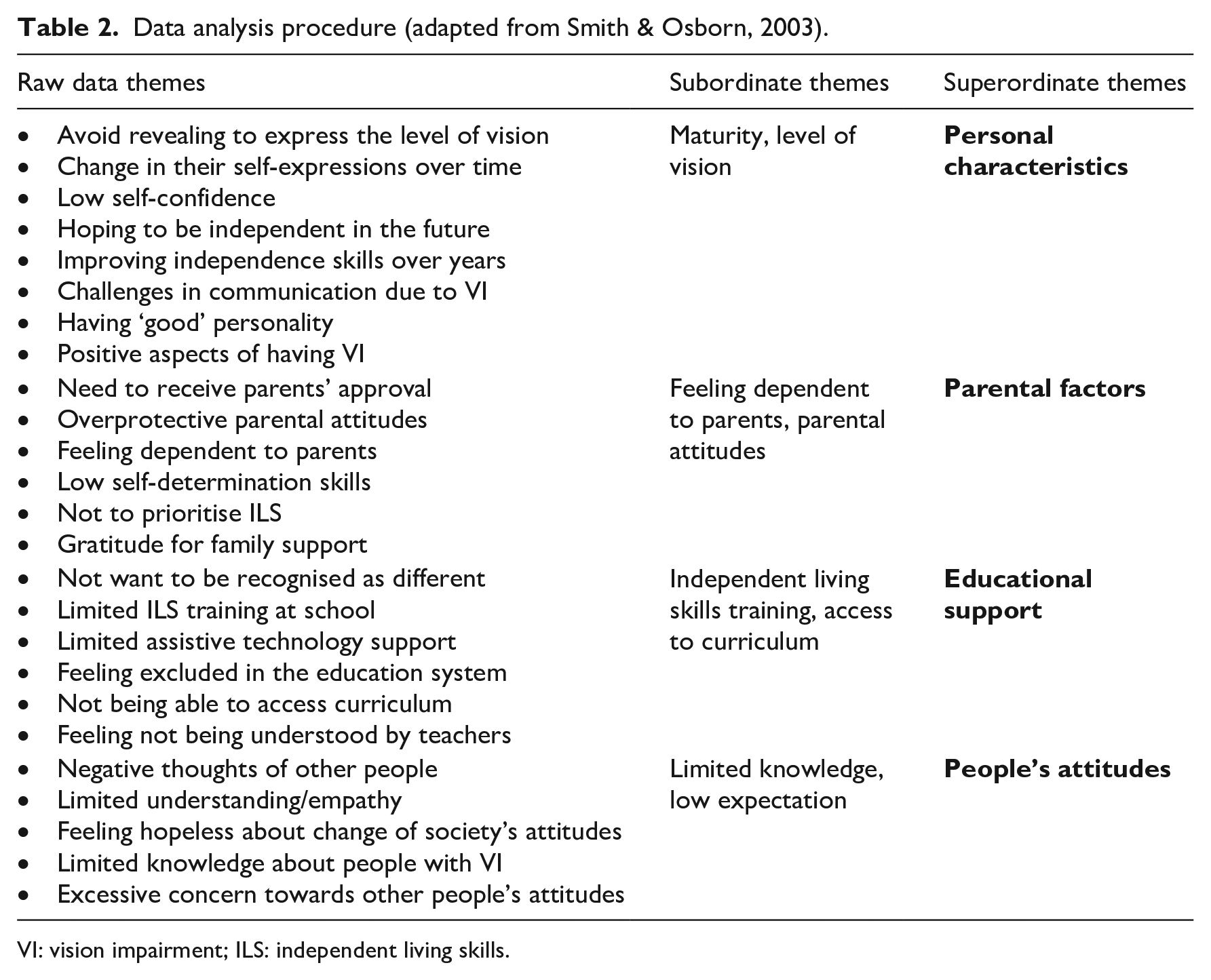
VI: vision impairment; ILS: independent living skills.
Findings
Personal characteristics
Most of the young people who participated in interviews (n = 9) tended to believe that their personal characteristics, such as having ‘good’ personality or being self-motivated, are significant factors which impact their readiness for higher education and independence. More specifically, maturity seemed to be one of enablers to independence since more than half of the participants (n = 7) expressed that they have improved a number of independence skills, including mobility, social interaction, and self-determination skills, over time. For example, some of them expressed they felt ‘better’ in communicating with people (P4, P8) or making new friends (P1, P8) in comparison to previous years. Similarly, some of the participants reported that they improved their mobility skills by time (P1, P3, P11). For this reason, it seemed that the young people commonly believe that when they get older, they would become ‘more’ independent, as directly referred by two of the participants: Not now but in the future, I believe I can live independently. (P10) I think I will be able to be independent when I get older. (P7)
With regards to personal characteristics, some of the participants (n = 4) did not identify their level of vision as a barrier to their readiness for higher education and independence, as stated below: My vision impairment is severe, but it doesn’t bother me. I don’t feel like I’m incapable. (P6) . . . if I’m honest with you, I even consider my vision impairment as a privilege. (P3)
Nevertheless, a number of barriers, such as difficulties with social relations were reported by a number of participants (n = 4) as the result of their level of vision. For instance, when they were asked about how they express their educational support needs to their teachers, a few reported that they ‘used to feel ashamed’ (P9) or ‘had some hesitations’ (P1) while they were talking about their level of vision. Two of them, for example, made reference to their negative previous experiences in relation to situations where they expressed their level of vision, as the following quotations illustrate: I’m not shy but I can’t tell any of my classmates that ‘let’s go out’. I suppose this is because of my vision impairment . . . No, this is definitely because of my vision impairment. I want my friends to accept me – I don’t want to try to be accepted by them. (P8) Once, when we argued, one of my friends said that ‘we accepted you in our [friend] group despite you are blind’ after he learned that I have been identified as an individual with low vision. (P5)
A few of the participants (n = 2) also tended to have excessive concern about other people’s thoughts towards themselves due their levels of vision, which seemed to impact their social interactions. For example, one of them stated that . . . because of that I feel hesitant to communicate with people. I think I have some kind of paranoia. Sometimes, I feel everyone thinks negative things about me. (P9)
The levels of participants’ vision also appeared to impact their readiness for higher education as some of them (n = 5) indicated a reluctance to leave their hometowns for university. The participants specifically mentioned their preference to stay in their hometown for university due to their reliance on others (particularly a family member) to meet their daily needs. It is also worth noting that one of the participants shared an interesting perspective, mentioning that her decision regarding higher education is influenced by her vision impairment, which has led to a lack of trust in other people: I don’t trust people as a visually impaired person [. . .] if I study in a university in another city, I will ask my family to come and live with me there. (P11)
Parental factors
All of the participants, except for one, reported that they live with their parents (n = 11). Regarding daily living, most of the young people (n = 8) reported that their mother takes responsibility for tasks at home, such as cleaning their rooms or cooking. In line with this, constant daily support from parents was mostly described by the young people as an enabler to their participation in life. However, the findings suggested that the young people tended to feel somehow dependent on their parents, and this might impact upon their readiness for higher education. For example, while they were expressing their views regarding their independent living skills, a few of them used phrases such as: ‘I can’t do anything without my family’ (P10) or ‘my mum should always be beside me for help’ (P5). A few of the participants (n = 3) also reported that their parents had some ‘overprotective’ attitudes towards themselves, expressing that their mothers ‘never allows them to cook in the kitchen’ (P8; P9) or their mothers ‘do not want them to do housework’ (P3). Perhaps unsurprisingly, some of them (n = 5) seemed to not want to leave from their hometown to go to university, as the following statement illustrates: I can’t live without my family. [. . .] If I have to study in a university not in Ankara, I’ll want them to come with me. (P7)
More specifically, when asked about their future plans, such as going to university or finding a job, a few of the participants (n = 3) reported that they would consult their parents’ opinions to make the ‘right’ decision. For example: I always take my parents’ advice because I’m sure if I make a wrong decision, they would warn me. (P6) Because older people have more life experiences, I care about the opinions of my teachers, my family, and other people who are older than me. (P4)
Educational support
Some of the participants (n = 4) emphasised a lack of appropriate formal education in developing and promoting independent living skills. Perhaps unsurprisingly, the role of schools in preparing young people with vision impairment to life was described as ‘not enough’ for living independently, as stated by one of the participants: Life is not only in schools. There is a life outside too. This should be considered while providing education for us. (P8)
In line with this, a few of the participants (n = 2) tended to believe that their independence skills have improved (or will improve) over time with experience or additional supports outside the school. For example, one of the participants recognised the role of special education and rehabilitation centres in Turkey, which offer training in independent living skills, in developing his own independence skills (MoNE, 2021): In terms of independent living skills, literally there is no training at school – neither in mainstream nor in special schools. I learnt all I know in the rehabilitation centre. (P2)
Another issue regarding educational support was reported in relation to access to the curriculum. The young people mostly reported that there is a limited educational support provided for learners with vision impairment in schools, including a lack of accessible materials and assistive technology tools (n = 5). However, one of the participants reported that he did not face any barrier while accessing the curriculum, stating these: I can take a photo of the blackboard with the permission of my teachers. Also, they make the exams in large print. They are trying to help me. God bless them. (P4)
Apart from this, a few of the participants (n = 2) tended to believe that they did not receive enough educational support to be able to feel ‘fully’ independent in school because they required support from their teachers and peers to access the curriculum, as illustrated by the following statement: I can do many things on my own but sometimes you really need someone. [. . .] The teacher writes a question and sends the photo of the question. There are some apps for audio description, but it has limitations. I have to ask someone to tell me what it is written there. (P2)
People’s attitudes
While sharing their views, the majority of the participants (n = 7) identified people’s attitudes towards individuals with vision impairment as a barrier to their independence. In particular, a few of them (n = 2) reported that a limited understanding in society regarding people with vision impairment. Although no negative previous experiences were shared regarding societal attitudes, it appeared that some of the young people (n = 4) tended to feel that potential negative attitudes had an impact on their independence, as illustrated by the following two statements: When people see I can type something in WhatsApp – they get surprised and ask me how I can do. [. . .] People don’t know anything about visually impaired people. They get surprised when they see what we can do. (P12) I didn’t use cane when I was a child. [. . .] I think this was because of the society’s attitude towards cane. It is like . . . if I use cane, people may think that I’m incapable. (P3)
Similarly, within the context of education, one of the barriers to independence and readiness for higher education appeared to be related to teachers’ attitudes. This was because a few of the participants (n = 3) reported that teachers working in mainstream schools may not have adequate knowledge about how to support learners with vision impairment. In particular, low expectations of teachers were defined as one of the barriers to their readiness for higher education. The following quotations illustrate this: I expressed my situation to a teacher. He said to me: ‘How will I teach you this?’. I said: ‘What is the difference between me and a normal [sighted] person?’. Then, he said: ‘But you can’t see’. (P2) Some teachers treat me as if I have intellectual disabilities. (P11) Teachers should understand that they don’t need to prepare easier questions for us in exams. Most of vision impaired students don’t want to go to universities considering they will not be successful at university. (P9)
Discussion
This study explored the experiences and views of 12 young people with vision impairment, providing insights into young people’s own definitions of what they believe has (or not) enabled them to develop their independence and prepare for higher education. Although the data was analysed through IPA to illustrate how young people were ‘making sense of their personal and social world’ (Smith & Osborn, 2003, p. 53) regarding their independence and readiness for higher education, some of the findings in this article mirror the results of previous studies. For instance, the findings presented here had a few similarities with Douglas and Hewett’s (2014) study, in which they revealed that personal characteristics were identified by young people with vision impairment as an enabler for contributing to their independence. As another example, in relation to barriers that were identified in this study, the findings supported previous research findings which suggested others’ attitudes as one of substantial barriers to independence of young people with vision impairment (Bishop & Rhind, 2011; Firat, 2021; Simui et al., 2018). However, this study particularly illustrated that attitudes of teachers and parents, including teachers’ low expectation and overprotective attitudes of parents, have been identified as external barriers to independence of young people with vision impairment.
Although the findings supported some of prior research, an interesting insight was provided by this study that how the young people perceived the notion of their independence. Since the participants mostly appeared to believe that they would promote their independence skills at a different time (in the future) and in a different setting (not at home or school), the findings implied that developing independence skills has not been highly valued by the participants at the present time. The findings presented here, therefore, raise concerns about how formal education in schools in Turkey prepares learners with vision impairment for higher education, particularly in light of some participants’ concerns about leaving their hometown to attend university. For instance, it may well be argued that a lack of formal and structured school education focusing upon developing independence skills (such as teaching the ECC skills) may cause delay for developing independence of learners with vision impairment. In line with this, possible limited emphasis upon teaching independence skills in schools may be a reason of that the young people believe they would improve their independence skills by time through having more experience outside the school. This may be also considered with linked to limited stress on improving ‘learning to access’ skills in schools as indicated in a study of Akbayrak and Douglas (2022), in which the roles of teachers of learners with vision impairment were investigated in Turkey.
Another interesting insight was provided with the study that how the young people perceive their personal characteristics as a factor impacting on their independence. Although the young people mostly identified their personal characteristics as an enabler to their independence, it appeared that they tended to believe that the levels of their vision might create some barriers while participating in education and life (e.g., concerns about expressing their vision impairment and leaving from their hometown for going to university). Therefore, considering the concept of ‘agency’, which ‘describe(s) an individual’s perception that they have control over their life to influence events’ (McLinden et al., 2020, p. 7), it can be argued that the level of vision may be perceived by young people in Turkey as a barrier to their development of agency, hindering their independence and readiness for higher education.
Accordingly, this study presented useful insights for decision-makers and policy-makers regarding how they may well provide educational support for learners with vision impairment. The findings suggested that formal education in Turkey should place much more emphasis on developing the independence of young people with vision impairment through a systematic and formal approach, in order for young people to ‘have control over their life’ (McLinden et al., 2020, p. 7) as active and independent individuals. In line with this, the study findings mainly highlighted the necessity of implementing a specialist curriculum designed for learners with vision impairment in Turkey, such as the ECC or CFVI.
Conclusion
The research findings identified a number of enablers and barriers encountered by the young people with vision impairment who were enrolled in upper-level secondary schools in Turkey. The factors impacting on independence and readiness for higher education were identified by the young people who participated in interviews as follows: (1) personal characteristics (i.e., maturity, level of vision), (2) parental factors (i.e., feeling dependent to parents, parental attitudes), (3) educational support (i.e., access to curriculum, independent living skills training), and (4) people’s attitudes (i.e., low expectation, limited knowledge). The study findings raise some concerns as a number of educational barriers have been revealed, such as a lack of structured and formal specialist curriculum training in schools, which have an impact upon independence and readiness for higher education of young people with vision impairment in Turkey. Accordingly, the research evidence mainly suggested that the concept of developing independence is required to be considered as an ongoing process throughout life span of learners with vision impairment within educational context and learners with vision impairment should be provided with a great number of opportunities within and outside school settings to develop their independence skills from an early age through a specialist curriculum (e.g., ECC or CFVI).
Limitations
This study had a number of limitations, which makes the findings should be interpreted cautiously. First, this study gathered the views from a small homogeneous group of young people in conformity with IPA (Smith & Osborn, 2003); therefore, it may not represent the views of all young people with vision impairment studying at upper-level secondary education schools in Turkey. Second, to gain an insight into how the young people conceptualise their independence and readiness for higher education, the interview schedule was designed in accordance with the ECC content areas considering the ECC is ‘the most commonly and consistently appears term in the literature’ (Douglas & Hewett, 2014, p. 82). However, the ECC is not internationally accepted as a specialist curriculum for learners with vision impairment, and the notions of ‘readiness’ and ‘independence’ are considerably complex concepts that cannot be explained solely within the scope of the ECC. Third, this study provided limited insights relating to enablers and barriers to independence and readiness for higher education from the perspectives of the young people with vision impairment. By triangulating the views of other agents around the young people, such as families, teachers and other professionals, future studies would enable to provide more useful information regarding barriers and enablers to independence and readiness of young people with vision impairment for higher education.
