




Abstract
Camp Abilities (CA) is an educational summer camp for children and youth with visual impairment (VI), developed in 1996 by Dr Lauren Lieberman at The State University of New York at Brockport and implemented internationally. The uniqueness of the program is that it provides opportunities for sports exposure and motor development, teaching physical education (PE) and adapted physical education (APE) for undergraduate and graduate students and research. CA has contributed to numerous publications but, to date, no systematic review has been published. Therefore, the aim of this study was to conduct a systematic review of quantitative studies conducted in CA, to document the themes investigated, to analyze the characteristics of the studies and the effects of interventions delivered, and to synthesize the results. This process identified 24 articles that examined 11 research themes. It identified several key findings, research gaps to guide future research, as well as practical implications for practitioners.
Introduction
Children and adolescents with visual impairment (VI) are considered to be at risk for sedentary lifestyles and obesity. Indeed, their physical activity (PA) participation (Augestad & Jiang, 2015; Haegele & Poretta, 2015) as well as their motor competence and perceived motor competence (PMC) tend to be lower than those of their sighted peers (Brian, Starrett, Pennell, Haibach-Beach, Gilbert, et al., 2021; Stribing et al., 2022; Wagner et al., 2013). This may be due to a number of barriers that limit access to PA (Armstrong et al., 2018; Robinson & Lieberman, 2004) such as limited access to physical education (PE) lessons, lack of training and professional preparation of teachers to adapt the lessons, lack of equipment, and lack of knowledge to adapt the school curriculum (Columna et al., 2019; Lieberman et al., 2002). In their families, the barriers reported by parents are fear of injury, beliefs about their child’s abilities, lack of opportunities, and lack of training from coaches (Linsenbigler, 2018; Stuart et al., 2006). Finally, youth themselves may constitute barriers by perceiving themselves as inferior and less competent than their sighted peers (Brian, Tauton, Haibach-Beach & Lieberman, 2018; Stuart et al., 2006). To overcome these barriers and provide access to PA, Camp Abilities (CA) developed in 1996 by Dr Lauren Lieberman at The State University of New York at Brockport is an educational sports camp for children and youth with VI, blindness, or deafblindness (Furtado et al., 2017; Haegele et al., 2014). In 1996, the first edition of the CA served 27 campers–athletes with VI under the supervision of about 30 professionals. Since then, CA served more than 4000 students at over 22 locations across the United States and in countries including Canada, Costa Rica, Finland, Ireland, Guatemala, Portugal, Bangladesh, Ghana, Kenya, and Switzerland. The uniqueness of the program is that it provides opportunities for (1) sports exposure and motor development for youth with VI, (2) teaching PE and adapted physical education (APE) undergraduate and graduate students how to teach youth with VIs, and (3) research (Furtado et al., 2018; Haegele et al., 2014; Lieberman et al., 2019).
The operational characteristics of CA
Participants, also called campers and/or athletes, are youth and adolescents with VI aged between 7 and 18 years. Campers must have a VI that requires a vision teacher. The official classification used in CA is the United States Association of Blind Athletes (USABA), in which vision levels are divided into four levels (B1, B2, B3, and B4) (USABA, 2017). CA accommodates between 20 and 55 campers each summer and lasts from 3 days to 1 week (Haegele et al., 2014). CA provides an opportunity to explore and overcome personal physical limitations while learning to advocate for oneself (Goodwin et al., 2011; Lieberman & Childs, 2020). Most directors of CA have an academic background in APE, PE, special education, or a related field, and often hold a university position. Their primary responsibilities include facilitating collaboration with university facilities, recruiting sports specialists and coaches, and directing undergraduate and graduate student research. Sports specialists and coaches are responsible for teaching specific sport lessons. Coaches, also called counselors, work in a one-on-one relationship with campers throughout the camp. Coaches are 18 years of age or older and are students in training from different fields such as PE, APA, or orientation and mobility teachers. Training typically includes information about VI, teaching orientation and mobility, intervention strategies, and immersion in all sports activities offered during the week. Finally, each CA is responsible to fund their camp from different foundations according to the local partnerships developed (e.g., foundation, grants from local organizations, fundraisers, and donations) (Furtado et al., 2018).
Teaching
Sports, physical activities, and instructional strategies
The program teaches different sports and physical activities in the mornings and afternoons during 5 days of the camp week. Each sport is offered at least two times so that the athletes can progress. The sports offered include but are not limited to goalball, beep baseball, judo, track and field, swimming, tandem bike, stand up paddle board, blind soccer, and gymnastics. In the evening, other activities are also offered with recreational and social objectives, such as socialization among the participants. To adapt instruction, different modifications can be personalized to each athlete, such as modifying equipment, modifying rules, or adapting the environment, or using of different instructional strategies. Finally, CA allows teaching of the nine areas of instruction through infusion of the Expanded Core Curriculum (Lieberman et al., 2021).
Research
One of the strengths of this camp is that it brings together individuals from a population that is geographically dispersed, which facilitates research in this field. The involvement of undergraduate and graduate students in CA field research allows for the development of scientific skills and rich experience in presenting their work at conferences or symposiums. This collaborative strategy across CA locations is positive for strengthening the validity of the studies by increasing the sample size (Furtado et al., 2018). Since its inception, many researchers have conducted research at CA. However, to date, no systematic review of the literature or synthesis of knowledge has been published. A systematic review of CA is relevant for several reasons. First, it will allow to identify all the studies carried out in the CA and the themes studied, as well as the different instruments used. In addition, it will allow the various directors of CA to become aware of the studies published to date and the themes studied, which could be inspiring for the development of new research. Finally, it allowed us to identify gaps in the subjects studied in order to orient future research. Therefore, the aim of this study was to conduct a systematic review of quantitative studies conducted in CA. Specifically, the objectives of this systematic review are (1) to identify all quantitative studies conducted in CA; (2) to document the themes investigated in the selected studies; (3) to analyze the characteristics of the studies and the effects of interventions delivered; and (4) to synthesize the results.
Method
Study selection
The literature review was performed according to the Preferred Reporting Items for Systematic Reviews and Meta-Analysis (PRISMA) guidelines (Page et al., 2021). In order to identify relevant studies, the following electronic databases were consulted: Web of Science, OvidSP, EBSCOhost, and SAGE Journals from 1996 (corresponding to the first year of CA) up to 2022. In addition, a contact with the director and founder of CA allowed a verification of the publications by consulting the resume and the ResearchGate profile. The keywords used in the research were visual impairment, camp abilities, summer camp.
Inclusion and exclusion criteria
To be included in the review, each study had to be written in English, peer-reviewed, and published in academic journals. As established by the Population, Intervention, Comparison, Outcome, Time (PICOTS) method (Hartmann et al., 2012), the following criteria were defined: Population (P) of the study must be defined by the authors as children or adolescents with VIs, aged 7–18 years, with or without other disabilities; Intervention (I) should be conducted during CA; Comparison (C), no comparative intervention was necessary; Outcomes (O) or results should have been quantitative data collected during CA; Timing (T), the study must be published between 1996 (corresponding to the first year of CA); and Setting (S) of study should have been CA. Studies could be descriptive or experimental, testing the effects of an intervention conducted during CA. Exclusion: Studies were excluded for different reasons, such as qualitative studies or theorical articles on CA without results. This procedure identified 271 articles. A first selection of 36 articles was made after reading the titles, the keywords, and the abstract. Next, a full reading of the articles resulted in 19 articles that met all inclusion criteria. Five additional articles were identified by snowball effect and direct contacts with researchers involved in CA. Finally, a total of 24 studies were included in the systematic review. Figure 1 presents the flowchart diagram based on PRISMA guidelines and summarizes the procedure (Page et al., 2021).
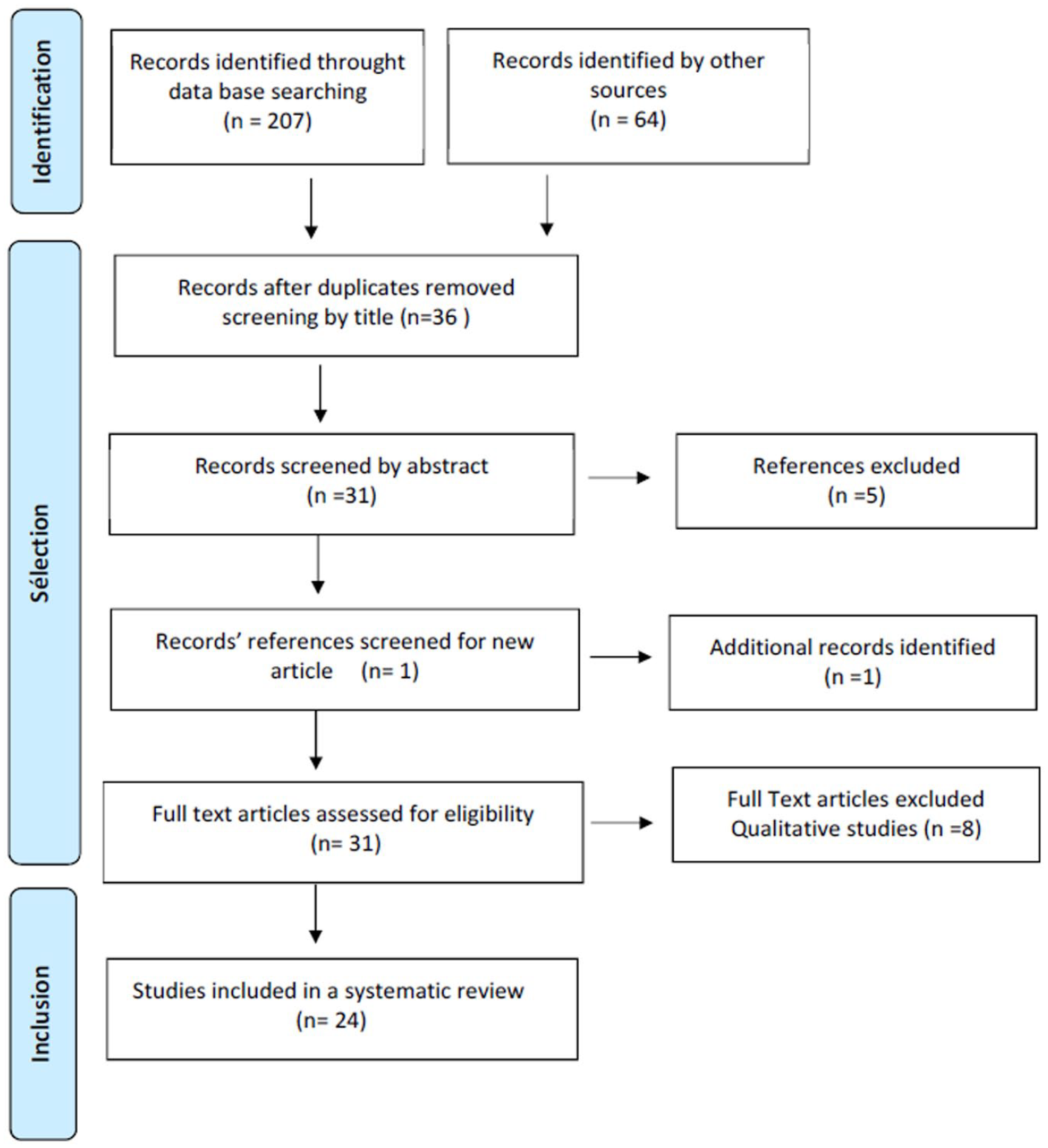
Flowchart.
Data extraction
A data form was used to extract key information from the studies. The study specifications were categorized following the classification used by Haegele et al. (2015). Five categories were utilized: (1) descriptive studies describe a given state of affairs without describing relationships or differences between groups; (2) intervention studies attempt to establish a cause-and-effect relationship with pre–post measures; (3) correlational studies explore relationships between variables; (4) comparative studies use techniques to test for differences between different groups of participants; and (5) validation studies examine the psychometric qualities of instruments. For each study, data were extracted on the characteristics of the studies, themes investigated, instruments used and main findings were extracted. As this systematic review aims to provide an overview of the studies, the results will be summarized by presenting the main findings without reporting the statistical analysis to lighten the results. The included studies were presented in different tables and then detailed by theme chronologically to present the evolution of the themes over the years.
Quality assessment
Assessment of study bias was performed according to the criteria used in another systematic review in the field of adapted PA (Furtado et al., 2017), which was an adaptation of Downs and Black (1998). Eight criteria were applicable for descriptive, correlational, comparative and validation design (n = 20 studies) and ten criteria were applicable for intervention studies (n = 4 studies). For each criterion, the score Yes was given if the criterion was present (1 point) and No if it was not present (0 point). The score obtained for each study was converted into a percentage and evaluated according to the quality classification proposed by Furtado et al. (2017). The quality of the study was considered Bad if the score was 21%–40%, Poor if the score was 41%–60%, Fair if the score was 61%–80%, and Good if the score was 81%–100%.
Interrater agreement
To ensure the validity of this method, several precautions were taken. First, the process of searching for articles in the databases was performed simultaneously by two researchers. Second, the risk of bias assessment was performed by two investigators on 25% of the studies (n = 6) (O’Keeffe & McNally, 2021). For each study, the sum of items in agreement between the two researchers, divided by the total number of items, yielded an agreement score of 78%. The authors felt that this score was insufficient and discussed their scoring to refine certain sub-criteria. As a result of this process, a second assessment of agreement was made with an average of 89% considered to be good.
Results
Study description
The studies analyzed were all conducted in the United States, with the exception of one study done jointly in the United States and Latvia. Among the 24 articles selected, 15 studies used a descriptive design (
Participants and camps
The participants were divided into three groups: athletes with VI (AVI) (n = 22 studies,
Characteristics of studies.
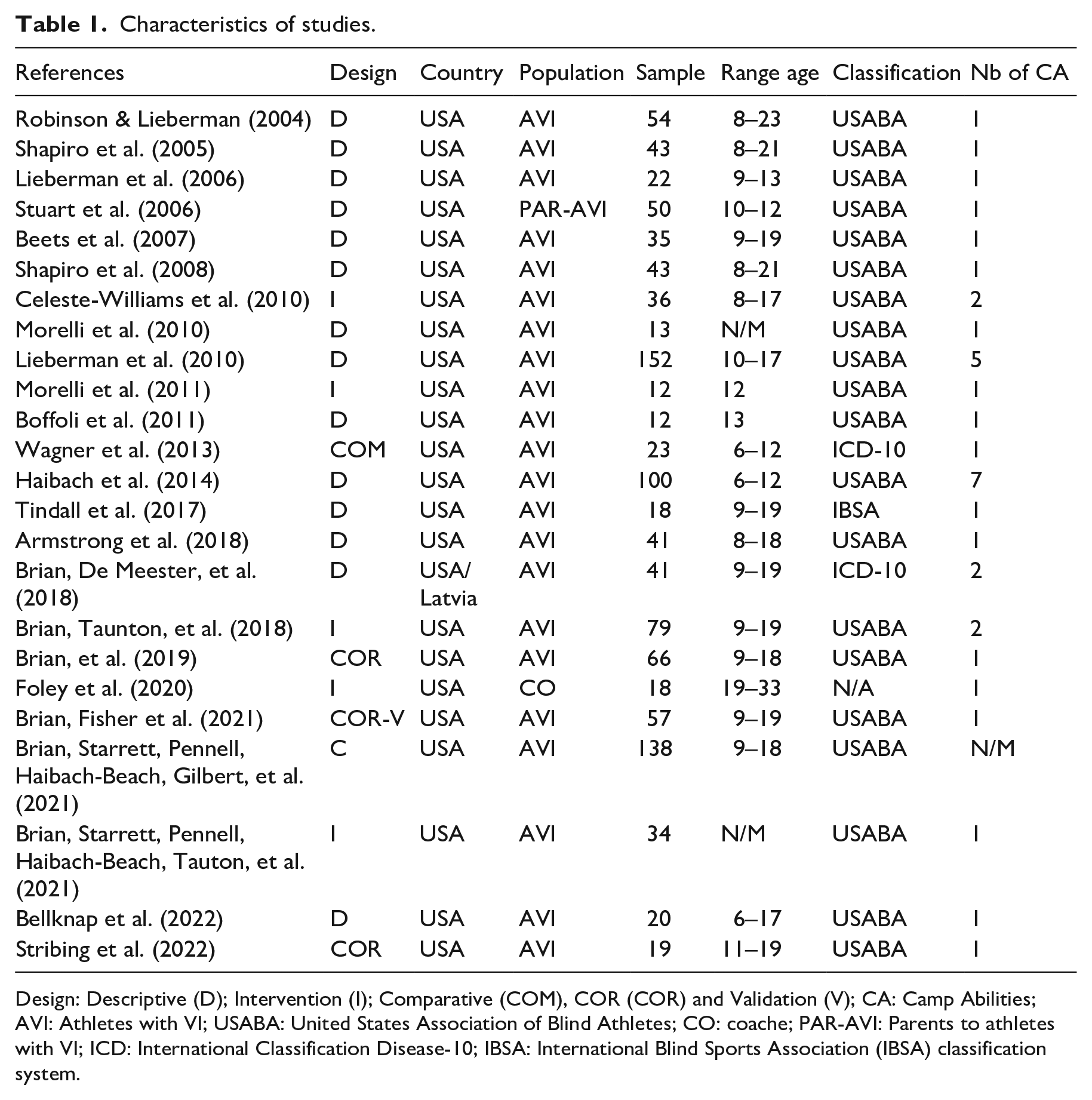
Design: Descriptive (D); Intervention (I); Comparative (COM), COR (COR) and Validation (V); CA: Camp Abilities; AVI: Athletes with VI; USABA: United States Association of Blind Athletes; CO: coache; PAR-AVI: Parents to athletes with VI; ICD: International Classification Disease-10; IBSA: International Blind Sports Association (IBSA) classification system.
Themes and instruments used
Articles investigated 11 differents themes such as (1) Fundamental Motor Skills (FMS) (n = 7), (2) Perceptions (n = 6), (3) Physical activity and barriers ([PAB] n = 5), (4) Walking (n = 2), (5) Exergames (n = 3), (6) Physical condition (n = 2), (7) Functional body image (n = 2), (8) Beliefs (n = 1), (9) Nutrition (n = 1), 19) (10) Self-determination (n = 1), and (11) Self-efficacy of coaches (n = 1) (
FMS
Seven studies assessed FMS of AVI with the Test of Gross Motor Development version II or III (TGMD-II/III) (
Three studies used correlational design to examined FMS of AVI (Brian et al., 2019, 2022; Stribing et al., 2022). Brian et al. (2019) examined associations among FMS (divided into locomotor and object control skills measured with TGMD-3), health-related fitness (HRF), BMI, and home- and sport-camp based PA for 66 AVI. The results confirmed that FMS and HRF are correlates with PA. Brian et al. (2022) examined the relationship between motor competence with TGMD-3, the PMC evaluated with the Test of Perceived Physical Competence-VI (TPPC), and the Physical activity with Physical Activity Questionnaire (PAQ) of 138 AVI (Mage = 13.37 years). The results indicated that the FMS predicted PMC, which predicted PA. In other words, PMC had a mediation effect on FMS but no significant relation was documented between FMS and PA. Stribing et al. (2022) also used TGMD-3 to examine the association among different variables (locomotor skills; age; gender; and degree of vision on self-perception, parent’s perceptions, and meta-perceptions). Conclusions indicated a significant difference in locomotor skills based upon the degree of vision, but not for any factor. As vision decreased, locomotor skills decreased for B1–B4. Finally, Brian, Fisher et al. (2021) also examined this topic with a validation and correlation study of the test Total Body Developmental Sequences (TDBS), a tool that measures FMS accross nine gross motor skills that practitioners can use to assess their students or clients during play or PE. Consequently, the authors concluded that TDBS could be used as an alternative for TGMD, since this tool represents more constraint and more time to adminster. This tool therefore represents a simplified and valid version of assessing the FMS of youth with VI that is easily used in practice. In conclusion, studies that examined FMS showed poorer skills than sighted youth and the longitudinal study confirmed that these delays increased over time. The more vision is affected, the more locomotor skills are diminished. Thus, youth with VI reach a plateau in FMS as well as an increase in BMI. These results have important consequences for their self-perception and that of their parents.
PMC
Six studies examined the theme of PMC (Brian, De Meester et al., 2018; Brian et al., 2022; Brian, Tauton, Haibach-Beach & Lieberman, 2018; Shapiro et al., 2005, 2008; Stribing et al., 2022;
Brian, Tauton, Haibach-Beach, & Lieberman (2018) compared the PMC before and after the camp with The Self-Perception Profile for Children (SPPC); The Self-Perception Profile for Adolescents (SPPA) and Perceived Athletic Competence Subscale of AVI and experimental group (n = 79, Mage = 12.71; control group = 20 AVI) were recruited from a school for deaf and blind students. The pre-camp measurement indicated that there was no difference between the groups for PMC. After 6 days of camp, the results revealed significantly higher levels of PMC than participants in the control group at posttest. Perceived motor skill levels among participants in the maintenance group (6 weeks later) were not significantly different from posttest to maintenance. In other words, the results of the experimental group confirmed that an intensive week of accessible sports can improve PMC in the short term (immediately after the camp), but also in the medium term, because the results were maintained over time (after 6 weeks). More recently, Brian, Starrett et al. (2022) also examined PMC and the relationship with FMS and PA of 138 AVI using the TGMD-3, TPPC-VI, and the PAQ. As mentioned in the “FMS” section, the results indicated that the FMS predicted PMC. More specifically, PMC mediated the pathway from locomotor competence to PA. Finally, Stribing et al. (2022) explored the relationship between FMS, PMC using TPPC for VI, parents perception and the representation that youth have of their parents’ perception (metaperception), and the differential effect of age, gender, and degree of vision. The results indicated that only degree of vision affected locomotor skills, but gender and age did not. Moreover, the authors concluded a signficant association among locomotor and self-perception, degree of vision and locomotor, and metaperception with parent’s perception. In conclusion, the authors examined the theme of PMC, which highlighted that FMS as well as vision could affect self-perception and parents’ perceptions. Nevertheless, these perceptions can improve with camp participation and be maintained over time.
PAB
Four studies examined the topic of PA levels (
Walking
Two studies investigated walking through evaluation of the number of steps of AVI using pedometers (
Exergames
Three studies investigated this theme (
Physical condition and fitness
Two studies examined this theme (
Functional body image
One study examined this theme (
Beliefs
One study examined the value parents place on their children’s PA and the barriers to PA that children face with The Subjectivity task value inventory and the questionnaire of self-efficacy based on Bandura’s theory (Stuart et al., 2006) (
Knowledges nutrition
Celeste-Williams et al. (2010) addressed the topic of nutrition by analyzing the effects of a nutrition knowledges taught during CA using the MyPiramid-based questionnaire (
Self-determination
One study investigated this theme with The Self-Determination Exercise Scale: Student Edition (Robinson & Lieberman, 2004) (
Self-efficacy of coaches
Finally, one study has examined the topic of self-efficacy of preservice PE teachers with the Self-Efficacy Scale for Physical Education Teacher Education Majors toward Children with Disabilities (SE-PETE-D) (Foley et al., 2020) (
Themes and instruments used.
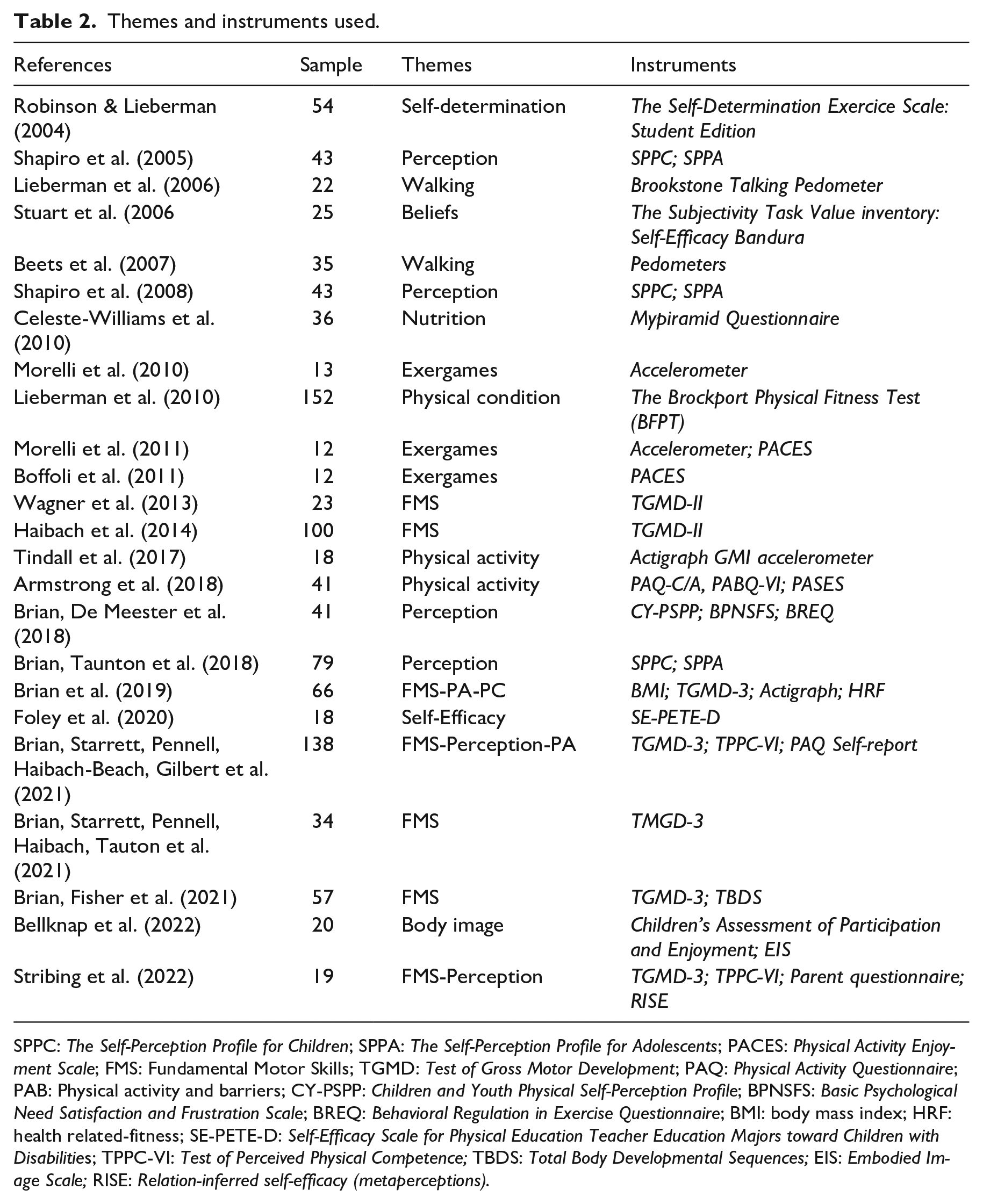
SPPC: The Self-Perception Profile for Children; SPPA: The Self-Perception Profile for Adolescents; PACES: Physical Activity Enjoyment Scale; FMS: Fundamental Motor Skills; TGMD: Test of Gross Motor Development; PAQ: Physical Activity Questionnaire; PAB: Physical activity and barriers; CY-PSPP: Children and Youth Physical Self-Perception Profile; BPNSFS: Basic Psychological Need Satisfaction and Frustration Scale; BREQ: Behavioral Regulation in Exercise Questionnaire; BMI: body mass index; HRF: health related-fitness; SE-PETE-D: Self-Efficacy Scale for Physical Education Teacher Education Majors toward Children with Disabilities; TPPC-VI: Test of Perceived Physical Competence; TBDS: Total Body Developmental Sequences; EIS: Embodied Image Scale; RISE: Relation-inferred self-efficacy (metaperceptions).
Quality assessment
The average overall quality is 89.13% (corresponding to good). More specifically, average quality for 20 descriptive studies is good (95.63%) as well as for intervention studies (87.5%). Among the methodological strengths of the studies analyzed, the criteria # 1–9 obtained a good score (81% and more). In the studies analyzed, these criteria are translated into good reporting (clear objectives, clear description of main outcomes, detailed description of participants, and main findings), good external validity (representativeness of population), and good internal validity (use of valid instruments and appropriate statistical tests to measure main outcomes). However, criteria # 4 obtained a fair quality (75%); these criteria were applicable only for four intervention studies. This weakness is reflected in the incomplete information reported concerning the intervention offered. Finally, criteria #7 scored poorly (58%), reflecting a weakness in the external validity, resulting in partial information about the practitioners (or the person who collected the research data). Table 3 presents the results of risk of bias assessment.
Quality assessment.
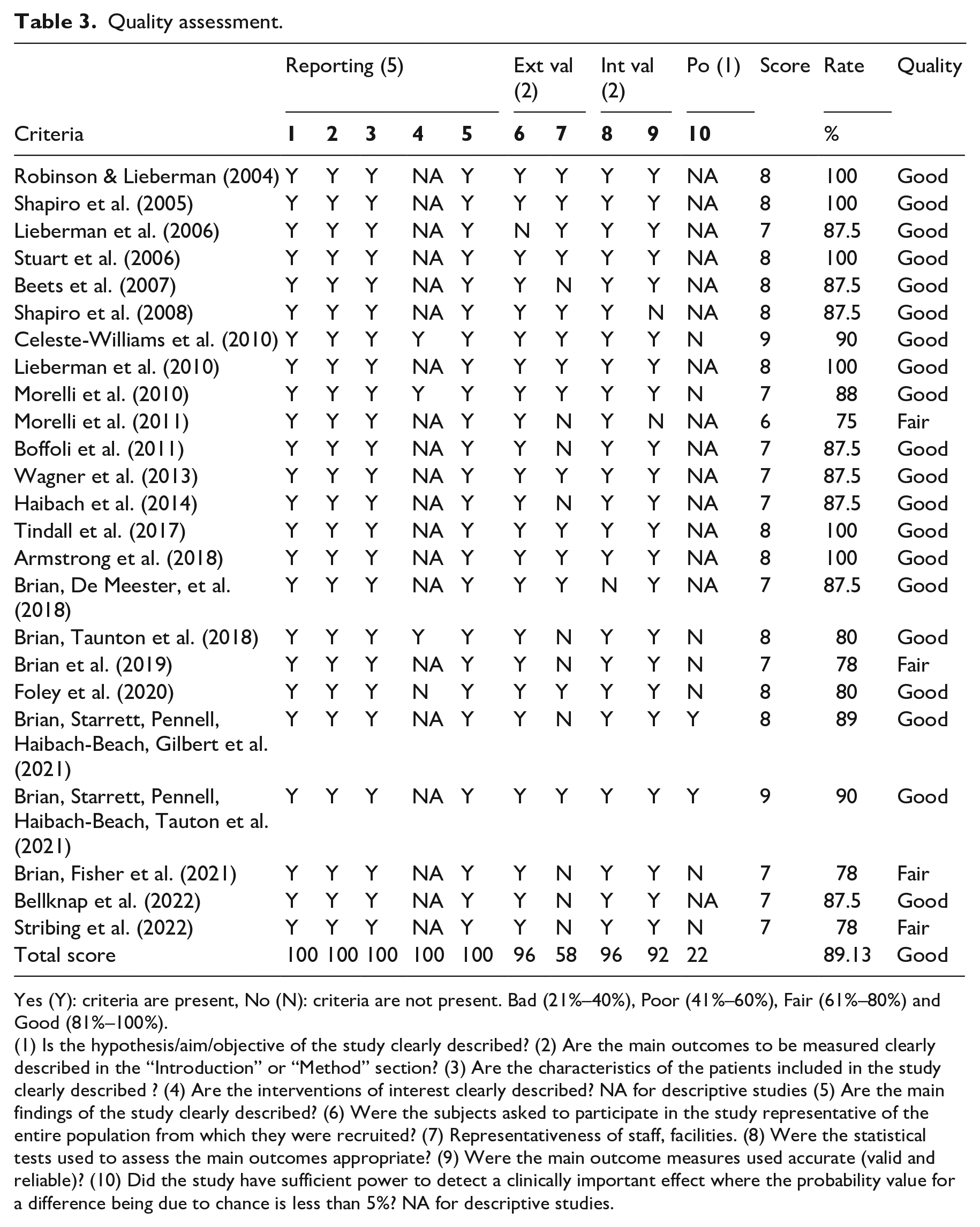
Yes (Y): criteria are present, No (N): criteria are not present. Bad (21%–40%), Poor (41%–60%), Fair (61%–80%) and Good (81%–100%).
(1) Is the hypothesis/aim/objective of the study clearly described? (2) Are the main outcomes to be measured clearly described in the “Introduction” or “Method” section? (3) Are the characteristics of the patients included in the study clearly described ? (4) Are the interventions of interest clearly described? NA for descriptive studies (5) Are the main findings of the study clearly described? (6) Were the subjects asked to participate in the study representative of the entire population from which they were recruited? (7) Representativeness of staff, facilities. (8) Were the statistical tests used to assess the main outcomes appropriate? (9) Were the main outcome measures used accurate (valid and reliable)? (10) Did the study have sufficient power to detect a clinically important effect where the probability value for a difference being due to chance is less than 5%? NA for descriptive studies.
Discussion
This systematic review of quantitative research conducted at CA reveals a tremendous amount of information related to 11 themes. While the majority of studies are descriptive (Lieberman, 2012), the analysis also identified intervention, correlational, comparative, and validation studies. This review described the trends studied through 11 themes in the three areas, namely (1) opportunities for youth with VI, (2) teaching experiences for graduate students, and (3) researchers (Furtado et al., 2018; Haegele et al., 2014; Lieberman et al., 2019).
Opportunites for youth with VI
One of the main themes examined in the articles was FMS. Brian, Tauton, Lieberman, et al. (2018) assessed the FMS of youth and adolescents with VI, mainly using the TGMD instrument, a test that is considered as valid and reliable to assess motor skills of youth with VI. Early identification of motor problems is crucial because inadequate motor performance can result in long-term consequences, including PA levels (Bakke et al., 2019; Haegele et al., 2015). Motor skill development, particularly for children with VI, is important as research has shown that they are often teased and ridiculed due to poor motor skills (de Schipper, et al., 2017). The TGMD test, originally developed by Ulrich and revised (Ulrich, 1985, 2000, 2017), has been adapted for youth with VI and the third version provides suggestions for adapting the items by adding, for example, brightly colored material to delineate the space, verbal signs, or audio to help the youth orient in the correct direction (Brian, Tauton, Lieberman, et al., 2018). An alternative for researchers and practicioners to assess FMS is the Brief form of TGMD-3 (Brian, Starrett, Pennell, Haibach-Beach, Tauton et al., 2021) or TDBS (Brian, Fisher et al., 2021). Globally, the motor skill results of AVI participating in CA scored lower than their sighted peers, a finding that converges with the results of AVI not participating in CA (Haegele et al., 2015). Although the use of standardized instruments such as TGMD has been criticized (Giese et al., 2023), these findings are satisfying because it shows that CA researchers have integrated recent knowledge into their research using tools considered to be the gold standard that have been validated and adapted to youth with VI (Bakke et al., 2019). This argument is troubling as current research has also shown that youth with VIs are bullied and teased (Ball et al., 2021) and they do not feel good about their FMS (de Schipper et al., 2017) when they do not attain proficient motor skills. In this sense, a new avenue for the CA could be to discuss movement goals and assessments with the youth themselves and ask them what they would prefer and which skills are useful and meaningful. Moreover, given the broad CA objectives of influsing the components of the Expanded Core Curriculum to practice different types of skills (e.g., assistive technology, orientation, and mobility), a broader angle than FMS would be interesting to describe participants’ functioning, especially since motor skills are related to adaptive behavior (Pineio et al., 2019).
A second opportunity for AVI is the improvement of their PMC. These themes were investigated by six articles, generally finding that AVI had lower perceptions, but that these perceptions could be improved and maintained following participation in a CA (Brian et al., 2018). In addition, these perceptions ares related to regular PA as well as to performance on motor skill assessments. Nevertheless, AVI tend to be more sedentary and engage less in PA (Augestad & Jiang, 2015; Haegele & Poretta, 2015). This review has identified some tools to assess the perception of motor skills (i.e., TPPC) (Brian et al., 2022), which is considered as valid and acceptable (Stribing et al., 2021). Nevertheless, measuring perceptions with pre-established criteria and norms could also be questioned. In this sense, other types of research, using a more qualitative method, would also make it possible to describe young people’s perceptions of their skills, without fitting them into a pre-established norm of a standardized tool. CA represents other opportunities for youth with VI as experimentation of new interventions (i.e., exergames), nutrition program, or opportunity to develop new skills of the Expanded Core curriculum (Lieberman et al., 2021) or self-advocacy skills (Lieberman & Childs, 2020). As a result, a deeper understanding of these areas would be necessary to understand how young people are evolving or would like to be trained in these areas, combining the opinions of parents.
Teaching experiences
Foley et al. (2020) revealed that improvements in perceived competence in teaching youth VI is extremely promising. This professional experience is therefore a rich experience considering that students and young professionals often feel they lack knowledge and training (Greguol et al., 2015; Lirgg et al., 2017; Sladewski et al., 2022). Thus, CA allows professionals to experiment new sports and test new adaptive equipment in a safe environment, circumventing the barriers associated with PA participation (Columna et al., 2019).
Research
For researchers, CA also represents a research laboratory as it allows for the combination of AVI from multiple camps to obtain larger samples (i.e., Haibach et al., 2014; Lieberman et al., 2010) as well as international collaborations (i.e., Brian, De Meester et al., 2018). CA also makes it possible to adapt tools specifically for youth with VI and to evaluate the psychometric properties of instruments in order to make them available to the scientific community (i.e., Brian, Fisher, et al., 2021; Stribing et al., 2021). Finally, CA provides a research vehicle to study many themes such as participant characteristics and the testing of different types of innovative and adapted interventions for youth with VI, such as exergames (Morelli et al., 2010, 2011) or the pedometer with voice announcement (Lieberman et al., 2006). Although not analyzed in this article, the CA also permits qualitative studies to explore themes such as youth motivation, meaning of camp (Goodwin et al., 2011), integration of ECC (Lieberman et al., 2021), outdoor adventure experiences (Lieberman et al., 2023), as well as teaching self-advocacy (Lieberman & Childs, 2020).
Conclusion
The aim of this systematic review was to identify, analyze, and summarize the themes from 24 quantitative studies conducted in CA. One of the strengths is the quality of studies as well as a variety of the themes examined. Nevertheless, one important limitation is the representativeness of participants and generalization of findings. Considering all participants were recruited from CA and not from the general population, generalizing the results to another population (e.g., students from schools for the blind) is a limitation to the generalization of the results. In addition, the representativeness of the participants–coaches may also be a bias as the staff involved in the studies were predominantly from CA Brockport, so it is possible that the professionals are more highly trained and supervised than in the other camps. Finally, another limitation of this systematic review is the involvement of the main director in the process of this study. The two lead researchers were not involved in the CA research, and conducted the systematic review of the articles independently of the other authors. Despite this fact, the use of the scale to assess the risk of bias, a subjective view of the research object (CA) could have influenced the assessment of study quality, as could the angle used by the authors to present the findings.
Moreover, the results identify areas in need of further research. As a central goal of CA, assessment of FMS and the PMC remains a research priority, particularly with adapted and validated tools. Moreover, given the expanded goals of the CA, assessment of participants’ skills in other developmental domains would be relevant, including assessment of social skills, adaptive behavior, and daily living skills could be the focus of future studies. In this sense, the translation and/or the adaptation of tools specifically designed for AVI represents an important area for CA researchers. To complement this analysis of quantitative CA studies, a second systematic review specifically targeting qualitative studies would be a complementary perspective. To date, CA researchers have examined the various research objects with a predominantly quantitative approach, although there are many studies that have been qualitative and included the voices of the athletes with VIs over the years. In the future, it would therefore be interesting to systematically analyze the qualitative research studies conducted in order to share the voice of the participants, parents, and coaches using the qualitative studies to illuminate the various areas studied. Additional qualitative research could also include the definition of FMS, the description of PMC, or how they would propose that barriers be circumvented to enable them to have access to PA. In terms of practical implications, this review has identified an inventory of tests that could be used in practice as well as intervention. Finally, the findings support the benefits of CA and suggest that programs in other countries could be developed following this model.
