




Abstract
This qualitative descriptive study aims to explore the lived experience of the adjustment process of couples who face vision loss, investigating the impact of such loss on daily life and the adjustments and adaptations that ensue. To undertake such an exploration, the application of an occupational perspective is relevant where the meaning and purpose partners ascribe to their everyday activities can be investigated. A total of 16 couples living in Western Switzerland were interviewed between January and June 2020. Data collection was carried out with semi-structured face-to-face interview. Three themes emerge from the thematic analysis of transcripts. The first theme emphasizes that either separate or joint everyday activities of partners can be shared within couples, which all give sense to the partnership; the second one shows that vision loss disrupts the engagement of partners in such shared everyday activities. The third theme highlights partners’ efforts to reshape their engagement in their shared everyday activities in order to maintain a sense of couple’s we-ness. While navigating vision loss requires both partners to jointly engage in this process of reshaping, couples described tension that arises because of the partners with vision loss’ growing dependence on the other partner. One’s sense of control when navigating vision loss is critical to adjust to a changing and changed daily life. Further research is needed that focuses on how romantic partners ascribe a shared meaning and purpose to their engagement in everyday activities, separate or joint, and how such meaning and purpose are impacted by the onset or aggravation of one partner’s vision loss.
Keywords
Introduction
The consequences of vision loss on daily life can be far-reaching and wide-ranging, including, but not limited to, problems with social participation (Berger, 2012; Boey et al., 2021; Vu et al., 2005), communicating one’s needs (Bertschi et al., 2021; Heine et al., 2002; Wang & Boerner, 2008), community mobility (Berger, 2012; Justiss, 2013; Rudman & Durdle, 2008), as well as paid employment (Demmin & Silverstein, 2020; Mojon-Azzi et al., 2010). As such, it is not surprising this type of impairment might also affect those around the individuals with vision loss, including their family and friends. Over the past 10 years, there has been a growing body of evidence outlining the impact of vision loss on close relatives, such as romantic partners (Hofsöe et al., 2019; Lehane, Dammeyer, & Elsass, 2017; Lehane et al., 2018; Mamali et al., 2022).
Romantic partnerships have been defined as a form of relation that occurs between individuals, mostly two (Banse & Rebetez, 2008; Klesse et al., 2022), with the shared aim of a mutually satisfactory relationship (Santelli, 2018). The concept of we-ness emerged in the early 2000s from systemic-constructivist social psychology (Fergus & Reid, 2001; Skerrett, 2003). We-ness has been described as the sense of mutuality (togetherness) that can exist between romantic partners in a couple, which usually develops over the course of a relationship (Buehlman et al., 1992), where partners would identify themselves as being part of a joint entity that transcends beyond their individual self (Buehlman et al., 1992; Singer et al., 2015). As such, we-ness can be reflected in how each partner shares a similar experience of their daily events (Gildersleeve et al., 2017; Topcu-Uzer et al., 2021). Numerous studies demonstrated that partners shape the identity of their couple through engagement in daily activities such as leisure (Chavez, 2015), household (Kaufmann, 1992), taking care of children (Gildersleeve et al., 2017), or work (Gildersleeve et al., 2017).
Couples’ sense of we-ness can be challenged in the face of health-related changes (Rohrbaugh, 2021). Such changes can have a resulting impact on not only established routines but also the need to engage in new activities and/or ways of doing such activities. Vision loss is such a health-related change. This condition can be either sudden or progressive. In the case of progressive vision loss, sight typically changes more slowly over time. While one would expect that such a loss would impact not only the impact of the person experiencing vision loss but also their respective partner, this shared impact on daily activities and corresponding adaptation has yet been studied (Lehane, Dammeyer, & Elsass, 2017; Lehane, Dammeyer, & Wittich, 2017). By exploring the experiences of those living through this health-related change, there is a unique opportunity to explore how such changes are reflected in romantic partners’ we-ness as well as consider corresponding strategies that enable the continuity of their partnership. To undertake such an exploration, an occupational perspective may be of particular value where the meaning and purpose partners in relationship ascribe to their everyday activities, or occupations, can be investigated. A brief overview of this perspective is outlined below.
Using an occupational perspective to analyze meaning and purpose of everyday doing
Everyday activities are the set of individual and collective activities in which a person engages in daily life (Wilcock, 2006). Adopting an occupational perspective of daily life involves examining what and how people do their everyday activities and their corresponding experiences (Njelesani et al., 2014; Wilcock, 1993). Such activities reflect what a human needs, wants, and has to do, which has been linked to health, well-being, and quality of life (Wilcock, 2006). Some have described everyday activities as being both meaningful and purposeful (Hinojosa & Kramer, 1997; Ikiugu & Pollard, 2015; Wilcock, 2006). For example, an everyday activity may be considered meaningful if it addresses an “intrinsic need for self-maintenance, expression and fulfilment” (Law et al., 1996, p. 16).
The notion of shared everyday activity has been raised in the occupational science literature (Doble & Santha, 2008; Leclair, 2010). Such activities reflect mutual engagement “. . . with others who share common experiences, interests, values and goals” (Doble & Santha, 2008, p. 187). In this respect, shared engagement has the potential to inform and transform a romantic partnership through which a shared identity can emerge (van Nes et al., 2012). Under optimal circumstances, partners in a romantic relationship often prioritize such shared everyday activities, which they perceive as strengthening their sense of we-ness (Gildersleeve et al., 2017; van Nes et al., 2012). When one or both partner’s experience a change in their ability to engage in such activities, which could be due to illness, such as vision loss, or other unexpected or unforeseen circumstances, there can be ramifications on the relationship. While there is evidence to suggest an ensuing adjustment period by one or both partners that follows such a change (Gildersleeve et al., 2017; Nizzero et al., 2017; van Nes et al., 2012), additional study is warranted to further understand the experience of romantic partners who navigate changes in their shared everyday activities. Hence, the aim of this study is to explore the lived experience of the adjustment process of couples who face vision loss. For this purpose, the study was designed to investigate (1) the impact of vision loss on shared everyday activities, as perceived by those in romantic relationships and (2) the adjustments and adaptations that ensue as they navigate the impact of such loss on their daily lives.
Methods
This study is the second part of a two-part research project funded by the Swiss National Association of and for the Blind (UCBA) that was conducted from 2019 to 2021: SELODY, or SEnsory LOss in the Dyadic, focuses on the effects of visual loss on romantic partnerships. The overall aim is to understand how partners experience the onset or worsening of such sensory loss. The first part of the study (Bertschi et al., submitted) is a longitudinal survey. Comprising multiple questionnaires, administered in two stages with 1-year interval, it investigates the extent to which one partner’s sensory loss affects the couple, the stress partners’ experience, and their ensuing dyadic coping. This, the second sub-study of SELODY, is a qualitative descriptive study (Colorafi & Evans, 2016) that explores participants’ experience of their adjustment process to vision loss. The research protocol has been approved by the Cantonal Commission of Ethics for Research on Humans (CER-VD) and the Cantonal Commission on Ethics in Human Research (CCER) (protocol number 2019-02221).
Study population and sample description
This study was conducted in the French-speaking part of Western Switzerland at the request of the UCBA. At the time of data collection (January–June 2020), approximately 377,000 individuals (4.4% of Swiss population) were identified as having a visual impairment in Switzerland of which 50,000 were blind. Following completion of survey questionnaires, which was the first part of the SELODY project, participants were asked to indicate their willingness to be contacted for a follow-up interview. If agreeable, the first author (R.B.) contacted the participants by phone where the aim of this study and corresponding protocol was explained. They also had to meet the following inclusion criteria:
Partners had to jointly participate to the interview, that is, together as a couple;
They had to be over 18 years old at the time of the interview;
They had to understand and speak French;
They had not to be under legal curatorship;
At least one partner was visually impaired;
The onset of the visual loss occurred or progressed during their relationship.
Exclusion criteria were defined as follows:
At least one partner had a disease or medical condition that would interfere with the ability to participate in the interview;
At least one partner did not give or withdraws consent.
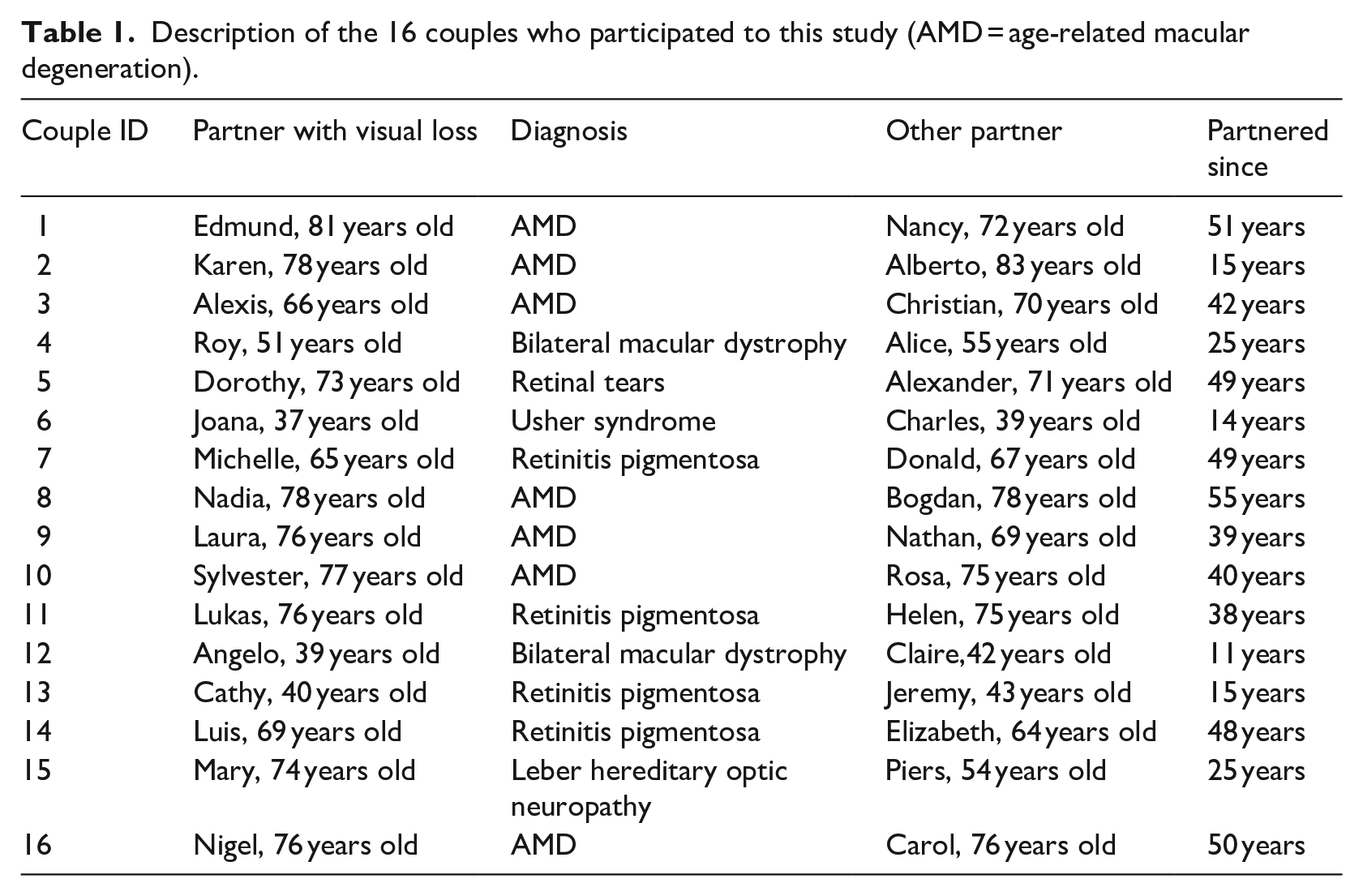
The consent form was sent to both partners and their enrollment was confirmed after the signed form was returned to the first author. A time was then set up for their interview. Sixteen couples were included in this study (Table 1).
Description of the 16 couples who participated to this study (AMD = age-related macular degeneration).
Procedure
A semi-structured qualitative interview of approximately 1.5 hr was completed with each couple. The interview was done face-to-face with the two partners by two members of the research team at a place of participants’ convenience. As interviews were conducted during the coronavirus pandemic, the public health measures from Swiss authorities were followed. For example, both the researcher and participants wore masks throughout the interview. The interview guide asked participants open-ended questions that explored the following topics: shared everyday activities of partners, how vision loss had affected such activities, and the ways in which they navigated such consequences. Participants were informed that they did not need to answer questions if they did not want to or could stop the interview at any time. Interviews were audiorecorded and transcribed verbatim. The transcribed data were coded, and pseudonyms were used to ensure the anonymity of participants.
MAXQDA 12 software was used to organize the data. A continuous thematic analysis was undertaken, which involves identifying and noting themes as each subsequent interview was completed (Paillé & Mucchielli, 2016). This methodology consists of simultaneously developing themes from the analysis of the verbatims. The data analysis was conducted in two phases. The first phase consisted in developing the themes. For this purpose, the first (R.B.) author did a first coding of all transcripts; from this coding, he and the second (N.K.) author then developed the themes. Themes were refined all along the verbatims were analyzed; they were then grouped in main themes and related sub-themes (Paillé & Mucchielli, 2016). The second phase involved reviewing the process and determining the themes with other members of the research team who were not directly involved in data collection. Themes were discussed in a session with all members present; refinements of themes were done to obtain a general agreement from research team.
Findings
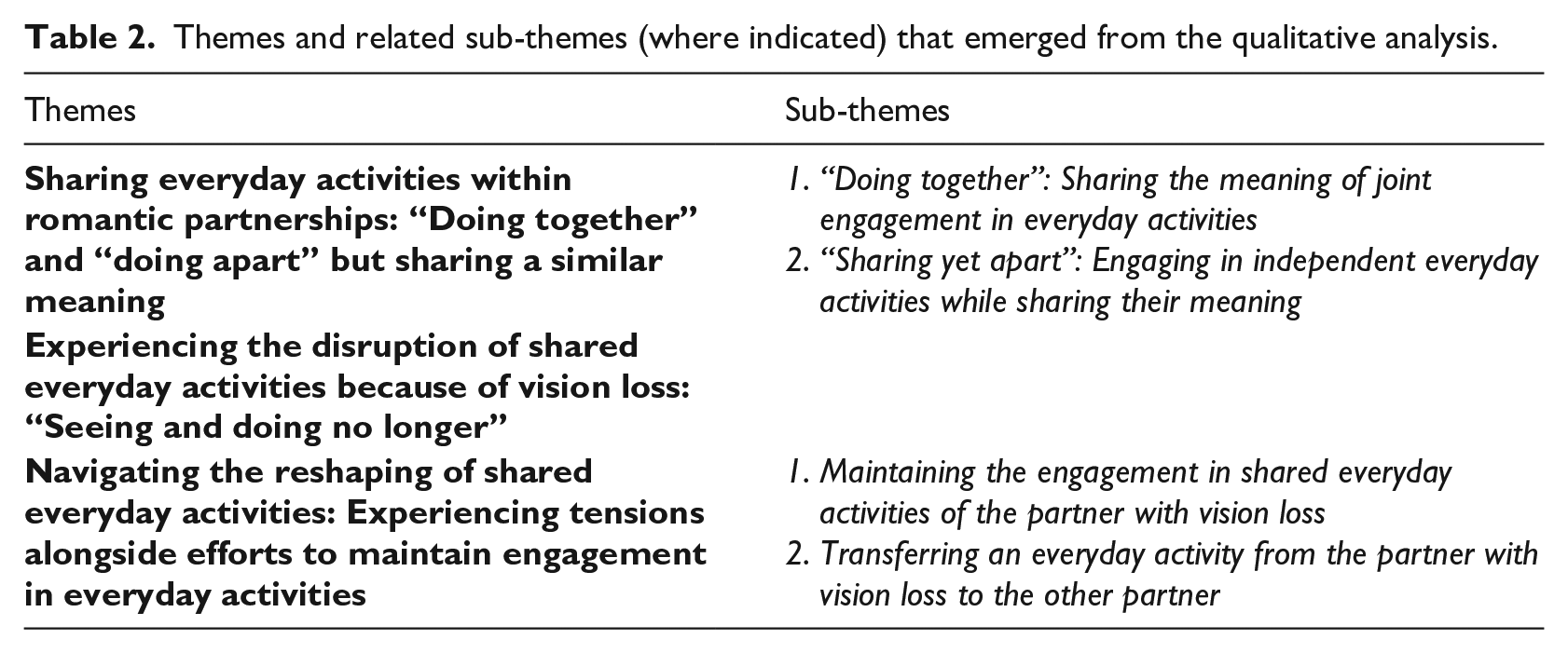
Three main themes emerged (see Table 2) that reflect how romantic partners experienced their adjustment process to vision loss. The first theme describes what everyday activities couples perceived as shared. The second theme highlights the disruption of partners’ shared everyday activities because of the onset or worsening of visual loss. The third theme addresses how partners experienced navigating this disruption where certain everyday activities were reshaped.
Themes and related sub-themes (where indicated) that emerged from the qualitative analysis.
Sharing everyday activities within romantic partnerships: “doing together” and “doing apart” but sharing a similar meaning
Participants highlighted everyday activities that they perceived as shared those in which partners jointly engaged in as well as some of partners’ independent everyday activities.
“Doing together”: sharing the meaning of joint engagement in everyday activities
When asked to describe the everyday activities they perceived as shared, most partners described those activities in which they engaged together. Nadia described a joint activity she did with her spouse, Bogdan: We like [the] theatre a lot . . . That’s something we still do together. Firstly by obligation [Laughs] . . . Because I can’t drive anymore. You like theater and you taught me to like theater. And then, it’s true that I like it a lot. It brought us closer.
Like Nadia and Bogdan, each couple named and framed a joint activity, and how its meaning was shared within their partnership. For Alice and Roy, it was their evening meal together: Alice: Preparing dinner is our moment. This has always been important for us. Roy: It’s a moment of sharing, absolutely. We first have the aperitif; we drink a good bottle of wine. And then, we prepare the meal. And then, well, we hang out at the table.
Rosa and Sylvester talked about their holidays: Rosa: We would go away for two or three weeks but we would change places every 2 or 3 days. We always liked to go on such touring holidays.
Joana and Charles used to hike together and described how they had done this activity almost every weekend since they first came together as a couple.
Joana: We often go for hiking on weekend. It’s a kind of family tradition.
“Sharing yet apart”: engaging in independent everyday activities while sharing their meaning
Some participants reflected that some of each partner’s independent everyday activities were shared since it contributed to the partnership. One participant, Edmund, described it as “doing for each other.” He indicated that he was the one responsible doing administrative duties of his couple before suffering from vision loss: Well, I was the one doing the bills, I was the one doing the payments, I was the one doing . . . doing that administrative stuff. She didn’t like it at all so she was happy to leave it to me!
Christian acknowledged the contribution of Alexis especially since he was not “passionate with cooking.” Alexis recalled, He was often in a hurry. So I was the one who cooked. [. . .] I did the grocery shopping; I prepared the meals . . . I did that for a long time.
Nadia and Bogdan perceived that some of Nadia’s engagement independent of Bogdan strengthened their togetherness since they explained: Nadia: When I dance, I can evacuate my ruminations rather than spilling them out on my husband. It makes me feel really good. Bogdan: [Laughs] For sure, I’d rather have her take out her anger by dancing than on me !
Participants further explained how vision loss has disrupted their shared everyday activities. The related experience is described in the second theme outlined below.
Experiencing the disruption of shared everyday activities because of vision loss: “seeing and doing no longer”
All participants reported their experience of vision loss as reflecting the disruption of their shared everyday activities, in particular, those that were jointly done. For instance, Alice and Roy talked about how the latter’s vision loss disrupted their evening meal: Roy: I was afraid we would talk about my eyes at our meals, so I tended to avoid them, I spent less time at the table. Alice: This period was very unpleasant for me. In fact, I felt an increasing distance between us.
Rosa and Sylvester shared how the way in which they traveled for holidays had be changed due to Sylvester’s vision loss: I don’t really want it anymore, because in three days I don’t have the time to become independent for anything. I can’t find our room in the hotel, because for that, I would have to locate where I am to have my points of reference.
Nadia and Bogdan explained how the latter took the responsibility for choosing the play of theater because his wife’s vision loss. She explained, We each read the program. I could give ideas, I could choose: “Here, this play might be nice.” But now, I have to trust him because I cannot read anymore.
The disruption also concerned certain activities in which partners independently engaged in. For example, Alexis explained that not being able to cook anymore for her husband Christian made her “somewhat feeling useless.” This kind of experience was also described by Mary, who recalled that she was managing the couple’s finances before losing vision: As long as I could read on the computer, I would do it. Now that I can’t, it’s an extra burden for my husband. And I’m concerned because Piers has so many other things to do.
At last, participants’ experience encompassed how they navigated the reshaping of shared everyday activities. This is described in the third theme below.
Navigating the reshaping of shared everyday activities: experiencing tensions alongside efforts to maintain engagement in everyday activities
The experience of partners is described in relation to the two key strategies of reshaping identified from the transcripts.
Maintaining the engagement in shared everyday activities of the partner with vision loss
In their interviews, those experiencing vision loss described how they changed how they engaged in certain of their independent everyday activities. For example, Michelle explained how she learned to use vision aids to continue performing certain tasks for both her and her partner: I only work with ZoomText for magnification. Without it, you forget, well. . . Because I can’t read emails, I can’t get a train ticket, I can do the payment . . . I can’t read anything.
In fact, both partners expressed that finding alternative ways to participate in shared everyday activities was a primary concern for both of them. For instance, while acknowledging Rosa’s efforts, she and Sylvester explained that they had changed the way they spend their holidays because of the latter’s vision loss: Rosa: Now we’re changing, but we have difficulties to find places where we could stay three times 10 days, or a whole month, for example. I convince myself that we are not in a hurry, that we have all the time to go and see some landscape, and then we can go further. Sylvester: It’s not easy for you, I know, but I want to be autonomous.
However, many participants noted that they experienced tensions alongside such efforts. For Laura, who did the cooking for her couple and who wanted to continue despite her age-related macular degeneration (AMD), Nathan’s insistence on assisting her during this task led to conflict: When I’m cooking, he touches the buttons on the hotplates. And I don’t see it. And then it’s no good, it is burned! It bothers me anyway. It’s like I can’t do anything anymore. I often tell him that when you are visually impaired, it’s just about vision loss, you don’t get dumber.
While Joana’s vision worsened because of her Usher syndrome, Charles went on to describe how he supported her participation in hiking: I always hold her arm, there’s no risk of her falling.
Joana however suggested tension when she explained: No, no, he doesn’t always stay near me, no. [. . .] When we go to pick mushrooms, each one goes on its side and I find myself alone sometimes!
Transferring an everyday activity from the partner with vision loss to the other partner
Participants described how they shift tasks to the partner with sight. Such shift could be experienced positively. Karen, for instance, indicated how, even with vision loss, she had been able to manage her entire household. However, when Alberto moved into her apartment, he took charge of all household-related activities, which enabled her to focus on her “volunteering” instead of “wasting her energy”: I have to say that I am very grateful because he really helps me a lot, with the cleaning, the cooking, the grocery shopping.
Christian also shared how he took over the cooking from Alexis due to her vision loss, as he recalled, My wife used to cook very well; I say, she “used to.” With her disability, it was more and more pre-cooked meals. I have to do the cooking, because I don’t want to eat pre-made, no.
Moreover, many participants expressed how they experienced tensions because of such transfer of everyday activities. Edmund, who has AMD, described as a tough experience to have to pass on a task that he had managed to his wife Nancy: I can’t anymore open an email and then read it. Gradually, it’s less and less me and more and more my young wife who does that. Because she has good eyes. Because she is fourteen years younger than me . . . I don’t have a choice.
She, in turn, expressed discomfort since these “new” everyday activities “definitely take up [her] time,” at the expense of her own chosen activities. Partners with vision loss also experienced tensions when transferring their task to their partner. Michelle and Donald explained that they were doing the grocery shopping together, but that it has been challenging since Michelle lost her vision and had to rely on Donald to pick up the goods: Michelle: I can’t read the labels anymore; everything is written so small! I might make a mistake. But then, I’m frustrated that I can’t do it on my own anymore. Maybe that’s why I yell at him when he takes the wrong product!
Such dependence to the other partner is also a source of tensions for Nadia. She worried about her “growing dependence” on her partner, Bogdan, due to her AMD and its worsening progression. However, she also perceived how such dependence was necessary if she was to continue certain everyday activities like dancing: Fortunately I have my husband to drive me. To go dancing, especially. He drives me there and back. As much as it pains me to admit it, I need him.
Discussion
The ensuing changes in everyday habits, routines, and everyday activities due to major vision loss impact not only the individual in question, but also those around that person, including their spouse or partner (Lehane, Dammeyer, & Elsass, 2017). Previous studies with couples have predominantly focused on the psychosocial effects of vision loss on the partnership (Lehane, Dammeyer, & Elsass, 2017; Lehane et al., 2018). As evidenced by our findings, such effects are indeed felt by both partners. However, using an occupational perspective, the current investigation goes one step further to explore how romantic partners experience vision loss by focusing on the engagement in everyday activities on the individual as well as the relationship and the shared meaning ascribed to such activities (Leclair, 2010). As such, the themes emerging from the interviews undertaken with couples evidenced how partners experience tensions alongside their efforts to maintain their sense of we-ness when navigating the disruption in shared everyday activities and routines.
One partner’s vision is known to challenge romantic partners’ communication patterns and roles (Lehane, Dammeyer, & Elsass, 2017) and have psychosocial consequences for both partners, such as lower well-being and marital satisfaction (Lehane, Dammeyer, & Elsass, 2017; Lehane, Dammeyer, & Wittich, 2017) as well as an increase in depressive symptoms (Lehane et al., 2018; Strawbridge et al., 2007). However, this study suggests that romantic partners’ experience of vision loss further reflects the extent to which their shared everyday activities are disrupted. As such, participants in this study acknowledged that an activity can be shared within the partnership, whether it requires a joint or independent engagement of partners. Indeed, couples who participated to the study emphasized how important it was for both partners to jointly engage in everyday activities in which they attributed a similar meaning and intention (Leclair, 2010), namely since they were their most preferred time of being together. For Bogdan and Janique, going to the theater has become a common passion over the course of their relationship that has brought them closer. Cathy and Jeremy explained that walking the dog was their preferred daily routine to spend time together as a couple. Such findings corroborate that shared time together, as perceived by both partners, can influence the quality of the relationship (Bernardo et al., 2015; Flood & Genadek, 2016).
An everyday activity in which one partner engages separately can still be important when it comes to maintaining we-ness. In fact, participants recalled how these activities were still contributing to their partnership. Previous research also showed how engaging in certain independent everyday activities, such as managing the finances of the couple, is perceived positively by one’s partner (Bailey & Jackson, 2005). In fact, this study suggests that helping with not only managing finances but also other everyday activities, which may seemingly be disparate from the couple per se, such as Nadia who practiced dancing on her own, can still be considered as having a positive impact. From the literature that has investigated one’s everyday activities, we know that engaging in leisure activities, for example, can elevate mood and quality of life among other benefits (Borges da Costa & Cox, 2016; Lee et al., 2021; Rampley et al., 2019). Nadia and Bogdan showed how this separate engagement can have positive repercussions on the partnership. Thus, both our findings and literature suggest that romantic partners can attribute a shared meaning and purpose to certain everyday activities in which they do not engage in together. As such, understanding the impact of independent engagement alongside joint engagement in everyday activities on couple’s we-ness is important. Hence, when one partner experiences a health-related change, such as vision loss, how such independent and joint everyday activities are managed is critical.
Participants involved in this study reported how their ability to engage in shared everyday activities (Leclair, 2010) became more challenged as the vision loss progressed. For example, Rosa and Sylvester changed the way they usually traveled, while the time Alice and Roy once spent having dinner together was no longer the same, as he found it reminded him of all that he had lost. Mary, for her part, described how she felt bad since she could no longer manage the couple’s finances. In fact, these participants exemplify that the meaning and purpose attributed to everyday activities may change because of vision loss. Both Sylvester and Roy reported that their joint participation with their partner in trips or dinners, respectively, had become difficult for them since they were exposed to the consequences of their disability. Similarly, Mary noted that her participation in managing the couple’s finances, which the couple considered to be supportive of the relationship, had become impossible because of her vision loss. Thus, the loss of shared meaning that partners ascribed to such activities resulted in their potential withdrawal that in turn may have affected their we-ness.
Navigating vision loss can require both partners to jointly manage the disruption that result in the reshaping of daily routines, including shared everyday activities (Bodenmann, 2015; Lehane, Dammeyer, & Elsass, 2017; Lehane et al., 2018; Rohrbaugh, 2021). Couples in this study described how their experience encompassed such reshaping, reflecting each partners efforts to preserve their disrupted everyday activities, whether by maintaining the engagement of the person with vision loss or by transferring the activity to the other partner. While these were meant to alleviate stress, some described how such changes in routines lead to tension between certain partners experienced alongside their efforts. In fact, the partners with vision loss’ growing dependence on the other partner was sometimes in conflict with their desire for autonomy. Autonomy, as French sociologist Gardien (2014, p. 53) wrote, can be defined as “belonging, being one’s own master, governing oneself according to one’s own rules.” According to her (Gardien, 2014), remaining autonomous in dependence implies that if one partner requires assistance of the other one, it should not preclude his or her ability to make his or her own choice concerning daily life. In their grounded theory analysis of adults’ adaptation process to chronic or acute disease, Walder and Molineux (2017) outlined that health-related changes due to disease, and corresponding implications on daily life, challenge a person’s agency and ability to make their own decisions, thereby experiencing a loss in their autonomy. Feeling a sense of control when one navigates such disruptions in health is key to adjusting to a changing and changed life (Grajo et al., 2018; Walder and Molineux, 2017). The tension between autonomy and dependence was reflected in partners’ experience of vision loss in this study as a push and pull of trying to remain independent while also acknowledging the need for assistance. For instance, Nadia regretted that her husband Bogdan had to accompany her to her dance class, as she needed to be driven. However, she also knew that participating in this everyday activity gave her joy and could preserve her couple from her mood. Michelle expressed frustration at not being able to do the shopping on her own any longer since she needed her partner’s support. Such subtle and seemingly minor changes yet had a big impact on the couples’ experience. Further research is needed that focuses on these tensions given that such tensions may be early signs of cracks in the partners’ sense of we-ness. Such cracks could be reduced if adapted support is proposed to couples facing vision loss in the reshaping of their shared everyday activities. However, this requires a better understanding of how romantic partners ascribe meaning and purpose to their engagement in such activities, separate or joint, and how such meaning and purpose are affected by the onset or aggravation of one partner’s vision loss.
Limitations
The findings of this study should be considered in light of certain limitations. First, we recruited a convenience sample for this study where all of the couples reflected heterosexual partnerships. As such, the experiences of our participants may not be representative of all kinds of partnerships. In addition, because partners were interviewed together and not separately, there is a possibility that individuals may not have expressed their feelings for fear of emotionally hurting the other partner (Torgé, 2013). However, none of the couples in this study expressed this potential concern when they were asked for it.
All participants were living in the same geographic region, Western Switzerland, which should be carefully considered given the differential in meaning of being in a romantic partnership may differ depending on sociocultural (Western) meanings and gender roles. Another potential limitation is related to the COVID-19 pandemic where public health restrictions were in place at the time of the interview. Such restrictions are also known to affect activity patterns (Fatmi, 2020; Güzel et al., 2020). As such, the impact of vision loss on couples’ activities likely intertwined with the impact of the pandemic. While it was not possible to distinguish between what was specific to vision loss and what was specific to the pandemic. However, this distinction may not have been systematic in the participants’ experiences.
Conclusion
This study is the first to the best of our knowledge to explore the experience of romantic partners facing vision loss with regard to daily activities. Using an occupational lens on this process, where the meaning and purpose of everyday activities are explored at an individual and shared level, allows us to better understand not only the challenges that arise, but also how adaptations and strategies are enacted to support engagement in everyday activities of both partners. Maintaining the couple’s we-ness in a time of disruption requires effort where some shared everyday activities may be lost, prioritized, and reshaped. Findings from this study highlight how experiencing this process can reflect tension between partners, which arise from their struggle between autonomy and dependence. Further research should focus more closely on particular points of tension related to the reshaping of everyday activities, which may be an early signal of fundamental shift in the meaning and purpose that partners ascribe to their shared everyday activities. This could help to design support for couples who navigate the transition and corresponding reshaping of everyday activities that ensue.
Footnotes
Declaration of conflicting interests
The author(s) declared no potential conflicts of interest with respect to the research, authorship, and/or publication of this article.
Funding
The author(s) disclosed receipt of the following financial support for the research, authorship, and/or publication of this article: SELODY research was funded by the following Swiss institutions: Accentus – Margrith Staub Fonds, Association for the Benefit of the Blind Geneva (ABA), Blind and Disabled Center Bern, Federal Office for Equality for People with Disabilities (BFEH), IRIDES Foundation, the “Loterie Romande,” and the Swiss National Association of and for the Blind (UCBA).
