




Abstract
An adult, who is blind, with modest experience in drawing, drew a cube in parallel and sideways inverse perspective, with Y and T junctions common in drawings by sighted 9- to 11-year-old children. Drawing development may be similar in the blind and sighted.
Theory of drawing development is commonly based on sighted children’s drawings of cubes. We point out that a woman who is blind, with very modest experience in drawing, drew a cube with key features of versions from sighted children aged about 9–11 years old. Unusually, but tellingly, it involves sideways inverse perspective, a remarkable and unanticipated clue to puzzles in drawing development theory. We highlight a key decision point in the drawing’s construction – a decision point not entertained in studies on drawing development. The drawing offers support for a theory of drawing development as similar in people who are blind and people who are sighted, one that may be helpful in education and museum access, and significant for theory of the senses.
Linear perspective was first used to create pictures in the 1400s in Florence (Kubovy, 1986; Landerer, 2000). In linear perspective, converging lines can show receding parallels. In oblique parallel perspective, parallels in the world are shown by parallels in the picture. Prior to 1400, inverse perspective (prospettiva rovesciata) and oblique parallel perspective (ortografica) were common (Avci, 2015; Florenskij, 2020). In inverse perspective, the lines diverge; the farther the referent, the more the divergence (Arnheim, 1972; Derȩgowski et al., 1994; Pavlopoulos, 2011). Commonly in the early Renaissance, the lines showing the right and left sides of square tables diverged up the page, and the lines for the front leg of a table were longer than those for the back.
In terms from Willats (2005), parallels in the world are scene primitives and parallels and diverging lines on the picture surface are picture primitives. Rough parallels on the picture surface count as fully parallel picture primitives, just as roughly spoken words – slurred perhaps, like “happy birsday” – count as versions of proper words – “happy birthday” in this case. Primitives are units of meaning. Rough lines and slurred words do not change the unit of meaning. Primitives are types. Rough examples are tokens.
Like sighted observers, people who are blind point aptly to targets on the ground varying in azimuth and elevation (Wnuczko & Kennedy, 2014), but drawings of cubes from novices who are sighted and novices who are blind have features of three perspective systems – parallel, linear, and inverse (Feeney, 2019; Golomb, 2002, 2004; Kennedy, 2019; Kennedy & Juricevic, 2006; Vinter et al., 2018). Of interest, M, an adult who is blind, with limited experience in drawing, drew a road in sideways inverse perspective (Carboni & Kennedy, 2020). On the picture surface, lines for the road diverged with distance. Drawings of cars increased in size with distance. The increase was to the right, so the drawing was in one-point inverse perspective applied sideways. This scheme was not entertained in art history or drawing development theory (Carboni & Kennedy, 2020).
Here, we analyze how M drew a cube (Figure 1) and highlight a key decision that produced inverse sideways perspective, and a second that resulted in standard early-Renaissance inverse perspective.
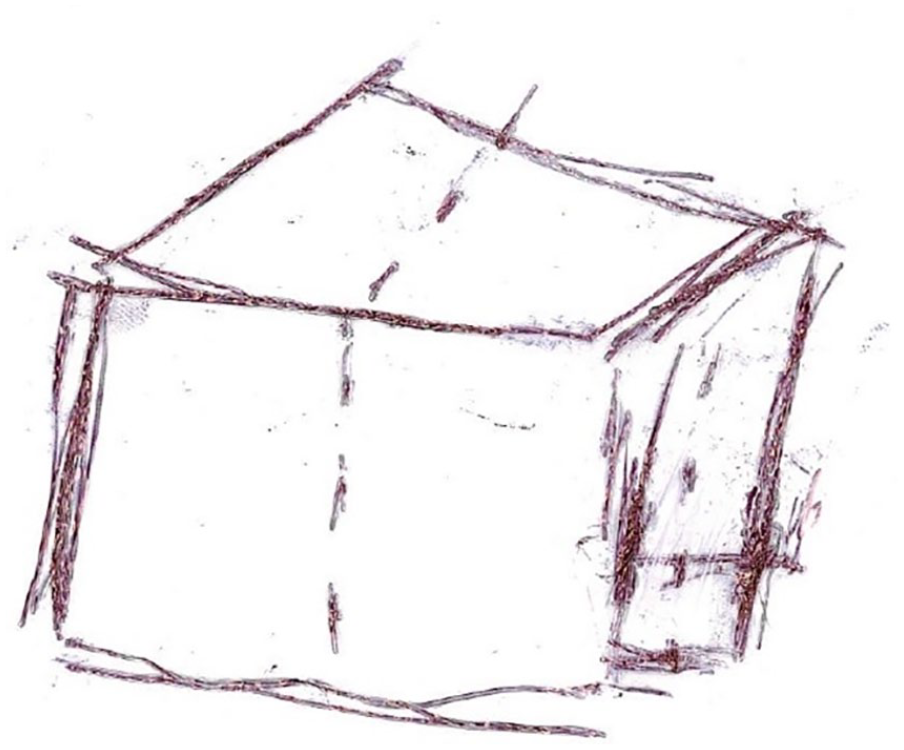
Drawing of a cube by M, an adult who is blind.
Method
Apparatus
Figure 1 is a raised-line drawing (size in the original 12 × 14 cm), made using a raised-line drawing kit from Cambratech, Milan, comprising a polyester film sheet (size 25 × 35 cm) resting on a drawing board with a rubberized surface. Lines drawn on the film with a ballpoint pen are raised and tangible, easily traced by a finger.
Participant and procedure
In Bergamo, Italy, M, aged 38 years, participated in a drawing session.
M was born prematurely (7 months) and placed in an incubator. As a child, she had severe low vision. The left eye had visual acuity of 20/400. (Note that 20/200 is “legally blind.”) Her right eye was totally blind. At age 20 years, the retina of her left eye detached. She is now only light sensitive.
At school, M used video magnifiers to read, study text, and to draw occasionally. In high school, she specialized in commercial subjects, and after graduation, she worked in private businesses. In her teens, her mother enrolled her in a 1-year after-school private class on painting and drawing. With pencil and paper, in this class, she drew vases with flowers, tables, and landscapes in perspective (email from M, 21 November 2019). In our experience, drawing classes do not include instruction in inverse perspective (Laursen, 2017). Art history texts often include tops of tables in inverse perspective, expanding symmetrically, but novices who are sighted and novices who are blind invent symmetric and asymmetric versions (Carboni & Kennedy, 2020; Golomb, 2004; Heller et al., 1996; Howard & Allison, 2011; Kennedy, 1993; Winner, 1982).
In a drawing class for adults who are blind, which M joined, M was asked to make a series of drawings – a face, then a road, and then a cube – in a session that lasted about 30 min. She said this was her initial experience making raised-line drawings. The class was not intended to be for research. The fact that M drew an interesting sketch led to this report. M kindly gave written permission to publish her drawing. We very much appreciate the opportunity M affords us. We thank her Bergamo drawing class, and take this moment to acknowledge that Italy has major ventures in the arts for children and adults who are blind, for example, in Bologna and Ancona.
Results
M drew the top of the cube first, the side second, and the front last. Figure 2 numbers the first four lines in the order drawn. Its guide lines suggest the orientation of picture primitives.
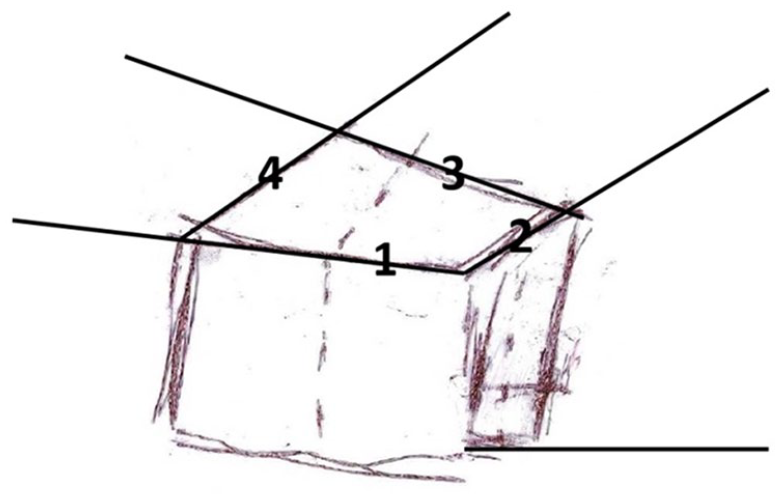
M’s cube with the order in which the first four lines were drawn. Interpretive guide lines added.
M drew the top quadrilateral first, the right next, and the rectangle for the front last. A Y junction standing for the nearest corner of the cube is surrounded by the three faces. Three dashed lines show the middles of the faces, M said.
M first drew a horizontal line for the cube’s near edge (Line 1). Her second line, a / oblique, extends from the right end of Line 1 and depicts a convex corner. Attached to Line 2’s top end is her third line, a \ oblique for a rear occluding edge. Line 4, the / oblique on the left, completes the top, and depicts an occluding edge. Lines 2 and 4 are parallel but 4 is a third larger.
The side face is shown by a slim trapezoid. M’s fifth line, the right vertical, stands for an occluding edge to the rear. To its left, the sixth line drawn is a vertical showing the near corner of the cube. The first vertical is about 30% longer than the second. At the bottom of the trapezoid, a short horizontal line, the seventh line to be drawn, pictures the base of the cube, an occluding edge.
The front is depicted by a rectangle. Its lower line was the eighth to be drawn. A vertical on the left was the last. Both depict occluding edges.
Discussion
This is a case history, but like a one-off fossil on a beach, it may repay analysis. Notably, we suggest the top is drawn in parallel perspective with oblique projection (Willats, 1985) and in inverse perspective, sideways. Of special interest, the first time sideways inverse perspective was described in any literature, art-historical or psychological, was in Carboni and Kennedy (2020), presenting M’s drawing of a road. No connection to a phase in drawing development prominent in the sighted was possible till now. The subject of the present drawing – a cube – allows that link to be made, here, for the first time. That is, the first time a picture in sideways inverse perspective – by anyone sighted or blind, in any era of art – was described as such was in Carboni and Kennedy (2020), and the second time is the present instance, and, in addition, on this occasion, an account is given, connected to a theory of drawing in both the sighted and blind.
As an alternate to the fossil analogy, let us note that documenting a drawing in sideways inverse perspective is like documenting rare stellar observations. Initially, the sightings challenge existing theory. The task they provide is theory development. Figure 1 allows just that for drawing development and the case of sideways inverse perspective.
Lines 2 and 4 are parallel and oblique – oblique since projection orthogonal to the picture surface renders receding edges simply as points. Lines 1 and 3, depicting edges parallel to the picture surface, diverge to the left in sideways inverse perspective. This is different from early-Renaissance inverse perspective in which diverging lines depict scene primitives orthogonal to the picture surface, for example, left and right sides of tables. In Renaissance inverse perspective, Lines 2 and 4 would be diverging.
Consider how Figure 1’s junctions relate to features of children’s drawings. Drawings of cubes by sighted children often have the combination of Y and inverted-T junctions of Figure 1 (Mitchelmore, 1985; Willats, 1985; Winner, 1982). Kennedy (1993) reported that 13% of 9-year-old, 15% of 10-year-old, and 18% of 11-year-old sighted children drew a cube with the Y and T junctions in the locations used by M. They mark middle childhood in drawing development. In our experience, the combination of the two is not taught. That is, novices who are sighted and novices who are blind develop the pairing without explicit tuition.
Individually, the junctions are cubic corners in oblique parallel perspective (Kubovy, 1986). However, as an ensemble, their angles are inconsistent.
Lines 2 and 3 contain a 50° angle. To keep Lines 1 and 3 parallel, the angle should have been 40°. Inverse perspective is due to the enlarged angle. It is not primarily due to Line 2 being shorter than 4. Line 2 depicts an edge closely aligned with the vantage point and projects as highly foreshortened (Figure 3).
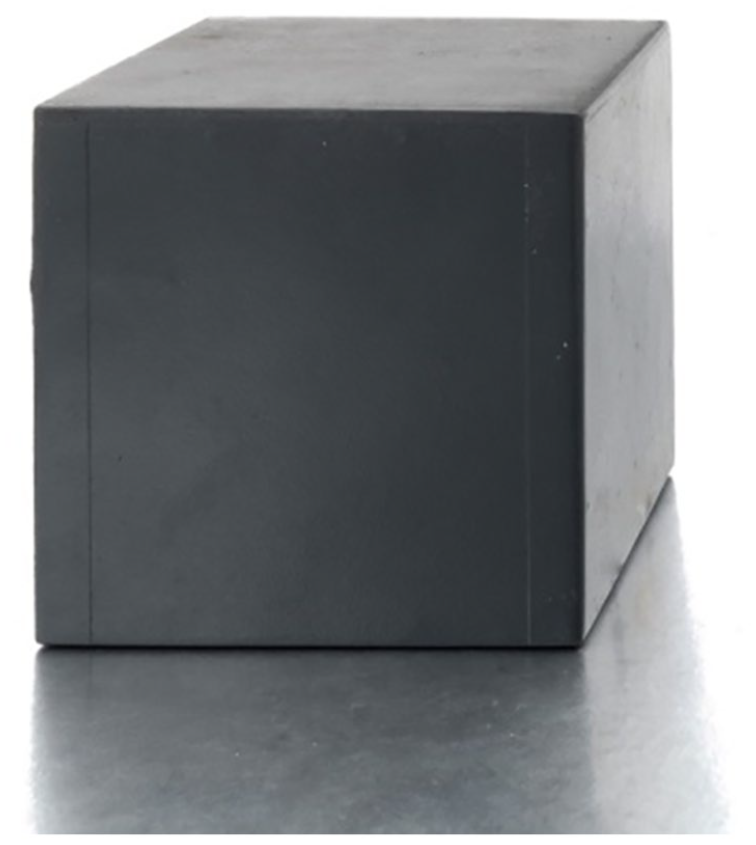
Photograph of a cube with foreshortened oblique, top right corner.
Sighted children also draw cube tops in sideways inverse perspective, as do sighted undergraduates completing drawings of cubes with parallel obliques. Mitchelmore (1985) asked 9-year-old sighted children to complete a sketch with a square and an / oblique like Line 2. The average response included a top in sideways inverse perspective, though not described as such by Mitchelmore. The / oblique like Line 2 given to them and the \ oblique like Line 3 the children drew enclosed an angle of about 55°, about 15° too large. The error distribution was unimodal.
Nicholls and Kennedy (1997) gave undergraduates an incomplete drawing of a cube in parallel oblique projection with long guideline obliques like Lines 2 and 4 as lines of dots. The participants connected as many of the dots as required to complete the cube. The result was short obliques like Line 2 paired with long obliques like Line 4. The sideways inverse perspective that resulted was not described as such by the authors.
Inverse perspective is also present in M’s drawing of the side face, but the side-face T likely depicts the base level of the cube, as it does for sighted children, according to Arnheim (1954, p. 164, Figure 148a). This is the early-Renaissance scheme that elongates lines for rear table legs.
In short, M’s drawing exhibits parallel and inverse perspective including sideways inverse perspective.
Sideways inverse perspective is also used in M’s drawing of a road (Carboni & Kennedy, 2020), completed just prior to Figure 1. However, M’s road lines diverge to the right, widening to depict distance. In Figure 1, obliques diverge to the left, wider toward the far edge of the cube. Since M changes orientations, she may be using rules, not a template.
Compared to drawings of roads, drawings of cubes by sighted children have been reported more systematically, and allow Figure 1 to be related to the children’s sketches and ages. It seems that a person who is blind who is a drawing novice has drawn much like many sighted novices. It is possible that drawing development is similar in people who are sighted and people who are blind, which may be because three-dimensional (3D) space is apparent to both (Wnuczko & Kennedy, 2014).
Why use inverse perspective? It can be used to expose hidden parts of an object (Avci, 2015; Golomb, 2004). In foldout pictures, a cube’s left and right sides are shown, unlike pictures where one side is occluded, and this can entail inverse perspective for the top. However, Figure 1 only shows one side.
Florenskij (2020) argued that with distance, the bubble of space around the vantage point increases. Novices might generalize the bubble rule to objects. However, Lines 2 and 4 are foreshortened, and generalizing the bubble rule requires 2 and 4 to be lengthened.
A novice might overgeneralize the inverse perspective used as a result of the T junction showing the base. However, M drew the top first, not the side with the T.
Drawing novices may appreciate that distance changes angular size. Linear size, angular size, scene primitives, and picture primitives can be combined several ways. In first attempts, novices might pair changes in linear and angular size the wrong way round. Inverse perspective may be entertained in a phase in development in which parallels, obliques, and projection are all being considered. Inverse projection may not be used long. Novices may quickly realize that if objects enlarge in the picture as they recede in the scene, eventually every single object would demand the full picture surface.
The drawing theory supported by Figure 1 is that drawing development is similar in people who are blind and people who are sighted. This may help educators develop broader ranging programs than would be envisaged if pictures were thought to be incomprehensible by people who are blind. If, with opportunity and practice, drawing development generally unfolds in people who are sighted and people who are blind in similar ways, both groups may benefit in similar ways from museums and galleries. Until recently, the theory of the senses guiding many practices was that pictures are restricted to sight. Challenging that doctrine could literally open doors to many who found them closed. Individuals who are blind and curious about pictures and their own skills may feel encouraged in their own pursuits, licensed to insist they have a role to play in art, and equipped with significant theory and evidence to brandish. Recently, students who are blind have taken on and completed BA, MA, and PhD programs to do with art and pictures. They had theory to offer, critique, and develop. The theory, whose growth is only a matter of decades, is unfinished but the surprises Figure 1 brings can play a notable part in its improvement.
As a coda, we should point out that perspective, linear or other, need not be considered the sole highpoint in drawing development. Besides perspective with its facility for realism, highpoints include metaphoric and symbolic drawings. These can be quite unrealistic, of course. Also, the composition of an artwork can be sophisticated, perspective or no. Expression can be another highpoint. The subject matter means a great deal too.
Further, drawing as a 9-year-old has no implication for other major cognitive skills, such as language, reasoning, and social abilities. Theory of drawing development contends it may speak to amount of practice just as swimming ability does. We are not infantilized when we start on a new skill such as swimming, and we are only novices in that single narrow domain.
In sum, M, an adult who is blind, novice at drawing, drew a cube with oblique parallel perspective, Renaissance inverse perspective, and sideways inverse perspective. Similar drawings have been reported in studies on drawings by sighted children, notably children about age 9 years. The drawing may fit with a phase in drawing development similar in the sighted and blind.
