




Abstract
In past comparative studies, children with vision impairment were often shown a developmental delay compared to sighted children in several developmental domains. Medical treatments of vision impairments and societal attitudes toward disabilities changed considerably. Besides, within the rehabilitation practices, a stronger integration of multiple perspectives and increased focus on social inclusion and participation in society is present. The main goal of this scoping review was to investigate what is known about the development in cognition, language and communication, motor, social–emotional, and adaptive skills development of children with vision impairment by longitudinal studies. Besides, the results of the past studies were related to a contemporary view on disability, the participation concept. This was done by applying the family of participation-related constructs (fPRC) framework to examine which factors were covered and which not. A systematic literature search was performed in Web of Science, PsycInfo, ERIC, and Medline. Studies were included if they have been published in peer-reviewed journals between 1994 and 2020 had a longitudinal design and examined the development of children with vision impairment with no additional impairments up to 18 years of age. From the 2698 identified studies, 32 studies were included. The most commonly assessed variables concerned cognition and language and communication development. To a lesser extent, studies examined adaptive skills, motor, and social–emotional development. The majority used vision status as a predictor variable for developmental outcomes. In terms of the fPRC framework, most studies included variables related to the factor activity competences. The factors preferences, sense of self, environment, and involvement were studied far less often. The review suggested a positive impact on developmental outcomes for including variables that can mediate the relation between vision status and developmental outcomes and variables that are related to the fPRC factors environment, sense of self, and preferences.
This scoping review describes the current state of evidence originating from longitudinal studies on the development and participation in society of children with vision impairment. By participation is meant the physical and social inclusion of children with vision impairment in society by what is called involvement in a life situation by the International Classification of Functioning, Disability, and Health for Children and Youth (ICF-CY) (World Health Organization [WHO], 2007). True inclusion is more than only attending. According to Bates and Davis (2004), it also means ensuring that people with disabilities “. . . have full and fair access to activities, social roles and relationships directly alongside non-disabled citizens” (p. 196). The importance of social inclusion and participation in society of people with disabilities is emphasized by both the Convention on the Rights of Persons with Disabilities (United Nations, 2006) and the publication of the ICF (WHO, 2007). From previous studies, it is evident that, compared to sighted children, children with vision impairment develop differently. For instance, they perform worse on tests on social communication (Dale et al., 2013; Greenaway & Dale, 2017), motor skills (Fotiadou et al., 2014; Wagner et al., 2013), and have a delayed development of joint attention (Bigelow, 2003; Tadić et al., 2009), and verbal skills (Brambring, 2007b; Cass et al., 1994). These and other delays have consequences for participation.
A reason to review developmental outcomes in children with vision impairment is that the last review stems from almost 30 years ago with the publication of Warren’s (1994) book, Blindness in children, an individual difference approach. More recent reviews are less comprehensive. For instance, Greenaway and Dale (2017) published an overview in 2017, but this review focused only on language and communication development of children with congenital vision impairment. The overview of Warren described, among others, the longitudinal studies of Fraiberg (1977); Jan et al. (1977); and Norris et al. (1957). An important conclusion by Warren was that, besides that most studies at the time were cross-sectional, they were also merely comparing children with and without vision impairment. By restricting the outcomes to group means, children with vision impairments almost always performed worse than sighted children and individual variation tended to get lost. That is why he argued for an individual differences approach over the traditional comparative approach. Whereas, a comparative approach focuses on comparisons between children with vision impairment and sighted children, the individual differences approach focuses on the variability within the population of children with vision impairments and the possible explanations for variability (Warren, 1994). This focus on individual differences was thought to be important to be able to develop individually tailored interventions. The question is whether Warren’s plea for an individual difference approach was heard in the last 30 years. Several changes in the last 30 years have taken place that might have affected the developmental outcomes of children with vision impairments.
First, a change has occurred in pathologies causing vision impairment. For example, compared to the times the studies covered by Warren (1994) were published, the number of children with blindness or vision impairment due to retinopathy of prematurity (ROP) is reduced considerably, mainly as a result of medical improvements in neonatal care (Boonstra et al., 2012). In Europe, cerebral visual impairment (CVI) is the most prominent visual disorder nowadays (Ortibus et al., 2019).
Second, up to the 20th century, the leading perspective in rehabilitation practices was based on a medical model, with a view on disabilities derived from the treatment of somatic diseases. In the 1970s, a countermovement emerged with the social model, that has its origins by the Union of Physically Impaired People Against Segregation (UPIAS; Haegele & Hodge, 2016). According to the medical model, the main goal in rehabilitation practices is repairing anatomical problems and enhancing bodily functions and teaching skills. According to the social model, a disability is not only an attribute of an individual alone, but also an attribute of an unreceptive society. Whereas in the medical model, professional support should be provided to help the individual to change (Haegele & Hodge, 2016), in the social model, true social inclusion is only possible if this person’s environment changes also (Burchardt, 2004). With the publication of the ICF, the WHO (2007) integrated medical and social models on development and care toward a broader focus on rehabilitation practices.
In the last decades, an integration of multiple perspectives and an increased focus on social inclusion and participation in society is present within rehabilitation practices (Reichman et al., 2008). This focus on participation is visible in the Convention on the Rights of Persons with Disabilities (CRPD) of the United Nations (2006). Since the WHO did not conceptualize in detail what participation is, Imms et al. (2017) stepped in and formulated the multifactorial framework, “the family of Participation-Related Constructs” (fPRC). For instance, the WHO did not clearly distinguish between activity and participation within their ICF classification system (Imms et al., 2015). The fPRC framework was meant to conceptualize the participation construct and its interrelationships to constructs within the activity and body function components of the ICF. It also stressed the importance of looking beyond the level of the person or body functions when designing interventions, and subsequently expecting downstream effects on participation, by looking at the interaction between the environment and the person on participation outcomes. The fPRC postulates that participation is influenced by various factors and processes and cannot be defined as a single construct. Participation is a construct with two components, namely, “attendance, defined as ‘being there’ and measured as frequency of attending, and/or the range or diversity of activities; and involvement, the experience of participation while attending” (Imms et al., 2017, p. 16). Involvement includes elements of engagement, motivation, persistence, social connection, and affect. Attendance is necessary, but not sufficient for social inclusion, involvement needs to be added. Various factors may influence participation, or are influenced by participation. These factors are activity competences, a sense of self, preferences, and interactions with the person’s direct environment and society as a whole. For example, sense of self consists of self-perception, self-esteem, and self-efficacy in which a person’s self-esteem is built upon his or her previous experiences and self-efficacy determines to a certain extent whether or not to participate in new activities. With regard to the environment, the place where a child grows up, can also influence participation by whether or not facilities are nearby and accessible (Imms et al., 2017). The exact details of each factor differ per individual. We have used this multifactorial framework as departure point for the present scoping review to identify which factors had been examined in the past, and which factors after adopting this framework require more in depth investigation.
Most current information on developmental problems and delays in children with vision impairment stems from cross-sectional research (Bathelt et al., 2019; Brian et al., 2021). This is problematic, because it is difficult to see developmental paths based on cross-sectional research. As a result, it remains unknown what significant predictors for later developmental outcomes are. A longitudinal design is a method par excellence to examine behavioral change over time by and also to analyze individual differences by studying individuals repeatedly over a longer period of time and looking for correlations between measurement waves (Menard, 2002). As such, it provides insights into children’s development, that is, changes in behavior over time, something comparative research cannot provide (Heppe et al., 2020; Kef, 2005; Verver et al., 2019). For this reason, the current scoping review is limited to research that studied the development of children with vision impairment with a longitudinal design.
In sum, based on the abovementioned changes, an update on the current state of evidence regarding the development of children with vision impairment is warranted. Our first goal is to investigate what is known about the development in cognition, language and communication, motor, social–emotional, and adaptive skills development of children with vision impairment. Four of the five developmental domains were chosen because they were also reviewed by Warren (1994) and are domains typically covered in assessments and early intervention programs. Adaptive skills development was added because this domain poses some difficulties for children with vision impairments (Bathelt et al., 2019; Greenaway & Dale, 2017).
The second goal is to match the results of previous studies with current views on disability by investigating how the results of the longitudinal studies relate to the factors of the fPRC. Which factors are covered well and which factors require more in depth examination? By creating an overview of the current knowledge, we can signal white spots in the literature. The review is restricted to longitudinal studies, because within a longitudinal design changes over time and individual differences between children can be studied better than in cross-sectional designs. Our goal was to investigate current information on the development of children with vision impairments and to identify knowledge gaps and next steps to be taken. For this purpose, a scoping review is most suited (Munn et al., 2018; Tricco et al., 2018) and not a systematic review. Systematic reviews are better suited to evaluate previous research findings, confirm the quality, and level of evidence, and to identify and examine conflicting findings (Moher et al., 2009). Scoping reviews can be used to identify important factors and characteristics and present how research on a specific topic was conducted (Arksey & O’Malley, 2005). Two research questions were guiding this scoping review:
What is known from longitudinal studies about the development of children with vision impairment in the domains of cognition, language and communication, motor, social–emotional, and adaptive skills development?
Which factors of the fPRC framework are reflected, and which not, in the results of longitudinal studies on the development of children with vision impairment?
Method
Inclusion and exclusion criteria
The review was set up according to the guidelines of the Preferred Reporting Items for Systematic Review and Meta-Analyses extension for Scoping Reviews (PRISMA-ScR) checklist (Tricco et al., 2018). Studies were included only when they had a longitudinal design with at least two data collection waves. In addition, participants had to have an age between zero and 18 years at the onset of the study, a vision impairment, and no multiple disabilities. Outcomes measures had to be within one of five developmental domains: cognition, language and communication, motor, social–emotional, or adaptive skills development. As Warren (1994) made a review of longitudinal studies performed prior to 1994, we decided to include studies published between 1994 and 2020. The included studies also needed to be published in a peer-reviewed journal. The specific inclusion selection forms can be found in Appendix 1. Selection criteria were hierarchical. If the answer was “no” to any question, the study was excluded, and subsequent questions were skipped.
Literature search
The following databases were searched to identify potentially relevant studies: Web of Science, PsycInfo, ERIC, and Medline. The MEDLINE strategy was developed in collaboration with a social sciences librarian, who was not associated with the project. The complete search strategy is described in Appendix 2. The MEDLINE strategy was adapted to other databases. The search results were documented in EndNoteX9, after which duplicates were removed. A complete file was uploaded in Rayyan developed by Qatar Computing Research Institute (QCRI; Ouzzani et al., 2016) to screen the studies for inclusion. The screening for inclusion was performed in three rounds. In the first round of screening, only abstracts and titles were screened for inclusion. Following this, eligibility was assessed through a full-text screening in round two. Eligibility at both abstract and full-text levels was assessed independently by the first author and one of the three second assessors. At the level of screening of titles and abstracts, both reviewers had to be in agreement to exclude a paper. Conflicting studies were included in the full-text screening. At the level of full-text screening, any disagreements were resolved via consensus. In case, consensus could not be reached a third assessor was consulted. In the third and final rounds, the references of the studies already included were screened for potential additional studies. This snow ball method can reveal hitherto not detected relevant publications.
Data extraction and synthesis
To extract data from the articles, a data extraction form was developed by the first author (see Appendix 3). Data extraction was completed independently and in duplicate by a combination of the first author and one of the three second assessors. Assessors resolved disagreements via consensus. Charted data were divided in study characteristics and study outcomes. Study characteristics included authors, country, year of publication, participant characteristics, vision status, number of waves, duration of the study, developmental domain, subject, and methods. The study outcomes were subsequently analyzed along the factors mentioned in the fPRC framework. Variables were categorized based on their presence in the fPRC framework. For variables that could not be categorized according to the fPRC framework, the categories were based on the ICF-CY model. This is because the fPRC framework does not deal with personal factors or body functions explicitly, but still is an extension of the ICF-CY. Screening of titles and abstracts showed that the designs of the included studies were highly variable, and often of the kind that do not allow to make causal inferences from the results. To strengthen unambiguity and readability, we use the term “predictor” in a neutral way for all variables that might have an impact on, or association with, outcome variables.
Results
Selection of sources
After duplicates were removed, a total of 2249 studies were identified (see Figure 1). Based on title and abstract, 2125 studies were excluded. Of the remaining 124 studies, no full texts could be found for 33 studies. The subsequent remaining 84 studies were assessed for eligibility, excluding studies in which: the participant’s age was over 18 years (n = 4), year of publication was before 1994 (n = 18), participants had multiple disabilities (n = 2), there were no outcomes in the designated developmental domains (n = 5), the design was not longitudinal (n = 23), the article was not peer-reviewed (n = 4), not written in English (n = 2), or concerned another population than children with vision impairments (n = 1). This led to a further exclusion of 59 studies and yielded 25 studies that were included for data extraction. An additional seven studies were included by the snow ball method. The first author searched the list of references of the 25 included studies and selected articles from these lists based on the inclusion criteria. Seven studies were found that were eligible for inclusion. These seven studies were checked by the second and third authors. All seven studies were included, making a total of 32 included studies.
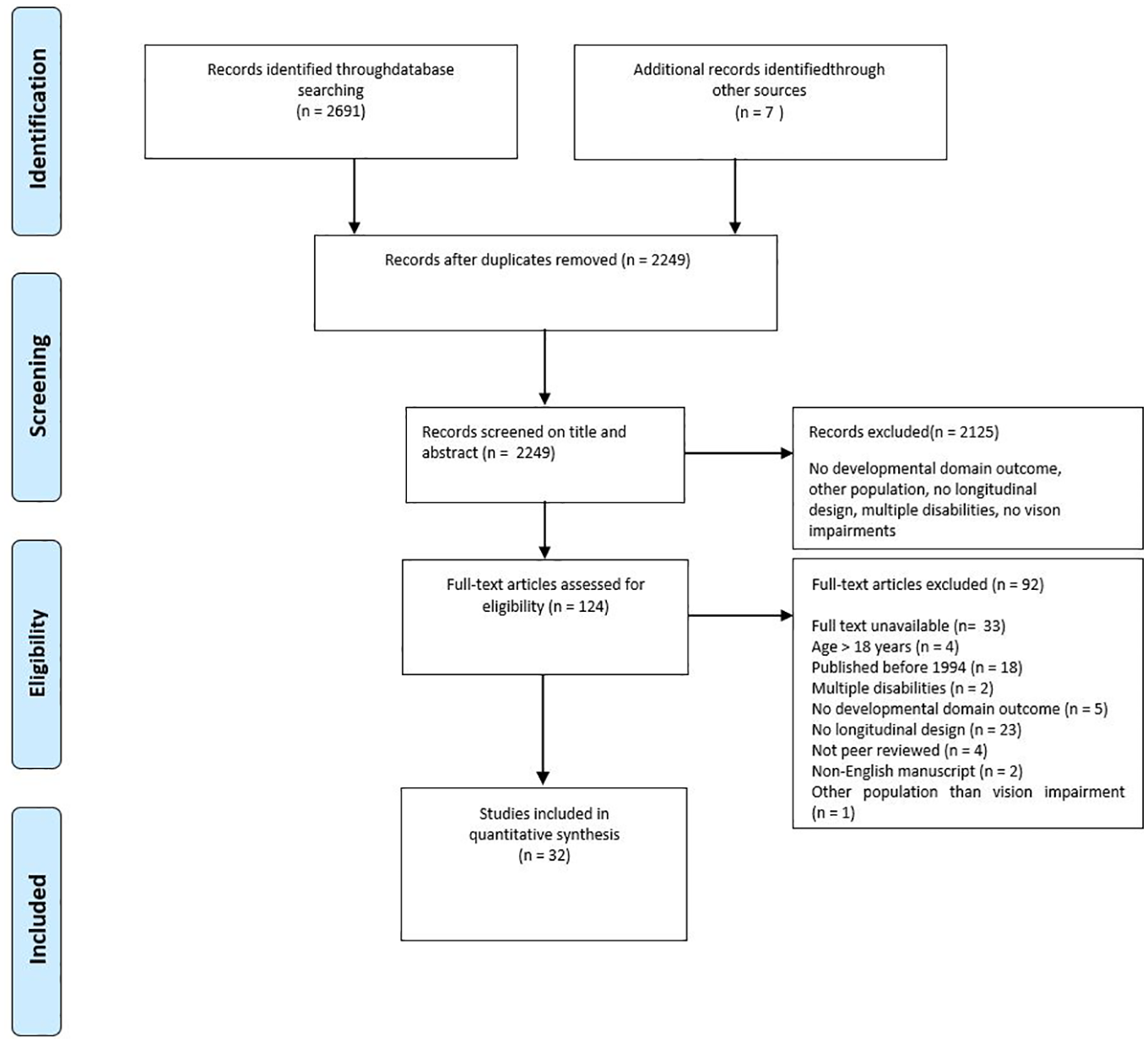
Flow chart of the inclusion process. In total, 2691 records were identified through database searching. After the removing duplicates, 2249 articles were screened for eligibility. In total, 2217 studies were excluded. Twenty-five studies were included in the synthesis. Seven additional records were identified through other sources, which makes a total of 32 included studies.
Characteristics of sources
The characteristics of the 32 selected studies are displayed in Table 1. Table 2 shows the main outcomes. Two studies were a single case study (#1 and 3) and three studies were case studies with two participants (#5, 7, and 12). All other studies examined groups of children, with group sizes varying between four and 742 children. One study included an intervention (#13), the others were purely descriptive. The number of waves varied from two (#4, 29, and 30) to 35 waves (#7) and the duration of the study between the first and last wave varied from 4 months (#1 and 3) to 9 years (# 4, 14, and 25). Different age cohorts were studied. Eleven studies included participants with a mean age till 2 years (#1, 2, 3, 9, 10, 13, 21, 22, 23, 24, and 32). Six studies included participants with a mean age ranging between 2 and 4 years (#5, 6, 7, 8, 16, and 31) and six studies included participants with a mean age starting at 4 years until 10 years of age (#4, 15, 17, 18, 19, and 20). Finally, nine studies included adolescents, of which eight studies included participants between 10 and 15 years of age (#11, 12, 14, 25, 26, 27, 28, and 30) and one study participants older than 16 years of age (#29). The participants’ vision status was classified as sighted or as a certain level of vision impairment. The vision impairments were blind or low vision. Two studies used profound and severe vision impairment instead of blind or low vision (#13 and 18). The severity of the vision impairments among the participants was wide-ranging. Of the ten studies with children who were: six studies included children with blindness only (#1, 2, 10, 12, 16, and 24) and four compared children with blindness to sighted children (#4, 5, 7, and 8). A mixed group of children with blindness and low vision was included in 13 studies. Eight of them studied children with blindness and low vision only (# 13, 14, 15, 18, 20, 21, 27, and 29) and five compared children with blindness and low vision to sighted children (# 3, 6, 10, 11, and 30). Eight studies included also some children with multiple disabilities in their study sample, but the majority of the participants had only vision impairments (#17, 18, 23, 25, 26, 28, 31, and 32), otherwise, they would have been excluded. Multiple methods and instruments were used in the studies to collect data. Developmental scales were used in 13 studies (# 2, 4, 13, 16, 17, 18, 19, 20, 21, 23, 24, 31, and 32). Nine studies used questionnaires for parents or children (#13, 17, 19, 25, 26, 27, 28, 29, and 30). Observations were used in eight studies (#3, 4, 5, 6, 7, 8, 9, 10, and 23). In three studies, children had to perform tasks (#11, 12, and 14). Interviews were held in four studies (#4, 14, 15, and 25), and one study used audio recordings (#1). Most studies used one type of instrument to collect data, but eight studies made use of multiple methods (#11, 13, 14, 15, 16, 17, 23, and 25).
Study characteristics.
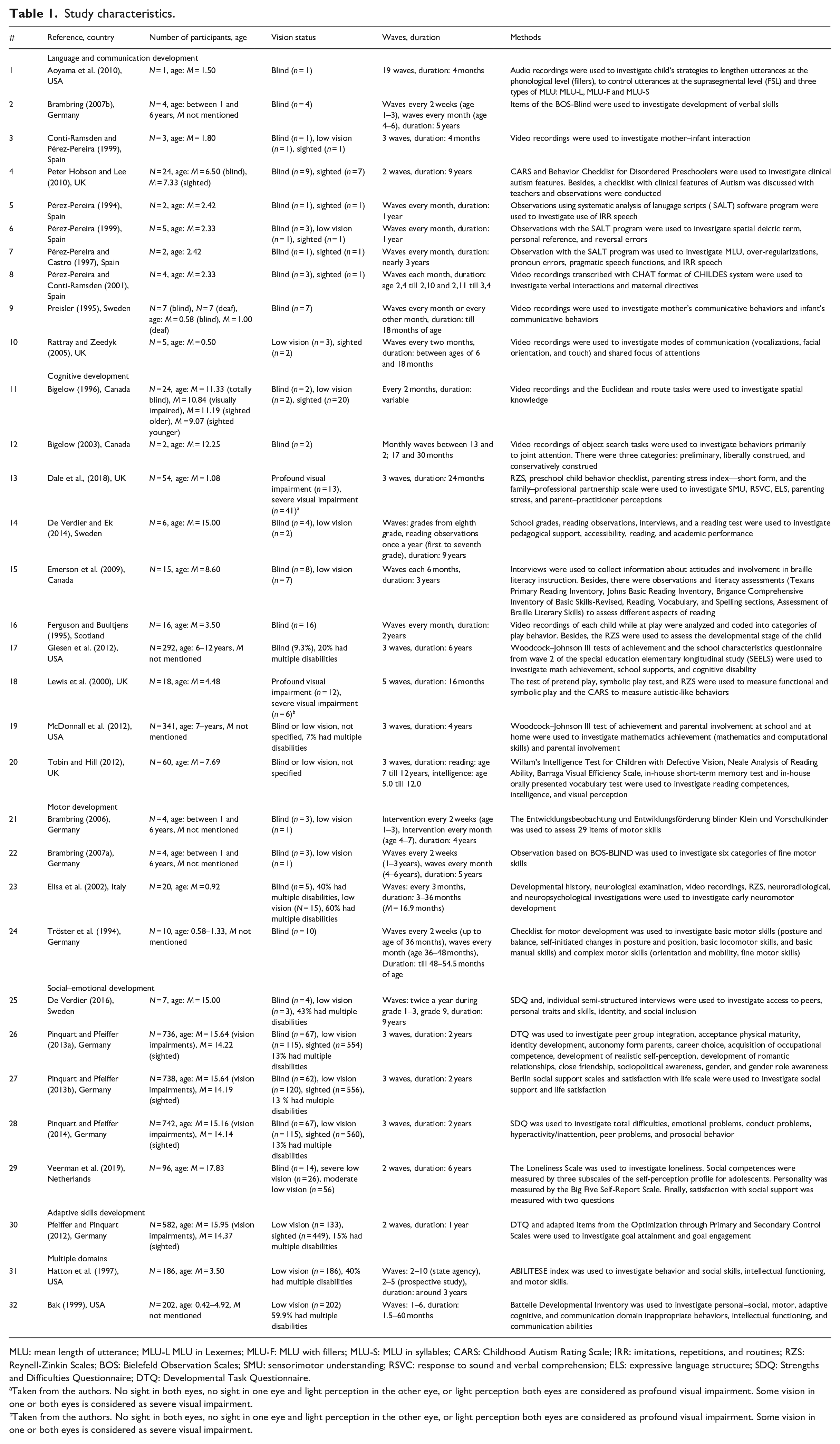
MLU: mean length of utterance; MLU-L MLU in Lexemes; MLU-F: MLU with fillers; MLU-S: MLU in syllables; CARS: Childhood Autism Rating Scale; IRR: imitations, repetitions, and routines; RZS: Reynell-Zinkin Scales; BOS: Bielefeld Observation Scales; SMU: sensorimotor understanding; RSVC: response to sound and verbal comprehension; ELS: expressive language structure; SDQ: Strengths and Difficulties Questionnaire; DTQ: Developmental Task Questionnaire.
Taken from the authors. No sight in both eyes, no sight in one eye and light perception in the other eye, or light perception both eyes are considered as profound visual impairment. Some vision in one or both eyes is considered as severe visual impairment.
Taken from the authors. No sight in both eyes, no sight in one eye and light perception in the other eye, or light perception both eyes are considered as profound visual impairment. Some vision in one or both eyes is considered as severe visual impairment.
Study outcomes.
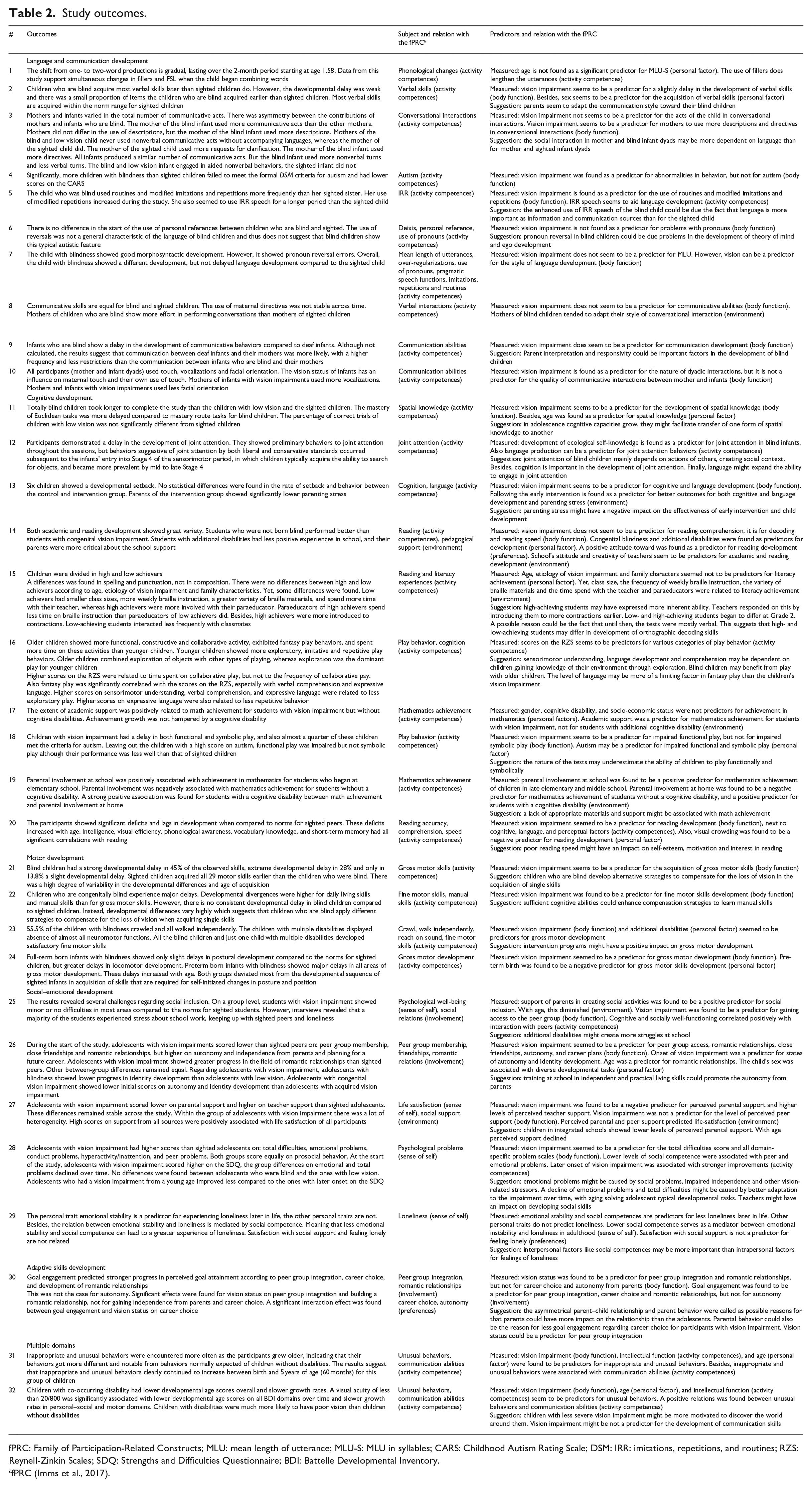
fPRC: Family of Participation-Related Constructs; MLU: mean length of utterance; MLU-S: MLU in syllables; CARS: Childhood Autism Rating Scale; DSM: IRR: imitations, repetitions, and routines; RZS: Reynell-Zinkin Scales; SDQ: Strengths and Difficulties Questionnaire; BDI: Battelle Developmental Inventory.
fPRC (Imms et al., 2017).
Synthesis of results
Development
Table 2 shows that cognitive development was examined in ten studies (#11, 12, 13, 14, 15, 16, 17, 18, 19, and 20), and 10 studies investigated language and communication development (#1, 2, 3, 4, 5, 6, 7, 8, 9, and 10). Motor development was explored in four studies (# 21, 22, 23, and 24), social–emotional development in five studies (#25, 26, 27, 28, and 29), and only one study focused on adaptive skills (#30). Two studies investigated multiple developmental domains (#31 and 32). Within the domains, there was a variety of studied subjects, such as spatial knowledge, reading and mathematics achievement in the cognitive development domain. See Table 2 for a complete overview. Some of the subjects have been researched in more than one study, namely, communicative abilities (#9, 10, 31, and 32), reading development (#11, 14, and 20), gross motor development (#21 and 24), romantic relations (#26 and 30), social support (#27 and 29), and unusual behaviors (#31 and 32). However, on closer examination, it turned out that the operationalization and instrumentation of the subjects was different in the studies, except for romantic relationships (#26 and 30). Both these studies used the Developmental Task Questionnaire (DTQ) to investigate romantic relationships and were part of the same project Marburg Study on Vision Loss (Pfeiffer & Pinquart, 2012; Pinquart & Pfeiffer, 2013a).
The authors of 20 studies mentioned an association between vision status and development (#2, 4, 5, 9, 11, 13, 14, 18, 20, 21, 22, 23, 24, 25, 26, 27, 28, 30, 31, and 32), whereas in eight studies proof for an association between vision status and level of development was studied but explicitly not found (#3, 4, 6, 7, 8, 10, 14, and 18). 1 More specifically, vision status did not prove to be associated with the use of pronouns (#6), mean length of utterances (#7), communicative abilities (#8), the quality of communicative interactions (#10), reading comprehension (#14), acts in conversational interactions (#3), symbolic play (#18), and autism (#4). In the remaining seven studies (#1, 12, 15, 16, 17, 19, and 29), vision status was not used as a variable. These were all non-comparative studies.
fPRC
To answer the second research question, the variables used in the studies were related to one of the factors of the fPRC framework of Imms et al. (2017). This was done by the first author and by one of the three second assessors. In case of disagreement or doubts, the fourth author was consulted. If after this analysis, some variables were left, that could not be in terms of one of the factors of the fPRC, they were classified in terms of the ICF-CY. This analysis resulted in results depicted in Table 2. The most commonly covered fPRC factor in the outcomes of the reviewed studies was “activity competence” (#1, 2, 3, 4, 5, 6, 7, 8, 9, 10, 11, 12, 13, 14, 15, 16, 17, 18, 20, 21, 22, 23, 24, 31, and 32), with the most frequently studied activities being language and communication (#1, 2, 3, 4, 5, 6, 7, 8, 9, and 10) and cognitive development (11, 12, 13, 14, 15, 16, 17, 18, 19, and 20). Other factors of the fPRC were covered scarcely; two included environmental factors (#14 and 27), four sense of self (#25, 27, 28, and 29), one preferences (#30), and three involvement (#25, 26, and 30).
The most common predictor used in the studies was vision status, a variable that is not covered by the fPRC, but related to body function of the ICF-CY model. Other common predictors were, in ICF-CY terms, personal factors, such as age and sex. To a lesser extent, factors mentioned in the fPRC were used as predictors. Seven studies had predictors in the realm of what Imms et al. (2017) call the environment. Examples of these predictor variables were the interaction style of mothers (#9) or the attitude and creativity of teachers (#14). Five studies had predictors in the realm of activity competences, for example, language (#12 and 20) or cognitive functioning (#20, 25, and 32). One study had a variable in the realm of preferences, namely, attitude (#14), one study in involvement, namely, goal engagement (#30) and one in sense of self, namely, emotional instability (#29). A visual overview of the variables studied in the 32 articles is depicted in Figure 2.
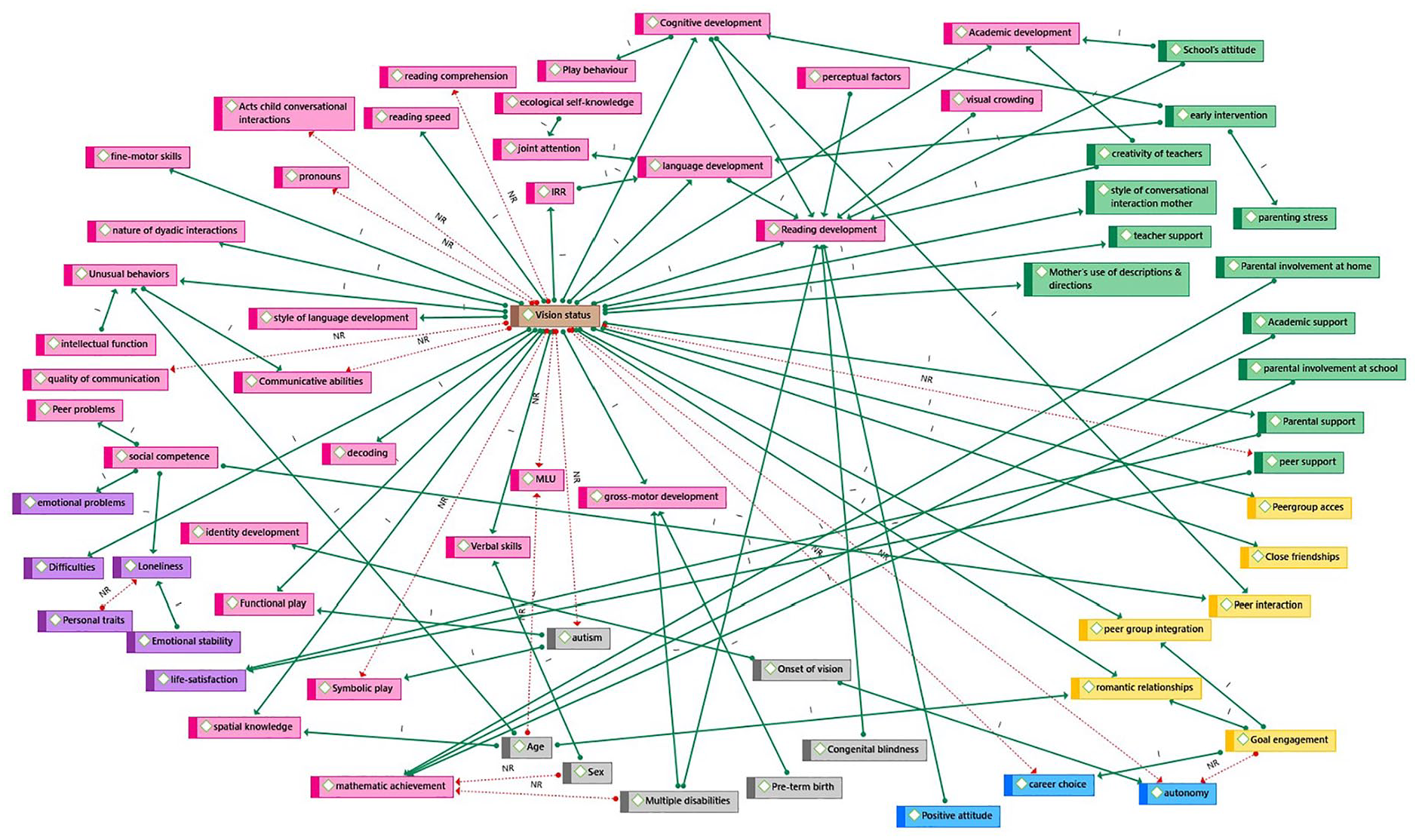
Overview of all the variables from the included studies, related to the factors of the fPRC framework. Related to the factor environment are: school’s attitude, early intervention, creativity of teachers, style of conversational interaction mother, teacher support, parenting stress, mother’s use of descriptions and directions, parental involvement at home, academic support, parental involvement at school parental support, and peer support. Related to the factor involvement are: peer group access, close friendships, peer interaction, peer group interaction, romantic relationships, and goal engagement. Related to the factor preferences are: autonomy, career choice, and positive attitude. Related to the factor activity competences are: mathematic achievement, spatial knowledge, symbolic play, gross motor development, MLU, verbal skills, functional play, identity development, decoding, social competence, peer problems, quality of communication, communicative abilities, style of language development, intellectual function, unusual behaviors, nature of dyadic interactions, fine motor skills, pronouns, acts child conversational interactions, reading speed, reading comprehension, IRR, joint attention, ecological self-knowledge, play behavior, cognitive development, language development, reading development, perceptual factors, visual crowding, and academic development. Variables that could not be related to the framework are: vision status, autism, onset of vision, congenital blindness, pre-term birth, multiple disabilities, sex, and age. These variables were related to the ICF-CY.
Discussion
The current scoping review examined the state of the art of longitudinal research on the development of children with vision impairment. The last comprehensive review was conducted almost 30 years ago (Warren, 1994). Since then, improvements in medical care and societal changes in attitudes toward people with disabilities have taken place. These changes have changed the outlook for children with vision impairment in Western Countries. First, this review was performed to indicate what is known today about possible developmental delays and where knowledge gaps lie. The second goal was to study whether contemporary views on participation of people with disabilities were reflected in longitudinal studies on the development of children with vision impairment performed since 1994. A total of 32 longitudinal studies investigating the development of children with vision impairment and published between 1994 and 2020 were identified.
Main findings
The first research question concerned the development in cognition, language and communication, motor, social–emotional, and adaptive skills development. The results showed that cognitive, language, and communication development were studied the most. To a lesser extent, motor, adaptive skills, and social–emotional development were investigated. A thorough look at the variables in the studies revealed that the nature of the dependent variables in the studies determined largely what the impact of the vision impairment was. For example, De Verdier and Ek (2014) found that vision status was positively correlated with reading speed and decoding, which makes sense, but not with reading comprehension. If children with vision impairment have trouble with reading comprehension than it is probably caused by something else than visual acuity. Another example, Rattray and Zeedyk (2005) found that vision had an impact on the nature of dyadic interactions, but not on the quality of communicative interactions.
The variable that stood out in most studies as a probable predictor for developmental outcomes in children with vision impairment is vision status that is the severity of the vision loss. Yet, the impact can be mediated by other factors or behaviors, so that, the effect of vision loss is alleviated by these mediators. For example, the joint attention of children with vision impairment can be facilitated by adults by giving a rich social context (Bigelow, 2003). Also, Ferguson and Buultjens (1993) suggested that the correlation between scores on the Reynell-Zinkin Scales and exploration could be mediated by language development. In line with Warren (1994), we conclude that vision status alone is not enough to explain developmental outcomes. For example, Pérez-Pereira and Conti-Ramsden (2001) studied communicative abilities and found no differences in their participants who were sighted and blind. They concluded that mothers with a child who is blind tended to adapt their interaction with the child to compensate for the effects of blindness. In this case, a possible negative association between vision status and communicative interactions may have been mediated by maternal behavior. Also in other studies, we found this mediating effect, namely, in studies that took into account the behavior of parents, such as parenting behavior or communication (Conti-Ramsden & Pérez-Pereira, 1999; Pérez-Pereira & Conti-Ramsden, 2001; Preisler, 1995), early intervention (Dale et al., 2018), and social competence (Veerman et al., 2019). That is not to say there is no mediating effect of other factors than these, it just was not studied. Also, note that the sources covered in this review for the most cases did not contain statistical evidence on this possible mediating variable, they merely hinted on an association. That parenting actions mediate the effect of vision status makes sense. Several studies even suggested that there might be mediating factors alleviating the impact on developmental outcomes. Mediating factors that came up were the quality of the interaction with the social environment, mostly parents (Brambring, 2007b; Pfeiffer & Pinquart, 2012; Preisler, 1995), and the role of language (Bigelow, 2003; Conti-Ramsden & Pérez-Pereira, 1999; Ferguson & Buultjens, 1993; Peter Hobson & Lee, 2010).
This scoping review showed that vision status, that is the severity of vision loss, is a possible predictor of developmental outcome because of the reported associations. Although in eight studies no evidence was found for the role of vision status in development, the majority of the studies that used vision status as a predictor for development, found that children with blindness and low vision performed worse than sighted children. Now, this is a result that was already known from Warren’s (1994) review. We still do not know what causes individual variation within the group of children with vision impairment. A practical explanation is that researchers operationalize severity of vision impairment in different ways. Most studies made use of ordinal data with a distinction between children who were blind, sighted or had low vision. A difficulty in the measurement of vision status is that it is not only expressed by visual acuity and field of vision, but also by other visual functions (e.g., contrast sensitivity, depth, color, and motion perception et cetera). Even for the most distinct group, children who are blind, different operationalizations were found. For example, blindness was defined as no form or light perception at all, but in some studies included children with some minimal light perception as well. Two studies (Dale et al., 2018; Lewis et al., 2000) made another distinction, namely, between profound and severe vision impairment. The pro-found group incorporated children with blindness and some shape perception. In general, less vision was associated with more impaired development. But whether this association is correlational and linear or non-linear is unclear, as vision status was mostly measured as a categorical variable. In addition, it was also not possible to conclude whether with regard to vision there is a certain cut-off point under which problems in behavior arise, since study designs were such that one cannot draw that conclusion. For now, we can conclude that the role of vision is task-dependent (see West et al., 2002) and that due to the inclusion of vision status as a ordinal variable in all the studies in this review the nature of the association between vision status and behaviors cannot be clearly demonstrated.
Although we found some indications that some variables might be predictors for developmental outcomes in children with vision impairment, we still have to be careful with drawing conclusions. A longitudinal design was an inclusion criterion. In the reviewed studies, this could mean two different things. Although most studies used repeated measurements with the same instrument in each wave, there were also studies in which children were studied in different waves and also with different instruments, capturing different behaviors or constructs (De Verdier & Ek, 2014; Emerson et al., 2009; Lewis et al., 2000; Veerman et al., 2019). The first kind of longitudinal studies is able to find possible changes in development over time. The latter can find possible predictors for later behavior, without being able to capture behavioral changes over time. Moreover, the longitudinal designs were highly divers, with great variation in the amount of waves, the time between waves and the total duration of the studies. For example, Brambring (2007a) visited his participants each 2–4 weeks for five consecutive years to describe their developmental paths, whereas, Dale et al. (2018) performed assessments in three waves in 2 years to investigate the development of their participants. Due to the large variation in longitudinal designs, it is impossible to conclude which changes over time actually occurred and what the true predictors of developmental outcomes were, since statistical evidence is lacking.
The second research question focused on which factors of the fPRC framework were present in the longitudinal studies. Following the fPRC framework of Imms et al. (2017), most studies investigated variables that were related to the factor activity competences. A first reason that many variables were in the category of activity competences, may be that there is a large number of skills and competences children gradually acquire, varying from communication skills to gross motor skills. A second reason has to do with rehabilitation trends over time. Given the time covered by this review it is not unexpected to find mostly studies covering activity competences. The dominant paradigm in rehabilitation practices at this period of time was to develop skills in people with disabilities (Berger & Wilbers, 2021). An empowerment and human rights perspective, such as underlying the UN convention on the rights of people with disabilities, or a social perspective, underling the ICF and ICF-CY categorizations are both of later date. The same counts for perspectives prioritizing quality of life, well-being, or participation.
Still, ten studies included also variables that were related to other factors of the fPRC framework than activity competence, namely, variables related to the factors: environment, preferences, sense of self, and involvement. Noteworthy, a positive impact on outcomes was predominantly found for the presence of predictor variables that were related to the fPRC factors environment, preferences and sense of self. For example, Pinquart and Pfeiffer (2014) found that vision impairment was negatively associated with the developmental goals “peer group integration” and “romantic relations.” Yet, goal engagement, related to the fPRC factor preferences, was thought to have a positive effect on the attainment of these developmental goals. Some studies showed the buffering or mediating value of fPRC factors in the development of children with vision impairment. For example, Dale et al. (2018) found that more severe vision impairment predicted impaired cognitive and language development, but this effect was mitigated by home-based early intervention. Early intervention, in fPRC terms belonging to the factor environment, was associated with better outcomes in cognitive and language development and reduced parenting stress. This outcome is hopeful, since vision impairment is often permanent and not amenable to intervention, but child rearing, communication and stimulating interactions as part of early intervention are, and can therefore be used in rehabilitation.
Limitations
The current scoping review has some limitations. First, the review included only longitudinal studies that were written in English, online accessible, and published in peer-reviewed journals. Because of this, it is possible that not all information that is available about the development of children with vision impairment was included in the review. Yet, we chose for these criteria to ensure that studies met scientific quality criteria and the information is monitored for false claims (Voight & Hoogenboom, 2012; Ware, 2011).
Second, the previous review about longitudinal studies was published by Warren (1994). Therefore, the present review only covered studies published after 1994 until 2020 to create an updated state of the art. A limitation may be that the timespan is still almost 30 years. And, as mentioned in the introduction, several changes over the years might have affected the development of children with vision impairment. A review period of thirty years might therefore be too long, with the consequence that perhaps some findings of the current review are no longer up to date or valid. For example, because of a change in etiologies causing vision impairment (Boonstra et al., 2012) or a changing perspective on rehabilitation practices, the WHO (2007) came with a statement about rehabilitation practices. In the same period, the United Nations (2006) published the United Nations CRPD. Since the ratification of this convention was a time-consuming process, and not all countries implemented it uniformly, it took a while before the notions from these publications found their way in rehabilitation practice and research. Regarding this and the fact that the fPRC framework (Imms et al., 2017) is published in 2017, it is not surprising that a majority of 22 studies had a single focus on activity competences of children with vision impairment. Ten studies had a more multi-perspective focus and investigated, next to activity competences, other factors, such as the role of parents, peers and teachers in the child’s environment, preferences, involvement, and the sense of self. To conclude, the new perspective on rehabilitation practices will only become visible in contemporary research after some time has passed.
Third, the review synthesizes the development of children with vision impairment in several developmental domains compromising several sub-topics and throughout the age spectrum. Thus, there is a lot of heterogeneity in the instruments that were used and in the study outcomes. As the group of children with vision impairment is highly diverse, with respect to the nature of the vision impairment, culture, social economic status, and age of the participants, there may also be a lot of heterogeneity in the samples of the studies. For instance, the same predictors were not measured across different age groups, making it hard to draw conclusions on the effect of these predictors for different ages. What applies to young children with vision impairment might not apply to older children. All in all, because of this heterogeneity, we have to be careful with drawing conclusions or generalizing findings. On the other hand, the heterogeneity can be seen as a valuable aspect of the current study, as this scoping review showed that various factors are of interest in the development of children with vision impairment. Among others, the included studies noticed the importance of the interaction of mothers (Preisler, 1995), goal engagement (Pfeiffer & Pinquart, 2012), emotional instability (Veerman et al., 2019), and cognitive functioning (Bak, 1999; De Verdier, 2016; Tobin & Hill, 2012).
Finally, it is notable that several variables used in the source studies could not be placed in the fPRC framework. The fPRC framework is based on the model of the ICF-CY, but deviates in the categorization of variables and terminology from the ICF-CY. This might have caused some confusion. Besides, in the terminology of the fPRC framework, preferences, sense of self and activity competences are intrinsic factors, but these do not include what are called personal factors in the ICF-CY. Examples are sex or age, or body functions, such as a vision impairment. As a result, the most commonly used predictor variable, vision status, could not be placed in the fPRC framework. So, in addition to finding which factors of the fPRC framework are more and less represented in longitudinal studies, we also found that the longitudinal studies also used variables that were not represented in the fPRC framework.
Implications for research and practice
The outcomes of this scoping review provided some implications for research and practice. To begin with the first, studies used very different types of longitudinal designs. Future research should preferably use a design with multiple repeated measurements of the same constructs over a sufficient period of time to see whether change occurs, where individual differences stem from and what the possible risk and resilience factors are (Heppe et al., 2020; Kef, 2005; Verver et al., 2019). Future research can include multiple repeated measurements to reveal developmental patterns in children with vision impairments. By studying children for a long time, it is possible to see whether development slows down, stagnates, deviates or even turns pathological, either permanently or just temporarily (Vervloed et al., 2020). Within such a design, Peter Hobson and Lee (2010), for example, were able to show that many children with vision impairments who scored high on autism ratings scored in the normal range later on. Such a development is hardly found in children with autism without vision impairment.
The current scoping review showed that it is meaningful to investigate a variety of variables, not only variables that are related to the factor activity competences, but also other factors closely connected to participation, such as environmental factors, sense of self, preferences, and their relations. This review found some evidence for the positive and stimulating impact of these factors on later development. Future research could build on these findings. A practical implication is that other than variables like vision status or the child’s sex, these variables can be altered which makes them useful for rehabilitation practices and intervention. An example is the behavior of parents and parenting strategies.
Applying the fPRC framework to the studies also suggests that the interaction of various factors in the framework may have a positive impact on the development of children, possibly because they work as compensation strategies. Compensation strategies refer to actions or specific behaviors that mitigate the effects of a disability, such as a lack of specific skills (Tomey & Sowers, 2009). More specifically, reduced functioning in one domain can be compensated for in another domain to some extent. For example, children with vision impairment can use their memory to compensate the lack of visual information to navigate in a space (Raz et al., 2007). With regard to practice, the presence of compensation strategies argues for a multifactorial approach in rehabilitation practices, where the focus should not be on fixing a single impairment, but on the interaction of various factors that can stimulate development and lead to participation, that is social inclusion in society (Imms et al., 2017; Schneidert et al., 2003; WHO, 2007). Future research can investigate multiple variables to find proof for compensation strategies that can be affected by intervention. A very practical consequence of this overview is that if one wants participation to improve the autonomy and the sense of self of children with vision impairment should be enhanced and the environment of the child should be included more to increase the feeling of involvement. Whether this eventually improves participation is something research could study.
Conclusion
The scoping review provides an overview of the current knowledge about the development of children with vision impairment, based on longitudinal research published between 1994 and 2020. It showed that a variety of developmental domains were investigated with cognition and language and communication being most represented. For the second research question, we applied the fPRC framework to the studies. Comparison with reasoning from the fPRC framework (Imms et al., 2017) showed that there are several white spots in our knowledge about the development of children with vision impairment. Variables related to the factor activity competences were mostly investigated, but the other factors of the fPRC, preferences, sense of self, and involvement were less often investigated.
Supplemental Material
sj-docx-1-jvi-10.1177_02646196211072432 – Supplemental material for A scoping review of longitudinal studies of children with vision impairment
Supplemental material, sj-docx-1-jvi-10.1177_02646196211072432 for A scoping review of longitudinal studies of children with vision impairment by Carlijn Veldhorst, Mathijs Vervloed, Sabina Kef and Bert Steenbergen in The British Journal of Visual Impairment
Supplemental Material
sj-docx-2-jvi-10.1177_02646196211072432 – Supplemental material for A scoping review of longitudinal studies of children with vision impairment
Supplemental material, sj-docx-2-jvi-10.1177_02646196211072432 for A scoping review of longitudinal studies of children with vision impairment by Carlijn Veldhorst, Mathijs Vervloed, Sabina Kef and Bert Steenbergen in The British Journal of Visual Impairment
Supplemental Material
sj-docx-3-jvi-10.1177_02646196211072432 – Supplemental material for A scoping review of longitudinal studies of children with vision impairment
Supplemental material, sj-docx-3-jvi-10.1177_02646196211072432 for A scoping review of longitudinal studies of children with vision impairment by Carlijn Veldhorst, Mathijs Vervloed, Sabina Kef and Bert Steenbergen in The British Journal of Visual Impairment
Supplemental Material
sj-docx-4-jvi-10.1177_02646196211072432 – Supplemental material for A scoping review of longitudinal studies of children with vision impairment
Supplemental material, sj-docx-4-jvi-10.1177_02646196211072432 for A scoping review of longitudinal studies of children with vision impairment by Carlijn Veldhorst, Mathijs Vervloed, Sabina Kef and Bert Steenbergen in The British Journal of Visual Impairment
Supplemental Material
sj-docx-5-jvi-10.1177_02646196211072432 – Supplemental material for A scoping review of longitudinal studies of children with vision impairment
Supplemental material, sj-docx-5-jvi-10.1177_02646196211072432 for A scoping review of longitudinal studies of children with vision impairment by Carlijn Veldhorst, Mathijs Vervloed, Sabina Kef and Bert Steenbergen in The British Journal of Visual Impairment
Footnotes
Acknowledgements
The authors would like to thank Leonie Besuch, Manon Borst and Esther van Sloten for their contribution in screening the articles and the data extraction. Yours sincerely, Carlijn Veldhorst.
Funding
The author(s) disclosed receipt of the following financial support for the research, authorship, and/or publication of this article: This work was supported by Stichting ter Verbetering van het Lot der Blinden.

Supplemental material
Supplemental material for this article is available online.
Notes
References
Supplementary Material
Please find the following supplemental material available below.
For Open Access articles published under a Creative Commons License, all supplemental material carries the same license as the article it is associated with.
For non-Open Access articles published, all supplemental material carries a non-exclusive license, and permission requests for re-use of supplemental material or any part of supplemental material shall be sent directly to the copyright owner as specified in the copyright notice associated with the article.
