




Abstract
Albinism is a huge challenge both socially and educationally in Tanzania and many other countries. Pupils with albinism are normally encouraged to read with a fixed gaze due to their nystagmus, and there are doubts about whether refraction improves their reading.
The aim is to get more knowledge about their functional vision as a fundament for educating pupils with albinism.
The article presents a case study with three pupils from a primary school in Tanzania who went through a functional assessment of vision using standardized methods and a new eye-tracker software measuring smooth pursuits.
The assessment reveals large individual differences not only in visual acuity but also in ocular motor functions.
There is a need for better understanding of the vision challenges these pupils face so that professionals can develop more suitable methods in school for securing their education.
Introduction
Pupils with albinism have visual challenges which influence their educational, social-emotional and later career development. Due to nystagmus, low visual acuity (VA), strabismus and photophobia (Jhetam & Mashige, 2019), pupils may experience a variety of vision-related problems in the school environment, such as glare to light and difficulties with reading and copying written information from the blackboard or textbooks (Dart et al., 2010). Tanzania has 14 times more people with albinism than most countries in the world (Cruz-Inigo et al., 2011) and nearly 70% of children with albinism report that their eye-sight has a severe negative influence on their school performance (Kiprono et al., 2012). In addition to vision problems, there is a serious risk of skin cancer due to absent pigmentation in the skin. Many experience discriminations in school and society, even violence and killing. Due to stigmatization, discrimination and the lack of technical aids and teachers with insight in their vision challenges, they do not have the same opportunities as others (Franklin et al., 2018). Although education programs are one of the solutions seen to avoid killing of young children with albinism in Tanzania (Taylor et al., 2019), only half of them complete primary school and 10% attend secondary school (The Citizen, 2018).
A research project that included some pupils with albinism was conducted in a Tanzanian primary school. Like the other participants, the pupils with albinism were assessed for various visual functions. None of the pupils wore eyeglasses for refraction. Jhetam and Mashige (2019) find that even though opticians achieve a significant improvement in VA for pupils with albinism through good refraction, the refraction does not seem to improve their reading. Their reduced near-VA and intense nystagmus are even found to be poor indicators of their reading speed (Barot et al., 2012).
The goal of this study is to develop a better understanding of the visual challenges of pupils with albinism, so that education can be improved. Perhaps some connections or visual challenges are overlooked which might be important for stimulating their vision development (Wilhelmsen et al., 2015). Teachers’ knowledge is normally limited to the fact that pupils with albinism need to sit close to the blackboard and their books, and that too much light is a problem (Dart et al., 2010). Children with albinism often read by locking the head in a position where the nystagmus is calm and in this position bend very closely to the paper (Lynch et al., 2014). Normally reading includes fixations, saccades, regressions and line shifts. But when the gaze is locked in a fixed position were nystagmus is calmer, the reading needs head or text movements. In this situation, they read drifted text which involves an alternation of smooth pursuits and saccades (Valsecchi et al., 2013).
Method
This case study (Olsson & Sörensen, 2006) was conducted to learn more about eye movements of learners with albinism. The three cases presented here are 10–12 years old and pupils in a public primary school in Tanzania. Their eye movements are tested and described. The results are compared individually and even with each other, to reach a better insight in aspects of their eye movement. The hope is that more insight in their ocular motor challenges can help develop better adapted educational methods.
The study took place during a broader project conducted by Western Norway University of Applied Sciences, Koblenz University of Applied Sciences and Patandi Teachers College of Special Needs. The primary investigators consisted of vision scientists, teachers for children with visual impairments and a computer scientist.
The special provisions made for these participants at school was sitting close to the blackboard, being allowed to stand up and go even closer to read the text, and a hat to wear as protection for disturbing light. The classrooms are rather dark with no specific lightening of the blackboard or their desks.
Screening of all participants was arranged in the only large room in school which had curtains for regulating daylight. The room had bright walls and electricity, and even an outside pergola to protect for direct sunshine. The pupils were screened during the school day and were divided in different stations connected to each test. Standard procedures were followed.
The test results presented here are: VA-screening at 40 cm and 3 m using LEA® charts with 5 symbols per row (LEA-Test Ltd., 2018). The results are recorded as decimals. The right eye and left eye are tested separately, and both are tested together. The results on a cover-test, a push-up convergence-test and the Hole-in-the-card eye-dominant test at 40 cm and at 3 m, are also presented. For the hole-in-the-card test a colored figure with a diameter of 5 cm was shown. The pupils should not describe any details; the task for the researchers was to observe which eye they instinctively chose when asked to look through the hole (Miles, 1929).
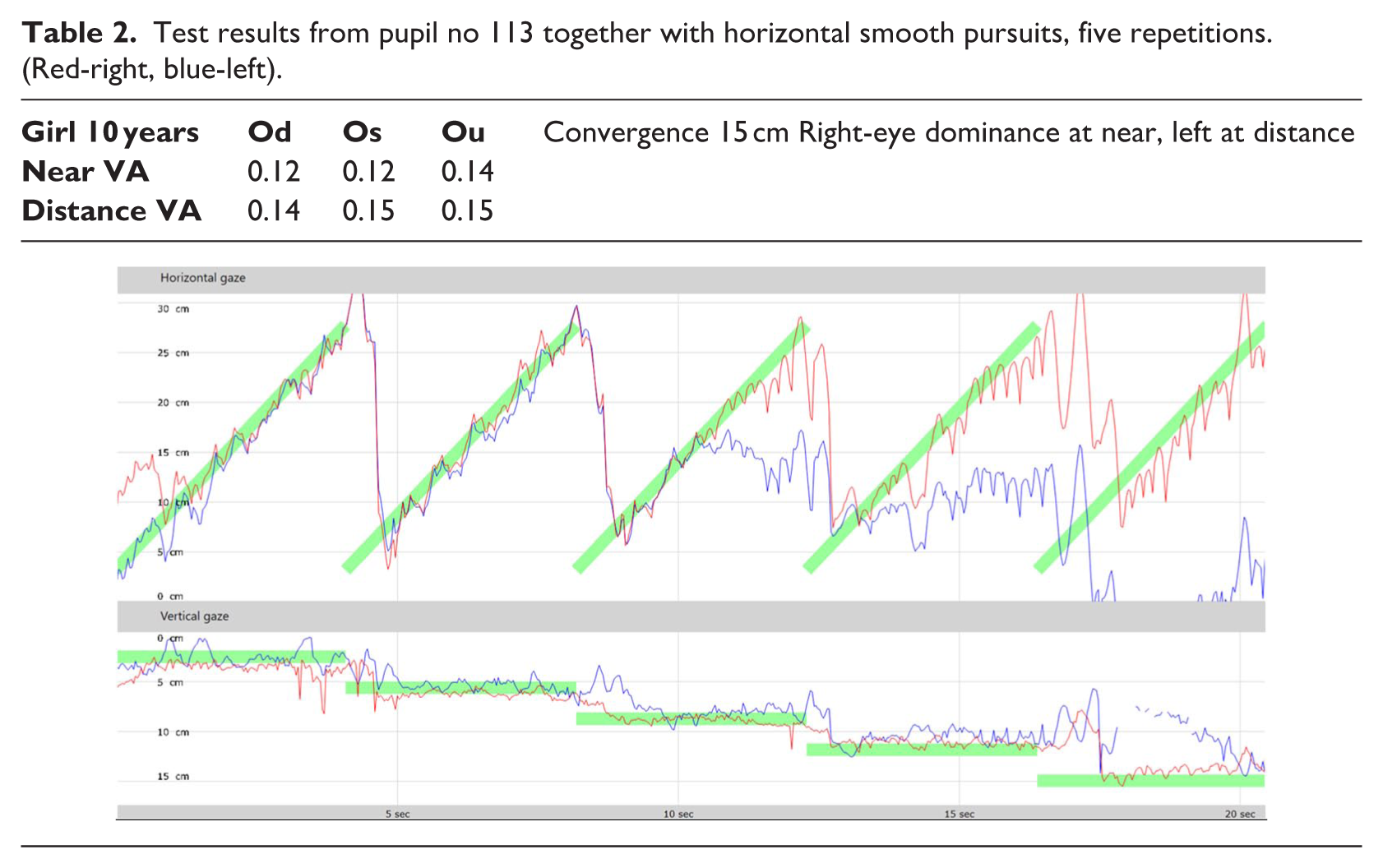
Because of the close relationship between saccades and smooth pursuits (Leigh & Zee, 2006; Shanidze et al., 2016), the eye-tracker task Horizontal Smooth pursuits, with five repetitions, was conducted with the Tobii Eye Tracker 4 C® and the soft-ware C&Look (Eide & Watanabe, 2017) to study the participants ocular motor control. The pupils were asked to follow an animation that moves smoothly across the lap-top-screen, which is placed at 60 cm. If the distance to the screen increases or decreases with +/-5 cm, the program tells. The subjects are tasked with looking at a colorful figure and keeping their head steady. Only with a stable head position is it possible to study the capacity of ocular motor functions since head movements are found to disturb clear vision of objects (Ramat & Zee, 2003). Often chin and forehead resting are used under similar tests (Shanidze et al., 2016), but the participants managed without. In the results presented below, the movements of the right gaze are colored red in the graphs and left eye movements are blue. A green line illustrates where the figure is moving. The upper graph shows the horizontal eye movements and the lower graph shows each eyes’ vertical eye position.
This research study was approved by the Ministry of Education, Tanzania, as well as Norwegian Center for Research Data (NSD-54866). All parents or guardians received a letter informing them about the project in Kiswahili and asking for their signed consent. The signed form was a prerequisite for participation. Parents/guardians and students were informed about their right to withdraw from the study at any time.
Results
Pupil no 109, an 11-year-old girl, has an equal VA binocularly at near and distance. Her dominant right eye has a slightly better VA than left eye, see Table 1.
Test results from pupil no 109 together with horizontal smooth pursuits, five repetitions. (Red-right, blue-left).
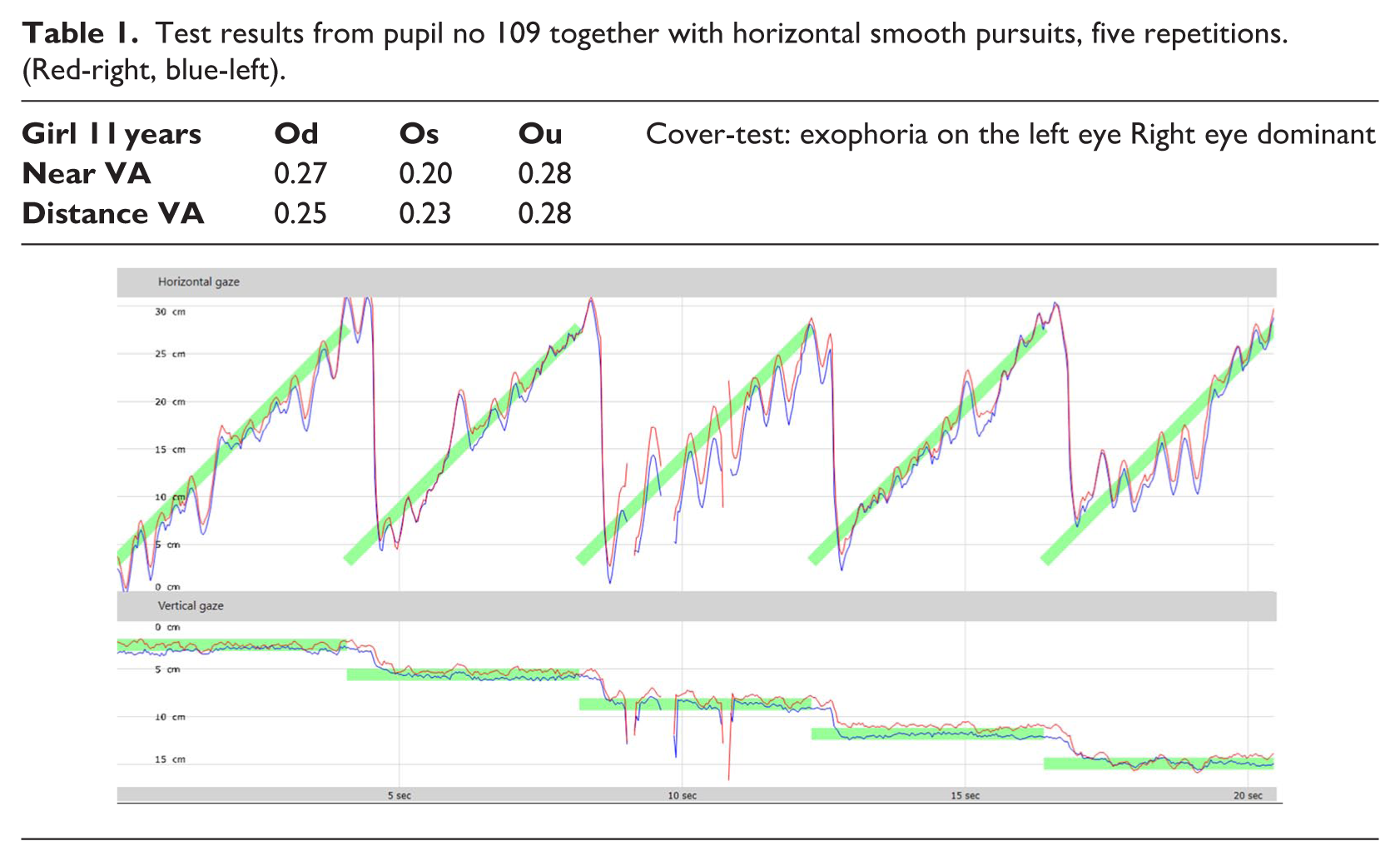
As seen on the horizontal gaze curve, pupil no 109’s horizontal nystagmus has a somewhat large amplitude, see Table 1. Although the cover-test shows an exophoria on the left eye, the subject converges her eyes quite closely together and follows the direction of the figure and fixate approximately on the same spot binocularly during the eye-tracker test. First on the third line, or on the middle of the screen, the eyes drift a little apart and the amplitude increases. On the next row, they are more joined again. The lower curve reveals even some vertically disturbances when following on the third line. One of the other recordings showed more vertical nystagmus.
The youngest subject is pupil no 113, a 10-year-old girl. On the dominance test she prefers the right eye at near and the left eye at distance.
Pupil no 113 has the lowest VA of the three subjects. Although the nystagmus has fast and small amplitudes at the start of the task, the eyes soon drift apart as they grow tired of keeping binocular fixation and the right eye is acting as the reading eye. From the middle of the third line the eyes depart, and the amplitude increases at the same time indicating that the subject is struggling more. At the vertical level, the dominate right eye is the most stable eye, see the bottom of Table 2. With a 15 cm convergence, the subject shows little strength of keeping binocular vision at near.
Test results from pupil no 113 together with horizontal smooth pursuits, five repetitions. (Red-right, blue-left).
Pupil no 108, a 1-year older participant, has almost identical VA both at distance and near, see Table 3. The cover-test reveals an esophoria on both eyes. The left eye is seen to be the dominant and has the best VA.
Test results from pupil no 108 together with horizontal smooth pursuits, five repetitions. (Red-right, blue-left).
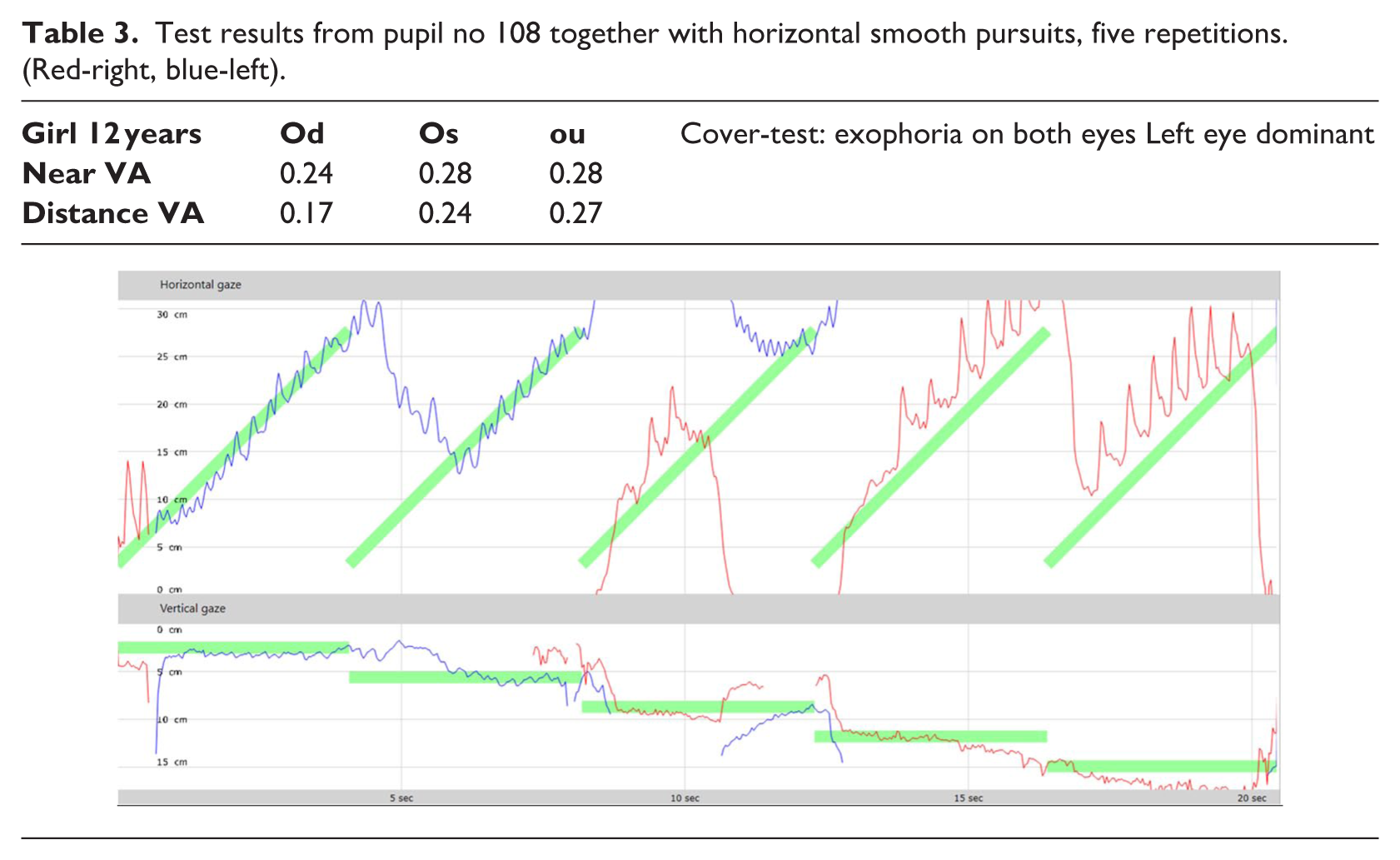
The eye-tracking-graphs show that the subject uses each eye separately. Although the left eye is the best and steadiest, she has a problem moving it into the very left position for starting a new line. The right eye turns to be the active focusing eye downward from the middle of the screen. The letter eye has a larger nystagmus-amplitude which is likely the reason why VA on this eye is weaker. Even here she is struggling turning the eye to the very left position when starting a new line. Also, vertically the not-focusing eye drifts into a different level.
These three cases represent one who converges during reading at 60 cm (Table 1), one with some binocular capacity at this distance before the dominant eye takes over (Table 2) and one with no binocular vision at 60 cm and with reduced capacity directing the gaze to the left (Table 3).
Discussion
Pupils with albinism often do not receive an appropriate education as they are unable to access curriculum due to their visual challenges. This is probably a greater problem in countries where refraction and technical aids are not available, like in Tanzania, although pupils with albinism are normally moderately or severely visual impaired even with the best refraction (Wilmar Eye Institute, 2020). None of the three participants presented here were equipped with refraction or magnifying devices and are therefore presented as they are in their normal school setting. The results show large individual variations in their visual functioning including their ocular motor capacities. Like in the study of Kumar et al. (2011), the pupils also had exophoria and esophoria.
People with albinism who do not experience nystagmus are found to have a distance VA between 1.0 and 0.4 (Wolf et al., 2005). This is much better than the distance VA of our subjects who have a moderate visual impairment, a VA between 0.3 - 0.1, both at distance and at near pursuant to the International Classification of Diseases (ICD-11, World Health Organization, 2018). The dominant-test shows which eye they spontaneously prefer as the sighting eye; and the cover-test indicates which eye has lesser ocular motor control. An eye-tracker-task reveals and visualizes additional information about the ocular motor capacity over time at a fixed distance of 60 cm. The smooth pursuits test was chosen because this ocular motor function is closely connected to their reading strategy (Valsecchi et al., 2013). Given their low VA, pupils with albinism, need to move very closely to the text or have the text enlarged. When reading on a screen it is also necessary to regulate the screen lighting to avoid glare and pain (Presley, 2018).
There is probably a need of looking for new methods which may improve the vision development of pupils with albinism. It is necessary to focus especially on reading since refraction is found to not improve reading (Jhetam & Mashige, 2019). Even low vision and nystagmus are poor indicators for their reading speed (Barot et al., 2012). Individual variation of the nystagmus amplitude over time, reduced ocular motor capacities at different distances and angles, and an underdeveloped foveal (Mokaya, 2010) are reasons for obtaining individual measures. It is important that pupils’ education is adapted to their functional vision and needs, and that measures are in place to ensure that they can succeed in school and fulfill their potential.
Vision is learned and can systematically be trained and stimulated (Amani & Poustinch, 2019; Barraga, 1964; Coetzee & Pienaar, 2013). Less repetitive ocular motor activity is found to give a higher amount of information which is important for learning (Bicalho et al., 2019). Strengthening the eye movements seems thus important. Research on ocular motor problems following brain injuries (Wilhelmsen, 2000) and ocular motor deficits among pupils (Gallaway & Boas, 2007) show that structured exercises can reduce the amplitude of unsteady fixation, strengthen the binocular vision, improve VA through better accommodation and lead to improved reading skills. Accommodative ability in particular is poor in learners with albinism (Karlén & Milestad, 2019).
Some studies on ocular motor training that included children with albinism also show significantly better visual motor control with a steadier near and far fixation (Aki et al., 2007). Positive changes in VA and fixation will not only influence reading and learning but also everyday activities, social participation and visual attention. Based on results from standardized vision tests and the eye-tracker results for the three cases presented, there is a need of a better understanding of their ocular motor challenges. This indicates the need of more individualized teaching methods and reading strategies.
A deeper individual insight in functional vision might be an essential factor in helping vision development of pupils with albinism. Educationally, pupils with albinism are usually provided with refraction, low vision devices, holding materials close to their eyes, more time to view materials and better viewing conditions such as avoiding glare (Jhetam & Mashige, 2020; Karlén & Milestad, 2019). The authors are in support of using those compensatory strategies to improve functional vision and educational outcomes for children with albinism. It may, however, be necessary to further investigate whether other strategies and methods could improve functional vision as well, particularly during reading. Children who are reading drifting text need to strengthen their capacity of smooth pursuits through stimulation. In addition, it would be worth trying to further develop their fixation stability, accommodative ability and binocular vision for better visual conditions even for longer distance viewing. Although Barraga succeeded with structured vision education and stimulation of children with low vision in the early 1960s, there is controversy with regard to vision training or “vision therapy.” Both the benefits of vision training and the type of professional who should actually do the work (Willings, 2017) are questioned.
For pupils’ development there ought to be competent vision teachers who can follow up Barraga’s (1964) work and develop individual suitable methods in an educational setting. A lot of research show that a specter of vision exercises has a positive influence on ocular motor disorders and leads to better functional vision for a range of vision problems connected to different diagnoses (Examples: Amani & Poustinch, 2019; Coats, 2012; Sterner et al., 2001; Wilhelmsen, 2000; Wilhelmsen et al., 2015). Given the significant problems of children with albinism in reading and due to their low reading speed, it is time for further investigations on stimulating vision methods in education.
Conclusion
After visiting several schools in Tanzania, no pupils with albinism have been found wearing any kind of refractive correction. Although it is questionable whether refraction improves their reading (Jhetam & Mashige, 2019), in the study presented, refraction was not assessed, which is a limitation of the study.
If possible, an observation of the gaze position on their individual reading distance could have revealed if any pupil could really keep a fixed gaze position during reading as this often results in abnormal head postures and neck problems (Papageorgiou et al., 2014).
From the results of the cases presented here, it is clear that Teachers of the Visually Impaired and eye health professionals need to carefully assess visual functions, nystagmus, and ocular-motor control in particularly – in children with albinism so that the necessary changes in viewing conditions and seating arrangements, and material adaptations can be made on an individual basis in the classroom. It is of great importance that teachers and other professionals carefully listen to the students’ descriptions of their challenges since they are highly individual. As seen in this study, more research is needed on the potential and limitations of the interventions for pupils with albinism. It is recommended to study the effect of structured visual training and stimulation on ocular-motor control for pupils with albinism. Pupils with albinism need skilled teachers who have detailed knowledge on their visual functioning so that they can make the necessary adaptations in school to meet their individual needs for vision development. For these pupils, we need to research on better educational methods for learning and reading.
Footnotes
Acknowledgements
We wish to thank Carsten Helgesen, Atle B. Geitung, Ilona Heldal and Harald Soleim for supervision on the eye-tracker software at Western Norway University of Applied Sciences. We also wish to thank Eldbjørg Knudsen, Heidi Jåstad and colleagues at Patandi Teachers College of Special Needs, Tanzania, and CPD-students in the HVL-course Vision for Reading and Learning in Tanzania, for data-collection.
Funding
The author(s) disclosed receipt of the following financial support for the research, authorship, and/or publication of this article: The Research Council of Norway, project no: 267524/H30.
