



Abstract
This article examines how supervision work during gradual release from prison in Finland contributes to the individualisation of punishment. Drawing on interviews with prison and community sanction officials, it demonstrates how probation and parole are understood as client-centred practices aimed at supporting social integration, with emphasis on individual planning, trust, and participatory cooperation instead of punitive control. Despite institutional reforms introducing efficiency targets and risk management, we argue that the supervision of gradual release in Finland continues to reflect social work values and orientations, even amid resource constraints and tightening penal policies.
Introduction
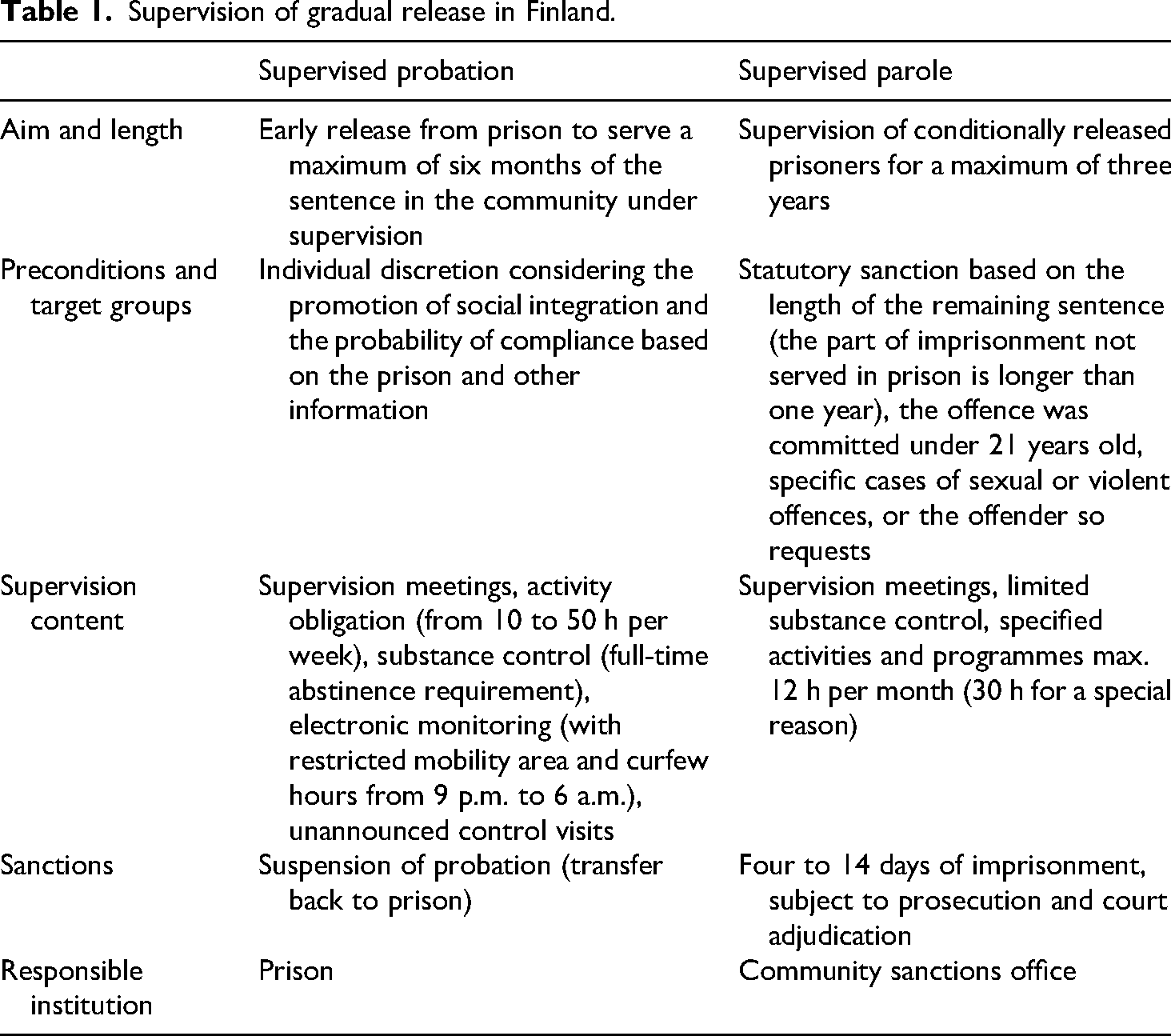
The principle of gradual and planned release from prison has long characterised Finnish penal policies, based on the idea that prisoners should progressively gain more freedom when approaching the end of their sentence, thereby facilitating their reintegration into society (Lappi-Seppälä, 2019). In addition to placement in an open prison, gradual release consists of two phases served in the community under supervision with decreasing control. Currently, a prisoner can be placed on supervised probation at the earliest six months before their conditional release, based on prison discretion, consisting of electronic monitoring and other extensive obligations. In turn, supervised parole is a statutory sanction imposed primarily on the basis of the length of the remaining sentence and administered by community sanctions offices, mainly including supervision meetings and lasting a maximum of three years. 1 Notwithstanding the differences, it is useful to examine these two phases of gradual release together because they have similar aims to support social integration and usually concern the same individuals, thereby forming continuity before the end of the sentence. Moreover, the placement on supervised probation and individual adjustment of obligations significantly shape the severity of punishment (Laaksonen, 2008), making the enforcement practices of gradual release an important object of research.
In this article, we focus on supervising officials’ views and experiences of gradual release in Finland, based on 26 interviews with both prison and community sanctions office staff. How do supervising officials individually modify the content of supervision and their supervision strategies? The expanding use of gradual release and community sanctions has changed the current penal landscape and increased the relevance of administrative discretion in penal policies: unlike the deprivation of liberty in imprisonment, community sanctions lack predetermined content and can vary considerably through individual modification (e.g. Beyens and Persson, 2017; Weaver, 2011). This article engages with a growing body of literature on gradual release and community sanctions, whose implementation varies significantly across European countries (McNeill et al., 2025). Much of the research on probation and parole has focused on the promotion of desistance, often drawing on supervising officials’ perspectives and methods (e.g. Dale et al., 2025; Koffeld-Hamidane et al., 2023; Norman et al., 2021; Todd-Kvam, 2022); offenders’ experiences have received less attention due to practical challenges, including in Finland (though see Järveläinen et al., 2023; Villman, 2024). Theoretically, research on community sanctions has engaged in debates on the transformation of penal policies towards neoliberal models of risk management and actuarial calculations identified already in the 1990s (Feeley and Simon, 1992). Likewise, it is argued that penal policies have also shifted in Finland from the social work framework to risk management following organisational reforms and efficacy considerations (Harrikari and Westerholm, 2015), with the emphasis on reducing recidivism (Järveläinen et al., 2023). Despite features of risk calculations in sentencing community sanctions, discretion on early release, and individual rehabilitation work, we argue that supervision officials largely practise a client-oriented approach to support social integration during gradual release, resembling specialised social work addressing individual and social needs, instead of punitive control or risk management.
This article contributes to the discussions on gradual release, social integration, and community sanctions by providing an empirically grounded analysis of the supervision of probation and parole in Finland, highlighting continuing relevance of social work values and orientations in everyday work (Canton, 2024; Smith, 2005). The empirical analysis is divided into three sections. First, we discuss the individual planning of gradual release and supervision, which often focuses on ensuring access to public services in multidisciplinary cooperation. Second, we examine the adjustment of control measures during gradual release and significant discretion in enforcement and sanctioning practices. Third, we focus on the relevance of good and trustworthy relations and subtle means of motivating offenders as preferred strategies to advance individual change. Despite insufficient resources, regional disparities in services, and prisoners’ deteriorated conditions, supervision work remains focused on individualised support aimed at promoting social integration rather than public security or recidivism, valuing small improvements as meaningful progress regardless of new offences. The phrase ‘support and control’ in the title of this article refers to the tension between rehabilitation and punishment that characterises gradual release and, more broadly, community sanctions and Finnish penal policies (see Council of State, 1972; Lappi-Seppälä, 2022; Linderborg et al., 2020), even if everyday supervision work leans towards supportive activities.
A changing framework of supervision: From penal welfarism to risk management?
Feeley and Simon's (1992) seminal article on new penology suggesting a shift from individualised rehabilitation to management of dangerous populations involving risk assessments and actuarial calculations created much debate about the transformation of penal policies. Similarly, Garland (2001) highlighted the decline of penal welfarism and the emergence of punitive, risk-conscious penal policies that prioritise security and cost efficiency over individual support. While the extent of actual transformations of penal practices remains debateable, neoliberal cost-efficiency calculations, managerialism, individual and collective responsibilisation, and risk considerations have influenced models based on penal welfarism such as probation (Hannah-Moffat, 2005) and rehabilitation (Robinson, 2008); in particular, common rehabilitation programmes on recidivism based on cognitive-behavioural models and focusing on individual risk factors reflect the changed conceptions of the penal subject (Kendall, 2004; McNeill, 2006; Ward and Maruna, 2007). At the same time, rehabilitation has developed into an industry under contemporary neoliberal capitalism, with emphasis on economic rationalities and ‘rehabilitation performance’ rather than meaningful social reintegration (Brierley and Dennehy, 2024). However, instead of a comprehensive transformation towards risk management, penal policies entail targeted modes of governance with a rather limited share of offenders deemed a serious risk to the public (Robinson, 2002). While changing penal rationalities have contributed to the proliferation and diversification of community sanctions and their underlying ideological foundations, they can even simultaneously involve managerial, punitive, rehabilitative, and reparative strategies (Robinson et al., 2013).
While affiliated with the management of dangerous classes as an indiscriminate mass, risk calculations can also serve individualised punishments and an adjustment of supervision to meet individual needs (Hannah-Moffat, 2005). Community sanctions – including probation – represent offender-based rather than offense-based criminal justice and penal policies in that their sentencing and enforcement follow an assessment of the offender and their circumstances and criminal history, beginning with the suitability to serve sanctions in the community based on pre-sentencing reports (Johansen, 2024). As the intensity of control and other obligations are adapted to the offender's social situation and assessed needs, the content of punishment in community sanctions may consist largely of continuing everyday activities, such as employment or education for those already meeting desired integration criteria, whereas for others it can denote more intrusive obligations, such as rehabilitative programmes for substance abuse or violent behaviour. Indeed, mandatory rehabilitation can function as punishment (McNeill, 2014), and, overall, support can be experienced as control (and control as support) (Villman, 2024). In addition to varying individual experiences and pains of supervision (Durnescu, 2011; Hayes, 2018; McNeill, 2018), circumstantial factors (e.g. availability of services and local institutional cultures) and individual resources (such as housing quality and family situation) also shape the conditions of punishment. While the different non-juridical authorities taking the role of judges have long shaped the content of punishment (Foucault, 1995: 22), wide discretionary power, the lack of ready-made models for community sanctions (versus prison), and individual planning of content and control measures contribute to the individualisation of punishment in community sanctions.
Empirical research on probation and parole has highlighted the relational dimensions of supervision work focusing on rehabilitation and social integration (Dale et al., 2025; Koffeld-Hamidane et al., 2024; McCulloch, 2005; Todd-Kvam, 2022). Supervisors often act as ‘facilitator-coordinators’ (Koffeld-Hamidane et al., 2024) who guide clients in overcoming individual obstacles, while humane approaches emphasising fairness, trust, and communication are linked to greater compliance (Lähteenmäki-Meriluoto, 2024; Norman et al., 2021; Robinson and McNeill, 2008). Good relationships and change-promoting skills among supervisors can have a significant impact on recidivism (Raynor and Vanstone, 2016): in general, affective practices – including empathy, warmth, and personal interest – play an important role in fostering trust and supporting desistance (Ugelvik, 2022). Probation staff often report deep personal engagement in rehabilitative work, sometimes resisting managerialist agendas through acts of ‘professional disobedience’ (Storgaard, 2025), and express frustration towards risk-focused priorities that undermine hope-based and desistance-supportive practices (Koffeld-Hamidane et al., 2024; Phillips et al., 2025). In addition to shaping the conditions of community sanctions, probation officers also exercise wide discretion in sanctioning violations (Beyens and Persson, 2017; Norman et al., 2021; Ploeg, 2017; Ruhland and Scheibler, 2021). Despite changing legal and administrative frameworks, supervision work is guided by professional ethos, local working culture, and educational background; overall, probation officers have viewed their role as being more connected to social work than to penal policies, even if they share sanctioning power regarding violations (Canton, 2024; Robinson et al., 2013; Smith, 2005).
The tension between care and control – or punishment and rehabilitation – has characterised the development of community sanctions due to the dual aim to support and facilitate social integration in the community, on the one hand, and prevent recidivism and function as punishment, on the other (Canton, 2022; Garland, 1985; McNeill, 2014; Ploeg, 2017). Although the selection and intensity of applied control measures – from electronic monitoring to various obligations – reflect the severity of punishment on the penal scale, or the penal nature of community sanctions, they also include various support services and assistance resembling social work models (Canton, 2024). While the nature of community sanctions as punishment has been questioned due to their historical roles as a form of voluntary assistance and an alternative to imprisonment (in particular, for juveniles) (Robinson, 2016), community sanctions expand the penal system both quantitatively and qualitatively by targeting new groups and introducing new forms of control in society (Cohen, 1985). Moreover, community sanctions entail a somewhat paradoxical penal subject that is ‘recognized and expected to be independent, self-regulating and willing to change, but is also constituted as requiring close monitoring and direction on how to make the necessary changes and choices’, as Turnbull and Hannah-Moffat (2009: 537) note. In contrast to incapacitation during imprisonment, the supervision of community sanctions represents governance through freedom that aims to restrict possibilities for harmful actions and advance desirable behaviour (Foucault, 2008), and, ultimately, to reform subjectivities and produce self-regulating and responsible subjects who internalise social norms and would also act accordingly without supervision (Werth, 2011).
Probation and parole in Finland
Since the 1960s, the aims of Finnish penal policies have gradually shifted from harsh sentences and forced treatment towards decarceration, facilitation of social integration, voluntary rehabilitation, harm reduction, and penal moderation (Lappi-Seppälä, 2019, 2022). The expansion of community sanctions since the 1990s aligns with these aims by providing alternatives to imprisonment, facilitating early release, and supporting social integration under supervision. While conditional early release has been in use already since 1889, community sanctions have mainly expanded in the 2000s in Finland, including the introduction of supervised probation in 2006. In 2024, 800 prisoners were released under supervised probation, accounting for 26 percent of all released convicted prisoners (N = 3077), although including 141 terminated supervision periods. The average length of supervised probation was 109 days in 2024. In the same year, a total of 2791 sentenced individuals were released on parole, of whom 794 were placed on supervision. Due to longer supervision periods, the daily average of offenders serving supervised parole was 1404 (Rise, 2025: 27–28). While gradual release and community sanctions aim to reduce the harms of imprisonment by supporting employment, family life, and other social activities in the community, economic considerations have also driven their expansion, due to their lower cost. Efficiency requirements have further shaped organisational reforms in the criminal sanctions system, introducing new performance targets for sentence enforcement amid tightened resources (Harrikari and Westerholm, 2015; Könönen et al., 2025). Overall, the proliferation of community sanctions has not contributed to decarceration in Finland, as the number of prisoners is increasing due to the recent penal reforms (see Rise, 2025).
Supporting a crime-free life and reintegration into society is an explicitly stipulated overarching aim of sentence enforcement in Finland, including imprisonment. A separate act on supervised probation (629/2013) specifies that its aim is to maintain and promote the prisoner's readiness to reintegrate through a planned and gradual release. Similarly, an act on community sanctions (400/2015) – including parole supervision – defines their aim to support the convicted and enhance their social coping skills and capacity to lead a crime-free life. However, the legal framework remains somewhat ambiguous and inconsistent in terms of the contents of each sanction, leaving considerable discretion in individual cases; administrative sanction manuals are often outdated and offer limited guidance in complex cases (Könönen et al., 2025). While supervised probation involves electronic monitoring and more extensive obligations, supervision of gradual release primarily relies on individualised support, well-timed measures, and early intervention to promote social integration, with reducing recidivism as a secondary aim: ‘The enforcement does not aim at achieving a deterrent effect nor is it regarded to have any other effect of primary prevention’ (Linderborg et al., 2020: 18). The following Table 1 summarises the main features of supervised probation and parole in Finland.
Supervision of gradual release in Finland.
Throughout much of the 20th century, in Finland, the tension between support and control – and between punishment and rehabilitation – intrinsic to criminal policies was manifested in the separate institutional settings of the prison system and in a largely independent criminal welfare association, which provided primarily voluntary aftercare services for prisoners. Since the 1970s, the integration of official supervision tasks into penal welfare services was met with wide criticism, as it was considered incompatible with casework practices centred on individual social needs (Council of State, 1972). Nevertheless, separate welfare services were gradually integrated into the official penal system, completed in the establishment of the Finnish Prison and Probation Service (Rikosseuraamuslaitos, or Rise) in 2010 (Harrikari and Westerholm, 2015). Although having different roles in the penal system, local prisons still retain broad discretion in the enforcement of criminal penalties and reflect markedly differing institutional cultures. Even though control, social work, and rehabilitation increasingly overlap, the historical division of labour between punishment and welfare is reflected in the differing penal orientations of community sanctions offices and prisons (and, to some extent, between open and closed prisons), as well as embodied in distinct professional roles in the penal institutions. Additionally, conceptual ambiguities obscure the aims and role of supervision work: the Finnish term valvonta refers to both the supervision of community sanctions and different control measures (such as electronic monitoring, substance control, and activity tracking), covering meanings of supervision, monitoring, control, observation, and surveillance. 2 This tension between control and support is also reflected in the dual purpose of community sanctions serving as both punishment and facilitation of social integration, reflected in everyday supervision work.
Data and methods
The article is based on 26 interviews with employees of prisons and community sanctions offices conducted in 2024. 3 Voluntary interviewees were recruited mainly through an information letter sent to selected prisons and community sanctions offices, aiming for wide geographical coverage. 4 The interviews on supervised probation focused on open prisons because only around ten percent of probation cases are implemented from closed prisons; the use of early release also varies among open prisons due to their different inmate profiles. A total of 24 research interviews were conducted, including one group interview with three participants. Eleven interviewees worked at community sanctions offices, eleven at prisons, and four in support patrols. The interviews lasted an average of just under two hours. The interviewees’ work experience in their current jobs ranged from less than a year to over 30 years. The interview data provide a broad perspective on supervision work, as many participants had previous experience in other criminal sanctions tasks and locations, and their current roles also included other obligations. While the sample included a women's prison and community sanctions offices serving all offenders, 5 the data do not allow examination of the impact of gender and other social dimensions in supervision practices.
The semi-structured thematic interviews for the study were conducted as video calls. The interviewees provided verbal consent to participate in the study and to allow use of the interviews for the research. The audio files of the recorded interviews were transcribed for analysis. The interview material was stored and processed at the university facilities in accordance with the data protection statement. The Atlas programme was used for thematic content analysis of the interview data (Braun and Clarke, 2006): interviews on supervised probation were categorised into 23 themes and those on parole supervision into 19 themes. The support patrol interviews were analysed as standard text files due to their smaller number and more limited scope. Following the research question on the individual adjustment of punishment and different supervision strategies, the analysis focused on individual planning and cross-sectoral cooperation, the flexible use of control measures, and the relational and trustful aspects of individual guidance. To ensure anonymity, colloquial expressions in the interview quotes are changed and references to places are removed.
The interviews provide first-hand knowledge into the practical challenges of gradual release, which play an important role in deciding the content and intensity of supervision. However, those committed to their work and having positive views about supervision were likely overrepresented in the voluntary interviews, even if they also criticised efficiency reforms and worsening work conditions. Many interviewees also had an educational background or work experience in social work, which can also be reflected in non-punitive attitudes. In addition, the interviews on supervised probation focused on open prisons, with closed prisons having more security-oriented policies. Nevertheless, the interviews provide important insights into the implementation of gradual release in Finland.
Individual planning and cross-sectoral implementation
A prisoner can be placed on supervised probation six months before conditional release, based on a discretionary decision made by the prison. Prior placement in an open institution increases the likelihood of early release, as it similarly requires a capacity to comply with rules and act in a less monitored environment. Available accommodations facilitate access to supervised probation, as offenders face difficulties renting an apartment, even with the assistance of employees; for disadvantaged prisoners in particular, the only option for disadvantaged prisoners is often social housing units.
6
While checking pending criminal cases and other updates from digital databases, in practice, prison employees rely on ‘tacit knowledge about prisoners’ – a part of experience-based ‘jail craft’ to handle prisoners (Peacock et al., 2017) – in making individual risk assessments, with a possibility of planning more intensive control or support measures from the outset of supervision. Notwithstanding recidivism considerations, substance abuse was usually regarded as the main risk concern and ‘intervenable need’ in the preparation of supervised probation by open prisons (see Hannah-Moffat, 2005). While most prisoners welcomed the opportunity, employees actively sought to persuade even those struggling with substance abuse to consider supervised probation: Not everyone wants to go on probation, or they are unable to stay sober for that time, so it's not always up to us. Of course, we put on probation all who are capable of it, but some people get stuck and then it takes a lot of persuasion here. Then we can even agree that you’ll go for a month, just to please me. In a way, it's easier to be released through probation than to leave straightaway. (Interviewee 3) We openly go through his background, dreams, goals, possible vulnerable areas or things where support is needed. Substance abuse, mental health, and parenting are perhaps typical things. About the prisoner's own goals, whether he has a study place […] or job already, family, or apartment ready. In other words, we go through the person's background and current situation extensively, and then we start thinking first here, what he would start doing, what would contribute to the time of his release. (Interviewee 8) It is case-by-case – at Rise they like the word ‘case-by-case’, what kinds of background they have, for example, if there are long, extensive histories of substance abuse, then more intensive supervision is carried out. […] We can also make stricter conditions, for example, that there should be rehabilitation during probation, also as a mandatory condition, that even if you go into a work trial, some substance abuse groups or A[ddiction]-clinic visits or something similar will be included. (Interviewee 18) The content of the meetings varies depending on the client's situation. If there is a lot of need for support, which requires networking, such as homelessness or some substance abuse problems, then those are usually the acute issues that I tackle first, and then we discuss other things later. But then if the life situation is ok, that there is an apartment and possibly a job or otherwise a stable life situation, for example, being retired or something like that, then the meetings consist of discussion. (Interviewee 15)
Adjustable and flexible use of control measures
Supervised probation involves disciplinary control measures – electronic monitoring, curfew hours, unannounced control visits, and substance controls – aiming to prevent risk behaviour and support a daily rhythm. The legislation leaves discretion for prisons to define the intensity of control: as one interviewee pointed out, supervised probation ‘can be made as harsh as you want’ (Interviewee 16). However, some prisons have adopted more flexible control approaches than others, beginning with exceptions to curfew hours and late evenings with family members, for example: ‘We strive for this kind of humanity, there are always [possibilities for] these small changes and room to manoeuvre’ (Interviewee 8). In contrast to the common practice of limiting daytime mobility areas to municipalities, larger areas were accepted in some prisons by default, whereas others opted for more strictly defined individual mobility areas. However, in some open prisons the mobility areas were not even recorded in the electronic monitoring system: In practice, we mainly only have the home municipality as the area of movement for our prisoners. […] It could be monitored quite well through the electronic monitoring system, since you can draw the area where the prisoner is allowed to move. And then it would immediately give us an alarm when the prisoner leaves it. […] We have done this [only] with the riskiest cases. (Interviewee 4) We consider who is at a slightly higher risk. Of course, when we see these people, we also quickly get a sense of who is a possible user or like that, and then of course we watch them a little more so that the testing would be regularly irregular. […] The prison sometimes sends us an email saying that here are these prisoners, you should take a urine test from them this month. (Interviewee 23) This is also a bit of a double-edged sword, as even though the manual states that the probation period is suspended in the case of a positive test, but I have heard and seen that a warning has also been given. […] If you blow a little [into an alcohol breathalyser], you can get away with just a written warning, but if you blow a lot or have used drugs, then at least there is a temporary suspension until all the tests and other verifications have been done. (Interviewee 18) For some, the minimum requirement is performance ability, because we have many clients who are never sober, so in a way, if we strictly adhered to that policy, we would never meet them. So that's why this kind of performance ability is more of a practical requirement. We do very little substance testing during supervision work. It would be perhaps a bit contradictory to this type of sanction, because I think that this is rather more supportive, and we want to be able to genuinely discuss the situation and the use of substances, so if we start testing and sanctioning the use of substances, then that relationship of trust will be broken very quickly. (Interviewee 6)
Individual guidance and motivation
In addition to assistance with practical matters and public services, the supervision of gradual release aims to provide psychosocial support and new perspectives, ideas, and motivation for a crime-free life for offenders. The content of supervision meetings is largely at the employees’ discretion, with usually less frequent and shorter meetings with those fulfilling desired social norms through employment or studies, for example. Indeed, offenders’ socioeconomic situations vary considerably: during supervised parole, about one-quarter were employed, over one-tenth studying, and around ten percent homeless (Rise, 2025).
8
One interviewee described their role as ‘a professional support person’, highlighting how they can offer psychosocial support in various individual struggles: Some people have a pretty good life, they have jobs, families, and no need [for support]. They have done something wrong and been sent to prison, and then life starts all over again. But then there are a lot of these people who specifically need support also from other authorities, specifically from adult social work or even disability services. […] Many people may also experience the meetings, I wouldn’t say therapy, but they have never necessarily had anyone who listens to them or talks to them about difficult things. (Interviewee 13) This [work] is about being a shoulder, listening to sorrows and worries. Guiding, motivating, problem-solving, supporting life management. It's a big package, but it practically covers everything. […] It's a really wide range of questions that come up there. Actually, everything between life and death. Sometimes [related to] giving birth, sometimes burying, sometimes crying, and sometimes laughing. (Interviewee 11) The fact that you get a communication connection and the supervised also feel that they have an opportunity to talk about everything, that already has a huge impact. That if there are difficulties and maybe challenges, which path they will take in life. That they can talk to us, and we can guide them, if necessary, if they need some support or help. (Interviewee 21) The most important thing is to create such a relationship with the client that it works well in cooperation. That you are firm enough or in a certain way you make sure that the boundaries of the punishment are met, but you can take into account the individual needs of the client […] and that in a way the employee has a certain kind of game eye. That there is an opportunity here to give so much line and in a certain way, a little bit like you have to [act] a little differently with each client to make it work. That it is easier with some and more difficult with others. (Interviewee 1)
Conclusions
While operating in the framework of support and control, the interviewees understood the supervision of gradual release mainly as a supportive client-oriented practice aiming to mitigate social problems, instead of imposing punitive control. Notwithstanding electronic monitoring and other control measures during supervised probation, supervision practices are individually adjusted to support social integration, resembling largely specialised social work in addressing individual social problems and aiming to enhance social coping (Canton, 2024; Smith, 2005). Despite recidivism considerations, risk calculations in supervised probation mainly concerned substance abuse and social problems, rather than public security, which may partly reflect the pre-selection of compliant prisoners for lower-security open prisons. Given the challenging life situations of many offenders, even short periods of abstinence or small improvements in living conditions were regarded as important achievements, regardless of the outcome. Supervisors were often willing to support offenders beyond their official task descriptions and draw on personal attributes and relational skills to facilitate trustful relations and communication as strategies for individual change (see Dale et al., 2025; Koffeld-Hamidane et al., 2023; Storgaard, 2025), even when struggling with their workload and limited resources. Overall, supervision of gradual release aims to mitigate social risks such as homelessness, unemployment, or substance abuse, with desistance being secondary to the aims of advancing social integration, even if often reduced to the integration into public services.
In aiming to support social integration and address individual needs, the supervision of gradual release results in the individualisation of punishment (Hannah-Moffat, 2005; Johansen, 2024; see also Foucault, 1995). Supervision work involves individual discretion, starting from suitability assessment for supervised probation to the modification of content and intensity of supervision. While varying life situations and criminal histories justify individual planning and adjustment of supervision, it can also jeopardise equal treatment. Indeed, administrative decision-making on eligibility for supervised probation (and open prison) and the content of supervision shape the severity of punishment in a significant manner (Laaksonen, 2008). Beyond individual adjustments, the severity of a formally similar sentence can vary significantly with contextual factors (such as local opportunities and availability of services) and individual circumstances (such as employment or housing quality during electronic monitoring). In addition to individual pains of supervision (Durnescu, 2011; Hayes, 2018; McNeill, 2018), circumstantial factors like housing conditions also affect the possibilities of successfully meeting the required obligations (Jacobs and Gottlieb, 2020; Turnbull and Hannah-Moffat, 2009; Wilfong et al., 2020). Community sanctions as a form of targeted governance carry a class-based aspect in that meeting social norms not only facilitates access to probation and community sanctions but also shapes their content: employment or studies typically replace activity obligations, which can account for rehabilitative programmes or work trials for others, involving more punitive and controlling features (Cohen, 1985; McNeill, 2014). At the same time, the individualisation of punishment allows social work principles to co-exist with risk management (Hannah-Moffat, 2005): the intensity of controls is adjusted according to assessed risks, while social work seeks fitting solutions for each person's challenges.
Our findings demonstrate the significance of social work values and orientations, emphasising individual support and respectful relations in supervision work in Finland, similar to other Nordic countries (e.g. Koffeld-Hamidane et al., 2024; Storgaard, 2025; Todd-Kvam, 2022). The longevity of social work culture contrasts with the suggested shift towards managerialism, punitive policies, and risk assessment in the implementation of community sanctions (Harrikari and Westerholm, 2015), even if evident in upper-level administrative and policy discourses. Or, as Smith (2005: 634) writes, regardless of ‘all the rhetoric of punishment and public protection, risk management and enforcement’, practical work to motivate clients and promote change continues to draw on ‘ideas and skills that have emerged from social work theory and research’. The persistence of a social work ethos among supervising officials also differs from emerging penal populism, reflected in recent criminal policy reforms for stricter sentencing and reduced rehabilitative services. Nevertheless, the resulting growth in the prison population, combined with staff shortages and increasing social problems and substance abuse among offenders, undermine efforts to support social integration during gradual release. Then again, social work also includes control of marginalised individuals – and support services can be experienced as punishment – with outcomes contingent on wider social conditions. Therefore, analysis of criminal policies should also address wider social transformations that shape the conditions for integration, as even the best support counts little without housing or legal subsistence opportunities (De Giorgi, 2017). While enabling family life and other accepted social activities in the community, gradual release also becomes entangled in the governance of marginalised groups (Feldman, 2021; Wacquant, 2009), keeping disadvantaged individuals under the oversight of social services, even without real prospects of social integration.
