




Abstract
There has been a lot of discussion about incorporating social capital-building opportunities for people on probation. We seek to inform practice on embedding these pathways into probation services. Following a discussion of social capital and its relevance for probation work, we present a one-page social capital-building tool that can be used to identify, assess evidence, plan and commission these resources. The tool has been developed, refined and aligned with the theoretical social capital and desistance literature. In this way, we hope that probation services and practitioners can further their own knowledge and practice around what social capital-building opportunities look like in practice.
Keywords
There has been a lot of discussion around the importance of probation practitioners working to support the building of social capital of those with whom they work, and the topic has been a regular feature in Probation Journal over the years (Best et al., 2018: Bosker et al., 2013; Canton, 2024; Mills and Codd, 2008; Nicholson and Mckeown, 2021; Wilson, 2014). Social rehabilitation remains one of probation's core tenants (Burke et al., 2022), and its active co-production with local communities has long been identified as key to good probation practice (McNeill and Whyte, 2007; Senior and Ward, 2016). In other words, probation cannot and should not do this type of work alone. Rather, probation's task is to work with local communities and local agencies by linking into existing opportunities to build social capital in pro-social groups in the communities where probationers reside (Nugent and Schinkel, 2016; Senior and Ward, 2016). That said, it is often the case that having an awareness of and signposting is difficult due to the siloed nature of probation work, which has retreated from the communities it serves over recent years.
Probation and social capital
The importance of building social capital will make intuitive sense to many probation practitioners, as facilitating a sense of belonging and active participation in wider pro-social networks, or social capital, is key to sustaining desistance trajectories (Farrall, 2013; McNeill and Schinkel, 2024; McNeill and Whyte, 2007; Weaver, 2015). However, little guidance or practical examples of how probation practitioners and, perhaps more importantly, services can go about identifying, assessing and strategically embedding this kind of provision have been provided. Good practice pinpointing what exactly social capital-building opportunities look like on the ground is scarce.
Our 1-page Social Capital-Building template is designed to kick-start conversations with staff, service users, wider community groups and other agencies operating in the vicinity, to guide good practice and ultimately stimulate localised social capital-building opportunity mapping, directory development and future gap-filling efforts in probation. Our tool can be used by people working in probation, such as strategic leaders, people with specific specialist lead roles or front-line practitioners, and will benefit from the input of service users’ local knowledge and experience.
Our own studies that led to the development of this tool include: An evaluation of a third sector recovery support initiative in the community (Albertson et al., 2017; Albertson and Hall, 2019); Research conducted in six community hubs, ranging from those run totally independently of probation to a reporting centre (Phillips et al., 2020a, 2020b); The identification of core constituents indicative of agency-desistance enabling structures (Albertson et al., 2022); The identification of structural mechanisms sustaining engagement in a mutual aid group (Albertson and Albertson, 2023); and most recently an evaluation of peer involvement role support infrastructures in custody (Albertson, 2024). Ultimately, engaging in these activities has made us realise that it is vital to highlight that prioritising building social capital in probation practice necessitates drawing on strength-based resources from other spaces and places. Strengths-based approaches are ‘about enabling people to find the best solutions for themselves’ (Alberston, 2021; Department of Health and Social Care, 2019). Underpinned by our own body of work, the aim of this practice note then is to help probation to get a more practical sense of what strengths-based, pro-social social capital-building opportunities look like ‘on the ground’ outside the immediacy of what the probation service delivers.
Probation practice commonly involves drawing on individual therapeutic, family, romantic and parenthood-linked relational resources to support desistance trajectories for those they manage (see Mills and Codd, 2008; Rex, 1999). In contrast, our distinct focus here is to share a helpful device to support the identification (and mapping) of geographic-specific collective and communal, largely non-criminal justice opportunities to build social capital. In other words – opportunities that exist independently of individual or familial resources and that are neither mandated nor delivered or controlled by probation. The pro-social community-based resources we are focussing on identifying here are characterised by being delivered in stigma-avoiding spaces, to non-offending community members and therefore represent sustainable social capital-building opportunities both during and beyond the end of probation orders (see Albertson et al., 2022).
We have developed this theoretically informed template to be broad enough to be applied in both criminal justice and non-criminal justice contexts. Our tool is designed to be used flexibly and relationally – with one template to be filled in for each potential opportunity site – to ultimately build up to generating a local social capital-building resource directory which probation practitioners can use for signposting and informing the work they do with people on probation. Importantly, this is a resource that begins with, continually incorporates, and builds, both on and from, the localised knowledge, experience and aspirations of those on probation, professional staff and local community organisations and members. In accordance with the principles of co-production, our tool development is designed as a response to the growing recognition that ‘the progression of meaningful and effective service outcomes, in any sector, depends on an interplay of effort, activity and commitment between service “users”, “providers” and “communities”’ (McCulloch, 2015, p 41; see Albertson et al., 2022; Albertson and Albertson, 2023). Successful probation practice has the relational co-production of rehabilitation within local communities at its core (McNeill and Whyte, 2007; Senior and Ward, 2016) and the formal application of applying Asset-Based Community Development (ABCD) approaches in probation is attracting contemporary attention (Nicholson and Mckeown, 2021: Russell, 2010). Similarly, our aspiration is for this template to be useful for senior leaders in probation to support social capital-building Asset-Based Mapping activities, to map pro-social community resources available in their locality. Thus, our template is designed as both strengths-based and ‘applicable to any intervention, setting, type or level of need and profession’ (Department of Health and Social Care, 2019, p 29).
Desistance and social capital frameworks underpinning tool development
Developing a sense of belonging to and active participation in non-offending networks, communities and wider civic society are widely acknowledged as key to sustaining desistance (Farrall, 2013; King, 2013; McNeill and Whyte, 2007). However, few practical or applicable examples of the real-world mechanisms by which social capital-building resource pathways are mobilised for people enmired in the criminal justice system have been shared. One of the authors faced this significant omission and was quite frankly at a loss, when asked to evaluate a community initiative aimed at building social capital. The subsequent mixed methods evaluation did identify longitudinal beneficial impacts on those engaging with the initiative (Albertson et al., 2017). Subsequent empirical research helped us to generate a more practical sense of the different structurally facilitated relational mechanisms by which the benefits of social capital-building accrued (Albertson et al., 2022). However, it took an inductive secondary analysis of qualitative data to identify the different spheres in which social capital building occurred, which was enabled by us adopting a relational desistance lens (Nugent and Schinkel, 2016). Our qualitative findings were correlated with a review of empirical desistance studies identifying different spheres where social capital resources reside, and we thus integrated our findings with social capital theory frameworks (Albertson and Albertson, 2023).
In essence, our social capital-building template presented here distinguishes between the different spheres in which the three different forms of social capital operate (Albertson and Albertson, 2023; McNeill and Whyte, 2007):
Bonding social capital signifies social ties being made between people in similar circumstances. We found this type of social capital occurring within the close, intimate friendship forming micro-relations sphere; Bridging social capital denotes relational networks with those socially similar, but more distant ties. We found this being built within the wider community or meso-relational context; Linking social capital indicates relational connections with those who are rather more socially dissimilar to ourselves. We saw interactions such as this in more macro-interactions in the civic decision-making relational sphere.
Having differentiated between the three different spheres where social capital resources reside, how each sphere relates to the next was found to be largely sequential, but not in every case. In essence, we suggest moving between these spheres of social capital-building opportunities is best thought of as centring on meeting the interests and aspirations of, in this case, the person on probation. Thus, we found some people:
simply wanted to make some pro-social mates they could hang out with (often to replace the offending friends they had lost in order to desist), so their aspirations were met in full within the micro, horizontal ‘Bonding’ social capital-building sphere activities outlined in our template (see Nugent and Schinkel, 2016). became more invested in their local communities, organising activities, recruiting others and forging wider connections with other local meaningful groups and becoming ambassadors and volunteers. In this way, some social capital-building aspirations were met in full within the meso ‘Bridging’ social capital sphere activities outlined in our tool below. became committed interest group advocates, actively representing their interest groups’ experience in more civic decision-influencing contexts. By realising their newly discovered skills (and passions) could become part of a realistic career trajectory, some people's social capital-building aspirations required more vertical opportunities to interact in the macro ‘Linking’ social capital sphere of our template.
For more specific details about the theoretical integration underpinning our template, please read Albertson et al. (2022) and Albertson and Albertson (2023). That said, whilst it is useful to think more broadly about bonding, bridging and linking spheres of social capital, put simply – our aim here is rather to provide a tool that:
Illuminates nuance in the types of opportunities and activities representing extended social capital-building spheres so that probation can pinpoint where it is being offered already, on the ground, in their own locality. Begins to assess whether or not probation is facilitating pathways into this range of opportunities for those they manage.
As active researchers, we have frequently adapted the template to examine a range of different collective contexts. It has proved a useful data collection tool, but more significantly, it has been a useful discussion prompt when engaging with both criminal justice and non-criminal justice agencies, staff and service users alike. One of the most memorable discussions involved utilising the template's content to provide an independently run Community Hub Manager with an evidence-based rationale to back up their idea of facilitating a current service user seat on their steering group (see Linking social capital sphere in tool below).
It is these very discussions that prompted us as authors to share the tool as a practice note in Probation Journal. We suggest criminal justice practitioners would benefit from thinking about social capital resources as sustainable and tangible collective connection resources that more often than not, already exist in the community. People on probation can therefore be alerted to a wider range of opportunity pathways that may change the direction of their lives, or through which they begin to situate themselves differently by reconfiguring their own relationships with, and to, families, communities and the state (Farrall et al., 2010; Weaver, 2013).
The social capital-building template
Our tool is a social capital-building template that we have used to record qualitatively generated observational data to understand the extent to which non-criminal justice collective groupings work can be said to currently facilitate, and/or identify further opportunities that could be strategically supported to provide practical opportunities to build social capital. Over time it has become clear to us – through discussions with criminal justice practitioners, and non-criminal justice third sector, geographic community stakeholders and a range of service users – that this template could be adapted and applied to help probation identify, map, assess and compare a range of existing and/or potential social capital-building opportunities available in their locality (Figure 1).
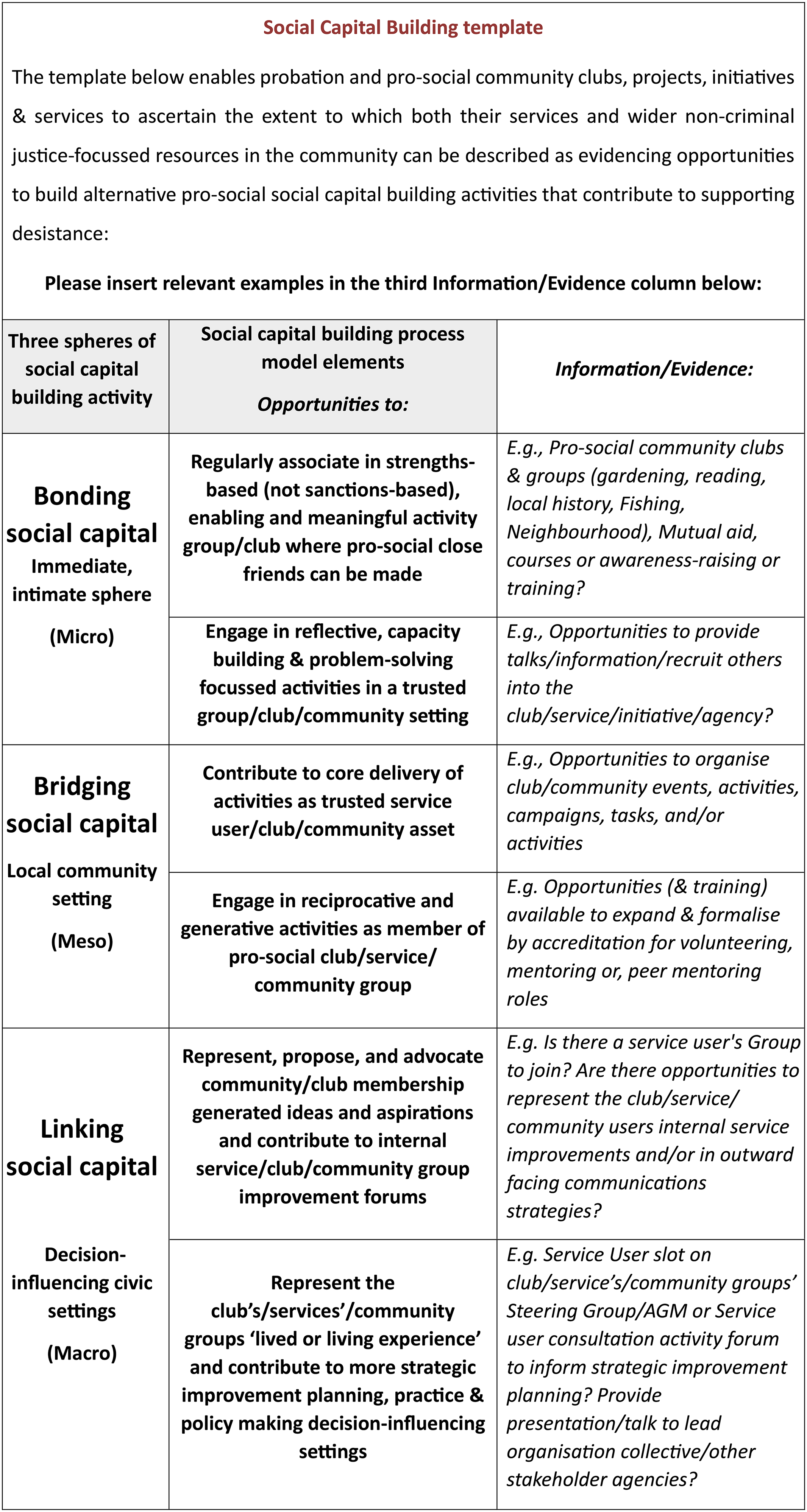
Social capital-building template.
Conclusion
It is anticipated that probation leaders can use this one-page tool to prompt an ABCD approach (Nicholson and Mckeown, 2021; Russell, 2010) to begin to identify ways in which they – or others – can strategically facilitate pathways into social capital-building opportunities within their locality. This will then allow for the identification of gaps in social capital-building opportunities that probation can draw into their practice. As a collective resource, this tool can also be added to by probation practitioners and current service users accessing promising community initiatives. Probation practitioners can make people on probation aware of these wider opportunities that are available to them.
We hope that this will be useful in illustrating where local social capital-building resources lie, whilst any gaps evident across the spheres wherein social capital-building opportunities can be facilitated can be targeted. As such, once this activity is completed for each local group, initiative, service or club, completed template contents can be drawn together, both to form a local directory and to enable comparison across the locality. This means informed choices can then be made in and across regions for probation to consider additional commissioning to support any social capital-building developmental decisions to fill any local social capital-building opportunity gaps.
Footnotes
Declaration of conflicting interests
The author(s) declared no potential conflicts of interest with respect to the research, authorship, and/or publication of this article.
Funding
The author(s) received no financial support for the research, authorship, and/or publication of this article.
