




Abstract
Drawing on existing literature on organizational culture in correctional work, in the current article we augment scholarship on community correctional services, specifically parole work, by considering how organizational culture, as narrated by frontline parole officers, impacts parole officers” feelings toward their work and their own health and well-being. Using the insights gained from 150 qualitative interviews with parole officers across Canada, we empirically show how participants described organizational culture as (1) imbued with social networks and hierarchies and (2) inherently reactive. We then provide insight into their perceived relationships with management. Participants explained they largely felt uncomfortable voicing concerns or making suggestions for improvements, in addition to feeling their work did not receive the respect and appreciation it deserved. We draw attention to the implications of perceptions on parole officers' feelings toward their job and sense of self, as well as the potential impact of organizational culture on parole officers' feelings of safety and emotional well-being on the job.
Introduction
Organizational culture, as defined by Brackin (2007: 16) and informed by Crawley (2004), refers to “the norms, values, beliefs, and behaviors that define an agency’s character.” Organizational culture builds on broader understandings of culture, defined as the “accumulated shared learning of a given group, covering behavioral, emotional, and cognitive elements of the group members' total psychological functioning” (Brackin, 2007: 10). Culture within organizations is fundamental to how employees experience their work environments. Culture can cause havoc or create a toxic work environment, but can also contribute to a positive workspace. Researchers have studied culture(s) among correctional officers (e.g., Arnold et al., 2007; Crichton and Ricciardelli, 2016; Liebling et al., 2010; Ricciardelli, 2019; Ricciardelli and Power, 2020) and others working within prison spaces (e.g., Lugo, 2016; Mclean and Liebling, 2007). However, there remains minimal research on parole officer (PO) culture(s) 1 , including of POs working in institutions or in the community. Mawby and Worrall (2011) argue that while probation cultures differ (e.g., between urban and rural probation contexts) and are subject to change and transformation, it is still important to understand the general elements that span probation cultures and that impact the work of frontline probation officers. That is because occupational culture informs how probation staff make sense of their occupational work, whether they feel fulfilled at work, how they cope with their work environment, and how they experience their physical work space. Culture should be considered in how and why frontline penal workers do their job (Mawby and Worrall, 2011). The authors conclude that “probation cultures are complex, but, if properly understood, do not undermine the objectives of offender management nor need they be feared by management, the government or the media” (Mawby and Worrall, 2011: 27). Thus, studying organizational culture provides understanding not only the frontline realities of correctional workers, but also the need for organizational change that can improve working conditions for staff.
In Canada’s federal prison system, institutional parole officers (IPOs) work within the 43 federal prisons, while community parole officers (CPOs) work in the community at day reporting centers, community correctional centers, and parole offices. In total, working across these carceral spaces are over 1400 POs, who, regardless of where they work, are responsible for preparing prisoners for community reentry and/or supervising and assisting criminalized persons living in the community. POs are fundamental supports for the potential rehabilitation and desistance of former prisoners as they are the first point of contact for (ex-)prisoners in supervising and preparing them for release (USJE, 2019). Although POs are frontline workers who, at times, are exposed by the nature of the job to a variety of potential stresses and potentially psychologically traumatic events (PPTEs), little academic research has been conducted about the on-the-ground experiences of IPOs and CPOs, including how their experiences are shaped by the organizational culture within which they perform their occupational responsibilities. Given that POs, despite where they are employed, work within small groups, we seek to understand how their work experiences are impacted by their relationships with their management or direct supervisors. Thus, in the current study we focus on unpacking the culture of IPO and CPO work, with a specific focus on the role of management in shaping occupational culture, to learn about how management impacts work culture, experiences, and organizational culture.
We examine how 150 POs employed by Correctional Services Canada (CSC) experience their organizational culture, including how feelings of being supported (or not) and respected (or not) shape both their work experiences and their interpretations of the environment in which they work.
Culture in community punishment work
Deering (2011) identifies three different levels that together operate to constitute dimensions of organizational culture: the macro level, with diverse rules and legislations; the value level (i.e., “what ought to be”); and the “things that are taken for granted as “correct” ways of behaving within the organization” (Deering, 2011: 25). These three levels inform POs' organizational culture as they work in diverse spaces and act on (ex-)prisoners during a unique period of criminalized people’s lives, which are characterized by restrictions on their mobilities and lifestyles. POs are responsible for both the safety of the public, which they enact through their oversight of current or released prisoners, and the rehabilitation of those on their caseloads. They have both a punitive and supportive function informed by their values and adherence to policy (Cosgrove, 1994; Lynch, 1998; Schneider et al., 1996). Brackin (2007: 17) explains POs are “not quite police and not quite social workers” and have a somewhat restricted degree of discretion. External legislation governs many of their occupational responsibilities are governed and determines when they must report their clients for poor behavior versus when they can continue being supportive.
Writing within the probation context, Durnescu (2008: 273) found that probation cultures vary, but can be categorized into four diverse types: “probation services based on promoting community measures and sanctions; probation services based on the model of assisting the judiciary; probation services based on the rehabilitation model/public protection; and probation services based on a punishment or enforcement model.” However, the most common model includes a movement toward an “Anglo-Saxon” model, referring to the prioritization of “control, risk assessment and public protection over welfare and social assistance” (Robinson, 2010: 198). These studies, despite not being Canadian, do capture the contemporary climate in which correctional services operate, and thus are helpful as a basis to understand the broader dynamics and developments that may also shape parole culture.
Correctional cultures are also shaped by the attitudes, beliefs, values, and skills of practitioners (McNeill et al., 2010). McNeill (2001: 677) writes that for the effective delivery of probation services, a probation officer should display: …willingness to learn; maturity and life experience; listening and confronting skills; being a sensible and realistic carer; an encourager; able to engage the probationer; believing in the possibility of change; being non-judgemental; being empathetic; inspiring trust, displaying honesty and confidence; and having a sense of humour.
Not all parole or probation officers can and do demonstrate all such attributes at all times; however, the actions of the PO inform the occupational culture in a cyclical way such that their actions are informed by organizational culture and, in turn, their actions shape the continued culture within the organization. In this sense, just as we see in prisons (see Crawley and Crawley, 2007), organizational culture informs the interactions of all POs. Yet, an organizational culture is often constituted by a variety of subcultures. Given that POs work in small groups and, in Canada, are distributed geographically across the country in different institutions and community spaces, it would be expected that each parole office or working environment is shaped by its own subculture.
Garland (2001) explains that managerialism, referring to the relationship between the governing body and public service organizations relationship (like correctional services), has come to dominate the western world. This means, like in the context of New Public Management (NPM), that consumerist approaches now shape public service organizations, which now operate to serve the interests of elite political actors. Such practices are long evident in Canada, where decisions made by politicians have come to determine policies and practices in correctional.
Managerialism, particularly NPM, serves to reduce the impact of organizations and professional groups on practices and instead leaves policies to be dictated by governing bodies who are thought to best understand needed practices. The consequence is that the voices of frontline actors and informed experts are reduced, and instead practices are structured with finances, public approval, and other such factors in mind, beyond everyday work conditions. The impact on POs of such practices is reduced autonomy and discretion, as well as increased accountability if the client falters in their rehabilitative journey (Phillips, 2011). Phillips (2011) finds that a culture of “fear” among probation officers arises with the increased accountability that POs must manage. Influencing this fear is how POs work in organizations that are constantly in a state of reform (see Robinson and Burnett, 2007). Exacerbating challenges for POs is dissonance between policy and practice, or what Persson and Svensson (2011) refer to as organizational versus professional logic. Here, professional practice among POs is increasingly structured by organizational mandates, which may not always appear logical, appropriate, or in the best interest of the client. Thus, parole culture appears increasingly ambiguous, disconnected from understandings of best practices and instead rooted in occupational demands (see Gelsthorpe and Nellis, 2002). This is far removed from what Arnold et al. (2007: 487) argue to be fundamental to “positive work cultures,” that is “good relationships and clear roles.” Conversely, the result appears to be POs being increasingly alienated from their professional practice as they march on under the confines of managerial directive. In such cases, POs may be left feeling unsupported by management (Butter and Hermanns, 2011)—which we argue creates a less positive work culture.
Methods
In the current qualitative study, we conducted semi-structured interviews to understand the occupational experiences, challenges, and long-term effects of parole work. The Research Ethics Board at Memorial University of Newfoundland approved the study. The data was collected in the context of multiple temporal factors: (i) The study was commissioned by the Union of Safety and Justice Employees (USJE) and thus, conducted with the support of both the union and CSC (the employer); (ii) The USJE and CSC both assisted with recruitment by emailing study information to POs; and (iii) Several participants informed colleagues about the study through word-of-mouth or social media recommendations, thus assisting our recruitment through informal snowball sampling.
In total, we interviewed 150 participants, but many more reached out for interviewing. We opted not to continue interviewing because of theme saturation. Here, we used a semi-structured approach that enabled participants to guide the discussion and identify issues that they believed to be most relevant, while permitting the interviewer to probe for clarification or elaboration (Brinkmann, 2020). We conducted interviews with POs between August and October 2020, after Canada’s “first wave” of COVID-19 infections, which peaked in early May 2020 (CBC News, 2021). We ended data collection at the beginning of a much more significant “second wave” of infections, which reached its peak in January 2021. While data may be limited by the context in which we conducted interviews, they nonetheless provide insight into POs' occupational experiences as they performed their duties as essential workers during an exceptional time, one laced with uncertainty or vulnerabilities.
Prior to interviews, each participant completed a demographic/work experience survey. We do not have publicly available data on the demographics of POs working in Canada, so we cannot determine if our sample is representative; however, our sample includes nearly 10% of the POs and parole supervisors employed by CSC in 2020. In total, 114 participants (76.0%) identified as female, 33 (22.0%) identified as male, and three (n = 2.0%) did not provide their gender. Most participants (n = 106; 70.7%) were between the ages 35–54. The majority of participants identified as white (n = 128; 85.3%), with racialized groups (Afro-Caribbean, Black, Chinese, or South Asian) as the next most frequent racial identifications (n = 15; 10%). Details of these demographic data are found in Table 1.
Demographics, sample of IPOs and CPOs.
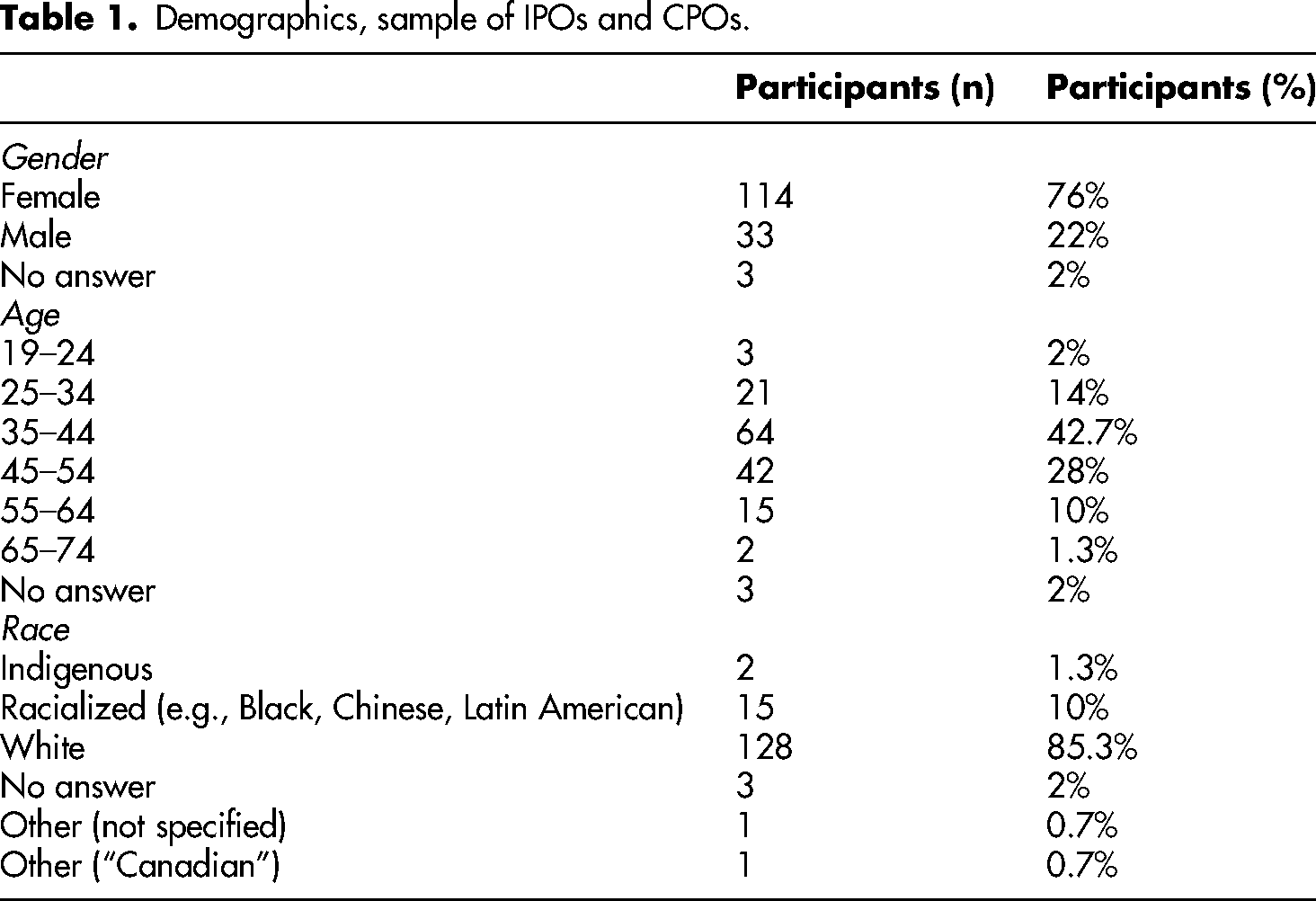
Nearly all POs (n = 146; 97.3%) had completed a university degree or done at least some postgraduate work. In Canada, POs are required to have a university degree, undergo training, and an onboarding probationary period. Of the 150 participants, 96 (64.0%) worked in correctional institutions and 54 (36.0%) in community settings. For the current paper, we do not disaggregate our results by position (institutional versus community setting), as discernible differences between IPOs and CPOs were minor and few. However, to provide the context of the quote, we denote which quotes are by IPOs and CPOs. Exactly half of participants (n = 75; 50.0%) had worked for CSC for between 10–19 years, while 36 (24.0%) had worked for CSC for less than a decade and 36 (24.0%) for more than 20 years. Participants' worked in all Canadian provinces/territories, with the exception of employment of Newfoundland and Labrador and Prince Edward Island.
Most interviews lasted between 75–120 minutes, and all took place over the telephone, due both to the wide geographic distribution of participants and ongoing COVID-19 restrictions. While face-to-face interviewing is more common in qualitative research, some studies demonstrate that research participants may feel more comfortable discussing difficult experiences or sensitive topics over the telephone (Mealer and Jones, 2014; Novick, 2008). Given that POs in the study regularly spoke about challenging occupational experiences or potentially psychologically traumatic exposures, it may be that our use of telephone interviews facilitated greater candour from participants.
Most participants (n = 145) took part in interviews in English, while the remainder (n = 5) participated in group interviews held in French-language group interviews that were live-translated by professional translators. The group interviews, which were organized with assistance from the Union of Safety and Justice Employees, allowed Francophone POs to participate in the study.
Our approach to data analysis followed a semi-grounded constructed approach (Charmaz, 2014; Glaser and Strauss, 1967; Ricciardelli et al., 2010); that is, we allowed our thematic findings to emerge from the data without pre-emptively imposing theoretical interpretation, while nonetheless being guided in our analysis by our scholarly and theoretical backgrounds. Following the verbatim transcription of the interviews, we conducted open-ended coding of the transcripts to reveal emergent themes. To determine a preliminary set of codes and to ensure inter-rater reliability (i.e., consistency of codes among the research team), the three authors independently and sequentially coded the same five transcripts. The remainder of the transcripts were then coded individually by members of the research team, a process through which initial codes were refined and new codes were developed as they emerged from interview data. We used NVivo, a qualitative data analysis software, to assist and facilitate auto-coding and assist with coding data into primary, secondary, and tertiary themes. The composition of a theme involves multiple participants reporting similar experiences, feelings, or thoughts, which collectively constituted insight into the organizational culture and interpersonal relationships shaping such culture.
Parole organizational culture and support
We structure the results to outline POs' experiences and perceptions of CSC’s organizational culture, their relationship with management, and feelings of lacking support and respect. We note that these factors often intersected and compounded to create occupational stress for POs.
Organizational culture
Management and social relations
As a large institution tasked with the management of all federally sentenced individuals, CSC has an elaborate organizational structure. CSC operates based on three levels of management: national, regional, and institutional/district parole offices (CSC, 2012). Specifically, there are five regional offices, across Canada’s vast geographic area, each responsible for the day-to-day management of institutional correctional operations. At each institution, the warden, followed by deputy and assistant wardens, have the authority and accountability to ensure the flow of prison operations, and coordinate correctional services with a wide range of actors (e.g., frontline officers, program and health care staff). In the community, parole offices are responsible for the day-to-day management of conditionally released federal prisoners. Here, parole officers take on the frontline responsibilities for supervising individuals in the community, and report to superiors and management within their office. Larger planning and policy decisions that affect CSC workings and operations are made at the national level, with National Headquarters located in Canada’s capital city Ottawa. The Head of CSC, the Commissioner of Corrections, reports to the Minister of Public Safety, and is supported through the work and coordination of other national and regional officials.
Within this elaborate structure that extends to various levels of management and governance, participants felt that meaningful change, albeit in their work responsibilities or toward improving their well-being, was inhibited and advocating for change felt near impossible. Several participants said that questioning management decisions was experienced as risky for their career, like participant 39 (CPO, male) who said “everyone’s afraid to say anything against management” or participant 91 (IPO, male) who remarked: You have to be really careful, in this environment, of what you say and what you do. And so that’s also a concern, because you might have thought you had a good day, and then you come in two days later, and the boss might want to talk to you about something you said.
Participant 128, talking of nuance of the work environment, notes that “there’s a lot of things that you see happen…but you won’t whistle-blow or say it…’cause you know that at the end of the day you’re going to be blacklisted if they find out it’s you.” As these narratives show, participants described a culture of restraint and concern of negative repercussions.
Some participants used the word “political” to describe CSC’s organizational culture, by which they referred to an environment where decision-making and behaviors were derived, even shaped, by power relationships rooted in social networks. They felt the culture was rooted in who one knows more so than one’s capacities are as an employee. As such, participants recognized power dynamics, at times, unfairly affect certain employees, particularly in promotional considerations. For instance, participant 121 (IPO, female) described CSC as: so political… Like, if [you] wanna be a ladder climber, you basically just have to kiss the right person’s ass… It’s very “who you know,” the relationships you’ve formed. A lot of it is very political that way.
The views of participant 121 suggest that power dynamics, many inherent in the hierarchical structure of the organization, impacted occupational positioning, such that promotion was based on relationships as much as merit, a sentiment echoed by participant 115 (IPO, female), who lamented: I find it’s become over the years less supportive and more political… People are trying to climb the ladder, so they’re going to try and please whoever they need to please in order to do that. So, it’s a matter of who do they have to throw under the bus or who do they have to make an example of to show that they’re doing a great job, instead of reaching out and supporting people… I’ve seen some of my colleagues treated horrifically all to try and show how great a manager they are.
Here, participant 115 explains how, the negative behaviors that underpin attempts to excel in the job, thus positioning an employee for a promotion, can be detrimental to the wellness of other employees who bear the brunt of managerial actions. Participants who identified the organizational culture as “political” considered the social network nature of the CSC’s culture as contributing to a negative workplace experience, largely because the relationships structuring their work experience felt unfair and less supportive, which decreased morale and positive feelings. Participant 39 (CPO, male) stated “the politics—that I don’t like”, while participant 46 (CPO, female) said “I never really realized how much politics were involved until you’re in it… That I find is my biggest struggle.” Participant 115 noted that the “politics” of her former workplace created an environment that was “very negative, toxic, and it was not a healthy place.”
The “politics” and hierarchal nature of the correctional work environments left some participants feeling they could not raise concerns with immediate managers, including when their immediate concerns were also impacting their own mental health and wellness. Participant 27 (CPO, female) stated: One of the weaknesses in our organization is that…if we want some sort of meaningful change, we have to talk to our supervisor about it. It’s kind of even almost unfair to [the supervisor], in a way, because it always puts them in the position of not just overseeing the workload of their staff, but overseeing the mental, emotional wellness of the environment… Because of the hierarchy… you’ll never see the district director or the area director coming to your office and having a seat and asking you ‘how is your day?’ and ‘how are things going here?’… So everything is filtered and that’s where you stopped being heard, right.
Participant 27 indicates that many POs feel that the hierarchical structure of CSC means that expressing their concerns will not result in structural changes, nor changes that improve their health and well-being—even if they have sympathetic immediate managers. Several participants continued to link the militaristic organizational culture to stigma around discussing mental health struggles, reinforcing that there is a barrier to coming forward for mental health support or workplace accommodations. Here, participant 17 (CPO, female) described her workplace as a “culture of “if you can’t hack it, then maybe you shouldn’t be here,”” while participant 121 said “a lot of people, I think, are scared to say that they have been affected by something [potentially psychologically traumatic].” Thus, participants felt that employees were discouraged from speaking out about their challenges and struggles due to what they perceived as a “political” culture and hierarchical structure.
A reactive culture
Compounding the political, arguably at times negative, work culture, was the fact that POs were frustrated because they felt CSC is reactive, rather than proactive, as an organization. Being reactive affirms to participants that little efforts are engaged in to change the occupational culture, which only adds to their occupational stress. Here, the organizational culture was described as “completely reactional” (participant 24, IPO, female) and “totally reactive” (participant 115, female, IPO). Participant 20 (IPO, female) comparatively stated that “within CSC we’re usually reacting instead of being proactive.” The reactive nature of the organizational culture also impacted POs' safety, such that they felt safety concerns were not taken seriously “unless something tragic happens” (participant 24, CPO, female). Thus, their ability to ensure client and staff safety felt at time compromised by the fact that for change to occur, POs felt, something terrible had to occur first Participant 115, in this context, further stated that she would like CSC to “focus their energy on preventative [measures], because [POs have] had their lives threatened,” illuminating the very real threat to safety that accompanies the PO occupation.
Other participants linked organizational reactivity to poor responses to POs' mental health concerns, such that mental health was approached in a reactionary, not preventative, manner. Participant 115, when asked to elaborate on her occupational stress experiences, explained that CSC’s approach to PO mental health is to “just fix it afterwards, when it’s too late” instead of proactively asking “what can we do to maybe prevent our parole officers from getting burnt out [or] our parole officers from being a wreck?” Participant 6 (IPO, female) also felt a more proactive organizational approach to mental health and well-being would benefit POs: I think if they were a little more proactive in, you know, support, morale, emotionally, and all that kind of stuff, they’d probably have less staff going off with burnout and whatnot.
In this context, the organizational culture was felt to sweep aside concerns about staff’s personal well-being, due to the minimal focus on prevention. CSC was perceived as constantly overwhelmed by its need to response to incidents and actions. Staff experienced the detrimental impacts of such a perceived reactive practice and, also, felt their clients suffered in consequence due to the lack of proactive efforts to organize a safe and healthy environment for both staff and clients.
A further consequence of the reactive organizational culture, according to POs, was that it created additional workload stress. Participant 146 (IPO, female), for instance, described the most challenging part of her job as “always being given new orders, new priorities, new policies… so this brings a lot of change, perpetual change in how [we do] our reports and the priorities what we need to focus on.” Thus, participant 146 explains that the reactive nature of CSC means that polices, practices, and priorities are constantly changing in line with happenings—which is difficult to keep straight when completing their occupational responsibilities. Participant 15 (IPO, female) similarly spoke of “policies being put in place before training is being done… [and] being pushed before the processes are tested or tried.” Here, participants articulate uncertainty in their employment responsibilities that results from reactive practices which regularly reshape policies and thus occupational expectations. Like others, participant 128 (IPO, male) felt “the most challenging aspect of the job is the ever-changing law and policy and every changing expectation”, which keeps reshaping his occupational parameters and responsibilities. He explains: We often get these really severe policy changes and I find that to be the difficult part of the job to deal with. Because you then have to take that policy change or something to an individual on your caseload. Where six months ago he would have been a candidate to, say, go to minimum security, now he’s not…. And I find that to be very difficult.
Beyond complicating PO occupational duties, POs felt that the frequent changes in policies and procedures failed to account for the nuances of their work. Rather flippantly, Participant 19 (IPO, female) suggests policymakers “come up with these brilliant ideas and then they expect us to just do it with very little consultation from the front lines. It’s patronizing, almost… It’s like ‘okay, we’ll just add that on to the list.’” Participant 19’s words suggest that new policies and practices may not align with their occupational responsibilities, which could be rectified to some extent if there was consultation with POs before implementing changes to their work. Participants felt they were never consulted before changes to their occupation, and the frontline views of workers were discounted, ignored, and not even sought. Participant 30 (IPO, female) said “the people who make the policies are not in touch with the people who are in the front lines”, which participant 22 (CPO, female) echoed in saying “we are the front line. If you want to know what needs to be changed, probably that’s where you should be looking.” Here, organizational reactivity intersects with POs’ occupational responsibilities and reshapes expectations, leaving POs to grapple with constantly changing work parameters; further, POs are embedded in an occupational culture that seems to create feelings of being disrespected and undervalued, specifically, in not having their experiences sought to inform parole work and associated policies.
Relationships with management
The importance of managerial support, including from immediate supervisors and upper managers such as wardens, was described as deeply affecting POs' workplace experiences, stress levels, and mental health and well-being. Participant 2 (IPO, male) stated that “a good supportive supervisor is very integral, ‘cause this work is hard enough,’ adding that the understanding and support of managers can “make or break how much you enjoy your job.” POs with good relationships with immediate managers described these relationships as significant to their job satisfaction. Participant 5 (CPO, female) stated that she has “been very, very blessed… I got a great supervisor, so I have to say I’ve been very lucky and that’s probably why I’ve hung on to doing this work.” The participant explains in their words that they continue to work as a PO because of the supportive manager. Likewise, participant 7 (IPO, female) described the positive impact of a new manager on her workplace: “our morale in our office has increased tremendously… He’s very supportive, he’s smart, and he’s cooperative [and] allows for flexibility.” These participants show how crucial a supportive manager is both to their own motivation and occupational fulfillment and also to the work culture and overall morale of their workspace.
While some POs described positive relationships with their immediate managers, more frequently they reported negative experiences. Participants used words like “offensive” (participant 6, IPO, female), “difficult to work with” (participant 7, IPO, female), “poor in addressing issues in the office” (participant 22, CPO, female) or “very closed minded” (participant 30, IPO, female) to describe managers. Similarly, participant 21 (IPO, female) stated that POs “are the first person to get thrown under the bus” by management. Several participants expressed the view that, while management did provide opportunity for POs to give feedback, their concerns were not acted upon. For example, participant 128 (IPO, male) stated that at these meetings “a lot of what is being said is lip service,” while participant 1 (IPO, male) said: Management often sits down with us, about once a year, and hears about our concerns, but there’s never any action. We get we get a lot of false promises and then they just hope that we move on. And we do, because we’re so beaten [down] and feel like we don’t actually have a voice. You just start to give up.
Some participants also felt that upper management did not have experience with parole work and, as a result, lacked awareness of or respect for the PO role. Participant 2 (IPO, male) lamented the fact that “many of the Wardens, and Deputy Wardens, etcetera, are from security side of the house…[and] a lot of work sometimes of interventions is not appreciated by operations.” Participant 107 (CPO, female) similarly stated that many upper managers “have never worked the frontlines… [so] I don’t think they always know exactly what it is we do and how hard we work.” For participant 1 (IPO, male), the distance of upper management from the realities of parole work meant that POs' struggles were not well-understood within CSC: [My immediate managers], they understand our workloads, they know we deal with a lot…and I think that’s because a lot of our local managers…all came from a parole officer rank. I think once you get beyond that, to the regional and national levels, it starts to get a little bit more diluted and they don’t they don’t appreciate or understand what a parole officer is going through.
Other participants felt they were micromanaged, creating additional stress. An IPO (participant 21, female) with previous experience as a CPO explained how, working in an institution, “there’s like three tiers of management on top of you, [so] you’re micromanaged to the hilt.” Participant 2 (IPO, male) stated that “I do not do well [with micro-management]. I have had those bosses… that try to manage by fear… And that does not produce results.” Participant 101 (IPO, female) noted that the detrimental effect that being micromanaged can have on POs' job satisfaction and well-being: “the [POs] that are the most unhappy with their positions are the ones that are micromanaged.” Finally, participant 97 (IPO, female) linked micro-management to feelings of having her professional expertise undervalued: We’ve become so micromanaged over the years. And I definitely don’t feel that we are recognized and supported… I don’t feel like we are recognized as professionals or given the reach to do our jobs as we see fit. We’re being told how to manage our time, what is a priority.
These participants collectively explain the pressures of being “micromanaged”, which are consuming and impact both their occupational performance and their relationships with their clients. This constant supervision and the resultant lack of agency micromanagement creates was perceived as detrimental to their work experience, creating a more negative work environment and additional stresses and pressures—as all of their actions feel susceptible to external scrutiny and possible reprimand. In addition, many participants felt their management did not express genuine concern for their health and well-being. Participant 79 (IPO, male), for instance, asserted that management at his workplace as “talk the talk and [don’t] walk the walk to promote a stress free, healthy worksite environment.” Participant 6 (IPO, female) stated that management “just don’t care about their employees” and went on to explain that she attempted to bring change to her team but was rebuffed: I’ve tried to help with that kind of change, and be motivational, and kind of bring up morale within our own group. And it’s exhausting. I mean, they just don’t really seem to care about our well-being or our needs… I don’t think I have it in me with this organization anymore.
The stress felt from relationships with immediate management was also felt by participants with managerial experience (i.e., as direct supervisors to POs), who explained the challenges they faced in juggling the concerns of POs and upper management. Participant 30 (IPO, female), who completed a temporary management assignment, stated that in this role “you’re dealing with a lot of staff but you’re also dealing with upper management, so you’re kind in the middle [and] you’re getting it from the top, you’re getting it from the bottom, and…it’s really hard to get everybody happy.” Many POs expressed a belief that their immediate managers found themselves in difficult circumstance and were, at times, inadequately supported by upper management. Participant 50 (IPO, female), for example, stated that “middle management in CSC, in general, needs a lot more support in training…. They aren’t given those [interpersonal management] skills. When you become a middle manager, they’re just like “okay, here’s a new chair, here’s a new role, good luck with that.”” The lack of training in supportive provision affected PO work environments but, more significantly, their well-being. POs were left feeling they had no one to turn to for assistance in managing difficult cases, situations, or their emotional state—a trying situation given the ongoing and nuanced stress that COVID-19 continues to create for POs (see Norman and Ricciardelli, 2021; Norman et al., 2021).
Lack of support and respect
While many participants described amicable working relationships with colleagues and, in fewer cases, with immediate managers, many POs described feeling unsupported and not respected by upper management or CSC as a whole. Participant 39 (CPO, male) stated “I think I’m respected by the guys on my caseload, by the social worker, by the psychologist, but not by management.” Participant 132 (CPO, female) said that POs “struggle with…recognition of who we are and what we do.” Participant 19 (IPO, female) explained that CSC is “big, it’s bureaucratic [and] I feel isolated from beyond my direct manager – I don’t feel a lot of support coming from above.” Participant 3 (IPO, female) stated that, among upper management, “there’s a perception that we don’t do a lot, which is bizarre.” She went on to say: It’s like they just want us to do what we’re told, and do our job, and go away. Because to bother with us would be a huge bother. To learn what we do, and to deal with the problems that we’re dealing with, that would be a pretty big task.
Participants expressed the view that a lack of respect and recognition contributed to the stress of the job, to the detriment of POs” mental health and well-being. Participant 6 (IPO, female) lamented that “it’s already such a tough work environment that it should be a kind of place where they go out of their way to look after their employees, and make them feel valued and respected, and it constantly feels like the opposite.” Participant 123 (IPO, female) described POs becoming “jaded” from the lack of organizational recognition for their work. She added: “I find that that’s stressful, too, because you’re kind of on this hamster wheel all the time, and at the same time you’re not getting recognition for it.” Linking a feeling of being unsupported with a view of a negative organizational culture, participant 117 (IPO, female) felt that her immediate and upper managers were not “supportive and positive” and that “that’s almost more of a stress to me than the heavy caseload, because I feel like I can’t go to anyone for help, because as soon as you ask for help, well, you’re just [seen as] shitty at your job.” Thus, the lack of support felt by POs appears embedded in organizational culture, an impact of the vast size of the organization and the disconnection that occurs due to the hierarchical organizational structure.
Most POs expressed a high degree of pride in their professionalism and contribution to public safety, yet, felt that CSC did not acknowledge their work and the significant responsibilities they carry in their everyday duties. Participant 54 (CPO, female), who was among the minority of participants who described receiving praise from management for their work, demonstrated the significance such feedback can have on POs' job satisfaction: “I get thank yous and I get thumbs up, and emails, and stuff like that, and it’s so refreshing.” However, such recognition was rarely described by POs. Participant 130 (CPO, female) explained that “I’ve had a folder for so many years now, so when I get a complement for something I stick it in there, because it’s so rare that you get something like that there’s no real recognition for things.” Participant 29 (IPO, female) expressed the belief that POs generally acknowledged each other’s quality of work, but “not so much management. I don’t ever feel like there’s ever a pat on the back for a good catch or a “good case” or a “good job.”” Participant 115, while critical of management’s lack of recognition of her work, placed responsibility on broader structural factors within CSC: “I don’t think the lack of acknowledgement is on purpose, I think they’re way too busy, too, they’re just frantically trying to manage their workload.” In these words, participant 115 (IPO, female) links her experiences of feeling unsupported within CSC to broader workload and staffing issues in the organization.
Some IPOs expressed the view that security staff received greater attention and support than interventions staff, such as POs. Participant 2 (IPO, male) stated that: The interventions folks feel sometimes like a second class to the operational folks because of the way the organization is run now. Operations tends to take a lot of the attention and our spotlight because…[of] the correctional officer group being the largest group institutionally, inside, and their union is quite vocal and active. So sometimes interventions folks feel like, uh, we’re forgotten.
Other IPOs described friction with or disrespect from correctional officers. Participant 1 (IPO, male) stated that “the correctional officers in general don’t understand what a parole officer does… You might have to put up with a bunch of comments… and just stupid little jabs about how we aren’t worth the money.” Participant 33 (female), a CPO with prior experience working in institutions, similarly explained that “[correctional officers] are very dismissive of parole officers and what we actually experience.” Participant 135 (IPO, female) noted that “some officers…don’t maybe understand what our role is, and so they get really irritated when we are looking to meet with inmates.” She added: “I’ve been yelled at by officers more than I’ve been yelled at by inmates.” While some IPOs described good working relationships with security staff, for many POs these relationships were a source of tension and stress.
Another area in which participants felt unsupported was receiving training or opportunities to upskill to effectively manage frequent changes to policy or procedure. Participant 131 (IPO, female) stated that she does not receive an adequate “level of support and training… There’s constantly changes in policy and best practices…[but] there’s a lack of training, there’s that lack of support.” Participant 131 added that available training opportunities are “not even remotely sufficient,” while other participants described training as “absolutely redundant” (participant 123, IPO, female), and “absolutely horrible” (participant 24, CPO, female). Participant 23 (IPO, female) lamented that annual training days, in which CPOs and IPOs from different sites would meet together, were no longer organized: “They cut all of that they cut all of the funding…. That would be nice to have a minimal amount of funding so we could together once a year and do some training together.” Participant 115 (IPO, female) similarly described a decline in the quality of training, which she situated within the broader feeling among POs that they lack organizational support: We don’t have the training we need; we don’t have the supports we need. Our training has gone from experts coming in and giving us really good training, to…a watered down version…to, more recently, “hey, your stuff’s all online! Good luck! Hope you can figure it out on your own!” So yeah, I don’t think we’re supported at all. Not mentally, not emotionally, not with training, not with much of anything.
Clearly, for many POs, limited opportunities for high quality and relevant training contributes to a broader feeling of being undervalued and under-supported within CSC. This experience reinforces to POs that they are low on the organization hierarchy and impacts morale—as though they are not prioritized for training.
Discussion
Correctional services work, including for POs, occurs within a hierarchical structure where frontline POs find themselves toward the bottom rungs on the ladder. This positioning can result in diverse stressors for POs, who in our sample described feeling largely unappreciated and under-valued by (upper) management. For participants, the organizational climate, culture, and policies also constituted sources of stress, with direct impacts on their occupational experiences, morale, and well-being. Although some participants spoke of positive relationships with management, which included feeling heard, appreciated, and supported, most POs lamented that relationships with their managers negatively impacted their experiences on the job, and that relationships with upper management, which can impact occupational positioning, were shaped by political pressures and associated interests, rather than merit and appreciations. One of the consequences of feeling this way was that POs did not feel they could be forthcoming about challenges encountered and felt that their voices were unheard when speaking to the realities of their frontline work. Most POs elected, as a result, to not speak up with recommendations that could optimize their occupational outputs, and instead felt silenced by political pressures and unsupportive management. The political nature of the organization, as understood by POs, reflected the power relationships that drove decision-making and practices (as well as policies and protocols) within the organization. They felt under the governance of management and that their occupational future, including promotional opportunities, reflected less their occupational work experiences and instead were based more on relationships – who one knows rather than what one does. As a result, POs were left feeling that they were in determinant positions with no possibility for career growth through promotion unless they became well positioned within the political networks that drove the organization—a demoralizing position. Be it a perception, or a true description of the organization, the result is that such feeling impacted morale, drove home feelings of hopelessness, and shaped an organizational work culture that minimized the impact POs made toward public safety and in supporting their client needs.
POs also lamented that their organizational culture was defined by reactive measures, rather than proactive responses and planning. Beyond not feeling able to voice concerns to management, POs felt that policies and protocols were enforced and created in a “top down” manner, that eliminated their voices and thus experiences. Instead, CSC was understood as reactively responding to occurrences, changing policies in light of “one off” situations and with little, if any, consultation with frontline staff. The reactive nature of the organizational culture further impacted POs as they felt they were left struggling to keep up with new revisions to policy and practice, and often felt that their own safety and well-being were overlooked in the construction of new ways forward. The impact on culture became pronounced, as the atmosphere across work environments remained about “catching up” and revising how POs approach their occupational responsibilities, including their relationships with clients (which are impacted by changes in policies and practices). To this end, participants longed for proactive approaches that “get in front” of problems within the organization by unpacking, even investigating, occupational challenges, including health and safety risks, and creating useable solutions that optimize the needs of staff and clients. They desired a cultural change that was proactive (as well as responsive) and included their voices and experiences, rather than retroactive implementations of policies in response to tragic occurrences. Here, POs in our sample felt that their inclusion in decision-making may create a safer, healthier workplace culture, with the latent function of creating a more responsive and supportive space for their clients' rehabilitation, personal growth, and successful community reentry (when appropriate). Indeed, policy changes and new practices often pushed workload overloading for already taxed and burdened POs trying to keep up with their many mixed and various occupational demands. There is also a need to revisit whether POs, particularly within the context of their micromanagement, have agency to respond to their clients' needs and how increasing POs' autonomy may reduce stress and create more opportunities for occupational development and growth, thus increasing job satisfaction and improving organizational culture. Future research should further consider how organizational culture impacts relationships between POs and their clients.
As participants articulated, many POs' relationships with their immediate and upper managers are a source of tension and stress in their workplace. Of note, those who had optimal relationships with managers found their workplaces positive, supportive, and were dedicated (i.e., exhibited organizational commitment). Not only can relationships with immediate managers influence POs' job satisfaction and occupational well-being, but the actions of upper management can also affect how POs perceive their value and respect within the organization, at times creating a negative work culture. Managerial support was considered necessary to alleviate diverse occupational stressors, as acting with the support of direct supervisors reduces occupational stress and can be helpful for overall morale and wellness. Moreover, as many participants felt unable to voice their needs to management, or that their managers were challenging to work for due to being poor in comportment, there is a need to formalize and create opportunities for regular effective communication between POs and their management. Such practices will also address POs' concerns tied to be feeling underappreciated or that their concerns, even needs, are not taken seriously. Regular communication would also relieve middle managers of the pressure of representing PO concerns to their supervisors, avoiding the problem of POs' communication not moving “up the chain” by ensuring upper management is regularly appraised of POs' ongoing challenges and concerns. POs, in consequence, may also feel more appreciated and that their work is better understood by management – who they feel struggle due to being removed from or inexperienced on the front line. Opportunities for direct communication would also provide a channel for upper management to directly explain policy changes to POs, enabling POs to seek clarification and better understand the rationale for changes rather than relying on one-way communication via written notifications. All such efforts would help to increase the transparency of correctional work, alleviating to some extent the notion of politics (and relationships) shaping organizational practices and promotional opportunities. The outcome would be positive change to the PO work environment and thus, occupational culture.
POs felt at times disrespected within their occupational space and unsupported, despite speaking to many amicable and fruitful relationships with their colleagues (or management). There is a need for CSC to implement interpersonal and workplace collegiality training for new managers, as well as POs, and to require existing managers to refresh this training periodically. Working to resolve and reduce interpersonal conflict is essential to any positive workplace culture and work environment. To further support this, there is a need for CSC to ensure that new managers receive comprehensive training on the responsibilities and contributions of both intervention and security staff, which may help improve awareness and appreciation of POs' roles and workloads, which would serve to help POs feel supported and respected. The reality remains that there can be, and at times is, conflict between security staff and POs. Reducing or eliminating this conflict will also make POs feel more appreciated and understood by security staff. Indeed, in the already difficult work role that is the PO occupation, reducing stress that derives from colleagues or management will allow more opportunity to focus on the challenging aspects of the job and to better focus on supporting clients.
To conclude, in this article, we illuminate the need for POs to be presented with more training opportunities. In terms of variety, POs specifically mentioned wanting training on topics such as exposure to PPTE (including vicarious trauma), working with specific populations of prisoners/parolees (e.g., those convicted of sex offences), cultural awareness, and new CSC policies. POs also desire training that brings them into interaction with other correctional professionals (including POs from other work sites) or that is delivered by experts. Overall, providing desirable and relevant training will help address POs” concerns that CSC does not adequately support their work and improve the organizational culture.
Footnotes
Declaration of conflicting interests
The author(s) declared no potential conflicts of interest with respect to the research, authorship, and/or publication of this article.
Funding
The author(s) disclosed receipt of the following financial support for the research, authorship, and/or publication of this article: This work was supported by the Union of Safety and Justice Employees
