




Abstract
In the current article, we investigate the occupational stressors parole and probation officers working in provincial correctional services in Ontario, Canada experience. We examine four specific stressors that emerged thematically from participants’ open-ended survey responses, and conceptualize these as operational factors (i.e., the duties of the job) or organisational factors (i.e., structural aspects of the organisation in which parole or probation officers work). Participants identified the operational stressor of exposure to potentially psychologically traumatic events and secondary trauma, as well as three predominant organisational stressors: paperwork and administrative tasks, insufficient human resources, and workplace relationships and tensions. Drawing from literatures on parole and probation, workplace stress, and organisational cultures and behaviours, we analyse how these stressors have detrimental impacts on the mental health and well-being of community correctional workers, which in turn compromises their ability to effectively supervise and support individuals on their caseload. Policy and well-being implications are discussed.
Keywords
Introduction
Probation and parole officers (PPOs) serve a foundational role in assisting prisoners during their community reintegration after release from prison (Lutze, 2014; Rhineberger-Dunn et al., 2016). In Canada, PPOs are employed within provincial and territorial correctional systems and parole officers are largely employed federally. Within Ontario’s provincial correctional system, there are 119 probation officers responsible for supervising approximately 41,000 individuals (Ministry of the Solicitor General, 2019). The literature on Canadian community corrections is limited, and researchers have tended to focus on the federal parole system rather than provincial probation and parole services (e.g., Hannah-Moffat, 2004; Maier, 2020). Absent in the research on parole and probation in Canada is an in-depth consideration of PPOs’ occupational experiences and the impact of said experiences on their mental health, well-being, and ability to effectively perform their public safety role. This is a notable gap, particularly given that, as part of the larger occupational category of public safety personnel, 1 the mental health and well-being of community correctional workers is of increasing concern to Canadian policymakers (Oliphant, 2016). 2 Outside of Canada, scholars (largely conducting their research in the United States) have found that PPOs face a variety of occupational challenges with significant implications for their mental health and well-being, including exposure to stressful or potentially psychologically traumatic contact with releasees (Gayman et al., 2018; Severson and Pettus-Davis, 2013) and excessive administrative and caseload demands (DeMichele and Payne, 2007; Farrow, 2004; Finn and Kuck, 2005; Simmons et al., 1997; Slate et al., 2003; West and Seiter, 2004).
In the current study, following Duxbury et al.’s (2015) examination of stressors in police organisations and Ricciardelli’s (2018) more recent study of Canadian rural policing, we conceptualize stressors experienced by PPOs as emerging from either operational factors (i.e., the duties of the job) or organisational factors (i.e., structural aspects of the organisation in which PPOs work). Specifically, analysing PPOs’ responses to open-ended survey items, we look to understand the organisational and operational stressors faced by PPOs working in provincial correctional services in Ontario, Canada. Our qualitative findings provide rich data on participants’ experiences of workplace stress arising from the operational and organisational challenges faced by PPOs.
We structure the article in four sections. We begin with a review of scholarship focused on the mental health of community correctional employees as well as their experiences of diverse operational and organisational stressors. We explain our study method, before presenting our results regarding the experiences of stressors as expressed by provincial PPOs working in community settings in Ontario. We discuss our findings, specifically the operational stressors of exposure to potentially psychologically traumatic events 3 (PPTE) and secondary trauma, as well as three predominant organisational stressors: paperwork and other administrative tasks; insufficient human resources; and relationships and tensions in the workplace. We conclude by putting forth implications and recommendations for policy and practice.
Mental health of community correctional employees
Researchers have identified several significant mental health concerns among correctional employees and/or professionals working with people charged or convicted of criminal offences, including post-traumatic stress disorder (Carleton et al., 2018a, 2019; Regehr et al., 2019; Ricciardelli et al., 2018); symptoms of major depressive disorder (Carleton et al., 2019; Gayman and Bradley, 2013; Gayman et al., 2018; Regehr et al., 2019); the intrusion of disturbing thoughts or dreams (Catanese, 2010); and suicidal thoughts, intentions, or attempts (Carleton et al., 2018b). Correctional work may create particular mental health concerns that are unique when compared to other public safety roles. For example, Carleton et al. (2018b) found that, across six categories of Canadian public safety personnel, 4 correctional workers (along with paramedics) expressed the greatest prevalence of suicidal behaviours both in the past year and over their lifetime. Despite a high prevalence of mental health concerns among public safety personnel, including correctional workers, they may still feel they face stigma within their organisation when seeking treatment for mental health needs (Ricciardelli et al., 2020b) or receive inadequate mental health resources from their employers (Ricciardelli et al., 2018).
Studies that specifically focus on PPOs have identified burnout and secondary (or ‘vicarious’) trauma as the most significant mental health concerns. Burnout, which can be defined as the ‘psychological strain that afflicts those working in the human service professions, including health care, social work, and law enforcement’ (McCarty and Skogan, 2013: 69), is consistently recognised by scholars as a significant occupational risk for PPOs (Gayman and Bradley, 2013; Lewis et al., 2013; Phillips et al., 2020). Researchers also demonstrate that PPOs may experience secondary trauma as a result of exposure to details of clients’ life histories and crimes or the experiences of victims (Lewis et al., 2013; Morran, 2008; Rhineberger-Dunn et al., 2016; Severson and Pettus-Davis, 2013). Secondary trauma can be defined as ‘the emotional, cognitive, and physical consequences of providing professional services to victims or perpetrators of trauma’ (Severson and Pettus-Davis, 2013: 7), and recognises that trauma may be experienced even where one does not physically witness or directly respond to a PPTE. Among public safety personnel, where a hierarchy of trauma can legitimise or marginalise particular types of suffering, experiences of secondary trauma may be considered less impactful than direct exposure to trauma (Ricciardelli et al., 2020c). Burnout and secondary trauma arise from specific operational and organisational aspects of community correctional work.
Operational and organisational stressors in public safety work
The mental health toll of public safety work is captured in the concept of operational stress injury, which refers to ‘any mental disorder or other mental health condition resulting from operational stressors experienced while serving in a professional capacity, especially in military or other public safety professions’ (CIPSRT, 2019: 10). The term originated in armed forces research, which recognised that mental health conditions developed through military operations are similarly detrimental to physical injuries acquired in combat (CIPSRT, 2019). In Canada, operational stress injuries have been recognised by the federal government as a significant occupational concern for public safety personnel, including community correctional workers (Oliphant, 2016), and researchers have recognised a high level of operational risk of exposure to PPTEs among those working in public safety (Carleton et al., 2018a, 2019; Ricciardelli et al., 2020c). Further, the mental health of public safety personnel, including those working in community corrections, can be understood as arising from both operational and organisational stresses. Following Duxbury et al. (2015), we understand operational stresses as emerging directly from job duties (e.g., job content) and organisational stressors as generated by structural aspects (e.g., job context) of public safety organisations (see also Ricciardelli, 2018).
Operational and organisational stressors in community correctional services
In the literature, scholars identify several operational stressors that community correctional staff face as a result of their work with probationers/parolees or victims, including perceived or actual threats to personal safety from those under their supervision (Finn and Kuck, 2005; Lewis et al., 2013; Morran, 2008; Vogelvang et al., 2014), client death by suicide (Lewis et al., 2013), and feelings of burnout that arise from the emotional labour required to engage effectively with clients (Phillips et al., 2020). However, the most notable of these operational stressors is exposure to PPTEs and resultant secondary trauma.
Unlike many other public safety personnel, community-based PPOs less frequently (although not rarely) respond directly to PPTEs; however, as part of their ongoing operational duties, PPOs regularly can experience vicarious or secondary trauma as they learn about the histories of those under their supervision (Goldhill, 2019; Rhineberger-Dunn et al., 2016; Severson and Pettus-Davis, 2013). For example, PPOs speak with clients about their personal histories (which are often traumatic; Goldhill, 2019) and criminal offences, reading details about these crimes in reports and victims’ statements, or other documentation. Such exposure constitutes repeated indirect exposure to trauma and crimes, including crimes that are culturally and socially interpreted as disturbing, such as sex crimes or the victimization of children (Catanese, 2010; Goldhill, 2019; Lewis et al., 2013; Morran, 2008; Rhineberger-Dunn et al., 2016; Severson and Pettus-Davis, 2013). Further, in some instances PPOs may interact directly with victims (Lewis et al., 2013; Rhineberger-Dunn et al., 2016; Severson and Pettus-Davis, 2013). The cumulative effect of operational stressors on PPOs can produce significant physical and mental health challenges, which may also negatively impact personal relationships and quality of sleep (Lewis et al., 2013; Morran, 2008; Rhineberger-Dunn et al., 2016; Severson and Pettus-Davis, 2013).
PPOs also face a variety of organisational stressors that can affect their well-being, including inadequate training (DeMichele and Payne, 2007), unanticipated deadlines (Finn and Kuck, 2005), staff shortages or a lack of administrative support (Farrow, 2004; Simmonds et al., 1997), as well as the perception that PPOs’ work is undervalued (Farrow, 2004; Morran, 2008). However, the most prominent organisational stressors identified are paperwork and caseloads (i.e., the number of clients a PPO supervises), both found to contribute to PPO concerns about workloads (DeMichele and Payne, 2007; Farrow, 2004; Finn and Kuck, 2005; Simmons et al., 1997; Slate et al., 2003; West and Seiter, 2004). Not only do caseload demands, including excessive paperwork (Farrow, 2004; Finn and Kuck, 2005) and navigating technologies (Finn and Kuck, 2005), occupy time that PPOs would prefer to spend working with their supervisees on specific re-entry needs, but these factors can cause PPOs to shift their focus ‘to mov[ing] offenders through the system’ (West and Seiter, 2004: 51). Perhaps it is without surprise that PPOs have identified paperwork as among the most significant sources of occupational stress and job dissatisfaction (more so than supervising clients; Finn and Kuck, 2005; Simmons et al., 1997; Slate et al., 2003). The concerns PPOs express about their workloads point to experiences of work-role overload, which refers to a worker’s inability to complete their expected tasks due to time pressures and is linked to ‘increased levels of anxiety, fatigue, burnout, depression, and emotional and physiological stress, and to decreased satisfaction with family and work’ (Duxbury et al., 2015: 362).
In the current study, we draw from open-ended qualitative survey responses to examine how Ontario PPOs understand stress in their jobs, and analyse the implications of these findings for their health and well-being. We categorise stressors as operational and organisational (Duxbury et al., 2015; Ricciardelli, 2018) to shed light on how occupational stressors are experienced by PPOs.
Methods
Data for the current study was collected as part of a broader project that investigated symptoms of mental disorders and operational stress injuries among provincial correctional employees in Ontario, Canada (see Carleton et al., 2020; Ricciardelli et al., 2020a). The project involved collaboration with the Ontario Ministry of the Solicitor General and the Ontario Public Service Employees Union, both of whom emailed recruitment materials to Ontario correctional services employees via internal listservs. Participants were asked to anonymously complete a confidential online survey, hosted on Qualtrics, which was administered between December 8, 2017 and June 30, 2018. Following Ashbaugh et al.’s (2010) guidelines for researching trauma using online surveys, the questions included demographic information and psychometrics screens, as well as open-ended responses. Over 1,300 correctional services employees accessed the survey, of whom 144 identified as PPOs. Respondents participated voluntarily and gave informed consent prior to staring the survey. Most surveys were completed in between 25 and 40 minutes. As the study was conducted by researchers at multiple institutions, ethics approval was gained from research ethics board at Memorial University of Newfoundland, Queens University and University of Regina.
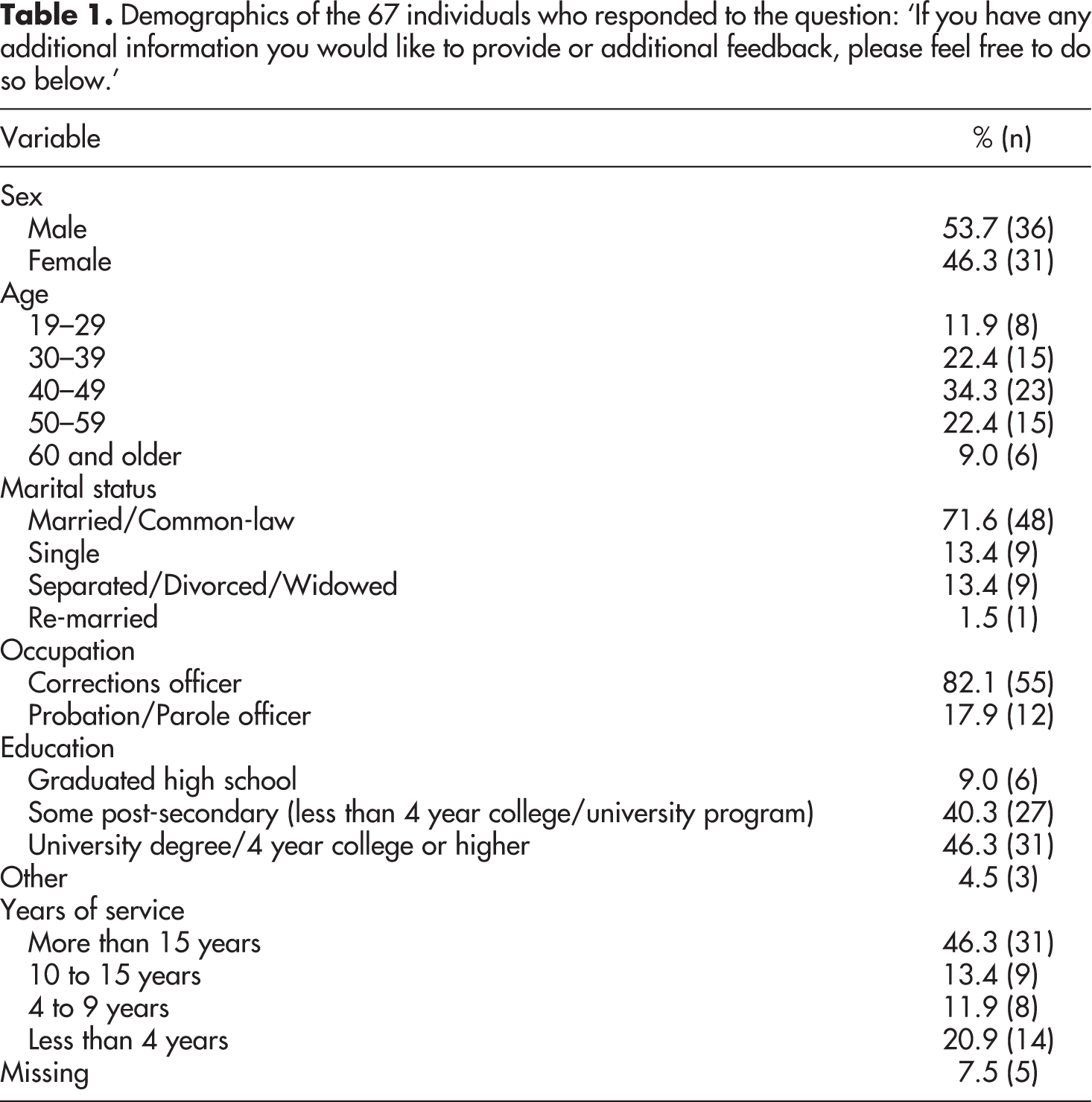
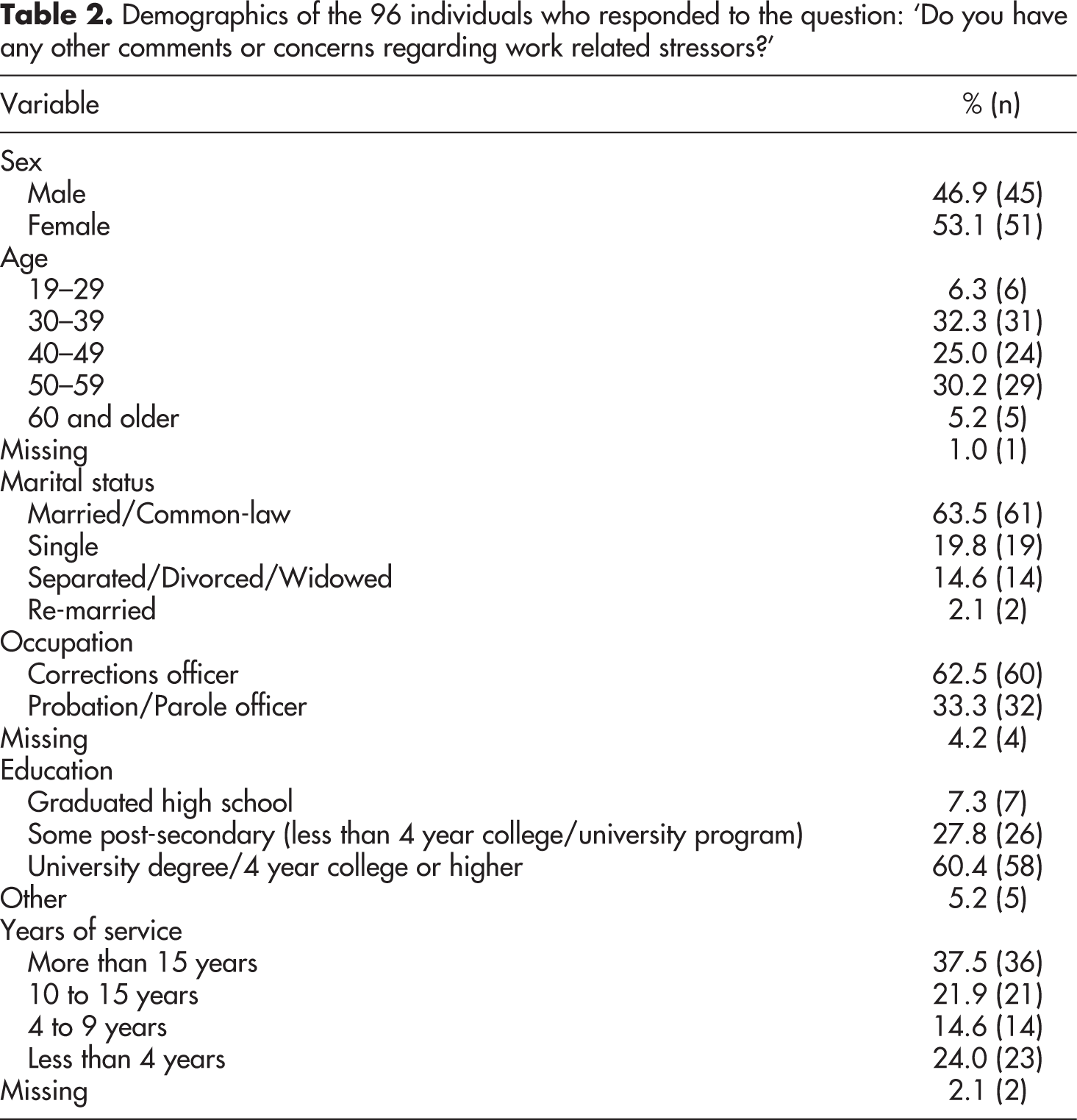
In the current study, we analysed data from employees who responded to two open-ended items. The first allowed for general comments (e.g., ‘If you have any additional information you would like to provide or additional feedback, please feel free to do so below’ (n = 67)) and the second was designed to elicit feedback on experiences of occupational stressors (e.g., ‘Do you have any other comments or concerns regarding work related stressors?’ (n = 96)). Together, 163 responses to these questions yielded rich data. Out of the 144 PPOs who completed the survey, 44 responses to the open-ended items were received. 5 Information on participant demographics of who responded to the broader items is available in Tables 1 and 2. We restricted our analysis in the current article to the participants who identified as working in probation and parole rather than those working in institutional correctional services.
Demographics of the 67 individuals who responded to the question: ‘If you have any additional information you would like to provide or additional feedback, please feel free to do so below.’
Demographics of the 96 individuals who responded to the question: ‘Do you have any other comments or concerns regarding work related stressors?’
Data were analysed thematically and inductively (Hesse-Biber and Leavy, 2004) using a semi-grounded emergent theme approach (Charmaz, 2014; Glaser and Strauss, 1967; Ricciardelli et al., 2010). The approach is semi-grounded in that although our analysis was fully grounded in the data (i.e., themes emerged from the data), theory development was not derived from the data as we feel unable to suspend our prior theoretical knowledge while conducting analysis (Ricciardelli et al., 2010). QRS NVivo Pro was used to autocode participants and to assist with coding data into primary, secondary, and tertiary themes. Axial coding, via an exhaustive coding scheme, was used to ensure the analysis was informed by relevant themes (Strauss and Corbin, 1990). Coded data was reviewed multiple times by the primary investigator and research assistants. Participants’ quotations have been edited for grammar and spelling, while maintaining the tone and content of their statements.
Results
Analysing emergent themes from participant responses, we identify one major operational stressor, specifically indirect or direct exposure to PPTEs, and three organisational stressors: (i) paperwork and administrative tasks, (ii) insufficient human resources, and (iii) workplace relationships and tensions. We note that the operational stressor of exposure to PPTEs, which arises from the inherent duties of speaking with or reading statements from releasees and victims, is an unavoidable part of community correctional work, while the organisational stressors are potentially mitigated by cultural or structural changes within correctional organisations. We discuss each in turn, while also revealing how participants’ responses demonstrate a clear focus on supporting those under their supervision and a concern that organisational stressors are obstructing their ability to effectively meet client needs.
Operational stressors: Exposure to PPTEs and secondary trauma
Consistent with the community correctional literature (Goldhill, 2019; Rhineberger-Dunn et al., 2016; Severson and Pettus-Davis, 2013), the primary operational stressor identified by PPOs was potential secondary trauma arising from exposure to details about the actions or personal histories of those under their supervision and victims. Respondents regularly identified the stress that secondary exposure could cause. For example, participant 1069, a female probation and parole officer, noted the sheer ‘amount that staff listen to, read about and have to engage in trauma discussions, i.e. clients backgrounds and offences, victims, etc.’ is a source of work stress. Echoing participant 1069, participant 575 (female, parole officer) further explains: Difficult to recall the number of times people have shared their traumatic experiences, it’s a part of every workday. When we complete an LSI-OR
6
we get the person to talk about their lives. Most community clients have had traumatic experiences in their lives. I’ve included numbers that stand out but it’s so common place that I don’t think of it as being unusual. It’s unusual to have a client that has not had any trauma and that surprises me more than hearing that a client has suffered traumatic events.
Participants also regularly discussed the challenges of working with probationers who experience mental illness. The uncertainty created by client contact and the potential to be exposed to secondary trauma were identified stressors. For instance, participant 767 (female, probation officer) demonstrates: Had a client leave a message on my phone in January 2018, that he was going to commit suicide that evening. Caused a lot of anxiety/stress. After meeting with police to document situation, I had to leave for home. I then contacted EAP.
Organisational stressor: Paperwork and other administrative tasks
Consistent with prior researchers’ findings, an organisational stressor that respondents identified was the detrimental effects of administrative duties, most notably paperwork (Finn and Kuck, 2005; Simmons et al., 1997; Slate et al., 2003). Respondents spoke at length about feeling overwhelmed by their administrative workload. Specifically, paperwork related tasks are viewed as time consuming and distracting from time that could be spent on hands-on operational tasks, namely working directly with probationers. For instance, participant 194, a male probation officer, described how administrative tasks affect his capacity to meet his clients’ re-entry needs: We work with a population who have mental health, addictions and other personal issues. The administrative work we are required to do, some that is not necessary, is making it difficult for us to work with clients and address their needs. Workload is insanely high. Everybody is behind and ‘drowning.’ If we want to spend the proper time to do the meaningful change-work with the client, we don’t have time to keep up with all of the admin duties and that is what the Ministry judges us on. We get the best ‘grades’ for the worst work and the worst grades for our best work. It feels hopeless. We don’t want to prioritise getting good reviews on Case Management Reviews over actually doing a good job with clients and keeping the public safe.
The detrimental impacts of vast workloads were particularly noted among community correctional staff, who viewed their many case files as burdensome and their caseloads as overwhelmingly high, particularly when compounded by the individual and often vast needs (e.g., psychological, in kind, employment) of many clients. Paperwork was considered a major source of stress: Decrease the caseloads. I can’t keep up with the paperwork. I love working with the clients, it’s all the admin that is so stressful. (participant 56, female, parole officer)
Organisational stressor: Insufficient human resources
Respondents reported a second organisational stress, that of insufficient human resources (e.g., under staffing, high absenteeism, unfilled vacancies). Respondents viewed insufficient human resources as particularly detrimental due to concerns about administrative workload, and PPOs believed that more staff could help share workloads and job demands by helping meet occupational requirements and, most importantly, client needs: The office I worked out of is severely understaffed and we serve high risk, high need clients that are extremely mentally ill and ridden with addiction issues. Because our average caseloads in the office can range between 65 and 75 we cannot support these individuals how they should be. Also the administrative demands (while some warranted) are repetitive and unnecessary at times and take our time away from counselling and helping our clients…. I’m watching officers with exceptional skills burn out, which is not only failing them as employees of the Ministry but also the clients we are supposed to be serving. How can you have healthy clients when you do not have healthy officers supervising them? (participant 129, female, probation and parole officer) Our office has become toxic and recently, out of 13 POs, about five POs are on stress leave…. The case loads are left open for far too long and we have to cover our caseload and several others. This results in clients getting angry, as they are constantly seeing different Duty Officers/POs, and can lead to anger outbursts by the clients or potential assaults. It is also resulting in the POs remaining getting highly stressed and the toxic atmosphere leading to more stress leave. It is a very bad situation right now. (participant 562, male, probation and parole officer)
The detrimental effects of short staffing on operational activities were consistently raised by participants. Some participants, like participant 1029, a female probation and parole staff member, described her belief that detrimental operational impacts of short staffing are becoming more pronounced over time: ‘By far the biggest issue where I am currently is ongoing, increasingly chaotic and worsening staffing shortages’ (participant 1029). Participant 1029 identifies ‘increasingly chaotic’ staff shortages as an increasingly prevalent source of stress and, even at times, an obstacle to performing her job duties in a timely manner. Overall, for these respondents, and many of the other participants in the study, short staffing and burnout are omnipresent elements of their occupational work, which can potentially affect a PPOs’ ability to fulfill occupational demands to an expected level of quality, including providing adequate support to clients.
Organisational stressor: Relationships and tensions
Participants consistently identified workplace relationships and tensions as sources of occupational stress, often describing how these created or contributed to a negative, or toxic, workplace environment. In many instances, participants explained that employers’ actions placed extra burdens on already overworked staff and hindered their ability to undertake their operational duties, particularly when working with clients under their supervision: Working with offenders is what I signed up for and what I continue to enjoy, despite the challenges and exposure to trauma. The lack of support from the employer, combined with workload issues and repetitive, meaningless administrative work, is a huge stressor which negatively impacts time left to deal with offenders. Monthly workplace meetings at my office have been very toxic, with people leaving in tears or with headaches. Lack of leadership is [a] contributing problem. (participant 583, female, probation officer)
Participant 583 additionally identifies a very toxic work environment that places emotional strain on employees. Notably, she expresses the belief that poor organisational leadership is intensifying the scope of the concern and directly contributing to increased strain on employees, some of whom leave meetings in tears or with headaches. Poor relationships between managers and employees are widely recognised as a significant source of workplace stress in organisations (Colligan and Higgins, 2006), a fact borne out by the respondent’s perception that management is exacerbating PPOs’ stressful working conditions.
Also indicative of a toxic work environment, participant 416, a male probation officer, explains how negative interactions with management can intensify the stress within an already stressful work environment: ‘It’s dealing with management and their deception and deceit, not offenders, that is the worst.’ In these words, the probation officer identified employee-management relations, and particularly the perception that management engage in deceptive behaviour toward staff, as the worst stressor he faces. Researchers have found that employees’ feelings of being deceived can increase their stress (Bryant and Sias, 2011) and that deception can have a detrimental impact on workplace productivity and trust (Hubbell, 2019).
Other participants elaborated on perceptions of a negative or toxic work environment. A female probation officer (participant 763) identified inter-staff tensions, rather than employer-employee relations, as a contributor to a stressful workplace: There appears to be a lot of policing of coworkers on other coworkers, which brings disharmony in the workplace. Coworkers are being disrespectful of each other at times.
Participants, in some instances, expressed frustration at a lack of support provided by their employers. Support could come in a variety of forms, from addressing staff shortages to adequate training. For example, a female parole officer (participant 13) described feeling inadequately trained for her work with parolees with mental health needs: I did not receive mental health care training from my employer. I paid out of pocket to attend training on occupational stress injuries in order to better understand and cope with mental health and resilience. If the employer continues to add job demands and does not provide more staffing than there are going to be many more individuals taking leaves due to work place stress.
Some community correctional workers felt that they are expected to handle any tasks that come their way, even if they do not believe that these tasks should fall within their job duties. For example, participant 569 (female, probation and parole officer) described ‘being the catch all for offenders when other agencies do not help them.’ Participant 569’s feeling of being the ‘catch all,’ particularly given her belief that certain tasks are the responsibility of other agencies, is a source of stress that both adds to PPOs’ workload and represents a lack of organisational understanding by partner agencies about the occupational realities and job responsibilities of community correctional workers.
Overall, PPOs in our sample describe their work as stressful, for both operational and organisational reasons, with consequences they believe are damaging to officers’ health and well-being (e.g., participant 584, a female probation officer, reported suffering from multiple physical and mental health symptoms related to work related stress). Many respondents stated that these organisational stressors, and their detrimental effect on PPOs, are unlikely to abate without significant organisational change.
Discussion
In the current paper, we show that, while operational stressors may be an inevitable part of working in community corrections, they may impact PPOs’ ability to effectively work with their clients. PPOs feel overworked, have concerns about burnout, and some believe that organisational stressors are preventing them from engaging in the sort of client-focused public safety work that they sought to undertake professionally. Conceptualising the stressors expressed by participants as either operational or organisational, following prior research on public safety personnel (Duxbury et al., 2015; Ricciardelli, 2018), we demonstrated how PPOs in Ontario experience occupational challenges arising both from the operational duties of their job and the organisational structures in which they work.
Consistent with findings from other PPO studies (Lewis et al., 2013; Morran, 2008; Rhineberger-Dunn et al., 2016; Severson and Pettus-Davis, 2013), our respondents identified exposure to PPTEs and secondary trauma, arising from ongoing and repeated exposure to case details they found emotionally upsetting, as an operational stressor. The prevalence of this occupational risk, which is an unavoidable facet of community correctional work, suggests that the concept of operational stress injuries should be brought into discussions of parole and probation workers’ health and well-being. Operational stress injuries are increasingly being used by other Canadian public safety personnel to label and legitimise the mental health disorders occurring as a result of their work (Carleton et al., 2018a), and their prevalence among the occupational group has become a particular focus of the Canadian federal government (Oliphant, 2016). Greater recognition of how the secondary trauma experienced by PPOs can lead to an operational stress injury might both deepen our understanding of occupational stress in community correctional services and empower these workers to define and seek treatment for the serious mental health toll of their work.
Some of our findings on organisational stressors align with existing PPO research, particularly concerning the possibility for administrative duties (e.g., paperwork) to contribute to burnout and affect the quality and quantity of client supervision (DeMichele and Payne, 2007; Farrow, 2004; Finn and Kuck, 2005; Simmons et al., 1997; Slate et al., 2003; West and Seiter, 2004). Participants’ understanding of paperwork and caseloads as major sources of stress was a salient theme. Meanwhile, the perception that administrative duties are an obstacle to performing their client-focused public safety role is a finding worthy of deeper investigation. Both the concerns about administrative work and short staffing speak to the possibility for PPOs to experience work-role overload, which can cause occupational stress and, as part of a broader role overload, may lead to increased levels of anxiety, fatigue, burnout, depression and emotional and psychological stress (Duxbury et al., 2008: 135). Finally, findings related to workplace relationships and tensions extend the small body of literature that recognises community correctional workers feel undervalued by their organisations (Farrow, 2004; Morran, 2008) by illustrating PPOs’ feelings of being unsupported, overworked, and undervalued. Moreover, some report a toxic work environment constituted by multiple diverse factors including strained relationships between management and staff, and among colleagues.
Given the inevitable operational stressors arising from secondary exposure to PPTEs, there is a need to provide effective mental health resources to PPOs. As such, it is encouraging that Ontario’s Workplace Safety and Insurance Act was amended in 2018 to include PPOs in the mental health benefits and supports provided to public safety personnel experiencing work-related posttraumatic stress disorder (WSIB Ontario, 2018). Thus, we recommend continued governmental recognition of PPOs’ exposure to secondary trauma and intervention to improve PPOs’ mental health. Further, we encourage employers to explicitly acknowledge that the risks of secondary exposure to PPTEs and development of operational stress injuries are inherent to community correctional work, and provide mental health supports and services to PPOs to mitigate the effects of this operational reality.
In addition, the organisational stressors of excessive administrative duties and insufficient human resources are the cause of significant psychological strain for PPOs and can lead to work-role overload and burnout. To this end, we recognise that community corrections may be underfunded and more efforts may be required to make caseloads manageable for PPOs such that they are able to best support those under their supervision. We therefore suggest that governments provide additional funding to community correctional organisations for the hiring of more PPOs, to reduce workloads and ease the administrative workload of officers. In addition, we encourage community correctional organisations to develop and enact clear policies to streamline administrative tasks and ensure effective information technologies are used, with the goal of reducing the time that PPOs must devote to paperwork. In Ontario, the need to reduce administrative and workload demands on PPOs is more relevant now given calls, such as that from the Ontario Human Rights Commission (2020), to reduce prison overcrowding by relying more heavily on community correctional services—a policy shift that would greatly increase the workloads of already overworked PPOs. 7
Finally, participants also expressed a need for strong managerial leadership to enact changes in order to reduce PPO stress and workplace toxicity arising from organisational structures. This finding has implications for community correctional organisations at large. Following best practices identified in organisational stress literature (O’Keefe et al., 2014; Shuttleworth, 2004), and where they have not yet done so, community correctional organisations should articulate a clear health and safety policy that includes mental health; train and support management in implementing this policy; regularly monitor progress; and provide employees access to mental health services and resources. These changes would not only address the mental health and well-being of PPOs but also signal to employees that they are valued and trusted, which is a key feature of increasing organisational trust and reducing workplace toxicity (Six, 2007). As such, government agencies responsible for probation and parole should consider mandating these policy changes and ensure that they are enacted by community correctional organisations.
It was clear that respondents were passionate about their work with clients, suggesting an intrinsic motivation to perform their job duties; yet they perceived that various organisational stressors were barriers to their ability to build strong relationships with and offer effective support to clients on their caseload. As such, enacting these recommended policies to reduce workloads, improve workplace climate, and strengthen organisational trust will likely reduce PPOs’ stress, and may also serve to benefit the clients that they supervise.
Limitations
The current study is limited in several ways. As with other qualitative studies, our thematic results may not be generalisable. Further, the response rate to the open-ended survey items was relatively low. Because the data were derived from anonymous survey responses, there was no opportunity for researchers to directly ask about emergent themes, ask follow-up questions, seek clarification, or probe more deeply into participants’ statements. It is also possible that, given the greater study’s focus on symptoms of mental disorders and operational stress injuries in correctional services work, it may have attracted participants who wished to report negative occupational health experiences; conversely, people suffering from operational stress injuries or other health issues may have been deterred from taking part in research on these experiences, or even unavailable to participate if they were on medical leave. Despite these limitations, the results offer rich insight into the experiences and views of a sample of Ontario community correctional employees and provide a foundation on which to conduct future research in this area.
Future research
Future researchers should design studies that probe more deeply into PPOs’ perceptions and experiences of occupational stress, allowing them to be qualitatively unpacked in greater detail. One area of particular interest for future researchers is to investigate the view, expressed by participants in this study, that the work-role overload and burnout arising from organisational stressors were negatively affecting their ability to engage with clients; a finding suggesting that the ability of PPOs to undertake their public safety duties is being compromised. Further, given the critiques of participants in this study about organisational structures and toxic workplace environments, future researchers should incorporate the views of managers in order to analyse their perspectives on officer stress and develop recommendations for ameliorating these structural concerns.
Conclusion
The current article provides insights into operational and organisational stressors in community correctional work. Unpacking written responses from PPOs in Ontario, Canada, we identify and analyse four emergent themes: the operational stressor of exposure to potential secondary trauma and the organisational stressors of burdensome administrative tasks, insufficient human resources, and workplace relationships and tensions that create a negative work environment. Although we analyse the themes separately, it is clear from participants’ responses that stressors often intersect to negatively affect both PPOs’ mental health and ability to devote time to the clients under their supervision. These findings deepen the scholarly understanding of occupational stress in community correctional work, and inspire our policy recommendations to minimise the effect of operational and organisational stressors faced by PPOs and, in so doing, improve their health and well-being. While it is apparent that many PPOs are inspired to support clients in their community reintegration, whether before or after release from prison, participants’ responses demonstrate that occupational stressors can impede their public safety work. As such, there are compelling reasons for community correctional organisations and governments to intervene to address these challenges and unburden PPOs to pursue their core public safety roles and provide greater support to the clients under their supervision.
Footnotes
Acknowledgements
We thank Dianne Groll, R. Nicholas Carleton, Tina Flood, Vicente Gannam and the team in the Employee Wellness Unit at the Ontario Ministry of the Solicitor General for their input into the broader research study and feedback on early drafts of the article.
Declaration of conflicting interests
The author(s) declared no potential conflicts of interest with respect to the research, authorship, and/or publication of this article.
Funding
The author(s) disclosed receipt of the following financial support for the research, authorship, and/or publication of this article: This research was funded in part by a Canadian Institutes of Health Research (CIHR) Catalyst Grant (16234). The open access publishing fee was paid by the Ontario Ministry of the Solicitor General.
