



Abstract
This article traces how forests in Turkey acquire meaning through their entanglement with nationalism, securitization, and racialized governance. The catastrophic wildfires of 2021, which destroyed over 150,000 hectares along the Aegean and Mediterranean coasts, became a site where ecological devastation was quickly translated into nationalist paranoia. Refugees and Kurdish insurgents were accused of arson, and fire was narrated as evidence of invasion, conspiracy, and betrayal. These claims drew on deeper histories in which forests have been managed through militarized strategies—burned during counterinsurgency operations, surveilled for signs of fugitivity, and recast as threatened zones in the service of territorial control. Building on the concept of “political forests,” the article shows how wooded landscapes in Turkey function as terrains of belonging, where ecological crisis intensifies nationalist claims, legitimizes violence, and reinforces exclusionary forms of governance. The 2021 fires illuminate the ways forests matter as stages for securing identity, policing movement, and naturalizing punitive state power.
Keywords
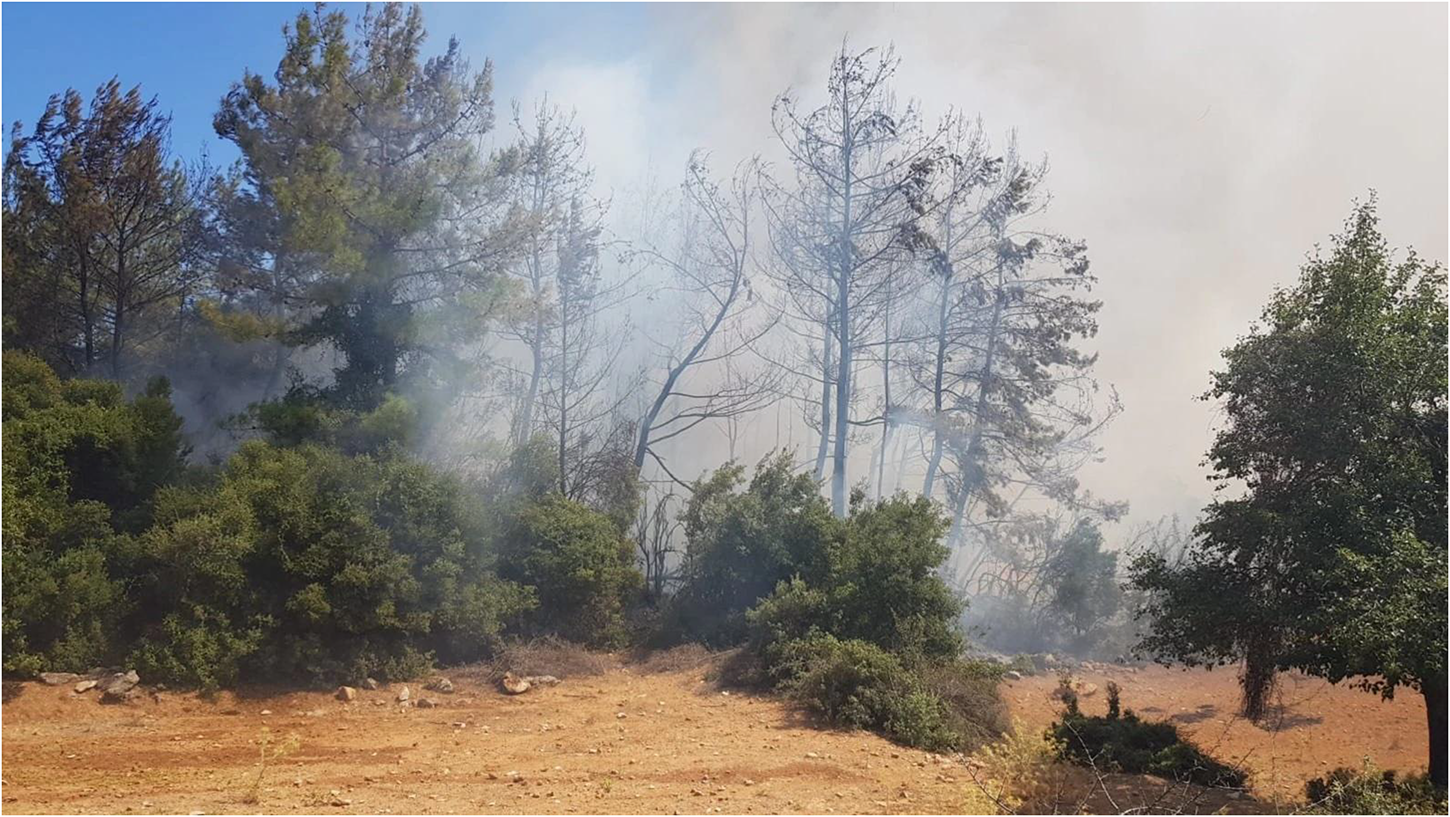
Over the past decade, mega forest fires have torn through Turkey, especially along the Aegean and Mediterranean coasts, where pine forests gave way to ash and bare soil. In 2021 alone, more than 150,000 hectares burned, making the year among the worst wildfire seasons in the country's history, and devastating local communities, displacing wildlife, and exposing the state's lack of disaster preparedness (see Wu, 2022). As fire consumed the landscape, nationalists reframed the disaster as an act of war or terrorism. Nationalist narratives quickly overtook environmental ones, recasting the disaster as an attack rather than a symptom of climate crisis, deforestation, or unchecked construction. Media outlets and viral videos quickly blamed “foreign arsonists”—Syrian refugees and Kurdish insurgents among them—turning ecological grief into a platform for security-driven paranoia.
One prominent voice in these nationalist narratives was the far-right Zafer (Victory) Party, which takes a hard-line anti-immigration stance and has been calling for a return to isolationist principles while weaponizing fears about demographic change in Turkey. The party, under its founder Ümit Özdağ's leadership, has been blending pseudo-intellectualism with populist nationalism, making the party a major player in contemporary Turkish politics. One might remember them from their xenophobic election campaign in 2022, which essentially boiled down to, “Under our rule, all asylum seekers will leave,” as a Twitter/X post of Özdağ made clear. Under Özdağ's leadership, the party quickly joined the chorus of blame, pointing fingers at Syrian and Afghan refugees as supposed arsonists, thus amplifying and legitimizing conspiracy theories already circulating online.
This convergence of ecological destruction and exclusionary politics raises a deeper question about the conditional value of nature in nationalist imaginaries. Forests tend to matter not for their ecological significance, but when they can be mobilized to secure borders, surveil populations, or stage performances of national purity. Their significance, then, is never merely ecological. Rather, trees and forests often matter in ways that reflect and reinforce existing hierarchies of belonging. Their protection becomes a political tool, contingent on whose presence is deemed legitimate and whose is cast as a threat. In this sense, forests are not neutral spaces but terrains of struggle, where environmental concern is selectively applied: safeguarded when they serve national identity, weaponized to vilify certain populations, or dismissed when their destruction aligns with state or corporate interests. They are, in other words, what Peluso and Vandergeest (2011) call political forests—zones where land, species, and governance are conjoined through state territoriality and bureaucratic classification. In the Turkish context, political forests emerge through the militarization of nature in service of nationalist and racialized governance. Forests become political when they are burned to flush out Kurdish guerrillas, surveilled for signs of migrant movement, or cast as zones under threat by “foreign” bodies.
To grasp how this securitized eco-politics enabled the scapegoating of refugees during the wildfires, we need to situate it within the broader historical trajectory of migration, state policy, and nationalist anxiety in Turkey. After the eruption of the Syrian Civil War in 2011, millions of Syrians fled to Turkey for safety, only to become exploited laborers in the informal economy while also fueling nationalist anxieties. The influx of Syrian refugees, numbering over 3.5 million at its peak, transformed urban demographics, particularly in cities like Istanbul, Gaziantep, and Şanlıurfa, where tensions over housing, employment, and social services escalated. Anti-refugee sentiment found traction across left–right ideological lines, fueled by economic downturns and a political climate increasingly hostile to racialized migrants. At the same time, Turkey's initial “open-door policy” evolved into a securitized border regime. Refugees, once framed as “guests” by the Justice and Development Party (AKP) government and half-heartedly welcomed by others across the political spectrum, ultimately became undeniable scapegoats for broader socio-political grievances. 1
The US withdrawal from Afghanistan in 2021 further inflamed Turkey's anti-refugee sentiment as more than 300,000 Afghan refugees arrived in Turkey. Many of these were young men fleeing Taliban persecution, former government workers, and people escaping worsening economic conditions. Unlike Syrians, who were often granted temporary protection status, Afghans faced even greater legal precarity, with many remaining undocumented or forced into informal labor. Their visibility in cities like Van, Istanbul, and Ankara fed into growing nationalist fears of an “invasion,” with social media and newspaper columnists amplifying baseless claims about their criminality and cultural “incompatibility,” reinforcing the narrative of a looming demographic threat rather than a humanitarian crisis. 2 Even Turkey's left-wing opposition adopted xenophobic rhetoric, making anti-refugee sentiment a rare point of political consensus. By focusing on xenophobic narratives, left-wing opposition forces diverted attention from the systemic issues within the AKP's immigration policies, such as the production of precarity and exploitation in the national labor market.
The result was a moral panic that transcended ideological divides—and this has been fomented further by the forest fires. Thus, when Zafer Party's leader Ümit Özdağ blamed refugees for setting the forests ablaze, many people believed it. Even anti-AKP media embraced these conspiracy theories, amplifying nationalist paranoia. The association between refugees and the wildfires was forged through viral rumor, video, and suspicion. As anti-Afghan sentiment surged, the fires offered an opportune moment for nationalist conspiracy theories to take hold. On social media and in WhatsApp groups, grainy videos began circulating—some allegedly shot in towns like Datça and Meşelik—showing groups of Afghan men in forested areas, surrounded by locals who claimed they had “caught the arsonists” and called the gendarmerie. One widely shared clip questioned how these men had reached the area if the roads were closed due to the fires, implying coordination and intent. Others, uploaded to YouTube with titles like “Who is burning our forests?,” showed supposed arrests in Muğla and repeated the claim that “many more Afghans are hiding in the forest.”
In some posts, the forest re-emerged as a space of suspicion, recalling earlier representations of Kurdish guerrillas using wooded terrain for insurgent activity. Refugees were thus racialized not only as foreign bodies but as potential insurgents, inheriting a geography of guilt historically assigned to the Kurdistan Workers’ Party (PKK). Reports of refugees simply being seen in the woods became proof of wrongdoing, activating longstanding associations between forests, fugitivity, and threat. This logic echoed in parallel narratives that accused Kurdish guerrillas. In July 2021, as Turkey grappled with devastating wildfires, rumors rapidly spread accusing the PKK of orchestrating the blazes. Despite a lack of concrete evidence, these allegations fueled vigilantism, with armed locals in regions like Antalya stopping vehicles to apprehend suspected arsonists. During that summer, I witnessed this atmosphere firsthand in Karaburun, a coastal district near İzmir. In the small village square by the port, at a local kahvehane, a group of retired men sat reading Sözcü and loudly speculating that Afghan refugees had started the fires. Others countered, insisting it was the PKK's doing, repeating the familiar pattern of blame that oscillated between racialized migrants and Kurdish insurgents.
This affective atmosphere, where environmental grief is transfigured into suspicion and punitive solidarity reframed ecological grief as a call to vengeance—a mood in which violence against racialized others felt both justified and necessary. While Ben Anderson (2009) theorizes affective atmospheres as indeterminate and ambient, the atmosphere surrounding the 2021 wildfires in Turkey was sharply directional. It was mobilized through viral images, rumors, and repetition, into a moral climate of retributive urgency, where racialized punishment became a collective affective demand. These charged atmospheres gave way to violence on the ground: Afghan men were assaulted by nationalist mobs, lynchings were attempted, and refugees subjected to public degradation.
Forests have long been managed as extensions of the nation-state, tied to securitized regimes of land use and the erasure of minority claims, particularly those of Kurdish populations in Turkey's Kurdistan, where an intermittent armed conflict between the Turkish state and the PKK has unfolded since the mid-1980s (Oguz, 2021). As part of counterinsurgency operations, the Turkish military has systematically burned forests, particularly in areas like Mount Cudi, to deny the PKK cover and resources. 3 These tactics have often coincided with the destruction of nearby villages, displacing communities under the guise of national security. 4 The deliberate burning of forests not only devastates local ecosystems but also undermines the livelihoods of Kurdish villagers who rely on these lands for agriculture and grazing. This environmental destruction thus serves multiple functions: disrupting insurgent activity, forcing population displacement, and reshaping the demographic landscape (Pehlivan, 2020).
The rapid scapegoating of refugees and internal “saboteurs” during the wildfires therefore reactivated deeper histories of militarized forest governance, in which ecological management overlaps with counterinsurgency and the racialization of territorial belonging. Ecofascist discourse, then, does not mark a break from the state's forest politics. Rather, it intensifies their latent logics, mobilizing environmental devastation to justify exclusion, surveillance, and violence. Such histories further demonstrate that the meaning, use, and political significance of forests are neither neutral, natural, nor fixed. Forests can be mobilized in multiple, and at times contradictory ways: as symbols of life, purity, and national belonging, or as strategic weapons burned to displace, punish, or erase. They can anchor both environmental justice struggles and authoritarian repression.
Yet while the entanglement of ecological destruction with state power is not new, what we are witnessing today is a more explicit fusion of environmental collapse with exclusionary, ethno-nationalist politics. How and when forests matter, in this context, is less about ecological value and more about reinforcing territorial control, but about defining who belongs to the land, and who is cast as its threat. In Turkey, forests are politicized through their destruction. It is in their burning, whether through military campaigns or speculative accusation that forests acquire political charge. They become spaces where national identity is imagined as under siege, and where ecological loss is reinterpreted as evidence of internal betrayal or foreign invasion. Turkish eco-fascism thus deploys forests as instruments of securitization: to displace Kurdish populations, criminalize refugees, and naturalize punitive state violence. Environmental destruction provides the terrain on which belonging is policed and threat is visualized, turning forests into instruments of exclusion. And as climate volatility intensifies, these ecologies of suspicion are likely to deepen, further aligning environmental crisis with racialized governance.
Footnotes

Funding
The author received no financial support for the research, authorship, and/or publication of this article.
Declaration of conflicting interests
The author declared no potential conflicts of interest with respect to the research, authorship, and/or publication of this article.