




Abstract
This paper explores the cultural significance of replacement bus services during three London Tube strikes in 2018. Strikes cause delays to journeys, and are often anticipated, framed, and reported as nuisances. Empirically informed by participant observation, the paper discusses how social interaction among passengers, triggered by a heritage bus journey, could redefine a disrupted commuter trip as a collective heritage journey, via its unusual materialities and sensations. Passengers notice the different material configuration of heritage buses, leading to the creation of an affective atmosphere, which then spreads among passengers as if by affective contagion. The resulting initiation of a temporary guide–audience relationship in this unexpected space enabled different forms of intercultural dialogue and knowledge exchange, which transformed an ordinary everyday experience into something extraordinary, in which heightened awareness of the bus environment and an increase in social interaction somewhat resembled a guided tour of the city combined with commuter transport. While the economic injustices at the heart of Tube strikes should not be neglected, I propose that the use of heritage buses as replacement transport contributes to the formation of affective atmosphere via the increase in social interactions triggered by their material configuration, and consequently to the sharing of everyday history.
Introduction
This paper is based on an opportunistic exploratory study carried out during the Autumn 2018 London Tube strikes, when heritage buses were used as replacement transport services. 1 Apart from the underlying economic and labour issues, which are obviously important, most attention during Tube strikes has been focused on the long queues they cause. While these are framed as ‘transport chaos’, what actually happens on replacement transport during a Tube strike has tended to escape both media attention and academic investigation. When strikes happen, the most straightforward solution is to run extra buses that cover the same route as the affected Tube services. However, as the ordinary bus fleet is often inadequate to cope with the increased demand, buses from private operators around London and transport museum collections are called into service. 2 These buses regularly appear at bus museum open days and other heritage events across the UK and their reappearance in service on the city’s streets is therefore something of a novelty. Such journeys encompass both the ordinary (or everyday) and the extraordinary, since the buses, which had been taken out of everyday life, are temporarily re-inserted back into the city and mobilities of everyday life, and are no longer as ordinary as they used to be. By empirically observing reactions and interactions on heritage buses, which constitute an unexpected presence when called into use as everyday passenger services, the study aims to broaden existing scholarly understandings of bus journeys in the specific circumstances of disruption. Finally, it points to some reflections on the broader potential for the use of heritage transport, and ends with some recommendations for future research in this rather untouched area.
The study begins from an interest in the ways that diverse audiences experience heritage buses of different materiality (such as altered internal and external configurations from yesteryear). It seeks to investigate what kinds of alternative socialities are produced on heritage replacement buses, and specifically to understand what role their unfamiliar materiality plays in that process. The roles and relationships among the mixes of people on board are analysed here in the light of existing research on how affective atmospheres are generated, and studies of both everyday and sightseeing urban buses. These frameworks inform our understandings of the cultural significance and implications of the unexpectedness, and the eclectic mix of people who use heritage replacement buses in London.
Conceptual framework
Affective atmosphere, multicultural sociality and materiality on public transport
There has been no shortage of research on the social life of transport (Bissell, 2009a; Löfgren, 2008). In his research on buses in Birmingham, Wilson discovered the formation of ‘temporary bonds’ and ‘collective culture and temporary community’ (Wilson, 2011: 647). Jensen (2012) also witnessed the formation of affective spaces on Danish trains, and found that emotional expressions are important in creating a social space. Similarly, in his study of sociality in railway carriages, Bissell (2010), found that affective communication is a result of contagion of the affective atmosphere, which is transmitted through the emergence of particular collectives. For Bissell (2010: 272), affect emerges as a relation between bodies, objects and technologies and has ‘distinctively spatial characteristics’, while Conradson and Latham (2007: 232) find that affect is the ‘energetic outcome of encounters between bodies in particular places’. These all point to a spatial dimension, found by this study, that alludes to the ‘atmosphere’ being formed.
This spatiality is further supported by the word ‘atmosphere’ having a meteorological origin besides the affective, which means filling a space, according to Böhme, for whom an atmosphere is ‘a certain mental or emotive tone permeating a particular environment’ (Böhme, cited in Edensor, 2012: 1106). As Edensor and Sumartojo (2015) explain, however, affect is not synonymous with atmosphere. Instead, atmospheres are multiple, ‘composed out of phenomenological and sensual elements, and the social and cultural contexts in which they are consumed, interpreted and engaged with emotionally as well as affectively’ (Edensor and Sumartojo, 2015: 252). Via spatiality, affect is said to be ‘distributed amongst different configurations of objects, technologies, and (human and non-human) bodies to form different capacities and experiences of relationality’, which are therefore useful in ‘foregrounding understandings about how such actors and energies are enrolled into affective fields’ that produce ‘temporary configuration of energy and feelings’ (Conradson and Latham, 2007: 238). Anderson and Harrison (2006) also confirm that the question of materiality cannot be omitted from a discussion of affect, as they are ‘assemblages of our intimate and prosaic entanglements with the object world’ (p. 334). For some commentators, this ‘affective atmosphere’ can be engineered (Edensor and Sumartojo, 2015; McCormack, 2008), which suggests further opportunities to reflect on the peculiarities of particular events. Edensor (2012: 1108), for example, makes the case that the Blackpool Illuminations aim to ‘encourage playful consumption, sensation and movement, and to produce cheer and pleasure’ via the ‘orchestration of affective atmosphere’.
One key theme in studies that explore public space, as well as those that examine collective experience on public transport, seems to be the mix of people from different demographic backgrounds in terms of ethnicity, gender, age, and social class. Thus, the urban bus has been seen as an important site of everyday intercultural encounters in the city (Jensen, 2009; Wilson, 2011). In Copenhagen, Koefoed et al. (2017) discuss the bus as a public space, focusing mainly on intercultural encounters. They suggest that such encounters on urban buses can be seen as an ‘extreme case’ of Massey’s (2005) concept of ‘throwntogetherness’. Conversely, a ‘tolerated multiplicity’ (Bissell, 2010) might emerge. In general, however, few scholars have discussed the ways in which encounters between mixed populations may be unique, or generate substantial interactions that go beyond casual chats. However, as Bodnar (2015: 2099) has suggested, ‘public space should not be treated as an undifferentiated genre’. Likewise, we can say that the studies of public transport must have a sense of specificities, and that the specificities of public transport types entail different genres of mobile public spaces that have yet to be analysed. In this instance, this means heritage buses as well as the often-studied regular everyday contemporary and sightseeing buses.
Much of the existing literature focuses on the everyday commute as a distinctive context for empirical research (Binnie et al., 2007; Bissell, 2008, 2010; Jain, 2009; Jensen, 2012; Löfgren, 2008; Lyons, 2014; Watts and Urry, 2008). Even so, as Wilson (2011) notes, bus journeying is regularly shot through with moments of surprise, and the ‘throwntogetherness’ of bodies, mass, and matter can produce unpredictable effects. Bissell suggests that we should ‘think differently about everyday commuting’ by considering how the ‘unexceptional activity’ of commuting ‘becomes exceptional’ (Bissell, 2018: xv). Jensen (2012) is particularly relevant here. He frames situations that evoke frustration, anger, and physical discomfort, such as delays, crowding and cancellations as ‘extraordinary events’ which are particularly conducive to an ‘unusual sense of intimacy’ via the creation of ‘mobile communities’ during the commute. These feelings in turn shape the affective atmosphere of the entire train carriage, giving rise to a series of ‘negative affects associated with frustration and annoyance’ (Bissell, 2010: 275). Bissell (2009a) also finds that delayed services produce heightened sensitivities and a reduced capacity to tolerate other people and their affects, and that the comfort associated with anticipated schedules that normally enables people to travel without much reflective thought is ‘brutally scrambled’ and ruptured. However, aside from such frustrations and irritations, Bissell (2010) also stresses that delight and excitement are important dimensions.
Situating the extraordinary experience in everyday transport
Existing studies of the formation of affective atmosphere, in particular Edensor’s (2012) study of festive events, and Closs Stephens et al.’s (2021) study of affective responses to commemorations of terror attacks, examine events that are out of the ordinary. Heritage replacement bus journeys are in one sense very different, in that they are just everyday occurrences, but they intersect with more extraordinary touristic events, opening up a number of ways to explore the sociality they generate. To date, however, although the everyday commute and tourism mobilities have both enjoyed increasing attention in empirical studies, there has been little research that explores the intersection between the two, or how the use of heritage transport per se might generate affective atmosphere.
In reflecting on the evolution of a hill passenger railway as both a mode of transport and a form of heritage, Roy and Hannam’s (2013) empirical research on the Darjeeling Himalayan Railway as a UNESCO world heritage site is one study that does embrace the fields of both tourism and transport. But the case of heritage replacement buses is quite different; they are attached to no particular infrastructure, and have nothing like the same international status. As Tube strike replacements, they run through the streets, becoming part of the city. They are not aimed at tourists, but at everyday commuters who genuinely need their extra services. Some studies have focused on the live commentary that describes tourist attractions (Farías, 2010) and the pre-recorded and scripted nature of sightseeing tours (Larsen et al., 2021), while Urry and Larsen (2011) see the guided bus tour as a passive consumer experience, during which people are controlled both inside and outside by a one-way communicative narrative that permits only a single interpretation. In all these cases, the relationship between human and non-human guides is largely pre-formed, performed, staged, and scripted, and is nothing like the relationships that spontaneously arise on the heritage replacement bus, which involve both a negative extraordinary experience (delay) and a positive extraordinary experience (a ride on a heritage bus that might be a museum exhibit). The ‘negative extraordinary’ carries the potential to be a ‘positive extraordinary’ event, making everyday life eventful by changing the rhythm, speed, and sensory experience of travelling. This paper therefore takes seriously Larsen’s (2019) proposal that everyday life is eventful and multicultural cities full of extraordinary moments and encounters. This is justified by the way that heritage replacement buses make everyday life extraordinary, by intertwining tourism with everyday practices.
Material aspects of heritage bus journeys
Little attention has to date been paid to the material aspects of public transport (but see Gibas, 2013; Kobiałka, 2015), or to the substantive content of the roles and relationships that develop within its ‘temporary bonds’. However, some commentators have suggested that materiality could be significant to the bus experience, especially within the context of heritage transport. Even for the study of everyday transport, Wilson (2011: 636) avers that ‘an examination of the sociality of public transport clearly encompasses a complex assemblage of human and nonhuman elements, of which there is “intense materiality”’. This line of thought is useful, not only because the different materialities of heritage buses play a role in determining passengers’ experience, in which the line between ordinary and extraordinary can be blurred, but also because there is also a ‘materialist root’ in the creation of ‘atmosphere’ (Böhme, 1993, 2021). Similarly, Anderson (2009) refers to Duffrenne’s conceptualisation of the term ‘atmosphere’ in The Phenomenology of Aesthetic Experience (1973), where it refers to a reaction to the affective qualities of aesthetic objects. Thus, it is the materiality of these museum-collection heritage buses that determines or redefines a journey as ordinary or extraordinary; the interactions triggered by unanticipated extraordinariness are what make this case worth studying. To enable readers to understand the interesting case of the heritage bus experience in a commuting disruption, this paper therefore examines how such heritage functions act as a ‘medium of communication’ that triggers increased social interaction leading to the formation of a positively charged affective atmosphere.
Methodology
In this attempt to understand the social nature of transport spaces, the method adopted in the field most closely resembled ‘mobile ethnography’: travel with people and things in a sustained relocation of the researcher (Watts and Urry, 2008).
Because the research depended on the provision of replacement bus services, and the strike dates themselves were entirely unpredictable (and might even have been called off at the very last minute), it falls into the category of ‘opportunistic research’ (Riemer, 1977). I carried out participant observation during the three London Tube strikes in 2018, on 26 September, 5 October and 8 November. Since I was interested in the impact of the materiality of the buses on the experience of replacement transport, it was particularly important to sample a range of heritage buses of different ages. Differences in appearance, seating, boarding and alighting arrangements, as well as engine sounds, all offered different kinds of experiences and mobile space for interactions.
My observations took place on routes 29, 91 and 121 during the Piccadilly Line strike on 26 September, 3 and on routes 25, 158, and 257 during the Central Line strikes on 5 October 4 and 8 November. 5 All the fieldwork was carried out between 6.00 and 9.00 am and 4.00 and 8.00 pm.
The primary hypothesis was that differences in the buses’ materiality and the subsequent experience of being a passenger would result in different reactions and dynamics. As vehicles from different historical moments are configured differently, and result in different passenger experiences, I sampled different bus types and configurations on the routes identified above, based on my own prior knowledge as a bus enthusiast. I adopted a flexible and maximising approach, boarding different types of buses and riding for five stops, staying on the bus for at least 10 minutes. This depended on the loading of the buses, which also had implications for the likelihood of meaningful observations taking place. I sat at the back whenever possible, so that I could see what was going on, and changed seats when a conversation emerged somewhere on the bus. On double-deckers, I also occasionally moved between the upper and lower decks to maximise the chance of obtaining useful data. I took a total of 28 trips on the six bus routes, boarding 24 vehicles of 11 different types. Fifteen of these were half-cabs, six were heritage rear-engine buses; and three were contemporary low-floor buses not belonging to the regular London bus fleet at that time. The distribution of buses sampled was approximately in proportion to their presence on the street during the strike events.
Comparative fieldwork was also conducted on two other occasions, as part of the PhD project of which this study is part. During the three days of Tube strikes during which fieldwork was carried out on the heritage buses, I also rode (in the middle of the day) on the unaffected Routemaster heritage service on Route 15. On the same days, but during off-peak hours, I also rode on the regular contemporary buses that were running on the same routes being used by the heritage replacement buses during peak hours.
Since the prime focus was to observe organically generated conversations, I remained anonymous and non-interventionist and did not collect any personal information about the people I observed. I took fieldnotes either while riding the bus or immediately afterwards; in particular instances I also made audio-visual recordings that I then used in the analysis.
The research focused on passengers’ sociality, but of course collective reactions and sociable conditions are only parts of a bigger picture. A less opportunistic future study might encompass a wider range of individual experiences, including those of drivers and conductors as well as passengers, and extend to more in-depth methods, such as follow-up interviews. The other major limitation here was a lack of multiple trained observers; the author’s role as the sole fieldwork observer was far from ideal, as it is inevitable that some valuable episodes were missed, especially given the very limited availability of strike events.
Findings: Heritage buses as public space
The major findings from the fieldwork highlight the specificities of sociality on the heritage buses. Interactions aboard the heritage buses were found to be very different from those highlighted by previous research on delays and disruptions (Bissell, 2009a; Jensen, 2012). There were several trigger points for interaction, with bus types playing a key part in this, reinforcing this paper’s call to pay more attention to the specific materialities of mobilities, rather than just to routes and networks.
Awareness of bus types through unusual materialities and sensations
Conversation usually began from interactions triggered by passengers’ interest in the material appearance and sensations of heritage buses. While waiting at the bus stop, some passengers (who may not have been regular bus travellers) 6 expressed anxiety about this unfamiliar situation, asking where the bus was going. Their attention shifted to the vehicle itself, however, when the heritage bus arrived with a conductor on the rear open platform to reassure uncertain travellers about its destination. Sensations also played a part, as the dimmer lighting and smell of the diesel engine produced what Edensor (2012) might have called a ‘profound theatricalization of space’ with ‘oneiric and phantasmagoric qualities’ contributing to an atmosphere with affective potential. These in turn produced tones of conviviality for an affective engagement to manifest amid the ‘medley of atmospheric constituents’ (Edensor, 2012: 1107–1108).
In general, the older the bus type, the more swiftly people noticed the differences from contemporary buses, and the more conversations began. This was particularly true for pre-1970 vehicles with engines in the front (rather than the rear as in contemporary buses), which were also likely to have an open platform at the back for getting on and off. Passengers were slower to acknowledge and pay attention to heritage buses with engines at the back and doors in the usual position. In this sense heritage buses therefore comprised an effective ‘medium of communication’ (Divall, 2003), as well as facilitating communication among those on board. There were multiple instances of older passengers picking up cues that others were interested, and then sharing their own stories with one or more people nearby. These included reminiscences of travelling on these buses when they were used in everyday life, as well as descriptions of the now-altered city as seen from a moving bus. Older passengers were also likely to share memories of different bus configurations and changes, including the switch in the 1980s from buses on which conductors sold tickets and supervised passengers, to the current one-person-operation in which people get on at the front and pay the driver, then get off the bus via doors in the middle. Through stories like these, not only did the older passengers get a chance to relive the past, younger people got an opportunity to live that life and hear more animated versions of bus history, accompanied by some historical contributions from those who had knowledge, having experienced the past. One salient feature was that getting on at the back of the bus had once been the norm, and had been a major feature in the history of London busing. Those who had not personally experienced heritage buses, either in real life or at bus museum events, expressed shock at such apparent differences, as did people who had previously lived with these buses and verified their historical experiences through personal accounts. The greater the material and sensory difference between a heritage and a contemporary bus, the more reactions were observed, and the more contagious was the affective atmosphere that formed as a result. Two types of narrative were evident: historical vignettes of both buses and the everyday city. The intertwinement of personal experience added a further layer to such accounts.
Active engagement and guided tour by enthusiast-owner of heritage bus
In addition to interactions in which people of different ages shared their experiences of the city, a second major form of interaction took place between bus enthusiasts and commuters. On the oldest heritage replacement bus on Route 25 from Aldgate to Ilford, interactions between bus enthusiasts brought the journey even closer to a bus museum event experience (Figure 1). The bus conductor introduced himself as the chairman of a bus company that owned both this bus and others in use during the strike. The quotes below come from three videos I filmed as this conductor made announcements after major stops where lots of people got on, such as at Bow Church and Stratford.
This bus will be 80 years old next year, which is double the age of everybody here.
Built in 1939, it went straight into the Second World War; it then went to America, it was outside a museum for 40 or 50 years … We decided to take it back here. It took us nearly 5 years to rebuild it. As you can see we made a good job with it, and it works very well.
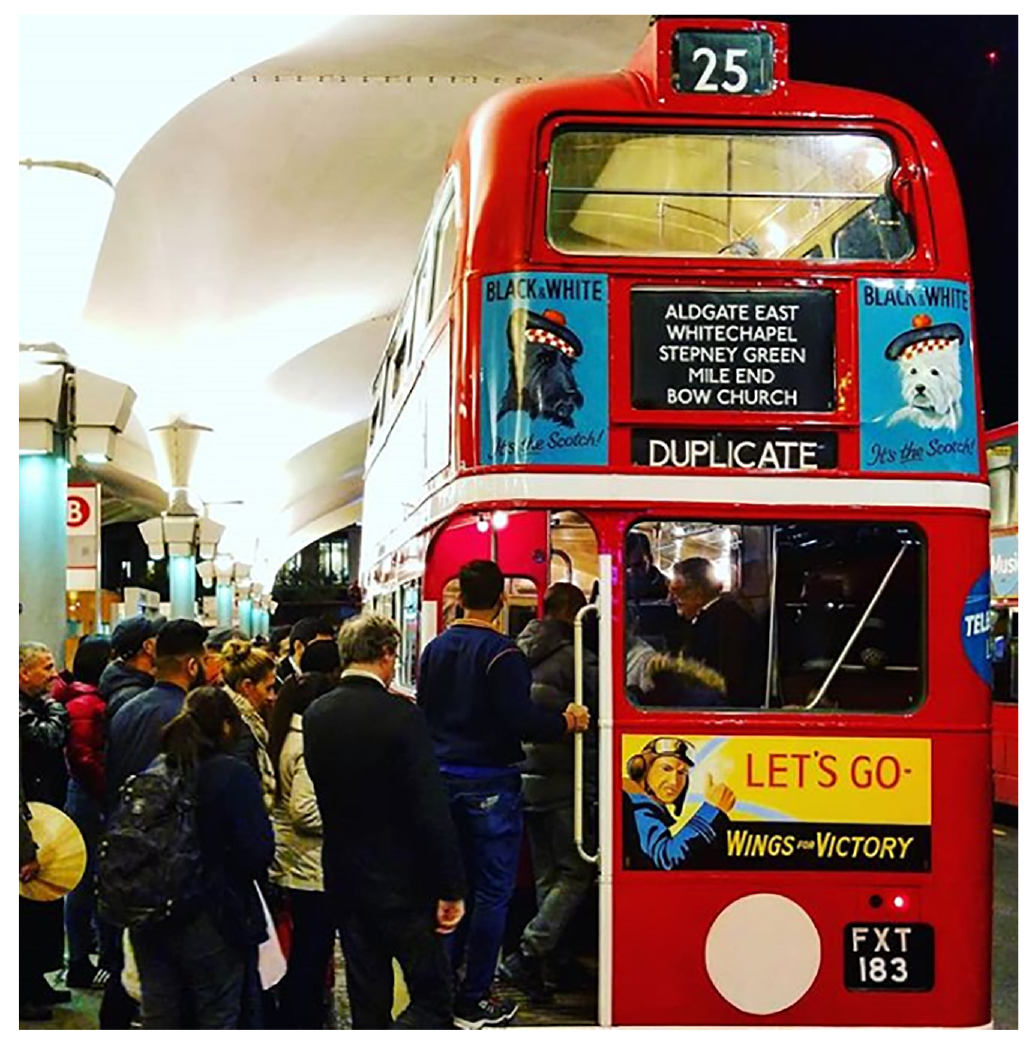
Passengers boarding via the open rear-platform of the 1939-built pre-War RT-type bus.
Most passengers showed their appreciation of this special announcement by applauding, and some shook his hand. Some people expressed surprise that the history tour was free of charge, and some said they would be happy to pay for it or donate towards the preservation of these buses. When the microphone was switched off, passengers began paying closer attention to the bus interior and describing how the engine sounded different compared to that of a contemporary bus. Moreover, the conductor’s special announcement led to further conversations among passengers, with some even asking him for more information at the end of the route. These interactions depended largely on the conductor’s intention and passion, which in turn determined the extent of the affective atmosphere on the bus. It was also common to observe passengers phoning family and friends to discuss the extraordinary experience and explain why they were late. Their conversations focused on the experience in itself, and on their encounters with others more than on the fact that the journey was taking longer than usual. This was a marked change from the emotions I had observed earlier, when people were waiting for the heritage bus to arrive. Thus, the presence of the heritage buses had a collective soothing effect, despite the delays and disruptions that initially defined the nature of a Tube strike issue.
Discussion
This section thematises the above findings with more nuanced discussion, by applying frameworks from the research on affective atmospheres, mobilities, museum, and tourism studies.
Affective contagion and an unanticipated transport-museum-like experience
Although a small number of people continued to focus on their own calls, music, or podcasts, activities commonly noted by other researchers were mostly suspended. Mobile devices were instead used for taking photos and recording videos of the bus journeys. In contrast to Simmel’s (1903) observation that urbanites can be neurasthenic and indifferent to the distinctions between things, heritage buses of specific materiality were enough to destabilise the habitual indifference and blasé attitudes of many passengers.
The transformation of routinised commuting practices into an unintended incursion of heritage buses during the Tube strike was in some ways comparable to what happens in a transport museum, where the ‘re-enactment’ of the past in the form of living history helps the public to understand the past (Divall, 2003).
Indeed, as Falk et al. (2006) have argued, interactions between individuals strongly influence the visitor experience in transport museums. This also explains the heightened affective atmosphere on the bus, as its visual features gradually sparked conversations. The material differences between the various buses, connoting the history of the London bus, and the everyday life of bus rides, became subjects of conversation. The result in this case was a contagious transmission of affect in relation to the materiality of the bus, which then contributed to the convivial atmosphere as different people boarded and disembarked the bus.
Here, the mix of people riding heritage buses during the Tube strike in the everyday space of the city is significant, as is the knowledge transfer that took place in the conversations triggered by the buses themselves. Riding the heritage replacement bus is very different from the same experience in an everyday context, but it is precisely within the everyday context that it occurs, disrupting individuals’ normal experience of the same routes. From my observations, it was clear that people’s sensibilities were heightened by their experience of the heritage bus, either instantly or gradually; those who were slow to realise that the vehicle belonged to a heritage collection caught the knowledge from the unusual reactions of others on the scene. Thus, passengers’ feelings were able to shape the affective atmosphere as conversations became focused on the buses themselves with at least some of the passengers actively constructing an experience specific to the heritage buses, both for themselves and for others nearby, whether intentionally or not.
The first major form of interaction took place among people of different demographic backgrounds, not only in terms of chronological age, but also in length of time living in London, with buses as part of everyday life. Specifically, those who narrated their histories of the buses and the city spoke with cockney accents, leaving no doubt about their long-term residence in the neighbourhood of East London (where Route 25 runs), regardless of their ethnic descent. Those with less experience of living in London included people chronologically younger, as well as immigrants from all over the world and others new to London. Here, the ‘novelty’ of the unanticipated experience on the heritage replacement bus was found to be a source of attraction, which had multiple meanings through its re-exoticising of journeys. As with transport museum audiences, for older passengers the occasion was about re-experiencing past years or childhood, while for younger passengers a heritage bus ride was a novel experience, as these buses had never been part of their lives. On the replacement buses, this was also a performance, as conductors expressed their enjoyment as enthusiasts by wearing meticulous London Transport uniforms consistent with the age of the bus, and communicating this to those who asked. This clearly differs from the pre-recorded and scripted nature of guides on the sightseeing bus (Farías, 2010; Larsen et al., 2021). With passengers just sitting there listening, it is unlikely that such a convivial atmosphere would have arisen. However, the conversational nature of the heritage bus journey contributed to establishing the affective atmosphere via the questions and answers between the passionate conductor and curious passengers. The conductor’s uniform, as a kind of unusual materiality, also functioned as a signal to curious passengers that the conductor was part of a re-enactment of the past.
Meanwhile, other enthusiasts who were riding the buses as passengers also provided mnemonic cues (Merrill, 2017) to bus history. While enthusiasts talked among themselves on the heritage buses, I noted that these private and jargon-filled conversations also caught others’ attention. This is in line with Bohme’s (cited in Edensor, 2012: 1106) argument that the formation of an atmosphere requires ‘sentient subjects’; the bus enthusiasts who had prior knowledge of bus history, together with other passengers, triggered a heightened sensitivity that radiated an affective charge. Subsequently, groups of enthusiasts also became autobiographical storytellers who introduced the history of the buses, both objectively with facts, and subjectively with their own personal experiences. These exchanges also constituted a form of ‘informal learning’ that relied specifically on passengers’ affective engagement; in this case they were fertile ground for social interaction that contributed still more to the atmosphere on the bus.
A collective soothing effect
The ‘collective soothing effect’ discovered in this disruption can be read as an ‘improvised, transitory and plural sense of togetherness’ caused by the emergence of a shared sensory experience (Closs Stephens et al., 2021: 37). The heritage bus journey exceeded what Jensen (2012) has referred to as a ‘temporary therapeutic space’, with unanticipated conversations creating a distraction during the disruption that not only soothed the affected passengers’ frustration at having a longer journey than usual, but which were also observed to be related to the materiality of vehicle and its presence in the city. Whereas Bissell (2009b) notes that a delayed service can heighten sensitivities or reduce one’s capacity to tolerate other affects and people, the heritage bus case showed that heightened sensitivities can also derive from a vehicle’s extraordinariness, more than from the delays per se. Despite some gestures of agitation, especially evident while queueing to board and not knowing what bus was coming, the majority of passengers appeared, judging by their facial expressions, to have shifted towards expressions of curiosity and excitement after boarding and seating. Those without a seat were less likely to be convivial or interact with others, and retained more neutral facial expressions. This implies that the type of vehicle, and its attractiveness and comfort, could alter the way passengers interpreted the disruption, which could bring unexpected benefits for the operator as well as for preservation groups and transport museums, not least for the exposure gained. Not only does the public gain an experience that might not have been free-of-charge in the context of weekend visits to the museums, but the conviviality created by a more diverse mix of visitors produced a thick and potent atmosphere that might not have been possible in different circumstances. This example, where the heritage buses themselves appeared to minimise negative emotions, and potentially the number of complaints, is therefore worth consideration; as Edensor and Sumartojo (2015) suggest in another context, passengers’ affective responses in a disruption could be ‘designed’ or ‘engineered’ towards a more positive outcome (see also McCormack, 2008).
Implications and further opportunities for the heritage bus
At this point it might be useful to reflect on the comparative fieldwork on the regular heritage service on Route 15 which served London on a daily basis until 2021. The study’s findings have implications for how atmosphere can be shaped and perhaps engineered (McCormack, 2008), despite the unanticipated and perhaps unintentional nature of heritage bus journeys. The Routemaster buses running on a daily basis were found to be less popular and garnered less attention. This could help to rethink the way affective atmosphere is more effectively formed by first attracting people’s attention. Passengers’ sociality on the daily Routemaster buses contrasted sharply with sociality on Tube strike replacements. Despite the fact that tourists also sporadically rode the Routemasters, most conductors on those buses were less welcoming than those who had helped to initiate an affective atmosphere on heritage bus journeys (albeit with a few exceptions, when tourists began asking conductors or other passengers questions about the bus). The daily Routemaster conductors, for the most part, did not have the friendliness or knowledge to respond in the way I had observed on the Tube strike replacements. On the rare occasion an affective atmosphere was formed on a daily Routemaster, the content of the conversation did not even come close; tourists mostly interacted with each other next to uninterested commuters whose body language spoke their refusal to communicate.
This difference in passenger response could be explained by the readily available nature of such services, for despite their distinctive and iconic appearance, the daily Routemasters were forced into the background rather than being the centre of attention, shifting the focus to the impact on passengers’ attention of unexpectedness vis-à-vis regularity, and the social composition of the passengers themselves. A broader social composition of passengers consisting of keen enthusiasts (including the conductor), excited commuters and non-regular travellers on that bus route, was found to be conducive to a much thicker atmosphere than that found on regular buses, and hence the creation of affective atmosphere.
Conclusion
The study makes two novel contributions. First, the very occasion of this exploratory work, which uses opportunistic fieldwork, has been shown to be a useful attempt to capture social life that arises unexpectedly and that, therefore, cannot be planned for in advance. This method should be encouraged and adopted more widely to capture such rare moments, which can generate productive research insights and outcomes. Second, the paper has demonstrated the formation of an affective atmosphere on heritage bus journeys, a process during which the vehicles themselves acted as a ‘medium of communication’ (Divall, 2003).
By seizing an unanticipated opportunity to carry out exploratory fieldwork on the sociality and affective atmosphere that arose from an everyday event, it has been demonstrated that people co-created atmosphere via a conviviality borne out of the unusual materiality of the buses – a materiality that was further enriched by the presence of sentient subjects (Bohme, cited in Edensor, 2012: 1106) with knowledge of the bus and the city’s past. The different configuration of the buses made for a positive affective atmosphere – a ‘space of extraordinary intimacy’ with ‘intense materiality’ (Wilson, 2011) in which people showed excitement and caught each other’s attention, resembling the contagion described by Bissell (2010). This chimes with Simine’s (2012) suggestion that museum objects (such as the heritage buses) can be material hinges for the potential recovery of shared meanings via narrativisation and performativity, and other research showing that not only is sociality strongly influenced by unexpected events, but that passengers’ feelings were able to shape the affective atmosphere of the journey (Bissell, 2009a; Jensen, 2012).
As a side note, and alongside this demonstration of the formation of affective atmosphere, the study’s most significant finding was precisely this increase in sociality among a diverse range of passengers, triggered by the novel materiality of the buses: older passengers, who had first-hand experience of heritage buses, shared personal narratives with younger people and new immigrants. Knowledge and experience were thus transferred and disseminated in a de-monopolised manner, as highly personalised narratives of everyday lives. At least some of the passengers were found to be active in constructing an experience specific to the heritage buses, both for themselves and for others nearby, whether intentionally or not, which is far from the top down, impersonal museum learning experience suggested by Fyfe (2006).
This points to the potential for further research on the transport museum context, as interactions between individuals in transport museums have been found to strongly influence the visitor experience (Falk et al., 2006). It would also be productive for further research to include interviews with the organisers of events, including heritage bus collectors and bus museum curators, to gain a more in-depth understanding of how they can ‘orchestrate’ affective atmosphere (Edensor, 2012), which could have practical uses in other situations that call for the management of passenger discontent.
Arguably then, the replacement heritage bus occasion needs further study. Aside from the generation of a positive affective atmosphere and the increase in communication between a diverse range of passengers, the encounters generated on the buses were similar in some ways to the (transport) museum experience as less experienced passengers were able to learn from the stories of older more experienced people. Museums and tour guides could perhaps learn something from this finding. Transport operators could also seize the opportunity to reflect on ways to minimise negative reactions and perceptions when an inevitable but disruptive event occurs in the future, by engineering an affective atmosphere.
Thus, despite the rarity of a strike event, the sociological richness of the heritage bus experience should not be undermined; it has the potential to open up novel perspectives and opportunities for future research.
Footnotes
Acknowledgements
I am grateful for the insightful comments and suggestions given by the three anonymous reviewers. My gratitude also goes to the panel convenors and presenters in the ‘Public Transport as Public Space’ session in the International Association for History of Transport, Traffic & Mobility (T2M) conference that took place in Paris, France in 2019, where an earlier version of this paper was presented. I thank the collectors of the heritage buses, and those who make heritage buses run on the Tube strike replacement services, without which the fieldwork and ideas of this article could not have been developed.
Declaration of conflicting interests
The author declared no potential conflicts of interest with respect to the research, authorship, and/or publication of this article.
Funding
The author received no financial support for the research, authorship, and/or publication of this article.
