




Abstract
Geographical scholarship has, since the late 1990s, shown how infrastructure was central to the making of urban modernity and the metabolic transformation of socio-natures. Meanwhile, the work of Latin American scholars including Aníbal Quijano and Maria Lugones has focussed attention on the imbrications between modernity and coloniality, in particular through the international racial division of labour. Moving between these ideas, I argue that there is intellectual and political ground to be gained by specifically accounting for the coloniality of infrastructure, in both its material and epistemic dimensions. I ground the analysis in the history of Recife, Northeast of Brazil, analyzing the role of British engineering in the production of the city's landscape and infrastructure, and address the epistemic dimensions of the coloniality of infrastructural by exploring infrastructural spectacle in 1920s Recife. Finally, I explore how the coloniality of infrastructure directs our attention to race, labour and finance.
Keywords
Introduction
The clocks on the wall in Recife’s former central train station, now a museum of railway history, read LONDON. The tea sets in the glass cabinets, GLASGOW. Amid the assorted paraphernalia collected to tell the story of the railways of the Northeast of Brazil, much is from the early 20th century, when British capital and administrators ran the Great Western of Brazil Railway company. The museum is neatand well run, with the faintly musty air of the enthusiast and the collector. When I visit, I am in Recife to study the archive of the Brazilian geographer, Josué de Castro. The museum and its site – backing onto the river Capibaribe – attest to the interlocking spatialities of infrastructure and landscape in the port-city, that Castro described and analyzed. The rivers, mangroves and tracks flow next to one another, in parallel, then tangle together. Josué de Castro, and other Northeastern geographers like Manuel Correa de Andrade, decades ago analyzed how the city and its port became the centre of an extractive economy of sugar, cotton and coffee. But the museum and its quaint air are eloquent of the texture of Recife’s historical geographies in ways that need further unravelling. The dusty iron tools of infrastructure, dragged from distant colonial metropoles, beg questions about how space and dependency were co-produced. The clinking tea sets, glistening with Edwardian zeal for imperialist respectability, suggest that there is more to say about the histories of power, capital and knowledge which tie this place into trans-Atlantic geographies of colonial modernity. I come to these questions as a reader and translator of Northeastern geographers, but also as a Londoner in Recife, trying to understand more closely the histories that so unequally connect these two apparently distant cities.
Soaking through these infrastructural histories are the geographies of uneven development. The ‘open veins of Latin America’ (Galeano, 1997) are precisely infrastructural. It was through infrastructural networks that colonialism and imperialism operated, which made relations of economic dependency and neo-colonialism possible. Infrastructure plays an intimate role in the coloniality of power and the international racial division of labour. It is central, too, to the making of modernity as a way of organizing space and time. Infrastructure’s metabolic transformation of socio-natures turns visions of modernity into concrete transformations of space and time (Gandy, 2011; Kaika, 2012; Swyngedouw, 1999). The coloniality and the modernity of infrastructure are not distinct, but co-emergent. In Aníbal Quijano’s terms, ‘during the same period as European colonial domination was consolidating itself, the cultural complex known as European modernity/rationality was being constituted’ (2007: 171). I therefore argue that if we take the coloniality of modernity seriously, we can find new ways into the geographical study of infrastructure. I do not seek to define modernity, but rather to establish a conversation between writing on how infrastructure harnesses social natures in the service of producing urban modernity (Gandy, 1999; Kaika and Swyngedouw, 2000) and writing on the colonial dimensions of modernity as a field of power and knowledge (Lugones, 2020; Quijano, 2000).
In recent years, infrastructure studies have ranged widely in geography and cognate disciplines (Anand et al., 2018; Schouten et al., 2019; Siemiatycki et al., 2019). My articulation of the coloniality of infrastructure builds on research that has begun to explore how ‘the work of securing the conditions of global circulation is deeply rooted in imperial history’ (Chua et al., 2018: 620; Cowen, 2019; Khalili, 2020; Ranganathan, 2019; Zeiderman, 2020). As Deborah Cowen shows – drawing on the Black Marxist tradition – transatlantic histories of finance, infrastructure and slavery are connected. I seek to add another historical geography, and another geography of theory, to these collective attempts to account for the relations between the colonial and the capitalist within infrastructure and its historical geographies. The histories of dependency and neo-colonialism pertain to Latin America in distinct ways, and theorists of coloniality including Quijano and Lugones can offer infrastructure studies new intellectual options. In particular, here, I use their work to think through the intersections of labour, race and finance in the historical geographies of infrastructure in the Northeast of Brazil.
Part of the task is to more deeply interrogate the spatial histories of infrastructure in cities beyond Europe and North America. Inspired by the work of Northeastern geographers of the 20th century, I therefore analyze the visual, infrastructural and landscape histories of Recife in the late 19th and early 20th centuries as an exemplary site for thinking through the coloniality of infrastructure. The Brazilian Northeast has long been central to transatlantic historical geographies of racial capitalism. As a node in these flows, Recife has been the subject and site of critical geographical research by scholars from the region for the last 70 years (Andrade, 1980; Melo, 1978). In the 1940s, Josué de Castro characterized Recife as a port-city and focussed geographical attention on the nexus between the estuarine landscape and circum-Atlantic flows (Castro, 1954). Like Rudolf Mrázek’s study of late-colonial Dutch colonial Indonesia, I approach the infrastructural histories of Recife’s wet lands first through the dry texts of design, engineering, surveying and cartography (Mrázek, 2018: xvi). Indeed, Recife shares a Dutch colonial history (1630–1654) with Indonesia as the Dutch left an enduring legacy in the urban structure of Recife (Castilho, 2014). As for Walter Rodney’s magisterial study of Guyana, land-making, canalizing and drainage were key to producing nature in the service of sugarcane and the (neo-)colonial economy (Rodney, 1981). Analyzing the watery details of Recife’s infrastructural landscape takes me through practices of draining, channelling and quarrying. After these engineering histories, I turn to infrastructure’s transmutation into a spectacle of modernity in a remarkable 1925 silent documentary film, Veneza Americana [Venice of the Americas]. Analyzing both the way that this film portrays Recife’s infrastructure, and the people and networks who made it, links the litoral margins of Recife to the plump-cushioned sofas of Edwardian Britain. I begin, therefore, with the infrastructural history of Recife in two moods: engineering and cinema.
Recife’s colonial modernity (i): Infrastructural engineering
The Northeast of Brazil was one of the economic heartlands of the Portuguese imperial project in the Atlantic, and the Captaincy of Pernambuco was one of the most profitable of Portuguese colonial enterprises. Based largely on sugar production and enslaved labour, it had been an archetypical monocultural landscape of extraction for centuries before the expansion of British capital and interests there in the 19th century (Rogers, 2010; Scheper-Hughes, 1993). British engagement in Brazil was long-standing, not least through secondary relations of domination established with Portugal, but it intensified in the 19th century as Brazil emerged as a ‘modern’, urbane republic. European fashion and knowledge influenced urban change across Brazil throughout contested and uneven processes of modernization in the late 19th and early 20th centuries (Bertoni, 2015). While urban aesthetics were particularly connected to France, engineering and finance were two critical vectors in Brazil’s neo-colonial relationship with Britain ( Needell, 1987). From the mid-19th century onwards, British investment in infrastructure was vital not only to the construction of Brazilian urban space (Meade, 1997; Miller, 1993: 132) but also to the production of nature as resource for extractivism, and the deepening of export-led, financialized neo-colonialism.
Brazilian historians have pointed out infrastructure’s role in the structural shift from a rural oligarchy to an urban economic elite, and in establishing a waged labour market (de Melo, 2008: 184–185). For Richard Graham, British investment was key to Brazilian industrial development along four vectors: first, they built the transport system; second, they supplied and sold the machinery; third, they provided the finance; and fourth, they supplied the technicians (Graham, 1968: 125–127, 132–145). Graham argues that British involvement in industrialization had various negative consequences on the Brazilian economy, but argues that in the case of ‘port facilities and railroads […] the British role [can] be considered neutral’. This ‘neutrality’, however, is highly partial: in Graham’s terms these infrastructures ‘benefit[ted] both planters and industrialists’ (Graham, 1968: 111). This is hardly neutrality, leaving only a choice between two different kinds of elite, both invested in different forms of conservatism. Thoroughgoing European control revolved around infrastructural investment and was key to establishing what Celso Furtado and Enzo Faletto outlined as Latin America’s technological dependence (Cardoso and Faletto, 1979; Furtado, 1970).
The Northeast was an area of ‘special interest’ to British capital (Freyre, 2011: 77). Investment in sugar production through companies including the Central Sugar Factories of Brazil Limited and the North Brazilian Sugar Factories Limited ‘changed human relationships as well as the economy’ in the Northeast in the 1870s–1990s, before fading away after the government cancelled guaranteed interest agreements in 1886 (Graham, 1968: 149–159). Concentrated in Recife, the capital of Pernambuco, British finance controlled banking in the wider Northeast and a resident British elite were part of Recife’s urban social fabric (Edmundson, 2016: 34–40; Freyre, 2011). These patterns of investment created extractive flows, consolidating capital back in the metropole. Recife’s port was built on the back of engineers’ surveys of the shallow waters and fluctuating streams of the Capibaribe and Beberibe. Engineers’ maps and surveys, often commissioned by the municipal government, became tools for the insertion of capital into export infrastructure, and the insertion of the Northeast into global flows of commodity extraction. Expert-led imperialism is a common trope, but the Anglophone scholarship does not discuss British mapping of Recife. Following the trajectories of the British engineers who helped produce this landscape gets us into the seams of the coloniality of Recife’s infrastructural landscape.
British capital had controlling or initiating stakes in the port, tramways, gas lighting, electricity, water utilities, drainage, logistics and bridges (Graham, 1968: 116–118; Manchester, 1964). The concentration of neo-imperial capital in infrastructure, more than any other sector of social and economic life, reveals its significance to producing dependency and conditions of coloniality beyond formal empire or settler colonialism. In 1873 the British owned Great Western Railway Company of Brazil was granted a licence to work in Brazil (Pinto, 1949). The company ran the Recife-Limoeiro Line, and, between 1885 and 1896, the Central Railway of Pernambuco that connected Recife to Caruaru in the agreste (Gaspar, 2003). The role of British capital in funding railway expansion in Latin America is well known (Cardoso and Faletto, 1979: 59–60; Miller and Finch, 1986). 1 But here I want to approach the relationship between imperialism and infrastructure through engineering, and flows of geographical, geological, topological and cartographic knowledge. If the railways were ‘planned from the perspective of neo-colonial markets’ (de Melo, 2008: 188) then it is worth attending to how British capital and experts were involved in the expansion of infrastructure in Latin America (Miller and Finch, 1986: 1). In colonial and neo-colonial space, engineers also struggled with local conditions and contingent and resistant environments. But these engineers ‘were not merely technicians of positivist progress, but agents of the development of capitalism’ (de Melo, 2008: 133–134), and infrastructure was a crucial tool of deepening imperialist and dependent relations.
In July 1832, a young British engineer called John Hawkshaw (1811–1891) travelled to Venezuela to learn his trade, directing the expansion of infrastructural connections around a copper mine in Aroa. The task was to connect the mine to a river, and build a ‘new loading pier near Point Tucacas for ships which carried the ore back to England, where it was smelted at St Helens, near Liverpool’ (Beaumont, 2015: 9). As he put it in his book of ‘reminiscences’ from South America, ‘forwarding ore to England was a sine qua non’ (Hawkshaw, 1838: 106). Hawkshaw returned to England in 1834 and worked in the Liverpool docks – following the ore – before becoming the chief engineer of the Manchester and Leeds Railway (Chrimes, 2013), President of the Institution of Civil Engineers in 1862–1863 and being knighted in 1873. He worked on Holyhead harbour, the Suez Canal, Great Western Railway’s Severn Tunnel and the Amsterdam Ship Canal. In 1874, Hawkshaw was appointed by Emperor Dom Pedro II to survey Brazilian ports. One of the priorities was Recife. It is easy to see why Hawkshaw was suited to the city, as two features marked out his practice: land drainage and river works on the one hand, and dock and harbour works on the other (Chrimes, 2013). Both were central to the history of Recife (Castro, 1954).
In 1874, Hawkshaw wrote a report outlining his recommendations. It reveals the competition between engineers and infrastructural speculators over the shaping of Recife’s landscape. Hawkshaw outlines previous plans by English engineers including Henry Law and James Blout (Figure 1), Charles Neate and a Mr Bidder (Hawkshaw, 1875b: 23–24). Hawkshaw summarizes and critiques all these previous plans, making comparisons to English harbours, and costs his own proposals. (Similar competitions between British engineers can be seen in Hawkshaw’s analyses of ports at Rio Grande do Sul, Maranhão and elsewhere). Law and Blout had proposed draining and canal works around the port. However, they were not disinterested experts, but part of the Pernambuco Dock and Harbour Company, founded in London in 1868. Their plans were not implemented (Graham, 1968: 93). Hawkshaw’s own 1874 plan was influential, though critiqued by Brazilian engineers (Souza Leão Vieira, 2003: 146), and in spite of attempts to attract investment with the same guaranteed returns as the railways, it was not precisely enacted (Simonini, 2016: 497).
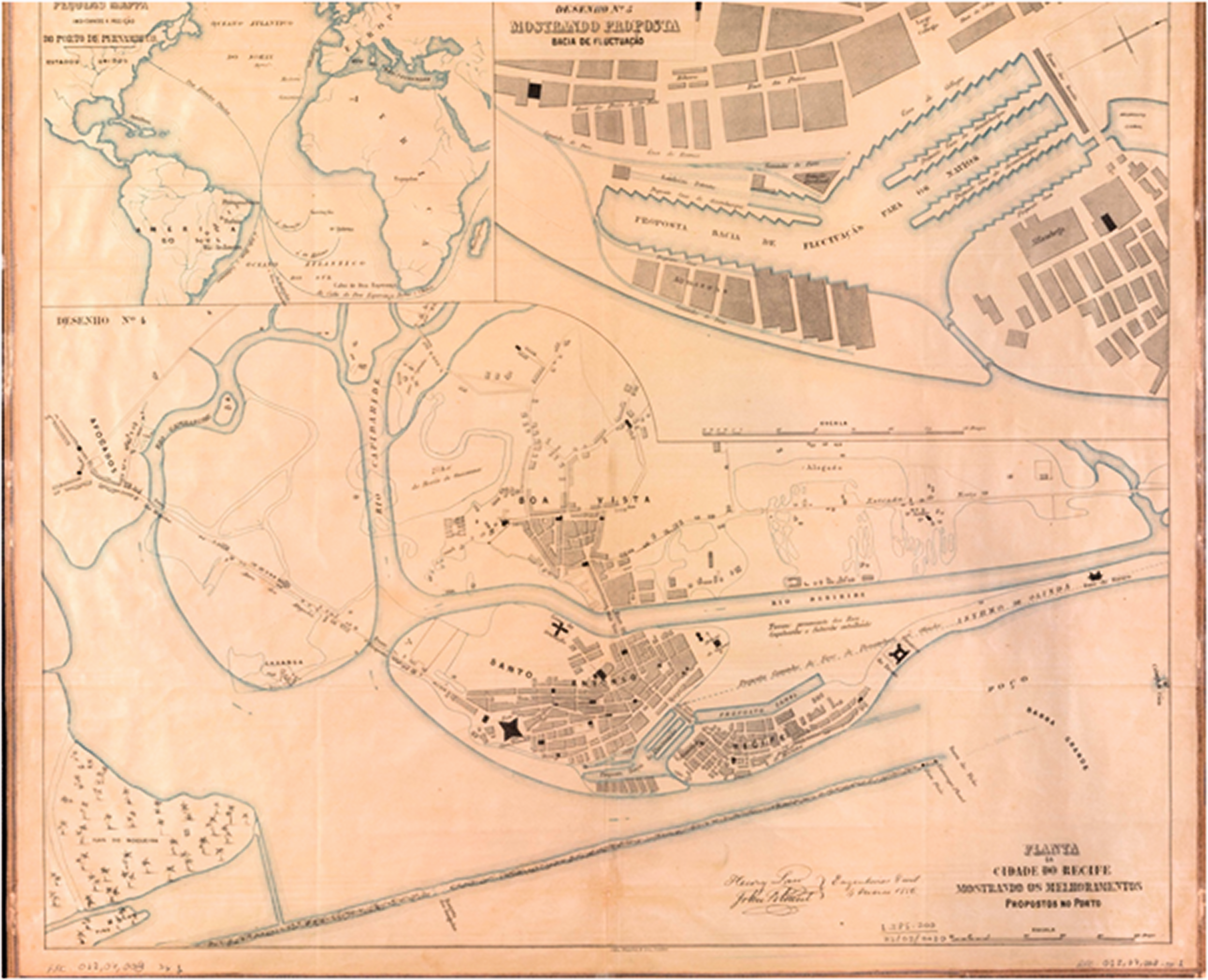
Law and Blout map 1856. Note the detail of port and transAtlantic routes.
The main objective of these projects was to deepen the insertion of Brazil into the commercial flows of the Atlantic (Simonini, 2016: 497). This is eloquently attested by Law and Blout’s map, which neatly juxtaposes Recife’s position within these flows with the proposal for the re-engineering of its docks. In 1906 Charles Douglas Fox mapped Recife for the State government with Henry Michell Whitley. Engineering networks were tight: Henry Law & Sons (of the 1856 map) worked for Whitley on his estate in East Sussex in 1896, 2 drafting plans to address flooding and drainage, as he had in Recife (see also Law, 1855). Fox was President of the Institution of Civil Engineers in 1899, John Hawkshaw had been President in 1861–1863, and his son was a Vice-President during Fox’s tenure. Watery knowledge ebbed and flowed across the Atlantic. Law brought expertise on flood management from Brazil – and Brazilians – which were applied in Sussex, from where Whitley’s company returned to map Recife 50 years later. Dozens of other British engineers worked in the Northeast, including the De Mornays and Thomas Brassey, the first contractor of the Recife-Sao Francisco railway line who built railways in Argentina and Peru (Hobsbawm, 1976: 72–73; Manchester, 1964: 323–325; Miller and Finch, 1986: 10). Hawkshaw’s firm, including his son, John Clarke Hawkshaw, later directed the construction of the vast docks at Puerto Madero in Buenos Aires. Hawkshaw was a referee for the São Paulo Railway in Brazil, the engineering of which was directed by his former assistant and protegee, James Brunlees, who also specialized in tidal engineering and designed railways in Porto Allegre, Minas and Rio. These biographical details serve to illustrate the density of these networks of imperial expertise, and the ubiquity of British capital in urban Brazil not only in the form of bankers, but in the form of the maker of infrastructure: the engineer. Indeed, as Gilberto Freyre recounts, the role of the ‘English Engineer’ became a caricature in Brazil, represented in ‘magazines, cartoons, street and café jokes, carnival costumes, folklore and risqué stories’ (Freyre, 2011: 46).
The company ‘Recife Drainage’ was incorporated in London in 1868 and worked until 1909 (de Melo, 2008: 112), even though its services were considered inadequate and criticized by the city council throughout the 1870s (Souza, 2002: 150–162, 219–222). A number of British surveyors were involved in Fox’s projects 3 (Barreto, 1994) which underwrote later drainage and water supply (Freyre, 1961: 10; Melo, 1978: 67–69; Vasconcelos and Sá, 2011: 13–14). These engineers carried aesthetic norms across the Atlantic as well as just financial and institutional ties. For the engineers, the problems of London and Recife were not so distinct: their ways of seeing according to modulations of depth, volume, pressure and flow transformed urban maritime space into a common set of calculative problems. But these logics were underpinned, too, by normative aesthetics, particularly when it came to questions of wetness. Charles Douglas Fox’s, 1899 Presidential address to the Institution of Civil Engineers looked forward to the day when the ‘fog-producing marshes of the East [of London] shall be thoroughly drained and dried up’ (Fox, 1899: 11). This aesthetic politics applied in Recife, where the making of land out of water was crucial to the production of urban modernity, and to imposing divisions into space and nature (Castilho, 2014). In 1908 a project was finally concluded to work on the port, extending sea walls, building quays, dredging, making new land, and building warehouses and port buildings (Dantas, 1992: 41–43; Souza, 2002: 195–205). Fox’s surveys facilitated the work of Saturnino Brito’s (1864–1929), who laid out Recife’s first sanitation systems between 1910 and 1917 (Brito, 1943; Faria, 2015; Outtes, 2003: 155).
These infrastructural histories demonstrate how relational geographies of imperial and neo-imperial space are linked by both epistemic and material flows – by both the concrete and the aesthetic. Engineers’ biographies embody the transatlantic continuities of the Brazilian economy and its infrastructures. John Hawkshaw, for instance, also engineered the East and West India Docks in London where Pernambucan sugar landed (Chrimes, 2011, 2013). 4 These infrastructures produced space not only along the new sea walls in Recife, but in the docks in Woolwich. The infrastructural networks that take commodities from sites of production to sites of consumption are metabolically and materially connected. Sugar produced in South America was a key part of working-class diets in London. While (enslaved and otherwise) workers on sugar plantations were worked to death (Brown, 2008), workers in the metropole experienced what EP Thompson called ‘regular dietary class war’ (see also Rioux, 2015; Thompson, 1963: 316). The metabolic qualities of infrastructure facilitated the movement of the nutrients of Pernambucan soil across the Atlantic, and were underpinned by under-fed labour on both sides of the Atlantic (Davies, 2019).
Recife’s colonial modernity (ii): Infrastructure and the cinematic urban landscape
Modernity is not only a question of mud and concrete, but of aesthetics and ideology. Infrastructure, often rhetorically understood as ‘invisible’, in fact relied on visibility to create the political effect of modernity (Larkin, 2013: 336). To consider the colonial dimensions of this modernity, therefore, we need not only to analyze the material making of infrastructure, but its visual emergence as a spectacle of modernity. The emergence of such spectacles is always contested, just as modernity is itself uneven and internally contradictory. Therefore aesthetic and political processes do not map neatly onto the ordering of urban space, even in epicentres of European modernity (Gandy, 1999: 36), and certainly not in a metropole of extraction like Recife. The epistemic flows in question were not only in terms of engineering knowledge, and the controls over its categories and practices, but broader exchanges over what defined urban modernity: what it looked like, how it functioned, and how it related to projects of nation building. As Gandy puts it, ‘the combination of landscape with infrastructure necessarily brings questions of aesthetics and cultural representation into our analytical frame’ (2011: 63). The very same export infrastructure of Recife that had been mapped, designed and competed over by British and Brazilian engineers became a spectacular cinematic landscape in the film Veneza Americana (1925). Through that film we can see how infrastructure’s part in the production of colonial modernity was not only concrete, but spectacular.
Film has had intellectual, philosophical and practical interconnections with the urban and urban imaginaries since the end of the 19th century. In its first decades, Brazilian film produced images of uneven urban modernity, technological networks and the infrastructural sublime (López, 2000). In this period and beyond, the relationship between film and modernity in Brazil was intimate and multi-faceted (Conde, 2018). The economic/functional and the aesthetic/ideological of infrastructural modernity co-exist and mutually support one another. Veneza Americana is a remarkable document in this context. It was made by Falângola and Cambieri during the ‘Recife Cycle’ of 1923–1931. Recife in the 1920s was in the midst of a modernist transformation, accompanied by a proliferation of magazine and newspaper publishing. Publications such as the Revista da Cidade documented the city’s changes. This ongoing photographic record of the city’s changing urban space privileged, in real time, the visual field as a source of the city’s modernity (Blake, 2016). The regional cinematic flourishing of the ‘Recife cycle’, like the newspapers and magazines Stanley Blake analyses, was tied to the modernization projects and regionalist politics of the time (Araújo, 2013, 2015; Saraiva, 2017; Souza Leão Vieira, 2003), and can be inserted into the contested production of modernity and the nation in early 20th century Brazil (Conde, 2018).A Unlike many films from Latin America in the period, it is a film we can also actually watch. Other films such as A Filho do Advogado (1926) and Aitaré da Praia (1925) demonstrate a similar interest in the city’s infrastructural novelties. Unlike Veneza Americana they are narrative fictions, but they orchestrate their visual spectacle through trams, boats and cars. Technological novelties take pride of place, with transport and mobility key features of modern élite life. So too in As Grandezas do Pernambuco (1925) and Recife no Centenário da Confederacão do Equador (1924) (Saraiva, 2017), Veneza America was part of a propaganda project by the Governor, Sergio Loreto (Araújo, 2013: 96), which promoted the transformation of the city and the port and the extension of rail and tram infrastructures. The film both ‘inserts the region into the process of capitalist modernization, and at the same time shores up conservative ideologies linked to the old values of patriarchal society’ 5 (Araújo, 2015: 23). The port authorities themselves made the port a central part of these discourses of rejuvenation, for instance through publishing a magazine in the early 1940s, the Boletim da Cidade e do Porto da Recife, publicizing its modernization and expansion.
The film narrates the arrival of the Gelria steamer (Figure 2). Its storyline is a journey through the melhoramentos, the improvements of the port and urban centre, including warehouses, docks, railway lines and logistical operations. We see stevedores loading and unloading sugar and key logistical bureaucrats and politicians posing for the camera. The intimacy between state, port, export and capital is total, and the film specifically connects powerful state actors with infrastructural development. For instance, we see Estaçio Coimbra arriving at Recife’s quayside. Coimbra was a steadfast member of the Pernambucan elite, a sometime mayor of Recife and by 1925 Vice President of Brazil. His arrival in the Recife of 1925 codifies a turning of the tide: British control of the railway was coming under pressure and Coimbra was among those who argued that the model of dependency on British extractivist investment was broken. He later called for the expropriation of the Brazilian Great Western Railway. When we see his placid face looking at the camera in the port, we might read ambivalence about the extravaganza of financially creative underdevelopment which underwrote the infrastructural modernity of Recife. The film’s aesthetics are repetitive and insistent. The camera lingers on vans, warehouses, quarries, cranes and tracks. It presents the modern division of infrastructural and logistical labour as a spectacle, and represents urban modernity through the aesthetics of an infrastructural and logistical sublime.
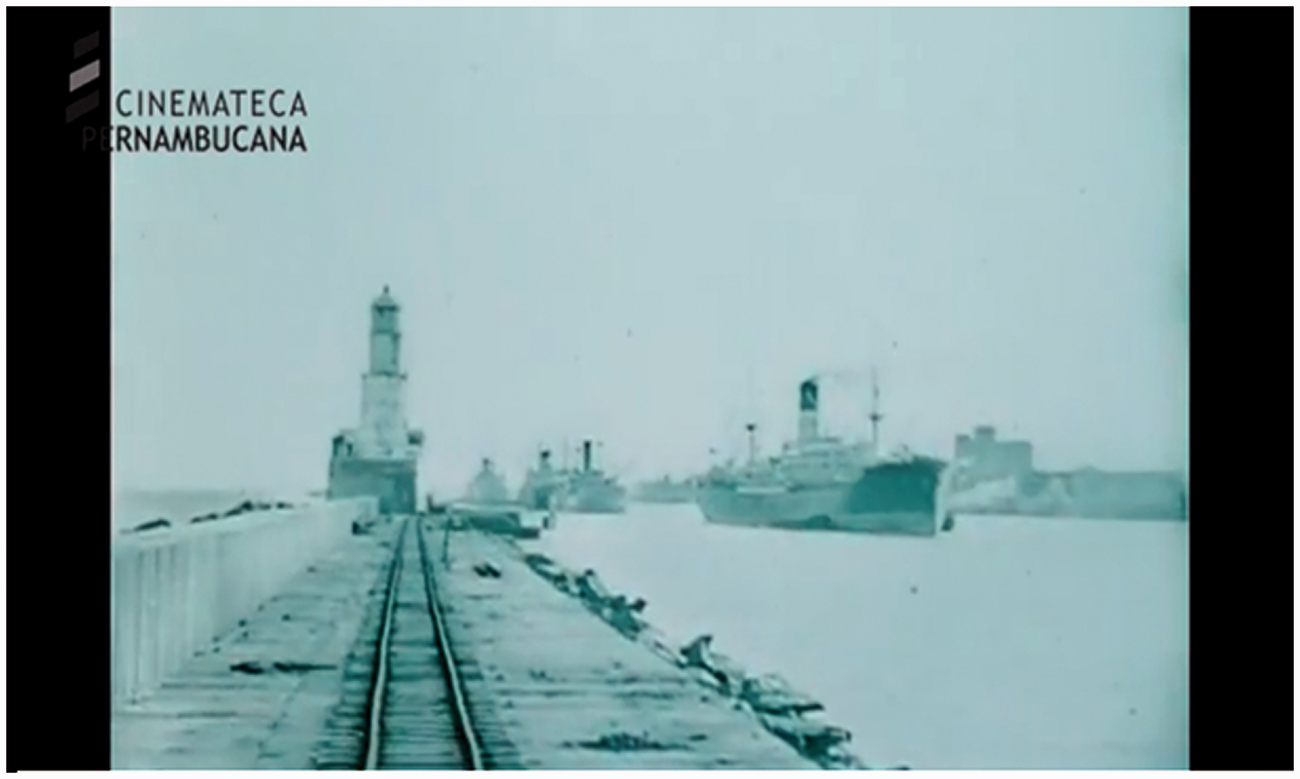
Screenshot, Veneza Americana (1925).
The film’s frayed aesthetics remind the contemporary viewer of its fragility, and of the swathes of lost films from the same period. At times, it is hard to decipher the details of the landscapes we see: are they warehouses, construction sites or ruins? This is not an aesthetic caprice: throughout the city at the time the construction of the new was coextensive with the destruction of the old (Barreto, 1994). At the time the film was made central districts such as Santo Antonio were under threat of demolition (Outtes, 2003: 158). Infrastructure was an ongoing process. As John Hawkshaw noted in his Venezuelan account, infrastructure required ‘not only constant repair, but almost constantly remaking’ (Hawkshaw, 1838: 106). Veneza Americana captures this constantly unmade quality of infrastructure, poised between destruction and construction. In narrating the construction of the port, the film takes us to quarries 21 km away near Jaboatão (Figure 3). Dozens of men cluster at the rockface. Machinery chugs away, puffing with exhaustion. Men haul large rocks across scrubland. An explosion sends dust floating across waving grasses. The effect is meant to be of an infrastructural sublime, but it has an air of bathos. The clouds at the quarry form part of this cycle of construction and destruction, and in watching the film we cannot always be sure where in that cycle we stand. The camera picks out machines, public works and sophisticated, modern urban flow. But it cannot hide what is in plain sight: the production of infrastructural modernity was made by gendered and racialized labour. The film turns to the hard lines of the docks, nearing completion. But there, too, the back-breaking logistical labour of the port is clear.
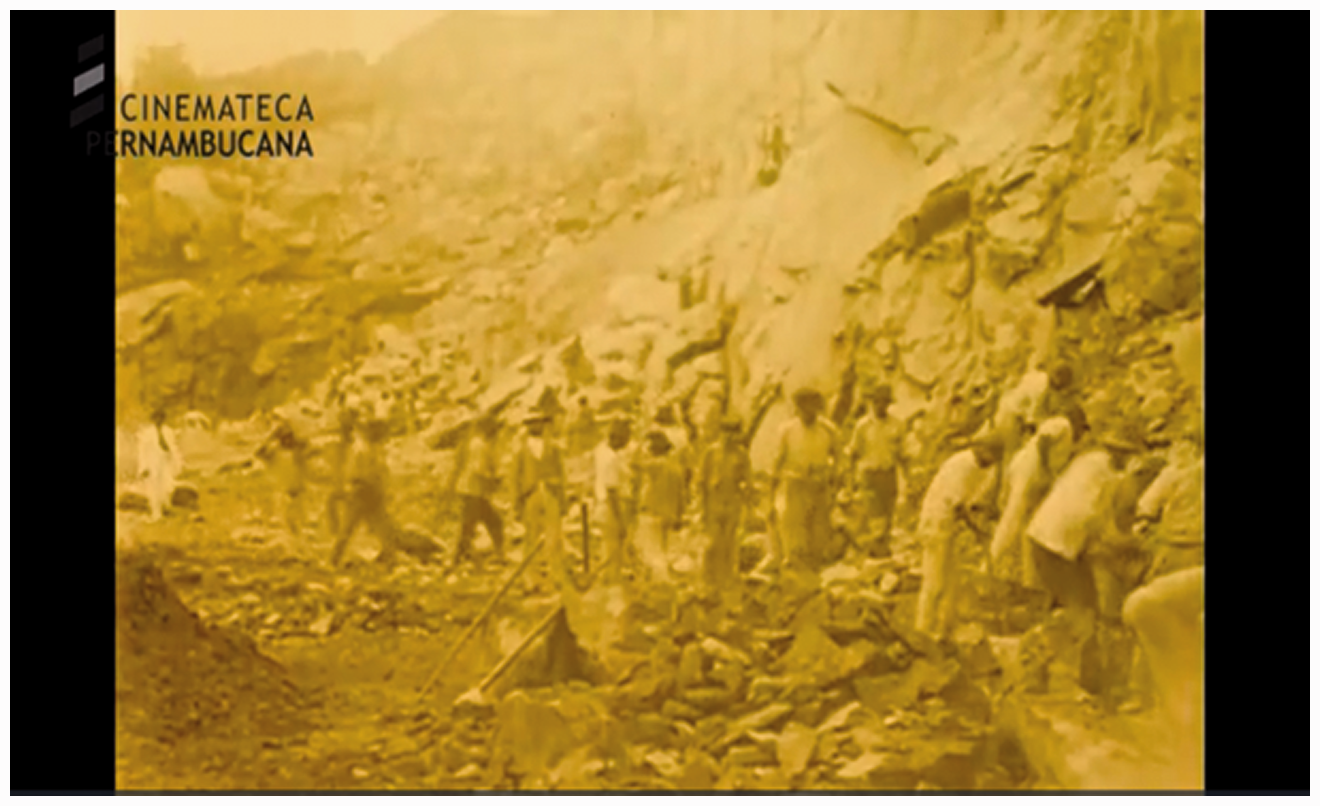
Screenshot, Veneza Americana (1925).
Veneza Americana’s climax is ‘a great mass of the people’ gathered on special trains to witness state power and infrastructural spectacle. Palms and pylons line the road. Rows of light-skinned, bourgeois women stand at the front to bear witness to the port’s modernity and the dignitaries’ arrival. They take part in a mobile celebration, a spectacle on which the public are brought to the Port on the modern tramways. The camera has pride of place as we are carried along the Recife coastline. The works, if we observe closely are only recently done: earth is piled up often haphazardly, and the tram’s infrastructure is indifferently finished. The arrival is greeted with an open-air feast in Boa Viagem, where the city’s great and good celebrate. Using archetypal techniques of early film, with foretastes of foundational urban films like Die Sinfonie der Grossstadt (Symphony of a Great City, 1927), the city is presented as a landscape through which the camera moves, recording, framing and detailing. Veneza Americana does not have the lyrical intensity or the architectural poetics of the later German film, but there are shared attempts to configure the urban sublime of modernity. Veneza Americana ends at the dockside, steamers waiting in the port, the Atlantic lapping at the sea wall. If Recife is the Venice of the Americas it is as a gateway, a threshold of entries and exists in the circulating flows of Atlantic infrastructural modernity.
The coloniality of infrastructure (i): Race and labour
This brings me to the second half of this paper, which aims to draw out some key categories of infrastructure’s coloniality, in the forms first of race and labour, and then of finance and gender. Kendra Strauss has noted that ‘scholarship on infrastructure has had relatively little to say about labour’ (Strauss, 2019). This is beginning to change, as we can see what Lugones calls the ‘thorough meshing of labour and race’(Lugones, 2007: 191) inside the infrastructural labour analyzed by Zeiderman(2020). In terms of the material analyzed here, we can see racialized divisions of labour clearly in the film Veneza Americana. Heavy labour is done by Black and darker-skinned Brazilians, while white overseers observe. And as the first section showed, the work of knowledge production and the control over technology was in the hands of white, male, imperial engineers, and their allies in Brazilian elite society and the state.
Aníbal Quijano wrote that ‘the coloniality of power’ identifies: the ‘racial’ social classification of world population – expressed in the ‘racial’ distribution of work, in the imposition of new ‘racial’ geocultural identities, in the concentration of the control of productive resources and capital, as social relations, including salary, as a privilege of ‘Whiteness’. (Quijano, 2007: 171)
Veneza Americana only shows one side of infrastructure’s dual life. Though built by the people who lived in the mocambos, infrastructural space was defined as their opposite and became the border between the two. In the long, failed and fractured process of trying to cleanse the urban landscape of racialized informality, infrastructure was the liminal point of difference. In 1934, for instance the Governor, Novais Filho, specifically banned informal settlements within 200 m of railway lines, tramways and roads (Zélia Gominho, 2012: 61). The visual ordering of the city, which had deep racial undertones, was organized around an aesthetic sensibility to which infrastructure was central. As Stanley Blake shows, Recife’s illustrated press of the time – with noteworthy examples such as the Afro-Brazilian photographer Francisco Rebello – reproduced visual representations of Recife’s poor and working classes that relied heavily on racial stereotypes, configuring darker skinned Recifenses in racist and eugenicist terms (Blake, 2016). Veneza Americana takes care not to show the mocambos that dotted and indeed overtook many of the central areas which the film portrays. The vision of the city that Veneza Americana portrays is an imaginary one, however much it dwells on the concrete and construction of the city’s modern infrastructure. However, what the film cannot help but show are the workers who lived in mucambópolis. The cinematic gaze has to pass through human work to pick out the machines and the logistics. The camera cannot hide what is in plain sight: infrastructural modernity is constantly made and remade through gendered and racialized labour.
The processes of racialization in question have specific historical geographies in Northeast Brazil (Arruti, 1997). The region’s social structure functioned through racialized divisions of labour, based on hierarchy and exploitation. The internal migrants and working classes who built the infrastructure that British engineers planned were racialized subjects who included both Afro-descendant, Black Brazilians, caboclos of African and indigenous heritage, sertanejos from the backlands, and other characteristically Brazilian forms of racial mixture. This racial division of labour has deep roots in slavery, and in the longer durée of the Northeast of Brazil. As Zeiderman has recently explored on the Magdalena river, these logics manifest in specific, articulated forms within infrastructural labour: what he calls the ‘situated afterlives of race and labour’ (Zeiderman, 2020). In Brazil, as elsewhere, the legal abolition of slavery did not mean abolition of the social relations of racialized labour exploitation, nor the abject conditions of life of many Black and indigenous Brazilians (Gonzalez, 2019; Ratts, 2007). Racialized and exploitative labour relations in the sugarcane industry persisted through the 20th century (Dabat and Rogers, 2017).
Regional dynamics were embedded in global negotiations of race. For instance, embedded and ongoing labour in the railway and port were bound up with the compromised position of the British in relation to the trade in enslaved people. Officially opposed to slavery, British-owned companies should not, according to their own constitutions, have employed enslaved labour to build the Recife–São Francisco line in the 1850s (Edmundson, 2016), yet adverts in the local press sought out enslaved labour through intermediaries (Freyre, 2011: 97). John Hawkshaw recounted the racial divisions of labour embedded in the railway and river port works in Venezuela where he learnt his trade. In Aroa, there were 200 English workers, mainly Cornish miners, on between 8 and 12 pounds a month, 1000 ‘creole’ workers, controlled by the English workmen on 2 shillings and 6 pence as well as even lower paid ‘native labourers [who] were extremely active in the water, and were quite as ready to go an errand to the bottom as to lend a hand above’ (Hawkshaw, 1838: 109). Hawkshaw does not state his own payment.
Hawkshaw’s account reveals anti-Spanish tendencies and a familiar set of imperialist clichés about dark continents, but also an imperialist, liberal abolitionism. This is articulated both aesthetically – ‘I really do not see on what ground persons who rejoice in a complexion, sometimes pasty, sometimes purple, sallow perhaps as saffron, white or grey, or still more nearly allied to the colour of a farthing rushlight, should arrogate to themselves a superiority of beauty over the bronzed features and flashing eyes of their southern brethren’ – and in terms of intellectual acuity – ‘that philosophy appears to me to be but shallow which supposes that, by a similar treatment, the African could not be raised to as high an eminence […as] to fill the Professor’s chair’ (Hawkshaw, 1838: 207–208). Nevertheless, while he was rhetorically opposed to slavery, he was willing to differentiate between ‘gentler’ variants in Venezuela. The themes of labour and race were no less fraught in Recife than in Aroa. As Zeiderman shows in his study of the Colombian riverboat workers, different kinds of infrastructural labour and processes of racialization are articulated to one another. Casimir de Melo describes similar divisions of labour in Recife’s infrastructure (de Melo, 2008). My concern here has not just been with the work of building infrastructure, but its design and engineering. As Lugones argues, ‘modernity and coloniality afford a complex understanding of the organization of labour. They enable us to see the fit between the thorough racialization of the division of labour and the production of knowledge’ (Lugones, 2007: 192). Such divisions operate in the labour of making (and re-making) infrastructure, but crucially, too, in that the production of knowledge was the preserve of white European men: there is an association between engineering knowledge and whiteness. 6 The control over knowledge (engineering, cartography, contracting, technologies), as well as control of financial flows, was central to the maintenance of dependency.
The coloniality of infrastructure (ii): Finance and gender
While engineers got their hands into the mud, financiers and investors kept their hands clean. But the expansion of Brazilian infrastructure was contingent on British financial capital. The global flows of commodities that passed through Recife, and the infrastructure which carried and modulated those flows, were woven into the future-oriented temporalities of finance. In Giovanni Arrighi’s terms, the long 20th century was one of the ‘highest moments of finance capital’ (cited in Baucom, 2005: 27), at the end of the ‘British cycle’, when financialization of circum-Atlantic accumulation intensified. For Baucom, ‘as commodity capital is to the nineteenth century’s intensification of the seventeenth, so finance capital is to the long twentieth century’s intensification of the eighteenth’ (2005: 22). Through finance, infrastructure’s geographies are Janus-faced – they look to the past as well as to the future (Santos, 2004, 2009).
In the mid-19th century, the Brazilian Empire funded investment in railways by establishing guaranteed returns on capital. British engineers were central. In 1875, John Hawkshaw addressed the British Association of Engineers as its President: The empire of Brazil also, which I have lately visited, is arriving at the conclusion, which I think not an unwise one, that the State can afford and will be benefited in the end by guaranteeing 7 per cent upon any railway that can of itself be shown to produce a net income of 4 per cent, on the assumption that the nation will be benefited at least to the extent of the difference. (Hawkshaw, 1875a: 44–45)
The dividends from railway companies flowed into British coffers throughout the 19th and early 20th centuries (Manchester, 1964). The nature of these returns relates to debates over finance in studies of infrastructure. As Purcell, Loftus and March argue, in the case of the financialization of water infrastructure, the expansion of the capital base helps to lock in future unit water prices, ‘setting the terrain for dependable revenue sources around which interest bearing capital […] is mobilized to appropriate value from the capitalization of infrastructure’ (Purcell et al., 2020: 14). The guaranteed return on investment functioned in a somewhat similar way. The historically specific ways finance has profited from fixed capital has been central to the coloniality of infrastructure for two centuries (Cowen, 2019; Khalili, 2020). Ian Baucom draws out the allegorical and imaginary nature of financial accumulation, perennially constituted upon future returns. In centring the financialization of infrastructure we can recognize how its contemporary material configuration relies not only on past circulations, but on future ones.
Following financial connections, as Deborah Cowen does in her work on the Canada Pacific Railway, can bring new relations into the frame. Infrastructure was financialized from its invention, and the relationship between engineering and finance was deep: projects selling stocks in new railway companies used the good names of engineers to drum up support among possible investors (Edmundson, 2016). Though infrastructural labour is almost exclusively male (see Zeiderman, 2020), drawing on Lugones’ interpretation of coloniality, we can see how chains of finance bring to bear particular modalities of gender. Lugones went beyond Quijano to show how colonialism produced system not only of race, but of gender and heterosexualism. There is, indeed, a strange, gendered dynamic at work in financial neo-colonialism, on which greater research is needed: ‘English girls’ were given stocks in Brazilian railways as dowries (Edmundson, 2016). This kind of shareholding was relatively common among wealthy and middle class women of various socioeconomic backgrounds in Britain in the period (Rutterford and Maltby, 2006). In Howard’s End (1910) E.M. Forster captures the role of railway finance in the reproduction of class relations in Edwardian Britain: [Mrs Munt] learnt, to her horror, that Margaret, now of age, was taking her money out of the old safe investments and putting it into Foreign Things, which always smash. Silence would have been criminal. Her own fortune was invested in Home Rails, and most ardently did she beg her niece to imitate her. “Then we should be together, dear.” Margaret, out of politeness, invested a few hundreds in the Nottingham and Derby Railway, and though the Foreign Things did admirably and the Nottingham and Derby declined with the steady dignity of which only Home Rails are capable, Mrs. Munt never ceased to rejoice, and to say, “I did manage that, at all events. When the smash comes poor Margaret will have a nest-egg to fall back upon.”
While Margaret and Mrs Munt may not control ‘collective authority’, their investment shores up broader systems of colonial finance. The temporal qualities of such investments are crystallized in the permanently imagined futures, and future pasts, of Forster’s grammar: the ‘smash’ is ahead, though never realized, but when it does come, Margaret will be able to again fall back on that (unsmashed), gendered double-metaphor of both futurity and permanence: the nest-egg. Forster’s sentences fold together decline, stolidity, collapse, futurity and never ceasing expansion. The sequence of tenses is laced with the temporalities of finance itself, including the gravity defying rise of the Foreign Things. There is, here, an echo of the guaranteed returns that the colonial qualities of financialized neo-colonialism ensured. Infrastructure, not least through its financialization, was an active channel for global systems of exploitation. Here Ian Baucom’s notion of the spectral and ghostly qualities of financial capitalism across the Atlantic is relevant. It seems to recall the trapped, hazy and interstitial visions of Recife’s infrastructure in Veneza Americana. The delicate, Glasgow tea set in Recife’s railway museum has its own phantoms. Infrastructural modernity, not least in its colonial dimensions, is at once a ghost of the past and a vision of the future.
Conclusion
The British role in the transatlantic trade in enslaved people led to an ‘orgy of construction’, and the spidery spread of infrastructure across the British Isles as a slavery-financed web of docks, railways, canals, roads and lighthouses accelerated industrial modernity in Britain (Baucom, 2005). The story of Recife’s infrastructure is another chapter in the same narrative. Modernity in Recife is not separate from, but connected to the urban technological networks of European modernity. As ‘the architectures of contemporary trade are rooted in a longer history of imperialism, dispossession and territorial conquest’ (Chua et al., 2018: 619–620), it is vital to understand these longer histories of infrastructure. Investigating technological networks turns our attention to global flows of knowledge and power as well as of commodities. Epistemic flows intersected with infrastructural flows as British capital and knowledge re-made the urban space, ecology and landscape of Recife in relation to global forms of modernity, finance and expertise. Material connections between cities like London and Recife extended into the design and construction of infrastructures and into the ways in which space and ecologies were destroyed and remade into infrastructural landscapes of export. Infrastructures entrench colonial modernity and instantiate the international racial division of labour in the landscape. We can, therefore, enrich our understanding of their place in modernity by accounting explicitly for their coloniality.
Footnotes
Declaration of conflicting interests
The author(s) declared no potential conflicts of interest with respect to the research, authorship, and/or publication of this article.
Funding
The author(s) disclosed receipt of the following financial support for the research, authorship, and/or publication of this article: This work was funded by an Economic and Social Research Council PhD grant (Ref: 1634803), and a Leverhulme Early Career Research Fellowship (Ref: ECF-2019–661).
