



Abstract
Logistics, as the language and practice that organises the distribution of matter and value, not only scripts the infrastructural expansion of late capitalist urbanisations, it also informs the tactics of survivability and resistance that address the spatial and social disparities generated by the latter. Behind the arrangement of makeshift infrastructural set-ups for commercial exchange, food distribution and community support, there is a form of popular logistics, interventions put in place to articulate the circulation of resources, weave nodes of solidarity and navigate the bureaucratic and territorial distances that exist across institutional scales. The paper frames the integration of these forms of counter-logistical expressions as an emerging form of municipalism. Focussing on municipal responses to the pandemic, the essay describes the emergence of counter forms of logistics in Rosario, Argentina. It registers the material and virtual adaptations that social movements, neighbourhood organisations and public agencies put in place to configure different forms of producing and distributing goods and services in the city. In a context where privatised infrastructures of distribution mediate the expressions of urban life, the paper positions the articulation of common and popular forms of logistics as a strategic dimension of municipal politics.
Politics as logistics: The pandemic in Argentina
The spread of Sars-Covid-2 prompted the Argentinean government to issue a decree enforcing strict mandatory social confinement. On 20 March 2020, the normal circulation of goods and people was interrupted. Commercial and manufacturing outlets that were deemed non-essential were closed. Street-vending, the recovering and recycling of discarded materials and the multiple and precarious modalities of making ends meet, were all suspended. The cancellation of movement halted minor forms of exchange and changas, 1 stifling the circulation of money, so vital for those living in one of the more than 4400 slums in the country. In an attempt to diminish the impact caused by the shutdown of circuits of provision and trade, the cabinet implemented a series of programmes, providing financial assistance to families and businesses: subsidies offered to poor households were multiplied and wages of furloughed workers were partly paid by the state. Yet despite these efforts, by April, the number of people requiring food assistance at a national level had jumped from 9 to 11 million. The pandemic rapidly dislocated procurement and commercial networks, disrupting contracts and financial commitments, shrinking an already battered and indebted economy.
The sudden interruption of flows triggered, in Argentina (and elsewhere), a public debate regarding the sustainment of basic forms of urban life. Where will things come from? How will they be moved? Where will they be stored? The management and governance of supply chains became a concern, not only for public officials, but also for business owners who had seen both supply and demand disrupted, and for social movement activists who had to secure a continuous flow of assistance. The pandemic reconfigured the domain of politics to the management of circulation patterns and the permanence of infrastructural services required to reproduce basic urban (metabolic) functions. From local to national administrations, politics was subsumed to a logistical emergency. This crisis of supply chains and the impact the pandemic caused on urban routines, prompted a proliferation of municipalist expressions that focussed on prefiguring alternatives to the privatisation and commodification of logistical services and operations.
The language of logistics, often reduced to the organisation and distribution of human and non-human resources and commodities, extended beyond the confinements of business management circles and impregnated not only the arenas of policy formulation (Rossiter, 2014), but also the tactics of contention and practices of survivability of social organisations (Gago and Mezzadra, 2017). Logistics broke its strict association with supply chain assembly and optimisation of circulation times and emerged as a critical concern for the organisation of cooperative procurement networks that focussed on community assets and the construction of public and common infrastructures. The pandemic introduced a logistical imperative, forcing commercial and political decisions to be broken down into temporal sequences of managed distribution. From transnational assembly lines of extractive operations (Arboleda and Purcell, 2021; Mezzadra and Neilson, 2019) to the arrangement of emergency food parcels collected by social movements, logistics defined what was materially possible. For commercial and digital platforms or the large grain operators in the country, investment in logistics fostered an opportunity to advance their position and control over spheres of circulation, incorporating new equipment, enlarging the urban footprint of warehousing and storage facilities and expanding their profit margins. For social organisations, urban collectives and several local governments, logistics emerged as an arena from where to move beyond the stifling dependency of simply distributing what they are given, and prefigure the articulation of alternative supply chains, becoming directly involved in the governance of the production and distribution of services and goods. The pandemic triggered an agenda that integrated what were regarded as immediate municipal concerns, like care, services and commerce, with wider and complex scales and infrastructures. Even though multiple theoretical contributions had anticipated the role logistics played in establishing a topological urban scale (Cowen, 2014; McFarlane, 2016), where extractive industries encompass vast hinterlands to expand the spatial barriers of capital accumulation (Arboleda, 2020; Brenner and Katsikis, 2020) the pandemic made visible the appropriation of logistical operations to organise and frame novel forms of collective action, a repertoire that linked the unfolding of politics with the integration of material resources, procurement lists, means of transport, the availability of mobile data and spreadsheets of activists, volunteers and critical contacts.
With the confinement decree in place, the national government declared logistical services essential and articulated a set of collaborative alliances. The bulk of the transport and storage interventions were outsourced to a consortium of well-established logistical firms. Even though the military, through the Ministry of Defence, became rapidly involved in the mobilisation of critical supplies, 2 all administrative levels relied on the services of an extensively privatised sector. Andreani, for example, a company that focuses on warehousing, transport and fulfilment solutions that was instrumental first in the movement of Personal protective equipment (PPE), and later in the distribution of vaccines, augmented its processing capabilities during 2020 by 500%. 3 The biggest firms that form part of the National Chamber of Logistics increased their revenue in 2020 by 43%. In deprived settlements, however, last-mile operations demanded the direct involvement of social movements and activists with established presence on the ground. La Garganta Poderosa, La Campora and CETEP added logistics to their repertoire of collective action. They helped to organise access to medical assistance and an articulated network of soup-kitchens, managed distribution points and mobilised activists to support families through quarantine.
Across Argentina, the closure of retail spaces accelerated the growth of on-line and mobile commerce. Delivery platforms colonised newly created virtual territories of exchange and valorisation, increasing commissions, whilst extending the footprint of suburban warehousing facilities. Small shops and a growing number of forced entrepreneurs relied on Facebook pages and WhatsApp to improvise commercial outlets. As the crisis unfolded and inflation diminished the purchasing power of subsidies and wages, logistics became a domain of contestation. In a few months, the practices of digital and delivery platforms like Mercado Libre Rapi Pago, or Pedidos Ya, and the monopolistic positions of food producers and supermarkets like Vicentin or Coto went from being unnoticed or unquestionable, to legitimate arenas of political dispute. The resistance extended beyond the workplaces and mediating infrastructures where these operations hit the ground, like ports or fulfilment and distribution depos. The crystallisation and advancement of a pattern of urbanisation that was underpinned by the efficiency, imposition and control of privatised logistical operations prompted a series of responses and interventions that sought to challenge the organisation of platforms and infrastructures for distribution and supply flow. These initiatives, often disjointed and fragmented, struggled for recognition and political support and repeatedly failed to limit the expansive power of concentrated sectors and the logistics of capital. However, they did signal an expansion of the agenda of municipalist strategies in Argentina, and the transformation of logistics into an arena from where to formulate other forms of production, commerce and distribution. From the growth of cooperative networks of food producers like the Union of Land Workers (UTT), or the multiple attempts to create municipal digital platforms to promote local producers and commercial outlets, popular forms of logistics prefigured other ways of generating surplus and distributing benefits.
In Rosario, the third largest city in Argentina, with a metropolitan population of 1.5 million, counter-logistical operations transformed the manner in which social infrastructures were organised. Rather than purely focussing on the internal and mediating functions of schools, soup-kitchens or activists’ offices, logistics shifted the focus to securing and arranging procurement networks, managing the flow of resources and integrating dispersed agencies and volunteers in a collaborative network. Logistics put public and political infrastructures in movement, transforming their reach and often their purpose. The National University of Rosario, for example, became involved in the distribution of PPE and food supplies and feminist movements worked in slums to implement a logistics of care by improvising monitoring systems and allocating and distributing resources.
The emergence of counter-logistical expressions in the city coincided with the conditions of exceptionality introduced by the pandemic. For a period of six months, until the severity of the first wave of contagions seemed to restrict the margins of political innovation, the emergency disrupted and expanded the contours of what was deemed possible in terms of public interventions. The sanitary crisis prompted the experimentation and implementation of exceptional municipalist programmes, not always driven and controlled by local governments. From digital platforms that collate municipal emergency responses and digital wallets that seek to support economies of proximity, to more ambitious interventions, like the (failed) attempt by the national government to take into public ownership one of the most important grain operators (Vicentin) in the country with the aim of changing the logistics of food distribution in Argentina, the crisis of supply chains and distribution positioned logistics at the heart of an expansive municipalist agenda.
The paper introduces the notion of municipal counter-logistics. Focussing on municipal responses to the pandemic in Rosario, the essay registers the material and virtual adaptations made to infrastructures by social movements, neighbourhood organisations and public agencies to configure different forms of producing and distributing goods, services and knowledges in the city. These counter-logistics are not presented as an integrated or coordinated response. Instead, they are analysed as fragmented prefigurative initiatives that – from different domains – sought to contest the prominence of privatised networks of provision and experiment with the integration of logistics as a central feature of political organisation. The article argues that the politicisation of logistics offers a means of extending the remit of municipalism. In a context where privatised infrastructures of distribution mediate the expressions of urban life, the paper positions the articulation of common and popular forms of logistics as a strategic dimension of municipal politics.
The essay is structured in three sections. The first section frames logistics as a centre ground for municipal politics. It traces the relation between logistics and urbanisation, expanding the strict association of supply chain management beyond capitalist operations. It argues for the municipalisation of logistics as the foundation for an expanded municipalist agenda. The subsequent sections describe the emergence of two different types of popular logistics in Rosario. The second section addresses the building of municipal platforms for the commercialisation of goods and services. By looking at two different initiatives, one implemented by the local government and the other proposed by an urban political party alliance, the section depicts how virtual platforms of exchange have become territories of dissent. The case of Mercado Justo, presented as a radical alternative to the expansion of local Amazon-like firms, seeks to rewire the local economy around principles of proximity, making visible the work of cooperatives and advances the municipalisation of logistical services. The third section addresses the logistics behind food production and distribution. Focussing on the work done by Pueblo a Pueblo and the proposal put forward by Ciudad Futura and Frente Patria Grande to create a public food company, the section examines how cooperative platforms between small farmers, fractioning hubs and non-commodified forms of distribution provide an alternative to prevailing restrictive and concentrated patterns of food access. The section connects the municipalist agenda with the commoning of the production and distribution of essential goods. The essay concludes by highlighting how these popular forms of counter-logistics, born out of rehearsed and shared histories of political struggles, present an alternative to the expansion of contemporary forms of logistical urbanisations. It frames and projects the call for the municipalisation of logistics as a political struggle that cuts across scales, focussing on the spatiality of organisational processes and not the institutional dynamics of local administrative domains.
Methodologically, the paper traces interventions developed and implemented during the pandemic in Rosario. It registers, through a series of 12 unstructured interviews the organisational decisions taken to develop, construct and administer selected counter infrastructural and logistical arrangements in the city. 4 These accounts were triangulated with a review of media reports and policy documents connected to the pandemic response. We analysed on-line versions of La Capital, El Ciudadano and Rosario3. We registered interactions in social media platforms and asked activists to share visual material of their infrastructural spaces and logistical interventions. We focussed on the organisational strategies of each intervention and their technologies to secure and sustain the production, circulation and allocation of their goods and services. We regarded spreadsheets, on-line forms, charts and diagrams as the materiality of logistics and the physical domains associated with the distributive operations as logistical infrastructures. Finally, we analysed this oral and visual data to trace and map the ways these operations were supporting the cooperative organisation of alternative supply chains in Rosario.
Logistics and urbanisation
The urban, almost 50 years after Castells’ classical contribution, is no longer primarily configured as a scale devoted to the reproduction of the labour force. Today, it is first and foremost a logistical space. The primacy once assigned to the bounded materialities of consumption and service infrastructures, the centrality given to the problems and conflicts of human inhabitation, are reconfigured, turning the urban into pure landscapes of circulation. ‘The city is but a stopover’, anticipated Virilio (2006: 31), ‘… a point on the synoptic path of a trajectory … pure habitable circulation’. With the generic replication of warehouses, distribution hubs, data centres and extractive infrastructures ‘our visionary architecture is designed not for the care and habitation of people but as a utopia of and for objects’ (Bratton, 2006 : 19).
The sanitary crisis laid bare the dependency of urban routines on the reliability and coordination of infrastructural services. With free movement and spontaneous encounters cancelled, city-life was reduced to procurement calculations. Stripped of civic expressions, the city emerged as a variegated combination of supply conduits, connecting multiple points of extraction with processing centres, accelerating the circulation of commodities through warehouses and fulfilment depos (Cowen, 2014; Neilson, 2012). From access to electricity or communications networks, to the multiple points of assistance and care improvised across popular metropolitan settlements, urban subjectivities seemed restricted to their contact and association with platforms and systems that arrange and coordinate the movement of matter, its transformation and valorisation. But the pandemic simultaneously highlighted how reliant the reproduction and expansion of contemporary circuits of extraction and capital accumulation are on the growth and acceleration of these aforementioned patterns of urban consumption (Arboleda, 2018). Urbanisation not only absorbs and fixates surplus through real-estate developments and construction practices. It is also involved in the realisation of value, as extractive mineral and commodity chains pass from commodity to money form to satisfy urban wants and necessities. The logistical revolution inaugurated a new process of urbanisation, where the accelerated circulation of commodities and just-in-time operations shape and condition the production of space.
Logistics – as the management of the circulation of resources – transitioned from military clusters, into a formal division of business towards the end of the 1950s (Cowen, 2014; Hesse, 2020 ; Mezzadra and Neilson, 2019). What, at the beginning, entailed a series of systems for controlling inventory and deliveries, by the end of the 1960s had expanded to include, under one total business strategy, global networks of production and distribution (Danyluk, 2018). The search for cheaper forms of labour and materials demanded the configuration of transnational supply chains. The spatiality of the factory no longer contained the entirety of the productive process. The science of logistics moved from focussing on the cost of circulation and became involved with the integration of dispersed assembly lines, disrupting geographical and regulatory barriers. This transition morphed the spheres of production and distribution (Neilson et al., 2018). ‘The shift from cost minimization after production to value added across circulatory systems’, points out Cowen (2014) in her political analysis of supply chains, ‘entailed the ascent of logistics to a strategic role within the firm’ (p. 29).
Transportation, storage and what Marx referred to as book-keeping, had been addressed as an integral circuit of the realisation of value. In fact, in the Grundrisse, and later in Volume II of Capital, it is the expansion of the sphere of circulation that facilitates the ever-increasing appropriation of natural resources, the ‘universal exchange of the products of all alien climates and lands’ ((Marx, 2005: 409) Cowen, 2014: 409) and guarantees the reproduction of capital. The surpassing of the spatial barriers to extract raw materials or develop new markets, required novel technological developments in transport and communications. But in multiple passages in Marx, the added costs associated with the labour of seafarers, and port and warehouse workers, do not in themselves modify the commodity that is in transit. Circulation is instrumental in facilitating the metamorphosis from commodity form to money form, in expanding the spatial frontiers for accumulation, but it is analytically and temporally distinct from the productive phase. In its imperial stage, technological developments accompanied the transformation of transport and communications into a productive industry. This in turn, reconfigured the seas into critical ‘surfaces for the circulation and realization of value’ (Campling and Colás, 2021 : 215). Marx understood that the constant expansion of capital relied not only on making, but also on moving. In the same way that, for military strategists, logistics had decoupled the dependency of armies from the pillaging of local resources, the sophistication in modes of circulation had disentangled capital from the constraints posed by of bounded domains of production and limited resources.
The logistical revolution in the 1960s accelerates this territorial transformation and dis-locates the domain of production and projects it to a planetary scale.
With the rise of logistical capitalism, it is not the product that is never finished but the production line, and not the production line, but its improvement. In logistical capitalism it is the continuous improvement of the production line that never finishes, that’s never done, that’s undone continuously. (Harney and Moten, 2021 : 38).
The focus on advancing the compression of space through more efficient infrastructures for circulation not only increases profitable margins of existing productive processes, it also becomes, in itself, a domain to absorb surpluses. Investments in expansive extractive, transport and processing infrastructures propelled what Danyluk (2018) refers to as the logistical fix. ‘[T]he logistics revolution’, he states ‘has facilitated a multifaceted spatial fix to capitalism’s chronic problem of over accumulation since the crisis of the 1970s’ (Danyluk, 2018: 631). This prominence of circulation over production transformed the modes of producing space, organising the articulation of geographical scales through novel urban typologies. From inter-modal hubs to expanded ports; from specialised economic zones to integrated networks of fulfilment centres, the logistical revolution turned the urban sphere into calibrated timescapes of extraction and consumption (Lyster, 2016 ).
Logistics actualised the interdependence between capital and urbanisation. It introduced new means of organising the pulsation of urban metabolisms, engulfing distant hinterlands as integral parts of the machinery that guarantees the constant circulation of matter and goods, turning the virtuality of orders, stock inventories and fulfilment coordination into the most pervasive form of operable space. For Cowen (2014: 56), ‘[t]he work of logistics is concerned precisely with the production of space beyond territory’. Logistics introduces a form of urbanisation that is structured and driven by the incessant movement of matter and bodies, dependent almost entirely on the choreographed circulation and consumption of transformed natures. ‘Supply-chain urbanism names the rise of a distinctive paradigm of urbanisation: the production of urban space to facilitate the circulation of commodities’ (Danyluk, 2021: 21491). The need to satisfy the logistical requirements of both planetary supply-chains and the exchanges generated through digital platforms demands a rapid morphological adaptation of urban peripheries, altering real-estate dynamics to accommodate transport, delivery and fulfilment infrastructure. 5 Logistics turned urban landscapes into ‘autonomous mechanical apparatus that constantly pumps the flows of extraction (minerals, fixed capital and living labour) into a giant circulatory system’ (Arboleda, 2020: 130).
Logistics and counter-logistics
The emergent field of critical studies in logistics has been broadly concerned with ‘how the politics of financial, corporeal and material movement reorganizes social relations with and against profit and power’ (Chua et al., 2018: 621). Most of the analyses have centred on how logistics becomes entangled with capital’s operations, accelerating extractivist forms of development through the inscription of novel infrastructural landscapes (Cowen, 2014; Mezzadra and Neilson, 2019). Logistics has been used as a lens through which to examine how the seemingly frictionless processes of circulation actually rely not only on radical alterations to the distribution of resources but also on the ever-expanding flexibilisation of labour relations. ‘[E]ven as global distribution networks deliver the material provisions that make possible the reproduction of contemporary life’, states Danyluk (2018b) when addressing the inherent conflictive nature of logistical spaces ‘their development and functioning rest on violent processes of community dispossession, labour exploitation, and ecological degradation’ (p. 4) . The conflictive nature of logistical urbanism prompted a series of studies focussing on the organisational tactics to oppose the operations along the supply chains. ‘Over the last decade’, states Cowen (2014: 4), ‘there has been a surge of labour actions targeting transportation networks around the world. From Busan to Shezhen … workers are taking action at inland and maritime ports, and within massive logistics companies like DHL, DP World, Fed-Ex, Amazon, and Walmart’.
There has been a growing interest in understanding and situating logistics as a site of struggle and from where to understand emerging labour subjectivities (Tsing, 2019). For The Invisible Committee, for example, power circulates and is exercised through the physicality of supply chains. Radical repertories of collective action should focus on disrupting these flows and the circulation they facilitate. ‘Power is logistic: block everything!’, they state. Bernes (2013) views the interventions on ports and distribution hubs as a means of building networks of labour solidarity across the supply chains. He presents the moment of disruption as a form of visualising the hidden role of the proletarian force in the process of circulation. Debating with Bernes, Toscano (2014) acknowledges the centrality of logistics as a lens to both depict the consolidation of a diagram of power and emergent forms of resistance, but he points to the need of moving beyond practices of disruption. When describing the passage of collective action from factories to ports and distribution hubs, he reflects that ‘[t]he space–time of much of today’s anti-capitalism is one of subtraction and interruption, not attack and expansion’ (Toscano, 2011: 25). ‘Attack and expansion’ require exploring logistics beyond its strict or exclusive association with the reproduction of capitalist relations and interrogating the objective possibility of appropriating logistics for other, more egalitarian purposes. He calls for a counter-logistics that is not merely disruptive but generative.
The empirical analysis of logistical operations and struggles has mainly focussed on the forms of dispossession that emerge around supply lines (Danyluk, 2019), the increasingly complex integration of transnational infrastructures and specialised zones associated with logistical hubs and corridors, and the emerging logistical landscapes that expand in tandem with the proliferation of digital platforms (Easterling, 2014; Mezzadra and Neilson, 2019). The focus on the technologies and physical alterations to assembly processes, transport infrastructure and warehouse operations projected a strict association of logistics with mutations in global capital. Less attention has been given to how logistics has been appropriated by urban social movements to organise and operate different environmental and economic relations. When Bernes presents the idea of counter logistics, the notion refers to an attempt to disseminate a shared consciousness of the role the proletariat plays within existing global supply chains. He calls for ‘a counter-logistics which employs the conceptual and technical equipment of the industry in order to identify and exploit bottlenecks, to give our blockaders a sense of where they stand within the flows of capital’ (Bernes, 2013: n.p.). But this restricts logistical practices to extractivist operations, ignoring how urban social movements rely on logistical knowledge and tactics to materialise agendas, actualise the repertoire of collective action and consolidate local political identities. Recently, Simone (2017) has highlighted how urban adaptations and survival practices rely on a form of logistical knowledge that is not associated with sophisticated tracking systems or live data feeds. ‘Logistical knowledge’, states Simone (2017: 409), ‘is the means to stabilize interconnections across multiple sites and practices’. Simone associates logistics with the sustainment of urban life: with the operations put in place by organised collectives to reproduce, adapt or expand urban practices. In this regard, counter-logistics should not only concern the disruption and sabotage of formalised logistic operations. They should contain and explore the arrangements, infrastructures, protocols and systems put in place by urban collectives and public agencies to produce and sustain corridors and operations of solidarity and survivability. The articulation and governance of these operations should be reconfigured as an experimental ground of an expansive municipalist agenda. The provision of food parcels, the organisation of networks of assistance and the implementation of social policies rely on logistical operations and the administration of circulatory flows of people and resources. The focus on infrastructures and platforms should not end in the provision of services or a discussion on rights of access. It should include and extend to the entirety of the supply chains that traverse the local sphere.
Municipalism and logistics
Recent debates on new municipalism have compared policies, programmes and organisational practices to establish and delimit ideal types (Blanco et al., 2018; Janoschka and Mota, 2021; Russell, 2020; Subirats, 2019; Thompson et al., 2020). From Barcelona, Preston and Cleveland to Bologna, Valparaiso and Rosario, new municipalism has been associated with attempts to democratise the governance of infrastructural services and reconfigure the municipal sphere as an integrated common. The local became the platform from where to challenge and supplant decades of neoliberal consensus and experiment with forms of exchange not driven, exclusively, by profit or extraction (Russell, 2020). Municipalism became entangled with attempts to establish community assets and the redistribution and appropriation of surplus through community wealth building exercises. Municipal programmes and prefigurative tactics included normative reforms and collective experiments to configure an infrastructural common: from public services and housing, to transport, cultural, digital platforms and local supply chains, the agenda sought to surpass the antagonism of state versus private control of services (Chatterton and Pusey, 2020). Municipalism aimed to integrate the provision of these services as a constitutive part of an economy re-rooted within bounded and defined socio-territorial dynamics. In this regard, the interventions presented in Barcelona aiming at reducing the dependency on private digital infrastructures like CISCO and Microsoft (Richardson, 2020), together with the attempts to ameliorate the negative impacts of urban platforms, like Airbnb, present an attempt at integrating the virtual domains of platforms and algorithms as constitutive concerns of the new municipalist agenda (Thompson et al., 2020).
However, this integration faced constraints and limitations. In a time when commercial practices and infrastructural development rely on expansive supply chains and transnational financial architectures, the search for autonomy and cooperative economic circles has recreated a form of localist trap (Purcell, 2006). Even in those cases where municipalities seek to question the control and access to digital platforms, the policies still gravitate around the provision of goods and services, ignoring how integrated production, distribution and consumption are in today’s just-in-time economies: advancements in municipal political economy focussed primarily on experiments with radical democracy. In European cases, there has been an attempt to adapt and reform normative structures, highlighting struggles over access rights. In the peripheries of world economic circuits, in contexts where extractivist practices had devastating effects associated with social displacements, environmental degradation and urban segregation through rent capture, social movements centred their interventions on the construction of autonomous infrastructures and the capacity of territories to develop and administer basic services (Gago and Mezzadra, 2017; Sitrin, 2016; Svampa, 2015). In South America, this was characterised as a retreat to the territories and the articulation of networks and infrastructures of solidarity and cooperation. But, in every context, regardless the balance between radical democracy or autonomy, the organisation of alternative economic and environmental municipal territories outstrips the established institutional and regulatory capabilities of local governments, limited supply chains or autonomous territorial experiments. The pandemic crisis accelerated the configuration of a municipalist agenda that focussed on protecting popular supply chains, integrating small farming units with cooperative networks of distribution and commercialisation, extending the remit of municipalism to the production of multiscalar and integrated infrastructures of production and circulation. The logistical lens allowed the problematisation, as part of a single continuous intervention, of the organisational scale of movements’ and agencies’ actions and their insertion within the conflictive spatialities of supply chains.
In Bookchin’s (1992) classical and revisited contribution, municipalism emerges as both a means of opposing the states’ expansive control over the circulation of goods and a defence against the commodification of everyday life propelled by contemporary forms of urbanisation. In Urbanisation Without Cities, Bookchin presents a stark and rigid binary opposition between municipalism – as an essential form of politics – and logistics. He regarded the latter as being strictly confined to the realm of bureaucracy and the technical arrangements needed to secure and sustain networks of provision; logistics was regarded as a set of administrative procedures. Politics, on the other hand, was associated with the radical democratisation of decision-making processes and assemblies. ‘If the distinction between policy making and administration is kept clearly in mind, the role of popular assemblies and the people who administer their decisions easily unscrambles logistical problems from political ones’ (Bookchin, 1992: 247). For Bookchin, statecraft had already evolved into an exclusively logistical operation, removed from the control and accountability of the populations it served. For him, logistics comprised a series of delegated technical functions related to the coordination and fulfilment of government and commercial actions. The movement, circulation and provision of resources was not addressed as a direct political concern, but as a technical one.
No city, in fact, is so large that it cannot be networked by popular assemblies for political purposes. The real difficulty is largely administrative: how to provide for the material amenities of city life, support their immense logistical and traffic burdens. (Bookchin, 1992: 247).
In this regard, for him, both the privatisation and commodification of public services and the nationalisation and centralised control of public infrastructures defined two different modes of cancelling the space of true political oversight and expression. Both forms of administration reduced the running of services as a logistical concern, veiling the moment of policy creation.
Bookchin presented municipalism as a means of overcoming the diminution of politics imposed by the prominence of logistical operations. Logistics was presented as the technology through which urban life had been extensively commodified. Municipalism, by contrast, was as a platform for participation, the institution of assemblies as a sovereign body, at the ‘apex of the structures of power’. As a political platform, municipalism did not entail a glorification of the parochial or a passage to a reduced scale and government. The aim, for Bookchin, was not the engineering of manageable administrative units, but the recuperation of politics, and through it, the ecological potency of the city. In this regard, the municipalisation of the economy proposed by Bookchin – a theme that echoes across present municipalist experiments, did not entail ceding control of services to local bureaucracies. It meant blurring the distinction between owners and users, and transferring the decision-making dynamics of the assembly to the sphere of economic policy.
The problem with Bookchin’s binary opposition between politics and logistics is that it reduces the latter to an ‘administrative’ concern. This restricted understanding of logistics was challenged by the municipalist responses that sought to respond, politically, to the undemocratic control of supply chains. Bookchin’s understanding of logistics not only complicates the practical possibilities of establishing federations of working assemblies or cooperatives seeking to entangle nodes of production and circulation. It also limits the remit of municipalism, by not extending the principles of the assemblies and the commoning of environmental assets to the arrangement of municipal supply chains. Far from reducing logistics to a technical and bureaucratic phenomenon, exclusively associated with the expansion of capitalist operations, logistics should be framed as a means of materialising the scales and collaborations needed to organise models of inhabitation that are not underpinned by extractive forms of production and urbanisation. In this regard, the discussions surrounding the possibility of promoting and multiplying counter-logistical initiatives could provide a material platform to strengthen and support the growing international networks of municipalist expressions and movements (Russell, 2019).
This paper presents the articulation of counter-logistical arrangements as a means of actualising the remit and scope of municipal politics. It describes, through the emergence of rapid responses to the pandemic, how the limitations associated with the municipalist agenda can be overcome by associating municipalism with the articulation of counter-logistical operations – modes of circulation, distribution, allocation and access that are not driven by the acceleration and rationalisation of accumulation strategies, but by the objective of sustaining a life in common and inscribing cooperative forms of environmental and productive relations.
Commoning platforms: Municipal logistics
In Rosario, like other cities in Argentina, the commercial outlets that were deemed non-essential had to close until May, when they were allowed to partially re-open. In the commercial downtown area, 10% of the 17,000 outlets did not endure the sudden interruption of flows. Even with initiatives that sought to alleviate taxes and obligations, rent suspensions and other incentives, for most shops that were not selling food or essentials, the transition towards a growing on-line retail landscape was simply impractical. In 2020, the construction sector, a source of informal work for the many that were forced to diversify income streams, shrank by 50%, unemployment soared to almost 15% and local levels of consumption plummeted. The municipality set up a crisis council, focussing on the distribution of food parcels. Together with the National University and a network of NGOs, they assembled and distributed basic staples across the city. But as lockdowns continued and employment conditions worsened, it became apparent that more drastic measures were needed.
A month after lockdown, with bars and shops closed, with open fairs and markets cancelled, the local government of Rosario developed an on-line service that would allow small enterprises to promote and advertise their goods and services: vidrieras en red (shop-windows on-line). 6 The platform was partitioned into three different pages: one was set up for outlets that displayed information about their products and details about services, a second utilised the digital infrastructure to process purchases and commercial operations, and lastly, a third page was exclusively curated for those involved in the suspended green fairs, offering organic products, supported by the municipality’s social economy programmes. The initiative, although it was limited in its scope and reproduced antiquated developmentalist distinctions between formal enterprises and initiatives derived from social and popular economies, did serve to identify imbalances and inequalities forced by the sudden virtualisation of commercial exchange. The pandemic rapidly shifted demand to on-line platforms, like big supermarket chains or transnational virtual warehouse sites like Mercado Libre, damaging local shops and enterprises who had no on-line presence. In addition, delivery platforms, like Rappi or Glovo, suffocated supply by adding 30% or even 40% to the cost of exchange. In this regard, the Secretary of Economic Development and Employment of Rosario highlighted how delivery apps for goods and food were mistakenly presenting themselves ‘as partners of local shops and producers’ (interview #5), generating and capturing value by providing the digital infrastructure to establish commercial relations and the logistical support – not the employment – for carrying out the operation. The survivability of the commercial and productive fabric of the city rested on the possibility of developing other means of guaranteeing the circulation of goods. The commodification of logistics not only had accentuated patterns of exclusion and differentiation, it also altered patterns of urbanisation, demarcating a geography of retail where the moment of consumption was no longer linked to proximate shops and outlets, but to warehouses, fulfilment depots and delivery routes.
‘Explosive growth’, that is how the CEO of Rappi characterised the expansion of the delivery platform during the pandemic. The app, even though it presents itself as a delivery service, is more than that: it fulfils urban logistical necessities, fusing functions of sorting and distribution, with credit offers. The apps generate a separate terrain of operation, where they govern the costs and rights of visibility (Richardson, 2020). For small commercial outlets, that previously relied on flyers and word of mouth to promote their shops, it meant adding the cost of page notoriety and algorithmic privileges to an already inflated cost of rent. Platform capitalism erodes the territorial frictions and impediments associated with the rigidities and regulations that are associated with work practices and the functioning of commercial and industrial enterprises (Srnicek, 2017). The app economy is based on forms of accumulation that although unfolding through space–time relations, are entirely reterritorialised. Exchanges and associations are replaced by points and nodes in live maps. Platforms turn this flattened, anonymised and standardised network of connections, into operable terrains. It is this potential operability – the client base, the hits received, the ratings given – that is turned into objective measures to acquire financial investment. This form of digital valorisation rests on the capacity to legitimise, through reviews, hits and exposure, the aggregated objectivity of a seemingly endless virtual territoriality of opportunities and profit. The apps, digital platforms, transport infrastructure and distribution hubs articulate a logistical urbanisation, weaving spatial fabrics of consumption that are dissociated from territories, calibrating supply corridors, turning the instance of fulfilment into a central moment of accumulation. During the pandemic, Mercado Libre became more valuable than Argentina’s main oil company, YPF.
From ‘Free Market’ to ‘Just Market’
In May 2020, two months after lockdown, the initiative put forward by the municipality was superseded by a project presented by the urban political party Ciudad Futura and the Popular and Social Front (FSP). Building on previous ordinances they had developed during the economic crisis that began in 2018 to strengthen neighbourhood economies and privileging cooperatives in the supply chain, the parties passed through the local legislature the framework to create ‘a digital infrastructure for exchange’. The project sought to strengthen local producers, privileging neighbourhood outlets, highlighting values of ‘proximity, solidarity and community’. 7 The initiative contemplated not only the commercialisation of goods, but also services, allowing the platform to also function as a job-centre hub. In contrast to the original municipal proposition, the creation of the digital infrastructure projected an economy that integrated local producers, shopkeepers, farmers, cooperatives and actors of the social economy, as part of the same network. Large enterprises were excluded.
No commissions were stipulated. The project incorporated innovative financial alternatives, allowing for the possibility of vouchers or credits to be used for future purchases. In addition, and as a direct alternative to the extortionate rates charged and accumulated by the competitors, the project incorporated the local municipal bank as a central actor, envisioning a radical expansion of public financial assistance to economic players that had previously been side-lined or overcharged by lenders. The communication campaign developed to promote the initiative, used the visual language of Mercado Libre 8 (the colours and the oval shape of the logo) and positioned the project as a direct alternative: a counter model of exchange, logistics and accumulation, where the platforms’ operations would not add to the circulation costs of local producers (see Figure 1).
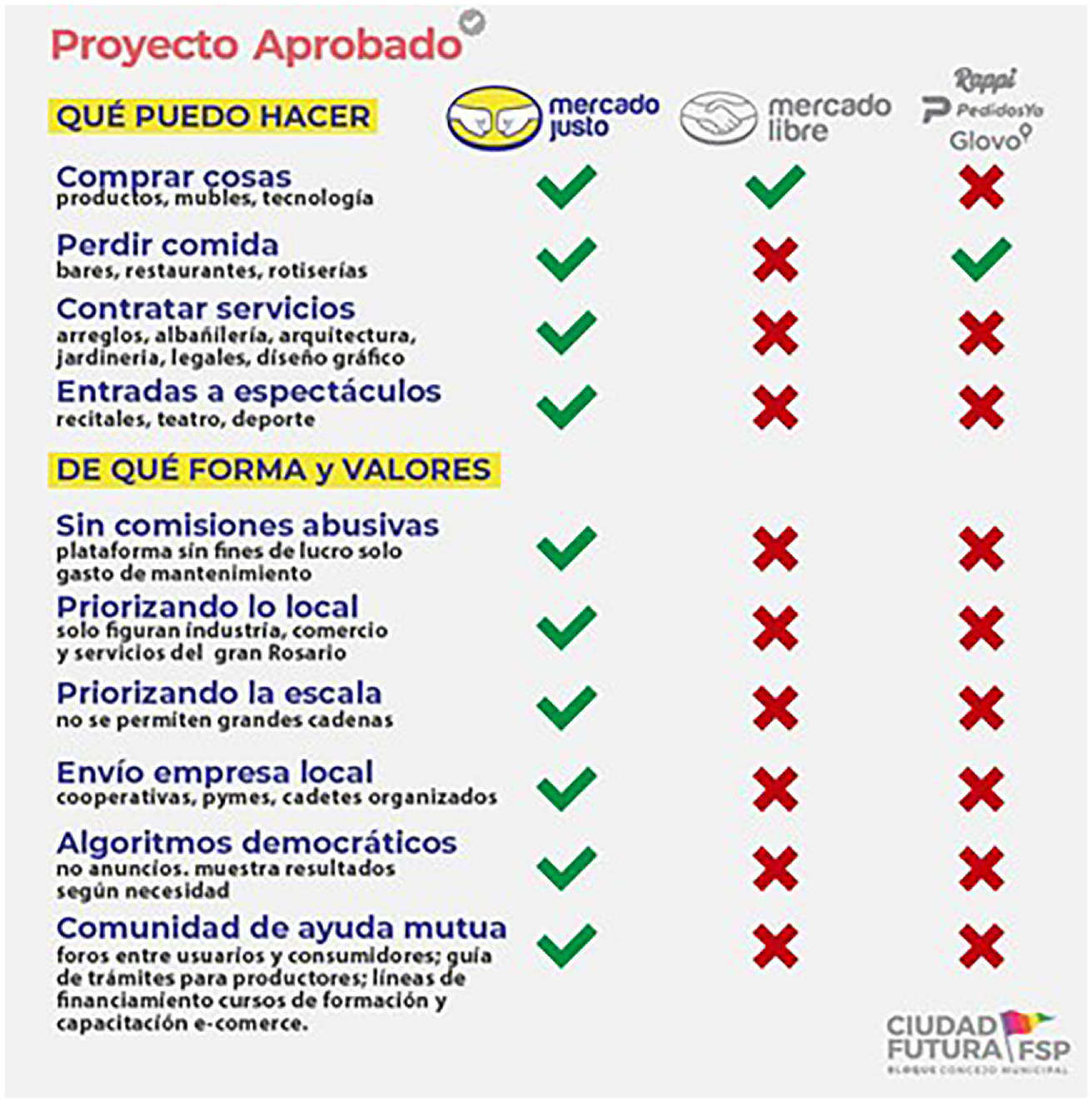
Ciudad Futura and FSP’s digital infrastructure for exchange, against Amazon’s model. No commissions, democratising algorithms, strengthening local economies.
When discussing the political vision that underpinned the proposal for Mercado Justo, one of the activists involved in the writing of the ordinance, stated: ‘[w]e wanted to dispute the territory occupied by Mercado Libre and other platforms’ (interview #6). Here, territory retains the theoretical and practical references that accompanied the movements’ struggles since their inception. For the members of Ciudad Futura, the territory is where late-capitalist conflicts are staged across Latin America. Where logics of extraction operate through processes of displacement and expulsion; where tactics of accumulation by dispossession obtain material and physical form. It is also from where resistances grow, where counter visions of other economies are prefigured. In the same way as a decade ago, when they were still named GIROS, they pushed for an ordinance preventing the new construction of gated communities in Rosario, illustrating how speculative real estate developments were accelerating fragmented and unequal forms of urbanisation, the Mercado Justo initiative recuperates the notion of territory and extends it to the virtual realm (Minuchin, 2016). The public platform challenges the commodification of logistics and utilises it to articulate terrains of cooperation, where connection, association and distribution are not a means of extracting and realising mercantile value, but part of a politics of urban inclusion. The commoning of logistics that underpins the design of the proposed public platform illustrates how a nescient municipalist agenda is bypassing Bookchin’s rigid separation between politics and logistics. The platform is presented as a strategic municipal infrastructure, one that could rewire the local economy, exposing the exploitive and extractive commercial and logistical costs engrained in the configuration of existing supply chains for basic and essential goods and services.
Counter-logistics of food circulation and popular infrastructures of production
As contagion spread, government agencies faced decades of accumulated infrastructural limitations or neglect. As the configuration of emergency logistical arrangements to distribute food and essential items to deprived communities stumbled with the lack of technical, human and financial resources, South America saw a surge of improvised solutions from below. In a context where food supply chains punish small producers by distancing them from distribution hubs and commercial outlets, different collectives sought to prefigure a counter-logistics of food distribution, questioning the concentration of private land, entangling small producers and cooperatives and connecting them directly to distribution networks. The food crisis served to expose the multiple stages of financial speculation that underpin the formation of supply chains: future commodity and currency prices create a separate domain of accumulation and have a direct impact on food availability. Novel financial instruments associated with agricultural production merge with 19th-century land rent dynamics, transfiguring the use value of food and decoupling grain and food supply chains from national circuits of consumption. In an attempt to position food as a public and common good, two different initiatives in Rosario sought to reconfigure the logistics of food.
Pueblo a Pueblo: Articulating cooperative networks of distribution
Pueblo a Pueblo, was born, within the movement of excluded workers (MTE), as a commercial initiative for small farmers. It was first launched at a national level in 2014. The Rosario branch began operating in 2016. As an organisation, it connects cooperatives, associations of family farmers, small producers and indigenous communities, with the objective of enhancing the quality and reach of environmentally conscious forms of agricultural production. Their aim is to establish what Gastón St Jean, the coordinator of Pueblo a Pueblo in Rosario, refers to as ‘a short chain’, creating direct relations between producers and consumers, protecting rights and living condition of the former. At the beginning, the network was made out of a few families. It now connects 150 family producers from rural areas close to Rosario.
Pueblo a Pueblo functions as a networked cooperative, where family farmers rotate to provide the fresh vegetables that will make up the commercialised boxes. The coordinator explains the logistics as follows: ‘[e]ach box contains seven seasonal vegetables; the farmers organise themselves in groups of seven and each of them provides one item for the box assembly. Every week or every 15 days, one group is in charge of preparing the boxes’ (interview #9). The products are then distributed through a group of volunteers based in Rosario. Details about the boxes circulate through social media networks between Tuesdays and Thursdays and orders are collected by using google online forms. Before the pandemic, distribution was organised on Saturdays, in four points across the city. Through this logistical set-up, cooperative rural forms of production, became entangled with ethical consumer practices. The organisation prefigured ways of materialising the reproduction of rural livelihoods by reshaping their association with processes of urban consumption. Pueblo a Pueblo breaks with the idea that there is only one possible way of sustaining the metabolic requirements of urban life. Through this proposed shortened network, producers receive 85% of the retail price: 10% is then left as a communal fund for all producers, and 5% is used for running and logistical costs. Pueblo a Pueblo now reaches peripheral and popular neighbourhoods in the city, establishing an infrastructure for cooperative and horizontal forms of food production and distribution.
The pandemic tested the scalability of the network and the resilience of their logistical arrangements – as they could no longer have customers come to the pick-up points. Mandatory confinement meant they had to develop a home-delivery system. Demand spiked. They jumped from commercialising 150 boxes every 15 days to distributing 1500 every week. They enlisted volunteers and made arrangements with transportation services that were left without work during lockdown. Pueblo a Pueblo was now reaching peripheral and poor neighbourhoods in the city, establishing an infrastructure for cooperative and horizontal forms of food production and distribution.
The initiatives developed by Pueblo a Pueblo, however limited in scope and scale, highlight how the premises that underpinned the logistical turn, particularly the blurring and integration of the circuits of production and distribution, have been appropriated beyond the domain of monopolistic operators. Cases like Pueblo a Pueblo expose how counter-logistics can promote a different absorption and distribution of surplus across supply chains and challenge the established geographies and practices of food consumption.
Public food company
The shortening of the supply chains, particularly regarding the production and distribution of food, is a shared political ambition among urban social movements interested in strengthening forms of popular economy. The economic downturn triggered by the pandemic positioned food procurement as a critical political concern: memories of riots and looting (Auyero and Morgan, 2007) demanded a set of radical responses to sustain and protect urban life.
In this context, members of Ciudad Futura and Patria Grande, proposed to dislocate established forms of food distribution, by problematising its configuration as a commodity, and introducing other actors in the productive process. Food is valorised as it circulates: fractioning, sorting, packaging, marketing. This movement disfigures its original use value and dissociates it from the territories and labour forces that produce it. The movements proposed treating food as a public good and articulating a counter logistics not driven by accumulation of surplus through distribution. Instead, they envision a model that consolidates networks of cooperation, transforming how land is produced and value (labour time) is recognised and protected. The initiative works on multiple scales. On one level, the organisations have presented in parliament a bill seeking to create a national network of Public Food Companies (see Figure 2): these horizontally run enterprises will distribute processing factories as connecting points between cooperative rural plots and deprived urban communities. As a means of prefiguring what that national network could look like, the movement has already started working in the first Public Food Company for Greater Rosario. Envisioned as a social enterprise, the company will not be administered by the municipality or the Provincial government. Instead, projecting the ideas of autonomy that underpinned much of the territorial experiences of social movements in South America (Dinerstein, 2014; Esteva, 2019), the activists involved in the project, speak of gestión social, a form of governance structure that allows social movements, cooperatives and actors directly involved in the production of goods and services to be involved in the administration of public enterprises. 9 The Public Food Company, according to one of the activists in charge of design and development, will ‘allow social organisations to run the factory, opening up job opportunities through the funds generated by fractioning, packaging and distributing food’.
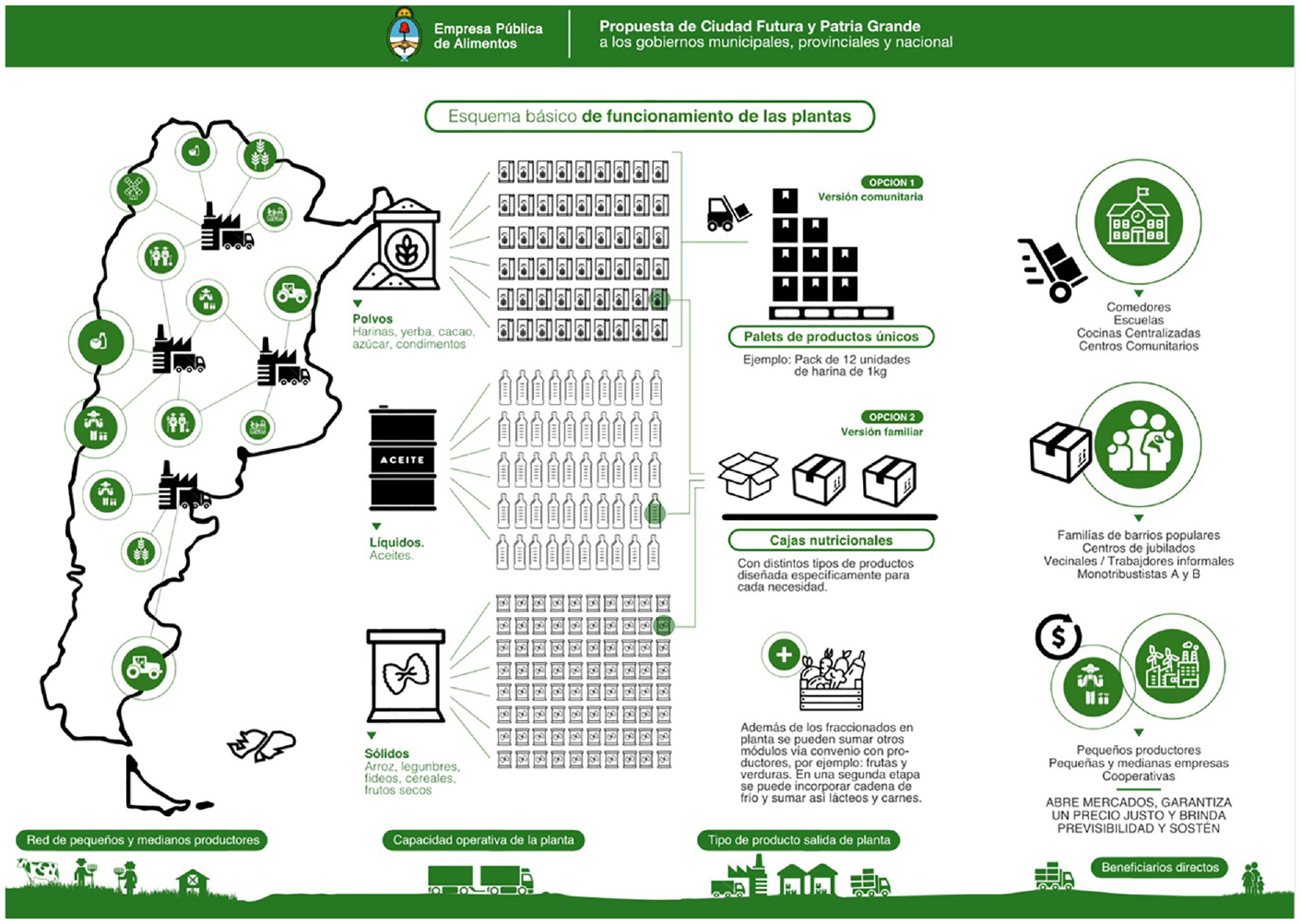
Public food companies in Argentina.
Presently, the municipality and the provincial state pay a high price to obtain suitable products and only a handful of companies qualify as providers, further enhancing monopolistic positions. The Public Food Company will not only shorten the supply chain, but redistribute the benefits to local producers, sustaining smaller enterprises, rescuing them from punitive rental structures. The counter-logistics proposed by the Public Food Company establishes, through cooperative associations, the territorial footprint of a new urban scale: it produces territory and introduces new forms of governing an expanded common. ‘We are always seeking ways of problematizing what we understand as public, a terrain where the State motorizes and finds allies in administering the commons’, states the document that socialises the initiative.
One of the persons in charge of designing the company details how they envision the process of production and distribution: ‘the factory will have two forms of outputs. One is based on pallets or large bags of 25 kg,. 10 These will be distributed to identified soup kitchens and institutions. A second form revolves around nutritional boxes. ‘With these we will not only reach state agencies, but also unions, pensioners and cooperatives’ (#interview 8). In terms of scale, they expect to be able to produce 25,000 nutritional boxes a month, roughly the figure of families who are expected to fall under the indigence line.
The making of a more egalitarian urban scale requires infrastructures and logistical arrangements that extend beyond the administrative remit and geographical boundaries of local governments. Initiatives like the Public Food Company introduce forms of producing territories that connect actors and practices that stretch across and beyond the cities’ administrative boundaries. They delineate a municipalist agenda, where the democratic control of logistical and infrastructural arrangements is practised through articulated platforms that extend and multiply the principles of gestión social.
Other municipalisms: Constructing counter-logistics
In a powerful summary of the political implications posed by the logistical revolution, Mezzadra and Nielson (2019: 275) state: ‘what is needed is a politics that is not centred on the state, but a politics that is capable of confronting … the extractive operations of capital at the level of their encroachment in the material fabrics of daily life’. This confrontation demands a programmatic agenda that extends beyond instances of critique and sabotage. Logistics not only optimises extractive patterns of accumulation. Primarily, it frames the way we organise the distribution and circulation of matter; it governs and standardises relations across geographical scales, and, through interfaces and the temporal management of practices, it produces space. Perhaps even more significantly, logistics has subsumed the quotidian processes of social organisation into the imperative of what Garcia Linera (2009) terms mercantile forms of value: the strict association of valorisation with market forces. Municipalism should confront the strict association of logistics with extractive and exploitative practices, by positioning at the heart of its economic and environmental agenda the political and emancipatory potential of counter-logistical arrangements.
As life in cities becomes increasingly dependent on the topological integration of infrastructural nodes, as logistical technologies and practices dictate quotidian rhythms, Bookchin’s rigid distinction between municipalism and logistics is no longer tenable. In a time when platforms and delivery services are materialising a form of just-in-time urbanism (Richardson, 2020), logistics cannot be reduced to a technical or administrative concern. The commons, a central feature of much of past and present municipalist theorisations (Thompson, 2021), cannot be configured as an exclusively physical domain, articulated through democratic and cooperative regulations. The networks, platforms and softwares that put people and matter in motion are constitutive of today’s urban commons. The municipalisation of logistical services and platforms opens a space of contestation and possibility.
The extension of extractivist models of accumulation and development that are shaping urban environments across Latin America cannot be confronted through a parochial or localist agenda. A municipalist politics for the region should focus on addressing the encroachment of logistical operations in everyday local practices, but with the capacity of interfering in the configuration of the supply chains that shape the metabolic functions of contemporary urban settings. If the confrontation against extractivist economic models is what explains the emergence of municipalist expressions in South America, counter-logistical operations characterise a new repertoire for collective action and the materialisation of a municipalist agenda.
The pandemic exposed how the reproduction of the urban is wired to exacerbate forms of inequality and extreme patterns of differentiation as access to infrastructural and logistical arrangements are not evenly distributed. But it also made visible an intricate and expansive network of popular organisations that are practising a different type of logistics (Gago, 2019). They shorten supply chains, they democratise technical knowledge and substitute mercantile processes of valorisation with cooperative economies. These often improvised, autonomous infrastructures contest discourses of efficiency, profitability and surplus, to construct and promote, through counter-logistical arrangements, a different territorial organisation structured around open and democratic supply chains that value environmental resources, cooperative economies and the sustainment of life.
The examined forms of counter-logistics proliferating in Rosario delimit and frame a territorial conflict that is going to shape urban politics in the 21st century. The disputes over how we govern and change the way we secure the production and circulation of matter will demand novel technologies of power and the recognition and visibility of other lives and bodies. In a region where interests behind infrastructural investments and the provision of basic services already dictate the margins of operability of institutional politics (Webber, 2017), municipalism should serve to contest what is deemed possible and articulate a radical agenda. Through counter-logistical initiatives it should propagate the discussion on the reach and purpose of public infrastructures, addressing the conduits and platforms for exchange, distribution and care as essential services for a life in common.
The sense of emergency introduced by the pandemic will eventually fade. Some of the tactical alterations made to cope with different degrees of enforced isolation will be reversed, but the conflicts regarding the ownership and organisation of supply chains, the logics of valorisation and accumulation that underpin them, will endure. The counter-logistics that emerged in Rosario and helped to prefigure other ways of imagining territories of care also sprang up and multiplied across Latin America. They illustrate and anticipate the crystallisation of supply chains as both sites of struggle and experimentation. They should also inform a new research agenda that connects critical logistical studies with radical municipalist projects.
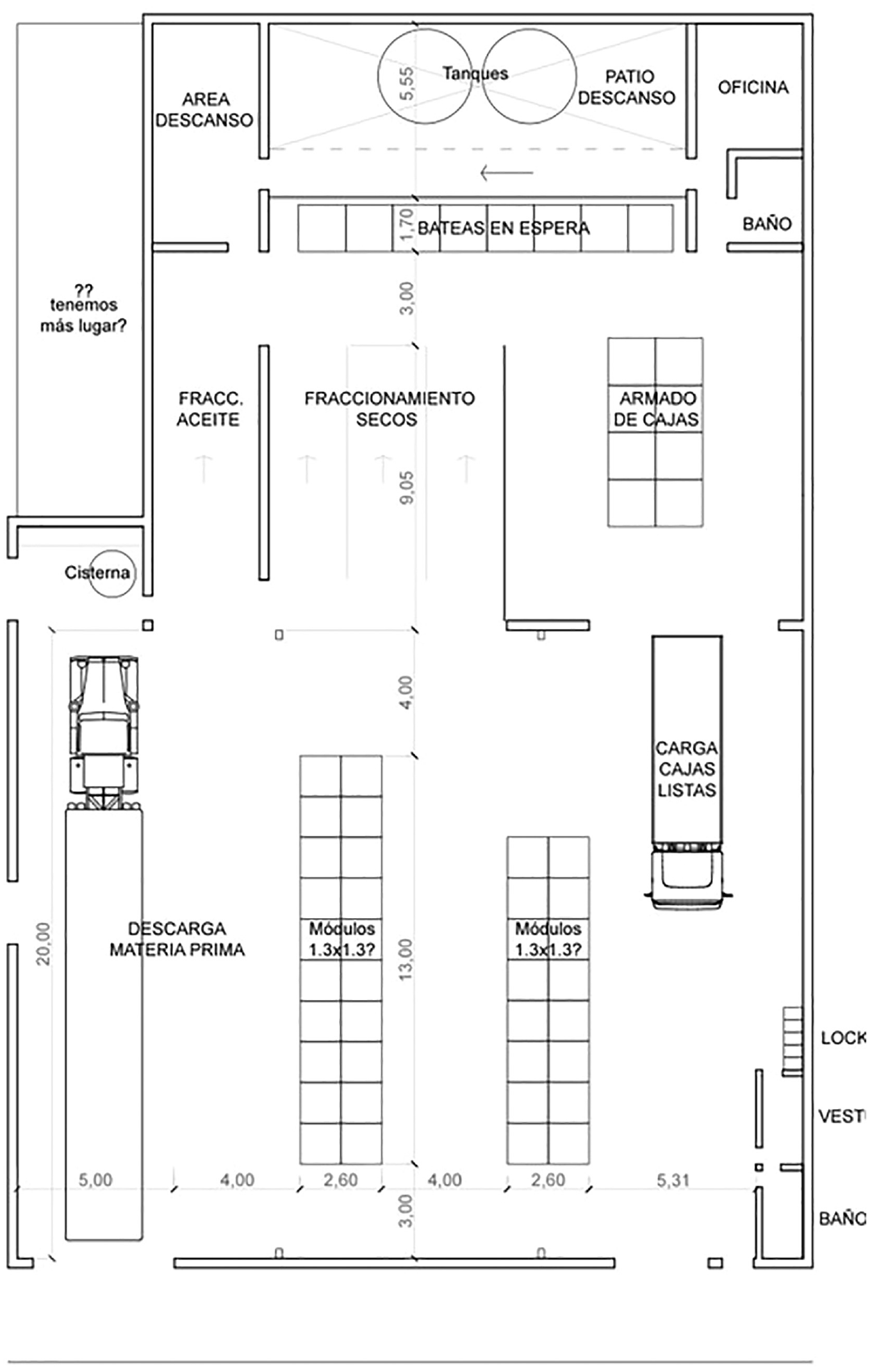
Draft layouts for the Public Food Company factory. Fractioning oils and dry products.
Footnotes
Acknowledgements
We would like to thank MINIM and the funders of the original report to allows us to extend our research. We would also like to extend our appreciation to the anonymous reviewers and editors for their comments and suggestions.
Funding
The author(s) disclosed receipt of the following financial support for the research, authorship, and/or publication of this article: This essay is based on a project commissioned by MINIM at the beginning of the pandemic in March 2020. In addition to the authors of this paper, the research team included scholars from the National University of Rosario (UNR): María Julia Bizzarri, Luciana Bertolaccini, María Victoria Gomez, Camila Panero. A shorter version of this paper was submitted as a report to the municipalist network, MINIM.
