




Abstract
How do residents on the socioeconomic margins of the city experience and perceive atmosphere? How does the concept of atmosphere change when we write it from a context of impoverished and stigmatized residents? Drawing on research in neighborhoods near Mumbai’s largest garbage ground, Deonar, we seek to advance a growing body of work on urban atmosphere. We examine how atmosphere operates materially and affectively through different and changing relations between air, waste, work, environment, and social conditions. The accounts from residents revolve around a set of recurring issues – health, smell, fire, and stagnant and contaminated water – through which different perceptions of atmosphere take shape. This reading both informs the pluralization and extension of understandings of atmosphere, from questions of health and bodily damage to social anxieties linked to stigma, and reveals atmosphere as an index of poverty and inequality. We argue for the value of a research focus on “perceptions of atmosphere” as part of a situated geography of atmosphere on the margins, and as a basis for understanding urban poverty, inequalities, and politics.
Introduction
How do vulnerable groups perceive and experience the encounter between air and the city? In this paper, we examine the experience and perception of air on the socioeconomic margins of Mumbai. We draw on narratives residents brought to living and working around the city’s largest garbage ground, Deonar, and consider what difference those accounts make for how we understand atmosphere in critical geographical and urban research. In doing so, we seek to show that attending to the lived experience of atmosphere on the urban margins is crucial for understanding urban poverty, inequality, and their reproduction.
Air and atmosphere are vital to the histories of the city and urbanization, and in recent years, from the climate crisis to the pandemic, that role has intensified. There is, for example, a long historical association between air, environment, health and the city which has resurfaced through the coronavirus pandemic, as it did with the SARS outbreak in 2003, the Ebola crisis, and the concerns with tuberculosis (TB) in many poorer urban areas. There are increasingly pervasive and urgent calls for more radical action on air pollution and climate change. It is in cities that these debates often come together, and there is a growing focus on urban air quality in public and political debate. Contemporary debates on air pollution in Indian cities, for example, have connected health and citizenship to economy and geopolitics ( Ghertner, 2020a, 2020b ; Negi, 2020). Indian cities have some of the worst air pollution in the world; air quality rankings often position Delhi, for instance, as one of the planet’s most severely polluted cities (IQ Air, 2019).
In Mumbai, the politics of air has a long history of concern and politicization, from colonial efforts to segregate urban space and institute public health regulations in response to fears over miasmatic air, to contemporary debates on rising air pollution, raging fires in the city’s garbage grounds, the appropriate disposal and treatment of waste, and the impact of climate change (Doshi, 2014). Municipal environment status reports have revealed dangerous levels of suspended particulate matter and nitrogen dioxide pollution in many parts of the city (Borwankar, 2019). The issue has sometimes captured public debate. In 2019, for example, non-governmental organizations (NGOs) Waatavaran Foundation and Jhatkaa, sought to monitor pollution using artificial lungs with high efficiency particulate air filters that mimic breathing. Within two weeks, the lungs had turned black. There has been an increase in civil society action on the environmental impacts of its current model of urbanization, demanding political accountability, cleaner air, a reduction in deforestation, and protection of the coast and waterways. Campaigns such as “Let me Breathe” and “Save the Aarey” forest have drawn attention to air pollution and forest restoration, and have gained momentum following the state’s felling of trees in the ecologically sensitive Aarey forest to make way for metro rail parking. The Aarey forest is the one of the last remaining substantial green spaces in Mumbai (Sen and Nagendra, 2019).
Here, the politics of air is highly unequal. Residents living and working around the Deonar garbage ground, as we will see, describe air as threatening and damaging, a hazard with its own urban micro-geographies, as a pervasive and inescapable force, and one that leaves the marginalized and poor at greater exposure than wealthier residents in other parts of the city. Air forms into atmosphere that is metabolized and lived, often generating anxiety and apprehension about health, work, education, and the future. Atmosphere emerges as a networked ecology, a set of changing and socially differentiated relations that connect different urban domains and sensations: smell, shame, air-borne disease, fire, water, waste, health, work, and education.
Our hope is to contribute to research in Geography and Urban Studies on atmosphere both by pluralizing and extending the intellectual and political terrain of how atmosphere is understood and researched, and by revealing how writing atmosphere from the context of marginal grounds demands conceptual and methodological reorientation. This involves foregrounding what residents’ perceptions tell us about the experience and inequalities of atmosphere, from perceived damage to the individual body to the socialization of atmosphere, including concerns with stigma for instance. Our attention to what we call “perceptions of atmosphere” derives from how marginalized residents themselves engage with air, and how that is shaped by material conditions of living. A focus on perceptions of atmosphere both brings together a network of concerns about poverty on the margins that simultaneously grounds the material and the affectual.
We focus on residents from one of the most impoverished margins of Mumbai, the M-East ward, based on interviews in late 2019 and early 2020. The research was conducted on neighborhoods around Deonar garbage ground, including Rafiq Nagar, Shivaji Nagar and Baiganwadi, Mandala, Jai Ambe Nagar and Sathe Nagar (see Figure 1). The selection of sites was based on secondary literature review, on previous research conducted in Rafiq Nagar, and on the basis of acquaintances established with local institutions in the area (McFarlane et al., 2014). Deonar’s surrounding areas suffer from a dual burden of the lowest Human Development Index and high levels of air pollution caused by heavy contaminating industries and toxic gases from the landfill (Mumbai Human Development Report, 2009). More than half of the residents in M-East, reports the Tata Institute of Social Sciences, have had heart disease, diabetes, respiratory problems including TB, and high blood pressure (Agarwal, 2019). The area has one of the highest rates of multi-drug resistant TB in the city. One NGO, Apnalaya, puts life expectancy in the area at a shocking 39 years old, compared with 73 for Maharashtra (the state of which Mumbai is the capital) more generally (Varshney, 2020).
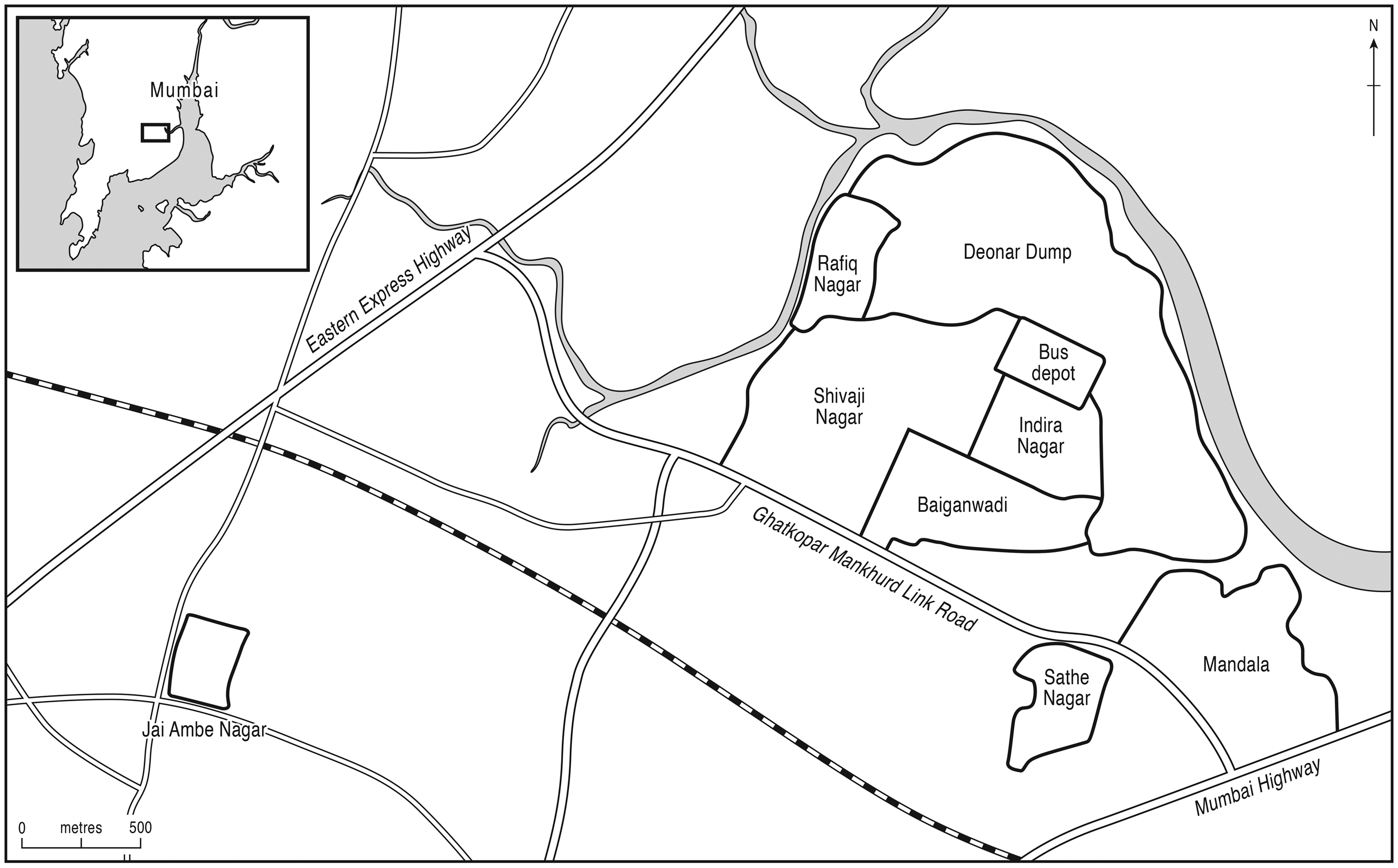
Map of the Deonar dumping ground and surrounding neighborhoods.
The area has a large Muslim population – up to 75% in some areas, such as Baiganwadi – which, given the histories of exploitation and disinvestment of Muslim groups in the city, has been a factor both in the denial of rights and provisions (Bhide and Solanki, 2016: 15). The histories of both systematic stigmatization and abandonment have left many Muslim residents without access to decent and reliable basic services and infrastructure, such as toilets, water, drains and electricity, and some work in unsafe conditions on the garbage ground by sorting, picking, collecting, and segregating waste and recyclables (Modak and Barnagarwala, 2016). As Nikhil Anand (2012) has argued, the relative absence of entitlements to the Muslim poor in the city is not a lack but an active denial, a form of abjection that pushes certain groups beyond the biopolitical care of the state.
There has been some important research in the neighborhoods around Deonar, particularly on health, housing, and basic infrastructure (see, for example, Biswas et al., 2020; Killekar and Doctor, 2019). There is work on the political geography of Shivaji Nagar and Baiganwadi that examines how the area was planned as a municipal resettlement site in the late 1970s and later largely neglected as an “unplanned” and “illegal slum” (see Bhide and Solanki, 2016; Björkman, 2014). Shivaji Nagar is predominantly comprised of Dalit families who come from villages in Maharashtra (Björkman, 2014: 12). Baiganwadi (or eggplant fields) is a former swamp where residents grew eggplants, which later became a resettlement area (Bhide and Solanki, 2016). While the BrihanMumbai Municipal Corporation (BMC) had provided water pipes and toilets, housing was largely auto-constructed and there is a long-standing history of resistance and campaigning for legal recognition and rights, often denied despite many residents having documentation of citizenship (Bhide and Solanki, 2016).
Mandala, another satellite neighborhood near Deonar where interviews were conducted, was auto-constructed mainly by people displaced from different parts of the city, and built through reclaiming land from mangroves (Bhide and Solanki, 2016). Residents here have regularly faced demolition and displacement drives by the BMC since the 1990s. Many residents who were interviewed worked in the Deonar garbage grounds as waste pickers and collectors. Rafiq Nagar is similarly regarded as “unplanned” by the municipal authority and the state (McFarlane et al., 2014). The area is separated into two parts – Part 1 is older and Part 2 is more recent and largely lacks the water, sanitation, and more durable housing constructions present, albeit in a patchwork and limited way, in the older area. “The narrow lanes of Rafiq Nagar are flanked by clogged drains and heaps of garbage”, writes Shraddha Agarwal (2019: no page), “the smell from the dumping ground hangs heavy in the air, and there are swarms of flies and mosquitoes that hover everywhere”. In Jai Ambe Nagar and Sathe Nagar, the two other neighborhoods included in the research, most residents belong to historically marginalized scheduled caste, Dalit and scheduled tribal communities who have migrated from different parts of Maharashtra and India.
Conducting interviews with residents in their native language, Hindi and Marathi, where it was spoken, helped to gather specific experiences and perceptions of atmosphere. We did not, however, set out to research urban atmosphere. Our concern was with the intersection of waste and urban density, and how residents experienced and perceived those relations. The work is part of a larger project that examines the politics and experience of density in cities globally, including several Asian cities (e.g., Chen et al., 2020). During the research conducted in Mumbai, residents were asked questions about their perceptions and experiences of living close to the city’s garbage grounds. Residents were asked about their perceptions and experiences of life in thick proximities of waste and dense living conditions. As discussions deepened, they repeatedly brought up concerns with air surrounding the garbage grounds – the sights, smells, tastes, affect, emotions, vulnerabilities, solidarities, and frustrations caught up with experiences of air.
While waste and density, and indeed densities of waste as they are worked and encountered by residents in daily life, remain important to the broader context of the arguments here, it is atmosphere that brings these into sharp focus in the narratives we received. On the one hand, this points to the broader importance in research of being able to shift focus as new themes become prominent, particularly when the focus is on understanding lifeworlds. On the other hand, it is a reminder that density is always already spilling into other concerns in the city – at one point a problem of managing volumes of waste in a busy neighborhood, at other moments a source of atmospheric pollution in the form of a wasteground and the gases generated around it (Chen et al., 2021; McFarlane, 2016, 2021). In asking people how densities of waste mattered to them, respondents performed this “spillover” tendency by networking density to work, health, living conditions, environment, and in particular atmosphere.
Next, we set out how our work contributes to research on urban atmosphere. We then anchor the empirical discussion around the central areas of concern that came up in the interviews, and here themes of health, smell, and water via the monsoon, were vital. In conclusion, we reflect both on what the interviewees saw as possible ways forward, and on the implications for research on urban atmosphere, and in particular for greater attention to situated atmospheres on the urban margins as a means of understanding atmosphere, urban experience and inequality.
Atmosphere: Air, waste and the city
There is a growing body of research on the role of atmosphere in the constitution, experience and politics of space in Geography and Urban Studies (Adey, 2014; Anderson, 2009; Engelmann, 2015; Gandy, 2017; Ghertner, 2020a; Jackson and Fannin, 2011; McCormack, 2009). “Air” and “atmosphere” are closely related but not equivalent phenomena. In the city, atmospheres emerge in the often unstable and localized inter-relations between the built environment, political economy, social conditions, bodies, and air (Edensor, 2012; Gissen, 2014). An urban atmosphere can be evoked and experienced differently in connection to distinctive sites, or in the larger spatial imagination of cities or regions (Gandy, 2017). As Matthew Gandy (2017) has argued, urban atmosphere can take the form of a prevailing mood of a place or situation. For instance, residents who live near the garbage ground often used the terms mahaul to describe how atmosphere impacts their attachment to place. As Asher Ghertner (2020a: 16) writes, “the Urdu–Hindi word mahaul, whose Arabic roots maa (what/that) and haul (around/about) can also mean ambience, condition, or environment”, and signals a particular cultural-historical contextualization of atmosphere.
Atmosphere, as Tim Ingold (2012: 75) writes, is also a “gaseous envelope” that fundamentally impacts humans as “living, breathing beings”. It can be understood as both meteorological and affective, both a set of environmental conditions and a felt mood (McCormack, 2009). Air is a material presence and flow, variously hanging, moving, inhaled, and changing, and is a vital component of atmosphere, but atmosphere is not formed by air alone. Instead, atmosphere emerges in the changing relations between air, locale, economic activity, governance systems, environmental conditions, and social relations. We think of atmospheres as milieus that can sustain or inhibit life in the city (Adey, 2014). While out focus is less on atmosphere as mood and more on how people experience and perceive its material configuration, as we shall see mood cannot be straightforwardly separated out in the accounts residents gave. By “material configuration” we have in mind a tangible perception of atmosphere as seeping into the body, as being toxic and contaminating, and as forged through the garbage ground and the activities around it while also being exacerbated at particular times – during the monsoon, or through the localized outbreaks of fires, for instance. In the accounts people gave, these configurations become layered into the question of “mood” through ideas of shame, stigma, worry and anxiety, and so on.
Urban atmospheres are shaped in the dynamic encounters between air and urbanization. The politics of air have been historically entangled with the very production of urban space, including changing understandings of illness and disease that often connected air, “slums” and what were seen as healthier, green spaces (Joyce, 2002). In the twentieth century, postwar city construction booms were in part responses to concerns about air pollution and public health (Banham, 1984). Patterns of urbanization and densification (and sometimes violent de-densification) have been caught up with debates on the experience and politics of air, while concentrated zones of industrial pollution have been enrolled in different concerns about the nature of atmosphere (Adey, 2014).
Urban air has become an increasingly powerful expression of inequality, and is an area of growing international concern. The United Nations (2019) estimate that 9 in 10 people in cities breathe air that does not meet the World Health Organization’s air quality guidelines. Low-income neighborhoods in Mumbai are often more exposed than other areas to polluting air in combinations of “heat-trapping particulates” that localize heat waves produced through industry, traffic, construction, and waste, and which aggravate asthma, lung problems, and TB (Adey, 2013: 300; and see Boo, 2012). At the same time, such neighborhoods are often neglected or ignored by the state, meaning that their residents “become responsible for the atmospheres in which they subsist and yet over which they have little control” (Adey, 2013: 302). Veron (2006) examines how superficial efforts by elites to “clean up” Delhi, including its urban air, amounted to a revanchist agenda of expelling the city’s poor (and see Baviskar, 2003; Bhan, 2016; Ghertner, 2015).
Ghertner (2020a, 2020b) has proposed a focus on “postcolonial atmospheres”, including a genealogy of atmospheric governance to explain the spatial, political and epistemological basis for the present entanglements between bodies, inequalities, infrastructure, and air. As Ghertner (2020a) shows, the current crisis of air pollution in India is shaped by colonial histories that depict body parts and characteristics, including lungs, as “deficient” and threatening, and which today often takes shape through the promise of socially and economically differentiated “privatized air” – air purifiers, masks, and other arrangements in the home, office or car – rather than a structural focus on remaking urban air for all. Vast numbers of vulnerable and poor populations are left out of the formal enumeration of health and pollution impact analyses, while the middle classes and elites opt for increasingly expensive and marketized artificially purified and conditioned air (Bryant, 1998; Ghertner, 2020b: 136). This results in a “mapping of class-based segregation onto atmospheric space”, sometimes accompanied by misdirected government advice to stay indoors or to ban fireworks during Diwali, that ignores the fact that the majority of lower-income and lower-caste homes in urban India “are not air-sealed domes immunologically sequestered from public air” (Ghertner, 2020a: 15).
Tracking the diffusion of debates on Indian citizenship from the individual to the atmospheric realm, Ghertner (2020b) shows how the judicial system has become embroiled in legal pronouncements on bodies – lungs, fetuses, breathing capacity, etc. – as well as population categories like the elderly and infants. This alters, he suggests, the governance of life itself, by drawing measures of traffic, dust, weather, and air quality into the politics of the city and citizenship, and here state responses have often been to disproportionately curtail pollution associated with poorer livelihoods, including “trash burning, waste picking, coal burning for winter heat, and industrial employment” (Ghertner, 2020b: 152). This political terrain is further complicated by the fact that air is inherently diffuse, and identifying its impact can be a complex process of linking the ether and bodies (Negi, 2020). Government authorities regularly shift culpability around a host of possible causes of air pollution, from regional crop burning and vehicular emissions, to construction activities or small-scale manufacturing (Ghertner, 2020b). Meanwhile, premature deaths from air pollution in India are estimated to have increased six-fold over the past two decades, yet policy makers have failed to adequately respond to an increasing research base (Arlene, 2013; Negi, 2020).
A concern with air has also emerged in other areas of research. In urban political ecology, for example, there is a body of work on urban metabolisms of water, waste, energy, and resources which has sometimes examined air pollution (Gandy, 2017; Keil, 2020; Lawhon et al., 2014; Ranganathan, 2015). This includes research on the political ecology of disease, where air features in the form of respiratory transmission, including on SARS and COVID-19 (Ali and Keil, 2008; Connolly et al., 2020). There is a growing concern with air and climate change in cities, including work on technological experiments to reduce carbon or engineer greener cleaner spaces, and the politics and economies that drive that (Bulkeley, 2015; Marvin, 2021). A distinct but related research area on environmental justice has examined the unjust distribution of resources and hazards, including work on how air pollution is differentiated by class, race and ethnicity (Ranganathan and Balazs, 2015; Walker and Bulkeley, 2006; Williams and Mawdsley, 2006).
Against this intellectual backdrop, our hope is to contribute to what Peter Adey (2013: 291) calls a “research agenda on mega-urban airs” (and see Choy, 2012). This agenda now extends across a number of intersecting concerns: with how air pollution is reformulating urban governance (Bulkeley, 2015; Gandy, 2017; Ghertner, 2020a); how pollutants are managed and felt through social difference; how inequalities are expressed in efforts to securitize the city-as-volume, or the secessionist spaces in which wealthier groups seek out cleaner air at home, work, leisure, or on the move (Graham, 2016); how urban citizenship is being reframed as an atmospheric problem (Ghertner, 2020b); or with how the politics of air speculation in housing and commercial development connects to enclosed atmospheres and aesthetics organized in the verticality of the city (Chen, 2020; Stein, 2019).
Our approach is partly inspired by Sasha Engelmann’s (2015: 432) description of an “air poetics” – “a mode of attentiveness to the deeply affective and personal resonance of airy matters” – focusing on how air is perceived and felt, and the implications for urban living. The accounts residents gave speak to both the perceived damage of air to the body and general health, as well as to the ways in which atmosphere becomes socialized, for instance in concerns around smell from the wasteground and its impact on family and social relations (such as stigma, anxiety, or embarrassment connected to visits from relatives). Indeed, the accounts trouble at the analytical distinction between material and affective atmosphere. This not only demands bringing these together but, as such, points to the political stakes of a focus on perceptions of atmosphere for understanding urban poverty and inequality.
Our approach is different from the literatures above because of our focus on context and difference on the urban margins, and how they enter into the making of “perceptions of atmosphere”. This contribution is at once conceptual and methodological. Conceptually, a key challenge for research on atmosphere is understanding the specificity of context – the ways in which atmosphere is experienced and understood in particular situations – and how that relates to the larger problem of difference. While research on, for example, affective atmosphere has approached this challenge through a focus on how people become differently “attuned” – attached, detached, moved by, repelled from, and so on (e.g., Anderson, 2009, 2016 ; Stewart, 2011) – to atmosphere at different moments and places, our focus pushes this agenda in a different direction. Our approach is to emphasize difference not just as a relation between people but as a location on the urban social and spatial margins of the city. This includes but goes beyond the question of multiple orientations to atmosphere that different people might express. Specifically, attending to perceptions of atmosphere on the margins reveals, we will show, both atmosphere as an index of poverty and inequality, and atmosphere as continually reformulated matter of concern, changing with circumstances.
This approach is part of a larger postcolonial imperative in Geography and Urban Studies to build a more diverse archive of understandings of atmosphere in the city, but it is also a political demand for urban research to elucidate the conditions of growing global inequalities in an increasingly fragmented urban world. Attending to perceptions of atmosphere at the margins is an important step in shaping a conception of atmosphere that better reflects a global urban moment in which cities are increasingly carved into evermore unequal, siphoned off, customized, and neglected atmospheric conditions (Marvin, 2021). A focus on perceptions of atmosphere in different urban contexts will be an increasingly relevant entry point to understanding the larger experience and condition of urbanism and cities.
One contribution from our methodological approach is that a useful way to understand perceptions of atmosphere is to construct a focus on residential narratives. An important reflection here is the question of methodological diversity as a means to understanding perception. As circumstances in the neighborhoods changed – from say, a fire outbreak to a monsoon downpour – so too did the experiential and political stakes of atmosphere. The interviews with residents were supplemented by observation, documentary research, and interviews with other actors – NGOs, for instance – but future research might usefully experiment with a wider range of methods for understanding perceptions of atmosphere. Here, walk-along methods, a focus on what Gough and Langevang (2016) call “tactics of social navigation”, mapping methods, participant photography, participatory workshops, and so on, could all broaden the scope for efforts to understand difference and context in atmosphere (Middleton, 2021).
For our part, it was attending to differences in gender, age, religion, caste, and location within the neighborhoods, in the approach to interviews, which formed the starting point for how to research perception and experience. This allowed us to investigate the perceptual and experiential micro-geographies of atmosphere, and how these are entangled in the lives of waste workers, health, gender, religion, caste, and so on, over time. A focus on perceptions of atmosphere is a useful way to bring a range of urban experience and inequality into a single research frame, given that atmosphere is so fundamental to urban living and working. The accounts below connect a series of domains that are not often linked in research on atmosphere, including health, smell, fire, and stagnant and contaminated water. These connections point to a larger experience of struggle in the city and provide insight into how atmosphere becomes a conduit through which urban life is reproduced.
The work took place around Deonar, the city’s largest garbage site, where 9000 metric tonnes of waste arrive each day, and where glass, plastic, metals, and more are segregated and redistributed through arrangements of private companies, gangs, and municipal officials (Varshney, 2020). The vast majority of the estimated 1.5 to 4 million waste pickers in India are lower caste women. Children and men also work at the ground at Deonar (Dandapani, 2017). The garbage ground was said to be “exhausted” in 2016, but the city’s High Court allowed the municipality to continue using it while alternative sites were being developed, and with a view to a new waste-to-energy plant in the area due in 2023. Many residents doubt the ground will ever close – “we have been hearing this since we were young”, said one – and the constant uncertainty is another cloud hanging over precarious lives.
The site is a focal point of the intensifying presence of urban air in the city’s politics. In 2015–16, two large fires almost destroyed the garbage ground, churning out enormous quantities of toxic smoke and leaving a thick fog across swathes of the east of the city. The voices in the media demanding that the garbage ground be shut down intensified, and residents led protests through the city, raising concerns over the health of their children and the seeming inability of the municipality to act. While the smoke from the fires received attention from international and national media, poorer residents in the surrounding areas were forced to deal with the aftermath and polluted air, metabolizing toxic smoke from the fires. The System of Air Quality and Weather Forecasting Research, a central government-led initiative, reported that the fires, toxic fumes, and poor waste management techniques at Deonar have caused acute respiratory problems in surrounding areas (Pinto, 2015).
Here, atmosphere is shaped by a political economy of urbanization that pushes precarious workers to the margins, and a cultural politics of power, gender, caste, religion, and stigmatization. People were taken from the inner city and “dumped here on the dumping ground”, said Arun Kumar, from the NGO Apnalaya – this is “cleansing the city”, and it is a politics that combines class, religion, and caste: “85% are Muslim, the remaining are Dalits”. The politics of air is as much an experience of displacement as it is of working and living in place. At the same time, the garbage ground has become more strictly surveilled and controlled, and in ways that have ushered in yet new hazards for many workers. Following the fires, the BMC and the Mumbai Police installed security cameras at the entrance gates, and only those with valid identity cards have permission to enter. The gates of the garbage ground are staffed with security guards. Residents say that it has become tougher for them to enter. In the next section, we describe the key themes that emerged in the interviews and which together, in different ways for different people, composed a perception of a toxic atmosphere.
These circumstances repeat in other parts of urban India (Anand, 2017; Desai et al., 2015; Soundararajan, 2014). De Bercegol and Gowda (2020), for example, argue that the Delhi government’s plan to contract private operators to launch new waste incineration plants has exacerbated the city’s air pollution problem and will worsen people’s health, especially if the network of waste-pickers and recyclers is eliminated. Gidwani (2015: 576) has examined how waste workers in Delhi perform vital roles in the city’s “infra-economy”, an economy “that is denied recognition by state and civil society (and is ‘seen’ only at moments of crisis, as an object of condemnation or reform)” but which nonetheless “repairs and renews the city continuously”. Schindler et al. (2012) show that in addition to being excluded from the urban planning process, many lower-income residents whose livelihood is dependent on waste work end up dispossessed and evicted from the city. The waste–atmosphere relation is and will continue to be a vital domain of urban life, inequality and politics in India and beyond.
Breathing, metabolizing, perceiving
There was a repeated sense amongst residents around Deonar of air surfacing as poor health, showing up in particular on the skin and in how people breathe. Razia, a resident in Janata Nagar, complained that the “air here is filthy” and felt sure it was the cause of a litany of health issues: “When the stench is so strong and the air is polluted, of course everyone will have breathing issues … urinary issues, liver disease … health problems are never ending”. The air, she went on, is suffocating: it “feels like one cannot breathe”. Connecting air and health to sickness, Mumtaz said: “Every second household has asthma, TB, pneumonia or other respiratory disease, skin diseases”, adding that her daughter, Nazma, has “had kidney issues several times, she is always fatigued”, while her youngest child “has constant skin infections”. Zarina and Mohammed Furuq, a married couple who are waste workers trying to support four children, spoke of how working on the garbage ground marks the body, in cracked and blistered hands, as well as the lungs and skin. Sometimes Faruq can’t breathe well at night, and is troubled by itching skin.
While air quality cannot be identified as the cause of these concerns, the point here is to underline how it has come to be perceived. Air here is described as a material force pressing in on the body, getting under the skin and into the lungs, to which anxiety and suffering are repeatedly attached. In these accounts, we can say that residents move from air in general to atmosphere in particular, for example by connecting air quality to other local conditions that were seen as interacting with the air, especially waste and bodies.
Shabana, for example, a waste worker and community organizer in Janata Nagar, explained how “gandagi” – filth and waste – connect to air to form toxic atmospheres that take shape on the body, particularly as respiratory and skin complaints. Kajal, a teacher, identified “the big open sewer [that] passes through here … there are a lot of sanitation issues due to that – lots of diseases, mosquitoes”. Mina Tai, a waste worker in Annabhai Sathe Nagar, said she felt it was a local medical incinerator and not the garbage ground that generates the most health consequences: “Since the medical incinerator has been placed, and they burn and handle the bio-medical waste badly, our health has been impacted”. For Shaikh Rahman, who was especially concerned about children involved in picking and sorting medical waste, the incinerator “has made our life hell”. Residents’ accounts repeatedly portray air and waste as becoming embodied and metabolized, leaving a mark on the body (the skin for instance), in the body, and in bodily processes (breathing, illness, disease, etc.).
Residents are keenly aware of the inequalities at play. In the larger politics of atmospheres in Mumbai, there is a set of environmental injustices at work around who gets to be exposed to hazards of urban waste in where they live and work, and who doesn’t, and around who gets to live where in the city and on what terms. Environmental justice scholarship has examined this in relation to, for example, the locating of industrial contaminants and placing of urban waste and other hazardous materials, or in the unequal provision of green space or decent housing and infrastructure, in ways that exacerbate inequalities in class, race, ethnicity, gender, and place (Ranganathan and Balazs, 2015; Walker and Bulkeley, 2006). For example, the Smoke Affected Residents Forum, based in a middle-income housing society in Chembur, is appealing to the city High Court to close the Deonar garbage grounds. For some of these voices, Chembur – “Gas Chembur” – is a victim of fires on the garbage ground that are causing health and ecological problems, yet in these public debates the concerns of the residents who live and work at Deonar often fall from view (Menon, 2005).
The first characterization of atmosphere from residents, then, was its formation as a health threat in the relations between air and waste. What was striking in many of these accounts was the prominent attention given to smell. Smell was identified as a stubborn sensation that connected working in the garbage ground and living in the neighborhood. Scent here is a particular quality of the atmospheric surrounds, one that is both pervasive but multiple in the relations and concerns it is connected to. “You notice there is a distinct smell here that is nowhere else in the city,” said Mumtaz, a waste worker from Baiganwadi. “We come home take a good shower and after cleaning one feels like eating – sometimes when we cook dry fish the stench the smell reminds us of the dumping”. Her daughter, Nazma, also a waster worker, added: “I still cannot stand it; I wrap my scarf around my face and go each time, but I feel like the smell follows me”.
Smell was described variously as “a headache”, a source of exhaustion – “from morning to night [it] doesn’t leave us”, said Zarina, a waste picker in Rafiq Nagar – and exacerbated at particular spaces and times. Ramesh, for instance, a waste worker in Annabhai Sathe Nagar, said that while the smell is “everywhere,” some sites are particularly active causes: Actually, the problem is the katalghar [slaughterhouse] … now they try to dig and bury the waste first. Also, seafood waste leaves a terrible smell, as most of it is wet waste, so some of us try to dry out the waste first and then dump it in big sacks, but it is not possible to do that always.
Beyond the locality, some mapped smell to their wider experience of moving around Mumbai, pointing to a comparative geography of olfactory atmospheres. Zarina explained that “when I go to Mumbai” – and here the atmospheric quality of the neighborhood was seen as apart from the city – “it’s like I am breathing a fresh air. The smell of salty sea air is different from me, makes me feel like there is a chance out of this life.” Here, the promise of a different kind of atmosphere is connected to the city “out there”.
The descriptions of smell as an atmospheric quality of space-time often connected the material and the affective. Some respondents, for example, connected smell to social and familial shame. Fatima, a waste picker in Rafiq Nagar, commented: “Now we are quite used to it, but we cannot invite relatives or friends. When they come they always complain that we don’t like to come visit you because the smells are strong. So what do we do?” Razia, from Janata Nagar, described how “guests used to hate to come to visit us here, saying, ‘are you frying dead fish here? Why does it always smell so bad?’” Noorjahan, an older woman also living in Janata Nagar, echoed this: We are very embarrassed to call them [relatives] here and torture them. Why will they leave the fresh air of the village to come to this stench … Every time someone comes into dumping they go home and take a good shower, as they carry home the stench of this place.
For Sameer, an auto-rickshaw driver and Baiganwadi resident, smell not only hovers around the neighborhood, but also it can kill. The smell, he insisted, “slowly kills people in the basti [neighbourhood] … [It] is killing you from within”. “The dumping”, said Fuzia, a waste worker in Janata Nagar, has turned the area into a “gas chamber”. “We are breathing poisonous air every day”, added Mr. Rahman, “and we know that, but we have to hold ourselves together. This is the work we do, handle the waste and shit of Mumbai – and they want us to leave Mumbai”. The garbage ground, he continued, is “like a big gas chamber, and one day if it explodes, it will take us all in flames”. The striking references here to a “gas chamber”, which recurs in other Indian cities (see Ghertner, 2020b), differs from the European historical context of the Holocaust, and instead refers to the idea of being enclosed – whether you are in the house or in the local environs – with toxic gases.
Across these accounts, the olfactory register of atmosphere is variously understood as draining, threatening, and – through shame and stigma – isolating. It is both individualized and sociospatial, connected to the locale and the wider city. If health and smell are key concerns in how residents perceive atmosphere, anxieties were also attached to fire, but here the issue is as much about the consequences of fire as the specific threat of fire itself. The large fires in 2015 discussed earlier had a particular impact on atmospheric politics and its consequences. The smoke engulfed large parts in the north east of the city and led to city wide protests – some to improve the lives of those working and living around the ground, others, such as the Chembur forum, campaigning for the ground to be closed – and weeks of media and political debate. All kinds of stories circulate about the fires and their causes, often connected to longer histories of urban politics. For Noorjahan, 60-years old and a former waste worker living in Janata Nagar, the fire “was a planned attack by the BMC and the government who came to demolish our houses”. The fire became an excuse for removing the most vulnerable, she argued. She cried while she recalled the events: “They sent three hundred police officers to destroy our lives. They didn’t even give us 24-hours notice. They just broke into the neighborhood with bulldozers, everything was gone for us, everything”.
The politics of atmosphere here hinges on how causality is formulated in relation to flammability. For the state, flammability is the result of the residents themselves. It is them, and their forms of work, that create fire risks, and so it is they who need to be removed. Residents, on the other hand, attribute causality to the gases that the garbage ecology itself produces. They are acutely aware of how the state has aligned blame in an opportunistic way with them rather than the material hazards of place, poverty, and labor. Sheila, a waste worker in Annabhai Sathe Nagar, believed that the fire started “because of the gas” on the garbage ground, arguing the combustible materials that sometimes generate small fires and mean there is always the risk of a larger fire. The fires, she argued, tightened restrictions on their capacity to work at the garbage ground, which in turn had a host of negative health and social consequences: Since the fires especially [over] the last four years, the BMC has become very strict. They issued a case against the workers saying that the fire was caused by the people of the neighborhood and they shouldn’t be given open entry, so we have been under a lot of pressure since then … We try to go everyday so that we have food to feed our children. But since the surveillance has increased, life has become tough for us, because our work opportunities have decreased a lot. There are a lot of people who pulled their kids from schools because they couldn’t afford it anymore. People barely had food … education was not their priority. [They] erected walls and put security cameras. Earlier there was nothing as such, one could go from anywhere … and there were fires before too, this was not a new phenomenon … [and] there were heightened police raids in the locality. We couldn’t work and live in peace we were constantly under threat, and a lot of people lost their livelihoods.
Finally, in addition to health, smell, and fire, another key concern in people’s experience and perception of atmosphere was in connection to water, specifically the stagnant and contaminated waters that result from the monsoon. Many respondents spoke about the role of the monsoon in aggravating atmospheric hazards by making airborne infections more prevalent. Pools of water and waste, particularly common in dense neighborhoods lacking adequate drainage, generate higher numbers of mosquitoes. “Malaria and dengue are common”, said Mumtaz, a waste worker from Baiganwadi. Iqbal, a waste picker in Rafiq Nagar, said that “there is a terrible problem of mosquitoes here”, while Zarina added that malaria and dengue “effects almost every second kid during monsoons”. On the one hand, Zarina pointed out that there is “no water” – i.e., not enough clean piped water – but there is also too much monsoon water, generating localized flows that mean “shit is everywhere”: “Who would like to begin their day with such a sight?”
Shabana, from Janata Nagar, put it simply: “For four months our life is hell”. “Outside the house there is trash and the kids play there all day, and come back home and bring trash with them”, she said, adding that wastewater flows into her house. These concerns do not, of course, pertain to atmosphere alone, but they are relevant here because they were seen to be important in the exacerbation of atmospheric problems. Mohammed, a waste collector and transporter who sells waste to the kabadiwala (recycler), expressed his concern that TB, skin problems, eye problems, and more, worsen in the monsoon. Residents do what they can to maintain their living environments during the monsoon. “I would say that we try our best to keep our environment clean,” said Fuzia, a waste worker from Janata Nagar, “if you go to any house here you will not find it dirty”. Fatima complained that the BMC does not conduct “rounds of fumigation”, adding that they should target “the gutters and sewers”. Instead, air, water, and waste together metabolize disease vectors and intensify health inequalities in the city, and the monsoon becomes another struggle in the changing configurations of atmosphere over time, and in connection to health, smell, and fire. The presence of the monsoon in the accounts residents gave connects atmosphere to the seasonal and to another elemental force, this time not fire but water. Perceptions of atmosphere become shaped as much by water and insects as “air” itself. In his work on the monsoon’s “ontological stickiness”, Harshvardhan Bhat (2021: 17) examines the “inseparable bonds” that exist between air and other forces and forms of life, from mosquitoes, animals and plants, to water, wind and particulates.
In these accounts, atmosphere emerges both as a singular problem – air and waste combining as an ever-present toxic force that seeps into bodies incrementally over time, showing up in all kinds of health symptoms – and a dynamic one, differently impacting particular bodies, lives, and socialities over time and space, from work and domestic life to schooling and relations with neighbors or family members near and far. Atmosphere intensifies at particular points, for example at times of individual illness or during the monsoon or in connection to fires or sites like the medical incinerator. It is both individualized and socialized, combining with local environmental conditions – waste dumps, drainage pipes, stagnant water, smoke, and more – but seen to be caught up in the wider experience of living on the margins, whether through a sense of shame and stigma, or as people compare atmosphere at different points in the city as they move around. For the residents, atmosphere changes over time, connecting with the elemental – fire, later water, as well as air – and the seasonal, such as in the monsoon, as well as opportunistic drives of city demolition and regulation. In the process, atmosphere changes in its experiential and political register. This matters in conceptual and methodological terms too, because it suggests that our understanding of atmosphere becomes disrupted and reoriented when we see how it becomes temporally and spatially differentiated. Atmosphere becomes a part of world making, unmaking, and remaking (Bhat, 2021). While the story of atmosphere told here is specific to a place and a particular group of respondents, the findings call for greater attention to perceptions of atmosphere on the urban margins as a means for generating insight into urban everyday life, struggle, and inequality.
Conclusion
We are working in garbage, living in garbage, and we will die in garbage – the state simply won't care. (Jarina)
We are on our own here. (Mohammed)
Are the concerns and struggles of marginalized workers and residents being heard? The answer from our research around Deonar is clearly negative. For example, one immediate issue that emerged in discussions is protective equipment for those working on the ground, including masks for reducing exposure to gases. Laxmi, a waste worker living in Jai Ambe Nagar, described how she cleans drains and gutters in Govandi with “just our ordinary clothes”. Kajal, a local teacher, observed a gendered politics at work: “Sometimes men are given uniforms but there is nothing for women”. What complicates this seemingly straightforward issue of basic safety is that few have much faith that the municipality, let alone private contractors, would listen to pleas for adequate equipment. Rajamma, a waste worker in Jai Ambe Nagar, talked about how she and others sought to become designated permanent workers with the BMC, which may have meant improved safety provisions, but that their application – which cost Rs. 2000 – was ignored. If you want your voice heard at all, Akthari said, you need to have good contacts with the municipal corporator, because he or she only looks after his or her own – including their own pockets. There is a “delicate balance”, she continued, for politics: if you push some things too much there could be repercussions. Iqbal put it this way: “Where will we go to complain – the police station? They will handcuff us for no good reason.”
But if the state is not seen, then, as a route to atmospheric improvement, it’s important to point out that neither is it seen as a monolithic entity. For example, local Samajwadi Party municipal councilor Rukhsana Siddiqui has organized protests on living and working conditions in the area, and reflected on atmospheric conditions in light of the COVID-19 pandemic: “People are dying here of respiratory issues. In fact, COVID-19 spread so much in this area because people’s immunity has reduced owing to years of exposure to smoke” – there had been 316 deaths related to COVID-19 by September 2020 (Deshpande, 2020: no page). COVID-19 led to an increase in the burning of masks and personal protective equipment at the garbage ground, which intensified concerns amongst residents. One resident, Faiyaz Alam, said, “since the COVID-19 outbreak, smoke has increased 10 times what was emanated earlier” (Deshpande, 2020: no page).
The work of some city and state officials and political parties notwithstanding, the more hopeful stories form residents were attached not to the state but to civil society groups and social movements. In Janata Nagar, many of the different lanes are part of co-operative societies. Apnalaya, a local NGO, has helped some residents gain identity cards. Health NGOs have helped to identify outbreaks and diagnoses of TB and other disease and illness. Of course, the impact of civil society is necessarily limited and cannot substitute for improved working and living conditions, or for quality health care. Local hospitals are too expensive or overburdened. Faruq, a waste worker in Baiganwadi, talked about rarely being able to afford doctors, and Akthtari said she didn’t have the money or time to get the tests the doctor advised for her heart problems and asthma.
At a minimum, residents and workers need personal protective equipment and health care, protection from airborne contaminants through enhanced garbage ground checks, and drainage that can withstand the monsoon, enforced regulations on disposing hazards that make their way onto the site, and the accountability of private firms and security apparatuses that flout conditions or extract bribes from workers. But rather than labor securitization, from regularization to pensions, healthcare to social security, the state too often blames residents for hazards such as fire and proscribes their livelihoods and identities. Activists and civil society initiatives in the neighborhoods and beyond M-East have long histories of campaigning for urban basics like housing, sanitation, and water, and are increasingly focused on air pollution (Anand, 2017; Björkman, 2014; McFarlane et al., 2014). Substantial change is likely to require years of pressure and campaigning for the structural remaking of air and atmosphere for poorer groups and places. This means bringing into view not just urban policy and cultures of power and exclusion across class, gender, caste, race, religion and more, but the driving forces of the existing model of urbanization and the political economies that protect the atmospheric interests of wealthier groups.
While the realm of urban possibility is truncated for sure in Deonar, a focus on atmosphere enables a wider discussion of the nature of poverty and inequality, and the possibilities for urban change. Precisely because of the diffuse and multiple nature of atmosphere, discussions with residents and activists opened out to a diversity of issues. Atmosphere is at stake in the urban condition itself: in the experience of work and home, of moving around the neighborhood and the wider city, of socializing with family and friends, of health and a sense of self, all exacerbated in this case by fire and water, and registering through smell and bodily marks as well as anxiety and struggle. The stories gathered here pluralize and extend the concerns Geographers and Urban Studies scholars attach to urban atmosphere, bring a range of urban experience and inequality into a single political frame, and contribute to our understanding of how cities are differently experienced and known. Researching atmosphere is an entry point not only to the entanglements of atmosphere with urban life, but – given its capacity to spill over into multiple domains from health and smell to fire and water – to social and corporeal vulnerabilities more generally.
The political stakes of attending to perceptions of atmosphere is that it demands engaging with a larger politics of urban poverty and inequality. Atmosphere is an index of the crisis of urban inequality. If a situated focus on the differential perception of atmosphere on the urban margins is a task that remains peripheral to research on urban atmosphere, it is also one that opens out the political ground of the urban question today. We have outlined just one way of pursuing this work, using interviews across a series of marginal sites in a larger area of the city, and other methodological approaches – mapping, participatory workshops, photography, film, and so on – could reveal other insights into perceptions and what they tell us about the urban condition. Our larger methodological point, however, is that when we write atmosphere from the context of marginal lives and spaces, a conceptual challenge emerges because we see how atmosphere is continually pulled into multiple relations, morphing and registering as a different kind of experiential field and political question at different times (now a politics of flammability and blame, later one of insects and water; here a source of shame amongst extended families, there an exhausting worry over a child’s recurring skin condition …).
In the context of deepening crises linked to climate change, evermore unequal urbanization, and pandemic crisis and its aftermaths, atmosphere increasingly matters to understanding and responding to the vulnerabilities and inequalities of urban life on the margins. At the same time, this focus serves to illustrate that for many residents it was less COVID-19 or even climate change that registered as their key concerns in relation to atmosphere, but a quite particular set of local configurations and everyday worlds. To be sure, in the accounts of residents some of the health concerns attached to atmosphere are speculative, but there is no doubting the real consequences of respiratory disease and illness connected to working and living at large garbage grounds. Residents feel this acutely, and it is partly why some respondents referred to the desirability of air of the city “out there” beyond the neighborhoods in Deonar, such as the city’s beaches.
There is a larger project here of researching atmosphere in the city from the life-worlds of the “marginalized, remaindered, and stigmatized” (Gidwani, 2013: 774). There are distinct historical narratives of atmosphere to write globally which need to attend to the specificity of experience, struggle and politics, and which could reframe how atmosphere is typically understood in Geography and Urban Studies (Gandy, 2017; Ghertner, 2020a). Listening to residents in different areas and socioeconomic positions can help to develop an archive of atmosphere from the margins. Our account moves in that direction, and there is much place-focused and historical work needing to be done. As we have learnt from the effort in recent decades to transform Urban Studies in light of the postcolonial and feminist critique (Peake, 2015; Robinson and Roy, 2015), this is a daunting challenge. As atmospheric politics becomes an increasing focus of debate and politics on cities globally, a wider epistemic politics that can pluralize how we understand and delineate the scope and potential of atmospheric urbanism is useful for both research and governance.
Footnotes
Author contributions
The paper has been produced equally by both authors in a 50–50 split. Note that Tripathy is to be named first author.
Ethical approval
Ethical approval for this research was provided by the Ethics Committee in the Department of Geography, Durham University.
Acknowledgements
We thank the anonymous reviewers for their constructive guidance, and Kate Derickson for her editorial advice. The paper benefited from comments and discussion with Ben Anderson, Hung-Ying Chen, and Romit Chowdhury; we thank them all. We are grateful to Chris Orton, in the Department of Geography at Durham University, for his help with producing the map.
Declaration of conflicting interests
The author(s) declared no potential conflicts of interest with respect to the research, authorship, and/or publication of this article.
Funding
The author(s) disclosed receipt of the following financial support for the research, authorship, and/or publication of this article: This project has received funding from the European Research Council under the European Union’s Horizon 2020 research and innovation programme (grant agreement no. 773209).