




Abstract
Environmental justice (EJ) scholarship has long done work in and on Black communities. Yet, the field’s engagement with critical race studies has been rather recent and limited. This paper questions what we learn about Black living from EJ scholarship. I argue that there are two main registers of Black living in EJ scholarship: dying and activism. I draw on Black feminist geographies to think and imagine EJ work that incorporates nuance to the modalities of Black life and futurity in the face of state-sanctioned environmental injustice. The goal of this is not to deter EJ scholars from exposing instantiations of environmental injustice in the world, nor to undermine the deadly realities of EJ communities. Rather, this paper pushes EJ scholars to be wary of essentializing Black communities to death and decay and urges these scholars to behold Black life and futurity experienced in close proximity to death in these spaces. I provide examples of Black living and making way for Black futurity that occurs beyond the registers of dying and activism in EJ communities, such as care, Black intellectual life, and refusal, registers made apparent through a Black geographies lens.
Introduction
In the midst of so much death and the fact of Black life as proximate to death, how do we attend to physical, social, and figurative death and also to the largeness that is Black life, Black life insisted from death? (Christina Sharpe, 2016: 17)
… a certain analytics of flesh (rather than humanity) is academic currency…I want to know black life differently. (Katherine McKittrick, 2017: 99)
There are two main registers of Black living that are encapsulated in environmental justice (EJ) scholarship to date: Black living as dying and Black living as activism. EJ scholarship has proven time and again that to live and love in a community facing environmental racism is to face loss, suffering, and death. Loss of hope in state protection (Pellow, 2017; Pulido et al., 2016). Loss of loved ones (Checker, 2005; Glustrom, 2019; Kohl, 2015). Loss of land and sense of place (Barron, 2017; Vasudevan and Kearney, 2016). Loss of life (Davies, 2018; Kohl, 2015; Landrigan et al., 2018; Morello-Frosch and Jesdale, 2005; Shultz et al., 2018; Vasudevan, 2019, among others). Life in EJ communities is undeniably very familiar with death. In fact, many of my childhood memories visiting Port Arthur, Texas, a small Black community in Southeast Texas nestled in what the EPA called “the largest oil refining network in the world” (USEPA, 2010), are in funeral homes or church reception halls for celebrations of life. High respiratory disease rates, high cancer rates, and many other indicators of premature Black death have been well documented in Port Arthur (Dement et al., 1998; Lerner, 2010; Prochaska et al., 2012, 2014; Thomas et al., 1982). The same is true of nearby Cancer Alley, found along the Louisiana Gulf Coast, less than 200 miles east of Port Arthur, a region whose nickname comes from the high rates of premature Black death due to environmental injustice (Davies, 2018; Lerner, 2006).
Those of us writing on EJ reference and recite disease rates, cancer rates, and death rates to prove disproportionate exposure to premature death in an effort to affirm their status as a community experiencing environmental injustice. The primary output of the field is the many instantiations of disproportionate environmental burdens and their health effects often noted through formations and rates of dying bodies and dilapidated, toxic communities. For example, when I examined the top 50 citations related to EJ and black peoples 1 in Web of Science, 68% focused primarily on hazardous pollution in communities of color and 38% concentrated specifically on overexposure to air pollutants based on race. These citations are a catalog of reiterations of disproportionate exposure to pollution based on race at various scales, predominantly focused in the US. Furthermore, if we were to focus on the Gulf Coast, citations center on health risk and impacts associated with chemical or natural hazard exposure and their intersections. In 2021, the Environmental Justice Journal dedicated two issues to Katrina/Gulf Coast. The articles in these issues stress health and other disaster related impacts across the region (see also: Davies, 2018; Dement et al., 1998; Lerner, 2006, 2010; Singer, 2011; Thomas et al., 1982).
I do not write to deter EJ scholars from exposing the innumerable instantiations of environmental injustice in the world, nor to undermine the deadly realities of EJ communities. Rather, I urge those within the field of EJ to become aware of and question our own role in shaping notions of and discourses around these communities. EJ literature as a whole often discursively collapses other possibilities of life within these spaces due to the field’s constant focus on dying and death. In particular, death is presented in a manner that renders communities and peoples into bodies and flesh acted upon with little attention to everyday forms of life-affirming, future building, and placemaking Black livingness (McKittrick 2021) in EJ communities. We have essentialized these spaces to abject dead and dying bodies and landscapes. What else are these spaces and the people that inhabit them other than containers of pollution, death, and decay? How can we honor the fact of Black living in a field centered on the enumeration of Black dying?
The second mode of Black living in EJ is living as activism, particularly spectacular activism. I use the term spectacular to highlight the sensational register of activism that has been the focus of EJ scholarship. It has been particular to documentations of protests, litigation, and grassroots movement building. I do not critique these efforts on behalf of community and activists. Rather, I intend this squarely for EJ scholarship and how we frame and depict Black life. More subtle, quiet, or everyday practices of resistance, acts of community care, or insistence on futurity have yet to be incorporated into EJ’s understanding of Black life. There is a lot of living, loving, caring, and life that occurs between spectacular activism and dying.
This article pushes EJ scholars to not end with the reification of inevitable and imminent Black death or to essentialize Black life to spectacular activism. I aim to push EJ scholars to behold Black livingness and futurity experienced in close proximity to death (Sharpe, 2016) in EJ communities. Drawing from the work of Katherine McKittrick and Black studies scholars, I problematize EJ scholarship’s essentialization of EJ communities and people in them. I challenge EJ scholars to attend to and illuminate what Christina Sharpe (2016) calls the “modalities of Black life lived in, as, under, despite Black death” within EJ communities (17). In the final sections of this paper, I evoke the theory of Black feminist scholars to think and imagine EJ work that incorporates Black life, dignity, and futurity in the face of state-sanctioned racial-environmental violence.
Scholars have called for EJ researchers to develop a more profound understanding and engagement with critical ethnic and race studies (Kohl, 2015; Pulido, 2017a; Vasudevan, 2019; Wright, 2018). Deeper integration of these fields is imperative as EJ has long written on communities of color, but, as of yet, has had little engagement with areas of intellectual practice that are built on the life experiences and ontologies of these communities. In what follows, I incorporate a Black geographies and Black studies lens to highlight the limitations of these binary modes of living as dying or living as activism as well as paths forward to attend to other possibilities of Black living beyond this binary.
The Black body in EJ scholarship
If we question what we know or learn about Blackness and Black geographies from EJ scholarship, what more is there than the locations and tolls of Black death and the ways environmental toxins modify Black flesh across generations? While EJ scholars have long written on Black communities facing environmental injustice, the knowledge produced about Blackness and Black geographies has been limited to the presence of and impacts of health disparities related to pollution exposure. This scholarship emphasizes health disparities, death, and degradation to highlight the dangerous conditions in which community members live. This is likely because this overemphasis fills the perpetual need for EJ communities to prove disproportionate burden to a state that often produces inadequate EJ action, a topic I dive into more deeply in section ‘Black life beyond spectacular activism’. It is a noble task to aim to assist in the constant burden of proof on communities, yet the emphasis on Black death with little attention to Black life reinforces a largely biocentric conception of Black people. Biocentrism positions humans as purely biological beings (King and Wynter, 2005; McKittrick, 2016) so this conception creates an understanding of Black people as bodies that are repositories of contamination and then dying bodies. There is an evacuation of humanity and a reduction to flesh.
Black studies scholars have argued that a strict analytic of the flesh, in fact, does a disservice to Black peoples and Black struggles by reinscribing the dehumanization of Black people. An analytic of flesh foregrounds and emphasizes the biological manifestations and impacts of racial violence, such as asthma rates or congenital disabilities. It fixes Black people as flesh that is acted upon. Kelley (2016) states that “increasingly Black bodies stand in for actual people with names, experiences, dreams, and desires” (8). Black studies scholars have problematized this reductive biocentric or biological discourse (McKittrick, 2014, 2016; Musser, 2014; Sharpe, 2016). McKittrick (2014, 2016) tells us this discourse excludes the possibilities of Black life and undermines the workings of Black intellectual life while also leaving intact the processes and systems of environmental and racial injustices that EJ scholars aim to write against. “No one moves” (McKittrick, 2016: 16). On that same accord, Musser (2014) suggests that isolating our discursive and analytical focus to damaged and dying Black bodies may elicit sympathy or empathy from the onlooker or reader, but at what benefit to Black subjects? Consider the February 2016 Time Magazine cover on the Flint Water Crisis. Under the title “The Poisoning of an American City”, sits a young Black child with abraded skin whose small body cradles as he looks into the camera (Time Magazine, 2016).
This image epitomizes the labor of sick Black bodies in EJ communities. The child is reduced to abraded skin and a somber look on display as a container of contamination and impacted flesh. Such approaches “discursively overtax the suffering black body” (McKittrick, 2011: 948) as they perform as a specter for emotional ploys (Musser, 2014) and, all the while leaving the circumstances of anti-Black violence intact (Sharpe, 2016).
Black studies scholars have argued for shifting beyond this biocentric perspective fixed on impacted flesh toward an emphasis on Black life (McKittrick, 2016). Black geographies scholarship disrupts geographic discourse that categorizes and essentializes subaltern peoples and spaces as simplified, homogenous spaces of blight, death, and decay, and without knowledge production (Finney, 2014; McKittrick, 2006, 2011, 2014; Woods, 2002). These scholars interject within this discourse that, even within the space lived in close proximity to death, there is struggle, new world-making, and a Black sense of place that must be acknowledged and brought to light. Such facets coexist, and we should not behold one without the other. These scholars have urged researchers, writers, thinkers to move beyond framing the Black body as the only source of Black knowledge towards an understanding that knowledge comes from Black art, intellectual life, quotidian life, and much more. All of which exists even within the structures extracting and demanding Black death (Campt, 2017; McKittrick, 2017; Sharpe, 2016). If we are to incorporate this call into EJ, then we must attend to experiences of life, joy, and Black sense of place.
Black life beyond spectacular activism
Activism and grassroots organizing in Black communities has long been a focus of EJ literature. My examination of top citations related to EJ and black peoples described earlier indicated the literature overwhelmingly focused on toxic exposures, but the remaining citations were almost exclusively about activism and policy reform, particularly planning. Academics’ coverage of EJ activism dates back to the early 1990s (Bullard, 1990, 1993; Foster, 1993; Taylor, 1997, among others). EJ began as a social movement after all. The 1982 Warren County protest is often cited as a beginning of the grassroots movement against the siting of environmental burdens in communities of color. For decades since, several EJ scholars have highlighted stories of Black grassroots organizing and protests against environmental burdens in their communities, particularly under the leadership and conviction of Black women (DiChiro, 1992; Rainey and Johnson, 2009; Yen-Kohl and The Newtown Florist Writing Collective, 2016). These cases often entail a Black community coming together to protest and litigate against corporations and local governments to some, but not substantial, avail (Cole and Foster, 2001). Many scholars stress community members' frustration when met with the limitations of litigation and the favor provided to industry involved in these cases (Checker, 2005; Cole and Foster, 2001). Legal EJ cases have often been unsuccessful because communities must prove intent or racial animus from a group or individual and prove that particular environmental or health outcomes are linked to a specific industrial facility (Essoka, 2010; Pulido, 2000, 2017b). Such tasks are almost impossible in communities with multiple sources of pollution and little evidence to prove intent (Checker, 2005; Pulido, 2000).
But Black communities have not only pursued justice through litigation. From the beginning with the case of Warren County, Black communities have used various tactics of protest gleaned from the Civil Rights Movement (Checker, 2005). Cole and Foster (2001) highlight the case of Chester, PA. Fed up with industrial pollution, expansion, and state disregard, community members protested by shutting down the roads, blocking corporate trucks, and stalling production. The efforts resulted in the corporation agreeing to move the road, but ultimately still acquiring all the permits and permissions needed to continue expanding (Cole and Foster, 2001).
These sensational protests and litigation are noted throughout decades of EJ scholarship (Bullard, 1990, 1993; Checker, 2005; Cole and Foster, 2001; Walker, 2012). Figure 1 is the Warren County protest. Black community members protested the dumping of toxic waste by lying in the street to prevent more dumping. This image exemplifies the spectacular nature of the activism that has been the focus of EJ scholarship. First, we see the disruption, even if momentary, of business as usual. There is an outright defiance of the necropolitical order of environmental injustice, as young Black folks lay in the street with legs crossed as troopers look on and dump trucks collect at the end of the road. This is very striking, but I am also drawn to the tired expression of the young child in the right of the frame. It reminds me of a sentiment Martin Luther King Jr, perhaps the epitome of Black activism, shared on more than one occasion, stating “I’m tired of marching, tired of marching for something that should have been mine at birth…I must confess; I’m tired” (Scott et al., 1987). Spectacular activism is tiresome and laborious. It harkens back to the labor demanded of the young boy’s body on the cover of Time Magazine. EJ activism itself is notable, necessary, and admirable as Black communities draw on tactics from the Civil Rights Movement to resist their oppression and demise in the face of racial capitalism and state-sanctioned environmental racism.
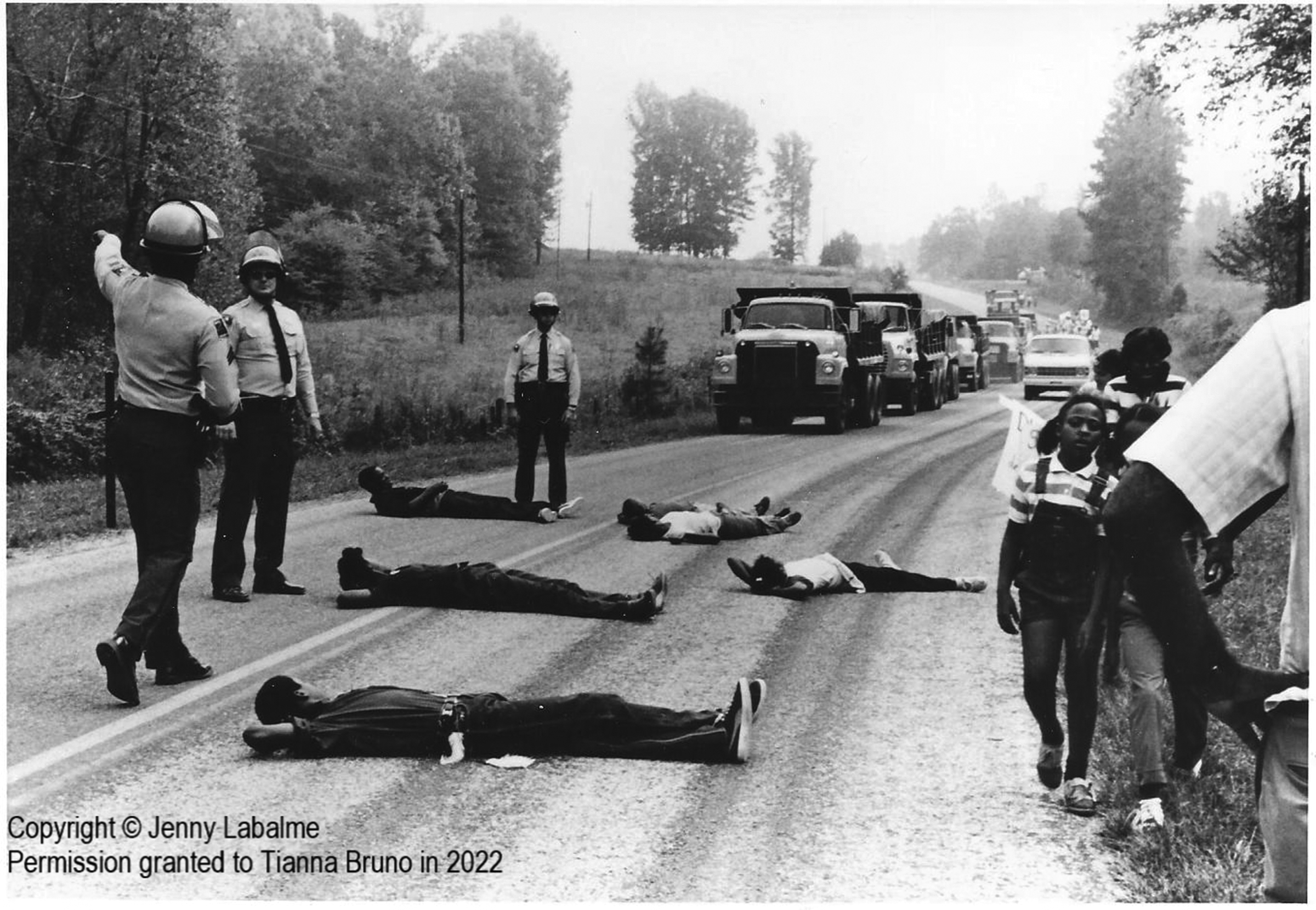
Warren County Protest, Photo Credit: Jenny Labalme.
Yet, it is, also, an extraction of labor and precious time of Black life, all too familiar with premature death (see also: Gilmore, 2017; Mahadeo, 2019). What are the quieter, more quotidian notes of Black defiance and refusal?
There are two key limitations to EJ scholarship’s essentializing Black life to spectacular activism. First, the focus on spectacular activism has restricted our understanding of acts for and of Black living and resistance to litigation and reliance on the state for justice. This is particularly evident in the field’s underscoring of petitions to the state around siting, enhanced environmental monitoring, and stronger regulation. However, Black studies scholars and Black communities have long recognized the state as often an adversary, sanctioning racial violence in the protection of whiteness and capital. To limit our understanding of Black life to litigation and reliance on the state diminishes and erases this facet. A key pillar of critical EJ is to critically analyze and acknowledge how reliance on the state and litigation pathways for justice have not been fruitful. We are challenged to think and act beyond state reliance (Pellow, 2017; Pulido et al., 2016). Pellow (2017) provides examples of organizations pursuing EJ and community goals without state initiation or intervention. However, I would like to push the bounds of this to include Black folks’ acts for and of living and futurity in ways beyond the state that are quotidian, and as Tina Campt (2017) might say, quiet.
Secondly, the focus on spectacular activism excludes more nuanced engagement with Black intellectual life. The contributions to EJ scholarship from communities is often limited to depictions of fleshy oddities positioned as objects of study, but Black ecological knowledge and intellectual life extend far beyond the flesh. Rather, Black geographies scholarship is rooted in the position that Black people and communities are placemakers, spatial knowledge producers, and geographic actors. I argue that the fixation on spectacular activism and dying has occluded the myriad of modalities of Black life and living that occur between spectacular activism and dying, such as quotidian, everyday acts for Black life and futurity.
Knowing state-sanctioned environmental racism
EJ’s preoccupation with spectacular activism has fixed acts for and of Black life in EJ communities to litigious and other legal processes that rely heavily on state protection and intervention for justice. Yet, critical EJ and critical race scholars have long critiqued the state’s complicity in anti-Black violence throughout US history, from segregation policies to present-day neoliberal state abandonment and pro-capital environmental regulation (Harris, 1993; Pulido, 2016, 2017a; Ranganathan, 2016; Wright, 2018). Industry is often positioned as the culprit and the state as the neutral protector, mediator, and convener. Recently, several scholars have made powerful arguments for conceptualizing environmental racism as state-sanctioned racial violence and cautioning both scholars and activists to question their framing of the state as a protector, or even an ally (Pulido, 2016, Pellow, 2017, Wright, 2018).
Pulido (2017a) urges us to think about the intimate entanglement between the state and racial capitalism. She asserts that persistently inadequate state responses to environmental injustice are not about “a lack of knowledge or skill [on behalf of the state], but a lack of political will that must be attributed to racial capitalism” (Pulido 2017a: 529). Scholars within the field of EJ have worked and written extensively proving disproportionate burden, high disease rates, and high death rates in EJ communities. EJ scholars have emphasized these rates as a plea for assistance and protection, hoping that the state surely will come to the rescue with the knowledge of the deadly reality in EJ spaces. As Pulido (2017a) has stated, knowledge of environmental racism is not the issue preventing meaningful action from the state. More data will not save us. Rather, the issue is the state’s imperative, often cloaked in notions of neutrality, to protect and facilitate flows of capital, even at the cost of Black life (Bledsoe and Wright, 2019). Even regulatory agency projects labeled for EJ have facilitated coopted notions of EJ that rarely increase or enforce regulation (Bruno and Jepson, 2018; Harrison, 2014, 2015).
Ideologies and institutions that devalue and dehumanize people of color have long been a part of state functioning in the U.S. (Harris, 1993; Pellow, 2017); thus, this outcome of policy, even if labeled for EJ, is not wildly unexpected. Critical race theorists, such as Cheryl Harris (1993), have shown that the US, since its inception, has created policies that establish, uphold, and reinforce white supremacy and the oppression of people of color. The forceful acts of conquest and slavery: taking land from Native Americans and extracting value from land by enslaving Africans predate their legal legitimacy. The force occurred, and then the law legitimated it (Harris, 1993). Thus, since the US came to be, protecting the privilege of whiteness and the violence of white supremacy has become the backdrop of legal cases and political action (Harris, 1993). Sharpe (2016) underscores that to be without state protection is a facet of Black life globally in the wake of slavery. Unequal state protection may have been more explicit with processes such as slavery and state-sanctioned segregation implemented until the 1960s. But the state did not move beyond racism with the end of these actions. Instead, there was an evolution to more coded, colorblind, and neoliberal forms of racial violence (Davis, 2007; Melamed, 2006; Roberts and Mahtani, 2010).
Echoing the sentiments of Sharpe’s declaration, some EJ scholars, particularly those working at the intersection of critical race studies and EJ, have pointed out the inherent anti-Blackness in the very state that EJ scholarship and activism have long petitioned for protection (Pellow, 2017; Pulido, 2016; Pulido et al., 2016; Wright, 2018). The case of Flint, MI, for example, provides glaring evidence of state awareness and complicity in endangering Black lives (Pulido, 2016). The state, on several levels, approved cost-saving measures knowing that these steps would risk the lives of those in Flint (Pulido, 2016; Ranganathan, 2016). City and state officials changed the city’s water source from the Detroit River to the Flint River to cut costs, aware that Flint River water was dangerously polluted, and that the pipes delivering water were corroded, leading to lead leaching into the water (Pulido, 2016; Ranganathan, 2016). The case of Flint makes plain the disposability of Black spaces and Black people in neoliberal state decision-making.
Even state EJ projects prioritize facilitating the flows of capital over the necessary steps to protect EJ communities. For example, in Port Arthur, an EPA project labeled for “environmental justice” focused on teaching community members to properly clean their homes to mitigate indoor air pollution, while not implementing greater regulation on the massive neighboring refinery, the largest in the nation, in fact. This enclosure of mediation to individual homes rather than large industrial polluting facilities perpetuates discursive and material processes of racialization (Bruno and Jepson, 2018).
If we in EJ are to take seriously the calls from scholars suggesting that we consider the long trend of state complicity in racial violence and question the role of the state as a neutral protector or ally, we must not only find new ways to struggle against environmental racism beyond the state (Pellow, 2017), but also shed light on the ways that Black and other subaltern peoples have always lived and struggled within and against state-sanctioned oppression.
The Summer of 2020, the height of a U.S. racial reckoning, brought to the fore for many that Black communities have long been aware of the role of the state in racial injustice in its multifaceted forms. However, the ways EJ has pursued and framed the struggle in these communities has left this out. The knowledge and awareness of the sanctioned nature of environmental racism are present in Black EJ communities, and the ways in which we continue to live, struggle, and make way for future generations exist in a myriad of forms of state engagement 2 and beyond; spectacular and quotidian. I argue for beholding this complexity rather than constructing and reinforcing a truncated view of acts of and for Black living and futurity in EJ communities.
Black intellectual life beyond the flesh
A second area of spectacular activism in EJ discourse is community-based research and citizen science (Cole and Foster, 2001; Corburn, 2005; Ottinger, 2009, 2010). This literature highlights the creative means EJ communities employ to collect data on contamination, pollution, and the health impacts of their toxic environments. This literature argues that community members have been excluded both from environmental decision-making processes as well as knowledge production on their own communities. “Science” and “experts” take precedence in producing knowledge on communities, while community members’ collective knowledge through their lived experiences is sidelined.
The act of community members interjecting themselves into the data collection and decision-making process could be interpreted as a site of life as it is an action for justice and validates community concerns. However, there remains a few aspects to be cautious of as we pursue research and writing in this vein. Often, the need for citizen/community science stems from a lack of adequate monitoring or regulatory action in EJ communities. First, we cannot forgo pressure on the state and industry for adequate monitoring. We must be cautious about discursively and materially positioning the benefits of community science as taking the place of adequate regulatory monitoring lest we perpetuate the extraction of more labor and precious time from these communities who are already strained. Second, the data produced is often aimed at eliciting state protection, leading back to the limitation of state-reliant solutions discussed in the previous section.
Furthermore, scholars have suggested that even in community participation processes, community knowledge is far from equal in value to “experts” (Yen-Kohl and the Newtown Florist Club, 2016). The knowledge of a community is limited to data or evidence for regulatory agencies and “expert” scientists, falling short of deep intellectual engagement. Community members are understood and deployed as on-site actors of “expert” science or frequently extracted from without any gain. Knowledge gleaned from Black lived experience and collective memory has long been undermined, undervalued, and often disqualified by “expert” disciplinary accounts (Sharpe, 2016). Yen-Kohl and the Newtown Florist Club (NFC) Writing Collective (2016) emphasize that the Black women who compose the NFC, living in an EJ community, are tired of being studied by outsiders only to have community claims and knowledge silenced or delegitimized.
Black geographies scholars make clear that subaltern communities hold more than data to feed into status-quo, state-centric expert science, rather they hold knowledge from the everyday, knowledge on new world-building and non-dominant ways of knowing and relating to space and place, collective memory, and various forms of cultural expressions that shape Black intellectual life. An intellectual life derived even as they are living within the realm of violence, oppression, and death (Lipsitz, 2011; McKittrick, 2006; Woods, 1998, 2017). McKittrick (2016) argues that “the task is not to measure and assess the unfree – and seek consolation in naming violence – but rather posit that many divergent and different and relational voices of unfreedom are analytical and intellectual sites that can tell us something new about our academic concerns and our anti-colonial futures.” (5) (see also McKittrick, 2021)
As an example, we can consider Wright’s analysis of the contributions of Black intellectual, James Baldwin. Building on Baldwin’s argument that white people must be willing to sacrifice whiteness, Wright (2018) states, “The death of whiteness as humanness and recognition of Black humanity…would set the stage for a repositioning of human-environmental relations” (14). This highlights the environmentally just world-building possibilities within Black intellectual life that the EJ field often overlooks. This intellectual life is a negation of the discourse of totalized abjection and death in Black communities.
Analytics for Black life and futurity
In what follows, I draw on Black studies scholars to map out methods of analysis that acknowledge and attend to Black living, resisting, and future building in EJ spaces, particularly in a way that moves beyond petitions for state intervention. There is an abundance of actions for Black life, relationships, and care beyond spectacular activism and dying that takes place in EJ spaces. There is Black life even in close proximity to death. We must attune our analytics to begin to behold these within EJ literature. Black feminist scholars have laid a path for us.
Throughout In the Wake: On Blackness and Being, Christina Sharpe (2016) challenges Black scholars researching, writing, and teaching in the afterlife of slavery to move away from disciplinary expectations or standards to attend to the dead and dying with care and with an acknowledgment and reverence to Black life that persists in spite of immanent and imminent Black death. Sharpe states I want In the Wake to declare that we are Black peoples in the wake [of slavery] with no state or nation to protect us, with no citizenship bound to be respected, and to position us [Black peoples] in the modalities of Black life lived in, as, under, despite Black death: to think and be and act from there. (Sharpe, 2016: 22)
While Black struggle can certainly be sensational and spectacular, Black feminist scholars have argued for attuning our listening to more quotidian forms of Black struggle (Campt, 2017; Sharpe, 2016; Weheliye, 2014). They call for attention to the complexity, persistence, and everydayness of Black struggle that exists outside of traditional conceptions of resistance or activism. I posit that these quotidian forms of struggle are, particularly, outside the litigation and policy routes that have characterized EJ scholarship and activism.
In Listening to Images, Tina Campt (2017) proposes a method that allows us to attune our analytic to pick up on the quotidian or quiet practices of Black peoples that resonate as resistance in the everyday. In particular, Campt focuses on images and state archives, such as passport photos from across the African diaspora. On the surface, these images seem to be mundane representations of state authority, impossible spaces of a resonance of Black defiance or resistance. However, Campt argues that through listening for lower frequencies we might capture the quieter, oft overlooked notes of refusal within those aspects hegemonically registered as compliance or abjection. Campt highlights the subtle, yet powerful practices of refusal that can be captured when we listen closely for them. Campt states, I theorize the practice of refusal as an extension of the range of creative responses black communities have marshaled in the face of racialized dispossession. In this context, refusal is not a response to a state of exception or extreme violence. I theorize it instead as practices honed in response to sustained, everyday encounters with exigency and duress that rupture a predictable trajectory of flight. (10)
Black life and futurity in/against state-sanctioned environmental racism
Black feminist scholars, Tina Campt, Katherine McKittrick, and Christina Sharpe, make way for us, EJ scholars, to begin to see how we can think and write Black life and Black struggle even as we acknowledge Black death and critique death-dealing state-capital processes. Sharpe (2016) calls attention to the ways that Black people can and do care for the dead and dying in the afterlife of slavery. Campt (2017) focuses on subtle notes of refusal that yearn for and make possible Black futurity. McKittrick (2016) teaches us to understand Black peoples as more than bodies, but also as peoples living, contributing, making new forms of knowledge production. These scholars highlight what Sharpe calls the atmosphere of anti-Blackness and the reality of premature Black death, yet they interject Black struggle and Black life, in its modalities, exist and can be attended to even within this atmosphere and reality. I ask again, how can we who struggle against environmental racism think, be, act, and write from there? In this section, I describe avenues for EJ scholarship to foreground Black life, particularly in ways that align with the calls from Sharpe, McKittrick, and Campt.
Care
What does it look like, entail, and mean to attend to, care for, comfort, and defend, those dead, those dying, and those living lives consigned to the possibility of always-imminent death, life lived in the presence of death…? (Sharpe, 2016: 38)
To live in an EJ community is to be familiar with death. Growing up in a family with roots and kinship ties in a Black EJ community, I have long witnessed death visit families, such as my own. Blowing over us like a wind leaving us bent and altered, but not broken. The Black women in my family are continuously caregiving and making funeral preparations. Caring in the face of state-sanctioned environmental racism.
In her work with the Newtown Florist Club, Kohl (Kohl, 2015; Yen-Kohl and The Newtown Florist Writing Collective, 2016) brings the care labor of Black women in EJ communities into EJ discourse. The Newtown Florist Club is an environmental and social justice organization composed of Black women in Gainsville, Georgia, a Black community that is surrounded by waste and industrial facilities. These women came together to provide flowers for funerals in their community. Kohl (2015) states, When someone in the community died, club members served as flower bearers at the funeral, processing the flowers into the church dressed in black in the winter and white in the summer, with a red rose pinned to their lapels, to offer a sense of solidarity and support to the family that lost their loved one. (29)
Caring for community within the context of environmental injustice (i.e., racial capitalism) is complex and multiscalar. On the scale of the home, Vasudevan (2019) highlights the precarity of the unacknowledged, gendered care labor where often Black women are also exposed to toxins through domestic tasks, such as washing clothes. Vasudevan (2019) insists that “Racial capitalism preys upon the very relations of care that people depend on when their lives are devalued” (9). However, as we see with the Newtown Florist Club, relations of care in these places extend beyond kinship ties to cover communities with care (see also Roberts-Gregory, 2020). Vasudevan and Smith (2020) identify this as Black revolutionary mothering (Gumbs, 2016) in spaces of bodily and environmental degradation and slow death. In theorizing Black ecologies of care, Reese and Johnson (2022) underscore the ways mutual aid and other forms of mutuality and solidarity have long existed within “ongoing experiments in relationality that foreground Black life and ways of living in ecologies of neglect and terror” (28). Importantly, we cannot forget that there is also ecological care taking place in these spaces (Barra, 2023; Davis et al., 2019), and these modes of care inform each other shaping an ecosystem of care making living possible in “unlivable” spaces. This encapsulates the struggle for dignity, protection, and care for Black life in EJ communities.
Futurity and refusal
What if we understand it…not always intentional or liberatory, but often constituted by minuscule and even futile attempts to exploit extremely limited possibilities for self-expression and futurity in/as an effort to shift the grammar of black futurity to a temporality that both embraces and exceeds their present circumstances …? (Campt, 2017: 59)
The processes of racial capitalism function on top of, around, and within the lives of Black people in EJ communities working toward the slow deaths of people, landscapes, and place (Vasudevan, 2019). Woods (2017) writes about Black EJ communities in Louisiana that have “ceased to exist” (249). This phenomenon stems from residential decline and corporate buyout, resulting in an empty town to be rolled over for industrial expansion. Mossville, LA is an example of one such town where the industrial imprint, via construction and contamination, has expanded and slowly snuffed out the surrounding Black community. Moreover, coastal communities find themselves concurrently facing the impacts of climate change, such as sea level rise, coastal subsidence, and more intense hurricanes. This simultaneous poisoning of Black people and ecologies in EJ communities is occurring across the U.S. South (Davies, 2018; Vasudevan, 2019; Yen-Kohl and The Newtown Florist Writing Collective, 2016).
These processes stifle, and perhaps limit, but do not wholly erase possibilities for futures or taking action for an imagined future in such spaces. EJ scholarship has few analyses aiming to understand how this insistence of Black futures takes place in EJ communities, particularly how communities are making room for Black futures within the confines of limited resources and while living in the deadly entanglement of state and racial capitalism. Moreover, as Campt (2017) asks, what if we refined our understanding of resistance and actions taken for Black futures to include those that are quotidian, minuscule, and even futile?
I want to return to Campt’s notion of refusal as a quotidian means for Black futurity, which entails coming face to face with the likelihood of one’s own premature demise, yet “maintaining an active commitment to the very labor of creating an alternative future” (2017: 116). Lorraine Leu’s politics of staying put and defiant geographies provide a helpful framing of such refusal. Through the story of Vila Autodromo’s refusal to be displaced as Rio tore down their community for the 2016 Olympics, Leu (2020) argues that this Black Brazilian community stayed put throughout demolition, shutting off of city services, and ruination as a means of place-maintaining, becoming visible, and defending their claim to their home. They remained to insist on a counter-narrative to the notion of Black placelessness and build toward their collectively imagined future.
In the face of constant chemical beratement, Black EJ communities across the US Black Belt have remained in place. One way to read this is that due to their objectification and dehumanization, they are relegated to the disposability of the state for the sake of protecting capital accumulation. This is certainly true. But is it also possible for us to understand that Black peoples in these communities, in some cases, refuse to be dispossessed from their land relations, place, and community?
I am not arguing that Black people peacefully and willfully remain in harm’s way as a form of defiance. Rather, I am suggesting that if we reframe our understanding of “resistance” and “agency” within EJ to position the very act of building connection to a place, desiring for your family and future generations to inhabit and build their own connections to this place, and staying put because it is home—as acts of refusal to be denied such possibilities for yourself and for future generations. It is a form of resistance and agency in the name of EJ that is beyond the state and in the everyday. In refusing, these communities are making a claim that they have a future and that this land/space has a future in their hands as an inheritance to future generations. This daily life (that threatens a premature death through higher cancer rates, etc.) happens for the existence (future generations of descendants and the like) to continue. In this way, the existence of these communities in place is both a consequence of racial capitalism and the Black radical tradition that has long struggled against racial capitalism (Johnson and Lubin, 2017; Robinson, 2000), pushing for place and community survival. Their refusing to leave and be demolished as a community is a means of creating a future they want to see now and leaving space for access to collective memory, even within limited resources and with tremendous odds against them.
The film Mossville: When Great Trees Fall (2019) provides an example of what I am gesturing toward. This film focuses on the stories of community members in Mossville, Louisiana, a historically Black town struggling to survive in the face of the progressive expansion of Sasol industrial facilities. Sasol is a South Africa-based petrochemical giant. The film focuses on the story of Stacey Ryan. Ryan, a descendant of the freedman founders of Mossville, is the only remaining resident in his area of the town. He describes how others have been either bought out by Sasol or have died from diseases believed to be linked to exposures from the chemical plants around the community (Glustrom, 2019).
It is important to highlight the position of the state. The film shows press conferences and news clips depicting the support and excitement of the then Louisiana governor, Bobby Jindal, for the expansion. Furthermore, the city permits the rezoning of the area where Ryan is living to an industrial area, which means no longer supporting the extension of essential services, such as water and electricity. Similar to the case of Vila Autodromo, we are shown scene and scene again of Ryan’s defiance and determination to stay put as the very ground around his home is effaced and services cut.
Mossville residents in the film make it clear that the place of Mossville is more than a burden from which to be removed. They are connected to this place. It holds ancestral significance for them. Ryan states, “I wasn’t ready to give up anything that my parents worked so hard for … I elected to stay behind because there is no other place for me” (Glustrom, 2019, emphasis added). Regardless of the political and chemical processes happening to push them out, another resident stressed that, “This is still home”. Ryan and other Mossville community members emphasize throughout the film that to be removed from this space is to lose a connection to ancestors, near and far. Mossville, the community and the place, is connections to family members who made life and lost life there for generations. Moreover, to be removed from this place, releases its further extraction, occupation, and exploitation for industry. As Ryan puts it, it seems the chemical companies “wait for us to die, and get the land dirt cheap”. He goes on, “This is why I fight. This is all we had. So tell me wouldn’t you fight to keep it?”
The film opens with the Maya Angelou poem after which the film gets its subtitle: When Great Trees Fall. It opens with white words on a black background: “They existed. They existed. We can be. Be and be better. For they existed”. Throughout the film, it becomes apparent that this may be an ode to the ancestors lost and loved in Mossville. Moreover, it is an ode to Mossville itself, as a place withering from chemical expansion and contamination. However, I also see that this quote rings true in the other temporal direction as well. As Ryan and so many more maintain relationships to place by staying put or holding and sharing honor and love for places, such as Mossville, they are making way for that relationship for future generations. There is a pushing back against industry, but importantly, there is a refusal to not have this space for future generations. Staying put maintains a connection to ancestors and makes way for those connections for future generations in this place. Mossville is but one example of communities across the region, such as Port Arthur, Texas, and beyond. The examples of Mossville and Vila Autodromo may be hyper visible; however, the workings of this mode of refusal can be encountered in the everyday ins and outs of living, loving, and caring in such spaces. Ecological precarity and degradation may shift and alter the ground beneath us, but it does not diminish the existence of generational ties to place and the environment in EJ communities. These sorts of insights into connection to place, resistance to environmental injustice beyond the state, and acts for Black futurity are lost without a Black geographies approach to EJ that implores we attend to the complexity of place and foreground Black life.
Conclusion
This article intervenes in EJ’s traditional approach that often figures Black living as dying or spectacular activism, to stress the many modalities of Black life beyond the bounds of such registers. The field’s fixation on environmental effects on Black bodies is understandable, given the deadly reality of Black EJ communities, but to isolate our intellectual gaze to this limits the possibilities of knowing Black spaces. We begin to only know these as containers of death and toxicity to the neglect of all the living experienced and forged in these death dealing spaces.
Black geographies call for us to be cautious of totalizing people, places, and landscapes to death, decay, and blight. In this tradition, I urge us to question what we know or learn about Blackness and Black geographies based on the knowledge produced within EJ scholarship. What more is there than dying and degradation? What are the modalities of life that exist in proximity to death? These factors are all worth examining to attend to the complexity of Black living, even in contaminated spaces.
The second register of Black living is spectacular activism. An essentialized notion of Black life to spectacular activism is limited in three ways. First, as depicted in the image of the Warren County protest, spectacular activism is laborious and extracts precious time from Black life that is in close proximity to premature death. How can we know and understand agency and resistance beyond this labor and time demanding framing? Secondly, spectacular activism is often restricted to state-reliant approaches, which have long been unsuccessful for EJ (Pulido, 2000, 2017b; Wright, 2018). Often, this approach does not attend to the historic relationship between Black communities and the state. Thirdly, within this activism framework is community-based research and citizen science efforts of EJ communities. While this approach has challenged power dynamics in research, scholars have highlighted that Black EJ community members or cultural expressions are rarely treated as intellectual equals to “experts” (McKittrick, 2016; Yen-Kohl and The Newtown Florist Writing Collective, 2016).
Shifting our analytic to understand quotidian and everyday forms of living against state-sanctioned environmental racism, opens our gaze to the various ways in which community members are acting for EJ beyond state petitions. I draw on the work of Black feminist scholars who have provided analytics and methods of writing and thinking about Black life and futurity even within a world all too familiar with Black premature death. By integrating a Black geographies framework into EJ analysis, we can acknowledge and honor the many forms of living, caring, resisting, refusing, and practices for futurity in the face of state-sanctioned environmental racism.
Supplemental Material
sj-pdf-1-epd-10.1177_02637758231218101 - Supplemental material for More than just dying: Black life and futurity in the face of state-sanctioned environmental racism
Supplemental material, sj-pdf-1-epd-10.1177_02637758231218101 for More than just dying: Black life and futurity in the face of state-sanctioned environmental racism by Tianna Bruno in Environment and Planning D: Society and Space
Footnotes
Acknowledgements
I am grateful to the Desirable Futures special issue editors for their guidance and encouragement with this paper. I would like to thank Laura Pulido, Alaí Reyes- Santos, Lucas Silva, Leigh Johnson, Jordache Ellapen, Malini Ranganthan, the University of Oregon Critical Race Lab, and the University of Texas- Austin Feminist Geography Collective for their feedback on early drafts of this article. I also thank the anonymous reviewers for their insightful and critical feedback that helped strengthen the arguments of this article. Any errors are mine alone.
Declaration of conflicting interests
The author(s) declared no potential conflicts of interest with respect to the research, authorship, and/or publication of this article.
Funding
The author(s) received no financial support for the research, authorship, and/or publication of this article.
Notes
References
Supplementary Material
Please find the following supplemental material available below.
For Open Access articles published under a Creative Commons License, all supplemental material carries the same license as the article it is associated with.
For non-Open Access articles published, all supplemental material carries a non-exclusive license, and permission requests for re-use of supplemental material or any part of supplemental material shall be sent directly to the copyright owner as specified in the copyright notice associated with the article.
