



Abstract
In this piece, we take up haunting as a spatial method to consider what geography can learn from ghosts. Following Avery Gordon’s theorizations of haunting as a sociological method, a consideration of the spectral offers a means of reckoning with the shadows of social life that are not always readily apparent. Drawing upon art installations in Brooklyn, NY, White Shoes (2012–2016), and Oakland, CA, House/Full of BlackWomen (2015–present), we find that in both installations, Black women artists perform hauntings, threading geographies of race, sex, and speculation across past and present. We observe how these installations operate through spectacle, embodiment, and temporal disjuncture, illuminating how Black life and labor have been central to the construction of property and urban space in the United States. In what follows, we explore the following questions: what does haunting reveal about the relationship between property, personhood, and the urban in a time of racial banishment? And the second, how might we think of haunting as a mode of refusing displacement, banishment, and archival erasure as a way of imagining “livable” urban futures in which Black life is neither static nor obsolete?
“Black experience in any modern city or town in the Americas is a haunting.”
—Dionne Brand, A Map to the Door of No Return
A dozen Black women adorned in white antebellum gowns traipse along Telegraph Avenue in Downtown Oakland. White lace veils cover their faces, white-gloved hands clasp white parasols, and painted white lanterns. Some carry bundles of white roses, others hold white-framed mirrors up to their faces, the mirrors gazing outward. The moonlight makes the figures glow, eerie, as they traipse through the streets, spectral. Passers-by absorbed in their smart-phones look up, startled, mouths agape, uncertain of what reality they have stumbled into. Others snap photos, which later appear on Twitter and Facebook, prompting a conversation of comments and likes and befuddlement. The figures hold up their lanterns and peer into windows, silent, conveying their presence through body movements alone. They gyrate through the streets, other times walking stoically in procession, stopping in crosswalks, meandering through gas stations. At one point, they gather in a circle and begin to cackle, belly laughter. As the women wander off into the night, pedestrians stop in their tracks, trying to make sense of this ethereal presence they crossed paths with on the streets of Oakland (see Figure 1).
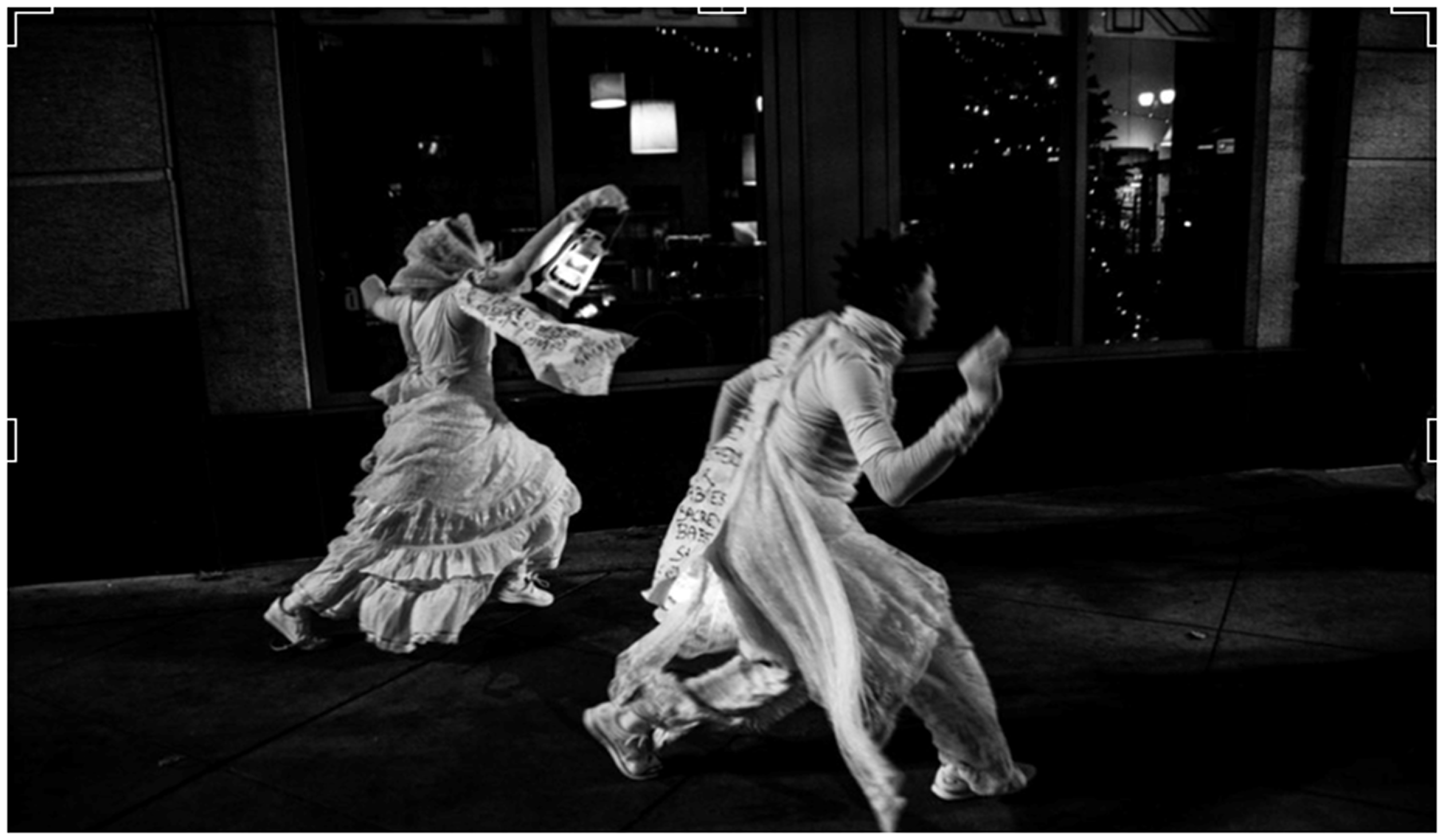
Now You See Me (Fly) (2016); from the series House/Full of BlackWomen (2015–present). Photographer: Robbie Sweeny. Image courtesy of Amara-Tabor Smith.
This essay begins with a haunting. Sociologist Avery Gordon (2008) used the term to describe “how that which appears to be not there is often a seething presence.” Haunting, according to Gordon, is the way of ghosts. It is also a “very particular way of knowing what has happened, and is happening” (p. 8). In keeping with Derrida’s invocation of the ghostly in Specters of Marx, Gordon posited that “the ghost is not simply a dead or missing person, but a social figure, and investigating it can lead to that dense site where history and subjectivity make social life” (p. 8). For Gordon, the spectral “alters the experience of being in linear time” (p. xvi). Extending this, we argue that ghosts also alter the experience of being in place. Here, following Gordon’s exploration of haunting as a sociological method, a means of reckoning with the shadows of social life that are not always readily apparent, we consider what geography can learn from ghosts.
In this paper, we are interested in how conceptualizations and planning of the urban are haunted by what Ananya Roy (2021) refers to as “gender-property logics” and, conversely, how Blackness necessarily troubles the notion of futurity as it relates to the urban. We center an analysis of creative texts by Black women artists for whom ghostly figures are central: Nona Faustine’s White Shoes (2012–2016) and House/Full of BlackWomen (2015–present), the former a photo series and the latter a performance art series that emerged concurrently in Brooklyn, New York and Oakland, California. Situated within a long history of Black performance, and explicitly channeling Black women’s geographies, these artists deploy haunting as a “relentless remembering and reminding” (Tuck and Ree, 2013: 642) of how Black women’s reproductive labor has been entangled in the very notions of property upon which the colonial nation state and contemporary urban futures rest. As Fred Moten writes, the issue of reproduction . . . has to do not only with the question concerning slavery, blackness, performance, and the ensemble of their ontologies but also with a contradiction at the heart of the question of value in its relation to personhood. (2003: 16)
White Shoes and House/Full of BlackWomen take up the role of property as one nexus through which we might consider the undulating relationship between Blackness and the making of the urban, recalling how property, as a racial capitalist social construct, extracts value from the continual “reorganizing” of Black life through displacement, traffic and practices of “racial banishment” (Roy, 2017). Put differently, these works both clarify and undermine the relationship between value, property, personhood and the city. Throughout the paper, we consider how these creative works play with and subvert the notion of possession as it is understood through propertied logics within racial capitalism, troubling the ways that property functions in the urban.
This paper is guided by two central questions. The first, what does haunting reveal about the relationship between property, personhood and the urban in a time of racial banishment (Roy, 2017)? And the second, how might we think of haunting as a mode of refusing displacement, banishment, and archival erasure as a way of imagining “livable” urban futures in which Black life is neither static nor obsolete? In what follows, we revisit haunting as an “oppositional spatial practice” that has been central to Black and decolonial thought and Black geographical method (McKittrick, 2006: xiv). We begin by paying close attention to the ways in which Black and decolonial scholars have taken up the spectral as a mode of reading the city. We put this line of inquiry into conversation with critical theories of property in order to suggest that a “hauntological” approach can be useful in understanding how property regimes, and their deeply racialized attendant “gender-property logics,” persist and manifest at moments of urban restructuring. Finally, turning towards an analysis of Faustine’s White Shoes and Tabor-Smith’s House/Full of BlackWomen, we argue that within the creative works of Black women artists we find illuminated not only the historical contingencies that link race and property but also ways of interpolating possession without, as Brenna Bhandar articulates it, “replicating logics of appropriation and possessiveness that rely upon racial regimes for their sustenance” (p. 18). A haunting, following Gordon (2011), gestures toward the “something-to-be-done” and yet it does not necessarily offer up a solution. The ghost is there to demand your attention, to notify us of how “what’s been suppressed or concealed is very much alive and present” (Gordon, 2011: 2). Thus, our goal in this piece is not only to situate Blackness in relation to the study of race, property and the urban, but to engage the spectral as a generative conceptual pathway for rethinking these entanglements.
“Black Haunts1”
The spectral has been productively utilized by scholars of Black and Indigenous studies to consider the contiguities of time, space, and colonial terror (Baloy, 2016; Gordon, 2008; McKittrick, 2013; Morrill and Tuck, 2016; Tuck and Ree, 2013), the work of memory, counternarratives and living archives (Hartman, 2006; Morrison, 1987), residual histories, and refusals (Simpson, 2007). Specters have also been taken up as a way to think about black urban life in relation to the ongoingness of antiblack violence and death (Brand, 2001). Katherine McKittrick (2013) returns to the excavation of New York’s African Burial Ground in 1991 to articulate the “spatial continuity between the living and the dead, between science and storytelling, and between past and present,” following the echo of Stevie Wonder’s “Living For the City,” to find “a location of black death that holds in it a narrative soundscape that also promises an honest struggle for life” (p. 2). Simone Browne (2015) excavates an archive of surveillance regimes, technes of perceptibility that produce something corporeal, something “unvisible,” something almost human (p. 11)—a racial body, a sort of black subject. Through the specter of “Black luminosity” Browne names “a form of boundary maintenance occurring at the site of the racial body, whether by candlelight, flaming torch or the camera flash” through which colonial terrors and their present day iterations can be brought to light. Saidiya Hartman (2019) assembles an expansive archive from remnants, ghosts, unnamed figures, to “illuminate the radical imagination and everyday anarchy of ordinary colored girls,” to consider how Black girls experimented with and imagined urban worlds at the turn of the century in ways that are otherwise invisible, illegible, or opaque in histories of the urban. Drawing upon and extending this rich body of Black speculative theory, our aim is to approach haunting as a meaningful theoretical frame and intervention for understanding a present in which “the black city is imagined and increasingly governed as ghost” (Simone, 2017).
In both Now You See Me and White Shoes, haunting—read through the lens of performance—creates a constellation of conjunctures and disjunctures in which property is a central node. In each series, Black women artists strategically deploy performances and representations of possession, calling our attention to possession as a discursive frame in which ownership, appropriation, occupation, and property sit alongside their presumptive opposite—(dis)possession. In doing so, they make visible property’s multiple manifestations and their work in shaping Black urban futures. As Ananya Roy (2017) reminds us, technologies of race and racialization are central to the continual reorganization and rearticulation of property: histories and geographies of Black dis/possession belie liberal categories of property and sovereignty through which the nation-state continues to reproduce itself. Through an attention to the entanglements between Blackness, personhood, and property, Roy lays bare the fraught set of relationalities that render property as an unstable category.
In the same vein, Brenna Bhandar (2018) explicitly links the production of modern property laws with that of racial subjects, stating that the two “share conceptual logics and are articulated . . . [and] produced through one another in the colonial context” (p. 8). Bhandar argues that “to study modern property laws [. . .] without accounting for the significance of the colonial scene to their development is to disaffiliate the development of modern law from its deep engagements with colonial sites” (p. 3). For Bhandar, race and property are bound and articulated at key historical junctures, and haunting, we argue, enables these junctures to meet in urban space in uncanny ways. As Bhandar reminds us, “articulations of race and property . . . do not emerge in a consistent, linear, or even fashion. The temporalities of colonialism are multiple and uneven . . . ” (p. 23). White Shoes and Now You See Me reveal how, as the two cities are narrated through frames of revitalization and development, Brooklyn and Oakland dwell “in the wake” (Sharpe, 2016). In doing so, these two installations offer a way of putting Roy’s analysis of the relationality of property in conversation with what Christina Sharpe (2016), drawing from Saidiya Hartman (1997), names the “afterlife of property.”
In Unsettling the City, Nick Blomley (2004) disrupts the ways in which colonial settlement frames definitions and deployments of property, instead calling our attention to how property consistently requires new enactments, representations and enforcement to retain meaning. Private property-owners, according to Blomley, must police the boundaries of property both literally and ideologically to retain the power of land ownership, mobilizing “bodies, technologies and things” into “organized and disciplined practices” (2004: xvi). Property “must be enacted upon material spaces and real people” to possess meaning—it must be translated from an abstraction into a material and legal objectification of life, labor and land (Blomley, 2004: xvi). Legal regimes of private-property enforce and reproduce the extraction of value from people in place, and “[the] ‘enjoyment’ of property frequently depends upon the dispossession of others, whether now or in the past” (Blomley, 2004: xvii). Following Bhandar’s provocations, we ask how these ideas of property and possession structure the urban, and how Black women’s geographies dis-order these propertied logics of urban space through haunting?
Critical theories of property have well illustrated how property is an unstable site, and in what follows we explore how Black women performing hauntings further upend its stability. Blomley poses the question, “what if we were to depict property ‘at loose ends,’ and refuse its circular and settled self-representation?” (2004: 14). In what proceeds we ask, what if Black women’s geographies are the manifestation of what Nick Blomley calls the “loose ends” of property, their bodies once the site from which property was literally (re)produced? Then, how might an attention to Blackness serve as a method for pulling at these loose ends of property, of an unraveling of property regimes?
Faustine’s Isabelle and the White Shoes Series
You feel the residual fallout from the history. You’re in between two worlds, in a way, when you go to these sites, the present, real city, and the city of the past. —Nona Faustine
Over the course of four years, Nona Faustine’s White Shoes project articulates Brooklyn’s history of enslavement, through “sites/sights of memory” (McKittrick, 2006: 23). As described by Faustine, In the series “White Shoes,” I quietly yet defiantly photograph myself at locations that refer to the largely unknown, 250 year hidden history of slavery in New York City. Wearing nothing but symbolic white pumps, I document myself in places where the history becomes tangible. (see Figure 2) Of My Body I Will Make Monuments in Your Honor (2014). Image © Nona Faustine.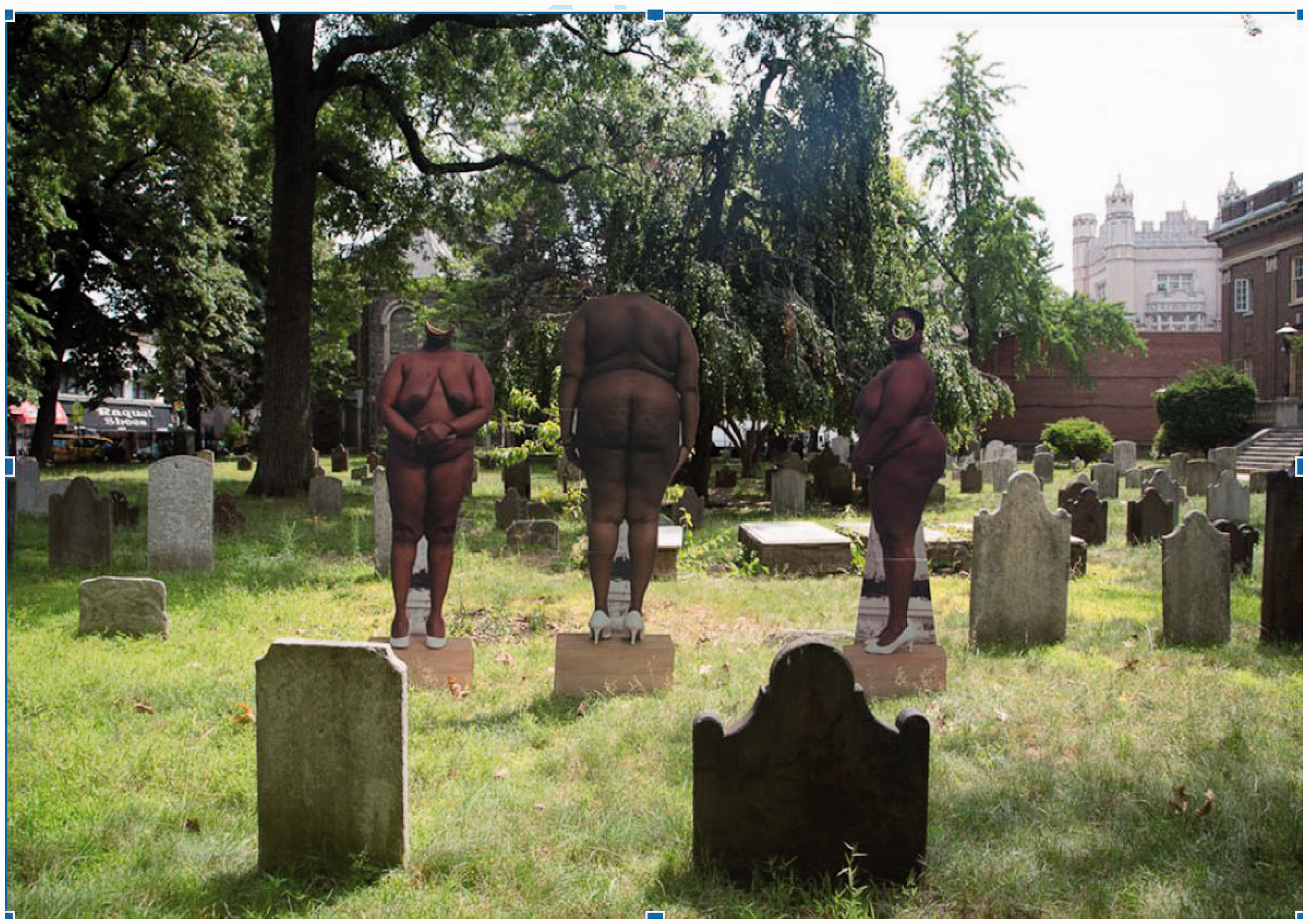
Indeed, as we have written elsewhere, Brooklyn served as a nodal point in the transatlantic slave trade, enslaved Africans were also trafficked from Brooklyn’s shores to the Caribbean, parts of Africa and the southern United States making Brooklyn a major exporter of human and non-human capital. Brooklyn’s function as a port city and its proximity to Manhattan, allowed Brooklyn to grow into a viable commercial node as Brooklyn’s Atlantic Docks were primary storage sites for tobacco and other commodities of colonial trade. Even after slavery was ostensibly abolished in 19th century New York, the city’s future remained tied to the plantation (Best, 2017).
Faustine’s project, then, might be considered one of excavation, or in this case exhumation. The photo-performance series bridges performance art and photography, mapping New York’s plantation geographies through the naked body of Faustine, a black woman artist. In one image titled, “Like a Pregnant Corpse The Ship Expelled Her Into the Patriarchy,” Faustine lays naked on the jagged, moss covered rocks along Brooklyn’s Atlantic shores, marking yet another contour of the link between the production of the city and the plantation (Best, 2017). Faustine, standing robust, deep skinned, naked, in these public sites, creates a “different way of knowing” the city. The ghostly figures in Faustine’s White Shoes series remind us of how histories of urbanization in the Americas are also histories of the plantation. But this is not only a project of remembrance and counter-cartography, it is also an opening to consider the ways that property logics, and occurrences of Black fungibility that they engendered, continue to haunt, and reappear at other historical junctures. Here, it is useful to return, again, to the work of Bhandar on how property logics shift and transform over time. According to Bhandar, The massive differences between the 19th century [. . .] and contemporary modes of neoliberal capitalism require close attention to the ways in which modes of appropriation, rationales for ownership, and the legal form(s) of property have adapted themselves to the imperatives of colonial domination. (p. 28)
In “Isabelle” (2016), Faustine stands just in front of Lefferts House, breasts bared, holding a cast iron pan, with a flowing white skirt draped around her waist, belted by a string of small white children’s shoes (see Figure 3). We are left to wonder whether Faustine’s Isabelle is an invocation of Isabel, the enslaved woman, on April 18, 1775, who is listed in the Genealogy of the Lefferts Family, as property of Peter Lefferts along with Ben, Dyna, 4 horses, 15 cattle, 142 acres and another enslaved person whose name does not make it to the ledger. Or perhaps she is some amalgam of the “negro wench” Jeny or the girl named Anna or the countless others. Looking at the image of Isabelle, there are no children in the frame, but the string of children’s shoes tied around Isabelle’s waist stands in for them, and we are left to grapple with the context of Isabelle’s mothering. Mention of children appear frequently, archived in the Lefferts family papers, documented in the bills of sale. They were typically sold as separate entities, listed without reference to parentage or familial ties. Standing alone, but with various props that signal reproductive and sexual labor, both spectacle and specter, Isabelle stands bound up in the violent nexus of slavery’s geographies, genealogies, and its ironies too.
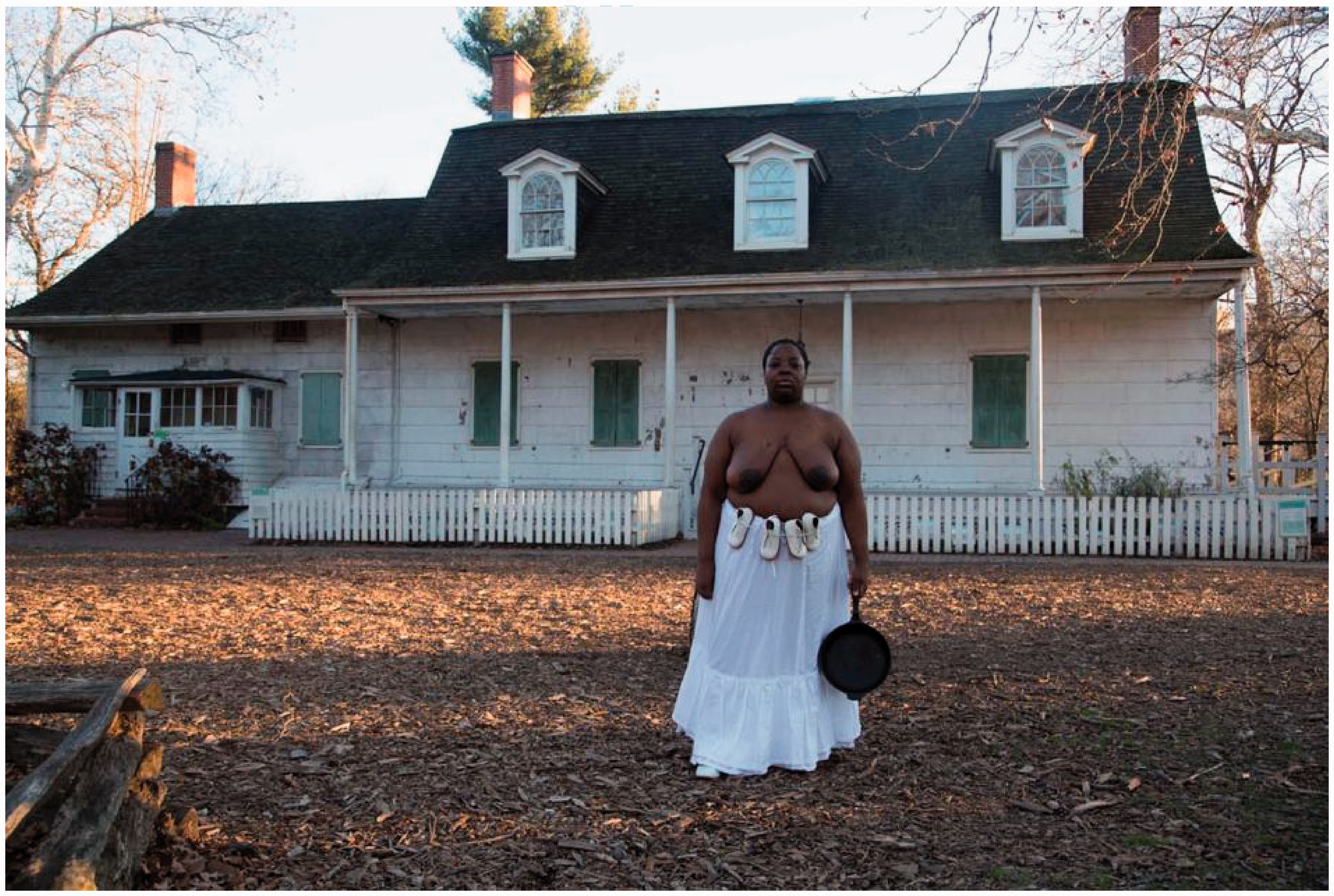
Isabelle (2016). Image © Nona Faustine.
While much of Faustine’s photo series is set within legibly urban and contemporary settings, the use of pastoral landscapes punctuates the series in remarkable ways. These landscapes act not as a contrast to architectures of the urban but as a mode of representing the intersections between power, space and time, and as a method of staging the grounds upon which we encounter the figure of Isabelle. Through the use of the pastoral, the well-worn image of the palimpsest is made visible. In the portrait of Isabelle, there is a sense of nostalgia in the setting, one in which Isabelle sits uncomfortably. In many ways, the scene plays with the pastoral. As Saidiya Hartman (1997) reminds us, the pastoral plays a crucial role in understanding Black performance because it articulates the complex relations in which the performance of everyday life, especially under enslavement, have been understood and bound up: “the pastoral renders the state of domination as an ideal of care, duty, familial obligation, gratitude, and humanity” (p. 53). However, as Faustine looks directly into the camera, her full body standing at the center of the frame, there is a clash between her uncompromising image in the foreground and the idyllic family farmstead in the background. Standing in front of the white colonial home, atop a pillow of fallen autumn leaves, breasts bared, holding a cast iron pan, with a white flowing skirt draped around her waist, belted by a strong of small, white children’s shoes, Isabelle re/constructs Brooklyn’s Black urban life.
Isabelle appears at Lefferts House, owned and bestowed to the city by one of the most prominent slave holding families in Brooklyn, became a historical landmark and eventually a museum of family life in 1920, opened as such by the Daughters of the American Revolution, a conservative sororal organization. The conveyance of land is especially important to understanding the context of this portrait. Where does a figure like Isabelle fit in this transfer of property? Here, “family” and “life” are intimacies entangled in the problem of property, or rather, the problem of Black fungibility illuminates the entanglements between human life, reproductive labor, race and property in this context. Locating Lefferts House within the city’s “racial-sexual terrain,” Isabelle is a scene that renders visible the ways in which the sexual-reproductive labor of enslaved black women has been integral to the production of the city, and how the erasure of that labor is just as crucial in how the city imagines and writes its own history in a period of gentrification.
House/Full of BlackWomen
Now You See Me (2016) is part of an ongoing series of impromptu performances Amara Tabor-Smith, her co-director Ellen Sebastian Chang and their collaborators have organized across Oakland entitled a House/Full of BlackWomen (2015–present, see Figure 4). Tabor-Smith calls the public performances episodes, a word she employs “in its multi-definition, as in a psychotic break and also in a section that is a piece of the larger story” (Tabor-Smith, 2017). Taking place in different sites across Oakland that are known for sex trafficking, each episode holds its own story arc, particular to the site it is performed upon, and yet the episodes all speak to a larger narrative that grapples with Black women’s lives in the wake. Another episode in the series, She (be) Here Now (2017), features figures dressed and masked in red and black garments wandering the streets of Oakland in ritual procession, garments which the creators describe as drawing inspiration from Yoruba traditions. Another episode, The Meaning of Canaries (2016), took place in EastSide Cultural Center in Oakland, the performers wandering outside of the theater onto International Boulevard at night to publicly grieve, singing and wailing, circling, and solemnly harmonizing, at times keeling over and frantically gasping for air. House/Full of BlackWomen unearths the connections and tensions of how Oakland exists as a major hub for sex trafficking for Black women and girls, while simultaneously Black families are experiencing racial banishment through ongoing urban restructuring. The Black women artists of a House/Full of BlackWomen take possession of Oakland’s streets, occupying space in ways that juxtapose these simultaneous realities of Black dispossession. The ghostly embodiment of their performance haunts the space itself, insisting that the viewer bear witness, these tensions of Black urban life in Oakland grieved through ritual, sound, and movement.
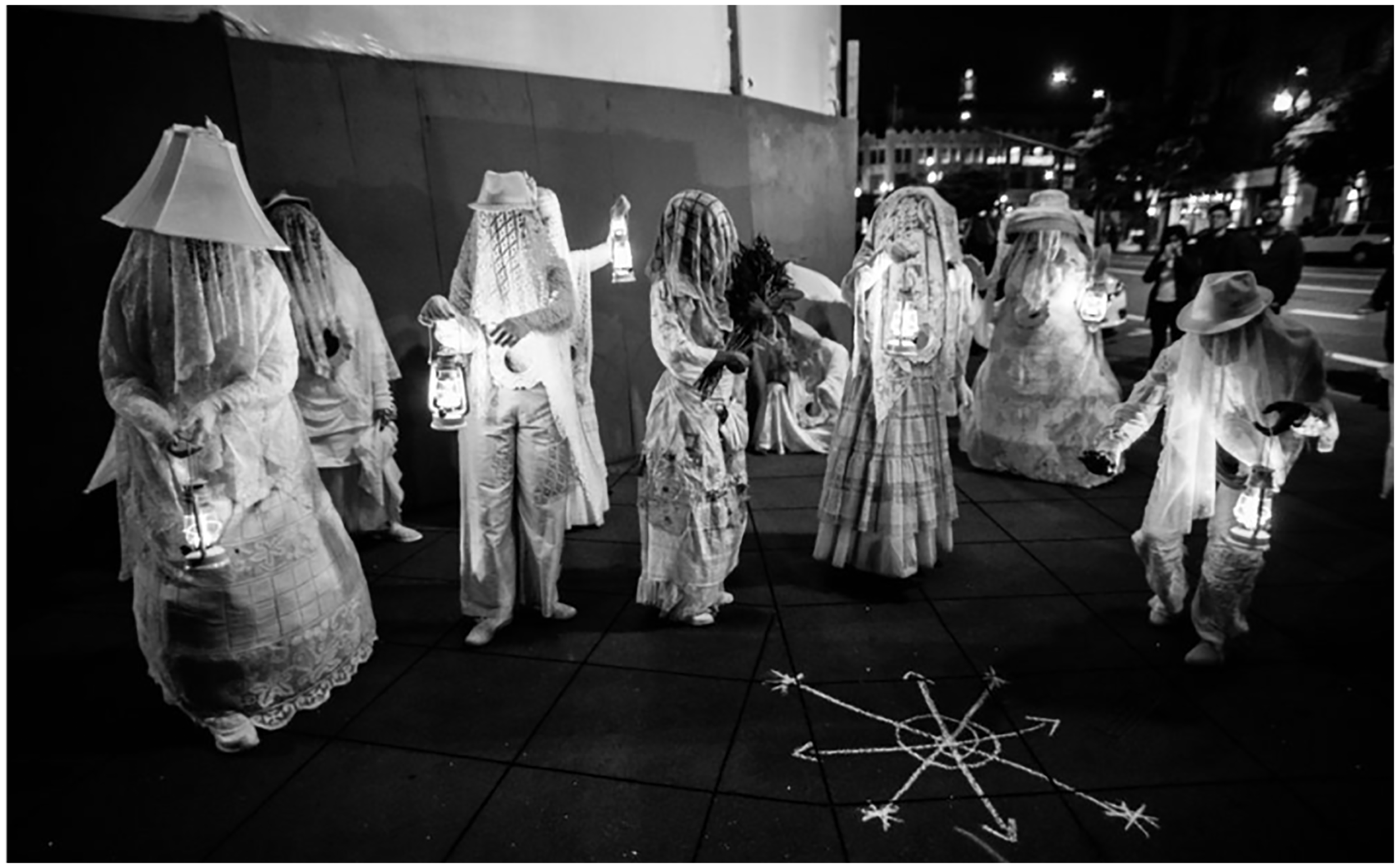
Now You See Me (2016). Photographer: Robbie Sweeny. Image courtesy of Amara Tabor-Smith.
In cities such as Oakland where Black life, Black women’s lives in particular, continue to be devalued and reordered for profit, the episodes of House/Full of BlackWomen conjure performative acts at the loose ends of property through ritual and performance. As Ashon Crawley writes, Black performance is “a critical intervention into the very concept of the historical, of historical being” (Crawley, 2016: 8). The spectral mode of Now You See Me draws a living archive into the present, ritual blurring the realms between spirit and the tangible, rupturing the temporal and spatial order of the city. Haunting here serves as a Black performative method that provokes a “material, physical, and situational shift” in the fabric of the city, disordering urban “economies of dislocation [into] . . . instructive elaborations on futurity” (DeFrantz and Gonzalez, 2014: xvi). Black women wandering the streets in antebellum gowns in Now You See Me brings a ghostly dimension to the current moment of urban restructuring Oakland exists within. The artists’ engagement with the space itself and those who cross their paths momentarily ruptures the temporal and spatial order of Oakland’s streets.
As Tabor-Smith explains, the episodes intend to disrupt the frequency of the space through what she calls “conjure art”—a performative method that draws from Yoruba spiritual traditions as a mode of practice.
1
Following Omi Osun Joni L. Jones’ writings on Black performance and Yoruba traditions, a Yoruba influence brings an improvisational mode of engagement to performance, seeking to make something happen. They are enactments on the spot. They conjure that which did not exist before . . . participants must be fully present, they cannot have an agenda beyond the work at that moment. One can anticipate what might happen, but one cannot force what will. (2015: 18–19)
This intention is present in Tabor-Smith’s method as well, as she documents the development of performance rituals as they develop over time on long scrolls of paper, detailing dates and inspiration, weaving thoughts, dreams, moments, questions, drawing up Yoruba symbols or vévés to mark each site/rite (Tabor-Smith, 2019). The vévés according to Tabor-Smith are intended to call the spirit into a ceremony, the marking of the symbol on the ground sets the space for the intention of the episode.
Ritual here is a material practice, interwoven with the performance itself, and while the intention behind each episode is developed over time, the episodes themselves take on an improvisational form that is fed by both artists and witnesses. As Tabor-Smith explains, the episodes engage with the sites they are situated upon: We choose the route spiritually on what we are trying to evoke. These issues could be anywhere, but it is happening in Oakland. Each geography has its own culture and experience so when we’re choosing a ritual procession or performance action, we consider what prayer or energetic shift to bring to that space. (Tabor-Smith, 2017)
The performance rituals haunt, quite literally possessing the city. Black women guised as specters trouble sites of ongoing (dis)possession in Oakland, refusing the continued expulsion and commodification of Black life.
Conclusion
Engaging Black creative texts as theories for reading the urban, in this paper we have attempted to lay bare the construction of property alongside that of anti-Blackness. Here, we have approached property not as a fixed entity but a set of relations produced through the relationship of propertied interests and racial banishment—one that requires a continual organizing of bodies, technologies and things, producing legal regimes that uphold and reproduce the extraction of value from people in place. The spectral, as exemplified in these two modes enacted by Black women in Brooklyn and Oakland, disrupts the “enactment of property” by haunting urban spaces that continue to devalue, traffic, police and displace Black life. Thus, these figures reveal how Black life has persisted in the wake of slavery, what life looks like for, as Ananya Roy writes, those “that once itself was property?” (2017: 3). These creative practices offer a recounting of Blackness in the “afterlives of property” (Sharpe, 2016: 15); renderings of Black life that destabilize notions of property as a measure and valuation of urban space.
In White Shoes and Now You See Me, enactments of haunting call attention to how there is a need for the re-narrativization of the urban. In Faustine’s White Shoes, ghosts do the work of refusing a temporality that disconnects histories of slavery and anti-Black violence from the historical production of urban space, placing Black women’s reproductive labor at the nexus of how cities are and have been developed. The hauntings that Tabor-Smith and her collaborators conjure in a House/Full of BlackWomen insist that the future of the urban depends on a re-rendering of how the city itself is ordered and imagined. Faustine’s and Tabor-Smith’s work thus insist upon a different ethics of in/habitation, one that can imagine and hold Blackness and other errant forms of life, labor, and being.
Haunting, as a method taken up by Black women artists, enables us to glimpse other(worldly) social and urban futures. Perforating the space-time of the city, these figures revisit Brooklyn and Oakland in their current state of urban restructuring, “[altering] the experience of being in time, the way we separate the past, present, and the future” (Gordon, 2008: xvi). Haunting is “at its core a contest over the future, over what’s to come next or later,” and while it is not up to the ghosts to define what that future looks like, “futurity is imbricated or interwoven into the very scene of haunting itself” (Gordon, 2011: 3). They remind us that the city, if ever imagined as a fragile site of promise for Black people, can no longer be imagined as such a crucible. In doing so, they ask about the “something-to-be-done.”
Through memory, ritual, and crafting scenes in which Black women exist in all of their waywardness (Hartman, 2019), these projects disrupt linear or teleological narratives that delink histories of (dis)possession from the future of the urban. By haunting the propertied system as subjects who once were property themselves, Black women artists disrupt ways of understanding the city both spatially and temporally. Ashon Crawley (2015) suggests that Black performance offers a way to understand time and space as “the grounds for, without being educated into, modernity.” Therefore, rather than implying that property can be “reclaimed” through these moments of Black creative practice, we consider how the artists themselves are taking on the role of ghosts so as to excavate property as one of the “dense sites” where social life is made. A refusal of propertied norms, haunting insists that to unravel or re-weave the loose ends of property, we must contend with the troubling histories of possession.
Footnotes
Acknowledgements
We wish to thank Nona Faustine and Amara Tabor-Smith for allowing us to reprint images of their work, AbdouMaliq Simone and Michele Lancione for their invitation, Katherine McKittrick for her close read, Malini Ranganathan and Anne Bonds for organizing the 2019 AAG session “Racial Regimes of Property”, and the anonymous reviewers of this piece.
Declaration of conflicting interests
The author(s) declared no potential conflicts of interest with respect to the research, authorship, and/or publication of this article.
Funding
The author(s) received no financial support for the research, authorship, and/or publication of this article.