




Abstract
Recent literature on investment and African infrastructure have called for examining ‘Global China’s’ urban impacts. This article investigates these in the entrepôt city of Beira, Mozambique, offering an approach to urban investment that centers cities’ rural-urban, and historically entangled connections. Through what I term ‘vertical’ and ‘horizontal’ aspects, I introduce an analytical and conceptual approach to attend to these temporal and spatial dynamics of not only city-making, but capitalist-oriented, extractivist place-making. Analyzing a set of historical and colonial hotels and special economic zones (SEZs), I demonstrate how, rather than being a Chinese model for implementation in various locales, new Mozambican-Chinese projects in Beira articulate with and create new spatial connections that are innately interlinked with European extractive practices and designs. I also de-center the city, demonstrating how urban space is reconfigured through its relationship with its outsides, rather than the other way around. By investigating Beira as a re-forming resource entrepôt, I challenge the above scholarship to take seriously deeper histories of infrastructure investment in Africa, and attend to the inextricable nature of especially city-hinterland regional ties. Ultimately, I examine temporal and spatial entanglements of capitalist extraction, entrepôt construction, and Southern African urbanism, through a historically situated and regional view.
Introduction
I arrive in Beira for the first time in the rainy season, and it is blustery and wet. Leaving the airport, my taxi driver mentions we are taking the new road into the city, explaining that ‘the Chinese’ built it, and that it circumvents the congested central route downtown. She is pleased with this, and as I comment that Chinese contractors have built a similar road in Maputo, the capitol, she agrees. “The Chinese get things done very quickly. This road helps a lot.” She points: “The Chinese built this hotel, too, and are going to pave the road soon.” She gestures toward a striking red gate, where beyond, I glimpse new building complexes. Inside is what I would learn to be the Golden Peacock Resort Hotel, built and operated by the Anhui Foreign Economic Construction Group (AFECC). Driving further, we pass skeletons of Portuguese colonial buildings with large ‘Investment Opportunity’ signs. Later, as I walk through the city, I am struck by the dilapidation of the Ponta Gêa neighborhood, the former colonial pinnacle of Beira’s urban beauty and luxury, and inspiration for some of Mozambique’s most renowned writers’ romantic memories. 1 There, I walk by the Grande Hotel, subject of innumerable media explorations, a site of extravagant colonial pleasure today in ruins. 2 I do not explore closely – the hotel is home to thousands who do not need another foreign gawker poking around. The contrast between these hotels – the new Chinese-Mozambican Golden Peacock and the old Portuguese Grande – is striking.
I begin with this ethnographic impression because it prompts a number of questions, around what each hotel signifies for the entrepôt city of Beira. Each points to unique historical moments associated with particular investors. Both moments are associated with respective SEZs, tied loosely and directly to these hotels, and regional hinterlands. Yet, despite the different eras, these hotels and SEZs are central to the production of Beira today.
This article investigates these hotels and SEZs as metonyms for globally-oriented capitalist investment in Mozambique and Beira. In conversation with recent literatures calling for analysis of ‘infrastructure-led development’ and urban impacts of ‘Global China’, especially in Africa, I focus on these sites, to offer an analysis that brings regional infrastructure-focused and urban study together. By doing so, I put forward a ‘horizontal’ as well as ‘vertical’ – a multidimensional – approach to spatial analysis, urban studies, and geographical political economy. With a view toward scholarship on contemporary investments in Africa, and particularly, China’s role, this article contributes to debates on urban approaches and investment as well as a growing body of research on infrastructure and extraction (Chua et al., 2018; Cowen, 2020; Goodfellow, 2020; Goodfellow and Huang, 2021, 2022; Kanai and Schindler, 2019; Schindler and Kanai, 2021; Shin et al., 2022). Ultimately, the article focuses on investment in African cities, centering the non-urban and historically entangled ties that fundamentally contribute to a re-forming resource entrepôt. I argue that this yields an expanded approach to and view of cities, conceptually and methodologically, which attends more centrally to place.
I first argue that scholars must attend to the overlapping vertical aspects of colonial and contemporary investment (Lazzarini, 2020). Examining each hotel, SEZ, and their functions within Mozambican capitalist periods, I consider their entangled and reiterative nature. Secondly, I argue that, to more deeply understand capitalist spatial transformation, urban scholarship must pay attention to horizontal relationships. This is with respect to connections between urban space and rural or hinterland space. Rather than highlighting how urban space impacts hinterlands, I consider the opposite. Examining these vertical and horizontal aspects together, I build a more place-situated and temporally complex perspective on urban production, demonstrating how contemporary and Chinese infrastructure investment both build on and depart from European colonial development. This is especially important to understanding new dynamics of uneven spatial transformation in African context, in the face of dramatic upticks in resource-related extraction.
This article draws on ethnographic research on hotels, SEZs, and infrastructure and Chinese investment in Beira and Maputo in 2018–2019. I include interviews with government representatives, AFECC employees, Beira residents and a prominent Beira architect, and Southern African researchers. I also include archival research on Beira urban planning, the Beira Convention, and the Beira Free Zone conducted in the British National Archives in London in 2020 and the Overseas Historical Archives in Lisbon in 2023.
I first introduce my focus on the entrepôt city. I explore verticality through a discussion of postcolonial layerings of place, then address horizontal linkages within global urbanisms debates, in conversation with infrastructure and Chinese-African investment scholarship. I explore the Grande and Golden Peacock Hotels, and Beira’s colonial and contemporary SEZs, their ties to inland extraction, and their roles in building this resource entrepôt, in colonial Portuguese and recent East Asian political economic contexts. I conclude by discussing the work’s implications.
Entrepôts: ‘Vertical’ and ‘horizontal’ place production
To more deeply understand cities like Beira, their colonial construction, and postcolonial rebuilding, critical scholarship must attend to their roles as re-forming resource entrepôts. By entrepôt city, I refer to a point of convergence of spatial economic relationships, a node of capitalist movement and disruption in regional centers of economic circulation. I argue that to better understand current development interests in city- and infrastructure-building, scholarship must examine the temporally layered and outward oriented aspects of entrepôts.
Vertical layerings
Understanding places’ actively intertwined pasts and presents – their verticalities – yields critical understandings of spatial complexities and contradictions. Such an approach opens space to understand how inequalities have come to be, not only as current phenomena but as historically and geographically rooted. Massey (1995) theorizes this vertical space-making as “a product of the combination of ‘layers’, of the successive imposition … of rounds of investment, new forms of activity … in which each is superimposed upon, and combined with, the effects of the spatial structures which came before” (114). Verticality captures historical and spatial entanglement, of “how regional trajectories of capitalist accumulation shape and are shaped by … rounds of investment and restructuring” (Werner, 2016: 47). Within postcolonial scholarship, approaching history as recursion, or time ‘folding back’ on itself, is useful in thinking through present and past entwinements (Mbembe, 2001; Stoler, 2016). Black geographers also center how histories actively shape the present through the concept of a black sense of place, wherein histories of racial violence and resilience can affirm and create the conditions for black life (McKittrick, 2011; McKittrick and Woods, 2007). Engaging place-specific pasts facilitates understandings of contemporary systems of exclusion, particularly in African context. Thinking vertically via layering and entanglement challenges the idea that imperial and colonial dynamics are ‘past’, allowing space to explore how such histories actively produce contemporary place.
Horizontal linkages
Examining horizontal connections extends vertical analysis. Thinking about urban and non-urban spaces together allows scholars to analyze how places ‘elsewhere’ centrally shape cities themselves. Such connections are often conceived of in multi-scalar and hierarchical ways, wherein larger cities are seen to determine the nature of smaller cities, connected hinterlands, or rural space. Non-city or smaller urban spaces are also conceived of as operating primarily to serve the development of larger nodal cities (Brenner and Katsikis, 2021). These city-centric perspectives understand these dynamics to be urban, rather than considering the complexities of agrarian and rural spaces as analytical spheres and sites in their own right. Thinking horizontally connects these intertwined urban, rural, and hinterland spaces, illuminating how rural and hinterland places and processes shape urban ones. I emphasize the complexities within which supposedly rural dynamics of, e.g., land, agrarian labor, and resource extraction, are intricately and unevenly woven into dynamics typically seen as urban, and which are critical to the production of cities (Roy, 2016). This does not simply mean scholars must expand urban concepts and approaches to a purported outside, but requires thinking about cities and urban sites as important but not necessarily central parts of wider spatial connections.
I thereby join scholarship which insists on attending to urban ‘constitutive outsides’: cities’ peripheries, rural areas, and hinterlands (Lancione and McFarlane, 2021; Roy, 2016). Similarly, I call attention to economic processes seen as outside the remit of the city, particularly in postcolonial context, wherein colonial projects aimed to bring goods from hinterlands to capital cities, for outward export (Jazeel, 2018). Planetary urbanization approaches can help examine extractive city–periphery relationships, but not understand ‘urban’ processes in city-decentered ways (Brenner, 2018; Brenner and Schmid, 2015). Instead, I value rural and agrarian places and dynamics as analytical sites too, and consider how they determine urban processes and lives (Roy, 2016). Rather than assuming that urban transformation is about urbanization, spatial transformations linked to cities can signify non-urban-centric processes, such as extended ruralization (Mercer, 2016). Urban ‘outsides’ must also be considered central to how ‘rural’ practices like farming are imbricated in ‘urban’ space (Shannon et al., 2021). This is especially important in African contexts, wherein there is ‘a long tradition of research’ demonstrating “the continued significance of the rural for shaping contemporary urban life” (Jenkins, 2003; Mercer, 2016: 80). Scholarship on resource extraction is also useful, in emphasizing how non-urban and hinterland extraction fundamentally shape cities (Kirschner and Power, 2015; Tsuji and Otsuki, 2022). Ultimately, scholarship must consider how densely populated centers are operationalized to support the activities and dynamics of nonurban and hinterland spheres rather than only the other way around.
Extractive infrastructure, global China, and centering African place
Recent work on infrastructure investment, especially via China, emphasizes two linked areas of African investment, in ‘dream’ cities and extractive corridors (Goodfellow, 2020; Kanai and Schindler, 2019; Watson, 2014). As Kirschner and Baptista (2023) write, “[a]longside the desire for ‘shiny new cities’, corridors encapsulate the interest of African political and economic elites to partake in and benefit from the latest global scramble for Africa’s natural resources” (5). Similarly, Shin et al. (2022) foreground the need to engage both the “infrastructural and real estate turn of African cities” (1458). By engaging vertical and horizontal aspects together, I examine how regional infrastructure and urban building are linked, and how colonial infrastructure-urban projects are being retrofitted for similar projects today. Thus, extending and contrasting with the approach of ‘China as method’ (Shin et al., 2022), I employ a deep engagement of place.
Recent work on infrastructure and logistics has explored ligations between cities and non-urban spaces. They investigate logistics cities as administrative nodes of global capitalist circulation, urging new focus on such extractive centers and related corridors (Chua et al., 2018; Cowen, 2020; Khalili, 2020). Scholarship on port and entrepôt cities highlights how, as state-, frontier-, and empire-building projects, these sites have also been built via trade and transit corridors, free trade zones, and offshore areas (Akhavan, 2017; Arboleda, 2020; Boon, 2013; Chalfin, 2019; Gleave, 1997; Sigler, 2013; Stenmanns, 2019; Stepputat and Hagmann, 2019; Tan, 2007). While these studies acknowledge and sometimes foreground the violent histories that enable logistics cities and nodes today, fewer studies detail specific interconnections between historical and contemporary infrastructure and extractive activity.
At the same time, much recent scholarship has focused on globalized Chinese investment in African infrastructure, ports, and resources. Such work focuses on how the continent has been figured as lacking infrastructure, and how this ‘deficit’ or ‘gap’ has shaped a new investment regime from European and Asian investors (Enns and Bersaglio, 2020; Goodfellow, 2020; Kanai and Schindler, 2019; Liu et al., 2020; Ougaard, 2018; Schindler and Kanai, 2021). Goodfellow and Huang (2022), for example, examine the impacts of such projects on urban space, particularly the ‘urban-industrial nexus’, the spaces in which cities, SEZs, and industrial parks meet. They write that in recent scholarship, the urban impacts of industrial investment are less analyzed, despite these spaces’ and Chinese agencies’ impacts on African urbanisms. Shin et al. (2022) also argue that scholarship must engage the urban aspects of ‘global China’. Goodfellow and Huang (2021) put forward that not only should scholars investigate Chinese firms’ roles in infrastructure building and urban change, but that researchers must take seriously the complexities of the state and centrally controlled nature of Chinese capital, and how this is “subject to significant local improvisation” (669). However, they also argue that “the forces shaping metropolitan infrastructure are less linear, messier and more contemporary” than “mega-infrastructures traversing rural areas, which often build directly on historical and colonial patterns” (Goodfellow and Huang 2021: 671). I contest this characterization, instead demonstrating how infrastructure building in both urban and nonurban spaces is complex, and also interconnected. Additional literature focuses on how Chinese investment, under the Belt and Road Initiative (BRI), seeks to connect ports, cities, and hinterlands (Bräutigam and Xiaoyang, 2011; Kanai and Schindler, 2019). This is common among Chinese projects in different African locales, but also connects with how space and capital in the continent have been repeatedly organized toward imperialist extraction.
In contrast, Africanist scholars investigating contemporary investment often center the coloniality of contemporary infrastructure projects. Such work examines how fantasies of ‘frictionless trade’, and ‘revived’ corridors and port cities, facilitate natural gas, minerals, and agro-industrial extraction, repeating colonial hinterland-to-coast plans and imaginaries (Enns and Bersaglio, 2020; Gonçalves, 2020; Schubert, 2018, 2021). Others interrogate entanglements between colonial and contemporary racial capitalist investment, and how contemporary African states invite infrastructure and corridor projects with imperial racial logics embedded in their foundations (Kimari and Ernstson, 2020; Kirschner and Baptista, 2023). Such scholarship analyzes how extractive corridors and infrastructures “represent a layered set of ambitions in colonial and postcolonial” (Kirschner and Baptista, 2023: 2) Africa, and repeated racialized hierarchies of profit and dispossession.
Existing literatures analyzing vertical and horizontal dynamics infrequently bring detailed historical and urban-hinterland analyses together, and fewer yet explore how this centrally builds today’s cities. In the following sections, I explore these aspects of entrepôt production to demonstrate how contemporary – and in this case, Chinese – investment builds on and departs from older forms of extraverted urban investment and building. Within these entangled spatialities, I center the Grande Hotel and Golden Peacock Resort Hotel, and Beira’s SEZs, to explore the entrepôt city’s reorientations and rebuilding.
Vertical ties: The Grande and Golden Peacock Hotels
The Grande Hotel
Mozambique’s colonial and contemporary states have been extraverted, depending on foreign private capital to develop their territories for extractive purposes (Alves and Chichava, 2019; Bayart, 2000; Neto, 2016). Without sufficient finances and population, Portugal depended on foreign-funded companies to administer its colony. From the 1880s to 1940s, Portugal leased nearly two-thirds of its territory to private enterprises, which were then responsible for developing their territories, called concessions, for capitalist production. 3 Portugal depended especially on Britain, and Mozambique was also crucial to Britain for providing ocean access to their occupied southeastern African bloc, of Northern and Southern Rhodesia and Nyasaland – today’s Zambia, Zimbabwe, and Malawi. Mozambicans as well as Europeans ridiculed Portugal’s weakness and dependency; Portugal responded to this humiliation with especially vicious forms of colonial violence (Allina, 2012; Hedges et al., 1993; Isaacman, 1996; Kagan-Guthrie, 2018; Santos, 2002; Vail and White, 1981).
The colony’s largest concession, the Mozambique Company, was primarily British-funded, and administered the colony’s center (Fernandes et al., 2015; Newitt, 1995). In 1892, the Company established its headquarters in Beira and invested in its urban planning and infrastructure (Fernandes et al., 2015; Newitt, 1995). With its port, Beira became the economic entrepôt for the Company and for the Rhodesias, Nyasaland, and their capitals: by 1948, nearly all of Beira’s port traffic originated in Salisbury (now Harare) (Kagan-Guthrie, 2014). While Portugal’s economic nationalism in the 1920s–1930s resulted in private territories being transferred back to Portuguese administration (Hedges et al., 1993; Newitt, 1973), after the Mozambique Company’s lease expired in 1942, it continued to operate in the region. Mozambique’s colonial spatial development, however, continued to depend on foreign and particularly British capitalist flows.
Within this context, Beira’s linkages inland centrally shaped the city’s identity. By the 1920s, the city became one of the most popular coastal destinations for white settlers particularly in the Rhodesias, and by the late colonial period, it was a ‘fashionable destination’ for business travelers and tourists (Sarmento and Linehan, 2019). Per Sarmento and Linehan (2019), the city’s urban plan emphasized ‘prestige and beauty’: the city embodied a colonial “imaginary by shaping parts of Beira into the likeness of a European resort town” (7). By the 1940s, while seeking to transpose European elite space to white enclaves in this tropical locale, Beira’s hotels contributed to a ‘dream topography’ of white settler society. The city and its hotels built an ‘imaginative infrastructure’ central to “the cultural agnosia that undergirded the comfort zones of the colonial settler”; in this, the hotel itself “as a capitalist, colonial and political project encapsulated the most violent inequalities of the colony” (Sarmento and Linehan, 2019: 4–5, 14). The hotels’ modernist aesthetics were also significant. Serving Rhodesian visitors, the hotels sought to convey control, in pleasing ways to especially inland settlers, and produce a European utopian fantasy that masked the forced labor, physical violence, and socio-spatial attempts at domination central to the colonial project (Fernandes et al., 2015; Sarmento and Linehan, 2019). The hotels contributed to Beira’s signification as a site of white settler pleasure and relaxation, and manifestation and obfuscation of colonial dispossession and violence.
Amidst Beira’s association as a resort town for Rhodesian tourists and businesspeople, in 1955, the Grande Hotel was opened (Figure 1). Costing approximately 2.6 million USD at the time, the Grande was “the largest private development to occur in Beira for decades” (Sarmento and Linehan, 2019: 8), a spectacular statement of leisure, refinement, and recreation. In practice, the hotel did not create a purely exclusionary white space, as Mozambique has always been racially and ethnically heterogeneous, and mixed race and black Mozambicans moved in and out of these spaces as guests and laborers. Still, the hotel played an important role. While Mozambicans and British ridiculed the Portuguese for their colonial inadequacies, the Grande sought to demonstrate Portugal’s racial and cultural superiority over its African subjects. As various writings, films, and today’s Beiran Facebook groups’ nostalgia regarding the hotel attest to, the Grande made a lasting impression of colonial modernist beauty tied to whiteness and European pleasure (Gupta, 2018; Hóspedes da Noite, 2007). Thus, the Grande Hotel came to embody the symbolic aims of Beira as a node of white settler pleasure and luxe, and of commodity flows and entrepôt extraction. The Grande was important to the city’s ocean access and settler tourism, and helped manifest an image of imperial fantasy through its European aesthetics and capitalist orientation.
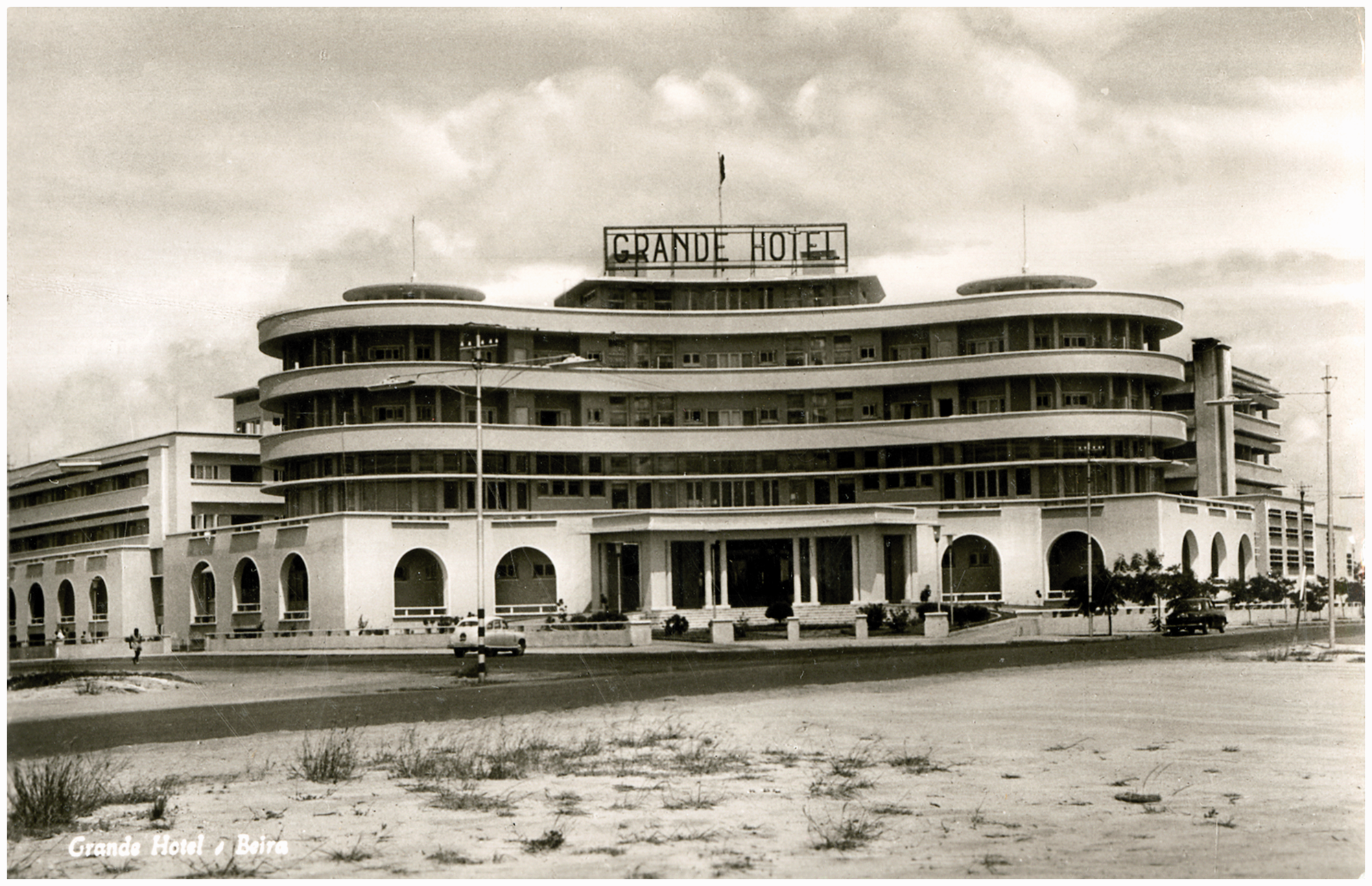
The Grande Hotel circa 1955 (The National Archives, ref. CO1069/3).
Despite the Grande’s luxury, the hotel was short lived: tourism substantially decreased following the hotel’s opening and it closed eight years later, reflecting colonial occupation’s failures and increasing stresses of African independence struggles. After post-independence euphoria and subsequent civil conflict devastation, and facing rapidly rising post-neoliberalization inequalities, Mozambicans fleeing the countryside began occupying the hotel. For Western media, the hotel has represented the failed dreams of an independent Mozambique. Its current residents, however, have transformed the Grande from a space of colonial fantasy to that of survival in the face of social and economic insecurity.
The Golden Peacock Resort Hotel
In contemporary Mozambique, foreign investment has been central to the state’s reorientation toward capitalism. Amidst structural adjustment pressures and in the name of national development, from the late 1980s, the formerly socialist central party, Frelimo, invited private capital to rehabilitate former colonial and often extractive projects (Pitcher, 2002; Schubert, 2018). After the civil conflict’s 1992 formal end, the government invited South African, European, and North American investment. More recently, investors from Brazil, China, and other Global South countries have contributed to development, creating new investment markets in rural and urban areas (Castel-Branco, 2014; Fairbairn, 2013). Projects include the controversial Brazilian-Japanese-Mozambican ProSAVANA agricultural project and Nacala corridor, real estate and construction booms, natural gas exploration and port construction, and mining (Kirschner and Power, 2015; Wolford and Nehring, 2015). In Maputo, new malls and hotels populate the extended Avenida da Marginal, which provides access to new middle class suburbs on the city outskirts. The building boom includes construction and expansion of large-scale office and residential buildings, the Radisson Blu hotel, and the colonial Polana Hotel, considered some of the most extravagant spaces in the country. Elites have colluded with international financiers and donors to access this capital, and social and economic inequality has dramatically increased (Alves and Chichava, 2019; Bayart, 2000; Castel-Branco, 2014).
Meanwhile, since the early 2000s, China has become a significant financial player in Africa (Alden and Chichava, 2014). Across the continent, China has provided loans for infrastructure- and extraction-related construction, via China Development Bank and China’s Export-Import Bank. Transport infrastructure loans feature prominently, as well as energy and mining investment, and half of recent construction has been built through Chinese finance (Bräutigam and Hwang, 2016; Goodfellow and Huang, 2021). Port development has been central to the BRI, China’s strategic plan for increasing global commodities and logistics connections, and nearly all companies involved in port projects have been state-owned enterprises (SOEs) (Liu et al., 2020). Media attention has focused on the BRI and President Xi Jinping’s 2018 announcement at the Beijing Forum on China-Africa Cooperation that $60 billion in financing would be made available to the continent in the following years, matching the 2015 commitment of the same. China’s economic activity in the continent follows its need for raw materials and commodities such as minerals and oil, and also reflects efforts to expand Chinese company activity especially in construction (Liu et al., 2020). Chinese-funded projects have been largely built through resource-backed loans, wherein financing is repaid through export commodities such as oil, or ownership in such companies as rail or electricity (Alves, 2013; Bräutigam and Hwang, 2016; Narins, 2016). 4 In 2011, over half of China’s nearly $70 billion in foreign direct investment focused on natural resource extraction through such loans (Alves, 2013).
As with other African partnerships, Chinese-Mozambican investment has been subject to scrutiny. With Mozambique’s investment boom, media and scholarship have zeroed in on China’s rapidly increasing development activity. Chinese investment has contributed to signature construction and infrastructure projects, including the Maputo-Katembe bridge – Africa’s longest suspension bridge – the Maputo Ring Road, the airport, national stadium, government ministry buildings, and road-building. AFECC, a Chinese provincial SOE, was involved in many of these projects, building Beira’s Golden Peacock Resort Hotel and Maputo’s Gloria Hotel. With activity in mining, supermarket, and hotel industries, and involved in constructing government buildings and sports arenas, AFECC operates in approximately 30 countries in addition to China (Carmody et al., 2012; Club of Mozambique, 2018). This includes in at least 10 countries in Africa, and others in Europe, Latin America, Southeast Asia, and the Pacific. AFECC hotels and supermarket chains run in Madagascar, Malawi, Zambia, and Zimbabwe, and it is claimed that AFECC built the largest commercial plaza in Southern Africa, Zimbabwe’s Longcheng Mall (Devex, n.d.). While Chinese projects have ranged in usefulness to national economies (Adovor Tsikudo, 2021), public opinion about Chinese investment and AFECC has been wary and often negative (Bräutigam, 2020; Jansson and Kiala, 2009; Lee, 2018; Nielsen, 2014; Schmitz, 2014).
In Mozambique’s Sofala Province and Beira – former Mozambique Company concession areas – AFECC has made a large investment footprint. The company is building the Manga-Mungassa SEZ near the Beira airport and reconstructing the N6 national highway connecting Beira to Zimbabwe and Harare. Its most spectacular project to date, however, is the Golden Peacock Resort Hotel. Opened in 2014, the Golden Peacock is an enormous complex geared toward global business and government elites, boasting a 5-star business and leisure experience. The complex includes 190 guest rooms, Chinese and Western-style restaurants, a casino, bar, café, swimming pool, spa, gym, and beachfront. It has conference rooms for large business gatherings, two ‘presidential villas’, and approximately 20 long-term residential houses, which accommodate some of the hotel’s and nearby AFECC supermarket’s Chinese employees. Rooms range from 156 to 820 USD per night, prices outside the reach of all but the most wealthy business and government travelers. The complex’s aesthetics are an Eastern–Western mix, with murals, bridges, ponds, and balconied verandas at enormous scales (Figure 2). Inside, Western-style rooms combine with East Asian design elements, gearing toward business facilitation. Outside the SEZ, an AFECC billboard advertises the hotel as “Your Resort – Your Dream” in English, showcasing the Peacock’s formidable grounds (Figure 3). In the image, a vaguely East Asian-looking woman in sunhat and flowing beach garb overlooks a birds-eye view of the hotel. With a calm blue behind her, she appears to be relaxing at the hotel’s idyllic beach. In my visit, this contrasted with the rainy season’s dreary grey mud (Figure 4).
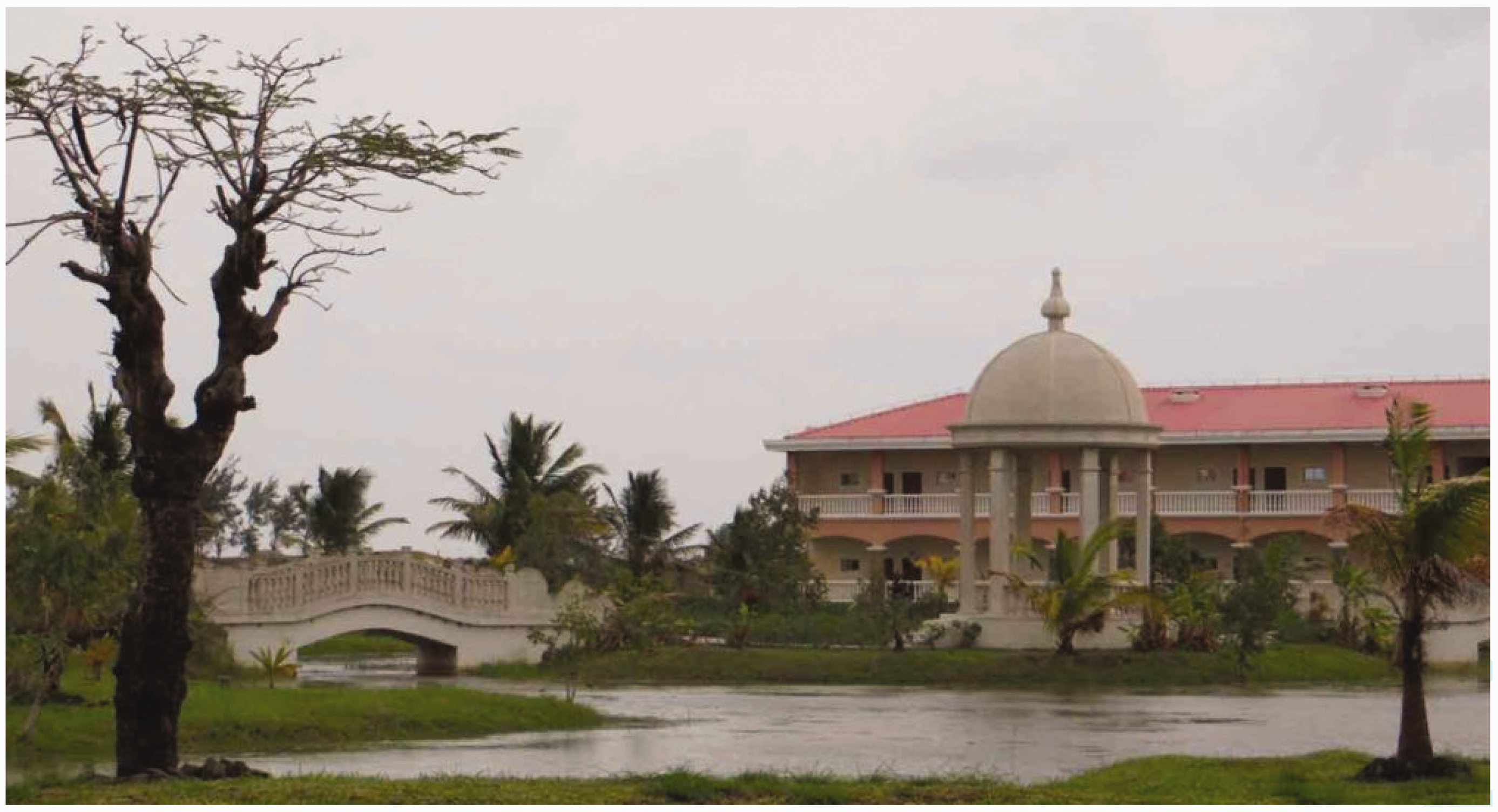
Golden Peacock Hotel grounds (author photo 2018).
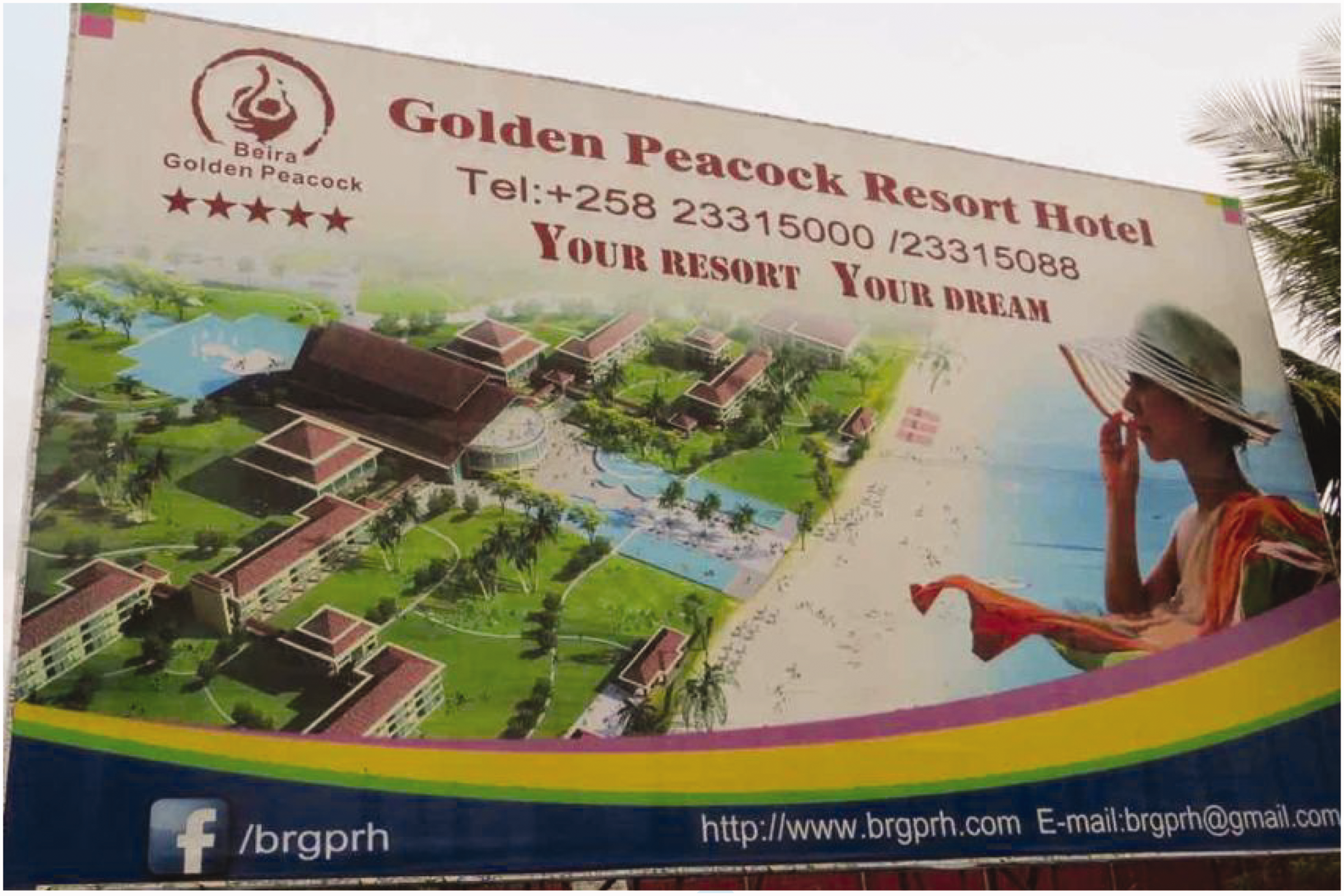
Golden Peacock billboard advertisement outside the SEZ (author photo 2018).
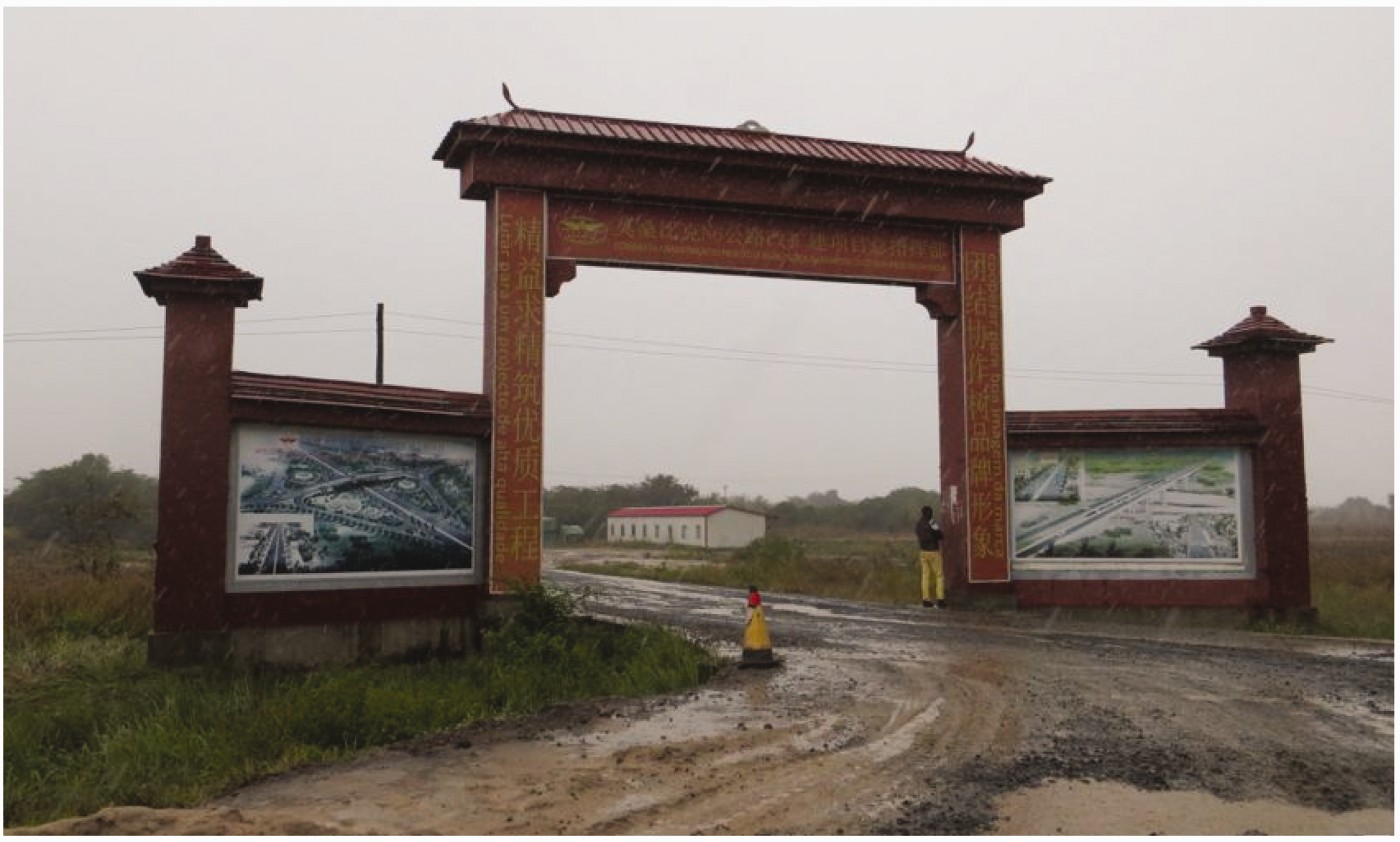
AFECC project gate along the N6 highway (author photo 2018).
While China is still a new investor in Beira, and longer-term funders are the Dutch, Chinese activity is the most publicly discussed, and notably, disparaged (Alden and Chichava, 2014; Alves and Chichava, 2019; Interview with Beira Municipal Assembly representative 4 July 2018; Interview with Municipal Cadaster representative 5 July 2018). Interviews and informal conversation indicated wariness of China and distaste for the Peacock’s eastern-oriented showiness. One government worker lodged there for business shared his dislike of the hotel, reporting that while the hotel strives to appear luxurious, it does not have the standards to ‘do things the correct way’. He was imprecise about what exactly he disliked, saying there was ‘something about it’, but he was clear that it had to do with the Chinese management. The hotel’s conspicuous emptiness suggested it was not as popular as its grand claims implied, either. A renowned Beiran architect agreed with this sentiment, sharing that the Golden Peacock is known to be ‘all empty, no one goes’, an impression conceded by a Mozambican AFECC manager (Interview with Beira architect 4 July 2018). When I noted its emptiness on a tour of the Peacock, the Mozambican worker guiding me agreed it appeared vacant, though claimed the casino drew visitors at night.
Visiting AFECC’s properties in Beira and Maputo, I noted the contrasts between luxury and emptiness across these sites, and desertedness versus urban bustle outside. When I asked an AFECC hotel manager about this, he lamented the problem, saying that AFECC hotels make “a strong impression … though unfortunately there exists a taboo, a prejudice … There is still some suspicion, a mistrust in Chinese products” (Interview with AFECC Hotel representative 8 January 2019). For this reason, there is a ‘fear’ of visiting because the hotel is Chinese. But, he continued, AFECC has “to know how to position ourselves because in this moment the whole world is turning to Africa, because of [its natural] resources” (Interview with AFECC Hotel representative 8 January 2019). In this interview and other conversations, Mozambicans, and especially Mozambican AFECC workers, alluded to or directly discussed Mozambicans’ mistrust of AFECC and its hotels. Amidst a racial colonial legacy of distrusting Chinese immigrants, and current Western alarm regarding Chinese investment, such ambivalence is not surprising (Feijó, 2014; Macagno, 2020). Interlocutors communicated wariness and even aversion to the ‘Chinese-ness’ of AFECC spaces. According to another AFECC interviewee, many Mozambicans were ‘prejudiced’ in assuming the hotels would be of poor quality, associating them with a foreignness not extended to European establishments (Interview with AFECC Mall representative 22 December 2018; Feijó, 2014).
Despite being a larger spectacle than the colonial Grande Hotel, and despite AFECC’s success in completing ‘mega’ construction and infrastructure projects around the country, the Golden Peacock was empty. Despite its visual dominance in the city skyline, and advertisements as a global business destination, Mozambicans reported avoiding it and associating it with a racialized stigma. While, like the Grande, the Peacock is associated with extractive business opportunity and foreign finance, the hotel has mixed into the city fabric differently to the Grande: while it is Beira’s statement hotel today, a sense of white colonial prestige and beauty remains attached to the dilapidated Grande.
Horizontal ties: The Beira Free Zone and Manga-Mungassa SEZ
The Beira Free Zone
In addition to its vertical layerings, Beira’s horizontal ties to inland resource extraction have been central to its production as an entrepôt city. One sees this historically through the Beira Convention and Free Zone, and today through the Manga-Mungassa SEZ.
Throughout the colonial period, Beira was key to East and Central African capitalist activity. Its port was the critical access point for goods harvested and produced in British Central Africa to be exported to outward markets. As such, archival records emphasize the importance of the Central African railways and roads terminating in Beira.
5
This fundamental dependence on the port gave rise in 1950 to the British-Portuguese Beira Convention. This agreement put favorable trade conditions in place for inland British colonies and established an early SEZ. Minerals including copper, chrome, and manganese, and agricultural products including tobacco and tea transited out of the British African hinterlands through Beira’s port. The hinterlands in turn imported commodities such as petroleum products, timber, cement, wheat, and fertilizers (Millbourn, 1948; Hance and van Dongen, 1956). According to a British Minister of Transport advisor, the Port of Beira was “the main terminal for imports to, and exports from, Southern Rhodesia, Northern Rhodesia and Nyasaland. Approximately 93% of the traffic passing through the port is to or from these countries” (Millbourn, 1948: 6). With port delays in previous years, Beira is an urgent and immediate problem … with the expanding economy of the Central African Territories, it is quite obvious that both extensions to deep water berths and additional cargo-handling equipment are urgently needed … anything … to improve the present facilities should be undertaken without delay. (Millbourn, 1948: 6–7; Mozambique, Port of Beira, utilization of the port and congestion, 1951) erect their own buildings and offices. Goods could be imported into this area without Customs formalities … where they could [be] processed or manufactured or stored [before import or export]. (Free Zone: Port of Beira, 1950: 2)
Beira already served as the key import–export node for British Central Africa, and the plan to retrofit the port and establish the Free Zone reinforced its spatial organization and purpose to serve hinterland resource extraction and global commodity flows. The Beira Convention and the Beira Free Zone thus worked to carve out and embed outward-oriented space in the city itself, orienting its urban development further toward capitalist circulation via land and ocean. These port and Free Zone designs, to store and process goods for locales outside Beira, oriented the city further toward urban and non-urban space elsewhere.
The Manga-Mungassa SEZ
Contemporarily, the Manga-Mungassa SEZ demonstrates the government’s and AFECC’s aim to re-establish Beira as an important commodities through-way. AFECC’s website describes Beira as a ‘crucial channel’, distribution point, and logistics management center to facilitate the movement of capital and goods. In 2010, exports represented 71% and imports 29% of the Port of Beira’s traffic, serviced primarily by truck and rail (Murithi et al., 2012; Perez Niño, 2015).
While AFECC’s Beiran showpiece is the Golden Peacock, the SEZ is its complementary major project. Manga-Mungassa, established in 2011 and still under construction, is adjacent to the former Beira Free Zone location (The City of Beira, Urbanization project, Built area, 1946). In interviews, AFECC managers emphasized that the hotel is less focused on an already existing clientele than in attracting investment in Beira and the wider province. One emphasized that the Golden Peacock is “more for businesspeople, more to come to do business, not exactly for tourism, despite being in front of the beach” (Interview with AFECC Hotel representative 8 January 2019). Instead, it seeks to attract global investors to attend conferences and meetings for investment possibilities (Interview with AFECC Hotel representative 8 January 2019). When I asked interlocutors why AFECC would be interested in Beira while others concentrate on Maputo, respondents repeatedly cited the city’s port, with one declaring that Beira is the country’s ‘convergence zone’ (Interview with Municipal Cadaster representative 5 July 2018; Interview with Beira Municipal Assembly representative 4 July 2018; Interview with AFECC Ivato representative 5 July 2018; Interview with AFECC Hotel representative 8 January 2019).
Among only five SEZs countrywide, Manga-Mungassa is featured prominently in AFECC project posters displayed throughout the Peacock. The AFECC website promotes the SEZ’s potential due to Beira’s entrepôt role. AFECC describes the city as the second largest economic center [of Mozambique] and a critical international port city, and also a crucial channel for southern African countries like Zimbabwe, Zambia, Malawi and Congo (Kinshasa) to the outside world. It is endowed with great economic hinterland and great strategic importance. (Manga Mungassa SEZ, 2018)
Manga-Mungassa plans also include luxury areas such as a ‘Waterfront Leisure Plaza’, ‘Leisure Vacation Villas’, tennis courts, and a yacht club. Though its plans include such leisure spaces, the SEZ and Golden Peacock are ultimately less geared toward attracting pleasure-seeking tourists and vacationing guests. Instead, they appear to have been built to serve the more ambitious aims of resource extraction. 7 The AFECC SEZ and Golden Peacock Hotel contribute to Beira’s rebuilding as a resource entrepôt by providing conference, living, international luxury spaces, and speculative investment sites, to facilitate Eastern-oriented capitalist activity in the region and hinterlands. The Peacock’s and SEZ’s footprints are large, together exceeding that of the Beira Airport. They work to provide East-Asian-centered extractive and capitalist possibility and circulation through inland resource access. They are layered with the active remnants of the Beira Free Zone and the city’s British-Portuguese past. Like the colonial Free Zone, Manga-Mungassa contributes to Beira’s outward orientation, this time toward Asia.
Discussion
Vertical analysis is key to revealing Beira’s nature as an entrepôt city, and the Grande and Golden Peacock hotels demonstrate Beira’s layered repositioning as such. The Grande symbolizes the European-oriented colonial city and its fantasy of inland-oriented luxe amidst extractive imperialism. The hotel centrally contributed to the fantasy and organization of the built city as a node of white entrepôt pleasure. In ruins, the Grande today remains an integral component of Beira’s urban fabric, a faded reminder of colonial occupation and its repurposed present. The Golden Peacock has been considered Beira’s new statement luxury hotel, a contemporary version of the colonial Grande’s grandeur. While the former was built for refinement, pleasure, and white settler luxury, dovetailing with British extractivism, the Golden Peacock has been built to attract investment, this time with an eye toward Asia. The Peacock and its new spectacular character re-signal the region’s and hinterlands’ lucrative extractive potential. These spectacular hotels and SEZs temporally abut and are layered in the landscape.
Beira’s horizontal aspects are also critical to understanding its reformation as an entrepôt, as the Beira Free Zone and Manga-Mungassa SEZ illustrate. With the city as Central Africa’s essential ocean access point, the Free Zone produced spaces and infrastructures in Beira’s urban fabric. This connected the city with inland networks of colonial occupation and extraction, enabling inland uneven development and African dispossession. This early SEZ and its aim to service non-urban and hinterlands space centrally contributed to the built city, and larger role as a critical nexus point for capital and goods export. Today, Beira’s hinterland ties are again central to how and why the entrepôt is being built. Between its SEZ, port, airport, and rail and road terminus, AFECC seeks to position Beira as a channel for ‘hundreds of enterprises’ to access the countries and resources of inland territories formerly serviced by colonial Beira. The Manga-Mungassa is modifying the city’s landscape this time, however, toward especially Asian investors. Rather than the city’s hinterland and rural spaces being superfluous to or only serving the city, Beira’s hinterlands have again changed the urban built environment and imagined role. This demonstrates how an entrepôt’s hinterland space shapes urban space, making urban processes secondary to other minor urban and non-urban sites. Without this perspective, the intertwined character of urban and non-urban spaces, and the value of considering hinterland space, is elided. Considering urban-hinterlands ties therefore yields a different perspective to urban space, as part of a convergence that facilitates larger regional and globally-oriented networks rather than being primarily ‘drivers’ of them. The Manga-Mungassa SEZ exemplifies how contemporary foreign investment extends and departs from colonial extractivist building. This creates new articulations between historical and current urban investment, and new externally-oriented urban fabrics actively embedded in the city, re-activating and reformulating Beira’s vertical and horizontal ties.
Current logistics and infrastructure, and Chinese-African investment literatures infrequently bring together detailed urban historical consideration and urban-non-urban relationships. Such literatures have identified African urban and infrastructure investment as contemporary twinned investment targets, where urban economies are framed as key because they ‘animate’ infrastructure connections (Goodfellow, 2020). Yet, despite assumptions of urban sites as being the more complex counterpoints to cross-urban infrastructure, through AFECC’s Golden Peacock, the Grande Hotel, Manga-Mungassa SEZ, and the Beira Free Zone, Beira’s horizontal and vertical aspects show that the city and its outward entanglements are significant, historically untidy, and interlinked. Exploring Beira’s temporal layers convey that investment connecting mining, energy, agriculture, and urban sites today build on and depart from those of the colonial past. Recent projects “integrat[ing] extended rural landscapes … with a network of urban nodes geared toward specific value-addition activity” (Schindler and Kanai, 2021: 46) are not only a contemporary trend. A vertical and horizontal approach shows how infrastructure-led development seeking to shape territories for “resource extraction, production, urbanization, and integrated logistic networks” (Schindler and Kanai, 2021: 46), and across “an increasingly blurry urban–rural continuum” (Kanai and Schindler, 2019: 305) articulates with and reformulates extraverted colonial development and desires. A notable change is in orientation. Today’s investment in cities and resource frontier, agroindustry, and production node connections “expand and reorient existing infrastructure towards China” (Liu et al., 2020: 5). Colonial infrastructure and city projects sought to do the same but with orientation toward Europe. By engaging Beira as entrepôt, I demonstrate that this is not a template emanating from China, but is also a spatial development design that articulates clearly with previous African investment. While contemporary scholarship makes much of the differences of Chinese investment – culturally, aesthetically, geopolitically – new Chinese economic activity articulates with Southern Africa’s colonial capitalist pasts. These layerings of outward orientation, toward Europe and Asia, have shaped Beira, as city and as place. Attending to historical and contemporary investment together allows a more deeply situated and historically complex perspective on urban production to come into view.
Conclusion
In this article, I have centered vertical and horizontal analyses to explore Beira city’s orientations and layered rebuilding. Analyzing the Grande and Golden Peacock Resort Hotels and the city’s SEZs, I have argued, first, that scholars must attend to the vertical aspects of colonial and contemporary investment: their historically laden spatial relationships. I demonstrate how ‘new’ urban-hinterland investment and extraction are not, in fact, novel, nor do they directly replicate the past. Seeking to articulate new hinterland ties, contemporary Chinese projects build on and re-activate older European ones, directly shaping the city’s postcolonial entanglements. I have also argued to examine horizontal intertwinings of urban, rural, and hinterland space. Rather than viewing rural and non-urban space as serving cities, I engage how Beira’s ‘outsides’ have acted upon and centrally shape it, to be oriented outward again.
The Grande Hotel and Beira Free Zone were established by different but interlinked colonial actors, contributing to the spatial and symbolic development of Beira and its connections inland. British-Portuguese colonial investment emphasized luxury, explicit racial division, and infrastructure-led extraction as key to Beira’s entrepôt development. Today, AFECC contributes to the city’s transformation in similar ways, through the Golden Peacock Hotel and Manga-Mungassa SEZ. The hotel provides a luxury space for AFECC to rebuild Beira’s resources and commodities trade-oriented hinterland ties. Chinese investors’ and Mozambican government plans invite speculation and luxury fantasy, an echo of British-Portuguese Beira’s aim to build aspirational worlds for foreign and Mozambican elites (Nielsen, 2021). While today’s Chinese investment emphasizes capitalist accumulation via extractive infrastructure, it also contributes to a new type of racialized capitalism, through spectacular forms of space-making and extraction for Asian enterprises, and in reconfiguring racial sensibilities.
Beira is composed of an uneven conjuncture of past investments, some of which have faded away, and others which are being retrofitted and re-strengthening. It is characterized by its jumbled connections, to its pasts and to its elsewheres: it is a city that was built and is being rebuilt through its connections outward, in deep entanglement with its colonial pasts. European and East Asian capitalist imaginations underpin these projects in extractive space-making, and Mozambique’s colonial and current capitalist-oriented governments have courted extroverted foreign investment to build extractive futures. These are race-inflected investment visions which have benefited foreign players and dispossessed everyday Mozambicans. A multidimensional approach reveals the iterative nature of infrastructure and urban investment in postcolonial Beira, by centering, deeply, Beira, as city and as place.
I have focused this article on accumulation-oriented imaginings and building. Yet, as with every city, more fully understanding Beira requires grappling with the heterogeneous people and histories that produce it, beyond capitalist-oriented plans. I therefore close with a reminder of Beira’s meanings beyond the entrepôt. Discussing the political response to the Golden Peacock, a Beiran interlocutor reported that when then-president Armando Guebuza granted AFECC land to build the hotel, this displaced residents and urban agriculture. This was incendiary, creating “big fights about whose land this was. It was like wood to a fire” (Interview with Beira Municipal Assembly representative 4 July 2018). The Golden Peacock adds a new layer to Mozambique’s histories of dispossession, oriented differently. Foregrounding the entrepôt city, however, also allows space for thinking the “possibility of infrastructure otherwise” (Cowen, 2020: 480). Re-imagining geographies of dispossession “as sites through which cooperative human efforts can take place and have place” (McKittrick, 2011: 960) shows how contestation of such designs also builds the city. Recent investment could only emerge from the foundations of deeply extractive, colonial-racial pasts; it also orients similar aims elsewhere. In an effort to think of infrastructure and city-building otherwise, I end with an autochthonous orientation. I center Mozambican residents’ continuing struggles for land and place, for those who also centrally produce the city of Beira.
Footnotes
Acknowledgments
I wish to thank interlocutors in Beira and Maputo, Mozambique, for their time and thought; Julia Corwin, Claire Mercer, Deen Sharp, and Jessie Speer for generous insights; and the LSE Department of Geography and Environment Writing the World series participants, particularly Megan Ryburn and Austin Zeiderman, for helpful comments. I gratefully acknowledge Bucknell University’s Institute for Public Policy; China Institute; Center for Social Science; and Center for the Study of Race, Ethnicity, and Gender for supporting fieldwork in Mozambique.
Declaration of conflicting interests
The author declared no potential conflicts of interest with respect to the research, authorship, and/or publication of this article.
Funding
The author received no financial support for the research, authorship, and/or publication of this article.